
In short
Expert Intelligence Podcast Summary
Episode Title
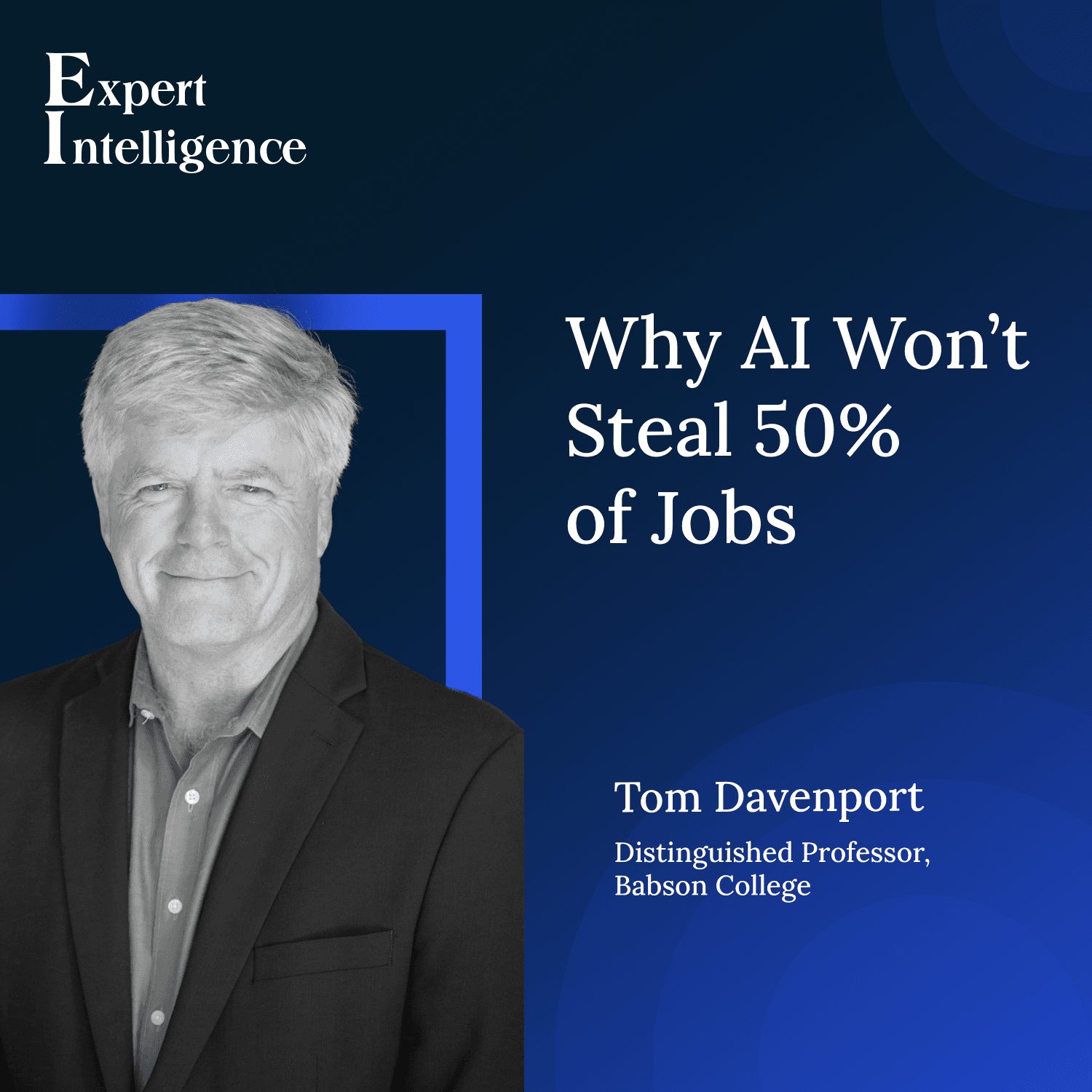
Why AI Won't Steal 50% of Jobs with Tom Davenport
Host
Paul Estes
Guest
Tom Davenport
Podcast Theme: The podcast centers on the intersection of AI and the workplace, focusing on human-centric approaches to adapt to technological transformations.
---
Episode Overview
In this episode, Tom Davenport, a seasoned expert in technology transformations, challenges the prevalent narrative that AI will drastically reduce white-collar jobs. With over 30 years of experience in the field and numerous publications to his name, Davenport provides a balanced perspective on the future of AI in the workplace, highlighting the necessity of process redesign and patient leadership in leveraging AI effectively.
Key Points Discussed
- Debunking Job Replacement Myths
- Predictions of job loss due to AI have consistently been exaggerated.
- Historical context: AI has been in use for 60 years without significant job loss.
- Expert opinions (e.g., Daron Acemoglu) suggest minimal impact on overall employment.
- AI Implementation Challenges
- Effective AI integration requires more than technology; it demands extensive process redesign and change management.
- Organizations struggle to derive real value from AI due to the complexity of implementation.
- Generative AI creates the illusion of simplicity but often requires a structured approach to achieve economic value.
- Organizational Readiness for AI
- Companies need a well-defined plan for reskilling and hiring entry-level talent.
- The misconception that AI can replace lower-level jobs could hinder future talent development.
- Leadership Perspectives
- Aggressive AI adoption strategies from CEOs often overlook workforce implications, potentially causing employee anxiety.
- It is essential for leaders to articulate visions that do not incite fear about job displacement.
- Citizen Developers and Vibe Coding
- The rise of 'citizen developers' democratizes technology creation, allowing non-technical employees to contribute to digital projects.
- Organizations must establish governance frameworks to guide citizen development efforts.
- Future of AI Agents
- Current AI agents are not ready to fully manage business processes due to reliability concerns.
- A mix of probabilistic and deterministic AI will likely improve the effectiveness of AI agents in the future.
---
Actionable Insights
- Process Redesign: Organizations should investigate where AI can integrate into existing workflows and prioritize redesign efforts.
- Reskilling Initiatives: Companies must focus on hiring and training entry-level employees to ensure a pipeline of future talent.
- AI Governance: Establish clear guidelines for citizen developers to prevent mismanagement of critical business processes.
- Patience in Transformation: Recognizing that significant changes in AI utilization require time, persistence, and leadership vision.
---
Closing Thoughts
The conversation emphasizes a realistic approach to AI in the workplace, challenging sensationalized narratives surrounding job loss and underscoring the importance of strategic planning and process improvement. Listeners are encouraged to share the episode and apply these insights in their organizations to navigate the evolving landscape of work effectively.
Next Episode Reminder: Tune in bi-weekly for more discussions on navigating the complexities of work in the age of AI.
Written by AI. May contain mistakes. Listen to the episode to check what was said.
Transcript
Automatic transcript. May contain errors.0:00We ended up talking to a bunch of insurance companies. A number of them said, well, we don't need those entry-level people anymore because we're having AI do the tasks that they used to do. And I would say, well, how are you going to get the experienced people of the future if you don't hire the entry-level people to do the boring, easy stuff? And they said, well, we're not quite sure. And every company that I've talked to has said the same thing for 12 or 13 years now. They don't have a good plan for that.
0:32Every week, another AI breakthrough hits the headlines. Every month, another company claims that the AI revolution will change everything. If you're feeling overwhelmed by the pace of change or skeptical about the hype, you're not alone. My guest this week is Tom Davenport, who's been at the forefront of technology transformation for over 30 years. He's a distinguished professor at Babson College, a fellow of the MIT Center for Digital Business, and the author and co-author of 25 books and more than 300 articles. I've read most of them. He helps organizations transform their management practices in the accelerating age of digital transformation.
1:09Hey, Tom, welcome to the show. Thanks. Nice to be here. Thanks for having me. So I've written one book, a couple dozen articles. First question I have is, what keeps you inspired to keep going? Well, maybe if I'd chosen another field like epic poetry or something, I'd say, yeah, You know, there's enough that's been written about that. But the field of technology, information technology, and how organizations use it keeps changing all the time. So I got to write about the new stuff. Now, there's a ton of hype. I mean, the technologies are pumping it out left and right. The algorithms are amplifying it as fast as they can.
1:49And it's pretty dystopian. You know, it's going to replace our jobs and some challenging things are going to happen. And as you look left and right in the business landscape today, specifically AI, what's your take? Well, I don't think things are quite as dire as they're often portrayed to be. You know, I sometimes say if you're not concerned about AI and jobs, you're not paying attention. But so far, things haven't been too bad. You know, we've been using various forms of AI for 60 years or so now and haven't taken too many jobs. And there's some really smart people. Daron Asamoglu, for example, at MIT, who just won the Nobel Prize, says, yeah, you know, he thinks there'll be some small loss of jobs, but nothing quite substantial.
2:43Not substantial enough to really increase the productivity rate much. So I keep telling myself that augmentation of people by AI and vice versa is the best possible outcome. And I hope that more organizations reach that objective. But I do worry about it. And I started writing some things on Substack about it. And that's really the only topic that I am writing about these days. But hard to get a whole lot of concrete evidence. It's mostly predictions. And let's say about the predictions, they have one thing in common, they're all way wrong. One of the things that you cover a lot, especially when you talk about augmentation in your writing, is around how AI fits in a larger process.
3:31It's embedded in a process when you look at large organizations. And having come from large corporate companies like Amazon and Microsoft, they're hard. I mean, minor change in these organizations is hard. And then you get into the hype cycle You've seen a lot of technologies come in your career. Call it the internet or mobile or pick your technology. I'm glad you didn't say the electric light bulb or anything. But you've seen this sort of storybook before where some technology comes, it's amazingly powerful, it is transformative. But how does transformation really work? Well, you know, the speed of organizational transformation is definitely a lot slower than the speed of technological innovation.
4:18And I think now, for example, we're realizing with generative AI that despite the fact that, as you suggested every day, there's a new announcement about a cool new model that does this better than anything ever has. And we're right around the corner from artificial general intelligence. We realized that organizations are having a bit of a tough time finding value with it. And so I think it takes a lot of concerted effort and change management and some determined and also visionary thinking, I think, by senior executives who are willing to see it through and eventually get something valuable out of it.
5:01But as you suggest, it's not nearly as easy as people suggest it is. And generative AI fools us into thinking it's going to be easy because it is so easy to use by individuals. But I'm just finishing up an article with a couple of Stanford people on how really to get value from it, I think you have to have an enterprise level project to use it, not just tell a bunch of people, hey, maybe you'd like to write your blog post with this or from henceforth, you know, do your PowerPoint presentations with this generative AI tool. That doesn't, I think, in general, create measurable economic value. So, you know, you have to look at the process.
5:41You have to redesign it. You have to upskill people. You have to figure out what the new process is and integrate it with the rest of your technology. And that takes years in many cases. You mentioned leaders. We've seen the manifestos. I don't think they're coming out as much, but the Shopify CEO, Duolingo, and a bunch of other CEOs came out and said, we're AI first. And then they wrote a bulleted list of what that meant to them. And some of it was actually informative, saying, hey, everybody's going to reskilling efforts, or here's some areas that we're going to start exploring where we think we can find value.
6:15When you look at these manifestos from CEOs, what are they getting right, and what are they missing? Well, I think it's a good idea to be aggressive. I wrote a book along these same lines almost three years ago called All In on AI about companies that are really aggressive in their use of AI. It was mostly then what I call analytical AI, not generative AI, a little bit of generative AI in the book. So I think it's good to be aggressive and it's good to have a vision. Think big, start small, I often say with these technologies that you're not that familiar with. but I think it's a bad idea, a really bad idea to say, we don't think we'll need, you know, half of the people that we have today because that really obviously does not encourage people to sort of try to figure out how to use AI to be more productive.
7:07It sort of suggests if you're too successful, you're out of here. So I think that part that they get wrong, you know, I think You have to say more than we're all in an AI or AI first. You have to kind of specify the areas of the business that you're going to focus on and maybe even give a sort of high level vision of how you might go about it. But don't start getting people worried about losing their jobs yet. I saw an article and I'd love to see somebody do research on it, but an article about how the companies that are saying, hey, it's going to replace jobs are the ones that are selling the technology.
7:44As a sales tactic, using the hype cycle of job replacement seems to be a way to help sell the ROI until a leader gets their hand on generative AI and realizes it's a lot harder than it seems. Yeah, well, in some cases, that's true. The CEO of IBM said it and the CEO of Anthropics said it. There are some other companies that have said it, like the CEO of Klarna, the Swedish pay for your internet purchases company. but he's backed away and said, no, we couldn't get rid of as many people as we thought and we've hired some back. So you might be right in general. There are some CEOs like the CEO of Ford who said we will only need half the white-collar people that we have today.
8:32And he said not just for Ford, but for the United States. But as I say, these predictions have all been wrong so far and I suspect they'll continue to be wrong. There was a couple of articles that you've written in a cluster around process and specifically around process mining. If I'm, you know, even at a mid-sized company or I'm just an individual, I think it scales from an individual all the way up. And I have things that I'm trying to accomplish to be productive or to create value out in the world. Process mining has been around for a long time. You know, it used to be RPA and before that it was something else.
9:05And then there was a guy, Ford, who used process improvements to build Model T. So it's been around for a while. How do you break it down and help people understand how to think about process improvements, process mining in a world where this technology is something they need to go all in, as you said, or experiment with? Yeah, well, I have a pretty long history with process. In the early 1990s, I wrote a book called Process Innovation about business process re-engineering, this idea that we can radically redesign our processes with information technology. It was the first book, not the best-selling book, I will admit.
9:43But I think that's coming back. And, you know, in those days, we were thinking, well, we need to redesign our processes to be enabled by SAP or be enabled by the internet or whatever. But now it's to be enabled by AI. And, you know, I think if you're not thinking simultaneously about, gee, this AI stuff is really quite cool, and gee, we have a business process. Where in the workflow can we fit it in? How will that change things? Can we make some radical improvements in it? Then I think you're not going to get the value that you would like to see. And again, I think a lot of organizations got rid of their process and provers and re-engineering largely died, I think maybe because of some overly aggressive head cutting that was disguised as re-engineering.
10:39But I think it's coming back and I'm not one to say, oh, bring back these ideas that I worked on a long time ago. But I do think that's a pretty important one. We have these tools like process mining that can tell you everything you know from your transactional system logs about how they're actually performing. You don't have to anymore, you know, have these crazy little post-it notes on whiteboards the way we used to do it. So lots of opportunity, I think, for using these technologies to change the way work is done. But that still doesn't mean it's an easy thing to do. When you're talking to your colleagues about data, AI, technology, there seems to be this battle around the C-suite of titles and the person that's in charge, whether it's a CIO or the head data officer or the chief AI person.
11:33And everybody needs to sit in direct report to the CEO in order to lead this change. And I even read an article that HR now manages all the engineering and because they're going to be managing agents and humans together and HR needs to be in charge. And how do you think about organizationally to advise any company, whether it's a midsize company or a large company that's trying to make sure that their leadership team, their SLT, is set up in a way that is able to have conversations and make decisions. Yeah, I have done some work on this too. I thought that I had an idea that was fairly controversial, so I did a survey on it of data and technology leaders.
12:15And that idea was that there were too many tech chiefs out there, as you say, chief information officers, technology officers, data officers, analytics officers, AI officers, security officers, blah, blah, blah. Digital officers, don't forget them. And so I did this survey and it turns out that a number of them said, there are too many and we don't collaborate in the way we should. And we'd be fine with the idea of a single tech and information and data leader who managed all of this, who reported to the CEO, I mean, obviously, if you have six or seven of these people, they're not all going to report to the CEO.
12:58So if you have one who very business change focus, not a kind of a keep the lights on person at all, but one person who orchestrates all of these other things, which, of course, still are important and still need to have somebody leading them, then they would be happy with that. And I found a number of what I called super tech leaders who were already playing that role. They had several different functions. Some of them had five or six areas reporting to them that are tech oriented and even operations, in many cases, in financial services. So I tried to sort of describe what these people are doing.
13:38I don't know that it's had much of an effect yet. Super tech leaders like to be written about, but that's what I tell organizations they need to do. A lot of people find it very controversial. If you're a chief data and analytics officer or chief AI officer, you think, oh, you know, those CIOs, they can't even spell data. Many of them can, obviously. But I think it depends on the, if you have a talented executive who works well with other senior leaders, I mean, that's, you know, managing up is a really important thing in that role. And who can sell the case for IT-enabled, technology-enabled data, and AI-enabled business change, you know, it's a great person.
14:19At least you have somebody on the senior leadership team, whereas you might not have anybody if you split this role up into six or seven parts. Now let's go down into the organization and talk about reskilling. Your book, Only Humans Need to Apply, you talk about AI turns us into citizen developers. And I've been, you know, for the past many months, been playing around with Bolt and Lovable and I've never hit compile in my life. I'm not a developer. I'm a non-technical - You've been vibe coding. I've been vibe coding. But I'm a non-technical business leader. And to be honest, I've been blown away by what I've been able to create by describing it.
14:57And these tools are getting significantly more advanced by the week. But when you say we're all developers now, it used to be only developers could create even a web page or a little web app. You had to spend hours and hours and have a lot of expertise to be able to build that. But from your book and you think about augmentation, help us understand that. Yeah, well, just to clarify, I did write a book called Only Humans Need Apply, but that was not about citizen development. That was about what are the different roles that people play with respect to AI. That one was a while ago. It was like 2015 or so.
15:35The book that you're describing was called All Hands on Tech, and it came out more recently, I think 2023, maybe something like that. I'm up to 27 or 28 books now, so I'm keeping track of them all. I'm telling you, as a podcast host who tries to spend a lot of time doing research. I appreciate the effort, let me tell you, Paul. The breadth of articles and books. And by the way, they're all super helpful. A corpus of work out there that is really, it's got a lot of trends and it's helpful. Well, thank you. Well, let me answer your question. I do think that it's important for business leaders to start to exploit these capabilities for citizens or vibe coders or whatever you want to call them.
16:19I kind of wish the term vibe coding had been created before I wrote this book rather than after because it's a cooler term than citizen developer. But I do think that it's important to sort of, you know, restrict the domain a little bit. You don't want your vibe coders to be developing a payroll system, a do-it-yourself payroll system, or if you're a banker, a demand deposit accounting system. You know, these things are really mission critical for the enterprise. And if you screw them up, it's going to bring your business down. So you have to make sure that the particular types of applications that people are working on are appropriate.
17:00I think Shell was the first to create a sort of a red, yellow, green kind of structure. Red, forget about it. It doesn't make any sense. Yellow can be possibly done by a citizen, but you need to have some pretty strict governance. And then green, fine, go ahead. It's just for you or your little department or whatever. And then we talked in that book about the need for organization-wide. I really don't like the term governance, but in some cases, it does need to be governance, sort of heavy-handed. No, you're not going to write a payroll system. but also things like guidance and guardrails and just things that make it easy to do the right thing for users.
17:47And more and more vendors are able to say, oh, by the way, somebody's developing something using this data. You might want to check and make sure that it's right. Or maybe you just send them a message, some guidance to educate people on how to do this effectively. So we found a surprising number of companies, my co-author Ian Barkin and I, and my son helped out on this book too, Chase Davenport, but a surprising number of companies that already had a pretty well-established program in place. Shell is one of them. They have thousands of citizen developers. developers. Microsoft, I think probably 90 % of all development happens by citizens at Microsoft these days.
18:27They don't even have a corporate IT organization anymore. Satya Nadella is a huge fan of citizen development, so he encourages everybody to do it. But I think there are some cases where people need that kind of help and oversight. It was one of the most amazing things I experienced in my time at Microsoft, I was there over 13 years, was the hackathon when Satya came and the entire company shut down for a week. And to shut down a company of over 200 ,000 people and tents, massive tents were built around the world. And the idea that everyone sat there, maybe it was a developer, maybe it was people in all sorts of different organizations hacking, trying to figure out how to use the latest technology to solve problems.
19:11And I forgot what the number was, but a lot of those things did make production or did make customer-facing debuts. And so it was an amazing thing to watch when you talk about empowering citizen developers. When you think of augmentation, how are you using AI to augment Tom? How is Tom being augmented with AI? Just give us a little peek behind the curtain. Well, you know, all my books starting in the mid-90s were written totally by AI. I had nothing to do with them. So, you know, just kidding. As someone who's read part of your books and written a book, I believe that not to be true. You find that hard to believe.
19:48I guess I should take that as a compliment. I'm not terribly much of a role model in this regard. It's funny. I just tried. I'm always trying to have AI do the scut work for me. So I wrote an article. It's about AI governance platforms and they want the references in a certain style. And I read just this morning that some academic was doing all of her references. I hate references, you know, putting them in the American Psychological Association style. And so I asked GPT-5 or whatever model it sent me to, you know, you don't really know so much anymore, to do that for me. And it just couldn't quite figure it out.
20:31I had links in it, hypertext links, but I said, go to the link, find what the source is, put it in, put it at the end, put it in the text, et cetera. Couldn't do it. And last week, I actually, I'd written a novel draft several years ago, like 2020 or something. Maybe it was my COVID project. I can't remember, but it was on robot football at MIT, robot American football that, you know, where we develop robots that could throw footballs and others that could catch it and run for touchdowns and get tackled and so on. And a lot of my friends had read it and they said, eh, you know, my wife was nice about it, but the friend said, needs a lot of work.
21:12And, you know, I kind of went back to writing business books, which I knew how to do. But I said to GPT-5, right after it came out, you know, clean up my book, figure out what it needs, make it more interesting, et cetera. And it did okay, but still a lot of work by me is required. So, I use AI a fair amount in teaching. I tried to get it to do grading. I hate grading too, like every professor, but it turns out it's not very good at it. Basically, it gives every student the same grade. It gives them copious amounts of feedback, but the grading I had to do on my own, and I still gave them some of my own comments too.
21:54I don't want them to think that they're not getting their money's worth. But it didn't do a great job of that. But figuring out how to teach with these capabilities that the students have so that they learn something and don't just issue a prompt and turn it into paper is really, really quite challenging these days. So I want to talk about what's next. And again, we'll go to yet another book, and I think I've got this one right, about agents and artificial intelligence. I do a bunch of training sessions. So one of the things that I do is I do a prompt lab where I try to help business professionals just do basic prompting and just kind of get comfortable with generative AI.
22:31And every time we do a thing of, hey, what are you interested in learning about? And all of the pins go to AI agents every single time. So help me understand if I'm a business professional and over the next five to six, 10 years, how should I think about agents? Give me a construct to think about them. What's buzz? What's real? We have co-pilots today. The definition of agents is, you know, it's kind of coming together, but it's different when you hear different people talk about it. So give me a one-on-one on agents. Yeah, I did co-author a book with a number of other co-authors on agentic AI.
23:10And I think I was the, among the authors, I was the one saying down boy, down boy, because I don't think they're ready for taking over our business processes, maybe small tasks within our business processes. But if you have, you know, a lot of little chopped up tasks, that's not going to yield a whole lot of value. I think they will certainly improve, become more reliable. But, you know, there've been some studies, Anthropic did this study of a little store in its headquarters building, having an agent run it, and it really screwed things up and sort of give stuff away for free. And some Carnegie Mellon professors did a little study of what things in a business could agents do without making errors.
23:51And it was like 24%. So I don't think we're ready for transactional capabilities for the most part. I personally think that we need some sort of, as long as we have probabilistic AI as the primary component of an agent, there's a chance that we'll get something wrong, call it a hallucination or just a bad prediction. I do think some mix of probabilistic and deterministic AI is going to be really necessary for that to be successful. And some of the RPA vendors, UiPath in particular, are moving quite aggressively into that space. So Gartner was suggesting maybe they've moved a little too quickly and abandoned RPA.
24:38But I do think that it makes sense to have the orchestration done by some deterministic technology, be it rules or something similar. I do think that they're going to get better. I do think they'll be able to do a lot of things without much human supervision. And frankly, I think, you know, that's what's got managers excited. hey, I don't need all these people around anymore. I hope that it takes away the boring work, like I was mentioning, I've tried to use AI for that, you know, we don't have enough help for. And so we humans can do something of more value. But what worries me is eventually we're going to take away all the boring work and there won't be a whole lot left to do.
25:21It's interesting. We talk a lot about boring work. And I think about it a lot because I go back to my career and think about a lot of the work that I've done that would be considered boring. But then I think about all that I learned from doing that work. And so there's this sort of disconnect around, hey, we're going to have jobs where people start there, you know, graduate from college and you just don't do boring work. The more you look back at your career, at least in my case, and I'd like to get your opinion, the tedious stuff was part of thinking. You know, it was part of creating. It was part of learning what was valuable, what was not valuable.
25:55And I don't know that there's another way to learn that because what is valuable in my journey to create value is very different than what's on your journey to create value. Yeah, no, I agree. And it's certainly the entry-level workers that I am most concerned for. And I was doing some work, I think in 2013, 2012 and 2013 on automated decision-making. And we ended up talking to a bunch of insurance companies for this research who were already doing a lot of automated decision making about, you know, underwriting and claims and so on. And a number of them said, well, we don't need those entry level people anymore because we're having AI do those.
26:38And this was largely rule based at the time. We're having AI do the tasks that they used to do. And I would say, well, how are you going to get the experienced people of the future if you don't hire the entry level people to do the boring, easy stuff? And they said, we're not quite sure. And every company that I've talked to has said the same thing for 12 or 13 years now. They don't have a good plan for that issue. And, you know, that issue is upon us now. We're seeing it with coding hires. who knows exactly how many people who are turned away from coding jobs or turned away because of AI or maybe companies were just hiring too much during the pandemic or whatever.
27:21But I think we're going to see it in a lot of different areas. And we need very quickly to say, OK, how do we take an entry level person and make them an experienced person if they're not going to have those entry level tasks to do anymore? Big issue. I was talking to a friend who is at a big law firm And you talk about paralegals and even paralegals or that entry-level law work, which you might call boring or tedious or is a way to learn the law, the practice of the law. And the only way to learn that is by actually trying it and doing it and having those collaborations on a lawsuit or a contract or whatever it is you're trying to accomplish.
Read the full transcript
27:57Yeah, what are you going to have somebody fresh out of law school jump into the courtroom on day one and start making heroic arguments to the jury? Seems unlikely. But that's the path we're on. Yeah, I think it is. Before we go, I've got a couple of rapid fire questions that I want to ask you. So I've got three. What's one myth that you would delete that's in every board deck right now? So every CEO is sitting in front of their board and they have a myth. What is that? we'll be able to chop out 50 % of our white collar workers. Those discussions are happening at boardroom level. They're not really happening too publicly in most cases, as we were discussing, but I know they're happening at the board level and not going to happen.
28:41Those CEOs and board members will be retired or dead before that takes place, I suspect. Next question. What's one boring workflow that you think everybody could try to automate in business today? I'm tempted to say things like accounts payable, maybe accounts receivable would be better because accounts payable. Somebody was telling me the other day they used to have a consultant client who would say, OK, whenever I get a letter asking for money, I just put it in a drawer. Then if they harass me later, OK, I'll pay them. If they don't, great, I've saved a lot of money. Accounts receivable, you know, is a harassment game, basically.
29:24So I think automating that makes a lot of sense. You're starting to see that in some areas. I talked to somebody at Intuit who is doing it with QuickBooks now and accounts payable. You see it in healthcare a lot where you have systems that will call your payer and say, when are you going to pay that bill? And it's actually, you know, have your robot call my robot because hardly any human ever gets involved in the discussion. But I think a lot of that will eventually be automated and it's not terribly satisfying work. If you're advising a business leader today, let's say somebody calls up and says, hey, Tom, I've read your everything about process and data and transformation.
30:05What's one habit I could adopt today? I'd say sort of persistence. My latest book is called The New Science of Customer Relationships, about using AI to improve customer relationships with a guy named Jim Stern. And it struck me as I was writing that book with him that the examples are of companies that have been doing this for decades. And first they got somebody in the CEO's office who really cared about it. And then they started replacing their transaction systems. and then they put it all in one database and then they hired some really smart analytics and AI people. And then they started to do loyalty modeling and then pricing modeling and so on.
30:52And it just takes a really long time for that sort of thing to happen. You could really transform the company, but nobody would ever think of it as an overnight transformation. So be patient and persistent, I would say. That's great advice, especially from someone who's been in the game this long and continues to write as perfectly as you do. Thanks for your time. I know you're a busy man and thanks for your insights. And for those of you listening, if this conversation resonated with you, make sure to share it with a colleague who's trying to figure out the reality versus the hype and maybe get some insights on how to navigate the next few years ahead.
31:27Until next time, everyone, stay curious.
31:41Thank you.
From the publisher
Tom Davenport has been watching technology transformations for over 30 years, and he's not joining the AI hype wagon. As a distinguished professor at Babson College and author of 27+ books, Tom brings hard-earned wisdom to the AI conversation that's refreshingly realistic. While Silicon Valley promises instant transformation and a job apocalypse, Tom reveals why real AI success requires the unglamorous work of process redesign, patient leadership, and years of persistent effort.
In this eye-opening conversation, Tom debunks the myth that AI will eliminate 50% of white-collar jobs while sharing practical insights on how organizations can actually capture value from AI. From his "super tech leader" framework to the critical mistake of not planning for entry-level hiring, Tom provides a clear and realistic vision of AI's true potential and timeline.
You'll Learn:
- Why AI job replacement predictions have been consistently wrong for decades
- How to organize AI initiatives across departments
- How to use process mining and redesign to unlock real AI value in your organization
- Why citizen development and "vibe coding" are democratizing technology creation
- The critical role "boring," entry-level work plays in developing future expertise
- Which workflows every business should consider automating first
- Why persistence and patience matter more than speed in AI transformation
Subscribe to Expert Intelligence so you don't miss any future conversations — these industry leaders separate signal from noise in this rapidly evolving technological landscape.