In short
Expert Intelligence Podcast Episode Notes
Episode Title
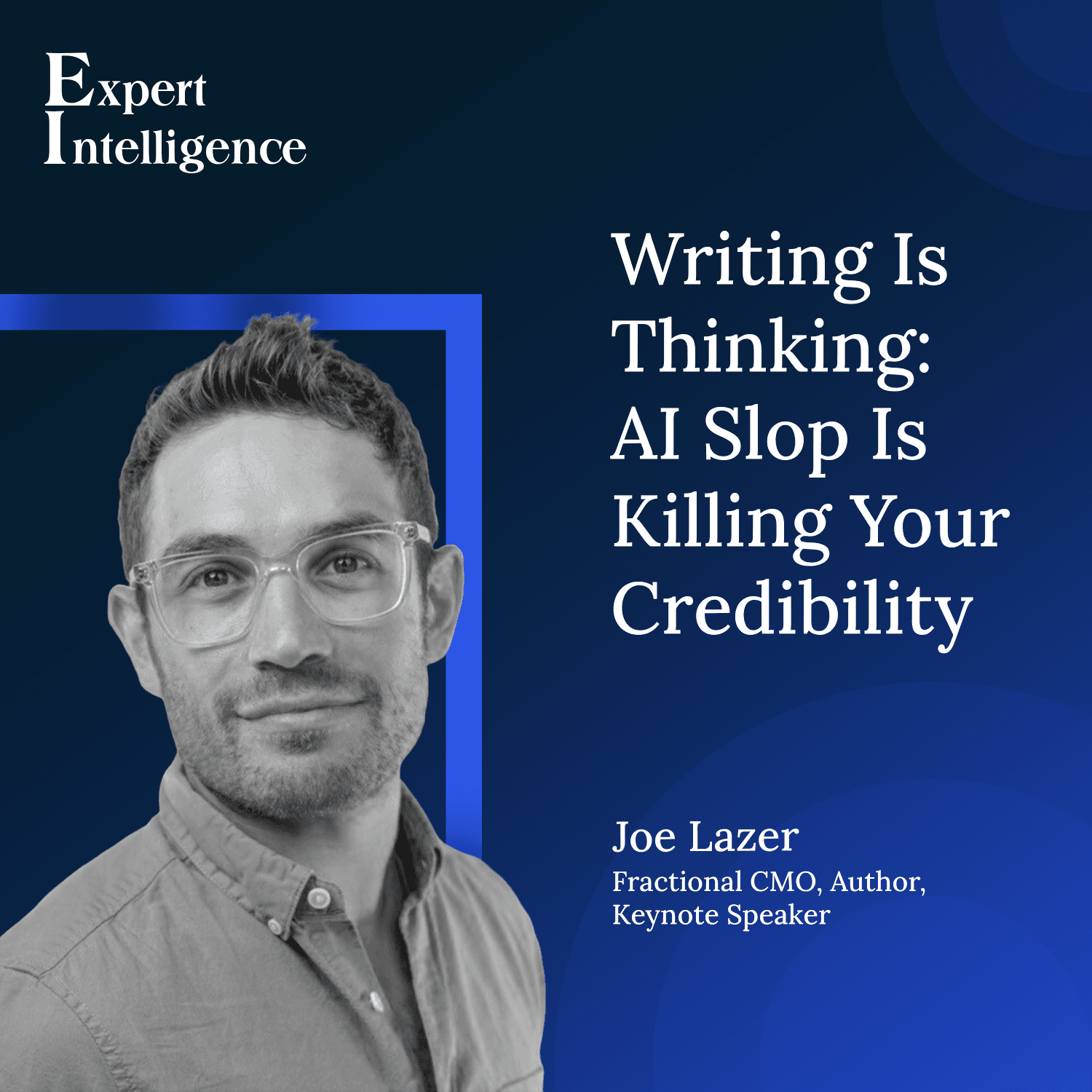
Writing Is Thinking: AI Slop Is Killing Your Credibility — with Joe Lazer
Episode Overview In this episode, Paul Estes interviews Joe Lazer, a storyteller and author. They discuss the overwhelming influence of AI-generated content, the importance of authentic storytelling, and how to navigate the complex landscape of creative work in an AI-saturated environment. Joe shares insights from his career journey, the ethical use of AI in creativity, and the competitive advantage that storytelling provides.
Key Themes and Discussions
- The Vortex of Mediocrity: AI Slop
- Joe describes a phenomenon he calls the "vortex of mid," where the ease of AI-generated content leads to a decline in originality and quality.
- The danger of relying heavily on AI-generated output results in reputational damage for content creators.
- Importance of Authentic Storytelling
- Personal Journey: Joe shares his background in journalism and his pivot from a stable executive role to focus on storytelling, which he believes is humanity’s "most essential superpower."
- Storytelling is positioned as a critical skill that machines cannot replicate, making it increasingly valuable in the workplace.
- Framework for Ethical AI Usage
- Joe introduces an "ideation-research-refine" framework for using AI in the creative process without losing one’s unique voice.
- Use AI as a tool for brainstorming and refining ideas, rather than as a crutch to produce entire pieces.
- Neuroscience of Storytelling
- Discussion on how storytelling triggers neural coupling, enabling listeners to connect emotionally with the storyteller.
- The role of oxytocin in fostering trust and connection is emphasized, showcasing the impact of storytelling on business relationships.
- Soft Skills in the AI Age
- Joe argues that soft skills like storytelling, adaptability, and empathy will be crucial competitive advantages in the workforce.
- Emphasis on the necessity for individuals to develop these skills in a world increasingly dominated by AI.
Key Takeaways
- Creating vs. Consuming: A call to action for individuals to prioritize creation over consumption in their use of technology.
- Mastering Storytelling: The skills of storytelling are essential for success in a narrative-driven economy, where attention and connection are key.
- Caution with AI: While AI can enhance creativity, over-reliance on it threatens to undermine authenticity and critical thinking.
- Invest in Soft Skills: Fostering abilities centered around human connection will become increasingly important as the workforce evolves with technology.
Resources Mentioned
- [The Storytelling Edge](https://www.thestorytellingedge.com/) by Joe Lazer and Shane Snow
- [Dr. Paul Zak's neuromarketing research](https://www.neurosciencemarketing.com/blog/articles/author/paulzak) from Claremont University
- [Kyla Scanlon's newsletter](https://kyla.substack.com/) on economics and narrative
Conclusion Joe's insights underscore the urgent need for individuals to reclaim their creative agency in an era where AI threatens to homogenize content. By focusing on storytelling and human connection, individuals can maintain a competitive edge and foster genuine relationships in both personal and professional arenas.
---
*Stay tuned for more episodes of Expert Intelligence, where industry leaders share their experiences and insights on navigating the intersection of technology, creativity, and the future of work.*
Written by AI. May contain mistakes. Listen to the episode to check what was said.
Transcript
Automatic transcript. May contain errors.0:00When you think of your time in journalism and your time writing for lifestyle brands and even doing corporate branding, where does AI actually fit in? AI can give you a large output that seems perfectly fine, but it sucks you into what I call the vortex of mid, and it's filled with this slop, this like AI parable bullshit, and the reputation damage that you're doing by so blatantly outsourcing your work, your thoughts to AI, I think is vastly unconsidered.
0:34We're all drowning in AI slop, wondering if our skills still matter, feeling stuck while the algorithms feed us content to consume. Today, we're going to talk to someone who's creating and practicing one of the skills that is more important than ever, telling stories. Joe Lazor is the author of Storytelling Edge, how to transform your business, stop screaming into the void, and make people love you. And he's made a career betting on himself, pivoting several times, most recently leaving as an executive at a fast-growing startup. Today, we're going to dig into the importance of telling stories, avoiding AI slop, and how creating can help you take back control of your career.
1:11Joe, welcome to the show. Paul, thanks for having me. So I follow your work and I read the newsletter every time it goes out. I want to start with the thing that I struggle with the most is raising two daughters and trying to help them with technology. The consuming versus creating. We have a rule in our house that you're allowed to consume on the screen for 30 minutes, but it's unlimited creating time using technology. Tell me how creating has shaped just kind of your journey so far. I think there's something that's very just innate for us as human beings around telling stories, right? There's a reward system that's there from the time where our kids are a young age.
1:51How old are your kids? 10 and 11. 10, 11. All right. I've got an almost three-year-old, right? And I think one of the most joyous things about parenting is seeing how he lives in a world of story, how he's constantly taking these trips every morning to Never Never Land and bringing me along with him, right? So, you know, when we're kids, we don't even question the idea that we're storytellers. It's as natural to us as breathing. We get sucked into this world of imagination. And I think as we get older, we get discouraged from it, right? And that's actually, I love the role that you have for your kids.
2:2930 minutes, hard cap on consuming, and create all you want, because there's just this joy that comes from creating and from telling stories. And I think it's something that for me that I felt from as long as I can remember. I was 16 years old when I realized I wanted to be a writer. I had my sophomore year English teacher in high school gave this assignment to write a bonus chapter to Kurt Vonnegut's Cat's Cradle. And I wrote this like pretty raunchy, like crazy chapter to go in there. And she called me up in class and I was like, oh man, I'm going to get in trouble again. Cause like I was not a very good student.
3:07The only homework that I did was English homework. And she comes up and she's like, this is amazing. I want you to read it in front of the entire class. And so like I got up there and I start reading this chapter that I wrote and like, I'm nervous. My hands are shaking. Like my, my you know sophomore year crush was sitting there in the front row um I started telling you know reading this story that I wrote and like everyone started cracking up and I immediately fell in love with it right this this feeling of creating something that brings people joy and that drives connection with other people and stuff that you know I wrote a novel when I was in high school you know became a journalist started running the school newspapers and all from there but I think for so many people, we spend so much of our life telling stories.
3:57It's the thing that, even if we don't realize it, is how we spend nearly half of our day. And when you really tap into those storytelling superpowers that all of us have, that we're all born with, just magical things happen. I think, we'll probably get into a little bit later, that storytelling now has greater implications for the future of work and where you take your career than it ever has before. Yeah, we're going to get into AI and more in storytelling, but I want to start with sort of your career journey. Because being a writer in today's age, and even like during the recession way back when, being a writer has never really been a stable place to be.
4:37Yeah, it's for fucking sure. And what impressed me most about your journey is sort of the agency that you took and you kept going and you tried different things. Let's go to your latest one. You did a LinkedIn post that I really liked. I first ran into you when you were at a startup called A-Team and you're on the executive team, fast-growing startup, and you decide to leave to go bet on yourself. Tell me the moment where Joe is sitting at his place in Brooklyn, the young three-year-old son, and says, hey, I can either stay here at a fast-growing startup with all the benefits and things that come with that, or I can bet on Joe.
5:16Yeah, and it's always a scary proposition. I have to pay the mortgage in this fancy building that has crazy-ass life pictures like this one in New York City, which is not cheap. But a lot of it came from having a son and not wanting to be one of those parents that I grew up with who you see and they're just pining for these days where they were pursuing the thing that they really loved in their life. And they're like, you know, one of my best friends growing up, his dad was stuck as an actuary to continue to pay the mortgage on their Montclair McMansion that you lived with. And you can just tell like this guy hated being an actuary.
5:57And I just never wanted to be that dad, you know, having like four whiskeys at night and just bemoaning, not pursuing the things that I loved most of my career. So, you know, I was always a writer from a young age. I always have written a lot, even through my tech and marketing career. but it was just getting to a point where my side hustles were piling up in this way where it forces a decision. I co-created a TV show that the pilot got made. I was doing some executive producing and I had a second book that I just really desperately wanted to write that I felt bubbling up inside of me in that way that I think a lot of entrepreneurs feel where, okay, I have to build this thing, right?
6:38It's not an option not to build this thing. And so I got to the point where I could not imagine a life or a pathway where I decided not to pursue that calling that I was feeling. And I'd worked at companies, at technology companies that were integrated in the gig economy for a long time, but particularly like the high end level of fractional work. creatives and content strategists that could command big money for brands when I was at Contently, AI builders and engineers and product designers that could command really high rates to build the technology of the future for companies when I was at 18.
7:17And I spent so much time marketing the idea that this is a viable lifestyle, right? That we don't have to work a nine to five anymore. That it seems like I should get back to a point of trying it out myself, which I did a bit when I was in my 20s. and it was one of the best decisions that I've ever made. It's funny you say that I, you know, my book, Gig Mindset, sort of came from that idea of working with freelancers and realizing, hang on, these aren't all sort of low skill people out there. There's people that have high skills and are making decent rates doing work and balancing freedom. And I had to write the book for me to figure out how to move on from big tech and corporate America.
7:57Like that was part of my cathartic process of making a decision. I'm sure others make the decision a lot easier than writing. Yeah. Whatever gets you there. Right. It just goes back to, I find a lot of safety in creating, thinking like writing is thinking. It helps me whether I ever publish it or not, or whether it ever sees the light of day, the stuff that gets crumpled in the trash can is still valuable. When you look at your career, Where's one time that you just straight up failed? That is a great question. And what did you learn from it? Sort of this is probably a success and a failure, but not reaching the heights that I wanted to.
8:35So when I was in college, I interned for some great, weird digital publications of the 2000s era. One of them was Nerve, which I ended up being a contributing writer for, which is this like 90s into the 2000s sex pop culture magazine. Like everyone wrote for it, like Chuck Palahniuk wrote for it. George Sanders wrote for it. I interned there. I started writing essays, personal essays for them, sort of humor essays, and became pretty close with one of my bosses. And when I was a senior in college, he decided to launch a new type of digital media company, a new site called the faster times and kind of asked me to come on and help launch it and build it and then that's what i ended up doing after i graduated college because it was the great recession the media industry was on fire the sort of ad model was completely collapsing there was no real entry-level journalism jobs so i figured screw it let me try and build something myself because the one thing that working at earth which is a digital media company it taught me was that there's kind of something really amazing and fantastic about the new world of creating content online that we were in in 2008, 2009, 2010.
9:53And so we spent three years building that. And I look back on that and it's like, I had no idea what the hell I was doing at that point in my life. Like not surprising, right? I was 22 years old and building a media company. And we had this overall thesis at first that we would create this business model in which the writers would get paid 75 % of the ad revenue that their pieces generated. And the section editors would get 15 % of their sections, right? So it was this sort of egalitarian, semi-communist way of approaching income redistribution off the business model where there's a lot of shared ownership.
10:35And that model completely did not work, right? Because it just turns out, you just do not make enough in the year 2009, 2010 on display advertising on Google. It's just not a viable business model. It's an interesting business model. Like the New York Times wrote several think pieces about us, and we got millions of readers and a lot of really good writers, but it just didn't work. And so then we had to pivot. And what we ended up pivoting into was the brand space. So got connected with Colleen DeCourcy, who is now like the CCO at Snap and ran Wine and Kennedy for a while, one of the kind of most epic, amazing advertising, you know, heads of the last 20 years.
11:17and she was starting a new agency called Socialistic. And she brought us in to be like the branded content arm or network for the clients that she was working with. And so we, from that, started building this branded content studio that really paid the bills for us, right? It's like having our writers do SpawnCon for Dove, doing social content for Homeland and Dexter, kind of things like that. Started doing some B2B kind of research writing. And what I really look back on is that there's so much that I know now about the marketing industry and tech where there's opportunities probably to build this into a real platform play to think about it more strategically.
12:01But we were really just living like month to month, quarter to quarter. And we built a decent business. We ended up selling that business. But overall, considering how early we were on content marketing, like doing it before there was an actual word for it, right? It sometimes hurts and feels like that missed opportunity where if I had probably the knowledge and perspective that I do now around marketing and technology, would have thought about how to build it into a platform play, you know, like Contently, where I went after that ended up being, but just did not have the vision for that at all.
12:33Let's talk about the elephant in the room, AI, and AI slop and AI writing. I think I do a ton of workshops with different teams that are starting on their AI journey or they're somewhere along the way. And they've all sort of followed the same framework. Hey, I tried this thing. It was amazing. And then they end up in slop land, either where they're creating terrible stuff or they're just getting so much information, they're confusing themselves. Like the idea that you can just get tons of information, they're just kind of stuck in this place where it's like, hey, I got all this stuff. Now what do I do with it?
13:06When you think of your time in journalism and your time writing for lifestyle brands and even doing corporate branding, where does AI actually fit in? So you said it, I think, really well earlier, right? Writing is thinking.
13:25An output that seems perfectly fine, but it sucks you to know what I call the vortex of mid. like there's this gravitational force when you're kind of turning the AI as the first step in your content that's going to suck you into this area of mediocrity. Like if you think of all content on a two by two that goes from like low originality to high originality, right? On one axis that goes from low quality to high quality on another, like AI is never going to be objectively terrible, right? It might give you the kind of work that you would get from a C plus B minus freelancer, but it's not going to be the type of truly good, original, personal content that breaks through to people and stands out.
14:09And I think that's where a lot of people get stuck. So when I am, you know, coaching and advising marketing teams on how they should be thinking about using AI, because I'm similarly like doing workshops and consulting around this. Like I worked for three years in an AI company. I'm not necessarily anti-AI, but I think that you have to use it in a really deliberate way. where you aren't anchoring yourself to the ideas that AI is giving you. When you're brainstorming, you're brainstorming first, and then you're using AI as an add-on to take those little parallel steps of creativity that get you to a better idea, right?
14:47Where you're using AI as a researching tool. When I was writing my new book, I didn't use AI to write a word of the book. It's something I would never do for that or for my newsletter. But as a research assistant, it's extremely powerful as long as you understand the best practices and checking the links that it's giving you in the citations and verifying all the information. It can save you quite a bit of time. I do believe that ChatGPT, Deep Research, Claude's research tools is a market stepped up from just Googling around because there's so much combination AI and human slop infecting AI in the web.
15:22I think AI can be a really effective tool for getting feedback and refining your work, right? Prompting the AI to act as the target audience that you're trying to reach, and then suggesting things that you might have missed, counterintuitive ideas that you might want to push more on, things that might be confusing. Using it as that feedback tool when you have a finished work is really, really important. But so much of what makes storytelling in content really significant and meaningful to people is a the fact that the stories are coming from you the entire story of the internet has been us falling in love with first person narratives and the real voice and perspectives that people bring to bear in the content that they publish and the second is the fact that what makes art art what makes a story a story is all of the little choices that you're making along the way and when you're just sitting here and you're saying i'm going to outsource everything that I'm doing to AI, right?
16:18I'm just going to say, okay, AI, you go and you write this thought leadership post. You write this story for me. You write this novel or this book for me. You're taking away your agency of making all of those little choices that make the thing that you produce matter. And that inherently just sucks the soul out of the content you're creating. And you can see that. You can feel that. Like you spend 10 minutes on LinkedIn And it's filled with this slop, this like AI parable bullshit that like, okay, yeah, maybe some of it from the bigger thought leaders is getting some likes, but that doesn't resonate or make a big impact on anyone.
16:54And the reputation damage that you're doing by so blatantly outsourcing your work, your thoughts to AI, I think is vastly unconsidered by most of the actors who are slopifying our feeds. So let's say that you have an idea. I'm Joe. I'm hanging out in Brooklyn. I'm walking down the street and you have an idea of a story you want to tell or something you want to say, right? Maybe it's your newsletter or something. And you're a professional storyteller and writer. What would you tell someone on how to approach telling a story and using AI? Like what would a workflow be? Like make it real. Yeah. So there's one framework that I teach, which is a colleague for say thought leadership content rights to say you're doing something like what I do.
17:40I write narrative nonfiction business books. I write a fairly popular newsletter about science and storytelling and how to apply that to your business. And the loop goes ideation, research, write, refine. So it would start with, okay, you're going to start with the ideation phase. You have an idea of what you want to write. I want you to kind of flesh that out as much as possible on your own first, but then turn to AI with a series of prompts, like what are like five other counterintuitive angles I could take on this? This is my target audience. What are uncommon things that they might be wondering about this topic, et cetera.
18:18Getting into the right phase, that phase is you write. You're always writing your first draft. But if there comes to a point where you're stuck or you're struggling for, say, a metaphor or analogy to continue it forward, the right transition into the next paragraph at that point where otherwise you might walk away, find a million distractions, go do the laundry, go walk your dog, stop writing that piece, you can use AI as that lever to get unstuck at that moment. I think that that's an ethical use of AI to say, okay, give me a metaphor for X. Probably what the AI gives you isn't what you're going to use, but it's going to help you get unstuck at that stage.
18:54And then, like I was saying a second ago, that refine point where, okay, let me craft this synthetic audience persona of who I'm trying to reach and let me get some feedback on what makes sense, what doesn't in the story that I'm writing. And I think AI can be really helpful that way. I think it also can be really helpful for something like thinking through five or 10 different variations of hooks at the start of your newsletter or the LinkedIn post that's promoting your story or the script for the TikTok video that you're using to promote your newsletter, right? The key is that you're not just outsourcing that completely to AI.
19:30Just to say, I'm gonna trust what the AI suggests to me full bore without thinking about it all myself. It has to be a creative partner that you're using and constantly pushing to modify and jump off of that as an idea to something that is truly your own. So that's the general advice that I give to folks, which is a little bit different, I think, than most people who are teaching AI to content or thought leadership teams, where they're saying, like, here are seven prompts that's going to give you the whole piece. I think that's just a path to mediocrity and a content that's going to check a box, but not make any sort of positive impact for you or your brand.
20:07You remember, it was like a year ago that the internet was just filled with like people selling prompts, 300 prompts, 200 prompts, and like, get my swipe file, this notion swipe file, comment swipe file on this post to get my ultimate database of expert prompts. Yeah. Fucking kill me. Yeah. I went down that rabbit hole and I went down the automation rabbit hole on these people who had done that. And I bought this guy's prompt, I think we're, I don't know, 99 bucks or something. And I tried all of them and they were awful. You could tell it was just people were not experts in what they were professing they were experts in and had never actually done the thing that the prompt was designed.
20:46No, it's just a bunch of prompts that chat GPT made that they put in a notion file, which is like, it's a hustle, but yeah, I don't think it really does anything for anyone. How do you help people understand the importance of the hard work of creating? Like if someone were to watch you create your newsletter or watch you write a piece, like it's hard mental work. Like there's a lot of carbon that's going back and forth in your brain to create. And everybody thinks there's a shortcut. And while AI, I think to your point is helpful, the shortcut is junk food for the brain. How do you help people understand that?
21:19I think that people need to experience it because the only way that you really internalize the idea that writing is thinking is to come to that realization yourself. There's so many pieces that I leave on the cutting room floor that I start going down the road on and then realize that this is actually not what I want to say, or this is not the piece that I want to write. And I think if you do that in contrast to having that topic idea or that idea of what you want to write and then just prompting AI to write it, you're never going to have that realization yourself because all you're going to do is end up with that finished product and then you're going to start like editing a little bit and post it, but you're never going to have gone to that mental place, right?
22:02Where you are on the third paragraph and you're trying to make this idea make sense and you realize that actually you have the wrong idea And then you get up and you go for a walk around the block and then you realize, oh, no, actually, it's this other thing, right? This is where I should be starting. This is what I should be talking about. And A, there is like a euphoric joy in coming to that moment. I think that if you experience that for yourself, you just feel so deeply satisfied in your soul for having figured that thing out and having gone through that process that there's a sort of natural dopamine hit that you get from doing it.
22:43But the second is also then getting to the point of going through that process and publishing it and seeing an idea that is truly your own that hits different. Not everyone is built to do this, right? That has the determination to do it. I think Instagram just came out with a stat that they have like a 99-1 rule, right? 90 % of people on the platform only consume 9 % remix and only 1 % truly create. Something like 90 % of on YouTube views go to 4 % of creators. So to say that I do believe everyone has the capacity for storytelling. I think everyone has the innate gifts and skills to be a great storyteller, but not everyone necessarily wants to go through that struggle and process.
23:30And like, that's okay. But I think that if you have goals to be a business thought leader, to differentiate your personal brand, you're going to have a much harder time if you're not willing to kind of put in the work and hustle and sacrifice to go through that wondrous creative process. One of the experiments I just got finished doing with a friend of mine who's mid-career kind of wondering what's next and he's sort of stuck. And we did an exercise on storytelling. He says, what story do you tell yourself? And so we sat down and talked for an hour about like, what in his mind is the story that he tells himself where he is today, where he wants to go, like all of those things that you might go to a therapist for like something like that and then we put it kind of through ai to synthesize it into a more of an action plan like say hey this is a story you tell yourself and this is kind of what that story is telling you he wasn't creating but he was using ai and storytelling in a pretty transformative way to help him think about the future and we even talked about like what stories and books and movies like what things resonated what was your favorite actor and what was your favorite movie and why.
24:37And like, it was an interesting way to think about storytelling. When you talk about neuroscience and storytelling, I'm fascinated by the brain in general. Like, what does it mean to be human? What does neuroscience tell us about story? Yeah, they tell us a few things. One is that storytelling is one of the most powerful and effective ways to unlock oxytocin production, right? Which is this neurochemical that engenders these feelings of human connection and trust. So I've followed and written a lot about the work of neural marketers who have studied this. One of them is Dr. Paul Zak from Claremont University, who found that when someone is deeply engaged with a highly emotional resonance story, in real time, you can actually see their oxytocin levels and their attention levels skyrocket.
25:25And afterwards, they're much more likely to do things like give to charity. They've been able to predict someone's likelihood to purchase from a brand based on their engagement with that story. So that's really, really powerful, right? We see that storytelling actually makes us much more likely to want to buy from brands. It also makes us feel more generous and connected to the people that we're hearing a story from. If I tell you a really engaging story and I sell it super well, something called neural coupling happens where the brain of the storyteller actually syncs with the brain of the listener.
25:59And we feel like we're going through the same emotions and the same experience, which is why storytelling is such an effective way to bond with people, whether it's friends, teammates, dates. If you want to really connect with a crowd when you're giving an opening keynote speech, the most effective thing is to open with a story that's going to build and connect those bonds. Neuroscientists have also found that when we engage with a great story, when we hear or watch a great story, the neural activity in our brain increases fivefold. It's like someone's flipped on a switchboard and illuminated the city of our mind, which is why we're so much more likely to remember a message when it's told to us through a story than through a memo or fact sheet.
26:42So here we see that stories do a lot of things that we really care about, particularly in business and in life. Stories make us remember. Stories make us care. Stories make us want to buy things and take action and help people, right? So it's really this cognitive technology that we've had for millennia that allowed Homo sapiens, despite being not the strongest hominoid species, not the smartest, Neanderthals actually had much bigger brains. They were much stronger than us, but we've been able to rise up and become these ultra-social learning machines that have conquered the world because storytelling allows us to trust each other to come together and work together, allow us to pass on information, to remember things from generation to generation, to teach lessons to one another.
Read the full transcript
27:33So, you know, we talk about the effect that stories have on our brains. It's simply immense. When we think about the effect that storytelling has had on our species, it's unparalleled with any other skill. And if you look at the things that matter for us most at work today, right, when AI is increasingly able to do technical skills better than most of us. The shit that matters at work is building those emotional connections, those relationships that distinguish us as human beings from droads that fill out Excel files and code websites. There's a big thing about vibe coding. Everybody's down with engineers using vibe coding to create things like applications and stuff.
28:11But when it comes to using AI and writing, it seems different. Why? I think there's a cultural difference for us. Coding so much has felt like humans doing the work of machines versus stories are something that's very, very deeply special and connected to us. And I think you see this in the language that we use around the two, right? Using AI for coding is vibe coding. Using AI for writing is AI slot. We feel this difference in how we respond to the uses of AI culturally. And I actually think that language says a lot about what we actually want AI to be doing in our lives. Like I honestly like super feel for all of the kids coming out with computer science and engineering degrees who have an unemployment rate right now that's over twice that of our history majors because the tech industry told everyone to learn to code and then invented a technology that's replacing junior programmers.
29:07But on a broader cultural level, coding is something that we've been doing for, in some ways, almost the past century, but really in a heavy way the past 40 years. Versus storytelling is something that we've been doing for 35 ,000 years with each other. So there's just one that is going to be something that we're much more attached to as human beings than a newer technology, which we're kind of mimicking the work of machines. I want to go back to Max. You have a three-year-old at home with you. When you think about Max being 22 or even getting his first job, what skills are important? If I had a crystal ball and could predict that, it'd probably be worth quite a lot of money.
29:55But I do have some guesses, which is that I think in the next stage of work, the most important skills are going to be based around the relationships we build with other human beings. We buy things based on our emotions, not pure rational decision making. I think that the role of human beings in telling stories to build connections and trust with consumers isn't going to go away. It's only going to grow more important. If you look at the way that most business deals and relationships get done, it's not just based on facts and figures, right? It's based on the relationships and the narrative that different power players are able to craft.
30:34If you look now at even just how our economy works, Kyla Scanlon, who writes a great newsletter on Substack, sort of this very popular Gen Z pop economist, she had this great piece a few months ago about how the kind of foundational economic inputs of our economy have changed, where it used to be things like land and capital, right? And now so much of it is attention and narrative. It's what's driving what gets funded, what gets resourced, what moves forward, right? Your ability to capture attention and drive the narrative as a founder or a business leader is kind of the most important thing that allows you to then get the capital and the momentum to move forward with whatever initiative you have.
31:19You see this with like Sam Altman and OpenAI, right? ChatGPT is in some ways a shittier model than Gemini and Claude, right? I don't think you can really argue there's a huge gap between them and any of their competitors, but they dominate the market so much because Altman is able to dominate and control the narrative and the share of attention in the AI space. We see what gets funded in startups now is so much based on who can build up hype and attention and narrative around their products. And when you look at what roles are going to be really important at work, so much of getting people to move inside of large organizations is based around what is the story you can tell that's going to rally people around a shared vision, around an initiative to actually want to work with you.
32:05So I think all of those skills that we've derived as soft, adaptability, resiliency, communication, empathy, leadership, are the lasting skills of the next couple of decades. And my argument would be is that if you look at how human beings have evolved, storytelling acts as this sort of super meta skill that makes us better at all those surrounding soft skills. So, you know, what am I looking at investing in his education? You know, it's him being a creative, artistic thinker, him being engaged in stories and play, his ability to kind of think about the world in terms of narrative. And that's the most fun shit that you can be doing with your kid as a parent.
32:53Right. So in a lot of ways, I think there's great news for all of us that want to set up our kids for success. I couldn't agree more. I have a daughter who woke up about six months ago and decided to write her first book. Amazing. Every day on the way to school, she reads me a little bit. And I am honestly impressed. And she's not working from an outline. She said she's in the flow. I love that. And I'm taking notes from her. I'm like, well, I'm not going to try an outline. And so I was trying to write a chapter the other day, and I was just going to, I'm going to just be in the flow. And so it's interesting that she's starting to realize the importance of being able to articulate herself in creating something.
33:30Yeah, and we also think about this world, right, where 90 % of other people are going to let their communication and writing and critical thinking skills actually because of AI. It's just what's going to happen. Like, it's hard to see a world in which we don't have people who cannot write and articulate themselves and think on their own nearly as well as they are able to currently. But if you're someone who invests in those skills, skills, you're going to have a huge leg up on the competition. And that doesn't mean that you can't also use AI as a force multiplier on top of that. But I think if you master those innately human skills first and then use AI to amplify those skills to use it in strategic ways, you're going to be in such a better place than someone who is just plugged into the LLM machine from the time they're five or six years old and never learned to develop those surrounding skills.
34:27Yeah, I think we learned that lesson from social media too. Yeah, but have we, right? There's like this alpha school in San Francisco where kids are doing two hours of AI a day from the time they're like elementary schoolers. Like, come on, that's absolutely insane. Everything should teach us that we should assume that technology is bad for our kids until it's proven otherwise. It hasn't turned out any other way so far. Smartphones were a disaster. Social media was a disaster, right? I think for millennials, we probably got off a little bit easy, but God, I was in some weird AOL chat rooms when I was seven years old.
35:04The pandemic sort of hypercharged technology. My daughter was on her computer the other day, my youngest, and she was doing math. And I was looking at him like, you're playing a game. She goes, no, I'm doing math. And so we had this argument of whether she was actually doing math or playing a game. And what you find out is the school district looks at the engagement metrics of the software. And so ed tech people are making software that drives like, you know, casino type social media, dopamine type stuff, because they know that if the kids stay engaged in it, they can sell more. It's just this weird cycle of technology in schools.
35:40There's this great politician that I heard on a plain English podcast with Derek Thompson, and Jake Auchincloss. I'm probably butchering his name. But he has this proposal that I think is pretty interesting, is that we should essentially tax tech companies who are delivering cheap dopamine hits to our kids the same way that we have taxed other vices in the past, right? Gambling, cigarettes, booze, and hold them accountable in that way, just by a simple tax of digital ad revenues that they're making off of these products. And I think it's a pretty novel idea or a way to think about what these social media platforms and these companies actually are because yeah it's a total dopamine factory for our kids it's not only our kids it's us well us too yeah yeah yeah i feel like the more you know we're probably enough agency or smart enough to resist it i think i think kind of framing it around okay this is something that's being fed to our kids is a good framing for getting the kind of popular support around this idea is something that we should tax or scrutinize a little bit more deeply.
36:46I went into a Walgreens the other day, you know, cigarettes are behind the counter. And there was a sign that said, and I think it was part of the lawsuit, the recent lawsuit that said, these products were made to be addictive. And I'm just like, but that should be on the front of Facebook, TikTok, and everything else. Like there's products literally were designed to be addictive. That's okay. Just call it what it is. Yeah. A hundred percent. Well, when you go out with your friends, ask everybody to unlock their phone and look at their screen time. So if everybody had to walk around with a shirt that said their average screen time for the week, that would be the best scarlet letter on the planet.
37:20I guarantee you we'd all start acting differently. That's a great idea. I love that. Hey, Joe, thanks for taking the time. Again, I follow your work. I aspire to be better at telling stories. It's hard work and you're very good at it. Where can people find you, your work and follow you? So everyone can follow me on Substack for my newsletter on the art and science of storytelling and how to apply that to build stronger relationships in business and in life. It's storytellingedge.substack.com. Hopefully, Pauly can put that in the show notes for everyone. I also will probably be announcing by the time this episode comes out, my next book is called Super Skill, Why Storytelling is the superpower of the AI age.
38:04It comes with 15 principles for mastering storytelling in the AI age and gaining an unfair advantage over the competition. So look out for that. You'll learn more about that in my newsletter. You can also learn more about my speaking workshops, everything else I do at joelazer.com. And really appreciate you having me on. Thanks a lot, Joe. Appreciate it. You just spent the past 40 minutes hearing Joe and me talk about the importance of storytelling, of creating instead of consuming, of raising kids who can actually think in a world increasingly designed to do their thinking for them. And now you're probably about to jump in a meeting or pick up your phone and scroll through whatever algorithmic-fueled dopamine factory is calling your name.
38:45I get it. I've been there. But what if you spent the next 30 minutes or even 15 actually creating something, writing that idea that's been in your head for months, working on that side project, or teaching your kid how to tell a story? There's a chance that over 90 % of people will let AI rot their critical thinking skills, which means it's more important than ever to invest in yourself. You can start to take back control, finding real health, happiness, and success. Don't just consume this episode, use it. I'm Paul Estes. This is Expert Intelligence. Subscribe so you don't miss conversations like this.
39:20Connect with me on LinkedIn. And until next time, stay curious.
39:31October 21st August 21st I��
39:51my k cl weekends
From the publisher
In a world drowning in AI-generated content, Joe Lazer is betting his career on the one skill machines can't replicate: authentic storytelling. The author of The Storytelling Edge and creator of a popular Substack newsletter walked away from an executive role at a fast-growing startup to pursue what he calls humanity's most essential superpower. In this candid conversation with Paul Estes, Joe reveals why he left stability to write his second book, how he built and sold his first media company, and why the "vortex of mid" is sucking the soul out of modern content.
Understanding which skills will matter when machines can do almost everything else is crucial. Joe shares his framework for using AI ethically in the creative process, explains why neural coupling makes storytelling our most powerful business tool, and offers a radically different vision for preparing the next generation. From the neuroscience of oxytocin to the reputational damage of AI slop, learn why mastering storytelling might be the ultimate competitive advantage in an AI-saturated world.
You'll Learn:- Why AI creates a "vortex of mid" that traps content creators in mediocrity and how to avoid it
- The ideation-research-refine framework for using AI as a creative partner without losing your voice
- How storytelling triggers neural coupling, making listeners' brains sync with yours to build instant connection and trust
- Why the reputational damage from publishing AI-generated content is vastly underestimated by most professionals
- Lessons from building and selling a media company at 22 years old
- Why soft skills like storytelling, adaptability, and empathy will be lasting competitive advantages
Subscribe to Expert Intelligence so you don't miss future conversations with industry leaders who are navigating the intersection of technology, creativity, and the future of work.
Resources Mentioned:- The Storytelling Edged by Joe Lazer and Shane Snow
- Dr. Paul Zak's neuromarketing research (Claremont University)
- Kyla Scanlon's newsletter on economics and narrative