
In short
Podcast Summary: Expert Intelligence with Paul Estes - Episode with Marcus Sawyerr
Episode Title
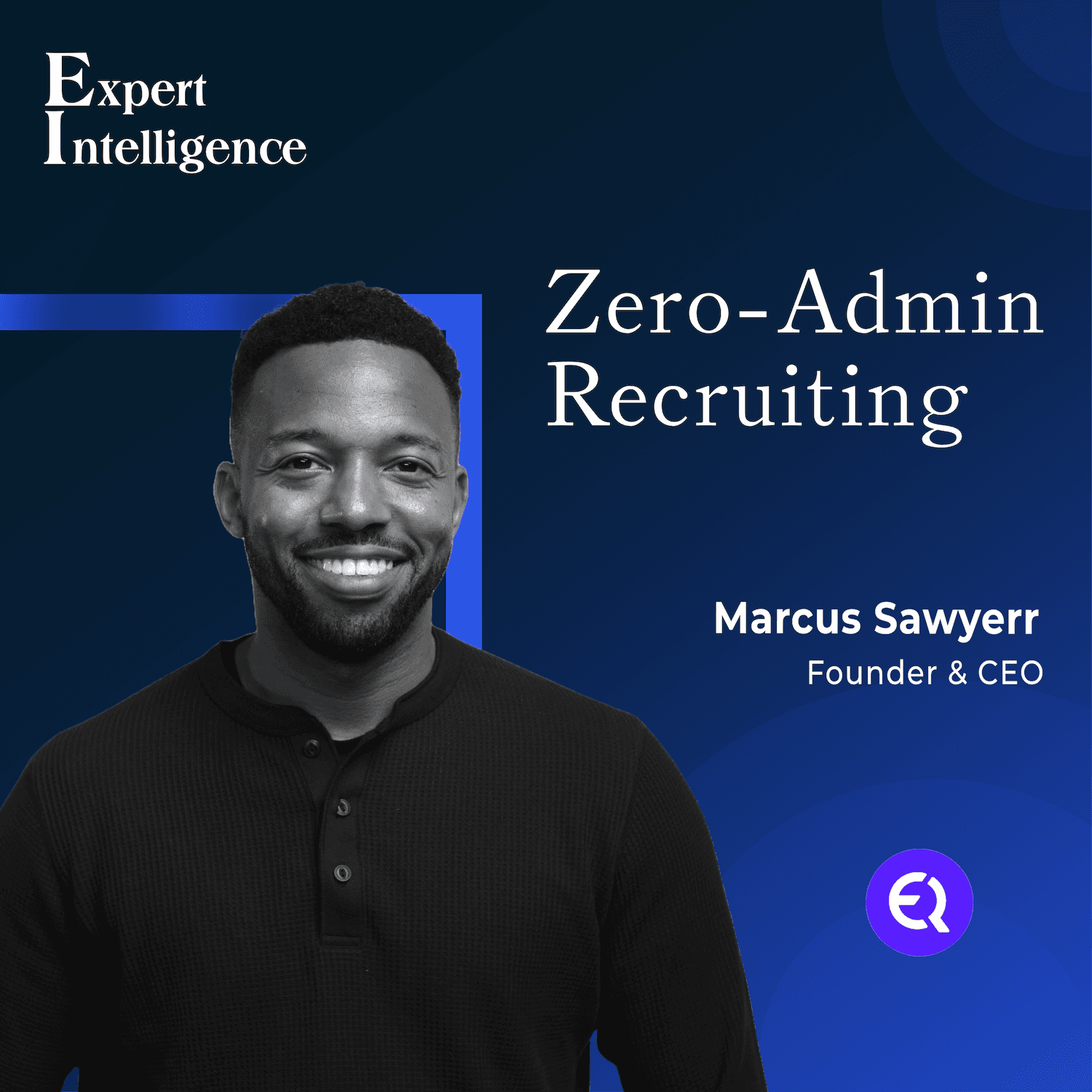
Zero-Admin Recruiting Episode Description In this episode, Marcus Sawyer, CEO of EQ app and former president of Adecco Group X, discusses the transformative impact of AI on recruiting. He shares insights about the "Zero Admin Revolution" and provides practical frameworks for job seekers to navigate AI-driven hiring processes.
Key Topics Discussed
Introduction to Marcus Sawyer
- Background in staffing and recruitment.
- Transition from traditional staffing to leveraging AI in recruitment.
- Insight into how AI can enhance human relationships in hiring.
The Zero-Admin Revolution
- Definition: A mission to minimize administrative tasks in recruiting.
- Emphasis on human relationship-building over administrative busywork.
Challenges in the Recruitment Industry
- Fragmented processes due to subjective views on recruitment.
- The overwhelming number of applications and the burden on recruiters to manage them.
Insights on AI and Recruitment
- AI's role in analyzing resumes and its differences from human evaluation.
- Importance of clarity around problems when implementing AI solutions.
- The necessity for organizations to define objectives to leverage AI effectively.
The OTT Framework
- Objective, Tasks, Tools (OTT): Framework to understand and implement AI agents in recruitment.
- Objective: What needs to be achieved?
- Tasks: Steps to achieve the objective.
- Tools: Resources required for execution.
Practical Tips for Job Seekers
- Resume Variability: Different resume formats can yield different evaluations by AI.
- Building Relationships: Importance of reaching out to hiring managers directly.
- Networking: Recommendations to find connections within target companies.
AI Agents in Recruitment
- Explanation of AI agents and their functions.
- Importance of specifying objectives and tasks to enhance effectiveness.
Strategies for Adopting AI
- Companies that face challenges are more likely to adopt AI solutions.
- Organizations experiencing high margins may resist change unless compelled by necessity.
Getting Started with AI
- Encouragement to experiment with AI tools and frameworks.
- 10 Ps Framework: Purpose, Problem, Profit, Partners, etc., to structure AI implementation.
Key Takeaways
- Transformation through AI: AI is reshaping recruiting by reducing administrative burdens while emphasizing human connections.
- Understanding AI's Role: Clarity of purpose and problem-solving are crucial for successful AI integration in recruitment.
- Building Connections: Networking and direct communication with hiring managers can significantly enhance job seekers' chances.
- Playful Experimentation: Encouraged to engage with AI tools to understand their potential and applicability.
Conclusion The conversation emphasizes the importance of adapting to technological advancements in recruitment. Marcus encourages listeners to play with AI tools, remain curious, and continuously learn in an ever-evolving workplace.
Producer
David Grabowski
Theme Music
Aleksey Chistilin
For more insights, subscribe to the Expert Intelligence podcast and stay informed on the latest in AI and the future of work.
Written by AI. May contain mistakes. Listen to the episode to check what was said.
Transcript
Automatic transcript. May contain errors.0:00The distinction is the ones that are getting the most out of AI have a problem that they want to solve and they have clarity around the problem. So the problem might be as a recruitment firm, I don't have enough clients. The problem might be my team is overwhelmed with applications and I can't get back to enough of them. Those that are not working so well are trying to find the AI and then take it and then retrofit with a problem.
0:30Today, we're joined by Marcus Sawyer, CEO of the EQ app and former president of ADECO's Group X. Five years ago, Marcus predicted how AI would transform recruiting, and now he's building that future himself. From his mission to create zero admin recruiting to the rise of AI agents, we get insights from a pioneer building at the front lines. Marcus, welcome to the show. Thanks for having me, Paul. Always good to reconnect. We met a long time ago, back when the buzzword was the gig economy and staffing. and people were trying to figure out how to get the right talent to do the right jobs because everything was hard.
1:08And now, fast forward seven years, and people are still trying to figure out how to get the right talent because things are moving fast and things are hard. You have a rich history in staffing. Tell me a little bit about how you've transformed your passion and where you spend your time from traditional staffing to the new world of AI. yeah so as you mentioned it's an evolution and it's never a revolution actually as many people think because you have to bring people along the journey but my background started from everything from convincing people that you should advertise on this thing called the internet instead of newspapers for job ads uh fast forward when we met i was buying companies investing in organizations in HR tech and recruiting on behalf of the ADECO group and operating summer CEO got to spend some time on the Microsoft services board also where we interacted in the halls and the evolution has really been how can you make a very people driven business more effective and more efficient to get to what the people were actually built to do which is build relationships and develop a meaningful trust between one another instead of doing all of the busy work so I've just constantly been on that quest and as the technology has got better and there's been more opportunities we've just been chipping away at the same problem which is you want to connect people to the right opportunity at the right time more effectively and efficiently as possible.
2:49So not much has changed from that standpoint, but the opportunities on how you can do it now are, yeah, immeasurable at this point. Before we get to AI and the EQ app, what are the challenges? Why is it so hard? Yeah. So I think about this a lot, and I think that everybody has a view on how to do things. So it's a very subjective versus objective industry. in terms of connecting people to jobs. And this is defined by the niche that you're in, if you're in healthcare, or if you're in financial services, or if you're in sales, everyone has a slightly different process. And then what happens is there's been technologies that have been created to apparently help you streamline this process, but then there's more that goes on top.
3:41And then what you start to do is you kind of create this environment where you're spending time on figuring out what's the best tool to use and i always liken to a hammer right um and sometimes a knife depending on who i'm talking to but like it into a hammer is like well do you want the hammer and we know this well right it's the job to be done do you want the hammer do you want the screwdriver or do you just want the ikea furniture to be set up and i think that everybody who who's in recruiting has a different way of doing it then you have new leadership that comes into a new company. They have their own spin on things.
4:18And so it just creates this kind of monumental mess of a workflow and a process. So I think it just gets, it compounds. The difficulty starts to compound versus the other way around. And I think companies that are starting from scratch or the blank sheet of paper have a huge opportunity. Now let's talk about the zero admin revolution and your perspective on the EQ app. You know, you wake up every day, super passionate. You're all over LinkedIn, you're all over podcasts, and thank you for joining. But like, what gets you motivated? And what do you think you've figured out in that compounding complex human problem of matching people with opportunity with EQ app?
4:58Yeah. And so I'll take a few steps back, like kind of from a personal standpoint, I think that the best business is done through relationships. And I think building your relationships, a lot of that comes with one-to-one connection whether that's in person or like what we're doing now right like we're gonna learn something about one another that we'll probably remember like we went for a walk right a couple of years ago and we were just talking but in order to get to that there has to be some kind of planning some kind of scheduling some kind of arrangement uh we have to maybe and now you and I we just talk generally so we don't need the full documentation to say okay this is what the podcast is going to be in this house can operate but there's some of that and I've always been someone that's not been great at the administration side I've had to learn to deal with it as you get into bigger organizations you look and then I realized I don't love it either so I'm not going to be great at it there must be a way away so how can you connect people to building that relationship as quickly and effectively as possible by removing all of the busy work and a lot of this work unfortunately has been created by the technical evolution and revolution right so more computers equal more data more data means more busy work and more jobs and it used to be the filing cabinet but now it's the internet so you've got to sift through this whole thing to get to what you want to in the end and so i'm just really about clarity where's the direction that you want to go and that's why it's really important when we talk about ai or as we go into that.
6:31It's about figuring out what's the problem you want to solve or what's your purpose and then working back into that instead of starting with the tech. Technology is the problem. There's this idea that, hi, I'm from a company, sass.com, and I can solve all your problems, right? And then you kind of get in there, you sign up, and there's a couple of features, and it ends up creating, like you said, more compounding problems when you layer it over an organization of people that's, again, constantly evolving. When you say get to zero admin recruiting, take me through a story of a client that used the EQ app, met Marcus at a conference, I'm sure, where he was giving a great presentation on the future of staffing.
7:14You got off the stage, talked to the person, they're like, I get it. Help me with that story. Okay. I'll give a very specific example of there's a client, they're in the recruiting space, but the way that they recruit is very much by community. So they like to organize dinners for mid to senior level executives because they're clients, they're candidates and they're candidates, they're clients. Now they do dinners all across the US in different markets. They have a certain archetype of the type of person that they wanna connect with. So we gave them a form, put in your form of who you want. Within two or three minutes, we send them a list of these are the people that we've identified in the location, the jobs that you're interested in you hit approve we outreach to them we send them the invites they turn up at the dinner and then you're going to have your dinner like that's like a very specific kind of use case which is quite niche but you can use it for all different types of people connections does that make sense paul it does make sense you posted something the other day that i want to build on around data the companies aren't short on data you know you have all these systems.
8:24You have your ATS system, your CRM system. There's this ecosystem and community around whatever industry or whatever your company does. How do you think about companies utilizing that data as we move into using technology like AI? Because it's different. Yeah, it is different. And the way that I think about going back to kind of the relationship piece on the business side, I was at a conference recently and I asked everybody, what's their superpower? So maybe I'll ask you actually, Paul, what's your superpower? You know, it's funny. I was talking to a client that I work for this morning and I think in systems.
9:06I think in systems and I try to make them more efficient. So I've had jobs as a chief of staff or an operator in organizations and I focus on the system. And so my superpower is trying to create the world's most efficient system to get done whatever it is that I need to get done. And then the Bill Gates quote would say that you want to get something done efficiently, hire a lazy person, because they'll find the easiest way to get it done. Right. And so let's say this to the audience, right? So everyone will have a few seconds. Think of your superpower. I don't care how many people this has gone out to, whether it's a billion or nine billion right the whole population i can guarantee not one person is going to be saying updating databases and so every time i go to conference i ask the same question so going back to your point around like where do we leverage the ai like how do we do like why the AIs, the technology, the infrastructure, all of these computers, all of this code, these ones and zeros have actually created all of this data in the first place.
10:18To your point before what we were talking about. So they are best placed to sift through that. So really, it's about collecting all of the data from the disparate sources and bringing them into one area and being able to pull on that at the right time for the right opportunity. And that's what the internet, that's what Google's promise was, right? For so long, it's a search engine, but you have to know what you want. And where the AIs are kind of moving a little bit further is they're going to provide you what you need before you know what you need. And we've seen this in recommendation engines, whether it's Netflix or it's Amazon or what have you.
10:55A lot of people still think, oh, is my phone listening to me? And you're never really sure because the next time you go in, you see something you're like ah you've had that moment right yeah i was about to say you're not going to convince me that my phone is not listening to me yeah right exactly exactly i can't convince you of that i was talking to somebody about this the other day in person i was in dallas i was with a group of a staff and a recruit group and we had the same discussion about like listening so i said okay well you've got your phone and your phone can tell someone where you are tell you what you recently searched for and did you search for maybe some black sneakers right and then maybe with those black sneakers you might want some shorts right so there's a prediction and if you do that over and over again and you do that along your journey to and from work it starts to understand who you are so I think the kind of end promise is that AI understands what you need before you know what you need provides you with a recommendation at the right time to connect with a person.
11:54So I think this goes back to the data piece, like how do you bring all of that data in one place so it can have access to it? And with the AI, it's not that hard to do. It just needs to be fed into the AI through different work streams. And it almost becomes an orchestration layer that understands what you're trying to achieve and then provides you with those recommendations. Yeah, I was helping a startup that was starting to scale. And so we were kind of doing budget forecasting, like, hey, we get from here and in two years we end up at this place and, oh, how many people are we going to need?
12:28And we did an exercise where everyone guessed, everybody kind of put their guesses and stuff. And then we asked the new AI reasoning engine saying, hey, we're this kind of business. This is where we are today. This is where we'd like to go tomorrow. How should I think about the resources I need as I scale? And the most important part, ask me any questions that you need to complete this task. And it asked like some super intelligent questions that somebody probably would have paid a consultant a bunch of money to ask, right? And so it asked the questions and it came out with a model that was pretty spot on.
13:04How are people taking that kind of capability and then putting it into the recruiting system? In my experience, and you spoke to this, going from, I want to hire people to actually hiring people as a hiring manager is just daunting. Yeah. Yeah. We were talking about early offline. It's early, right? So not everybody's doing that just yet. But I've seen some signs of some examples of how it can be done. So one client, they've got 68 recruiters. They get 250 ,000 applications per month. They placed 18 ,000 people last year. now they're just trying to keep their head above water and respond to people in a thoughtful way now that doesn't necessarily say that they're going to predict like who's going to be the best and how it works but one of the things we've been thinking about with them but a few others in particular has been how do you rank those applications in a strategic way respond and provide a summary so the recruiters can prioritize so you almost have to predict based on your criteria so we don't set the criteria we give some templates to say okay like it might be based on experience a number of years but you can change the dial for what you're looking for because all the jobs things are predictions like who do you think is going to be the best fit for the role like that's a prediction actually because you don't know so you've got some historical data and then you've got some maybe forward-looking data or you have to create that forward-looking data, which is a judgment on how you think people are going to perform.
14:42And to your point, with your example, you had, I don't know, let's say four or five people in a room. The AI had access to the internet, okay? Right? And then there's like, okay, out of the internet, there's 99.9999 % of it. It is irrelevant for this question. And let's find that 0.001 % piece and start to figure out what has worked, what the businesses that are doing well the ones that have gone public and how did they scale where did they get to and then let's infer what we think the likelihood of this is so a lot of it's all weights and biases and it's all there's biases in this as well and if you understand that like you obviously you do paul and even with the question like what are we missing you can then impact the biases with the input that you're providing which is all context and that's what we talk about context and the knowledge bases.
15:37And the more knowledge you can give it around your situation, the more accurate the result is going to be. So I think companies have to work hand in hand with the AI to program them and have system thinking in order to get the output that they want. You've been around resumes for a long time. Yeah, I've seen a lot of resumes. A friend of mine is looking for a job and we did an experiment yesterday. Yeah. And I want to ask you because I want you to be able to give whoever out there is listening some advice because it's a really interesting experiment. So he's looking for a job and he's got three different resume formats.
16:13It's very stressful formatting a resume. You know, one that a professional resume person did, one that he had from five years ago that he kind of did some updating on, and then another one that another friend who was a professional did. So we have three different resumes, same person. Yep. And we put into one of the LLMs. In this case, we use ChatGPT, the reasoning model. Yep. Hey, you're a hiring manager. Here's three resumes. Which one would you choose based on the information as provided? And it was really interesting because the one that he thought was like the best example of who he was, was the one at the bottom of the stack.
16:52And so as you have people working to try to, you said, you know, 250 ,000 resumes in a system, and there's part that I need the opportunity to at least start building a relationship with you. But before I do that, I've got to get through a gauntlet of systems and now a gauntlet of AI to get to a recruiter. What is the advice in the industry as this all changes? What are you hearing? there's probably three things there's two that i know of and there's probably a third one that's going to come after i say the first two things the first thing is there's one data point that's key to that which is the job so you've got the three resumes but what you should also do is input the job and then say okay what is the likelihood that there is a fit for these three resumes against this job okay and that it's going to be seen and read so it's like almost what you were doing before is like kind of like further inquiring so if you get that data point you probably got a higher chance of matching against that that depends on the level that you're going for now the other thing is how do you reach the hiring manager right if you're really looking for a job what you want to do is you want to reach the hiring manager now that the resume parsing or processing might be a formality but you always want to go that extra line say hey look I've applied for the job I think I'm a really great fit here's my profile and so you could use AI to build a shortlist of all the target companies with all the hiring managers all the people that you want to reach out to send them a personalized message and then send them the resume or let them dictate to you to go through the ATS.
18:42So I just think that it's evolving because everybody's receiving more applications. And so how do you get to the top one? Match against the job. Two, find a person that you can connect with inside of that organisation. Reach out to them. Better yet, the third thing would be find someone that works there that you know that could then refer you in and strategically plan your job i'm speaking someone today who's thinking about leaving they haven't left they're thinking about leaving because they've noticed what's going on in the market so we were talking about some stuff that they could do with us as a freelancer and i was like what are your intentions after this well if it goes well i'd like to come full-time okay that's an interesting way for us to kind of test and learn right so i think that there's opportunities like that for a job seeker but it depends on the level that you're at but find the hiring manager i think is key there's one thing that's in the news at least the ai news every day so those that are following the news and it's ai agents and the deeper down the rabbit hole you go with with ai agents i think sometimes the more you get confused between and use this word traditional ai which i would call chat gpt the basic chat bot, AI workflows, which is, hey, read this, maybe this item in a Google sheet, think about it because you're using chat GPT and then spit out an answer.
20:08And then there's agents. And so I know you're giving a talk next month down in Florida on AI agents. And can you just help people understand what an AI agent is, like how to think about it in a pretty simple way? And then one example that illustrates how powerful it could be. Sure. Yeah, so the way that I think about AI agents is a kind of a three-pronged framework. I'll give you a framework. OTT. So the difference between an agent and traditional AI is OTT. So the agent needs an objective, tasks, and tools. so the objective could be a job something you want it to get done tasks is how is it going to get it done tools could be the crm the ats system or another ai okay so objective tasks and tools the way to think about that and why that some are great and some are not so good if you don't give the agent the right objective and the right task like hiring a person and in the right tools it has a high propensity to fail we as human beings are less forgiving when machine fails than when a human fails because we can talk to them and say hey hey and but we've got to reprogram this thing okay how to get it right focus on a very specific use case we have an agent that is there just for ranking candidates or just for enriching your database so your objective is to make sure that my database has enough information where I can hire a candidate based on the information that's there.
21:55Task, view the database and have a look on where the gaps are. Second task, find that information from these sources, these tools that I've given you to enrich and upload. And in final, present it to me. So you give it these kind of three elements. Now, when you start to say, just generally make my database better it's not clear enough so the briefing is really and it's the same thing paul as freelancers as you know if you don't give them a clear objective you don't give them clear timelines don't give them clear it's not going to work well but i think what we've done with ai agents as they've started and we we were subject to this and we've learned a lot we've modulized all of them so they're like legos and then you can connect one ai agent the your next one will then reach out.
22:42So you want to really have them focus on specific tasks and get really, really good at something that's very, very particular instead of too general, otherwise it won't work well. One of the things organizations, in my experience, have struggled with is identifying objectives of what they're trying to accomplish. How are you seeing those that are adopting AI or agents and those that aren't? Because there's people that are all in. They're like, I know this is where the future is going. I'm watching the videos, attending the conferences. I'm curious. And then there's others that are like, I'm busy.
23:21It's not going to impact whatever the reasons are. But there seem to be two distinct camps. Yeah. I think that's a fantastic observation. And I believe it to be true also. The distinction is the ones that are getting the most out of AI have a problem that they want to solve. And they have clarity around the problem. So the problem might be as a recruitment firm, I don't have enough clients. The problem might be my team is overwhelmed with applications and I can't get back to enough of them. Those that are not working so well are trying to find the AI and then take it and then retrofit with a problem.
24:03there's another category of people that just like to test stuff and they're kind of starting from scratch and they'll figure it out and figure out different use cases and they're constantly renovating and redesigning but the ones that are solving the problems with AI don't care if AI solves the problem actually they just want the problem solved and so it's going back to vitamins versus pain keepers I've got headache I just want that problem solved right obviously I don't want all the terms and conditions that come with the ad at the end. It's like, hey, you might die in five minutes or something.
24:37You don't want that bit, right? But you're willing to do most things to solve that problem. So I think that's a key differentiator, identifying the problems that you want to solve. Now, some people say, I don't have problems. I look at opportunities, I look at challenges. And I'm kind of a bit more optimistic. So I think in that way as well. Having said that, you might have an again you might have a purpose or a goal that you want to achieve what are the barriers that are stopping you from achieving that goal so you have to have some clarity of thought on what you're trying to get done when you talk to staffing companies because i've been on some of those same stages i was always surprised at how slow staffing was to adapt to technology because, to your point, there's an important relationship aspect that people shouldn't minimize.
25:29It is critical to be able to talk to someone and have a face-to-face call and really understand if they're the right person for an opportunity. Are you seeing an acceleration of the staffing industry or recruiting and HR adopting technology with AI? So in the last couple of years, or since 2021, the staffing industry has been down year over year. I think last year was like down about 11%. And it goes back to what we were talking about. That's a problem. So as you have the problem, some of those companies are like, what can I do about this problem to solve? And it's almost like COVID, right? Like you knew before COVID, hey, video calls are actually really efficient.
26:14Other people were like, I can't get to my meetings I can't sell so I'm going to now start using video conferencing calls so I think there's been adoption where people have had challenges and then there are other like maybe growing the business or getting clients the other ones like let's take healthcare for instance there's a surplus of healthcare jobs in particular nurses there's like 60 million global nurse jobs and there's only 30 million people that can do it so the thing that you're you this is a very supply driven market so the way that you care for those nurses and you communicate to them that sometimes takes a lot longer for a human to consistently do that but we've seen examples where the AIs will reach out send personalized messages and updates so the adoption has really been determined by the problem they're trying to solve and you've everyone's already heard this but I think it was Einstein who said this is that necessity is the mother of all invention.
27:14So when you have a problem that you need to solve, you're going to figure out a way to get it done. And those constraints are breeding new opportunity and new innovation. But if you're not constrained and you're doing well and you've got high margins, you're kind of like, hey, I'll just continue. There's no problem. Yeah. What would you tell someone who is listening because they were curious about AI and they get it? They're like, hey, I understand that it's a thing, it's a technology that's going to be structurally impactful, and I'm curious, I want to get started. What's something they could do today?
27:51So play is the first thing I always say. So play around and get familiar. If you're more serious on the B2B side, figure out the problems that you're trying to get solved and just write them in a structural format. We've got this format called the 10Ps, which I can send over, which is... We'll put a link in the notes. We'll put a link. Yeah, exactly. But what's the purpose? What's the problem? How do you make profit? Who are the partners? Who are the people? And so on. And you can change some of the piece if you're like in film or media, you want to put it in production. But put it out. Write it out.
28:29Figure out what you're trying to solve. And then start searching. Remember the time when everyone said there's an app for that? There's probably an AI for that. But have clarity of thought on the problem. and if you haven't started playing around send your first message and get some feedback and see how it feels and then also the other thing as well is find a group and there are many groups online we have a newsletter that you could sign up to as well it's free and you can get access and talk you're obviously doing great work in the space as well Paul so like keep educating yourself and think about it like the internet.
29:05Think, could you do your job without the internet? That's going to be the same for AI in the future. Marcus, thank you as always for your time. I know you're busy and I know you have to run to another event. If somebody wants to get in touch with you or reach out to you to learn more about the EQ app or anything else that you're talking about, what's the best way to reach out? So if you're on LinkedIn, You can just find me first name, last name on LinkedIn. Also, if you're interested in learning more about AI and you're in the space, the recruiting space, you can follow me on my Substack. It's just first name, last name, and Substack.
29:42And then we've got a four-letter word domain, which is eq.app. Check it out. Get your free AI action plan. You can go on the site and get access to that, and it'll give you some indication of what you can do. Sounds great. Marcus, thank you, as always, for your time. And everyone out there, keep experimenting, keep learning, and most importantly, stay curious. Thank you. Thanks, Paul.
From the publisher
Marcus Sawyer, EQ app CEO and former Adecco Group X president, is building the AI recruiting revolution he predicted five years ago. In this eye-opening conversation with Paul Estes, Marcus reveals how AI is transforming hiring and Paul shares an experiment where AI ranked his friend's "best" resume dead last. If you're job hunting in 2025, you need these insider tips on getting past AI gatekeepers to land your dream role. From Marcus's "Zero Admin Revolution" mission to his practical OTT framework for implementing AI agents, learn how AI is transforming recruiting while keeping human relationships at the core of the recruiting process. You'll Learn:
- How AI analyzes resumes differently than humans—and what this means for your job search
- Why the "Zero Admin Revolution" is transforming recruiting (and how to benefit)
- The simple "OTT" framework for understanding and implementing AI agents
- Why finding the hiring manager is more crucial than ever in an AI-filtered world
- How to distinguish between companies truly solving problems with AI versus those just chasing the next shiny tech tool
- The critical first steps anyone can take today to get started with AI (hint: it begins with play!)
- Marcus's powerful “10 Ps" planning framework for implementing AI effectively
Subscribe to the Expert Intelligence podcast so you don't miss future conversations with industry leaders at the forefront of technological transformation. Each episode brings you practical insights to navigate our rapidly evolving digital landscape. Producer: David Grabowski Theme Music: Aleksey Chistilin