In short
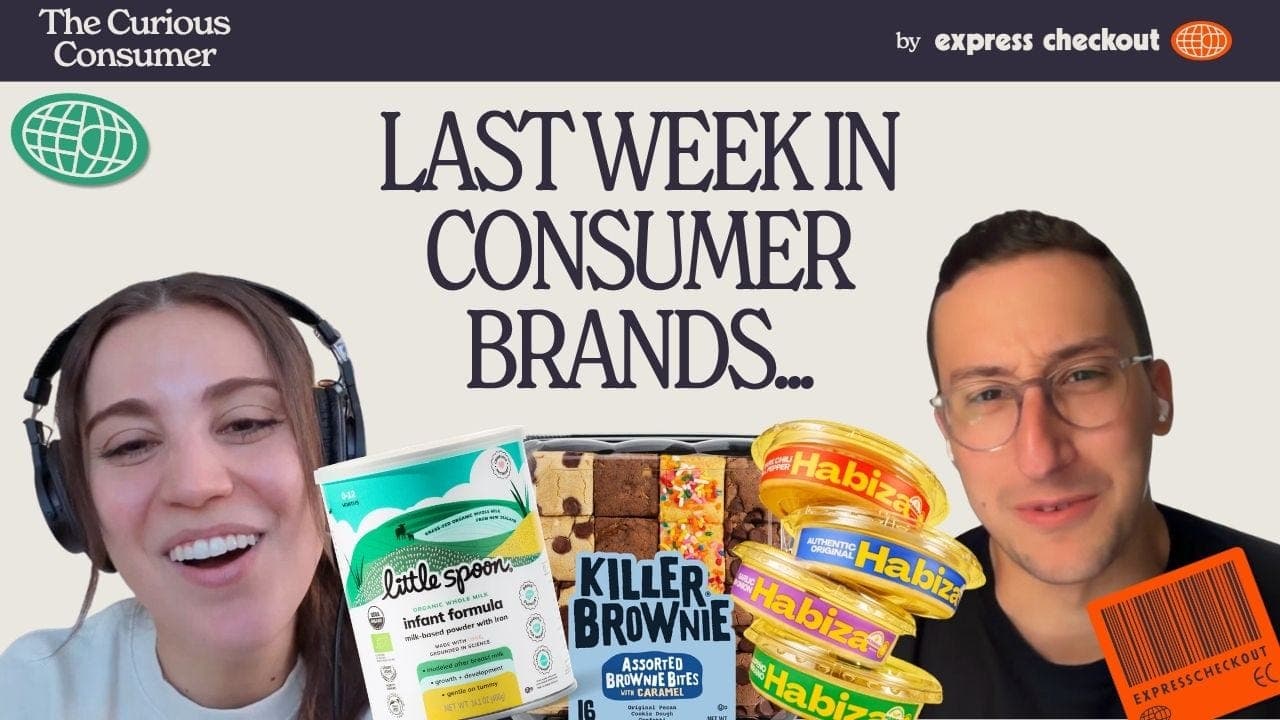
The episode of The Curious Consumer is about (1) airline/CPG snack trends and (2) how brands win via operations, taste, and emotional connection.
Guests
Shemin Ross, third-generation retail grocery veteran turned Killer Brownie wholesale/CPG leader; previously a registered nurse for 20+ years. Killer Brownie: started in the 1970s/1980s; dad trademarked the name in 1988; original was a layered caramel brownie (about 20–25% caramel). Ross says the brand scales by owning manufacturing (no co-manufacturers), using frozen supply chain (7–14 day shelf life), and focusing on “decadent dessert” taste over protein/functional claims. Examples: Killer Brownie on Moe’s permanent menu; expansion to Target locations “this summer”; 15,000+ retailers including private label.
Key claims
brand beats private label emotionally; bakery branding must signal freshness despite clamshell packaging; operations/data help retailers prove velocity. The hosts also discuss Habiza (exclusive domestic tahini sourcing), Kraft Power Mac vs Goodles, Nectar dairy-free taste parity results, and beauty/food “drinkable sunscreen” plus Iota and Little Spoon formula expansion.
Written by AI. May contain mistakes. Listen to the episode to check what was said.
Chapters
Tap a time to open that second in VONate's United Airlines Experience
0:45 to 1:30
Nate shares details about his trip to a United Airlines event showcasing new in-flight offerings.
“They're basically like if you take a circle of puffed quinoa and coat it in chocolate.”
Introducing Shemin Ross and Killer Brownie
1:30 to 3:00
Shemin Ross shares her background and introduces Killer Brownie, a unique dessert brand.
“We would love if you could start and just intro yourself and Killer Brownie as some of your background.”
The Evolution of Killer Brownie
3:00 to 4:30
Shemin discusses the history of Killer Brownie and how it gained a national following.
“So that's why I always say I have this weird conglomerate of a life.”
Transitioning to a National Brand
4:30 to 6:00
Shemin explains the challenges of moving from retail to a wholesale manufacturing business.
“And that's really what the challenge was going from being like this product in a bakery to then scaling and staying true to what people loved from the beginning.”
Killer Brownie's Unique Position
6:00 to 7:30
Shemin describes the brand's unique offerings and its presence in the market.
“And that was really more about the name, the packaging.”
The Importance of Branding in Bakery Products
7:30 to 9:00
Discussion on the significance of branding in the bakery aisle and consumer perceptions.
“So there's a ton of white space for us to play in.”
Navigating Retail Relationships
9:00 to 10:30
Shemin shares insights on maintaining relationships with retailers while promoting the brand.
“How do you do creative packaging when you're in a fresh space?”
Staying True to Product Quality
10:30 to 12:00
Shemin emphasizes the importance of taste over trends in the bakery category.
“traffic to the bakery and support what they're already doing without competing with it.”
Decadence Over Functionality
12:00 to 13:00
Shemin argues that a product must taste good first, regardless of health trends.
The Decadence of Dessert Branding
14:01 to 15:49
Explore the unapologetic branding of a dessert-focused company and its commitment to flavor over health claims.
“As a brand, we are a decadent dessert, unapologetic.”
Show all 19 chapters
Emerging Trends in Hummus and CPG
15:50 to 16:48
Discuss the rise of Habiza, a Gen Z-founded hummus brand, and its unique sourcing strategy.
“And if people want to find out where the brownies are, just go to killerbrownie.com in the locator and put your zip code in and it'll pull up one near you.”
Operational Strategy in CPG Brands
16:49 to 19:16
Delve into the importance of operational infrastructure and exclusive partnerships in the CPG space.
“They're going to further their distribution to national retail.”
The Blurring Lines Between Beauty and Food
19:17 to 22:46
Examine the intersection of beauty and wellness with the introduction of drinkable sunscreens and hydration products.
“You can't separate those things anymore.”
Premium Ingredients in Body Care
22:47 to 27:08
Analyze how beauty brands incorporate culinary ingredients and the implications for skincare and wellness.
“You should also worry about the quality of your skin.”
Kraft's High-Protein Mac and Cheese Initiative
27:09 to 28:00
Discuss Kraft's introduction of a high-protein mac and cheese and its competition with newer brands.
“Blurring of worlds that we're seeing right now.”
Market Share Shifts in Mac and Cheese
28:00 to 29:58
Explore the rise of premium mac and cheese brands and consumer loyalty.
“And they now control 6 % of the box mac and cheese market, which is crazy.”
Startup Brands vs. Traditional CPGs
29:58 to 31:36
Discusses the competitive landscape between startups and established brands.
“makes sense why we're seeing so much movement in the strategic CPGs.”
Nectar's Taste of Industry Report on Dairy-Free Products
31:36 to 35:58
Insights from a study on consumer preferences for dairy alternatives.
“Now they are because they're resonating with people in a way they haven't been.”
Little Spoon's Entry into Baby Formula Market
35:58 to 38:34
Examines Little Spoon's strategic move into the sensitive baby formula sector.
“Very highly competitive baby formula market.”
Transcript
Automatic transcript. May contain errors.0:00Nate:Welcome back to another episode of The Curious Consumer. I'm Nate.
0:05Chimene Ross:I'm Jenna.
0:05Nate:And I'm in a hotel room in LA. I am out west for an event with United Airlines. Out here for their elevated event, their first ever one. They're showing off new offerings in flight, and that includes snacks and drinks and all the fun CPG stuff. So I will have updates next week of what's happening in flight.
0:30Chimene Ross:We're going to get Nate to get us all the deets on how they pick the coolest snacks on flight. I am a United Gurley and I get the undercover snacks, dark chocolate quinoa. So good. How do you describe those? Dark chocolate quinoa crisps? They call them cookies and they're not.
0:47Nate:They're basically like if you take a circle of puffed quinoa and coat it in chocolate. It's delicious.
0:53Chimene Ross:is it's always so cool on flights that it's brands that not they're not always like the most mass market brand like they're not showing goldfish they're showing undercover snacks and I feel like it's gonna I'm very excited for you to learn a little bit more about that but yeah well we're very excited for your journey to LAX literally just not to LA to LAX no LAX the
1:13Nate:The event's at a hangar. Oh my God. It's just at the airport. It's kind of cool.
1:19Chimene Ross:But the news must go on. So here we are. Always. Still recording.
1:24Nate:We have a very special guest with us, Shemin Ross from Killer Brownie. Welcome.
1:30Chimene Ross:We would love if you could start and just intro yourself and Killer Brownie as some of your background. Yeah, I have such a weird life. My family's been in the retail grocery business since 1948. So for a long, long time. Over the years, we always had special products in our stores to draw people in to an independent location. And one of the products that we had in our bakeries for many, many years was a brownie that started in the 1970s, 1980s. Everyone always asked me when exactly it started, and no one in my family can agree on the exact launch date, because it just was like, you know, the chaos of building a business in those years.
2:06Chimene Ross:My dad trademarked the name in 1988, and that brownie became a local call following in Dayton, Ohio. Sometimes people when they talk about Dayton they're like, oh have you been to Doris Lane Market and had the killer brownie? Like it had its own like following, a national following. And then around the time of the pandemic we were seeing that it was starting to grow. We'd started this wholesale business it was kind of organically growing and we decided to strategically focus on growing the brand nationally. Which is a big huge difference from running retail grocery stores to doing a wholesale manufacturing business and growing into kind of that whole branded CPG space across the country was a huge difference.
2:44Chimene Ross:My personal journey is I was a registered nurse for over 20 years and then came back into the family business in 2013 and really started focusing on killer brownie customers. And being a third generation in a family business has its own exciting and fun challenges. So that's why I always say I have this weird conglomerate of a life. So yeah, in wrong, right around the time of the pandemic, we moved into a bigger manufacturing space and really started focusing on growing the brand. How many retailers are you in right now? If you include private label, it's over 15 ,000. I just wanted to touch on that quickly because I feel like even if our listeners are not familiar with killer brownie yet, they obviously will be now.
3:27Chimene Ross:Um, but this is a sleeper branch. Like this is a, I mean, I guess, how does it feel when I say sleeper branch? Yeah. Well, that's how I feel like all of a sudden, I mean, we're on Moe's on, on menu. It's a permanent menu item at Moe's. Oh, wow. We're seeing more national presence in, in food service. We have several launches that are coming here soon. We should, we'll be in every target location this summer. So lots more cool places for, for you to find the brand. so not a best-kept secret anymore. I just wanted to touch on that really quickly because again I'm not sure our listeners are aware of how big this brand is.
4:04Nate:I mean the brownies are truly killer they're so good the I love the the caramel stuffed ones.
4:13Chimene Ross:So that was actually the original brownie was a layered caramel brownie was the original so as you look at the product itself all the ones with caramel it's about 20 to 25 percent of the product is caramel and there was it's hard to do that there was nobody else doing that that's what made it unique and then as we've grown the business we really are specializing in all things brownies which is notoriously kind of like the stepchild of the bakery like brownies were sort of boring and so we like to think that we're creating this category for brownies so there's a lot more buzz around brownies but our niche and our specialty is doing those special layers.
4:50Chimene Ross:We own that manufacturing at scale. And that's really what the challenge was going from being like this product in a bakery to then scaling and staying true to what people loved from the beginning. Yeah, that's actually exactly where we would love to dig in because you have this really unique perspective that a lot of the brands that we're talking to, we don't hear from this side of starting from wholesale and then moving into a branded product. We hear a lot of the opposite and we actually will talk about the opposite on today's episode. Can you share a little bit more about what that looked like when you got to a point in wholesale where you're like, oh, this actually needs to be its own standalone brand?
5:34Chimene Ross:When we first got into wholesale, we just sold the product in bulk. So people would repack it out and put their own, it sometimes would say killer brownie and sometimes not. So that was really how we started to grow. And then we did our very first couple of retail ready or packaged programs were actually private label. And what we learned in that business is we learned about retail ready packaging. What we realized is that what people loved was the brand, the name, the experience, how they felt. It was a brand. And so we wanted that to scale. And that was really more about the name, the packaging.
6:13Chimene Ross:Like how could we bring all that together and bring that to the consumer across the country? Because all the other business, private label is great. We still have some private label customers and it's great for distribution. It's great for growing your business. But it's not what customers are coming back for. They're coming back for your brand. They're tied to who you are. They're tied to your story. and you can't tell that story when you're just in private label. It was experience, the brand, it was how you feel. And that's just more, it gives us more longevity. And we can have more, the consumer give us more feedback about what they're experiencing on the brand.
6:47Chimene Ross:We're more tied to the consumer on the brand side than we are just on private label. So great for business, one is great for growing, great for distribution. But it's not, the consumer doesn't really, it doesn't have an emotional connection to that. the way that they do a brand.
7:05Nate:Especially because this is like a decadent baked good that has personality to it. Do you think that's like also a big differentiator between like, like you can't really do private label for that as well? Because you want the brand associated with it.
7:24Chimene Ross:There's no other brands or manufacturing doing what we're doing in this space. So there's a ton of white space for us to play in. And the fact that we don't use private or we don't use any co-manufacturers. We own our entire manufacturing process. So then we can pivot quickly. We can react to the consumer quickly. We can be creative. We can have equipment built specifically for our process. So it makes it a lot harder to duplicate. And then it just, it gives us this niche, niche, and this following in the marketplace that is scalable, that is difficult to do. Again, if you're not tying that all back together to the consumer experience.
8:07Chimene Ross:What's really interesting to me is the section that you are operating in. Because again, like we typically cover packaged food that's in the aisles and you're in the bakery section. I think actually in this category, I don't think as much as a consumer about brand when I'm going into bakery as I do in some of the more like packaged food aisles where there's like so much loud, bright packaging. This is just like a lot of plastic containers. Do you think that there will be some kind of shift in this section where there will be more branding and more marketing behind it and not just these like plastic clamshells everywhere?
8:47Chimene Ross:I always say to our team what's so cool about this is if you think about just exactly what you said, like brands that you can think of off the top of your head that are in bakery, you can count them on one hand. Here's the challenging thing about our space. You're right. A lot of clamshells. How do you do creative packaging when you're in a fresh space? Because any other packaging doesn't feel fresh. So you want to be the perception of fresh. And a clamshell does give you the perception of fresh. So we have spent a lot of time on what's the label look like on the package. And it's, we have, there's been many iterations and I would always challenge our team.
9:25Chimene Ross:You got to see it from 10 feet away. How are you going to stand out on shelf in this sea of a lot of white or a lot of clear, right? Look at our branding on shelf, even on a clamshell. But a big part of our brand is fresh. We don't use preservatives. We are, the supply chain is frozen. that's the preservation is the supply chain is frozen so it's a thought and then it's the the um seven to 14 days shelf life but that's also part of the brand experience so over you know there's all this noise and conversation around clean label we started cleaning our labels up in 2014 before anyone was even talking about that in that space and we want to stay true to that we want it to be a fresh experience so how do you like jump off the shelf in that space and i think the other challenging thing about being in that space is a lot of our customers are also could technically say they're our competitors because private label is maybe right next to our product.
10:25Chimene Ross:So our challenge is how do we show them that we can show up next to them and drive even more traffic to the bakery and support what they're already doing without competing with it. Yeah, I'm thinking of it as actually really analogous to what's happening in produce, We've covered branded produce in the past. Um, very similar of like, you can't get rid of the fresh perception. That's so critical, but people are seeking a brand because brand signifies quality to them and people want something to stand behind. So something you mentioned, sometimes there's kind of this tension between. You still doing white label products for bakery and also having a brand.
11:02Chimene Ross:What does that conversation look like for retailers? Like, is that ever a point of tension where they want you to only do private label for them and you're like, well, Killer Brownie needs to also be there. What does that look like and how do they kind of not cannibalize each other? So what we're doing for private label has to look different than what we're doing on the branded side. I think that's an important thing so that people know there's an, for only offering certain things under the brand. And that's really what the consumer wants. With us being the manufacturer and with our vision really being about growing the brand at this point now, we're not growing the private label side of our business, we're maintaining and nurturing that.
11:37Chimene Ross:and so we have some really important relationships, but really putting all of our resources behind growing the brand and connecting more with the consumer. This is one thing that, and I'm sure you guys have found this as you're interviewing other people in CPG, is that getting on shelf is one part. Distribution is only one step because technically someone can order a big old purchase order from you and can sit in a warehouse forever. And getting out to the shelf and then getting the consumer in and having the data to prove that your velocities are there this is a whole this you can't really do that with private label but with your brand you can pull all that data and see how the consumer is responding to your product so I think that that's another reason we were so much closer to the consumer now and then that's data then we can then bring to the retail partner and say we can show you what the consumers are looking for as far as the brand and then build a real case to how we're we're adding to their bakeries not taking away that we're not cannibalizing and we have a lot of data that shows that we're doing that one of the things i've been thinking about there's so much noise in cpg we are always covering the noise and we are unfortunately part of the noise um but it's you're in again in an interesting category where bakery is bakery.
12:57Chimene Ross:There's not like better for you isn't necessarily trying to seep its way into bakery in the way that it is into other aisles or categories. How do you stay focused on what matters in your category when there's so much going on with fiber and protein and functionality? How do you, how do you keep your blinders on? Oh my gosh, this is like my, this, you, this is my soapbox. The product has to taste good yeah you have to stop saying put protein in everything like it has to taste good I think you know I spent a chunk of my life really really invested in fitness and I used to track my macros and all that I'm here to tell you this is this is just personally I've never had a protein cookie that tasted as good as like a cookie there are people who are tracking their macros they want to feel like they have a treat can have a protein cookie but if you want some if you want a treat Like you think about the most memorable moments of your entire life where you were eating dessert and it probably was not a functional, right?
14:00Chimene Ross:It was a dessert. As a brand, we are a decadent dessert, unapologetic. I would never sacrifice the taste, the flavor, and the experience to be able to say it had XYZ on the label. I think that this, we are a dessert and that's okay. And I think that, I don't know, if you look around again at some of the other trends, there's this, obviously there's this whole decadent trend happening, all the trends happening around, like, you know, the whole Dubai craze. That's still there too, right? The Dubai chocolate. I think that that's separate from all those other things. We don't have to make everything have everything.
14:41Chimene Ross:You can't be everything to everyone. And that's okay. and we are we are always going to lean into flavor and experience first because that's that's who we are that's what we built our brand on i i also think like those are the things that also can
14:54Nate:like just last generations something that is yeah good and fun and and can just make you happy and i i do think dessert is functional it makes you happy that's true that's a function we we agree with your soapbox.
15:11Chimene Ross:Yeah, it's definitely interesting because I feel like from people might put on like a strategic lens and look at the bakery category and be like, there's white space for something that has protein in this category. And you're like, no, the white space is actually that there's no emotional connection to a brand in this category. And that is such an interesting nuanced perspective. And again, one that actually will last through the ebbs and flows of trends and it's such an honor to have you on. And I know you claim your story is weird. I think it's really cool. It's actually really refreshing to hear someone go back to their family business because we don't hear a lot of that anymore.
15:48Chimene Ross:And we're just grateful to have you on. So thank you so much. Thank you. This was awesome. Yeah. And if people want to find out where the brownies are, just go to killerbrownie.com in the locator and put your zip code in and it'll pull up one near you. Amazing.
16:00Nate:They're really good brownies. Yeah.
16:01Chimene Ross:Everyone's going to be craving a brownie. Thank you. There was a lot going on this week. We're going to kick it off with some hummus news that just led us to think about what is most important in a CPG brand a little bit differently. So the news itself is that Habiza, which is a up and coming emerging hummus brand founded by a Gen Z man when he was 19 when he started it. Yeah, it's crazy.
16:30Nate:I tried an early version of that hummus in a completely different branding. I think it was a non-branded package. It's very good hummus. It's very creamy.
16:38Chimene Ross:It's fantastic hummus. So Habiza raised$2.5 million from a group of investors, including Tinder's co-founder, Sean Radd, and Food Beast Ventures. And that's exciting. They're going to further their distribution to national retail. Albertsons, Target, we're both on the list. But what was really interesting to us is that with this announcement, they also shared that they will be exclusively sourcing their tahini from a company or producer called Seeds and Snacks, which is a domestic tahini producer. So they'll be able to shore up their supply chain because tahini often is actually not made in the U.S.
17:16Chimene Ross:And this exclusivity and they're not owning the manufacturer, but they will be exclusively partnering with Seeds and Snacks brought us to just a really interesting story.
17:27Nate:It's something that we, you know, we see a lot in the CPG world, but we don't see it too much where it's like such a strong focus on the operational side of the business and especially like owning or having a very, very close relationship with the upside of the business. I mean, we've seen Oats Overnight do this, really invest in their manufacturing and their domestic manufacturing and literally owning the manufacturing. We've seen other homeless companies do this, like Little Sesame, with their facility in D.C. They did this last year. And I think it's a really smart move, especially with sourcing ingredients that are not necessarily always domestic.
18:09Nate:With tariffs and general global strife, it enables Habiza to have a little bit of a stronger foothold. I think this is such a smart move from them. And it enables them to also be really nimble if they want to go into private label, into food service. And it's nice, too, because hummus is one of those global products that is very beloved. It's very known. It's a known entity now. Sabra did a lot for that. And now there's a lot more players in the space trying to push in to the homeless market and actually try to grow and beat out Sabra.
Read the full transcript
18:47Chimene Ross:You mentioned the private label of it all is something that's really interesting. We're seeing private, we talk about this all the time, private label is taking over. And it's not enough to compete with private label with your own brand. Sometimes you actually might need to turn yourself into a supplier yourself. And so the way that you do that is by either owning your manufacturer or having exclusive partnerships with your manufacturer like Habiza is doing. The brand isn't the moat anymore. The operational infrastructure and being able to be a supplier and compete with private label by also being private label potentially is the brand now.
19:21Chimene Ross:Operations is part of the brand. You can't separate those things anymore. Anyone can be a cool, buzzy brand. But do you have the operational moat as well? And no, you're so right. Like the hummus category is fascinating. Sabra definitely kicked it off in like 2010s. I felt like it almost got oversaturated, but then somehow there are all these like emerging really great, higher quality brands than I even knew we needed that are reaching like, I would say restaurant parody. Hubisa is one of them. It tastes like something that you would get at a Mediterranean restaurant. So it's, it's exciting to see the movement.
19:53Chimene Ross:And hopefully this also means that private label hummus, which will probably be cheaper will also be higher quality.
19:59Nate:So that's on homeless and building a new CPG mode. But something else we should talk about is the blurring between beauty and food and food and beauty. We had two really interesting stories this week. Freaks of Nature, which is a natural body care line started by a surfer, which is very fun. They launched a hydration packet that is designed to the UV protection that you drink, which is a fascinating concept if you ask me. I did not know this was a real thing, but you said that your boyfriend told you this is very real.
20:35Chimene Ross:I know. I was like very quick to be like, oh, now they're telling you you can drink your sunscreen. Like, look at this. And he was like, wait, no, actually oral sunscreen is a thing. It's not a replacement for topical SPF, but - Please wear sunscreen. Oh my God. But some of these ingredients, which I will not be able to pronounce, include polypodium leucotomos. You know what? I'm going to stop there. Are you saying a spell? Yes. Yes. Some of those ingredients actually have been shown to at least increase your body's ability to protect against UVB radiation and combat some of the free radicals that are triggered by UV exposure.
21:14Chimene Ross:It doesn't mean necessarily that you can't get a sunburn still, but it means that your body is better able to tolerate UV exposure is my understanding. Point being, this is like the epitome of beauty and wellness combining. So we have this brand that wasn't a supplement brand that was body care. They make sunscreen actually. Yeah, a natural deodorant. Yeah, like totally not. They're not in Food and Bev. come out with this hydration packet, so like a liquid IV situation, making a lot of the same claims that their topical products also make. So they're offering hydration, strengthening the skin barrier, internal protection against UV damage, and also obviously supports digestion and gut microbiome because what doesn't?
22:06Chimene Ross:Why would you come out with something without prebiotic fiber? what is the point? I don't understand. It's not surprising. I would say we're seeing this blur between beauty and wellness all the time. So this is, as we said, it's founded by a former athlete and the messaging and positioning is really, it's for athletes. It's like, you're going to be outside and exposed to UV and blah, blah, blah, but it's also beauty. And that is just like this very specific segment that I think, I mean, we're seeing more and more of, but this like fitness focus bend to beauty. It feels a little less vain, I guess, than just beauty for the sake of beauty.
22:44Chimene Ross:And yet it still is. It still is like you should have glowing skin. You should also worry about the quality of your skin. But that was an interesting new angle.
22:55Nate:It kind of provides a little bit more of a quote unquote holistic approach to beauty and wellness and skincare hair and diet, this all-in-one kind of thing. And I think we've seen nuggets of that in specifically the food and beverage space, and more specifically with collagen beverages and products that have supposed skin, nail and hair benefits, beauty within kind of thing. So this sort of feels like the culmination of a lot of that. But it is interesting to see it more as this holistic approach, full cycle, full, full routine kind of thing.
23:35Chimene Ross:That's such a good point of like, it's all part of this larger lifestyle brand.
23:39Nate:Yeah. There, yeah, there was this big swing to just to what you're saying, fitness for everyday people. And now, I mean, with this brand Cadence, which is a hydration brand that's really geared towards like really fitness minded people, or at least aesthetically it is. I think we're going to start seeing a new round of like very fitness focused brands and products that will still be accessible to everybody and still be available everywhere and still probably within that mindset underlying, but will be geared, at least from a branding perspective, more towards the fitness guru because it's shifted and it'll shift back and it's a never ending cycle.
24:21Chimene Ross:And because now everyone's supposed to be the fitness guru.
24:24Nate:Right. Right.
24:25Chimene Ross:And then, so we had, we have this news and then we also had news. I said on the other side of the gut skin access. So apparently gut skin access is a thing that people say news to me, but this was something you drink for your skin. And then there also was news for something you put on your skin that is supposed to help you internally, which is the quote unquote nutritional body care brand. You can't make this up. Iota is the name of the brand, is expanding into Ulta and a few Nordstrom locations this summer. And Iota's whole shtick is microbiome balancing. It is topical products, but they are a body care brand that cares a lot about your microbiome.
25:11Chimene Ross:This brand is just such an interesting combination of a few trends that we've seen. One being the skinification of body care, which we've been talking about a lot recently, where we're seeing ingredients like hyaluronic acid, things that people were putting on their face and have been popularized for skincare also in body care. Obviously another trend is the convergence of wellness and beauty. And then the last one is gut health. As I said, there's a lot of focus around microbiome balancing with this brand, but literally their topical products also have prebiotics in them.
25:44Nate:Because of course they do.
25:45Chimene Ross:Because of course they do.
25:47Nate:The other thing with this brand too, is like one of the things they emphasize is that, as we were saying earlier, they're using food products. They're using ingredients that you could technically eat at some point in that ingredients life cycle. They've also partnered with Oishi, Strawberry. There's also this blurring between food and beauty from the marketing perspective, from the ingredient perspective, it's all merging into one. They really were emphasizing the food and the ingredients that they were using, white truffle and yuzu. It sounded very edible almost.
26:21Chimene Ross:Yeah. I'm like, do I want my face to smell like white truffle? I don't know. I'm not sure it actually does smell like it, but it's interesting because the culinary world has done the work of elevating and popularizing ingredients like this, like white truffle and yuzu. And now when we hear them, even in a vastly different context, we have this premiumization and understanding that this is an ingredient that at one point someone told me this was like something I should try. And now I'm like, oh, maybe I'll try it in this format as well. So it's really interesting to see the beauty worlds capitalize on some of these ingredients that the food worlds taught us were premium and were prestige in some way.
27:05Nate:Even better for you in some capacity. It's very interesting. Blurring of worlds that we're seeing right now. And I think we're only going to see a lot more of this in the coming years. Should we move on to our next story? This is one I'm very passionate about. It's about Kraft Mac and Cheese. So they are finally launching a high-protein SKU. It's called Power Mac. They announced it, I think, almost like a year ago at this point. It's nothing really that exciting. It's a high-protein, I think there's high-fiber mac and cheese from Kraft, the iconic industry leader in box mac and cheese. However, they have lost some market share to some newer emergent brands like Goodles.
27:52Nate:Goodles is the box mac and cheese brand that started back in 2021. It's high-protein. It's high-fiber. It's got fun flavors. It's got added hidden veggies. It's a very good brand. It's a very good product. They're fun. They're buzzy. And they now control 6 % of the box mac and cheese market, which is crazy. It took them five years to take that. It's a tiny chunk, but that's a big chunk when Kraft mac and cheese basically owns most of it and has been around since they were invented in 1937.
28:24Chimene Ross:And I kind of think they missed the boat here because obviously you're saying it's too late, obviously. But I also think even more important than that is that now that people are buying, they're not going to switch from Goodles. I don't think like the person who is buying Goodles is not even, even if Kraft comes out with something that has identical macros, they are now part of this brand world and brand loyalists to this more premium brand and the chances of them just moving back to craft, even if craft comes out with this thing that is apparently better for you and more premium in some way are pretty small.
29:05Chimene Ross:I mean, unless it's significantly cheaper, but Google's at this point is almost at price parity, I think.
29:11Nate:It really isn't. Even if it's a dollar more. It's funner branding. It's more exciting. This is not reason enough to switch. And I think people also over the past few years have looked down on craft from a flavor perspective, from an ingredient perspective, from a branding perspective. And it's very clear that they're just not with it. They're not on top of these trends. They're not on top of what consumers are wanting. And I just don't think this Kraft Power Mac is the move. And it just, it shows how slow these strategic CPG brands can be. It shows how just out of touch some of them are. And it makes sense why we're seeing so much movement in the strategic CPGs.
30:02Nate:We're not going to fully get into this right now. You can read it in our newsletter, but there's been a lot of movement of sell-off and mergers and acquisitions and restructuring and repositioning of some of the departments within these big strategic CPGs to try to take back what the startup world is taking from them. And there's a Wall Street Journal article, I think back in October, talking about this, how emerging and startup brands are outpacing strategic CPGs in aggregate, of course, not individually. They can never do that. But in aggregate, the startups that we're talking about here are taking market share and dollars away from strategic CPGs that own the grocery store.
30:41Nate:So they're definitely taking notice. And I think we'll see a lot more movement from strategic CPGs, either coming out with irrelevant products like Power Mac, or trying to acquire or trying to restructure. It just paints this like bigger picture. And I even talked about this in a LinkedIn post I made about Graza becoming the title sponsor of Top Chef. I actually think that is a huge indicator for what's happening right now and why startups are doing such a good job. They resonate culturally with people. They're exciting. They're interesting. They're talking to the culture. They're talking to the culture that's happening now.
31:21Nate:And Graza taking that title sponsorship of a 20 plus season premier cooking competition. Startups are finally like in the cultural zeitgeist now. They weren't really before. Now they are because they're resonating with people in a way they haven't been.
31:40Chimene Ross:A hundred percent. Yeah. It's this shift that we are seeing away from these conventional brands. And I feel like that conversation often moves towards like, Like, oh, consumers just want to pay less and it's about private label and that's the reason conventional is suffering. It's also just because emerging brands are doing really well right now and are resonating.
32:01Nate:Our next story, Jenna, I don't know where you found this, but I loved this. So there's this organization called Nectar. They put out a study, the taste of the industry, 2026. So it was a sensory analysis of dairy-free products. So butter, yogurt, ice cream, milks, cheese, everything. And it is a fascinating 35-page analysis of what people like and why they like it and which products people overall like. It is such an interesting read.
32:35Chimene Ross:Yeah. Well, how I found it is they pitched it to us. So that's cool. So thank you, Nectar, for coming to us with this news. Last year, Nectar, so every year they run a Taste of Industry report, but last year it was on meats. So it was on plant-based alternatives to meats. But basically, this Nectar runs these double-blind studies on consumers who are omnivores. So these are not people who are plant-based. And they share both products that are plant alternatives or meat-free or dairy-free alternatives and the actual meat or, in this case, dairy product. So this year, they focus, as you said, exclusively on dairy alternatives.
33:17Chimene Ross:and through these blind taste tests, they ask the tasters which one they think is better or if they think they're equal. And there were 98 products. 27 of the products achieved taste parity with their dairy counterparts. That's huge. That is a really significant chunk for people who claim that they won't eat something because of the taste. What was really interesting here, though, is by far the products that are achieving taste parity within the dairy-free, dairy-alternative category is plant-based milks. And we kind of knew that. Plant-based milks, people have been opting for over-dairy milks for a while.
34:00Chimene Ross:The cheese products, the ice cream products, those did not achieve taste parity. But what's so important about this is there's so much speculation around what the real issue is with why plant-based isn't taking off right now. And a lot of people think it's about price. And a lot of people think it's about texture. And according to Nectar, it really comes down to taste. And these double-blind studies are the best possible way that we can analyze this. The brands that were a standout, Califia Farms and Silk both won multiple of their, they call them Tasty Awards, which are products that achieve taste parity or were considered even better than the dairy alternative.
34:38Chimene Ross:But then we also saw some brands that we love to talk about, one of them being Maseley, which is corn milk. Oh, so good. It's so good. And I'm actually excited to see that this made the list because it does have a taste. Like corn milk doesn't taste like dairy, but people evidently prefer it over its dairy counterpart. Ripple, which is a pea milk that recently had a huge fundraise. They now have$17 million in funding. And Milkadamia, which we talked about recently for their oat milk slices. It wasn't the oat milk slice product, but they also made the list. and a lot of them were barista blend milks, which also makes sense to me because over time we've discovered that oat milk actually froths better than certain dairy milks.
35:24Chimene Ross:But yeah, I just think this piece of like milk, which was the best tasting category, it had 15 times higher market share than cheese. That is so important for these dairy alternative brands to think about. There is a massive opportunity right now for brands that are willing to invest and taste innovation in categories like plant-based cheese or ice cream. You should totally read the report. We'll link it below. And I'm excited to see what they come out with next year too. Or maybe run a study with your own friends. See what happens. I kind of want to do that. In other actual milk news, Little Spoon, which we talk about all the time, Little Spoon is a baby and toddler, actually baby and kids food brand, which recently launched nationwide in Target after being the number one D2C baby and kids food brand, is entering the baby formula market.
36:17Nate:Very highly competitive baby formula market. So they're launching USDA organic grass-fed whole milk from New Zealand. This baby food launch comes the backdrop of a lot of news around baby food. There were scandals around heavy metal testing with some brands. There was the shortage a few years ago, which led to brands like Bobby and Nara Organics sort of coming on the rise. There's a lot of movement in the baby food sector right now.
36:51Chimene Ross:It's much needed, especially coming off of the formula shortages, but also parents just kind of have a different set of standards now for baby formula. It's a very, very sensitive product to purchase. And we actually interviewed the founder of Nara Organics and the brand's biggest fan for our brand's biggest fan series. so that'll be coming out soon. But a lot of what we spoke about is the sensitivity around choosing a formula product for your child. And only 9 % of U.S. parents say they trust baby and kids' food brands, and the FDA doesn't actually require manufacturers to routinely test infant formula for heavy metals.
37:27Chimene Ross:And more and more parents are now aware of that. A lot of parents are now seeking European standards, which have stricter contaminant limits. So this like EU-inspired quote-unquote call-out has been a really big credibility signal for parents that are looking for a formula for their babies. But what's so interesting to me, particularly about Little Spoon's entry to this market, is that they started, as we said, as a baby and kids food brand. They have like 23 different SKUs at Target now. They have so many products.
38:00Nate:It's crazy.
38:01Chimene Ross:They are a very trusted household name product for parents now. And it's interesting to see them move upstream into infants because we often will see like the opposite of brands will get older with the customer in some way and come out with products like as, as the customer gets older. but this is the opposite. And I think that they know that they have so much trust and credibility in the baby and kid space that they were able to make this kind of pivot into, as I said, such a sensitive category. And they know that they will still be able to pull market share. And then the opposite thing can happen where if they start a consumer or a child, I guess, on infant formula and the parents start to trust that brand, they'll have a brand that they can now grow up with because they have these products up to kids products that are already readily available.
38:56Nate:Yeah. I mean, they've built all this trust with parents of young kids. And that obviously will translate to a younger child as well, because these parents, they're most likely, you know, young parents have other young parent friends who are then having kids, or they have a kid and then they have a second kid and they know the brand and they trust the brand. Little Spoon has done all this brand equity building and brand trust building that enables them to jump into this space and immediately see success. And now with the partnership with Target, they're in, as we were saying, there's like 23 different products in six different aisles across Target.
39:37Nate:They have a lot of brand love and trust and distribution. I think we're going to be seeing a lot more baby and young kid products in general target is launching a baby boutique within their within some of their stores so I'm very excited for the kids cpg world I think it's very exciting I think there's a lot of opportunity for brands to to execute really well in that category that's all we got for you this week definitely stay tuned for our next episode of Brand's Biggest Fan, where we have the CEO and founder of Nora Organics on. Go read our FAIR report that we did last week on the state of beauty and wellness.
40:18Nate:It's really interesting. Follow us on Instagram at Express Checkout, and we'll catch you in the next one. Bye.
40:24Chimene Ross:See you next week.
From the publisher
Welcome back to another episode of The Curious Consumer! Today we’re joined by the incredible Chimene Ross, CEO of Killer Brownie, for a discussion on the power of branding in bakery, running a family business, and moving from private-label to a branded product.
We also dive into the convergence of beauty + wellness (ft. hydration powder with UV protection…), why owning manufacturing is the new CPG moat, and Little Spoon’s entrance into infant formula. Let’s get into it!
Check out NECTAR’s Taste of the Industry sensory analysis on dairy-free products here.
The Breakdown
0:00 Intro and Nate’s United Airlines adventure
1:24 Interview with Chimene Ross, CEO of Killer Brownie
16:07 Habiza Hummus and the new CPG moat
20:03 The beauty and food convergence
27:19 Kraft’s new protein Mac
32:00 Dairy-free taste parity report
36:00 Little Spoon enters baby formula
🎧 Love the show? Subscribe to The Curious Consumer wherever you get your podcasts! New episodes drop weekly.
📧 Get the inside scoop Subscribe to Express Checkout, our newsletter packed with consumer insights, trends, and exclusive content straight to your inbox at expresscheckout.co.
🗣️ Let’s connect! Follow us for behind-the-scenes content, quick tips, and more: @expresscheckout
💬 Join the conversation Have a product you’re curious about? DM us your questions or drop them in the comments—your topic could be featured in our next episode! If you have any thoughts/questions/suggestions, feel free to email us at hello@expresscheckout.co :)
⭐ Help us grow If you enjoyed this episode, please rate and review us on Apple Podcasts or Spotify. It helps other curious consumers find us!
Get full access to Express Checkout at www.expresscheckout.co/subscribe