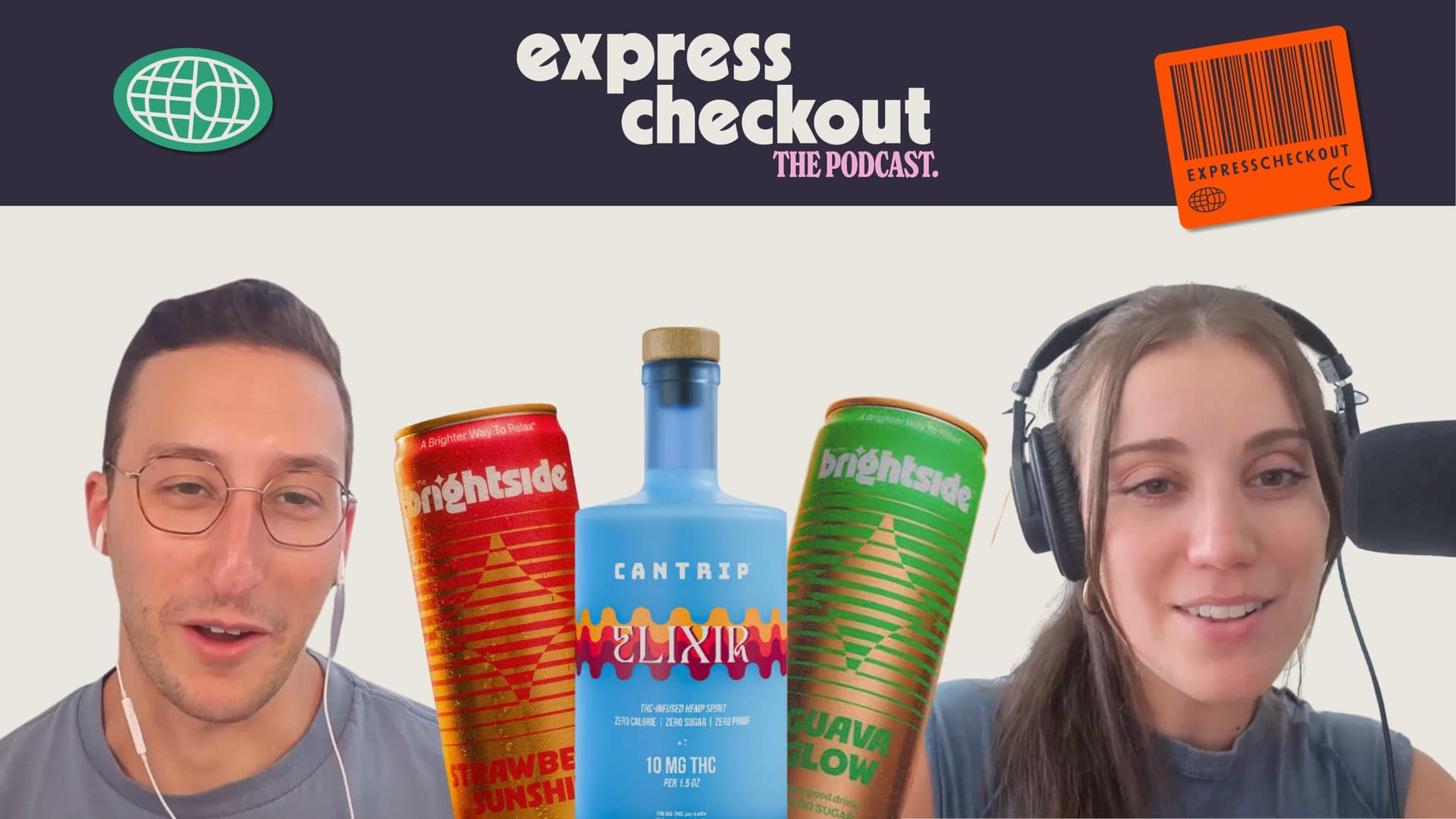
In short
The “next wave” of functional drinks, contrasting cannabis-infused THC seltzers/sodas (Cantrip) with a new federally legal functional soda (On the Bright Side) built around Zembrin for calm, relaxation, and mild mood lift.
Guest
Adam Terry, CEO and co-founder of Cantrip. Background in cannabis since 2015 after a chemical engineering degree; worked in vertically integrated cannabis (2017) and launched Cantrip in 2020 with low-dose THC seltzers (3mg THC/2mg CBD) via dispensaries, later expanding to hemp-channel liquor stores/mainstream outlets. In 2026 he launched On the Bright Side.
Key claims
Low-dose THC beverages didn’t become reliably “social”; data suggests ~15% use socially and ~85% drink at home with a partner/mostly solo. Consumers often scale dose quickly (2→5→10→up to ~10mg median, sometimes 50mg) and consume in one sitting. On the Bright Side uses Zembrin (standardized South African kanna extract) ~75% calm/25% euphoric at low dose; ~75% report mood lift. Mechanism claim: Zembrin inhibits the PDE4 pathway, reducing cortisol/stress response to scary faces.
Notable examples
Massachusetts 2021 dispensary results (3mg lagged brands selling 5mg); Minnesota hemp THC legalization enabling higher-dose buying (10mg then 50mg). Retail positioning comparisons: Trip, Hi-O, Recess, Olipop/Poppy, and alcohol alternatives like Heineken Zero. Regulatory discussion: hemp THC ban extensions/delays and Cantrip inventory strategy.
Written by AI. May contain mistakes. Listen to the episode to check what was said.
Chapters
Tap a time to open that second in VOFounding Cantrip and On the Bright Side
0:45 to 1:39
Adam Terry discusses his background and the creation of his beverage brands.
“I joined the industry in 2015 after moving to California after when I graduated with a degree in chemical engineering.”
Challenges in the THC Beverage Market
1:39 to 4:40
Insights into the challenges Cantrip faced in the THC beverage market.
“So I'm excited to talk about both of those today.”
The Concept of On the Bright Side
4:40 to 7:14
Discussion about how On the Bright Side aims to address previous challenges in THC beverages.
“And even if you make a really low dose product, what happens is people just don't buy it as often.”
Understanding Zembrin and Its Effects
7:14 to 10:12
Adam explains the key ingredient Zembrin and its calming effects.
“What is the ingredient that you're using?”
Consumer Education on New Ingredients
10:12 to 13:06
The importance of educating consumers about Kana and its benefits.
“all of those things you nailed right there.”
Marketing Strategies for On the Bright Side
13:06 to 14:01
Discussion on how to market On the Bright Side in retail environments.
“They have to pick it up and understand it.”
Navigating the Functional Beverage Landscape
14:01 to 16:47
Learn about the challenges of positioning functional drinks in retail.
“A lot of where you get to put on a shelf is determinative of what you put on your package and what the buyers decide for you.”
Understanding Kana and GRAS Status
16:48 to 19:19
Explore the nuances of Kana as an ingredient and its safety status.
“I mean, I know it is federally legal, but you're kind of operating in this somewhat of a gray area, I would imagine.”
The Science Behind Kana's Effects
19:20 to 23:53
Discover how Kana interacts with the brain and its potential benefits.
“For example, the toxicology study on Zembrin showed that essentially you have to take something around an estimate 2 ,500 times the amount of the daily recommended dose to see an adverse event.”
Comparing Ingredients in Functional Drinks
23:54 to 28:05
Discuss the differences in benefits between Kana and other functional ingredients.
“I'm really interested at the start of this, you were talking a lot about how you and many other THC brands had this hypothesis around low dose THC beverages being a social lubricant.”
Show all 18 chapters
Comparing Calming Beverages
28:05 to 29:56
Explore the distinction between magnesium and ashwagandha in calming effects.
“you've just described about Zembrin, putting it next to another beverage that the hero ingredient is magnesium, like it doesn't necessarily feel like those things should be considered the same subcategory.”
Retail Placement Strategies
29:57 to 31:00
Discuss the strategic placement of beverages on retail shelves.
“And I think we will at least try that at some point.”
Defining Functional Beverages
31:01 to 32:55
Understand the distinction between physical wellness and mental wellness beverages.
“Now, that's like as opposed to something like kava, which has a much more potent intoxicating effect than kana does and has a generally like mind altering effect on it, too.”
Challenges in Beverage Entrepreneurship
32:56 to 34:55
Learn about the difficulties and considerations in launching a beverage brand.
“And like the nice thing too is like, especially from this wellness boom, you can have a section that's also not just beverages.”
The Importance of Branding
34:56 to 36:58
Discover how branding influences the success of beverage products.
“And like, I don't actually know how to run a gummy brand.”
Future of Cantrip and THC Beverages
36:59 to 42:05
Delve into the future prospects for Cantrip and the evolving THC beverage market.
“Like any other Schedule 3 drug has to be an FDA approved therapy that's prescribed by a physician and sold through a pharmacy.”
The Future of THC Beverages
42:05 to 44:29
Exploration of the challenges and potential of THC beverages in the market.
“and he will not hold it for us but the point being so the point being like is a manufacturer date that's before the shutdown admission of a crime or is no one going to care about that i I don't really know.”
Closing Thoughts and Resources
44:30 to 45:28
Summary of insights from the conversation and where to find more information.
“And obviously we're like rooting for that as well.”
Transcript
Automatic transcript. May contain errors.0:00Welcome back to another episode of the Express Checkout Podcast. Today, we are joined by an entrepreneur who is rewriting the rules of the beverage industry. He is the CEO and co-founder of Cantrip, a trailblazing brand in the cannabis-infused beverage space, and on the bright side, a new feel-good soda brand. Everyone welcome Adam Terry. Hey, thanks for having me, guys. Excited to have you here. If you could start telling us a little bit about yourself, about the two brands you run that we can see in the background here for those of our visual listeners. Visual. You got to get more on the bright side stuff.
0:41Yeah, I'd be happy to tell you more. My background has been in cannabis for a long time. I joined the industry in 2015 after moving to California after when I graduated with a degree in chemical engineering. And so I've been always sort of downstream of the actual plant, turning plants into oil, turning oil into other stuff. I moved into the vertically integrated cannabis industry in 2017, joining a company here on the East Coast that had labs and processing in Massachusetts, New Hampshire and Maryland. And then in 2020, I started a cannabis beverage company called Cantrip, which was focused on low-dose THC seltzers at first, primarily through what we today refer to as the dispensary channel.
1:24And then expanding that into seltzers and sodas of a variety of doses in what we call the hemp channel now, which is inclusive of liquor stores and, you know, more mainstream outlets than dispensaries. Then in, I guess, 2026, I launched a new beverage called On the Bright Side, which is a functional soda that is focused on calmness, relaxation, and honestly actually solving a lot of the challenges that we set out to solve with Cantrip originally that did not end up getting solved by THC beverages. So I'm excited to talk about both of those today. Okay, love that intro because I think you just gave us the next question I want to ask you, which is what are the challenges that Cantrip wasn't able to solve?
2:08What was the impetus for founding on the bright side? Awesome. So I love this question because every THC founder I think I've ever met in the THC beverage industry, which is a lot now and accelerating over the last few years, even some this year, which is honestly crazy for other reasons. But everybody starts with the same philosophy, which is pioneered actually by a competitor called Can, who I know you've had on the show, which is that low-dose THC beverage make people more social, make people drink more of them. You know, the idea of giving somebody something that hits a little bit faster, that they can session, that they can drink more of is a really appealing idea.
2:43It makes a lot of sense for beverage. You want to drive scale. You want to drive volume in beverage. So more of one small thing. One small dose is really what I think the entire industry wants. And so when Cantrip launched, we originally had three milligram of THC and two milligram of CBD drink. And we were only those. The problem is every market I ever launched those in, those products immediately got beaten by whatever the highest dose in that category was. So in Massachusetts in the year 2021, even though, so we launched in June 2021, in August of 2021, we were reported as the ninth best-selling THC drink in America in the dispensary channel.
3:18Can was number two on that list, actually. Interestingly enough, number one was another brand in the Massachusetts dispensary channel called Levia. And one of the biggest differences between them and us is they sold five milligram drinks and we only sold three milligram drinks and they just flew off the shelves. And as we entered Minnesota later on, once a lot of laws changed with a really complicated story about how Republicans in 2022 just didn't read legislation, essentially Minnesota legalized selling hemp THC drinks outside of dispensaries. And you can make a 10 and you can make a 50. and pretty immediately people were buying the 10s and then we started making the 50s and people were buying those and it kind of showed that the consumer behavior behind THC drinks is less pro-social, less drink a couple at a time and more I want to get the dose that I want in one single can.
4:10The behavior that we've seen in THC beverages is really the following. People tend to find with their doses, that dose scales up over time pretty quickly from two to five to 10 and sometimes stronger. But usually the median cap is around 10 milligrams. And that is usually consumed in a single time in the evening. This is backed by data. We've seen it in our own internal polling where about 15 % of people report using these socially and 85 % report drinking them home with a partner. We've seen this in several data sets that Crescent Canna has published, which is a competing brand we have seen it in the more better studies which cantrip has participated in two of them these are real world data studies and the venture capital from listen which did a big survey of real thc drinkers i think they had a few hundred participants showed about 15 one one out of six people will take them to a party and then another one six will like consume them with intimate friends and the other four occasions that they identified are all solo drinking occasions so the short of it is THC can be social, but it's not for most people most of the time.
5:16And even if you make a really low dose product, what happens is people just don't buy it as often. And you see this not only in us who went from three to five to 10 to 50 and just continue to sell all of those doses. We had our median consumer was around 10 milligrams with some outliers, the 50 range, and eventually it ended up having to cut our three milligram. And then you see it in folks like Can who introduced a two, then a five. I mean, actually, I think they have a two, three, four, five, and 10 now, just because there were some limitations around. Live Nation required no more than four milligrams, I believe.
5:47And Connecticut at one point required three milligrams and no more. So there's a whole host of reasons to make a whole bunch of different doses. But ultimately, yeah, we figured out that we found out through data, the cannabis consumer is not that generally social, at least not today. And there may be room for that in the future. As more people adopt these things, people pointed out still not that many people know that Target it sells weed. And so as there increases adoption, there may be more people. But right now, what we see over a few million consumers in five years is that people are just not consuming THC socially.
6:20And so, you know, I found personally that it still wasn't, Loda still wasn't improving my social life. You know, I would drink, you know, a three milligram and it would be too much for me. And so as this hemp ban came into place or this, you know, hemp ban was threatened and we were thinking, okay, what else do we want to do? You know, we have this incredible team, this incredible market sales and marketing infrastructure, and a lot of great formula ideas. What else can we make? And can we solve the original problem we set out to? And that's kind of how On the Bright Side came into existence, which was trying to create something that was more of an alcohol alternative that at least had a good shot at people actually feeling something, but not too much, where they could still socialize, that was more pro-social, generally speaking, and that was focused on maybe more of the rights-infused ingredient to make that jump rather than just providing sort of an alternative to the taste or feeling of alcohol.
7:13Yeah. So can you tell us then about what is on the bright side? What is the ingredient that you're using? How'd you discover it and why? Yeah. So on the bright side is a, we're calling it a feel-good drink or a feel-good soda, depending on whether or not you understand that sodas can be functional. This is something apparently that turns out to be of some debate. And I've been having a lot of internal debates about what even defines a functional beverage, which is a whole other article that I could write at some point and probably will. But the focus of On the Bright Side is this ingredient called zebrin.
7:44And zebrin is a standardized extract of the plant kana. Kana is a succulent from South Africa that has been used for centuries for calm and focus. And what that really means is that there's two alkaloids inside the plant kana. And these are the things that actually matter. Or there's more than two alkaloids, but there's two alkaloids of specific interest called mesembry and mesembranone. And it is the ratio of those two and the amount of them that kind of dictates how much this plant can cause calming effects versus how much can cause euphoric effects. And usually there's a mixture of the two.
8:17Some people, when they're solving for Kana, are looking to dial up the euphoria as much as possible and keep that calm to a minimum. And some folks are trying to focus on the more calm than euphoric. So we're more like three quarters calm and one quarter euphoric at a very low dose. And so it's a very mild impact on a person. But, you know, about 75 percent of people report an active mood lift feeling, including myself. Some people don't. But what we do have and the reason we chose Zembrin specifically when we were looking at this ingredient, Kana, is a ton of data and studies that were done by the manufacturer that show here's the mechanism, how it works, here's why it works, and this is why we know it works and that it's safe.
8:59It's, I mean, it's really interesting and it's really exciting to hear about this ingredient. I know you've mentioned it's obviously been around for years and years in its origin, but like new to the average American consumer. And that obviously presents a lot of interesting challenges. So you went from building this company that was really rooted in, yes, something that is like legally ambiguous right now, but at least everyone's familiar with cannabis. A lot of people know how it affects them. People understand what the dosages mean for their individual bodies. Canna, totally different situation.
9:39A lot of people don't even know what it is, let alone how it will affect them. So what's like, how are you approaching educating consumers and removing that burden of this unfamiliar ingredient? Yeah, I mean, it's a really good question. And I think part of the answer is also a bit of a pushback on the premise of the question, which is that people don't actually know what cannabis and THC are as much as you would think, at least not once you start selling the beverages. A big thing that Cantrip had to spend the last few years doing, and many people did, is educate people on how it affects them, what the dosages should be, all of those things you nailed right there.
10:15Those are important talking points that have taken a lot of time to get even a baseline to the consumer. I mean, when we started selling THC beverages to liquor stores back in 2022, a big question was, how is this different from CBD? And anyone who knows CBD and THC knows that there's a pretty big difference between CBD and THC. But a lot of those retailers had felt burned on purchasing CBD beverages that never moved because there's no real psychoactive element to it. And so we have spent the last three or four years building this educational infrastructure. And it's been a big part of sort of the ethos and internal mantra of how we do business as a beverage company.
10:52And so in getting into Kana, which as I think is correcting your premise is an even bigger hill to climb when it comes to educating consumers. I mean, that just becomes part of the marketing. It becomes part of the ethos. And in my view, every strength is a weakness and every weakness is a strength in the sense that the weakness of Kana is that not many people know about it. The strength of it is that not many people know about it. So it's a lot less competitive of a set. There's a lot more you can do there. And what I think is working is that there are a lot of successful brands in what I view as the competitive set, which is more in the sort of the trip, the high-o, the recess, maybe even the non-cannabis breeze world.
11:32And as that section is growing and as more people are interested in Kana as a function, as people are interested in functional beverages generally, we think that we can really fit in there and also offer something that has a great taste because the active ingredient level is very low. That is a very potentially for more people has a more noticeable feeling. You know, certainly not something that we can or will promise to everybody, but something that we're really focused on helping people understand, you know, what this could do for them and understand that this is still a beverage first. And one of the things about cannabis beverage that was really important to me when I started this cannabis beverage company in the first place was that most of the ones I tried before that didn't taste any good.
12:12And the big change in like 2019 when Cannes launched and 2021 when we launched is that people were finally starting to figure out how to make these things taste good. And I think the functional beverage category still has more taste hills to climb. And so I think that's going to be a big advantage as we grow in this category. So it's more about helping people understand, I think, what the thing is supposed to do at like a top level, understanding that this is supposed to be helping calm, relax, be pro-social, be a great serve alternative or part of your socializing evening, even if it's not a complete substitute for alcohol.
12:45Maybe you zebra stripes, switch drinks between alcohol and this. And then really, once people are there and understand what's supposed to do, starting to get them down that funnel and explain the science, which I've been explaining the science of THC for years. And I've read every study on Zembrin. So I feel confident in walking them through that. And that just becomes another engagement opportunity with the consumer. They don't have to just pick it up and walk away from the brand. They have to pick it up and understand it. And so that really compels them to, like, interact with us, try to understand more about it.
13:13In retail, are you trying to lean into the function or the fact that it's a good product first? Because I've tried it. It's a great product. It's very chuggable. It's very flavor forward. It doesn't taste like a functional beverage. And I'm curious because online and in social media, it's very easy to lean into the function side of it because you have more room to provide the education. But on shelf, it can be really hard, especially if you're selling this outside of a liquor store where there's fewer options and people sort of linger a little bit more. If it's on shelf in a Target, for example, people are moving a little bit quicker.
13:51So they might not notice the common call outs. They might just notice, oh, it's on the bright side. Guava sounds good. Let me try it. How are you sort of thinking about that? Yeah, I mean, it's a really good question because something that we didn't get as much of on the THC side of things because we were in liquor stores primarily, which has a totally different world of retail buying and distribution. A lot of where you get to put on a shelf is determinative of what you put on your package and what the buyers decide for you. and something that I think we're going to encounter a lot of is that buyers today they don't really accept the concept of a soda being a functional which I know sounds strange because like poppy and ollie pop exist but they really had to define themselves more I think less in less functional terms to be where they are and more focused on flavor and just soda alternatives like a healthier better for you soda than they had to focus on the gut health stuff at least in the later years when they started to scale and something that i think we're encountering is that we probably we can't be put on the soda shelves if we are functional and we can't we may not even be able to call ourselves a soda if we want to be on the uh on the functional shelf set in the first place which is the craziest thing to me because to me i've designed this around being bubbly and uh and flavorful which to me is that soda as a word is like lost all meaning in some senses you know because there's not really a big separation between what a seltzer and a soda is anymore you know it used to be a seltzer was just flavored bubbly water without any sweetener and then hard seltzers kind of change that because they're all sweetened and then you know now liquid death exists with their soda flavored sparkling water uh is how their sodas are defined and so i think the pact is actually going to change from feel good soda to feel good drink and then we'll focus on the flavor and the bubbliness to kind of sell the soda because i think a soda would be great sitting next to say Ohio, which is a great tasting, but it is called a tonic.
15:48And I think it fits the mold of what a tonic is. It's got a little bit more of a medicinal kind of feeling to it. And the same with Breeze and Recess, I think just calls itself a beverage and Trip just calls itself a drink. Oh, which is fine, but they're very different than what we're kind of pushing as like our flavor profile. And so I think this would be a sort of a great compliment to that set in providing something more aligned to a soda, but that may just not make it past the, you know, like the standard buying criteria. And so we may have to do more work on calling it a soda in our marketing than on the pack itself.
16:20We have these weird institutional ways that we categorize food and beverage products that don't always marry to what a consumer expects. And so it's hard to both be a consumer obsessed company and, you know, get to where the consumers are sometimes. And that's kind of the big difference between D to C and retail. Yeah, absolutely. Another thing I've been curious about is Kana can be psychoactive, correct? Yeah. It depends on the dose that you're talking about and the specific type, right? Yeah. So I'm just interested. I mean, I know it is federally legal, but you're kind of operating in this somewhat of a gray area, I would imagine.
16:58Can you sell on the bright side in normal retail as a soda, even though it includes Kana? From my understanding, it's generally recognized as safe as an ingredient, but Like it seems like still a regulatory gray area. Yeah, it is a challenge to get the details and explain it again as part of the education because it's not just consumers that need educating, right? It's everybody up and down the chain. But there are a couple of things going for it, right? The first is what you just mentioned, generally regarded as safe. Not all Kana is GRAS and not all. So Zembrin is a specific extract of the Kana plant that comes from one single tribe.
17:34It is genetically fingerprinted at the time of extraction to make sure it is still the exact same Kana. So basically that makes sure it has the exact same amounts of all the things in it that are supposed to be there. And it is seed to sale tract, which is actually also very similar to cannabis. So the source and the extract are standardized. And that is the specific extract that's been studied. So when we reference these studies of Zembrin, if you actually look at some other brands that sell Kana, They'll often reference those studies, but they don't necessarily apply to any of those products because the Zembrin studies only apply to Zembrin, which is different than, you know, run-of-the-mill KANA that you get from random suppliers to any other supplier.
18:13And so those studies were done specifically to obtain what is called self-affirmed GRAS status, which is something like a 50-page document vetted by three independent experts that is put together and compiled to submit to the FDA to show safety across a wide range of things. Now, generally regarded as safe or generally recognized as safe is an FDA status. And there's basically self-affirmed, which means you've submitted this to the FDA. And then there's FDA notified or no questions asked status, which is a slightly higher regard where you actually go through the work with the FDA, which is something that Zembrin has not obtained.
18:50But the GRAS status does mean that essentially up to that certain dose, and as my mother, who's a toxicologist, loves to say, it's the dose that makes the poison. Up to that dose, anyone basically should be able to consume it without worrying about anything else on the other side. And like so, you know, there's a lot of products that are GRAS or a lot of food products that are GRAS specifically because they were grandfathered in. They existed basically before the status was around. And then there's stuff that you can pay to get studies done. And those studies include intense toxicology. For example, the toxicology study on Zembrin showed that essentially you have to take something around an estimate 2 ,500 times the amount of the daily recommended dose to see an adverse event.
19:32So you have to drink that would be the equivalent drinking like 8 ,000 of my cans, which you'd probably explode from water before you saw any adverse events. And then, you know, again, we're talking about up to the certain dose in a day, which is 50 milligrams, which would be the equivalent of three of my cans. And then that doesn't mean it's necessarily unsafe afterwards, but it means that you should be doing more digging. You should be more understanding of how it's affecting you. And so because of that, we know that this product is more acceptable than, say, if I put anything else. No, like as a contrast, things like ashwagandha, lion's mane, not all of these have GRAS status either.
20:06And, you know, they're on plenty of shelves everywhere, right? ashwagandha actually learned recently is illegal in japan um so you know there's a lot of things that we think of as like fine in america just because they've been putting stuff for so long are actually illegal in other places because they're viewed up as drugs and so everything and i know you guys have had some scrutiny of the you know supplements adjacent world everything is you know up for sort of consideration debates and its actual impact on your psyche and Like psychoactiveness is not always indicative of its danger and the inverse, its lack of a direct impact on your consciousness is not indicative of its safety.
20:46And so all of those things need to be assessed when you look at what you're consuming and why it is important to actually read the label on everything you have. But this is why we think it can go. I wouldn't put it necessarily next to, you know, Olipop and Poppy. I would put it near Hio and Recess and Trip because if you're wandering that aisle, you should be spending more time reading labels and recognizing what you're in. Yeah, that makes a lot of sense. And like luckily, like there is this set being built for this type of drink. It's no longer just in the NA side or in like VMS. There is a functional beverage category.
21:22There's a whole set for this and brands like we've mentioned them, Trip, Hio, Recess. They have been helping to build that set out, so you fit really nicely in there. And luckily, too, you've branded it so differently that it also really stands out in, I think, a very nice way. Have you, from talking to retailers, from going to these trade shows, have you felt that the buyers are understanding what you're positioning to them? I think conceptually, yes, at a trade show. And when you're talking to them, they get it. I think when it comes down to they have 2000 SKUs to review all at once, it's a little bit of a different thing.
22:01And, you know, we are lucky enough to have engaged a great broker. We have some top sales staff. This is like the nice part about starting a brand with some existing infrastructure. We have some people who know what they're doing, which is in contrast to me who just makes beverages and hope somebody else knows what they're doing. So we've been able to get in front of a lot of buyers. I do expect, you know, we'll get some good pickup next year, but we're not going to get everywhere that we want. you know, and it's going to take more time. Luckily, and this is again, something else, another learning from the THC industry is like, as a category gets built, it is a rising tide raises all boats kind of situation.
22:34And so the better trip does, the better recess does, the better I will do. And so I have no problem name dropping them several times on your podcast, because I want them to succeed, right? You know, I want that ship to rise when it's funny because so we've mentioned can before, again, back to the THC analog, we launched in the same week with the same distributor as can in minnesota when hemp thc was first sort of codified into law by by by the state and the weird thing was like as we started expanding states like we started looking in new jersey really early on because i'm from new jersey my co-founder is from new jersey and we would go to stores and they'd be like you're trying to sell me what and like the belief that this was legal was just not there and it's not until you have like 10 sales guys knocking down your door with, you know, slick branding on every can that it's like, OK, maybe there is something going on here.
23:25And that's kind of the point of branding, right? Like it's a psychological connection. So I'm putting my mark on it because I put my faith and my backing behind it. And so that gets more retailers going. But I do think there is sort of like a cap on it, too. And it's something an investor asked me is like, how many could succeed in this category? I'm like, I don't think it's going to be more than 20, you know, but I think it's more than three. And so, well, you know we have to see the category grow but as more people get interested in functional beverages as folks like you you know help educate people just on that these things exist it helps i think build consumer interest and it's not a monocultural beverages anymore it's not everybody's drinking coca-cola and butt light every weekend and people are more interested in different things and i think there's a huge opportunity in sort of covering this common category in a way that it isn't yet and like now is hemp ban or no hemp ban the perfect time to build in this space yeah Absolutely.
24:19I'm really interested at the start of this, you were talking a lot about how you and many other THC brands had this hypothesis around low dose THC beverages being a social lubricant. Seems like that was relatively proven wrong. Why is Kana different? What about Kana's effect will make this actually the social lubricant that you are anticipating and not cause the same effect of needing to up the dosage more and more in cotta. Yeah, that's an interesting question. So I don't have a lot of information about tolerance build over time, but I can talk about why it's actually more pro-social than cannabis.
24:59Now, we don't have as much information as anyone would like on exactly what cannabis does in your brain. We do a decent amount about interactions in CB1 and CB2 receptors. For example, we know that CBD is great at inhibiting your anxiety or pretty good at it at least. And THC can actually increase your anxiety, right? This is, you know, commonly called paranoia that happens to owners. What happens with Kana, and this is what was learned in some of these studies that were specifically done on Zembrin. So what I'm about to say, I only know what applies to Zembrin. I don't know that it applies to all Kana generally is that what it seems to do, the data suggests that it inhibits something called the PDE4 pathway in your brain.
25:40And what that pathway does is it basically is a link between your hypothalamus and your amygdala. Now, the amygdala is where fear occurs in your brain. And the hypothalamus releases things like cortisol, which is a stress hormone. And so the study that they did showed that it reduced the amount of signal that your hypothalamus was being shown when. And this is the actual methodology for the study. They showed people basically neutral faces and slightly scary faces. And they measured people's cortisol responses to that. And people who were on Zembrin, you know, double blind studies showed that they had less cortisol being released.
26:20So basically the signal from the amygdala that said, be scared of new faces was reduced. And when it got to the hypothalamus, the hypothalamus produced less stress. And so this is not like a dramatic effect. This is not, it's not an antidepressant. It's not going to stop you from being afraid. It's not going to numb you, but it can make you just maybe a little bit more inclined to be talkative or a little more inclined to have that conversation with somebody that maybe you wouldn't have before. And that's been my experience generally. You know, we did a little lunch party in Austin, so I got to drink a fair amount of it and talk to people.
26:54I felt, you know, very social which is like different than what i do at cantrip i feel so weird because my my co-founder is very social on cannabis and can consume quite a bit of it uh i am not and so we go to cantrip events i can't really consume cantrip at those events without like then needing to go home and that just puts me in like you never want to be the founder that's not consuming their own product at their own event so coming back to kana specifically zember and we know what the mechanism is and we know that's not a dramatic effect these are like a couple percentage points improvement but enough to show the point of it and whether or not you actually actively feel that mood uplift has nothing to do with whether or not you have a reduced stress response.
Read the full transcript
27:34And so, you know, the data that we have show that there is a reduced stress response. Would I love more data because it's always great to do more studies on these things? Absolutely. We'll keep proving the point that this is safe, it's effective, and it's not going to get anybody messed up. Really interesting. Yeah, as I'm hearing you talk, I do keep coming back to this thought of how all of these brands that you keep mentioning are now going to be looped under this category functional, which like after everything you've just described about Zembrin, putting it next to another beverage that the hero ingredient is magnesium, like it doesn't necessarily feel like those things should be considered the same subcategory.
28:17How do you feel about that, I guess? I feel like for this specific thing, magnesium is going for the same effect that we are. And that's why they would necessarily be grouped together. Like magnesium is supposed to be calming. The ashwagandha, to some extent, I'm not totally clear what the desired outcome from ashwagandha is, to be honest, because I've heard a lot of different things. I don't think anybody does. And so when I think about, yes, magnesium is, but magnesium is also hydration because it's an electrolyte. So I'm like, I get a little confused on that. Can's new product actually really confused me for that.
28:46I was like, it is, I guess, hydration and calming at the same time. But I think it's like it's in that same vein. And while we know more about like the effect, like magnesium is having an effect on people. It's just maybe they haven't done as much. They haven't been required to actually look at the mechanisms in the brain. They haven't been required. And there is like an upper limit to how much magnesium you consume in your body before you get heavy metal poisoning. You know, it's a lot of these these things, they just they get a pass because they exist or because they're more generally known.
29:16Right. I mean, magnesium is a single ion. So we know a lot or we've been it's just been in existence a lot. Kana is just less well known. But generally speaking, you may get a mood lift from Kana and some stress reduction from Kana that doesn't exist in magnesium. But not to such an extreme extent that I wouldn't necessarily feel comfortable with them on the same shelf. I guess like I'm curious less about the comfortability of them being on the same shelf and more from a consumer standpoint. I think these are different occasions. And so it's interesting to hear like them being placed on the same shelf when I associate magnesium more with like, yeah, calm sleep as opposed to social lubricant means something different to me.
29:56No, that's a really good point, too, because there's an argument to put these on the shelf in a liquor store instead of in a grocery store. Right. That's what I'm thinking. Yeah. And I think we will at least try that at some point. The thing that we're nervous about with liquor stores, and this may be more of a long tail thing as long as THC beverages are still in liquor stores, but people go to liquor stores primarily to find something that they can definitely actually feel like it's the actual intoxicant because these are not intoxicating enough. I don't know that they would move a turn as well.
30:26I think people would be interested in them. And while they're pro social, it's like, you know, these also might instead of being next to high on trip, they could also maybe fit next to like Heineken Zero. Right. Like they could fit next to like the alcohol alternative drinking occasion. And I think there's a lot to learn about like where you end up on a retail shelf. Like I said, it has a lot more to do with how the buyer understands your product than necessarily how you understand it. Part is like how you pitch it to them. We are going for a specific shelf, but I think, you know, the challenge we face is the friction and understanding where this goes.
30:57And like that's the thing that we're working hardest to overcome. And it seems like we fit more neatly when it comes to, quote, functional beverage than it does when we fit to alcohol alternative and how people generally understand it. Now, that's like as opposed to something like kava, which has a much more potent intoxicating effect than kana does and has a generally like mind altering effect on it, too. I think it also is a higher risk of further regulation if it becomes very popular. but that may fit better into a liquor store i think than into you know a natural grocer but then again sprouts sells dhc beverages target sells dhc beverages so like what shelf where how why is a really big question what defines a function you know what defines functional versus non-functional i'm starting to categorize in my head is like physical wellness which includes you know probably maybe to some extent magnesium but also just hydration generally or gut health or protein like protein is a functional beverage but a very different kind than what uh you might call mental wellness beverages which is more like the trip and the recess and the high oh like things for the mind and the soul rather than for the body love that distinction because that was like one of the things that was really bothering me is like i have been trained to think of functional beverage equals gut health because of olipop and poppy and so when i think of the functional category, although I know obviously of brands like Trip and Hi-O, I wouldn't have in my mind positioned them next to an Olipop or a Poppy in the functional set because they're not physical wellness.
32:33And I almost think there needs to be an entirely different subcategory for these mental wellness beverage brands, which like insane to hear myself say those words because that sounds actually ridiculous. I'm like, how did we get here? I think it's ridiculous at all. There's enough brands to make these specific categories, to have gut, to have mental, to have physical, to have a sleep section. And like the nice thing too is like, especially from this wellness boom, you can have a section that's also not just beverages. Like it can sit alongside skincare, other edibles, topical. Like it can sit, it doesn't have to just be in grocery too, which is actually also, which is really nice because then you can actually position it much more for the type of function that you're, you're leaning to with these complimentary products.
33:23I think part of it is that brands really run ahead of where retailers are at. Like Poppy and Ollipop were way ahead of any of the. Decades, decades ahead. Like where I feel like the beverage industry needs to be today. And we're just so far away from it. It's like a store where instead of shopping by like product format, you're shopping by what you want out of that product. Like you could basically have like a section that's like all stuff that's just contains protein and then just all stuff that contains collagen peptides, you know. And like that's your skin care section. Like you can have your, you know, your face creams right next to your, I don't know, name it.
33:57Any one of the beverages has collagen peptides in it right now versus, you know, your mental wellness. And like there's, you know, a ton of powdered magnesium and there's a ton of different like just, I mean, Zembrin comes in capsules. That's the most common thing that it's sold in capsules or gummies. And it does exist. Like sprouts already carry Zembrin in their supplement section. A lot of these stores carry some version of Kana. and i think beverage is just a really popular format for buzz for scale god knows i mean it's i don't know why beverage continues to be a popular format because someone who's run a beverage company for the last five years it's like literally the least efficient way to run a cpg business because nobody's asking the beverage founders should i launch a beverage company they're just launching a beverage company what is it just water and some powder how hard yeah yeah no it's uh it's really tough when young entrepreneurs come up to the booth at the trade show and ask hey should i start a beverage company i'm like you want to be encouraging but also like wait that also begs the question you just started a new beverage company why did on the bright side need to be a beverage no that's a really good that is a really good question why i don't know maybe i hate myself a little bit just like i'm a beverage guy it's just what i do i've been doing it even before i was like making cantrip so i was a bartender in college and i was in like high-end coffee and espresso So before that, and I was, you know, learning all the stuff about taste and bar and like beverage has just always been for me the best place to like express, you know, what I'm interested in, both from like a flavor and a communication standpoint.
35:30Like I've had a small distillery. I've done everything inside beverage. It's just like the world I know. And like, I don't actually know how to run a gummy brand. Like I don't know how to run. We, I mean, I'm definitely thinking on the bright side, if people respond well enough to the brand and the ingredient, which I really think they will as soon as we, I think we need to do more brand marketing, frankly, than we even need to do product marketing to start. And if the brand is received well, and then eventually the ingredients receive well, I think it would go great in a stick pack. It would go great in a gummy.
36:00My, you know, my profit margins would love me a lot more if I made anything beside a beverage at all. I will say this, actually, I will take it back. Beverage is not the hardest thing. Frozen is the hardest thing. Frozen is the hardest thing. But as far as shelf stable products go. yeah it's super interesting so it sounds like you want to build a little bit of a platform brand if it's well received i think all good brands are platform brands right like i think if you're making if you're really otherwise you may as well just be a product like that just generically i mean wasn't there that company that tried to do that some like five years back that was like yeah brandless they're just like we're just gonna be a thing that was that was a their products are terrible they raised so much money to they raise like close to like god i don't know like 350 million maybe a little bit more fundamental misunderstanding of human psychology i feel like because like ultimately brand doesn't work because of the product product works because of the brand like liquid death is just a water canned water company and like none of their early marketing anything really to do with water other than a sick-ass tagline that said murder your thirst and to date they've killed fewer people than panera bread has so like i don't really understand like that's a good line actually i think we need to tie it all together what's the future for cantrip now well the future for cantrip uh i like to say is still bright uh i'm looking on the bright side these days all right damn beautiful no look there's not only one way to sell weed in america there are multiple ways cantrip's been in dispensaries before there is no single i think scalable opportunity in dispensaries today that could change schedule three for for marijuana is likely to happen and like for those keeping track at home we actually don't really know what that means i mean i could have told you a year ago when they moved medical to schedule three which happened immediately on the the appointment of todd blanch like schedule three would not necessarily mean marijuana medical marijuana is legal but what i did not anticipate is the dea actually released an entire registration form for medical cannabis for something that does not exist anywhere else.
38:05Like any other Schedule 3 drug has to be an FDA approved therapy that's prescribed by a physician and sold through a pharmacy. Medical cannabis under Schedule 3 apparently does not. So medical marijuana dispensers are going to be exempt from 280, it looks like. I'm still not totally clear on that. 280 for those who don't care or who do care, which is almost nobody, is a specific punitive tax code that exists on narcotics in America, which is why every cannabis company is really struggling. They get taxed basically like four times as much as any other company. And CPG is also already not super profitable.
38:40But the point being that we are getting closer and closer to a real federal interstate trade future that I didn't even predict could happen under Schedule 3 because it's not totally clear what that means for recreational cannabis. Because technically speaking, according to the letter of the law today, just because something Schedule 3 does not mean you can suddenly trade it among states. Like Spencer in California can't suddenly start selling to a dispensary in New Jersey legally or vice versa because of Schedule 3. But because of how uniquely cannabis is being treated, which does make sense because it is unique among sort of these drug therapies that exist, there could be ways of states working with the federal government to find a path for some version of a weird federal patchwork system that doesn't exist for any other substance.
39:23Or we could be one step closer to legalizing it fully. Now, hemp specifically, which is the version of cannabis that is federally legal today, and just a quick definition on that, anything less than 0.3 % Delta 9 THC by weight, which can include a lot of milligrams of THC as long as something is sufficiently large to be less than that weight. For example, a 5 milligram 12 ounce beverage is 0.0015 % Delta 9 THC by weight. And so you can put a lot of milligrams in a beverage before it becomes federally legal. So those may still have a future immediately. We got our 30-day delay. I don't know if you've had anyone on since that happened, but Congress, this is basically the same package that gave us a one-year clock on all of hemp THC being banned last year, last November, is the same vehicle that has given us now a 30-day extension.
40:11Actually, I think it might even be 29-day extension to make it even shorter. What does that mean? It could mean a lot. It could mean nothing. What I've written about is essentially what it means is that the job now is for congressional leadership to agree behind the scenes what could be done with hemp next for maybe beverages and edibles, maybe full spectrum THC, because that's something the president wants. We could see a package agreed to behind the scenes, and then they pass another extension with the next continuing resolution. And that would kick it into spring. There's no way a new regulatory bill could pass by December.
40:44It's just not possible, particularly because a tax bill, anything that involves taxes has to be run through the OMB, which takes 90 days. So we're looking at maybe spring to summer for a full regulatory package and possible a delay of the implementation of the ban, but maybe also with some further restriction. For example, this extension did not was not a clean extension. They still banned all synthetic THC in this extension. We can see the next extension saying, OK, now there's an official age gate must be 21 plus and we're going to limit it down to beverages and edibles. or we're going to say direct to consumers band or we're going to say there's a version of it out there.
41:18It's like we want it only grown in the US. We want 21 plus and we want it at five milligram per serving cap. I don't I don't know what version of that could happen in December. The kind of complicated part of this is that the government could shut down on December 12th. I think it's incredibly likely that that happens. So even if we thought there was going to be an extension, it's going to be illegal during a shutdown. And so you could have a situation which inventory that's legal on December 10th and has an expiration date for another year. becomes illegal on december 12th and then it becomes legal again on december 23rd and i don't oh my god i don't totally know what happens there so well i mean take it off self and throw it back on self like what does that even look like exactly is it still legal i mean but the holding it is a technically a crime during that interim and so he will not hold it for you and he will not hold it for us but the point being so the point being like is a manufacturer date that's before the shutdown admission of a crime or is no one going to care about that i I don't really know.
42:14So what's going to happen with Cantrip is I would keep an eye on our website for one last Black Friday sale. It's going to be maybe a sort of everything must go kind of deal. So we'll probably try to run down inventory close to zero. I think that's the wise move to make for any beverage brand in the space right now. And then hope that we can manufacture inventory after. And even if that doesn't happen, I think these things are coming back one way or another. I think there's a lot of vested interest in making sure, even if it doesn't get fixed by December, that it gets fixed in spring next year or summer next year.
42:46So I still believe THC beverages in liquor stores and generally as a scalable business model is a long-term viable pathway. It just may take longer for legislation to catch up. And in the meantime, we'll probably go into dispensaries for a couple of them, keep the brand alive, keep people aware of what we do and why we do it. You know, I think there's going to be a lot more pushback on this ban once it actually hits consumers, because a lot of people, as many emails as I can send, do not read their emails that we send about things going out of stock in a hemp ban. And, you know, Can has a great campaign that's going right now that don't ban Can campaign that we're all just trying to find our pathway out of this.
43:26But once everything is hard banned and people just can't get access to that THC, you see what's happening in Texas right now. They don't even have a full THC ban. Technically, Cantrip can all the Delta nine natural products that are under point three percent. The edibles and the beverages are still legal, but it's the flower vapes that have become illegal. And everybody in Texas is treating this as a total ban, including prominent Senate candidates. And so once that if that happens nationally, I think we're going to see a pretty different attitude in Congress. And so I have real faith that Cantrip is still going to be.
43:56I mean, I still think it could be a billion dollar brand because I think there's going to be 10 to 20 billion dollar THC beverage brands in the next 10 years. Assuming we figure this stuff out in Congress and there's a lot of companies, a lot of money that aren't going to give up. Well, these remedies are going to just disappear after growing as much as they did. And nowadays isn't going anywhere. A lot of the smaller brands are going to unfortunately die. But that's kind of what some of these bigger players who are not yet selling THC kind of want. They want a market reset and then they'll work with Congress to magically find a pathway to reopen it.
44:26And I think we'll still see these things on the shelves by the end of 2027. We'll be waiting with bated breath. And obviously we're like rooting for that as well. But it sounds like quite the hurdle to get there. So glad that there are other products like on the bright side that people can try and see if it is functional for them and hope that something changes on the cannabis side. Yeah, absolutely. I'm just glad you're thinking on the bright side. Yeah, thinking and drinking on the bright side. Thinking and drinking. Thank you, Adam, for joining us. This was a really interesting conversation.
44:58I really appreciate you providing some extra insight and analysis on what's happening. Where can people find Cantrip and on the Bright Side? The websites are drinkcantrip.com and drinkbrightside.com. You can find us on, we're at Bright Side Soda on all the socials. We're at drinkcantrip. I have a sub stack everybody can find by just Googling my name. Anytime you guys want to talk about legislative policy on cannabis, you know where to find me. All day, every day. We appreciate it, Adam. Thank you so much. Catch you in the next one. Thank you, guys. Have a good one. Bye.
From the publisher
This week on the pod, we’re thrilled to be joined by Adam Terry, CEO and co-founder of Cantrip and On the Brightside—and absolute WEALTH of knowledge on all things THC regulation and functional beverages.
Adam walks us through his journey in the cannabis beverage industry and pivot into a new kind of functional drink. He explains why the low-dose THC hypothesis didn’t pan out, the science behind the new functional ingredient he’s betting on, and the tricky retail landscape of functional beverages.
This is a great follow-up episode to our interview with Jake Bullock, CEO and co-founder of Cann—offering some updates and rare insights into the ever-changing THC regulatory environment!
The breakdown
0:00 - Intro and Adam Terry’s background
1:56 - The low-dose THC hypothesis
6:13 - The hemp ban and birth of On the Brightside
7:14 - What is kanna?
9:09 - Educating consumers on an unknown ingredient
13:20 - Retail strategy: soda, function & shelf placement
19:55 - Kanna vs. other functional ingredients
24:01 - The science: why kanna is more pro-social than THC
27:50 - Rethinking the functional beverage category
37:22 - The future of Cantrip & hemp ban outlook
🎧 Love the show? Subscribe to the Express Checkout podcast wherever you get your podcasts! New episodes drop weekly.
📧 Get the inside scoop Subscribe to Express Checkout, our newsletter packed with consumer insights, trends, and exclusive content straight to your inbox at expresscheckout.co.
🗣️ Let’s connect! Follow us for behind-the-scenes content, quick tips, and more: @expresscheckout
💬 Join the conversation Have a product you’re curious about? DM us your questions or drop them in the comments—your topic could be featured in our next episode! If you have any thoughts/questions/suggestions, feel free to email us at hello@expresscheckout.co :)
⭐ Help us grow If you enjoyed this episode, please rate and review us on Apple Podcasts or Spotify. It helps other curious consumers find us!
Get full access to Express Checkout at www.expresscheckout.co/subscribe