In short
Troy, founder of SAWS, explains how the brand built a $22M pasta sauce business by disrupting commoditized tomato sauce with Gen Z-first branding, flavor innovation, and retail-scale distribution.
Guest background
Troy grew up in LA, studied at USC, interned at a merchant bank during COVID (tech/media/telecom M&A). He and co-founder Winston started with COVID drop-shipping a sanitizer dispenser (no inventory, no IP), then pivoted into making tomato sauce after investing in consumer brands via angel checks.
Key claims
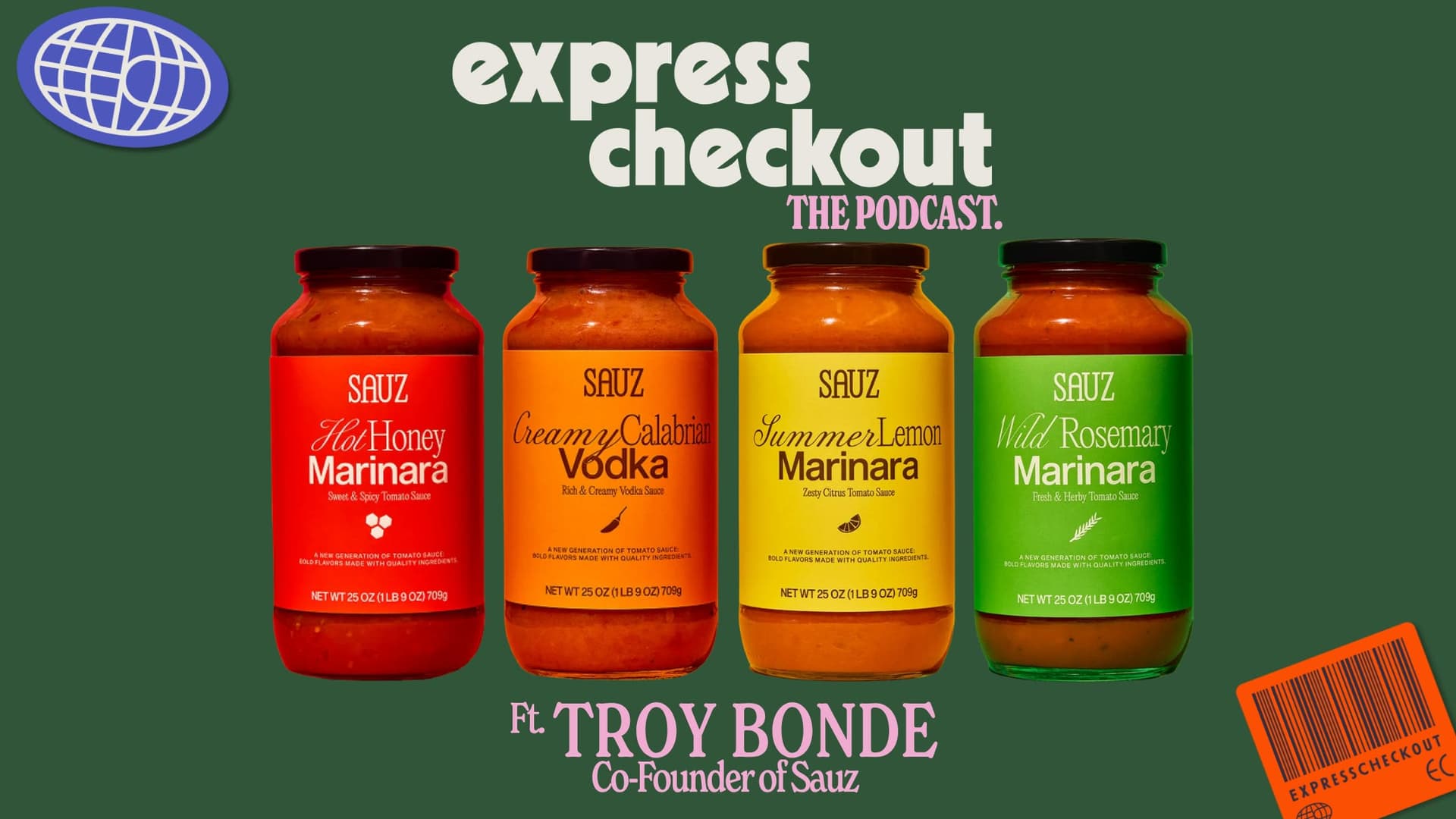
SAWS “breaks norms” of premium Italian restaurant-to-retail branding, using content to create awareness and incrementality (claims: ~15x category average with young families). They “own the modern tomato” and plan TAM expansion beyond sauce. They see strong repeat via panel data despite low household penetration (~9–10% ACV).
Notable examples
Hot Honey; Basic Basil Marinara (announced as an April Fool’s joke, went viral); California Naturals collab tomato lip balm with Owen Wilson tie-in; “pimping Troy out” dating-show-style TikToks; value-engineered flavors designed to work from Whole Foods to Walmart.
Written by AI. May contain mistakes. Listen to the episode to check what was said.
Chapters
Tap a time to open that second in VOTroy's Journey: From Hand Sanitizer to Pasta Sauce
0:36 to 5:07
Troy shares his unexpected journey from selling hand sanitizer to disrupting the pasta sauce market.
“Troy, you want to give us a little bit background on yourself, how you got started in this?”
Disrupting a Sleepy Category
5:07 to 10:54
Troy discusses strategies for innovating in the pasta sauce market and the unique branding approach of Saws.
“I want to get into all of that, but I want to back up a little bit because I feel like we skipped a step.”
Future Expansion and Unique Collaborations
10:54 to 14:01
The conversation transitions to potential product expansions and unique collaborations for Saws.
“And I think your timing was also really good.”
Innovative Collaborations: Tomato Lip Balm
14:01 to 18:05
Explore how Sauz's unexpected collaborations, like a tomato lip balm, drive brand identity.
“Like I think, I think we can be in many ways, like there could be tomato based products that are not a sauce or condiment that I think we could win in.”
Reverting to Basics: The Basic Basil Marinara
18:05 to 24:29
Discover the strategy behind Sauz's return to classic flavors with Basic Basil Marinara.
“I look up to those two girls in so many ways from a collaboration standpoint.”
Social Media Strategies and Brand Identity
24:29 to 28:01
Learn how Sauz leverages social media and unique campaigns to enhance brand visibility.
“And so that's really my goal, to be honest.”
Creative Marketing Strategies
28:01 to 28:50
Explore unconventional marketing tactics that drive brand engagement.
“As long as it helps you sell tomato sauce.”
Driving Growth in the Pasta Sauce Category
28:51 to 30:40
Learn how to attract and retain new consumers in traditional food categories.
“Now there is, brings them back into the category.”
Balancing Premium Branding and Mass Market Appeal
30:41 to 34:16
Understand the challenges of transitioning from niche to mass markets while maintaining brand identity.
“I think a lot of retention and building lifetime value is simply relevance.”
Innovation Inspired by Global Flavors
34:17 to 36:24
Discover how global flavors influence product innovation in food categories.
“Like we laugh about it often in internal innovation meetings because it's like so different than what you would expect premium to be.”
Show all 13 chapters
The Future of Flavor Innovation
36:25 to 38:46
Examine opportunities for flavor innovation within the pasta sauce market.
“Consumers sometimes need to be shown what they want.”
Community and Collaboration in CPG
38:47 to 41:24
Appreciate the importance of community support among early-stage CPG brands.
“There's so much opportunity to continue with our foot down on the growth that I have no reason to be distracted other than the fact that I love it and it's so exciting.”
Gratitude and Closing Remarks
42:01 to 42:21
The hosts express gratitude and share light-hearted closing comments.
“And we're just so grateful to have you on.”
Transcript
Automatic transcript. May contain errors.0:00Welcome back to another episode of the Express Checkout podcast. We have recently decided to change the name from The Curious Consumer to just Express Checkout podcast, make it a little simpler, a little bit more unified with the rest of our content. Nothing will change from your end. If you've already subscribed, we'll keep getting the podcast. And if you haven't subscribed or your friends haven't, just tell them to search Express Checkout wherever they find their podcast. So enjoy this conversation with Troy, the founder of Saws. We are very excited to be chatting with him on all things Saws.
0:34So please enjoy. Today with us, we have a very special guest, a saucy guest, Troy from Saws. Welcome, Troy. What's going on? I'm happy to be here. Thank you both for having me. We're so happy to have you. We're very excited. I love it. I need that on my Tuesday morning. I'm excited. Yeah. Let's start talking about some sauce. Troy, you want to give us a little bit background on yourself, how you got started in this? Yeah. Why you're making the hottest sauce brand on the market right now? Yeah. Well, I didn't expect to be doing it. I grew up in LA. I went to USC. I was an intern at a merchant bank during COVID in lower middle market tech media, telecom, M &A.
1:20wanted to go banking it was like Nate's face says it was boring boring I didn't I didn't love it and you know I started drop shipping during COVID I was selling this hand sanitizer dispenser with a built-in infrared thermometer so you could take your temperature with your hand it would display it and you could sanitize your hands at the same time Nate I can't believe I've never told you this we've known each other a little while no that's a crazy like such a COVID drop shipping, hand sanitizer, tapestry. We held no inventory. We owned no IP. We were effectively a distributor for a Chinese manufacturer in Shenzhen.
1:59And Winston, my co-founder and I started the business together because we were bored on Zoom interning. He was in real estate. I was in banking. And we cold emailed a local school district in LA. And they emailed me back same day. They said, we bought one unit from a manufacturer in China. We tested it. It worked. We emailed a school district. They emailed me back. I demoed it that evening at the school district. And by the time I got home, I had assigned PO for 25 grand. And I called Winston and it was like shocking, first of all, because we'd never seen a purchase order of$25 ,000 in our lives.
2:37And Winston said to me, I'll never forget. First thing he said was, how are we going to buy the inventory. We need$9 ,000. We started laughing. And I ended up, I drove to my grandfather's house. He was 90 at the time. I told him I needed to borrow$9 ,000. And he wrote me a check and said, I don't expect it back. And I said, I'm going to pay you 10 % in 15 days. It's net 15. And so I went straight to the bank, wired it to a manufacturer in China who I'd only spoken to via WhatsApp. Being a novice founder sometimes is a great thing because I would never do that today. And a week later, five pallets arrived on my parents' doorstep and we delivered them to Glendale Unified by hand.
3:18And they paid in 11 days. And from there, that business was a wild one. It went zero to almost seven figures in, it felt like 60 days. It was probably 90 days. And it went seven figures to zero in the next 45. And so if you look at two quarters of the P and L, it was straight up and straight down. I didn't want to go back to banking. Winston didn't want to go back to real estate. We'd netted, it was a highly efficient business. Winston and I were sales, marketing, finance, and ops. And so we netted enough to be able to take another shot, but not enough to not go back to banking, right? And we knew we had to pivot into something that was sustainable and that we could build real enterprise value for and one that you really had true brand affinity and brand equity with a consumer.
4:06And so we had an office in our hometown. We were cooking tomato sauce all the time. We were buying jarred tomato sauce. We were tired of it after a week. And we felt like we could take this two-pronged approach on brand and product and really innovate in a category that was totally commoditized. That's how we ended up in tomato sauce. It was a strange path that I never otherwise would have expected. And I always joke that one of my favorite memories is calling my parents and telling them that I wasn't going to go back to banking and I was going to sell tomato sauce for a living.
4:36Troy Bonde:But we've been really fortunate. We, we, Rao's had just been acquired and there was a, the eyeballs finally turned to the category that had been sleepy for so long. And so a lot of tailwinds, so much luck and really great timing, but that's how we ended up here for the most part. And now you've built this incredible brand sauce that is available in Target nationwide and Sprouts and all over the country. Absolutely killing it. Scaling so quickly. Raised$22 million. I want to get into all of that, but I want to back up a little bit because I feel like we skipped a step. You went from hand sanitizer to just pasta sauce is boring.
5:14Troy Bonde:Let's start a pasta brand. What did that even look like? Did you know anything about CPG at the time when you were entering this? Obviously, you knew what a PO was. That's a good leg up. That's something. But there's a difference between I'm shopping in this category and I think it could be better and actually starting that brand. So can you tell us a little bit about that? Yeah, you know, we didn't know CPG in any way. We didn't really know how to run a business, right? I mean, there was a steep learning curve, to be honest with you. But we took, so half of our bottom line on the sanitizer business actually went toward early stage investing, writing angel checks in like series A and prior consumer brands.
5:58And the thesis there was that what better way to see under the hood of CPG than to write small checks and to get to know founders and to accelerate a network build. And so we ended up, I mean, we invested in Mezcla and in Half Day Iced Tea and a few other great early stage consumer brands at the time. This was 2021. And that really allowed us to familiarize ourselves pretty quickly with the ins and outs and the day to day really across sales, marketing, finance ops, fundraising, distribution growth, brand building, all these things. And it also allowed us to see and meet founders who we felt were doing everything right or so many things correctly, and then understand where we maybe would disagree with some of our portfolio founders.
6:47And so it wasn't a ton of capital, but it was really enough to gain access, like pseudo-information rights. And then the other half of what we'd netted on the sanitizer business went towards saws. So in parallel, we effectively had a crash course in CBG through deploying angel checks. And we would take exactly what we had learned there and just apply it to our own business in ideating and commercializing.
7:15Troy Bonde:It makes a lot of sense having your hands in some of these companies, even in a small way, gave you that POV. But even still, you knew you wanted to disrupt this very, very sleepy category. how did you know like what angle I guess to take because some of some of the portfolio brands that you named um they've innovated in their own way but not I wouldn't say that it's like a one for one and what you've done in pasta so how did you know what angle to take when you were deciding to disrupt this category yeah I think what we recognized early is that if we broke the the norms of the category. If we challenged conventional wisdom and built a brand that was not old Italian tan label New York restaurant to retail, if we could break that convention, we would have permission to do things that nobody else could do.
8:06And I think both on brand and product, we feel like even today, looking at the category and the landscape, we can really just do things. We have a license to do things and get away with creating content that is so unlike what you might expect, what the consumer might expect from a tomato sauce brand and innovate on flavors in a way that nobody else really could. I think my favorite component of premium is that it is dominated by restaurant to retail, primarily northeastern Italian restaurants. And by virtue of that, you know, any innovation that comes from one of these restaurant brands theoretically should have to be something that could be served at their restaurant.
8:48And so I love thinking about the things that couldn't, wouldn't work at a Michelin star restaurant in New York. Right. And so I think that was really something we identified early and it likely is a product of us being Gen Z's ourselves. We feel like in many ways we are our consumer, but both on product and brand, we felt like we could genuinely challenge conventional wisdom in the category and break this not only commoditization of product, but what we felt was a kind of a series of commoditized brands in many ways. There's so many great Italian New York restaurant brands in the category. I know a lot of them.
9:26Michael from Michael's of Brooklyn is one of my, he's a great guy. He's one of my good friends. But I think we felt like it was a unique vertical that we could establish in the category that would not require any educational lift. We could really drive awareness and impressions and acquire consumers by creating content that they actually want to go out of their way to consume and associate with and watch on TikTok and send to their friends. And in turn, we could build a highly productive flywheel of lifetime value through experiential and memorable product, right? Like we could go and get away with selling hot honey in a marinara sauce unapologetically, right?
10:06And that to me was really the key to then being able to go to investors and to retailers and say, look, these two things equal incrementality. And I know incrementality is a buzzword in CPG these days, but not only have we said from the beginning that we will be the most incremental brand this category has ever seen, but the data shows it. We index like 15 times category average with young families with kids between 3 and 17 years old. And to me, it's that we've been able to identify a really unique niche that is a massive TAM, that doesn't narrow our TAM. I actually would argue it's more approachable than most in premium.
10:46And so I think that is part of what makes Saws so special, is that we've shattered conventional wisdom in the category. You guys have done an amazing job with that. And I think your timing was also really good. But Rao's coming out of that acquisition and leaving room for this newness. There was a gap. There was a big gap. And I think especially a gap for a younger consumer, for that Gen Z consumer who was starting to be very aware of the brands that were buying and very much wanting something to speak to them both online and offline. And this really does it. You stand out with the colors. You stand out with the name.
11:26I know the name is very simple. How long did that take you to come up with? We were, Winston and I were sitting on the couch. We had lived together at the time. This was probably late 2020. And I honestly, I think we were playing Fortnite or something on the couch. We had done too much of that during COVID. And I think Winston just blurted it out and said, SAWS. How about SAWS? I said, Winston, that's totally trademarked. There's no way we're getting SAWS, S-A-U-Z. There's no chance. And we looked it up and there was, I think there was a, there was either a dead trademark or there was nothing at all.
12:05So we immediately jumped on it. But the fear was that someone would, or the consumer would just not know how to pronounce it. And we were just on, on GMA and, or it might've been the Today Show. Oops. I might've just messed that one up, but it was one of the two and they said, sow, like sow, they pronounced it like sow. And we all started laughing. We're like, you know what? There's something really valuable about the mispronunciation. It makes you think about how to pronounce it. But in my mind, there really isn't a better name we could have found. And what an asset for the business and owning the trademark too, right?
12:38It actually, it wasn't something that we spent a long time thinking about naming and we were hyper obsessed with perfection in the beginning, but it was one of those things I think it just popped in Winston's head.
12:49Troy Bonde:I think the other thing that the name does that I'm interested to hear about from you is it opens you up for to become more a larger category brand than just pasta sauce. So are there any thoughts around that right now? You are just pasta sauce. What do you, when you're thinking ahead, is there any sauce expansion in the works? And this relates to what we just spoke about in a way in that I think Saws also as a brand has permission to be a product platform that most others don't. Right. And we're not restricted to Italian ideals or Italian products. And in that way, I do think we have a product platform that allows for TAM expansion opportunities, unlike most others in the set.
13:35I think Primal Kitchen has done a great job of it. I say often, I think we in some way could be the primal kitchen for Gen Z that is maybe more approachable and more flavor forward than better for you, though. I love their products. I know their team, like they've done such a great job. And I do feel that we have a product platform unlike most others in premium. And I also feel more so than just sauce. And I get pushed back on this, but like, I think we own the modern tomato. Like I think, I think we can be in many ways, like there could be tomato based products that are not a sauce or condiment that I think we could win in.
14:11And I think we've built a, I think we've built an identity that is in some ways so unexpected. My hope is that consumers don't always know what's coming next from sauce, whether it's content related or having to do with product that we can do things. For example, the California naturals collab that make no sense, but actually make entire sense, right? Like I love marketing in that way.
14:36Troy Bonde:Okay. Wait, let's talk about that. So California Naturals, for those who don't know, is a, I guess a beauty brand. They started hair care, and now they also have lip balms as well. You collaborated this summer on a tomato lip balm. Can you tell us how that came about? What were you thinking around it? That is, these cross category collabs are so endlessly fascinating to us. Yeah. No, I mean, it was a great one. And there's a little bit of background. I mean, I was at Erwan Santa Monica about two years ago, a year and a half ago. And I'd made really good friends with the manager there when I was living in LA.
15:13I was demoing all the time. We were pretty new to launch at that point. And I walked in and the manager came up and he said, you know, you look just like my buddy Owen. And I said, Owen? Your buddy Owen? He said, yeah, yeah, he's here. He's here. You got it. Wait, wait, wait. Follow me. And he grabs me. He's like, follow me. It's like, Owen. And it turns around, it's Owen Wilson. And Owen goes, yeah, it was amazing. And so that was, I mean, I don't even know if they had launched at that point or I didn't know about California Naturals then. And the team came to me probably six months later and said, we've got this idea.
15:54And it was perfect because I've always been an Owen Wilson fan. And then when the manager at Erwan Santa Monica said I look like him, it made it completed my life. Right. And so the tomato lip balm to me is a you know, it was an opportunity to do something that only saws could get away with doing in some way. And that is, you know, like I just said, exactly how we like to market. I want consumers to be given what they would never expect. And it was a really, you know, I think it was a cool way to also offer a means to better deliver product direct to consumer. I mean, we have, like, I love channel optionality and Saw's It's No Secret has very little channel optionality as a brand.
16:37We're in a heavy glass jar. It's a retail business through and through, and the vast majority of our business comes from retail. but any way I can innovate in form factors that lend themselves better direct consumer I will and so the the lip balm felt like it checked a lot of boxes it felt like it was easier to distribute it was a a means of like driving trial for brand in a product format that is in no relation to what we're actually selling but you know I really I think it's just one of those opportunities we couldn't pass up with a great brand, a really good team. And I think Cement saws as having these proprietary permissions.
17:21Troy Bonde:Yeah, absolutely. Did that thesis play out? Were you able to track if there were any consumers who went from lip balm to sauce? It was difficult to track. I like to think so, but it almost impossible to understand. I will say we have seen a ton of cart overlap. So We saw plenty of consumers who we acquired with the lip balm that then we actually drove LTV through product with not a business changing amount of consumers. Any consumer acquisition that stems from a fun collab will take. And I think we really look at these things primarily from an awareness standpoint. How can we build brand equity and brand affinity through really fun, exciting collabs?
18:04There's so many brands that I look, for example, Good Girl Snacks. I look up to those two girls in so many ways from a collaboration standpoint. They just do such a good job. And so this year you'll see a lot more, even through the end of year, but also into next year. You're going to see saws in a lot more aisles and a lot more form factors in ways that you otherwise, some ways that make a lot of sense and other ways that you would otherwise never expect.
18:31Troy Bonde:I'm very excited to see what that means. I have no idea what that means. It'll be fun. It'll be fun. Yeah. Yeah. Can't wait. In the meantime, I know there's still innovation happening just on the Saws side alone. So you recently released the Basic Basil Marinara, which is Saws' take on a Basic Basil Marinara. The whole thesis of the brand was really around some of these more innovative flavors. I know I've listened to you on many podcasts before, and the poster child of the brand that you're always hyping up is the Hot Honey. You have these really innovative flavors that you've launched with, and now you're going back to the basics.
19:11Troy Bonde:So can you explain that thesis to us and what you're expecting from that product? Yeah, well, the origin story of that SKU is that we posted it on April Fool's Day as a joke. because it was, and we had this long letter that said, we're so sorry to betray you, our loyal fans, but we're going back to basics. And to this day, I mean, up until we launched that SKU, we'd always get DMs and comments and emails. Where is basic basil? It's sold out. Where is it? Most consumers thought that was either real or have been craving basic basil. And so I think one, if we hadn't announced that SKU as an April fool's joke, it wouldn't have happened and it went viral and so many have continually asked for it up until launch.
19:56But I think too, from a strategic standpoint, it's no secret that we've introduced something to the category that consumers really have never seen. There is a barrier, not an education barrier, but a trust barrier for a new brand that's premium. We're ultra premium. We're not selling a cheap product, right? And it's a flavor profile that is familiarly unfamiliar in the sense that the consumer knows what hot honey is, but the consumer doesn't quite know what it's going to taste like in a jarred tomato sauce, though I think it is an incredible experience. And I know most consumers do too. It can be difficult to convince the consumer to part with their hard earned dollars when they have to take a risk, right?
20:39And so to me, it's a means of inviting those consumers who might not be willing to take the risk to the brand, to build kind of low-hanging trust and to drive in, I think in many ways, incrementality toward our own assortment. So really, you know, one, I feel like we can do basic better. I feel like it's a new vertical of the business that allows us to take the basics that consumers know and have loved for so long and make them a little bit more experiential. We're not going to reinvent them, but we're going to blast the tomato basil with more flavor. And on the flip side, I do think strategically from a brand standpoint, it's a really good means for us to build trust with those who maybe aren't as trusting as our core consumer is.
21:27Troy Bonde:It's interesting because so you could compete on flavor with the other SKUs. Obviously, this is not necessarily competing on flavor, at least at first glance, because it looks similar to other things on shelf. So what do you think will be the thing that will drive trial for someone, this hypothetical consumer you're describing who was afraid of the crazy flavors, why would they swap their loyalty from another brand to this one to try? Yeah, I always say I've never bought into the notion that the consumer shopping at Target in Minneapolis or in Toledo, they're working really hard to earn their dollar.
22:05They have a family at home who they have to feed. I don't buy into the notion that they go home at night And they say, they think to themselves, I wish I could take my family to a Michelin star meal in the West Village and spend$1 ,500 doing so, right? I really feel like there's, with some consumers, a sense of either fatigue or a lack of knowledge about what these Northeastern or really just like truly Italian restaurant retail brands are. And I feel like there is a vertical for a brand that is cheekier and is more fun and is more approachable and that really doesn't take tomato sauce so seriously.
22:44If you go read the copy on that skew, we just want to have fun. We want to offer a memorable experience that allows us to effectively live on the palate and leave a lasting mark on the palate of the consumer. And it's not a century-old recipe. It's not something that is rooted in awards. And, you know, it's not something we can brag about in the media. We made the formula is a year old. It's not a century old. But I think it's approachable and it's fun and it's different. And in my mind, approachability is a real means of acquiring. And my goal there, too, also is not even to trade loyalties. I do think still that we can be entirely incremental to a set in driving a new consumer digitally to the store.
23:35And you can't, so many brands will say that. It is so hard to make, to build any scale out of that. I don't expect a million consumers to go from Instagram and TikTok to Target to buy basic basil marinara. But I do think there are consumers digitally as well that maybe don't have loyalties in the category that otherwise wouldn't go to the set to buy a jar of tomato sauce, but that we'll see basic basil and we'll be intrigued by it and might at their next target trip stop by the aisle and pick up saws and that's my goal my goal honestly isn't to pull a consumer from michaels of brooklyn for example i love michael i want to do no harm by michael my goal is to bring a new consumer to the set and i think if i can bring a new shopper to the set and the shopper loves base or the shopper excuse me buys basic basil marinara and they love it or they don't love it.
24:24Either way, it's a win. And it's really a win for Michael or for some of the other brands in the set, because the more incremental I can be, the more spillover they might find. And so that's really my goal, to be honest. I do think we can get some consumers to trade loyalties. It's not my ultimate. It's not really what we're thinking about when we're ideating and commercializing. Yeah. And you also, you need other brands to have the set you need. Like for you to succeed you need the other brands it makes it really hard if you're the only player because you need a little comparison but i think you guys do such a good job at introducing people to the sauce category as a new consumer and i think part of that is the social side of things whether that's direct with somebody looking at your social channels and then shopping in store or just generating that word of mouth.
25:16One thing with the social channels that I absolutely love is how your social team has been pimping you out, trying to get you on dates. For our lovely audience who is not grossly online like I am, and I guess Troy is too, his social team has been trying to set him up on dates. Has, one, have you been on any dates from that? and two how is that sort of let's call it a campaign performed for the brand jenna is dying of laughter right now i'm i'm muted i know it's crazy to just be like to label it a campaign but like it's insane could you imagine if i yeah imagine my wife because of a tomato sauce tiktok And why do I actually think that's going to happen?
26:11I should be sponsoring dating shows now. There's a lot of really good ones out there.
Read the full transcript
26:17Troy Bonde:Well, it's also, and I've seen you guys play this up. It is such like a stereotype of my husband will be able to cook me a pasta meal. And so there's a lot that you can do with that anyway. Yeah, let's hear about the, how did this come about? And has it been driving incremental growth to the category? Or to your loved ones. Yeah. You know, we show the TikToks in the buyer meetings and they love it, right? I mean, that would go over well. No, I mean, they, my social team is insane. I don't, like, if I could live inside their brains for one day, I think I would be like, I think I'd be scared. I don't know how they do it.
26:53It's unbelievable the way they think, but it's such an incredible talent. You know, I opened, or somebody sent me a TikTok one day and I opened it up and I don't live on TikTok much, mostly Instagram. And it was like this whole collage of me. And I don't, I also am not, I know I don't seem shy, but I don't love being consumer facing in many. I really, it's, it's not my, I don't, I'm not always on podcasts for you guys. They're just scared of the mustache. Yeah, but it went crazy viral. It did go really viral. And the team has doubled down. To be fair, though I don't love the content when they post it and I don't love to be consumer facing I always tell them double down on what works continue testing and kind of kill the losing content the stuff that's not working acts it quick and let's keep iterating and it's worked so they keep throwing that back on me and saying you tell us to double down on what works so we're going to keep doubling down but I don't know still single there's not there's I don't know there's been it It is.
27:53There's been, yeah, I don't know. I don't know. No comment. It's like, you don't actually need to answer the question. I'm focused on tomato sauce. I promise. As long as it helps you sell tomato sauce. Yeah. I had a board member who I'm really close with. I walked into a board meeting in New York six months ago. And one of the first topics was, since when did, what did this business become a means for pimping Troy out? I promise you, this is not my idea. I disagree with it. I don't condone it, but it works. And honestly, in many ways, I think it's content that is great for the brand. Again, I know the common theme here is me saying, let's do things that nobody else can do.
28:33This to me feels like one of those things.
28:36Troy Bonde:Yeah. Or nobody else. Yeah. Nobody else is willing to do it at least. I'm not even willing to do it. You're being strong armed into it and it's apparently working. No, I love that. That's so funny. I kind of want to go back to the last question. One of the things that you were talking about, obviously is just driving incremental growth to the category as a whole. I could absolutely imagine that happening because I know you have the data to prove that it's happening, but also anecdotally, I think any of our listeners can understand maybe pasta sauce is something that felt really old and dated to them.
29:07Troy Bonde:There was nothing buzzy and new to try. Now there is, brings them back into the category. Have you seen them stay in the category? Do they become this incremental growth of these new consumers entering the pasta sauce aisle? Do they become just brand loyal to Saws, stay with Saws, continue to be repeat purchases? Is there any way to measure the longevity of the new to brand that you've brought in? Yes. And we actually recently began pulling panel data and we do see really strong repeat. It's hard. Our household penetration is still really low. We, though the brand has scaled incredibly over the past 24 months, we're still like nine, 10 % ACV.
29:47Most of the brands we're competing directly with are like 40 to 50 % ACV, right? So there's still a ton of upward opportunity. And by virtue of that, we're relatively low household penetration. And it's hard to measure those things when your household pen is low, which is great. Honestly, from an ops standpoint and a sales standpoint, we have a ton that we can still gain from even just filling distribution gaps or adding new distribution for the existing assortment. But from the panel data that we do have thus far, we have really strong repeat. And again, I think it's this, we take this end-to-end holistic approach of not just offering great product that is memorable, but engaging and re-engaging across every channel and every vertical that we can to really be as culturally relevant as possible.
30:41I think a lot of retention and building lifetime value is simply relevance. Like how relevant can you be in the consumer's life? And I don't expect the consumer to think about me every day, but if there is a TikTok on there for you page, maybe once a week, and we can get a consumer to buy twice a month or three times a month, it's a huge win. That lifetime value is massive, right? And I do feel, and the data does show though, it has to be taken with a grain of salt when you're a brand that is still sub 10 ACV. But we have a lot, there's a ton of loyalty. And I think our community shows it as an anecdote to trial and repeat in store.
31:20You can see how engaging our socials are and there's got to be plenty of overlap there.
31:25Troy Bonde:Yeah, absolutely. I would imagine. You're mentioning household penetration and it has me thinking about your distribution which is incredibly impressive so you started out in air one you are nationwide in a mass retailer with target yeah those are obviously very different consumers sometimes they're the same consumer but oftentimes we're talking about different kinds of consumers and this is a premium product so can you help us understand like when you made that transition from we are in the like elite natural retailer to we are mass market like what did you if anything have to change about the brand about the messaging about the price point if at all or did you not have to change anything because you established yourselves as this premium brand and that still did well nationwide at target well i think very early we identified like i'd mentioned earlier that you know we don't feel that in between LA and New York, the consumer is conditioned to consume, you know, a Michelin star tomato sauce.
32:29I think we felt like there was an opportunity there to really value engineer product to fit the consumption habit of the consumer in the Midwest or in the South, or really, you know, where the majority of the Tam is. And the majority of the Tam lies between the two coasts. And so from the beginning, and I mean this, I'm not just saying this, like we've looked at, you know, the best-selling chicken wing at Wingstop is the hot honey chicken wing, right? We've looked at Wingstop, Buffalo Wild Wings, the Chick-fil-A menu. We really like to think about the consumption routines in fast casual or when at a restaurant of the average American consumer, and then try to value engineer product to fit that palette, right?
33:15And so to me, we actually, from the beginning had a product that we felt would work in the Midwest and in the South and in conventional and in mass and in club. And so though it doesn't feel that, that doesn't, I think it also maintains the premium nature of products, like having this value proposition of flavor innovation that ideally allows us to communicate that our product is maybe worth more dollars than the rest has helped a lot too. But I would say from the very beginning, Like we tried to really toe the line of value engineering products to not only work at a Whole Foods in Brentwood in L.A., but also in, you know, one day in a Walmart in Bentonville.
34:01Right. And I think that comes from an innovation strategy that actually lies. It revolves around the reality of daily consumption for the average consumer in the U.S. And that's a lot of fun to be able to do as well. Like we laugh about it often in internal innovation meetings because it's like so different than what you would expect premium to be. But product then comes out ultra premium, so much different, so experiential, irreplicable in the kitchen. Like I always say, it's really hard to make hot honey marinara in your own kitchen. If you try to make it, it's going to taste like honey. It's not going to taste like tomato sauce.
34:41Summer lemon is going to taste like lemon juice, right? These flavors have to sit in a jar to marinate and to mature. And so, you know, that I think is where we focus. Like, I actually feel we are building product that better fits the consumption routines of the average American than maybe it does somebody shopping at Air One. Though you look at the Air One data and we move a lot of product at Air One. So in that sense, you know, it's a delicate balance, though. Yeah.
35:14Troy Bonde:Do you, when you're looking at other categories, as I'm sure you do for inspiration and just the CPG world is small, is there, are there brands and other categories that you see as very analogous to what you guys are doing for sauce? Yeah, I think so in some ways. I see it more in, almost in global flavors in a sense. And the reason I see common denominators with global flavors is that I like to take influence from those categories. Like we, for example, we launched miso garlic marinara. It's now called savory garlic with miso, but that skew, for example, came straight from me standing in the global flavors aisle for an hour on a Saturday, right?
35:55Like I love, I actually see a lot of common threads between what has been done in global flavors with what we're doing in our own category. I would say maybe less. I look at so many other condiment categories and a lot of brands that live center store. And I would say I don't see a ton of it. I think it's been done in sweet and salty snacks. Of course, like there's a lot of brands like Nuff's, for example, comes to mind. Like they've done a great job of it in a category that I hadn't really seen much flavor innovation in prior. but in the categories that I think we could theoretically play in the future if we were to expand and execute on product platform I do think there are a few that are really big that haven't had flavor innovation the problem is some categories don't need flavor like that just is the reality like I don't know it's difficult and it's something that the like data very rarely will tell you whether that's the case or not if it hasn't been done like I could go sample thousands of consumers and say, how would you like hot honey mayo?
37:02And I wouldn't trust the results. I just wouldn't trust it.
37:06Troy Bonde:Yeah. Consumers sometimes need to be shown what they want. So it's like, although hot honey mayo. I promise you we're not going to launch hot honey mayo. Yeah. I wouldn't get into the mayo biz. We have some big players there now. I know. There's already been some innovation. I've got some Graza mayo in the fridge and it's great stuff. And so I think Graza did the right thing. I mean, Graza has a means of using their core business as an ingredient, which is a value prop to the consumer in adjacent products, right? And so if you build these adjacencies that actually are synergistic to your supply chain, you can create a really efficient business that has outsized value props by virtue of the product and brand equity you've built in olive oil.
37:47That makes total sense to me. I think saws coming into mayo, for example, and saying, here's hot honey mayo just doesn't feel right. So that's why I, You know, like I said earlier, I think we own the tomato. I think there are ways that we can be a little bit smarter in taking what we've built in tomato sauce and now in pesto and in Alfredo and using that brand equity and that trust that ideally we've built over the past couple of years in a way that kind of shaves off those years in other stories.
38:21Troy Bonde:Or you just stick to what you're doing damn well. And that's always another option. To be honest with you, and I mean this, like that's what we're going to do. The product platform question is long term. I think it can be so distracting. Tomato sauce is a it's a it's like a$10 billion category that is still ripe for disruption. I look shocked that I don't feel like there's really anybody nipping at our heels. And that that's a that's been a little bit shocking to me. I think we're still doing something that's entirely unique to category. It's resonated at scale. Like I said, we're 10 % ACV. There's so much opportunity to continue with our foot down on the growth that I have no reason to be distracted other than the fact that I love it and it's so exciting.
39:03I have no reason to innovate elsewhere.
39:05Troy Bonde:Yeah. It sounds like you were born to be in CPG, even though you took a fun little hand sanitizer path to get there and banking path. So glad you're not banking. You must be so glad you're not. When you look back, are you like, yeah, this is how it was meant to play out? Yeah. Yeah, it's, I think so. I think so. And that sounds so weird to say, because I'd never, literally never would have expected you. There's any other occupation that told me I would be doing. If I was a sophomore or a freshman at USC, and I woke up in the middle of the night and somebody whispered in my ear, like, you're going to be selling tomato sauce.
39:42I would have thought I would have checked myself into like some, some, like, I would have thought I was crazy, right? I would have dropped out of school and never come back. It's unbelievable. But also my favorite part about it, honestly, is the network and the community. And what you two have done, I'm not just saying it, for early stage and being advocates. This business and this industry and really every category has huge incumbents that have so much cash on their balance sheets and can squeeze little brands if they want to. And I think a lot of the reason that the small brands make it is because there's so many advocates driving awareness and helping drive trial and like subsidizing some of these costs to scale simply by giving a platform.
40:28And so I mean it like what you two do and what so many in this industry do for early stage CPG is amazing. And it's unlike any other industry I've ever seen. So I feel fortunate in this. It's a huge community, but it feels so small and so tight knit. And in many ways, we're all on the same team. Like I joke about Michael from Michael's of Brooklyn. I mean it. Like Michael is every time I'm in the fresh market, I see someone buying a jar of Michael's of Brooklyn and I text Michael. Like, Michael, what are you doing in the fresh market? How can I catch up? This guy needs so much product in the fresh market.
41:02And he texts me, yeah, you guys are crushing. I don't want to hear it. I don't want to hear it. And then he's just like, even those who theoretically on paper should be competitors are friends, right? Like we're selling tomato sauce. Right, it's not that deep. It's not that deep. We're selling tomatoes. That's the best part about it. I just, I hope you all know, like, I really do appreciate the platform you give early stage. and the industry just in general is I feel so fortunate to be in it thank you for saying that
41:30Troy Bonde:means a lot of fun for us and we couldn't exist without people taking a chance on building a business which is something we will never do so no we're smarter than that yeah trust me I'm in the wrong business sounds like you're about to become an influencer by accident so So stay on that train. I get too nervous. For sure. Thank you so much, Troy. This was so much fun. Everyone needs to go try the basic basil and attest if it's better than the basic basil that they've been using. And we're just so grateful to have you on. Thank you. I appreciate it again. And you've got a lifetime supply of salt, so you all let me know.
42:10I'm going to drop a pallet on the Upper East Side for you, Nate. I am pumped. Thank you, folks. Thank you. Really appreciate it.
From the publisher
Welcome back to another episode of Express Checkout (surprise! new name)!!
This week, we sit down with Troy Bonde, Co-Founder of Sauz, the brand that's rewriting the rules of the $10 billion tomato sauce category. Troy takes us through his wild journey—from a COVID-era hand sanitizer dropshipping hustle to building Sauz into a nationwide brand at Target and Sprouts, backed by $22 million in funding.
We dig into how Sauz found its brand moat, the story behind the name, their viral "pimping Troy out" social campaign, the new Basic Basil marinara launch, and what's next for the brand.
Let’s get into it!
The breakdown:
0:00 - Intro
0:36 - Introducing Troy
1:08 - From hand sanitizer to pasta sauce
5:35 - Learning CPG through angel investing
7:47 - Breaking category norms
11:33 - The story behind the name “Sauz”
14:37 - The California Naturals tomato lip balm collab
19:16 - Launching Basic Basil marinara
24:44 - Sauz’s viral social media strategy
29:31 - Measuring repeat purchase and loyalty
31:25 - Scaling distribution: Target, Erewhon, and beyond
39:17 - Closing thoughts
🎧 Love the show? Subscribe to Express Checkout wherever you get your podcasts! New episodes drop weekly.
📧 Get the inside scoop Subscribe to Express Checkout, our newsletter packed with consumer insights, trends, and exclusive content straight to your inbox at expresscheckout.co.
🗣️ Let’s connect! Follow us for behind-the-scenes content, quick tips, and more: @expresscheckout
💬 Join the conversation Have a product you’re curious about? DM us your questions or drop them in the comments—your topic could be featured in our next episode! If you have any thoughts/questions/suggestions, feel free to email us at hello@expresscheckout.co :)
⭐ Help us grow If you enjoyed this episode, please rate and review us on Apple Podcasts or Spotify. It helps other curious consumers find us!
Get full access to Express Checkout at www.expresscheckout.co/subscribe