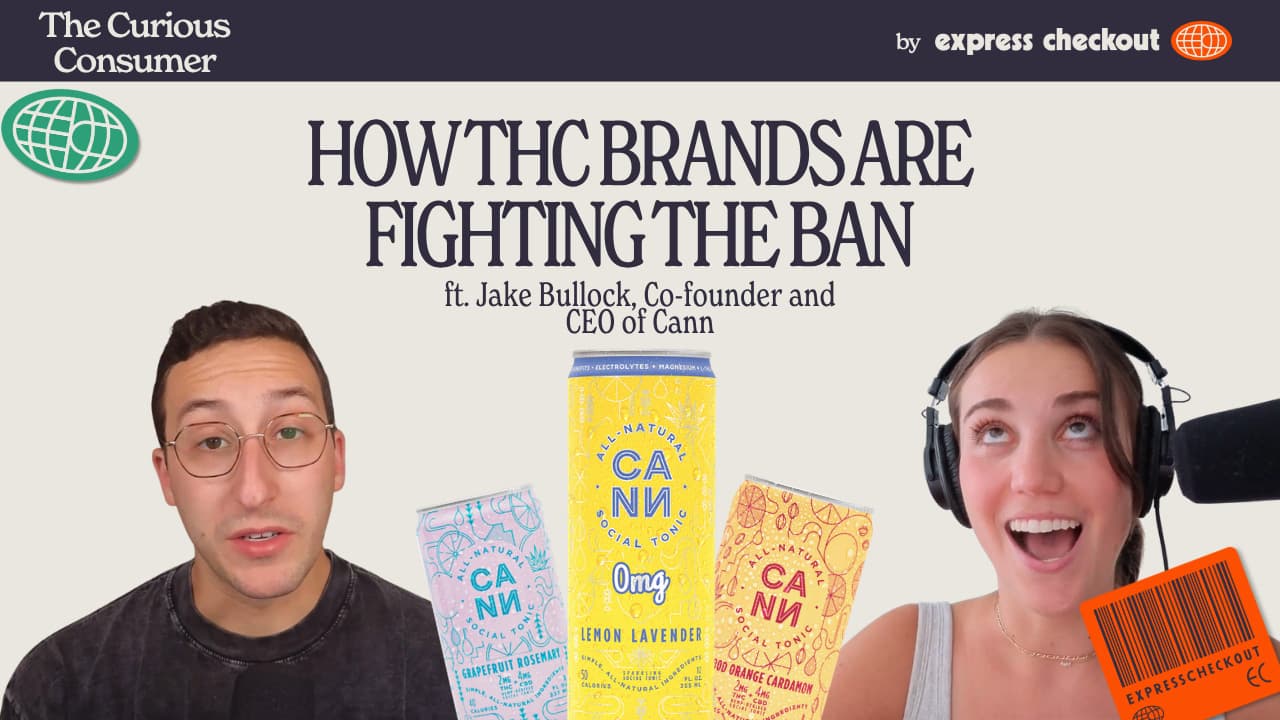
In short
Cannes (microdose THC/CBD drinks) explains why a proposed hemp definition change would effectively ban hemp-derived THC beverages on Nov 13, 2026, and how the brand is lobbying for alcohol-style regulation. It also launches “Zero MG” (uninfused) to protect customers if THC products are pulled.
Guest backgrounds
Jake Bullock, co-founder and CEO of Cannes; previously at Bain & Company; grew up in Colorado and built the microdose THC beverage category (launched ~7 years ago).
Key claims
Microdose THC is a “two milligram” sweet spot for mild, social effects (vs 100 mg dispensary drinks). The Farm Bill enabled hemp drinks via <0.3% THC dry weight, but FDA rules didn’t follow; states like Minnesota created liquor-store access. The November ban would raise the hemp threshold to 0.4 mg per serving, reclassifying many products as Schedule 1. Cannes argues for level-playing-field rules like alcohol and caps THC, not a blanket ban.
Notable examples
Minnesota liquor-store rollout (scale/distribution shift); California and Massachusetts state bans; “synthetic” Delta-8/10 gummies and other high-dose products cited as the target of the crackdown; Zero MG flavors (blood orange cardamom, lemon lavender) with magnesium, L-theanine, passionflower.
Written by AI. May contain mistakes. Listen to the episode to check what was said.
Chapters
Tap a time to open that second in VOIntroduction to Jake Bullock and Cannes
0:14 to 0:51
Meet Jake Bullock, co-founder of Cannes, discussing the THC beverage landscape.
“Today we wanted to learn more about something very timely, the impending hemp-derived THC ban happening this November and what that could possibly mean for the entire THC beverage category.”
The Founding Story of Cannes
0:51 to 2:18
Jake shares the founding story of Cannes and the challenges faced.
“We make a range of microdose THC and CBD infused drinks that are really meant to be alcohol alternatives.”
Understanding the Two-Milligram Concept
2:18 to 4:19
Exploring the idea of microdosing THC in beverages and its social potential.
“We were sort of like normal millennials getting into our thirties being like, wow, we really cannot drink alcohol like we used to be able to.”
The Impact of the 2018 Farm Bill
4:19 to 5:36
Discussion on the opportunities created by the 2018 Farm Bill for THC products.
“So it felt a lot like alcohol and what we're used to in that world.”
Navigating the Regulatory Landscape
5:36 to 9:56
Jake elaborates on the evolving regulatory landscape and its challenges.
“And I think that's like a really powerful thing.”
Transitioning to a New Market
9:56 to 11:09
Cannes' shift to selling through liquor stores and the benefits seen.
“And it was where our core customer was because they were on their normal shop, right?”
Current Trends and Future Challenges
11:09 to 13:00
An overview of the current trends in cannabis regulation and the future outlook.
“Obviously, you can't really go back in time and see what this would have looked like.”
The Regulatory Landscape of Marijuana
14:00 to 16:45
Discussion on marijuana's classification and the implications of regulatory changes.
“Currently, marijuana sits on schedule one, which means there's no approved medical benefit that we recognize for these products.”
Impacts of Proposed Hemp Ban
16:45 to 21:29
Exploring the consequences of a potential hemp product ban and industry concerns.
“And so how do we figure out how to get rid of all those products without throwing the baby out with the bathwater, which is what this regulation did, right?”
Launching a New Non-THC Product
21:29 to 22:44
Introduction of a new product aiming to cater to consumers concerned about THC regulations.
“It's the can flavors that you know and love, that everyone says, I'll drink it every day at lunch, plus some benefits that people actually are looking for, right?”
Show all 15 chapters
Navigating the Functional Beverage Market
22:44 to 28:01
Discussion on entering the crowded functional beverage market and brand positioning.
“And it's also a product that you can drink at various points during the day, right?”
The Evolution of THC Beverages
28:01 to 29:15
Explore the brand's journey in the THC beverage market and its unique positioning.
“So these things are always going to live in this family together, right?”
Navigating Regulatory Challenges
29:16 to 31:20
Understand how the brand is addressing regulatory hurdles and its lobbying efforts.
“We spent a lot of our design exercise around creating this product was very clearly going back to those NAVers and just saying, like, how do they do it?”
Industry Collaboration and Compliance
31:21 to 34:16
Learn about the collaboration within the industry to ensure compliance and safety.
“And, you know, often it's fundraising and it's new products and, you know, building the business.”
Future Prospects and Customer Impact
34:17 to 35:37
Discuss the future of the brand and hear customer stories about its impact.
“some really compelling stories of why we need this industry to survive in some form, in some way.”
Transcript
Automatic transcript. May contain errors.0:00What can and what our peers in the beverage industry have been screening about for years and have gotten really loud about in the last six months is the answer here is not continuing the status quo. The answer here is not extending another year. The answer here is we want regulations. Welcome back to The Curious Consumer. Today we wanted to learn more about something very timely, the impending hemp-derived THC ban happening this November and what that could possibly mean for the entire THC beverage category. So we went straight to the source. Jake Bullock, co-founder and CEO of Cannes, the brand that pioneered the microdose THC beverage category.
0:33We'll cover how Cannes was founded in the perfect regulatory window for hemp-based drinks, what Cannes was intended to disrupt, the current regulatory battle that now threatens the entire category, and Cannes' response to it all, a zero milligram beverage, zero MG, that launched just this week. Let's get into it. Jake, welcome to the podcast. Thank you for having me. I'm the co-founder and CEO of Cannes. We make a range of microdose THC and CBD infused drinks that are really meant to be alcohol alternatives. So folks, instead of having a couple of glasses of wine, wake up the next day feeling pretty hungover.
1:06We'll have a couple of cans, same amount of fun, but you wake up feeling great the next day. Absolutely.
1:11Jake Bullock:And can a test. Yeah. Can a test. Yeah, it works. It works. And I would also add, because you're probably too modest to say this, but like can really did kick off the ready to drink THC beverage landscape in a lot of ways and probably broke through a lot of regulatory barriers to get there, which I'd love to get into. We're partly having you on today to talk about an exciting new launch. So we'll have everyone stay tuned to hear about that. Let's back up a little bit and tell us about your founding story of Cannes and maybe walk us through some of the barriers that you had to push through to set the scene for this category.
1:48Yeah, yeah. I mean, you nailed it. We created this category. When we launched seven years ago, you could find THC-infused drinks. They're mostly in dispensaries, and they were 100 milligrams of THC. And I'm not even joking. That was what was most popular seven years ago. And actually, funny enough, if you go into a dispensary today, that's still what's most popular. People, for whatever reason, going into dispensaries, they want to get high. They want the highest THC for their dollar. And so those 100 milligram drinks sell pretty well for folks that are looking for that. We were not that. That was not me.
2:19That was not my co-founder, right? We were sort of like normal millennials getting into our thirties being like, wow, we really cannot drink alcohol like we used to be able to. And that was a problem for us in part because we wanted to still be social. Like we weren't ready to retire to the suburbs and like live a quiet life. But we also were recognizing that alcohol was getting in the way of our own priorities. And so you couldn't have a two day debilitating hangover and also be your best at work, right? And so I had kind of followed the emerging legal THC industry because I had grown up in Colorado.
2:52And I had seen these products that were like, you bite the head off of a gummy bear because if you ate the whole thing, you'd get way too high. And all my friends wanted me to smuggle them out of Colorado when I was home. And that didn't make sense either because we're kind of like, wait, wait, this is the new industry that everyone is going to say is going to be this huge thing. We're like eating the heads off of gummy bears. Seems unlikely. We learned at Bain & Company, me, my co-founder and I, how to think about new businesses or emerging businesses, right? You use analogs. And so we were like, well, what's a good analog for what we're trying to do here?
3:20What's happening with THC and CBD and these other cannabinoids? And the answer was, we actually have other mild intoxicants in our lives. If you think about it, caffeine is a mild intoxicant. Alcohol is a mild intoxicant. We actually drink them, interestingly, both, if you think about it, thousands of years of human history. We socialize around beverages and we drink them in microdoses. And this was kind of the key thing that I think we figured out early on, which was the reason that there's a certain amount of alcohol in a beer or a glass of wine or in a cup of coffee, there's a certain amount of caffeine.
3:53It's about what your body can metabolize in an hour. It allows you to have multiple of them. It makes it really social. It kind of unlocks this potential of beverage. And so we said, well, wait, what would that equivalent be in THC? It's not 100, let me tell you. It's like two. And we tested this on a ton of consumers. And in doing that, we found that that two milligram was really that key sweet spot where people felt an effect from it. It wasn't overwhelming. If they liked it, they could have another one. You know, it's about a drink an hour in terms of how your body metabolizes it. So it felt a lot like alcohol and what we're used to in that world.
4:25And so we said, okay, great. Let's try to unlock the social potential of this ingredient in a beverage that would ultimately function like a one-to-one alcohol alternative. And you nailed it. I mean, like you got two consumers here. I think you did a really good job at putting it into the more social category, too. It felt like something you could have by the pool with friends, not just by yourself sitting on the couch and zonking out. Yes. I mean, that part of the market was there, right? It's still there. I think we were trying to do something different, right? We were not going to get you high.
4:55Just kind of like, you know, once you get drunk, like that's sort of the end of the party, right? We didn't want to, we weren't trying to get somebody to a place that they would feel anxious or paranoid. All the sort of negatives of THC. that you might hear a friend that had a bad experience with the pop brownie in college, right? Like we were the opposite of that in some ways. And it's because we wanted these products to be social, to your point, right? Like you should be able to have them alongside people that are also drinking alcohol. Some of our best consumers still drink alcohol, right? But what we're doing is we're taking them from what was way above average, and we're kind of bringing them back to average, something that feels a lot more normal.
5:31And that's like a big wellness move for so money, right? To go from over indexing on alcohol to being more moderate. And I think that's like a really powerful thing.
5:38Jake Bullock:I'm really interested in the fact that like this brand was founded 2018, coincided pretty nicely with the 2018 farm bill, which is the reason that so many of these brands are now able to be sold in stores and not just in dispensaries. Can you tell us a little bit about that? You obviously were entering a market that you didn't really know what the regulation would look like and you entered anyway and like how that has how that played out at first and what it looks like now yeah when we launched so we launched in california we started the company in venice beach california and we launched in the dispensary channel because that at the time you know was where we thought we could sell thc was being regulated in in states like colorado and in washington and oregon and california and they had dispensaries and so we launched with the largest dispensary chain in california at the time and also the largest delivery cannabis delivery platform, which was sort of a licensed dispensary model as well, but they would deliver it to your door.
6:33And let me tell you what, that was hard. The customer that's going into a dispensary is largely looking for a lot of THC. They're not looking for a two milligram drink. It was pretty amazing how we were able to convince these retailers to even take us in in the first place because they're kind of looking at us saying, well, wait, two milligrams? I would need to have 50 of these personally me in order to feel an effect. And that was just wild to us. It was a really big customer mismatch between who we were targeting and where we could actually sell. Now, we got over that hurdle by literally physically pulling people into the dispensaries.
7:04I mean, we were doing all sorts of crazy things where we would like stand outside Erewhon and give you a Barry's class if you would sign up for ease and place an order to deliver to your house. Or we set up a pop-up next to MedMen on Abikini and we said, well, we can't sell you anything here, but you can go next door. And if you go next door and buy a six pack, we'll give you a canned t-shirt. And actually, a lot of people did that. It was kind of amazing. So we did creative things like that to get people into dispensaries. But our core customer was never there. To your point, the Farm Bill created this really interesting opportunity where you extracted the THC and CBD from hemp.
7:35You were governed by a different set of rules, by the hemp rules. And those rules basically said you have to have under 0.3 % THC by dry weight in your product. A beverage, it's not that difficult to calculate what the dry weight contents of a beverage are. You evaporate the water and what's left is mostly sugar. So that meant you could put a decent amount of THC under these new hemp rules, but there were no regulations. Like what should have happened after the Farm Bill passed, which is really an agricultural standard, right? If you think about percentage by dry weight, we're talking about crop there, not consumer products, is there should have been a regulatory effort around the consumer products that, okay, we've got this new ingredient.
8:09It's now legal. You can have hemp. It's not a controlled substance. That's what the Farm Bill 2018 said. Then the FDA should come in and give us rules. Tell us, well, what types of products can we have? Can we put this in food or not? And the reality is the FDA didn't do that, right? They said that, well, because of these esoteric reasons that we've approved some forms of these cannabinoids in drugs, you're not allowed to put them in food. And that hasn't actually been tested. There's some legal back and forth on whether that argument actually went out or not. But what states started doing, and the first state to do this was Minnesota, is said, well, we see this new ingredient, and the FDA is not stepping in to provide rules, so we're going to provide rules because we want to have a regulated marketplace.
8:44And they said things like, well, you have to sell these products to people that are 21 plus. you need to test all the products and demonstrate that what you say is in the product is actually in it and there's nothing else in there like heavy metals or pesticides that shouldn't be in there and you have clear labeling so if we put two milligrams of THC in the can that's actually what should be in the can consumers should know that when they buy it and so all of those rules came into effect and Minnesota said if you follow that set of regulations you can sell in our liquor stores well in Minnesota the way that alcohol works is it's a separate premises so beer wine spirits are all sold together.
9:16Grocery stores will have like a companion store next door. You can kind of go take your cart around and get your alcohol at the end of your shopping trip. What that really meant for us though, is it meant that Minnesota was saying you can sell can everywhere alcohol is sold. And that was huge for us. This was in 2023 where there, you know, we had kind of been pushing the rock up the hill in dispensaries. It was really hard. The core customer wasn't there. We grew to a bunch of different states in the dispensary market. I think we are peaked at seven different dispensary states. Every one of those states, You had to create a new manufacturing supply chain.
9:45Your accounts were different. Your distributors were different. There was no really economies of scale. That totally changed in Minnesota because all of a sudden we could make this product. We could sell it in Minnesota liquor stores. We could do it at scale. And it was where our core customer was because they were on their normal shop, right? And they were looking, oh, are we going to have alcohol tonight? They're grabbing a bottle of wine. Maybe they grab some NA beer and they grab a can. That's a party. That's what socializing looks like now in this new era. So we took advantage of that. We figured out very quickly how to extract THC and CBD from the hemp plant.
10:14We made the version of our products that had hemp THC and hemp CBD. It's kind of an interesting pivot, right? Because we didn't change anything about the consumer experience or the actual end product, right? Like the flavor was the same, the chemicals in the product that had the same exact effect, right? But we pivoted our regulatory structure. We pivoted our route to market and our distribution and started going to market through an alcohol supply chain. Very quickly, other states saw what Minnesota was doing. And they said, well, wait, we should do this too. And so we moved across the country, largely on the back of some retail partners, including Total Wine and more, who has really been a leader in this category and opening up a bunch of states.
10:50So they would go to a new state we would follow. And that kind of created an almost national footprint for the brand and then have continued to grow from there. It's such an insane story because you obviously, like when you started the brand, you never
11:02Jake Bullock:could have predicted any of this. And the fact that you ended up creating this category by accident in this exact time feels almost faded. I'm curious. Obviously, you can't really go back in time and see what this would have looked like. But when you made this business, was the plan then going to be like, we will always sell through dispensaries? It's funny that you ask this because in our very first fundraising deck, we had a slide that addressed this question of like, What do you ultimately think the route to market and channels will look like for this product? And we had a slide which showed, we thought that there would be about 60 % of it would be sold direct to consumers online.
11:4130 % would be in retailers and 10 % would be in dispensaries. And the 10 % in dispensaries would really be kind of like your local wine shops where you're not really going there for the best price. You're going there because they're going to have a really interesting selection. And they probably have a shop person who may be the owner who loves wine and you talk to them about wine and they share all this information. And it's kind of like an education experience more than anything. That's kind of how we think about dispensaries still to this day. I think that probably is how the role that they'll serve is like, it really is like a, an exploration and education experience to go into.
12:12But over time, we sort of felt that our business would look a lot like it does today, where we have a pretty robust online business. That's a little bit more than half the business. And then, you know, we sell largely through retailers again, because this is where our customer is like, this is how the consumer of today shops. If you really think about your own purchasing behavior, you know, you're buying mostly stuff online and then you're going into store for some very specific things, particularly like grocery goods and things that you need for tonight or for the next day. Right. And that's ultimately where we think this will probably continue to look.
12:42Now, obviously, we've got some big regulatory challenges on the horizon that that I'm actively, you know, fighting to keep this category alive and to get actual regulation at the federal level. We have it in most of the states that we operate in today, which is great, but there's still some real challenges ahead. but assuming we can overcome those, that's going to be kind of how this industry will look. You'll have some component of online, you'll have some component of in-store, and then I think, you know, there will still be dispensaries selling the higher dose products.
13:07Jake Bullock:Very, very interesting to see like how it did end up playing out. So you alluded to the fact that things are changing. Can you walk us through that? For someone who is very new to the cannabis regulation situation, situation, how would you describe what's going on in 2026? And how would you describe what the category is doing to respond to it? Yeah, so there's actually a lot going on. I'll try to disaggregate some of it. So first, there's a bunch going on in the marijuana world. So marijuana and hemp are both versions of the cannabis plant. A lot of times people will say cannabis because that's how a lot of these state programs were initially described when they were passed.
13:46Folks didn't want to use the word marijuana for all sorts of reasons we could get into, but it's actually becoming more popular now is we're using the two terms to distinguish between what's actually hemp, what's actually marijuana. So the marijuana efforts that are underway are happening at the federal level, and they're all related to rescheduling. Currently, marijuana sits on schedule one, which means there's no approved medical benefit that we recognize for these products. That's obviously false, right? Like we have medical marijuana programs in all sorts of states. You know, folks are relying on these products for things like pain management and all sorts of other things.
14:16So the government is looking to change that. They've already done it for medical applications. And now they're going through a process right now to see if that could be extended to adult use products as well. So recreational consumption. We'll see. There's been some hearings on that this summer. That probably is a more like a few month timeline to understand whether that will actually happen or not. But folks think that there's a pretty good shot. That's all marijuana. The old world that we were in, the dispensary world. Now we live in the hemp world, which is the 2018 farm bill that you discussed.
14:44In November of last year, if you remember, we had a government shutdown. Everyone's trying to figure out, is the government going to reopen? It was the longest shutdown in the history of the country. A bill, a compromise was struck between Republicans and Democrats in the House and the Senate to reopen the government. In that bill, there was some language that was snuck in by folks that were trying to ban hemp products that basically said, in a year, we're going to change the definition of hemp. It's no longer 0.3 % by dry weight. It's actually 0.4 milligrams. And any product that has more than 0.4 milligrams in it is considered marijuana.
15:16It's Schedule 1 drug. and is no longer legal. That goes into effect in November 13th. And the industry since last November has been fighting in DC to try to change those rules or prevent that from happening to protect beverages like can to protect the hemp products that people rely on. Now, the original premise of why folks were pushing for that ban language of what's effectively a ban, right? Even your most popular and effective CBD products, full spectrum CBD products that people rely on have some amount of THC and it's more than 0.4 milligrams. You know, maybe it's three milligrams, maybe it's two milligrams, something like that.
15:48Those products all go away too. It will be an effective ban on the hemp industry. And the reason that this came up, right, was largely not because of two milligram drinks like can, right? It was because of highly intoxicating, almost always synthetically derived THC products that were, you know, often gummy candies or like Oreos with infused with THC or Skittles spelled with Z. I mean, pretty like bad stuff. You should not be legal under even our most liberal dispensary laws and are being sold in gas stations, right? To, you know, some people say to minors, I actually think they're being sold to adults, but the adults that are, you know, acting like kids in some ways, like who would buy these products?
16:27Hundreds of milligrams of synthetic Delta 8, Delta 10. There's a whole alphabet soup of these synthetic cannabinoids that are manufactured in a lab and are, we just don't know about them, right? Like we may find out in 30 years, they're not dangerous, but they are very potent. And so we shouldn't be allowing these products to be sold. CBD, THC, naturally just derived from hemp we've been consuming as humans for thousands of years, they're very safe and mild. And so how do we figure out how to get rid of all those products without throwing the baby out with the bathwater, which is what this regulation did, right?
16:55And it did it in a way that was really underhanded because you basically had to vote to keep the government closed, right? That was the vote that everyone had on this topic. And so no one was going to do that. Everyone's going to open the government. And so that also just seems like from a process standpoint to be the wrong approach. But we still have to go figure out regulations, like what can and what our peers in the beverage industry have been screening about for years and have gotten really loud about in the last six months, is the answer here is not continuing the status quo. The answer here is not extending another year.
17:25The answer here is we want regulations. And many states have models for this. Let's take the best models that are out there. You know, interestingly, we spent 100 years regulating a mild intoxicant that's in an adult beverage. Maybe we borrow from the alcohol rules and create a level playing field. So our alcohol supplier friends who often criticize hemp drinks because they think we're competing with them unfairly. We are competing with them to some degree, right? Like we talked about the shift in consumer preferences away from alcohol towards alternatives. We should have a level playing field.
17:54Give us alcohol's rules and we will abide by them. That seems like a good model. So there actually have been a few bills that have been circulated that are trying to do this. Hopefully we'll get introduced here in the coming weeks and we'll have a real legislative path. I think we're doing a good job of winning the policy argument here that the lowest dose safest products like beverages should be allowed. They should be regulated like alcohol. There are other low potency hemp products that seniors rely on CBD, full spectrum CBD products. The president has actually spoken a lot about this and has a series of executive orders and directives to Congress to try to fix this problem so that we can protect the program that the CMS Center for Medicare Studies does that allows seniors to reimburse CBD products, $500 on their Medicare.
18:34That seems like a great program we should protect. If this law goes into effect in November, it will be gutted. None of the effective full spectrum CBD products will be allowed either. So we need to do something to fix these issues. And we're optimistic that something will get done, but it's gonna be a fight here in the next five months.
18:49Jake Bullock:That was such a helpful walkthrough. It is an extremely complicated and nuanced regulatory environment. and sneaky the way that it was presented. I'm certain that consumers don't know this is happening. And even people within the industry, there's still a lot of learning to do. It sounds like Can is getting pretty involved on the regulatory side, which is also great. But I imagine there's also some bet hedging to do just in case this doesn't work out. And not to say that is the reason for a new product that you are introducing, but I would love for you to talk about the new product that you are launching and maybe where it fits within this conversation.
19:30Yeah. Yeah. So very excitingly, we are, we're launching our first ever uninfused product. Um, actually it's not entirely true. We used, we used to sell a product called unspiked in a few markets, which was also an infused, but we've been making this product for a long time. These are, this product that we use in, in, in demos, right? We have an uninfused version of product. We always thought, well, should we, should we launch that? People love people come up to me all the time jake i would drink can every day at lunch if it didn't have thc in it it's so delicious the flavor is amazing i said yeah but you know it sort of feels like it maybe it's a glorified you know sparkling water or something like that that never made sense to us in the last six months or so since the band we've done a lot of thinking about our customer and actually a lot of them have come and reached out to us and said jake we can't we don't know what to do if can gets banned like we're not going to go back to alcohol this has become such a huge part of our lives.
20:16We've made these shifts toward wellness by consuming less alcohol, and it's made us better in all sorts of ways. Can't save my marriage. I'm slower to snap at my kids. I mean, like pretty incredible stuff, they've told us. We thought a lot about this consumer, and we said we cannot leave them high and dry. We really can't if this ban goes through. And also importantly, this is, even though we're talking about a federal ban, which will go into effect in November if nothing changes, we have had state-level bans in a number of our key markets over the last couple of years. So California very famously put in emergency rules to ban hemp drinks from the liquor stores in that state.
Read the full transcript
20:48And we were in those liquor stores and folks loved it. It was an amazing period of time for them to have access to Canada that they otherwise wouldn't have. A lot of people won't go into a dispensary, right? And so that was a huge opportunity for us that got shut down in our core market where we were born and raised. Similarly, Massachusetts has also did a similar thing. We were in the dispensaries in Massachusetts. We weren't able to make that work because of just how underdeveloped the manufacturing is on the beverage side in Massachusetts. And so we were able to sell our hemp products in liquor stores and grocery stores in Massachusetts, and then that was banned.
21:21We dealt with this in other markets, and we think a lot about those customers as well who have not been able to buy a can or don't have access to our products. Creating Zero OMG, which is our take on OMG, it has zero milligrams of THC. It's the can flavors that you know and love, that everyone says, I'll drink it every day at lunch, plus some benefits that people actually are looking for, right? One of the things we love about OMG is it's not just the canned flavors. It is also going after the things that you actually want, right? It has hydration, electrolytes for hydration. We think that's really fun.
21:51Everyone else around you is working on their hangover. You're working on staying hydrated. Okay, great. And we also put in some other ingredients as well that are really designed to help you take the edge off. So we have magnesium, we have L-theanine, and we have passion flower. The combination of them I think is amazing. Each one individually is doing a lot of heavy lifting to kind of just reduce that cortisol in the potty, the stress, the sort of buildup of tension that you have. That's what our customer loves about can. If you really ask them, they'll tell you two things. They love that it's something that takes the edge off that's not alcohol.
22:21Great, OMG is gonna check that box. And they also love the flavors, right? And it's gonna check that box too because it's the same flavors that you know and love, our blood orange cardamom, our lemon lavender. So we're really excited about this. It's the first time that we'll be able to sell a product in all 50 states. So no matter what happens in November, like this is here to stay. we're so excited about the ability to be back in California with this product, to be back in Massachusetts, to sell in places like Washington and Oregon, where we've never been able to sell can. So that's really exciting.
22:45And it's also a product that you can drink at various points during the day, right? It is not intoxicating in the same way that if you have six cans, right? Like you're going to feel really intoxicated. That allows people to consume it at a bunch of different consumption occasions that we've never really had the opportunity to build relationships around with our consumers.
23:02Jake Bullock:It's really exciting. And we're very excited for you and excited to try. I'm really curious. You are coming from a place where you basically, no, we decided you did create a category. You created a category. You really did. And now you are entering debatably one of the most crowded categories right now in CPG, which I know this isn't exactly how you're framing it, but this is a functional soda, basically, or functional beverage. Functional beverage, which, as we know, is really crowded, has been doing really well. but is you're not creating this category. How does that feel entering this category at this peak time and maybe not being the trailblazer?
23:45Yeah, it's a good question. I think you're right. Like it is a growing category. I don't know that we're at the peak of it yet. I think it's got a lot of room to still go. And we looked at it as if we were a category creator in some ways, right? We sort of stood in front of this shelf, you know, in our retail stores and looked at the, you know, whether it's functional beverage or it's alcohol moderation, I think there's like radiations we're starting to see here, right? Like we're very much not in like the gut health space, like put those folks aside. But we are kind of in this, like, how do I get, how do I drink less alcohol and also get the benefit of like taking the edge off or feeling like I got, you know, some relaxation out of it, right?
24:24That unwinding that people look for at the end of the day, that category is still evolving, right? It's kind of like a modern mood category. And we look at it today and we sort of say, well, what do consumers actually really want out of these drinks, right? Is it that they want the highest amount of L-Thanene possible, right? And when we talk to these consumers and when we spend time with them around their consumption habits, what we find is that they really care about a couple of things, right? They want the product to taste great. That's what keeps bringing them back and back. So if somebody says, oh, why do you keep buying that?
24:56Why do you like that? What makes you loyal to an existing product in the sort of modern mood category. It's almost always, I like the way it tastes. Okay, great. Well, we feel like we've got an advantage there because we believe we taste better. Not only are we the best tasting THC infused drink, but we're also one of the best tasting drinks on the market. And it's because of explainable reasons, right? We don't cut corners. We don't put in preservatives. We don't use concentrated juices. We don't use with other natural flavors that technically are natural, but don't taste anything natural. If you've ever had a lime LaCroix, you know what I'm talking about.
25:22And so for those reasons, we feel really good that we can come in with an amazing tasting product and one that's won all sorts of boards. We've kind of got the receipts as it relates to flavor. Then the question becomes, well, what do they really want from a functional standpoint? And I think what's cool about can, and we've always done this from the beginning, we are the microdose THC beverage category creator, right? We care about your ability to have a few of these. It's meant to be social. That incremental benefit that you get from being able to have a second round or a third round, that's like why our product has two milligrams of THC it.
25:52We can do the same thing in this category, right? It's not going to hit you like a bus. It's going to be very mild. Those mild predictable effects are things we hear from our customer that they love. We also hear that's what folks are looking for in this modern mood category, right? If they wanted 300 milligrams of ashwagandha, they should probably be getting that through a powder, not through drinking 10 of these drinks that have 25 milligrams of them, right? That doesn't make any sense. And then for that reason, we've actually stayed away from adaptogenic mushrooms and some of those functional ingredients where, look, there's probably a benefit if you consume a lot of it every day for six weeks, but there's no way I'm going to be able to deliver that to you in a beverage form factor.
26:31It doesn't make any sense. And if I try, it's going to taste like dirt. So we're not going to do that either. Right. And so we started seeing this opening where it's like, wow, well, we can actually leverage our own product values around flavor, around not cutting corners, around mild and predictable effects. And there's a way through a lot of the confusion that you might see on the shelf today because how many ingredients are being thrown around and this does this and this does that and it's like well do they really do anything like what what actually works and we tried to distill down after trying hundreds of ingredients to the ones that were like no not only is there good scientific evidence behind this but it's also doing the thing we want it to do which is taking the edge off right it's not putting you to sleep it's not hitting you like a bus we're not giving you 200 milligrams of caffeine right we're trying to give you just what you need
27:13Jake Bullock:So then I'm curious what distribution looks like, because you could go one of two ways. You could be like, we've never been able to enter traditional grocery. Now we can, or you can be like, we are going to, we want to just build our brand block in a liquor store and be the zero milligram option sitting next to our THC options. What do you, what's the path you're taking? Yeah, it's a great question. When we started this whole process around Zero MG, it was really about you've got Heineken and their Zero Zero product, and you've got Peroni and their Zero Zero product, which is actually quite a good Zero Zero beer.
27:49Why don't we have a can Zero Zero? Like that's what we're looking for. And we want to have it right alongside those other NA products. And I still believe that. I think that's where this ultimately lands, because we're going to be successful one way or another, whether it happens in November or when it happens sometime after November, THC drinks are not going away. So these things are always going to live in this family together, right? And it's really about you getting to make a decision about what you want to put in your body at any given time. We are going to show up with delicious tasting beverage.
28:15That's going to make you look cool while drinking it. And you can figure out if you want THC to be a part of that, or you want passionflower and elf hanging to be a part of that. And that flexibility is, is at the core of our brand, right? We've always been an inclusive brand. We care a lot about that. Like I said, our best drinkers also drink alcohol still to this day, right? And so we want to just give you better social beverage options. And I think we're doing that. Now, would you also want us to have, you know, a spot in the functional beverage aisle as well? Probably. Yeah, I think that would be great.
28:40If they'll put us in both places, we'll take it. But I really feel like this lives in that 00NA beer kind of world. Is that why you decided to stick with the can branding and the can name rather than going with a new sub-brand? Because I've seen some other THC cannabis hemp-based beverages go that route where they just build another brand effectively rather than continue with the namesake. that made them popular? Yeah, look, I mean, building a brand is really hard. We've spent a lot of time over the last seven years doing that. And we think we've done it to some degree, right? We've imbued it with some meaning.
29:14Like it says something about you when you pick Ken off the shelf. That's part of it, right? We spent a lot of our design exercise around creating this product was very clearly going back to those NAVers and just saying, like, how do they do it? Oh, they take, okay, they change this color to this, to that color. Or they take this number and they change it to that number, right? And we kind of did a similar thing, right? Where we wanted to keep a lot of what made the brand recognizable and special the same. But then we made a lot of changes, right? Like our line art illustration is actually cut out.
29:40So it's silver. We leaned into the silver, right? Again, like trying to reinforce the zero around it. Obviously having zero MG be like the lead and calling the product OMG has been really fun from a brand standpoint too. Cause we're thinking about all these like OMG moments in people's lives. One of them obviously being like, wow, I don't need to drink alcohol to have as much fun, right? That's kind of an exciting one that we're bringing into the storytelling around Cano and G as well.
30:05Jake Bullock:I love that there is still a bit of differentiation, as you mentioned. We're still seeing something new that could intrigue a consumer who has never been familiar with the Can brand and is now excited to partake in some respect. So very excited about this launch and just the future of Can. It sounds like there's a lot of hope regardless of where this regulatory landscape lands that can will still be a thriving brand but i imagine yeah you're hoping for the best around here too so it's an interesting place to be in 2026 yeah we're very optimistic i will say that the thing that makes us so optimistic is these products are having a transformative impact in people's lives yeah it is not something that they're just going to go over go away overnight and they will one of the benefits of the alcohol beverage supply chain is on november 13th all these products will be off the shelves everywhere.
30:55Now, will there be an underground market and will there be bad actors that will be selling highly intoxicating MTHC products? Yes. And that's part of why we need regulation. But our consumers are so passionate about CAN and about the impact that it's had in their lives that if this goes away, it will only go away for a short period of time. I would be very afraid to be an elected official that has banned CAN.
31:15Jake Bullock:Are you, is CAN actively lobbying? We are. Yeah, I would say, you know, it's funny, my time over the years has split into all sorts of different things, right? And, you know, often it's fundraising and it's new products and, you know, building the business. And in the last six months, it has been about half on lobbying and probably, I would say every month at this point, which is pretty, pretty wild. And we're winning the policy argument. Look, like when I was going into offices in November or December of last year, and this had just, we're kind of dealing with the fallout of this, people didn't really understand what happened.
31:48Again, like it was in a bill to reopen the government. No one was paying that close attention to the small hemp provisions. And they kind of thought, oh, this is those gummy candies that people have been telling me about. It's like, no, it's not just that. It's actually affecting the entire hemp industry. Now we go into meetings, it was just there two weeks ago, and folks say, we know, we know we need to fix. I have 100 hemp meetings. We understand it. The president wants it. It's actually one of the few bipartisan issues that we have right now in Congress. And the question is how? And how do you do it in an election year when there's only so many bills that are going to pass between now and November anyways?
32:18And look, doing regulation the right way is not an easy thing. This is something that it would take Congress a couple of years to figure out and you bring all the stakeholders to bear. And it's not the most no-brainer issue, right? They're hearing from people on the other side of it. They're hearing from alcohol suppliers who are saying, no, don't allow this. They're competing with us. We don't want them to compete with us. People are drinking less alcohol. We need all the help we can get, right? Or folks on the marijuana side are saying, wait, we've already done legal marijuana regulation. Why doesn't THC be sold all through the dispensaries?
32:47Again, we know that doesn't really work for beverages because people don't go into dispensaries to buy a two milligram beverage. And so there's real opposition there that we have to help navigate. The good news is, is I think there is consensus where if you give us level playing field, the same rules as alcohol and you cap the THC, we're not talking about highly potent edibles or smokable products that should be sold in a dispensary. Then I think you can get everyone on the same page.
33:08Jake Bullock:Is there like a strong cohort of other brands I imagine that are like on the lobbying side with you? Yes, there are. The industry has really risen to this occasion. It's been amazing, I would say, in the last six months just to see folks, I mean, especially the beverage folks, right? Like, we've been trying to do this the right way. It is full of good actors. You know, whether a state requires us to test our products or not, we're testing our products that go to every state, right? We're complying with the most stringent, rigorous rules that any state has, and we're applying that to our whole portfolio.
33:37So it really is amazing, the level of expertise. And a lot of it comes from alcohol beverage folks that are in this space now that they're help guiding us so we're not making any of those mistakes. Now, are there bad actors out there? Yes, there are. That's part of why we need these rules. But largely on the beverage side, we've got a really good cohort of peers that are fighting like crazy for this. I mean, we have stories that are pretty amazing of the government told us we could do this right in 2018 with the Farm Bill. People have invested their life savings into these companies. They've mortgaged their houses to start a THC beverage brand that complied with all the laws.
34:10They comply with the state laws. They comply with the federal laws. And now folks are saying, oh, we're going to take that away. I think especially in the beverage side, you have some really compelling stories of why we need this industry to survive in some form, in some way. We want the rules. We want restrictions. We want to be taxed. How many industries are saying that?
34:26Jake Bullock:Can't imagine very many. Well, we're rooting for you. We're definitely rooting for you. And beyond just the brands who have invested so much time and energy, it sounds like you have like countless customer stories of how this product has improved people's lives. And it's just an industry that should exist. So fingers are crossed for you in these next few, I'm sure, insane months. It's actually wild when you think about it, that you're doing these huge launches while also lobbying to the degree that you are lobbying. So I hope you are sleeping, but really appreciate you walking us through all of this.
35:00Jake Bullock:I think a lot of people are very in the dark about all the things that are going on in this industry. And it's great to hear from someone who not just is knowledgeable about it, but is playing in it. And honestly, as we said, created this category. Thank you. No, I appreciate that. Thank you so much, Jake, for coming on to the Curious Consumer. We're so grateful for your knowledge and time. And we are very excited to share the zero milligram beverage is in the world now as of us launching this podcast. So get your hands on that. Try it out if you haven't tried a can product before and thank you so much yeah jenna nate thank you both
From the publisher
Welcome back to another episode of The Curious Consumer! We're excited to share a fascinating full-episode interview with Jake Bullock, the Co-Founder and CEO of Cann—the pioneer of the microdose THC beverage category. Jake breaks down the whole hemp-derived THC beverage landscape, from how it came to be (and Cann’s role in that) to the regulatory threat it now faces with the impending November ban. Plus, he shares how Cann is responding with a new product launch that just came out this week: Cann 0mg.
Let’s get into it!
The breakdown:0:00 - Intro1:34 - How Cann created the microdose THC beverage category5:52 - Navigating the dispensary channel and the 2018 Farm Bill11:11 - Cann's original vision for distribution13:16 - The regulatory threat: What the 2026 hemp ban means17:08 - The industry's push for federal regulation19:15 - Introducing Cann Zero MG (0MG)26:58 - Distribution strategy for 0MG31:04 - Lobbying efforts34:11 - Closing thoughts
🎧 Love the show? Subscribe to The Curious Consumer wherever you get your podcasts! New episodes drop weekly.
📧 Get the inside scoop Subscribe to Express Checkout, our newsletter packed with consumer insights, trends, and exclusive content straight to your inbox at expresscheckout.co.
🗣️ Let’s connect! Follow us for behind-the-scenes content, quick tips, and more: @expresscheckout
💬 Join the conversation Have a product you’re curious about? DM us your questions or drop them in the comments—your topic could be featured in our next episode! If you have any thoughts/questions/suggestions, feel free to email us at hello@expresscheckout.co :)
⭐ Help us grow If you enjoyed this episode, please rate and review us on Apple Podcasts or Spotify. It helps other curious consumers find us!
Get full access to Express Checkout at www.expresscheckout.co/subscribe