
In short
The episode argues that protein demand isn’t a fad, but the industry is “recalibrating” due to pricing and availability pressures (e.g., whey up ~50% since January). It explains Lasso Food Labs’ “food physics” approach: a patented centrifugal “fiber spinning” platform (like an industrial cotton-candy spinner) that weaves protein into a dietary fiber matrix at ambient temperature, aiming for high-protein/high-fiber, cleaner-label foods with fewer binders/gums and improved texture.
Guest
Mike Messerschmidt, CEO of Lasso Food Labs (Cambridge, MA). Background: U.S. Navy nuclear engineering officer; CPG roles at PepsiCo/Frito-Lay (Doritos), Chobani (Greek yogurt category growth), Nature’s Bounty (sports nutrition), first U.S. employee at Oatly (7+ years).
Key claims/examples
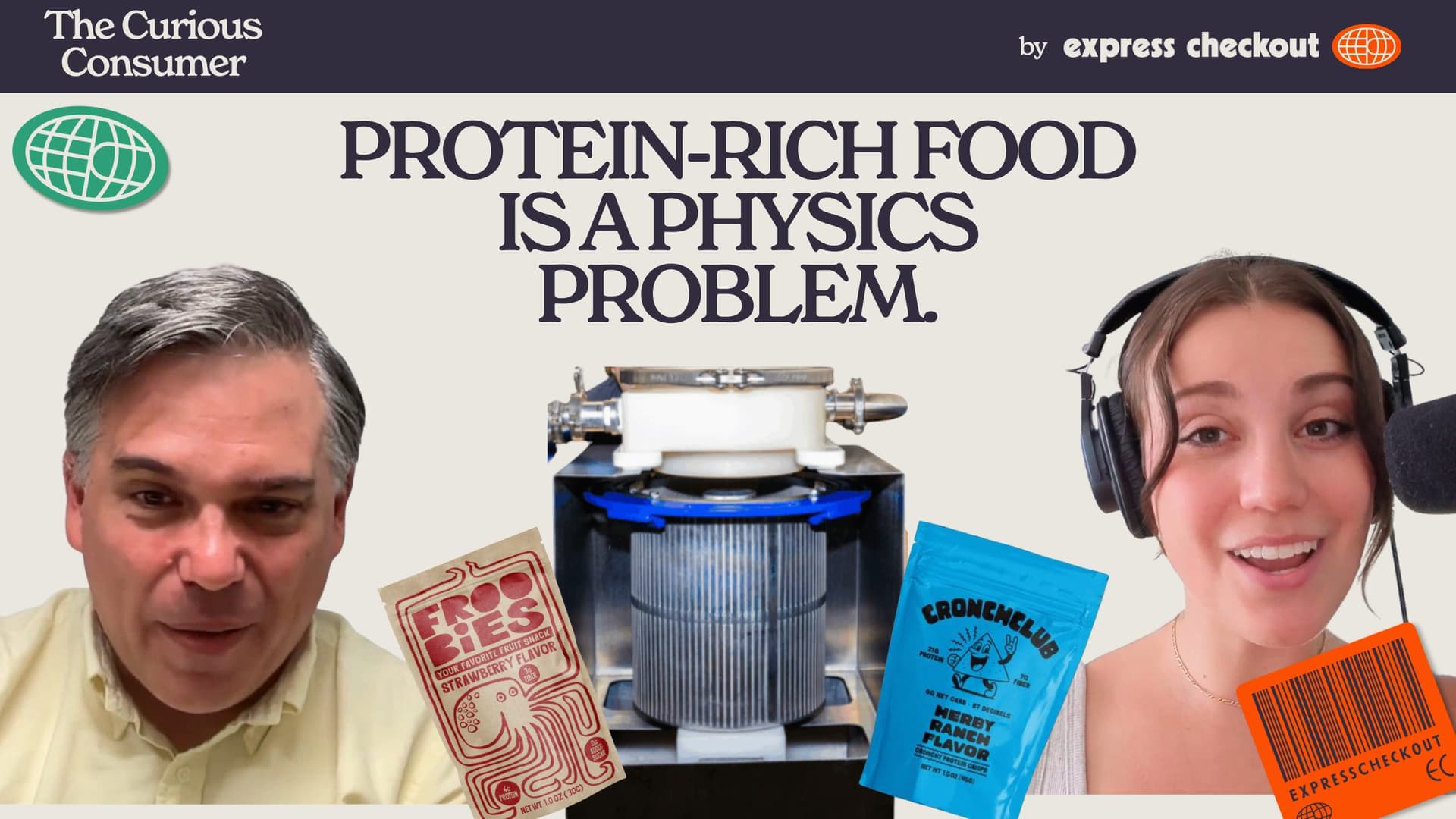
Lasso can encapsulate protein for smoother taste (plant and novel proteins), enable rapid reformulation (days vs months/years), and reduce reliance on “linchpin” ingredients. Examples: Crunch Club (chip/snack), Froobies (fruit snack); initial focus on plant-based meat, later pivot to snacking and B2B licensing.
Written by AI. May contain mistakes. Listen to the episode to check what was said.
Chapters
Tap a time to open that second in VORethinking Protein Consumption
0:00 to 0:28
Exploring the current state and future of protein consumption.
“I don't think protein consumption is a fad, but I do think it's a mistake to look at the protein situation we're in right now as a sourcing issue.”
Meet Mike Messerschmidt
0:45 to 1:40
Interview begins with Mike discussing his background and career.
“Lasso is a food tech company developed by Harvard scientists.”
From Navy to CPG
1:40 to 3:20
Mike shares his transition from the Navy to consumer packaged goods.
“I've been looking forward to it for a while and thanks for having me.”
Growth in the Dairy Industry
3:20 to 5:00
Discussion on Mike's experiences in the dairy and yogurt industry.
“Was at the Nature's Bounty Company for a while doing sports nutrition products.”
The Rise of Greek Yogurt
5:00 to 6:40
Mike reflects on Chobani's impact on the yogurt market.
“I mean, one of the things I admire most about Chobani and Hamdi and the way that they built that category is he had a vision around better food.”
Transition to Oatly
6:40 to 8:20
Mike discusses his evolution from dairy to oat-based products.
“And that was just something that was really special to be a part of.”
Innovations in Food Technology
8:20 to 10:00
Exploring how Lasso aims to innovate food production processes.
“And then you go to shows, we saw each other at Expo West a few months ago, And I love innovation.”
The Future of Food Production
10:00 to 11:40
Discussion on the need for innovation in food production methods.
“Everybody, no matter your political affiliation, your economic status, can food be cleaner?”
Lasso's Unique Technology
11:40 to 13:20
Mike explains the technology behind Lasso's food production.
“communities, for lack of a better term, aren't always speaking to each other also.”
Ingredients and Processing at Lasso
13:20 to 14:01
Details about the inputs and processing methods used at Lasso.
“And so it is a small footprint, high throughput, patented machine.”
Show all 18 chapters
Exploring Protein and Fiber Inputs
14:01 to 16:46
Learn about the combination of protein and fiber inputs in food tech.
“And that's what we're working on all the time.”
Applications of Protein-Fiber Technology
16:46 to 19:22
Discover the different food products created using protein-fiber technology.
“Or why is the ingredient deck so complicated?”
Brand Building and B2B Tech Strategy
19:22 to 22:21
Understand the dual approach to building brands and providing B2B tech solutions.
“And we're trying to help them with that.”
Challenges of Innovation in Food Tech
22:21 to 26:32
Examine the challenges faced by food tech companies in innovating products.
“companies to be able to use that tech to make those things for themselves.”
Whey Protein Shortage and Its Implications
26:32 to 28:01
Learn about the whey protein shortage and its impact on the industry.
“I'm interested to go back also to just the protein source conversation a little bit.”
The Future of Protein Consumption
28:01 to 34:02
Explore the recalibration of the protein industry and its future challenges.
“Like when big players like Starbucks start adding protein at scale, when you walk around the grocery store and you see protein everything, it has an effect.”
Processing and Consumer Perception
34:03 to 38:04
Discuss the implications of ultra-processed foods and consumer expectations.
“I am curious if there's such so much rhetoric around ultra process, right?”
Innovative Solutions for Food Production
38:05 to 40:32
Examine technological advancements aimed at improving food production and nutrition.
“i would approach it with like out judgment and like all these sorts of things which is so hard in the world.”
Transcript
Automatic transcript. May contain errors.0:00I don't think protein consumption is a fad, but I do think it's a mistake to look at the protein situation we're in right now as a sourcing issue. It is more an industry recalibration reckoning moment for how people are thinking about the reality and future of protein consumption and demand.
0:28Welcome back to another episode of The Curious Consumer. I'm Jenna Masovitz, and today we have a special interview with Mike Messerschmidt, the CEO of Lasso. Unlike a lot of the interviews we do on this podcast that center around specific brands or products, this interview is actually centered around a process. Lasso is a food tech company developed by Harvard scientists. The company's patented fiber spinning platform uses centrifugal force. Big word that in this case essentially just means like a cotton candy machine that is able to spin together fiber, protein, and other really simple ingredients to create products without having to use any excess heat, any additives that brands normally need to use to get protein and fiber to stick together in one product.
1:13Thousands of different kinds of CPG brands could ultimately use this technology to create cleaner alternatives to existing products or even make entirely novel products using this food technology. So we're really excited about this podcast. Mike also has a really awesome history in CPG. So let's get into it. Mike, first of all, so happy to have you here. I was looking forward to this conversation. I've been looking forward to it for a while and thanks for having me. Amazing. We're so excited to have you. And let's just kick off with a little intro. What's your background and what are you doing right now?
1:50Right on. My name is Mike Messersmith. I'm the CEO of a company called Lasso Food Labs. It's coming to you live from Cambridge, Massachusetts, where our company's headquartered. Going back to the beginning, I started my career as an officer in the United States Navy, working in nuclear engineering, got aircraft carriers. Always the obvious origin story for a CPG veteran. and it's almost cliche and tried at this point, but started my career floating around on boats in the ocean for a couple of years, paid for college, didn't want to be a sea captain for a living, and I've always loved food, grocery stores, shopping.
2:27I do all the grocery shopping for my family. I am that annoying person that wants to walk down every single aisle and turn every package ever since I was young. And so I got started in my career in consumer packaged goods, First at PepsiCo, down at Frito-Lay, all the best chips, all the Cheetos and Doritos and Tostitos and everything. I was on the brand team for Doritos in one of my first jobs. Literally my favorite consumer packaged goods product. My inner 17-year-old rejoicing over getting a chance to brand and sell Doritos. And honestly, like my first start in the industry, like big companies and, you know, who have massive platforms and billion-dollar brands.
3:08And that kind of got me started at working towards smaller and more, you know, newer companies that were trying to like really create categories and create something new. So moved from there to Chobani Greek Yogurt at a time of tremendous growth in the height of the yogurt wars. Was at the Nature's Bounty Company for a while doing sports nutrition products. And then I was the first employee in the United States at Oatly. The oat milk brand was there for like over seven years, all the phases of the rocket ship, just like one of the things I'm most happy, proud of. And then for the past close to 18 months, I've been the CEO of a food technology startup here in Cambridge that is seeking to really change the way food is made and give people more of what they want and less of what they don't and try to create some really special innovation.
3:59And so that's what I'm up to these days. I'd love to talk about any of it. What an incredible background. Very well decorated in CPG. I'm really interested, and I think this will tie in later in the conversation too, it's you started in dairy and then moved to Oatley. Can you tell me a little bit about that transition? Yeah, totally. One of the craziest parts is my wife is from upstate New York. Her dad worked on a dairy farm for his entire career. And so when I was at Chobani, going home for Thanksgiving, Christmas, and literally Chobani is one of the foremost darlings of the New York dairy industry.
4:34My father-in-law was so proud of me for different things. And then I went to a company whose tagline was famously, like milk but made for humans. Wow, no cow. And he just like the sideways glances I would get for the Alt Dairy affiliation was something else. And I think like those companies have a lot in common and a lot of things different. First off, credit for category creation of the Greek. I mean, one of the things I admire most about Chobani and Hamdi and the way that they built that category is he had a vision around better food. and this nutritionally dense Greek yogurt, strained yogurt product, along with other brands like Faye.
5:19And there were big incumbents like Yoplait and Danone that could have made that product, but they have their factories. They already built their big tanks and pipes, and they chose not to change until brands like Chobani came along and made them change because the market spoke and they wanted, really ignited this revolution in that dairy category of premium protein packed Greek yogurt. And I was there, it's more than a decade ago now, time flies. And I remember distinctly being in conversations when we were at Chobani of people asking, are we reaching peak protein? Have we, you know, a conversation that feels almost cliche a decade later where it's like peak, we haven't even reached the like starting gates on this thing because who would have imagined what was to come in terms of the way consumer tastes and diets and the grocery store would evolve over the last decade.
6:15And honestly, like being a part of Chobani at that time of incredible growth and transformation, you really become addicted to what challenger brands represent of companies that have a strong point of view around their purpose, their intention, their products, and then the motivation to make the industry change. Like consumers speak, and then you have this lever to really drive incredible change. And that was just something that was really special to be a part of. And then Oatly, you know, I think like it was, there was definitely an evolution there. There's so many similarities in terms of the ethos of truly this disruption category creation mindset that we had at our core.
6:57And both had strong technical scientific roots at the cores of the company. Oatly's ethos in a very Swedish Nordic mindset our company was created with the explicit belief around the exploring the impact of of the dairy industry on climate change and is there a way to create a product that is without compromise yet better for the planet and less resource intensive emitting greenhouse gases and so the sustainability mission was at the core of every choice we made at Oatly, a core of the product and why it exists, that I think also both of those resonate, you know, extraordinarily well with consumers and was a big part of our DNA.
7:40Yeah, absolutely. So can you tell me a little bit more about Lasso, what you're building now, and some of the remnants of your past work experience that are still showing up? Yeah. Yeah, I think all the success that both those companies have had, the category creation, disruption, momentum that they created, I think was rooted in that both companies created products and platforms that actually were meaningfully innovative without compromise, right? That innovation mindset is the core of what I think both of those companies have achieved incredible success behind. And then you go to shows, we saw each other at Expo West a few months ago, And I love innovation.
8:26I love going to these shows and seeing what's new, who's deeming things differently. And as I thought about what I wanted to do next after Oatly, which was truly one of the best, most rewarding, successful, gratifying experiences of my professional career, I really was obsessed with where does that innovation come from? And I think the success that with these really great breakthrough brands is people that can actually look to change the process, not just the recipe. Right. And that true innovation in consumer goods is possible, but not just by taking incremental marginal improvements to the same base.
9:08Right. And so when I got involved with Lasso at the invitation of one of our investors, first on the board and then joining into the management team, we have a team of incredibly sharp physicists, engineers who invented and patented a new piece of food technology out of a lab at Harvard. that really is the foundation for us trying to not just compete at the margins for 2 % more protein, 5 % less calories, but trying to change the curve that the food is built upon. And that's incredibly exciting for me because I think that we're in a place when you look at consumer goods in the grocery store where I don't think that anyone is walking around saying, boy, I'm so satisfied with where everything is at.
10:01Everybody, no matter your political affiliation, your economic status, can food be cleaner? Can it be more nutritious? Can it be more affordable? Can it be better for the planet? The answers to those is yes, but it's very hard to build that new food using the tools and platforms that have been abundantly available for the last 80 years. You need new solutions to actually create innovative process improvements to create the food that people want in 2026 and beyond. And so that's what we're trying to do here. It is hard work where it's a tech startup in a food world, but I've been really excited about what we've been building.
10:46And And honestly, for me, the creativity and reward of trying to create better food, more nutritious, cleaner label, different textures, accessing different new ingredients is incredibly exciting because there's no absence of innovative, creative spirit amongst food entrepreneurs. Even big companies, big CPG companies want to change. they're lacking the tools oftentimes to meaningfully affect that change. Such a great point and I completely agree. I see so much enthusiasm around the idea of changing the food system, but it gets poured into creating new products and not new tech. And that's always been interesting to me.
11:31And it sounds like that is what fueled this pivot for you because it is a pivot. We think of these things as all one world, but CPG is vastly different from food tech and those communities, for lack of a better term, aren't always speaking to each other also. So can you, yeah, tell me about what is Lasso? What is the tech that we're dealing with? And how did you first get involved? Yeah. So what the platform is, our founders created a machine that you could imagine is almost like an industrial cotton candy spinner. So if most, when you walk around Expo West and you look at lots of categories in the store, a lot of food is used using extrusion processing, which is think of like, for lack of a better term, an industrial Play-Doh press.
12:14You're putting a whole bunch of ingredients into a tube, you're using temperature, pressure, and kind of like forcing it together. Typically, within those ingredients, that means you need binding agents to hold your ingredients together. You're needing sugars, gums, binders, oils, fats to hold the nutritional content together. What we've created is something that in we create a a mix of protein and fibers, our machine spins at an incredibly high rate of speed and we're actually weaving together nutritional content into a dietary fiber matrix. So the fiber is the train that carries the nutritional payload of the protein and other nutritional content.
12:58And so you're replacing this like food chemistry with food physics of weaving things together so you're able to create incredible nutritional content, high protein, high fiber foods with very clean label because we're able to avoid oftentimes the necessity of these binding agents and really extraordinary texture rather than like kind of like homogenous sausage style consistency. And so it is a small footprint, high throughput, patented machine. And for me, we didn't have to build new factories to do it. We have co-manufacturers that we plug the machine into and we're trying to create that base to think about what could we make with this that would benefit from high nutrition, you know, high protein, high fiber, clean label foods.
13:48And that's started us down the path of looking at snack foods, nutrition bars, fruit snacks, even down in like consumer pet food. Like what are the categories that would really benefit from this type of innovation? And that's what we're working on all the time. It's so incredible. So what are the inputs then? Because I know there's protein and fiber, but what is that? We are not an ingredient company. We are completely agnostic on the ingredient side. And so we start with a mix of protein and fiber. It usually comes in a powdered format. We mix it together. Think like a cake mix that then you add some water.
14:24So you create a liquid mix that then gets spun in our machine. The mix is usually a combination of fiber, oat fiber, any sort of dietary fiber that people want, plus protein. We can use any protein source from whey protein to plant-based sources to really novel proteins. We think that's really important. And then the machine operates at a gentle, like ambient room temperature processing. So you avoid some of the high temperature, high heat processing that can really ruin some of the nutritional content, flavors, et cetera. One of the things we've also explored is that the fiber from a technical kind of like structural level is the encapsulation around this, these protein inside, but it can also be other things besides protein.
15:12Cause when you look at the space of food, protein, I think is like, we're in a era of protein maxing, but also people want other things. They might want vitamins. They might want collagen. They might want gut health. There's lots of things in there that our fiber spinning system and our lasso spin tech, can create this encapsulation capability as a vessel for the delivery of high value nutritional ingredients like proteins. And so in an era where you walk around the grocery store and it's protein everything, how do I get more protein? How do I get more fiber into these foods? And they're really lacking the tools to do that in a meaningful way without having to resort to just more kind of cramming things in.
16:00usually at the expense of sensory experience, taste, clean ingredient deck, etc. Okay, so if those, the inputs can be varied, it sounds like, which is really exciting. Then walk me through what some of the outputs are so far. Yeah, so we started, the company started, and our first application was in plant-based meat. The company was founded in 2020 when the peak of the alt-protein craze, where the founders were looking at the companies and the products that were really catching all the momentum in the heat at the time and said, boy, I think the technology that we built might be able to do that better for the same reasons that exist today.
16:38Could we do a lot of the critiques that have existed around the alt protein kind of center plate protein space have been, boy, there's, I like it, but the texture consistency is a little bit off. Or why is the ingredient deck so complicated? Why is there so much sodium or kind of flavor maskers in this? So could the original thesis for the company in our first application was, can you create using proteins and fiber, a fiber structure that looks like animal proteins, but without with less ingredients, less sodium cleaner label. From there, that was the original thesis that they kind of built. Obviously, that market has been tricky.
17:18By the time there's lots of companies that have built incredible businesses there. But in 2026, tough from an investment standpoint, tough from a customer consumer standpoint, I was on the board and I said, boy, I think this machine is incredible. What you guys have done. The world needs more food platform process tech to build things. But when I look at this, it's not a plant-based meat machine. What you have is this protein fiber, like nutrition creation machine. So let's look at what other categories are fundamentally changing with consumer habits and what people want. And I was experienced a lot of those changes myself.
17:58Like my diet has changed over the past 10 or 15 years, looking for more protein, looking for more fiber. I'm not the only one that experiences that. And sometimes that gets poo-pooed of, oh, is this a fad? Is it a craze? It's like people's, they have more information and there's authentic reasons for why they're trying to change their diets like that. And so we started first looking at snack food and could we do a high protein, high fiber, really crunchy, salty snack chip product. We have a ton of parents on our team who are constantly thinking about what do I throw into the back seat of my car on a commute at 4 p.m.
18:37that I can bridge my seven-year-old till dinner. Something that they'll actually eat but has a little bit of protein, a little bit of fiber in it. So we made a really cool fruit snack product. And then on deck, we've got some jerky stuff. Meat snacks is crazy right now. We're looking at a high-protein cracker that we're really excited about, which we think is really cool. And the brands that we've created are conceptual ideas that we're selling through TikTok, we're selling through our website, intentionally trying to keep them pretty focused with the goal being that like, I want to help other companies make products on our machine.
19:14We are not trying to beat the big CPG companies. We're trying to help them. And so that's been the work that we've been doing over the past year of like expanding the aperture of the applications, snacking into other spaces, and then starting to bring on, which has been going really well, some really like blue chip, amazing companies who are equally trying to figure out how they get more protein fiber into their foods, but lacking the tools to do so. And we're trying to help them with that. Amazing. Yeah. And I've tried two of the products. Yeah. Crunch Club and Froobies. Crunch Club is like the chip basically.
19:49And Froobies is the fruit snack and they're both amazing, incredible products. I think this is like an interesting thing that just people might not necessarily know much about, I'm still learning about too, when food tech brands are building their own brands as a way to showcase how the tech works, but also are serving as B2B technology. So can you tell me about what that split looks like? Do you intend for Lasso to be a brand builder or is it going to actually probably be more of a B2B tech? Yeah. First off, I would just say building breakthrough consumer brands is really hard. There's no entrepreneur that's ever started a brand that you always hope for the best is going to be a 50 million, a hundred million dollar brand.
20:31We're gonna have all these exits, but you never know. It's hard to do these things. And so what the way we approach it is we ha with new technology, we have to create our own brands to show the world what is possible with new tech, the texture, the macros we can achieve. And why is it different? Because you're trying to get people to change. Making food brands is difficult, but it is easy just to go to what the established paradigm is and be like, give me that. That's what private label manufacturers are for and Comans are for. The easiest path on this is not to do something new. It is to just go to the status quo.
21:08And so we believe that by launching our own brands, A, it allows us to get great feedback, work through all the process, scale-up kinks of making sure we're ready for prime time. It also showcases what is possible with this technology. And those conversations at shows like Expo West, where we show our fruit snacks or we show our chips. Yeah, I like showing them to buyers at a retail store. The more compelling conversations for us oftentimes are people that are already in that category. And they're like, ooh, this is different. How did you guys do this? And then that is a segue for us to say, yeah, we're launching these, but I don't necessarily need to take this to 10 ,000 points of distribution.
21:51nationwide. I would love to let you do that. You have a better factory, a better sales team. I've been at companies where we built the best sales team ever with supply chains and factories. What we want to do with this company is let you do what you're great at and use this tech to create something new in market under this brand that you've already developed. And so our view is launch brands on our own that are illustrative examples of what the technology is capable of. We use them to de-risk the process, the capabilities, and jump into partnerships with companies to be able to use that tech to make those things for themselves.
22:31And in that you get a business that's a mix of own brand, pretty focused D2C, like traditional brand P &L with a B2B licensing, like high margin piece on the other side. I would say also you have a lot of investors and different people and people starting companies. My background was always in consumer fund consumer food investment. It's tricky. We have to tap into different sorts of investment profiles for something like this. There's lots of great consumer funds that want to find the brand that is killing it at Air One and get in early, give them a$3 million check and go from 500 doors to five.
23:08That playbook is amazing. For us, it's a tricky balance of we're in the consumer space, but typically we're looking for technology focused investors, which we're a scrappy food technology startup in an era of AI and other things. And so we're trying finding those partners that really believe in the possibility of where food is going, how it's fundamentally changing, and that you're going to need new technological solutions to be able to tap into that. And that there's a great opportunity in that, which has been a journey for us and pretty exciting. Yeah, absolutely. And definitely I hear you on the positioning of that can be challenging.
23:46Yeah, it's tricky. I want to go back a little bit to the tech because I've been sitting here thinking like all of these brands want something like this so badly. They know that the consumer is looking for clean label. They know they're looking for high protein, high fiber. Have they attempted to do something similarly in house? And why has no one succeeded before this in creating tech like this? Yeah, it's a tough, I think, like asymmetry of the pressures you feel inside a company. There's incredibly talented engineers, R &D specialists. They have great resources, the best factories in the world.
24:21Yet oftentimes you're under so much pressure for throughput, optimization, etc. that you're lacking the internal capital focus, etc. for true creation. You can innovate incrementally internally, but if you're looking to add new capabilities, you need to look outside the walls of your company. And so our startup culture started from a multidisciplinary lab at Harvard where they were doing lots of different things. They're doing textiles, they're doing biopharma, and they invented this machine. Not necessarily imagining that they were going to make protein chips someday, But like thinking about the capabilities of high throughput, being able to manipulate these like dry, raw material ingredients and really creating like magic from a formulation standpoint.
25:09Whether you're the scrappiest entrepreneur or you're the largest food international CPG conglomerate, there's no shortage of desire for the change. What you're like what both I think confront the reality of is that when you're an entrepreneur You get started by going to a co-manufacturer and they say I want to make a granola bar Or I want to make a fruit snack and they say great Here's the machine that we have and you plug it in and the truth is that a lot of the food is all made on the same machines This is why it tastes a little bit different. Yeah On the periphery you can innovate on things yet it's all flowing through the same pipes of these machines that are at the co-manufactures.
25:51And so we look at our company and we reflect that, am I as good and polished as these machines that have been running in their factories for the past 40 years in terms of the number of hours? No, we are below the curve on that. However, the output of what we can create and the consumer desirability of it, protein, fiber, clean label is significantly above the curve. And so the work that we do is finding partners who are willing to invest with us to bring ours up, work around how we integrate it in. That's the promise of if it works, it has the potential to create something that didn't exist before.
26:29And we think that customers are willing to pay for it. Absolutely. I'm interested to go back also to just the protein source conversation a little bit. We alluded to the whey protein shortage. I have written about the whey protein shortage. I know, I've enjoyed reading those, yeah. Lots of thoughts there. And the products that you've created so far, Crunch Club and Froobies are both plant protein, but it sounds like you are very open to pivoting into animal-based proteins as well when you're using Lasso's technology. Can you tell me about, first of all, I'm interested in how you guys are viewing the whey protein shortage and this being a potential solution or workaround?
27:08And two, are there ideological mismatches sometimes that come up when you are dealing with both plant protein and animal protein? Yeah, I think that first off, I mean, the whey situation that we're seeing in the market today is something I heard about that was coming last year from talking to manufacturers and suppliers in the industry who used to be able to buy containers of whey at a certain price. And now it was, the question went from like, at what price can I even get it? And you could see these kind of like slow motion challenges coming on the horizon. And now it's going to market and like, gosh, like the price of whey protein is up, I think 50 % since January.
Read the full transcript
27:50And like, not, they're always going to add capacity. I mean, I know from Oatly, demand peaking and then how capacity comes. I mean, it took us a long time to add capacity to build oat milk. And it shouldn't be surprising. Like when big players like Starbucks start adding protein at scale, when you walk around the grocery store and you see protein everything, it has an effect. Not to mention just like, I think we're really just seeing still the tip of the iceberg of the impacts of GLP-1 protocols with the shifts on diets and how people view it. And so again, I don't think protein is, and protein consumption is a fad, But I do think it's a mistake to look at the protein situation we're in right now as a sourcing issue.
28:35It is more, I think, an industry recalibration reckoning moment for how people are thinking about the reality and future of protein consumption and demand. And I think about this in kind of three ways of how we try to build things at Lasso. The first one is there's a lot of companies of which the whey protein or the casein protein is the linchpin ingredient who are now without moves of how do I reformulate or what do I do? And I think that this is where big food machines that the food that the products are made on don't do anything quickly. But you have to change that. We see that with reformulating whey.
29:19We see that with people trying to remove red dye number 40. You pull out these linchpins and formulations and sometimes the whole thing starts to crumble. It's not easy to make changes. You need sometimes new, like a new nimble processing solution where we can do rapid prototyping and swap something out in days, not months, years. Right. Secondly, I think on plant-based proteins for a long time, you know, there was a palatability issue on that of like, you're making compromise and people are not willing to do that. Is it gritty? Is there off notes? Does it taste as good? It's food. It has to taste great.
29:55And what we found is that for our tech, the encapsulation of the protein in the dietary fiber creates a more smooth, nuanced, pretty neutral taste profile, which we like as weaving the protein in rather than kind of stuffing the protein on and how you get the protein into the food. The last one is we have to look hard at like protein sources, you know, the, the, there are so many companies doing incredible things with novel protein sources, like mycelium, duckweed that like are often incompatible with high temperature, high pressure processing. It actually denatures the nutritional content of the protein itself.
30:39And so in the future, we're going to need access from, we can even park the environmental sustainability aspects of protein sourcing. Let's just talk about the protein availability of these products. Like you're going to need different food process technology to be able to allow those products to come to market and make their way into food because they're incompatible with the machines that were designed 80 years ago to process industrial plastics. Then you get into a question of the tensions where I think that you're always, when you're building a brand, you're always in optimization and trade-off.
31:19And there are certain things that whey protein and dairy-based proteins are great at. They taste, texture, the PD-CAS, sort of like bio, you know, the nutritional content of it, historically cost. They're great until they aren't, right? When we talk with companies, not just in the United States, but around the world as potential lasso partners, they say, well, could you use soy? that's the most abundant you know we know you don't do that much in the united states or it's a little bit out of favor but boy really like an incredible protein low cost perfect like yeah absolutely could we use a novel protein we use chickpea protein in the current formulations of the products we have because we really like it we think it's great we think it's we got it you know we have a great some great supplier relationships there but we're not contingent upon a single ingredient input, nor is it ingrained in our company's DNA that it is a necessity that we're making vegan products.
32:19We want to be the tool that enables innovation without compromise. And I think that in that you need access to be able to bring new proteins to market to make it taste more palatable so that then companies, innovators can optimize taste, cost, sustainability, nutritional content, et cetera, and make the right choice for their business. Whereas today, oftentimes, and I think you're seeing that ripple effect into the market, people are so limited with their options that they don't have moves to make. And you get to this level of frustration and asymmetry between like landslide market demand for more protein, everything, nutritional content with people feeling tremendous pricing pressure where they want the protein, they need the protein.
33:12They're told they have to eat so much of it. Yet grocery prices are the number one most hot button issue for people. And brands with compressed margins being like, what do I do? And I think that's the type of breaking point that will force us to really look at, do we have the right underlying solutions? What an opportunity for change in this. And so I don't, again, it feels a little bit of like COVID era supply chain logistics challenges. This is, it acutely looks like a sourcing issue. I think it's actually a tipping point for me in looking at how the CPG industry is going to reckon with the undeniable future of protein consumption, everything through the entire grocery store and beyond.
34:01Thank you for walking through all of this. Yeah. I am curious if there's such so much rhetoric around ultra process, right? And like, no matter what the source of the protein is, once it gets processed, in some respect, people have all sorts of opinions on it. This is obviously processing, which is not an inherently bad thing, but have you gotten pushback on this technology creating like an ultra process, quote unquote, version of protein and fiber? And what is your response to that? Totally. Yeah. I think that's one of the, you put your finger on the universe of ultra processed foods. And again, we can park maybe some of the regulatory FDA, whatever the government says it is.
34:38But the truth is a protein powder, like you can go buy a$20 smoothie at the bougiest, fanciest, newest grocery store. And that's going to have protein powder, or maybe like a, imagine like a greens powder or a beet powder. Like all of that comes from an ultra processed source, you're making a choice that feels clean. It feels healthy. It feels natural. Yet I'm not asking people to break the cognitive dissonance of is, is that an ultra processed food? Because the difference from a consumer perspective between making that choice for yourself, your family, whether you're at home or at a smoothie shop versus maybe eating the most processed gas.
35:23And I love a gas station food. I love a gas station snack, but there are some of those thermonuclear green icing sort of things that oh boy this is truly ultra processed food at the same time it's hard i think as humans consumers to hold in our head that those are the same thing i what i think people really are pushing back against is when they turn around their ingredient deck on their food and they have more information than they've ever had before in the palm of their hand with apps with access to information they look at an ingredient deck And do the ingredients in this look like things that I might have in my kitchen, in my pantry with ingredients that I can understand?
36:04Or does this look like a bit of a chemistry project of things that are not supposed to be in there, right? And I, truthfully, we have billions of people on this earth. We're not going to be able to feed people at costs and nutritionally without the idea of processed foods, right? What I think people are wanting, and again, this is my opinion and from talking to people, is you want a cleaner ingredient deck with more of the stuff that you think is supposed to be in there and less of the things you don't. And along the way, so for Lasso, we think about, okay, can I avoid having to put as much sugar in this to hold these ingredients together as the food glued?
36:54Can I avoid a carrageenan or a gel and gum? Now I'm not saying those are bad for people, but we do think it makes people feel better about their choices. Because it is tricky of like, what is ultra processed foods? You kind of know it when you see it, right? And that's how I feel about these things. And so what we can do with Lasso is, can we take stuff that delivers more nutrition with a cleaner label and better texture so that people are able to feel better about those choices? That's such a fantastic answer. And yeah, I just think about this a lot. It's especially when you're like, this is lasso labs.
37:28And there was so much rhetoric around, I don't want something made in a lab. And there's a lot of irony around that because what does that even mean, right? How do you produce any food, even the cleanest foods, in order to get them to your, into your hands, onto the shelf, whatever it is. That was a really interesting breakdown. I love the vegetables that come from our garden. We're in cherry tomato season. like i'm here for it but also like we live in the world and if you can live a fully devoid of ultra i think you're going to live a beautiful healthy life probably but people like convenience cost availability flavor taste like everybody's kind of like trying to navigate this world and so one i would approach it with like out judgment and like all these sorts of things which is so hard in the world.
38:17But I do think what we're aspiring to do with new tech underlying technology to make innovative food is can we make food that is more nutritious, that has a cleaner, more understandable label, where if you look at this, it feels more like food ingredients that I can understand and kind of rationalize, even if the source of it is a protein powder and oat fiber powder, like that That makes sense to me rather than reading more like kind of a pharmaceutical, like food chemistry sort of a list. So that's, that's kind of how I approach it. Yeah. It's like separating a synthetic ingredient versus a method of processing.
38:57Actually, I think what you said at the beginning of this is about physics, not chemistry. It's a really distinct way to put this. Yeah. My physicists of the team that would feel super, are always super proud of me when I say that of can you use amazing food physics to create to seek to replace decades of increasingly like difficult food chemistry still science driven to be able to make we have to make food at scale it has to be affordable it has to be delicious it has to be but can we change some of the paradigms and foundational truths that are inherent and i love like i'm i'm also someone who tries to not have too much like animal-based protein in my diet and i really appreciate this approach of like you are still working with animal-based protein that's where a lot of the demand is coming from these days but you're also at the same time working to prove that plant-based proteins can achieve taste parity or textural parity to some of these animal-based proteins and i think sometimes when you choose a side you actually polarize yourself in a way where people never believe that these two things can be in the same room and they can.
40:06So I really appreciate that. I'm super excited to see where this tech ends up getting used and experience some of the products or maybe re-experience some products that I've loved my whole life in a new way. I think that's a lot of where some of the excitement around this tech comes from. Such a pleasure talking to you. So interesting to hear about how you went from this brand side to the tech side and you're dabbling in brands still, but just a really fascinating background and really grateful to have you on. Awesome. Thanks, Janet. Thank you.
From the publisher
Welcome back to another episode of The Curious Consumer! Today, Jenna is joined by Mike Messersmith, CEO of Lasso Labs—a Harvard-born food tech startup using a patented fiber spinning platform to create high-protein, high-fiber foods with cleaner labels and no compromise on texture or taste.
Mike shares his journey from legacy CPG to Chobani and Oatly (both at their peaks) to food tech founder, how the tech actually works, and why he believes the future of food will be won by changing the process, not just the recipe.
Plus, we’re getting into the protein reckoning unfolding across the grocery store right now—why the whey shortage is a symptom of a much bigger industry shift, how Lasso’s tech could meet that demand, and combatting fear-mongering around processed foods. Let’s get into it!
Chapters:
0:00 Introduction to Lasso
1:47 Mike’s background: PepsiCo, Chobani, and Oatly
3:58 From dairy to oat milk: category creation and disruption
11:49 What is Lasso and how the technology works
13:59 Inputs, outputs, and product applications
23:38 Building a brand vs. a B2B food tech company
26:28 Why big food companies haven’t cracked this yet
27:14 The whey protein shortage and what it really signals
34:02 Ultra-processed foods: separating fear from facts
38:47 Food physics vs. food chemistry
🎧 Love the show? Subscribe to The Curious Consumer wherever you get your podcasts! New episodes drop weekly.
📧 Get the inside scoop Subscribe to Express Checkout, our newsletter packed with consumer insights, trends, and exclusive content straight to your inbox at expresscheckout.co.
🗣️ Let’s connect! Follow us for behind-the-scenes content, quick tips, and more: @expresscheckout
💬 Join the conversation Have a product you’re curious about? DM us your questions or drop them in the comments—your topic could be featured in our next episode! If you have any thoughts/questions/suggestions, feel free to email us at hello@expresscheckout.co :)
⭐ Help us grow If you enjoyed this episode, please rate and review us on Apple Podcasts or Spotify. It helps other curious consumers find us!
Get full access to Express Checkout at www.expresscheckout.co/subscribe