In short
How supplement brands misuse “clinically tested”/“science-backed” claims and how consumers can evaluate efficacy claims amid weak US regulation and AI-driven misinformation.
Guest backgrounds
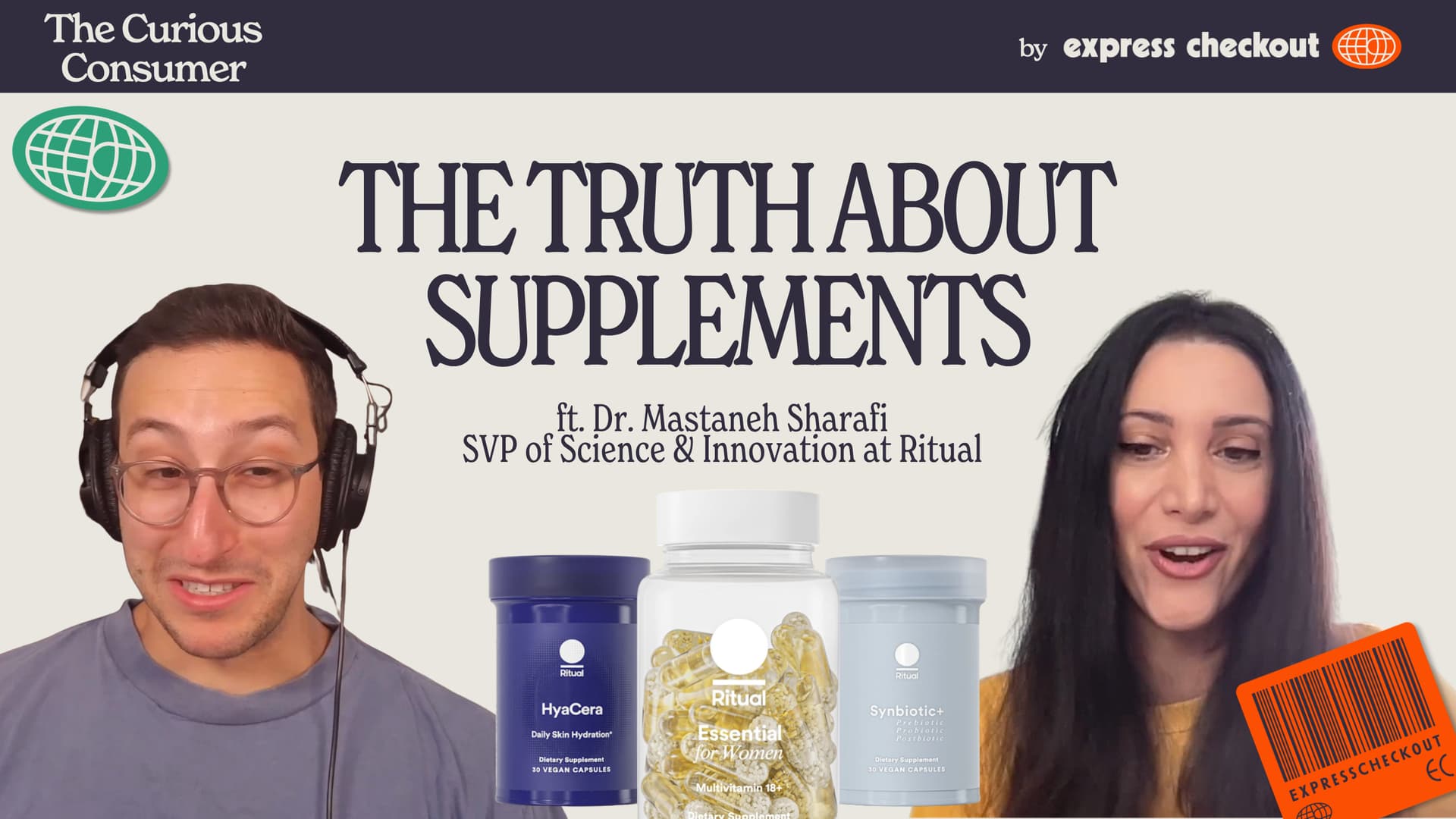
Dr. Mastaneh Sharafi, PhD in nutritional sciences; registered dietitian; Senior VP of Science and Innovation at Ritual (7 years). Background includes nutrition research (dietary patterns/quality, chemosensory perception, behavior) and industry work on claim substantiation, clinical trials, and patents.
Key claims
US supplements don’t need FDA proof of efficacy like drugs. “Clinically tested” should mean the finished product was tested vs placebo/control in the target population, with matching dosage/form; otherwise it’s often misleading. “Science-backed” may rely on ingredient-level evidence that may not match the product. Ritual aims for a clinical trial behind every finished product by 2030.
Notable examples
A Ritual strain example where a brand’s website had fabricated study titles/content (80%+ of citations). A metabolic calculator claiming weight loss without a finished-product clinical study; used ingredient studies and mismatched BMI criteria. Ritual’s delayed-release capsules (not gummies) to improve intestinal delivery and bioavailability; prenatal trial included consumer experience ratings vs a leading prenatal + DHA brand.
Written by AI. May contain mistakes. Listen to the episode to check what was said.
Chapters
Tap a time to open that second in VODr. Sharafi's Background and Role at Ritual
0:30 to 2:45
Dr. Sharafi discusses her background in nutrition and role at Ritual.
“I'm Senior VP of Science and Innovation at Ritual.”
The Evolution of Ritual and Consumer Interest in Supplements
2:45 to 4:00
Discussion on the growth of Ritual and consumer interest in supplements.
“looked really different, but consumer understanding and interest in supplements looked really different.”
Understanding Supplement Regulation
4:00 to 4:25
Exploration of the regulatory landscape surrounding dietary supplements.
“Honestly, I think asking consumers to evaluate efficacy claim is one of the hardest jobs we've given them.”
Evaluating Efficacy Claims in Supplements
4:25 to 8:40
Dr. Sharafi discusses how consumers can assess efficacy claims of supplements.
“But at this moment, what I'm seeing with common AIs and the way consumers are using, they're not getting the input that they need.”
The Fabrication of Citations in Supplements
8:40 to 9:50
Dr. Sharafi reveals the alarming truth about fabricated citations in supplement marketing.
“And if the finished product is clinically tested, the claims we are using are based on the outcomes that we found significant difference against a placebo or control.”
Clarifying Clinically Tested vs. Science-Backed Claims
9:50 to 12:42
A detailed explanation of the difference between clinically tested and science-backed terminology.
“The dosage and the form should match the clinical study.”
Lobbying for Clearer Standards in the Industry
12:42 to 14:08
Dr. Sharafi discusses Ritual's efforts to lobby for clearer regulations in supplement claims.
“You know, a lot of your work focuses on women navigating pregnancy and postpartum.”
Understanding Daily Value in Supplements
14:08 to 15:00
Learn about the implications of 100% Daily Value on vitamin labels.
“Consider a woman in her 20s or 30s, not pregnant, not postpartum.”
The Need for Women-Specific Clinical Trials
15:00 to 16:19
Discover why clinical studies often exclude women and the impact on supplements.
“So if you see a 100 % DV on a product that is for hair, for a vitamin, it's more likely that it covers the needs for men versus women, providing probably more, not for all nutrients, for majority of the nutrients.”
Consumer Skepticism in Cycle-Specific Supplements
16:19 to 17:43
Examine the marketing behind cycle-specific supplements and their effectiveness.
“clinical trials are being done on women.”
Show all 16 chapters
Integrating Taste and Dietary Behavior in Supplements
17:43 to 21:45
Explore the importance of taste and experience in supplement adherence.
“If it doesn't have a clinical study on finished product, does it have behind an individual ingredient, ask form, dosage, the life stage matches?”
Efficacy Over Taste: The Gummy Supplement Debate
21:45 to 25:42
Understand why some brands, like Ritual, avoid gummy supplements for efficacy.
“So as you know, our multivitamins all come with scented tabs.”
Consumer Discourse and Innovation in Supplements
25:42 to 28:10
Learn how consumer conversations influence innovation and product development.
“Um, things that people talk about, oh, I'm seeing benefit with this ingredient.”
Evaluating Supplement Efficacy
28:10 to 29:18
Learn about the importance of clinical studies and scientific evaluation for supplements.
“So as we said at the top of this podcast, a lot of brands we have been seeing are misusing and abusing some of these claims.”
Identifying Misinformation in Supplements
29:18 to 34:37
Discover key red flags consumers should look for to avoid misleading supplement claims.
“We're just seeing a lot of misinformation.”
The Psychology of Weight Loss Marketing
34:37 to 36:51
Understand the psychological tactics used in weight loss supplement marketing.
“I think the time bound one is especially interesting to me because that is like supplements thrive because they often are a subscription product or at least DTC supplements thrive because they're a subscription product.”
Transcript
Automatic transcript. May contain errors.0:01Welcome back to another episode of The Curious Consumer. We have a special episode today, a full interview with Dr. Mastaneh Sharafi, Senior Vice President of Science and Innovation at Ritual, a supplement company known for its science-backed formulas. She's going to answer some of our biggest questions around the most controversial category in CPG, supplements. Stay until the end for her best tips on sifting through supplement misinformation, why your favorite supplement brands may not actually work, and so much more. Let's get into it. Thank you so much for having me. I'm so excited. I'm Senior VP of Science and Innovation at Ritual.
0:38My background is in nutrition. I have a PhD in nutritional sciences, and I'm a registered dietitian. During my time in academia, my research was focused on dietary patterns, dietary quality, chemosensory perceptions, dietary behavior. And during my time in industry, I have been focusing science and innovation. from designing new products to claim substantiation to designing clinical trials and managing it and also developing patents to protect formulation. So I'm a dietitian. I believe in food first philosophy, which means that you need to rely on food first to get your nutrients and use supplementation to fill the gap.
1:20Supplementation never replaces food. That's my foundation. That's my belief. Also, as a PhD in nutrition, I believe in providing proof through data. So what got, what made me interested in ritual was that they didn't ask me to lift those foundation aside, they actually wanted me to bring this foundation to design new products. And my personal mission also has always been improving public health. Amazing. Thank you so much. Such a robust and interesting background. And I know you've been there for a long time, right? Yes. Seven years. Yeah. Seven years. And within that time, you must have seen the company change so much.
2:03Yes. It's changed so much. When I joined, we just launched the prenatal product. And after we have multiple products right now, and I have been very lucky to be part of the design of those products, substantiation and clinical and patent development work. And I think what we are doing is pretty unique in the industry, especially, for example, I don't know if you know, we have a mission that by 2030, we will have a clinical trial behind every finished product that we launch. So that's huge deal. And for someone like me, who is very passionate about public health, I think this is the right way to do.
2:44So obviously, you joined at a time when the company itself looked really different, but consumer understanding and interest in supplements looked really different. Like within the past, I would say even five years, just there's been so much more consumer interest in supplements. So you've been there at a really interesting time, but with all of that extra interest, there's also a lot of misinformation. We're really interested in kind of centering our conversation around that. So I'll contextualize a little bit for our listeners. Under the US law, efficacy of dietary supplements is actually not required.
3:17So manufacturers don't have to document quality, safety, efficacy in the way that a pharmaceutical product does. Manufacturers don't actually have to submit any evidence to the FDA substantiating the claims that they make about their products and supplements. So ritual running these clinical trials and that goal for 2030 is really notable within that context. But this regulatory gap really makes clinical trials interesting because it makes them a bit of a marketing asset also because it's not a legal requirements. Sometimes the language surrounding efficacy claims can be misused or even abused by supplement companies.
3:50Given that, how should today's consumers approach language like clinically tested or science-backed and be evaluating those claims? That's a great question. Honestly, I think asking consumers to evaluate efficacy claim is one of the hardest jobs we've given them. And the reason is that, as you said, we have more brands than ever and they all want to stand out and what's an easy way to stand out what you just mentioned there's not much regulation when it comes to these claims so that makes it hard for the consumers and as you may we have some regulation by the way it's the shay 1994 but and they have some clarification i think in 2000 but it's mainly around what not to say and it's like about like prevention and treatment of the disease but when it comes to other claims big room so misuse confusion so it's very it makes it very hard for the consumers to evaluate there's also other factors that I think mixing it making it hard for consumers to evaluate claims and one is the usage of AI so when you think about AI you think oh this is powerful which is powerful and I think we can get to a good place for consumers to use the AI tools to evaluate efficacy claims.
5:13But at this moment, what I'm seeing with common AIs and the way consumers are using, they're not getting the input that they need. And because the AI have a tendency to kind of like combine the marketing language with the scientific language and come up with a recommendation, it kind of gives like a very confident recommendation for an average consumer it makes it very hard to evaluate efficacy claims and then another thing i'm seeing recently is that you're seeing a shift from overstated claims by brands to kind of like fabricated claims so that kind of gets connected to probably ai usage too um a few months ago one of my team members uh showed me a brand website and they had this one of the strains that we use in one of our product which is symbiotic plus and i'm pretty familiar with the research on that strain i know the claims that you can make and she was like showing me the claims and i was like what are these claims coming from and she was like they have like 20 citations.
6:21I looked at the citations. I have a PhD in nutritional sciences, so I can like see the citations, like if they're legit or not. The name of researchers were legit. The name of journals were legit. The titles all fabricated. The study content was all fabricated. More than 80 % of the citation on the website was fabricated. So if, and it took me time to look and check the journals to find out that the citations were fabricated, and if it takes me time as a PhD nutrition, how can I expect a consumer going to a website, seeing all these amazing citations, the claims that are connected with citation evaluate the efficacy claims that's a big problem even nature journal just published like i think it was april 1st yeah two weeks ago about hallucinated citation it is a big deal not i don't think the brands were doing it intentionally i think they were using probably ai because it kind of hallucinates the citation i don't think we can expect much honestly from consumers to me brands are responsible if you are a science forward brand you need to have real a standard when it comes to science also you mentioned jenna about the regulation we need a stricter regulation and policies when it comes to claim consumers should not investigate too much to be able to evaluate an efficacy claims.
8:02But there are a lot of things consumers can do too. They should ask more questions. And by more questions, I would say not yes and no question. Like, is there a science? It needs to be open-ended question. How is the science? Is it applicable to me? When they're asking about the science, you mentioned about the clinically tested and science-backed language. We have a specific definition because there is no regulation on those terms. At RITUAL, we develop our own definition. If we're using clinically tested language and we are not saying anything else, the finished product needs to be clinically tested.
8:41And if the finished product is clinically tested, the claims we are using are based on the outcomes that we found significant difference against a placebo or control. This is something that you do not see much in the industry because if you just look at the changes from baseline to the end of a study and you do not compare it against a placebo or control, it's highly prone to bias because you may just do nothing and see benefit. It should be against placebo or control. Another important thing, it needs to be in the same population you are targeting your products. That's another issue we are seeing.
9:21There are products marketed for pregnant women, for example, the studies done on women of reproductive age or even on men. So the population and the publisher should match and we need to have comparison against a placebo or control. There are other occasions you can use clinically tested. You have to have the ingredients name after the clinically tested. So that transparency is important for the consumer. So they know that the clinical study was done on an ingredient, not on the finished product. When can you do that? The dosage and the form should match the clinical study. Also the population.
10:01These are the rules we follow. Science back to me is less rigorous to clinical trials. Any clinically tested claims is science-backed, but not any science-backed is clinically tested. So how I use science-backed when I use like government agencies, recommendation, NIH website, those are legit science-backed, but don't necessarily have clinical study on the same dosage and form, for example. You just said so many things that I like that I want to dig into more. There was such good content and everything you just said. One thing I just want to make sure we clarify for our listeners, because this is such an important thing that you mentioned, is this difference between a clinical trial on an ingredient versus the final product.
10:48And this is something I called out in, we wrote a piece on a turn I'm calling function washing, which is when brand supplement companies claim that they can do something and often will use language like clinically backed, but they don't actually have enough of the dose of whatever the ingredient is in their product to be efficacious. So that point of what you just said is so critical. You can say that this product is backed by clinical studies, and that might just mean like there's vitamin D in it, and vitamin D has clinical studies, but not this product in this dosage. So I love what you just said, and it's so cool to hear that Ritual has made your own definition for what that means because when actual regulation doesn't provide that sometimes you have to internally and that being said I know like one of the things that you said too is this kind of has to come from top down does ritual do anything to like lobby for this kind of regulation or is that really not okay you're actively doing that especially around clinically tested language because I think the standard we have is the standard that everyone should follow in the industry.
12:00Because when you have multiple ingredients together in a fresh product, the way they interact, the way they work together is not the same as individual ingredient. And if you have an individual ingredient, and if it doesn't have the same form and dosage, it's going to behave differently. And also the population that sometimes we forget about, if it's working for a man, And it doesn't necessarily work for a woman. So you need to consider all of these. We are actively doing lobbying. And I think in a month, we are going to be in D.C. lobbying around clinically tested language. That is awesome and really cool to hear a brand actually taking a stand.
12:41I think you've touched on a few things that sort of lead us into our next question. You know, a lot of your work focuses on women navigating pregnancy and postpartum. and we've seen a lot of other supplement brands take that same approach. We're really curious what actually distinguishes a woman's specific supplement from the gendered marketing of it and how can people develop, specifically women, develop frameworks for evaluating the products in this space? Honestly, I think most of what I'm saying in the market is around positioning for women rather than scientifically formulated for women. what I would say ask yourself is this product formulated for me how you can ask I usually say three things first does it consider my life stage it's so important because women go through so many life stages men and women start similar infancy childhood puberty then men go through adulthood for women in adulthood the life stages mean reproductive age pregnancy postpartum perimenopause menopause postmenopause about twice more life stages than men so does it product consider my life stage second thing does the dosage use is what i actually need as a woman let me give you an example.
14:09Consider a woman in her 20s or 30s, not pregnant, not postpartum. She wants to buy a multi-vitamin. She looks at the label. She sees A to Z vitamins all in 100 % DV. She's like, oh, this is so reassuring. This is so complete. But what does 100 % DV mean? 100 % DV or daily value. Daily value is a single reference value developed to cover the needs for adults and children age 4 and up. So how they develop this reference value, they look at the highest requirements among children, men, and adults and choose that single value. Who do you think among men, children, and women has the highest reference intake?
15:00Adults men. So if you see a 100 % DV on a product that is for hair, for a vitamin, it's more likely that it covers the needs for men versus women, providing probably more, not for all nutrients, for majority of the nutrients. So that's a big problem. And it's not customized for women. And the third thing I always say is look at this study. Who has this study been done? is this study done on the people in my group like women who are as i mentioned i think earlier if you're pregnant the study needs to be done on pregnant women but unfortunately when you look at the studies it's on reproductive age or men and we have to accept the reality women don't have many clinical studies on them for decades women have been excluded from clinical trials from 1970s 1990s.
16:00And when women finally got included in the clinical studies, even now, it's so hard to do clinical studies on them. Women's body is complex. You need to control for hormones. There are a lot of things that come to mind. So it's complex. It's expensive. It takes time. So still not many clinical trials are being done on women. That's why it's so important for brands, especially if they're targeting women to have a clinical trials on their products. Yeah, that was really, really helpful. And like, again, obviously something that a consumer can do is look into if these clinical trials are happening, but they shouldn't have to.
16:37And as a woman, I feel like it's been so interesting to see a lot of brands come out with a lot of cycle specific supplements and products and it feels to a consumer like wow like they really get the nuances of my hormones and you feel really seen in that but I also have been very I guess trepidatious because I am like well how much of this is just marketing what do we really know about the differences I mean you were speaking about differences in life stages of a woman but like even just within a cycle yeah it's it's so interesting because when people see a product targeted for a specific life stage they assume there should be a study behind it but in reality there's no there's not much studies so i i think there are few studies on like individual ingredients that uh are can't like be related to cycle but there's not much so definitely uh people need to ask again ask questions how is it formulated it?
17:43Does it have a clinical study? If it doesn't have a clinical study on finished product, does it have behind an individual ingredient, ask form, dosage, the life stage matches? That are kind of questions that they can ask. And unfortunately, there are not many in the market. I want to zoom out a little bit because I was reading up on you and you have a really interesting background in just taste perception and dietary behavior, which is different than the supplement space. But, And you even mentioned in your intro that you would love for people to turn to food first and not supplements first. But culturally, we've seen a pretty big shift recently where it does feel like people have almost given up on looking to their diet to be the main source of health and are looking to supplements almost exclusively, not just to fill in the gaps.
18:33So I'm curious how your background has informed the way that you think about why people are turning to supplements in this time and what are they actually trying to solve for? I love this question, by the way. I've done interviews. Nobody asked me about my background and how I'm using this because I think it's so fascinating. because once you understand how taste perception and dietary behaviors works you understand that the reason people turn into dietary supplement is not just because they calculated a nutrient deficiency it's because something in their lived experience with food has been missing so either their diet has been inconsistent, maybe they don't like a specific food or like have a specific diet that eliminates a specific food groups, maybe they don't have time or maybe they want to have a sense of control over some symptoms they're experiencing.
19:34So overall dietary supplements, how I see it, is not just a nutritional solution, it's kind of behavioral solution too. so and when you think about it for supplements also to be effective they need to be taken over a period of time you will not find a supplement that is going to magic work and like in one or two days you're going to see the benefit you need to take it over time and quite frequently like daily over for example 12 weeks is like what we commonly see in clinical trials showing the efficacy, for example, for dietary supplements. So for that to be happening, the dietary supplement needs to be integrated to your life.
20:15It needs to become part of your ritual. And that's where the taste perception and dietary behavior comes in. For someone to stick to a specific routine, i don't think uh just knowledge about efficacy is enough for them to stick to it the experience matters a lot too and the experience comes from taste is actually the first drive when it comes to food taste is the number one driver of purchasing even um higher rank than cost and convenience so taste is super important you may think that if supplement is like is going to help with my symptoms or this benefit I'm looking for. But if it doesn't taste good or smell good, if it gives some bad aftertaste, or even if it doesn't simply fit into your routine, you're not going to stick to it.
21:13So it's so important to consider these micro-experiences like taste, smell, texture, when you are coming up with supplements. That's what I'm using as my experience during my PhD. when I'm designing new products here. Not only when I'm formulating, I think about the ingredients, the form, the dosage, the clinical evidence. Also, I think about always the delivery format, the technology that is relevant and is going to be the most impactful. I also think about the experience. So as you know, our multivitamins all come with scented tabs. And the scented tabs are impactful. We actually, in our essential prenatal clinical trial, we tested, in addition to all these measures we had with maternal blood, placenta, blood cord, we also asked consumers about their experience.
22:05We compared our prenatal vitamin with a top leading prenatal brand plus a DHA. And we asked about their experience and we did a statistical analysis. So there was a significantly higher rating when it comes to their overall experience with essential prenatal and significantly higher score for taking this product again for their future pregnancy and referring that to their friends and family. So experience is so powerful and it can be used to support people, especially for the products that they need to be taken over the time like prenatal vitamin. So yeah, big fan of using taste perception. And dietary behavior too, like repeated exposure can help with developing preferences.
22:54and that's like taking it every day, making people want to get back to it and develop it, the preference for it. So much you can do with this. Yeah, really interesting too, because something that we've been seeing a lot of is gummies. And I know Ritual, to my knowledge, doesn't have gummies. Is that correct? Yeah. So I'm really curious, like given everything you just said, I imagine gummies are a really great, I mean, they're a great taste vehicle. They're probably really good for adherence. Why is Ritual staying away from gummies when everyone else is leaning in? Great question. It's all about this efficacy mission that we have and also safety on some side because we have seen that there are like foreign materials that sometimes are found in gummies that are not disclosed.
23:50So that was like on the safety side of it. On the efficacy side of it, it's hard for some nutrients, for bacteria to survive in the gummy matrix. So when we develop product, first is efficacy. What is the best format to deliver the nutrients? So for example, for a multivitamin, it comes with a delayed release capsule, which what it does, and we have an in vitro studies on that, that shows that It dissolves later, so it kind of bypasses the stomach and releases the nutrient in intestine. That's the place that you want to absorb the nutrient, because if it doesn't have it, some of the nutrients just damage in the stomach environment.
24:34So you want the nutrients to get delivered, the majority of nutrients to get delivered to intestine for absorption. Or the same as our symbiotic plus, which has a delayed release cap, so it's in the dual and we found that it helps release the nutrients actually close to getting to colon. So these are like important things because, again, you want bacteria to go to colon. You want the nutrients to get to the intestine. I don't think you can achieve it with gummies. So efficacy is a big part. But then when we have capsule, think about how we can make it a better experience. I hope in future we have like a good matrix that can bring nutrients in the best way make it bioavailable in the gummy format I haven't seen it honestly yet but big fan of experience if we get to that point that we feel confident we are gonna deliver nutrients the best way possible we'll do it love that answer it feels very honest and sorry to any gummy supplements we may have offended in the process, but it's important.
25:41I think they probably know. They probably know. Yeah. I'm curious, with a lot more consumer discourse around supplements and well-being, and there is a little bit more of at least surface level consumer education on this stuff, is it leading to more innovation within ritual? I definitely consider general demand because we don't have science on everything to know to know like something is working for someone or someone something is not working if we are seeing consumers are as talking about some areas i'm personally very curious to to check that through scientific research to see if there is any relationship because you know how we do clinical studies first there are epidemiological research talking about the relationship and then you do through clinical trials to look at the causal effect so to me when consumers are talking about something i can't i take it as like a point as something to consider when i'm like designing or clinical maybe there is something i'm not aware of and have not been looked at in clinical research it's definitely not going to be my primary outcome when I'm doing the research, but I will definitely consider these like discussions that are happening.
27:05Um, things that people talk about, oh, I'm seeing benefit with this ingredient. If I'm seeing that tendency, I'm like more people are talking. I'm definitely curious to test stuff. Where are you finding some of these discussions happening? Is it places like Reddit? Is it other forms of social media? Are you just like social media, Reddit, anything like, um, social whispers, We look into all of these to just so what people are talking about. And that's exactly what I'm passionate about. Because I decided to go from academia to an industry. And the reason I did that was I've been in a nutrition field for more than 20 years.
27:51What I've seen is that much of the science never makes it to people's lives. I have this opportunity in the company that values actually science to make products, evaluate them, and get it into people's daily life. So to me, that makes it very exciting for me that I can use this knowledge, get people what they're talking about, formulate a product, do a clinical study, show the efficacy, and actually support people with some of their needs. so yeah definitely value these conversations that's happening but again in if I have it as a product out it needs to be scientifically evaluated so this is going to be like earlier stage research work we even do like pilot studies like very early on to just see some of the trends and then we have it in a full clinical study given the fact that yeah you came from academia and now you're dealing with this whole other population of consumers, you're probably also interacting now with a whole population who isn't fluent in these subjects in the way that you are.
29:04So as we said at the top of this podcast, a lot of brands we have been seeing are misusing and abusing some of these claims. And there's, in general, not even on the brand side, like just in the social listening, I'm sure you're doing as well. We're just seeing a lot of misinformation. Can you speak on that a little? how do we sift through all of this misinformation? Yes. As you said, a lot of misinformation happening, not people like brands intentionally doing it, but I think there are things that consumers should watch out for. And I would usually say four things. First thing I think we kind of covered, like clinically tested, like how they should cover it.
29:41So I won't explain more on that. But the second thing is I call it dosage theater. You kind of, Jenna, you kind of mentioned that but it's like you look at the label you see a lot of like trendy ingredients they look very scientific and was like wow that seems very scientific it sounds scientific but it's all for the show because they use like very small dusty dosage of those fancy scientific ingredients in the formulation third one is propriety blend that's a watch out for consumers because when you look at products that have propriety blends usually the reason is that you want to protect the formulation for the patent but most of the time it's just to hide the dosage that they are including in the blend because when you put propriety you just have one dosage and i'm seeing that a lot with the green products they have like 30 ingredients they call like a specific blend for it and they call organic this fruit organic exotic vegetable organic and people get that that's like to me it's like misinformation because people feel that i'm getting like 20 30 exotic fruits and vegetables you look at the those are just like i don't know few milligrams of like the powder to me that's a watch out um i'm not saying uh always it's bad i think you they need to have a scientific knowledge a scientific rationale on like why those specific uh for example frozen vegetables are combined has there been any testing on like what that frozen vegetable is doing because they call it something like very cool this blood like this is for beauty this is for antioxidant like it's when you look deep into it there's not much it's more like on marketing and kind of like deceiving uh fourth thing which i'm seeing more recently is time bound claims so that's a watch out too uh because you consumers they want to see benefit so you see that this product is gonna do this benefit in two weeks in four weeks you're gonna see that benefit in six weeks you're gonna see that the only way you can make claims that detail for a product doing something is you need to have a clinical trial behind that finished product on the population you are testing.
32:14How many of the products you are seeing that have time-bound claims have a clinical study behind the product? If you are using individual ingredient, again, it should match the dosage, form, and the population. Let me tell you a funny story. I was looking at a brand website a few weeks ago, and they had a metabolic blend, and they They had a calculator in there. Ask my height and weight, and it gave me an information on how much weight I'm going to lose if I take their metabolism. I think I looked at this same website. I literally think I did that exercise. Because I was like, this is the weirdest thing.
32:59And then it was like, this is your BMI, so you can expect to lose that. I was on the same website as you. That's crazy. They're going to get sued. Sorry. that we went on the same i was like i'm a nutritionist if you're talking about weight if weight loss like basal metabolic just like a simple equation you need to have age you need to have gender height and weight how can you give me how much i'm gonna lose weight by just getting my bmr and then i was like okay let me see if they have a clinical study i didn't find a clinical study behind their finished product what they wrote was that they are they they made this calculator using clinical studies on ingredients no transparency on what ingredients how it was made and then it said the studies were done on people with bmi 25 plus my bmi is 20 why are you telling me i'm losing five pounds if if i'm um using um this product also shouldn't it it should probably be like maybe don't lose weight it would probably be like maybe this product isn't for you not this is how much you will lose if you get on this product i literally was on the same website that's so crazy it was crazy and you know people see that and they think this is so personal like oh like they feel it's custom it is it feels for them as i mentioned like a lot of things you see and they you assume there is scientific logic behind it but it's all marketing again watch i'm not saying all this time on claims or like all this proprietary business i i what i'm saying is just watch out for these there are like these four things uh for me is just yeah flag it dig deeper ask questions and yeah make decision no that was so helpful sorry nate no i was playing around with the the calculator i sent him the link apparently i'm gonna lose 40 pounds that's yeah um no the i I mean, all of that was so fascinating.
35:02I think the time bound one is especially interesting to me because that is like supplements thrive because they often are a subscription product or at least DTC supplements thrive because they're a subscription product. And the best way to get someone to sign on for six months immediately is to be like, you actually probably won't even see results in six months. So of course that's a marketing tactic, but a little part of me was always like, well maybe it's true that i won't see results in six months and so like yeah yeah but scare tactics i mean a lot of it is is fear-mongering positioned as we're gonna make your life better but it's actually just scaring a lot of consumers into taking something that might not actually do anything or to jenna's point might not have enough of the thing to actually do something for you Yeah, and I think this kind of like giving the assurance, like too much confidence, like this is like what you need and this is what you're going to see.
36:01That makes me scared. It was like, how can you give that much confidence without data to prove it? Yeah. Right. Yeah. And unfortunately, especially with weight loss medication, they have such a ripe customer of people who are eager to jump on this. I don't want to say trend, but kind of trend and find a way that they can have a less expensive than Ozempic version of Ozempic. That consumer set of people who have now decided that they need to lose weight, whether or not that's medically true, is so ripe for exploitation. And it makes me really sad. They're desperate, preying on people who are desperate.
36:47And that's a dangerous game. This was all so fascinating. I'm so glad that we got into the misinformation conversation at the end here, too, because that was very tangible takeaways for our audience. for me even, I'm like, I'm a sucker too. Oh, same. Same. We're all suckers here. It's not our fault. Capitalism made us suckers. But I wanted to thank you so much for taking the time to speak with us. And you are such a wealth of knowledge, but just really interesting to hear that there are brands with integrity still. This is not sponsored by Ritual. Though a lot of podcasts are, and we're open to it.
37:29next time next time now that they know that we're fans yeah thank you so much thank you so much i really enjoyed this one of the best uh podcasts i've been on amazing we're keeping that in we're still recording thank you so much
From the publisher
Welcome back to another episode of The Curious Consumer!
This week, we have one of our most fascinating interviews yet: Dr. Mastaneh Sharafi, SVP of Science & Innovation at Ritual, a supplement company known for its science-backed formulas. She’ll be answering some of our biggest questions around the most controversial category in CPG: supplements. Let’s get into it!
Quick note: There’s some background clicking noise in the first few minutes, but it goes away quickly! Stick with us, it’ll be worth it :)
The breakdown:0:00 Intro + Dr. Sharafi’s background 1:58 Ritual’s evolution and mission3:59 Evaluating efficacy claims & misinformation13:11 Women-specific supplements & clinical trials18:43 Why people turn to supplements23:02 Why Ritual doesn’t make gummies…25:45 Consumer demand and innovation29:22 Four ways to spot misinformation in supplement marketing
🎧 Love the show? Subscribe to The Curious Consumer wherever you get your podcasts! New episodes drop weekly.
📧 Get the inside scoop Subscribe to Express Checkout, our newsletter packed with consumer insights, trends, and exclusive content straight to your inbox at expresscheckout.co.
🗣️ Let’s connect! Follow us for behind-the-scenes content, quick tips, and more: @expresscheckout
💬 Join the conversation Have a product you’re curious about? DM us your questions or drop them in the comments—your topic could be featured in our next episode! If you have any thoughts/questions/suggestions, feel free to email us at hello@expresscheckout.co :)
⭐ Help us grow If you enjoyed this episode, please rate and review us on Apple Podcasts or Spotify. It helps other curious consumers find us!
Get full access to Express Checkout at www.expresscheckout.co/subscribe