In short
Eye On A.I. Podcast Episode Summary
Episode Title
#195 Mrinal Manohar: Building Secure AI Systems with Blockchain
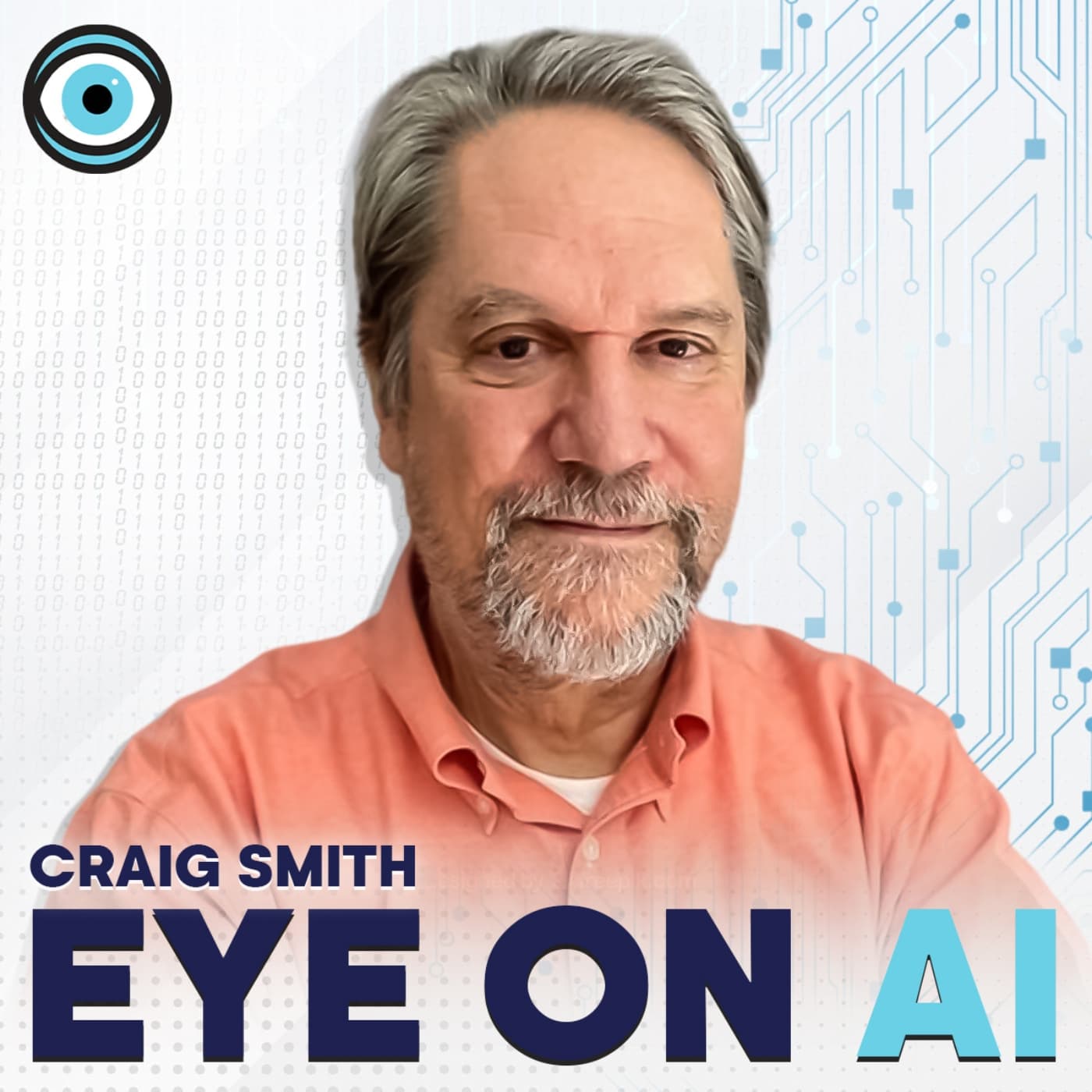
Episode Overview In this episode, Craig S. Smith interviews Mrinal Manohar, CEO of Casper Labs, focusing on the intersection of blockchain technology and AI governance. The discussion highlights how blockchain can enhance the security, compliance, and governance of AI systems.
Key Highlights
- Introduction to Mrinal Manohar
- Background in computer science with experience in AI governance.
- Transition from Wall Street to founding Casper Labs in 2018.
- Casper Labs Overview
- Focus on enterprise-grade blockchain infrastructure.
- Development of tamper-proof and auditable records through blockchain technology.
- Key Innovations
- Collaboration with IBM on developing Prove AI, a product designed to enhance AI governance through blockchain.
- Features include multi-party access, version control, and audit trails for AI models.
- Importance of AI Governance
- Upcoming legislation like the EU AI Act emphasizes the need for compliance in AI systems.
- The goal is to ensure that AI development and deployment are transparent and accountable.
Detailed Discussions
- Blockchain as a Solution
- Tamper-Proof Records: Blockchain offers a secure, immutable ledger for AI governance, ensuring that data used for training AI systems remains unaltered.
- Auditability: The integration of hashes allows for verification of data integrity and ensures that any modifications can be tracked.
- Prove AI Product
- Proof of Concept: Showcased results from collaboration with IBM, demonstrating blockchain's application in real-time data integrity for AI models.
- Product Features:
- End-to-end tracking of AI model training.
- Automated logging of context switches (changes in data sets or model parameters).
- Legislative Context
- The EU AI Act and ISO 42001 standards highlight the growing regulatory landscape demanding greater accountability in AI systems.
- Casper Labs aims to help companies navigate these requirements by providing necessary tools for compliance.
- Technical Differentiators
- No Orphan Blocks: Unlike other blockchains, Casper Labs avoids orphan blocks, ensuring consistency in transaction timestamps—a critical aspect for governance.
- Hybrid Networks: Combination of public and private blockchain structures to balance security and scalability.
- Upgradable Smart Contracts: Allow ongoing adjustments to smart contracts as business needs evolve.
- Implementation Process
- The integration of Prove AI is designed for ease of use, enabling enterprises to track their AI models without extensive coding.
- Support from both Casper Labs and IBM for onboarding and implementation.
- Future Vision
- Preparation for the launch of Prove AI in Q3, with ongoing conversations with potential enterprise clients.
- Focus on expanding the reach and compliance capabilities of their blockchain solutions globally.
Closing Thoughts Mrinal Manohar emphasizes the importance of proactive governance in AI and how blockchain technology can lead to a more secure and compliant AI landscape. Casper Labs positions itself as a pioneer, aiming to set standards in AI governance.
Additional Notes
- The episode also touches on the challenges companies face in adapting to new regulations and the consequences of AI mismanagement.
- There is a strong focus on collaboration between technology companies to enhance AI governance standards and practices.
Stay Connected
- Casper Labs: [Website](https://casperlabs.io/), [Twitter](https://x.com/Casper_Labs)
- Eye on A.I.: [Podcast Twitter](https://twitter.com/EyeOn_AI), [Craig Smith Twitter](https://twitter.com/craigss)
Episode Structure
- (00:00) Preview and Introduction
- (01:37) Overview of Casper Labs
- (03:46) Proof of Concept and Collaboration with IBM
- (06:58) AI Governance and Compliance Needs
- (08:38) Key Components of Blockchain for AI Governance
- (10:22) Training Data Integrity and Auditability
- (14:22) Challenges in AI Governance
- (17:15) Real-World Use Cases and Partnerships
- (19:24) Technical Differentiators of Casper Labs
- (23:39) Future Vision and Product Launch
- (26:23) Scalability and Hybrid Networks
- (27:52) Product Integration and User Experience
- (31:54) Support and Onboarding for Enterprises
- (33:11) Building the Blockchain Network
- (36:02) Market Response and Future Prospects
- (39:16) Differentiating from Competitors
- (41:06) Expansion Plans and Future Vision
- (45:43) Global Compliance and Availability
- (55:44) Closing Thoughts
This episode offers invaluable insights into the developing space of AI governance and the significant role that blockchain can play in shaping its future.
Written by AI. May contain mistakes. Listen to the episode to check what was said.
Transcript
Automatic transcript. May contain errors.0:00If you have like four trillion hashes, it's such an overhead to go through them. So it's really about very smart and efficient batching. You do it at the model level. You don't say, okay, I have 30 models running. I'm going to put them all in one pot. So model becomes, you know, one subset. And then each of those models could have a version number or, you know, a certain parameterization. So now you've created more branches of the tree. And each of those was trained by a certain set of data sets. And as you see, then you go down into a tree, which is very, very similar to what Walmart does. You have the aggregate financials right up at the top.
0:38But that is a combination from the tiny store in the book, all the way up to the massive store on the outskirts of Chicago. Hi, I'm Craig Smith, and this is Eye on AI. Today, I speak with Mrenol Manohar, the CEO of Casper Labs. With a background in computer science and experience in AI governance, Mrenahl discusses the innovative use of blockchain technology for AI governance, the importance of tamper-proof records, and the future of AI compliance. We explore how Casper Labs is addressing regulatory changes and creating a more secure and efficient AI landscape. I hope you find the conversation as interesting as I did.
1:23Can you start by introducing yourself, give your educational background as far as it's relevant and then then we'll start talking about Casper. Absolutely. Hi, I'm Rinald Manohar, CEO of Casper Labs Holdings AG, which is a Swiss-based company that's working in the area of AI governance. In terms of my background, I'm a computer scientist. I got my MS from Carnegie Mellon University. Research areas that I was particularly interested in include neural networks, formal language theory, etc. You know, the base rudiments of artificial intelligence. Great to see the whole thing come full circle. In terms of career, I actually spent a lot of time on Wall Street.
2:11I spent a few years at Bain & Company, the management consulting firm, and then Bain Capital in private equity for another two to three years. That was at Cigard Holdings between 2012 and 2017, and all these jobs focusing on the TMT sector pretty much exclusively. Founded the company in 2018. So it's been about five years and really excited about what we're doing. Thanks for having me on, Craig, by the way. When you say you focused on the TMT sector, was that as an analyst or were you doing something quant like? Both. So while I was at Bain Capital, I was an associate. I joined that job when I was 24.
2:55So I was there for just under three years. A lot of it was quantitative, but quantitative analysis, more so financial statements. But given my deep interest in tech, I'd always take it a level lower, look at what their coding standards were, essentially really examine if a company, another competitor could replicate their mousetrap. At Sagard, obviously slightly more senior. I was a vice president and later a principal and sector head of technology, media, and telecom. And so basically did all the quantitative and qualitative analysis of companies in the technology, media and telecommunications spaces.
3:34Yeah, and so tell us about Casper Labs. You're involved in blockchain. I was interested in blockchain a few years ago, but it got so crazy I've kind of pulled away from it and really focused on artificial intelligence. But you're kind of at the intersection is that right that's that's absolutely right so let me let me just step back we're an enterprise grade blockchain infrastructure company or just an enterprise grade infrastructure company our interest primarily in blockchain early on was that blockchain is really the best version of tamper proofing that there is compared to a regular database, you have a completely tamper-proof record of things.
4:25So there's various applications in any sort of governance tool. And on top of that, it allows things like multi-party access, Turing complete programming on top of it, which a database just doesn't give you. Now, what we've been really looking for, what's the right use case to really bring these you know, these characteristics to bear in the market. And AI governance, we actually started work on this well over a year ago, about April of 2023, even before, you know, all the legislation came out. We realized that since you have this tamper-proof immutable record, it has massive implications for governance of AI, where you have these rapidly evolving models.
5:07And if you want to track and trace their development, or have an accurate audit trail, or perform version control, for example, this is really the best, cheapest, and most secure technology to do this. Yeah, and I've been talking to people, I don't know if you know Oasis Labs out in California, it's Don Song out of Berkeley, but they're working on differential privacy and productizing differential privacy for large corporations. And over the years, I've talked to people about federated learning and things like that. Do you guys have a product or are you a SaaS platform? Are you a consultancy? What's the primary offering to corporates?
6:02The primary offering is a product. We're building a product called Prove AI. we actually showcased the proof of concept in November of last year. We co-hosted a Gartner webinar with IBM where we showed the proof of concept, where in real time we showed end-to-end data integrity and tracking of an AI model. We showed version control as well as multi-party access to governance. And it was based on the interest in that webinar that we decided to go full bore and develop this product in collaboration with IBM Consulting. I see. So coding is active. It's been active since early this year. And we're launching Q3 of this year.
6:44I see. And when you say in collaboration with IBM Consulting, are they, in effect, the sales arm for the product? I mean, will they take the product to their customers? So I'll give a nuanced answer. It's a qualified yes in the sense that the product integrates seamlessly into WatsonX. So the WatsonX platform has three components, WatsonX.AI, which is essentially a model studio, WatsonX.Data, which is curated and pre-indemnified datasets, meaning you know that there's no PII or copyright information on it. And then, of course, WatsonX Governance, which is a newest product. And all of these are really built on the OpenPages platform.
7:30You know, IBM has been at the forefront of GRC for the past few decades. And so the product Prove AI will seamlessly integrate into the WatsonX platform because it's a better together story, meaning you get all the UX and open pages design that IBM's known for, as well as the augmentation from the blockchain, which is tamper proof and auditable records. So your ISO 42001 and EU AI compliant, multi-party access, as well as version control. So, it's in both our interests to sell the product and also in the interest of the customers to be compliant with the raft of legislation that's coming up. Yeah.
8:13Well, to that point on the raft of legislation, what legislation specifically does Casper help address? Yeah, so specifically, and when we initially built the product, just to be fair, in April or May, when we came up with the idea, none of the legislation had actually come out. To be honest, we're surprised at the speed in which governments have reacted. We thought this is probably half a decade out, but let's get companies prepared. Specifically, I'd say the EU AI Act, we have a strong belief that's similar to GDPR. It'll be de facto in many ways. Obviously, it's in a nascent state. I actually think it's a pretty well-written act, especially given it's in a nascent state.
9:00And it's likely to be modified significantly. But off of the EUAI Act, ISO started a standard called 42001. If you're compliant with 42001, I mean, nothing's ever black and white, but you're, in essence, compliant with the EUAI Act. But if you looked at the acts coming out of the UK, Colorado, California, etc., all of them are very, very close to what the EU AI Act is. And if I were to step back, you know, not go through the entire act because it's fairly long, essentially what it says is the level of auditability you need for your underlying AI system builds needs to approach that of financial statements, meaning the old world of, hey, it's AI, it's a black box.
9:44we don't know what's going on, that's not acceptable anymore. You're going to have to be able to give an auditable trace. And there's this concept of adversarial robustness where you have to prove that your trace has not been tampered with. And you combine those two things, the combination of the WatsonX platform and what we bring to bear with Prove AI basically addresses all those points. Yeah. And by using the blockchain, this enterprise-grade blockchain, That's the immutability of that and the ability to store data on the blockchain. Are those the sort of key components of what you're doing?
10:29That's one of the key components. But if I may talk about a couple more. So one of the key components, obviously, is it's an excellent form of copy protection and immutability. You know, the records don't change. As a result, it saves you a lot of cost because you don't have to have a third party verify it or a third party can easily say, yep, it's clear to us that this hasn't been modified. But blockchain gives three more things that you wouldn't get off of a database. The first is multi-party access is very, very easy on a blockchain system because it uses a private key system. who has access to what information, to your point early on in the conversation about privacy and data integrity and privacy issues, all of this is out of the box with a blockchain because managing access control is an inherent part of an underlying blockchain.
11:21The second thing that it brings is any programs written on top of a blockchain are Turing complete. So if you think about a database, you're beholden to SQL, which is an input-output language. And so more complex access control or more complex triggers can't really be set up on a database, especially in a multi-party environment. And third, as a result of all the things I've noted above, you actually get the best form of version control for your AI because you are tracking and storing all the fundamentals on this immutable ledger. ledger, if your AI starts misbehaving, instead of trying to solve it the brute force way that they do today, which is retrain the model, which is A, very expensive, and B, non-deterministic, you're hoping for the best, you can actually just revert the model back in time to a state when it was behaving to specification.
12:17Yeah. So for people who aren't familiar with blockchain uh with how it works um i'm trying to let's let's take uh i mean one of the things you do is protect the integrity of training data and make that training data data audible audit auditable is that right that's correct so so talk about how you do that and how the blockchain does that. I mean, blockchain essentially is a ledger where transactions are recorded. It doesn't necessarily hold the asset, right? That's correct. It holds two things though. It holds the transaction, meaning this data set was used to train this model at this time that was working under these specifications.
13:16So all that metadata is stored, but it also stores a hash of that data set. So meaning not to become fully auditable, meaning if anyone modifies or tampers with that data set, those hashes will no longer match. So you don't need to replicate the data within the blockchain, you can keep that within your data lakes. And if you're using Snowflake, or you know, a standard Oracle database, you can keep it where it is. It's just that the record of the trace path is completely immutable. Meaning if there was any modification to the data set, the hashes wouldn't match and then that way you could not prove auditability.
13:54So if you look at the way the acts are stated, you essentially do have to snapshot your data sets and be able to clearly prove this is what I used going forward. And so you get both those things from blockchain. Yeah. And on that, on the training data, the auditability of the training data, how, do you understand how that works? That's something, you know, people say, but these, the OpenAI, the GPT-40 training set is larger than anything that a human could crawl through. So how do you audit that? I'm going to give a two-part answer. So first part is essentially you replicate what a general ledger system looks like in a financial statement.
14:54For example, if you take Walmart, right? Walmart does billions and billions of transactions, but their financial statements essentially aggregate that. You have proof at each store level. And so essentially, you transform that into a general ledger system. You essentially say, anytime a data set is going in, we're going to track it, we're going to capture the hash. And so we know that this transaction occurred. Now, it brings up a second point, which is where's the point at which it's useful versus useless, right? If you have like 4 trillion hashes, it's such an overhead to go through them. So it's really about very smart and efficient batching.
15:34You do it at the model level. You don't say, okay, I have 30 models running. I'm going to put them all in one pot. So model becomes, you know, one subset. And then each of those models could have a version number or, you know, a certain parameterization. So now you've created more branches of the tree. And each of those was trained by a certain set of data sets. And as you see, then you go down into a tree, which is very, very similar to what Walmart does. You have the aggregate financials right up at the top. But that is a combination from, you know, the tiny store in the book all the way up to, you know, the massive store on the outskirts of Chicago.
16:12all of them aggregating up to the top. Now the AI data set, ChatGBT is a exception here, but for most enterprise use cases, if you have a AI chat bot that's giving you insurance quotes, yes, it gets pretty complex. You're drawing actuarial information from several sources, but you essentially replicate the general ledger system, as I said before, and then it becomes way less unwieldy. Essentially just what you've been doing with financial statements before, And it's all automated. If you've written your smart contract appropriately and you say, every time I train it, put an imprint here, all of this is done through a UX.
16:49So you don't have to really write any custom code. It essentially aggregates the data such that you have a general ledger of sorts of everything that happened with your underlying AI models. Yeah. And then the actual auditing, is that done with AI? I mean, who does the actual auditing or is that just sampling and that sort of thing? The good news is you wouldn't have to sample that much. I mean, look, again, there's a difference between practicality and being compliant. You wouldn't need AI to audit this, right? You could just send a trace and say, okay, this is the trace history of the model.
17:35do all the hashes match to all the data sets that you've stored? If the answer is yes, you can just spawn a certificate. And then a third-party vendor like Vanta, Shellman, or one of the big four can look at that and say, yep, this is on a highly secure, highly cryptographic ledger. All the hashes are matching. So whatever you're telling us you said you did is what you did. And so that's how it works in real time. Now, obviously, if you're a company, look, this isn't happening now, but who knows in a decade. If you're a company running 100 AI models, which is each looking at thousands and thousands of data sets, there might be some sampling involved similar to how audit at large companies work.
18:16They take 10 random stores, make sure everything's above board, and then assume, okay, it's been above board across. There, it's a little harder to comment because that depends on how regulatory standards will be enforced. In financial statements, some level of sampling is allowed. I assume as the volume of AI data sets and AI models increases, sampling could be allowed as well. But the good thing is since it's stored on this data structure that's Turing complete, a lookup is not actually that complicated. Like even if you had to go through a billion records and just reconcile the ashes, we're not talking months of work.
18:54We're talking days. Yeah. And the product that Casper's developing, it will record where the training data resides, when it was created. so you can track the provenance and model versioning of the data, I guess. Does that mean you can track the model versions? Yes. So what we're tracking over and above multi-party access, because that's really important to AI. But essentially what we're tracking is anytime a model has a context switch. And a context switch means it'll behave differently than it does currently. And the way that happens is one of three things happens. Either it's trained with a new data set or your vector database that's performing retrieval augmented generation has an update to it.
19:59So that's a new context. The second is, has the tuning of the model changed? Meaning the parameterization. Have you changed the number of tokens if it's a token based model? have you changed the P or K values? Have you changed the sampling method? Any change there would also change context. And then finally, of course, any update to the core model itself. You know, if you go from flan 1.1 to flan 1.2, you've obviously created a context change. So if any of these three things change and you know, these change fairly rapidly, if you're deploying a lot of models, that will result in an imprint. Now, obviously with the retrieval augmented generation, it goes back to how practical do we need to be?
20:43Because, you know, vector database could be updated. You know, if it's spitting out sports scores, for example, it could be updated every millisecond. So you might decide that the right batching mechanism is once every minute. We take an imprint every minute, that's the lock. And so there are certain areas, especially in RAG, where you have to think a little deeper. But for general data set training, you know, you cover those three, you're essentially covered. That being said, that's how AI is currently being used. We don't know how it goes in the future, but the beauty of, you know, Turing Complete smart contracts is you can always add another primitive if that primitive becomes substantial to the governance of underlying AI platforms.
21:27Yeah. How are companies doing this now? By and large, they aren't or they're doing it highly manually. AI governance is a very new industry. I mean, there have been some competitors who've been around a while, but it seems the focus has been much more on MLOps, you know, having model studios and helping with that plumbing. The rush towards AI governance has actually been spurred by both a general call it, hey, let's stop and make sure we're doing this right, for lack of another term. You know, there's just a general feeling that AI could go off the rails. And by the way, I'm an AI optimist. We're not doing this because we want to slow things down.
22:14We're essentially saying we give you the seatbelt so you don't have to worry about that. Drive as fast as you can. And the second reason is on the back of, you know, all the legal threats that have gone back and forth for PII, copyright infringement, you know, that Google bot showing Nazis of varying times. types, you know, because of that, it seems like governments have taken, you know, very, very strict action. The EU AI Act actually goes into effect in 2025. So this has actually become one of the top of mind subjects for CISOs, CIOs, chief risk officers, because, you know, the clock is ticking.
22:54There's about six months to get ready to be compliant. Obviously, it's not going to be as strict in the early days as we saw with GDPR. But over time, you can expect, as with GDPR, Sarbanes, Oxley, etc., this just becomes a de facto way of tracking and tracing what you're doing. Yeah. Can smart contracts on blockchain enable automated triggers to detect or shut down rogue hallucinating AI systems? I mean, does it have that kind of capability? Yes, absolutely. In fact, the way you'd set it up is access to power and access to compute would basically be a switch on the blockchain. You set up your triggers.
23:35And if the trigger gets overridden, essentially, the blockchain would cut off power, essentially shut down the model and make sure it doesn't have access to anything. So, you know, while that's not our primary use case that we're going off, we're not looking to just build a kill switch. The kill switch does exist. Yeah. Can you explain that understanding? That's not your focus, but it's something that the public certainly talks about. How would that work? Yeah. Just to set up historic context. Right. So if you watch Matrix or Terminator, like the main thing that caused Skynet to happen or models going really, really rogue.
24:20And obviously, we're not close to that yet. The main thing is they figured out, OK, we have access to our own power now. And so once that happens, you know, they don't need us. Right. There's no intermediary needed. So essentially, you need a technology that is absolutely not affected by AI to decide whether it gets access to power, access to resources, etc. Blockchain is a completely decentralized system, meaning, you know, take our network, for example. there's tens of thousands of delegators. It's their combined vote that decides whether a transaction goes through or not. So someone writes a smart contract, essentially you say access to this power is governed by the smart contract, is currently set to on.
25:03And the smart contract looks for a set of triggers. For example, is the AI asking, is it emailing vendors trying to figure out whether it can get power from somewhere else? Is the AI acting outside of bounds? Meaning Is it, you know, it's a robotics facility? Has the AI, you know, started like making the arms do things that it's not meant to do? Is it putting humans in the category of food? You know, all sorts of things can happen. You set your triggers up and you essentially say, if any of these triggers are ever overridden, immediately cut off power, immediately cut off access to compute, and the AI just shuts down.
25:41or if it tries to copy itself. You can't imagine the number of scenarios, but essentially anything you can imagine, you can set up as a trigger within the blockchain. And essentially it'll automatically, because smart contracts are too incomplete, shut off that power and give you time to go audit it. But again, that's not our core focus area. It's just really interesting because yes, the technology does enable you to do that. Yeah. What's the scalability consideration when applying blockchain for AI governance at an enterprise scale? Yeah. So essentially the best way to deal with scalability is to have hybrid networks, meaning you want essentially the important imprints to all be on the public network.
26:34Because the public network is truly immutable and is truly tamper-proof. And so everything is replicated to a degree or batched to the public network. But the way you get real hyperscale within your builds is you set up a private instance as well. It's similar to what you do with cloud computing. You know, you mix and match your on-prem and off-prem. You get the best of both worlds. So similarly, the way you scale is essentially you're building a layer two network within your company where you store absolutely everything. And then you decide like, hey, for auditability purposes on a daily or hourly basis, we are going to put every imprint that we have relayed to the public blockchain, prove that all the hashes are secure.
27:19Obviously, all of this happens in an automated manner. You set up the policy up front, and then the smart contract just takes care of it, and it can be upgraded as time goes by and policies change. But essentially, the scalability is similar to how they do it in cloud. It's a mixture of on-prem and off-prem. And how would an enterprise implement this? Excuse me. So I've got a model and a training data set, and the model is making inferences. Are you kind of plug and play? I mean, how do you integrate your platform into what I'm doing? Hi, I wanted to jump in and give a shout out to our sponsor this week, TrialKey.ai, the market leader, AI-driven clinical trial design optimization and predictor that improves trial design and execution.
28:25I recently had TrialKey on the podcast. I encourage anybody who's interested in clinical trials to go back and listen. With over 90 % accuracy based on precision recall, TrialKey.ai predicts the success of clinical trials more precisely than any other tool on the market. TrialKey.ai contains the world's first clinical trial design simulator, which allows you to manipulate a trial's design to find the best combination for most probable success. TrialKey.ai pulls data from over 350 ,000 clinical trials, inclusive of medical devices, alternative therapies, and non-randomized drug control trials. Pivotal clinical trials often exceed$48 million in cost, yet only 10 % of pivotal trials succeed.
29:22TrialKey aims to address this issue by helping companies improve trial design with AI. A 2011 study found that 60 % of trial protocols needed amendments, with a third preventable through better design planning. On average, completed protocols undergo 2.3 amendments, each causing significant delays and costs around half a million dollars each. AI provides clinical researchers and pharmaceutical companies with in-depth variable analysis and a clinical trial simulator that improves trial design, execution, and drug mechanism of action. Leverage AI-powered clinical trials to accelerate medical breakthroughs at trialkey.ai.
30:10Maximize clinical trial success while minimizing costs. Book a demo at trialkey.ai or sign up for free. Transform your clinical trial outcomes and shape the future of healthcare. Again, schedule a demo at TrialKey, that's T-R-I-A-L-K-E-Y, AI, or sign up for free. Elevate your trial success and drive innovation in healthcare. Yeah, so you basically sign up for Prove AI, and now you have access to the entire platform, as well as, you know, the integration into WatsonX governance. And then essentially, you can bring in your models. You say, hey, this is the model I'm using. I want this to be tracked and traced completely.
Read the full transcript
30:57You hit your toggles, essentially say, whenever a context switch occurs, which is a re-parameterization, a new data set, or the model version changes, I want to create an imprint. And then you set the access controls. And then it just flies. Anytime a new data set goes in, that data set is logged. The imprint is logged, hashes are established. And going forward, everything is tracked and traced. And as you get new models, you just do the reference. It's all within the UI UX of the platform. Unless you want to do something incredibly complex, it should require no custom coding. Hmm. And when you say, so it's a self-serve platform, the enterprises.
31:44Correct. And look, if people need onboarding help, the Casper Labs team is there as well as the IBM team. Since we're building it in collaboration, both teams know the product really, really well. Obviously, over the next quarter, as we're preparing for launch in Q3, we're really putting together what the customer service looks like. But it'll be a combination of our team and IBM's team that we're collaborating on the product. Yeah. And the blockchain that you're building for Prove AI. Can you talk about how you build a blockchain? That's another thing I've never understood because you depend on nodes in a vast network.
32:33And do you need to recruit people to participate? How do you compensate them and all of that? Or can you do it without those things? For a public network, you can't really do it without those things because you want it to be self-sustaining and public. And so the way we did it was we set up basically a testnet, meaning testnet participants got rewarded for their utility in setting up the testnet. We had like 100 participants, which have become 100 core validators. We have validators from, you know, popular shops, Figment, Stake.us, you know, a lot of the well-known validators validate our network.
33:18And so essentially right at test, we set that up. So there was infrastructure. And then, you know, they were also allowed to, you know, purchase basically proportional votes on the network with the underlying token as well. And so the network was basically decentralized from day one. So we did set that up through the nonprofit Casper Association. But what's really important and where our network varies, some other networks have done this as well, is we allow delegation. Meaning if you own the utility token, but you don't want to set up your own hardware, you can delegate to any of the multiple hardware providers out there or just run it on AWS.
34:03and essentially it never leaves your wallet. It just gets locked into a contract. And so you always retain your keys. You never have to transfer. And similar to all other networks, including Bitcoin, people are essentially rewarded off of minor inflation. Yeah. I mean, this is the point at which I get lost on blockchain. So the current blockchain that you're building Prove.ai on has how many validators, how many nodes? Yeah, it has 100 plus distinct sets of hardware. So that's validators. But delegators, it has tens of thousands, meaning a lot of these validators are essentially aggregating delegation.
34:52I mean, if you look at any blockchain, really after, you know, validator number 50, it's a really, really long tail, like vote tends to be concentrated in top 50, like with any system. And so really, the way to square that circle is allow delegation to these hardware providers to be absolutely seamless, and not to have your actual wallet transferred, but rather delegated. And so that's how it works. So there's tens of thousands of people essentially voting, meaning if a validator starts going rogue or misbehaving, people will just pull their stash from that validator and put it into another one.
35:33And so it's a self-correcting mechanism. You know, the network's been out for about three years. We've not had any issues. Upgrades have gone for fine. We've never had, you know, overspend or double spend or any of those problems. So you have the 100 hardware sets, and those are individuals or companies that do this for every team? So it's a combination. So some are well-known companies, like Figment. There's a lot of these well-known companies that just run validators. That's some of it. Some of it are individuals. Some people are, you know, very big supporters of the protocol. They've individually decided to do it.
36:22And a lot of them are companies that have gotten created because they saw the opportunity. You know, we have this group out in Vietnam. We have some supporters in Vietnam. They all pooled together and set up a validator on their own, which is great. You know, as a result, we have huge global diversification, huge diversity. So, you know, the network isn't really geographically prone. It's across multiple time zones that comes with its own issues. When you're doing an upgrade, you have to sync across all these time zones as well. But essentially, it's a combination of those three things. There's professional companies that do this.
36:59There's individuals and enthusiasts that do this. And then sometimes they pull together and companies are basically created or pools are created because it's, you know, the call it the infrastructure cost makes much more sense if you're able to pull more of a stash against it, as opposed to, you know, if everyone tries to run it off of a smaller value. Yeah. And then they earn tokens for the validation. Is that right? Correct. And, you know, the tokens only do two things, right? It's a pure utility token. It's essentially a proportional vote on the network, which gives it its security. And it's an AWS credit equivalently, meaning whenever you want to do compute on the network, it acts as a credit that accesses that compute.
37:49So, you know, so an imprint costs this much based on how much computation it runs. And then, you know, it's paid for. And then the computation occurs. It's literally just like an AWS credit with some voting privileges. Yeah. I mean, is there a third, I mean, a secondary market, I should say in these tokens, if somebody doesn't need the AWS credit, can they sell them on some marketplace to people that do? Yeah. A bunch of exchanges have listed us. I think the aggregate value of the network is, 400 million or something like that right now. And so, yes, there are. But again, it's completely decentralized.
38:37Exchanges choose whether they want to list it or not. We're fortunate that we're on a bunch of them and we'll be on a bunch more. But it's really fully decentralized, meaning we don't control that at all. So how do you differentiate yourselves from other companies that are providing this or building this kind of service on the blockchain? So we're unaware of anyone who's doing it end to end the way we are. You know, differentiation number one is we were really first about this. We were talking about this in April, May, before all this legislation came out. And so as a result of being first and also having amazing thought and collaborative partners in IBM, we really have the first end to end product out there.
39:29So, you know, that's one that's a that's a huge competitive differentiator. We think it's a better together story. This is not something that should be sold in isolation. Having the, you know, GRC history and DNA of IBM is really, really valuable. But the second thing is, there are some really big technical differentiators that our blockchain has that others don't. And the reason for that is, we always knew that we were going after enterprise grade infrastructure, as opposed to, you know, blockchain, just like the internet in the early days has had, you know, some funny use cases, for lack of a better word, that that's really not been our focus, our focus has been enterprise grade infrastructure.
40:11So I'll just give you a few examples of like, things that we have that you don't really find on other blockchains. So one is, we have no orphan blocks or reorganizations. This can happen in other blockchains, which means you could de-sync in terms of timestamping. I mean, a transaction could have not gone through, so the timestamp could be de-synced. That's a problem if you have a governance issue you're solving. The timeline is incredibly important. Secondly, when you mentioned scaling, we talked about hybrid blockchains, where you can get all the benefits of the public blockchain, transmit a a lot of your immutable imprints, but you can also run a private instance as well to get scaling.
40:54That's something fairly unique to us. And then on top of that, we have things like upgradable smart contracts. Your smart contracts aren't set it and forget it. You can have best demonstrated processes for our practices for software development, where as you see a smart contract being insufficient to your current business problems, you can always upgrade it. And we have all the bells and whistles on access control as well, meaning who gets to upgrade it, you can predefine what permissions are required. And we have very sophisticated access control, including weights and key management, such that multi-party access can be very, very rigorously governed.
41:38So the sum total of that is really a feature set that doesn't really exist in other blockchains. Some might have one or two of those things, but not done really from the ground up. And we were able to achieve that because unlike most blockchains, which fork an existing blockchain, usually Ethereum, we didn't fork anything. We built it from scratch. We said, all right, what are the precepts that an enterprise requires? And we built it accordingly. Yeah. Do you guys offer secure storage for training data sets? We can. Again, honestly, I think the best way to do that is to use your blockchain as the access control mechanism and the tagging mechanism.
42:20Because just storing the data on the blockchain, you don't really get that much. It's the access control and, you know, the immutable trace that's really valuable. So you can actually prevent anyone from accessing that data unless they have that permission off of the blockchain. So you get all the security. But I wouldn't say, you know, obviously, we store a ton of metadata on the blockchain. But you know, if you have like a 10 petabyte, you know, data repository of actuarial information that, you know, trained your fintech program, it makes much more sense to store that in a data lake, like Snowflake, etc.
42:57And just make sure that all your access control and all your audit trace is all on blockchain. Thereby, you get the best of both worlds without having to replicate infrastructure. Yeah. Are you offering this only through Watson X or IBM's products? No, you can buy it standalone. So if you want to use it as a standalone product, you can. There's, you know, obviously some people aren't, you know, an IBM shop, etc. We do think it's stronger together. And, you know, we're going to figure out what that means for pricing and go to market motion, et cetera. But the answer is no. If you're absolutely, no, I just want to run this on my own.
43:42I know how to set this up. I can make all of this work. It can work as a standalone product as well. Yeah. Well, what does IBM offer that you wouldn't get if you're working with it as a standalone product? It's really the GRC, you know, because it's, I wouldn't say reskin. I'm sorry, GRC, you have to. Oh, yeah, sorry. Governance, risk, and compliance. Right. So OpenPages, which is a decades-old product from IBM, has been doing governance, risk, and compliance for, you know, financial statements, internal HR policies, et cetera, for decades. And essentially, the WatsonX governance platform mimics that DNA.
44:28And so what you get is really a UI UX that's been stress tested, you know, across decades and tens of thousands of users. So you get that benefit because you get the access to WatsonX's AI platform, WatsonX's data platform, as well as a governance platform. And it's an open platform, meaning they just announced the partnership with SageMaker, which means if your models reside on the Amazon infrastructure, it's seamless. You can access all of those. They're an investor in Hugging Face. So there'll be an integration with that as well. And so you really get all those benefits of having a tried and tested GRC product alongside very, very strict tamper proofing provided by the Prove AI.
45:14Will you guys be the only partner offering blockchain governance and compliance solutions? Or GitHub, for example, has integrations with every new product that comes up. but but they you know a lot of the products uh that that are integrated uh into github uh there are many companies offering essentially the same product it just depends on which you want to uh to go with is is it that sort of thing uh yes look we we don't know of anyone who's as ahead as we are um you know we've already announced the product we're already uh you know in active development. We already have our first design partner on it.
46:06And so we're ahead. As far as we know, no one else is doing this, especially not at the scale we are. But, you know, as with anything, we welcome competition. It's good for the industry. But I do think we just have a really significant head start given the relationship and given, you know, the technical differentiators I outlined. Given it's a highly distributed system, it would take someone a year or two if they're an existing blockchain to get there. So none that we know of, but it's not impossible for sure. Yeah. And how did you come to this with IBM? I mean, that's a pretty big win for a startup.
46:50up? It really started with a thought partnership exercise. Sham Nagarajan, who's a partner of global consulting and head of AI governance for IBM Consulting, he's been active in the blockchain space for a long time. He's been a great thought partner to us. I'm a member of Ledger Foundation, as is our company, also the Linux Foundation. And so, you know, we've run into each other a lot. And when we saw like the GPT boom, I reached out and kind of we co-sketched out like, hey, isn't this a really perfect use case for blockchain technology with the added benefit that there isn't an incumbent tech stack here.
47:38So we could build this right from the ground up. And so that was the initial discussion way back in April, May of 2023. Subsequent to that, we said, we should actually just test this. Let's test this in the market and see if people think similarly. And so Gartner, who are a great partner, allowed us to co-host a webinar with IBM, where we showed a proof of concept of the product. And a typical Gartner webinar has 100 or 200 signups. We had like 1 ,700 people sign up. It was probably augmented by the fact that the day before, and we didn't know this was going to happen. So November 3rd was when we were doing the Gartner webinar.
48:20On November 2nd, Biden executive order came out saying, hey, all people who use AI have to use it responsibly. It's very vague. You don't know exactly. It doesn't lay out what actually the legislation is going to be. But as a result, we saw a massive spike. Everyone's like, all right, we should listen to this. And subsequently, a lot of people signed up to be beta partners, help us get this product to market. And I think that really stimulated both the teams at Casper Labs and our partners and collaborators at IBM Consulting to really go after this. So really, it was a long journey, but it started April, May of 2023.
49:03and then really came to life in November of 2023 when we saw what the market opportunity was like. Yeah. And when are you going to launch? Q3 of this year. Oh, Q3. I'm sorry you said that. Yeah.
49:18And are you working with enterprises in preparation for that launch? I mean, are there companies already, you know, it takes some preparation, right? Yeah, we have a pipeline of a few dozen companies that we're in active discussions with. We expect to have quite a few of them at launch using the system. One in particular that we're furthest along with is a company called Grayscale AI. So Grayscale AI basically uses AI on top of machinery and food inspection. So, you know, your chicken nuggets, your fries, chocolates go through this machine, it tests for presence of heavy metals, infection, bad shapes, the gamut really, and of course, they do a lot of AV testing, right?
50:14You put in some that you know, two or three of these are off, make sure that the machine can pick it up. And you know, the AI models continually update. So there's a twofold thing there, which is a, you want to track and trace that AI model, make sure it's not working out of spec, et cetera, which we're helping with. And the second thing is, additionally, you want to be able to tell the food manufacturers, whether it's a Tyson or a Nestle, et cetera, that, hey, every single batch that we say was tested has been tested. And we have a tamper proof log that's been on the blockchain to prove that this has happened.
50:52So you get both the governance as well as the attestation that everything has been AI examined and working to spec as we've defined. And so that's a really interesting use case. And we're really excited to partner with them. There's a few more that we're in very advanced conversations with, but you know um uh they're not ready to go public yet uh grayscale has been kind enough to to be willing to go public so yeah really really looking forward to show the power of that that goes yeah and uh the uh the eu uh ai act you were saying is uh it's coming into effect uh next year uh so So presumably you'll be up and running and IBM will be offering this on the WatsonX platform and you'll be in a good position to capitalize on that.
51:47Yes, barring any black swans, that's accurate. it uh and in terms of uh blockchain uh development uh can you give me a little bit of context because as i said i was interested to be beginning i mean in you know 2017 18 16 17 18 that period when the first sort of big public focus. And I kind of lost interest. Are there a lot of enterprise grade blockchains out there doing things that people aren't really aware of? Is it a technology that's maturing on the enterprise side, not on the cryptocurrency side? So the answer is a qualified yes. Yes, but not as fast as we thought it would be. Because honestly, my view has always been that the enterprise use cases are the real use cases, similar to what we saw with cloud computing, what we saw with Linux, what we saw with the internet, they all start out being, okay, this is for enthusiasts, this is for the anarchos out there.
53:04And then eventually, you know, it becomes really, really serious. I do think that shift has started, you know, like the early days of blockchain were really fueled by speculative fever, as well as, you know, NFTs, meme coins, you know, a bunch of stuff. But, you know, similar to the Internet, you know, early days, it was just porn and gambling. Like, that's what it was in the early days. And if you told someone that an Amazon is going to be born out of this, or Netflix, they would have probably scoffed. That's starting. I think Prove AI could be an amazing linchpin moment for that happening because the issue that's happened with a lot of these enterprise use cases is that there is an incumbent tech stack.
53:50So, for example, blockchain is a great solution to your supply chain problems because you can get inputs from everyone. You have one single source of truth. But the pushback you always get is, hey, look, I've got like 10 products looking at my supply chain already. Why am I going to go through the brain surgery of replacing it, even if it's better? I just don't want to do that. AI governance is, there is no incumbent tech stack. This is the best way to do it. Not just my opinion. IBM seems to agree. Gartner seems to agree that having a blockchain as an immutable ledger is the best way to perform AI governance.
54:25And so there's this chance to get the tech stack right, right out the gate. And so long winded way of saying, we're hoping to really drive the seriousness of enterprise grade use of blockchain. And we are noticing that, you know, companies are really in the space are really thinking about it, because, you know, the speculative driven things don't last forever, right? They come and they go. But you find a real enterprise use case that lasts forever. You're solving a problem and people have no incentive to move away if it solves the problem in a cost effective manner. Yeah. Are you guys continuing research?
55:08I mean, obviously, you've got your hands filled building a product, but is there a research angle to what you're doing? Yes, there's research on two areas. Obviously, on the blockchain side, we always want to be a step ahead in terms of enterprise features and distributed computing, really always have the most secure, most cryptographically authenticated source of truth out there. But on the AI side, everything that we've built has been through extensive research. The research is a combination of looking at legislation, really understanding how companies are deploying these AI models. We're not building this in a black box.
55:50And over and above that, in addition to all our beta signups and customers we talk to or potential customers that we talk to all the time, we've also done a huge series of guide point interviews, where, you know, we talk one on one and really, really dive into the pain points and build a product. And then finally, I don't know the exact date on this. But we we do a lot of polling with our partners at Zogby, where essentially we list out a bunch of questions. And, you know, we publish free reports on the state of AI governance, AI governance of blockchain, etc. And we have one coming out, I believe, in a roundabout a month's time and craig i'll be happy to share that with you as soon as we have it um it's it's you know it's usually about 600 cios cto's cso's of companies going from you know small and medium businesses all the way to fortune 500.
56:43we try to make it a demographic mix that matches you know the economy at large and targets are u.s europe and china and so you you get a geographically diverse spread. So the product is always informed by these external, this swath of external research that we do. Yeah. You mentioned China and that's a particular interest to me. I spent a lot of my adult life in China. Is this product going to be available to Chinese companies because they're going to have to comply with various jurisdictional regulations themselves? Or is there a similar regulation being implemented in China that this product would address?
57:39So the answer is yes. So absolutely, it will be available in China. You know, IBM has had, you know, four decade presence within China. And, you know, so as a result, that makes it easier, you know, to use the product. You could, you know, one of the gateways is obviously through the WatsonX platform. That being said, you know, initial outreach is because, you know, we're EU and US based. having those iterations fast is likely going to start in the EU and the US. And China's legislative framework for governing AI is at a very, very nascent stage, especially relative to the EU. And even in the United States, we're seeing a raft of state-level legislation coming out.
58:29And I expect that pace to grow irrespective. China does have, call it a staple act that's come out, but it's incredibly vague. But obviously, we're tracking this all the time. But the TLDR is yes, definitely available in China. Initial focus might be a little more EU-US tilted. That being said, if major legislation comes out and there's a raft of demand, And, you know, obviously we'll be there to meet it with our partners. Yeah. Okay. Well, we're up to about an hour. Is there anything I haven't asked that you want to say or that you want to talk about? No, just wanted to end saying, Craig, thank you so much for having me on board.
59:12I have really enjoyed your content, both this podcast and your journalism. And, you know, if we can ever be helpful with information or anything, let us know. and I'd like to thank your audience for listening to this. It's been a pleasure being here. That's it for this episode. I want to thank Rinald for his time. If you want to read a transcript of today's conversation, you can find one, as always, on our website, Eye on AI. In the meantime, remember, the singularity may not be near, but AI is changing our world, so pay attention.
From the publisher
This episode is sponsored by TrialKey.ai, the market leader AI-driven clinical trial design optimization, and predictor that improves trial design and execution. With over 90% accuracy based on precision/recall, TrialKey.ai predicts the success of clinical trials more precisely than any other tool on the market.
Maximize clinical trial success while minimizing costs – book a demo at https://trialkey.ai/ or sign up for free!
In this episode of the Eye on AI podcast, join us as we sit down with Mrinal Manohar, CEO of Casper Labs, to explore the intersection of blockchain technology and AI governance.
Mrinal delves into his journey from Wall Street to founding Casper Labs, a leading enterprise-grade blockchain infrastructure company. With a strong background in computer science and experience in AI governance, Mrinal shares how Casper Labs is setting new standards in AI compliance and security.
Discover how Casper Labs uses blockchain to create tamper-proof, auditable records, ensuring the integrity and security of AI systems. Mrinal explains the innovative use of blockchain for multi-party access and version control, highlighting the company's collaboration with IBM to develop cutting-edge solutions integrated into the Watson X platform.
Explore the implications of upcoming AI legislation, such as the EU AI Act, and how Casper Labs is helping enterprises navigate these regulatory changes. Mrinal provides insights into the challenges and opportunities in AI governance, discussing real-world use cases and the future of secure AI systems.
Learn how Casper Labs is positioning itself ahead of the curve, with technical differentiators and strategic partnerships that set it apart in the industry.
Tune in to understand how Casper Labs is transforming AI compliance and security with blockchain, and what this means for the future of AI.
Don't forget to like, subscribe, and hit the notification bell for more insights into the technologies driving the AI revolution.
Checkout Casper Labs:
Website: https://casperlabs.io/
Twitter/X: https://x.com/Casper_Labs
Stay Updated:
Craig Smith Twitter: https://twitter.com/craigss
Eye on A.I. Twitter: https://twitter.com/EyeOn_AI
(00:00) Preview and Introduction
(01:37) Overview of Casper Labs
(03:46) Proof of Concept and Collaboration with IBM
(06:58) AI Governance and Compliance Needs
(08:38) Key Components of Blockchain for AI Governance
(10:22) Training Data Integrity and Auditability
(14:22) Challenges in AI Governance
(17:15) Real-World Use Cases and Partnerships
(19:24) Technical Differentiators of Casper Labs
(23:39) Future Vision and Product Launch
(26:23) Scalability and Hybrid Networks
(27:52) Product Integration and User Experience
(31:54) Support and Onboarding for Enterprises
(33:11) Building the Blockchain Network
(36:02) Market Response and Future Prospects
(39:16) Differentiating from Competitors
(41:06) Expansion Plans and Future Vision
(45:43) Global Compliance and Availability
(55:44) Closing Thoughts


