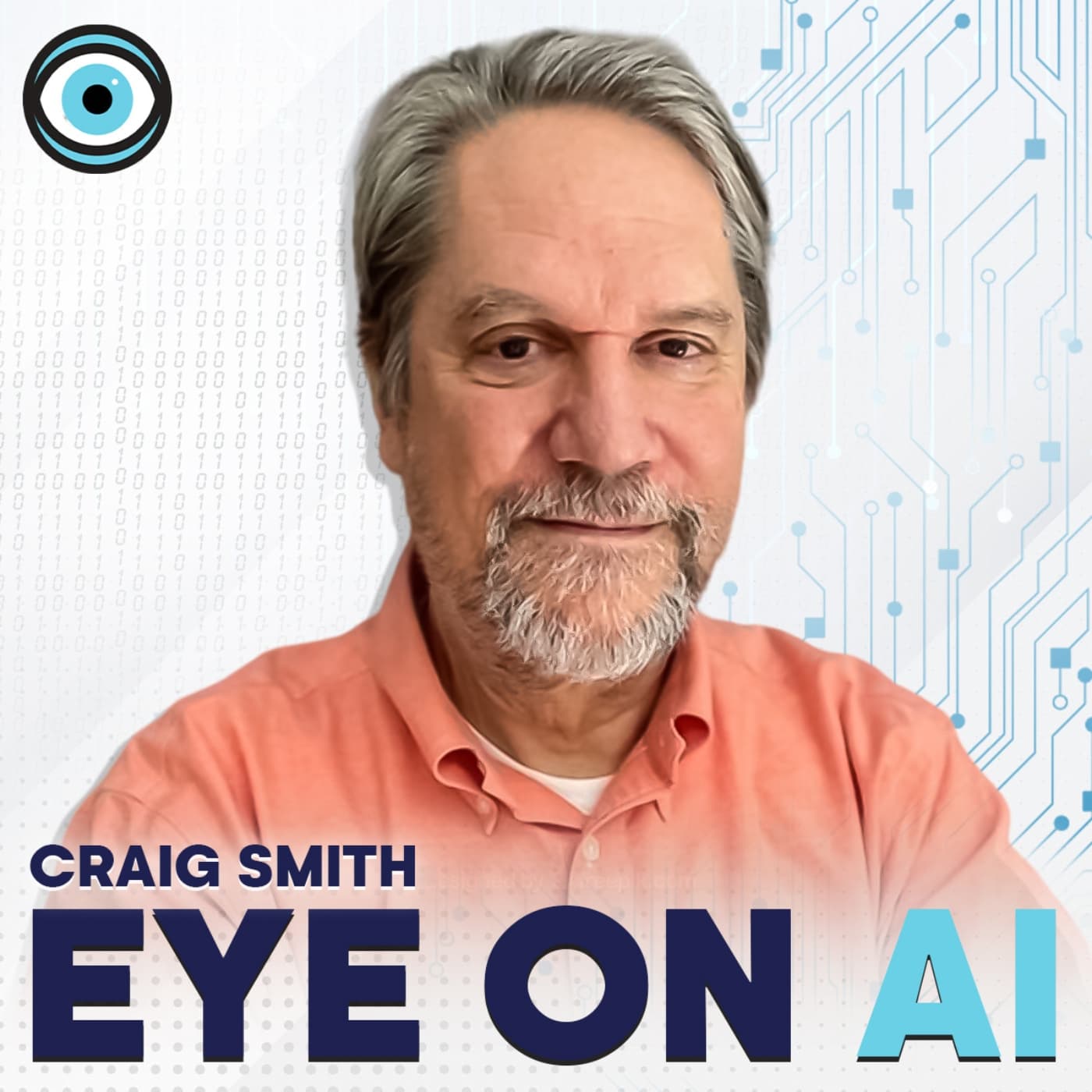
In short
Episode Summary: Eye On A.I. - #235 Vall Herard: The Future of AI-Driven Compliance (Saifr.ai)
Podcast Overview Podcast Title: Eye On A.I. Host: Craig S. Smith Description: A biweekly podcast that discusses advancements in artificial intelligence and their global implications.
---
Episode Highlights Guest: Vall Herard, CEO of Saifr.ai Main Topic: The impact of AI on regulatory compliance within the financial services sector.
Key Points Discussed
- Introduction to Saifr.ai
- Saifr.ai acts as a "grammar check" for regulatory compliance, ensuring AI-generated content adheres to SEC, FINRA, and global financial regulations.
- Integration with common applications like Microsoft Word and Outlook to facilitate compliance checks in real-time.
- AI and Compliance Challenges
- Compliance serves as a significant barrier to the wider adoption of AI technologies in regulated industries.
- Saifr aims to reduce compliance friction by providing suggestions for compliant language during the content creation process.
- Examples of Compliance Issues
- Misleading claims, such as guaranteeing returns on investments, which are flagged as non-compliant by Saifr.
- Image use in marketing materials, where certain visuals may imply unrealistic financial returns.
- Saifr's Technological Capabilities
- The tool checks all consumer-facing content for compliance.
- It can also review internal communications to prevent issues like insider trading.
- Supports various languages to cater to a global market, with immediate goals focused on financial services.
Partnership with Microsoft
- Saifr has announced a strategic partnership with Microsoft.
- Their models are now included in the Microsoft Azure AI model catalog.
- This collaboration enhances Saifr's capabilities and accessibility for financial service providers.
Impact on Content Creation
- Saifr's technology serves as an efficiency tool by reducing the back-and-forth between content creators and compliance teams.
- It helps in managing the risk associated with generative AI by ensuring compliance without a significant increase in compliance staff.
---
Key Takeaways
- Regulatory Compliance as a Barrier: Compliance is a major obstacle for companies looking to adopt AI tools. Saifr aims to mitigate this risk by integrating compliance checks early in the content creation process.
- Future of AI in Regulated Industries: With the right compliance tools, companies can leverage AI technologies for content generation, ultimately improving efficiency without sacrificing regulatory adherence.
- Global Market Potential: Saifr's technology, while currently focused on financial services, has potential applications in other regulated industries such as healthcare.
- Safety Layer for AI: By adding a compliance layer on top of generative AI, companies can reduce risks associated with erroneous or misleading content, facilitating wider adoption of AI technologies.
---
Additional Insights
- Future Trends: As regulatory frameworks evolve, tools like Saifr will need to adapt, ensuring they continue to meet the latest compliance standards.
- Role of AI in Content Management: The use of AI to assist not just in content creation but also in compliance monitoring reflects a broader trend toward automation in regulatory processes.
---
Conclusion This episode provides valuable insights into how AI is reshaping regulatory compliance in the financial sector. Vall Herard's discussion highlights the importance of integrating compliance into AI systems to enable organizations to harness the benefits of generative AI while maintaining adherence to regulatory requirements.
Written by AI. May contain mistakes. Listen to the episode to check what was said.
Transcript
Automatic transcript. May contain errors.0:00Because large language models, they are making their way into every aspect of what we do. the idea of using a generative AI model to generate content, where someone can just copy and paste that and send it out, for example. The idea behind Safer, adding a layer on top of any large language model to ensure that the content is closer to being compliant once it's being generated, and also in instances where we detect that it's non-compliant to ensure that we can provide a suggested language to help make it compliant. We think by adding that safety layer, that guardrail, that will lead to wider adoption because in regulated industries, that's one of the barriers, for example.
0:45What does the future hold for business? Ask nine experts and get 10 answers. Bull market, bear market, rates rising or falling, inflation going up or down. Can somebody please invent a crystal ball? Until then, over 40 ,000 enterprises have future-proofed their business with NetSuite by Oracle, the number one cloud ERP, bringing accounting, financial management, inventory, HR into one fluid platform. With one unified business management suite, there's one source of truth, giving you the visibility and control you need to make quick decisions. With real-time insights and forecasting, you're peering into the future with actionable data.
1:37If I were a larger organization, this is the product I'd use. Whether your company is earning millions or even hundreds of millions, NetSuite helps you respond to immediate challenges and seize your biggest opportunities. Speaking of opportunities, download the CFO's Guide to AI and Machine Learning at netsuite.com slash IonAI. That's NetSuite, N-E-T-S-U-I-T-E dot com slash IonAI, E-Y-E-O-N-A-I, all run together to get the CFO's Guide to AI and Machine Learning. The guide is free to you at NetSuite.com slash IonAI. NetSuite.com slash IonAI. Okay, so Val, why don't you start by introducing yourself to listeners and how you got to Safer, and then we'll talk about what Safer does and its partnership with Microsoft.
2:47As it says there, my name is Val Herrod. I'm the CEO of Safer.ai. As far as my background is concerned, I studied mathematical economics and engineering. I actually had a professor of economics at Syracuse University who told me that there were these things called derivatives on Wall Street. And if you could solve a linear set of equations, it might be worth looking into. And so I ended up taking a job at the Bank of New York as an analyst. And then I worked various places on Wall Street, went to NYU, studied financial engineering, or mathematical finance, as it was called back then. And I continued to work on the street.
3:39I eventually took a detour because I wanted to work as a consultant and so built risk management systems from a quantitative standpoint. And one of the capabilities that we built was acquired by a UK-based company. And so that's how I ended up in the technology space, if you will, or financial technology or what people call fintech. Yep. And eventually I made my way back working at places like UBS. And then I went back into Fintech, worked at a couple of places that were building analytics for pricing complex derivative products. But my career had always been in the quantitative side. Back then, I remember one of my first jobs at the Bank of New York was building a model to try and predict what the revenue for the department, for the Union Investment Trust Department was.
4:42At the time, we were not calling it AI, but it was essentially building AI models using regression analysis. and after doing that for a while ended up working at various other companies. One of the companies we ended up selling to Moody's Analytics. It was an Edinburgh, Scotland-based company that was working in the insurance space solving some fairly complex problems and I ended up taking a role at Fidelity Labs Fidelity Labs is the innovation in Incubator our more fidelity investments. And that's where the idea for SAFER was born. Okay, well, tell us what SAFER does and how generative AI can help AI be more compliant in safety and trust.
5:36Yes, so SAFER's mission is to make AI safer. And by that, what we mean is the following. In financial services, the notion of safety comes up through regulations in a number of different ways. One of the ways that it shows up, for example, is in marketing communications. So a company cannot mislead a consumer or an investor into buying a product, let's say, for example. Or in other areas, it shows up in other industries, similar to pharma, for example, where products cannot be misleading. You cannot make exaggerated claims about products. Well, those same kinds of rules exist in finance as well.
6:27And people use AI to help generate content, whether it's marketing copy, whether it's emails. And so there's a need for content when it's being created for it to be compliant. And so when we talk about safety, And those rules are intended, by the way, to keep consumers safe. And so when we talk about safety within the context of safer, what we are trying to do is to ensure that when AI creates content, Or else, if a human is writing content and they're using AI to either edit what's been created, that we can make that content as close to being compliant as possible. Again, the reason why I say as close as possible is that these are models.
7:16These are mathematical models. They are going to make errors. They are going to make mistakes. And so there is a need for human review, if you will. But the idea that if you can get a generative model to create content that is closer to being compliant, you take a lot of friction out of the process. Because typically what that process looks like is someone, whether it's a subject matter expert, let's say portfolio manager, it's writing content. Then they'll work with a copy editor, let's say, for example. that then gets sent to a compliance team that then reviews that content. And then there's a lot of back and forth that happens in that process.
8:03So the idea behind SafeRail was to help in the creation of the content to help make it more compliant so that by the time it gets to the compliance team, there's less for them to review. And so consequently, you take friction out of the process and you're able to create content much faster. Yeah. Yeah, you guys refer to SAFER as a grammar check for regulatory compliance. Is it only for marketing materials? Is it for other materials? Yeah, so any content and financial services means to abide by those rules. So, for example, anything that a consumer or an investor can potentially read or see or even hear, that needs to be compliant, right?
8:57And so, consequently, we've built models where if someone is using an inference or, let's say, to post a TikTok video, you can download that video and then we can go through it. and then detect instances where there is something that's potentially non-compliant in that video and then alert UI socket this is where something is potentially non-compliant. And also, we can generate suggested language that is compliant to say, hey, if you were to say this in this way, then it's closer to what would be considered to be compliant based on U.S. financial rules, let's say, for example, whether it's the SEC marketing rule or FINRA rule 2210.
9:47Yeah. Can you give us an example of language that someone might write thinking it's okay and that SAFER would catch as potentially noncompliant? Yeah. So if someone were to say, for example, that I guarantee if you invest in this product that you're going to generate X return. That is something that, because investment products involve risk, that is something that is potentially non-compliant. And so we can suggest how you would rewrite that to make it compliant. Another example is we have an image detection capability where in certain contexts, let's say, for example, an image may be non-compliant because it may give the illusion of outsized return.
10:34Let's say, for example, someone, you're writing content about a certificate of deposit, which has a oily product for that site that has a low return. And you're using an image of a$200 million yacht, let's say, for example. So within that context, that image may not be compliant, where it could mislead someone into thinking that by investing in this product, I'm going to generate outsized returns. Yeah, that's interesting. So how closely is that sort of stuff policed by? Is this the SEC? Would that be the regulatory body that polices that? Yes. So the SEC, FINRA, for example, regulatory bodies, the CFPB, for example.
11:25And so if you think about what some of these regulators, what their function is, which is to have a fair sale market to make sure that companies are providing a transparency in terms of the risks that's involved in their products. So those are some of the regulatory bodies that have an interest in these kinds of regulations and ensuring that the investing public is protected. Why is compliance a barrier to AI adoption in regulated industries? and in what way does SAFER lower that barrier? Yes. So because large language models, they're making their way into every aspect of what we do, if you will.
12:25The idea of using a generative AI model to generate content where someone can just copy and paste that and send it out, for example. The idea behind SAFER, adding a layer on top of any large language model, whether it's GTP, whether it's neutral, whether it's LAMA, to ensure that the content is closer to being compliant once it's being generated. And also in instances where we detect that it's noncompliant to ensure that we can provide suggested language to help make it compliant. we think by adding that safety layer, that guardrail, that will lead to wider adoption because in regulated industries, that's one of the barriers, for example, to wider adoption as far as content creation is concerned.
13:18And so this is where, going back to something you said earlier, why we use the term really grammar check for compliance, because if you think about the same way in which someone who's writing using a WordPress, so let's say, for example, Microsoft Word, they'll have a grammar check. Imagine that if someone is not a compliance expert, they are writing stuff that is supposed to be compliant. the ability to help them generate content that is compliant, we think adds a noted efficiency tool to what the knowledge worker is using. Yeah, and I imagine in a very large global organization, you know, a bank, for example, there is marketing material or public-facing material being produced at all different levels of the organization and all different geographies.
14:29So it's otherwise difficult to track compliance. Is that right? Yes. And so, but not only that, I would say that plus, right? So even in instances where someone is sending an email, where it's not public facing, where it's institution to institution, there is a need for that communication to be compliant as well. So, for example, you cannot send an email that contains certain material non-public information that may lead to insider trading. That's just one example. And so organizations have an obligation to monitor some of those communications to ensure that they are compliant. And so we've built capabilities to help with that process as well.
15:22So it's not only the public-facing piece, but there's also internal and company-to-company email communications that have to be compliant. And through the help of some of the tools that we've built, we can use AI to detect an instance where there may be something that falls outside of the regulatory rules and alert the person. They're not intended to stop you, but we can alert you and say, hey, these are some of the potential issues with that communication. Yeah. Are companies using this not only for content going forward, but to review content that they already have existing? Yes. So hopefully content that already exists went through a human review process before it was approved for distribution.
16:17But the capability can be run on archived material as well. because there is this rule called Rule 17A4 compliance where public-facing documents have to be archived over a certain period of time because let's say that three years ago you made a claim in a public-facing document. And then three years after that, that's when there's a potential loss because it was misleading, if you will. So the ability to go back and say, this is what was said, and it was, in fact, noncompliant with the rules. That's why you have Rule 17A for warm storage, so that in instances where you do have infractions that happened in the past where an investor or the public was misled, you can go back into collective action.
17:14So you can run it on that archive as well. But one of the more interesting use cases that we've seen is a lot of companies are building ranked systems to help answer customer questions, for example, to make that process more efficient. In those communication channels, let's say that you build a smart agent, a smart bot to help answer customer inquiries, the answers that are generated have to, there's a need for those to be compliant as well. And so having SAFER as a layer that can sit on top of that and see what answers were generated and providing some context or some risk score, if you will, in terms of the level of regulatory risk that may exist in that answer is one of the more novel use cases where we see the models being adopted.
18:12um and and does this uh is it a plugin i mean you mentioned emails for example that it would like a spell check uh sort of track what you're typing and and pop up a message or is it something that i would write an email and then i'd copy and paste it into safer to to check its compliance? I mean, how does it work? So we want to be where the user is, meaning that the least amount of steps that you need to take to check it is where we want to be. So we've built capabilities that plug directly into Outlook, that plug into Microsoft Office types of applications, but we've made the models available so that if you have your own workflow, if you are, for example, a software company building services for financial service companies, you can leverage the models and put it in your workflow.
19:26And so we want to be as flexible as possible. So if you're creating content, let's say, in Adobe PDF, and that's where you're creating content, that's where you want to check to make sure that what you're creating is closer to being compliant, you can plug it into that framework as well. But if you have a marketing workflow solution and you wanted to plug it into that workflow system, you can do that as well. Yeah. And you announced a strategic partnership with Microsoft. Can you tell us about that? Yes. And so we've been speaking with Microsoft for the better part of a year. And we were very happy that the partnership was announced in Chicago at Microsoft Ignite last week.
20:19And that partnership is taking a set of all models. We've made them available in the Microsoft Azure AI model catalog next to models from OpenAI, for example, from Mistral, from Meta, so that our clients can either go to the catalog and use the models and embed the models into frameworks that they already have. And so if you've already built this workflow at your company, there's no need for you to replace that. You can take the safer models and embed it directly into that workflow through the Azure model catalog. But if you're a software company, you can do the same as well. And so that's kind of like the first part of what we've worked on with Microsoft.
21:13There are some additional models that we will be making available in 2025 through the catalog as well. Are there any metrics about how often SAFR will flag something as noncompliant? Yes. So we reduce about 70 % to 80 % of the friction. And one of the more important metrics that we use is what I call the human coverage test, meaning that before we release a model, we do a lot of work around human validation. But most of our models are built through human reinforcement learning. So this is a great part of what we do, meaning that before we release a model, we will create it, we will take content, we will have the model score the content, and then we will give a human without telling them what the model came up with, a human subject matter expert in compliance, and have them score that content as well.
22:25And then one of our analysts will essentially compare and contrast the two to make sure that there's enough coverage between the two before we release a model. And in those scenarios, we typically look at 80 % to 90 % coverage or agreement between the model and the subject matter expert before we will make a model available. But above and beyond that, although the rules apply equally to everyone, it's not as if Fenris is making rules specific to, let's say, company X versus company Y. So although the rules are uniform, but the interpretations that companies apply to the rules, there's a little bit of wrong.
23:10Sure. Yeah. Because a company might decide to be more aggressive from a risk perspective. They want to be a little bit riskier versus another company. And so the ability to calibrate the models, if you will, to adapt the models to your own risk appetite of the company is an important consideration that we also allow companies once they start using the application to do. So over time, it can stop running. What's the risk appetite at company X versus company Y? Yeah. And on the Azure catalog, if you pull in the safer model or models, how does that integrate, for example, with Microsoft Word? So right now, we have a Microsoft Word plugin that you can essentially download and use.
24:21I think part of the conversations with the Microsoft scene going forward is to look at that integration a little bit more closely and see if there are efficiencies that we can get by having a tighter integration. But right now, that's done through a plugin where someone can use the Microsoft M365 plugin and essentially have the capabilities available in all of the Microsoft Office 365 applications. So how, let me think here. Can you give some practical insights about balancing innovation with regulatory requirements? I mean, you were talking about some companies want to be more aggressive, others more conservative.
25:20Yes. So from all perspective, we think that we'll continue to evolve the models. Let me take that back. So from all perspective, we think that safety, as represented in regulations, is what we are trying to solve. And so the extent to which that there are new adaptations of regulations. So, for example, the SEC did an update to the marketing rule for registered investment advisors. And so we needed to essentially adopt the models to take that into consideration. Because these rules are not static. that do change over time. And so consequently, the interpretations that a company will apply to an existing rule or an update of a rule is something that we need to be able to reflect in the models as well.
26:20And so part of the service is really to keep abreast of what's happening on the regulatory side to make sure that the risks that the regulators are calling out to keep investors and consumers safer are reflected in the safer models. Yeah, and so does that require sort of continually fine-tuning the model, or do you use a RAG component in your role? So it requires fine-tuning the models, and so we do a lot of work in reinforcement learning. And so on my team, I have a function called compliance and legal engineering that works very closely with the data science team. And these are regulatory experts.
27:08In some instances, they are former regulators or staff attorney at the SEC, et cetera, who work with the team to make sure that we understand the nuances of the language of the new updated regulations. Sometimes it's an interpretation that's issued by a regulatory body about an existing role to make sure that we can fine-tune the models, that we can adapt the models over time to those changing regulatory requirements. Yeah. And is that done? Do you then swap in a new model when you have one? Yes. So that's the intent. So there's kind of like the baseline models that are getting updated once regulatory requirements change.
28:00And then we are essentially updating the baseline models for clients and also ensuring that whatever adaptation, localized adaptation that takes into account the risk appetite of the organization is also accommodated in the new model as well. Yeah. And so by marketing material, this would apply also to annual reports and prospectuses and things like that? Yes. So anything that a financial services company will put out needs to be compliant with regulations. And so any content that is getting produced, in some instances, press releases, for example, which is not marketing collateral. Right. press releases.
28:45So if you, going back to something that I mentioned earlier, if an investor can read it, can see it, or can hear it, it has to be compliant. And so the use cases across what a company would use this for is fairly broad. from all perspective we think that anyone who's writing anything in financial services can use this application yeah you mentioned earlier anything that people can read or see and you said hear would this apply also to like podcasts if a company for instance a service company has a podcast Yes. And so this is an area where we are seeing increasing usage because that's an area from a compliance review perspective that is very time consuming for companies.
29:47because the way that that process works right now is that someone will have to write, if there is a script, if they are following a script, someone will have to write the script, submit it to the compliance department for review, and then you have to actually tip the podcast exactly as what was reviewed. The other way of doing it is certainly if it's more of a free-form podcast, you'll have a compliance officer listening in. And if someone says something that is non-compliant, they'll stop and make the corrections. Or else, if you actually have the podcast and it's out there, a compliance officer will come in and listen to it after the fact, like fairly, fairly close after the fact, and listen, stop, listen, stop, listen, stop, listen, stop.
30:39And as you might imagine, over a 45-minute podcast, that takes a while. With Safer, you can essentially upload that into our application, and then we will transcribe it. So we have a language model that is purposely built for financial services so that we can understand the context of financial jargon. because you might get someone who's on the podcast who's using a financial jargon that some of the open source large language models will mistranscribe, which might lead to you not detecting a potential risk. So one of the things that we've seen, for example, is in a podcast where one of the large language transcription models that's out there would transcribe mutual fund into mutual fund.
31:34And so consequently, when you go and run the risk detection on it, if you are missing that context, then obviously you could potentially miss the fact that mutual fund require fee disclosures. And so by uploading that 45-minute podcast into Safer, we can very quickly, within a matter of minutes, do the transcription and highlight, hey, at minute 245 on frame X, this was said, which is potentially noncompliant. And so that review process happens much, much faster. Yeah. I mean, you're focused on financial services, and certainly financial services is a massive, massive market. But it seems that your technology would apply to other regulated industries, healthcare, for example.
32:39Do you service any other industries beyond finance? So right now, our focus is squarely on financial services. We have a roadmap in financial services that we're executing on. But as you quite rightly point out, that the underlying principles that you have in financial services, not to exaggerate language, not to be misleading, they are applicable across other industry segments as well. And so we certainly have a perspective in terms of utilizing the existing models that we have, how we can really help solve similar problems in other industry sectors as well. And so although the immediate roadmap is focused on financial services, we do think that there is a case to be made to expand beyond financial services into other industries as well.
33:43Yeah. And how do you guys charge for this? Is this a seat license or a pay-as-you-go model? It is a seat license up until a certain point, in which case it becomes an enterprise license. Yeah. Okay. And with unlimited use and you're not... With unlimited use, we don't believe that, I mean, people should know what their cost is, and they should essentially be able to create content. And so our model right now doesn't consist of, oh, you can only create X number of content. Yeah. This is interesting, this idea of how generative AI can help companies be more compliant because there is, I mean, companies right now are starting to implement Gen AI tools.
34:45and a content creation is one of the first areas that they deployed in. And there is a concern that, you know, there's a lot of subpar content being generated by these generative models. Can you talk a little bit about how that affects safety and trust? Yes. So from all perspectives, so when you think about a large language model, it's really a couple of things, right? First of all, it's really a compression problem that you are trying to solve. Essentially, you're taking real-world distributions and some of the underlying knowledge that's embedded in those distributions, and then you are compressing it so that you can make a prediction.
35:42And in making any sort of prediction, obviously, they are subject to hallucination, subject to errors. And so what we are trying to do is focus on an area that people are already familiar with in the following sense. People are already familiar with using a grammar check, for example, familiar with using a spell check, for example. And so what we've done is essentially try to focus the output of these general AI models through some adaptations that we've done so that what gets outputted is compliant. Because if you don't do that, you may actually end up making companies less efficient in the following sense, right?
36:28So I should deploy these tools. If you don't have these guardrails, because these generative tools allow you to create more content, but at the same time, you are not increasing the number of compliance officers to a level where you can do this efficiently. Right. And so if on the one hand, the velocity with which you are creating content is going up because you have these tools now, but yet you don't have the review process scaling up as well, then you create this imbalance where the risk for the organization actually goes up and you become less efficient. And so this is why we think that this kind of capability where we can serve as this safety layer, insofar as regulatory compliance is concerned, on top of these large language models, we think that is a worthy problem to solve.
Read the full transcript
37:32and I think that the adoption that we're seeing for safer proves the same thing. I think this is one of the reasons why after about a year or so speaking with the Microsoft team, we've done the partnership with Microsoft. I think there's a realization that if you can help make the content more compliant that you actually will increase the adoption and you will make the compliance officer certainly at financial services companies, you'll make it a little bit easier for them to approve the use of these tools. So you're integrated, for example, in a Microsoft Office. Now, the way that I use Gen.AI, ChatGPT, or Perplexity is I'll ask it some questions.
38:24And if I'm going to use that content, I copy it and paste it into a Word document, for example. Is it at that point when you paste it into a Word document that Safer would run its screening? And do you then have to click a button for Safer to review the text? or does it actually review stuff, the output of the chatbot, the LLM directly? So both use cases we can accommodate. And the reason why you want to accommodate both use cases is that even in the instance where you copy and paste it into Word, you are going to make some edit. And I don't know, maybe you're a trend compliance officer, But if you're not a trained compliance officer, when you do your edit, you might introduce language structures that are non-compliant, right?
39:27And so we want to be able to do that check as well. And in the use case earlier that I mentioned where there is a generative AI that is helping to generate answers to inbound inquiries, where that process is seamless, where it is essentially helping the large language model that is generating the answers to those inbound inquiries to be closer to being compliant without any human intervention. I see. So in that case, it sits as a wrapper around the large language model. Right. And so for now, I mean, these days people are using AI, GenAI chatbots in customer service, for example. it would be a wrapper around whatever model they're using to generate those answers.
40:28And does it adjust the language before it's printed on the chatbot screen? Yes. Yeah. So it adjusts it before it gets printed so that when you are actually seeing it, what you're seeing is closer to being compliant with industry regulations. And so I think this gets at the safety considerations that I talked about earlier. It's the ability to give these large language models a way in which they can create content that actually follows industry rules. In this case, financial services, industry rules. Yeah. And you said that uptake is healthy. How is Safer marketing this beyond appearing on my podcast?
41:28Yeah, so beyond appearing on your podcast, we've stood up a sales organization over the last year and a half or so. And we are out at trade shows speaking with industry professionals. I think this year I've spoken between Europe and North America. I've spoken at 13 different conferences. I think, again, as a startup, you want to start small. But I think the sort of partnership that we've entered into Microsoft and others that we are speaking with right now gives us an ability to scale on a global basis. And so those are the primary ways in which we are marketing the product right now. And to your point, I think we are growing at about the rate that we would expect, given some of the projections that we have.
42:27And so we are very happy with where we are, and we are ready to sell the business as, again, the partnership with Microsoft attests. Yeah. And you mentioned globally. Do you support languages other than English? Yes. So right now we had a client that had a requirement for us to support six different languages. And so we support six different languages and looking to expand beyond that. So Spanish, for example, that requirement was actually based in the U.S. because a lot of financial services companies, they advertise in Spanish-speaking market as well as English in the U.S. And so that was, for example, one of the core requirements that we had from one of our prospects.
43:21Yeah, and I don't know what, certainly European Union has a bunch of languages. Well, yeah, so French, for example, was one of the requirements as well in Spanish and German. And so those are capabilities that we've built, and Chinese was also a capability for this one client that we're looking at. But certainly, we are looking to expand beyond that because we think that this capability or this need, if you will, is one that's global in nature. If you look across financial services with large, on a global basis, there's over 100 ,000 companies that can benefit from this kind of capability. and that's the market that we all focus on right now.
44:21Yeah, and that's a big market. Yes. Okay, I'm running out of questions. Is there anything I haven't touched on that you want listeners to hear? Yes. So I think from our perspective, this idea of adding a safety layer on top of generative AI will lead to greater adoption. And we think that greater adoption, given the penetration that we've already seen with generative AI, is a worthwhile pursuit. And also one of the things that we've seen in regulated industries that's stopped, in some instances, adoption of these tools is precisely this regulatory, this need for content to be compliant. And so we think that the efficiencies that we deliver and also the fact that we address the safety concerns that industry participants have raised with us is something that we're very proud of.
45:37And so I would certainly love to speak with you more about it. There's a chance to go into some of the in-depth math behind what we are doing. But I think we are addressing a big problem for a very large market. And we think by addressing this problem, we're going to help increase adoption of AI and generative tools in general. This is for regulated industries, but it seems there's so much fear about generative AI hallucinations or, you know, there was a famous case with Air Canada, a chatbot that guaranteed a refund to a customer. And then when he filed the refund, the chatbot was wrong, and that ended up having to go to a tribunal.
46:45And there was a certain amount of reputational damage to Air Canada.
46:53How applicable is this solution? Not that you're looking in those to expand the market, but this kind of thing. Do you expect to see this kind of thing in non-regulated markets, just sort of a check on top of what generative AI is? Yes. So we think that given the underlying tenets of the rules that we have on the books for financial services. So, for example, the idea that you cannot make an unsubstantiated claim, that applies, broadly speaking, in our opinion, whether there's a rule in the books or whether there isn't a rule on the books. Right. Although I deal that if you are making a claim that is an exaggeration, that that applies as a overall rule.
48:06If you are running a good business from our perspective, whether or not that's embedded in the rules. Right. So happens that in financial services, it is embedded in the rule. You cannot make an exaggerated claim. And so we think from that perspective, although we are marketing the product to financial services institutions where you have the rules on the book, there isn't anything stopping any other company from running the models on content that they are generating otherwise. Because we think some of the basic principles, that's just good business practice. That's just doing good business. And so from that perspective, we're not going out and making the claim, oh, other industries should use it.
48:54But certainly, if another industry segment wanted to use those rules, we think that it would be good business practice for them to do so. I see. That's interesting. The key message of adding a safety layer, which is if you think about one of the number one reasons, one of the number one issues in China's AI right now is safety. All stakeholders, whether it's the consumer, whether it's regulators, whether it's the companies who are building language models, the notion of safety is top of mind. And going back to something that you said earlier about the EU, so in the EU, and if you look at the EUAI Act, one of the underlying principles of the EUAI Act that's been enacted is that AI needs to be compliant with all existing rules.
49:53safer is a testament to that right where we are helping you we can take a model that doesn't comply with financial services regulatory rules and make it compliant with financial services regulatory rules what does the future hold for business ask nine experts and get 10 answers bull market, bear market, rates rising or falling, inflation going up or down. Can somebody please invent a crystal ball? Until then, over 40 ,000 enterprises have future-proofed their business with NetSuite by Oracle, the number one cloud ERP, bringing accounting, financial management, inventory, HR into one fluid platform.
50:42With one unified business management suite, there's one source of truth, giving you the visibility and control you need to make quick decisions. With real-time insights and forecasting, you're peering into the future with actionable data. If I were a larger organization, this is the product I'd use. Whether your company is earning millions or even hundreds of millions, NetSuite helps you respond to immediate challenges and seize your biggest opportunities. Speaking of opportunities, download the CFO's Guide to AI and Machine Learning at netsuite.com slash ionai. That's netsuite, N-E-T-S-U-I-T-E dot com slash ionai, E-Y-E-O-N-A-I.
51:37all run together to get the CFO's Guide to AI and Machine Learning. The guide is free to you at netsuite.com slash ionai. netsuite.com slash ionai.
From the publisher
This episode is sponsored by Netsuite by Oracle, the number one cloud financial system, streamlining accounting, financial management, inventory, HR, and more.
NetSuite is offering a one-of-a-kind flexible financing program. Head to https://netsuite.com/EYEONAI to know more.
In this episode of Eye on AI, Vall Herard, CEO of Saifr.ai, joins Craig Smith to explore how AI is transforming compliance in financial services.
Saifr.ai acts as a "grammar check" for regulatory compliance, ensuring AI-generated content meets SEC, FINRA, and global financial regulations. Vall explains how Saifr integrates into Microsoft Word, Outlook, and Adobe, reducing compliance risks in marketing, emails, and AI chatbots.
We also discuss Saifr.ai’s partnership with Microsoft, AI’s role in regulated industries, and how businesses can safely adopt generative AI without violating compliance laws.
- How does AI reduce compliance friction?
- Why is regulatory oversight a barrier to AI adoption?
- What does AI safety really mean for financial services?
Find out in this deep dive into AI, compliance, and the future of regulation.
Like, subscribe, and hit the notification bell for more AI insights!
Strengthen your compliance controls with AI: https://saifr.ai/
Stay Updated:
Craig Smith Twitter: https://twitter.com/craigss
Eye on A.I. Twitter: https://twitter.com/EyeOn_AI
(00:00) Introduction to Generative AI and Compliance
(02:47) Meet Vall Herard, CEO of Saifr.ai
(05:28) What Saifr.ai Does and Its Mission
(08:25) How Saifr.ai Ensures Regulatory Compliance
(12:13) Overcoming AI Adoption Barriers in Finance
(19:58) Saifr.ai’s Partnership with Microsoft
(24:11) How SaferAI Integrates with Microsoft Office
(29:33) AI in Podcast and Audio Compliance Review
(33:54) Saifr.ai’s Business Model and Pricing
(38:09) How Saifr.ai Works with Generative AI Chatbots
(42:36) Supporting Multiple Languages for Compliance
(50:08) Future Outlook


