
In short
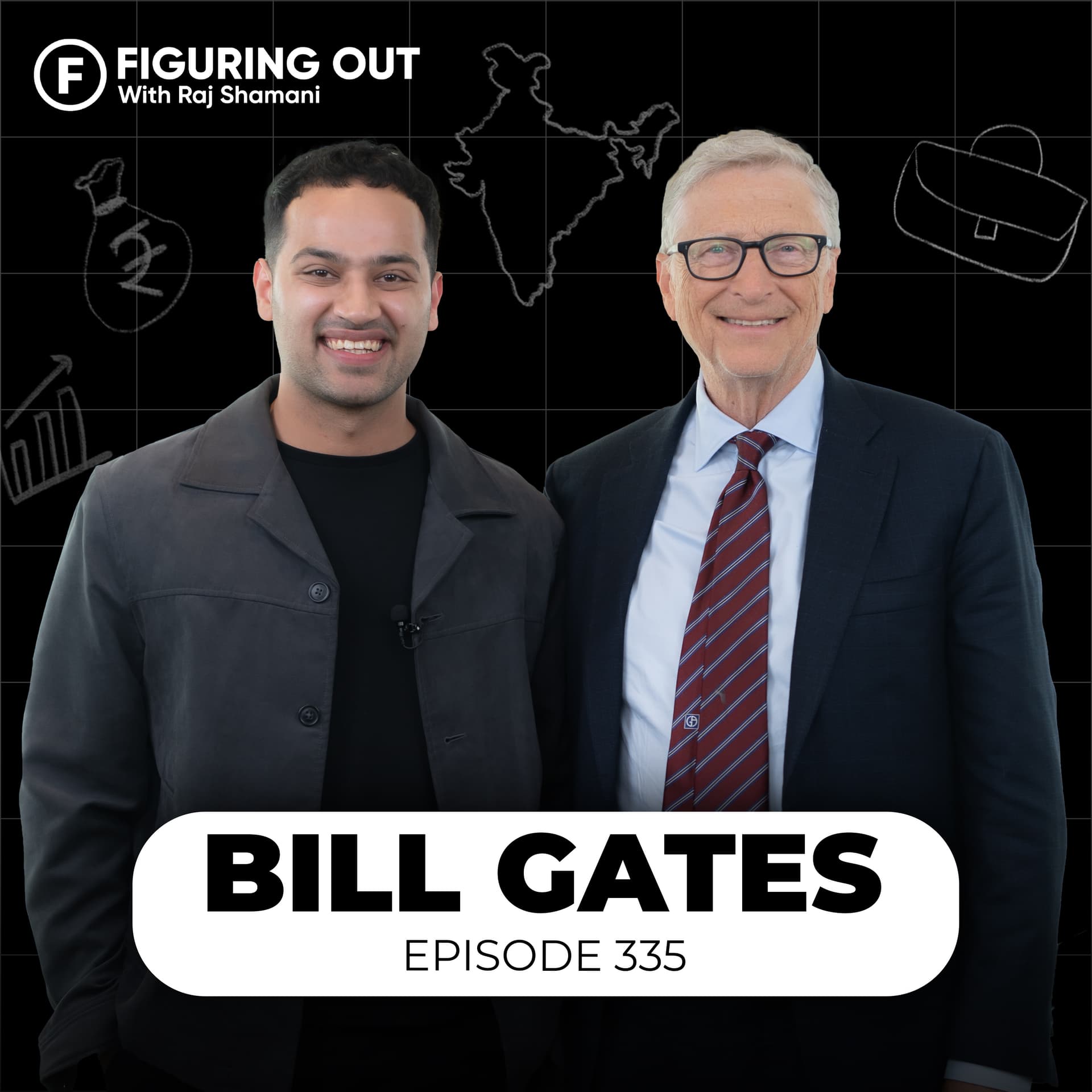
Podcast Notes: Bill Gates on India, Billion-Dollar Business Opportunities, PM Modi & Children | FO335 Raj Shamani
Podcast Information
- Podcast Title: Raj Shamani's Figuring Out
- Episode Title: Bill Gates on India, Billion-Dollar Business Opportunities, PM Modi & Children
- Host: Raj Shamani
- Guest: Bill Gates
- Episode Description: A discussion with Bill Gates about India’s evolution, opportunities, philanthropy, AI, and personal insights.
---
Episode Overview The episode features a conversation with Bill Gates, co-founder of Microsoft and philanthropist, discussing India's growth, his philanthropic vision, and societal issues. Gates shares insights about the future, the role of technology, and personal reflections on learning and legacy.
---
Key Topics Discussed
- Observations on India
- Transformation of India:
- Gates highlights the rapid changes in entrepreneurship and innovation in India.
- He reflects on the advancements in health and technology driven by Indian talent.
- India as a Global Talent Hub
- Significance of Indian Engineers:
- India contributes 20% of the global population and has a strong focus on engineering and software.
- Gates emphasizes India's role in providing leadership positions globally.
- Philosophy on Wealth and Inheritance
- Gates's Approach to Family Wealth:
- He allocates less than 1% of his wealth to his children to encourage their independent success.
- Discusses the cultural differences in inheritance and philanthropy between generations.
- Philanthropic Challenges
- Foundation Work:
- Gates discusses the challenges his foundation faces, including scientific hurdles and funding cuts.
- Highlights the importance of empathy in addressing inequality.
- Lifelong Learning
- Advice for Young People:
- Advocates for continuous learning and reading as key behaviors for success.
- Encourages the youth to remain curious and diligent in their pursuits.
- Personal Fears and Reflections
- Concerns About Aging:
- Gates shares his fear of losing cognitive abilities with age.
- Reflects on the importance of maintaining a learning mindset throughout life.
- Future Predictions
- Expectations for the Future:
- Gates is optimistic about solving global challenges like polio and malaria within the next decade.
- He expresses the need for robust strategies to address AI, climate change, and health crises.
---
Key Takeaways
- India's Growth: The podcast underscores India's emergence as a global leader in talent and innovation.
- Philanthropy: Gates emphasizes the critical role of philanthropy in addressing health and educational disparities.
- Lifelong Learning: A recurring theme is the importance of being a perpetual student and adapting to new technologies.
- Cognitive Health: Gates's reflections on aging highlight the importance of mental acuity and ongoing education.
- Cultural Shifts: The discussion points toward a generational shift in how wealth and responsibility are perceived, especially concerning inheritance.
---
Personal Insights from Bill Gates
- Biggest Misunderstanding: Gates addresses the perception that wealthy individuals have different values and agendas.
- Mistakes in Business: He openly discusses past failures at Microsoft and in philanthropic efforts.
- Advice for Entrepreneurs: Encourages the pursuit of areas where individuals have a deep understanding and passion.
---
Conclusion The episode wraps up with Raj expressing gratitude for the opportunity to converse with Gates, emphasizing the significance of learning from influential figures. Gates’s insights provide a blueprint for young listeners on navigating challenges, understanding societal issues, and embracing a growth mindset in their personal and professional lives.
---
Additional Resources
- Gates Foundation: [Visit Website](https://www.gatesfoundation.org/)
- Raj Shamani: Follow on [Instagram](https://www.instagram.com/rajshamani/), [Twitter](https://twitter.com/rajshamani)
---
Timestamps
- 00:00 - Introduction
- 03:16 - Raj Shamani x Bill Gates begins
- 03:52 - Observations on India
- 06:40 - India: The Global Talent Capital
- 08:00 - Views on Inheritance
- 20:30 - Advice for Young People
- 41:29 - Problems That Will Be Solved in the Next 5 Years
- 42:20 - Outro
---
This summary encapsulates the rich discussion between Raj Shamani and Bill Gates, shedding light on critical themes relevant to young entrepreneurs and a global audience.
Written by AI. May contain mistakes. Listen to the episode to check what was said.
Transcript
Automatic transcript. May contain errors.0:00What's the biggest misunderstanding about you? Whenever you hear about somebody who's got, you know, ridiculous amounts of money, their values are different than your values. You should be concerned about their agenda. What's your biggest fear? I'll be sad as my brain gets less capable. That disappoints me. Tell me one behavior we all should adopt. Reading a lot, being a student, that's a big part of my success. Richest and most powerful men in the world. Bill Gates has unleashed a technological revolution that has changed our lives. Bill Gates are 25 and Bill Gates are 70. Any change that you feel personally?
0:36In my 20s, being a maniac was the right thing. My competitors would say, oh no, you work too hard. And I'd say, yes, I do. If you're in a race, your 20s, when you have no wife and no children, that's the time to do it. If you get an opportunity to invite three Indians for dinner, who would that be? There was a mathematician, Ramanujan. I would have loved to have met him. Why do you think India is becoming a global talent capital for the world? We'd hire people from India and bring them to the United States. You know, both the United States and India were kind of mad at us because we were taking, you know, the smart people and moving them.
1:14In India, a lot of kids also fight with their parents on inheritance. Have your kids ever spoken to you? Ha ha.
1:27Before we start today's episode, all I want to say is thank you to each and every one of you I'm really grateful that we were able to sit down with one of the most influential men in the world the Bill Gates I have been this young boy who always used to hear stories about this man about the kind of money he has made the kind of lives he's impacting the kind of things he's building through Microsoft from there to be sitting in front of him. It was surreal. When I started the conversation, you could see it on my face that I was really nervous, really scared. I didn't know what to talk about. But as we went in the conversation, the podcaster in me took over and we spoke about his fears, his misunderstandings, the mission, and what is he doing today.
2:20Today, I want you to see this episode from a lens of a 20-year-old sitting with Bill Gates and figuring out what goes on in his brain this episode is truly special because i could have never thought that bill gates will be on our podcast this soon in our journey i always had a belief that we will be able to sit down with the smartest people around the world but it'll happen this soon i can't believe this right now i just want you to enjoy this episode the way i did i want you to sink in that this is happening because it's not sinking in with me and I just want to tell you that there are more episodes coming so keep supporting us and hit the subscribe button right now.
3:15Welcome on Figuring Out Sir. I'll tell you a little story. So during the pandemic me and my sister we were watching the Netflix documentary Inside Bill's Brain and halfway through it I told my sister that, hey, you know what, like one day I'll sit with Bill Gates and I'll directly speak to him and get inside his brain. And just randomly and she was laughing. So this one's for you. You did it. So it's an opportunity. I don't know how it just came out of my mouth and it's happening today. So thank you so much for doing this. Well, you've come to India quite often. Tell me something that you've observed about India, which a lot of people don't know about.
4:01Well, people probably, you know, because they're here all the time, you know, they probably don't recognize how much things have changed. And if you go away and come back, then you see, wow, you know, the level of entrepreneurship and the, you know, the amount of innovation that's actually taking place here. It's pretty fantastic. And, you know, for the foundation, we've been here originally because a lot of the health challenges were here. And we still care a lot about that. But now a lot of our invention is being done here, whether it's, well, vaccines, obviously, we have some incredible partnerships.
4:47but it's broadening to better seeds, better diagnostics, the ways that we can use AI for health or education. So the innovation ecosystem has really exploded and that's going to be great for India. It's going to be great for the world. So when you meet other leaders around the world or when you meet your billionaire friends, what's the first thing you tell them about India? Is it the same thing, what you just told me? Yeah, it's, you know, we've had such a great experience in our work in India. You know, I encourage people to come and tap into the great things going on. Is there anything specific you tell them?
5:37Well, you know, my connection with India goes all the way back to the Microsoft days when, you know, we at first would hire people from India and bring them to the United States. And, you know, both the United States and India were kind of mad at us because we were taking, you know, the smart people and moving them. And, you know, then they came back here to India and created the Microsoft India work, which has been absolutely fantastic. So, you know, up until the year 2000, I mainly knew the tech scene. So, you know, a lot of Bangalore, Hyderabad. Seeing the country more broadly, you know, that's in my foundation work.
6:21So, you know, Bihar, UP, you know, seeing, you know, where we could partner and help with things. you know I still want to take more vacation here I've done it a little bit but you know there's a lot of great places in India that I haven't been to. Talking about Microsoft and taking people from here to US people like Saturadala, Sundar Pichai, there have been incredible CEOs around the world why do you think India is becoming a global talent capital for the world? Do you think Anything special here, which is out there? Well, you know, 20 % of the world's people live here in India. And India's had a particular emphasis on, you know, engineering, software, you know, and turned out a lot of top people.
7:16And so when you get people like Sundar Satya, who are both great at engineering and management, you know, that's a magic combination. And, you know, so they, you know, these companies, you know, are looking anywhere in the world to find that mix. And, you know, so India's getting about its fair share of those top leadership positions. And, you know, it partly comes from having great universities, you know, not just the IITs, but starting with them. you know that's using the incredible talent that's here so talking about indian talent you do a lot of philanthropy work here and you've met a lot of talented people here a lot of rich people here as well do you and you believe that all the money that rich people have or like people who have made wealth for themselves they should use it for charity work they should pledge it in india there's a usually a lot of people believe that as parents is their duty to save everything for their kids for the inheritance right like the kids will get everything what do you think is the right mindset using all the money for pledging and giving it back to the society or giving it to the children well i think you know everybody gets to decide on that you know In my case, my kids got a great upbringing education, but less than 1 % of the total wealth because I decided it wouldn't be a favor to them.
9:02It's not a dynasty. I'm not asking them to run Microsoft. I want to give them a chance to have their own earnings and success be significant and not overshadowed by the incredible luck and good fortune I had. And different families see that differently. I think the people who've made fortunes from technology are less dynastic. and so they'll even take their capital and give a lot of that away. You can have the view of giving away your capital or just giving away your earnings. And of course, I love all philanthropy, but the tech sector is probably the most aggressive about giving most of it away.
9:53Now, the other sectors, Because you have not seen that in any other kind of industry where people try to give. Not to the same degree. It tends to be giving some portion of the profit as opposed to the actual base capital. You know, in India, a lot of kids also fight with their parents on inheritance. Have your kids ever spoken to you and be like, hey, why are you not giving us everything or anything? Has it ever happened? You know, you don't want your kids to ever be confused about your support for them and your love for them. And so I do think explaining early on your philosophy, you know, that you're going to treat them all equally and that you're going to give them incredible opportunities.
10:46But that, you know, the highest calling for these resources is to go back to the neediest through the foundation. And, you know, they've seen the success of the foundation. I hope they're very proud of the foundation. And so, you know, I've seen cases where kids actually tell their parents to be more philanthropic. You know, I think the younger generation sometimes actually is pushing against this idea of, you know, the wealth just being passed down mostly. um and so that's so you know every family is a bit different i have last question on india and then we'll get to the foundation work and try to understand you as well if you get an opportunity to invite three indians for dinner dead or alive who would that be Well, I get to spend time with some incredible people in India.
11:57I get time with the prime minister and understand his vision and how we fit into that, this 2047 thing that everything is lining up to try to achieve that. You know, I get to meet, there was a great scientist, Raj Ban, who created the Department of Biotechnology. There was a mathematician, Ramanujan, who I would have loved to have met him because he was, you know, almost mysterious how he was so genius at what he was able to do. You know, I got to work with Rotten Tada. I'm getting to work with all of the amazing philanthropists and a lot of the innovators here. You know, I get to see small companies early on.
12:51I just went through some of these companies using AI in health. Some for profit, a few non-profit. But, you know, we had a great 25-year celebration, and this great sitar artist came, and that was a pretty special thing. So it would be hard for me to pick. There's so many incredible talents. You can't pick three. I think I defend some people by not including them. Fair. Fair, fair. You were talking about small companies. If you were to start something from zero in India today, where would you put most of your time and what's the first step you'll take? Well, you'd mostly start a company because you think you enjoy working on something and you think you have a world-class understanding of a unique contribution.
13:55For me, that was software. For this day and age, if you think you understand fusion, that's great. If you're successful, which that's risky, you could really improve the world. You know, AI is sort of the today's equivalent of what I did when I was young to see, you know, wow, the possibilities are unlimited. And so, you know, I'd probably be doing one of these new AI companies if I was starting out today. Do you still feel there's opportunity, a lot of opportunities in AI to build something as significant as what you've built or it's pretty late? Well, you know, the big companies are putting a lot of money into it.
14:48And the number of companies globally is, you know, huge. I mean, you know, many people didn't even know these Chinese companies were doing all this work. And yet, you know, some of the best results over the last six months have come from three or four of the models there. So it's not, when I got going in computing, it was a very small set of people. And people thought we were crazy that we set a computer on every desk and a computer in every home. And that just seemed strange to people because they couldn't see the, they didn't get software and they didn't get the exponential improvement of the chips was making computing basically free.
15:33So I'd say it's tougher to get out in front. There will be new companies. I mean, NVIDIA is almost as valuable as Apple and Microsoft. and yet they came into prominence only really in the last five or six years, although they're about 15 years old. So there are opportunities and there will be some new companies that use AI to achieve unbelievable success, but it'll be two or three out of 10 ,000. And would I be able to do that again? Hard to say. you talked about like when you started a lot of people thought that oh what are you doing this is some random thing these guys are trying to do they may be stupid they may be thinking too big whatever right and over the time every time you do something big usually people do not understand you or anyone like not just you like whoever wants to start something new and big Like in today's world or as of today, what's the biggest misunderstanding about you?
16:47What do you think? What do people misunderstand about Bill Gates? Well, whenever you hear about somebody who's got, you know, some degree of power or, you know, ridiculous amounts of money, you know, you might think they have grand schemes, you know, and there's almost a sense that, you know, Their values are different than your values and, you know, that you should be concerned about their agenda. You know, hopefully for the people who actually do know me, you know, and how much I love the foundation work and, you know, how I work with my friends or my kids. It's very different from the people who just think, oh, wow, he's one of these guys who's pushing levers and has too much money and too much authority.
17:45So that people misunderstand about you. And talking about misunderstanding, have you made any major mistake that people don't know about? Well, some of my mistakes are very public. I mean, Microsoft, you know, we had lots of products that didn't work. You know, we did a phone operating system and now, you know, Android, you know, took that position. So I certainly, you know, messed that up in a huge way. For the foundation, you know, we often have multiple plans. You know, we wanted to have an HIV vaccine. We don't have that yet. that we're working on a very cheap toilet, but it's still too expensive.
18:32So that's taking a lot longer. We don't have polio eradication done. I'm still very committed to that, but it's taking a lot longer than we thought it would. So talking about foundation work, you've impacted millions of life and you spend a lot in making people's life better. What's your biggest challenge today? Because somebody who's watching this might think that at your level with so much power, influence, money, you can actually fix a lot of problems. What do you think is your problem? What challenges do you see here? Well, I love the scientific challenges. I mean, we still don't fully understand malnutrition.
19:21We have some tools to reduce it that it's super exciting. But, you know, I'm really pushing our research workers hard that, OK, you know, we need we need to know more about that. You know, I do think getting money to help the very poorest countries, a lot of which are in Africa, you know, Asia, you know, many of the countries are having good economic growth. And Africa has a lot of unique governments or instability or disease challenges. And so telling people they should, you know, help out other humans, even though they're far away and speak a different language, that's not as easy as I thought it would be.
20:15You know, right now, some of the rich countries, including my country, are cutting their aid budgets. And I'm very disappointed. You know, to me, that's not, you know, the golden rule of treating people like you'd like to be treated. So what do you think all the people who are watching this, including me, young people should do so that we could convince more people to help other people? Well, when you're young, if you're here in India, you can probably travel some modest distance, an hour or two, and see people who don't have the same opportunities you do. They're smart, but their school's not good, or they get some health problem and they're not able to access things.
21:01I would say in India, you know, programs like the aspirational district program, India does talk openly about the places that are the worst off. And that's, you know, that's pretty impressive. You know, even issues like sanitation that governments, most governments, you know, you wouldn't catch them talking about toilets. You know, this country, you know, took on a pretty aggressive plan and made a lot of progress on that. So you can go out and see people and develop empathy without going too far. And you've spent hours and hours and days in this country. You have spent millions on vaccines and trying to take care of healthcare challenges.
21:55What's one problem you feel that money cannot fix?
22:02There's a lot of talk about obesity. And when I saw the prime minister, he was talking about various yoga type things that people would adopt those. But it's been hard. You know, not many countries have gotten the behavior change. You know, maybe India can pioneer some approaches there. But, you know, frankly, and I'll sound like a technologist, the most promising thing is actually, you know, a drug, a class of drugs called these GLP-1 drugs that, you know, are going to go off patent and become cheap. And, you know, so I always like, you know, I'm a little over focused on a scientific solution.
22:47So maybe a combination of that behavior change and the new tools. But behavior change is hard. We haven't succeeded in that as much as we'd like to. Tell me one behavior we all should adopt. Well, the behavior that's helped me is basically being a student all the time, wanting to learn things and being pretty brutal with myself of, do I really understand, you know, what's going on? You know, do I understand some AI thing or some disease thing? And, you know, fortunately, I can meet with people who in many cases can help me understand. And then, you know, knowledge, if you're careful about building your knowledge, it all kind of connects together.
23:38But, you know, reading a lot, being a student, And having people who can teach me, that's been not only fun for me, but also a big part of my success. So all of people who are watching this actually feels pretty validated at this point. Good. Because this whole podcast is about learning from really, really incredible people like you. and we have so many questions that we just keep asking to learn more to learn more to get inside brains so thanks for validation perfect okay what's fascinating for me this time in your journey like this time your visit to india the full gates foundation board is your right and that's pretty unique and they get to experience india what what do you think what are your priorities with regards to this nation?
24:36Why the whole board is here? What do you guys are trying to figure out? What are the things that you're doing? Well, as much progress as we've been part of achieving here in India, there's still a lot to do. You know, the child to death rate is about a third of what it was, but it's still almost three times higher than in a rich country. So we should all want to close that gap. That's equity. I mentioned malnutrition. The country is very serious about that, and yet it means that your brain never develops. And sadly, if whatever dietary or disease things affect you during pregnancy in your first year, even if later you get a fantastic diet, your brain and your physical capabilities, they don't adjust.
25:40You're sort of permanently affected. And so we're working with some great scientists here. We have a lot of the tools of biology have gotten a lot better. So I do think, you know, in the next decade, we'll totally get to the bottom of that. And, you know, I'm thrilled to do that. And a lot of the scientists we partner with, you know, including some at ICMR, but, you know, lots of institutions around the country, they're also committed to that. so you work here a lot and with the foundation you work around the world a lot of things and because of all of this passion and data and this intention to try to help people you've been pretty accurate in trying to understand trends way before people like normal people let's say you were pretty accurate in so many things in predicting so many epidemics as well is there something that you know, which we don't.
26:44Like, how do you spot these things way faster? Well, the biggest change agent in my lifetime has been the miracle of digital, you know, now moving into the AI phase of that digital revolution. So the fact that as a young person, And, you know, I was programming at age 13. And by, you know, 18, I had my, you know, thousands of hours of really strong feedback about, you know, getting better and being pushed. And so it's a really lucky thing to have such a familiarity with the thing that's going to change the world. And so, you know, I wrote a book called The Road Ahead a long time ago, you know, that talked about, you know, the Internet and digital money and video conferencing.
27:45And then when I moved into the foundation work, the health work, you know, people in that community understand pandemics. And, you know, so my saying, hey, you know, there's a big risk and the thing that's going to kill, you know, 10 million additional people is likely to be a pandemic. You know, that's commonplace knowledge if you're in the global health community. It's a very small community. But I was just somebody who was listened to stating this. And sadly, you know, most of the people who listen to that prediction, listen to it after it came true. Then, you know, what my goal was, was people to hear that and actually stop it from happening.
28:31That's usually the case, right? Like people listen to pieces, golden advice pieces and pieces of nuggets way after the time has been passed. Because of this, do you fear anything today? I definitely hope that we shape AI in a positive way. It's such a big impact on, you know, being smarter than humans that it will change our world a lot. And it's, you know, it's definitely new territory. So I have a list of about five things, you know, AI, shaping AI properly is at the top of that list. But, you know, avoiding the next pandemic, avoiding nuclear war, bioterrorism, climate change. It's only about five or six things that we need to minimize the chance of, you know, and use our additional wealth and insights, you know, against those things.
29:36Do you have any personal fear? What's your biggest view? You know, it's not like I'm afraid of heights or planes or fire or anything like that. You know, I hope I'll be sad as my brain gets less capable, you know, which, you know, as I turn 70 this year, you know, I'd be lucky to have 20 years of, you know, being able to learn. You know, maybe I'll get lucky and get a little bit more. But, you know, that disappoints me because I've had such an amazing time learning things. And I used to think of old people as not, you know, contributing all that much. And now I've had to change my mind about how important old people are.
30:24Do you feel different? I don't. I don't at all. You know, probably if I took an IQ test, I would do a little bit worse than when I was 25. But, you know, I've accumulated enough knowledge, you know, so wisdom, you know, can compensate a little bit for a slight reduction intelligence. And I do think it's like a muscle that if you're pushing yourself to think and learn that, you know, you stay. it really helps your capabilities a lot. But yeah, I have a fear that, you know, eventually I'll lose, you know, I won't want to pick up a 500 page book. I'll look at it and go, are you kidding? I'm done with that.
31:12So with age, you have not felt any changes in your brain? Not really. In terms of flowing? Wow. No, I don't think so. So, you know, whenever you can't remember something, you're like, oh, no. Now, but, you know, so maybe a tiny bit of that. But then, you know, it's just a little bit because you're looking for it. You know, when I was in my 20s, if I can't remember something, I was like, so what? So is there any change you feel? Because so Bill Gates of 25 and Bill Gates of 70. Is there any change that you feel personally? Well, in my 20s, I chose to focus on one topic from age 20 to about 31 or 2.
32:04I told myself, hey, I love biology and math and all these things, but I want to be the person who's advancing software faster than anyone else. And so I really did narrow my focus and I didn't, you know, take much time off. And I could stay in the office, you know, 72 hours and then crash. And so my adrenaline was really unique. Now, my understanding of how to manage people other than myself wasn't that good. I look back and I've learned a lot since then. But just my stamina and focus for that period of my life, being kind of a maniac, was the right thing. And my competitors would say, oh, no, you work too hard.
33:06And I'd say, yes, I do. Do you think that's a great advice for every young person who's watching? Be a maniac in your 20s. It's not for everyone. But if you're in a race and moving a little bit faster can make a difference, then yes, your 20s when you have no wife and no children, that's the time to do it. that's the time to be a little maniac about certain things right you also just mentioned that you love learning which obviously the world knows but during this conversation also you just talked about it like a little bit again again what are you currently learning or what do you want to learn now well there's a lot going on uh you know ai just staying on top of that is, you know, I very much enjoy that.
34:09And I get to sit and talk with the top people at OpenAI and I get to play around with things. But then when you think, okay, now about what about AI applied to mental health care? And isn't that one of the most exciting things? Because, you know, we can never have enough therapists. And even people who aren't, you know, suffering massively, Maybe we could help even people with mild symptoms. So what does this AI companion look like and how can that help us? My friend Reid Hoffman just wrote a book called Super Agency that he's got a really good chapter about this. So I'm pushing myself to try and understand, you know, what can we do there and meet the people who are, you know, pushing the boundaries because I see such potential.
Read the full transcript
35:12So what would you advise young people to start learning today and from where? AI itself? Well, if you have a mathematical mind, you know, not everyone should learn AI. You know, these tools are going to be available to everyone. And so you ought to be a user of AI. But the underlying stuff, you know, that's a pretty narrow set of people who will have an opportunity to, you know, push on a new training method. And even people who grew up with software, some of them don't really get this because it's a bit more mathematical than it is just a programming type thing. So it's as a user that, okay, if you like doing creative work, yes, AI is going to change your world and AI hopefully can help you do things faster and better.
36:13So my prescription would be yes, to use it for the areas that you're excited about. Any area that you're excited about, learn about that and try to make a bridge between AI and that industry. Right. I mean, the internet has so much educational material on it. So between all that material and then an AI that can help take long documents and you can have a dialogue with it, you can do it in text or you can now do these generate podcasts about things. It's a great time to be a learner. When I was young, I had to go to the library and read the encyclopedia alphabetically. No multimedia. this is a paradise.
37:04Yeah, thanks to you guys. The digital world. Yeah, the digital world. You made it easy for us. We don't know the world, what it looked like to go to a library and read about something. We get fidgety if we don't get an answer in three seconds. Oh yeah, I have last two questions for you. One is, in your philanthropy work with the foundation, How is India contributing to your global strategies? Well, more and more of the innovation is being done in India. India's got a depth of talent and a desire for frugal solutions. And so even though the rich world, US, Europe, we have a lot of talent. And for some basic science thing like immunology, a lot of the new insights will keep coming from those institutions.
37:58But when it comes to actually putting the pieces together, including something like AI for health care. You know, I was just meeting with a number of companies working on various pieces of that in India. And so, you know, we need better seeds and we need better weather advice for farmers. And so, although we're going to continue to do a lot of implementation here in India, help get things rolled out, more and more of our sort of product research work will be done here, both because it benefits India. But, you know, we're also very good if it's saving Indian children, really working. well, our foundation has a lot of presence in Africa.
38:49So even take the classic example where India was totally the leader on this digital public infrastructure, the digital money and identity adhar thing, funding the Africans to come here and learn and for their budgets and helping to create the open source software that makes it easy for them. That's now a huge agenda item, which is kind of a South-South thing with a little bit of facilitation from us. Got it. And here's the last question. If the world had to write one sentence next to the name Bill Gates, what would you want them to write? You know, I don't do my work, you know, based on some epitaph.
39:36You know, ideally, you know, they'd say that, wow, there were these diseases around, you know, polio and malaria and malnutrition. And, you know, now we don't have to think about that, you know, partly because he championed, you know, putting more great thinking and resources into ending those problems. And so, you know, I hope people look at the word polio and go, what was that? You know, when you read Dickens novels and they talk about somebody had consumption, it's like, what is that? Well, that's actually TB. So we still not in the UK. We don't have much, but we still do. They just changed the word.
40:23So, you know, hopefully some problems that we can actually finish and then move on. Which problem do you think we'll be finishing first? Well, polio, you know, I expect even in five years. And that'll give us the credibility to go after things like malaria and measles. That's amazing. Oh, it is. It's going to be fun. It's amazing. In five years, we can make that a reality. It's going to be incredible for the humankind. It's wow. Yeah, it's only happened only once. smallpox was eliminated back in 1980. So, you know, polio, serious disease, it's going to be the second. Wow. I really, truly wish that it happens faster than what we've just talked about.
41:14And I hope like more than, by the time the foundation gets in full-fledgedly in the work, I believe instead of not two, three, there could be multiple of them so that you lost counting. That should be the goal and I'm expecting for it. well thank you so much for doing this sir it was pleasure having you when i was a kid i was growing up in school just you were the richest person in the world before i gave it away so your name would pop up so just to talk about you and how you made your money was a proud feeling in school and in friend circle everybody would respect you that oh you know so much about this person and that.
41:57From there, that kid sitting right in front of you and trying to, you know, being in a situation where I'm sitting with you and figuring out what's going on in your brain. It's an incredible opportunity. I'm so grateful. Thank you so much for doing this. It's a dream come true. Great. We'll have to do it again. Yes, we need to. I've got you on camera now. Thank you. Thank you. Pleasure. I'm definitely really nervous because it's a big, big, big podcast. I'm tired of having a little nervous. It's time. It's time. But I'm not thinking about it. I'm excited. Hi. Hi. Raj. How are you? Very good. How are you?
42:36Pleasure meeting you, sir. Please, how are you? Yes. That's fine. It's a pleasure seeing you, sir. I'm pretty nervous at this point. Uh-oh. Bear with me. It'll be easy. Good, good. I had 500 ,000 things to talk to you and now I'm speechless. and like there's nothing in that thank you so much for watching this episode till the end please let us know in the comments who are the next guests that you want to see on this show because we are determined to get the best of the best minds from the world and provide you the maximum value I'll see you next time until then keep figuring out and don't forget to share this episode with at least one person who will be positive in life calling for paper charges section 빵 something
43:35clicks s
From the publisher
Visit Website: https://www.gatesfoundation.org/Guest Suggestion Form: https://forms.gle/bnaeY3FpoFU9ZjA47Disclaimer: This video is intended solely for educational purposes and opinions shared by the guest are his personal views. We do not intent to defame or harm any person/ brand/ product/ country/ profession mentioned in the video. Our goal is to provide information to help audience make informed choices.Order 'Build, Don't Talk' (in English) here: https://amzn.eu/d/eCfijRuOrder 'Build Don't Talk' (in Hindi) here: https://amzn.eu/d/4wZISO0Subscribe To Our Other YouTube Channels:-https://www.youtube.com/@rajshamaniclips
https://www.youtube.com/@RajShamani.Shorts
Timestamps(00:00) - Introduction(03:16) - Raj Shamani x Bill Gates begins(03:52) - Observations on India(06:40) - India: The Global Talent Capital(08:00) - Views on Inheritance(11:34) - People He’d Like to Meet Again(13:33) - Future Possibilities(16:18) - What People Misunderstand About Him(17:50) - Mistakes Made by Bill Gates(20:30) - Advice for Young People(21:42) - Problems That Money Cannot Fix(23:01) - Behaviors Everyone Should Adopt(24:32) - Perspectives on India(26:13) - Accuracy of Predictions(28:44) - Things He Fears(29:37) - Personal Fears(31:44) - Being a Maniac in His 20s(33:54) - What He Is Currently Learning(35:13) - What Young People Should Start Learning(37:20) - India’s Contribution to the Gates Foundation’s Strategies(39:19) - What People Should Think When They Hear “Bill Gates”(40:32) - Problems That Will Be Solved in the Next 5 Years(41:29) - Thanks for Listening(42:20) - Behind the Scenes(42:56) - OutroToday's guest, Bill Gates, the co-founder of Microsoft and one of the world’s leading philanthropists, shared his observations on India’s entrepreneurship boom, the impact of its universities, and why the country is becoming a global talent hub. From technology to philanthropy, he offers a glimpse into his journey and the principles that have shaped his life.We discuss his philosophy on wealth and inheritance, his thoughts on AI startups if he were starting today, and the biggest misconceptions about him. Gates also talks about the challenges faced by his foundation, including scientific hurdles and global funding cuts, and why empathy is key to understanding inequalities. He highlights problems money can’t fix, such as obesity, and emphasises the importance of continuous learning.In the last segment, he opens up about his fears, including AI, climate change, and the next pandemic. He reflects on how ageing affects intelligence, how his relentless work ethic shaped his 20s, and why this is the best time to be a learner. Finally, he shares how he hopes to be remembered by the world. Subscribe for more such episodes!Follow Bill Gates Here:Instagram: https://www.instagram.com/thisisbillgatesLinkedIn: https://www.linkedin.com/in/williamhgatesFacebook: https://www.facebook.com/BillGatesX: https://twitter.com/BillGatesAbout Raj ShamaniRaj Shamani is an Entrepreneur at heart that explains his expertise in Business Content Creation & Public Speaking. He has delivered 200+ speeches in 26+ countries. Besides that, Raj is also an Angel Investor interested in crazy minds who are creating a sensation in the Fintech, FMCG, & passion economy space.
To Know More,Follow Raj Shamani On ⤵︎Instagram @RajShamanihttps://www.instagram.com/rajshamani/Twitter @RajShamanihttps://twitter.com/rajshamaniFacebook @ShamaniRajhttps://www.facebook.com/shamanirajLinkedIn - Raj Shamanihttps://www.linkedin.com/in/rajshamani/#Podcast #FiguringOut #RajShamani #billionaire #billgates #gatesfoundation #money #entrepreneur #business #microsoft About Figuring OutFiguring Out Podcast is a Candid Conversations University where Raj Shamani brings raw conversations with the Top 1% in India.


