Ask ChatGPT


 Figuring Out with Raj Shamani
19 Nov 2026 · 1h 57m · 48 chapters
How brain scans and biology (brain injury, trauma, infections, toxins, blood flow) can shape behavior—especially aggression, addiction, and self-destruction—and how habits/exercise/positive attention can improve brain function and mood.
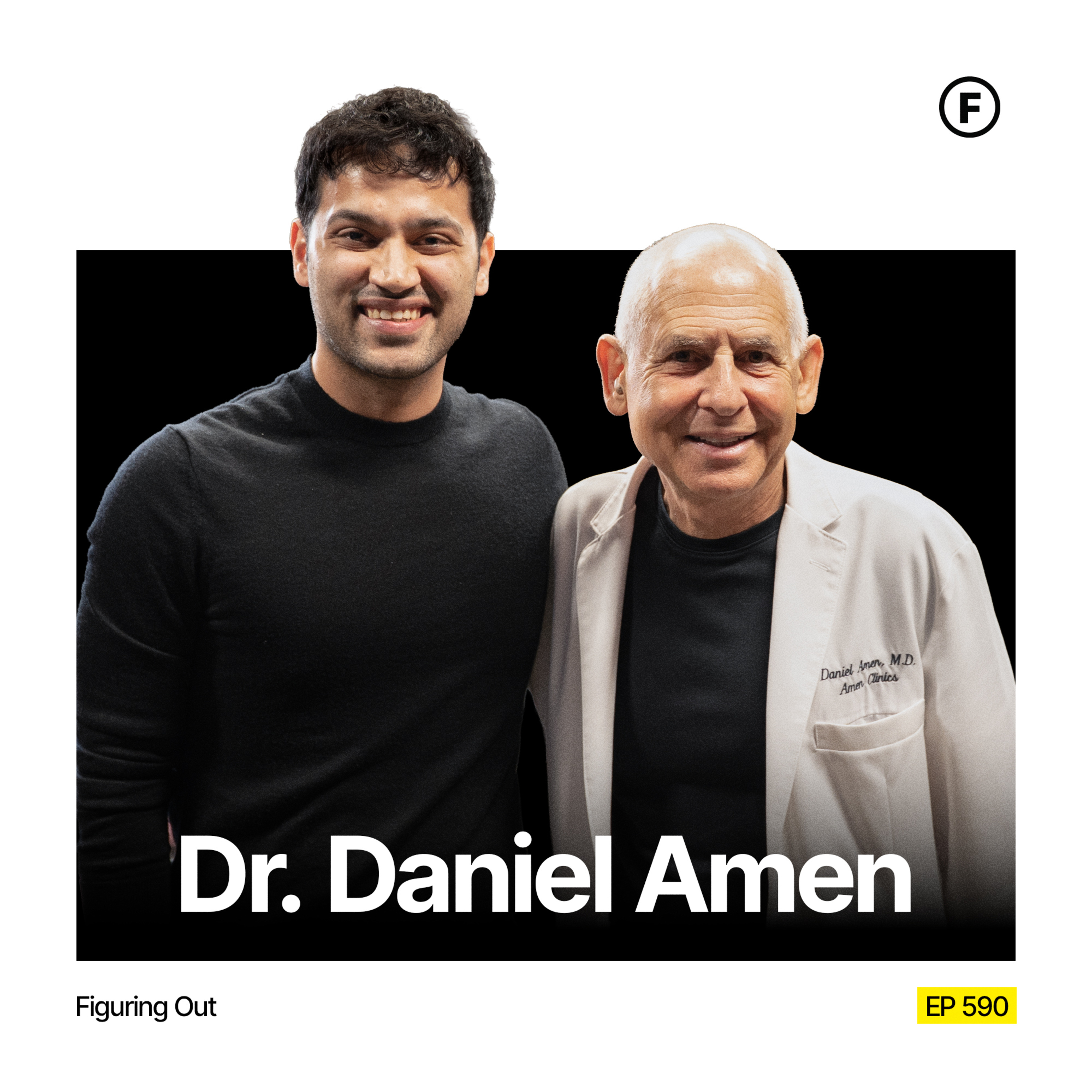
Dr. Daniel Amen is a psychiatrist and brain-imaging expert who has scanned about 300,000 people using SPECT imaging at Amen Clinics. He has worked with celebrities including Justin Bieber and Miley Cyrus. He also describes his early career in the military as an infantry medic and later an x-ray technician, then psychiatry after a suicide attempt he witnessed in someone he loved.
Written by AI. May contain mistakes.
Explore how brain function varies in criminals and the implications on behavior.
“I mean, it depends if they want to change.”
Learn about daily practices that can enhance happiness and mental health.
“What is one rate you would want to give that brain from the beginning?”
Discover how environmental factors like mold can affect brain health.
“but psychiatrists are the only medical doctors who virtually never look at the organ they treat.”
Examine case studies that illustrate how certain brain conditions can lead to violent behavior.
“So why shouldn't we look at it like every other medical specialist look at it?”
Understand the biological, psychological, social, and spiritual factors influencing behavior.
“that can change their brain and make them violent?”
Delve into how low frontal lobe function contributes to impulsive thoughts and actions.
“And there's a spiritual circle, which is why the heck do you care?”
Explore how brain activity influences the manifestation of violent thoughts into actions.
“Jerry Seinfeld, the famous comedian said, the brain is a sneaky organ.”
Learn about the risks associated with childhood device use and nutrition on brain health.
“Do you think parents make some kind of mistake that the frontal lobe of kids are not being able to fully develop?”
Examine the characteristics of a 'criminal brain' through brain scans and their implications.
“And now there's a$17 billion fine to Meta and other device organizations because as a society we're paying for the mental health damage to our young people.”
Discover various factors, including genetics and environment, that affect brain health.
“but I also don't see the inside of their brain.”
Understand how different traumas affect individuals based on their brain's condition.
“Well, if you look at someone as bad as this one that I'm looking at, it could be drug abuse.”
Explore how individual brain health affects responses to trauma.
“It depends on the brain they bring into the trauma.”
Learn the differences between healthy and damaged brains in trauma scenarios.
“into the struggles that he had, which is always why you want to work on increasing your brain's reserve.”
Discover how chronic trauma affects emotional regulation and brain function.
“in that moment does how the brain is on that day, in that week, in that month?”
Understand the impact of negative thinking patterns formed by trauma.
“so that even years later, you're always watching for something bad to happen.”
Learn strategies to cultivate happiness through positive reflection.
“can unbalance the positivity versus negativity.”
Explore how individuals of all ages can improve their brain health.
“So I pray that and then I go, what went well today?”
Debunk misconceptions about brain change and aging.
“oh, he's 94, it's normal, I'm gonna take them out of the will.”
Learn how lifestyle choices impact brain function and memory.
“When I say that baby seahorses, but your behavior either grows them into the big hippocampus or big seahorse or it murders them.”
Discover how certain exercises can improve brain function comparably to medications.
“And what I love about my practice is a side effect that I don't tell people generally is their erectile dysfunction gets better with a brain healthy program.”
Explore the connection between ambition, success, and maintaining personal balance.
“Alcohol, marijuana, being overweight, not sleeping, being sedentary, eating low quality food.”
Understand the differences between healthy passion and unhealthy obsession.
“What are those things you need to do that work now, but that you'll be able to sustain?”
Learn how anxiety levels can impact behavior and decision-making.
“But I'm not going to go, what do you want as far as the number in your bank account?”
Explore how immigrants' experiences may shape their brain functions and behaviors.
“You know, another thing, because we are in America, and there's a certain number of people who have little fear, who have little fear, and yet they do something amazing, which is I'm talking about immigrants, right?”
Discover the detrimental effects of loneliness and social media on mental health.
“I think they'd have more sleepy frontal lobes because it allows them to be more creative, to not have to do the same thing.”
Learn how to focus on personal growth rather than competition.
“And as we said earlier, your brain is a sneaky organ.”
Understand how to train your brain to cope with rejection and embarrassment.
“And then your brain will start doing it on its own.”
Explore the relationship between chronic pain and mental health.
“you suffer it's the thought that's making you suffer and question five is take the original thought she's going to reject me and i'm going to be embarrassed turn it to the opposite but she's not going to reject me.”
Discover how negative thoughts can perpetuate a cycle of pain and suffering.
“No matter what I do, it just stays there.”
Learn strategies to improve brain health and reduce chronic pain.
“leads to ants the automatic negative thoughts and negativity which accelerate the suffering circuit which then leads to more tension.”
Learn how brain health affects both chronic pain and depression.
“and there's a couple of months of just doing the right things.”
Understand how hope and multiple pathways contribute to success.
“What is one trait you would want to give that brain from the beginning?”
Discover strategies to increase hope and personal responsibility.
“We scanned 6 ,400 brains who took the hope inventory.”
Learn how to challenge limiting beliefs and improve mental health.
“And that if people do that on an everyday basis, can they...”
Explore why self-kindness is crucial for achieving one's goals.
“Better brain, your better dad, your better mom.”
Learn how visualization techniques can aid athletic performance.
“You notice what they do right or you notice what they do wrong.”
Discover how diet influences brain function and emotional health.
“So we were just using sort of the creativity because I never wonder what's my goal for her to jump as high as she can jump, right?”
Understand the connection between blood sugar levels and behavior.
“So if you're struggling with anxiety, it could be low blood sugar.”
Exploring how nutrition and brain health affect athletes' performance.
“And the answer is some of them are jahoo.”
Discussing how fame affects brain health and dopamine circuits.
“And I had his brain before when he was younger.”
Analyzing the psychological risks associated with early fame and success.
“And so video games, scrolling, alcohol, marijuana, they all increase dopamine.”
Ranking common behaviors that negatively impact brain health.
“Someone, let's say, who's watching this and is doing all the worst behaviors, which is bad for brain.”
Creating a 30-day routine for improving mental well-being.
“how to deal with your ADD or your depression.”
Learn how to cultivate positive thinking for better brain health.
“During each moment that you remember, is this good for my brain or bad for it?”
Discover how different supplements and exercises can enhance brain function.
“it, but there's 16 different brain types.”
Understand the importance of sleep hygiene and tech management before bed.
“I saw one of your clips where you said to live the longest, one of the best sports is bracket sports.”
Explore crucial advice on worthiness and the transient nature of money.
Hear about the ambitious goal of promoting brain health worldwide.
“And what is the most extraordinary thing you want to do next?”

Get the gist, explore an idea or ask about something said.
 Claude
On Figuring Out with Raj Shamani, what are the key points of this episode?
Searching your listeningAutomatic transcript. May contain errors.
0:00We scanned about 3 lakh people for their brains. Out of them, 1 ,000 convicted criminals and more than 100 murderers. What is different? What genuinely shocked you when you looked inside the brains of criminals? I published a study on murderers. The younger ones had low frontal lobe functions. It stops you from saying things you shouldn't say or doing things you shouldn't do. When this goes low, those thoughts get out. Dr. Daniel Amen, one of the world's leading psychiatrists and brain experts, has worked with celebrities like Justin Bieber and Miley Cyrus. In this episode, discover why some brains are wired for crime, addiction and self-destruction while others drive success.
0:44Let's say someone has been violent and angry for 10 years. Can you change them after that? I mean, it depends if they want to change. So I have all my patients start every day. Today is going to be a great day. If you're programming your brain to notice what you like more than what you don't like, in three weeks, your level of happiness will go on. Someone, let's say, who's watching this and is doing all the worst behaviors, which is bad for brain, I want you to rank them. Alcohol, weed, porn, what's the worst? What are the top 10 alcohol, marijuana, pornography would be next. Bad food, not exercising, doom scrolling, watching the news.
1:24If you watch the news in the morning, you're 27 % less happy in the afternoon. There will be one very underrated thing, which is really good for brain and for hippocampus, which most people don't do. There's something called Japanese walking. It's walk normal for three minutes, fast as you can for three minutes. Do that five times. That's one of the best exercises you feel? Yeah. What happens if you do that? So it's actually increasing the flexibility of your blood vessels. And your brain gets 20 % of the blood flow. And that blood flow problem can be addressed just by walking in a Japanese walk style?
2:04For sure. Their brain will be healthier. So their mood will be better. You're less depressed, less anxious. Your brain is sharper. You have less erectile dysfunction. Tell me top thoughts people should not believe, which their mind keeps telling them. You're not enough. That's the biggest one. And that I can't, I'm stuck with the brain I have. No, you're not stuck. You can make it better. And it all comes down to one question. But whatever you're doing now, is it good for your brain? You can answer that one question, your whole life will begin to change. Let's say you have to design an exceptional brain from scratch.
2:40What is one rate you would want to give that brain from the beginning?
2:47I have a small favor to ask you. I need you to subscribe to our channel. The more subscribers we have, the better and bigger guests we can bring and provide you more value through these conversations. And the full audio experience of this show is also available on Spotify, where you can follow us and listen to the new episodes as well. When you're trying to do your best work, you need a laptop that allows you to focus without interrupting your flow. That's why I use the ASUS ExpertBook Ultra. It comes with up to an Intel Core Ultra X9 Series 3 processor that delivers up to 50W TDP performance so that it can keep up with your thinking.
3:28It's also an AI PC with up to 180 total platform tops and built-in Copilot plus AI giving you ultra-powerful AI capability. And because it's CPU, high-performance GPU and NPU all work together, you get ultra fast performance no matter how heavy the work gets. The ASUS Expert Book series is available on Flipkart. Check the link in the description below.
3:57It's an honor to have you. Welcome to Figuring Out, Doc Amen. It's amazing to see you. If someone is watching you for the first time and they have no clue who you are, how would you explain them? What do you do? and why somebody should watch this episode for the next couple of hours. Well, they'll have a better brain. And what I do is I change people's brains. And when you change their brain, you change their life. I'm a psychiatrist by training, but psychiatrists are the only medical doctors who virtually never look at the organ they treat. And when I decided, when I fell in love with psychiatry, 47 years ago, I knew it was wrong and I knew it would change.
4:50I just had no idea I'd be involved in the change. And since that day you decided that you want to change? Right when I fell in love with psychiatry. So the backstory for me is when I was 18, uh, America had a draft and we're at war in Vietnam and I became an infantry medic where my love of medicine was born. But about a year into it, I realized I didn't like being shot at. So I got retrained as an x-ray technician and developed really a passion for medical imaging when I was 19 years old. And our professors used to say, how do you know unless you look? And I love that. And I love taking pictures of people's body parts.
5:45And then in 1975, I got out of the army, finished college, went to medical school. And when I was a second year medical students, someone I love tried to kill herself. And I took her to see a wonderful psychiatrist. His name was Stan Wallace, loved him. And I wanted to be like him because I realized if he helped her, it wouldn't just help her. It would help her children. It would help her grandchildren as they would be shaped by someone who was happier and more stable. So 1979, I fell in love with psychiatry and I've loved it every day since. But I'm like, why aren't you looking at the brain? I mean, obviously, if you're depressed, if you're angry, if you hear voices, if you want to kill yourself or kill other people, something's wrong with your brain.
6:40So why shouldn't we look at it like every other medical specialist look at it? Psychiatrists guess. And so early on, I'm agitating my professors, well, why aren't we looking? And they always said, that's the future, that we can't find useful things by looking, which I thought was complete nonsense. And so when after I finished my training, I did my psychiatric training in the military at the Walter Reed Army Medical Center in Washington, D.C. So it's this massive hospital. And we took care of all sorts of fascinating people. And I'm like, we should look. And once I got out and I was the boss, we started to look.
7:32and you said that if there are something horrible things which are going in your brain if there that you want to you want to kill somebody or you want to kill yourself there's something inside your brain which is going on we need to look right and since then because of this fascination you have scanned more than about like you've scanned about three lakh people for the brains 300K people for the brains, right? Right. And out of them, you scanned around 1 ,000 convicted criminals and more than 100 murderers. So what do you see inside their brains? What is different? What genuinely shocked you when you looked inside the brains of criminals?
8:19Well, it's not one thing. You can have impulsive murderers. They just get a bad thought and act on it. low frontal lobe function. Or you can have compulsive murderers, think serial killers. So they can't stop thinking about killing people. They have too much activity in the front part of their brain. Sometimes they have traumatic brain injuries, major cause of psychiatric problems that very few people think about. Sometimes you have an infection like Lyme or COVID that changes your brain that makes you wanna do bad things. Sometimes it's toxic. You live in a mold-filled environment. And if you never look, you actually never know.
9:12And 25 % of the US population is on psychiatric drugs. without anybody ever looking at their brain, which I would argue that's insane. You said someone living in a mold environment, a toxic environment, that can change their brain and make them violent? Yes. And very few people know that. Just by... And when I first started imaging people, I was the director of a substance abuse treatment program. and their brains were so bad and they looked toxic. But then I would see toxic brains of people who weren't drinking or doing drugs. And I'm like, why is that? And that's when I learned things like infections and mold or anoxia, lack of oxygen can cause serious behavior problems.
10:12Give me an example. What did you see in someone's brain? What specific thing inside the brain that made you believe that this person has criminal tendencies or violent tendencies? So my favorite case is 1995. I got a call late one night from my sister-in-law, Sherry, who said my nine-year-old nephew, Andrew, attacked a little girl on the baseball field, for no particular reason, out of the blue. And I'm on the other end of the phone because this child is my godson. And I'm like, what else is going on? And she said, Danny, he's different. He's mean. He doesn't smile anymore. I went into his room and found two pictures that he had drawn.
11:00One of them, he's hanging from a tree in a suicide attempt. The other picture, he's shooting other children. So here in America, we've had a lot of famous school shootings like Columbine or Sandy Hook or Parkland, Florida. And Andrew's one of these kids. And when I scanned him, he had a cyst the size of a golf ball occupying the space of his left temporal lobe. And at that time, I'd already correlated the left temporal lobe to violence when there are damage or problems in the left temporal lobe. And when the neurosurgeon drained the cyst, his behavior completely went back to normal. So sometimes there's actually reversible causes of violence.
11:50And do you see this pattern across all criminals or violent people, or is that different? No. And, you know, I always think of people in four big circles, that there's a biological circle. So how's your brain and body? There's a psychological circle. How's your mind? How do you think? What's your development like? There's a social circle. How are your relationships? What's the modeling? And there's a spiritual circle, which is why the heck do you care? What is your deepest sense of meaning and purpose? Why do you believe you're on the planet? What is your sense of God, of your past, of your future?
12:40Very important part. You can have problems in all of those circles, then you become a school shooter. But if you have problems in one, sometimes the other ones will modify it. But so say you have a head injury, you've had childhood trauma, your father or mother modeled violence for you, and you think you're here by random chance. That's a vulnerable person to actually act on it. But is there something which is common across? I published a study on murderers on 40 of them. And the younger ones had low frontal lobe function. So if you think of the front third of your brain, it's the brain's break.
13:35It stops you from saying things you shouldn't say or doing things you shouldn't do. It sort of sees the future and goes, is this a good idea? So the younger ones had really low activity in their prefrontal cortex. The older ones had global low activity. Interesting. And you said the break in the brain. So that is the break that will stop you from doing certain things, right? Right. Like everybody has crazy thoughts. thoughts. Jerry Seinfeld, the famous comedian said, the brain is a sneaky organ. We all have weird, crazy, stupid, sexual, violent thoughts that no one should ever hear. When this goes low, those thoughts get out.
14:29And you've probably seen these people where you're like, why did you say that. It's like, don't say that. Interesting. Explain me what happens. So frame by frame, if someone who gets a thought, which is a violent thought, how does it manifest into an action? What is the process? What's going on in the brain in 10 seconds that there are a few people who just go like, boom, I want to do this thought. I got this violent thought and I want to do it. And there are a few people who won't. So if we have healthy activity here in the prefrontal cortex, and I get a violent thought, and I've certainly had them, I'm like, no, don't do that.
15:19Because I see the future that a violent thought then leads to maybe they'll be violent with me or I might get arrested and I don't like institutional food. I don't want to lose my medical license. My brain begins to play out those scenarios with the thought. But if you have low activity here, perhaps you have somebody who has attention deficit disorder, ADD or ADHD. They often have low function here. They get the thought and they just act on it. Or maybe I have good activity here, but I just had six beers and alcohol lowers it. So, I'm much more likely to say something that hurts people's feelings or do something that is not a good idea.
16:13Or let's say I play soccer or football and I've hit my had hundreds, thousands of times damages function here, get that thought, you're less likely to evaluate it and more likely to act on it. Or if there's too much activity here, your brain gets stuck. And so I don't know if this happens in India, probably it does. Somebody cuts you off on the road. And what certainly happens here. And in your mind, you might go, you bastard. Well, the person where there's too much activity here, see, in my mind, I might go, you bastard, and then I don't do anything because I have no idea if they have a gun in their car.
17:05I have no idea how they're going to react. And I just leave it alone. The person who has too much activity in the front part of the land. You bastard, you bastard, you bastard, you bastard. And then they have to do something almost like a compulsion. So it's very interesting. The same act of violence can come from different brains. And so you would never want to treat everyone the same, but that's exactly what we do with depression. That's exactly what we do with anxiety disorders or people who have ADHD, where the imaging taught me all of these problems have multiple subtypes. True. Do you think parents make some kind of mistake that the frontal lobe of kids are not being able to fully develop?
18:01Yes, if they don't feed their children properly, if they encourage them to play contact sports too early, right? Letting children hit soccer balls with their head is bad or play tackle football. Not a fan of that. Golf is good. Tennis, terrific. Table tennis, I think the world's best sport. I think too. Uh, it's, um, every day you're growing your child's brain in a good way or in a bad way, depending on, you know, if you give them an iPhone at five and you don't supervise their device use, you're increasing their risk of brain problems. So if you have to pick one, what's the number one mistake that ruins a kid's brain under the age of 10, which is a mistake by the parents?
19:02Devices. Under the age of 10, you should think that there should be no devices? You should limit them as much as you can because they steal dopamine. I think of them as dopamine destroyers. And in Silicon Valley, where they make a lot of these devices, they have nanny contracts where the nanny is not allowed to use her phone in front of the kids, not give kids devices. If the people who create these things know they're dangerous, why then have they unleashed them on society? And now there's a$17 billion fine to Meta and other device organizations because as a society we're paying for the mental health damage to our young people.
19:57Now, on top of that, it's like the food we eat, 70 % of American food. I don't know how it is in India, but 70 % is ultra processed food. So kids aren't getting the nutrients they need. And because they're on devices, they're inside and not getting vitamin D like before. It's problematic. And then, well, this is if they're a little bit older, many parents think marijuana is innocuous and alcohol is a health food. So this younger generation is in trouble. In trouble. And do you think all of these things which you just described can lead to a criminal brain? Yes. I think they can lead to a criminal brain.
20:48Is there actually a thing as criminal brain? Can you look at two scans and tell that one of them is a damaged brain, one of them is not? Absolutely. Like if I give you, I'm going to give you two different scans. So, yes. What's the difference? Like explain me. Like how, can you tell what's criminal and what's not? So the image on the left is looking at a healthy brain, full, even, symmetrical activity. The color doesn't matter. It's the shape. The image on the right shows all these holes, which is low activity, low blood flow. Now, it doesn't mean this person's going to do anything bad. But if I had to bet, this person is probably 10 times more likely to commit a criminal act than the person on the left.
21:55but I also don't see the inside of their brain. You know, when we look at brains, these are SPECT scans. That's the study we do at Amen Clinics. SPECT looks at blood flow and activity, looks at how your brain works. And basically tells you three things, good activity, too little or too much. And then my job is to balance it. So there's another view of this that'll tell me, is it working too hard? And so if I saw healthy on the outside, but dramatically overactive on the inside, then I would change those prediction numbers. But just this 10 times more likely to go to jail than a person with a healthy brain.
22:41But don't forget what I said. It's not just brain. It's not just biology. It's brain and body, mind, relationships, spirit. I have this one really terrible looking brain from a spiritual teacher. And she's the nicest, sweetest person. But she wasn't before she had her enlightenment. She was a rager. She was an alcoholic. She was a mess. And then she woke up on the floor of a halfway house in Barstow, California. I think it was 1986. And she realized when she believed her thoughts, she suffered. But when she didn't believe her thoughts, she didn't suffer. And then she's gone on this world mission to teach people to not believe every stupid thing they think.
23:38And then you said that. But she had a terrible brain. So terrible brain, but a good mind, good relationships with a deep sense of meaning and purpose. So she was able to modify her bad brain. I have two questions on this. One is how much of the brain is, and I'm talking about the unhealthy one, which is more likely to be violent and self-destructive. How much of that is from childhood, from their own choice, from biology? What is it? Well, if you look at someone as bad as this one that I'm looking at, it could be drug abuse. It could be an infection, an environmental toxin, anoxia, which is a lack of oxygen, like having a near drowning episode or somebody tried to strangle you.
24:47I mean, there are lots of different potential causes. There's a term I like called brain reserve. It's the extra tissue you have to deal with whatever stress comes your way. And your parents, through their behavior, before they even have you, is influencing your brain reserve. So if your father smoked cigarettes when he was a teenager, he's decreasing your brain reserve. So what your parents did before they ever have you is impacting the health of your brain. And if you think about it, it really is sort of crazy. When a little girl is born, she's born with all of the eggs in her ovaries she will ever have.
25:41So in her mother, so your grandmother, when she's pregnant with your mother, her habits are actually influencing how healthy her grandson is going to be. And so if your mother didn't want you, if she was chronically stressed, if she was sick a lot during her pregnancy, she's decreased the health of your brain. And then, of course, the day you're born is the most dangerous day of your life. Three percent of babies have birth trauma. And so that contributes to brain reserve. Easy birth or a C-section birth. Much easier on the baby. And then how does she feed you? What's the level of stress in your home?
26:39What are the educational opportunities? How's your level of sun? How's your level of exercise, your food? All of that is either increasing your reserve or decreasing it. You said C-section babies. What's better, C-section or the normal delivery? Normal delivery is better if it's safe because it will populate the microbiome in your gut. So do you know the microbiome? You have 100 trillion bugs in your gut. And babies that are vaginally delivered and breastfed have healthier microbiomes. But like with my daughter, if the baby gets in trouble, much better to have a C-section. Because if they go through the canal and they get stuck or they have the cord wrapped around their neck and the baby is born blue.
27:37Very bad for the baby. And you said the 3 % of babies were birth trauma, right? And not only birth trauma, there are different types of traumas one person goes through during their lifetime, right? Why does it happen that a trauma or a traumatic experience can make one person destructive and make another person extraordinary? I love that question. It's such a good question. It depends on the brain they bring into the trauma. So let's take two soldiers, put them in the same tank, expose them to the same blast. Everything's the same. One of them walks away unharmed, the other one's permanently disabled.
28:29Why? It's the brain they brought into the trauma. I have a patient who had birth trauma and had a lot of trouble in school, and he had a very bad brain. Now, we fixed it with 89 sessions of hyperbaric oxygen therapy and some simple supplements. But there's no way he could handle the traumas in his life without becoming angry, without becoming self-destructive. It's the brain he brought into the struggles that he had, which is always why you want to work on increasing your brain's reserve. Explain more what kind of brain a person who will become destructive brings into the trauma versus what kind of brain a good person, like a healthy person, is bringing in.
29:33So if you have a healthy brain, what does that mean? Like, what do you mean healthy person bringing brain? So for me, after looking at all these scans, if you have a brain that is working as healthy as it can be because it's not had head trauma, it's not had dietary deficiencies, it has reasonable structure, that brain is gonna be much more resilient than a brain that has been hurt. And in that moment when they're going through trauma, in that moment does how the brain is on that day, in that week, in that month? Or it is like throughout the childhood, whatever has caused you that brain you're talking about?
30:23Well, and it depends on if the trauma is ongoing, like you're being raised in an alcoholic home, or it's a single incident trauma. You're in a car accident.
30:43Chronic trauma changes the brain and actually activates the emotional circuitry in the brain. So if you have a dad or mom that's an alcoholic and you can never predict, is he going to be nice? Is he going to be reasonable? Is he going to be attentive? or is he going to be destructive? You never can predict. So your nervous system is now chronically heightened. That's much more damaging. We published a study a couple of years ago on adverse childhood experiences. So on a scale of zero to 10, how many bad things happened to you as a child? And the more you had, the more heightened your brain was, your emotional brain was, so that even years later, you're always watching for something bad to happen.
31:43And when somebody goes through this chronic trauma, do you think, let's say someone's been raised for four or five years or 10 years in a very toxic environment, even after they leave the place, can they continuously rehearse the same situation in their brain and make it worse? Absolutely. That they become very good at noticing what's wrong and not very good at noticing what's right. And so you might smile at them. So say you're married to them. So my wife on a scale of zero to 10 is an eight. So she grew up in a lot of craziness. And so, but she's gotten help and she and I are best friends and it works.
32:34But she notices what's wrong way faster than what's right. So when the pandemic happened, she was prepared she's one of we call them here in the u.s preppers she's a prepper and now i can never say i'm like why are you spending all this money on things we'll never use and um but she was prepared but if i smile at her she might notice might not notice that But if I frown, she might get attached to what's wrong. And they tend to notice what's wrong much faster than what's right. And that can actually hurt you in relationships because it can unbalance the positivity versus negativity. Interesting.
33:31So you're telling that people are literally rehearsing to make their brain more dangerous and self-destructive. Yeah. And so we have, I developed a game to help her see the positive faces. So we'd have an airplane and it's like, notice the positive ones. And she did it for like 10 minutes. She goes, no, I don't want this. It's like, no, I'm keeping my suspicious. Interesting. Because of that, do people become violent? Well, the more negative you are, the lower the function in your frontal lobes over time, the more likely you are to do things that are not in your best interest. And then if someone's doing that for 10 years, let's say someone has been violent and angry for 10 years.
34:34Can you change them after that? You bet. I'd love that. I mean, it depends if they want to change, right? You can't change people who don't want to. But people who come to me and they go, this really isn't working for me. Help them have a better brain. train positivity. So I have all my patients start every day. Today is going to be a great day. Like push your brain to look for what's right. And then during the day, notice even the littlest things, um, like, Oh, just holding. I like water. Water is good for me. Um, notice the littlest things. And when you go to bed at night, and this is the big one, go what went well today, and start at the beginning of your day looking for what you liked about the day.
35:32In three weeks, your level of happiness will go up. So I want people to be able to notice what's wrong and fix that. But happiness is in noticing what you like way more than what you don't. you're telling just like morning morning midday and night if somebody just notices what went right in three weeks they can increase their happiness just by noticing that's it and doing nothing else and doing nothing else but if you think about it when you go to bed like when I go to bed I say a prayer I actually have a new book coming out in February on the Lord's Prayer it's called the neuroscience of the Lord's Prayer.
36:17So I pray that and then I go, what went well today? But I do it in a very specific way. I start at the beginning of my day, look, and I go hour by hour going, what did I like about today? So this interview will show up. I'm like, this was so much fun.
36:41and it puts me to sleep. And think about it. So what happens to your sleep, to your dreams, if you're programming your brain to notice what you like more than what you don't like? Your dreams are better, which means your sleep will be better, which means the reason you sleep, your brain cleans and washes itself when it sleeps. And so it's actually making your memory better the next day. If you want your memory to be better tomorrow, go to bed a half an hour early tonight and do this exercise. And I remember the night my dad died, which I think was the worst day of my life. It was a terrible day.
37:28And when I went to bed, I went, what went well today? the supervising voice because we all have it you know like that voice that judges you that criticizes you they're like seriously we're doing this tonight but it's my habit you don't do what you want to do you do your habits and I've been doing it for a decade and when I went to bed I'm like what went well today my mom said something to the police officer because my dad died at home that was so funny, I just started laughing. Because he died at home and the police officer, who I knew said, Mrs. Amon, because he died at home, we have to do an investigation.
38:14And this is someone whose husband of 70 years had just died. She goes, do you think I was cheating on him? Do you think I had him killed? And she was just being silly. But for her to be able to do that, I was impressed. And then I got hundreds of texts from people who love me and love my dad. And then I held his hand before the mortuary took away. It was so soft. And then I fell asleep. Because it's my habit. And so if you really want to be a happier person, get better habits. And the better habit you mean is just notice what went good today. What went well. What went well. Yeah. What's the youngest and the oldest brain you've seen transformed because of this habit?
39:07Children are remarkably compliant often. And so six, I think, would be the youngest that incorporated this into their life. I have a brand new book also. So, um, and I won't talk about books anymore, but in January, I have a book called Freddy, um, how to train your brain for happiness. And it's all around. It's a very beautiful, cute book. Notice what you like more than what you don't notice what you like more than what you don't. And then I have those three habits in the book as well. Um, the oldest person, 94. A 94-year-old can transform themselves. Absolutely. In fact, if I'm 94 and my children take me to the doctor because I have a problem and they go, oh, he's 94, it's normal, I'm gonna take them out of the will.
40:11I've already told them that. It's like, no, that's like elder abuse. And now at 72, people go, oh, he's 72. I'm like, absolutely not. Your brain can be way better every day. Your brain is getting better or it's getting worse, depending on the habits you have. My dad, when he was 90, he started seeing little people on the ceiling. He's like, Danny, I'm seeing little people. And then I scanned him and he had really low blood flow. I put him in a hyperbaric chamber. Six sessions, the little people on the ceiling went away. But if I would have said, he's 90, don't worry about it. No. So don't people say that after the age of 25, it gets very difficult to change brains?
41:07That's amusing. That's not true. Well, your brain sort of finishes, but not really. I mean, your brain continues to develop throughout your whole life. One of my favorite stories is one of the young superstars I see who I couldn't get to stop smoking pot. I'm not a fan of marijuana.
41:40And I knew she loved animals. So I taught her about an area of the brain called the hippocampus. which is on the inside of your temporal lobes. And hippocampus is Greek for seahorse because it's shaped like a seahorse. And every day, whether you're six or 96, it produces about 700 new baby stem cells. When I say that baby seahorses, but your behavior either grows them into the big hippocampus or big seahorse or it murders them. And I have a 23-year-old. Now, both of us, 700 baby seahorses. Hers are more likely to stick around because younger people have better blood flow in their brain. But if I take care of my brain, I'm likely to keep them, which means I'm likely to keep my memory and my mood and my spatial awareness.
42:44So anyways, I was telling her she was murdering the seahorses and she stopped smoking pot. So I was very happy with myself. Tell me one activity that murders the seahorse and one which helps it make better. I'm talking So if we're murdering the seahorse, alcohol, marijuana, not sleeping, living in a mold-filled environment, eating crappy food, not exercising, all decrease function of the hippocampus, growing it, going to bed a half an hour early, eating a salad with the wild salmon and olive oil, doing something you love that's not bad for your brain. Tell me one very underrated thing, which is really good for brain and for hippocampus, which most people don't do.
43:46Well, I think it's high intensity exercise. Not so much that you have too much stress. I'm not a big fan of marathons because it's too much stress. but there's something called Japanese walking that I like a lot. It's walk normal for three minutes, fast as you can for three minutes, normal for three minutes, fast as you can do that five times. I think completely simple, easy to do, underrated. That's one of the best exercises you feel? Yeah. Along with lifting weights, because the stronger you are as you age, the less likely you are to get Alzheimer's disease. I think people undervalue muscle.
44:30But what happens... Tell me about Japanese walk, which you just talked about. What happens if you do that? So it's been found to be actually more effective than just walking for 10 ,000 steps. It's the high intensity part, it's the burst, is actually increasing the flexibility of your blood vessels. And I have a term I love called brain envy. It's about loving and caring for your brain because the brain is the only organ where size actually matters. So you want a bigger brain. But your brain gets 20 % of the blood flow in your body. Anything that damages blood vessels damages your brain. And so you want to have blood flow envy.
45:20And here in the United States, 40 % of 40-year-olds have erectile dysfunction. 70 % of 70-year-olds have erectile dysfunction, which means 40 % of 40-year-olds and 70 % of 70-year-olds have brain dysfunction. Because if you have blood flow problems anywhere, they're everywhere. And that blood flow problem can be addressed just by walking in a Japanese walk style? It'll help it, for sure. And what I love about my practice is a side effect that I don't tell people generally is their erectile dysfunction gets better with a brain healthy program. And ultimately, I have an acronym maybe we could talk about called bright minds.
46:13You want to keep your brain healthy or rescue it. You have to prevent or treat the 11 major risk factors. And bright minds is the acronym. And the B is blood flow. Anything that damages blood flow damages your brain. Interesting. And let's say if someone is, someone doesn't even realize the kind of problems they're going through, it's probably because of blood flow, right? And they don't know what they're going through. And they've never, they're a couch potato. They just sleep. They're lazy. they probably go to work and come back and just be lazy again. And play video games. And play video games or just watch TV.
46:57Play video games, scroll, or watch Netflix. Perfect. So they do this. And you look at their brains today. And for 30 days, every day, for 20 minutes, they do the Japanese walk. What will change inside their brain and their body? Their brain will be healthier. It'll start to go from a bad-looking brain to a better-looking brain. And what will happen in their day-to-day behavior? So their mood will be better. So head-to-head against antidepressants, walking like you're late, equally effective to antidepressant medication. No way. equally effective. So the study with Zoloft, good SSRI, versus walking like you're late for 45 minutes four times a week, equally effective at 12 weeks.
47:50Now, think about it. What do you have at 12 weeks with Zoloft? You're less depressed, less anxious. You're more likely to have sexual dysfunction because it decreases your ability to have an orgasm. And you're dependent on an antidepressant. What do you have at the end of 12 weeks of walking like you're late? You're cuter. Your brain is sharper. You have less erectile dysfunction. It just seems like, well, shouldn't we start with exercise? Yeah. Better blood flow. And so with each of the 11 risk factors, What makes us know you have it and how do you prevent it? So I work really hard to make things like as simple as possible.
48:47So what damages blood flow? Alcohol, marijuana, being overweight, not sleeping, being sedentary, eating low quality food. What increases blood flow? exercise, certain foods like beets, certain supplements like ginkgo, simple things. But basically, it's loving your blood vessels. It's just thinking about, oh, I have high blood pressure. What are my risks and how can I have healthier blood pressure? Because very few psychiatrists will ever talk to you about your blood pressure. But if you have high blood pressure and 60 % of the population is hypertensive or pre-hypertensive, it's like, oh no, we have to get that healthy.
49:43Interesting. We'll come to Bright Minds. I have a question and then I'll arrange it there. But coming back to the healthy and unhealthy brain, what we were talking about, Tell me, here's what, you know, during the, like my podcast is for young ambitious people who really want to do extraordinary things in life, right? And I spend a lot of my time with people like you who are creating an extraordinary change in the world, right? And here's what fascinates me, that aggression, obsession, fearlessness, risk-taking behavior, all of these things can make somebody an extraordinary person. And these are the same behaviors which you will find in a criminal as well.
50:41Yeah, I haven't really thought about it like that. but think i think of the criminals so i would rephrase that the most successful people i know are focused and they have a sense of what they want and for my patients like i have um julius randall who's an nba superstar and uh and he came to see me because it's and it's all public knowledge because he's been on my program and we've talked about it. He's smoking pot every day. He was miserable. He had no ability to manage his mind. Wildly successful, right? In the top 0.1 % of all successful people, recognition, money, all of that. But he's miserable.
51:34Our first exercise is called the one page miracle. On one piece of paper, write down what you want relationships work money physical emotional spiritual health he said it was the most helpful thing because he was completely unbalanced where basketball was everything and i told him i'm going to be your best investment because if he would have gotten divorced it would to cost him a hundred million dollars. Right. And now because his wife is important to him. So now he acts in this balanced way where his wife, his children, basketball, money, mental health, all it's important. So they're focused where most criminals, it's about the moment it's not about all of the moments and for the young people listening it's and i ask this to everybody i see do you want to be successful now or now and later and so what What are those things you need to do that work now, but that you'll be able to sustain?
52:55Like I never make a business decision for a quarter. I'm always making business decisions for the next 10 years. Right. So it's that frontal lobe forward thinking. And I don't want to go to jail. So I do the right things that help with now and later. So it's that focus and balance. I do it very specifically because the people who are wildly successful in business, like Julius is, but they're often miserable because they're unbalanced. But that's after they got successful. Then they started doing the balance thing, right? Before, you look at the similar traits, the world-class performers or criminal, which decides which direction a person will go?
53:54Because there are clearly really obsessive people who have become world-class, and there are obsessive people who have become criminals and they're in prison. Yeah. How do you define... You know, I think... Let's just think about it in those four circles that we talked about. So biologically, if their brain is healthier, they're more able to take their passion. So we could take it as obsessive, which is pathological, or change it to passionate, which is not necessarily pathological. Like I work a lot, but I love it. and it works for me, right? If I didn't love it and I still was obsessed with it, that would work against me.
54:50So passion plus low cortisol, low stress hormone, because I love it, is very different than passion, but I have to do it. Because if I don't, it's like a compulsion. It's like, I have to. That's not good for you. And at what point the obsession becomes compulsion? When you can't stop, even though it's hurting you. And then it becomes... can't stop and you're losing so um in the news recently has been tom brady because somebody i guess wrote a book about his divorce and he's married one of the most beautiful women in the world and she's like but you're not paying any attention to me and she's warning him and he's like no i still have to do it at that point it's pathological if he loves his family right it's like no more and he'd already won seven super bowls or something crazy you know at that point it's pathological and how why some people become like that and they're not able to balance in part because of how their brain works is that they just can't stop and that's not low activity it's generally too much can you fix that you can balance it sure if they want to and i i always start with like if you came to see me it's like what do you want i mean i have my goals for you my goals for you is to have a better brain how can i balance your brain but ultimately i work for you and it's like well What do you want?
56:44But I'm not going to go, what do you want as far as the number in your bank account? I'm like, what do you want? Relationships, work, money, physical, emotional, spiritual health. What do you want in all of those things? Because if you get two stock on one of them, you're going to end up being burnt out. And interesting. So a lot of people with these traits that we just obsession, aggressiveness, or fearlessness, these things combined with passion and love, they actually lead to better outcomes. And then these things combined with high cortisol and hatred takes you to the direction. Is that what you're trying to say?
57:36So I'd be a little concerned about the fearlessness because it's people who have low anxiety that go to jail. It's I want my patients to have enough anxiety. So a lot of people come to me and they go, I'm so anxious. I don't want to be anxious anymore. And they're like, can you get rid of the anxiety? It's like, no, I can lower it. But let's not get rid of it because you want like 15%. So if we like scale it from zero to 100, it's like you come to me with 80. I want to take it to 15. I don't want to take it to zero. Why? Because you want some of the anxiety seen ahead with trouble. You want when it's raining out to not drive at 125 miles an hour.
58:31You want your brain going, let's be careful. Let's be thoughtful. And too much risk-taking, I mean, it leads to bankruptcy. It's like, let's be thoughtful. Let's have enough anxiety that we just do the right things. I like this. I'm hearing this for the first time, that have little anxiety. It's good. Yeah. No, they actually study people with low anxiety, people who their heart rates are lower, their sweat gland activity is lower. They go to jail more. It's why lie detectors actually don't work with criminals because they don't react like normal people do. Do you know about Alex Hanholt? Okay.
59:28Because you're talking about fearlessness and this example has come to my head. He recently climbed Taipei 101 with no rope. And he's like the fearless guy. And there was a, like somebody scanned his brain years ago and there was his fear center barely reacted. Yeah. The same with the person who did the documentary Free Solo, who climbed, I think it was the face at Yosemite. He had low amygdala function. They die early. They can do amazing things. And we just did a firefighter study, which is really interesting. Because, you know, there are people who run away from fire on one of them. It's hot.
1:00:20And then there are people who run toward the fire and they have different brains. And often their amygdala is less reactive. So they can manage the anxiety of running toward the fire. So in these cases, firefighters and then Alex, who's a world performer now, and he's setting records do you think fearlessness is an advantage?
1:00:54It can be in certain situations, but then it can be a huge disadvantage if you don't pay your taxes because you're a friend. You end up in jail. So I think you have to know what the goal is. I mean, if the goal is to be a world-class climber, it's a huge advantage, right? If that was my goal, no way I'd ever do it. It's like, no. I have a terrible story of I was in the army and we had to cross a ravine. by, so they tied us in a Swiss seat to the rope and then hand over hand, you had to cross the ravine. And when you get to the middle of the ravine, they said, let go and trust the rope. But I didn't trust the rope.
1:01:49And I felt terrible because all of my, you know, soldier friends were watching. And it's like, so now I'm stuck. Do I be brave even though I don't trust it? or do I act like a scared little bunny rabbit and don't test it? And that day I acted like a scared little bunny rabbit and I went to the other side and I was feeling terrible about myself, but the guy behind me tested it and they mistied his rope and he dropped 30 feet and broke his neck. And since then, I'm like, some anxiety is good. So I appreciate the scared bunny. So you're like, have fear, but learn to manage it. Learn to manage it.
1:02:36Extreme fearlessness is not. It's not good for you. You know, another thing, because we are in America, and there's a certain number of people who have little fear, who have little fear, and yet they do something amazing, which is I'm talking about immigrants, right? So immigrants are 80 % more likely to start a business in America. And almost 59 % of billion-dollar companies in America are founded by immigrants. Do you feel immigrant brain is designed and wired differently? Have you scanned immigrant brains? Yes. So I'm the grandson of an immigrant. Yeah. And my grandfather worked in a foundry shoveling coal in a General Motors plant in Michigan.
1:03:28He had arms like you cannot believe. He was so strong. But my dad started a business and owned a chain of grocery stores and was chairman of the board of a$4 billion grocery company. Um, so if you can leave your home and go to a new place where you don't know the language, there's something, there's an advantage to your brain. Um, now also a high incidence of ADD and immigrants because they're restless and they're always sort of what's next, what's next. But immigrants build the United States for sure. Have you compared an immigrant brain versus a native brain? You know, not that specifically, but I've certainly scanned many.
1:04:27That's actually a great question. You've never compared apple to apple? No. But do you know, are there some patterns in immigrant brains? I think they'd have more sleepy frontal lobes because it allows them to be more creative, to not have to do the same thing. The stronger your frontal lobes, we usually think of that as a good thing, but it's not necessarily a good thing. the more you get attached to ritual and routine. So people who are attached to ritual and routine do not become immigrants. The people who become immigrants want something new, want something different. They're not attached to ritual and routine.
1:05:17So is that a good thing for everyone? They should not be attached to routine and ritual? No, I think it's where, like I said earlier, where our habits, it depends if our habits are useful or they're outdated, for example. You were talking about your grandfather and we were talking about immigrants. There's one thing that immigrants and not just immigrants, a lot of people go through, which is years of uncertainty and years of loneliness. Does that do something to your brain? Loneliness is really bad for the brain. In fact, chronic loneliness has the same negative health effects as smoking 15 cigarettes a day.
1:06:01There's a new report out by the Surgeon General on this epidemic of loneliness, both here in the United States and in the United Kingdom. It's very bad. And with AI and all the social media, we're more connected. We have more followers and fewer friends. Friendships have gone down 40 % since 1990. So we're really more disconnected. Does that make your brain weaker? Yes. Because you're not getting the feedback from other people. When we're interacting, there's a lot going on in both of our brains, which means our brains are working. If you're paying attention to the other person, there's interaction.
1:07:00The problem with social media is if you don't like something, immediately you get rid of it. And they have algorithms that keep you there by making you angry or anxious. And then your own thoughts sort of become a louder megaphone because they feed you what you think. and so politically if you're a little bit to the right they make you more to the right if you're a little bit to the left they make you more to the left and then they make you hate the other side because if you hate the other side you stay and spend more money it's been very damaging to our society and it's heartbreaking um Do you know who Charlie Kirk is?
1:07:55Yeah. So Charlie was one of my patients. And I loved him. And I have patients on the left. I have patients on the right. I'd say brain and mental health are not political issues. They're sacred human rights. And I posted how much I loved him. And I got so much hate. I was stunned because I loved someone. People hated me because they didn't like him or they didn't like his thinking. That's a sign of a toxic society. But a lot of people are lonely and they don't even want to actually build fruitful relationships because they're scared of rejection, humiliation, and heartbreaks. And that's why they don't do it.
1:08:50It's because they can't manage their mind. Early in school. I have another children's book called Captain Snout and the Superpower Questions. You have to learn. So when you're in school, did they ever teach you not to believe every stupid thought your brain generated but they should have yeah i was 28 years old in my psychiatric residency at walter reed in washington dc and one of our professors said you have to teach your patients not to believe every stupid thing they think it's part of a therapy called cognitive behavior therapy developed by Aaron Beck many years ago. And I'm like, but I believe every stupid thing I think.
1:09:34And so a hallmark exercise that you should do, that everybody should do is whenever you feel sad, mad, nervous, or out of control, just write down what you're thinking and then go, is that true? And we all want to be masterful at rejection. And it's a numbers game. that yes, you might get rejected by 98 beautiful women that you're attracted to, but only one really has to say yes. And so every day you win or you learn. And as we said earlier, your brain is a sneaky organ. We all have weird, crazy, stupid, sexual, violent thoughts, we all have rejection thoughts.
1:10:31And it's a numbers game. You just have to go, what do you want? Is your behavior getting you what you want? And if you got... There is no losing. That's why I'm not a huge fan of the Olympics, even though I have an Olympian that's one of our patients. I love her. because I never want to be the best at anything. I want to be my best. When you have to be the best, like in the Olympics, you have to beat people. And if you have to beat people, it separates you from them. If you have to be your best, then you can bring people with you. You can root for other people. You don't have to... It's not about winners and losers.
1:11:18it's like I want to be my best and when I get some of my professional athletes to get out of I have to be an all-star or I have to win a championship or I'm no good at all it's like that's just dumb thinking it's not helpful what's helpful is how can I be my best every day and you're more likely to win an NBA championship if you're your best every day but either way you're going to be happy. But if I don't have this, I don't have that, then I'm nothing. Can you train your brain like this? Absolutely. And you only have to do that exercise 30 times. And then your brain will start doing it on its own.
1:12:09Just like we talked about earlier, what went well today. And on the worst day of my life, my brain went, what went well today. That's so important that I don't believe every stupid thing I think. But teach me, let's say, if someone's watching this and that person is afraid of being rejected, being embarrassed, how can someone train their brain to not be afraid of embarrassment and rejections? so what's the thought so let's role play so there's somebody cute you want to ask out yeah and but you're afraid they're going to reject you of course so what's the thought they're going to reject me yeah and i'll be embarrassed in front of everybody embarrassed yeah everybody will laugh at me and i can't go and how will i look now you're getting lots of other thoughts in because that's what happened.
1:13:08Exactly. That's right. Is the bad thought turns into another bad thought, which then turns into another bad thought. So when my brain used to do this, I used to imagine, you know, if like you're almost in an accident in the car, my brain would like then see the car on fire and then see myself be burned over 90 % of my body and then have to go and get my bandages changed every day and it's incredibly painful and the nurse is not even cute so i mean that's your brain like starts one thing magnifies it and then it gets worse and worse actually for a little while i wore a rubber band around my wrist and every time my brain started to like catastrophize i'd snap the rubber band just to start to attach pain to catastrophizing more effective write down what you're thinking they're going to reject me five questions memorize the five questions and these came actually from byron katie the person who i told you is the spiritual teacher yeah earlier she has this great book i love called loving what is it's five questions the person's going to reject me question one is it true yeah maybe you don't know yeah i don't know maybe maybe but maybe not the second question is it absolutely true with a hundred percent certainty you know she's going to reject you no no third question how does the thought make you feel the thought of rejection terrible yeah right the thought makes you feel awful small anxious, I hate myself.
1:14:58Loser. Fourth question, how would you feel if you didn't have the thought, if you couldn't have the thought? Still terrible and loser, but I'll be in my head, I'll protect myself. I'll protect my dignity. If you couldn't have the thought, she's going to reject me. How would you feel?
1:15:22free relieved free it's the thought that's making you suffer it's not the situation that's making you suffer it's the thought that's making you suffer and question five is take the original thought she's going to reject me and i'm going to be embarrassed turn it to the opposite but she's not going to reject me. And I won't be embarrassed. And that's where you meditate. That's where you begin to do the work to change your thoughts. You don't have to believe every stupid thing you think. And if you think she's going to reject you, you'll never ask, so you'll never know. So I'm filming a new show next week.
1:16:13And I have this great example of Rosemary, 75-year-old woman, husband of... She was the alumni director at my college, and I've loved her for 50 years. And her husband died of cancer. It was awful. And two years later, she and I are having lunch, and she's like, I'm lonely, and I want a date. I'm like, that's awesome. She goes, no one will ever want a 75-year-old woman. I'm like, is that true? She said, yes. This is absolutely true. She said, no. This has that make you feel. Angry, lonely, angry at God. Like, what does God have to do with this? I said, well, how would you feel if he didn't have the thought?
1:17:02Better. I said, turn it around. Someone will want a 75-year-old woman. And then she started to date. And she kissed a couple of frogs. and then she met Jack. And when I sat with him, it was like sitting with two 15-year-olds who were hormonal. I mean, it was crazy fun. So imagine if she would have stayed with, no one will want a 75-year-old woman. That one thought would have caused her to be lonely for the last 20 years of her life. it's like no just stop believing just because your brain produces it doesn't mean you have to accept it you know another stupid thing that i used to believe and i still believe somehow and i saw a book coming in right it's somewhere related to that belief but let me quote something because I was trying to find a confirmation bias that how many more people have this belief that I have.
1:18:09It's found out and it's about pain. I believe that there's a certain chronic pain in my lower back right now since last six months and it's terrible. No matter what I do, it just stays there. So one in five Americans, they go through chronic pain. one in eight people around the world have faced certain phases of their life in chronic pain. And you have a new book which says that your pain is in your head, something like that. Right? It's all in your head. It's not quite like that. It's called Change Your Brain, Change Your Pain. It's about the pain circuitry absolutely is in your head. and if your brain's not healthy, you're much more likely to hurt.
1:19:04And I wrote that book because it was my back, it was my knee, it was my shoulder, it was my neck. I'm like, no. And then every time you go get an MRI, they're terrible and the doctor wants to do surgery and I know what anesthesia does to the brain. So I'm like, no, on the surgery. And then I realized if your brain's not healthy, you're in chronic pain physically. It's your back, it's your knee, it's your neck. And I came to believe through someone's work, John Sarno's work, that pain is often repressed rage. And if you can get the rage processed, identified, you often hurt less. And I talk about the doom loop.
1:20:02So the doom loop is you have pain for any reason. So say you take a long flight and your back hurts. Pain for any reason. Or you get rejected right you ask her and she said no the same circuitry lights up in your brain and then um so pain for any reason which lights up the suffering circuitry in your brain which then leads to ants the automatic negative thoughts and negativity which accelerate the suffering circuit which then leads to more tension. Tension accelerates the pain, which then leads to bad habits, whether it's alcohol or bad food or marijuana or loneliness. And it gets into this cycle of the doom loop.
1:20:56Well, the healing loop is when you have pain, get curious. what happened? What did I eat? How did I sleep? What are my thoughts doing? It's you start to be curious and not furious. And then you do things to calm the suffering circuit. And one of my favorite things being from India, you probably might agree is saffron. The spice saffron has been found not only to decrease pain, but it decreases depression and increases happiness. In fact, in that part of the world, there's lore. If you're too happy, oh, you must have eaten saffron and curcumin. So we actually make something called happy saffron, which is by far number one selling product in the world, saffron, zinc, and curcumin.
1:21:53So calm the suffering circuit, kill the ants, train positivity bias, relaxation. It's absolutely critical. It's why I love hypnosis and get the rage out. What are the things that have pissed you off that you have blocked? Because it's often the nice people, what Sarno calls the goodest that have the most pain because they can't get into the things that really piss them off and then get good habits. And since I've written the book, I've had no pain, which I'm eternally grateful for. And when I get pain, I don't catastrophize it because it's often you have pain, you then see the MRI. And people my age, 80 % of people my age who have no pain at all, have terrible MRIs.
1:22:53Even if they have no pain at all, they have terrible MRIs? Yeah. Why? Because your body usually figures out how to get around the collapsed disc or the other problems. Now, if you have an emergency, a nephew who really slipped a disc in his neck and he needed surgery, but that's different than chronic pain. Chronic pain is your body usually will figure out a way around it unless the circuitry in your brain is not healthy. Can you reset that? I'm sorry? Can you reset that circuitry? Yes. I mean, it's the whole idea behind my work. You're not stuck with the brain you have. You can make it better.
1:23:40I can prove it. And how long will it take to rewire that? You know, it depends on the brain you bring into it. You know, I tell a story of Amelie in the book who developed something called complex regional pain syndrome, which is just a nightmare. and there's a couple of months of just doing the right things. And she was amazing. And isn't it interesting that there are certain medications that go after both chronic pain and depression? And it was one of the reasons I wrote the book. I'm like, why does Cymbalta, which is a really good antidepressant, also work for chronic pain? And why does SAMe, which is a supplement that has really good science for depression, also work for osteoarthritis.
1:24:35It's like, that's so interesting, because they work on the same circuitry in the brain. And if you could just entertain that thought that maybe the health of my brain is involved in my pain, if you can just get curious about that and then work really hard to get your brain healthy,
1:25:00it's likely to be helpful. After scanning so many brains and looking at all of these things, and after understanding your work, you have seen so many transformations. Let's say you have to design an exceptional brain from scratch. What is one trait you would want to give that brain from the beginning?
1:25:31persistence. The... No, hope. Because hope is tomorrow can be better. I have a role, so it's agency. And I have multiple pathways. It's agency and pathways. But that's what hope is. Tomorrow can be better. and have lots of ways to get there. And I think for the people who want to be successful, is stop thinking there's only one way to get there. It's start looking for multiple pathways. And that's where the hope, right? It's like, oh, if this girl won't go out with me, it's like, well, there's probably 17 other ones. It's like, you know, what's the goal really, Right if it has to be this woman, that's your ego talking.
1:26:33Start having pathways. How can you make a person high agency person? You can actually teach hope. How can you teach hope? You can teach hope. I'd love that. We're just getting ready to publish a huge study on hope. We scanned 6 ,400 brains who took the hope inventory. So better brain, more hope. But also it's responsibility. So people who tend to blame other people for how their life is turning out, they have low hope. It's like, okay, notice when you do that. And then let's come up with four ways to get what you want. So you have to teach them pathways. And there's nowhere in school where they teach you to manage your thoughts or increase your sense of hope.
1:27:26Tell me a framework or an exercise that somebody can do to become more hopeful. So what is it I can do today that'll make a difference? So this is very important with hope because when you're blaming someone else for your situation, you're a victim, you can't change anything. You have low hope. So in your relationship, how much responsibility do you want? For me, I went a hundred percent in how I respond to whatever happens, right? So it's eliminating blame. And I call out all my patients when I hear they made me do this, they made me do that. I'm like, no, you allowed them to make you do this.
1:28:15You allowed them. So it's getting the words right. And then it's pathway thinking. It's like, come on, let's come up with an, what are four ways that you can get this one thing you want? So those are the exercises. It's, I mean, it's super simple, but it's basically pathways and responsibility. So it was like,
1:28:42Is it like a triangular hope, pathways, and responsibilities? Is that what you're saying? Sort of. And that if people do that on an everyday basis, can they... And they don't believe every stupid thing they think. Yeah, that's the big one. It's like, don't believe every stupid thing you think, know what you want, and know that there are many ways to get what you want. tell me three top three thoughts people should not believe which their mind keeps telling them because you're not enough that's the biggest one yeah right that's the social media thought that you know i've treated some of the most famous people in the world and they all have the same thought.
1:29:29I just look at them like, if you're not enough, who is? Really? So I think that's the mother thought.
1:29:45And that I can't, I'm stuck with the brain I have. Whether you have dyslexia or you have ABD or you have a tendency toward depression. It's like, no, you're not stuck. You can make it better. And here are different ways to make it better. And it all comes down to one question. I mean, it's insane. It's literally this simple. Whatever you're doing now, is it good for your brain or bad for it? And does it make the world better? You can answer that one question, your whole life will begin to change. What you're doing now, drinking water, talking to you, good for my brain. Walk out of here, go to the restaurant, order beer, bad for my brain.
1:30:37Or order the cheesecake, no, bad for my brain. It's the ultimate sign of love to just choose good. that's how your life gets better. Better brain, better money. Better brain, more love. Better brain, your better dad, your better mom. You said some of the most famous people you have, you're scanned, right? And they think that they are not enough. Do you think usually it's the feeling of not being enough actually makes them famous and actually gets them to the top? No. I think it's the lie. They'll often tell themselves, if I don't hate myself enough, I won't do the work. I'm like, is that true?
1:31:32And it's like, no, it's not true. They'll do the work because they love what they do. And if you don't love what you do, why not do something you love that can make you the kind of money you want to live? But this is such a normal thing. So many famous people, really world-class performers, top people, they say that they've had an inferiority complex, which is why they pushed a lot and they held themselves to high standards and they ended up becoming who they are. but they're miserable. And ultimately my work with them is to do what you love while you're being kind to yourself. I have this hockey player now, so hard on himself when I first met him.
1:32:24And I'm like, tell me about the best coach you ever had, noticed what he did right, taught him when he could do better. Tell me about the worst coach you ever had. Noticed what I did wrong. Never let me forget it. I'm like, are you like a good coach to yourself or bad coach? He is a bad coach to himself. And it's the same way with children. You notice what they do right or you notice what they do wrong. And I always want to raise responsible kids. So I let them make a lot of their own mistakes. but notice what you like more than what you know. And it's true of yourself. And it's the lie. Now, my pole vaulter, my Olympian that I see, do you jump higher when you're pissed off, when you're proving people wrong, or when you're proving people right?
1:33:24Because she has so many people who love her and support her. And she jumps higher when she's proven people wrong. But she's also more miserable. And so the goal, we actually... Do you know EMDR? No. It's a specific psychological treatment for trauma. Okay. And so we were doing that. And she got this image. So right before the 2024 Olympics in Paris, we were working together. We've actually been working together since Tokyo 2021. And she got injured where she sprained her ankle really bad. And she became afraid of jumping. And so we were doing EMDR. And I'm like, go into that feeling of being afraid.
1:34:22and all of a sudden she got the picture of minions, you know, from the Despicable Me movies, minions. And they went, ah. So like 12 of them all at once go, ah. And we thought we were protecting you. We didn't realize we were hurting you. And so we actually started using that imagery that when she would jump, she would imagine her haters all exploding in the stadium and the minions would go take their energy and give it back to her so she could jump higher. So we were just using sort of the creativity because I never wonder what's my goal for her to jump as high as she can jump, right? To be as effective as she can without hating herself, without the self-flagellation, the negativity.
1:35:19And so we sort of worked around it with the imagery. And so she could see the people who loved her and use the people who she was angry at to fuel her jumps. And she won the bronze medal. But that's after she has become the best, right? Do you think when she's becoming the best, You actually need a little bit of the negative fuel. But you can, it depends, right, on what floats your boat or your pole vaulting stick. But you don't have to stay stuck in it. And that's where curious not furious comes from. If you can always keep that mindset, if you never fail, you're just always learning. And if you're always learning, you don't have to beat yourself up if you're not the best.
1:36:23Am I my best? And one of the craziest things with Alicia is she would use dried mangoes for energy before me. And I'm like, absolutely not. It's too much sugar. And mid-meat, she'd go, do I want to be here? Right? She's trained for decades to be there. And she'll just get this thought, do I want to be here? It's a low blood sugar thought. And who is thinking that it could be what I ate right before the meat that screwed me in the middle of the meat? And so now she eats apples and almond butter. so she has a stable blood sugar. Who's thinking of this stuff, right? I mean, most Olympic athletes should be, but it's the fuel you put into your brain that determines how you feel.
1:37:22So if you're struggling with anxiety, it could be low blood sugar. And I have a lot of my patients where you've seen the blood sugar monitors. I'm like, Let's just wear it for three months and see when you're performing, is your nutrition right? So your blood sugar is fine. So your brain has the right nutrients to behave properly. One of my patients who got arrested all the time, I caught he had hypoglycemia or low blood sugar. And now he eats four or five meals a day and he's not been arrested since. So could criminals have hypoglycemia? And the answer is some of them are jahoo. This is fascinating because so many Olympic players around the world, they take chocolate or sugar as a way to reward themselves, a way to fuel their energy right before the big event.
1:38:20They'll be on a strict diet for a very long time, but then right before a big tournament or after, they would take that bit to give them a high. And that can be detrimental. That's interesting. So if you take it and then you perform within the next half hour, you're probably going to be fine. But with pole vaulting, you might be on the track for three hours. So you might be fine in that first jump. But by the last jump, the one that's the hardest, you're totally messing with yourself. Interesting. See, you've scanned all these people, right? Someone like the Olympic player we just mentioned and a few of the big names from all around the world, even celebrities like Justin Bieber, Kendall Jenner, or top athletes, performers, billionaires, all sorts of people.
1:39:16Do you think these people who are at the top, do they have different brain scans? Are their brains different versus other ordinary people? Well, some of them are worse. Some of them are terrible. What's worse in their brain? Which is worse and yet making them successful? But they usually come to see me if they're miserable. Right? Like Alicia had a brain injury, had something called Erlen syndrome, which is a visual processing problem, and then had no ability to manage her mind, even though she's beautiful and 10-time Canadian bull vaulting champion, right? I just added loving and caring for her brain.
1:40:11And then those four circles, right? We're always working in those four circles and it just helps her be better. I mean, this work, and we have a program now that I love so much called the Amen Hole Four that's in seven countries now where we teach everybody how to love your brain, train your mind, reconnect all with a sense of meaning and purpose. Because it's not just for famous people. But my question was more on, you say they're miserable, their brains are miserable, some of them, yet they're successful. What is in the brain which is miserable and not stopping them?
1:41:02You know, when I saw Justin's brain.
1:41:11And I had his brain before when he was younger. And then when he sort of fell off a cliff and he'd been diagnosed with bipolar disorder, and it wasn't, his brain was actually hurt with inflammation and an infection.
1:41:34and then nine months later it was so much better but i can't tell you you know miley's brain or his brain you know what about their brain that made them successful um
1:41:49i can just tell you it wasn't healthy and we worked to get healthy yeah and what kendall's brain was on fire because she had post-COVID anxiety. And you could just... I mean, she had otherwise a very healthy brain, but oh my goodness, the inflammation was stunning. Why? Because of post-COVID. And that's one of the things I learned. And almost all of us have had COVID, right? For vulnerable brains, they really can change your life in a bad way. And what changed in Justin Bieber's young brain and the old brain?
1:42:37Well, young, like 18, and then I think at 23, it's that he had an infection and it was really low activity that nine months later was better. And he didn't have that when he was young. Fame is very hard on the brain, especially young fame. Really? It's very hard. A lot of people want to be them, but it's lethal for some people because if you get everything you want before your brain is actually finished developing, you end up destroying your dopamine circuits. So he would perform. I mean, he went on this crazy tour of like 170 performances. I mean, like crazy. And afterwards, he'd play video games, he'd drink, he'd be able to have sex with anybody he wanted to, all of those things dump dopamine.
1:43:42So pretty soon, if you dump this neurotransmitter that makes you feel normal, focused, motivated, happy, you don't do drugs to feel high. You do them to not feel awful. very interesting that if you damage those circuits which he did that
1:44:11you have to repair them if you're not going to kill yourself you have everything but feel horrible very fascinating so explain me more on this how does fame and power changes your brain so fame wears out the dopamine circuits in the brain and we're already in trouble with our dopamine circuits every time you get a buzz on your phone or every time you get a notification or every time you scroll and you see that baby kitten video you love, it's like, whoa, all those little whoa moments were thrilling our brains to death. And so video games, scrolling, alcohol, marijuana, they all increase dopamine.
1:45:09But the more you push on the dopamine circuits in your brain, deep in your brain, the more you push on them, well, pretty soon you begin to wear them out. And then when you do that thing again, you don't get quite the high you got. And so as you deaden these areas, you hate yourself. Even if you have everything. You have every woman you want, you have every car you want, you have all the money you want, and you still feel bad. And so fame, people recognizing you, people wanting you, people, you know, your records chart, but what happens when they don't do it quite as well, right? It begins to damage those areas of your brain.
1:46:03So you have to be very careful with fame. Talking about damaging things of brain, let's talk about ordinary person, right? Someone, let's say, who's watching this and is doing all the worst behaviors, which is bad for brain. I want you to rank them. Tell me what's the worst to the least worst, okay? So a common person does alcohol, weed, porn, doom scrolling on, like just watching their reels and TikTok, sugar, fried food, or these days it's a big one, outsourcing their thinking to AI and let AI do the work. So rank for me. What's the worst? So I think direct poison is the worst. So direct poison would be alcohol and marijuana.
1:47:01And when I published a study on 64 ,000 people, marijuana was worse than alcohol. And I don't know if I believe that they're both bad. So I would like, if you want to protect your dopamine neurons, don't drink. And don't smoke. nicotine or marijuana. Okay. So, yeah, because I think those are direct. So substance is worse. Let's come to reals, porn, outsourcing your thinking to AI. So probably pornography would be next because it's pushing on your dopamine circuits. Okay. And AI, it depends. If you use it to think for you, that's bad. It's like you're going to the gym and thinking for yourself, you're lifting 25 pounds for your biceps and you're really making progress here.
1:48:04Now you're letting AI think for you. It's like you're lifting one pound. And it's like, no. But if you're using AI to help you think and you interact with it, it could be you're lifting 30 pounds. Now, one of the things I really like about AI is I had so many boring teachers in high school and college. I don't know if you did too, but so many. And for really hard classes, when you decide to go to medical school, organic chemistry is hard. And now I can go explain this to me like I'm in sixth grade. and it's so good about teaching you. So it's sort of like you have 10 ,000 PhDs in your pocket that can help you.
1:49:02So it's here. If you use it to think for you, it's going to be bad. You're going to become weak. If you use it to help you be strong, I think it's going to be a positive. I think it's going to be a net positive, especially when it comes to education. Got it. E-sugar is pro-inflammatory, so I'd put that toward the top. Yeah, bad oils, low exercise, totally be toward the top. You want to keep your brain young, you have to keep your blood flow. And doom scrolling? Doom scrolling would be in the top 10. You know, so I go, what are the top 10 alcohol, marijuana, bad food, not exercising, doom scrolling, watching the news.
1:49:56If you watch the news in the morning, you're 27 % less happy in the afternoon. I mean, it's just seeing the war for your brain. Corporations spend billions of dollars every month to hook you, not to heal you. And then they'll give you the pill to heal your ADD or your depression, but they won't teach you how to deal with your ADD or your depression. And our goal, I'm working on something with the government called the Decade of Brain Health. And I'm so excited about this. I want everybody in the world to go, is this good for my brain or bad for it? And to just choose good. Nice. Sort of my sneaky little goal to be the little voice in your head that just helps you do the right thing.
1:50:48Nice. I love this framework of ask, before doing anything, ask yourself, is this good for my brain or bad for my brain? Really helpful. And if you have children, play the game with them. So when my daughter was two, I'm like, we call it Chloe's game. Is this good for your brain or bad for it? If I said blueberries should go, are they organic?
1:51:12Nice. So let's say if I bring you some 25 or 35 year old ambitious young adult right now, they're ambitious, but they're distracted and they're anxious, they're addicted to their phone. They want to do so many things, but they're inconsistent. They're in somewhat toxic environment. So there's like a lot of bad things going on, but they want to get out of it. So for next 30 days, if you could design their routine, how would that routine look like? Start every day. Today is going to be a great day. Look for the little micro miracles throughout the day. Go to bed at the same time consistently. What went well today?
1:52:01During each moment that you remember, is this good for my brain or bad for it? Start the day with sunlight and exercise, water, just to make sure you're plenty hydrated throughout the day. First day, one page miracle. What do I want? What do I really want? Relationships, work, money, physical, emotional, spiritual health. What do I want? And then you go, well, does it fit? Does my behavior get me what I want? Whenever you feel sad, mad, nervous, or out of control, write down what you're thinking. Ask yourself whether or not it's true. Start directing your mind toward what you want in this balanced way and know that there is no failure.
1:52:49With every day, when are you? Learn. And I have many different ways to get what I want. all with a sense of meaning and purpose. Is there a specific food or a sport or a supplement or a sleeping routine that they should follow? So for my patients, everybody multiple vitamin, omega-3 fatty acid supplement. The five of you for 30 days, first day I'm getting blood work. I can't change what I don't measure. and so odds are you'll probably also take vitamin D. I'll know your brain type. We didn't talk about it, but there's 16 different brain types. What's yours? Supplement to your type. If you tend to be sad, saffron could be really great.
1:53:41If you tend to be anxious, theanine could be super helpful. If you tend to be distracted, I like we make something called peak energy with perizanthane.
1:53:56Yeah, I mean, we designed that program. The sport is table tennis, because you got to get your eyes, hands and feet all working together while you think about the spin on the ball. We didn't talk about the cerebellum, little brain, very important, but it gets activated with coordination exercises. So if you do that on an everyday basis, that part of your brain just gets trained? It activates it, yeah. And it's better? And it's better. I saw one of your clips where you said to live the longest, one of the best sports is bracket sports. Yeah. Coordination exercises. Bracket sports. Do you play that often?
1:54:39I do. And is there anything pre-bed routine apart from what went well today? Yeah. Kill the gadgets and the blue light an hour before you go to bed. So put blue light blockers on your phone, on your computer, and then put it down an hour before you go to bed. Because if you get your sleep right, everything's going to be better tomorrow. nice perfect well here are last two questions that i ask my guest all my guests just one liners is one is what is one advice nobody should follow that you're not enough somehow you have to be better in order to be worthy one of my friends uh rick warren uh is a pastor at saddleback church said money is only something you borrow because as soon as you're dead, it's somebody else's.
1:55:40Nice. Nice. And what is the most extraordinary thing you want to do next? Decade of brain health. I want everybody in the world to love and care for their brain. Our world will be a better place. well thank you so much it was lovely having you do many more podcasts together we will next time discover or talk about brain types that we missed today but thank you so much it was fun i've watched your work a lot and it was an honor to have you thank you so much for doing this thank you for helping me spread the word about brain health thank you thank you for watching this episode till the end. We would love to know what you liked or disliked about this episode and which guests you would like to see on the show.
1:56:29Let us know in the comments. Your feedback help us improve and make every episode a little better. I'll see you next time. Until then, keep figuring out.
Checkout ASUS ExpertBook Series: https://www.flipkart.com/bbd-eb-intrigue-at-store
Get your hand-picked playbook here: https://www.figuringout.co/pdf/fo-590
Guest Suggestion Form:
Disclaimer: This video is intended solely for educational purposes and opinions shared by the guest are his personal views. We do not intent to defame or harm any person/ brand/ product/ country/ profession mentioned in the video.
Our goal is to provide information to help audience make informed choices. The media used in this video are solely for informational purposes and belongs to their respective owners.
Order 'Build, Don't Talk' (in English) here: https://amzn.eu/d/eCfijRu
Order 'Build Don't Talk' (in Hindi) here: https://amzn.eu/d/4wZISO0
Follow Our Whatsapp Channel: https://www.whatsapp.com/channel/0029VaokF5x0bIdi3Qn9ef2J
(00:00) — Intro
(03:57) — Dr. Daniel Amen on Brain Health, Psychiatry & Changing Lives
(07:32) — What Brain Scans Reveal About Criminals, Violence & Impulsive Behaviour
(11:51) — The Four Circles of Mental Health & How the Brain Controls Impulses
(17:53) — Parenting Mistakes That Can Harm a Child’s Developing Brain
(34:26) — The Daily Habit That Can Rewire Your Brain for Happiness
(43:37) — Japanese Walking, Exercise & the 11 Biggest Risks to Brain Health
(49:44) — Success, Obsession & Anxiety: High Performers vs. Criminals
(1:05:33) — Loneliness, Social Connection & the Importance of Relationships
(1:23:29) — Hope, Responsibility & the Power to Change Your Brain
(1:31:04) — What Olympic Athletes Can Teach Us About Brain Performance
(1:55:10) — One Advice No One Should Follow
(1:55:43) — The Most Extraordinary Thing You Want to Do Next
(1:56:20) — Outro
In today’s episode, we sit down with Dr. Daniel Amen, psychiatrist & founder of Amen Clinics, the doctor who has spent decades scanning brains, including those of more than 1,000 convicted criminals.
Follow Dr. Daniel Amen Here: Instagram: https://www.instagram.com/doc_amen
About Raj Shamani
Raj Shamani is an Entrepreneur at heart that explains his expertise in Business Content Creation & Public Speaking. He has delivered 200+ speeches in 26+ countries. Besides that, Raj is also an Angel Investor interested in crazy minds who are creating a sensation in the Fintech, FMCG, & passion economy space.
To Know More,Follow Raj Shamani On ⤵︎
Instagram @RajShamani https://www.instagram.com/rajshamani/
Twitter @RajShamani https://twitter.com/rajshamani
Facebook @ShamaniRaj https://www.facebook.com/shamaniraj
LinkedIn - Raj Shamani https://www.linkedin.com/in/rajshamani/
About Figuring Out
Figuring Out Podcast is a Candid Conversations University where Raj Shamani brings raw conversations with the Top 1% in India.