
In short
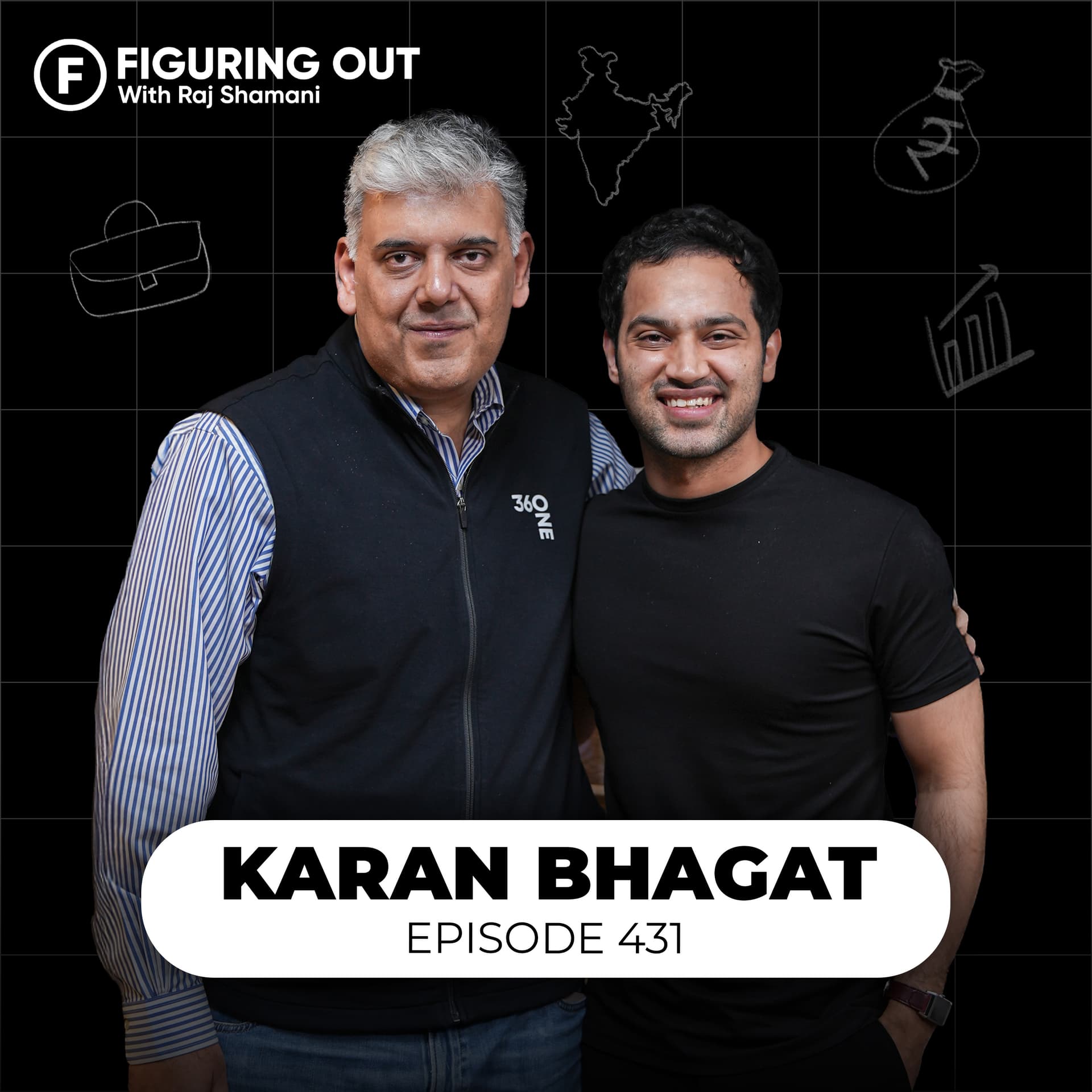
Podcast Episode Summary: Money Making Opportunities with Karan Bhagat
Podcast Title
Figuring Out
Episode Title
Money Making Opportunity: Investment, Business & Profitable Sector | Karan Bhagat
Episode Description
In this episode of "Figuring Out," Raj Shamani interviews Karan Bhagat, the Founder, Managing Director, and CEO of 360 ONE, one of India's leading wealth management firms. They discuss the mindset of wealth, the opportunities in the Indian market over the next decade, and the distinctions between old money and new money.
Key Themes and Discussions
- The Landscape of Wealth in India
- Understanding Richness: The discussion begins with defining what it means to be rich in India, citing a threshold of ₹5 crore as a benchmark for the top 0.2% of the population.
- Problems of Wealth:
- Expectations: With wealth comes high expectations from oneself and society.
- Peer Pressure: The visibility and scrutiny faced by wealthy individuals contribute to stress and pressure to perform.
- Investment Opportunities in India
- Key Sectors: Karan identifies six main sectors ripe for investment:
- Financial Services
- Consumer Goods
- Technology Services
- Industrial
- Defense
- Pharma and Healthcare
- Future Growth: He anticipates significant growth driven by innovation and the inclusivity of talent from middle India, suggesting a shift in the entrepreneurial landscape.
- The Mindset of Wealth
- Differences among Wealth Classes: Distinguishing between the mindset of individuals with ₹1 crore and those with ₹1,000 crore, emphasizing:
- Incremental Growth vs. Exponential Thinking: Successful individuals often focus on small, consistent improvements rather than seeking immediate, large-scale success.
- Generational Wealth: Discusses the fear among wealthy individuals regarding the ability to pass down values and wealth to the next generation.
- Old Money vs. New Money
- Old Money Values: Focused on preservation and stability, often more risk-averse.
- New Money Attitude: More open to experimentation and investing in new technologies and business models, with a willingness to share control.
- Geopolitical Insights and Global Comparisons
- Understanding Global Billionaires: Karan compares Indian billionaires' behaviors with those from China and the USA, noting the latter's ability to diversify investments more broadly.
- Emerging Geopolitical Trends: Opportunities for investment may increase as global dynamics shift, notably between India and China.
- Future Trends and Emerging Opportunities
- Growth Potential: India is projected to grow significantly in the coming years, with potential to become a $30-32 trillion economy.
- Urbanization and Consumption: Predictions indicate an increase in the number of major cities in India and a rise in consumption across various sectors.
- Advice for Young Entrepreneurs
- Pursue Passion: Karan emphasizes that success comes from pursuing one's passion, alongside hard work and integrity.
- Diverse Opportunities: Encourages exploring diverse sectors such as digital distribution, manufacturing, and cultural investments.
Conclusion Karan Bhagat shares a holistic view of wealth creation and management in India, encouraging young entrepreneurs to seize the myriad opportunities available in the next decade. He emphasizes that success comes from a blend of passion, hard work, and the ability to adapt to the changing economic landscape.
Notable Quotes
- "Sleep with gratitude, wake up with hunger."
- "Money is an output; effort and passion are the inputs."
Guest Information Karan Bhagat: Follow him on [Instagram](https://www.instagram.com/karanbhagatkk/) and [LinkedIn](https://www.linkedin.com/company/360one/).
Host Information Raj Shamani: Follow him on [Instagram](https://www.instagram.com/rajshamani/) and [Twitter](https://twitter.com/rajshamani).
---
This episode of "Figuring Out" provides valuable insights for anyone interested in the dynamics of wealth, investment, and the future landscape of the Indian economy.
Written by AI. May contain mistakes. Listen to the episode to check what was said.
Transcript
Automatic transcript. May contain errors.0:00How much money is rich? What is the most fear? The most fear is that our values can be passed on to our children or not. Tell me the problems of being rich. The most big problem is how to handle expectations. And second, I think you're more in the face everywhere. And therefore, peer pressure also to do is much, much more. Where will you become the most in India in the next 10 years? So that these 20-year-old something can start focusing on that particular space. I think it's about the price. Because you study these guys. You have to do preparation, you have to understand how they make money. Now you can see that in your country there are six sectors maximum.
1:14Financial Services, Consumer, Technology Services, Industrial, Defence, Pharma and Healthcare. And these six sectors are much more of an alignment of interest. Second, I think innovation can lead to disproportionate growth. Have you seen any difference in Indian Billioners and Chinese Billioners or American Billioners? How do they behave? Americans and even Chinese are able to make business out of everything. In India, I think it's a bit inclusive. If you go to China, every billionaire wants to also go out of China. I think these are big differences. The Billioners, they are now coming to their information.
1:52First of all, there is a change in policy, there is a decision in some place. Today, our guests are Karan Bhagat, founder, managing director and CEO of 361, one of India's top wealth management firms. In today's episode, we will talk about how many fears of people growing up. Old money versus new money mindset. And how much money can change life and how much not. and India's top thousand families how do they manage their money and what's their biggest fear? Watch this episode until the end. This will explain you the equation of the money and peace. And if you want to keep your wealth and values in a balanced balance, check out 361.
2:41The link is in the description.
2:48Tell me three problems of being rich. I am not the right example but you have to know I think obviously the first problem of being rich is expectations are always very before even we do that tell me tell me how much money is rich that is also very different but we have problems so that we set it 10, 20, 50, 100, 200, 500 kron I think today in India, in my opinion, a good house and 5 crore is very very rich. It is not a... So, what is the problem with 5 crore? What is the problem with 5 crore? Plus a good house. I think you will definitely qualify in the top maybe 0.2 % of the population. So, this is a 0.2 % country which is above 5-10 crore.
3:49What are their problems? top 3 problems top 3 problems whatever you do friends feel parents feel it will get worse okay and every time I also feel people say you are older children will not see all problems in life how will they learn they will never become competitive they will never learn the challenges they will never work hard but in reality they really work hard so I think I think the burden of when we were there the expectation was very low to be honest if you're if we're making 5 ,000 rupees a month parents were super happy with it it became 10 ,000 parents were even more happier with it I think today the expectation is a lot.
4:50So for me, the biggest problem is how to handle expectations. And second, I think generally speaking more socially upward mobile there is a lot of exposure to entire social media today everything. You are more in the face everywhere and therefore peer pressure also to do is much much more. And everybody is out there trying to show somebody or the other has done something extra and parents there is also pressure on parents every parent wants to say my kid has done this extra that extra I think that is constant pressure and I think honestly if you look at your childhood there is no more than that honestly the only thing we used to do is play sports and all the rest of the things were not there I also believe what I noticed you are not married not yet good decision at 29 is good I think now you are thereabouts you are thereabouts because what happens is at 29 you have to imagine when you have grandkids you will be approximately mid 60s now more or less so then you want to enjoy 15-20 years if possible a healthy life with grandkids hopefully science and technology will change so I am a good believer I love I love that 27-30 kind of age bracket there was a stat that long this is American style but most reliable and stable and healthy marriages happen when couple gets married between 28-34 food okay so i'm saying 27 to 21 yeah but whatever you said i feel like papa please real id that don't hide behind but what i see in my generation you have a lot of money or not you have a lot of background or not you have a lot of 10 rupees or 10 crores or 100 crores i feel the biggest fear of our generation today is fear of insignificance and irrelevance.
7:13Everyone has so many metrics that everyone has such a good comparison. Hey, I have a potential. Hey, I have a lot of expectation. There are so many opportunities that people become a hero from zero. And after that, I didn't get anything. Whatever you think, I didn't get anything. I can do anything, but I didn't do anything. And if I'm doing anything, there's a constant question that I didn't get anything. I think that point I don't have to address but I think middle India so let's just for example I think the younger kids who are not rich I think last 5-10 years you have seen the talent is phenomenal phenomenal I think that kind of hard work and effort which is happening in middle India is just unbelievable the kind of people we are getting and the kind of talent we are getting is just impossible in the last 20 years the change has been is just a insane thing so I think we are talking about the problems of the rich but the opportunities which we have really taken is super impressive but whether you are from any background fear is irrelevant that's pure pressure like crazy and I know so many people who are doing good in life but they ask me I don't do anything.
8:36And they're open Instagram, they're thinking about it. News are thinking about it. Talk about it. They're thinking about it. Everyone's ambition has grown so much. Which is great. But it's also grown up with fear. And everyone's feeling, another layer to this fear is that my potential is not utilized. I don't have such an average. But today it's not finished. I think that's also true. That is impossible. It's grown because you guys didn't have enough comparison. But that's the only answer for that. I think a glass is half full and half empty. Whenever you think like that. But I believe on that point that age-wise you should change thinking.
9:16I think in our age you should think that glass is half empty. Fair enough. India needs young, hardworking, ambitious, hungry people. You should always think that. We can't think that if we are the fourth largest economy or we are the best. So we are happy. We should think about how to become world number one and what are we doing for it. I think that I believe. In fact, even at my, there's nothing at your age. Even at my age, I want to stay hungry and I want to stay foolish. So I think these two, you have to be foolish and hungry. It's not, you always have to be hungry for more. And you also always have to be wanting to learn much more.
10:00okay if these two things are done anyway you are finished okay so you have to feel foolish and you have to stay hungry in my house that we need to wake up every morning and we need to wake up and we need to sleep and we need to sleep and we need to learn and we need to learn and we need to learn no attention we are very fulfilled so you sleep with fulfilled that glass is full but you wake up with the same hunger that we don't have anything let's learn
10:32I'm going to repeat this to my kids at home today. Sleep with gratitude, wake up with hunger. It's a good line. So that's, we talk about it a lot. Because my father is a fulfilled and gratitude kind of person. And I'm a hungry person. So Papa and I will make it to you. He will do it with you. He doesn't sleep in tension. How old is he? He's 56. but he's always been family settled he told me don't do that but his moments come on
11:08so when you started your own thing you started your own 361 before IFL now 361 right so when first billionaire client or first somebody with very big money how did he convince him here's my question who has 4 ,000, 5 ,000 crore 10 ,000 crore who are the people of the world to manage their money they have a lot of trust fake people smart people global firms like JP Morgan's of the world they have to take their money we will do it in different countries we will save tax I don't know how much financial engineering will have been done so there are many options why will you trust in the beginning because in the beginning you don't have an experience and pool of 10 ,000-8 ,000 families I have a business so you don't have it no, it's a very tough question and a very good question it's not an easy answer it's not okay so in 2008 when we started business so IFL we gave a little capital to start and 2008 we went to the same problem which we We were 2 ,001.
12:24Our name, IFL name was not known in South Delhi, South Bombay. One meeting in South Delhi, South Bombay, that was a big win. Client conversion was a very long term. Meeting was a big deal. So how did you get the first meeting? Meeting was a big problem. Because we were thinking of 2008-13, actually we were thinking of the clients in Kotak, most of them will move. Reality is less than 10 % of the clients moved. 10 % from 10 % from 10 % and that 10 % from 10 % left 4-5 clients which started everybody started with a small portion of the portfolio so if someone has 10 crore or 1 crore started and said go and settle down we have a new company we like you but at least let's see make a platform and do everything I can't transfer everything today and every person has 3-4 supporters who say I will transfer transfer karta ho start karo.
13:21But, usse business ni ban sakta, usse ek start ho sakta hai. I think, but hum log general mein, again, jaysse mein aapko pehle bola, 90 % opturity sabke lihe same hai, hard work or effort sab se jada important hai. To 2011 se 14 we focused only on companies, jahaan koi event of dilution ho ra tha, ya liquidity event ho ra tha, and they were ending up with some liquidity event because of which they were getting money. Okay. And those were the people we started chasing. And when someone comes to a new rupee, he always wants to challenge the status quo. He's saying that what I have today is to see beyond it.
14:03I have to see what else is available. And he's ready to take out of his life to meet everybody fresh. And he's also ready to meet a new kid on the block. Okay. So that was our opportunity between 13 to 16 and I think us time jitte aise transaction we converted 80 % of those transactions why it comes back to the same thing people associated with us as entrepreneurs they liked our business model we changed the model that time we became advisors that's the biggest change actually we have that product manufacture we have been getting clients so basically now us and the client are on the same side of the table instead of the opposite side of the table right I think that change was the most important change but tell me this now when your first client converted they said what was that meeting that meeting was actually the client just passed away he's still he's still a big client of ours the grandfather passed away in Bombay the how much portfolio they gave them that time I think today 560 crore was going to be that time about 100-100 crore they had sold some land in Ghat Koper and they were moving from Ghat Koper so that's how they ended up getting the 150 crores and that's how you said what you said walk me through that meeting let's relive those memories actually I can walk you through two very interesting meetings that time so this is a Bombay client and then I'll talk about a Delhi client so he basically is a very very old man maybe among the smartest people I've ever met in life they're a glass company and actually in that meeting he spent two hours but it was a lot of fun it was an Indian company started by somebody who's 29 commercially smart so he was very very quick on his numbers super super quick on his numbers and he loved the fact that I was also super quick on numbers chemistry on numbers was imaureate vibe that was something because he was a businessman he was entrepreneurial he could understand the business that he really really loved it second most importantly I think he had dealt with everybody in the past and he always felt a lack of trust because of the fee structure with us we were able to establish that very very very very quickly and third I think somewhere in India a lot of these businessmen want to give you a if they find you genuine and honest they want to give you a chance that I agree they want to give you a chance that I agree and we do not get 100 % of that they got 300 crores we got 50 % of the 300 we got 150 crores and actually like I'm talking at the same point of time I got another client from Bombay actually who's today maybe got more than 7-8 thousand crores and with us also he's got more than 5 thousand crores he's one of the largest clients in the country he is still alive again maybe he's a very sharp guy in numbers he's 78 and actually the good thing for me the most important actually in both families the children and the grandchildren are equal friends okay and equal clients today okay so that is our biggest achievement it is not only converting the client in 2011-12 today if i fast forward today 14 years all of them are clients all of them are friends okay and they have got more money with us this maybe 10 times more money than with us than they had in 2011-12 my Delhi client actually is even more funny he he was one of the clients I got from those W36 GK2 okay and he was right now in Bombay two weeks back and we had a dinner and we actually did a photograph with him his son his grandson but he came home it's just phenomenal right with him we just kind of hit it he just felt that he's a person he likes to back and nothing financially and he was just very different from a little bit more different from Bombay but much much more relationship oriented and we just kind of and he's a person who's so trusting that he actually doesn't look at his a portfolio at all because he knows that you know with you you will not take a decision which is not wrong you can always take a decision which is wrong which you don't intend to be wrong and I think and these things come out yeah I think at the fundamental level I don't know how to put it but trust and effort okay are two qualities which are way ahead of anything else everything else okay coming to your experience with people which like you said some 5 ,000 crores some 500 crores which are the most people of money what's the most fear with their money what's what's what's the fear because everyone has fears look I think fear just because someone has more than a more than a fear change is not fear ultimately all human beings I think across the board the fear of my fear of our staff working at home to the fear of my richest client is the same okay I'm saying okay, I'm ignoring our hard working 90 % of the working population where they have to also fear basic needs, I'm taking it okay, I'm not taking it I'm not taking it but I feel the needs same as I feel okay, the most important need which I think today, if I sleep at night and I sleep 10 years ago and nothing to change with the amount of money you have the biggest fear is that our values can be passed on to our children or not that is the biggest fear all of us have now you are thinking, I was asking in the last 20 years what is the most valuable thing for you for me it's the most valuable that I faced the adversities I could convert that into an opportunity hopefully hopefully my children never have to face the adversity without facing the adversity I'm so spirited so mature how can I make them will be one of my biggest fears okay I can't put them in adversity for them to turn mature and this thing and I don't want so how do all those who have learned how to translate to our next generation is I think one of the biggest fears all of us have all of us have and I think across the board I think if I look across all friends clients I think I think that's one of the biggest fears.
22:06Second fear, I think people are not really worried about making money 10%, 11%, 9%. I don't think that's really a fear.
22:26But people, I think people have really started now in India for the last 5-10 years. what can we do during our life also to make ourselves happy and I didn't see this before there was this entire infatuation with money everything else aside we have to just focus on I think before so everything is something and parents obviously rightfully especially in India you discussed that last India maximum wealth was made in the last 35 years everybody wants their kids to be humble like they were humble when they were kids, everybody wants their kids to not waste away the money they have earned everybody should be equal to this and second I think you had this old thing that does money last after three generations your first generation earns it second generation stabilizes it third generation blows it away right I think India I am very happy I feel very secure actually I am the best to be honest I think our third generation is not like that okay I think 60 to 70 % of our again there are exceptions okay no rule but 60 to 70 % of third generation rich India okay actually is using the money to expand okay which is a very good thing I am I am my clients have more fear but I don't see that fear I am feeling very happy about the third generation of of our kids and third I think people have a fear that boss what if something happens to me tomorrow morning what if I don't get up in the morning tomorrow okay that is obviously a fear and I think that's a topic which our clients spend a lot of more time spend in succession I have no will most importantly can my family manage after me so you are saying that people who are very much people especially the rich like ultra rich especially the ultra rich their big fear is not that my capital inheritance will happen their big fear is that how do they psychological inheritance it's not about capital inheritance psychological inheritance meaning that my values my emotional thinking my deep rooted beliefs which I have made a business or I am going to work on that I will pass on so that my next generation will be better and egoistic if the parent is not egoistic they want the same value because parents are grown but the child is born rich you know anything double-edged sword 100 % double-edged sword if you can pass on one is you can pass on what you think you have made business what you have made in time and what you have made people treat this can be very good but maybe time change the way leadership change control change and you will give them and in fact versus banana because if imagine dadajee and budche like dadah and pota same man gai in the way with dealing people impossible it's trouble trouble gen z can't be led as boomers impossible impossible impossible that's not possible I think and that's why that thing the whole thing of problem of being born rich I think that's the entire problem I think how much follow and how much it's not so easy but I think if you talk to someone with a 10-8 people, ask your top 3 concerns, I think that will be this.
26:33First will be kids, kids, kids. What do you think was the difference between 1 crore when managing and 1 ,000 crore when managing? What difference is it? No, objective changes. Because risk-taking appetite is different. What do you think 1 crore? What do you think 1 crore? 1 crore will at least 50 lakhs every time on debt. That's a little safety. Safety and security is important for him okay I need liquid, I need safe okay, I need other 50 lakhs I grow but I need safe which is 1000 crore that should not be safe okay, that will be a fixed amount safe 50 crore, 100 crore the other 900 crore is growth capital so we call it safety pot so if wealth is more It's a fixed amount of safety.
27:26It doesn't become a percentage. When the amount is small, it's a percentage. And in small amounts, the idea is also different. People have to risk a lot of risk. What do you grow up with this small amount? What do you grow up with 8 %? It's different concept. But more often than not, if you have one of the priorities, you need a little safety, need security, college education is there, now education costs a lot of money, we have to buy a house, there are EMIs, insurance is important, 500 crore, 200 crore, 1000 crore there is no matter what it is, all these things are out of the window, the question only is that the rest of the 100 crore and let's say you have 6 % in 100 crore, we will take care of all of these things and more, so how do you grow and grow that is their main so the biggest difference is your ability what your ability is in a little bit in risk and growth so I think that is the biggest difference the operating principles beyond the point same which has more can think a little long term its less liquid he can lock in his instruments for 3, 4, 5 so a little complicated instruments we can do it who should not do it complicated everything simple available all points of time obviously financial understanding of that investment also might be lower because typically a family office internally there is somebody to guide him on what is right and wrong so he is more sophisticated regulators also rightly have introduced a concept called accredited investor okay so which is a network let's say 5 crores and above now he can become an accredited investor and once he becomes an accredited investor he can do slightly more riskier complex instruments okay things which are not that easy to like 5 crore after which investment opportunities open no like for example let's say you are doing a locked in product alternative investment fund for 5 years So ideally you should be a investor that is coming in the understanding of what risk you are going to be locked in for 5 years.
29:57Okay, let's go, you can get extra 4-5 % return. But what you are sacrificing for is very important to understand. And what's the difference between high net worth individuals versus ultra high net worth individuals? How many people are activated? Who can you say H &I and who can you say ultra-h &i? No logic. People call it ultra-h &i. Every company has a different logic. What's your logic? Our logic is, so broadly for us, high net worth individual is between 10 crores to 50 crores. Between 50 crores to 500 crores, we have ultra-high net worth individuals. Above 500 crores of financial assets, we call them first families.
30:42First families. Okay. So it is every company can have splits. Okay. Now if you typically go to the bank, then the high net worth will become 1 crore to 10 crores. Yeah, 1 crore to 5 crores or 1 crore to 10. Ultra high net worth will become 10 crores and above. And then there will be two splits. Okay. So there is no universal logic identified or defined. but yes who is not a retail bank and who is also a wealth management they will typically have three kinds of cuts starting from typically 10 crores and above so like you must have had clients who have maybe started from 1-2 crores and now ultra high net worths or family first first families most of those clients were started with 1 crore or 2 crores or 3 crores because you have to build confidence and today it will be a big portfolio what have you seen that those who are 1, 2, 5, 10 crore people who are 100, 500, 1000 crore how do they make 100, 500, 1000 crore how do they make 100, 500, 1000 crore what is the difference in the mindset of people who are at 1, 2 crore versus who are making 500, 1000 crore great question and I think I have a very simple answer for this but for me I will give a term in English which I really believe in incremental is exponential so we have our entire world for the last 10 years everybody wants to do exponential I don't understand that okay it can work for one person out of there is always Elon Musk there will always be somebody but that is one example nine examples will be people who are doing everyday things right everyday and they are doing everyday slightly better than what they did the previous day.
32:41And I like to call this incremental is exponential. So if every day you can do slightly more than the previous day, you are bound to be successful because the compounding is massive. So to be honest, I think if I look at entrepreneurs who in 10, 15, 20 years really hit the ball out of the park, they had a certain discipline to their process. okay they've got up in the morning they've not tried to do 50 things okay they try to do 10 things or one thing but do it with a certain amount of discipline discipline okay and that is very very important important and i for me i think that small incremental steps but steps in the right direction is the most most important has to come with a lot of focus hard work is a common denominator and without that no one can't see and you can't build your life on that out of 100 people 5 people end up getting wealth 1 person may get it by luck by inheritance 1 person might get married into it that's a separate issue altogether 3rd person might just win a lottery for all you care 4th person who whatever it is worth blindly invested somewhere that companies ended up becoming very large.
34:03But these will be one, one, one, one examples. You can't really build your life saying, let me become one out of these four. It's not possible. So you look at the remaining 95 examples. There will always be very, very driven, hard work, lots of sacrifices, lots of moments of failure, lots of moments of disbelief, lots of moments of struggle, lots of moments of lack of confidence in yourself also but everyday you get up and do slightly more. So you are telling me that in a lot of money there is a difference largely that the people who make money make money a little distracted versus some people who are disciplined for a long time and that's how they end up winning and second obviously I think again discipline and distraction and values it's not only discipline values end of the day values have to be right values have to be right because you have to be honest you have to have a certain degree of integrity you have to honest and integrity doesn't mean you don't earn money it means you earn money the right way okay you do deals okay so I'm saying that has to be there okay again there will be examples of five people who reached without that.
35:29But that can't become the operating principle. But even if you look at the stories of exceptional people, it's same. So, a video of Michael Phelps. Yeah, I'll see. Michael Phelps. So, there's this one video. I love that. Love the video. I've seen the video. And he says he talks about, somebody asks him a question. Michael Phelps, you're such a person, such an individual who won the world most of the Olympics medals. I mean, you cannot win. It's humanly not possible to win as much as you. How many gold medals, how many gold medals can you win? So, he says that only practice every day. And everyone is saying that only practice every day.
36:09Exactly. So, he says that only practice every day. So, he asks that only practice every day. He says that only practice every day. You are not getting it. for 7 years every day Christmas practice Diwali Holy whatever Thanksgiving New Year's practice every day it's cold it's warm it's cold it's cold it's cold it's cold it's cold it's cold 7 years of my life I don't remember what I remember rest day or recovery day practice that's it and the way he says it i'm like that's so true i think that's that's really what is what's the game at the end of the day tell me about different mindsets of people so let's say region-wise compare okay billionaires and money people from north how do they behave how do South people behave or East or West or maybe communities different maybe Punjabi would differently or Jain would different I don't know if community is different but area is definitely different I think there are three ways three ways cut it from three ways okay means the easiest cut in a sense is big cities and small cities I won't call them small cities but next set of cities in some senses so tier 1, tier 2 not in the Indian definition of dear 2 I'm stay still saying I think generally speaking Bombay, Delhi Bangalore, Calcutta, Chinnai
37:58very very open so they are very very open to new ideas to deal with everyone they are not ready to deal with them they are not like that I will deal with them they are they are in a sense much more confident about themselves that we will end up taking the right decision so okay, let's go one is that we will choose two advisors, three advisors but at the end of the day they think that we will take the right decision and we can work around it and they have the right exposure also like I am not saying too many but next set of cities let's call them Puna Bhavnagar Indor Rajkot Surat Udaipur Ahmedabad to a certain extent also these are these are cities which I will call as next cities okay your relationship and trust is even more important okay than anything else okay than even ideas okay because see if you have Puna and you go Puna and Ahmedabad now change Puna and Ahmedabad but earlier what was in Puna in Mumbai and then three months will not come that was the attitude Puna and Ahmedabad was practically saying that people come from Bombay and then they go so there is a very deep rooted conscience to deal that I locally deal so independent financial advisors if you see Bangalore Puna and Ahmedabad are the most historically popular because connection one on one relationship was strong and people felt more connected connected and comfortable nothing wrong with it okay today obviously Puna, Ahmedabad, Hyderabad has become a big market but we have to be there physically so there today even today relationship comfort is very important but have you seen the pattern like I'll tell you what I mean by this okay I don't have anything I don't have any data.
40:06These are my friends who have a lot of money and made a lot of money. First generation, second or third generation. I saw that some of my friends who have made money, they would have interested in buying a hotel. Which is more that our name should be. That if we have been given money, we have taken the name of the hotel. Or we need an automobile dealership. Which is more name driven, status driven businesses. which I mean, where I want to manage a lot of money versus which I have which is a very first-generation money they are happy that I don't have any building real estate my name is not that my first generation I just keep interest in money I don't have name-driven businesses and then my friends few of them in South so I have seen that they have to do everything like it's like if they are in real estate business then they have to do finance then they have to do insurance they have to do something else then they have to do something else it's like more conglomerate approach no I think you're right I think all three points are right I think it's not South, North, East or West it's also a little bit of how you grow up in Western India everybody all the growth is growing from the capital markets so we are in Bombay and Calcutta and Ahmedabad exposure to the stock market is substantially higher so that is a core part of our life so everyone has a portfolio in years so beyond the point there is a business and a portfolio you will go to Delhi historically I was doing in Delhi in Delhi I was doing stocks I hardly there was no exposure all real states clients have a relationship but there is no deep exposure of capital markets so in Delhi obviously then the second alternative is not quickly financial portfolio but it is businesses and in those businesses there is no such hard asset infra infra is a little bit more in the south and then naturally then what do you gravitate towards land real estate and hotels and obviously I think name is all for every part of the country people want names but south is okay north is a little bit more so therefore you see a little bit of hotels car showrooms and stuff like that but generally I think fascination for real estate is very high in north and in south but conglomerates you are absolutely right South I think sub entrepreneurs ko kaafi kuch businesses karna hai and I think they've done well also but unko broad karna unko businesses broad karna and they really want to believe in investing into multiple businesses and agar unki 4th 5th 6th generational businesses they sub conglomerate big examples they are planning for individual businesses for each of their family members yeah that he will do a family member that he will do a family member that I have seen I have noticed that he will open five businesses so it's a the patriarch is doing a lot more succession planning now it's a little bit of time the kids will work out so it's a stage of evolution true then tell me the difference between old money and new money how does their mindset change?
43:59I think there is old money obviously is kind of more focused on preservation because I think India I think what it was said in the 1960s 70s one time 90s 2000s lot of people lost that money so I think that has carried on old money people want to preserve and another I think now make a new business new assets buy hard assets new money is slightly more different because people are they are willing to experiment they are willing to do new businesses they are
44:40people are willing to consume also I won't say they are not disciplined but they are open plus they want to look at overseas investments new age investments AI may care invest can invest in tech they are more open to ideas risk taking ability old money risk taking ability but business risk taking ability their business control that is values new money don't control control they are happy to invest with professionals where they own 15-20 % or 30 % and professionals own the rest of it that openness is a lot in old money that openness is lesser but remember we are also reaching a point where old money is in new generation is coming so the distinction between old money and new money is also changing every day I think in the next 10 years old money will be practically 10-15 years old money will be practically new money in some senses in our business we watch a day because today now most of the as we were clients half the clients automatically change because it's moved from one generation to the other in the last 15 years in the next 10 years in 15 years the whole client base change change so I think in that sense decision making always change but similarities also have a lot old money and new money just because you are talking about 2-3 difference this means not that it is very different 80 % of things actually same 20 % of the things are different and it seems like risk taking ability different but it is very different risk taking ability is more in itself in business and in hard assets in old money new money risk taking ability is more on new assets, tech, AI, new businesses without control.
46:58So risk taking ability is both. But see risk taking ability is what happens to a person. For example you and your business you can take a lot of risk in your business. Some day you went up, some stuff has not been down. You will fight. You will get up. You will fight. I will look up in my business I can see it up and down. For me, I understand it. When you invest in it, the risk-taking ability is a bit higher. Whatever you are controlling, the risk-taking ability is very high because you have a conviction about it. So, what I have noticed is anecdotal evidence again that old money and new money, the difference between investing investing behavior old money investing behavior which I have seen two major differences one is when they invest in other people they have a profitable business new money is okay that if you have 2-3-4-5 years profit will be done we will put money on loss making businesses because they have seen examples loss making businesses 10-20 years old money not do so easily.
48:17Old money should be cash flow positive businesses and bad businesses. They don't understand anything. So that's one risk taking difference. Old money is so fast and it doesn't make it. And second which I've seen, old money is very open to their family members and friends and friends. They're like, let's go, okay, something will become a partner or something will happen. They'll give them money, give them money, give them money. It'll be just in the family. like they want to make sure sure sure sure sure sure sure for sure for sure just because this is my family right and this is old money no actually Raj I agree with your second one fully first one I think old money will also go there and it's going but not as if they're going there but today don't you see difference like tech new entrepreneurs new money tech entrepreneurs who have gained money they are okay they are okay but they are open but old age old money is also going it's not as if it's not going but look I think that argument is also up for debate whether you can just keep making losses and become profitable at some point just for one Zomato and Swiggy and you know 10 more names there are 9 ,990 names which have not done which have not been able to move from profit to loss so there is a little wisdom in both things 100 % I am just saying behavior is different yeah behavior is different I am asking you because you see you meet these people everyday you know better I think people are open but the quantum of money which will go will be different especially if you made see India if you see tech entrepreneurs nobody's really made huge money it's only in the last 8, 9, 12 months that you've finally seen some good IPOs come I think these people will invest they will invest a lot in back tech so the brand of new money that will go into all these businesses that will be developing in India in India it's not that like Facebook or Google who came because it will develop and hopefully will be the next year so that type of investments in India actually not to be honest but if you about new money to I fully agree with you because that new money actually will go in the traditional format will go in the mutual funds in PMS's in listed stocks there will be a lot of interest in bonds their interest will be substantially more on this side but I think we are just at the starting point of that but that will more and more go in the new age investments have you seen any difference that Indian billionaires or Chinese billionaires or American billionaires their behavior how do they think different types different behavior different behavior what do they think three different comparison it's not a difference to be honest but I think billionaires outside like I said before there are more work outside interest and investments in which Americans both Americans and even Chinese but Chinese in a different way but Chinese also are very all work US billionaires are much broader every billionaire owns a sports team this that there are lots of passions and they are also business people they are able to make business out of everything India I think is a bit inclusive focus on business inward China every billionaire wants to also go out of China so he's done something in Hong Kong he's done something here something there so I think these big differences I think generally speaking US billionaires and European billionaires are able to they are able to do more outside the business okay now whether it is either for passion or it is for again a different business or it is something to do with sports or to do with media sports and media they are two very very big themes in the culture sports media all three very important i think india in india you want to become two billion two billion you want to become four billion four billion you want to become 15 billion so i think a little business focus which is nothing good or bad it's just it's that's the way it is i think generally speaking outside you you see them a little bit diversified and Arab billionaires Arab billionaires Arab billionaires are very interesting to be honest I think they've actually done quite well and I
53:55they don't do anything but they're doing a lot actually somehow they are able to outsource their professional management very well most Arab billionaires don't do it themselves most of them most of them have got very very good teams to do it Arab billionaires are enjoying the most in some ways because they have the highest amount of free time in that sense but they have very very good teams for the operating business also and for the investing also so I don't know how they manage it but they are able to do it very nicely they are able to figure out a way they are able to figure out a way where their involvement on the primary businesses is substantially lower it might happen because their business is so much based on single commodity oil has a big role to play with it so in some senses it is possible that that is a big reason okay tell me how because you study these guys in their preparation how do you make money like what I have heard from the podcast people have come to the podcast that when apart from passion I'm talking about strategic that once the money has become core business after that how do you make money not the core business because the core business that there are 50 fundamentals which 50 things combination of where to work I don't know next businesses how do you make business interests national interests aligns you end up making more money than normal if the country has said that we have top government or the country has said that we will make India a green country so it's obvious that you will do something in green energy so you will become money or country said 10 years ago that we will make roads because we don't have roads in the country, so infrastructure which will get tenders or bid at some level, they will end up making more money it's national interest like when it was pharmaceutical, India has a lot of pharma billionaires because when all of this happened, India will make the whole world generate drugs, so we saw pharma billionaires like that so when you align national interest and country you make more money, which insights are there?
56:30yeah i think at the highest level you said it's a national interest that can be actually extended to her industry so now you take pharma steel, infra, cement real estate hospitals in some senses there has to be a national I won't only say national interest also national need cement, steel these are the sectors now you can see that in your country there are 6 sectors maximum financial services, consumer technology services industrials, defense and to a certain extent pharma and healthcare these are 6 which really kind of make up and this 6 is a lot of alignment of interest second I think the other place I would think where it's kind of leading to a fair amount of growth now it will come to me I think a little bit of innovation will lead to the next phase of huge amount of growth and I think it needs in India and I purposely what innovation use I'm not using invention so invention happens once in a century or once in a decade innovation can be a lot and I think India which stage innovation will happen everyday in some ways innovation can happen in process manufacturing can happen innovation consumption can happen manufacturing can happen innovation financial services can happen innovation will happen in India and I think innovation is something which can lead to disproportionate growth now it's a little bit of innovation it's not really, like we business innovation example
58:38for example government was a notified bond now it's not a NABAD bond that used to be bought only by insurance companies but it was a notified bond, so it was effectively fixed deposit, NABAD is owned 99 % by RBI when we started start in 2009, we have the most clients because it was 8.2 % but it was notified bond so it was 12.5 % so it was 7 % post tax but there was no brokerage for selling. If you do fixed deposit then it was 7.5 % but it was 40 % tax. So it was effectively 5.5 % post tax but now you leave that interest to keep your brokerage and look at the client So suddenly, obviously you have 100 clients in that.
59:29So I think this is a small innovation. It's not, I don't discover anything, it's just a small innovation, really small innovation. Now, it's a thousand things in our country. In small process, there are all areas of innovation. And I think innovations will be a lot. And the full world is changing. Now it's inclusive and exclusive. Today, you are watching US tariffs are there. We are becoming inclusive with other partners. none of us know where this is going to go but all countries generally speaking will be a little inclusive and when it will be inclusive it will be a little bit of innovation half glass full and half glass empty I think it will break a little status and because of that status it will break I think it will come a little adversity and it will be stronger because all countries in the world will innovate and discover and in some ways all these challenges will become good because status quo change because we will do more work let's talk about this status quo favorite topic hidden opportunities first of all you think today what are the opportunities what data you learn what insights you learn which you believe believe strong is in
1:00:55I think let me start India in India in India in India I will see in my business I will see ultra-in-a-to individual in middle-sized individual in retail in all opportunities how do you what insight you think you think you see for example on the ultra-in-a-to side you see data around about 4 ,000 ,000 there are 4 ,000 ,000 people who have more than one crore in mutual funds 4 lakh people in India with more than 1 crore in mutual funds it's not a small number, it's a very very big number so theoretically those 4 lakh people today can consume pretty much everything the same number used to be 30-40 thousand people not too long back maybe 8 to 10 years back you fast forward it 10 years ago these 4 ,000 ,000 ,000 ,000 ,000 ,000 ,000 ,000 this kind of wealth creation and financial savings pretty much everything is going to be here, everything is going to be opportunity now take real estate current, cement, steel now take roads, commercial assets take everything, everything is opportunity, take your business media distribution, everything will become an opportunity because people will consume, people will consume data, people will consume information people will consume food will consume everything will get consumed, capex will happen to build businesses, capex will happen in agriculture industry, everything so I, I think 10-12 % growth every year will be no doubt in that obviously India is inflation 4-5%, real growth 6-7 % 12 % growth for 20 years is practically you gave us an example before but 12 % growth for 18 years will make it 8 times of today's number today's 4 trillion dollar economy will potentially become 30 to 32 trillion so 30-32 trillion economy in 20 years is a massive opportunity now let's understand dollar depreciate also appreciate 3-4 % so 32 % will be$20-25 trillion but that is a massive opportunity so I think 6 sectors together with agriculture because there today our exposure to agriculture but in agriculture the opportunity is equal these 7 things will be very very large all 7 sectors second I think like what happened in the US in the mid 80's number of cities in India will change dramatically number of cities relevant cities relevant cities see you see US in India 40-50 massive cities they are not like they are not small cities they are like huge cities today you see India honestly 8-10 cities but that 10 cities 30-40 cities I was going to be in Nagpur okay I was in Nagpur okay unbelievable Nagpur Phopal everything is changing in a very very massive way okay my big growth will happen if you can if you can any entrepreneur 10th to the 40th city will capture the problem is that Bombay is growing so you can't do in Bombay it will be 30 cities then you will it it's a different problem but in 30 cities there is still a lot of growth in 30 cities you have to focus on 10 cities in the next city but in 30-40 cities it is a lot of growth in the next city now you depend on the stage of the business because in the next , ,30 cities there is a lot of growth but the impact of the absolute number will not be much more so you depend on the stage but in that sense I think we will become 40 to 50 cities very big cities so number of airports everything will change dramatically and thirdly obviously I think generally speaking this experience will be your experience and especially because your audience is also in that age group I am finding at least in my interaction the average 25 year old male and female are at least three times smarter than what they were ten years back at least three times smarter and smarter I didn't say this, it's intelligence smarter in terms of they are aware about what is good for them what is not good for them they are aware about their own strengths and weaknesses, they are socially much more at ease which before they were socially awkward they were socially at ease they are not afraid to ask questions they are willing to ask questions overall I think demographically also next 10-15 years I think we are in a very good position when this 25 year old becomes 35 or 40 he is likely to do much better than the existing 35-40 year old I think there are some changes which we will see unfortunately
1:06:36and it is possible that a lot of the Indian NRIs and so on and so forth other world throughout inclusive so a lot of them might actually send back much more capital investment to India also that is also a big big opportunity it's a great thing for us it's a great thing for us so if that because these people you know if you look at our NRI population in US Middle East London Indonesia Singapore they made crazy money Africa crazy money and even if you can redirect 10-15 % of that rupee back into the country for productive use it's a huge huge amount of money so I I'm not I'm not saying it negatively geopolitics has not been the best for everybody in the last 10 years but again how do we deal if you can look at it manage it well and at the same point of time develop it and make it stronger it will be good it's not a problem true and what do you feel about geopolitics straight up question do you think that change of world order I think generally speaking generally speaking I think every nation will have to look out a little bit for themselves okay all of them you have to do it and there is no problem in that Modi ji came 10 years back rightly he said which is perfectly fine I think generally speaking that will stay in the world but I don't think that everything is so easily fungible it's not that you take a business from here India's skill set will come to the US the US skill set will come to the US India will have its own way that it will set up it will be done now there will be winners and losers now I have full confidence I will figure out as a country also that I have points of winning and losing and you should not see 2-3 months in 2-3 months I think honestly there will be no difference unfortunately to businesses which are directly impacted they should not see 2-3 months and 2-3 months unfortunately and there obviously whatever as a country you can do to help those businesses which are directly impacted we should do but from a full country perspective it's a much much longer longer battle but you think longer term trend because US and India are inherently friends I think we're still friends or God knows what is happening but trade wise you don't even see trade wise overall everything else you're friends you can see arms deals are already very early it's been 25 tariff now 28 tariff 29 tariff what do we see 50 tariff 70 tariff see as i told you earlier this is all on our pay grade what conversations are what are not honestly what does it mean for you as a business to be honest we are a second order and a third order impact if there is impact so directly no impact second order obviously is sentiments but first order let's say if pharma people if you will get more than you, if you will get more than the US, then tariffs will get more than the US.
1:10:27My first order impact will be, generally speaking, if you have a surplus to invest in all clients, but let's go, let's go, a little impact on pharma clients. Because it's large, technology services clients. But you see, markets are smart, but there is nothing like that in the past 4-5 days. See, at the end of the day, our trade also 2.5 % of GDP impact in that 2.5 % you will split so the largest is to be honest gems, jewelry, handicrafts and textiles in these three obviously we have to be careful because not only because gems is big for us in this actually three are labor intensive more than the rupee impact we have to take care of our people because these three sectors together will be employing, I don't know the right number, but let's say a lot of, a lakh, two lakh, three lakh employees will be there.
1:11:25So I think that's a directly, what I mean, first order impact is that. So I'm saying that we can ideally, I have full trust in the government, they'll manage the plus minus something we will manage. So that is what I'm calling is the absolute first order impact. so I think overall I'm hoping and there's always substitution and smartness in the world let's see I think I am concerned but not disturbed let's put it this what are you concerned about? it should be peaceful we don't need change everyday there has to be some stability to make decisions and see stability is important everywhere right at the end of the day if you are US businessman and you are making tariffs on a basis you will make a business in US and then tariffs are gone and now your business is not competitive so that is also a problem see the problem is not only here everything you do has an impact because tariffs are gone so now somebody else has become more competitive now that has increased its capacity and after a half years for some reason tariffs reduced so now it was more competitive and the capacity was made non-competitive so everything will be going it's not it's not something that happens everything is going to be here and the capacity will create new capacity consumption is going to be the same module that you buy you don't buy it it's also to buy it now okay it's more than that because it's 50 % is more expensive and if someone has capacity to make it if someone has it's not to be able to raise capacity to raise capacity if it's capacity to raise capacity then he will do it when will it go so everything has a yeah it's not that easy it's not that easy to just change and I think these are let's see I think let's see I'm sure there is enough logic and this thing and everything so they will solve do you think because of this India and China do you think we will come close no I don't know see I'm a very unfortunately or fortunately I like to think about things which I can control which I can control so when the crisis happens this is all news in the world in your control you don't move money so sometimes a lot of people say more opportunities in the country where there are opportunities see do you see that as an opportunity we see it as an opportunity but don't not as a big opportunity I'll tell you we generally speaking as wealth managers we are not massively opportunistic people we are not fundamentally our job is to again like do everything more and more right process driven so we have client's portfolio is invested in 100 rupees 5-10 % always liquid for opportunities so if there's a lot of something in 100 rupees and a war driven opportunity market is corrected 15-20 % out of that 10 % we'll put 5 % because see war is an opportunity if it ends in 10 days if it doesn't happen in 10 days it can become an adversity also and then you need that last 5 % to really help you protect that remaining 95%.
Read the full transcript
1:15:11So, every thing has an intent. When it starts, you don't know. It's going to be 10 days or 3 years. It's going to be 10 days. It's going to be 10 days. Nobody knows. Nobody knows. Opportunities are there. Okay, but there has to be a discipline. It cannot, there's nothing which, and if everyone knows that it's going to be done in 9 days, then that opportunity will not come. See, I'm not, generally speaking,
1:15:40you have to be tactful about it all in we can't but SNU that the top 0.01 % people in the country people who are operating at the top level their information comes first they are privy to first hand information and a lot of cases policy may change on the policy they can make decisions based on certain things or take a decision and then influence use exposure I won't say information comes from before exposure is more and there are more people servicing them like there is an institutional broking house or research house what do you do now? who service mutual fund managers. Okay, so you have more information to take rational decisions.
1:16:39It's not that you have more access all the time. But isn't it like that? I have noticed this.
1:16:49See, I think those information, those edges are there in every part of the world. There is nothing like that. There is nothing like that. So how do we will get access to that? No, so there obviously you are meeting more people. The more people you meet, the more information you get. You have to build a network. You have to study more. It's not something which you have to, eventually it's not that somebody is coming and giving you information. You have to find patterns. And basis that you have to take an intelligent decision. And sometimes it works, sometimes it doesn't work. and have you seen information and trades and money making different sectors different type businesses when the country is different stage so if there is a developing nation there will be a different type of money developed nation there will be a different type of money emerging economy there will be a different type of money see obviously emerging economies have more money getting made out of real assets so real assets I am saying anything real estate infra roads therefore cement steel power all of those things are very large that's where the capital has to go first and there is money now every 10 years in every country there is such a big infrastructure spent but every 30 years you have to spend on infrastructure so emerging to development you have to spend a lot of money on infra a developed nation will have more money coming out of capital market or innovation.
1:18:28Financial services, innovation, lending, capital market, stock market. That's really stage two. And stage three, which only few countries have been able to do, is really do invention. Pathbreaking invention. So, for example, in the last five, seven years, to a certain extent, US and China. If you see AI, you see biotech. what these countries have been able to do is just phenomenal so that kind of wealth creation we have not seen in India yet that's a totally different element now in the US you have if I'm not wrong around about 7-8 companies more than 2.5 trillion dollars so you have 10 companies nearly 60-70 % the size of India from a GDP perspective now that is all all made out of last 4-5-6 years of growth so I think invention of that nature biotech and AI is maybe stage 3 post you become and developed emerging to this thing is real assets and India you can see city wise it's broken and country also I mean more money is out of capital markets you have second tier tier 2 more money out of hard assets so hard assets to financial assets to innovation is the way I would put it So now, what stage will India be?
1:19:53I think we're first two for sure. I think third one we have to get there. We're still in hard? Yes, for sure. Outside of the top five, six cities, we're still in hard. So today, we'll build hard infrastructure? We'll build a lot. Where do you see maximum money getting made in India? Absolute maximum money, I think it'll still be made in consumption. In consumer. Explain. Anything. Opportunity was there? Biscuits. today too okay now Haldiram for example I'm just giving an example just did a it's a public fundraise right whatever it got valued at then obviously you've got the entire everything India's consuming pretty much everything but today too today too it's the start biscuits like I mean biscuits is an example yeah yeah like basic things today too do you think the market is just asking do you think the market has been dominated by a few large players and many small players and they are doing now there is not such opportunity see everything changes for example and I'm saying biscuits I'm just using it as a term last three years see the amount of growth in in protein bars in cosmetics in deodorants I'm just saying I'm using all the consumption all of these and you have now if you just go back five years back in today and see the number of brands number of brands which are now thousand crores plus every year it'll be it'll be I think the number will be hundred plus okay with such brands and there's so many clothes brands niche this that everything right so I'm just saying India will consume India is going to earn and India will and in this consumption do you think that this premiumization story will be more or only organized story both both India will consume across the board across the board in the same way 100 % 100 % I don't I am not this believer that only premiumization will do well it is tougher to make money at the lower end because obviously cost is very important you have to go to 150 cities manpower is continuously becoming expensive logistics is tougher to handle so it is tougher to make money but whatever level can make the valuation is very much because it is very consistent anything which is built on urbanization and this thing sometimes can also be a fad people might like it and consume quickly and then leave because there the competition to replace is also very high so if you go to the bottom level then your sustainability is also fair much more give me an example of both DMART at the lower at the lower level for example it doesn't seem to be it doesn't seem to be DMART I'm asking no it will everything will have a model but it's not getting replaced DMART is definitely see it's in so many cities so many it's just impossible to for us to get tech and internet penetration to so many different cities we're going to be different different ball game the ability for DMART to set up logistics and acquire at such low costs is very very difficult to replace but for a DMART there will be something else also okay there's not that it's going to be only just DMART okay but that will always always be there give me an example of give me more example of let's say Nika is at the higher end of the pyramid just to give an example right they're getting more premium brands or let's say the Reliance retail is at the higher end of the pyramid also they're getting all the brands there initially you're building it out you're maybe you know kind of serving a very small portion of the but there is huge amount of premium today between these two platforms you end up getting 40 to 50 % of all the items you would get in a Dubai or a London.
1:23:48So in that sense, you'll have both kinds operating at the same level. And give me two more examples of bottom of the pyramid and premiumization story. See, premiumization actually is there in every item today. If you see burgers, pizzas, cakes, ice creams, that premiumization is across the table. Today you go to every average house. the average pizza order today is 350, 400, 450, 500 rupees very very easily today you don't you know you're not really killing yourself for ordering a 200 or 250 rupees pizza at the same time for example there's this company called Boxate they have this pizza I forget
1:24:39what's it called I forget but it's still 50 rupees okay it's still a 50 rupee pizza doing extremely extremely well phenomenally well right and this company Boxhead was largely doing kind of office kind of panties and COVID there to more or less wind down that business ended up launching a pizza brand okay and because of but they wanted to stay at the lower end of the pyramid okay so I launched launched a pizza Mojo I think the pizza is called Mojo at 50 rupees and it's done phenomenally so both of them have opportunities opportunity will be a lot of opportunity ultra high network will be a lot of opportunity but there is inflation in the world in ultra high network because luxury items today are highest in inflation but in India can there be any brand for ultra high high network?
1:25:37in everything you've got some kind of ultra high network But today if you look at real estate, there'll be three, four developers who are ultra-high net worth. You're able to charge a certain amount of premium. Today if you go to small things, today if you want to go to bespoke, everything you do in life. You want to ultra-high net worth, car, the car is on wait list. I'm just saying it's… But it's outside, right? I'm talking about in India opportunities for Indian brands. ultra-achinized because ultra-achinized is the whole globe so they compare with global standards and compare ultra-achinized is the toughest place to build a global brand toughest place to build a global brand and toughest place to build an Indian brand because global access sorry I mean Indian brand in India because global access is much more easily available like the only example I think that ultra-achinized who has killed an Indian that's all that's true I think he killed it by a specific market specific tradition and built it and hopefully 360 but I say I agree with you I think I agree with you it's a it is a toughest segment to what tough segment is it because every ultra high to the individual has a global choice and he has the ability to consume pay a little bit of import duty what do you usually read about reports and things because I was looking at some data where I found very interesting that the highest number of ultra H &I is that last time from Udaypur you must be reading our high net worth report so I think tell you where the most money is getting in the world in Bombay 9 millionaires, multi-millionaires for sure Bombay and Bangalore Bombay, Bangalore and Delhi that sequence tell me top 5 cities Bombay, Bangalore, Delhi Bombay highest?
1:27:36Yeah, by margin. Bangalore is also up to the money. These are startup boom, tech boom, nothing. Bombay has just got too much money. It's not comparable. And the capital markets are See, number may sometimes for example, if Flipkart goes for listing, number might increase in Bangalore. But the quantum will eventually Number of people making millions is higher in Bombay. and may become for one year it may become Bangalore but generally speaking it's going to be Bombay Bombay, Bangalore, Delhi and Delhi is now Delhi, Gurdwana, Noida so if I include all those three there that still might be slightly more than Bangalore also but if I'm talking about NCR as a let's say Delhi, NCR one then it will still be more than Bangalore so Bombay, then Delhi, Delhi, NCR then Bangalore then Bangalore then there's a big dip then there's a considerable dip but Ahmedabad Hyderabad sorry Hyderabad Ahmedabad Pune Calcutta and Chennai will be the next big ones next five big ones small cities tell me I mean tier 2 definition Indore, Udaipur, Nagpur type where is the most money I think everywhere so I think everywhere for example even if you look above 100 crore families there'll be at least 40 to 50 families in each of these locations still like Surat Indore Surat Indore Rajpur Nagpur Jaipur Baroda so everywhere there's money everywhere no huge amount of money in the right places in Kanpur Lucknow Chandigarh Ludhiana all of these places UP is doing very very well also UP is doing very well and over like on books money or off books money we can only deal with on book money I'm only talking about on books money and then there are obviously exceptions okay there are two or three families in Bhavnagar two or three families in but those will be more it's not as if it's across the board but all the other cities which we've spoken about there are at least 40-50 families above 100 crores on books which they are able to track and if you look at the business values 100 crores in liquidate money what is financial assets financial assets business valuations taking it is a lot of that's a separate I think there will be approximately 40 ,000 30 to 40 ,000 people now with the ability of having 50 crores plus financial assets what are you talking about?
1:30:14in India? 30 ,000 people 30 ,000-40 ,000 people 50 crores in financial markets financial assets do you count real estate? no I'm not counting real estate just market by payasas just financial assets including fixed deposits and tell me top three fields where money comes from now it's across but top three would be still financial services would be the financial services so MBFC lending banks that would be the largest second obviously will be all the five sectors consumption healthcare give me one what do you think where money comes from now I would still go then I think that still sticks to consumption new money in consumption in the last 10 years has been massive FMCG money and third then if you're looking at the full country it'll still be industrials because manufacturing is industrial products and manufacturing massive everybody is doing something or the other chemicals, adhesives healthcare, healthcare equipment every place has got businesses doing 100, 200, 250 crores of revenue with 10, 15, 20 % of bidda margin.
1:31:32So you make 8, 10, 12 crores. That's compounding every year for the last 8, 10, 12, 15 years. You've not sold your business or you've not monetized your business. But this keeps compounding, keeps compounding, keeps compounding. And basis, whether your next generation wants to do this business or not, then you take a decision. Should I sell it? Should I not sell it? So in that sense, that's a much later decision and that is also happening a lot in the last 10-15 years a lot of the next generation does not want to necessarily go back into the same business in India every week there are 5 businesses getting sold for some number between 100-4 ,000 crores every week and where is maximum sales and buying like buying selling is happening which industry same industries in manufacturing in manufacturing a day, there is a manufacturing facility in the same five sectors in the same five sectors the most obviously is manufacturing because strategics in Europe and the US consolidate into and what's a consumer let's say, do you think because if you're talking about consumption there's a lot of selling and buying so consumption what I understand is that the top 20 % of the 80 % which is from your 10 crore to 500-600 crore range revenue they are very regional they are also big big thing they are getting sold by for example let's say if you see ice cream as a category there are at least four big transactions in ice cream in the last five years Lotto for example bought that was Habmore that was one of the biggest nationwide right hardly now nationwide when Habmore was there it was more more regional yeah it was more Gujarat in every sector you take your pick and what are the multiples these guys are getting sold multiples it can be all over the place but it can be very rich it can range from 15 times to 70 times of profit multiple of EBITDA EBITDA or even profit that depends but these are very very unique to every industry every industry every business India consumption multiples have always been rich they've always been 30, 40, 50, 60 times healthcare multiples are always rich hospitals can quote from anywhere from 15-16 times all the way to 30-35 times for the bigger hospitals financial services companies can again be very very broad you've got financial services companies quoting at 15 times all the way to 50 times of profit so these are very, see people like to see three things in business right, so for multiples number one strong and credible management is most important because you are effectively backing those set of people second most important is that business can repeat the same business can repeat challenges are in every industry so what is the repetitive value now what is the repetitive value of what can you measure how is the revenue what is the pull of the brand how is the management handle all of this is repetitive value of the business the business is repetitive the business is more multiple third market size business is more today you assumed 5 % 10 % of the market share how much more can you grow and fourth you are using capital well because if I am buying your stock and you buy the stock and you have 10 % so as a so as a business your return on equity 15-20 % so on these 4 parameters multiples can change so something which is doing 100 crores of profit can be worth 1000 crores something else which is doing 100 crores of profit can be worth 4000 crores something which is making 100 crores a loss can also be worth 4000 crores so based on these patterns so there is multiple is one of the parameters it is not the only parameter but in these 4-5 things I think things kind of get and also get decided between the desperation of the deal obviously obviously sometimes if you are buying an asset and it's making you number 2 to number 1 then you will pay but typically premium 20-25 % for strategic reasons it's not like that it will be 100-200 and there's obviously So it's not a 100 becoming 200 but 25 % premium So yeah, coming back to what kind of reports and data and things that you read I consume everything but I don't like to read too much of finance again because that's Not finance, like country data insights, something you read What you recently studied interesting, tell me, I'm just interested in that I love to meet people more than read okay fortunately whatever I'm doing my ability to meet people is very high so I was in the US two weeks back I think one thing which was really alarming and I was in Frisco for three days and there were only two holdings all the way from the airport to all my meetings one holding was only and only AI okay and the second hoarding was only sports okay so whole of that part of the US is only artificial intelligence and sports okay I mean all the hoardings were in these two 20 % of hoardings is on this and Frisco okay and the biggest shock for me was I was at least I was at least Frisco or San Francisco San Francisco yeah so I was I was I was I was I was I was even coming from me I'm more or less embarrassed to say, I thought artificial intelligence is still some time away, now the valuations are running away, they leave the valuations on their use case even people like me sitting here I thought artificial intelligence is really some time away going back and seeing 90 % of things that you think is going to be innovative is already being used on a daily basis.
1:38:12It is here and now. It is not something which is going to happen after couple of years. 5, 10, 15 years. It is here and now. For example, I was standing in the main city square of Frisco and you won't believe 40 % of the cars 40 % of the cars not 1-2 cars 40 % of the cars were driverless cars. Not one or two cars. 40 % of the cars were driverless cars. 40%. Okay. So imagine if 150 cars went in front of me in five minutes. 60 cars were interesting. Driverless cars. Now, honestly, sitting from here, I think driverless car is going to come three or four years later. I think it's probably 10 years later.
1:39:03I think it's 10 years later. But there it's I'm saying it's done. It's not it's no longer a test it is what it is it is now being used everyday AI everything is it's just unbelievable whether it's a Grok, whether it's a Claude whether it is a Chad GPT whether it's perplexity whatever you want to call it but these are here and happening now somewhere I think it was an eye opener I think we need to kind of you have to see use case is going to come in India very fast so okay here's the last question because we have talked a lot about the world India capital coming to India new industries opportunities if someone who is in their 20s watching the podcast purely based on insight that you have to make money to manage money where the most more in India in next 10 years will become money in India.
1:40:07So that this 20-year-old something can start focusing on that particular space. I'll give you a very specific opportunity where you think that it will become actual money. So I think again I'll repeat first thing maximum money whatever you're doing in life will become there. Whether you're doing a job or doing a profession 20-year-old doesn't know where you're doing or what you're doing. Whatever you do where you're spending 14 hours of your life where should they spend 14 hours of their life my answer is right
1:40:42unfortunately as much as you have asked me I have no answer because my answer is every 6 of them there is no such thing I am going to say first 90 % in India there is no tick box there is no such sector you can do it where you don't make it it's possible it's not possible in India it will make it so now the choice is not important if you have a lot of capital then do financial services there is a lot of ability if you have capital there is a lot of ability then do something in services because in services there is a lot of opportunity you have a ability to go and do great amount of work across many regions then do something in consumer or do something in the digital distribution because you'll be able to understand and reach more.
1:41:39If you're creative, okay, and you feel you have an ability to pull people, okay, then you can go online, digital, everything you can do. Fifth, if you have a, which is maybe I fear the lowest amount of people, you want to go out and spend time in the factory and make small changes in the process, okay, deal with actual labor and that gives you a high. There are a lot of opportunities and India will continue to produce to send money out. And sixth, even in culture, there's a lot of opportunity in India. The kind of investments you're seeing, kind of interest you're seeing in India, in culture, art, music, sports.
1:42:20Sports is a huge opportunity in India. Every sport is getting democratized in India. All these six, seven things, there is tons of opportunities. and especially for a 24-25 year old the opportunities here are unbelievable all 6-7 news is good most of these businesses don't have much capital and where capital is available today there is capital available there is no capital available small thing like shark tank all the way to all private investors willing to fund every good business where there is a hardworking entrepreneur I am not saying smart entrepreneur and I'm saying hard working smart hard working I'm saying 70 % passion 25-30 % talent 10 % that is my descending order especially passion is very important because we can't do it you can't think of any sector that you will become a rupee and that doesn't have passion it's not possible honestly you can put me manufacturing so I can't make money I mean it's not possible it's not my first love I don't know I don't know I don't know I don't know it's not my edge okay so it's not possible so first is still going to be passion and hard work and then everything else will be I mean India to be honest in the next 10-15 years there is no challenge to make money.
1:44:05How do you treat yourself? What do you do? What do you do? What is integrity? What is the values? What is the trust system? What do you do? What do you do? That is important. I think money will be an output. It will never be an input. It just cannot be an input. Money is an output. Effort, hard work will end. interest will be an input. And I'll give you one last example. Our top educational institutions, you take IIT, IIMS, whatever. Why do you think they have the best output? Only because they take the best input. They obviously do a lot in those two years. They really make us good. But they make the good better.
1:44:56okay so in two years you can't change a human being okay so the input has to be good only then you can get to the output so money is an output everything else is the input perfect thank you so much sir thank you thank you as you're talking to you what do you do apart from all of this wealth wealth ke lava I like to work I'm a bit of a workaholic whether it's wealth or it's personal investing or it's I've kind of started collecting a bit of art very early days for the last 4-5 months but I like to read I'm not a what would you like to do interesting? not I don't like to read fiction non-fiction but I like to read about topics so right now I'm reading a bit about art the artist I like I read a lot about I'm spending a lot of time with my son he plays a lot of chess so I'm reading about that oh nice thank you so much for watching this episode until the end now you have to do three things do not forget to subscribe to this channel because as much as you subscribe we will get better and valuable guests for you number two comments in this episode what did you like and bad so that we repeat mistakes and which guests you want to see in our podcast so that we will take them and give you value and number three this episode you must share with someone because one conversation can change someone's life I'll see you next time.
1:46:23Until then, keep figuring out.
From the publisher
360 ONE: https://www.360.one/
Guest Suggestion Form:
https://forms.gle/bnaeY3FpoFU9ZjA47
Disclaimer: This video is intended solely for educational purposes and opinions shared by the guest are his personal views. We do not intent to defame or harm any person/ brand/ product/ country/ profession mentioned in the video.
Our goal is to provide information to help audience make informed choices. The media used in this video are solely for informational purposes and belongs to their respective owners.
Order 'Build, Don't Talk' (in English) here: https://amzn.eu/d/eCfijRu
Order 'Build Don't Talk' (in Hindi) here: https://amzn.eu/d/4wZISO0
Follow Our Whatsapp Channel: https://www.whatsapp.com/channel/0029VaokF5x0bIdi3Qn9ef2J
Subscribe To Our Other YouTube Channels:-
https://www.youtube.com/@rajshamaniclips
https://www.youtube.com/@RajShamani.Shorts
📺 Watch Figuring Out episodes on YouTube: https://youtube.com/playlist?list=PLE0Jo6NF_JYO5-phess8GKafKMtPv3tfZ
(00:00) - Intro
(02:49) - Problems of being rich
(11:10) - How he landed his first big client
(19:37) - Fears of wealthy people
(26:35) - Mindset of people with ₹1 crore vs ₹1000 crore
(30:05) - HNIs, UHNIs & first families
(31:24) - Incremental & exponential growth
(36:59) - Mindset of Tier 1 vs Tier 2 cities
(43:51) - Old money vs new money
(51:34) - Indian vs Chinese vs American billionaires
(53:37) - Arab billionaires
(55:30) - Opportunities & alignment of countries
(1:00:46) - Hidden opportunities
(1:07:49) - Changing world order
(1:14:11) - War, opportunities & insights
(1:17:41) - Money & developing nations
(1:27:04) - Ultra HNIs & Indian states
(1:32:19) - Maximum buying & selling trends
(1:36:25) - Reports he reads
(1:40:07) - Opportunities in India for the next 10 years
(1:45:12) - BTS
(1:45:50) - Outro
In today’s episode, our guest is Karan Bhagat, Founder, Managing Director & CEO of 360 ONE, one of India’s leading wealth management firms. Karan has spent decades advising some of the country’s wealthiest individuals.
He also opens up about the “fear of insignificance,” especially among those who’ve already achieved material success.He talks about old money vs new money, city-wise mindsets, and the psychology of risk, and why he thinks India's next wave of innovation will come from inclusivity. He says the opportunity today isn’t just for the rich: “Middle India’s ambition and talent are exploding,” and that’s where the real story of growth lies. Karan offers a rare inside view of wealth and aspiration in modern India.
Follow Karan Bhagat here:
Instagram: https://www.instagram.com/karanbhagatkk/
Follow 360 ONE here:
LinkedIn: https://www.linkedin.com/company/360one/
Instagram: https://www.instagram.com/official360one/
About Raj Shamani
Raj Shamani is an Entrepreneur at heart that explains his expertise in Business Content Creation & Public Speaking. He has delivered 200+ speeches in 26+ countries. Besides that, Raj is also an Angel Investor interested in crazy minds who are creating a sensation in the Fintech, FMCG, & passion economy space.
To Know More,Follow Raj Shamani On ⤵︎
Instagram @RajShamani https://www.instagram.com/rajshamani/
Twitter @RajShamani https://twitter.com/rajshamani
Facebook @ShamaniRaj https://www.facebook.com/shamaniraj
LinkedIn - Raj Shamani https://www.linkedin.com/in/rajshamani/
About Figuring Out
Figuring Out Podcast is a Candid Conversations University where Raj Shamani brings raw conversations with the Top 1% in India.


