
In short
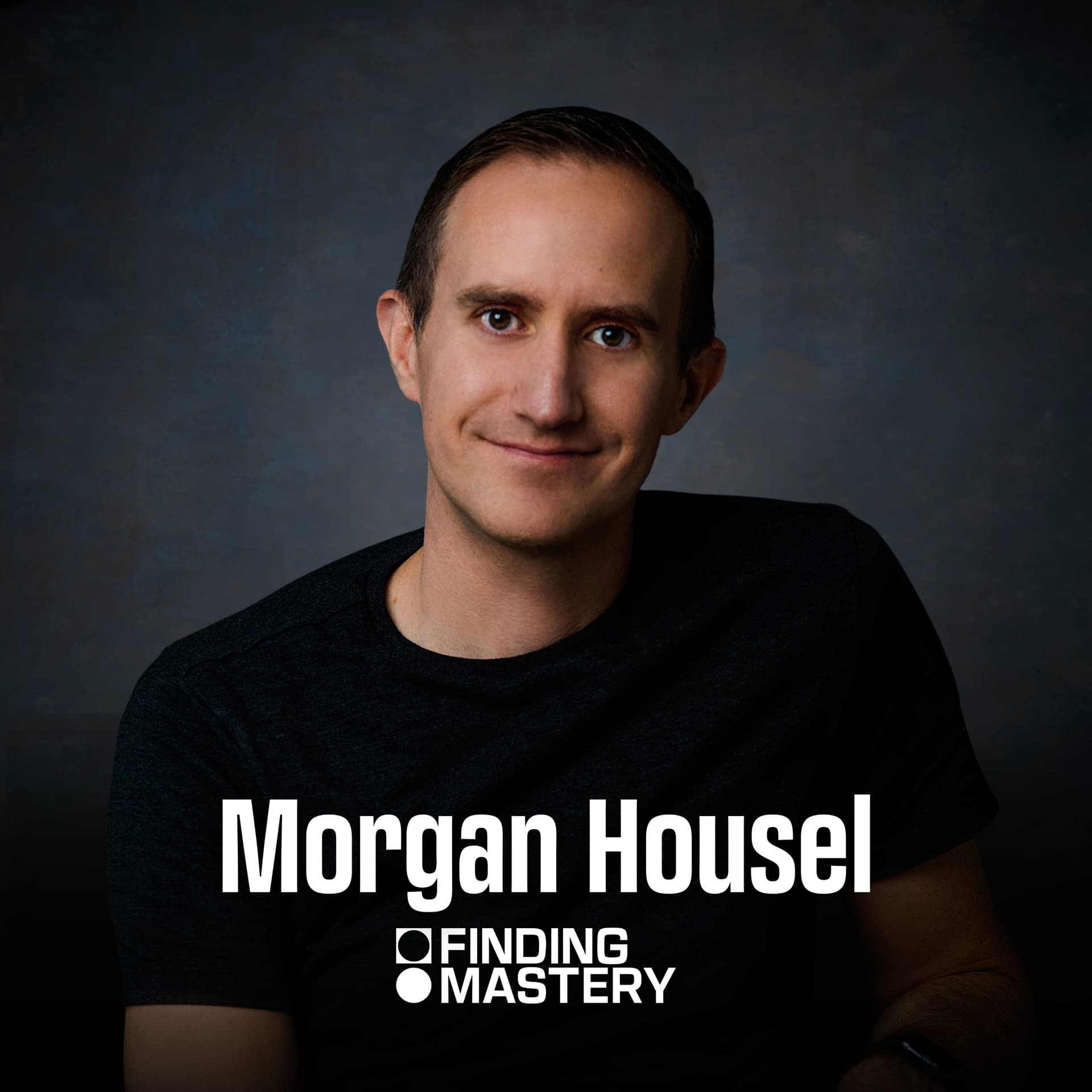
Morgan Housel discusses “The Art of Spending Money” and reframes money as a tool for independence and happiness, not just accumulation. He also explains how to think psychologically under uncertainty, and why “getting rich” differs from “staying rich.”
Guest backgrounds
Morgan Housel is an influential writer on money psychology and decision-making. He graduated USC (2008), started at The Motley Fool as a writer/blogger, and became known for storytelling about behavior around money. He authored The Psychology of Money (sold just over 10 million copies).
Key claims
Luck and risk are the same underlying concept (outcomes driven by what’s outside your control), but people obsess over risk and ignore luck. To build lasting wealth, you need “grounded optimism”: optimism about the long-term plus realism about near-term difficulty (Stockdale paradox). “Getting rich” requires optimism and risk-taking; “staying rich” requires conservatism, pessimism, and worst-case thinking. Saving is “buying independence,” and he keeps about 20–25% in cash to sleep well.
Notable examples
Bill Gates’ high-school access to a computer; Bill Gates’ success as partly luck; Bill Gates’ path contrasted with others who had the same opportunity. He also argues housing prices rose like an “accounting trick,” delaying adulthood for young people, and blames zoning restrictions for insufficient homebuilding.
Written by AI. May contain mistakes. Listen to the episode to check what was said.
Chapters
Tap a time to open that second in VOIntroduction to Morgan Housel
0:03 to 0:59
Learn about Morgan Housel's background and expertise in money psychology.
“Mastery because we know one great hire can change everything.”
Introduction to Morgan Housel
1:05 to 1:54
Learn about Morgan Housel's background and expertise in money psychology.
“Staying rich is almost the exact polar opposite.”
Understanding Money and Happiness
1:56 to 2:57
Explore the relationship between money, happiness, and societal expectations.
“Who Pete Carroll brought in to work with the Seahawks.”
The Nature of Envy
2:59 to 3:21
Discuss the difference between admiration and envy in success.
“if we're not really intentional with how we're thinking about money.”
Morgan's Journey into Finance
3:25 to 4:25
Hear Morgan Housel's story about his unexpected career shift into writing.
“I think like a lot of careers, it was accidental with a lot of serendipity.”
The Psychology Behind Money
4:27 to 5:56
Discuss the importance of understanding money psychology for a fulfilling life.
“Everyone's laying people off as fast as they can.”
The Challenge of Predicting Financial Trends
6:01 to 6:39
Learn about the complexities of forecasting in finance and writing.
“You're competing against 10 ,000 other people.”
Creating Relatable Financial Content
6:41 to 7:54
Explore Morgan's approach to writing about finance without formulas.
“And over the years too, I finally realized one of two things.”
Understanding Luck and Risk in Finance
18:00 to 28:00
Explore the concepts of luck and risk in financial outcomes and decision making.
“There's risk involved in asking a question.”
Understanding Current Financial Uncertainty
28:00 to 28:48
Learn about the persistent nature of uncertainty in financial markets and history.
“All right, let's actually move forward to the context of what's happening today and money.”
Show all 32 chapters
Perception of Uncertainty Through History
28:48 to 30:30
Explore how historical events shape our perception of financial uncertainty today.
“At every single moment of the last 20 years, at every single moment, we've been drowning in uncertainty, drowning in it.”
Personal Insights on Saving and Independence
30:30 to 32:26
Discover personal savings strategies and the value of financial independence.
“And even if you could say the uncertainty that exists in the world today that is political, did that not exist a year ago?”
Cash Allocation and Simplifying Investments
32:26 to 36:20
Gain insights into cash allocation and the importance of simple investment strategies.
“But we give ourselves the impression that it is because we can look back at the 1950s, let's say, and say, God, they were so lucky.”
The Housing Market Crisis for Younger Generations
36:20 to 40:22
Understand the challenges faced by younger generations in the housing market.
“cash, Vanguard index funds, just very low cost, diversified funds where I'm owning basically a slice of the U.S.”
The Housing Market Crisis for Younger Generations
40:25 to 41:50
Understand the challenges faced by younger generations in the housing market.
“And I want to come back to something a little more personal.”
Challenges in Housing Supply
43:05 to 45:15
Explore the complexities and historical context of the housing market.
“meaning like rent is good, no problem, figure out how to maximize that expenditure?”
Advice for Young Renters
45:15 to 48:07
Learn about the benefits of renting versus buying at different life stages.
“Speak to the renter right now, the 26-year-old renter.”
Understanding Rental Costs
48:07 to 49:58
Find out how to manage expenses and set a reasonable budget for housing.
“And I think it makes you invested in your community to a different level as well.”
Perception of Wealth and Status
49:58 to 52:15
Examine how wealth is perceived and the dangers of materialism.
“How is the status game show up in your understanding of money and people through social media and keeping up with the Joneses?”
Investing in Real Estate vs. Stocks
52:15 to 53:56
Discuss the merits and challenges of investing in real estate compared to the stock market.
“Do a trend analysis if people are interested in where to invest.”
Self-Awareness in Financial Management
53:56 to 56:00
Learn how self-awareness can improve financial decision-making.
“I think a lot of people who do it love it.”
Understanding Personal Financial Goals
56:00 to 1:02:03
Learn about the importance of self-awareness in setting financial goals.
“should you do Bitcoin, should you do real estate, whatever it might be, they're not actually disagreeing with each other.”
Understanding Personal Financial Goals
1:02:07 to 1:03:08
Learn about the importance of self-awareness in setting financial goals.
“Nearly 95 % of us are not getting enough fiber.”
Understanding Personal Financial Goals
1:04:30 to 1:04:45
Learn about the importance of self-awareness in setting financial goals.
“That's Proton, P-R-O-T-O-N, VPN.com slash mastery for 70 % off your two-year plan.”
The Impact of Wealth on Behavior
1:04:45 to 1:09:18
Explore how wealth influences personal behavior and social dynamics.
“And if you are self-absorbed, it accelerates that way of thinking.”
The Role of Trauma in Success
1:09:18 to 1:10:01
Understand how personal traumas can shape one's path to success.
“And I think everybody has their own unique trauma.”
Overcoming Early Challenges and Self-Doubt
1:10:01 to 1:11:50
Learn about Morgan's journey through self-doubt and the challenges he faced in his early years.
“And so I really had this moment of like, oh, oh my gosh, like what now?”
The Pursuit of Contentment Over Happiness
1:11:50 to 1:13:08
Explore why chasing contentment is more fulfilling than pursuing fleeting happiness.
“your physical body, your second act, you're definitely cognitive.”
Evolution of Personal Happiness and Days
1:13:08 to 1:14:38
Hear about the evolution of Morgan's happiness and his insights on having fewer bad days.
“I think I've done better over the years, but there's a lot of evidence that if you ask people, how much money would you need to be happy?”
Aspiring to Be a Good Ancestor
1:14:38 to 1:16:12
Discover Morgan's philosophy on parenting and the importance of being a good ancestor.
“And so look, that's a lifestyle upgrade.”
The End of History Illusion
1:16:12 to 1:17:45
Understand the concept of the end of history illusion and how it affects our projection of self.
“One thing, I think one of the most powerful ideas in psychology is called the end of history illusion, which means that you and I and everybody, we're very cognizant of how much we changed over the last 10 or 20 years.”
Insights from The Art of Spending
1:17:45 to 1:19:19
Learn about the intentions behind Morgan's book and the importance of self-reflection.
“Why do you want people to read The Art of Spending?”
Transcript
Automatic transcript. May contain errors.0:00Dr. Michael Gervais:Finding Mastery is brought to you by LinkedIn. We use LinkedIn Hiring Pro here at Finding Mastery because we know one great hire can change everything. One bad hire, it can cost you a lot, way more than time. It can cost you momentum and culture and real dollars. And that's why how you hire matters just as much as who you hire. And it's why I've become a big believer in the power of LinkedIn Hiring Pro. Here's what I appreciate about it. When you're running lean, you don't have hours to sift through a pile of resumes hoping to find the right person somewhere in the stack. Hiring Pro is built exactly for that reality.
0:32Dr. Michael Gervais:You describe the role and it screens candidates for you, surfacing the people who are a best fit so that you can spend your time and conversations with those folks rather than in the weeds of the applications. And the results back it up. Those hiring with LinkedIn are 24 % less likely to need to reopen a role within 12 months compared to the leading competitor. So join 2.7 million small businesses already using LinkedIn to hire. Host your job for free at linkedin.com slash mastery. Terms and conditions apply. Again, that's linkedin.com slash mastery to post your job for free.
1:04Morgan Housel:Getting rich usually requires being an optimist, taking a risk. Staying rich is almost the exact polar opposite. It requires a degree of conservatism and pessimism. And to do well over time, you need to marry both of those like Jekyll and Hyde personality together. If you're purely a pessimist, you go nowhere. If you're purely an optimist, you run off the cliff.
1:22Dr. Michael Gervais:What if the hardest part of money isn't earning it, but using it in a way that actually improves your life?
1:28Morgan Housel:I think everyone, what they want to chase with something like money is happiness. I just want to be happier. I want to have a happier life. And if I have more money, I will be happier. It's not that money cannot give you a better life. It absolutely can. But happiness is a 10-second emotion. The emotion that is phenomenal and a massive life upgrade that you should chase is.
1:46Dr. Michael Gervais:Welcome back or welcome to the Finding Mastery podcast, where we dive into the minds of the world's greatest thinkers and doers. I am your host, Dr. Michael Gervais.
1:54Morgan Housel:A high-performance psychologist named Michael Gervais.
1:56Dr. Michael Gervais:Who Pete Carroll brought in to work with the Seahawks. Famous for his work with Felix Baumgartner when he jumped out of space in the Stratos Project.
2:04Morgan Housel:Olympic athletes depend on something more than just training and talent. They have to stay mentally tough.
2:10Dr. Michael Gervais:The idea behind these conversations is really, really simple. It's to sit with the extraordinaries, to learn, to really learn how they work from the inside out. Today's conversation is with Morgan Housel. He's one of the most influential voices shaping how we think about our behavior and decision making around money. He's best known for his book, The Psychology of Money. This conversation centers on his newer work, The Art of Spending Money. It's a reframing of what money is actually for once all of your basics are covered. How would I choose to live?
2:39Morgan Housel:Even if money was no object, I had unlimited money, but nobody could ever see it. People don't post on social media, they perform. And when you strip away that, how would you choose to live? I would want a nice house with a nice view. I wouldn't care if it was bigger than my neighbors or not, if nobody could see it.
2:52Dr. Michael Gervais:We talk about how comparison and status quietly manipulate our choices. and why the pursuit of more oftentimes crowds out joy if we're not really intentional with how we're thinking about money.
3:03Morgan Housel:A lot of times people think that they are harvesting admiration for their success. What they're actually doing is fostering envy, and you don't want people to envy you. It's cool if people admire you. You do not want them to envy you. That's not a good thing. You should never be proud if people envy you.
3:16Dr. Michael Gervais:So with that, let's jump into this week's conversation with Morgan Housel.
3:25Dr. Michael Gervais:morgan this is exciting to be able to talk to you about one your success that you've had and the impact you've had on so many of us about thinking about the psychology of money the psychology of spending and it couldn't be more timely than right now to have you on so thank you for coming in thanks for having me back good to see you yeah and why have you dedicated your efforts to the psychology of money and the psychology of spending. Why this domain? I think like a lot of careers,
3:53Morgan Housel:it was accidental with a lot of serendipity. I graduated college in 2008 here in Los Angeles, went to USC. And like a lot of young men in the mid 2000s, I wanted to be an investment banker. Kind of before tech existed, before Google and Amazon really existed in a big way, that was what a lot of young men in particular wanted to do. That's where in the eyes of a 20 year old. That's where the money and the power was. And so I didn't really know anything about investment banking other than money, power. And before my prefrontal cortex was fully developed, that was like, yeah, let's go do that. So that was the goal.
4:26Morgan Housel:Graduate in 2008, the economy's a wreck. Nobody's hiring. No investment bank, no hedge fund. Everyone's laying people off as fast as they can. The only finance job I could find that was willing to give me a paycheck was as a writer for The Motley Fool. And so I began as a writer with no interest in writing, with no, and I would admit almost a sense of shame that in my mind, I wanted to be a big, powerful banker on Wall Street. And now I'm a journalist. What? Not even a journalist. I'm a blogger. So I really did. But I thought I'll do this for six months before I find a real job. It's kind of how it was in my mind.
5:00Morgan Housel:And like a lot of things in life, I actually, after six months or a year, I went, you know what? I love this. I actually love doing this. And what I loved is that I felt like I could sit up in the bleachers as an outsider watching the game and just try to piece together what was going on. And I wasn't impacted by a lot of the incentives of the players, so to speak, the investment managers, the hedge fund managers, the financial advisors who had good people, but had a lot of incentives in their field to act a certain way, to believe a certain way. And I feel like I could just pick it apart and just try to figure out what was going on in people's heads.
5:35Morgan Housel:I was never interested in what stocks should you buy? Where's the economy going to go next? Because I didn't think anyone was any good at that. I just felt like it was a lot of smoke and mirrors going on. But I was really interested in what's going on inside of people's heads. That was interesting to me. And why that was also important as a writer is because it's a very competitive industry. There's a lot of writers out there. And online, you've got to get people's attention. And if I was just writing articles about, here's what I think the Dow Jones is going to do this week. You're competing against 10 ,000 other people.
6:05Morgan Housel:You're just going to get lost into the ether. But if I could tell a story about behavior, not only did I think it got you closer to the truth of what was going on in the world, in my mind, it was more entertaining to tell a story about behavior. And what I didn't know, but I quickly found out is I think there are more stories about how people engage with money, the psychology of it, greed and fear, people who do it, do a good job, do a very poor job, people who are addicted to money, people who couldn't care. There's so many stories to tell. And so I just, that became kind of my niche. I was just like, I just want to tell stories about how people deal with the psychology of money.
6:43Morgan Housel:And over the years too, I finally realized one of two things. This is a little bit talking my own book, but I think there are two topics in life that everybody, literally everybody has an obligation to learn about. And that's health and money because it's very difficult to have a good life unless you understand both those things. You can have a great life not knowing anything about organic chemistry. You can have a fine life not knowing anything about meteorology. It's very difficult to have a good life unless you have some idea and some level of sophistication about money and health. And so that's why it was a topic that I found very interesting that I really enjoyed digging into.
7:19Morgan Housel:And I felt like if I can tell stories about how people deal with the psychology, the behavior of money, that can actually do a lot of good for people.
7:27Dr. Michael Gervais:You know what I really appreciate about how you just opened up our conversation is that you worked from a personal experience, brought me into that. Then you worked from a first principle and then from your first principle, which is to really understand health and money, you said, how am I going to better understand that and share my insights with others? So the first principle is to live a good life. You need to understand these two basic things. and then you want to be a storyteller about best practices, insights. Okay, so you are first principle-based. There you go. And when it comes to money, do you want to talk about saving or spending more?
8:06Morgan Housel:What's interesting is I spent the first 15 years of my career writing about, I would say, the accumulation of money. How do you save and how do you invest? And it's a very important topic, and I really enjoy that topic still today. the genesis of my recent book the art of spending money was I realized in a moment of reflection probably five years ago that if you asked me about my philosophy of accumulating and investing money I could talk to you for hours and hours but if you asked me five years ago if you said what are your philosophies of spending money I would have drawn a blank I didn't I hadn't really thought about it.
8:42Dr. Michael Gervais:Well, in your first book, by the way, congratulations on it being a massive hit. Thanks. Can you share the number of books that you've sold to date? It's just over 10 million for the first book. I mean, to put that in context, you are in the 0.01 % of all books.
8:59Morgan Housel:I'll put it into context. The first print room was 5 ,000 copies and we would have been elated to sell that many. One of the things that I write about is how very difficult it is to forecast to anything because there are elements of trends that can't be quantified, that you cannot look at it beforehand and say, well, the numbers all line up. And therefore, if A happens, then we expect B to happen. In the real world, there's just so many weird, quirky things. Yeah, there's a principle like overestimations, underestimation.
9:28Dr. Michael Gervais:We're not good at predicting the future. Very difficult. Yeah, it's very difficult. It's a good way to say it. Okay. So The Psychology of Money was your first book, Massive Hit. And you probably didn't have a ton of money going into that, but you're probably, your life and lifestyle are very different now. Is that a fair assumption? Yeah. Yeah. Yeah. So why was that book so radically successful?
9:50Morgan Housel:In anything that has an outlier success like this, I think this is true for music. I think it's true for art. It's true for social media posts and books. And anything where there's a level of success that is an order of magnitude more than anybody expected, it's a very high degree of luck. And if luck is the wrong word, maybe a better word is very difficult to repeat. And so, you know, there are a lot of really talented musicians out there. Like, why was U2 and Michael Jackson and Taylor Swift, why did they rise to the level? There are artists out there who are just as talented who never get there.
10:24Morgan Housel:There's an element of right place, right time, and kind of a social tipping point, to use Malcolm Gladwell's phrase of like, once it gets to a critical mass, you can't stop it. And it takes on a life of its own. And I think the important thing is for most of those things, it's very difficult to repeat. And so in my mind, I would call that luck. Now, if I said, was Bob Dylan lucky? Like, no, he's obviously talented, but could he repeat what he did in 1960s over and over and over again? Probably not. And I bring that up. I listened to this interview with Bob Dylan a couple months ago and he said, I might be getting some of these dates wrong, but he was like, the vast majority of the good work that he did came in a three-year window in the 1960s.
11:05Morgan Housel:And he was like, I've never been able to repeat that. He was like, my brain just worked differently back then for this three-year window and nothing I've ever been able to do then could match that. And so that's what I think about, not necessarily luck, because luck is kind of a derogatory word, but I think, are you able to repeat it over and over again is a better way to think about it.
11:25Dr. Michael Gervais:And so what's the takeaway that you're working from about how to position yourself to catch a zeitgeist, to catch that type of lucky momentum? Obviously, you're skilled. You talked about something that mattered to you. You took a deep dive into it. You had an honest expression. What else goes into it? What else did you do behind the velvet rope that maybe we wouldn't be privy to know?
11:49Morgan Housel:I think the vast majority of finance books and financial content are formulated as a lecture to tell you what you're doing wrong, shame you, and the solution is a formula. That's how most of it is. And most people have no interest in reading that in either one of those. Don't tell me that I'm doing it wrong because I feel bad about myself. And don't give me a formula that looks like it came out of Algebra 2 as the solution for it. I have no interest in that either. And so I've always very intentionally shied away from that. I don't tell you what to do in any of my books because I don't know you and you're different than me.
12:20Morgan Housel:So who am I to say, here's how you should live your life? We might have very different goals. We almost certainly have very different goals. And if there's any solution that I might provide in there, it's a story about how other people have dealt with the behavior of it. Rather than here is my formula to solve your problems. That just doesn't exist in the world. And so I think that's been sorely lacking in a lot of the advice field. if you could just don't tell people they're doing it wrong. Say like, look, we're all different. And maybe you're doing things that you might regret. And I don't know what those things are because it's gonna be different for everybody.
12:56Morgan Housel:But here's how you can think about the behaviors that go through people's heads when they're dealing with these problems. And I'm gonna leave it to you. I'm not gonna give you advice. I'm gonna leave it to you to contextualize that behavioral insight that I just shared in your own life.
13:09Dr. Michael Gervais:Finding Mastery is brought to you by Rag & Bone. I've been a big fan of Rag & Bone for a number of years. I just love what they do. It's a go-to for me when I'm choosing clothes. I've been wearing their infused denim for a while now. They've done just a really nice job with this product. For me, I am really intentional about what I invest in. In clothing, it's no different. I want things that are well-made, that stand the test of time, that don't distract me, that support my focus on the things that matter most. And that's exactly why these deliver. And they look sharp, full stop. They've spent 20 years obsessed with getting this product right.
13:39Dr. Michael Gervais:And that kind of long-term commitment to craft, that's something we talk a lot about here at Finding Mastery. quality compounds. The right inputs may consistently over time show up in everything. And you can feel that the moment you put these on. If you're ready to upgrade your denim with something that's genuinely built to last, it's time to upgrade your denim with rag and bone. For a limited time, our listeners get 20 % off their entire order with the code finding mastery at rag-bone.com. That's 20 % off at rag-bone.com with the promo code finding mastery. And when they ask you where you heard about them, please support our community and this show and let them know that we sent you.
14:18Dr. Michael Gervais:Finding Mastery is brought to you by our flagship mindset training course, Finding Your Best. Anytime you feel the pull to reset, to zoom out, to refocus and ask, am I moving toward the person I want to become? It helps to remember this, lasting change comes from training, not resolutions, not short-term sprints, but deliberate practice of the skills that shape how we show up in work, in relationships, and in the moments of great intensity as well. That's what finding your best is all about. It's a science-backed framework for training your mind. And it's the same set of tools that we've taught to Olympic athletes, top executives, elite military teams, and artists at the peak of their craft.
14:53Dr. Michael Gervais:In this course, you'll learn the foundational psychological skills to be your very best. Full stop. And the best part is you can start anytime. Right now, we're running a limited time offer on finding your best. Simply head to findingmastery.com slash course and use the code RENEW100 to get$100 off your registration. If you've been waiting for the right moment, this is a good one now to lean into. Spring and summer, they are powerful seasons of momentum. It's a great natural time to step into growth, to refocus, to recommit to who you want to become. And this discount will not be around for long.
15:27Dr. Michael Gervais:So go to findingmastery.com slash course code renew100 for$100 off today because your future is not shaped by what you intend. It's shaped by what you train. share a couple with them for the folks that have not read psychology of money just a maybe three that you think are really important questions to entertain or principles to work through because you did talk about the philosophy to understand your philosophy a lot i don't want to lead you to an answer and you did talk about like what is enough you know as a provocative question but quick summary because i do want to get into the art of spending and i do want to contextualize it with how money is experienced right now.
16:11Dr. Michael Gervais:At the time of recording, there's a lot of anxiety about money. So before we go forward, let's kind of reground on the psychology of money and just a couple of things you hope people could entertain right now that maybe haven't read it or are they read it, you know, six months ago.
Read the full transcript
16:27Morgan Housel:I think one, this is one of the first chapters of the book is kind of similar to what we're just talking about, the idea of luck and risk. And I think luck and risk are actually like the exact same concepts, just in opposite directions. In my mind, the definition of risk is there are things that can happen in the world and in your life that are outside of your control that have a bigger impact on outcomes than anything you can do intentionally. That's my definition of risk. That's interesting. What is the definition of luck? It's the exact same thing. There are things in the world outside of your control that can have a bigger impact on outcomes than anything you do intentionally.
17:00Morgan Housel:Exact same definition, just in opposite directions.
17:03Dr. Michael Gervais:I hear that as the definition of luck. I hear that. I don't hear it in risk. You know how I think about risk is that there is an unknown just on the other edge of your capabilities. So it is not risky for me to, I don't know, have people observe me signing my name. I'm pretty good at it. might be some variance, but you know, however, like I'm being kind of cheeky about it, but there are things that I do that I, I don't have command of. I don't, most things, I don't have a command of, and I'm right at that messy edge where if I keep going, I know that I'm in a territory where I don't have proficiency and I'm taking a risk to, to stay longer or extend further in a place that I don't have proficiencies.
17:55Dr. Michael Gervais:And that's where I see risk. Even like showing up to maybe this is where you're at. There's risk involved in asking a question. There's risk involved answering a question because you and I have never done this before. And so there is risk just showing up in the unfolding nature of a moment because you and I don't know how the next moment will go. So there's inherent risk of just being with the unfolding experiences, which are out of our control. Is that where you're orientating your definition?
18:27Morgan Housel:I don't disagree with that. I would also frame it like this. There's a good quote that I love, which is risk is what you don't see. And so you can and you should in your personal life take stock of all the risks in your career, in your personal life, in the broader world. That's a good thing to do. When you're done with that exercise and you have a list of risks in front of you, the actual biggest risk in your life is the thing that's not on the list. That's what makes it risky. Because you can't see it. Because you can't see it and you're not prepared for it. And it is always like that in the broader world.
18:54Morgan Housel:If I said, what were the biggest risks in America over the last 25 years? This is subjective, but I would say 9-11, COVID, and Lehman Brothers going bankrupt. And the common denominator of all three is that nobody saw them coming until they happened. And you could put Pearl Harbor in there. Like the biggest risks that move the needle the most, what is unique about them is not that they were big. It's that nobody saw them coming until they happened. And I think I would put luck in that too. I see that. When people say they get lucky, it's like I never saw this coming. I never expected this amazing thing to happen to me.
19:25Morgan Housel:Maybe that was your flight got canceled and then you had to have dinner in a bar that night and you met your future spouse. Are you trying to embrace luck or reduce luck? I think luck and risk, I take that as a package, and I just want to acknowledge the power that they have. One of the reasons this is important is because in finance, people tend to obsess over risk. They talk about risk all day long. And if you're talking to your financial advisor, you'll hear him use phrase like him or her, like risk-adjusted returns. Like we talk about risk all day. Nobody ever talks about luck. Nobody ever talks about luck.
19:56Morgan Housel:And in fact, if I said, you got lucky, I looked jealous and bitter, right? That's not a good thing to say. And if I look in the mirror and say, I got lucky, that's hard to swallow too. I don't want to accept that. So we're very cognizant of risk and we tend to just push luck out of the way. And it gives us a false sense of people's performance when you're judging other people or judging yourself about the influences that are totally out of your control that had an impact. One of the examples I used in the book is Bill Gates went to one of the only high schools in America that had a computer. By some accounts, probably the only high school at the time that had a computer.
20:31Morgan Housel:Was he hardworking, genius, visionary? Yes, all the way down. Did he also have this unbelievable stroke of luck that was out of his control? He had no influence over it. Yes, he had that as well. And by his own reckoning, there would be no Microsoft if he didn't have that. And so look, there's a lot of other people who went to that school who did not become sent to billionaires. So it's not to say that he didn't deserve it. That's not the point. But in any level of outsized success that you dig into, this is a point from Daniel Kahneman. the more the success, the higher the degree of luck there was in there, or at least some degree of, I couldn't repeat that.
21:06Morgan Housel:I couldn't do that again.
21:07Dr. Michael Gervais:Very cool. Love how you are framing the way that you think. And you're definitely a systems thinker, which I can appreciate. Okay. Let's go back to the question. Two, three things that people can think about to entertain as they walk away from this conversation with that's important for the psychology of money that you wrote about?
21:28Morgan Housel:One that I really like from the book is the idea of getting rich versus staying rich, which are two completely different skills. Getting rich usually requires being an optimist, swinging for the fences, taking a risk. Staying rich is almost the exact polar opposite. It requires a degree of conservatism and pessimism and worst case scenario thinking. And to do well over time, you need to marry both of those like Jekyll and Hyde personality together. You have to have both in equal amounts. You have to be very optimistic about the future, your own future, the country's future. You have to be optimistic to get rich.
22:02Morgan Housel:It's required. And you have to acknowledge how difficult it's going to be between now and then. Very optimistic on where we're going and very realistic about how hard it's going to be to get there between now and then. If you only have one of those, it's not going to work. And I think there's actually a lot of people in the economy who are pretty good at getting rich, but they have no ability to stay rich whatsoever. So you can quantify this. There's tremendous turnover on the Forbes 400 richest list, the list of billionaires in America. Turnover that has nothing to do with death or whatnot. People who just made a fortune and then lost it.
22:35Morgan Housel:Tremendous amount of turnover on those lists because it's one skill to say there's a trend in the internet and AI and oil, whatever it might be, and to go all in on it. That's a skill and we should acknowledge and appreciate that skill. It's something completely different to have that skill and at the same time have the counterbalance of say, look, I took a big risk, but I'm also kind of scared about economic cycles and political instability. And I don't know if I can repeat what I just did. And so let me take a little bit off the table and I'm going to be really weary of debt. That's a completely different skill.
23:07Morgan Housel:Once in a while, you'll see people who have it in spades, but it's rare that somebody can get rich and stay rich.
23:13Dr. Michael Gervais:So a foundational psychological disposition to get rich is optimism. a foundational psychological disposition is to also discern the risk. Is that correct?
23:25Morgan Housel:The way that I love contextualizing this is what's now called the Stockdale paradox, which came from a guy named Jim Stockdale, who was the highest ranked POW in Vietnam, in the Vietnam War. He was an admiral. He was a POW. And he gave an interview after the war, and he said, you know who did the worst psychologically as POWs? It was the optimists. because the optimists, while they were POWs, would say, we're going home by Christmas. I can feel it. We're going to be home by Christmas. And then Christmas would come and go and they were despondent. They just lost it. And he said the people who did the best psychologically were people who were very optimistic that they would go home someday.
24:02Morgan Housel:We're going to see our wife and kids again. I know it. We're not going home by Christmas. It's not going to happen. They were very optimistic on the ultimate result and very realistic about how hard it would be to get there. And I think, you know, obviously that's a very extreme situation that they're dealing with. But I think that mindset of optimistic on the ultimate outcome and very realistic on where we're going to go, because if you're only optimistic and purely optimistic, you're not actually optimistic. You're just complacent. You're complacent with how fragile and uncertain the world is.
24:29Morgan Housel:And you see that very often in startups, tech startups. You know, there's a lot of founders, very charismatic, very talented, can build incredible products, but they are just as optimistic with their balance sheet as they are their wisdom. And a huge portion of them will be bankrupt in the next five years. There's a long history of that cycle.
24:50Dr. Michael Gervais:You are speaking directly to what's called grounded optimism, which is like, optimism is a fundamental belief the future is going to work out. The best is yet to come. That thinking is, I haven't met a world's best that is not fundamentally optimistic. That being said, toxic optimism, this toxic positivity, that idea that it's always going to work independent of work is problematic. So I love that you are pointing to what we would consider to be grounded optimism. And just as a side note, optimism can be trained. This is not something that you are necessarily, as far as we can tell, born with.
25:28Dr. Michael Gervais:It is influenced by parents, your neighborhood, your friends, who you hang out with, what news station now you're listening to. And so let's go back to a couple of principles. You're saying invest in a psychological disposition of optimism and make sure it's grounded in the work required to make that so.
25:49Morgan Housel:Yeah. And it's not an easy thing to do because those are often conflicting personalities.
25:53Dr. Michael Gervais:Okay.
25:54Morgan Housel:They go against each other. So there is this cognitive dissonance of having it at the same time, which is why it's a pretty rare skill. Yeah, but without it, without optimism, I haven't met a world's best.
26:05Dr. Michael Gervais:That is not fun. Like I say it again, like without it, we just keep getting in our way to minimize risk. Yeah. To, I don't know, save ourselves from -
26:15Morgan Housel:If you're purely a pessimist, you go nowhere. If you're purely an optimist, you'll run off a cliff. Well done.
26:20Dr. Michael Gervais:Body Mastery is brought to you by Fatty15. Did you know that Navy dolphins helped unlock a secret to healthy aging? It's a wild story. And it's the foundation for a product that I've come to really love, Fatty15. Fatty15 is built around C15, the first essential fatty acid discovered in over 90 years. And it was discovered by Dr. Stephanie Van Watson. She's the co-founder of Fatty15. While she was working with the U.S. Navy. And based on over 100 studies, we now know that C15 strengthens our cells and is foundational for healthy aging at the cellular level. Stephanie's been on the podcast and it was one of my favorite conversations.
26:57Dr. Michael Gervais:She's amazing. And what her and her team are building is something I'm really excited about. Head to fatty15.com slash finding mastery and use the code finding mastery for an additional 15 % off your 90 day starter kit. Again, that's fatty, F-A-T-T-Y, 15.com slash finding mastery. And the code is finding mastery. I want to take a second here to tell you about a morning routine that I've been using for years. For me, it's a great way to switch on my mind, to ready myself to take on the day. So before I check my phone, my emails, market updates, or text threads, I choose how to start my morning.
27:32Dr. Michael Gervais:That's always in my control. That's always in your control too. This is the same morning mindset routine that some of the world's top performers across sport, business, and the arts are using. The best part, it only takes about 90 seconds to do. So just head over to findingmastery.com slash morning to download the audio guide for free. Again, head to findingmastery.com slash morning to get your morning mindset routine. All right, let's actually move forward to the context of what's happening today and money. Again, at the time of recording, there's a lot of uncertainty in the world about money.
28:12Dr. Michael Gervais:Precious metals are kind of radically on the rise. There's crypto that's under tow. the dollar is you know compromised in a lot of ways it seems to me at least and you know we're struggling with inflation and so can you just can I get your take on how you're thinking about money in general before we get to the spending of it and maybe you're going to drop your pearls of wisdom about the philosophies that you would want people to entertain well I hope this doesn't minimize the
28:41Morgan Housel:uncertainty that we have today because what you just said of dealing with inflation and political uncertainty is absolutely true. I've been studying money in this topic for over 20 years now. At every single moment of the last 20 years, at every single moment, we've been drowning in uncertainty, drowning in it. So I think there's very little, very seldom are there actual changes in the amount of uncertainty in the world. What changes is people's perception of it. Wait, pause there for a second.
29:08Dr. Michael Gervais:You won't lose your train of thought, right? Nope. I'm so glad you're bringing that up because unprecedented, you know, all I start to just glaze over like, wait, hold on. You're missing the Dark Ages were hard. You're missing like, you know, the 1800s were really tricky. You know, like you're missing a lot of historical context. Go back to the Roman era where, you know, I mean, it was brutal.
29:31Morgan Housel:Like, so here's an example that I use. I use this in my second book, Same as Ever. there is a haunting radio recording from a New York City radio host. And it's recorded about 8 a.m., which that time will make sense to you in a second. And the radio host says, good morning. It's Tuesday, September 11th, 2001 in New York City. It's going to be a beautiful day in New York, sunny skies, looking forward to the day. So look, if you and I were having this conversation on September 10th, 2001, we would both probably agree, not a lot of uncertainty in the world. Feels pretty good right now. Got a reasonably strong economy.
30:07Morgan Housel:Things are looking pretty good. Politics, things are going okay. You're completely blind to what was out there in the world. And so I think there's a lot of that. It's not that the uncertainty changes, it's that your perception and your awareness of it changes. Because obviously on September 12th, we would have said the world is more uncertain than ever. But was it more uncertain than it was on September 10th? No, you were just oblivious to it on September 10th. So I think there's quite a bit of that. There's a lot of uncertainty in the world today. There was 10 years ago. There was 10 years before that.
30:34And even if you could say the uncertainty that exists in the world
30:37Morgan Housel:today that is political, did that not exist a year ago? Were we in a more stable time a year ago? No, we were just oblivious to what was going to happen in 2026. We just weren't thinking about it. And so I think, yes, there's a lot of uncertainty. There is always a lot of uncertainty. There'll be a lot of uncertainty 10 years from now. Of course, it seems like there was less uncertainty in the past because we know how the story ends.
30:59Dr. Michael Gervais:How do you help people work with uncertainty? I feel like you're going to kind of move into the psychology of dealing with change and high-performing VUCA-based environments. But I'd love to get your take on it.
31:12Morgan Housel:I like the general idea of read more history and fewer forecasts. And there's another great quote that I love, which is, when you haven't engaged with history, everything feels unprecedented. And so if you become more of an amateur student of history, which some people enjoy, some people don't. But if you do it, you realize that it's the same movie over and over again. It's a different cast of characters. It's maybe a slightly different plot. The movie that we live in is the same thing over and over again. And so what we're dealing with, the uncertainty that we're dealing with today, they dealt with the same thing in the 1980s, in the 1970s, in the 1930s, in the 1950s.
31:49Morgan Housel:Pick your decade. They dealt with rising inflation, political instability. They dealt with everything. It's a different cast of characters. It's the same movie and over and over again. We deal with the uncertainty that AI will cause our future. Do you know what they dealt with in the early 1900s when there were all these new trains and tractors and cars and airplanes and they didn't know what that was going to do their future? They lost their minds in the same way that we do it today. And so when you engage with history, it gives you more perspective of like, yeah, I have no idea what's going to happen over the next 10 years, but welcome to the club.
32:23Morgan Housel:It's always been like that. There's never been a time when it has not been like that. But we give ourselves the impression that it is because we can look back at the 1950s, let's say, and say, God, they were so lucky. The world was so stable. The only reason we think that is because we know how the story ended, which was there was not a nuclear holocaust, which they thought there would be in the 1950s, which was the economy did not fall off a cliff after the World War II spending ended. They thought it would back in the 1940s. So there's all these things that we know now that they didn't back then.
32:54Morgan Housel:And so it gives us the impression that they had more certainty than they actually did. And I also finished by saying, I guarantee you, guarantee you that if you and I have this conversation 10 years from now, we will look back at 2026 as an era of relative stability, not because it was stable, just because we'll have known how the story ended.
33:15Dr. Michael Gervais:Clever. With that framing and with the grounded approach you have in history to understand frames, how are you thinking about saving and spending right now? In my personal life, when I think about saving, there's two
33:31Morgan Housel:things that are important. One is I'm saving for events that I cannot even fathom because risk is what you don't see. And so if you looked at my assets, there's a decent amount of cash in there. And you can say, are you saving for a house? Are you saving for a car? No, I'm saving for a world in which I have no idea what's going to happen to my life or to the broader world over the next 10 years because nobody does. And so if you're only saving for events that you can think about, then by definition, you're not prepared for the surprise. And it's always a surprise that throws you for a loop risk is what you don't see.
34:02Morgan Housel:The other thing about saving is what I want more than anything out of money is independence. It's the only goal that I want out of money. And yes, I like a nice material life. I'm not anti-spending, but what I want more than anything is just the ability to wake up every morning and say, I can do whatever I want today. I just want independence. And so when I save money, I don't necessarily think of it as I'm saving money. I think of it as I'm buying independence. I'm purchasing independence, a little token of independence every time I save money. And that's not delayed gratification. I feel like I get use out of that today of waking up and knowing that I have independence, waking up and knowing if the economy were to fall off a cliff tomorrow, my career were to collapse tomorrow, we're going to be okay.
34:45Morgan Housel:Things might get a little tough around the edges, but we're going to be okay. That level of independence gives me a tremendous amount of gratitude and contentment and moments of happiness that I value more than anything.
34:58Dr. Michael Gervais:Talk about the imaginary line of where that exists. And I know it's different for everybody, but how do you think about how much is enough in this case to buy independence? And what percentage of your resources are you allocating to cash? It's a two-part question.
35:14Morgan Housel:I think my cash has always been, obviously my net worth has changed over time, but it's always been in the 20 to 25 % level, which if you were a financial advisor, you would say is way excessive for somebody my age. But I have no aspiration to be the world's greatest investor. It doesn't appeal to me at all. What I aspire to do is sleep well at night and tuck my kids into bed and be like, you're okay. It's good. Okay. That's what, and now some people would disagree with that. And this is why money is such a personal thing. I don't recommend anybody necessarily do it like I do. It works for my personality.
35:50Morgan Housel:It might not work for yours.
35:52Dr. Michael Gervais:Yeah. And you would, you're saying that 20 % allocated cash is a conservative basis based on your age. Based on my age. Yeah.
35:58Morgan Housel:And even if I was 70 years old, most advisors would say that's too conservative. And where's the other 80 % invested. My entire net worth is a house, a checking account, and Vanguard index funds, and shares of Markel, where I'm on the board of directors. That's it. It's very simple. It's as simple as you could possibly get it. And that's by design too. I think the more simple your investing strategies.
36:23Dr. Michael Gervais:Do that one more time. So checking account is the cash. Cash. Yeah. And checking savings. Yep. Same thing. Okay. And then what are the other two? Your house. My house.
36:32Morgan Housel:cash, Vanguard index funds, just very low cost, diversified funds where I'm owning basically a slice of the U.S. economy. It's a simple and plain vanilla as it gets and shares of Markel, where I'm on the board of directors. It's a large insurance company. Very simple allocation. I mean, and that's another thing. If you were a financial advisor, you would say, no, you need some more complexity in here. You got to have some fun. I'm not necessarily against it, but I value the simplicity more than anything.
37:00Dr. Michael Gervais:And the cash is the imaginary, there's an imaginary number for you where it buffers against the unseen risks that are coming. And it gives you enough kind of wiggle room to be like, okay, I can buffer and manage that. And if I wanted to kind of jump on a plane and come down to finding mastery, like I can. Yeah.
37:19Morgan Housel:Yeah. I've never tried to justify it scientifically. So my level of cash and all my asset allocation, I just use the, yeah, that feels right to me test. And I think people get too cute when they try to get it, you know, go into Excel and try to get the exact number. I'm like, does it feel good to you? Good. Move on. Go enjoy your life.
37:36Dr. Michael Gervais:In our earlier conversation or our first conversation on the podcast, I think you talked about like pay off your home or don't pay off your home that you had that type of question, right? Rent or buy that we were, I think we're in that type of weeds. And let's just go there one more time because it's expensive right now to buy. Oh yeah. Oh, and like huge, I look at my son who's 17. I'm like, wait, you know, the percentage, like whatever his earnings is coming out of college relative to what a home costs in my neighborhood. Like how?
38:07Morgan Housel:I think it's not hyperbole to say that in many parts of the country, the big cities, unless you work in tech, you work in finance or your parents are helping you, you're not buying a house. That's directionally right for a lot of the country. And I think it's the biggest social problem that we have in America right now because there are so many problems that are downstream of housing affordability. For most young people, if you can't afford to buy a house, statistically, you're much less likely to get married, much less likely to have kids, much higher degree of alcoholism, much higher degree of mental illness.
38:38Morgan Housel:It stunts your maturity into adulthood if you feel like you're always just suppressed. It's a very clear box checking step into adulthood that most previous generations had. So if you look 30 years ago, the median age of a first time home buyer was 28. Now it's 40. And there's more people over age 70 buying homes today than there are people under the age of 30. And so that's, you know, if there is a pitchfork and torches issue in America right now where people like you should be mad at this because it's a big deal. It's how we've managed housing over the last five years or so. And I'll say one last thing.
39:14Morgan Housel:I think one of the biggest, the worst things that we did over the last 30 or 40 years is convince people that rising home prices are a good thing. It did a lot of damage to a lot of people, particularly the younger generations. In what way? Well, here's how I'd frame this. If you bought a house for$300 ,000 and it doubles in price, now it's worth$600 ,000. You're a homeowner, you just think, amazing. I've never made that much money in my life. I just made$300 ,000. No, you didn't. because if you sell that house for$600 ,000, you have to buy another house that also inflated in value over the last 10 years that also cost twice as much as it did 10 years ago.
39:53Morgan Housel:And the tax basis is enhanced. You didn't gain anything. But you know who did lose on that tremendously is the young couple, the young generation who now their entry into the housing market does cost twice as much. And so we really screwed the young generation in order to maintain an older generation that actually didn't gain anything from it. It's just kind of like an accounting trick that they played on themselves. That's why I think it's such a big deal.
40:22Dr. Michael Gervais:Finding Mastery is brought to you by LinkedIn. Earlier, I mentioned LinkedIn Hiring Pro. And I want to come back to something a little more personal. We talk a lot about the people who make extraordinary things possible. And I want to take a moment to acknowledge some of ours. Janelle, Taylor, Alex, Emma, and our newest teammate, Chelsea. Every single one of them came to us from LinkedIn. And every single one of them has raised the bar of how we operate here at Finding Mastery. Our relationship with LinkedIn, it also runs a lot deeper than just using their tools. We also work with their teams on the corporate side, helping them build the kind of high-performance culture where great people want to stay.
40:59Dr. Michael Gervais:They want to grow. I've been building businesses for over two decades now, and I'll tell you, the right team, that matters so much. It's the difference between grinding and flowing. So this partnership, I believe in from the inside out. When you hire through a platform like LinkedIn Hiring Pro that surfaces people who are genuinely aligned with what you're building, you get a different quality of candidate, not just in skills, but in fit and values, the kind of energy someone brings to a team. So if you're thinking about your next hire, I want to strongly encourage you to be intentional about where you look.
41:33Dr. Michael Gervais:The right person is out there and LinkedIn Hiring Pro helps you find them faster with a lot more confidence. Post your job for free at linkedin.com slash mastery. Terms and conditions apply. Again, that's linkedin.com slash mastery. Finding Mastery is brought to you by Sunlighten. I'm really excited about a new partner of ours. Something that I've come back to again and again is when I invest in recovery with the same intention that I bring to my work, everything gets better. My energy, my focus, my ability to show up fully for the people that I'm with and the work that I care about. That's why I am so bought in on the Sunlighten M-Pulse Intelligent Sauna.
42:13Dr. Michael Gervais:I was first introduced to their team a few months ago and was so impressed by what they've created. This is one of the most advanced infrared saunas that they've built in over 25 years of pioneering this technology. That's right. They've been at this game for 25 years. I had one installed in my home a few months ago and it's made a real difference. I feel more refreshed, more grounded, more relaxed, and it's become a consistent part of how I recover, how I reset every day. I'm using it to support muscle recovery, for improved oxygen delivery, and for nervous system recovery. And what I love most, I don't have to leave my home.
42:47Dr. Michael Gervais:They're offering the Fonny Mastery community up to$2 ,100 off. Simply head to sunlighten.com and use the code mastery for this great discount. Again, that's sunlighten.com and use the code mastery for up to$2 ,100 off. So is the potential anecdote here is to change the psychology of ownership, meaning like rent is good, no problem, figure out how to maximize that expenditure?
43:15Morgan Housel:One of the issues about this is that most big economic problems are very complicated. You know, how do we extract more oil from the grounds? Really complicated problem. Let's not pretend that that's an easy thing. The housing issue, I think, is actually fairly simple. And that's we don't build enough homes. And we have the capacity. We have the money and the materials and the wherewithal to build them. And we don't. Why don't we? Largely because of local zoning issues. That makes it damn near illegal to build homes where people want them to. What does that mean? If you are a home builder here in Los Angeles and you buy a big plot of land and you say, great, I'd like to build 100 homes on it now.
43:50Morgan Housel:Well, you go down to City Hall and you apply for an application. and it's going to take you five years and a quarter million dollars to get that application. And there's a decent chance that it's actually just going to be blocked anyways. And so that's what it was. And that is a reasonably new phenomenon in the last 50 years or so. When the World War II vets came home from the war in 1945, late 1940s, there were 16 million veterans that came home. They were all, you know, age 18 to 30, roughly, all looking to what they wanted more than anything when they got home from the war was stability. And there was a massive housing shortage because during the war, we really didn't build any homes.
44:26Morgan Housel:We were building tanks and airplanes and stuff. It's massive housing shortage and people were really up in arms over it. But back then there was very little zoning laws. And so if you were the Levitt brothers in New York or Pennsylvania, you could go buy a thousand acres of abandoned farmland and build as many homes as you want. You barely needed anyone's permission to do it. It was a very different So it was much easier to ramp up the housing supply when there was a lot of demand. And it took a couple of years, but we did it. We built millions and millions of homes very quickly so that by the early 1950s, you could go buy the house in Levittown in Pennsylvania or in New York.
45:04Morgan Housel:And that's where that created that prosperity of that generation. And it's just nearly impossible to do that these days outside of some areas like Texas and whatnot where they have very loose zoning laws. But the areas where a lot of people want to live here in California, New York and areas like that, Seattle, where I live, it's very difficult to build.
45:22Dr. Michael Gervais:Speak to the renter right now, the 26-year-old renter. How would you help them think about money?
45:31Morgan Housel:My wife and I rented for a long time. We rented for 10, 15 years, and it was a fantastic thing to do for us. At that period of life, it was the absolute right thing to do with us because our careers were in such flux. and our dreams, our ambitions were in such flux that there was one point where like, yeah, we should live in LA. That's the right thing to do. And we did. And then a year later, it was like, no, we need to move to Washington, DC. That's where, okay, let's do that. And then, oh, actually we need to move to Baltimore. Let's do, so we lived in five or six different cities and every couple of years or every 18 months or so, we packed up and left.
46:03Morgan Housel:And if we were locked down by owning a home in that period of life, it would have been an anchor like no other. Now, when we had our first kid, that flipped like a light switch. That was, I remember the day after our son was born, I had this overwhelming sense of like, I need my own house and I need it right now. And so at that phase of our life, when we were young parents, desperately career-wise and now child-wise, I was like, I want to have an anchored home base that is stable. That feeling was overwhelming. So we bought that. And at every phase, like we bought homes that we could afford and it was a different era.
46:37Morgan Housel:It'd be much more expensive now, but we could afford it. And it was the right thing to do for us at that phase of life. And so I think a lot of people go astray when their calculation for should I rent for buy, they try to solve that on a spreadsheet. Well, which is cheaper? Am I going to save more money? I can write off my interest? That's not like throw that away. Is it right for the phase of life that you're in? That's how you should try to answer this question. And this is another area that I think we did a lot of damage of convincing people really in the early 2000s of like, hey, 22-year-old, you can get a mortgage for 2%.
47:09Morgan Housel:You can go buy a house. And look, they could afford it. Homes were cheap back then, but then you anchored them. The transaction costs are so much greater to try to move when you own a house versus rent.
47:20Dr. Michael Gervais:If you can't afford a home and in the neighborhood that you want, because there are homes in the United States that you can afford, but maybe you don't want to live there to your earlier point. Maybe it's schools, maybe it's weather. There's lots of conditions. Would you advise, just based on how you think about strategy here, to rent in the neighborhood that is ideal for you or to buy in a home and get into the slipstream of the benefits of homeownership? Or are you clearly saying that, wait, hold on. Homeownership is way overrated. This is not the path.
47:53Morgan Housel:I think financially it tends to be overrated. Spiritually for your family or whatever word you want to use in terms of the stability and having a home base for your family, that might be underrated. That could be, if you have small children and a stable job, owning your house is amazing. And I think it makes you invested in your community to a different level as well. When I was a renter, I really didn't pay any attention to local politics because I was like, I'm transient. I'm just a guest here. I can slip in and out whenever I might. Now that I'm a homeowner with kids, I'm like, I'm paying attention to that.
48:26Morgan Housel:I'm paying attention to local tax rates and building new schools and whatnot. And that's great. It's good to be invested in your community. And I think it takes you to another level when you actually own your house. I would also say, if you think renting is throwing your money away, try owning a house that you can't afford. That's throwing your money away. Try replacing a roof that's leaking. That's throwing money away. So it's very easy to fantasize about the financial aspect of owning your own house and like, oh, I'm not throwing my money away in rent. Owning a house can be a financial boondoggle for people.
48:56Dr. Michael Gervais:When you think about rent, what percentage of your income do you think is a kind of reasonable, healthy allocation for people to spend on rent and or mortgage. But let's just do rent.
49:06Morgan Housel:I don't know if there's any hard and fast rules, but I would want to live a life in which after rent and car payment and student loans and call it basic living, food, Netflix, that kind of stuff, I could still save 10 % of my income. Now, in some part of the countries, that'll be a stretch for people, but that's what I think you need to - That feels really thin. So maybe I'm really conservative. Well, look, the average savings rate in America is 3 % or 4%. If you're saving 10, you're doing great. That's pretty good. But I would use that as a baseline. I have and I've always wanted to be the kind of person who can save more than that.
49:41Morgan Housel:But I would say if you're not, if you can't, if after paying all your basic bills, you're right at the razor's edge. I think there is some extent. It's a hard balance here. So this is not a black and white thing. But there is some extent where it's like you might need to lower your ego a little bit. And maybe you can't afford to live in that neighborhood. And that's okay. That's okay. It's not that's not that big a deal.
50:00Dr. Michael Gervais:How is the status game show up in your understanding of money and people through social media and keeping up with the Joneses? That's not a new phrase. Like. How insidious is that and how do you address it for folks?
50:16Morgan Housel:I think one of the reasons that money can be so dangerous in this in this aspect is that it's so easy to measure. And so if I said, who's a better dad, me or you? There's no there's no way to measure that. We could get intangible about it, but there's no dad score. Who's a better husband? Me or you? There's no husband score. We can talk about subjective things, but there's no score. But if I said, who has a higher net worth? Me or you? Well, we can measure that down to the penny, apples to apples. Who has a higher income? Me or you. Who earned higher returns in the stock market? Me or you? We can measure that cleanly apples to apples.
50:49Morgan Housel:So because even though it's clearly not the most important thing in life, I think both of us being a good dad, being a good husband, that's more important. But money is so easy to measure that it becomes the ultimate metric that we chase and track. I would love to be a 10 % better dad. But it's hard to track that. I don't know how I would track my own progress. I would also love to increase my net worth by 10%. And I could track that very cleanly.
51:11Dr. Michael Gervais:And both of them have proxies, which is, or signals. If you have a big house or a big fancy car, or you're the one that is buying dinners for folks, Like there's a signal that you have a net worth of significance. Those signals are dangerous.
51:29Morgan Housel:They're very dangerous. Yeah. If you see somebody driving a$100 ,000 car, the only thing you know about their net worth is that they have$100 ,000 less dollars than they did before they bought their car. That's the only thing. I was a valet when I was in college. And sometimes people would drive in and really fancy, expensive cars. And so these people, I got to know them. They come into the hotel on a daily, weekly basis. and a lot of them were not that successful. They were like a low level law clerk or whatever, and they were spending half their money on like a Porsche lease payment. And so it gives this impression.
52:01Morgan Housel:It's a very dangerous impression. Ooh, he's driving a nice car. That's a rich person. No, no, no. And the opposite is true too. Sometimes you meet people who, when you get to know them, you're like, that guy's very wealthy. The guy makes a fortune and he's driving a Toyota Tacoma. You would never know. Do a trend analysis if people are interested in where to invest.
52:22Dr. Michael Gervais:So we talked about saving. We have not talked about spending yet, which is the art of your new book. But let's do investment. Are you more interested in real estate as an investment? I know we're beating that up. Or the stock market?
52:35Morgan Housel:Me personally, I have nothing against real estate as an investment. Now, I would say the house that you live in is not a financial investment. It's a family investment. You get good money, you get good memories, and you get to hang out with your kids. It's a family investment. Financial investment is not. Owning real estate that you're renting out to other people, that can be a decent investment. Now, a lot of people get into the trap of thinking that is passive income. It's a very dangerous set of words, passive income. They think, oh, I'm going to buy a duplex and rent it out, and that's passive income.
53:03Morgan Housel:No, no, no. being a landlord can be a full-time job. They're going to call you at 2 a.m. because the toilet's leaking, the roof is leaking. They didn't pay rent. They abandoned it. They left the place trashed. There's nothing passive about that. That is a job with a capital J. And so I have nothing against real estate. But look, owning a diversified stock fund, that can be relatively passive. Now, you have to deal with the emotional ups and downs and the uncertainty, and that's a real cost. But that is, if you just invest in stock funds and you leave it alone for 10 or 20 years. It's going to pay you a dividend every quarter.
53:34Morgan Housel:That is closer to passive than being an active landlord. And so I have nothing against real estate. I don't think the evidence is that persuasive that even before you adjust for the hassle and the work of being a landlord, that over a long period of time, you're going to earn a substantially higher return than you would in a diversified portfolio, especially when you adjust for leverage and things like that. And so it's never been that persuasive to me, but I have nothing against people who do it. I think a lot of people who do it love it. And so even if they're not necessarily earning higher risk adjusted returns, they love doing it.
54:07Morgan Housel:And I respect that aspect of it.
54:09Dr. Michael Gervais:Okay. If we knew what you knew, how would we save better and how would we spend better?
54:15Morgan Housel:I think what's been helpful for me, and I think a lot of people get this wrong with money, is you got to spend more time looking in the mirror, so to speak, and try to figure out your own personality, maybe you and your spouse and your kids, your own unique goals, your own unique flaws that we all have and should embrace, even if those are very different from a lot of people around you. Because a lot of financial mistakes happen when you engage with a financial plan that is right for somebody else but wrong for you. And it's an easy trap to fall for because you're like, I just watched Ken and his wife do X, Y, and Z, and they're really happy and successful for it.
54:50Morgan Housel:I should go do that too. And maybe, maybe not. Maybe it's not right for you. So there's a lot of things. I find this really interesting. I tried to make that point in my book. And in the last chapter of Psychology of Money, I really opened the kimono and said, here's how my wife and I manage our money. There's no numbers in there, but here's how it's spent. Barely even. But I really tried to open it up and say, this is how we think about money personally. And the number of people who would email me and say, I liked your book until I read that chapter, and now I can't trust you because you're doing X, Y, and Z wrong.
55:21Morgan Housel:Even after I made the point of saying, everybody's different, and I don't recommend you do this, but this works for me. You have to figure it out for you. I think a lot of people can take it as an attack if you manage and spend and save money different than I do, than anybody else does. They want to think that there is one right way to do it and the right way is the way that they're doing it. And if anyone else does it different, they're clearly wrong. And so people understand the concept. If I like Italian food and you like Mexican food, we're not right or wrong. It's subjective. More power to you.
55:51Morgan Housel:I hope you enjoy your dinner tonight. But with money, they want to think there's one right answer. And if you're doing it differently, you're clearly wrong. And I think most financial debates, when people are arguing over the best way to invest, should you do Bitcoin, should you do real estate, whatever it might be, they're not actually disagreeing with each other. It's people with different time horizons, different risk tolerances, different personalities talking over each other. And they can't accept that you should just figure out what works for you and do that. And so that's, I think, the single most important thing you can do is spend less time trying to mimic what other people have done and spend more time looking in the mirror and say, what is my personality?
56:23Morgan Housel:What is my disposition? What are my unique goals?
56:26Dr. Michael Gervais:So you're on record talking about like the greatest financial skill that you can have is self-awareness, is to really understand yourself. And what would be some of the best practices that you would support or challenge people to do more often?
56:43Morgan Housel:I try to live in a humble bubble is how I described it financially of, I want my goals and my aspirations and my strategies to really not leave the roof of my house. I just wanna think about my family and how money can benefit us as a little tribe. As soon as my goals start anchoring to you and other people and the rest of the world out there, and my definition of success is not my spending quality time with my kids. My definition of success is my house bigger than Jimmy's, which is a much more common way to do it. Everything breaks down at that point. And so I think being selfish in a good way when you're setting those goals and trying to – the mindset that I try to think about is if I lived on a deserted island with my family and nobody could see how we lived, nobody could see anything that we bought.
57:31Morgan Housel:You can't – nobody could ever see our house, our cars, our clothes. How would I choose to live? Even if money was no object. I had unlimited money but nobody could ever see it. How would I choose to live? And for some people, the answer might be not that different than I live right now. They truly enjoy their material possessions. I think a lot of people, if you're honest with yourself in that situation, your desire for the bigger house, the faster car, even the fancier vacations would diminish if nobody else could see it. That's always been the case. In a social media world, it's supernova relative to what it used to be because people don't post on social media.
58:05Morgan Housel:They perform. It's all a performance. Everybody, I do. I post cute pictures of my kids. I don't post pictures of them melting down, which of course they do. So everyone is giving, here's my best side. And when you strip away that, if you just pretend nobody's watching, how would you choose to live? I would want a nice house with a nice view. I wouldn't care if it was bigger than my neighbors or not, if nobody could see it.
58:27Dr. Michael Gervais:Yeah. So that is a rubric that you use for making decisions on how to spend.
58:32Morgan Housel:I try to think about it all the time. I remind myself of that almost every day too, because life is a competition in many ways. And so the idea of it doesn't matter how much money I have. all that matters is that I have more than you. I think that's a very real thing. That's an unavoidable thing. Life is a competition. It doesn't matter how good of a podcaster you are. It matters that you're better than the next guy, right? So you can't avoid that.
58:53Dr. Michael Gervais:We call that the performance-based identity is when your identity is wrapped around not necessarily who you are, but what you do relative to -
59:01Morgan Housel:Relative to other people. It's always going to be that. So it's almost a daily reminder of, Now, a part of this is you don't get the social benefit that you think you will from having the biggest house on the block or whatever the fastest car because nobody's thinking about you as much as you are. They're thinking about themselves. And even if you do have the biggest house on the block, by and large, your neighbors are not saying, wow, look at Michael's house. That's like he's doing well for himself. They're imagining themselves in that house. They're just imagining themselves having that house and all the attention that they would receive if they lived there.
59:35Morgan Housel:Everyone's thinking about themselves more than they're thinking about you.
59:38Dr. Michael Gervais:Technically, it's called the spotlight effect. Yes. We miss the impact that how much time people spend thinking about themselves. Yeah. And we think we're under the spotlight, but they're putting themselves under the spotlight. Right. Yeah. All the time. And then the judgment or the thinking about your big house is actually, it kind of dissolves quickly and it can also leave a residue. and so the residue is a bitterness or jealousy or some sort of reflective feeling that they don't maybe want to be around you because the way they feel because they feel smaller if your house is bigger and so there is it dissolves quickly meaning they stop thinking about wow that's
1:00:15Morgan Housel:such a nice house and then and then it backfires yeah so a lot of times people think that they are harvesting admiration for their success but what they're actually doing is fostering envy and you don't want people to envy you. It's cool if people admire you. You do not want them to envy you. That's not a good thing. You should never be proud if people envy you.
1:00:33Dr. Michael Gervais:So how do you buffer against that? Because now that you sold 10 million books and you've got more money than, a ton more money than when we first met, how do you buffer against that?
1:00:43Morgan Housel:We live a pretty private life, which is maybe an irony because I do a lot of podcasts and videos and whatnot, but our personal life is very private. We have a very small core group of friends, my wife and I, who have known for many, many years. And I think a lot of wealthier people will make a big mistake when they become wealthy where they discard their old friends. And they say, now that I'm wealthy, I need wealthy friends. You kind of up your soul. And that's almost always a mistake. And when you hear people who became very wealthy, but still hang out with their buddy from high school, I'm like, that's the right way to do it.
1:01:14Morgan Housel:That's how you do it. I was talking with a friend last night about a concept that he described as reverse charisma, which is when you meet somebody, you make them feel great about themselves. It's not that you have charisma and you're like, look how interesting I am. You make them feel interesting. You make them feel like they're the most interesting person in the world. And one of the chapters I wrote in my most recent book is I titled, The Luckier You Are, The Nicer You Should Be. And this is from The Art of Spending. Yes. And I think that is kind of holds the idea of reverse charisma. The luckier you are, the nicer you should be.
1:01:47Morgan Housel:And the more, the wealthier you are, the more you need to think about, are you gaining admiration or are you just flexing on other people who you're making feel like shit and they're going to remember it and not like it. And I think nine times out of 10, the answer might be yes.
1:02:02Dr. Michael Gervais:Yeah. Body Master is brought to you by Momentous Fiber Plus. Here's a stat that surprised me when I first came across it. Nearly 95 % of us are not getting enough fiber. And the thing is, most people think that they are. That used to be me. I eat well, I'm intentional about whole foods, and I still wasn't hitting it consistently. And fiber matters. It's one of those quiet, unglamorous fundamentals that shapes how the rest of your system runs. Your gut, your energy, how well you absorb, everything else you're putting in. So when Jeff Byers and the team at Momentus reached out about Fiber Plus, I paid attention.
1:02:35Dr. Michael Gervais:I've been using their products for years. And the reason I keep coming back to them, it's pretty simple. They don't chase trends. They They go deep on the fundamentals and they build it to a high standard. And the same holds true for Fiber Plus. It's clean, no artificial flavors, no unnecessary additives. The cinnamon flavor uses real cinnamon bark powder and it tastes great. And I don't usually say that about fiber supplements. I mean, they built this thing right. Like everything they make, Fiber Plus is NSF certified for sport, which is why it's trusted by over 200 professional teams and athletes.
1:03:05Dr. Michael Gervais:That's the momentous standard. And that's why it's been part of my routine. If you want to upgrade one of the most overlooked foundations of your health, head to livemomentous.com slash finding mastery and use the code finding mastery for up to 35 % off your first order. Again, that's livemomentous.com slash finding mastery. The code is finding mastery for up to 35 % off. Finding Mastery is brought to you by ProtonVPN. For so many in our community, travel is part of the rhythm of doing meaningful work. Boarding flights, hopping between cities, working out of hotel lobbies and coffee shops. It's all part of what it takes for some of us to lead and build at a high level.
1:03:44Dr. Michael Gervais:And one thing that's easy to overlook in that rhythm is digital security. Because the moment you connect to public Wi-Fi in a hotel or airport or cafe, your activity is suddenly a lot more exposed than most people realize. Logins, emails, financial information, sensitive work, it's all in the open. In a way that doesn't match the standards we hold for the rest of our lives. That's where ProtonVPN comes in. ProtonVPN is a secure service designed for people who want to prioritize their digital privacy and security. It lets you access the internet the way it should work, open, secure, and on your own terms.
1:04:18Dr. Michael Gervais:If you take your work seriously, take the conditions you work in seriously too. Right now, ProtonVPN is offering you 70 % off a two-year plan when you go to protonvpn.com slash mastery. That's Proton, P-R-O-T-O-N, VPN.com slash mastery for 70 % off your two-year plan. Again, that's ProtonVPN.com slash mastery. Money is an accelerant. And if you are self-absorbed, it accelerates that way of thinking. Yes. And if you are benevolent and kind and interested in others, it can accelerate that as well.
1:04:56Morgan Housel:It's also an interesting window into people's personalities. Because if you become very wealthy and you use that wealth to flex on other people, and a lot of them do that, a lot of times that is just a reflection of a weakness and insecurity that they had. That now that they have this supposed power with their wealth, now they can push down on the people who always felt like, you know, this. If you wake up every morning and you feel loved and happy and you feel fulfilled, you don't have the desire to go show off and flex in front of a bunch of strangers. So when you're doing that, it's usually a reflection of some other kind of scar or weakness.
1:05:30Dr. Michael Gervais:Okay. I want to go back to parenting for a minute. If we knew what you knew, as a parent, how would we support our children to think about money, to think about saving and spending and earning? Like how, if we knew what you knew, how would parents support their children?
1:05:45Morgan Housel:Two things. One, a lot of parents or a lot of people will ask me, Morgan, how do you talk to your kids about money? And the answer for me, and I think this is true for most people, is you don't need to. they're already paying attention. You don't need to sit them down and give them a lesson or a lecture. Every time that you go grocery shopping, they're paying attention to what you buy and what you don't buy. Every time you make a little innocent comment about what we can or can't afford or make a comment about somebody else's money or somebody else's vacations, they're building a mental model in their head.
1:06:14Morgan Housel:And by the time they're probably 14 or 15, they have a very strong mental model of their head of what money is and how to think about it, even if you didn't say a word to them about it. And so I think part of that is the best, and I think the only thing you can do as a parent is lead by example. If you sit down your teenager and lecture them on the right thing to do, they're going to rebel against it anyways. But they're always paying attention to what you actually do. And so I think about that quite a bit. The other thing that comes up very often with money in kids, not just from wealthy people, but a lot of ordinary middle class people is like, how can I use money to help my kid without spoiling them?
1:06:49Morgan Housel:And where a lot of parents go wrong on this innocently. It's very well-intentioned, but they want to withhold support from their children, whether those are children or adult children, to say, look, my kids need to learn the value of hard work. And it's very well-intentioned. But while those are your intention, what the child actually hears by and large is, I'm not worthy of your support. And the parent does it with very good intentions, learn some dignity, learn the value of hard work. What the kid hears is, I'm just not worth it. Mom and dad could help me, but they don't because I don't deserve it.
1:07:23Morgan Housel:And you see a lot of broken relationships in higher net worth households because of that, of the child growing up with a lack of self-esteem, specifically because the parents were trying with good intentions to teach them the value of hard work. And so I think you need, again, to lead by example, not by humiliation.
1:07:44Dr. Michael Gervais:Your thinking around money, earning, saving, spending is really clean. And you have obviously a bias towards psychology. I'd like to just spend a few minutes to shift the gaze on you. So that's mastery of craft. And now as just a bit of an exploration on mastery of self, you have it all buttoned up.
1:08:03Morgan Housel:Oh, no, no.
1:08:04Dr. Michael Gervais:Yeah.
1:08:05Morgan Housel:Absolutely not.
1:08:05Dr. Michael Gervais:Okay.
1:08:06Morgan Housel:I feel like my entire career has never been, I'm an expert and let me impart this wisdom on you. It's always been, I find this topic fascinating and I'm trying to pick apart my own life and figure out my own flaws.
1:08:19Dr. Michael Gervais:Yeah, you have a humility. You have a discerning ability about you that you think deeply and in frames and you think quickly. You're likable. You have an openness to explore and you appreciate the nuances. I think you're highly conscientious. And, you know, I don't think you'll agree just on a whim, like you're really scrubbing to understand to get down into something. I can't feel like that if you come from a neurotic place or where you're scared, where your traumas are impacting your daily rhythms. I would like to understand that about you because you are an emblem for great success. You have the clues that you can leave for other people, whether they want to be an author or an orator or a parent.
1:09:09Dr. Michael Gervais:Can you talk about how your traumas, maybe even what some of them are and how they've impacted your successes?
1:09:17Morgan Housel:Let me give a few. And I think everybody has their own unique trauma. So these are my unique ones. But I know I'm not unique in general in having traumas. One, I didn't go to high school. I was a competitive ski racer. And I did an independent study program that was basically nonexistent. And when I was 16, they gave me a piece of paper that said diploma on it. But I did nothing for it. I basically stopped at an eighth grade education, which at the time I was a ski racer up in Lake Tahoe. And I skied six days a week, 10 months a year all over the world is amazing. But then I became 18. I broke my back skiing.
1:09:49Morgan Housel:And that was the end of my ski racing career. And then it was, well, what now? I basically have an eighth grade education. All my friends are going to college. I can barely add two-digit numbers. Like, what am I going to do now? Because now that I have an eighth grade education, it atrophied because I spent four years just skiing around. And so I really had this moment of like, oh, oh my gosh, like what now? My parents were such free spirits and I really admire them for this to let me. Forget about high school. Just go have some fun skin. They were, you know, but it left me in this moment when I was 18, 19, 20 years old of like I really just screwed it all up.
1:10:27Morgan Housel:And there's no, everyone else is so much smarter than me. And that was not false humility. They were because they had educations and I didn't. And so that was one aspect of it. The other aspect was I had a very severe stutter when I was a kid, and I really couldn't speak fluently like I am right now until I was 30, which was not that long ago. And so between those two things, I think I had a very low self-esteem, but had this Jekyll and Hyde personality of one day I could say, I'm nobody and I'm going absolutely nowhere. And I next day I could be like, I'll show them, watch this. And I think if you only have one of those sides, it's dangerous.
1:11:11Morgan Housel:If you can toggle between them, it's actually pretty productive because I had the humility of knowing that I was an idiot and that I could barely speak. And that was real. And the next day I could be like, yeah, but it hurts me so bad that I'm going to sprint as fast as I can and work as hard as I can to get out of this zone. And so, but that was 10 years of false starts and fits and whatnot. And it was very difficult and whatnot. So a lot of it, I think if I look back at my life, in my adult life, a lot of it was running from fear and terror of those two aspects of my life.
1:11:48Dr. Michael Gervais:Thank you. Your early life was obviously a deep investment in your physical body, your second act, you're definitely cognitive. The stitching between the two is usually the emotional part of being a human. What is the most difficult emotion for you? What are the more prickly, scratchy, difficult emotions for you to work with?
1:12:13Morgan Housel:I think the concept of enough and contentment is really important and difficult. That's a hard one for you? I think it's hard for everybody. I think everyone, by and large, what they want to chase with something like money is happiness. I just want to be happier. I want to have a happier life. And if I had more money, I will be happier. It's what they tell themselves. And it's not that money cannot give you a better life. It absolutely can. But people chase the wrong emotion because happiness is always a fleeting emotion. Happiness is a 10-second emotion. It's temporary. It's like humor. You hear a funny joke, you laugh for 10 seconds, and then it's done.
1:12:46Morgan Housel:You don't laugh for 10 years. And so if you're chasing happiness, I think you're always gonna be on a treadmill. The emotion that is phenomenal and a massive life upgrade that you should chase is contentment is getting to a point where you're like, I've got everything I need. And if I have more, that's great. And I enjoy being productive. I enjoy working, but I've got what I need right now. And if the curtain fell tomorrow, I would say, this is fine. This is okay. Where are you on contentment? I think I've done better over the years, but there's a lot of evidence that if you ask people, how much money would you need to be happy?
1:13:19Morgan Housel:I'm using that word, happy. Almost everybody, no matter how much money they have, says twice what I need right now. Twice what I have right now. And if they have a million, they say two. If they have two, they say four. It never stops being 2X. And what's funny is that when I think about my own net worth and the level at which I would be like, oh, I think that's my number. It's 2X what I have right now. And so it's a very human emotion to have that and to tell yourself, if I had that, everything would be fine. Now, there's a level at which your dividends and interest cover your annual burn. Like actual passive income, real passive income covers what you spend.
1:13:58Morgan Housel:And at that point, you can very reasonably take a step back. I don't know if I'm happier now. No, I'm not happier now than I was five years ago before my books came out. I'd say I have fewer bad days. I don't have more good days, but I probably have fewer bad days. Five years ago, I had days where I would just say, what am I doing with my career? How am I going to pull this off? I got two kids to feed and to raise and want them to be proud of me. And I'm not doing a good job of it. And I'm anxious and I'm not going to sleep tonight. And I'm going to go for a walk and say like, what, what am I doing here?
1:14:27I had a lot of those days and I have much fewer, I have fewer of them now,
1:14:31Morgan Housel:but I, but I don't have more days where I'm like, this is great. I had great days back then. I have great days now, but not more of them. And so look, that's a lifestyle upgrade. Having fewer bad days as a lifestyle upgrade, but it's not more happy days. What does your heart want? I heard this quote from Jonas Salk, who's the guy who invented the polio vaccine, obviously extremely accomplished. And someone asked him what his goal was, and he said, I want to be a good ancestor. And I thought, even if you're an ordinary person, not someone who saved humanity practically, that's a great goal. I want to be a good ancestor.
1:15:06Morgan Housel:Another quote that I love is the education of a child begins several generations before they're born. And so the idea that if I can be a good father for my kids, they will be good parents to their kids. And then it goes on down the line and you're a good ancestor. And is money a component of that? Sure, it could be. I have a lot of desire and I think my wife and I will use money to give our kids a good life. Give them money, help them buy houses, whatever it might be. And so if I can, But obviously there's so much more than that. If we can raise them to be good people. I have a friend, Jim O'Shaughnessy, who said his goal as a parent was not to raise good kids.
1:15:42Morgan Housel:It was to raise good adults. That's the ultimate goal of how well you did as a parent is when your kids become adults, are they well balanced? And that's the reflection of how well you did. And so I think as the overarching, I want to be a good ancestor.
1:15:55Dr. Michael Gervais:Awesome. What a fun conversation. Super applied. Frameworks are clear. Sparks a bunch of different ways to think about money, spending. making, saving. Is there anything that is left unsaid that is really important for you to want to share with this community?
1:16:13Morgan Housel:One thing, I think one of the most powerful ideas in psychology is called the end of history illusion, which means that you and I and everybody, we're very cognizant of how much we changed over the last 10 or 20 years. I'm an utterly different person now than I was 20 years ago. But when we try to forecast 10 or 20 years from now, we think we'll be the exact same person. And we're always mistaken. You and I and everyone listening will be very different than they are 10 years from now. Different goals, different outlooks, different philosophies, maybe different political views, different financial views, different career goals.
1:16:44Morgan Housel:And it's hard to contextualize that today. We're all ignorant of that today. And I think it's almost impossible to forecast who we're going to be. And if you've had long-term friends or siblings that you've known for your whole life, you see this. I'm like, yeah, you're still my friend, but man, you are a different person than you are 20 years ago. I still like you. I still enjoy hanging out with you, but man, remember when you used to believe X, Y, and Z? And I was talking to a friend the other day about how my political views have evolved over the last 10 years. And they've evolved a lot. And they'll probably evolve over the next 10 years.
1:17:15Morgan Housel:And I think that's unavoidable. So it's always tempting to say that my view of the world right now is the right one. And the humility that comes with the idea that 10 years from now, I'm going to look at what I believe today and say I was either just factually wrong or I wasn't contextualizing it right or I learned and grew and evolved in a way that makes my beliefs today invalid is a humble way to go about it, but it's unavoidably true.
1:17:45Dr. Michael Gervais:Take us home. Why do you want people to read The Art of Spending?
1:17:48Morgan Housel:I think if it gets you to look in the mirror more and try to understand your life, there's nothing in the book where I say, here's how you should spend your money. There's no direct advice. A lot of people don't like that. They want a self-help book. And this is not that. I hope it gets you thinking more about you and your family's life. And then you can use some of those insights to figure it out for yourself. But I'm not going to do it for you because I can't.
1:18:10Dr. Michael Gervais:Best practice to do with your spouse. Best three questions to do with your spouse.
1:18:16Morgan Housel:Respect them for their flaws because their flaws are probably reflections of their past that they had no control over. That's true for me and you and them. There's a good quote I love from a historian. His name was B.H. Liddell Hart. And he said, gain enough appreciation of history where you can respect each other for their delusions. I want to respect you for your delusions, and I hope you respect me for mine, because we all have them.
1:18:42Dr. Michael Gervais:That is awesome. You're a quote machine. I'll give one back to you. More money, more problems. Biggie Smalls. Good guy. Yeah.
1:18:50Morgan Housel:Do you like that phrase? Yes, I think it's very true. And it's impossible to understand that. And if you are a relatively poor person and you hear that, you're probably going to say, that might be true, but let me find out for myself. But once you experience it, you're like, oh, no, it's true. It's there.
1:19:07Dr. Michael Gervais:Morgan, thank you for your time, your expertise, your commitment to write with great clarity, telling stories that pull me in as a page turner. And thank you for just the joy of this conversation as well. This has been fun. Thanks for having me back. Next time on Finding Mastery, it's another Ask Me Anything episode. You submitted thoughtful questions about performance, relationships, purpose, and navigating the complexities of being human. And with the help of friend of Finding Mastery and Momentus CEO Jeff Byers, Mike sits down to answer them. From managing self-doubt and building confidence to leading well and staying grounded under pressure, this conversation is shaped entirely by you.
1:19:47Dr. Michael Gervais:If you're curious to hear your questions explored, then join us Wednesday, March 4th at 9am Pacific, only on Finding Mastery.
1:20:17Dr. Michael Gervais:Also, if you haven't already, please consider dropping us a review on Apple or Spotify. We are incredibly grateful for the support and feedback. If you're looking for even more insights, we have a newsletter we send out every Wednesday. Punch over to findingmastery.com slash newsletter to sign up. The show wouldn't be possible without our sponsors and we take our recommendations seriously. And the team is very thoughtful about making sure we love and endorse every product you hear on the show. If you want to check out any of our sponsor offers you heard about in this episode, you can find those deals at findingmastery.com slash sponsors.
1:20:53Dr. Michael Gervais:And remember, no one does it alone. The door here at Finding Mastery is always open to those looking to explore the edges and the reaches of their potential so that they can help others do the same. So join our community, share your favorite episode with a friend and let us know how we can continue to show up for you. Lastly, as a quick reminder, information in this podcast and from any material on the Finding Mastery website and social channels is for information purposes only. If you're looking for meaningful support, which we all need, one of the best things you can do is to talk to a licensed professional.
1:21:29Dr. Michael Gervais:So seek assistance from your health care providers. Again, a sincere thank you for listening. Until next episode, be well, think well, keep exploring. Come on.
From the publisher
What if the hardest part of money isn’t earning it, but knowing how to use it well?
Morgan Housel, bestselling author of The Psychology of Money, returns to Finding Mastery to explore the core idea behind his newest bestselling book, The Art of Spending Money. In this next chapter of his work, Morgan shifts the conversation away from accumulation and toward a deeper question: after the basics are covered, what role should money actually play in your life?
While most financial advice focuses on how to earn and invest, Morgan argues that the more consequential skill is learning how to spend in alignment with your values. The challenge isn’t simply getting rich. It’s defining “enough.”
In this conversation, Dr. Michael Gervais and Morgan unpack why money decisions are rarely logical and almost always emotional… shaped by identity, comparison, uncertainty, and the quiet pull of status. They explore the psychological difference between getting rich and staying rich, why uncertainty is a permanent feature of life, and how financial independence — not prestige — may be the real prize.
At the center of it all is a powerful reframe:
Money is a tool, not a scorecard.
In this episode, we explore:
- Why money anxiety persists even when you’re “doing fine” on paper
- How comparison and status influence spending decisions
- What it means to use money in service of “a good life”
- Why defining “enough” matters more than earning “more”
- How to spend with more intention and fewer regrets
If you’re serious about building a life that feels aligned — not just impressive — this conversation offers a grounded, psychologically rigorous lens on how to think about money differently.
__________________________________
Links & Resources
Subscribe to our Youtube Channel for more conversations at the intersection of high performance, leadership, and wellbeing: https://www.youtube.com/c/FindingMastery
Get exclusive discounts and support our amazing sponsors!
Go to: https://findingmastery.com/sponsors/
Subscribe to the Finding Mastery newsletter for weekly high performance insights: https://www.findingmastery.com/newsletter
Download Dr. Mike's Morning Mindset Routine: findingmastery.com/morningmindset
Follow on YouTube, Instagram, LinkedIn, and X
See Privacy Policy at https://art19.com/privacy and California Privacy Notice at https://art19.com/privacy#do-not-sell-my-info.