
In short
Motivation and attention as brain-computable processes; how apathy can be caused by basal ganglia damage (not depression), how dopamine circuits relate to addiction, and how attention control (overt vs covert) and stress meaning-shaping support performance.
Guest
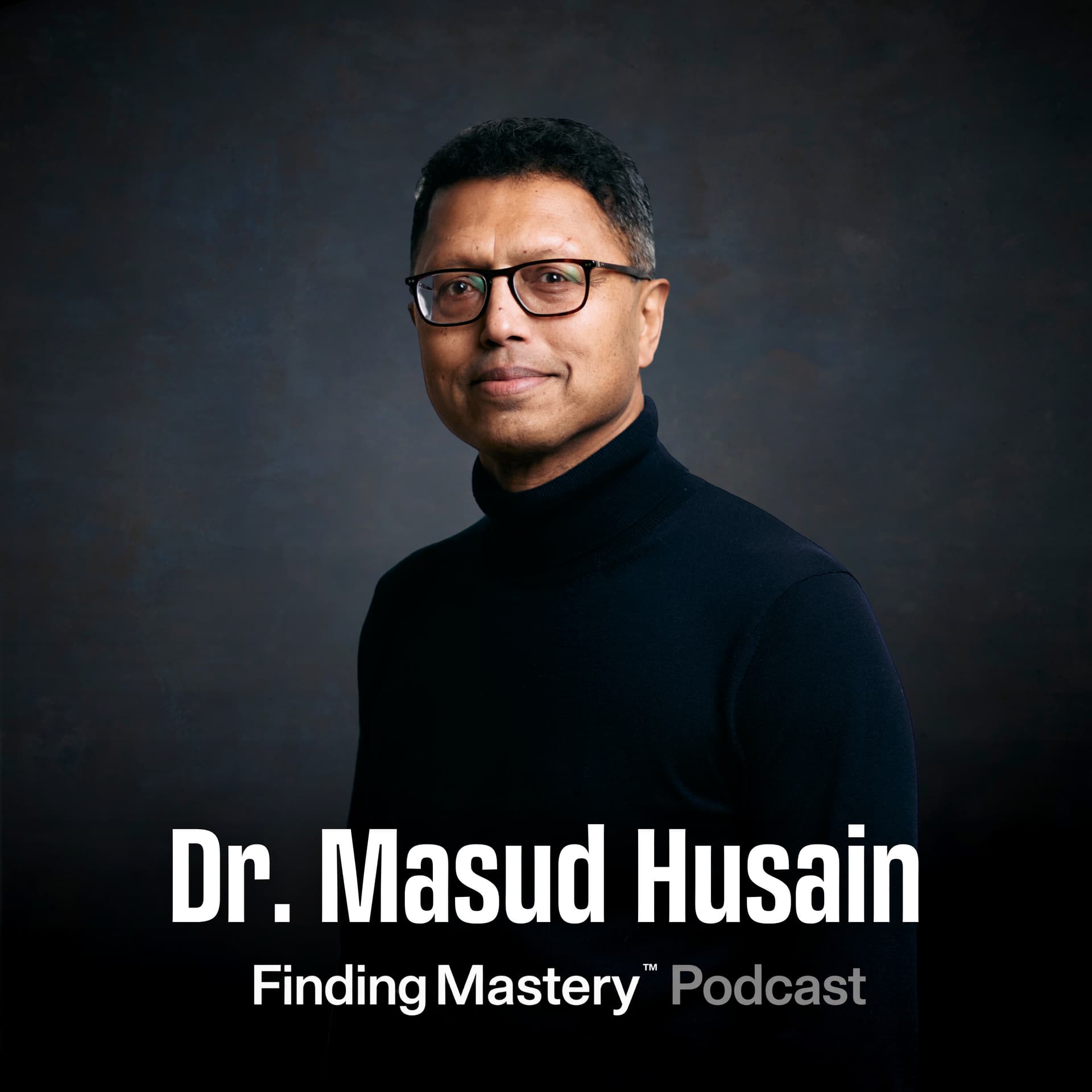
Dr. Masud Husain, Oxford neuroscientist and clinical neurologist; Professor at Oxford; author of Our Brains, Ourselves; editor-in-chief of Brain; winner of the 2025 Royal Society Triveti Science Book Prize. Background includes human neuroscience research on attention/conscious awareness and clinical work treating brain disorders.
Key claims
- “Pathological apathy” can arise from two tiny basal ganglia strokes, producing loss of motivation without sadness or hopelessness.
- Motivation depends on a cost-benefit calculation: whether expected reward is worth the effort (physical, cognitive, social).
- Dopamine is framed more as “wanting”/driving action than as simple pleasure; “liking” is linked more to opioid systems.
- The frontostriatal circuit implicated in apathy overlaps with circuits hijacked by addiction drugs.
- Attention can be trained; covert attention (without eye movements) can be decoupled from gaze and may be less computationally costly.
- In stress, performance depends on how people interpret and manage physiological cues and internal narratives.
Notable examples
- “David,” a highly productive finance worker who stopped showering, socializing, and even seeking benefits after basal ganglia strokes; antidepressants failed; L-dopa failed; rapinarol restored motivation within months (new job, haircut, girlfriend).
- Right-hemisphere stroke patients can lose conscious awareness of the left side due to selective attention/working-memory-related mechanisms.
- Oxford student MRI study: more apathetic students showed greater basal ganglia/ventral striatum/frontal activity during effort-reward decisions (a paradox).
Written by AI. May contain mistakes. Listen to the episode to check what was said.
Chapters
Tap a time to open that second in VOUnderstanding Pathological Apathy
0:42 to 1:08
Exploring the condition of pathological apathy and its neurological basis.
“Editor-in-chief of Brain, one of the most respected journals in neurology.”
Impact of Drugs on Motivation
1:08 to 1:51
Discussing how addiction affects motivation through neurological circuits.
“Whether it's nicotine, alcohol, cocaine, heroin, amphetamines, they work through this system.”
Dr. Husain's Work and Research
1:51 to 3:50
An overview of Dr. Husain's research in cognitive processes and clinical practice.
“on how the intersection of those variables work.”
The Relationship Between Attention and Consciousness
3:50 to 6:36
Delving into the complexities of attention and its measurement in neuroscience.
“considered one of the three hard problems in science.”
Attention Mechanisms and Their Importance
6:36 to 8:05
Understanding how attention operates and its implications for daily life.
“Or if you have a healthy brain, we can put you into the MRI scanner and look at brain activity when we're asking you to attend, let's say, to one or other side of space.”
Selective Attention in High-Performance Settings
8:05 to 12:06
The role of selective attention in sports and high-performance environments.
“Well, it turns out that the brain has developed systems, including in the right parietal lobe, to do some of this selection.”
Managing Distractions and Competition for Attention
12:06 to 14:00
Strategies for managing distractions and focusing on important tasks.
“The same is true, let's go into the boardroom or an executive room, is that there's a psychological position that you walk into a room with.”
Selective Attention in Sports
14:00 to 15:40
Explore how selective attention affects performance in sports contexts.
“I have got to deploy all my selective attention to that ball.”
Selective Attention in Sports
15:44 to 16:53
Explore how selective attention affects performance in sports contexts.
“you know the real cost isn't just the salary.”
Selective Attention in Sports
16:56 to 18:09
Explore how selective attention affects performance in sports contexts.
“Some of the most important work we do happens in conversation.”
Show all 40 chapters
Covert vs Overt Attention
18:18 to 19:56
Understand the difference between covert and overt attention in psychology.
“Try it for free at granola.ai slash mastery.”
Locker Rooms vs Boardrooms
19:56 to 21:28
Explore the honesty and dynamics of locker rooms compared to boardrooms.
“because that is less expensive to run that that process well i mean there may be analogous things that we could talk about in the boardroom, but it may not necessarily be an issue about covert and overt attention.”
The Importance of Eye Contact
21:28 to 23:28
Learn how eye contact influences communication and connection.
“But of course, some people read the room.”
Attention in High-Stress Environments
23:28 to 25:51
Discover how attention and stress interact in high-pressure situations.
“And, you know, to give your your listeners and viewers some idea of this, it can be something as simple as having a squint.”
Navigating Stress Responses
25:51 to 28:00
Understand how individuals respond differently to stress and its implications.
“that happens before and or after moments of high stress.”
Understanding Stress and Response
28:00 to 31:10
Learn about how physiological cues impact stress and performance in high-pressure situations.
“So I think one thing that makes a difference is how you respond to those physiological cues.”
Pathological Apathy Case Study
31:10 to 35:56
Explore a case of pathological apathy and its impact on motivation and behavior.
“Bring us back home right into the center of your petri dish.”
Decoding Motivation
37:02 to 41:30
Understand the dynamics of motivation and the effort-reward relationship in behavior.
“why ought the person right now pay attention to your finding?”
Neuroscience of Motivation Restoration
41:30 to 42:01
Learn about the neuroscience behind restoring motivation in individuals with apathy.
“And two is, this is for the scientists amongst us, is that how do we know that this process was better than placebo, was better than some other intervention that was subtext that was unobserved?”
Understanding Motivation and Neuroscience
42:01 to 44:48
Explore the relationship between biological factors and motivation in individuals.
“So it wasn't just some sort of drug that he thought this is going to do me some good.”
Dopamine, Apathy, and Addiction
44:49 to 47:59
Discuss the roles of dopamine in motivation and the implications of addiction on this system.
“Well, as I was saying before, the evidence doesn't suggest that dopamine gives you that pleasurable experience.”
Research Findings on Apathy in Students
48:00 to 54:35
Examine the surprising brain activity results of apathetic students during decision-making tasks.
“It goes from the ventral tegmental area to the ventral striatum and then loops into parts of the frontal cortex, which loop back towards the ventral striatum.”
Psychological Processes Behind Motivation
54:36 to 55:14
Delve into the psychological aspects of motivation and how individuals can overcome apathy.
“Not even, but you're talking about the decision before the behavior.”
Psychological Processes Behind Motivation
55:17 to 56:18
Delve into the psychological aspects of motivation and how individuals can overcome apathy.
“And sometimes travel makes it tricky to eat well.”
The Challenge of Sustaining Motivation
56:30 to 58:20
Discussing the difficulty of maintaining motivation and the importance of planning.
“Highly motivated, highly successful person says, hey, I'd like to get some help.”
Activation Barrier and Commitment
58:20 to 1:01:06
Examining the concept of activation barriers and the need for commitment to initiate actions.
“So one of those is people find it very difficult unless they've actually got a plan for this week, right?”
Breaking Down Tasks for Success
1:01:06 to 1:05:22
Strategies for breaking down overwhelming tasks into manageable steps.
“And so if you make the effort smaller, maybe this behavior is worth it.”
Engagement and Culture in Organizations
1:05:22 to 1:10:01
Focusing on the importance of employee engagement and building a positive culture.
“You know, there could be prompts, external cues to get you to do this.”
Understanding Dementia: Insights and Challenges
1:10:01 to 1:13:10
Explore the complexities and emotional challenges of dementia, including its various types and impacts on behavior and cognition.
“We haven't talked about, you know, there's some real things that I still want to get to.”
Best Practices for Managing Dementia
1:14:10 to 1:21:49
Discover effective strategies for managing dementia through education, physical activity, and social engagement.
“There is really no cure in the way we'd like to think of it for dementia.”
The Hard Problem of Consciousness
1:21:49 to 1:23:51
Engage in a discussion about consciousness, its emergence, and the challenges in understanding it scientifically.
“I don't think I've ever even talked about this on the podcast.”
Exploring the Hard Problem of Consciousness
1:24:00 to 1:27:15
Discussion on the challenges of explaining consciousness and the self.
“that it's an emergent feature of the activity of the brain.”
Debating Free Will and Determinism
1:27:15 to 1:33:59
A conversation contrasting perspectives on free will and determinism.
“I mean, it's also the case that we can't necessarily solve this problem with the tools we have at the moment to try and solve it.”
Personal Journey and Identity
1:33:59 to 1:38:00
Dr. Husain shares his immigrant experience and the evolution of his identity.
“And I would love for you to take us home based on your unique life experiences, based on your research in laboratories.”
Navigating Belonging and Identity
1:38:00 to 1:41:35
Exploration of identity and belonging in decision-making spaces.
“You know, I think I've got to give the best that I can.”
Effort vs. Intelligence in Success
1:41:35 to 1:43:11
Discussion on the balance of intelligence and effort in achieving success.
“And believe me, when you put it like this, you really cut out the stuff that you don't need to do.”
Deathbed Reflections on Life Choices
1:43:11 to 1:44:59
Considering life decisions based on hypothetical deathbed reflections.
“It's kind of nauseating because when you really know somebody and you see somebody just say the positive things.”
Understanding the Neuroscience of Self
1:44:59 to 1:47:39
Insights into how brains create identities and the implications for mental health.
“Yeah, and it was probably anxiety more than anything.”
Behavior and Personality Influences
1:47:39 to 1:49:15
Discussion on how genetics and experiences shape behavior and personality.
“Yeah, your writing and your exploratory nature of the self and coming from a physicalist or a kind of embodied position here is refreshing for me.”
The Role of Psychology in Achievement
1:49:15 to 1:51:18
Exploring psychological insights that contribute to being world-class in one's field.
“Do you separate the brain from the mind?”
Transcript
Automatic transcript. May contain errors.0:00I'm a clinical neurologist about 15 years ago. I get this letter which says, I've got this young man in his 30s. He's been a highly productive person, but all of that has gone. He hasn't been looking after himself. He hasn't been taking a shower. Turns out he got fired from his job because he'd lost motivation. This is terrifying. It is terrifying. And he wasn't depressed. He had this condition we call pathological apathy. And the reason he had it is that he suffered two tiny little strokes in the basal ganglia.
0:31Dr. Michael Gervais:Oxford neuroscientist. Neurologist. Professor Masud Hussein. Author of Our Brains, Ourselves. The winner of the 2025 Royal Society Triveti Science Book Prize. Editor-in-chief of Brain, one of the most respected journals in neurology. Why ought the person right now pay attention to your finding? That circuit we found in David that links the basal ganglia to the frontal lobes, which when damaged leads to loss of motivation, apathy. That same very circuit is the one that's been identified as the circuit that's hijacked by almost every drug of addiction. Whether it's nicotine, alcohol, cocaine, heroin, amphetamines, they work through this system.
1:16So we thought, why don't we try a drug that affects the dopamine system? Started him on that and slowly increased it. David came back to see us three months later and I didn't recognize him. This is incredible. Exactly. But the really interesting thing in the results we got was that...
1:35Dr. Michael Gervais:This is why I love science.
1:41Dr. Michael Gervais:I'm so excited to sit with you and I'll tell you why. neuroscience, consciousness, performance, a better way of living by being more connected. You've studied this deeply and you've got some real research in science and lived experience on how the intersection of those variables work. So first and foremost, thank you for being here. Thank you for inviting me. Secondly, how do you describe your work? Well, I do several kinds of work. Probably first and foremost, I'm a neuroscience researcher and I work in humans and I work on how humans think, cognitive processes, and how those thinking processes might go awry because of brain diseases.
2:25I'm a neurologist, that's what I study. Secondly, I'm also a clinical neurologist, so I look after patients. So I have to interact with people in a way which I think requires certain skills to, first of all, extract information that you need that might be helpful in understanding what's going wrong with somebody and also thinking about treatments. But in my other life, I'm also the editor-in-chief of a big journal called Brain. We get about a hundred new submissions, new papers every week that we have to look through. And of those, perhaps, you know, eight of them will make it into the journal.
3:04And finally, I also have personal responsibilities. I'm a father, husband and a son. So those things are really all important in terms of how they color your work.
3:16Dr. Michael Gervais:You've got a full plate from what I can understand. And one of the reasons I wanted to be able to sit with you is that you take those facets of your life seriously. You are leading from the front and supporting from the back, if you will, in a world-class way. And I fully thought that you would explain all of those variables that you just did. And then you've done it rather humbly as well, meaning that you're doing it on the world stage. You're doing it at a significant university as well. And so let's start with the brain. Let's start with consciousness, which is a hard problem in science, considered one of the three hard problems in science.
3:55Dr. Michael Gervais:Why did you want to tackle consciousness? Well, I wanted to see if we could tackle one part of consciousness. And we were particularly interested in attention. And the relationship between attention and conscious awareness is something that's quite controversial. But attention is something that we can measure, whereas consciousness is sometimes very difficult to measure. You know, of course, someone can be conscious or they can be in a coma, unconscious. But between those levels, between the highly conscious and someone who is comatose, it's much more difficult to measure states of consciousness.
4:35So we were very keen to measure attention and how that can go wrong in people with brain disorders. And in particular, we started off looking at patients who had suffered a stroke, particularly of the right hemisphere that tends to give more problems with attention than strokes of the left hemisphere, which is usually a language dominant hemisphere. and looking at how we might be able to understand better the components of attention and conscious awareness. Because some people who have these strokes fail to be consciously aware of information on the other side of space. So if you have a right parietal stroke, you may fail to be aware of something on your left.
5:22And that could be in vision, in touch, but also in hearing. You may not be consciously aware of someone speaking to you from the left. That could be as extreme as that. But much of this, until the last 30 or 40 years, has been very descriptive, rather than analytical, in terms of trying to deconstruct what is going wrong. And it turns out that loss of conscious awareness on one side of space can be due to several different factors. It could be due to a process we call loss of selective attention. It could be due to a process which we call a bias in where you start orienting attention. Strangely enough, problems in attention can be very, very closely linked to problems in what we call working memory, short-term memory.
6:12Because if you've forgotten where you've looked, you may go back to a place you've been before on the right side and not explore information on the left side. So to answer your question, the reason we got into attention was that there are ways in which we can measure it in humans, and also we can correlate that with what's happening in the brain, either through where the damage is in the brain, let's say, after a stroke. Or if you have a healthy brain, we can put you into the MRI scanner and look at brain activity when we're asking you to attend, let's say, to one or other side of space.
6:51Dr. Michael Gervais:Why would somebody who is operating at a really high level in life, they've got a sense of buoyancy about themselves, they're leading and living in an aspirational way, they're doing really well, why would that person benefit from understanding what you've come to understand? about attention and consciousness. Yeah. So although the work I've been describing is in people with brain damage, actually it has really important implications for healthy people who don't have this kind of problem because it's giving us insights into how attention works in you and me. The brain has limited capacity. It can't store everything that's coming at it, you know, on a millisecond basis, our eyes are being stormed by visual information.
7:38I'm wearing this shirt. Every millisecond, I'm getting a feeling from different parts of my body about this shirt, right? Most of this is not very useful or interesting. We need to have some mechanism by which we select which information is important to us and which isn't. So the brain has limited capacity, therefore we need a selection mechanism. Otherwise, You know, our storage systems would be overrun. So how do we do that? Well, it turns out that the brain has developed systems, including in the right parietal lobe, to do some of this selection. How does a selection work? It can be bottom-up.
8:18So, you know, if something is coming straight at you, let's say a football or something like that, you need to take action. And that salient image of a football coming at you means that you need to take some action immediately, right? On the other hand, you might have goal-directed attention. You might have certain goals. You're in a crowded railway station and you're trying to find your friend. She's told you that she's going to be wearing a red coat. So you can selectively filter out other people who are not wearing anything red and just attend selectively to find which people are wearing a red coat.
8:57So there's bottom-up attention, football. There's top-down or goal-directed attention when you are selecting goals. And then there's the issue about distractibility, right? So it's perfect if the system is working okay, but sometimes we'll be distracted by other things, right? It doesn't have to be as salient as a football. Something else can distract us. And it could be externally in the world, or it could be internally, a thought that comes in your mind. that's distracting you. So that's why this work on selective attention turns out to be very interesting in telling us how our brains normally operate.
9:37And I've just mentioned selective attention, but there's also a system dedicated to sustaining attention over time. If you look at a young child, they find it very hard to sustain attention on a problem for more than a few seconds. They'll be off, they've drifted off somewhere else. a brain system develops throughout childhood, young adulthood, which allows us to sustain attention. It could be a problem that we're trying to solve. It could be something like, you know, watching a TV program for an hour. That's quite a thing for a brain to do, to just sustain attention over that period of time and extract the information that's useful to it.
10:19Dr. Michael Gervais:For folks that are wanting to be great in their life, selective attention is really important. Where do I put my attention? And for how long do I attend in that direction? And can I shift my attention to something new once I identify something maybe more salient or important for that moment? So there's the shifting of attention. There is the external, internal distractibility and signal. And one of the things that we would find very commonplace in the field of high performance psychology is understanding what hijacks attention. And certainly at the moment that we interpret threat or danger, there's another system in the brain that is saying, hey, we should probably figure out how to survive this rather than thrive in it.
11:08And so early kind
11:11Dr. Michael Gervais:of studies of sport psychology and performance psychology was, well, how do we work with those two systems? Because to catch a football in a high-speed environment where you need to be accurate with catching it, you need to put your attention completely focused on the tip of the ball and track that in all the way into your nose is what we would teach somebody that is in the NFL per se, in any league, a developmental league or in the elite league. And at the same time, there's a 250 pound human that is running full speed at you that is working to disrupt that and or tackle you or hit you. And sometimes if you're unfit or are surprised by it, that can actually lead to an injury.
11:55Dr. Michael Gervais:So it is very difficult to be able to know how to distract out physical real threat and attuned to the one thing that you have decided matters more. It's a very difficult process. The same is true, let's go into the boardroom or an executive room, is that there's a psychological position that you walk into a room with. This is a really important meeting, let's say that's the orientation you have. And now the body is readying for that level of importance. So you've got this internal narrative, you've got an internal physiological experience, that is loud. Both of those tend to be pretty loud. And you've got one thing you need to attend to, which is either your next eloquent stitching of a thought or the response from the person you're speaking to.
12:42Dr. Michael Gervais:So in both of those scenarios, pick whichever one is more interesting for you. How would you help us, based on all of your research, operate better towards our honest potential to be just a little bit more eloquent, a little bit better in what we're doing. And you could pick either those examples and or the developmental path to get better or in the actual moment, how do you navigate better? Right. And what you put your finger on here is a key part of attention that I haven't mentioned, which is that things compete for your attention because it's limited capacity, things compete. So in a way, the best way to frame this perhaps is how do you suppress one thing in terms of the value it has for your attention and elevate something else that's your particular goal so if we're going to the nfl football player how does he or she suppress the oncoming 200 pound juggernaut and heighten the attention given to this ball.
13:48And I think it has to be practice, right? There is no other way you're going to do this unless you train yourself that I'm not going to attend to the distraction of this juggernaut coming at me at this speed who is going to hit me. I have got to deploy all my selective attention to that ball.
14:10Dr. Michael Gervais:Otherwise, I'm going to miss it. You know, what's interesting is that as you're saying this, two things pop up for me. One is there's an actual, let's call it brain profile for just a moment, where if I peek out of my left peripheral vision to see where that 200 and whatever pound juggernaut is, and I peek and I look, and then I quickly come back to the ball, that some brains can track. and I know you're familiar with what I'm speaking about and I'd like for you to put it in your language, but I can track how that, based on that quick frame of reference, how it's likely to progress. Okay. Other brain profiles, they peek, they look, and then they come back to the ball and it's as if they have completely lost the orientation of that object.
15:00Dr. Michael Gervais:So when they catch the ball, happy days, this second profile, when they look back to where the defender is, it's like they're taking a new picture. They don't know. They haven't been able to run this parallel process of a prediction model of where that person might be. Okay, pause here for a moment. That person with that type of brain profile, once we understand it, we don't put them in a situation to have to fully flip their head, to just focus on one thing and and try to hold in their minds what might be happening, meaning that the juggernaut coming after them. We keep them looking at both at the same time.
15:39Dr. Michael Gervais:Right. Finding Master is brought to you by LinkedIn Jobs. If you've ever hired for a small business, you know the real cost isn't just the salary. It's the time that you lose when the fit is off, the momentum that stalls when that fit doesn't work. And that's the pressure of having to get it right while you're still running everything else. That's why I'm paying attention to LinkedIn Hiring Pro. It's built for the reality of hiring when you're operating lean. You describe the role in playing language, and then Hiring Pro helps you draft the job post, surface the right candidates, and then narrow to a short list without turning hiring into another full-time job.
16:12Dr. Michael Gervais:And when applications start coming in, it doesn't leave you buried in resumes. It streamlines screening, including AI-powered interviews for initial conversations. How about that? So that you can spend less time searching and then more time connecting with the people who match what you need. With Hiring Pro, you can hire with confidence knowing you're getting the best talent for your business. In fact, those hiring with LinkedIn are 24 % less likely to need to reopen a role within 12 months when compared to their leading competitor. Join the 2.7 million small businesses using LinkedIn to hire.
16:43Dr. Michael Gervais:Get started by posting your job for free at linkedin.com slash mastery. Again, that's linkedin.com slash mastery. Terms and conditions apply. Body Mastery is brought to you by Granola.ai. Some of the most important work we do happens in conversation. It's in the meeting. It's in the one-on-one connection. It's the moment someone shares an idea that could shift the direction of everything. And the greatest gift you can offer in those moments is your full attention. That's exactly why I love Granola. Granola is an AI notepad. You take down the notes that matter to you, and Granola transcribes the entire conversation right beside them.
17:19Dr. Michael Gervais:So what does that mean for me? It means that I get to be fully present, to listen deeply, to give real attention to the details and the nuances, the thing behind the thing, knowing that Granola is there taking notes from me behind the scenes. And the best part, it works right through your device's audio, which means it integrates seamlessly into your video conferencing tools that you already use. No big setup, no awkward bots. All I do is let folks know that Granola is transcribing in the background. Happy days. We're off and running. I use it every day. And what's remarkable is how it helps turn a conversation into something useful.
17:52Dr. Michael Gervais:When we're done, I've got a clear, organized recap of what said, along with a clean list of action items and clear next steps. Nothing slips through the cracks. That is the gift of Granola. I think you're really going to like what they're doing. If meetings are eating up your day, Granola is a no-brainer. You can try it totally free. Just head to granola.ai slash mastery. That's G-R-A-N-O-L-A dot A-I, granola.ai slash mastery to get your time back. Try it for free at granola.ai slash mastery. I think one of the important things here is the difference between what we call covert attention and overt attention.
18:32And the terminology here in psychology, experimental psychology, has been that overt attention is what you normally think of about paying attention. You move your eyes to the location that you're paying attention to. But it turns out that you can unyoke where attention goes from where your gaze is. I mean, we've all done this, right? We've gone to a party, we're talking to someone who is boring the pants off you, and then somebody really interesting comes in through the door. But because I'm British, and I'm very polite, I'm going to keep looking at you, Mike, boring as you are, and keep talking to you.
19:12But actually, I have unyoked my attention and I am selectively paying attention without moving my eyes. Now it turns out there's a whole bunch of work which shows that can be done. It can be done really well and with training you can do that even better. And that has really real implications for the problem on the field because every time you move your eyes your brain has to keep track of how much you move your eyes right if you don't move your eyes from from this location it's much simpler to do the the kind of
19:48Dr. Michael Gervais:calculations about what's going on so the takeaway there is you can decouple the two you can and but for the executive or the leader it is much more preferable to stay tuned to where your eyes are because that is less expensive to run that that process well i mean there may be analogous things that we could talk about in the boardroom, but it may not necessarily be an issue about covert and overt attention. There might be another problem here. Oh, boardrooms are highly covert. I think some of the most honest rooms that I've been a part of are locker rooms. I think they're very honest. Okay. And then boardrooms, I think, are some of the most dishonest.
20:30Why so? I don't have that experience. What's happened?
20:33Dr. Michael Gervais:In locker rooms, if you drop the ball, if you show up late, if you are sloppy with your preparation, if you're underweight, overweight, whatever, you get called out. They walk around fully exposed to the force ranking stats of their position, both in the locker room and globally. So it's like there's very little places to hide. And when you get a group of alpha competitive humans that want to do something special, they know they can't do it alone. So they need each other to be great. and when somebody is not pulling their weight by choice, by choice, they get called out. In boardrooms, there's all of these political covert, you know, side angles.
21:14Dr. Michael Gervais:There's all this other stuff that is very sophisticated. You have to be very sophisticated to be able to make it into a boardroom and sort out how to lead and or sometimes survive in those boardrooms. And there's some of the least honest environments that I've been part of. Right, it's interesting. But of course, some people read the room. That's right. I read the room. That's right. We actually mean read the faces, right? And sometimes, I mean, obviously people are good at some disguising their true emotions, but where you look is one of the interesting aspects of where you're attending to and why are you looking there?
21:50Dr. Michael Gervais:So describe an elite operator, somebody who is exceptional at what they do. You might even call them masterful at any craft, whether that is the craft of conversation or the craft of anything else. How do they use their attention? And if you haven't done original research or know the research, I would love to get your very informed opinion about it. Well, the bit I do know is about the fact that if you really want to engage somebody, if you want to persuade somebody, you have to look them in the eye, right? You don't try and do this in some sort of looking aside and all the rest of it. So you have to really engage people by looking them in the eye.
22:27That's a very important part of getting them on board. And what are we doing here? Saying, I value you so much. I'm going to put all my attention, where my eyes are looking, on you, Michael. That's why I'm going to try and persuade you that what I'm going to say is something really, really genuine and important. And both of those things are, I think, are really key here. Genuine, because I'm looking you in the eye. I can do that. there's no other distraction i value you and this is really important i think there's two parts of
22:58Dr. Michael Gervais:that that are important to note one is the holding of the attention why is that important because i am now signaling to you that if there's a potential other threat that is less important than my connection with you we know that that there's other threats in the world but i'm going to give you my attention okay the second is that it has to have a alignment and intentionality behind it. So when you take the gaze with the genuine intention, now you got something because you've met people that they're looking at you, but their intention is to intimidate or their intention is to get out of the conversation or they've got the thousand yard stare where they're they're just not here because they're overwhelmed.
23:40And, you know, to give your your listeners and viewers some idea of this, it can be something as simple as having a squint. Someone you might meet who has a squint. It's not their fault. Their eye is deviating. The axes of the eyes are not aligned. You find it difficult to read because one eye is looking one way and the other is slightly deviated. It could be just five degrees away. It's slightly difficult because you're not sure whether they're really paying attention to you and engaging with you. And of course, people who have strabismus, deviation of the eyes, it's not their fault. They have it.
Read the full transcript
24:17they can be born with it or they can develop for other reasons. I'm just saying it's an example of how difficult it can be to read people with that.
24:26Dr. Michael Gervais:Why do some people look at the mouth when they're speaking versus eyes? And why do some people not look at either of those things? What do they look at? Well, they may look at your forehead or, you know, I've heard of, I don't know the research, you look at somebody's forehead, it actually stresses the other person. I think that's, it doesn't feel natural right yeah that's right and so humans are interested in communication and the the most communicative parts of our faces are where we're looking eyes we've just been talking about that and what are we doing with our lips um and that could be even when you're not talking that's right i'm interested to know what are you doing with your lips how's that what are you signaling to me and the frontalis muscles yes which is the the brow and the space between the two eyes because if there's so much information that you know is happening there exactly am i safe or is this a threat and we're effectively talking about where do i selectively attend right on a face and if you're not trained in condition you will go to a survival bias as opposed to an exceptional connection bias in environments of consequence the brain is designed to sort out survival move away from that threat more often or go to it aggressively to try to mitigate it.
25:40Dr. Michael Gervais:And so left untrained, our brains will do its job, which is to figure out survival in a high stress environment. Sometimes connection is survival, but oftentimes connection is a luxury that happens before and or after moments of high stress. I think our people, our community at Finding Mastery are actively choosing high stress environments. They like it. They know that stress is something that helps make, create, develop something special, including themselves. And so they're operating in a high stress environments, but don't have the full set of skills to manage that high stress. So acute stressors are amazing.
26:19Dr. Michael Gervais:If you know how to manage that acute stress, if not over time, it moves to chronic stress. So now you've got a selective attention issue during a high stress brain versus a, let's call it moderate stress brain. So can you talk a little bit about attention and stress. Right. So individuals vary enormously how they respond to that situation. And you might say, well, what makes a difference between someone who has to go and present to a CEO in a boardroom? It's a very stressful situation. What makes a difference between someone who does that without being flustered, without getting anxious versus is someone who crumbles under those circumstances.
27:06And I think, of course, a lot of it is about your previous experiences in stressful situations. Can you generalize from other stressful situations? If you've been a footballer, can you do the same thing when you get into a boardroom? So are there ways in which you can generalize? And are there ways you've learned how to cope under those high levels of stress. Part of it is physiological, right? When you go into a highly stressful environment, I can remember that as a child, your heartbeat is racing. You feel a little bit clammy, right? You've got all these autonomic physiological cues telling you this is a highly stressful environment because you've got these, your adrenaline system is high, right?
27:56And that can have this impact in terms of either choke or wind in this sort of environment. So I think one thing that makes a difference is how you respond to those physiological cues.
28:08Dr. Michael Gervais:Okay, let's call that part two. Part one is what determines a high-stress environment. Right, okay. And I think we make it. There are certainly some environments that it is biologically grooved that for most people, when you're next to a cliff and your toes are over the edge of the cliff, you're supposed to be activated. That's a survival mechanism. But when you walk into a boardroom, you have to make it stressful. How about that as a provocative statement? Meaning that there's some meaning making that you carry into that environment that turns on the adrenal system. Yeah, I think there are two ways of looking at it.
28:47So there are people who you have to engage here because this is highly important. You have to make that so though. Yeah, that's right.
28:55Dr. Michael Gervais:Meaning that you have to determine that this is important. Yeah, but there are other people who I think can become very calm under those situations if they are able to say to themselves, right, you've practiced presenting here. You know what you're going to do. You're going to give your best. That's all you can do, right? That's it. I would call that a first principle of mastery is to master the things that are 100 % under our control. and speak to ourselves in alignment with that first principle. It's really important. And I think, you know, even when you speak to a nervous child, if you're a parent, right, one of the things you can say to them, look, you've done your best.
29:33You've prepared for this. It doesn't matter. Go in there and do your stuff. That's so important. And if you can take that with you when you are older,
29:42Dr. Michael Gervais:you've done your stuff, right? What if you have another competing idea, which is it does matter. If I miss this moment, I will not get into the college I wanted to. If I miss this moment, I won't get funded the way I hope. Yeah, and this is back to our idea about this competition between what we're going to attend to, in this case, the thought. Are we going to attend to the thought that we can do this? Or are we going to attend to the thought, this is not going to, we're going to crumble here. And I think you have to learn how to do this. It's not going to be something you're going to master once.
30:13You have to do this. And of course, one way to do that is practice. Put yourself in that situation.
30:18Dr. Michael Gervais:Yeah, I'm so aligned with the practicing because what you and I are talking about is attending internally to your feelings, emotions, or thoughts and or externally, which is the unfolding environment around you. and if you can shift between those two and choose the highest value and the shaping of that attentional cue meaning if i'm going to think a certain way my highest value is thinking this way versus that way and then you can train just that and you can also train like oh i feel a little too activated my heart's beating i'm a little clammy that you mentioned yeah probably breathing might help here, but you know what?
30:59Dr. Michael Gervais:Hold on. I'm actually in control of how I present myself. So let me just give it my best. Good. Fill in the blank. So, okay. It's fun that we got onto this path. This is actually probably slightly adjacent to what you study most. Is that correct? It is. Yeah. Okay. Bring us home. Bring us back home right into the center of your petri dish. Right. So my research team, we investigate attention, which we just discussed. We investigate aspects of memory. But perhaps the most exciting thing we're doing at the moment is looking at motivation, human motivation, and how it can go wrong and lead to apathy, loss of motivation.
31:39And the way we really got into this was about 15 years ago. I'm a clinical neurologist. At that time, I was working at the National Hospital for Neurology in London. and I get this letter which says, I've got this young man in his 30s. He's been a highly productive person. He works in finance. He is socially absolutely charming. He has lots of friends, but all of that has gone. He no longer seems interested in his work. He's lost all motivation and he's no longer interested in connecting up with his friends who are worried about him. I thought he was depressed. I tried him on an antidepressant.
32:17Nothing happened. Can you help? So this guy is called David, and he was incredibly difficult to get to see us, to get him to see us, because he wasn't motivated to come. So I had to phone him up and say, look, I'm intrigued by what's going on here. Will you come tomorrow? Because I will be here waiting for you. So grudgingly, he turns up, and he's in a terrible state. He is disheveled. He hasn't been looking after himself. He hasn't been taking a shower. Turns out he got fired from his job because he'd lost motivation. And he couldn't even be bothered to get social security benefits. So he couldn't pay the rent.
32:57This is terrifying, by the way. It is terrifying. And it was very, very instructive for us about how a person who was highly motivated could within days suddenly become so apathetic. So his friend said, OK, come and stay with us. If you can't stay in the apartment because you can't pay the rent. Come and stay with us. And within a few days, they regretted it because all David did all day was sit in a chair doing nothing. So when I asked him, what would you normally do? Oh, I'd listen to some music. So why aren't you doing that now? It would take me some time to put my music system together. How long would it take?
33:39Five minutes. So for him, the effort, five minutes worth of effort, putting the cables together for his music system, was not worth the reward of pleasure he might get from listening to music. And he wasn't depressed. He had this condition we call pathological apathy. And the reason he had it is that he'd suffered two tiny little strokes in the basal ganglia. These are really important structures deep in the brain which are evolutionarily very very well conserved. If you look at the oldest vertebrate it's a lamprey it's an eel-like creature. It's 360 million years old. It's highly successful. It has basal ganglia which link primary motivation cues like hunger to action.
34:30So it turns out that system the basal ganglia to the frontal lobe system has been preserved through evolution, it's in you and me.
34:39Dr. Michael Gervais:And the frontal lobe being responsible for judgment. And actions and decisions, yeah. And of course, you know, in a couple of hours time, you and I are also going to get an urge to find some food. It's a motivational urge to act. And we now realize that many of these motivational cues go through the basal ganglia to the frontal lobe. they're really important in the system for motivating us to act and there are not only primary motivators there are also obviously psychological motivators in you and me in terms of long-term goals what are we doing how we do we get there in David it turned out that the goal of let's say listening to music was not motivating enough to make him act turned out to be really really insightful because what it led to us doing was to think, okay, can we deconstruct motivation?
35:33It seems like a really nebulous concept. Many people consider it to be like willpower, but can we deconstruct motivation? So we went to the drawing board and thought, okay, let's think hard about why is it we do what we do? It's a fundamental question. And why is it we do that?
35:56Dr. Michael Gervais:Finding Mastery is brought to you by Oslo Sleep Buds. Here's something I come back to with almost every high performer I work with. You can do everything right during the day, but if the night consistently falls apart, so does recovery. That's exactly the problem Oslo set out to solve. And that's why I invested in the company. I love what they're doing. They just launched Sleep Buds 2. This is the next generation of the world's smallest earbuds built for one thing, sleep. And once you're out, once you fall asleep, they switch to built-in sleep sounds on their own. Over time, the app even shows you personalized sleep patterns so you can see what's actually helping you recover.
36:35Dr. Michael Gervais:Sleep is a skill. You can train it. And the right tools make it easier to protect. Protect your sleep. It matters. Do not leave your recovery up to chance. Right now, you can get$20 off with the code FINDINGMASTERY at oslosleep.com. Again, that's findingmastery at oslosleep.com for$20 off.
37:02Dr. Michael Gervais:For somebody who has not had a stroke or has not lost all motivation, but does notice that they are struggling from time to time, motivated, if you will, to do the thing that they know is of highest value for the person they want to be or the project they're working on. why ought the person right now pay attention to your finding? So a key part of what we learned here was that one really important component of motivation is a calculation, if you will, of whether some particular action, the reward that would come from that action is worth the effort. And the effort could be physical effort, putting the cables together for the music system.
37:45It could be cognitive effort, putting in hours of effort to analyze, read, extract information from a document. It could be social effort, getting off your ass and getting to a party or whatever it is to meet people. Going to the gym.
37:59Dr. Michael Gervais:Going to the gym. Investing in some AI new capabilities that are complicated and out of the rhythm of business. Exactly. And we all differ in how we evaluate, how we value certain things that we could do. So, you know, it's a beautiful day out there. There are 20 different things we could do, but we can't do all of them. We can only do one of them at a time. So which one do we do? Which one do you prioritize as your current goal? Scroll on my phone. Lowest possible choice of all the choices. In that case, what we're doing is saying, scrolling my phone is more valuable and least effortful. I'll do that because that's one that seems to be easiest to prioritize.
38:42Awful life choice. Right, of course. But, you know, we all differ in how we would put a value on all the potential things we could do against the effort required to do that. And in David, that calculus was nothing is worth the effort. Nothing pulled him to put in the effort. He needed to be prompted to do things. He needed to be prompted to have a shower, to eat, to help with the household. Otherwise, he would just sit doing nothing. So it turned out that for David, nothing was rewarding enough to incentivize him to act. And because we know a lot about the basal ganglia, one thing that stood out for us was that dopamine is the neurotransmitter which is critical in motivating animals to act.
39:31Animals as well as humans. So we thought, why don't we try a drug that affects the dopamine system? and we used a drug that acts on dopamine receptors that is already out there that's used in parkinson's disease patients to treat them l-dopa we started with l-dopa levodopa which is the drug you see in the film awakenings that's what happened and it did nothing so we were really despondent we thought maybe this was not going to work so we thought before we completely lose hope with this we'll try one other thing there's another drug which directly latches on to dopamine, a specific type of dopamine receptor.
40:11And that's called rapinarol. And we started him on that and slowly increased it. And he came back to see us. David came back to see us three months later. And I didn't recognize him because in the waiting room, there was a man who had had a haircut. He had a suit on, told me that he got a new job. And most surprising of all, he had a new girlfriend. He would never have seen anyone in the condition he was. So that was an extremely important lesson for us, that you could extinguish motivation in somebody who is highly productive, highly sociable, but you could also restore it by using a drug that affects the dopamine system.
40:58And, you know, there's a mythology that dopamine is really all about pleasure, the chemical pleasure. Actually, most of the evidence suggests that it's about motivating people to act, making them seek something that they would find rewarding, but it doesn't necessarily give you that hedonic, pleasurable response.
41:17Dr. Michael Gervais:I want to go two places. One is the hedonic treadmill that people are concerned about and we talk about. And related to that is what can we learn from your insight on how we can live a little bit better in our own lives? Okay, that's kind of 1A, 1B. And two is, this is for the scientists amongst us, is that how do we know that this process was better than placebo, was better than some other intervention that was subtext that was unobserved? Right. You mean in David? In David. Okay, so let me take the second question first. So you like that one, huh? Yeah, I can tell you about placebo. Yeah, we ruled that thing out this way.
41:57Dr. Michael Gervais:Okay, good. Well, it's interesting because as I said, he tried Lever Dopa and it did nothing, right? So it wasn't just some sort of drug that he thought this is going to do me some good. That's why I'm better. And it's also the case that we tried reducing the dose of the Rapinarol we used and his motivation began to lessen again. So I think we have enough information there. Those are good trials. Yeah, that's good experimentation. Yeah. You didn't give him a sugar pill to see what happened though. No, we didn't. Yeah. I mean, we were just amazed. It worked. This is incredible. This is incredible.
42:32So that you can turn around someone's life by understanding the neuroscience.
42:36Dr. Michael Gervais:You know, what's cool about like what I love about your process with David is that just like all of us, we would have said, oh, this looks like depression, right? A severe case of a psychological disorder. And it's been this way for, to meet major depressive disorder. It's a 15-day experience where somebody feels A, B, and C, you know, in symptomology, meaning that there's a lethargy, there's an overwhelmed feeling, there's a sadness, fill in the blanks. And it's got to last for 15 days. Usually it's somewhere around 30 before it starts to get like, okay. And that was obviously the case, but you found a biological solution for what looked like a psychological issue, but it was not psychological.
43:15Dr. Michael Gervais:It was a biological issue. In this case, it was a biological cause, which led to psychological, psychological disruption. But I think you've touched on a really important part here, because what we've got into is thinking, what's the difference between apathy, which is what David had, and depression, which many people are very familiar with, and something else, which we call anhedonia, lack of pleasure. Lack of pleasure. Yeah. So actually, this is a very rich area of research at the moment. But one key difference between apathy and depression and anhedonia is that patients who have pure apathy don't feel sad.
43:55David wasn't sad. He wasn't hopeless about the future, which is something that people with depression may have. He just could not be bothered to do anything.
44:06Dr. Michael Gervais:You know, Aaron Beck, the psychologist, back to his kind of early the insights about depression and I'm going to make it super simple is that I think I suck I think you kind of suck I think the world kind of sucks I think the future sucks it's like that idea that I the future and you and everything else involved in it are lame and he didn't have that he didn't have that yeah and also if you gave him something like a meal he could still have pleasure from eating that meal. So it wasn't like he was anhedonic either. There was a dopamine expression during moments of temporary pleasure, like eating.
44:49Well, as I was saying before, the evidence doesn't suggest that dopamine gives you that pleasurable experience. Actually, the evidence suggests these are opioid receptors in your brain that give you the hedonic response of, let's say, enjoying this meal.
45:04Dr. Michael Gervais:So I can hold both things together here, that dopamine, typically, that we first, when we first learned about dopamine, I think you probably did in your early studies as well, is like, oh, the pleasure chemical. And then we started finding more motivation, more aligned with motivation. Are you suggesting that it is actually not part of the pleasantry or the pleasant circuitry, but it is primarily or only for motivation? yeah and it's a little bit more nuanced than that because some people like to separate what they call wanting the motivation to seek something versus liking the enjoyment you have in the moment okay so you know let's say you can be motivated to go to a restaurant to have a great meal but when you go there the experience of having a great meal is is different from the motivation to go and have that meal so there's a difference between wanting which is mediated by dopamine and liking which seems to be mediated more by opioid neurotransmitters in the brain when a 20 year old says i no longer feel alive and they rule out depression and they just say i think i've had so much dopamine hits in my life this is an unsophisticated way of saying it based on our conversation, but I just have had so much stuff.
46:27Dr. Michael Gervais:I just feel ehedonic. I feel like I don't have pleasure anymore. So I completely believe the 20 year old in that they may not find pleasure in life. What I don't think we can do is to say it's due to dopamine hits. And what we can't also say, a lot of people say this, you need a dopamine detox, right? The evidence for this stuff is really, really flaky. And there's a whole industry out there telling you you're having dopamine hits and you need to dopamine detox. You know, it's not like dopamine is building up in your brain and somehow you need to open the tap or something and let it out. Yeah.
47:03Dr. Michael Gervais:I like that. I want to know what your recommendation would be for somebody who's doing this, but I can see the crosswalk where maybe you can draw a clear line, dopamine and cocaine, and then too much cocaine. When people come off of cocaine, there is a deficit in their ability to feel pleasure again, right? So that's a clear crosswalk. But can you walk me through how you think about it? So it turns out, and this is really fascinating for us, that circuit I was mentioning we found in David that links the basal ganglia to the frontal lobes, which when damaged, in this case by strokes, leads to loss of motivation, apathy.
47:38That same very circuit is the one that's been identified as the circuit that's hijacked by almost every drug of addiction. So almost every drug of addiction, whether it's nicotine, alcohol, cocaine, heroin, amphetamines, they work through this system. And if you will, the way to think about that is they are overstimulating that dopamine production. What is the name of that highway? It's called a frontostriatal circuitry. It goes from the ventral tegmental area to the ventral striatum and then loops into parts of the frontal cortex, which loop back towards the ventral striatum.
48:25Dr. Michael Gervais:Okay, and the ventral striatum is where the basal ganglia. That's exactly the area that was taken out in David. But it cannot be a coincidence that this circuitry, which we've identified as being so important in apathy, is also the same circuitry that's been identified by addiction researchers. I don't do any addiction research. They have come to the same conclusion that this is the circuit that's hijacked by drugs of addiction. How do you make sense of this? I think it's fundamental neuroscience here. We've got a primeval system which is important in motivating us to act. if you take some of that out in the sense that by natural causes like a stroke you may lose motivation to act we can restore it by giving you a drug that stimulates the dopamine system on the other hand if your brain is intact and you take a drug of addiction that may over stimulate the dopamine system which hyper motivates you to action to seek to want that rewarding outcome complex how do the healthy folks that are earnestly wanting to be better in their life find value from your insights so one of the things we did after studying david was to think what about healthy individuals healthy young people and we picked students at the university i work at oxford and believe it or not there are students there many of whom are very apathetic come on yeah True.
49:53And people who are highly motivated. It's the same in any major university. You can be bright, you can be cognitively a superstar, but you can still also be apathetic.
50:01Dr. Michael Gervais:There's also like, as you would recognize, there's a radical mental health crisis taking place on university campuses right now across definitely the US where addiction, depression, anxiety, suicidality are on a rapid, scary rise. And so I'm interested in what you're suggesting here because we can separate maybe a lack of apathy or an increase in apathy from some of the mental disorders, which is going to be an interesting nuance. It's important, I think. Yeah. But so we took this range of students and we put them into the MRI scanner to look at brain activity and we asked them to make decisions.
50:36We asked them to say whether this particular option is worth it for them. We might give them an option of a certain amount of reward or a certain amount physical effort required to achieve that reward. And we could look at this space of increasing rewards, increasing effort, and see which of these options they were willing to work for. But all we were doing in the scanner was asking them to make a decision. Do you think this option is worth it or not?
51:05Dr. Michael Gervais:For example, make it concrete? Would you be willing to physically exert this much force in order to get this much money? That would be the simplest way to put it. And what we found was that across all these students, the brain areas which were active included the basal ganglia, the ventral striatum, and parts of the frontal lobe when they're making the decision. When they're actually making the decision. Exactly. But the really interesting thing in the results we got was that the students who were most apathetic were the ones who showed the greatest activity in these regions. Now, That was a real paradox for us because we were expecting them to show less activation.
51:50They're the apathetic ones. You'd expect them to show less.
51:52Dr. Michael Gervais:This is why I love science. Yeah. I mean, it's a completely surprising result. Were you excited in that moment or were you terrified that you were completely wrong in every assumption you've ever had? We had to think long and hard in the way we've explained it. No, but I want to know your first reaction. Oh, yeah. No, I didn't know what to make of it. And then, so in that moment where you had an idea, you fully expected that you were, you're going to likely get something close to your original idea, your hypothesis in this case, and it was completely different. I want to know how you manage that.
52:20Yeah, it was disappointing because scientists have these hypotheses and when they don't come true, you think, oh, did I get that completely wrong? On the other hand, I could say to myself, hang on, you're being hard on yourself here. Look, you have found the brain regions which are active when people are making the decisions. And they align with what we know from patients like David. It's the basal ganglia and the frontal lobes which are important when people are making this decision about whether a particular behavior is worth the effort.
52:54Dr. Michael Gervais:When I go to the gym or when I lace up my running shoes to go for a run, is it worth some sort of later potential benefit. And I put a lot of little asterisks in there. And it's a very important psychological, neurological process to understand because rewards that are not immediate when they're down the road are really important to figure out how to invest in. And so, or invest in the behaviors for the later reward. That's what I want to get to with you is like, how do we, if somebody has an idea of who they want to become or what they want to be able to do, or let's just say a weight loss or weight gain or something as simple as that, and they feel apathetic, how do we help that person?
53:33Okay, and maybe I could just finish this story off of the activity in the brain, because it turns out this is important for your question. So how did we explain the fact that apathetic students show greater activity in these brain areas than the motivated ones? And one way to think about it is actually, for them, it's a bigger deal in terms of making this decision. it's a bigger energetic cost for the brain to think is this worth it or not so there's a bigger activation if you if you want to call it that that a bigger activation hill that you have to get over in order to make that decision so they had to work harder they worked harder to make the
54:16Dr. Michael Gervais:decision to do a thing right but to potentially do a thing yeah and of course they might make this decision for us in the scanner we've brought them in specially we're asking them to do this but at home you might just think oh it's too hard to make this decision i just won't do anything i'll just be inert it's too hard to go to the gym because i don't know if it's worth the effort in the long term who says it's going to be worth the effort yeah and then you add some other type of belief systems in in there which make it complicated like people like me don't end up looking like people like that or you know like there's other belief systems that which would bias how much you value this particular behavior, right?
54:57Which behavior? To go to the gym.
54:59Dr. Michael Gervais:Yeah, okay. Not even, but you're talking about the decision before the behavior. That's right. The decision to do this behavior. You know, we would suppose that you'd make that decision before you may do the action. Okay, so actually I want to extract my last question and give you a new scenario. Finding Mastery is brought to you by David Protein. Travel a lot at Finding Mastery. And sometimes travel makes it tricky to eat well. Best intentions, and then you're at the airport. And then suddenly the only options around you are the ones that you'd rarely choose at home. Something I come back to often is that discipline isn't really about willpower in the moment.
55:32Dr. Michael Gervais:It's often about choice architecture, setting up your environment ahead of time so that the easy choice and the good choice are the same one. That's the role David plays for me on the road. The gold bar, it's their flagship high protein density, great texture, flavors that make it easy to stick with. So when I throw a few in the bag before my trip, I've already made the decision. The hard moment later takes care of itself. And the team here at Finding Mastery, they love the bars as well. They are ripping through them in the Finding Mastery lab. Salted peanut butter and fudge brownie seem to be the fan favorites right now.
56:01Dr. Michael Gervais:They have built something with real rigor in a crowded, sometimes ambiguous space like nutrition. That matters when it's something that you reach for again and again. David bars are now available in major retailers like Walmart and Target. And if you'd like to buy them directly and get a special offer for being a Finding Mastery listener, head to davidprotein.com slash finding mastery, where right now, if you buy four packs, you'll get the fifth one for free. Again, that's davidprotein.com slash finding mastery. This is a source of frustration for me. Highly motivated, highly successful person says, hey, I'd like to get some help.
56:39Dr. Michael Gervais:I've got this idea of who I want to become and how I want to be able to operate in environments of stress. Great. So we sit down, we have a conversation. So tell me what you're doing to invest in your psychology, you know, to be a little bit better. And I go, oh, you know, I do this, that, or the other. And I say, oh, okay, well, what about this or that? new set of processes, like let's say meditation as a simple one. And the research is astounding. It's been around 2 ,600 years. My internal experience with it is phenomenal and it's quite boring. Okay. And it actually can be quite overwhelming because you go explore places within yourself that are the dark recesses in the corners of your own psychology and the things that, you know, like are left unexamined for a reason.
57:26Dr. Michael Gervais:Okay. So it can be hard in that case. And it's also sustained attention over time is a difficult thing to manage as we've already spoken about. And they go, ah, yeah. Well, what else do you have? And I say, well, I actually think this is the unlock for you. I think that this is worth an experiment to run. Let's do it for, what do you say, seven days and just kind of see if there's anything there. Full knowing that seven days, you're not going to have this new way of operating in life. Okay. And then the person comes back, let's say seven days later and how'd it go? And they say, ah, I didn't do it.
58:03Dr. Michael Gervais:Now you came in motivated to want to change. You're very clear. You're a highly successful person. And then somebody that has traveled this path ahead of you has come back with a lantern and handed you the lantern to say, if you want to see the path a little bit more clearly, here's how you hold the lantern. So you need more than the lantern. You need some other tools. for this person. Keep going. Yeah. So one of those is people find it very difficult unless they've actually got a plan for this week, right? You said you do it seven times during the week. Oh, I'll get right down to, let's schedule it.
58:36Right. Let's, that's right. Let's put in your calendar. When are you going to do it? Yeah. And we are going to say that actually, even if you don't feel like doing it, start, you will find that if you start, you might get the motivation to continue, right? And perhaps the other thing to think about -
58:53Dr. Michael Gervais:Wait a minute, wait a minute. This is an old adage in locker rooms, you know, like, I don't always feel like lifting. Yeah. But you know what? Once I go to the gym afterwards, I feel better. Okay, so you're saying the real work, the heaviest bar or the heaviest lift is lifting the door. What does that say? Getting over the activation barrier, right? Yeah, okay. So what you're saying is that you have to make a fundamental commitment to do the thing. initiate to initiate anything. And then once you're in the slipstream of doing that activity, the dopamine system could have been important in getting you to initiate.
59:30Dr. Michael Gervais:But let's say, no, let's say it's not. Let's say that system is not part of the initiation piece. You have, you are actually making a decision. Then when you're engaged in the gym or the yoga or the meditation or whatever, it might be the run that then the dopamine system kicks on or no. We're also getting evidence that it's really important for persevering in sustaining your motivation in a task. But it's important initiating. Okay. Motivated to initiate the action. It's important for persevering. What happens when I initiate? You have gotten over the problem we were talking about. The activation hill in terms of how much energy you're going to put into this.
1:00:13Dr. Michael Gervais:And how do I override that calculation? Right. So we could make that activation hill smaller. That's another thing we could do, right? So I don't know how long you're asking them to meditate, but maybe we could say... Let's say six breaths. Right. Well, that's doable. That's doable, right? Okay. But we want to get them to somewhere between eight to 20 minutes. Right. But then we could break it down into, it's not going to be the same every day. Do the six breaths. So I'm super clear on the small chunks to initiate. What is happening neurologically that you're resting on to say that that is a best practice?
1:00:51Oh, because we are getting that information from the idea that I mentioned at the beginning is that people make a calculation about whether this behavior is rewarding enough to make it, put in the effort for this, right? And so if you make the effort smaller, maybe this behavior is worth it.
1:01:13Dr. Michael Gervais:That's what I'm saying. That's it. Super crisp, very clear. And so the job to start anything is to start small, to lower the height of the perceived mountain. Exactly. Okay. So take one step as opposed to, you know, trying to climb the whole thing. Now stay here for a minute. I'm going to share a bias I have, which is, wait, you said you want this. Okay. Now, do you mean it? You want to be artistic in high stress environments. You want to be eloquent in the way, how agile you are and how clear you are. You say you want that. Yeah. And now I've got to say, listen, all I want you to do is three breaths because I'm going to start you off crawling.
1:01:51Dr. Michael Gervais:Why not just say, look, the answer is quite simple. I think it's 20 minutes a day for the rest of your life. Say just one meditation. So here's my bias. Wait a minute. We're talking to an adult. And this adult says, and they're already high performing. And this is a total bias I have. I maybe have like 10 clients a year now. Okay. So I don't have that many clients anymore. but when they come I say you better come strong like let's go so it's a little bit overwhelming at some points and maybe I'm blowing past all of these really important small steps that I I need to go back to right I mean of course there are some people in whom you just say this is what you need to do they'll go away and do it but most people don't do that and they have to in a way learn a new habit right this is what we're what you're almost teaching them to do you're getting them to do something which is unfamiliar to them, meditation, and maybe aversive, as you say, because it's something you think you might then have these thoughts that take you to dark places that you don't want to go.
1:02:56So there is a cost for meditation as well as a potential reward. So it depends on your assessment of that person, right? And how they're going to evaluate the costs and the benefits. That's what we're talking about.
1:03:08Dr. Michael Gervais:How do people in my position work with people that are amotivational, lowly motivated. Right. So another thing we haven't talked about is what's the meaningful reward. There you go. Keep going. I mean, because that is psychological purely. That is really psychological. Yeah. So what is it that you're trying to get out of this? And could we, I want to be happy. Okay. Let's say that's, I want to be happy. Of course you do, mike yeah and and then then you say so you take my position right so i say i say to you i just want to be happy in life i'm kind of struggling and you say well we all want to be happy but there are different routes to happiness right so let's think about the route that would suit you which way would you like to go what could we do that would you would think you would enjoy and gets the most out of.
1:04:00Dr. Michael Gervais:You put it back to the person to be able to figure out the first small step that they can take that they think will have the highest value. So it is not quite what motivational interviewers do. That's right. But it's clear. That you tell me what you think is a sensible thing to do here. And for folks that are not familiar with motivational interviewing and or Rogerian therapy. So you were just took a hybrid between Carl Rogers and motivational interviewing. Do you want to open up one of those two? No, no, no, please. Yeah, motivational interviewing is basically, and Carl Rogers, both assume that you have the answers.
1:04:37Dr. Michael Gervais:And my job in this process is to help illuminate, unlock, explore what's already inside of you by asking a set of questions and having an orientation that there's already the answers inside of you. They don't come from me, from the high tower, whatever. They're already inside of you. Yeah. And I think this thing about the roots to a solution. The roots to a solution. because there are multiple routes. And it's good to get somebody who you're looking, you know, trying to help to find which of the routes they are most likely to actually engage with. Because from a neuroscience standpoint, what you're doing is decreasing the perception of the mountaintop.
1:05:16Yeah, exactly.
1:05:16Dr. Michael Gervais:So that they'll actually take the first initiative to take a step. And of course, there are other things you could do. You know, there could be prompts, external cues to get you to do this. What are some of your favorites? It depends on the problem. What about things you use? Things you use. Going to the gym, leave your trainers by the door. That's a continuous signal to you. For non-Brits, that means shoes. Yeah, right. Leave your gym bag or whatever by the door. I wrote a book and I had to motivate myself to get to the screen every day. So I'd say, yeah, you've got to get to the screen. It's going to be at six o 'clock.
1:05:55But when I get to that screen, the document's open. so that's my cue and what am I going to do it makes it easier for me I've got the chapter that I'm working on it's open on that chapter the place I want to go it's not like I have to find it all
1:06:09Dr. Michael Gervais:those kind of things so you would end your last session on the place that you want to be yeah yeah the book that I just wrote I'll use my dissertation as a more simple example is that I made a commitment to write one page at least per day same here exactly what you did one page per day. Sometimes six would come out. Yeah, exactly. And this is this thing, start. Start. One page. I could do one page. Have the external prompts that the page is ready for you to get. I was terrified that I would be an ABD, all but dissertation. I'd take all the coursework and then left of my devices. I've never heard of that too.
1:06:42Dr. Michael Gervais:ABD, yeah. It's like 50 % of psychologists. I think we just call that failure. Okay, good. So I was terrified of that. And so ABD, all but dissertation. You did your coursework, did a nice job. Now you're left to your own devices to write your research. And now I'm in a cave by myself. And so I was like, I could see me not finishing. So I had to create out of fear. I had to create, not out of inspiration, but out of fear, a mechanism to do at least one thing. And I figured most dissertations are, you know, roughly 250, 350 pages, something like that. Okay. So that would take me a year. And if I could do one a day, I'm on my way.
1:07:19Dr. Michael Gervais:Yeah. And how long did it take you? It was about 11 months to get there. Yeah. So it was a bit of a process. I wish I could have said to you six, but it wasn't that, you know. Yeah. I wish I could have said that. But yeah. So I deploy the same tactics that you're suggesting now as well. So what else do you use in your life that you found to be useful? Well, I mean, we just talked about this example of meditation, but often the kind of thing that people want to solve have many components to them. And it can seem completely overwhelming, right? in terms of how do I land this whole project? It could be a year-long project and seems very, very overwhelming.
1:07:58So one of those things is actually not necessarily say, I'm just going to do a page a day, but think of the components of this process and think, I just, let's do, my goal is to get this one thing done in two months.
1:08:12Dr. Michael Gervais:Here's something that comes up a bunch in my profession right now, is that a CEO or senior leader in an organization will say, I want to get this culture switched on. I want to have something that is really special. It's got, we're working from these values. And if we could just kind of get our noses pointed in the same direction with this type of spirit, we could really do something special. Okay. And then use your imagination. Let's say there's 400 to 40 ,000 people in an organization. Some of the organizations we work with have like 400 ,000. It's huge. How would you suggest that they go about chunking daily activities to be able to move closer towards that aspiration?
1:08:55Yeah, and that's where management comes in, because that's what you can guide people with and also reward them if they meet that target, right? That's right. That small chunk, not the whole thing, but you will get some positive response for doing this. I'm not necessarily talking about financial incentive, because a lot of the work suggests that it's not always financial incentives that are really most meaningful for employees. They need to feel, to buy in to this culture. And to do that, you have to make them feel like they're part of building that culture. If they're just running the system for you, getting you from A to B, you don't really feel as an employee that you are involved.
1:09:43And that's one of the most important, powerful things you can have in a team is that these people actually feel invested and involved in what's going on here. At the beginning, a manager could give the goals, but they could be involved in also saying, okay, the next goal should be this. Let's discuss it. What's our next goal? What can we achieve here? Yeah, very cool.
1:10:05Dr. Michael Gervais:But I think they have to be involved. Okay. We haven't even talked about dementia. We haven't talked about, you know, there's some real things that I still want to get to. Can we slide over to dementia for just a moment? Of course. Yeah. 57 million people globally, you know, are potentially, this is, I think, research back in 2021. It's larger now than at that point. But there's a significant number of people that are struggling from dementia. And this also terrifies me, is to have a loved one, more so than for myself, but to have a loved one, let's say, be unable to access themselves, personality, memories, general faculty.
1:10:49Dr. Michael Gervais:And it's like, you know, you get a glimpse of them if they're in the full throes of dementia. And it's a very complex, difficult, relational bit to manage. It's overwhelming for most folks. So can you just talk a little bit about your understanding of dementia and maybe some best practices for folks that are with it and maybe provide if there is some hope for research right so it's important to understand that dementia doesn't equal alzheimer's disease because many people think alzheimer's disease is dementia there are actually over 200 causes of dementia the big ones are alzheimer's disease vascular dementia or mixed dementia which involves both of those lewy body dementia frontotemporal dementia but there's a whole list of causes pathologies which affect the brain circuits that might be devoted to memory, motivation, attention, the things we've talked about.
1:11:42But this pathology varies according to what the pathology is, and it leads to cognitive decline. If that cognitive decline is severe enough that it's affecting someone's everyday function, we call that dementia. So dementia is the behavior that one sees from the pathologies in the brain, which can range all the way from Alzheimer's disease to vascular dementia to the rest of them. And obviously, many people think also dementia is something that just affects memory. As I said, it can affect attention, it can affect motivation, it can affect language, and importantly, it can also affect behaviour.
1:12:26People can change in their behavior. And that's sometimes ignored at the beginning. People just think they're changing a little bit. That may be an early sign of dementia. What types of behaviors? It can be more irritable, aggressive, less interested, apathetic.
1:12:41Dr. Michael Gervais:My grandfather, who I was really close with, had vascular dementia. And so we didn't know for a while what was actually happening. And I throw it in the bucket of dementia. But is it Alzheimer's? Is it vascular? And he had a a blood flow issue or an oxygen flow issue, you know, that was causing the changes. And, you know, there was some, there was some interesting benefits to it. I would not wish it on anybody, but it was very complex, very difficult to manage. Body Mastery is brought to you by AG1. The people that I am fortunate to work with, the ones who sustain high performance over decades, they aren't chasing the next big thing.
1:13:20Dr. Michael Gervais:That's not how it works. What they do is they invest in fundamentals, things that they can trust day after day after day. And that's exactly what AG1 has been for me. For nearly a decade now, one scoop in cold water, it's been one of my go-to morning anchors, no matter what's in front of me. One of the things that I love most about AG1 is how they continue to make the product better, constantly upgrading the ingredients and refining nutrient forms to work better with your body. It's one simple daily routine that supports gut health, that fills my nutrient gaps, and just helps me show up as the best version of myself.
1:13:53Dr. Michael Gervais:If you haven't tried it yet, this is a great time to start. Simply head to drinkag1.com slash finding mastery to get started. With your first order, you'll receive a free welcome kit and a free flavor sampler. Again, that's drinkag1.com slash finding mastery. Your morning is important. Own the start of your day.
1:14:17And patients are different. Each patient is different. Our treatments are relatively limited. There is really no cure in the way we'd like to think of it for dementia. But this is why neurology is such an amazing subject, because we've worked out many things about the rest of the body, the heart, the lungs, kidneys. But the brain is really the last frontier. And it's so difficult to get to because it's encased in a skull. We can't do the things that we can more easily do in other organs. And in terms of best practice, I think the key thing, not only for people who suffer from dementia, but also the families and the friends around them, is education.
1:14:57Actually understanding what's going wrong here. And that's an important part because, you know, someone might be willing to think, okay, my grandfather or my husband has problems with their memory. But why isn't he helping me take out the trash or help around the house? Well, it may be because he has developed apathy, because the processes which is leading to his dementia is affecting those circuits we were talking about before, from the basal ganglia to the frontal lobes.
1:15:29Dr. Michael Gervais:There are behavioral things that can ward off dementia, maybe even prevent it in some cases if I'm provocative. And there are maybe behavioral things that once somebody has dementia that you would recommend, and there maybe are therapeutic things. It's important to understand that because the other thing that many people do not appreciate is that you can have Alzheimer's disease but not have dementia. There are many studies now which have looked at brains post-mortem and shown that perhaps 20 to 30 percent of people who have Alzheimer's pathology never got to a point where they had dementia. So this speaks to your question about how can you stave off dementia.
1:16:13These people were getting Alzheimer's disease, but they never got dementia.
1:16:17Dr. Michael Gervais:List off a handful of things that if you want to prevent cognitive decline. Yeah. So there are physical things. Exercise. That's really key in all of this. To oxygenate your system. Well, it has many effects, maybe including oxygenation, but also blood pressure. It sneaks up on you. Hypertension sneaks up on you. You need to keep that under control. blood sugar. So people who are diabetic have a higher risk. Or higher diabetic. Yeah, or pre-diabetic. Raise cholesterol, other vascular risk factors. If you smoke, if you drink too much alcohol, that can make a difference. For somebody that has early onset dementia, how would you think about slowing the progression?
1:16:56Well, we don't have the evidence that the factors we've just discussed would slow down the progression of dementia. We just don't have that evidence. Doesn't mean that it may not work, but we just don't have that evidence. And of course, there may be other factors that we just haven't discovered yet. But at the moment, there aren't many studies which really point to a lifestyle change that you can make once you've already developed dementia.
1:17:22Dr. Michael Gervais:So take your research hat off for a minute. If there was one to three things that you would say, oh, I would absolutely make sure I'm doing this. What would those things be? I think one would be physical exercise. And that becomes more difficult because if you're withdrawn. The second is keeping up relations, having a social network, getting out of the house. That's the kind of thing you need to do. So those two. And so if you are a loved one of somebody that is on the slide of cognitive decline, that you would say, take a position to really coach them to be physically active, right? And then take the initiative and the coaching to make sure that they stay socially engaged.
1:18:00Dr. Michael Gervais:Yeah. Those are the two really important things. And if we can add in curiosity and sense of purpose, why not? Why not? And then what about sleep? Of course, that can make a huge difference to cognitive function, even in healthy people who don't have dementia. But sleep is disrupted in many types of dementia. So if there are ways in which this can be done, it's called improving your sleep hygiene. And that might be behavioral changes you can make, or it may be related to drugs. But in the first instance, thinking about are there things you can do that might change the sleep hygiene? For example, you know, there's no point in going to bed early, but waking up several times during the night and having disrupted sleep.
1:18:43In some ways, you'd be better off going to bed late and having a good period of sleep for five hours than 10 hours in bed, waking up five times overnight.
1:18:53Dr. Michael Gervais:If a leader, somebody who is operating at a high level in their profession is turning to you for guidance on how to be better and they ask you about sleep what do you say to them about sleep you need to really give me the information about your sleep pattern because that will help decide how we need to go in terms of what intervention needs to happen and it could just be behavioral there's a wonderful app called sleepio and Sleepio has now gone through clinical trials in the UK and I think outside the UK. It's now used by the National Health System in the UK to try and improve sleep. But in many ways, Sleepio is simple.
1:19:38It extracts information from you about your sleep pattern. Subjective data? Subjective data, yeah. It doesn't have to be from wearables. Yeah, self-report. Then, if you like, prescribes you the intervention in terms of what would be best for you, given what you've told Sleepio. But other things are important, like losing hearing. That can make you socially isolated. And coming on to non-physical things, loneliness. Two other psychological factors are really important. Having a sense of purpose in life as you age really turns out to be a critical factor. A lot of the studies suggest that.
1:20:18Dr. Michael Gervais:And purpose is also related. People that have a clear purpose, this is a bit of interesting research, they even make more money. That's a wild finding. I mean, it's a wild finding. And so purpose not only can help with connection, it can help with performance. You feel like your identity is less on the line when you're in service of something greater than you. I think deeply investing in purpose is one of those kind of outsized levers that create a whole cascade of benefits. And to put flesh on the bone, purpose means having goals that you are committed to. that you are motivated to act on. A sense of curiosity turns out from the studies to be really important, that you don't shut down, you are open to new ideas, you're willing to think about other facts.
1:21:03You might join a group, whatever it is, that takes you somewhere else that you've never been in your thinking.
1:21:08Dr. Michael Gervais:It allows for novel stimulation. Novel stimulation. And of course, it also means that your network of social relationships might increase, which turns out to be a really important factor because people in whom social networks shrink, and that happens as we get older. We've retired, so we don't see our colleagues so much. Our children are now far away. It's harder to see people. Our friends may be reducing in number. So to keep that network of social relationships is very important. So sense of purpose, curiosity, keeping up a social network. These three things are really important as well as the physical things we talked about.
1:21:50Dr. Michael Gervais:I didn't know you were going to talk about these, but we went out, this was maybe 18 months ago, and identified what we thought were the most important mindsets to be able to have and or develop to live well in the modern world. We came up with five. Okay. You ready? And then we built a whole cascade. I don't think I've ever even talked about this on the podcast. Then we built an entire set of training mechanisms, courseware, if you will. We do that typically behind the paywall of enterprise companies, but I think maybe we're going to launch it to, you know, individuals. But so we went after, what does it take to develop a purpose mindset?
1:22:24Dr. Michael Gervais:What is your purpose and how do you activate that on a daily basis? A curious mindset. Okay. Okay. Now you didn't say this one, but I'm going to, I'm going to put the word we did relational mindset. So curious people actually have more, they're more likable. And so, you know, but how do you engage in relationships from a first principle standpoint? The fourth mindset is optimistic. And then the fifth mindset is agile. So an agile mindset. So you can adjust to the shifting trade winds, relational, you're more connected, optimistic. You can see a bright future purpose that you're, you're here for a reason.
1:22:59Dr. Michael Gervais:And then of course, being curious as a, as a mechanism for learning in this modern world. So I think you would probably nod your head to say, yeah, those are good. Yeah. They converge, don't they? Yeah. With what I was telling you about the research in dementia and prevention of dementia. And so let's go one more turn of the screw. Okay. So we're talking about the brain. We've hit dementia. We've hit tension. We've hit motivation a la apathy. We've also talked about the building of habits and the importance of like chunking small to get the initiation of action towards something greater. When you think about consciousness, it's curious to me that the prevailing position is that from non-conscious matter emerges consciousness.
1:23:45Dr. Michael Gervais:And I don't have a solution, okay? So you've spent way more time here than I have on it. But it is curious to me that consciousness is an emergent property. So you do take that position theoretically? I think so. And I think most neuroscientists would take that position too, that it's an emergent feature of the activity of the brain. I find that to be so jarring to me. I know that that is the prevailing thought. And I know that it's a hard problem in science. And I know that my knowledge, maybe you can offer more light, is that nobody's actually solved that and can prove that it is an emergent property.
1:24:24Dr. Michael Gervais:No. And you're right, it's actually called the hard problem of consciousness. And the really hard problem of consciousness is explaining the experience we have of being conscious. so it's all very well for neuroscientists to say of course it's a brain that's what's creating your conscious state but to explain the experience of consciousness is something that no one has really been able to do let's start with the tools we have with the tools we have let's start with maybe just in a pedestrian way describing consciousness it is this kind of invisible slippery thing that's hard to even describe. Do you have a way that you like to describe consciousness?
1:25:09Okay. So I guess, you know, it means that you have to be awake, aware, and attentive. These are things that I think are common to the conscious state, but there are different levels of consciousness. You know, you could be at different levels of awareness and paying attention and being awake.
1:25:29Dr. Michael Gervais:And being aware that you exist is a level of the metacognitive consciousness, if you will. And so now we're into the problem of the self. Yeah. And that's where from non-conscious tissue, brain tissue, emerges consciousness. And an idea of the self seems, you know what it seems like to me? Okay. I'm not asking you to defend your position or whatever. I'm just sharing my perspective. Working with an elite athletics for, you know, 25 so years, early on, and there's still a bias this way that drives me a bit nutty. Okay. Early on, the goal is to create high performance on a field or wherever the performance happens.
1:26:15Dr. Michael Gervais:And so I think most people feel a little bit safer with the concrete world. So they say, things you can touch, feel, see, right? And so they say, let's help. Where's the first bias? Let's help our athletes be bigger, faster, stronger. It's physical. And then there's a big investment in that field and that discipline. And now athletes are bigger, faster, stronger. Great. But when you create a bigger, faster, stronger athlete, and you haven't upgraded their psychology or opened up the aperture for them to feel more free in a high stress environment, They're bigger, faster, stronger in practice. But then the psychology is not upgraded, which is the invisible world.
1:26:56And we all recognize and nod our head that that invisible world either chokes off the physical capabilities or opens up access to those physical capabilities.
1:27:08Dr. Michael Gervais:But we're just now getting to the invisible world. And so that's where I go with the hard problem of consciousness. I think it makes perfect sense that we would start with the tangible and not start with the thing we can't see yet. Right. I mean, it's also the case that we can't necessarily solve this problem with the tools we have at the moment to try and solve it. Where does your imagination go to what those tools could be? We would need to be looking at neurons at an individual level and looking at the activity of those neurons. and we're talking about billions of them in the human brain and trying to decode what the pattern of activity would be.
1:27:49Charles Sherrington, who's a famous physiologist from Oxford from 100 years ago, called it the enchanted loom, this pattern of activity in the brain, right? To try and decode that pattern of activity and understand what it means in an individual, let alone across individuals, is a task that we can't even comprehend doing at the moment. We can do it in little organisms like worms. We can do it in fruit flies. Non-conscious. Well, that's another question. Because some people would say that there is something called the minimally conscious self. The minimally conscious self is something that experiences the world.
1:28:30You know, I get pain if I put my hand into the fire. Or has agency. I move my hand to pick up this glass.
1:28:39Dr. Michael Gervais:And a worm would retract from heat. Could do, right? But it isn't what we would call a person. And philosophers... Or a sense of self. Exactly. Make this distinction that a person is a self-reflective, rational, and also therefore can be held responsible for their actions. It is funny. You're citing the definition. And I always chuckle at the idea that we are rational beings. And the reason I chuckle at that is because... Yeah, because we're so irrational. 100 % emotions run the show yeah reason does not run the show well you know philosophers come up with these definitions 100 % so so i i respect the hard problem i was just wondering if you know what part of your theoretical orientation as a position that the mind emerges from the brain what causes you pause there to say we might not have it right it's not just me there are lots of people so you Some people have said it's an illusion.
1:29:33The idea that you have a self is a bit of an illusion. Other people like Dan Dennett, famous American philosopher, said that you're never going to find the self in the brain. It doesn't exist in one place. It's like the center of gravity. You're never going to spot it.
1:29:49Dr. Michael Gervais:Are you familiar with Donald Hoffman? No. Yeah, Donald Hoffman has an interesting perspective that we are actually kind of, our mind is basically like a headset. a virtual reality headset that there is a consciousness beyond what we can understand and that virtual reality headset is creating and he's using virtual reality loosely is creating the sense of self and then in return creates a physical form to try to have something tangible but like it's a wild proposition as well well it's not that far from dennis view that we like stories we have a narrative of ourself we have he says we're virtuoso novelists we write this story about ourselves so when someone says to me tell me about yourself we tell them that story which we think is a coherent body of of facts that define ourselves but i don't think it's just a complete illusion and i don't think it's just the narrative that we say because you know for me the self is personal identity and it's social identity.
1:30:54The personal identity is the embodied self. I occupy a different physical space to you. I occupy this body and I can have confidence that this physical body is occupied by me over time because I've grown up with it. I've grown up with it getting bigger. I've grown up aging. I have confidence that I occupy this body and that's part of myself and not yourself. Because to have a self, there has to be others, right? How else are you going to define this? So there has to be this physical embodied self, but that's not enough. We also need some kind of psychological continuity, this experiential self that I'm the person who experiences the pain if I put my hand in the fire.
1:31:38I also have agency because when I move my hand, I can pick up this cup, right? So you have free will? We'll come back to it one minute, because I think that physical embodiment and that psychological continuity of a time is what defines your personal identity of self. But the other feature of this is social identity. And that's how you link up to other people, your affiliations with groups, the connections you have with other people, because that also defines who you are. That's what's important. And in terms of free will, your big question there is the controversy there is, okay, we may think we have freedom to make our decisions.
1:32:20We made this choice. But actually, we've grown up with experiences in the past that bias our way of actions. You're a determinist.
1:32:29Dr. Michael Gervais:Are you a determinist? Of course I'm a determinist. Oh, my God. Yeah, of course you are, because you believe or your logic has led you to understand that if we could understand all of the influences that we've had in totality, of course it would lead me to ask this question. Yes. And I am determined. But probabilistically, I mean, I wouldn't be able to say definitively that you're going to do this, but the likelihood that Mike was going to do this is very high, given what he's done before. I'm a free will proponent and you are a determinist. You are a physicalist and I would be more of a spiritualist, I think, in our approaches.
1:33:11Dr. Michael Gervais:But we're having a great conversation. There's room for everyone. Yeah. This is why it's the hard problem. You know, I wish that in the U.S., Republicans and Democrats could have this type of conversation. And I don't see it your way. You don't see it my way. Well, no, I do see it your way. I just don't agree with you. Yeah. That's even better. That is even better. Yeah. And so I think the interesting thing to try to unlock for humans is like independent of whether the mind emerges from the brain or we are determined or we have free will. Or there is another level of consciousness that we can't begin to understand that has informed the shaping of our physical being or psychological and or our social essence.
1:33:53Dr. Michael Gervais:What are you going to do about it? While we're here, how do you make the most of this experience? Right. And I would love for you to take us home based on your unique life experiences, based on your research in laboratories. What do you hope we could understand about how to live a better life? For me, the critical thing is that the self is not set in stone. Your personal identity is not set in stone. You can change. That's the most important thing I think I've learned. So you do have some will to change? No. Well, let's not get there. I promise I won't interrupt. Keep going, because I want to get to the insight.
1:34:35Dr. Michael Gervais:Yeah. So, I mean, my own story is I grew up in what is now called Bangladesh. I moved to the United Kingdom at the age of five. This is in the late 60s. and then it was incredibly difficult for an immigrant to do anything, to have any kind of ambition to achieve anything. I remember that I decided I want to be a novelist and at the age of 10 I started to write this novel and I thought actually it's better to dictate novels than write them so I'll just use my dad's reel-to-reel tape recorder and I'll dictate this novel right. So I started dictating this novel and played it back, this voice comes out of this thing and it sounds completely different from what I expected to be, from the self I was expecting.
1:35:27Because this guy has an accent from the Indian subcontinent that I'm listening to. I'm going, wow, no wonder I don't fit in. First of all, I'm brown. And secondly, I speak completely like an alien. I've got to change. So the thing that I did is I started listening to the BBC World Service. The voice you hear here is a product from the age of around 10 of listening to the radio and getting a British accent.
1:35:58Dr. Michael Gervais:Can you slip back to that 10 year old narrative? I mean, it just felt very disorienting growing up in a culture that you weren't familiar with. and we were moving, you know, every few months from place to place. Scary? Not just good, but you'd be, you know, you'd be called names on the street, the things you wouldn't happen here. Racism was rife. In those days, for example, if you wanted to rent an apartment or something, sometimes there'd be signs outside saying, you know, no blacks, no browns, no Irish, because it was just as bad to be Irish in the UK then. But things change, you know. although I felt alien at that time, by the age of 18...
1:36:37Did you feel like an outsider? Completely. In fact, you know, the book, Our Brains Ourselves, which I wrote, originally had a title called Outsiders, because that's exactly what happens to people who don't fit in, right? And that's what I felt. I felt I didn't fit in. But by the age of 18, things had changed. I even managed to become an undergraduate at the University of Oxford. I mean, come on.
1:37:02Dr. Michael Gervais:How did you get to that? Like, I feel like we could have spent the last two hours on just understanding your micro decisions to lead you to, from an outsider, from a underdog to somebody that went to one of the greatest institutions on the planet. And you had to navigate so many micro choices to be able to do that. Yeah. And it's difficult to remember all of those micro choices. But one thing was clear in my mind is you have to have a goal to be excellent at what you do. What does excellence mean to you? Well, in those days, it meant being top of the class. Being the best? Yeah. Not your best?
1:37:36Yeah. As a child, I think you just think being the best, right? But now I understand what you mean, which is, can I give my personal best in what I do? And that's what I think I do now. And I'm trying to do that in different domains of my work. In my research, as a clinician, as the editor-in-chief of Brain, and also as the author of a book. You know, I think I've got to give the best that I can.
1:38:03Dr. Michael Gervais:Yeah, I think you're doing a pretty damn good job. Where do you feel like you don't belong still? I am as establishment as they come in many ways in the UK. And the thing that still surprises me is I can walk into a room and I'm still the only brown person in a room which is at the height of the decision making tree. And still think, yeah, OK, things have changed. They have changed enormously, but it still feels like you're the only one. How do you manage that privately? Like, what is that tumbler that that observation goes through for you to... I don't let that get to me. I don't worry about it.
1:38:45Dr. Michael Gervais:How do you do that? Thought comes up, wow, no one looks quite like me or probably had the same spices in their food growing up that I did. And like, so then what do you do with it? I've accommodated to it. You know, I've had 60 years of doing this, so I'm used to it. So there's no, oh, well, I offer something unique and I can't wait to share that uniqueness. Or, you know what, boy, they're going to really look because there's probably a bias in here. And you don't get involved. I don't get involved in that. I think I have great relationships with my colleagues and I don't think they are judging me on my skin color.
1:39:18They're valuing me for what I have to offer them. I've never felt since about the age of 18 that the doors have been shut to me because of that. I think there is much more of a meritocracy in what I'm doing.
1:39:31Dr. Michael Gervais:If you were to have two dials on this dashboard of success, and we're using that word loosely, or excellence, we're using those words loosely right now. And just let's keep it kind of geared towards academia for a minute. Raw intelligence is one, and then effort is the other. Okay, there's more dials. Yeah. Okay. Where do you think you sit? obviously you are above average in both. Where do you think you sit in both of those? 10 out of 10 on both or? No, I think I have put more effort in. I knew you were going to say that. Why? Because like, why would you say my intelligence is outstrips my effort?
1:40:09Dr. Michael Gervais:You know, so right. You were determined to say that, weren't you? All right. So like, so you knew what I was going to what I was going to do. Why did I ask? Why did I even bother? But, okay, so maybe ignore the bad question and get to like, how do you flex high effort consistently? I actually think it's developed into a habit with me. You know, people will say to me, why on earth are you doing that now? Right? Because surely you've achieved all these things. What are you doing that for? It's because it's almost programmed into me because I've developed this habit. If I'm going to do something, I will try and do it to the very best of what I can do.
1:40:47This is what you meant about your excellence. But I also am very good at saying, no, I'm not going to do that because I have this thing, which I call the deathbed scenario. When I'm on my deathbeds, I want to be able to look back on that thing and say, that was worth it. And if I don't think it's going to be worth it, and there's a choice about whether I do it or not, I'll usually decline.
1:41:12Dr. Michael Gervais:so that is a decision tree if you will that's a fundamental primary decision tree and walk me through it one more time an invitation comes up to do something could be exciting could be amazing and you are holding what in mind to make that decision if i was to reflect back when i'm dying on this invitation would i think that was really worth your time and effort was that something that you could value, you would think. On your deathbed. It's valuable enough to do. And believe me, when you put it like this, you really cut out the stuff that you don't need to do. What haunts you in that decision-making process?
1:41:54Oh, it doesn't haunt me. No. I mean, I don't regret the things I say no to. If anything, I might regret the things I say yes to. Yeah.
1:42:01Dr. Michael Gervais:For me on the deathbed is that, you know, I have struggled to find the right balance between the people I love and the passion of my craft. And that is the part that haunts me, is that have I honored the promise to be a great spouse and a great father? And listen, I try really hard to do both of those. I know the amount of time that I put in on running a business, being an applied scientist, like time under tension across both of those is unequal. And so that's the part that haunts me. Like, how do I get this thing right? Do you have it right? Can you teach? Getting it right for people who want to do their best, they'll never get it right.
1:42:51Dr. Michael Gervais:It's hard. It's really hard. Yeah, it's really hard. You say it with a smile. Are you getting it right more often than not? I hope so. Yeah, me too. I do hope so. I hope that the eulogy moment that somebody gives, you know, for either of us that they're actually, if they could be radically honest, most eulogies are so favorable. They're, it's called the halo effect. It's kind of nauseating because when you really know somebody and you see somebody just say the positive things. So you want to say he did try. He tried. He tried. He tried. You know, morally sound, you know, boy, I'll tell you what, let me tell you the other side of him that you didn't get to see.
1:43:30Dr. Michael Gervais:No, that comes at the wake afterwards. Are you linear or curved? Curved. You didn't expect that, did you? No, I did not because your thinking is pretty linear. You're a systems thinker that likes to drill down and you can go horizontal. People are always full of surprises, Mike. Yeah. Are you a systems thinker? I think so. Oh, you're a systems thinker. Yeah. You're pretty well structured, but you also have that rare ability to be a systems thinker and at the same time be intimate with the information or the person that you're with which makes for a relatively rare combination of the two well done on that thank you yeah could i share a few insights that i've come to observe in the last two hours yeah is it two hours yeah are you sure you are open to ideas you are an explorer of understanding.
1:44:22Dr. Michael Gervais:So there's a cognitive agility that you hold. And at the same time, you do not abandon those ideas to be approved of or liked by another person, which there's a strength in that agility that is noticeable. I do not sense an overwhelming neuroticism about yourself, right? Like there is not a neurotic sense. Yeah. Well, somehow I think it's underneath most high achievers and I don't sense it from you. And so either you've addressed it or maybe it was never there, but I think that you would be the outlier in that case. Are you the outlier? No, I think it was there. Yeah, and you addressed it. Yeah, and it was probably anxiety more than anything.
1:45:04Yeah, and I think that happened early because of this outsider feeling.
1:45:09Dr. Michael Gervais:That's right, yeah. And an uncertainty about who I am. And you addressed that anxiety and you addressed all of that in many ways probably. but you went to the physical form for comfort. You went to the things that you could tangible measure, beating the appetite of, I want to understand more. You had a natural proclivity to understand complexity. And so you felt at home when you could understand the physical world just a little bit better. So you made up this idea that the consciousness comes from it. I'm joking. You also like are naturally motivated. Take out your neurochemistry for just a minute.
1:45:41Dr. Michael Gervais:I don't think I need to shoulder tap you to do work. I think you are internally and intrinsically motivated. You'll take the external. You'll take the money, fame, attention, whatever. But that's not your primary driver, as I can tell. You likely enjoy the kind of schedule that you have in your days, but you appreciate the looseness of a schedule. And so I think you'd be hard to pin down. You would be hard to manage. You would be difficult to lead in those respects. and people love being around you because of your curiosity, your nature to make somebody feel seen and understood because it is what you deeply wanted your whole life.
1:46:21Dr. Michael Gervais:So you're better practiced at seeing another person than other people might appreciate. And so people like working with you. And again, probably difficult to manage, difficult to lead. And I should probably call some of your closest colleagues to confirm that because would they agree to that or would they say no? Oh yeah, no, I've caused trouble. Yeah, yeah, right. That's cool. And how do you get in trouble? Well, I've written these editorials, which are really targeting the fact that our universities are now becoming bureaucratic machines instead of what they're supposed to be there for. Yeah.
1:46:53Dr. Michael Gervais:So you push against the edges. Definitely. Yeah, that's very cool. Look, I think that people would appreciate being part of your team because you see a potential of what could be and you hold a pretty clear standard of what it would take. How do I know that about you? is that your systems are quite clear in the way that you think. And you've given lots of space and time for me to say some things that you're like, I don't know about that. Or like, hold on, can I finish the story? Because we're going to get to it. You know, I think that there's some general psychological observations that would make for a really interesting understanding of why you are world-class at what you do.
1:47:28Thank you very much.
1:47:29Dr. Michael Gervais:I've never had anyone give me these. In 30 seconds or less. Yeah, I know, but that's pretty much on the ball for my point of thinking. I appreciate you're in the world. I think you make it better. Thank you. Yeah, your writing and your exploratory nature of the self and coming from a physicalist or a kind of embodied position here is refreshing for me. So thank you. And what do you hope that the listener will walk away with? Well, I hope they'll have been stimulated by this wide-ranging conversation where we've covered how brains create selves, including how they attend, how they motivate us to act, how things can go wrong, such as in dementia.
1:48:13understanding that those brain systems we're beginning to get a handle on in terms of the circuits involved in memory attention and motivation and even potentially having treatments that can restore motivation to people who lose it i think it's a really fantastic time to be in neuroscience and neurology because discovering new ways to understand the brain but also to treat
1:48:38Dr. Michael Gervais:brain disorders what do most people get wrong about the brain i don't think they've got a really good idea of how the brain operates. I'm not talking about neurons and synapses and neurotransmitters, but the fact that the brain leads to behavior and personality. People just say he's just that way, but it was for a reason he's just that way. It was the brain he was born with, the genetics that he was born with, but also the experiences that brain had as it grew up, right? The actions it took, the choices it made, the decisions it undertook and all these things. Do you separate the brain from the mind?
1:49:22Dr. Michael Gervais:I don't. Yeah. This is where we depart. It's okay. I can accommodate you, Mike. You know, it's going to be too simple, but the brain is like the hardware and the mind is the software. It's way too simple, but I can accommodate you. Well done, mate. Thank you for a radical commitment in application of solid science and being able to translate it so we can understand it well. So thank you for that. Thanks. I really enjoyed it. Thanks. Next time on Finding Mastery, what if the fear around your pain is actually making it harder to heal? Dr. Mike Gervais sits down with orthopedic physical therapist and rehab science author, Dr.
1:50:03Dr. Michael Gervais:Tom Walters, to explore why pain doesn't always mean injury, how our brains and beliefs can amplify what we feel, and how movement, education, and self-trust can help us recover with less fear and more confidence. So join us Wednesday, September 23rd at 9am Pacific, only on Finding Mastery. All right. Thank you so much for diving into another episode of Finding Mastery with us. Our team loves creating this podcast and sharing these conversations with you. We really appreciate you being part of this community. And if you're enjoying the show, the easiest no-cost way to support is to hit the subscribe or follow button wherever you're listening.
1:50:43Dr. Michael Gervais:Also, if you haven't already, please consider dropping us a review on Apple or Spotify. We are incredibly grateful for the support and feedback. If you're looking for even more insights, we have a newsletter we send out every Wednesday. Punch over to findingmastery.com slash newsletter to sign up. The show wouldn't be possible without our sponsors and we take our recommendations seriously. And the team is very thoughtful about making sure we love and endorse every product you hear on the show. If you want to check out any of our sponsor offers you heard about in this episode, you can find those deals at findingmastery.com slash sponsors.
1:51:18Dr. Michael Gervais:And remember, no one does it alone. The door here at Finding Mastery is always open to those looking to explore the edges and the reaches of their potential so that they can help others do the same. So join our community, share your favorite episode with a friend, and let us know how we can continue to show up for you. Lastly, as a quick reminder, information in this podcast and from any material on the Finding Mastery website and social channels is for information purposes only. If you're looking for meaningful support, which we all need, one of the best things you can do is to talk to a licensed professional.
1:51:54Dr. Michael Gervais:So seek assistance from your health care providers. Again, a sincere thank you for listening. Until next episode, be well, think well, keep exploring.
From the publisher
A letter landed on Masud Husain’s desk about a man in his thirties who had stopped doing anything at all.
David had been highly productive, worked in finance, and was charming company. Then he lost his job, stopped showering, and could not be bothered to claim the benefits that would have covered his rent. Asked why he no longer listened to music, he said it would take five minutes to connect the cables.
Dr. Masud Husain is a clinical neurologist, neuroscientist, and Professor of Neurology and Cognitive Neuroscience at the University of Oxford. He is Editor-in-Chief of the journal Brain and author of Our Brains, Our Selves, winner of the 2025 Royal Society Trivedi Science Book Prize.
David was not depressed. He had suffered two tiny strokes in the basal ganglia, the structures deep in the brain that connect what we want to what we do. Nothing was worth the effort to him anymore.
Masud's team started him on a drug that acts on the dopamine system. Three months later David came back with a haircut, a suit, a new job, and a new girlfriend.
Addiction researchers had arrived at that same circuit from the other direction, as the one nearly every addictive drug hijacks. Masud and Mike get into what that overlap means about the science of motivation, why apathy and depression are different conditions, what over two hundred causes of dementia means for prevention, and whether there is a self to be found in the brain at all.
This is a conversation for anyone who has decided to do something and then not done it. Masud frames motivation as a calculation of whether the reward is worth the effort, so the way through is to make the effort smaller and leave the cue somewhere you will trip over it.
After thirty years of seeing patients, the thing Masud says he has learned is that the self is not set in stone. You can change.
Enjoy the conversation.
______________________________________________________
Links & Resources:
Dr. Masud Husain’s Website: masudhusain.org
Dr. Masud Husain’s Books: Our Brains, Our Selves: What a Neurologist’s Patients Taught Him About the Brain, Oxford Textbook of Cognitive Neurology and Dementia (co-editor)
Dr. Masud Husain’s Journal: Brain, where he is Editor-in-Chief
Subscribe to our Youtube Channel for more conversations at the intersection of high performance, leadership, and wellbeing: https://www.youtube.com/c/FindingMastery
Get exclusive discounts and support our amazing sponsors!
Go to: https://findingmastery.com/sponsors/
Subscribe to the Finding Mastery newsletter for weekly high performance insights: https://www.findingmastery.com/newsletter
Download Dr. Mike’s Morning Mindset Routine: findingmastery.com/morningmindset
Follow on YouTube, Instagram, LinkedIn, and X
#FindingMastery #MasudHusain #DrMichaelGervais #OurBrainsOurSelves #Neuroscience #Neurology #Motivation #Apathy #Dopamine #Attention #Dementia #BrainHealth #Consciousness #Identity #HighPerformance #Psychology
See Privacy Policy at https://art19.com/privacy and California Privacy Notice at https://art19.com/privacy#do-not-sell-my-info.


