Ask ChatGPT
 Finding Mastery with Dr. Michael Gervais
4 Nov 2026 · 1h 9m · 23 chapters
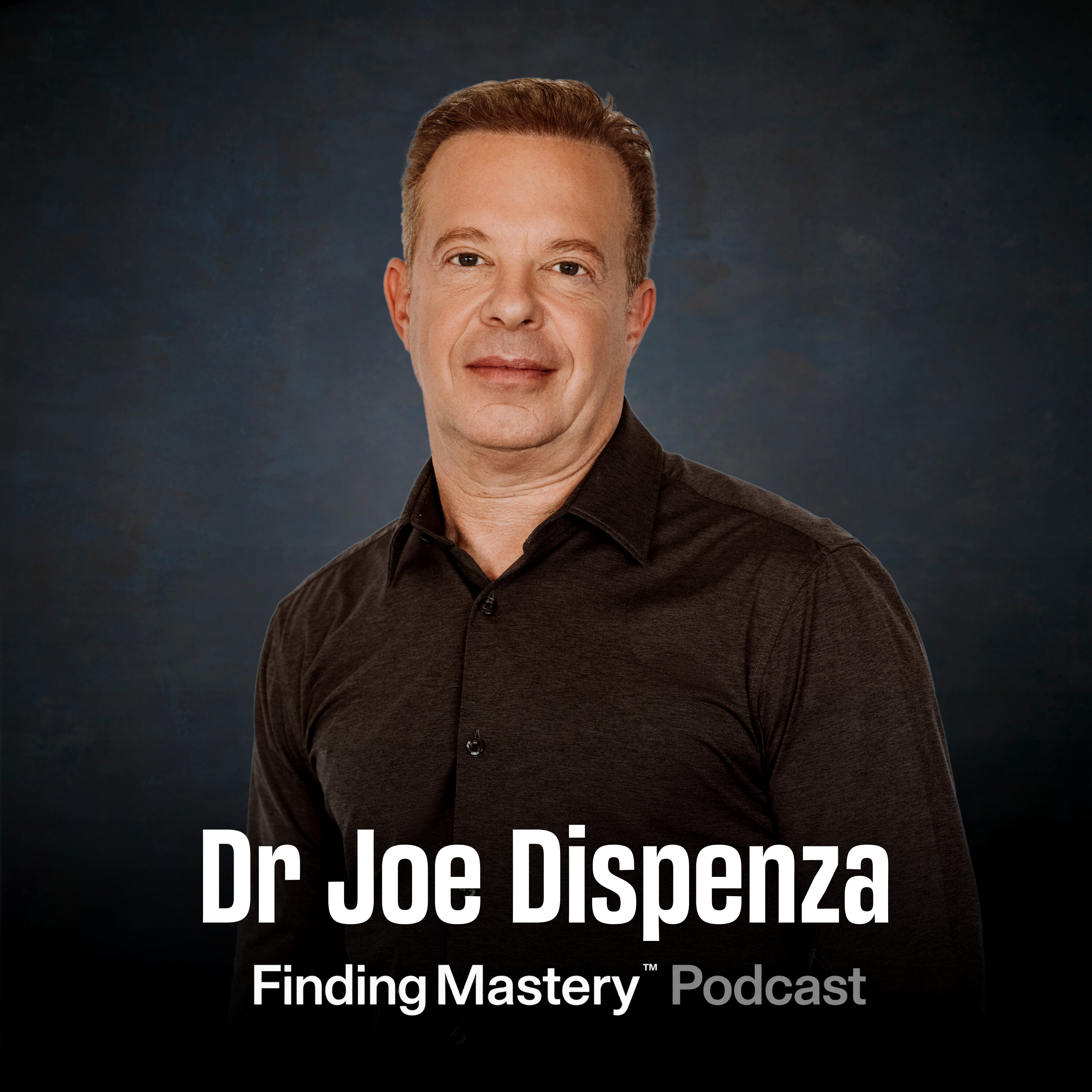
How “change” happens psychologically and biologically—by unlearning automatic thought patterns, becoming aware of unconscious beliefs, and shifting from survival-mode physiology to a coherent, present-moment state. The episode argues that when people truly change their mind and behavior, downstream effects can include improvements in chronic conditions (even remission of terminal diagnoses), brain/heart function, microbiome, muscle strength, gait, breath, and gene expression. It emphasizes that knowledge must be practiced (not just believed) to rewire neurocircuitry, and that meditation/retreats help people catch themselves going unconscious and stay longer at the “messy edge” where transformation occurs.
Dr. Joe Dispenza (New York Times bestselling author; lecturer/researcher/educator). He’s known for books including Breaking the Habit of Being Yourself and You Are the Placebo.
Change requires breaking the habit of “being yourself” and noticing unconscious thoughts; emotions are physiological signals; the prefrontal cortex can be strengthened to resist limbic hijacking; stress is “addictive”; heart coherence (with EEG/HeartMath research) can reset the amygdala and shift the brain into a creative, coherent state.
Parkinson’s, eczema, and spinal cord injury reportedly improving after mindset change; meditation retreats (2.5-day and 7-day) used to train awareness and “temper the animal”; mental rehearsal/visualization to prime future behavior; Tom Brady cited as an example of wanting the high-stakes unknown.
Written by AI. May contain mistakes.
Explore the process of change and the importance of unlearning.
“The only way you're going to change is to unlearn.”
Discuss the importance of self-knowledge and its role in empowerment.
“Yeah, you are doing so much good for people.”
Understanding that change is essential for life transformation.
“You know, I would like to kind of pull on some of those strings, but foundationally, I'll work in reverse order.”
Investigate what makes change difficult and how to overcome barriers.
“I think a lot of people know what they want to change.”
Explore how scientific understanding can facilitate personal transformation.
“So we just thought, oh, you know, we may see some changes with certain, you know, chronic health conditions, but we never expected to see, you know, diagnosed terminal health conditions going through remission.”
Understand how belief systems influence our ability to change.
“When you have the experience, when you embody it, you can repeat it.”
Learn about how the body and mind connect through emotions and memories.
“that's creating the emotion and the emotion that the person is recalling and remembering by thought alone.”
Understand the importance of unlearning past behaviors for change.
“The body's believing it's living in the past.”
Explore how emotional states impact creativity and brain function during change.
“And energy naturally moves into the heart.”
Learn how the heart influences the brain to create a coherent state for better well-being.
“now the heart starts informing the brain something else.”
Understand the effects of stress on perception and the importance of living in the present.
“So when we're stressed out and we're on the freeway or we're impatient and we can't get to where we need to be, we're stepping on the gas, the fight or flight neuroses, we're stepping on the brake at the same time.”
Learn how to transform insights into actionable changes in life.
“and then put it towards like building something that is not just entertainment, but building something that actually can move.”
Discover the impact of mental rehearsal on behavior and belief.
“And, you know, what is it for me to change?”
Explore methods to manage emotions and promote healing.
“Elite operators in sport and environments of consequence, they love it.”
Understand how individuals can teach themselves to heal.
“Yeah, but one hour or 45 minutes in a meditation or 30 minutes in meditation, spend the rest of your day stressed out.”
Learn about brainwave states and their role in personal transformation.
“And the door between the technically relaxed and awake.”
Discover how gamma brainwaves contribute to transformation and healing.
“The person has a transformation when there's a connection.”
Exploring how visualization and imagination can facilitate physical healing.
“It's controlling, coordinating all other systems.”
How breathing techniques influence brainwaves and stress responses.
“I thought, okay, so we got to go from narrow to broad.”
Exploration of how meditation influences health and biochemical responses.
“They want to go through and experiment what you're doing.”
Discussion on how shared experiences impact biological changes in individuals.
“One out of four people get a great response.”
Insights into the immersive experiences at events and their broad demographic.
“You know what's cool is like, it's cheap.”
Exploration of the concept of mastery and the grace that accompanies it.
“and 80 different countries from around the world.”

Get the gist, explore an idea or ask about something said.
 Claude
On Finding Mastery with Dr. Michael Gervais, what are the key points of this episode?
Searching your listeningAutomatic transcript. May contain errors.
0:00The only way you're going to change is to unlearn. The only way you're going to change is to break the habit of being yourself. The only way you're going to change is to become conscious of those unconscious thoughts that have been slipping by your awareness, unnoticed by you. What are you pointing to? Nobody's talking about change. We never expected to see, you know, diagnosed terminal health conditions go into remission. And medical conditions that were staying the same were getting worse all of a sudden completely get better. And so everything changes when we change. Dr. Joe Dispenza is a New York Times bestselling author of books like Breaking the Habit of Being Yourself and You Are the Placebo.
0:33He is well known as a lecturer, researcher, and educator. I think that a lot of people wait for crisis or trauma or disease or diagnosis, you know, hit their lowest denominator where they finally make up their mind to change. And my message really is why wait for that? You're going after just the thinking part of it to get to the behavioral changes. We all of a sudden see the Parkinson's. There it is. Now it's gone. There's the eczema. There it is. Now it's gone. There's a spinal cord injury. There it is. Now it's gone. Your human nervous system can manufacture a pharmacy of chemicals that works three times better than any drug.
1:05Dr. Michael Gervais: That's what our data says. That's the part that I think people are craving from you. How? I'm going to give you the short answer to this.
1:17Dr. Michael Gervais: Joe, I relish the time that I get to spend with you. So thank you for being here. and I'm really excited to have this conversation. No, I'm so excited to be with you too. Yeah, you are doing so much good for people. You know, I don't know if you've lost track of how much good and how many people or you've ever counted, but the groundswell that you've created from getting right on the edge and taking some bold swipes at like best practices and, you know, being brave enough to be on the fringe and being brave enough to be on the frontier, I respect you for that. Thank you so much. That means a lot to me.
1:53Dr. Michael Gervais: What do you hope people will learn or experience through our conversation today? I think knowledge is power and knowledge about yourself is self-empowerment. And for me, I'm a pragmatist. I'm not into dinner conversation. I want to know what I learn, what information that I embrace, what knowledge or philosophy or theory that I understand. Is it the truth? And the only way you know it's the truth is if you put it into practice, right? You have to initiate that knowledge. You have to demonstrate. You have to apply it. You have to personalize it. And I think that for me personally, I like the idea of giving people the tools to question the nature of reality.
2:32Is it really the way I believe it is or am I seeing it? Can I see it another way? And then what can I do about that? Because I think this is a time in history where it's not enough to know. It's time in history to know how. So lifestyle, living a better life is what people are after. So I want to understand the science of change and transformation and help people understand that when you change, your life changes and nothing changes in our life until we change.
2:57Dr. Michael Gervais: I mean, if there's gems per minute, you dropped about 12 of them. You know, I would like to kind of pull on some of those strings, but foundationally, I'll work in reverse order. If you don't change, life doesn't change. Exactly the truth. And your life purpose is to help people understand from a knowledge standpoint first, and then a how standpoint second, I think is what you're saying, on how to actually become more of who you want to become. Yeah. I think a lot of people know what they want to change. They know why they want to change. They just don't know how to change. Or they've forgotten that they know how to change, one or the other.
3:36And so my interest then is to demystify that process. Why is change so hard? If I do change, does my life change? You know, what is change? What is the definition of change? And I think that a lot of people wait for crisis, trauma, or disease, or diagnosis, you know, hit their lowest denominator, where they finally make up their mind to change. And my message really is why wait for that, you know, that you can learn and change in a state of pain and suffering, or you can change in a state of joy and inspiration, right? So what we're discovering right now, I don't think, I never thought in my life that we you would see the effects of when a person truly changes.
4:11What happens to their health, what happens to their brain, what happens to their heart, what happens to their face, what happens to their voice, what happens to their microbiome, what happens to their muscle strength, what happens to their gait, what happens to their breath, their breast milk, their gene expressions. All these things are actually downward cascades of when a person truly makes up their mind to change, and so many people that have changed from one state of mind and body to another, this is the surprising part. I never thought I would see the kind of outcomes that took place in chronic health conditions, right?
4:45Because chronic health conditions are based on lifestyle, which means the change of lifestyle is to change your chronic health conditions. So nobody's talking about change. So we just thought, oh, you know, we may see some changes with certain, you know, chronic health conditions, but we never expected to see, you know, diagnosed terminal health conditions going through remission. And medical conditions that were staying the same we're getting worse, all of a sudden completely get better. And so everything changes when we
5:10Dr. Michael Gervais: change. And you're going after specifically how to change thought patterns that are born from thoughts. And you're going after just the thinking part of it to get to the behavioral changes. I think there's a little bit more to that. Okay. And this is what we discovered. If you give people sound scientific information, and I believe that science is the contemporary language of mysticism. I think it's what demystifies the mystical. And I've learned over the years that if you talk religion or culture or tradition or spirituality, you're going to divide the audience. But science kind of unifies and creates community.
5:47So as I said, when people gain the information, they gain the knowledge, they're making new stitches in their neurocircuitry. It's so much easier to forget this information than to remember it. We discovered that if we give people the information and nothing's left to conjecture or superstition or dogma. They begin to understand it. And once they understand it and comprehend it, we ask them to teach it back to the person next to them. If they can't teach it back, it's not wired in their brain, right? They don't really understand it. So you have to remind yourself constantly of what you're learning.
6:17And the research from the Nobel Prize laureate, Kandel, in the year 2000, he said that you focus on one concept or an idea for about an hour, and you'll double the number of connections in your brain. But if you don't review it, If you don't think about it, it prunes apart within hours, right? So we discovered that people learn the information, they expose themselves to the information, they teach it back to each other, they build a model of understanding, nerve cells that fire together, wire together. They begin to install the neurological hardware in their brain in preparation for the experience, right?
6:49So then the more they understand what they're doing and why they're doing it, the how gets easier because they can assign meaning to the task. And when you assign meaning to a task, you switch on the boss of the brain, which is the prefrontal cortex, and it wants an outcome. And that outcome is called intention. You get very clear, and the frontal lobe is now silencing all the other circuits in the brain like, I can't, it's too hard, it'll never change, it's my mother's fault, what about this that happened 20 years ago, I don't feel like it. It silences all those circuits because it's making a decision with firm intention.
7:20Now, the person, as I said, takes the information and does something with it. If they apply it, if they personalize it, if they initiate it, then if they get their behaviors to match their intentions, they get their actions equal to their thoughts, they're going to run into a new experience. Now, experience enriches circuitry in the brain. But the end product of the experience is called the emotion. And once you feel unlimited, once you feel successful, once you feel abundant, once you feel whole, now you're teaching your body chemically to understand what your mind is intellectually understood.
7:51So in that moment, you're embodying the truth of that philosophy, chemically instructing the body to understand what the mind is intellectually understood. And now the information is no longer in the mind. Now the information is in the body, right? And this is how people start to overcome themselves and overcome their past. And in the beginning, it's awkward. It's uncomfortable because the hardest part about change is not making the same choice as you did the day before. And even when you're not changing, you're still choosing, right? But to make a different choice and do something differently, it makes sense that the more you understand the knowledge and the information, the more prone you are to, you know, as a precursor, you create that experience, right?
8:30And then the next question is, is that how do you sustain it? Well, you have to keep repeating the experience at will. And every time you repeat the experience neurochemically, neurologically, and chemically, you're conditioning the mind and body to begin to align to begin to work as one. And the body becomes so conditioned that it now knows how to do it better than the conscious mind. Now you've become that knowledge, right? Now you've mastered that philosophy. It's innate in you. It's automatic. When you have the experience, when you embody it, you can repeat it. Now it's more automatic. It's innate.
9:01It's who you are, right? So it really is about believing, behaving, and becoming. It really is about knowledge and experience and wisdom, you know, mind, body, soul, you know, thinking, doing, being.
9:10Dr. Michael Gervais: There's a nuance in there. I think it's really important, which is amongst all the things that you were waxing on is that the emotion that we experience is a physiological signal. It's a physiological experience. You can observe emotions, okay? You can't observe feelings. They're private. They're intimate. They're part of the making sense of the emotion. And what you're suggesting is if you can get this prefrontal cortex, which is one of the greatest assets of the human experience. It's the crowning achievement of the human being. Yeah, how about it? It's the majority of our brain. 40%. 40%. And it can easily be overridden by the limbic system, by the amygdala, as people would recognize.
9:54Dr. Michael Gervais: Easily overridden. So we must figure out this seat of consciousness, the seat of decision-making. How do we fortify, build, develop, strengthen, become more attuned to that part of our brain and not let the external world hijack it, not let the internal world, our threat detectors, hijack it? And if we can do that, and then we can create on this loop that you're talking about a certain way of thinking that leads to a thought pattern, that leads to a habit of thought is the language I like to think about. You call it belief system, which I'm down with. I'm totally down with it. Belief is just a thought you keep thinking over and over again.
10:31Dr. Michael Gervais: Over and over and over and over again that becomes automatic. Listen, I'm so lined with you change your belief system like you got a chance. You got a real chance. If you are going to continually bump up against your belief system or your habits of thought, you find yourself kind of lapping in the same pool for the rest of your life. And so here was my point. If you can get that circuitry between the way that you, this idea of who you want to be, and I want to pick that apart just a moment. The way you want to be, the way that that version of you talks, and then you can start getting the behavioral and emotional system to synchronize together.
11:05Dr. Michael Gervais: now you are in your language, a new you. We're in a new state of being. New state of being. And then, and so what's so great about it is like when I'm around you and I'm like, ah, yeah, let's talk about potential and possibility. And like, I can feel it. Like there's an electric visceral, like interest in ideas and not a critique of ideas or hardening of like, there's just. A wondering, yeah. That's a good word. And if you're around that type of thinking loop or those types of people, those types of environments, it's easy, but your responsibility is to be responsible for your loop. Right. How about it?
11:39Independent, by the way, of what you believe anybody else is doing to you. Oh, yeah.
11:44Dr. Michael Gervais: Okay, so that, I want to talk about version of you, okay? Is it also true that if you're unaware of your thoughts, emotions, and behaviors, and you confine yourself easily into a state of sickness, how do you discern our responsibility? Because certainly, I don't know, the most tragic three-year-old that has leukemia, they didn't think their way into it. Sure. You know, so how do you go both sides of the coin? Okay, let's start with something that I think would be most practical for people. By the time we're in the middle of our life, almost 100 % of who we are is programmed. A set of hardwired beliefs and perceptions and thoughts and attitudes.
12:22The brain is a record of the past. It's a memory bank. Reality is a memory, right? So we're seeing reality through the lens of our memories, right?
12:31Dr. Michael Gervais: Open that up because that's a really important thought. The brain is an artifact. It's a memory bank of everything you've learned and experienced to this moment. So if you wake up in the morning and you start thinking about your problems, and those problems are memories that are etched in the brain, that are connected to certain people and objects and things at certain times and places, theoretically, the moment you're remembering the problem, you're remembering the past. So if a memory is known, then it is familiar and it's the same, right? So most people, they start their day reaffirming their identity.
13:04to the memories that they have that are etched in their brain. There's nothing wrong with that. The problem is if you believe that your thoughts have something to do with your destiny and you're thinking the same thoughts, your life is going to stay the same. It's just the way it works. In fact, there's about a 500 millisecond pause when we wake up where we don't know who we are. We haven't quite anchored in there. If you're in a hotel room like I am, a lot of times it could be up to 10 seconds where you don't know who you are or where you are. It's a weird feeling. Yeah, it's a weird feeling.
13:30Yeah. But for the most part, people, they start thinking in the past. And every one of those problems has an emotion associated with it because they've experienced it. So the moment they think about their coworker or their boss or their problems in their life, and they feel the emotion associated with that problem, now the body's in the past. Because thoughts are the language of the brain and feelings are the language of the body. The moment they feel that emotion, the body's so objective as the unconscious mind, And it does not know the difference between the real life experience that's creating the emotion and the emotion that the person is recalling and remembering by thought alone.
14:06The body is getting a dose of the past because the same emotion is familiar. So it's that thought and that feeling. It's that memory and that emotion. It's that stimulus and response that's conditioned the body, become the mind of that emotion. Now the body's believing it's always living in the past. Now the emotion -
14:24Dr. Michael Gervais: Wait, what does that last mean? The body is what? Body Mastery is brought to you by Fatty 15. Okay, let's talk about longevity. Longevity is much more than simply adding years. It's about maintaining health and a zest and a vitality and enhanced performance as you age. And that's why I'm excited about Fatty 15. It's an award-winning supplement. It's powered by C15, which is the first essential fatty acid discovered in over 90 years. Okay, so C15, it's a geroprotector. What that means is it helps to slow biological aging by strengthening your cells, basically protecting them from damage. You can think of it like kind of like a 401k for your health where you're investing in cellular quote unquote resilience.
15:08Dr. Michael Gervais: And I dug into the research on the relationship between C15 and heart health. I love what I saw. Fatty 15 is on a mission to optimize your C15 levels to help you live healthier longer. Get 15 % off your 90-day subscription starter kit by heading to fatty15.com slash findingmastery and use the code findingmastery at checkout. That's fatty, F-A-T-T-Y, 15.com slash findingmastery. Start investing in your long-term health today. Finding Mastery is brought to you by LinkedIn Hiring Pro. When you're building a small business, every new hire has the potential to make a real impact. The right person, they can bring fresh energy and new ideas and really help the whole company move forward.
15:53Dr. Michael Gervais: It's awesome to watch when you get it right. So finding that right person, finding that great hire, it takes clarity. You have to know what you're looking for. You have to recognize it when you see it and then make the call with confidence that this is the right hire. That's where LinkedIn Hiring Pro can help. It's really like having a hiring partner throughout the entire process. You can chat with it just like you would a recruiter. You tell it what matters most for you, for the role, compare candidates side by side, you give it feedback, and then Hiring Pro listens, it adjusts, it helps surface the people who actually might fit what you need.
16:23Dr. Michael Gervais: They're trying to help us optimize. We're still the ones making the decision. LinkedIn Hiring Pro is just a smarter way to find the right people to build the team of your dreams. Now, if you haven't already checked them out, LinkedIn Hiring Pro can really help your business. Get started by posting your job for free at linkedin.com slash finding mastery. Terms and conditions apply. Again, that's linkedin.com slash finding mastery. The body's believing it's living in the past. It really believes it's in the same past experience. The brain, let me think this through really quickly. The brain is holding memory, correct?
17:01Dr. Michael Gervais: It's survival-based. It is also a meaning-making mechanism, and it's also a forward projection mechanism. Maybe I'm going to collapse two ideas, is the mind and the brain in what I'm saying. And so are you saying just the tissue, the neurochemistry of the brain is primarily responsible for memory? I'm saying that the majority of the rest of the brain is all associative memory, right? Even the layers of our visual cortex are all pattern recognition, right? That's correct. So what I'm saying is, is that the majority of people, when they wake up in the morning, who they are is a memory of the past, both neurologically and neurochemically and hormonally.
17:41The body as exactly believing that it's in the same past experience will begin over time to maintain its state or potentially get worse because there's no new information emotionally that the body's receiving. And I think one of the reasons that— Oh, that's why you're pointing to that small gap.
17:58Dr. Michael Gervais: Yes. In the morning. Yeah. Okay. So then the question was, how do people ultimately get sick, right? So if 95 to 100 % of who we are are the same thoughts and the same behaviors, and what is a habit? When you've done something so many times, the body can do it better than the conscious mind. In other words, the body's behaving as if it's in its past. So now you have the brain in its past. You have the body habituated in a program subconsciously where the body is the mind and it's running the show. You have a thought and you automatically behave in a certain way. It could be complaining, be blaming, be making excuses, it could be feeling sorry for yourself.
18:35It could be judging another person. But if you practice it a lot, it just gets easier to perform, right? That's just another way that we become wired. So then the stronger the emotions that we feel from conditions in our life, the more altered we are inside of us. That change in that chemical continuity arouses the brain. And the arousal of the brain causes us to narrow our focus on whatever the cause is. and the brain takes a snapshot and that's called a long-term memory. The stronger the emotion, the more you remember the event. So now it's embossed neurologically in the brain. So then the body then, we don't know this, but when we relive the trauma 50 times in one day, we're teaching the body how to stay in the past.
19:17So then now the person wants the change and they're subconsciously conditioned emotionally where the body's believing it's in the past, right? They're behaving as if they're in their past and they're believing in their past, right? And that's 95 to 100 % of who they are. So if you're going to change, this is not about positive thinking. To answer your question, the only way you're going to change is to unlearn. The only way you're going to change is to break the habit of being yourself. The only way you're going to change is to become conscious of those unconscious thoughts that have been slipping by your awareness, unnoticed by you.
19:52And everything is always fine when there's no discomfort. But if you say, I want to be healthy now, or I want to be wealthy, or I want to be in love, or I want to have a mystical experience, or I want to have a greater life, there's going to be a lot of voices in your head because the moment you start believing in something else, if the body and the brain are programmed into the past, it's going to say, good luck. And you may start out really good with great intentions the first two hours, and the body starts craving the emotions, starts telling the brain, think this way. Make the same choice.
20:21Do the same thing. Create the same experience. It really complains so you can feel the emotion of it and return back to the same self. And the default is so seamless because it's automatic. And so people start off their day with really great intentions. But it's so common for us to go unconscious. And how many times do we have to forget until we stop forgetting and start remembering? That's called the moment of change. So to answer the question, the brain learns by mistakes. It absolutely learns by mistakes. and you're going to catch yourself going unconscious 50 times, but returning and coming back is the labor.
20:59It's the victory. It's really hard to do. It's really hard to do. What we discovered is it takes an enormous amount of energy and an enormous amount of awareness to catch ourselves from going unconscious. So then we use meditation as the model, one of the models we use to teach change. Why? Because the moment you close your eyes and you disconnect from the environment and you reduce the sensory information and you play music in the background to fill the space and you're not eating, you're tasting and smelling, you're not experiencing and feeling. All you're left with is your kind of thoughts and feelings, right?
21:34And in the beginning of our week-long retreats, you see so many people coming up against themselves because the body's used to getting agitated and frustrated and impatient and judgmental and you're denying it. It's reality, right? And like an untrained animal, it starts to get aroused, it starts getting stressed. This is where most people give up on themselves and that becomes the habit.
21:54Dr. Michael Gervais: Certainly without a mentor, a coach, a teacher. Telling them what to do. An elder. Yeah, to say, look, here's the wisdom of what works. Try this. Or you notice you want to get up and start doing something during the meditation and you catch yourself where your body's kind of on a program and you execute a will that's greater than the program. That tempering process is the difficult part because what you're doing is you're telling the body it's no longer the mind, that you're the mind. And you're executing a will that's greater than the program. And the body bucks and kicks like an unbridled stallion.
22:27But if you keep working with it and you keep doing it, sooner or later it surrenders to a new mind. And what we discovered is that there's this huge liberation of energy in the body. There's a huge liberation of energy. And energy naturally moves into the heart. The person's moving out of stress. They're moving out of survival. They're no longer tormenting their body, right? And I think that that kind of liberation is how joy is born.
22:48Dr. Michael Gervais: So in your retreats, I will ask you to describe the retreat so people can conceptualize what actually you're doing for, I think you've got a three day and a five day, or is it a two day and a five day? It's a two and a half day and a seven day. Seven day. Okay. We'll ask you to do that. But is the process more about getting to that messy edge, that reflexive state where your brain says, you got to get up. This is where you get agitated and then just kind of run that program. It's a better program to be agitated. It's kept you safe. Be agitated right now and you're good. Are you more interested in getting to that messy edge?
23:23Dr. Michael Gervais: And then it's going to sound so cheesy, but like breaking through it. Or are you more interested in the process to become more aware? And in that process of becoming more aware, you can repeat that higher level of being with awareness when you leave the retreat. Yeah, I don't think you can have one without the other. I don't think you could. but I do think when I look at, let's say, the hustle hard mentality coaches, they just want to get people to the edge and then stay in it, lift one more rep. Let me define the edge because it's very different than anything physical. Many people come to our work because the chemo didn't work, the surgeries didn't work, the radiation didn't work, the drug trials didn't work, the diets didn't work.
24:07And the only thing they were left with is their belief in themselves, right? And I believe that your belief in yourself must be earned. No one's coming for you. No one's going to do it for you, right? It's just something that you have to fully embody. And so many people will say, oh, God, I saw the testimonials of your work, and I really believed it was possible. I just didn't believe it was possible for me. Now, this is the moment you get out of the bleachers and you get on the playing field. This is the moment where you have to show up for yourself. And so what we discovered in our research is that when people come to that edge, They're coming to the edge of their emotional belief.
24:43They're coming to the edge of the known. And if they want something unknown, you know, new, they have to be willing to go past that point. And if we give them something to do, a way to cope and a way to overcome it and practice it, everybody does it. They actually get to that point where they start figuring out how to temper the animal. And when they go past that point, that's when the brain changes the most. That's the one point. The second point is, the only way you're going to become more conscious in your life is to catch yourself going unconscious.
25:15Dr. Michael Gervais: Would you replace the word conscious with awareness? Same thing. Okay. To me, same thing. Use the word awareness just for a moment. The only way that you will become more aware. Is by catching yourself becoming unaware. That's right. Yeah. Or forgetting. Okay. Yeah. Or forgetting. Yeah. Clear. So we're biologically programmed in survival to run from the unknown, right? I mean, you have better chances of survival if you just run from the unknown than if you stick around. So here we are now. You told me the brain was kind of remembering the past and predicting the future. Well, if you can remember the familiar past, that's a known.
25:46And if you can predict the future, that's a known. The only place where the unknown exists is the present moment. Now, this goes against survival. 100%. This is a luxury.
25:56Dr. Michael Gervais: All right. So when you get people to relax into the present moment and you give them the signs behind it, what they're doing is they're relaxing into the unknown. They're relaxing into uncertainty. And when they can condition their body to do that, there's a very dramatic physiological change that takes place. Remember, we were talking earlier about the prefrontal cortex and, you know, how do you get better at using it? Well, it's the boss. It's the CEO. It's the symphony leader. It has intention. It has attention. It has will. It speculates. It examines possibilities.
26:31It creative part of the brain. But you can't create when you're living in survival. It's not a time to create. It's time to run, fight, and hide. Unfortunately, people spend more than 70 % of their waking day in that state of survival, that vigilance, that readiness, the anxiety, you know, all the things, the resentment, the competition, all that stuff is the body ready to survive, right? Or fear or pain or anger or whatever it is, right? Right? So when the person kind of finally, this takes about two days in our retreats, when a person finally finds the sweet spot of the generous present moment, and they can relax into the unknown, there's a dramatic change in their physiology.
27:09Energy naturally moves right into the heart. It just goes there. We just see all of a sudden the heart beating like a great drum. It goes into this beautiful level of order and coherence. And the heart's the creative center. It's the union of opposites, of polarity and dualities, where wholeness begins. So now the heart, think about this. When you're in the freeway and you're really agitated and really angry, your heart is telling your brain, pay attention to the outer world. Look for all of the things in the outer world that could potentially cause anger for you. It filters that, right? If it's fear, the reticular activating system changes the image.
27:44Now you're looking for all the things that are potentially you're afraid of. So now when the heart is doing that, it's informing the brain to stay in survival. If energy moves into the heart and you're feeling grateful and you're feeling in love with life and you're feeling you appreciate the moment and you feel overjoyed that you're alive and you have this kind of joy for existence, now the heart starts informing the brain something else. The trauma's over. The past is over. The betrayal is over. The stressor is over. The event is over. And it sends a signal right to the amygdala that tells the amygdala, let's reset the baseline.
28:16And what happens is the body naturally moves out of the past. When we look at real-time scans, Mike, we see these people moving to these beautiful levels of heart coherence, but we have them hooked up to an EEG, and all of a sudden, the heart is telling the brain. It's just like grabbing a big sheet and going like this. There's this kind of wave of alpha that moves right into the forebrain. Which is a calm focus. Which is telling the brain to imagine, to dream, to create, to be. Now we're out of survival, and now this is the perfect state to create in, right? And energy in the heart gets highly organized and energy in the brain gets super coherent.
28:52Now you have a coherent heart and a coherent brain. You got a pretty good state of being.
28:56Dr. Michael Gervais: It's worth us explaining coherence from a electrical standpoint that is worthwhile us opening up. The other thing, reticular activating system also known as the RAS is basically a funnel in, in our brains that are saying, pay attention, don't pay attention. So swings open and close. And when you have an emotional state, whatever it is, it is looking for reinforcement of why you're feeling that way. It's a mechanism that is bizarre, but beyond conscious awareness, if a certain smell was around food or, um, but you couldn't even, you didn't even smell it yet, but you looked at something or you smell something and it's like, it's rotten, that's dangerous.
29:31Dr. Michael Gervais: Maybe your brain is supposed to respond to that before you actually put yourself in danger. So that is one of the mechanisms why we think that that exists. All that being said, I do want to, before we get to the coherence piece. I do want to get to this parallel between elite sport operators and who you're describing. Sure. I've been fortunate to work with like best in the world across multiple disciplines in sport. And people like to ask like, what is the, what's the red thread? What's the golden thread, if you will, between them? And I wish I could tell you with great simplicity, it's this, but I will say, and I, because I can't, I don't know.
30:08There's, they are more
30:10Dr. Michael Gervais: similar than dissimilar, but they're all unique in the way that they approach their life. But there is one commonality, and that commonality is a radical appreciation or the courage to get to the messy edge, to the space where everything could fall apart or unlock something. And the forcing function to be there long enough for the unlock or the mistake-making is a deep appreciation for the unfolding, unpredictable unknown. For sure. That's the present moment. Yeah. And they have a higher tolerance. They have a better appetite. They have better skills to manage themselves once they're there. And they have better skills to, and community, I think, to help propel them to that danger line.
30:57Dr. Michael Gervais: And once they're in that place and they love it, they're like, this is where it happens. they understand they have a different appreciation for the present moment. I think all the mystics have it. I think the best, you know, adventurers have it. I think the best operators in business and the best operators in relationships, and you're describing the best humans in health would also have the ability to be here more often, which sounds almost so trite, but that's what you're helping people do. Get to that just beyond that reflexive, normal response for them of agitation, irritation, fear, or whatever it might be, and say, just stay it a little longer.
31:33See what happens. Wow, there's a lot there. I do want to say one last comment about the reticular activating system because I do think that when you do find that place where the heart's informing the brain that the trauma or the stressor is over.
31:46Dr. Michael Gervais: Where the heart is informing the brain. Yeah, I'm talking about this center, where the heart begins to beat very coherently, very orderly, right? So think of incoherences like choppy waves in a sea, right? When those waves come together, they interfere with each other and they deconstruct, they cancel each other out. And that's when energy in the heart goes down. In other words, we've all felt stress and felt our heart kind of contract. When you feel resentment, when you feel impatience, when you feel frustration, the heart produces a very specific pattern. That pattern is a frequency. And usually that pattern is very incoherent, very out of order.
32:22Dr. Michael Gervais: I want to interrupt because this is not something you are making up. There's a well-established bit of research around brain coherence, heart coherence. What was the product? It was like 20 years ago, HeartMath? Sure, HeartMath. Are they still around? Yeah, we do research with the HeartMath Institute. Yeah, so that's kind of where I was introduced to the first product I was familiar with. And so I just want to remind the listener that there is this word coherence. I know you're going to get to RAS. It's a thing. Yeah, this is not you making up this word. Coherence is actually a synchronicity across electrical frequencies in the brain and heart.
32:56Dr. Michael Gervais: actually practice and get really good at. That's the part that I think people are craving from you. How? Finding Mastery is brought to you by Momentus. There's a principle that the team at Momentus uses that has stuck with me. The relentless pursuit of better. Creatine is a good window into what they mean by it. Creatine is one of the most studied supplements in the world. The benefits are reasonably well-established. Strength, power, recovery, and increasingly what it does for the brain. It's been found to support brain energy metabolism and easing mental fatigue. So this is something a lot of people do take every day.
33:30Dr. Michael Gervais: And when you take something on a regular basis, what's in it, what's not, and how consistently it's made all start to add up. That's the part that Momentus obsessed over. Rather than settle for what's on the market, they searched the planet for the highest quality creatine source. Then they built their own specification around it. They call it the signature spec. It's made in a pharmaceutical facility, 10 times fewer impurities, six stages of testing across four independent agencies, NSF certified for sport, and it's micronized so finely it actually mixes clean. No grit. Go to livemomentous.com slash findingmastery and use the code findingmastery for up to 35 % off your first order.
34:10Dr. Michael Gervais: Again, that's livemomentous.com slash findingmastery, code findingmastery. Bonnie Master is brought to you by Granola. Here's something that I think most of us miss without even really realizing it. Every conversation that we have has two layers happening at once. There's the conversation, the obvious conversation with the words themselves. And then there's everything else underneath. That's the emotional language, the subtle tones of voice, micro expressions, the brief pauses before someone answers. That second layer is really rich with information. and in meetings, it's easy to miss it when our heads are down and we're taking notes.
34:47Dr. Michael Gervais: That is why I use Granola. Granola is an AI-powered notepad that makes your meeting notes useful. It captures what happens in your meetings and then turns them into clean, structured notes with decision and action items pulled out and made easy to find. And the best part, it works right through your device's audio, which means that it integrates seamlessly into the video conferencing tools that you already use. No big setup, no awkward bots. I use it every day when my meetings are done. There's a clean recap and a clear set of next steps that are just waiting for me. Nothing slips away. This isn't about doing less.
35:18Dr. Michael Gervais: It's about being more present. I think you're really going to like what Granola is doing. Once you try it on a first meeting, it's hard to go without. You can try it totally free. Head to granola.ai slash mastery. That's granola.ai slash mastery to get your time back. Go to granola.ai slash mastery and try it on your next call. yeah so when the heart you know when we move out of survival right and the information from the heart is going to the brain the heart's telling the brain to see beauty in all things find gratitude in your life find the reasons you're grateful the filter changes completely and people all of a sudden pro-social networks turn on the brain and the protective net network shut off and we move closer together trust one another more and we have a greater appreciation for life and for the moment That's kind of the natural state of being when we're not in survival.
36:08So when we're stressed out and we're on the freeway or we're impatient and we can't get to where we need to be, we're stepping on the gas, the fight or flight neuroses, we're stepping on the brake at the same time. Heart's pounding because it believes there's a threat around the corner, but you're in traffic, right? So the heart is beating against the closed system. And when it beats against a closed system, it starts becoming very erratic. It starts beating incoherently. And that becomes a kind of a conditioned response because we could say that as the person thinks about their problems or reacts to someone in their life, they're telling their body that the threat and the danger is always there, right?
36:40Dr. Michael Gervais: And it's the body staying aroused and staying in that state, right? I had the most unbelievable experience this morning. I was driving, it was a beach city that I was coming in here. And this unhoused person was carrying what looked like a half of a mattress, definitely their home. And it was over two shoulders and it was a sad visual to see. And they were crossing the street and a car was pissed. And the car came right up to him aggressively to let him know that you, I don't think you should be here. He was crossing the street to his best ability. And then he got to the side of the road and the car sped off and there was a red light kind of, I don't know, like 50 feet ahead of him.
37:23Dr. Michael Gervais: And it was stops at the red light. and the unhoused person comes right next to them and says, hey man, you're stressed out. This is a person that doesn't have a home. You should take care of yourself. What's wrong with you? Look at me, he says. You should take care of yourself. Why are you so stressed out? And I'm like, wow. Like that person who's clearly would love a shelter, would love a bath, it looks like at least to me, was giving the sage wisdom to this person who had probably all the accruciements that you would hope. So I share that with you because we are stressed. No, stress is addictive, period.
38:06What do you mean by that? The arousal of the stress hormones heightens the senses. The rush of arousal heightens the senses, and now we narrow our focus on the cause and survival. We have a very narrow focus. We have an object focus. Something in the bushes that's moving, you narrow your focus and you freeze, right? and the arousal is a rush of energy. But what if it's not something in the bushes? What if it's your coworker? What was once very adaptive becomes very maladaptive because our response produces this rush of energy. And in time, we begin to use the people, the problems and the circumstances in our life to reaffirm our addiction to that emotion.
38:43And we become addicted to the life we don't even like. And that's why change sometimes is hard. What do you think the tiger in the bush is now in modern life? Oh gosh, uncertainty. Yeah. I think for me personally, in my life, I've never lived in a time where I felt like there was so much unpredictable states and uncertainty and it seems like that's a bit. And by the way, when you can't predict something, you're in the unknown. And for many people, that's a stressor, right?
39:10Dr. Michael Gervais: Unless you have conditioned your habits of thought to love the unknown, because the unknown is where - Magic happens. Everything beautiful, wisdom is revealed, high performance take place, all the amazing parts of life and the hard parts of life are experienced in the present moment. And people will often ask me, and I want to ask you the same question is like, okay, what are you really trying to do, Mike? What are you really trying to do here? And I'm trying to help people live in the present moment more often because that's where the unlock of all that is lying dormant within them becomes realized and expressed.
39:42Dr. Michael Gervais: And over time, we need to kind of stack these moments together to get to insight, to get to wisdom. Sure. And we were talking earlier about your, you know, we were talking about the elite athlete going to the edge, you know, I think they've reached a certain level of skill sets where they've proven to themselves they can do things really, really well. Because that does take practice, attention, breaking it down, doing it again, watching your states when you're anxious, settling your body. And they're self-regulating all the time, the ones that emerge to the top. But I think that level of mastery, then all of a sudden for that person you're talking about the next level of kind of this virtuosity or this kind of supernatural state where the person wants to be put in the conditions, the circumstances of the unknown, where it's no longer predictable.
40:30And for them, they want to see if they're able to actually slow everything down and still be able to produce an outcome. Now that's like, now you have to be poised and you have to kind of be impromptu in a sense. You know, it's like you have to be able to do it on command, right in that moment, because it can go any way. And I think that's when you get to that level of virtuosity. It's all in there, and this circumstance is going to present itself, and most people are going to collapse, and I got this. I'm going to prove to myself this is the next level, right? So I always think of Tom Brady as an example, just because he's been in Super Bowls.
41:06I'm at halftime thinking they're absolutely going to get crushed. And what is that where you want that test, not victimized by the test, but actually wanting that circumstance to actually unfold because you've trained your whole life for it.
41:21Dr. Michael Gervais: Yeah. There's an unhealthy version and a healthy version, right? Which is I need this moment to be seen and I'll do whatever it takes to be seen. Right. Pretty dysfunctional and unhealthy. And there's another version, which is the virtuoso purity of mastery, which is like, uh, this is the next natural condition that I'm compelled to see how well I can live and operate in that moment. And then I'm most interested, I'm actually disinterested if the narrative stops there. I'm most interested in how do you take those insights about how to be fully absorbed and then take those skills and put it towards relationships and then put it towards like building something that is not just entertainment, but building something that actually can move.
42:08Dr. Michael Gervais: You take that into your life, which is what it's about, no? Yeah. We think about the exemplars for being fully present and changing the world accordingly. It's not the superstars in sport. It's the people that have transformed their insights to something where they're just the emanating exemplar, I'll use that word again, of complete presence. They're totally present. So anyways, off the ivory tower, aspirational aspect, drop us right down into, you said you could go at this at gratitude training, or you listed off a couple of things that you could do. And I can hear executives saying, I know that, but God, it's so, you want me to meditate and do gratitude training?
42:48Dr. Michael Gervais: Like it's so mechanical, so simple. That's not going to do it. And I don't have time for it. Yeah. Well, I would say, so be it. Yeah. But I mean, we just don't teach that kind of simple gratitude training. Everything that we do, I find it really valuable to give information. As I said, when we started, the what and the why is so important for people. People who are the CEO level person, and we do a lot of consulting, a lot of those CEOs have gone from thinking to doing to being. They've made their way. They have a lot of great resources. They already know how to do it. but if they're spending the majority of their life living in stress and they're addicted to the hormones and they're unhappy with their life and they don't know how to change, don't wait for the crisis, right?
43:34I mean, why not start off by saying, how can I change? And, you know, what is it for me to change? And, and it may not be a gratitude meditation. It may be becoming conscious of that 95 % of your unconscious states, you know, in thoughts, behaviors, and emotions, and then sitting down and saying, all right, what do I want to believe? Why don't I remember to think this way? Let me remember to think this way. I'll keep remembering to think this way. I'm going to remind myself to think this way. And nerve cells that fire together, wire together. Keep doing it, all of a sudden it's going to be a new voice in your head.
44:07It's going to be a new belief, a new software program. If you're talking about mental rehearsal, okay, forget about the sports. What about if you want to be patient and you've already been great at sports? Well, I'm sure that if you want to be patient with your children, then you're going to have to actually demonstrate it. It's not philosophical any longer. So now let's get down to mental rehearsal. Instead of mental rehearsing your golf swing or your backflip or whatever it is, why not mental rehearse? What would greatness look like? What would love do in this situation? Let me just prime my brain.
44:36If I can start thinking and mentally rehearsing, the research shows, if you do it enough times, the brain looks like it's already experienced the event. It's no longer a record of the past. Now you're priming the brain. It's a map to the future. Keep rehearsing it in your mind. The hardware becomes more like the software program and you start behaving that way. You have circuits in place to use. And then can I trade the emotions of stress or anger or resentment or impatience for an elevated emotion? Can I teach my body I want to feel this way instead of that way? Can I tell my heart I want it to signal my brain to get creative?
45:09And if it takes 20 minutes to get there,
45:13Dr. Michael Gervais: it's always worth the effort. The science is so compelling about mental imagery. Technically, we're called mental rehearsal. Some people might call it visualization. The science is really compelling. There's nice research about how it strengthens neural pathways. It enhances confidence. It can, and, and, and. It's really good. Elite operators in sport and environments of consequence, they love it. They get it. They use it and practice it. I was asked this morning at breakfast with two colleagues, how much are executives using that practice? I don't think they're ready for it. Listen, I believe that we're mentally rehearsing all the time.
45:53Just what are you mentally rehearsing? Are you mentally rehearsing the fictitious fight with your in-law that you're running through in your mind because you're on the freeway? You're mentally rehearsing. You're actually, you're living that event, right?
46:05Dr. Michael Gervais: So this is a caveat to be, how are you taking the power of that practice in a disciplined way, in an intentional way and carving out time to actually see the most beautiful movie you could imagine. Sure. And you're saying 20 minutes? I'm saying if it takes you 20 minutes to get there. Okay, yeah. If it takes you 20 minutes to get there because your mind is wandering. That's a realistic thing. What the data shows is that athletes do it really easily is because they physically rehearse. And you reach a certain point where you have a lot of circuits in place by experience, right? The ones that can take the experience of what they're doing to the next level.
46:41If the circuits are already in place, they'll use those circuits to mentally rehearse. They'll run through all their plays. They'll run through all their moves. They'll run through everything overnight, whether you're diving, but it doesn't matter what you're doing. But a musician does that too. Musician is always, always riffing in their mind. An actor has to rehearse their lines mentally. They have to put themselves in the scene. So they're priming their brain for the act. So my point is, let's demystify it. So the world-class athlete that has the ability to do it because they have the circuits in place, then how does it practical for someone who doesn't have the circuits in place?
47:13The brain learns by mistakes. You get out there, you fall from grace. You say, where did I go unconscious? What did I do wrong? Okay, if I have that same circumstance again, let me rehearse what I am gonna do. This is evolution. And that's how people actually change because when we see people heal in this work, it's not a linear process. They improve and then they plateau and then they improve and plateau. Why? Because it might not even have dips. Yeah, but one hour or 45 minutes in a meditation or 30 minutes in meditation, spend the rest of your day stressed out. Okay. How am I stressed? My body's out of balance.
47:46Okay. So how am I going to get really good at doing this with my eyes open? The person who feels better, their pain levels are down, they're sleeping through the night, they have more energy, but their blood values are still the same. They don't say this doesn't work. They're saying something's working, but I plateaued. Oh, let me see. My life depends on this. And my reaction to my ex-husband is weakening my body. Mm-mm. the next time I see him, I'm going to demonstrate compassion and kindness for who? For everybody. And that person now is no longer tormenting their body with that emotional response.
48:18And they continue to heal again because they're moving their body back into homeostasis. So it's a practical application. There is no end. There is no end to this because you'll always want to keep evolving into something else.
48:30Dr. Michael Gervais: No different seeing the person versus imagining the person. No difference. When we're running beautiful movies or any movie, horror movies in our mind, anxiety is a little bit like a horror movie. When we're running and playing those movies, there's a physiological downstream impact and response. And so there's a difference, though, that you're highlighting that I just want to capture. There's a difference between a formal practice and an informal practice. So a formal practice is eyes closed, if you will, and setting aside some disciplined time to really create that experience, a movie, if you will.
49:01Dr. Michael Gervais: And then informal is when you are walking to go get your tea or coffee or something, you might have some images that pop up. And that's good. Those are cool. Be aware with them, guide them, shift them. All that's good. It's nice. But that's very different than this sloppy, haphazard, junkyard approach to think that you're doing imagery while you're driving and you haven't actually formally trained it. It's not the same. It's not. But I mean, everything requires training. A lot of people that come to our work, they think they're doing it until they go through a week long event. And they're like, oh my God, I wasn't doing anything like that.
49:36I thought I lifted weights. Now I came to your gym and I'm like, oh, that's lifting weights. But the cool thing about it is that we have so much data. Two thirds of the people. In your community? Yeah. Two thirds of the people in our community teach themselves how to heal. What does that mean? They've never come to a week long event. They read the book. They started doing the meditations. They started reading more. They started studying more. They started doing more meditations. and they taught themselves how to heal at home. They just learned it on their own. Like they didn't come to the gym.
50:06They just would have a trainer. They just went and trained themselves. One of the things that they had in common though was that they never missed a day, almost all of them. They'll just say, I couldn't miss a day.
50:15Dr. Michael Gervais: Do you have a protocol for healing imagery or do you have an experience that people go through to help them extinguish the old patterns and build the new ones? Yeah, I'm gonna give you the short answer to this. We see people heal in a few different ways. One of the ways they heal is to go from one personality to another personality. They stop thinking a certain way. They stop acting a certain way. They stop feeling a certain way. They get in that 95%. And that's how you're defining personality? Yeah, how you think, how you act, and how you feel. And then they start thinking differently. They start acting differently.
50:49They start feeling differently. And they keep doing that over and over again. And that becomes a new personality. We have language specialists that come and study the language of transformation. and there's this kind of sense of temporality, Mike, where they say, I used to be that person, but the disease exists in that person. I'm somebody else. Like, that was the unhappy guy. Like, I'm this guy now, or I'm this woman, or I'm not that person any longer. And there's this kind of sense of temporality where they're just happy with themselves. And many of them will say, I would have never changed and been this happy if I didn't have that disease.
51:23They're no longer victimized by it. They used it as a tool to change, right? So that change sometimes takes place in months. Sometimes we've seen it in less than a month. Could take place weeks or months, years. We've seen people just cross that river of change. It's just taken them a long time. And that's one way. And then there's another way where we've kind of demystified this kind of process where the person gets in the right brain state, where they kind of slow their brainwaves way down. They're relaxed and awake.
51:54Dr. Michael Gervais: Binding Mastery is brought to you by our partners at Lisa. Most of you know that I have a morning mindset routine. It's what I do every morning before I check into the world around me. I check into the world inside of me. And it's just a few quiet moments to set my intention for the day, make sure I answer to the things that I'm grateful for. And I want to focus my attention on what matters most. And what that does is it wakes up the mindset to help me bring the best of myself in the day ahead. Generally speaking, I wake up feeling pretty good. No aches, no stiffness, nothing pulling my focus, you know, the minute that my eyes open up.
52:27Dr. Michael Gervais: So when your body gets the recovery it needs, it is so much easier to set your mind up to help you be your very best. So that's why we turned to Lisa for some support. We've worked with Lisa for a long time now because they build quality crafted mattresses that are tailored to how you actually sleep. Your position, your feel, all of it. Premium materials, premium mattresses, real full body support. The intention they put into their products is real. I love what they're doing. Go to Lisa.com for up to 30 % off mattresses, plus get an extra$50 off with the promo code mastery exclusive for our listeners.
53:00Dr. Michael Gervais: That's L E E S A.com promo code mastery for up to 30 % off mattresses, plus an extra$50 off and let them know we sent you in the survey after checkout. And the door between the technically relaxed and awake. Are you talking about alpha theta? Talking about five to 10 standard deviations outside of normal and theta, like a lot of theta. A lot of theta. A lot of theta. So just a crash course, delta brainwaves is sleeping. Theta is just kind of that. Hypnotic. Yeah, it's right before. Highlight. Yeah, it's also a very ADD-ish type of thing, but not the hyperactivity piece. Alpha is this smooth kind of focus.
53:36Dr. Michael Gervais: Beta is an intense focus. So beta is when your attention's on the outer world. That's how I like to think about it. Oh, that's a good way to think about it. And if I said, hey, I'm going to take you to a dinner party or go to lunch, there's gonna meet five new people, I might not remember their names. Kind of move into kind of this mid-range beta. You kind of perk up, you get a little bit more aroused. But if you're really angry or if you're really fearful, if you're really anxious, if you're really in a lot of pain, you go into this kind of high-level beta. That's when the brain is in emergency, right?
54:03And that's when the gas is on, right? And people get stuck there, right? And we become very narrow-focused. So then as you slow your brainwaves down, you move out of beta, like we're in beta right now. The brain's trying to make meaning between the outer world and the inner world. This is a good beta though. Yeah. I like this. This is low level beta. Yeah. But you're always moving from beta to alpha because the moment you pause and you go like this, you're making your inner world more real than your outer world and that's alpha where you start imagining, you start dreaming. Kind of the voice in your head, the critic in your mind kind of shuts off and you start to see in pictures and images.
54:34So it's a very creative state, right? Alpha. Alpha. If you can keep working on relaxing your body, you could actually put your body into a light sleep, like in a state of rest while you're conscious and awake. Now in theta, the door between the conscious mind and the subconscious mind is wide open. And when it's wide open, we're suggestible to information. So it's a very hypnotic state. So what we discovered is that the person's in a very low level of theta and they're suggestible, but they're not getting suggestions from something in their environment. They're putting their attention on just an experience.
55:08The information tends to make it right through. Yeah, it's pretty awesome. And then now they go into gamma. They go into these elevated levels of gamma. There's an arousal. It's the insight. It's the zone. It's like a lot of different words. It's a connection. And the arousal is in pain. The arousal is in fear. The arousal is in anger. The arousal is ecstasy. The person is connecting to something really big. And that's kind of the language of transformation. We see it. The person has a transformation when there's a connection. And when that happens, and we see these high, high levels of gamma, super consciousness, hyperdrive, it's not taking place in the thinking brain.
55:47It's taking place in the limbic brain, the seat of the autonomic nervous system, right? So remember, stress is autonomic dysregulation. Now you're getting an enormous amount of regulation in gamma. So what happens is that the autonomic nervous system is touching every cell in the body. It's controlling, coordinating all other systems. So now it's being informed with new information. Every cell is getting new information. And that transformation is a body all of a sudden has this kind of biological upgrade. We all of a sudden see the Parkinson's, there it is, now it's gone. There's the eczema, there it is, now it's gone.
56:23There's a spinal cord injury, there it is, now it's gone. All of a sudden there's kind of this transformation that happens more instantaneously.
56:30Dr. Michael Gervais: It is wild. I've experienced it as you and I have talked about before. There's an injury that I had that I used imagery to help heal that part of the body. I didn't have language for it. I didn't understand it really. I read some research. It was scant at best on kind of what was happening. And all I could think about is like, my body's trying to figure it out. So if I get really quiet and I drive my attention to create the healing mechanism that I needed to be able to imagine first, I might accelerate it. That's the simple part of how I was thinking about it. I have pre and post MRIs to show that there was actually a difference over a small period of time, which I didn't tell the surgeon about it because I think he was going to think I was crazy.
57:16Dr. Michael Gervais: So I just quietly was like, what just happened? You would have had that experience and then built an entire industry around it, which you have done. I just quiet. I kept it quiet. Unfortunately, I went into like the power of imagination to be something exponentially different than I think most of us understand. And to go from a beta brainwave, let's go high beta just for a moment. How many long exhales do we need in your best estimate to go from a fight flight to a rest and digest? I'll tell you what we've discovered just based on our research in a seven-day retreat. How many retreats have you done?
57:51Seven-day events. We've done 68.
57:53Dr. Michael Gervais: How many people come through all of your trainings in person? It's about between 2 ,000 and 2 ,500 people per week long. times 68 plus all the three days. We do a lot of other events too. Holy moly. Are you at all of them? I think I've showed up for every one of them. No way. Yeah. I've run the whole thing. No way. Yeah. I mean, what we discovered in the seven day immersive experience is that you can really train people to change in seven days. And we show our data to other reputable universities. You know, we have a lot of great studies. In fact, we have the largest database in the world on the mind body connection and on meditation.
58:29We just have huge.
58:30Dr. Michael Gervais: Is this some of the research down in San Diego? Yeah, UC San Diego. We're working with Harvard too and Stanford and Johns Hopkins. So what we discovered, your breathing changes when you feel fear, right? I mean, it either gets really shallow or it stops, right? But it's a sympathetic response. You need that, right? So we know that if you slow your breathing down, you slow your brain waves down. And there's a way to do that to slow your brain waves down. Why is that? Because basically what you're telling your body is, hey, take a few breaths and relax. You're safe. You're safe, right? So it may take certain people a long time.
59:01And I always tell them, think of your body like an animal. It's just been trained and it's vigilant. So you don't want to say, okay, we're going to switch. We're going to convert. We're going to breathe slowly so I can get you out of this fight or flight sympathetic, get you into a more of relaxed parasympathetic state. So let's breathe to work with our body. So we teach them how to breathe, right? We don't see a lot of changes in theta when they start breathing. What we see is they start dropping into alpha. But what we notice in terms of the greatest changes when a person starts really getting into those lower states, when we're living in stress and we're living in survival, we obsess, we over-focus, right?
59:36We narrow our focus on the cause. That emergency kind of focus is kind of what's called a convergent focus. When you're really stressed, you're overthinking and over-analyzing everything. And that actually drives the brain further out of balance. And we've seen it. So what if we did the opposite? Instead of narrowing your focus on something material, something physical, just broaden your focus. And if you broaden your focus and you take your attention off of everything physical and material and you sense space, and this is, you have to do this. Experience is the great professor. As you're sensing space, you're no longer analyzing and thinking.
1:00:10And so what we discovered is as you sense space, the act of sensing and no longer thinking is causing you to feel and your brain waves start to naturally move from beta to alpha. But the cool part about this is that when we're living in stress and we're living in survival, we're trying to control and predict everything in our life, or we have the perception that things are going to get worse. We shift our attention from one person to another person to another problem to another thing to another place at another time. And each one of those elements has a neurological network in the brain. So when you're living in high beta and you're living in stress and you're trying to control everything, you're thinking about all these different elements and like a lightning storm in the clouds, the brain starts siloing, it starts compartmentalizing, it starts modulating, and the brain starts firing out of order.
1:00:56That's an incoherent brain. When the brain is incoherent, we're incoherent. When our brain isn't working right, we're not working right. So what we discovered, a few breaths get the body slowed down, and we start opening our awareness, and we teach people how to relax into their heart and open their awareness. And the act of doing that causes those different compartments of the brain that are once subdivided to start to synchronize. And if you're no longer thinking about your coworker, you're no longer thinking about your problems, or you're no longer thinking about those things, but you're sensing space, those compartments now have a chance to kind of unify.
1:01:27And what sinks in the brain links in the brain. So we've seen, and we haven't, we published a study in Nature about this. In seven days, whether you're a beginning meditator or you're advanced meditator, our fMRI studies show this kind of elegance where there's just dramatic reduction in compartmentalization and modulation. And the brain is firing in a more holistic state. It's a prettier picture when you look at it. It's a way prettier picture. Now, the crazy part about that is that when you look at the fMRI studies, that person is in such a lucid state that they look like they're on psilocybin.
1:01:59Dr. Michael Gervais: Oh, my God. So I'm so glad you brought that up. It was 1996, somewhere, 97 maybe. And I was just starting to work in the UFC. This was early days in the UFC, early days in my career. And the coach says, hey, this fighter, he introduced me to the athlete. I was doing some work with the athlete and the coach says, when he gets in the cage, he tightens up. He's one of the best in the world. He tightens up. He comes too narrowly focused. I thought, okay, so we got to go from narrow to broad. We got to figure out that mechanism, right? Because he's, to your point, going dot focus to next dot focus to next dot.
1:02:34Dr. Michael Gervais: And he's missing the hook, if you will. He's missing the opponent's setups. Okay. And so I said, oh, well, let's just do kind of a attentional gazing. So sit down, go for like three to five minutes, something short. We go, because it's hard to do this. Narrow attention, pick a dot on the wall, and then come way out on your periphery. And then hold that gaze when you get it and just feel that feeling. And then go back to narrow and then back to broad and back to narrow. And after like three to five minutes, we all felt so high. So you were just calling it this lucid. Our brains went into this state where we were like, it felt like somebody gave us a shot of something.
1:03:13Dr. Michael Gervais: It's actually real. And they're like, am I supposed to feel this way? I go, shit, I don't know. I've never done that before. Like I made it up. Yeah. And there was no protocol. And it was like, so is this something, are you going narrow, broad, narrow, broad? No, we're just going just broad. We go way broad. Yeah, way broad. We go way broad. Yeah, you're going beyond the room. You're going beyond. We're going, yeah, we're going way out there. So what we discovered though, is that those people who have that kind of brain integration, when we look at the fMRI studies, 100 % of those people are making their own endogenous opioids.
1:03:46Not a little bit, a lot, a very high amount. Those opioids cause this kind of relaxed and awake state, right?
1:03:53Dr. Michael Gervais: Wait, when you go, I want to say that again. When you're going really broad, the brain is creating natural opioids. When you're connecting to whatever that is. What is that? Everything's material or immaterial. Okay. Everything's matter and energy. If it's not matter, it means it's energy. Between you and I, there's a field called the electron field. or the quantum field that exists. You can't see it. You can't see it with your senses, but it exists. There's more information in the immaterial than there is in the material. That's a fact. Matter is a unique phenomenon. It makes up one one thousandth of one percent of the universe, right?
1:04:28Dr. Michael Gervais: The rest is space, right? Just look at the room. There's less material than immaterial. Yeah. So the immaterial though is frequency and frequency carries information. So where you place your attention is where you place your energy. If you have your attention on materialism, then that's reality. But if you start broadening your awareness and putting on space and you're creating a divergent focus, you're taking your attention off the material and you're putting it on the immaterial. Now, if you keep doing that, what we discovered is you're going to run into something really big. And that's that arousal.
1:04:58The arousal, you're dipping into source. You're connecting to this invisible field. And its signature is wholeness. So when we see these kind of changes take place, you know, in a person where they hit that state of arousal, The arousal is connecting them to something that's immaterial. And since frequency carries information, all the cells are being informed with new information and the body's being lifted in this way.
1:05:20Dr. Michael Gervais: I want to tell you experience. So I know exactly what you're talking about. The first time I experienced it, it was too much. I pulled out of it. It was too overwhelming. And I didn't know what just happened. And it was this flood of emotion that could have been radical tears, radical laughter. It was right on the edge of being so out of control. And I got a glimpse and a hint. This is my first taste of it. And I said, whoa, whoa, whoa, whoa. And I shut it down. I wish I would have had the courage in my first moment. All I could handle was this nanoparticle of light, call it. I don't even know.
1:06:02Dr. Michael Gervais: I don't have the language. There's no language for it. In fact, our language specialist will tell you there's no language for this. It's because it's unknown. And so it felt like I was on this uncommon, I didn't have people around me to talk about it. Of course, my wife and like, how do I go back? I accidentally tripped into the state. I didn't have a system, a structure, a teacher. and then I started to figure out, oh, I can taste that after handfuls of moments of getting quiet. Not 20, but literally just three or four. And I'll tell you what, I don't have it as often as I would like, but holy moly, I know exactly what you're talking about.
1:06:46Yeah, it's real. And many people have had the experience once, you know, and it's not uncommon to shut it down because I always say the same thing. It's big, like it's big. It's big. It's big. It's overwhelming. I tell people it's big. They're like, yeah, no, no, no, it's really big. It's big. And I've seen people at our events where they lay down and I'm watching them after the end of the meditation, they lay down and I'm watching the energy move and they're just like, oh boy, like it's, it's really big. So I have shut it down too in the beginning because I was like, this is,
1:07:15Dr. Michael Gervais: I feel more normal. No, I, I thought I was having a, I thought I was having a stroke or something. Yeah. Felt like someone plugged me into a light socket. I just thought it was, oh my God, I thought something was wrong. And then you're like, you suck, dude. Like, Like you spend, what you spend your whole life for this moment. If you want the unknown and the unknown comes and you contract. And then all of a sudden you start rehearsing. And next time that happens, I'm relaxing. But it gets further away. No, no, no. It took me three and a half months to reproduce it. Okay. For me, I wanted it so badly.
1:07:44Dr. Michael Gervais: I wanted another try at it, you know, and I wanted to, and I was gripping too tight and I couldn't kind of, I couldn't go. Listen, I'm an applied scientist and I'm very clear. I don't talk about these things often because, and this is why I respect the position you take. I don't have all of the language for it. And I can't point to the research of it because there's not enough there. You're on that bleeding edge. But I'm telling you something. I think that the athletes I spend time with, the executives I work with, the people that really, they've tasted it. And they have a sense of what is possible in this lifetime, in this bag of bones.
1:08:21Dr. Michael Gervais: if they could condition themselves to be a little bit closer to that freedom as a word. This is why I think what you're doing is so epic. As a listener, if you're into what we're talking about, just go find Joe. Go be an experimenter. Well, look, I mean, it's kind of crazy because I never planned on doing any of this. And I never thought I'd come to this point where we're seeing the research kind of prove that we are greater than we think. We are more powerful than we know, or we are more unlimited than we could ever dream. And you can't call it pseudoscience anymore. because the data supports that human potential is absolutely real.
1:08:55It is real. I don't think we know what our potential is. No, for sure. But I can tell you something. The conversations I'm having with researchers and scientists were not the conversations I was having five years ago because the data is undeniable now.
1:09:10Dr. Michael Gervais: Body Mastery is brought to you by AG1. The people that I am fortunate to work with, the ones who sustain high performance over decades, they aren't chasing the next big thing. That's not how it works. What they do is they invest in fundamentals, things that they can trust day after day after day. And that's exactly what AG1 has been for me. For nearly a decade now, one scoop in cold water, it's been one of my go-to morning anchors, no matter what's in front of me. One of the things that I love most about AG1 is how they continue to make the product better, constantly upgrading the ingredients and refining nutrient forms to work better with your body.
1:09:46Dr. Michael Gervais: It's one simple daily routine that supports gut health, that fills my nutrient gaps, and just helps me show up as the best version of myself. If you haven't tried it yet, this is a great time to start. Simply head to drinkag1.com slash findingmastery to get started. With your first order, you'll receive a free welcome kit and a free flavor sampler. Again, that's drinkag1.com slash findingmastery. Your morning is important. Own the start of your day.
1:10:16Dr. Michael Gervais: When you have a hardcore scientist that comes in and they don't want to talk about anything unless it's been double-blind placebo-controlled study, and they're like, no, it has to be rigorous in that way, and they come and experiment it. They want to go through and experiment what you're doing. What do some of them say? Or maybe just one of them. Wow. I asked one scientist. He looked at the data. I said, hey, why are you here? And he said, because it's medicine. I've seen the data. It's medicine. It's good medicine. I mean - I mean, if you can do something and create opioids. Listen, what our data says right now, now I'm not saying this, the data is saying this, that your human nervous system can manufacture a pharmacy of chemicals that works three times better than any drug.
1:11:03That's what our data says.
1:11:04Dr. Michael Gervais: Is this like interleukins or what are you pointing to? No, I'm talking about everything. I mean, at the end of seven days, novice meditators regulate thousands of metabolites in their blood. but upregulate genes to make these metabolites that were not present before the seven-day event. Now, the question is, where are those chemicals coming from? There's antiviral chemicals. There's anti-cancer chemicals. There's chemicals for neurogenesis. There's anti-pain chemicals. There's chemicals for longevity. I mean, there's all kinds of different factors that are anti-diabetic. So is it an A-B test? You measure before they come in and measure after?
1:11:44Exactly.
1:11:44Dr. Michael Gervais: Or are you just measuring after? No, no. We're measuring before and after. Let me tell you. We measure faces. When you change, your face changes. We measure voice. The harmonicity of your voice will change as you change. The language that you will be speaking will be different. Your microbiome is completely different. Thousands of metabolites are upregulated in your blood to suggest that you're living in a new environment and you're in a ballroom. There's not a whole lot going on in a ballroom. some inward experience is transforming people, right? So then your breast milk is different. Your breath is different.
1:12:20Your gait is different. Your strength is different. Everything changes when we change. So a person comes in, we do all these factors. We put them through a seven day experience and then we have post measurements. I'm going, Joe, I am going. I know, I know you are. I'll see you next year. I want to hear from our community of people that have been. But I can't believe it's the truth is my point. My point is that I'm more surprised than anybody. I really am surprised. Like a drug study is about, a good one is about 25 % effective. One out of four people get a great response. Here's what our data says.
1:12:55No matter what we're measuring, it's 80%, 84%, 90%, 95%, 100 % of the population are having these changes. It's not a small thing. When human beings behave in the same way and they are exposed to the same information and they embody that information and they're feeling the same emotions, there's an emergent consciousness that's created in the collective that's being reflected in the biology. I mean, we can measure people's genotype from all different parts of the world. We can put them through a seven-day event, genes make proteins. At the end of seven days, 80 % of the population are expressing the same genes and making the same proteins.
1:13:38the flock, the herd, the tribe, the emergent consciousness is being reflected in their biology and everybody's evolving together, right? That's crazy.
1:13:47Dr. Michael Gervais: You know what's cool is like, it's cheap. It's a cheap trick to upregulate somebody's physiological response. Meaning, you know, I start yelling and I like do something intimidating or like, it's a cheap trick. Like you will respond. Your amygdala limbic system will respond with the fight or flight mechanism. What you're doing is the same thing. You're creating a safe environment. a theta-based brain. What are all those things telling us? Antiviral, anti-cancer, anti-aging, anti-pain. The body is expressing more life. The body's believing it's living in a nurturing environment and they're in a ballroom.
1:14:23Joe, what you're doing is rad. Thanks, bro. Yeah.
1:14:26Dr. Michael Gervais: I don't want to like it and I love it. I'm telling you, you have to come. You have to come. I mean, it's like trying to explain what a mango tastes like. I mean, it's full. I mean, And it's the immersive experience is very full. And you're the right guy for it. I mean, because we have people, we have kids that are, we had an eight-year-old and 10-year-old go through a week long just last month. And we have people in their 90s go through it. Our usual event is somewhere between 65 and 80 different countries from around the world. It's a really, you'll meet the coolest people you'll ever meet. They're just a great community.
1:14:59Really well done, Joe. Thanks, bro.
1:15:01Dr. Michael Gervais: Thank you for the light that you are and investing your hard-earned time money to try to explain it to folks that want to see data. Thank you for that too. And one last question. How do you think about mastery? I always think about mastery in terms of knowing that you know. Like, you know, that's a kind of that final stage of evolution where you know that you know something. You can be a master at complaining. You just know that you know you do it really well. But I think there's a kind of quiet grace that takes place when you've mastered something that kind of relaxed and awake, you know, poised, spontaneous, present.
1:15:37You know, I think that's the natural state of being. Joe, where do we find you? DrJoethespenza.com, yeah.
1:15:43Dr. Michael Gervais: Brother, I appreciate you. Thank you so much. You're welcome. I appreciate you. Next time on Finding Mastery, what happens when life forces you to see the world completely differently? Best-selling author Robert Greene returns to share how a life-altering stroke inspired his new book, Sublime, and transformed his understanding of what it means to be alive. He and Dr. Mike explore how to rediscover wonder, find meaning in adversity, and see the extraordinary in everyday life. Join us Wednesday, November 11th at 9 a.m. Pacific, only on Finding Mastery. All right. Thank you so much for diving into another episode of Finding Mastery with us.
1:16:23Dr. Michael Gervais: Our team loves creating this podcast and sharing these conversations with you. We really appreciate you being part of this community. And if you're enjoying the show, the easiest no-cost way to support is to hit the subscribe or follow button wherever you're listening. Also, if you haven't already, please consider dropping us a review on Apple or Spotify. We are incredibly grateful for the support and feedback. If you're looking for even more insights, we have a newsletter we send out every Wednesday. Punch over to findingmastery.com slash newsletter to sign up. The show wouldn't be possible without our sponsors, and we take our recommendations seriously.
1:16:59Dr. Michael Gervais: And the team is very thoughtful about making sure we love and endorse every product you hear on the show. If you want to check out any of our sponsor offers you heard about in this episode, you can find those deals at findingmastery.com slash sponsors. And remember, no one does it alone. The door here at Finding Mastery is always open to those looking to explore the edges and the reaches of their potential so that they can help others do the same. So join our community, share your favorite episode with a friend and let us know how we can continue to show up for you. Lastly, as a quick reminder, information in this podcast and from any material on the Finding Mastery website and social channels is for information purposes only.
1:17:41Dr. Michael Gervais: If you're looking for meaningful support, which we all need, one of the best things you can do is to talk to a licensed professional. So seek assistance from your healthcare providers. Again, a sincere thank Thank you for listening until next episode. Be well, think well, keep exploring.
Why is change so hard, and what actually makes it possible?
Dr Joe Dispenza returns to Finding Mastery for his second conversation with Dr. Michael Gervais. He is an author, lecturer, and researcher whose work on meditation and the mind-body connection draws people from dozens of countries to his weeklong events.
His starting point is that most of us run on what we already know. By the middle of life, he says, much of who we are has become familiar, the same thoughts and the same reactions arriving on their own. His interest is in what it takes to step outside that, and in making the process teachable and learnable.
They get into the prefrontal cortex and what it does when we set a clear intention, why the present moment is the only place the unknown lives, and what shifts when attention moves from a narrow focus to a wide one.
Dr Joe’s definition of mastery is knowing that you know. What arrives with it, he says, is quiet grace.
Enjoy the conversation.
__________________________________________
Links & Resources
Dr Joe Dispenza’s Website: drjoedispenza.com
Dr Joe Dispenza’s Books: New You, New Life: Reprogram Your Mind and Body to Create the Future You Want (audio original), Becoming Supernatural, You Are the Placebo, Breaking the Habit of Being Yourself
Dr Joe Dispenza’s Retreats and Online Courses and Programs: drjoedispenza.com
Subscribe to our YouTube Channel for more conversations at the intersection of high performance, leadership, and wellbeing: https://www.youtube.com/c/FindingMastery
Get exclusive discounts and support our amazing sponsors!
Go to: https://findingmastery.com/sponsors/
Subscribe to the Finding Mastery newsletter for weekly high performance insights: https://www.findingmastery.com/newsletter
Download Dr. Mike’s Morning Mindset Routine: findingmastery.com/morningmindset
Follow on YouTube, Instagram, LinkedIn, and X
See Privacy Policy at https://art19.com/privacy and California Privacy Notice at https://art19.com/privacy#do-not-sell-my-info.