Ask ChatGPT
 Finding Mastery with Dr. Michael Gervais
7 Oct 2026 · 59m · 20 chapters
The psychology of storytelling—how society links happiness to external achievement, why awareness must be practiced, and how honest self-expression (especially through poetry) interrupts harmful personal narratives and builds empathy, collaboration, and purpose.
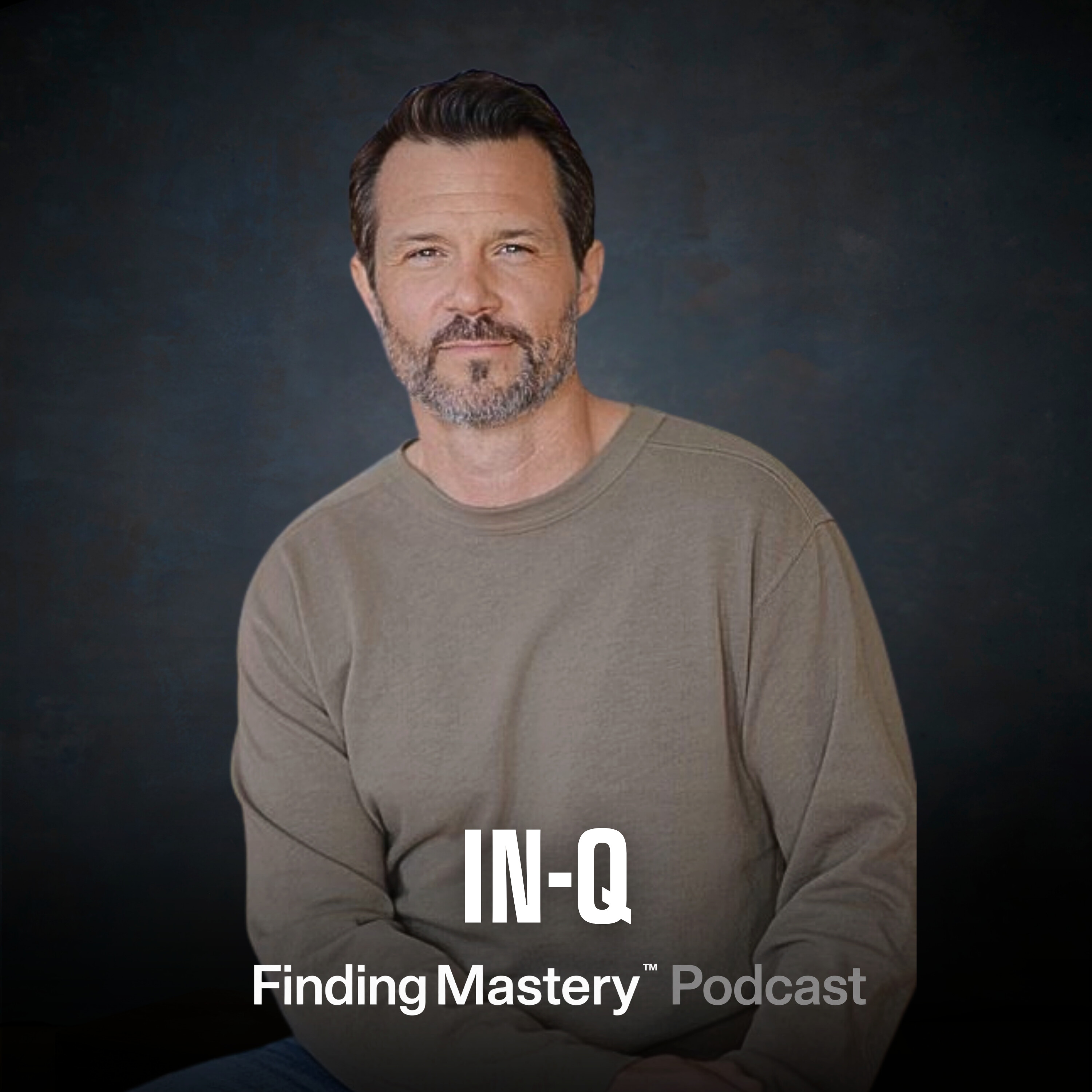
Adam (host, Finding Mastery team) and In Q (Emmy-nominated poet and multi-platinum songwriter). In Q’s songwriting credits include Selena Gomez, Miley Cyrus, Aloe Blacc; he was named to Oprah Winfrey’s Super Soul List. He also writes/ co-writes for major franchises (e.g., Disney’s The Descendants) and has a background in spoken-word communities.
Happiness isn’t a destination; awareness is a conscious act. People often hide vulnerability to avoid shame, but storytelling creates “containers” for deeper connection. Performance anxiety is tied to fight-or-flight social threat circuitry. “Don’t write to be good—make it real.” Art should be lived, not outsourced.
In Q describes freestyling as early meditation; a stage moment where he fixated on a phone user and realized he was inventing a threat story; and a pro-sport mental-skills story about imposter syndrome and standing up to a coach. He also shares a poetry-writing method: write a poem, choose something meaningful you wouldn’t say at dinner, and separate from the story to enable alchemy/healing.
Written by AI. May contain mistakes.
Discussion on how society hinders personal expression and the importance of storytelling.
“And in doing that, we rob ourselves of the opportunity to express.”
Examining the impact of vulnerability and honest sharing during storytelling sessions.
“But I want to start with my experience for just a moment.”
How sharing experiences can create deeper empathy and collaboration among individuals.
“As an artist, did you ever think you were going to be in front of thousands of people sharing your art or creating an experience for them to find some art within them?”
Reflection on personal stories and the journey of an artist in finding their voice.
“And because of that, I think I looked outside of myself for what masculinity was supposed to be at least.”
Discussing the interplay between self-expression and the need to connect with others through art.
“So you got to have a sense of control in a, what felt to be a life and death experience.”
Exploring feelings of self-doubt and how to handle imposter syndrome in creative fields.
“And we scan the world looking for all the threats.”
Understanding the importance of vulnerability and decision-making in high-pressure situations.
“I walked into a locker room with a coach who had no interest in me being there.”
Exploring the challenges of imposter syndrome and moments of vulnerability.
“Oh my God, I haven't learned a thing yet.”
Discussing the significance of poetry and the need for everyone to express themselves.
“You can't leave it out because it is the hero story, but it's not the hero story because it was easy.”
In-Q shares his experiences and challenges as a white rapper in LA.
“but you don't know what our narrative is about whatever that you're gonna give us.”
Discussing personal narratives and overcoming self-doubt through vulnerability.
“I mean, I mentioned it during the workshop, but trying to figure out how to make a living as a poet is like, you know, chopping your way through the jungle with machete and a half filled canteen.”
Reflecting on transformative experiences in education and mentorship.
“This is a part of my history that I don't talk about.”
Discover how mentorship during formative years can shape one's mindset and aspirations.
“I didn't have a clue what was happening as a high school student and because I was too afraid to actually invest, to be vulnerable to invest.”
Understand how poetry and art can facilitate deeper self-reflection and expression.
“and let them know we sent you in the survey after checkout.”
Examine the important role poets play in highlighting truths within communities.
“Well, I'll just tell you how I do it and how I help other people do it through poetry.”
Explore how past experiences shape creative work and personal growth.
“You know, there's plenty of other ways that I'm sure you could approach this, but this is my way.”
Discuss the importance of evolving identity and love in relationships.
“Somebody that's looking at the truth for the truth, what are you doing here?”
Exploration of how personal experiences shape one's outlook on happiness and fulfillment.
“And I don't want people to only see me for what I have or what I do or who they think I am even.”
Discussion on the importance of being present and appreciating moments with loved ones.
“And I hope our community stands up and, you know, gets their phone out and email and whatever, and gives you a ring and hit you on social, whatever, for sure.”
Announcement of the next episode featuring insights on relationships and personal healing.
“Next time on Finding Mastery, we're joined by clinical psychologist, former president of the American Psychological Association and bestselling author, Dr.”

Get the gist, explore an idea or ask about something said.
 Claude
On Finding Mastery with Dr. Michael Gervais, what are the key points of this episode?
Searching your listeningAutomatic transcript. May contain errors.
0:00The main problem is society has taught us that our happiness is something we can gain, something we can claim, something we attach to our name so we distract from our shame and search for happiness outside ourselves perpetuating pain. But happiness is not a place. It's not a destination on the map. There's nothing that's outside of you that's going to show you where you're at. Awareness is a conscious act. My happiness is not an accident. I practiced it.
0:31Dr. Michael Gervais: In Q is an Emmy-nominated poet, multi-platinum songwriter. With songs written with artists like Selena Gomez, Miley Cyrus, Aloe Blacc. And he was named to Oprah Winfrey's super soul list of the world's most influential thought leaders. We leave all art to the professionals. And in doing that, we rob ourselves of the opportunity to express. Adam, you just created a 90-minute gift where you brought the entire Finding Mastery team through an experience. There was a nervousness and excitement. It was just awesome. Thank you for saying that. We basically went through a storytelling session specifically around the genre of poetry.
1:09The idea is figure out what it is that is stopping you from living your life with the fullest power and purpose and passion. How do we do that? Well, I'll just tell you how I do it. I just, well done, mate.
1:24Dr. Michael Gervais: Well done. I see you in queue. Thank you, buddy. Yeah, man.
1:32Dr. Michael Gervais: Adam, I've never started a podcast the way that I feel right now. And the reason being is because I've never had the gift that somebody has given me prior to the podcast. So you just created a 90-minute gift where you brought the entire Finding Mastery team through an experience. And I would like for you to describe what it is that you just did for us in your words. But I want to start with my experience for just a moment. My eyes were welling almost half of the time. My heart was full. There was a nervousness and excitement. There was a vulnerability. There was relief in the honesty of sharing.
2:16Dr. Michael Gervais: It was the celebration of other people going for it and revealing parts of themselves that were the most honest parts of themselves. It was just awesome. So I'm starting this conversation in a way that I've never started. So I excitingly don't know how this conversation will go. Thank you. And more importantly, can you share what you just walked us through? Yeah, absolutely. First of all, thank you for saying that. It's a really nice reflection to receive. We basically went through a storytelling session specifically around the genre of poetry. And I try to create a container for groups of people that either are strangers or who have worked together for years to dive into moving and meaningful stories about their lives.
3:05and then share them with each other in an environment that celebrates vulnerability, honesty, authenticity, so that people can wind up connecting on a deeper level. And hopefully that connection leads to more empathy, better collaboration, and better creation.
3:24Dr. Michael Gervais: As an artist, did you ever think you were going to be in front of thousands of people sharing your art or creating an experience for them to find some art within them? Did you ever think that that would be your path? Well, I was always more interested in my story, to be honest, which looking back was necessary. But now the older that I get, I think other people's stories are so fascinating. I mean, I know my own story and I'm happy to talk about it in this conversation today. But I'll probably also ask you questions about your life because I want to know who you are and how you came to be in this moment that we are sharing together, they're spinning in the middle of space.
4:05So for me, I still write for myself and I share those things with other people. I'm always the first person in my audience. I don't even always decide that I want other people to hear the things that I create. So I start from that place of rawness and realness, but I'd also like to use it as a vehicle for other people to remove the obstacles that are in the way of them telling the truth.
4:30Dr. Michael Gervais: You just hit on something really important, which is like the idea from self to others. And when a person is in pain or they're suffering in some way, emotional, physical, whatever, spiritual, whatever it might be, there tends to be a self-focused or self-absorbed need to take care of the wound or the pain or suffering that the person's experiencing. And so up crops self-help. And it is a self-focused venture. And we get it terribly wrong if we don't get the second note right, which is for what aim what reason and the second note is to be there for others to help others to support them to challenge them to help them go further deeper whatever it might be that that that second beat you're certainly on and I want to just maybe pause and say why did you focus what was happening in your life that you needed in your words to do the art for yourself well I was raised uh in Santa Monica California my mom's a school teacher my father wasn't around at all I meet them until I was 15 years old.
5:30And because of that, I think I looked outside of myself for what masculinity was supposed to be at least. And I saw that in television and pop culture, and it made me chase a lot of the wrong things. So I had a very tumultuous path to wind up sitting in this chair with you right now. But one of my escapes and one of my outlets was freestyling. And at the time, it was kind of like my first form of meditation, because when you're freestyling, you have to think about the next rhyme and the next line and so you can't be out of the moment you know some it's like rock climbing you miss a hand or foothold and you fall and die this is metaphorical of course but if you're doing it in front of an audience of any size whether it's a cipher of five people or you're doing it on stage it is still an existential crisis if the train falls off the tracks you know and that made me feel empowered in a way that nothing else ever had much less about what I was saying, much more about the act of expression itself.
6:34Dr. Michael Gervais: Interestingly, that the same circuitry in the brain for prepping oneself for physical danger and consequence is the same or very similar cousin circuitry to emotional and social. So when somebody walks on stage, why it said it's one of the great fears for people is that it feels like you could die. Totally. And it's the same circuitry. Heart is pounding, racing. His breathing changes. There's a bit of a shimmy that takes place quietly in the body for a little bit. You know, like it's a whole experience readying for fight or flight. Why? Because it feels as though if somebody were to ostracize us with a cut of an eye, right?
7:16Dr. Michael Gervais: Or a yawn or a look to their partner like this guy or whatever, you know, whatever the actual or perceived nonverbal experience. that you as the presenter or anybody that's a presenter might experience feels as though it is life and death. So you got to have a sense of control in a, what felt to be a life and death experience. And over time, do you still feel that vulnerability when you perform what you just did? or do you feel like you are free yes and it's both there's always more layers of freedom that i could find and every environment is different and i still want to provide the most value that i can so i want people to like my art but i'm not willing to give up my authenticity in order to do that and i still have the fight is that the inner civil war the the struggle like I want people to like it, but I will not become small for it.
8:20Yeah. I mean, you have to love yourself above and beyond everything in order to love other people and in order to truly be in the world as your momentary true self. We give what we have. Yeah.
8:36Dr. Michael Gervais: That's all we can give what we have. We have anxiety, nervousness, frustration, love. That's what we give. Yeah. And I think trying to hide it is just a waste of energy. But I still have voices in my head. You know, part of the Civil War is my own judgments on myself, my own judgments on other people perceived or real. You know, there was this one time I was performing on stage and you mentioned, oh, get a load of this guy or facial expressions. You were reading somebody's facial expression in the crowd. That's right. And they actually got on their phone. The room of thousands of people, I see this one fucking guy on his phone.
9:11I'm like focused on this guy what was the quiet thought you had? he's not listening here I am I'm sharing something that is vulnerable I'm sharing something true I'm sharing something from my life I don't need to do this I'm giving this to you you're not receiving my gift and then of course afterwards he comes up to me and he's like man I was sorry about that I was writing down the things that you were saying So I had created a reality that wasn't real. First of all, it made me think, how many times do I do that in other situations?
9:47Dr. Michael Gervais: We're constantly sorting out information to fill in the holes of the story. And most of our stories are that we are not good enough. We are not enough. So we scan the world. Our brains are designed for threat detectors. And we scan the world looking for all the threats. And if the story is unresolved or unclear, if we are okay being wherever we are, then potentially a lot is the threat that we are making up. I had a similar experience. I think you're going to really appreciate this. I don't think I've ever talked about this. Right. Is my first foray in pro sport right out of graduate school. I'm as green as you can be in a sport that I never played or understood a lick of the culture.
10:32What was the sport?
10:33Dr. Michael Gervais: Ice hockey. And I grew up on the beach surfing. Okay. So, and I didn't, I did not understand pro sport. I did not really care to work in pro sport. I wanted to work with people that wanted to get free to explore their edges that were as committed to that venture that I was. Right. Like I didn't have a tolerance for, I was very intolerant at that time, but I didn't have a tolerance for meandering or that type of approach to life. so the gm so back to the politics of it the gm brought me in he's like man this was a great meeting we're gonna love you we really need this is amazing like i can't wait to get started he sent over a contract i didn't even read it i was excited just because he was excited i signed it and he says see you at the rink you know next week great so i show up at the rink have you ever been to a empty arena and an ice rink no empty arena large cavernous space i don't know 20 guys on blades skating.
11:32Dr. Michael Gervais: Okay. It's really cold. I showed up in flip-flops and board shorts. The laugh is appropriate. And I was like, oh man, I'm cold. Oh man, I have no idea what I'm doing here. So now I'm completely in the throes of imposter syndrome. I'm completely in the throes of imposter syndrome. I didn't have a name for it at the time. Long story getting a little bit shorter. He sees, the coach sees me. I hadn't met the coach yet. He sees me, but he knows why I'm there. I'm the sports, I'm the mental skills guy. I'm going to help him. There's a hardened coach now. He whistles, blows a whistle, pulls all the guys to the center line.
12:12Dr. Michael Gervais: And then I don't know what's happening, but then I see the guys like radically going blue line to blue line skating feverishly, like intensely. I'm like, damn, these boys practice hard. So then blows another whistle. they're gasping for air and kind of everyone's walking to the locker room past me and they're kind of grunting looking at me like they know what i'm here for okay so then coach walks with me and he says hey come to my office so we're going to the office we talked about nothing for four minutes nothing and he says i'm going to introduce you to the boys we walk out into the into the locker room guys are kind of half changing if you will it smells like you've never smelled anything it's awful and he walks out and these are like alpha competitive men and he says hey boys this is Gervais and he's here to help us with our minds and apparently they're fucked up in the head go talk to him and he turns around and walks away wow now in that moment I had a choice I'll stop the story here because the choice is actually immaterial but I'll stop the story here for one reason.
13:20Dr. Michael Gervais: I didn't know what I was doing. I walked into a locker room with a coach who had no interest in me being there. And so I share all of that with you because now here I am 20 years later at the Seattle Seahawks, head coach brought me in and I hadn't met the GM yet. I hadn't learned anything in 20 years. How about that? I'm in front and now I'm presenting in front of all the coaches, staff, whatever. And the GM leans over to the head coach and they're in the front seat and they leans over and he whispers in his ear and I hadn't met him yet. And I felt like I was completely naked in front of the, in the room and I made up a story.
14:01Dr. Michael Gervais: Oh my God, I haven't learned a thing yet. I should have met the GM before I'm coming in to talk to the team. And so, man, that's a long narrative. Can I ask you a couple of questions about that? Yeah. Do you mind telling me or us, I guess, what, what the choice was. And because that's a part of finding mastery too, is like dealing with that imposter syndrome and still deciding to show up. Yeah. So what was that choice? And then what, how did that ripple into the rest of the experience or, or working with the team? I'll tell you exactly what it was. The reason I stopped the story and I didn't finish it is because there's not as ounce of vulnerability in it.
14:38Dr. Michael Gervais: And I was in a vulnerable state. And what did in that moment as he was walking away it's going to make me sound like a hero but it was my only option i came from humble means you know like humble yeah not poor definitely not like whatever but like humble but i definitely didn't need money because i didn't value it what i valued was like looking somebody in the eye and having an experience so he walked away and he gave me his back and i grew up in a in action sports and punk sports if you will you know i say hey coach i was full of piss and fire at that moment i say hey coach my door's open for you like what a fucked up thing for him to do to me yeah so i gave it right back to him right doors open for you and i fully thought i was gonna get thrown out of there yeah and i also thought that he might turn around and like become violent sure like aggressive not physically violent and And he paused, his feet were staggered and he nodded his head.
15:44Dr. Michael Gervais: I could see him nod his head and the boys go crazy. They go nuts. Of course. Right. And so it was in that moment, he knew in that moment, like, oh, okay. So he's not going to take my shit. Yeah. And then the boys knew that like, oh, okay. Well, maybe the guy's got something to say because he just stood up for himself. So I say all that because I bury the lead because it sounds like a hero story. And I'd rather actually have most of that left to the imagination. You know, like, I don't know. Finding Mastery is brought to you by Granola. Here's something that I think most of us miss without even really realizing it.
16:19Dr. Michael Gervais: Every conversation that we have has two layers happening at once. There's the conversation, the obvious conversation with the words themselves. And then there's everything else underneath. That's the emotional language, the subtle tones of voice, micro expressions, the brief pauses before someone answers. That second layer is really rich with information. And in meetings, it's easy to miss it when our heads are down and we're taking notes. That is why I use Granola. Granola is an AI-powered notepad that makes your meeting notes useful. It captures what happens in your meetings and then turns them into clean, structured notes with decision and action items pulled out and made easy to find.
16:55Dr. Michael Gervais: And the best part, it works right through your device's audio, which means that it integrates seamlessly into the video conferencing tools that you already use. No big setup, no awkward bots. I use it every day when my meetings are done. There's a clean recap and a clear set of next steps that are just waiting for me. Nothing slips away. This isn't about doing less. It's about being more present. I think you're really going to like what Granola is doing. Once you try it on a first meeting, it's hard to go without. You can try it totally free. Head to granola.ai slash mastery. That's granola.ai slash mastery to get your time back.
17:28Go to granola.ai slash mastery and try it on your next call.
17:35Dr. Michael Gervais: Finding Mastery is brought to you by LinkedIn Hiring Pro. When you're building a small business, every new hire has the potential to make a real impact. The right person, they can bring fresh energy and new ideas and really help the whole company move forward. It's awesome to watch when you get it right. So finding that right person, finding that great hire, it takes clarity. You have to know what you're looking for. You have to recognize it when you see it and then make the call with confidence that this is the right hire. That's where LinkedIn Hiring Pro can help. It's really like having a hiring partner throughout the entire process.
18:07Dr. Michael Gervais: You can chat with it, just like you would a recruiter. You tell it what matters most for you, for the role, compare candidates side-by-side, you give it feedback, and then Hiring Pro listens, it adjusts, it helps surface the people who actually might fit what you need. They're trying to help us optimize. We're still the ones making the decision. LinkedIn Hiring Pro is just a smarter way to find the right people to build the team of your dreams. Now, if you haven't already checked them out, LinkedIn Hiring Pro can really help your business. Get started by posting your job for free at linkedin.com slash mastery.
18:36Terms and conditions apply. Again, that's linkedin.com slash mastery. I know, but I loved it. I love the punchline. Yeah. You can't leave it out because it is the hero story, but it's not the hero story because it was easy. The hero story is never easy and you could have pivoted or not done anything. Yeah. You know, fight or flight or freeze. you know you could have frozen yeah or submit yeah but to actually do what you did to stand up for yourself but not only for yourself for what you believed in but i didn't think i had a choice
19:12Dr. Michael Gervais: yeah you know like there was really very little vulnerability it was reflective and so even that though you being that guy is part of what allowed you to communicate to the team and open them up to new possibilities. Because if they didn't see themselves in you, they might not have trusted you in order to do it. And the coach certainly wouldn't have. So it was kind of like a, you know, mic drop. Yeah, and I think most of us, like in pro sport, like there's a lot of money flowing. Yeah. And people say, you show me how you respect me with my contract. That's a sentiment that would an athlete, you know, clearly could take easily.
19:50Dr. Michael Gervais: But you and I both know it's not about the money. No, it's definitely not. Money's cool. Yeah. You can do a lot of good with it, you know, and create some safety and this, that, and the other. But I want to make sure I'm not losing the bead here because this is a fun story to talk about. But I want to come back to your genius. No, I'm more interested in yours. I'll let you be the captain of this ship. Why is poetry so important to you? I mean, I think that you can express yourself in any art form. and I think that one of the tragedies of modern day society is that we leave all art to the professionals and in doing that we rob ourselves of the opportunity to express to explore and to alchemize the trapped energy inside of us and it's not that I don't think that the people that have spent their outlier hours, including myself, becoming a professional at something, don't deserve to have the spotlight.
20:51But everybody deserves to have a spotlight. Everyone deserves to be seen, to be heard, be respected, and to be celebrated. And I just provide a space for people to do it through spoken word.
21:05Dr. Michael Gervais: I was going to say, pause that because that's exactly what you did. So that is your, that is a first principle for you. All people deserve to feel seen, fill it in, the words you just said. Yeah, seen, heard, respected, celebrated. Celebrated, yeah. So the power of a first principle is cool when it's clear, but then it is exponentially more powerful when it can be lived in any environment. And you just did it. I think we're a friendly group, but you don't know what our narrative is about whatever that you're gonna give us. And so very cool. thank you for reminding of the first principles and this was a mechanism of self-discovery your artist name is in q yeah stemming from when i was you know a teenager and looking for a rap name my buddy jay was like i'm gonna start calling you inquiry because i was always so curious asking questions and incessantly thinking about why things were the way that they were and who people were and who I was and what we were doing here in the first place and then everybody just started calling me uh inquiry and then in Q and then Q for short and I rarely heard my real name after that you're a white guy in rap in LA in the 90s yeah tell me about that I found plenty of stages that I could get on and I made you know 10 albums over my years and um you know got a standing ovation from Dre in a, you know, kind of like crazy club called Stevie's in the Valley and, you know, met some of my heroes and was in the studio countless times, but I couldn't quite figure out how to turn the corner on it.
22:48And so I was always chasing this idea of success. And I came up at a time where like, you needed to know people, you needed to meet an A &R. And I knew no one coming up, right so I had to like figure out my own ways you know selling cds out of the trunk of my car and during this period of time I ended up at an open mic for poets in Los Angeles called the poetry lounge turned out to be the biggest open mic in the country 350 people have come for almost 30 years to just watch people get on stage and be vulnerable about the things that they believe in about their fears about their anger about their pain and it's like church without religion and it was definitely the college i never went to and uh that group of people became my community that became my family i got on stage i was just doing my rapping acapella at first and then uh was on hbo's deaf poetry jam and we won the national poetry slam championships and i woke up one day and i was like i'm more of a poet than an mc oh okay so that was You said we, who's we?
23:59Just that whole group of people, you know. Okay, got it. Chian, Javon Johnson, Omari Hardwick, Talam AC. There's just countless incredible artists in the spoken word community, not only in Los Angeles, across the country, that really inspired me. And I would say, you know, steel sharpens steel. They helped create my style as much as I hoped they would say vice versa. And you've also been fortunate to write or co-write some massive hits. Yeah. I mean, I mentioned it during the workshop, but trying to figure out how to make a living as a poet is like, you know, chopping your way through the jungle with machete and a half filled canteen.
24:39And it took me a really long time to monetize what I was doing without losing my artistic integrity. But I was doing colleges and doing workshops and libraries and junior high schools and high schools and juvenile facilities anywhere really I could provide a space for kids to explore their voice and to feel empowered through this art that I loved so much and at one of those shows somebody came and then through an introduction ended up bringing me into this production team called Rock Mafia and they make huge hits for all sorts of artists and they saw something in my lyricism and allowed me to kind of like jump on songs so you know our biggest hit was selena gomez love you like a love song or at least the one i was involved in but we also wrote with miley cyrus and aloe black and also the people and um mike posner and have written over like 50 songs for disney television movies that have become quite uh successful over the years in these major franchises like The Descendants and all of that.
25:43And it's funny because even while I was doing all that Disney stuff, which I am still doing now, I almost looked at it as like something I was doing while I was doing the real thing that I was doing, which was like this poetry was more important to me. But now—
25:59Dr. Michael Gervais: That's a mechanism that you probably found some safety in. Exactly. Right? That was a narrative that you adopted so that you could stay core. That's right. even though it was a that's an amazing set of experiences yeah why did you need to have that mechanism i think it probably was unhealthy fuel that i needed to use oh so you come from a chip yeah yeah huge chip boulder when did you know you had a chip and have you made a decision that the chip is serving you or not serving you where are you with the chip now i'm chipping away at the chip yeah i want to i want to turn it into a sculpture and maybe it's like an ever-changing sculpture as I move into my life, you know, it becomes really heavy.
26:42Yeah. Did you, you, I'm assuming can relate to that. How did you address yours? Yeah, I was, you know,
26:49Dr. Michael Gervais: nice way to deflect. My, my chip was that I wasn't smart enough. Yeah, me too. And then, so I distracted as cleverly as I could from looking at my intelligence and come to find out, I actually can think relatively quickly. I didn't know it, but I had to go a long way in the education pathway to come at home with myself that, no, like my thinking capabilities are actually fine. Did you have any learning disabilities or? No, no. Yeah. It was just a narrative that somebody saw something in me. I heard them say, maybe he's stupid. And I thought, oh, this feels awful. So let's not be vulnerable around this again.
27:33Dr. Michael Gervais: So did it make you try less in school? Oh, it made me try harder in not, not to be seen. Right. So I didn't try at all in school. I shouldn't have graduated. This is a part of my history that I don't talk about. I got a zero on my PSAT. I got a zero on my SAT. I went surfing for both of them. I didn't have any college path. And so people would say, oh, Dr. Michael Gervais, licensed psychologist, specialization, sport, subspecialty consequence, done all these amazing things. I didn't have a clue what was happening as a high school student and because I was too afraid to actually invest, to be vulnerable to invest.
28:11Dr. Michael Gervais: So I went to a community junior college and I feel really fortunate. I got inspired by three folks. And so they were mentors of yours while you were there. Three professors. Yeah. Yeah. It sounds like a bad joke. It was a theologian, a philosopher and a psychologist. They walk into a college. They walk into a college. Yeah. Yeah. And I tripped over kind of everything they were leaving behind. And they was like, hey, kid, this seems like you are interested in it. And I said, it is. I am interested. Was there any one moment that you remember being turned on, like your brain kind of like clicked to what could be rather than what was?
28:48Dr. Michael Gervais: Yeah. I was really struggling with some anxiety. It was my freshman year at a junior college. And my professor, psychology professor, was walking to class. I say, hey, Doc, can I walk with you to class? And he goes, yeah, come on. And he goes, and I said, there's something I'd like to talk to you about. Is it cool? He goes, yeah. And we had a six-minute walk to the class. And I thought I was going to get all of my therapy done in this moment. I didn't know what therapy was, but I needed to ask somebody that knew about psychology. And I started to tell him a story about this scenario that was very difficult and anxiety-provoking for me.
29:24Dr. Michael Gervais: And I was shaking as I was telling him, tremoring, not shaking. They could hear it in my voice and the whole thing. And he stopped me mid-sentence and he's like, hey, when somebody knocks on your door, do you have to answer it? And I thought, damn, dude, like I'm telling you my story. I'm giving you my heart. What do you mean? And he saw that I was stunned. And he looked at me and kept pacing and just kept walking to class. And I was like standing still. And I was like, psychologists are weird. That's lame. That is awful. I didn't want to go to class. Yeah. and it took me way too long to sort out that he fundamentally interrupted my train track my pattern well said i didn't realize what he was doing and he did it and he was awesome and i thought forever like man he's on something like i gotta know what he like how did he know and so um that was a moment for me that was cool it's almost like tony robbins like change your state yeah he changed my state interrupted your state yeah but he did it in a way where it planted a seed for you that wound up growing into you know a redwood back at you is there a moment i would not say that i have one moment necessarily that comes to mind what i would say is i could very much relate to not feeling smart as a student i mean you know like from the beginning of my academic career.
30:47I mean, I just never really felt like I could communicate or get good grades. And that's something though, you know, look what you're doing here. Yeah. It's interesting. And, and, and I definitely decided I was stupid, you know, and the same thing. I was, uh, almost like wanting to disappear academically. And if I didn't try, then I wasn't risking failure. I had the second part, not the first part.
31:16Dr. Michael Gervais: Say again? I had the second part, not the first part. I didn't decide. I just didn't want to know. I was afraid to have it be true. But that's a metaphor for a lot of areas in life that people have blind sides around. They decide something and then they don't pursue something because they're afraid to lose it or to fail. And in doing that, they never allow themselves to adapt or to transform or to find, you know, what else could be hidden beneath. And so it's really great when someone in your life or something that you experience or a piece of art plants that seed to interrupt your pattern. I would say definitely poetry did that for me.
31:59Dr. Michael Gervais: Finding Mastery is brought to you by Athena. The psychological skill of control is something we talk about regularly here at Finding Mastery. And part of that skill is being honest about what's actually yours to carry and being clear about what is not. Not every task deserves your time, even when it really needs to get done. If you're leading a company or a team, there is so much competing for your attention every day. You know that. You feel that. The inbox, the calendar, travel, hiring, the list goes on and on and on. And just because something needs to get done doesn't mean it needs to get done by you.
32:28Dr. Michael Gervais: That's the shift that Athena is making possible. They match you with a dedicated, full-time, remote executive assistant. It's a real person who takes on the inbox, calendar, travel, the details that fill up your day. They're EAs. They come from the top 1 % of more than 60 ,000 applicants, the best of the best. And they're fluent in AI tools. They make great support. They support you even better than you can imagine over time. Clients, on average, get back 15 hours a week. How about that? Take control of what's in your control and learn to delegate the rest. Check out what Athena is doing. I think you're really going to appreciate it.
33:02Go to athena.com slash mastery right now and get matched with your EA. Give yourself a few hours back this week and go to athena.com slash mastery and see who they pair you with.
33:13Dr. Michael Gervais: Finding Mastery is brought to you by our partners at Lisa. Most of you know that I have a morning mindset routine. It's what I do every morning before I check into the world around me. I check into the world inside of me. And it's just a few quiet moments to set my intention for the day. Make sure I answer to the things that I'm grateful for. and I want to focus my attention on what matters most. And what that does is it wakes up the mindset to help me bring the best of myself in the day ahead. Generally speaking, I wake up feeling pretty good. No aches, no stiffness, nothing pulling my focus, you know, the minute that my eyes open up.
33:46Dr. Michael Gervais: So when your body gets the recovery it needs, it is so much easier to set your mind up to help you be your very best. So that's why we turned to Lisa for some support. We've worked with Lisa for a long time now because they build quality crafted mattresses that are tailored to how you actually sleep. Your position, your feel, all of it. Premium materials, premium mattresses, real full body support. The intention they put into their products is real. I love what they're doing. Go to Lisa.com for up to 30 % off mattresses, plus get an extra$50 off with the promo code MASTERY, exclusive for our listeners.
34:19That's L-E-E-S-A.com, promo code MASTERY, for up to 30 % off mattresses, plus an extra$50 off. and let them know we sent you in the survey after checkout.
34:32Dr. Michael Gervais: You have an ability with your eye contact and your precision of language to be able to at least be interested in the heart of something, the center of it. What is it about your life experiences that led you to get right into the center of an idea or an expressed idea? Well, so the curiosity has always been there. I could very easily talk about myself. I could very easily be in conversation with people, but I could also very easily like interview people not in front of the cameras but I really just love digging into people's lives as I said and I love digging into my own through this particular art form of rhythm and rhyme so I would say part of the spark that made me do that was this desire this falling in love with self-expression without boundaries part of it was desperation no plan b part of it was obsession because that's my personality type and i always thought you know what's my favorite piece the next one i don't know what it's going to be and there was some excitement there so i would be up for the wee hours of the morning exploring like the kernel of an idea but it always came from something that was true or some breadcrumb trail that I wanted to follow to find out what was at the end.
36:00Like even now when I start a piece, I don't think what other people want to hear. I think what do I want to explore? And if I pay attention to my daily life, things stand out. It's almost like being on shrooms and everything becomes brighter and more vibrant. Something in my day might become more vibrant and then I'll take that idea and I'll put it into my phone. And because it started in a place that was real and authentic, whenever I come back to it, it's always going to be real and authentic.
36:32Dr. Michael Gervais: Words are one of our greatest tools as humans. And our mind is this ecosystem that allows us to understand and have ideas and connect them with emotions and express the feeling as best as we possibly can or the concept as best we possibly can. And your tool is very, very, very, very refined. I would hope that there'd be a couple ways that you could help our community be on the path of refining the words. And when I say refinement, I'm not saying like shiny, I'm saying precise and accurate and honest, meaning lining up thoughts and words. If you can line up thoughts and words in any environment, you will become masterful at self.
37:26Dr. Michael Gervais: Most of us become overwhelmed that the consequences of our thoughts and words might not be good enough or might be dangerous or might, you know, create, I don't know, some disparity or whatever. And so we play it safe and small. How can you help us be more tuned to the words that we choose that are honest? Through art or through life? Yeah. I'm not sure I know the difference. yeah well that's a that's a mic drop as well i mean that's a beautiful way to say it because our art is our lives yeah you know i asked everybody before we started who thinks they're a poet and only send her raise your hand and then um i asked who thinks they're a storyteller and everybody raised their hand because we do know inherently that we're all storytellers and that the stories that we tell ourselves and other people become our lives.
38:18So the idea is change your story, change your life, change your life, change the world. Interrupt other people's patterns, interrupt your own patterns. Figure out what it is that is stopping you from living your life with the fullest power and purpose and passion and even create exercises for yourself to go after those things. How? How do we do that? Well, I'll just tell you how I do it and how I help other people do it through poetry. I create this structure for people to explore things that are moving and meaningful to them. So the first thing I tell them stylistically when you're writing a poem, you can do it any way you want.
39:03It can rhyme if you want it to rhyme. It doesn't have to rhyme if you don't want it to. It can be long. It can be short as long as you're not shorting yourselves. Use the time that you give yourself to fully dive into the subject matter. But almost like don't approach it as a journal entry, because when you're doing a journal, you're using the same voice that you use to communicate with the world and yourself. So there's a catharsis that comes from getting those things out of your system. But when you're actually creating a piece of art, you are separating yourself from the story. And in that space is where alchemy lives.
39:38It's where healing begins. so say to yourself you're writing a poem before you start and then you're writing a poem and no one can tell you any different the second guideline is choose that thing that is moving and meaningful that you wouldn't normally talk about after 15 minutes at a dinner party so something that's a layer deeper something you want to release something you want to create something you want to process a memory and then the third thing is don't try to make it great don't even try to make it good. Just make it real. Make it honest. Make it authentic because then it will be better than good.
40:14It will be great. And afterwards, hopefully, once you're done, you might decide to share it with somebody in your inner circle because there is something about seeing and being seen and being unconditionally accepted for our stories that allow us to have more power over them rather than them having power over us.
40:35Dr. Michael Gervais: Super clean, very easy to follow. And you just need to get a piece of paper out and go to work. Exactly. Okay. What I love about that is that's a 15 minute to 45 minute training session. Ideally, daily, weekly, whatever the tolerance or interest level of the self-discovery process. And what I really love about it is that there are no secrets to the work. It's doing the work. You just created a container. Like, look, there's, perfect is not the aspiration. Honesty is like, if you want to write a poem, just say, I'm going to write a poem. And then hopefully if you get to a place that you're like, yeah, that's honest, that you'll share it with somebody.
41:18Dr. Michael Gervais: That's the work. And most of us want the same thing. We want to live an amazing life. We want the same for our kids and our loved ones. We want to live this small amount of time we have here. Like we want an amazing life. How? You got to do some work on yourself. And it's like saying that you want to be really healthy, but you make a whole set of different choices, right? I want to be happy, but you do things that do not support it. I want to be alive and vibrant, but you do things that do not support that. You're saying if you want to be alive and vibrant, here's a way to do it. And it's not the only way.
41:58And it's not the only way that you could do it through poetry. You know, there's plenty of other ways that I'm sure you could approach this, but this is my way. And it's the gift that I try to keep giving to myself and the world.
42:11Dr. Michael Gervais: Poets have taken up an important role in, you know, humanity. They'll often point out cleverly things that are in plain sight, but people are afraid to say, or they're not clear enough to say them in a way that can move people. And what is the downside or dark side of this role that you have in your family and or your communities? That's a really, really great question. I'm not sure anybody's ever asked me that. And I have a very specific answer to it. And it almost goes back to like a conversation we were having about therapists, like therapy has played a really important role in my life. But I believe whether it's right or wrong for other people i can't say but for myself i don't want to be with the same therapist for 25 years like and i think a really great therapist will probably say you've learned what you've needed to learn from me and now i want you to go be empowered in your life in other ways what i would say is is that like you can dig into your life too much and I've certainly done that through my art I've actually like buried something and then just like dug it back up and then buried again dug it back up and at a certain point I realized that was unnecessary and unhealthy for me to move on like you have to also move on you know and you have to move into your life and you have to take full responsibility for everything that has happened whether or not you understand it, you know, but never looking in the rear view mirror doesn't work either.
43:53So people have to find ways and they have to look at their life like a diversified portfolio, rebalance, rebalance, rebalance. There was this one specific time. It was like in my mid twenties where like I had broken up with somebody and I was having a hard time, you know, I was about to sit down and write this like new breakup poem about this whole relationship that didn't fucking work and blah blah blah and uh instead i decided to read some of my old breakup poems so i break out all these old breakup poems i read all the old break i gotta get into the vibe of my heartache no no it wasn't even that it was my curiosity to just instead of make something new about a similar subject.
44:40Let me just look at what I've already created. Yeah. And what I realized is all of those old breakup poems applied to the new breakup. So then I go, okay. I don't need to write a new breakup poem. I need to figure out why I'm continuing to create the same lesson in a different disguise over and over again and then write it out and get celebrated for it on stage because my life is more important than my art because, like you said, my art is my biggest life. So from then on, I was like, okay, I'm going to start writing about solutions rather than problems. And I went through a stage like that. And then I realized, oh, I don't want to only be living in solutions because that's inauthentic.
45:27So then I started to, you know, and it's always like this rediscovery of myself through my art over the years. So I would say maybe the downside is just always needing to analyze something rather than just accept something. But even that, I could analyze accepting and turn that into a piece of art that hopefully would be resonant for somebody else.
45:54Dr. Michael Gervais: Yeah, I was wondering if you would make it about your dark side or other people's dark side. meaning that it's hard to be around people that can put a spotlight on the dusty corner and point out the dusty corner it's hard to be around that person yeah that holds a gaze and just in that gaze there's a depth of wanting to understand and then it kind of kicks up like a dry rag in an attic the anxiety and the stuff in other people and it can happen just from a look yeah it can happen from a micro expression like really yeah you know say more or whatever it might be and it kicks up a lot i'm wondering if that is the case for you as well or do i need to ask your wife if that's the case for you well it's funny because you could talk about my most intimate relationships or you could talk about people that i work with you could talk about strangers and all of what you said could apply to any of them is that right yeah and like there's this one interesting thing that happened to me recently i'm not going to say the specifics because I don't want to like call anyone out, but I recently did like a big inspiring meeting of the minds conference.
47:03And I just thought that the organizers were really unaligned and I did not like their behavior, but I was already there and I'm a stickler for the truth, you know, and somebody did something and it kind of like, hmm, was negative towards one of the people on my team. and I got on them real quick. And I created like an unnecessary enemy in the world. So the good part is I stand up for the people that I care about and I'll tell the truth. But the bad part is some people didn't ask for the truth. And I don't need to be the global police of arrogance because that's actually not good for myself. It's not good for my team and it's not good for my family.
47:49It's not good for my art. So it's like, once again, rebalance, rebalance, rebalance.
47:57Dr. Michael Gervais: For a human that spends so much time introspectively examining, analyzing is the word you use, but I think it's, yeah, you can synthesize, you can analyze. I'm talking about you. And you also can hold the experience and look at it. Where does that take you? What are you really trying to sort out with this small amount of time that you're here? Yeah. Finding Master is brought to you by Magic Mind. The question that I often come back to and I hear from people I work with isn't, how do I perform well today? It's how do I protect my capacity to perform well over my entire career? That's a different question and it changes what you invest in.
48:36Dr. Michael Gervais: At some point, I started applying that same thinking to my own brain. Not just what helps me get through every week, but what am I actually building over time? Because there is a difference between burning through your cognitive resources to meet the demands of the day and investing in the long-term health of your brain. That's one of the reasons I enjoy using Magic Mind. It's a daily two-ounce mental performance shot with clinically backed ingredients like ashwagandha, turmeric, and lion's made. When I drink it, I know that I'm investing in better focus, sustained energy. And what I value just as much is what's happening underneath.
49:09Dr. Michael Gervais: These ingredients support stress adaptation and long-term brain health in ways that seem to compound over time. That's the long game. The formula is based on over 10 years of research and nano encapsulated for five times better absorption than traditional pills and powders. Go to magicmind.com and get 50 % off your first order. The best performers I know make investments today that their future self-thanks them for. This is one of them. Body Mastery is brought to you by Fatty 15. Okay, let's talk about longevity. Longevity is much more than simply adding years. It's about maintaining health and a zest and a vitality and enhanced performance as you age.
49:47Dr. Michael Gervais: And that's why I'm excited about Fatty 15. It's an award-winning supplement. It's powered by C15, which is the first essential fatty acid discovered in over 90 years. Okay, so C15, it's a geroprotector. What that means is it helps to slow biological aging by strengthening your cells, basically protecting them from damage. You can think of it like kind of like a 401k for your health where you're investing in cellular quote unquote resilience. And I dug into the research on the relationship between C15 and heart health. I love what I saw. Fatty 15 is on a mission to optimize your C15 levels to help you live healthier longer.
50:25Dr. Michael Gervais: Get 15 % off your 90 day subscription starter kit by heading to fatty15.com slash finding mastery and use the code finding mastery at checkout. That's fatty, F-A-T-T-Y, 15.com slash finding mastery. Start investing in your long-term health today. Somebody that's looking at the truth for the truth, what are you doing here? Not in the studio, but what are you doing here? That's a great question because my wife and I have a one and a half year old at home and her family is quickly expanding and not having a father in my household was certainly a part of my maturing for both good and bad, I guess.
51:14And I had these unexpressed, unconscious expectations about becoming a father, especially so late. And then our son, who's a magical little dude, he also had colic, and he's really spirited. and it was a bumpy ride for both my wife and I. And it kind of like felt like somebody, have you ever taken acid? No. Okay. Not that I'm promoting it, but I have. And when you take acid, it's almost like somebody cuts off your head from here and everything that you know is in confetti. And it just like dumps it on the floor. Exactly what I imagined. Yeah. And then you pick it up and put it back in in different orders.
52:09So you have different realizations about yourself and about the world. That was like what having our son was kind of like, you know, he's a really, he doesn't sleep very well, you know. So it was like a really, really long period of time of just expectations versus reality, mixed with overwhelming love, mixed with my own desires from the past. I thought this was going to be. And then it's made me then re-question the Rubik's Cube of my life and what I am doing here and what truth am I searching for. I mentioned this to somebody after the workshop. up, I try to like give myself the room always to wake up every day and decide not to be a poet because I want to always have freedom around my choices and not become a prisoner to the life that I have already lived because I don't want to wake up and say, oh my God, I'm like chasing dreams of a version of myself that has already died.
53:11And then when I re-choose being a poet every day I do it from that place of power. This is worth interrupting.
53:19Dr. Michael Gervais: Sorry, please. That idea that you examine the choice, the fundamental choice is really scary and wonderful. And it feels like not needed. Maybe it's for some people like, Oh, why would you want to do that? Like, just keep moving, keep growing. I'm going to apply that same principle to the way that I do love with my wife is that my mom introduced this idea at a very young age and I didn't get it. And I thought it was almost like a throwaway comment, but she says, no, you need to make a choice every day to be in love. And when I think about the woman that I married and fell in love with in my twenties is a very different woman that I am partnered and in love with now.
54:03Dr. Michael Gervais: And so So I'm not making a choice, reality versus expectations, to love the woman only as a 20-year-old. But all of those changes and all of the heartaches and the fun and everything we've been through and to celebrate every morning, the new person. So when I hear you say that you do that for yourself, I'm like, yeah, I do that just about, I would say just about because I'm not doing it every morning, but just about every morning in my relationship. and so now I'm going to apply that same thing to myself please yeah and so what does that look like like how would I do that when I wake up in the morning hold on I know why I don't do it I've had a disdain since I was a kid he would say oh this is Mike he's a surfer I said no no and I would correct it no I surf a lot very different like my identity was I never wanted my identity collapsed on the thing that I did that's great I knew that from a young age that there was something super dangerous with it.
55:02Yeah.
55:02Dr. Michael Gervais: It kept me from going all in though. Yeah. Because if my identity was completely connected to that, I probably would have fully chipped in and I didn't. Sometimes it haunts me because I didn't. All that being said is I don't currently see myself as a psychologist or whatever. So how would I do it if I'm refusing to have my identity be the thing that i do i think then you're already doing it oh or maybe i'm misunderstanding but like what you just said i feel like is the recipe got it so you might not even need to check in because it's already inherent to who you are that was like as a 14 year old punk i mean it's the same thing with me from the standpoint of like i thought i was going to be a professional basketball player you did thousand percent certain of that when i was eight you know yeah i didn't grow i didn't get strong enough oh you know and then you're like 12 and you're like people are dunking and you know it's just like no chance you know yeah it's good on the all-star team of boys club santa monica but not not in the big league the rec league was right so yeah yeah and then i thought i was gonna be an mc you know that was my next thing well if i put everything into that you know i'm gonna and then that didn't happen these two dreams that kind of like died or became other things And so now in this new dream, I kind of realize it's not the only dream.
56:28And I don't want people to only see me for what I have or what I do or who they think I am even. Because then I'm trapped. Then I'm just trying to recreate past success or past perception over and over and over again rather than being in discovery.
56:46Dr. Michael Gervais: Yeah, you've got a golden handcuff or golden cage that's pretty electric. You've flown at the highest levels. you're shaping rooms of thousands of people, you're intimately available. And it's, it really does wrap around this skill that you have. And so if you ignore the skill, who are you? Right. Yeah. It's a dangerous proposition. Yeah. And as I say, everything I just said, can I put you on the spot? Yes. Can you share your art? So any, anything that comes up that seems fitting for you right now? Yeah. Happiness is not a place. It's a range. It's not a goal that you reach because it's constantly in phase, but if you stay inside the margins and you consciously engage, your happiness can find a balance on the razor's edge of chain.
57:39The main problem is society has taught us that our happiness is something we can gain, something we can claim, Something we attach to our name so we distract from our shame and search for happiness outside ourselves perpetuating pain. But happiness is not a place. It's not a destination on the map. There's nothing that's outside of you that's going to show you where you're at. Awareness is a conscious act. My happiness is not an accident. I practiced it. This one time I saw a dude who worked for Vons collecting stacks of shopping carts in the parking lot with only one arm. Now I should say that on this particular day I had been feeling down about myself.
58:33Depressed about some stupid shit. Complaining in my head that I'm not as far along as I would like to be. that life is victimizing me. And mind you, I was buying food at the time. To put into my car, to put into my house, to put into my fridge, to put into my mouth. And that's when I saw him. Ten carts deep. Pushing them with one arm down the street, whistling. I swear he was whistling. Do you know how happy I would have to be? to spontaneously pucker up my lips like I was about to blow a kiss, then open up a bit and push some air from my esophagus into a higher pitch? Anyway, back to this dude.
59:21The first thought I had, I'll admit, was a bit rude, but hear me out before you boo. See, I was confused, because if I was in his shoes and I had to choose a job, this would not be the job I'd choose. And I know that sounds hardcore, but honestly, this is one of the jobs that I would want two arms for. Now, that being said, this particular dude was an absolute gangster. The arm he had looked like it was strong enough to be the anchor on an oil tanker. The arm he had looked like it was strong enough to be the anchor on an oil tanker like he could have been Arnold Schwarzenegger's trainer back when he was starring in The Terminators.
1:00:00And it woke me up like the scent from a cup of Senka. So I went home and I wrote this poem as an ode to thank him. See, it really got me thinking about my situation Why the fuck am I complaining? Our world is full of people maintaining No matter who you are or where you're from We all have to wake up every day And accept the fact that we don't know where we'll go or why we've come And that can cause confusion So we distract ourselves and focus on amusement instead of self-improvement, a mutually agreed upon collective delusion. But with this much stimulus and this little understanding, it's no wonder we don't all just completely fucking lose it.
1:00:51Genius and insanity are closer than they seem. Your perspective is the difference between your nightmares and your dream. because if everything is energy and my body is a vessel, then my struggle is unique, but that doesn't make it special. And this dude here has the balls to up and whistle with a fistful of shopping carts that he guided like a missile and it blew me away like a sneeze into a tissue that someone who has seemingly so many issues could be unequivocally so blissful while someone who's as lucky as I am could be self-creating problems by the listful. So from this point on, if my thoughts start thinking that they're important or my feelings start feeling too distorted, I'm going to sort them into categories to see if I can change them.
1:01:51If I can, I'll simply make the moves to rearrange them. If I can't, I'll acknowledge them, but I won't engage them. I look them square into their eyes with courage as I face them and...
1:02:25Dr. Michael Gervais: I don't know how you do it, but like the entire time you're taking on this very plain language, expression with real depth to what you're sharing. And the entire time I've got this electric kind of thing on the top of my stomach, like, where's he going? Oh, he just hit it. But where's he going to go now? Oh, oh my goodness. Like he just did that the whole time. Thanks. Yeah. I don't know how you do it, but I know it's time under tension being really honest, but thank you for the high art of helping me feel a certain way about myself, which is like, there's more in me. there's further to go. I feel more grateful when I'm around you.
1:03:06And so, um, I'd just be very clear
1:03:09Dr. Michael Gervais: that I wish you were in more rooms, especially rooms of leadership to help people get more clear about what matters to them and to be able to influence the others in the most honest way that you're doing it for them. So thank you, man. Yeah. Like I can't wait to figure out how to do more with you. I want to take a second here to tell you about a morning routine that I've been using for years. For me, it's a great way to switch on my mind, to ready myself to take on the day. So before I check my phone, my emails, market updates, or text threads, I choose how to start my morning. That's always in my control.
1:03:45Dr. Michael Gervais: That's always in your control too. This is the same morning mindset routine that some of the world's top performers across sport, business, and the arts are using. The best part, it only takes about 90 seconds to do. So just head over to findingmastery.com slash morning to download the audio guide for free. Again, head to findingmastery.com slash morning to get your morning mindset routine. And I hope our community stands up and, you know, gets their phone out and email and whatever, and gives you a ring and hit you on social, whatever, for sure. And before we kind of close the conversation up for now it all comes down to it all comes down to the miracle of this moment you know I always thought that when we had kids uh I would always be split wherever I went because you know we travel a lot and I do uh things for communities and corporations companies all around the world right and I thought I would be there and be halfway there you know because I had this like anchor of the thing that was most important to me at home.
1:04:55And even though I do have that anchor, weirdly, I just have more appreciation for every moment that I'm in. Because otherwise, it's a disservice to my family and a disservice to me and a disservice to God. And it's like, this time that you and I have spent, it's the only time. It's the only time that's promised. and I'm fully here with you. I always want to provide the most value to people that I can. And I also want to be on an adventure. So I would say the miracle of this moment. Well done, mate. Well done.
1:05:32Dr. Michael Gervais: I see you in queue. Thank you, buddy. Yeah, man. All right, brother. So where can we find you? Where can we party with you? There's stuff all over. Literally all over. Yeah, I have a book called Inquire Within that was put out by Harper One a few years ago. I have a journal called The NeverEnding Now. The NeverEnding Now is like, first of all, the title is eloquent. Thank you. Yeah, like in all the ways. It's a good one. Yeah, thank you. Yeah, for sure. And socials? Yeah, socials is INQ Life on all the socials. And then my website is in-q.com. And yeah, I hope to see you out in the world and keep creating.
1:06:11Dr. Michael Gervais: Yeah, and like really, I'm going to say it clearly here, and we're going to figure out ways to partner in projects is that if you're in a leadership position and you want to really change your room, call you. Yeah, I love doing this for teams. It's awesome, man. Thank you. Thank you, man. Next time on Finding Mastery, we're joined by clinical psychologist, former president of the American Psychological Association and bestselling author, Dr. Tamer Bryant. Why do we keep repeating the same mistakes in relationships? Dr. Tamer and Mike sit down to explore how to heal from past experiences, recognize the patterns holding us back, and build healthier, more authentic connections by first working on the relationship we have with ourselves.
1:06:53So join us Wednesday, October 14th at 9 a.m. Pacific, only on Finding Mastery.
1:07:02All right.
1:07:03Dr. Michael Gervais: Thank you so much for diving into another episode of Finding Mastery with us. Our team loves creating this podcast and sharing these conversations with you. We really appreciate you being part of this community. And if you're enjoying the show, the easiest no-cost way to support is to hit the subscribe or follow button wherever you're listening. Also, if you haven't already, please consider dropping us a review on Apple or Spotify. We are incredibly grateful for the support and feedback. If you're looking for even more insights, we have a newsletter we send out every Wednesday. Punch over to findingmastery.com slash newsletter to sign up.
1:07:37Dr. Michael Gervais: The show wouldn't be possible without our sponsors and we take our recommendations seriously. And the team is very thoughtful about making sure we love and endorse every product you hear on the show. If you want to check out any of our sponsor offers you heard about in this episode, you can find those deals at finding mastery dot com slash sponsors. And remember, no one does it alone. The door here at Finding Mastery is always open to those looking to explore the edges and the reaches of their potential so that they can help others do the same. So join our community, share your favorite episode with a friend, and let us know how we can continue to show up for you.
1:08:15Dr. Michael Gervais: Lastly, as a quick reminder, information in this podcast and from any material on the Finding Mastery website and social channels is for information purposes only. If you're looking for meaningful support, which we all need, one of the best things you can do is to talk to a licensed professional. So seek assistance from your health care providers. Again, a sincere thank you for listening. Until next episode, be well, think well, keep exploring.
“…the stories that we tell ourselves and other people become our lives.”
— IN-Q
This is a conversation about the story you are living inside, about creativity as a practice rather than a talent, and about why being witnessed helps us release what we might otherwise carry alone.
Before this conversation started, IN-Q walked the entire Finding Mastery team through a poetry workshop. Each person wrote about a personal experience with risk that changed the direction of their life, then read it out loud to the room. Mike opens this episode saying he has never started a podcast feeling the way he felt coming out of it.
IN-Q is a spoken word artist, two-time Emmy-nominated lyricist, multi-platinum songwriter, keynote speaker, and bestselling author of Inquire Within. He has written songs with Selena Gomez, Miley Cyrus, and Aloe Blacc, and he was one of the original members of Da Poetry Lounge in Los Angeles, the open mic he calls church without religion.
IN-Q and Mike get into the three guidelines he gives people before they write, and the night he read his old breakup poems and realized every one of them applied to the new breakup.
He also describes giving himself the room every morning to decide not to be a poet. Choosing it again each day – instead of waking up already being one – keeps the work from turning into a life he inherited from a version of himself that has already faded away.
Both of them tell stories about an old chip on the shoulder, and the two trace back to a similar place. The chip became fuel. IN-Q calls it unhealthy fuel, and describes chipping away at it now, trying to turn it into a sculpture.
Change your story, change your life, is how he puts it. He also tells you exactly where to start.
Enjoy the conversation.
____________________________________________________________________________
Links & Resources
IN-Q’s Website: in-q.com
IN-Q’s Books: Inquire Within, The Never Ending Now Poetry Journal
IN-Q’s Album: The Never Ending Now (featuring Isabella Turso)
IN-Q’s Poetry Special: IN-Q – Live at the Ace Theatre, streaming on Amazon Prime Video
IN-Q’s Poetry Workshops and Retreats: in-q.com/poetry-workshops
Subscribe to our Youtube Channel for more conversations at the intersection of high performance, leadership, and wellbeing: https://www.youtube.com/c/FindingMastery
Get exclusive discounts and support our amazing sponsors!
Go to: https://findingmastery.com/sponsors/
Subscribe to the Finding Mastery newsletter for weekly high performance insights: https://www.findingmastery.com/newsletter
Download Dr. Mike’s Morning Mindset Routine: https://www.findingmastery.com/morningmindset
Follow on YouTube, Instagram, LinkedIn, and X
See Privacy Policy at https://art19.com/privacy and California Privacy Notice at https://art19.com/privacy#do-not-sell-my-info.