Ask ChatGPT
 Finding Mastery with Dr. Michael Gervais
11 Nov 2026 · 1h 27m · 26 chapters
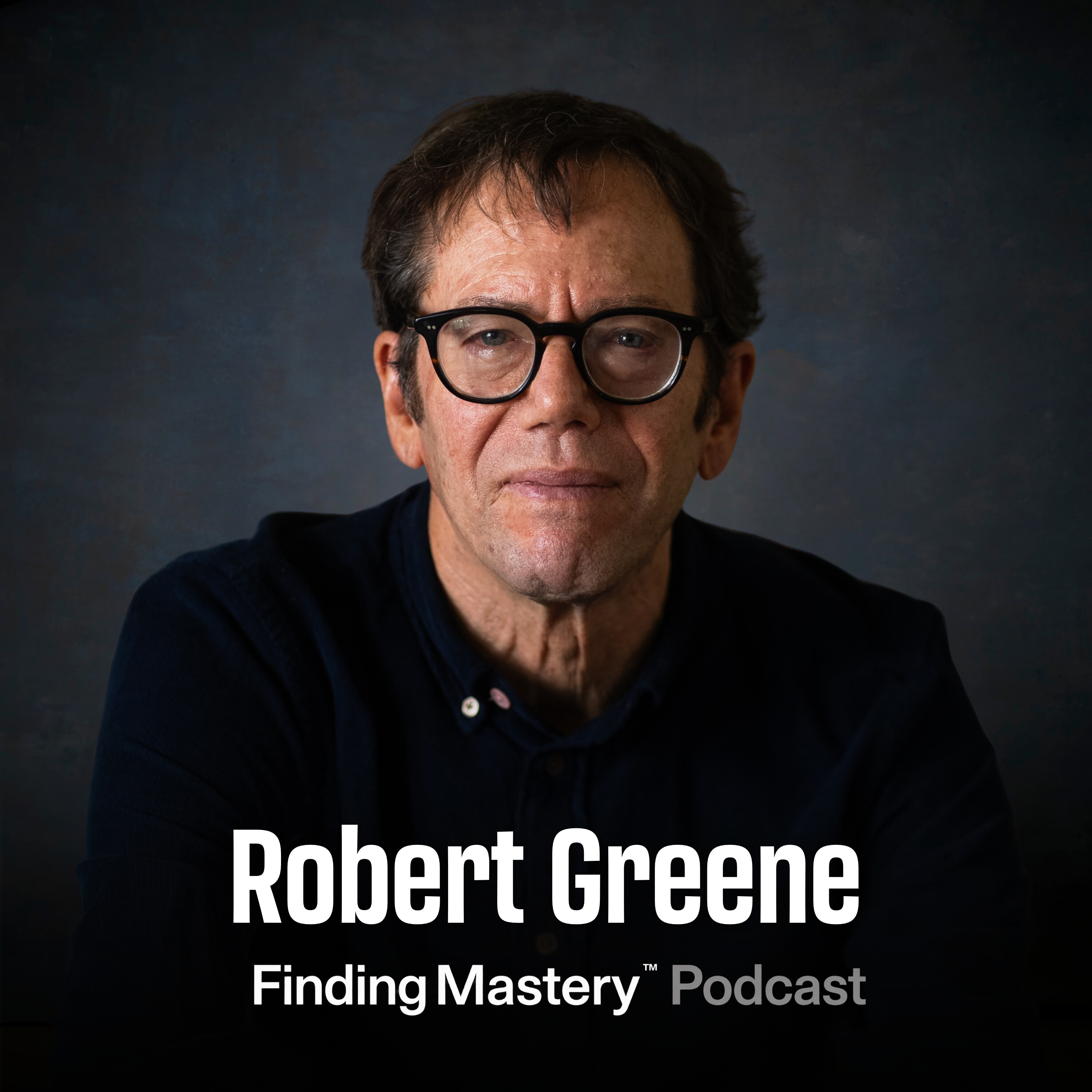
Robert Greene discusses his new book The Law of the Sublime, defining “sublime” as brief moments when the mind touches something beyond everyday reality—often triggered by near-death, nature, or intense perception—and argues that ego/self-absorption blocks access. He connects sublime experiences to mortality, childhood perception, and a “daemon sublime” (a deeper self beneath social identity). He also describes how his stroke and near-death experience shaped the book’s worldview and writing process.
Michael (host) is a longtime podcast interviewer who has had Greene on multiple times, including an early 2009 Skype-era recording in Hermosa Beach. Greene is a New York Times bestselling author (The Laws of Human Nature, Mastery, The 48 Laws of Power), releasing seven books with millions sold.
Death is the “ultimate sublime doorway.” Sublime expands the mind beyond a “circle” of repeating thoughts. The right-side brain injury increased Greene’s emotional intensity, aiding his depth. Sublime is accessible through practices and exercises, not just theory.
Greene’s stroke hospital awakening with “incandescence” in the world; birds/crows seeming magnificent; being trapped in his house and finding magic in a small backyard; “kissed by God” surfing moments; “tombstoning” surrender underwater; and Buddha’s enlightenment via recalling childhood horror at insect slaughter amid sky and life.
Written by AI. May contain mistakes.
Robert discusses his near-death experience and how it changed his perception of life.
“But if you think like that, it kind of alters your whole perspective on life.”
Robert shares his journey of recovery from a stroke and its emotional impact.
“So, just how are you doing on that front, on the physical front?”
The conversation shifts to defining the concept of 'sublime' and its implications.
“Obviously, we're going to talk about your new book, Sublime.”
Robert explains the arduous process of writing his latest book while dealing with physical limitations.
“But there's not a sense of I can actually have that experience.”
Learn about the intricate writing process and its transformative impact.
“I devised a system of two book stands, a notebook here, a notebook there, writing a story, then copying it out word by word in a second and editing it slowly.”
Explore how a stroke can affect emotional expression and cognitive depth.
“I'm glad you brought me into that process because it allowed me a little bit more time to sense what I'm sensing.”
Delve into the concept of the sublime and its metaphors related to consciousness.
“So, okay, take a run at defining Sublime.”
Discuss the limitations of self-absorption and the desire for transcendent experiences.
“track that your mind goes on, that's daily life, I've got my schedule, I've got my children, I've got my tasks.”
Exploring the human longing for transcendence and connection beyond the ego.
“The human brain is actually quite sublime, and I go into that in depth.”
Discussing the concept of the 'daemon sublime' and the inner self beyond social identity.
“your mind is really what you're pointing to as well.”
Practical steps to awaken and perceive the world differently, focusing on observation.
“So a simple thing is just trying to look at the world differently through a different lens.”
Examining the relationship between life and death and the importance of recognizing impermanence.
“What does that mean, that half of our life is death?”
A discussion on 'tombstoning' in surfing and its metaphorical implications for life experiences.
“Have you heard of the term tombstoning in the surfing world?”
Learn about the profound impact of near-death experiences on consciousness.
“And kind of like you, it's probably like, he counted how many seconds it could have been him, like 20 seconds.”
Discover how childhood experiences shape adult perceptions and the feeling of loss.
“and remembers something from when he was six years old, where his father took him out to these fields.”
Understand how children perceive time differently than adults.
“But you can have part of that experience again, and it will waken you up, and it will give you something that you're definitely missing right now.”
Listen to personal anecdotes that reveal the significance of early memories.
“and not thinking of this kind of abstract time that is tormenting you in life.”
Explores the mixed experiences and emotions surrounding the moment of birth.
“It's a pretty hard thing to wrap the mind around.”
Discusses the profound nature of love and the balance between physical and spiritual connections.
“Jonathan, let's talk about love, Robert.”
Encourages listeners to let go of defenses in relationships to experience deeper connections.
“It may go on for several years, whatever.”
Explore the profound adaptability of humans through history and evolution.
“and just see, you don't even have to say anything, just feel it and see if there's a different dynamic going on and kind of register how it makes you feel differently.”
Understand how love and purpose foster resilience in extreme adversity.
“Order your copy today at dearparentbook.com.”
Understanding the difference between happiness and fulfillment through personal experiences.
“how i define happiness and i say happiness isn't really the important value for me at least it's fulfillment.”
Discussing the physical and mental challenges of writing a book and the lessons learned.
“How did you work through the frustration, the doubt, the loneliness, the limitations that you're working through that you never had to work through before?”
Exploring the disconnect caused by technology and the importance of empathy in writing.
“that's outside all the technology, which is our new religion, that there's something else going on.”
Connecting the concepts of mastery with transcendent experiences in life and creativity.
“How does the sublime work with the path of mastery?”

Get the gist, explore an idea or ask about something said.
 Claude
On Finding Mastery with Dr. Michael Gervais, what are the key points of this episode?
Searching your listeningAutomatic transcript. May contain errors.
0:00I have my near-death experience, and death is kind of the ultimate sublime doorway that you can look through. It's beyond words. So coming out of that, I realized the gods are sending you a signal. Now is the time to write this book. You couldn't write the book before this. It wouldn't have been this book. Right? I wanted to, like, impart it to other people to show them that this is a world that's just beyond miraculous. It's beyond magical. You don't understand it. You're not seeing it.
0:23Dr. Michael Gervais: Robert Greene is a renowned author of books such as The Laws of Human Nature, Mastery, and The 48 Laws of Power. He is a New York Times bestselling author, having released seven books, millions of copies sold worldwide, and has just released his latest, titled The Law of the Sublime. So many people go through life, they're not aware that in one moment it can all disappear. But if you think like that, it kind of alters your whole perspective on life. All of your books are great, and some are very tactical. This one is the stuff underneath. And it's not lost that you were forced to go there yourself.
0:56When I first awoke from my stroke, everything looked different to me. Everything had this intensity. The word I like to use is kind of incandescence. I see birds flying by going, my God, how magnificent. What a life. I was like soaring with them for a moment.
1:09Dr. Michael Gervais: As you're speaking, I still see you, but I hear and feel you in a different way. Yeah, this book has changed you. Yeah. What do you hope people will understand about Sublime? who can sense that the world is sublime, the universe, the stars in the sky, mountains, animals, nature, culture. But I'm trying to tell you that the human being, ourselves, are actually the most sublime thing in the universe. So what do I mean by that? Well,
1:40Dr. Michael Gervais: Robert, it is always a treat that we get to spend time. I really relish the time I get to spend with you. So thank you for coming in. Thank you again for being part of our community in a meaningful way. Well, the feeling is definitely mutual, Michael. And this is my third time on your podcast. And the first time was probably the most memorable of all. You got us like a tiny apartment. Where was that? Yeah, it was in Hermosa Beach. Hermosa Beach. That's right. Yeah. And you had this like weird equipment that you were recording on. It's all done by yourself. That's right. It was pretty. It was very memorable.
2:16Dr. Michael Gervais: Why was it memorable for you? Because I think it was like one of the first podcasts I've ever been on. 2009, I did some kind of Skype call that may have gotten on, got on the internet sort of thing with this weird guy who's since become kind of famous. But a real kind of podcast. Yeah, we were learning it together, you and I. Like I didn't really know what I was doing. It was a small little office in Hermosa. Oh, yeah. But I was fumbling around with the gear. You were, yeah. I'm glad that you remember that part of it. I remember that part, yeah. And look what you've done since. It must have been because of that podcast.
2:51I think so. I owe it all to you, man. That's right.
2:54Dr. Michael Gervais: Oh, God. So, all right. Quick update. Last we spoke, you were wrestling with your stroke. You were in the middle of kind of sorting out the new way of arranging your life. So, just how are you doing on that front, on the physical front? Well, you know, it's a process. So, in the beginning, there was just a lot of frustration and impatience. I'd walk around just constantly criticizing myself. Why can't you do this? Why can't you do that? Slowly, you've got to work on yourself, right? You know, you have these limitations. You can either fight them, and then what happens is your mind constantly gets in your way, or you can kind of accept it and be kind of gracious about it and feel gratitude that you're alive, that it affected the right side of my brain, but it left my cognition and my language skills pretty much intact so I could write another book.
3:51In other words, there was a lot to be grateful for, but I had to work on it, you know? And I kind of noticed this idea that I'm always judging myself and watching myself perform with my leg because I have a hard time lifting the left leg and balancing on it for a good flow of walking. I just get so upset and I've just had to like realize that that is setting me back constantly. And you know, it kind of relates to sports in a way. Your thinking and your judging yourself and watching yourself perform is often a big detriment to your actual performance. So I'm getting better at it. I'm a work in progress.
4:29But I've definitely calmed down. I'm not so frustrated and impatient. But I still have these limitations. It's so sad that I can't, like, yesterday we were driving through Malibu. I see all these beautiful hikes. I used to live for hiking. God, I can't do it. Like, you're passing by these candy shops when you're a kid and you can't possibly go in. I don't know. Maybe I'll figure it out. Maybe there'll be some drug or some form of therapy that will be invented that will get me there. It's a mixed bag. You know, I have these emotions.
5:02Dr. Michael Gervais: You know what I hear is honesty. and honesty with the emotional impact that it's had, the self-criticalness that you're now more aware of. Yeah. And then working with the sadness of like, this is the condition. Yeah. And there's things that I want to do, but my body won't let me do. And I'm grateful that I get to be able to think and I get to use my language. And this is a bit of a rollercoaster experience that life is. It is. I mean, a lot of people have their strokes when they're in their 80s, and it's a different experience. Mine happened when I was about 58, 59. And I was still very healthy, and I was swimming like every three days and such.
5:47So it was a much, and there are people who are much younger. During COVID, a lot of people had strokes. I know a woman who's in her 40s who had a stroke from COVID. So the other thing is I would look out my window where I was kind of trapped in my office in the beginning to write the book. I couldn't really go outside much. And I would see people running and biking and walking their dogs. I'd go, oh, God, I missed that so badly. But then it dawned on me they don't really appreciate it. They don't know what's missing in life. They're walking their dog. They're listening to something. They're watching, looking at their phone.
6:23They're not aware of how exciting it is to be outside, to be with your animal, to walk, to run. They're not thinking of that. And so in some ways, me having to develop myself and being aware of what it means to be alive, I almost have it better than them. I had to go through that kind of process and not be crushed by the envy of it all.
6:44Dr. Michael Gervais: Meaning that you're more tuned to this moment and all of what this moment has to offer as opposed to a thin slice of this moment. Yeah. And to basically taking everything for granted, so many people go through life, they're not aware that in one stroke, in one moment, it can all disappear. But if you think like that, then it kind of alters your whole perspective on life and it alters everything that you do, you know. Obviously, we're going to talk about your new book, Sublime. But on the heels of what you just said, when I read your book, I was like, oh this is robert's worldview like you went you went for it yeah as we all know you do but you went for it in a different dimension that was less tactical definitely yeah way more kind of scratching at bedrock as opposed to the kind of surface layer of things like all of your books are great and some are very tactical this one is the stuff underneath yeah and it's not lost that you were forced to go there yourself?
7:48Well, I had originally wanted to write this book on the sublime some 20 years ago. It was a concept that fascinated me because I had read a book on the subject and I go, God, I've never heard of such a thing. Because there's an arena of life, a region in our experience of life, where you feel something that's different from your normal everyday experience, but you don't have words for it, right? And it's hard to describe if you don't have words for it. So this book was kind of about that. And I go, God, I want to write a book on that. I got distracted. I got the 50 Cent Project that kind of interrupted.
8:22That was going to be my next book. Then it came 50 Cent. Out of 50 Cent came Mastery. Finally, you know, I have my near-death experience. And death, as I say in the book, is kind of the ultimate sublime doorway that you can look through, right? It's the ultimate experience that you can't verbalize. it's beyond words so coming out of that i realized okay the gods are sending you a signal now is the time to write this book because for me in that moment right after i i had my stroke it wasn't that the sublime was this thought this abstract concept i had lived it was something physical was in my body and when i first awoke from my stroke in the hospital room looking out the window So everything looked different to me.
9:13Everything had this intensity. The word I like to use is kind of incandescence, sort of radiant glow in the sky and the leaves of trees. I'd see birds flying by, mostly crows, going, my God, how magnificent. What a life. I was like soaring with them for a moment. Can you imagine what it would be like to fly like that? That kind of intensity and radiance that everything had, I wanted to impart it to other people to show them that this is a world that's just beyond miraculous. It's beyond magical. You don't understand it. You're not seeing it. That I can try to describe these qualities that I felt that you can feel them as well.
9:55Dr. Michael Gervais: You couldn't write the book before this. It wouldn't have been this book. Well, sometimes things happen for a reason. I know that sounds kind of woo-woo, but I really believe that. And if I tried to write it 20 years ago, it would have been this kind of elitist thing of going into the Amazon forest and trekking here and there and hanging out with dolphins and such. And people would have read it and go, oh, that's interesting, Robert, but I can't ever experience anything like that. I don't have enough money. I don't have that luxury. And so being a prisoner in my own house, which is literally what I was, made me realize I can't write a book unless I feel it.
10:37All of my books have been that way. I have to be emotionally engaged in the book, not just intellectually. How do you get engaged in a subject so vast like this when you're like trapped in your house? So I had to work on myself. I had to realize that my backyard was a magical place. It's not a large backyard by any means. It's actually quite small. But it had all these insects. It had butterflies. It has flowers. It has life. And I could look up at the sky. And so seeing that it's in everything around us, that just being on planet Earth is sublime, I could impart that to the reader. Whereas they can't identify with blowing down the Amazon.
11:22It's interesting. It could be an interesting experiment. We like to read adventure books. But there's not a sense of I can actually have that experience. And I want the reader to feel that everything I've written in there is something that you can actualize in your own life. If you would have written this book 20 years ago, you would have been on the front end of this movement of people gearing up, barely training, paying up to go climb Everest.
11:50Dr. Michael Gervais: and there's literally now, it looks like an escalator. Yeah, I know. I see that. The folks that were true explorers are... They're aghast at this. Oh, it's the right word. Yeah, it's horrified as, you know. And so you would have been on the front end and that community would have loved it. And so there was a thing happening. I'm really happy that you've introduced these concepts in this book in your way at this time. Before we kind of take the next turn of getting into like defining sublime and, you know, before we do that, by the end of this conversation, What do you hope people will understand about Sublime?
12:22Well, first of all, they'll understand the concept because we use the word now rather just, I had a Sublime breakfast, I went on a Sublime vacation, blah, blah, blah. We use the word, you know, kind of loosely for anything fantastic. I'm redefining it in a different way. So first of all, you're going to understand this concept. The second thing I hope is that they'll look at themselves and they'll go, yeah, I had a moment like that. It was brief. I was out hiking someday and it kind of struck me. I was walking in the city and suddenly something felt differently. I was looking at my spouse, my partner, and suddenly I had a different sensation.
13:05Like they're not this object, but there's something that I'm inside them that I can understand what it's like to be them. That you have had these moments like with animals or with premonitions of death, just fleeting little sensations and that I've given you a way to kind of look at it and you look at your life and you go yeah I've had those moments I understand very intuitively what Robert's talking about so I can access this it's something that I want more of in my life as you're speaking
13:35Dr. Michael Gervais: I still see you but I hear and feel you in a different way yeah this book has changed you Yes. I mean, it was very difficult to write the book overcoming my own limitations. Right. So I had a very tedious, arduous process. I can't type because my left hand is non-functional. So I had to handwrite this. It's a thick book. I had to handwrite the entire book. I devised a system of two book stands, a notebook here, a notebook there, writing a story, then copying it out word by word in a second and editing it slowly. And then going back to the first one, copying it out and editing it, then back and forth.
14:20In the end, I had like well over 100 notebooks completely filled with all sticky pads here and there. And it's a mess.
14:26Dr. Michael Gervais: This was like 1700s writing. Yeah. No, 1300s. 1300s. Yeah, right. And finally, if it was in a good enough form, I would dictate it into the computer with whisper transcription and then print it out and then edit it with pen on paper and then finally dictate it again and edit it with one hand. It's hard to describe the patience you have to have, but that process kind of transformed me as well because it made me think on a different level than you normally think. Normally when you're typing, it's all kind of fast and fluid. You don't have a real physical connection because it's a screen, right? Here you're with pen and paper.
15:10Your hand is moving. It's scratching the surface. And you're having to think more deeply than the fluid kind of typing on a computer. So I think it made me analyze things on a deeper level. And it'll probably flow into my next book whenever I get around to my next project.
15:30Dr. Michael Gervais: Finding Master is brought to you by Lisa. Flow state is one of the most optimal human states that we can be in. When you are fully absorbed in what you're doing, the noise just falls away and your best work, it has room to emerge. Flow isn't something that you can force. It doesn't work like that. You create the conditions for it. And one of those conditions is knowing how to be calm, to be well recovered, to have a nervous system that is repairing. That's why sleep is such an important part of high performance. We've worked with Lisa for a long time because they understand that great sleep is personal.
16:04Dr. Michael Gervais: Their mattresses are designed around how you actually sleep, your preferred position, the feel you like, and what your body needs to fully settle in and recover. You can take their quick sleep quiz in just a couple of minutes and Lisa will help select the mattress that's right for you. Better sleep, a clearer mind. And with Lisa, that's something you can choose to prioritize on purpose. Go to Lisa.com for up to 25 % off mattresses, plus get an extra$50 off with promo code mastery, exclusive for our listeners. That's Lisa, L-E-E-S-A.com, promo code mastery for up to 25 % off mattresses, plus an extra $50 off.
16:43Dr. Michael Gervais: Let them know we sent you in the survey after checkout. Bonnie Mastery is brought to you by LinkedIn Hiring Pro. When you're building a small business, every new hire has the potential to make a real impact. The right person, they can bring fresh energy and new ideas and really help the whole company move forward. It's awesome to watch when you get it right. So finding that right person, finding that great hire, it takes clarity. You have to know what you're looking for. You have to recognize it when you see it and then make the call with confidence that this is the right hire. That's where LinkedIn Hiring Pro can help.
17:16Dr. Michael Gervais: It's really like having a hiring partner throughout the entire process. You can chat with it just like you would a recruiter. You tell it what matters most for you, for the role, compare candidates side by side, you give it feedback, and then Hiring Pro listens, it adjusts, it helps surface the people who actually might fit what you need. They're trying to help us optimize. We're still the ones making the decision. LinkedIn Hiring Pro is just a smarter way to find the right people to build the team of your dreams. Now, if you haven't already checked them out, LinkedIn Hiring Pro can really help your business.
17:45Dr. Michael Gervais: Get started by posting your job for free at linkedin.com slash finding mastery. Terms and conditions apply. Again, that's linkedin.com slash finding mastery. I'm glad you brought me into that process because it allowed me a little bit more time to sense what I'm sensing. Okay. And I think that your emotions are more at the surface. So you used, it helped me analyze your big brain. You've got like this huge horsepower on how to think deeply. And you know that you'd had nothing really to do with that. Your parents gave you that, but then you've really worked it and you're better at it now than probably 99 % of the world.
18:26Dr. Michael Gervais: But like, that's always been your strength. And then at the tail end of your description of your process, you said, I analyzed different. I was like, oh, that's it. You have more available emotion now than previous times that we've spent together. Well, I noticed right after my stroke that I was definitely more emotional. I was laughing at everything, right? The nurses thought I had brain damage because I was so happy. Something must be wrong with Robert. Then when I got home, I would sometimes get really sad and I'd start crying. I couldn't understand why. I looked it up and your right side of your brain is more related to your emotional life and the left side of your brain is caught.
19:07I mean, this is an oversimplification, but left side is more reasoning and logic and patterns and grammar. And oftentimes when people have a stroke on the right side of their brain, they have less control over their emotions. So some of it's neurological. I've always been surprisingly a quite emotional person who always kind of feels things before I almost think about them. But I think the stroke kind of just like triggered that and made it even more intense.
19:34Dr. Michael Gervais: I think this is a secondary gift that's taken place is that you've allowed that part of you that's been strong to to say, I'm just, it's just going to kind of be at the surface with me more of a friend than, you know, sometimes it's a hard to deal with friend. Yeah. But that's how I think about the, my emotional part of me. It's like, sometimes these emotions, like these are great friends. Like it's awesome. And other times like, wow, it's kind of prickly in here and it's a little, a little scary, you know, fill in the blanks. So I'm excited for this part of you. I'm excited to sense this with you.
20:06Dr. Michael Gervais: And I don't think you can write the depth and the honesty in the book that you did without having a porous system between analyzing and cognition and emotions and sensations. So, okay, take a run at defining Sublime. Well, I think of two sort of metaphors. The first metaphor, which is actually on the back of the book as an image, is a circle. And what I mean by that is think of your mind, your mental space as a physical space that you inhabit. And And it's kind of like a circle with limitations. Now, it's just a metaphor. It's not reality, obviously. But your mind exists in a kind of a space. And it never goes outside the limits of the space.
20:49Now, what do I mean by that? Well, you have thoughts, but the thoughts tend to repeat. They tend to go in these patterns. They tend to circle around the same experiences that you've had in life, the same kind of grievances, the same things that are being fed to you in social media. and they're kind of, they're like grooves on a record. They go round and round. They may progress along the vinyl, but they're going round and round and round in this circle. Some of these are what our culture considers to be reality. And reality is something we've all agreed upon as reality. Now, in ancient China, people were walking around with that circle, but it was a different circle.
21:29It was still something limited, but their concept of reality is different from our concept of reality. Nevertheless, your mind is existing in this kind of limited space that it never ventures out of, right? And we have born with very, very active minds. The brain is incredibly powerful. And if you've ever tried to meditate like I do every morning, you notice how the thoughts are just whipping by rapidly. You can't control them. Our minds are so active. So at the same time that we feel this kind of limitation that we live in, we're bored, we're restless, we're upset. our minds want to explore. Our minds naturally want to expand beyond those limits.
22:11So the sublime, I mentioned like you've had a moment where you looked at your spouse or you're hiking. Your mind at that moment went a little bit outside the circle, right? And something else flashed inside of you. You had a little touch of outside that circle of what reality actually is, and I can get to that later. And in touching outside the circle, it's like a shock. My God, there's something else out there. There's some other way of living. There's some other way of experiencing. It's weird and exciting, okay? That is the sublime. And in this book, I compare it to kind of a doorway because the word sublime in Latin means sublimin up to the threshold of a door, okay so imagine there's like a little doorway in your brain and you've gone up to that limit and you've looked through that door and you've seen something else and it's very exciting i have 12 doorways around the circle that are kind of little aspects of the sublime the other metaphor i use is that we have evolved consciousness obviously to survive survive in a very harsh environment.
23:22That's why our brains developed as much as they did. We're a social animal. The world is very difficult and dangerous. We need consciousness to talk to people, to communicate. But at the same time that you're in the struggle to survive and you're looking at the animals and you're figuring out how to do it, you're also looking up at the sky and now you have consciousness and you go, wow, stars in the sky, the sun, it's weird, it's strange. Animals are in the struggle to survive. They have minds and they're operating like that. They're not looking up at the sky and going, wow. They're not looking at other animals and going, how did that ever happen?
23:59How did that ever evolve? They're not looking at the plants coming out of the ground and going, how does life even come out of the ground, right? So at the same time that you have consciousness to help you in your day-to-day life, much as people did 50 ,000 years ago, that same brain also takes you outside the struggle to survive and clicks sometimes and makes you aware that there is another way of looking at life outside just the bare necessities. It's the source of our spiritual longings. It's the source of religion. It's the source of art and poetry and some of our highest aspirations. And so that's how I look at it.
24:41There's like this track that your mind goes on, that's daily life, I've got my schedule, I've got my children, I've got my tasks. Sometimes it veers off that track into looking at the world actually as it is instead of the kind of obsessive hold that the practical life has on us.
25:00Dr. Michael Gervais: As you're speaking, I'm nodding my head to everything that you're suggesting. And this was what I appreciate about what you've done is you've taken some really difficult concepts, as you mentioned earlier, things that are hard to describe. And you've put it in, with that big brain of yours, you've put it into a model that did not exist before. You clearly borrowed from A, B, and C world religions and A, B, and C deep philosophical positions. You've combined it in a way in your own intuitive experience to say, but I have not seen the 12 as doorways to the sublime and the liminal, the space between this experience and that experience is what you're really going after.
25:46Dr. Michael Gervais: And then I want to add just some fun context from the more physical world, because there's a physical component to this, of course, but the more physical world or sport is that in surfing, there's this phrase, kiss by God. Never heard that. Yeah. So kiss by God is the moment or the experience where God came down and gave you a kiss. And it was so - Like the perfect wave or something? Everything was completely tuned, completely organized in a way that you were with it. Yeah. And some will hear this and they'll say, oh, you're talking about the zone. No. Oh, you're talking about flow state. No, that was the same thing.
26:24Dr. Michael Gervais: No, it's not that. It's something that transcends that harmonious experience. It is better. is a way to think about it, is more aliveness inside of it. Kissed by God. And it usually happens on the danger line. Yes, most definitely. Now, all that being said, what gets in the way, before we go to the 12 here, what gets in the way of sublime being more available, experienced more often? Well, the ego and self-absorption. And it's getting worse and worse in the 21st century. But if your focus is only inward, That circle gets narrower and narrower and narrower because, I mean, the amount of emotions and thoughts you can have about yourself and whether you're getting enough attention, whether people like you enough, whether about your status in life and about your position in the office, etc.
27:19It's a very narrow round of experience that you're having, right? You're always going around the same problems, the same grievances, the same hurts, probably going back to your parents when you were a child, right? Everything stemming from that. So your focus on yourself, your self-absorption, your egocentricity is causing that mental space to continually shrink. And as you get older, that shrinking process gets worse and worse as you have all of these hurts and disappointments and resentments. And the mind circles around them more and more and more and more. That is the greatest obstacle. Because the sublime is about expanding your mind.
28:00And I have a chapter on the brain. The human brain is actually quite sublime, and I go into that in depth. But I'm talking about opening your eyes to the universe, to life itself, to animals, to other people, to history and the past, to death itself. You have to get outside of yourself to have that. But I'm saying in the book that you long for that. You long to be taken out of your ego. you're in prison and you secretly want to be freed from this prison and you want these kind of transcendent experiences and since you can't get them because our culture doesn't provide them it's a culture that is kind of anti-sublime you go in search of it in other ways that are kind of false and i talk about that in the book but embedded in your human nature right now as you're listening is the need to feel yourself a part of something greater than your individual life.
28:58You can either accept that and voyage into the sublime, or you can deny it and go further into yourself and your bitterness and your loneliness.
29:07Dr. Michael Gervais: This is why most people, when they experience what you're describing, it's very agitating. There's an irritation inside because I don't want to feel this way. I don't want to feel like I don't matter, like I'm not here, like fill in the blanks and that agitation is actually a mark of health yeah it is a problem for everyday functioning and quality of life but that struggle to get free is very different than the hopelessness and the helplessness you know the allegory of the cave where plato described some people are just going to sit there in their make-believe shackles and just stare at something that doesn't really exist, but they think it is the thing.
29:48Dr. Michael Gervais: So that struggle to want to get out of the shackles of your mind is really what you're pointing to as well. Yeah. And I have a chapter in the book, I call the daemon sublime. It's about this sort of second self inside of you that is who you really are below the surface of your social personality, which isn't who you really are. Your social personality, I'm introverted, I'm shy, I'm ambitious, blah, blah, blah, blah, blah, blah. It's just a reflection of other people's judgments on you. It's not really who you are. You're always thinking of yourself in comparison to other people. But there's something, a core about you that is physical, physiological, neurological, that is you and not like anybody else.
30:33There's no other social component, right? And I say, the moment you feel frustrated about yourself and about your career and about your life and about where you're going, is the voice of that second self talking to you about what's wrong, right? It's communicating to you. So on a similar level, your unhappiness, your sense of feeling trapped and enclosed is kind of an invitation to get outside of yourself. It's kind of speaking to you like you want something greater than what the culture or what your life is giving you. And so you have to be able to listen to those singles. So what you're saying as frustration and feeling trapped is actually a good sign of health.
31:18Dr. Michael Gervais: And for folks that are feeling that, what do you suggest is a reasonable set of steps or actions to take to find a bit more freedom? Well, read the book. Yeah, for sure. I have exercise. So I meant the book to be practical, not just an academic discourse on sublime. Each chapter ends with exercises that you can go take outside and bring into your life. But the main thing is, is to kind of wake up. So you're kind of sleepwalking through life. So a simple thing is just trying to look at the world differently through a different lens. So when you walk outside, you try to drop words and languages and categories and just kind of observe and feel the world, not just analyze it and think in terms of categories, but look at the world and feel it and look at the sun and marvel at the fact that this exists, that life exists, that there are people around you, that there are animals around you.
32:27But you're not looking at anything. You're kind of trapped in language. You're kind of not seeing the miracles of what a tree is. A tree, when I first had my stroke, I looked out the window. I saw these giant palm trees swaying in the breeze. And I was going, oh, what a strange thing, a palm tree. If you look at a palm tree, which we have a lot in LA, there's some of the strangest things you'll ever see. This enormous thing going straight up into the sky with only like leaves at the very top. It's weird, right? I'm just asking you to go and look at your world a little bit differently. Get off that track and veer off and kind of something clicks in your mind and you look at things as they might actually be.
33:11A lot of exercises in the book like that. I think a large problem in our culture is we have subtracted death from our reality. And I try and say, to be alive is to die. They go together. Half of our life is death, right? And we carry death inside of ourselves.
33:31Dr. Michael Gervais: What does that mean, that half of our life is death? Meaning that when you look back at some point, you're at the midpoint of your life? No, no. That to be alive is also to face death. So you can't subtract them. You can't be alive without having to die at some point. And it's not just the physical death. Your cells are dying constantly in your body. Thoughts are dying. People around you are dying. The world is changing. Nothing is permanent, complete impermanence, okay? So we live in a culture that denies that, that denies that sense of impermanence of everything around us because we want comfort.
34:07We want security. We want stability. And so I'm trying to get you in that chapter to get closer to the death inside of you. It is a physical reality that you carry with you every moment. You don't realize how fragile the body is. At any moment, something can collapse. You don't see your heart beating. You don't see the blood going through you. You don't see the process of respiration. They're very delicate balances, right? One slight thing goes off and your health is ruined. You carry death inside of you. It's not morbid. It's not depressing. When you connect to it, it makes all of life look different.
34:48And I have an exercise to the end of the book. Based on my own near death and based on tons of research, I'm taking you through the feeling of yourself dying, how you will feel in that moment. It's a moment you are going to face. okay and it feels strange your brain is kind of going off like a computer turning off your whole body is getting heavy i take you through that exercise so you can feel the death inside of you and it's not morbid at all and then once you feel that i ask you to go outside as if you have died and and the exercise is meant to be very powerful if you follow it you are going to feel like you are in the process of dying.
35:37You go outside, the world is going to look differently to you through that lens now that you feel like the physical presence of death inside of you. These are exercises that are going to allow you to see everything differently once you go through the process that I'm bringing you into.
35:55Dr. Michael Gervais: Body Master is brought to you by Granola. Here's something that I think most of us miss without even really realizing it. Every conversation that we have has two layers happening at once. There's the conversation, the obvious conversation with the words themselves. And then there's everything else underneath. That's the emotional language, the subtle tones of voice, micro expressions, the brief pauses before someone answers. That second layer is really rich with information. And in meetings, it's easy to miss it when our heads are down and we're taking notes. That is why I use Granola. Granola is an AI-powered notepad that makes your meeting notes useful.
36:30Dr. Michael Gervais: It captures what happens in your meetings and then turns them into clean, structured notes with decision and action items pulled out and made easy to find. And the best part, it works right through your device's audio, which means that it integrates seamlessly into the video conferencing tools that you already use. No big setup, no awkward bots. I use it every day when my meetings are done. There's a clean recap and a clear set of next steps that are just waiting for me. Nothing slips away. This isn't about doing less. It's about being more present. I think you're really gonna like what Granola's doing.
37:00Dr. Michael Gervais: Once you try on a first meeting, it's hard to go without. You can try it totally free. Head to granola.ai slash mastery. That's granola.ai slash mastery to get your time back. Go to granola.ai slash mastery and try it on your next call. Finding Mastery is brought to you by Momentus. There's a principle that the team at Momentus uses that has stuck with me. The relentless pursuit of better. Creatine is a good window into what they mean by it. Creatine is one of the most studied supplements in the world. The benefits are reasonably well-established strength, power, recovery, and increasingly what it does for the brain.
37:35Dr. Michael Gervais: It's been found to support brain energy metabolism and easing mental fatigue. So this is something a lot of people do take every day. And when you take something on a regular basis, what's in it, what's not, and how consistently it's made all start to add up. That's the part that Momentus obsessed over. Rather than settle for what's on the market, they searched the planet for the highest quality creatine source. Then they built their own specification around it. They call it the signature spec. It's made in a pharmaceutical facility, 10 times fewer impurities, six stages of testing across four independent agencies, NSF certified for sport, and it's micronized so finely it actually mixes clean.
38:14Dr. Michael Gervais: No grit. Go to livemomentous.com slash finding mastery and use the code finding mastery for up to 35 % off your first order. Again, that's livemomentous.com slash Finding Mastery, code Finding Mastery. Have you heard of the term tombstoning in the surfing world? Tombstoning? Yeah. Well, you're interested in a lot of interesting new vocabularies. I'm going to have to write this down. Yeah. Kiss me God. Kissed by God. Kissed by God. Okay. Kiss me God. Yeah, that's a good one. God, come on. Kiss me God. Yeah, yeah. Kissed by God and tombstoning. Tombstoning. is a thing that happens where when you're held under for a long enough period of time and you're really under that there's tension between the surfboard and your leash and the leash is attached to your ankle so there's a there's a bunch of tension and the board is not flat on the surface because you're so far deep in the ocean it's the board pops up and when the board pops up it looks like a tombstone.
39:20Dr. Michael Gervais: It's kind of moving towards the beach as you're getting dragged. But it only happens when you're really far under. And it's this interesting signal to all the other surfers like, oh, he's in a heavy spot or she's in a heavy spot. So I had a tombstone. It was here off the coast of California. And I had a tombstone moment when I was in high school, college. Oh, yeah. And I remember that feeling like, uh-oh, couldn't struggle, couldn't get up. Most hold downs under pretty big conditions are like three to six seconds. It's kind of like, after six seconds of struggling, it sounds like it's nothing, but it feels like an eternity sometimes.
39:58Dr. Michael Gervais: This probably was nine to 12 seconds. Now, I can hold my breath for 12 seconds. No problem. But there was a tombstone. And I'm making these numbers up. I didn't count. I don't really know. No, no, no, of course not. But when you're bored tombstones, it's a signal. And when I came up, my buddy was right next to me. and because he paddled over to see if he could help and see if I was going to be okay. And I came up like, holy smokes, because what happened was I didn't give up, but I had to stop struggling and I had to go with this feeling that I might be drowning and I'm in it and there was a quietness.
40:36Dr. Michael Gervais: There was a simplicity in it. There was a full surrender. I was caught underneath the wave. It eventually passed and I could feel like this is my moment to come to the top. So now I'm swimming to the surface with all of my might, pulling up my leash to get to, I come out of the water gasping for air and I look and I see my buddy and I knew in that moment I was going to be different. I wish that in some respects that I would be tuned to that every day, which is the meditation you're talking about. And the only way that I think you're going to appreciate this practice, when I say goodbye to you, I'm going to say, this is my practice.
41:11Dr. Michael Gervais: When I say goodbye to everybody. I don't know if I'll see you again. Yeah, yeah, I know what that's like. When I say goodbye, I'm also having a second conversation, which is, gosh, I really hope. And this was a really good moment for me. Well, every separation from people in life is a little death. Yeah, it is a mini death. And that mini death, if you will, to use your language, forces an appreciation for life and aliveness. And so some of my favorite people are action sport adventure folks that are on the danger line. And they wrestled with it, and they come back with a different perspective.
41:45I've read a lot of books on near-death experience. One of them was a man who was drowning off the Channel Islands, I don't know, I think like in the 90s or 80s. And he had this intense, intense experience as he's drowning. And kind of like you, it's probably like, he counted how many seconds it could have been him, like 20 seconds. but like all these things happened and he's had like figures of light coming to him and it was just like a total transcendental experience and then he survived and he was just never the same and he couldn't get over it and he kept trying to figure out what what actually had happened and i can't remember the full it's a beautiful book and i'll i'll find it for you i'll tell you what it is because you probably appreciate it awesome but there's also mountain climbers who fall and in the falling it's obviously a matter of 10 seconds or so their whole life passes they feel all these incredible emotions people who've jumped off the golden gate bridge to commit suicide but survive and so something is happening to the brain as you're processing death and as things are dying as the brain is dying to kind of alter your consciousness it's an incredibly powerful experience i've worked with a couple folks that have had near-death
43:03Dr. Michael Gervais: experiences. And what it reminds me of is that there is more. It's as simple as that. There's more to this thing than we know. And when we enter the doorways or even knock on the doorways of the other side of it, and I don't even mean death in this case, I'm talking about literally the sublime, the liminal, if you will. So I want to get right into this about some practices and some understandings about some of the 12 that you went after. And we've talked about death we've talked a little bit about daemon i would like to go after childhood love i'm interested in the cosmic and the dynamical yeah the dynamical i'm sure it would be most appropriate well the childhood sublime is essentially the idea is that when you're born in the first few months of your life you're just crying and you're just a bundle of needs right you're not really truly conscious although there's recent articles about when consciousness in a baby begins, so it's in dispute right now.
44:07But you're not really conscious. You're just this bundle of needs and nerves and crying and food and all these other things. A moment arrives, maybe nine months, ten months old, when that calms down and you start to look at things. Maybe there's like a mobile above in your crib and you're seeing things kind of moving and you're beginning to become aware of people moving about and maybe you see pets and maybe you see nowadays you see some kind of screen type thing. But you're starting to become aware and you're starting to become conscious. You went through that process, you hearing and seeing this podcast, right?
44:44And it was before you had language. It was before you had categories. And everything had this intensity to it that you've lost. Everything was new. What does that look like? What does that mean? and people who've studied the brain of infants notice that there's a chemical difference in the brain. First of all, our brains operate by inhibiting information so that we can get through our day without too much chaos, right? It kind of filters down what we essentially need. The baby's brain doesn't have that. It's just interested in everything. Everything moving around is exciting and weird and strange and you want to understand it, right?
45:27And so you get older, you get language, things are still fascinating to you. Words are fascinating as you're first learning them, right? Then you start becoming aware of a self, an ego, as you look in the mirror and you see that you're this other person that you can look at. Things start shifting in your consciousness. And then you get older and that sense of a self and an ego comes to dominate your experience of life. and that sense when you were a baby and there was no self and you were just open to everything and the world was this intense experience, some of it terrifying, no doubt, but some of it incredibly exciting and it's why you learn so quickly.
46:10You get into your 20s, your late teens, your 20s, you start losing that, it gets in the distance and the world starts closing down in the process that we talked about earlier. And what I try to say is if you had never gone through childhood, you would never have this feeling that you're missing something in life because you wouldn't have had that experience that was so different. But because buried deep in your consciousness now as an adult, you can remember that there was a different level experience where colors were like obsessed you or movement or just the strange objects or animals or pets or the sky.
46:49Children, when they look at the night sky, they have very strange thoughts. The thought of infinity, what does that mean? Something goes on forever. You were once open to the world, and now you've lost it. And that sense of, I call it the lost self, the self that you lost in adulthood haunts you. And the sublime are often moments where the childhood experience erupts inside of you again. And so what you want from your childhood is not, oh, it was so sweet and wonderful. I had these friends, I had parties, and I had all this fun. What you want is to experience life again through the lens that you had as a child, how you experienced time.
47:33Time had a much different feel to it. I tell the story in the book about Buddha, the Gautama, the first Buddha, right? And he came from a very wealthy family. He had everything he wanted, a beautiful wife. He was very handsome. him. But if something was missing, couldn't figure it out. He just wasn't happy. He left the palace that he grew up in, right? He put on the robes of a monk and his family was horrified. And he wandered through these forests for years. He tried every kind of ascetic practice. He tried yoga. He tried starving himself to death. He tried drinking his own urine and all these other things.
48:13He almost died, and he realized, this isn't what I'm looking for. This isn't the enlightenment I'm looking for. And one day, he's sitting under a tree, and remembers something from when he was six years old, where his father took him out to these fields. It was harvest time, and they were cutting everything down to harvest it. And as they're cutting everything down, all these insects are dying and being killed. And as a child, he looked at that, and he was horrified, all this murdering, this bloodbath of insects, just insects. But at the same time, there was the sky, there was life, there was this incredible intensity, and he felt this overwhelming emotion.
48:55This is what leads to Buddha's enlightenment, is recalling his childhood. So I'm saying, if you can recall your childhood experience in some way, and I give you exercises on it, and I give you plenty of stories and tell you how your experience was different. If you can relive yourself, if you can open yourself up, if that can become part of you internally, you're going to have a sublime experience. You're going to return something that you once had and you lost. I'm not saying I want you to be a child again. You have bills to pay. You have things you have to do. You have a job. I understand. But you can have part of that experience again, and it will waken you up, and it will give you something that you're definitely missing right now.
49:36Dr. Michael Gervais: There's a Zen principle, which is the ultimate attainment of the mind. is a childlike mind. You know, the Buddha, we all have Buddha, say it again, the beginner's mind. Yeah. And so what does that really mean? It's to see the wonders of the world and not be so jaded, not be so protective, not to be so judgmental about this is good and this is bad. Yeah. So the childlike or the beginner's mind is what you're pointing to. And it's also not lost. I mean, one of the stories about Buddha that I've always been interested in is that he came from a wealthy family and then dad, let's call it, or the court of his family wanted to take care of him in such a way that every time that he came out of the castle, they would sweep in front of him.
50:21Dr. Michael Gervais: Like they would make the roads and the streets clean and they would make sure that the people that were unhoused were kind of moved out of the way. So he always thought that the world was like really this wonderful place. And then when he got outside, when he snuck out or got outside the walls, he's like, well, I've been living in a false reality. Yeah, yeah. So I need to really get tuned to what's happening. I always find that part fascinating. When I think about my life, I think about my son's life, I think about our lives, that being amongst the actual experience of life is way more richer than the manicured.
50:57Yeah.
50:58Dr. Michael Gervais: Yeah. All right. Check. Childhood. Get back to that mind. Can we move to love for just a moment? Sure. Yeah. Yeah. The only only just one other thing about childhood was you had a different experience of time. And I think it's a very important concept. Time was not something outside. It wasn't abstract. It wasn't past, present, and future. I have to get this thing done, that thing done. Time was a physical flow that you felt inside of you. It was the sense of being alive. Moment by moment, moment by moment, you were progressing like down a river and you were inside the river and you were experiencing time in your body.
51:38And I have exercises in the book where I'm trying to take you back to that physical sensation of time passing and not thinking of this kind of abstract time that is tormenting you in life. Anyway.
51:50Dr. Michael Gervais: Yeah, it's a really good point. And time is a made-up construct anyways. So figuring out how to wrap yourself into a way that you're with time and not tormented by would be a really important unlock for people. There's a best practice in psychology. and it comes from Alfred Adler. And the idea is to go and pull forward your first memories. What is your first experience that you remember? Yeah. And I'm curious what yours was. Well, I think I was about four years old, maybe four and a half, I don't know. And I was with my friend at the time, Ricky Weisbaum. Don't ask me why I can remember his name.
52:30I grew up in Baldwin area called Baldwin Hills. and we were walking around and there was, our parents just left us alone. Imagine back in those days. We were at a building and it was all these shadows and it was dark and the shadows and the darkness on this side of the building. I just remember that very deeply. And that's like my first actual memory of an experience. The shadows and the darkness in this corner of a building.
52:58Dr. Michael Gervais: Are you making this up? No, why would I make it up? Which just eloquently fits the model, which is whatever your first memory is that you call back up from that experience is that it's telling about the way that you've organized your life. Let's say, for example, and for you to remember the shadows, it's so fitting, Robert, with another person. Kind of out in the wild by yourself before you're actually equipped with the wild. It was a city streets, whatever. But that you remember the shadows, the shadow part of life, the shadow part of you, the shadow part of others, which is what you've been working to bring to the surface.
53:36Never thought of it that way. Hey, how about good psychology is right there for us. You're doing good interpretation there.
53:42Dr. Michael Gervais: Yeah, yeah. What was yours? It's bidirectional in that I remember being in the crib, holding onto the edge of my crib. That goes pretty damn far back. It's pretty far back. And I can also see myself in the crib, which is like, this is a mind bender for me. I can see out of my eyes, looking down at my hands, being in the crib. And then I can see where my parents' room was, was kind of across the hall over there. And I can also remember watching me. You mean they watching you? No, no. Like I can see me from the corner of the room in the crib. We didn't have cameras. So this was like, this is a little confusing for me.
54:21Dr. Michael Gervais: but I'll finish the story. There was two ways I remember experiencing that, which is like bright eyed, like, oh my God, like, I just want to get out of here. But like, this is, this is kind of wonderful. You can see me kind of like barely having my sea legs, you know, but bright eyed. And then I also have a second part of it. I've collapsed a couple of memories or experiences into one, which is like, where is everybody? That's a very calm childhood memory. Yeah. And so, so I've got two, I want to go. And the other one is a little heavier. Like, where is everybody? Why am I alone? So then if you fast forward my life, you're like, oh dude, you're just trying to be connected.
55:00Dr. Michael Gervais: You're trying to explore and be connected. Like, yeah, yeah. You know, it makes sense. That first memory must be like nine, 10 months old or something. Maybe I was in my crib up to like four. I don't know. Maybe that's part of the problem. No, that wasn't the case, but yeah, it was early. I've scrubbed it enough to ask if I have pictures of that. And I've just looked at the picture and misremembered, but we don't have pictures of that. But your parents could tell you about the crib that you were in. Yes. I could have falsified the memory, but I feel like this is my first memory. No, it's not false.
55:31Dr. Michael Gervais: Yeah. Right. Yeah. Wow. That's very exciting. It is exciting. And that'd be good for our community, both of our communities to like think about and maybe even ask their partner what was your yeah what's the first memory there's a new frontier in in science of related to near-death experiences where there are children who could remember their moment of birth that's right yeah the birthing experience and it's corroborated the mother will tell them that yes that thing that you saw was actually there in that room that's It's a pretty hard thing to wrap the mind around. You could remember that moment, that first few hours of being born.
56:11Dr. Michael Gervais: Yeah, and some people talk about how traumatic it is, going from warmth to cold, you know, or how wonderful it is. There's a mixed bag there. Finding Mastery is brought to you by Athena. The psychological skill of control is something we talk about regularly here at Finding Mastery. And part of that skill is being honest about what's actually yours to carry and being clear about what is not. Not every task deserves your time, even when it really needs to get done. If you're leading a company or a team, there is so much competing for your attention every day. You know that. You feel that. The inbox, the calendar, travel, hiring, the list goes on and on and on.
56:46Dr. Michael Gervais: And just because something needs to get done doesn't mean it needs to get done by you. That's the shift that Athena is making possible. They match you with a dedicated, full-time, remote executive assistant. It's a real person who takes on the inbox, calendar, travel, the details that fill up your day. They're EAs. They come from the top 1 % of more than 60 ,000 applicants, the best of the best. And they're fluent in AI tools. They make great support. They support you even better than you can imagine over time. Clients, on average, get back 15 hours a week. How about that? Take control of what's in your control and learn to delegate the rest.
57:21Dr. Michael Gervais: Check out what Athena is doing. I think you're really going to appreciate it. Go to athena.com slash mastery right now and get matched with your EA. Give yourself a few hours back this week and go to athena.com slash mastery and see who they pair you with. Finding Mastery is brought to you by Magic Mind. I get to spend time with people who are relentless about training their minds. It's one of the things I love most about my profession. And for me, and those I work with, we are looking for ways to optimize our psychology and our brains. Magic Mind is a daily two ounce mental performance shot loaded with vitamins, amino acids, antioxidants, and clinically backed ingredients like turmeric, ashwagandha, and lion's mane.
57:59Dr. Michael Gervais: The ingredients are nano-encapsulated for five times better absorption than traditional pills and powders. And I love the taste. I love what they're doing here. I use Magic Mind just about every mid-morning. And what I notice is that I think just a bit more clearly, my focus is definitely enhanced, and I don't experience an afternoon drop. That's not a small thing when the quality of your thinking is one of your most valuable skills. So go to magicmind.com and get 50 % off your first order. You spend a lot of time sharpening your mind. It is worth fueling the brain behind it. Okay, so, all right.
58:33Jonathan, let's talk about love, Robert. The idea is, I call it the Love Sublime, and the title of the chapter is Escape the Prison of the Ego. The idea is that the human animal is a mix of two things. We're physical and we're spiritual at the same time. So physically, we have deep desires, attractions to another person, sexual attractions. We want to reproduce. We want children and all these other things like that. And we want that kind of pleasurable physical experience. But it's not enough. We have it. It's over. And it's often kind of an emptiness afterwards, after you've had the sexual satisfaction or the bare physical satisfaction.
59:18Something is missing. So you go in search of another partner, then another partner, trying to keep that sensation, or you repeat the sexual experience, but there's still that feeling of emptiness. Spirituality, you have organized religion, you have beliefs, you go to church or you go whatever you do. But there's also something not there because you're a physical creature, you're a physical animal with tastes and desires and hungers and longings and emotions. Some religions have aspects of that, like the Pentecostal church or whatever, But generally, it feels kind of abstract. It feels like outside your body.
59:59But the love between two people, man and woman, man and man, whatever it is, is the combining of the two sides of our nature. We have the physical side, which then turns into something spiritual. It turns into love, right? We bond with another person and the actual attraction turns into something that's invisible that you can't even quantify or qualify. And it's a feeling that normally the people around you are objects. You're not aware of this, but you just see them outside. You're not inside their experience. They're just objects moving around you. And sometimes you manipulate those objects to get what you want.
1:00:43When you fall deeply in love, and I mean deeply in love, the other person transforms into a subject. They live inside of you. You get inside of their spirit, their mind, and for a moment your two consciousnesses emerge and blend, and it's an insanely transcendent experience. Now, I use the word falling in love is very eloquent because you're falling. And to fall has an element of terror, of fear, right? because you keep falling and you might hit ground. In other words, you're opening yourself to another person. They could hurt you. They could abandon you. And that's like the greatest fear that we have is the fear of abandonment.
1:01:25It goes back to our early childhood. And so as you're falling, you reach a point where you stop and you have some distrust and you go, can I trust this person? Am I becoming so vulnerable that they can hurt me? And so the spell is broken at that moment. You stopped falling, and it will never continue because it kind of creates these seeds of doubt that start sprouting. The other person senses that you've reached that point, and it affects them, and they go, they don't seem to be trusting me. I don't know if I can trust them. It kind of creates this back-and-forth moment. Both of you start falling, and you start thinking about the relationship and about maybe you're going too far.
1:02:05Okay? So you stop falling in love. You may have a relationship. It may go on for several years, whatever. But it's not turning into this deep, deep sense of love. You're not letting yourself fall completely into the spirit of the other person. A lot of his other people are telling you, I don't think you can trust her. You listen to other people and you listen to the culture that tells you romantic love is kind of a cliche. It's silly. It's stupid. It's sentimental. Don't be like that. Whatever it is, you stop the process. But imagine if you had another person, you've all had experiences in your life where you fell in love with a person.
1:02:43But what if you just kept falling and falling and falling without any defensiveness, without any resistance, without any doubts? You just let yourself fall completely into the spirit of that other person. And even if it ends in pain, you at least had that sensation of something very deep happening and you allowed yourself to keep falling. If you keep falling and you allow that to occur over months and years, you reach this level that I call love sublime, where there's nothing separating you from the other people. Your defenses have finally let go completely of yourself. Your ego is melting away.
1:03:22It's getting thinner and thinner and thinner. And you feel this intense bond with another person. It is both physical, but it has a very powerful spiritual component. They have come alive inside of you. And because it meets both sides of our nature, to me, it's almost the most powerful sublime experience you can have. Because as somebody who yearns for transcendent experiences, but also is a social animal, that experience of going into the transcendent with another human being is the most potent form of it. A lot of people are hearing this and it's not part of their experience, right? and maybe they've had moments of it where they fell pretty far but stopped themselves.
1:04:08So I'm asking you to kind of imagine what it could be like if you had stopped that process of doubt and mistrust and gone completely into this.
1:04:18Dr. Michael Gervais: God, I love the analogy. Two things pop up for me. One is the Zen master says to the student, good news, bad news, bad news. Life is like falling through the sky with nothing to grasp, nothing to hold on to. It was the good news. There's no bottom. It's terrifying. I find myself wanting all of it and also being terrified of letting go more. My sense of self, my ambitions, my selfishness, my responsibilities that I have keep me from the accelerated pace of falling that I want to be on. yeah robert believe me i want it like so much so that i know my responsibility is to really let go yeah i want my wife deserves that of me my son deserves that of me and i want to give all of me to them same with everything that i'm doing the love affair with the unfolding unpredictable unknown is the greatest love affair of all yeah and when you can do that with another person.
1:05:28So a lot of our psychology, because we're social animals, is relational. So you think that the other person is just doing something to you, but you don't realize that your energy is maybe causing them to react to you a certain way. It goes back and forth. It's like a chemistry that's happening between you two. You maybe are causing them to withdraw by the fact that you have drawn first, right? It's a pretty well understood idea in marriage therapy. Yeah. Yeah. So if you let go, even for a moment, and let go of your defenses and say, what causes a lot of friction is, I want something that they're not giving me, right?
1:06:15If you tell yourself, I don't need that, I want to give to them. It's not about them giving to me, it's about me giving to them. And you let go of that first little hitch that's stopping you, and you just drop it. They're going to feel it, and they're invited to follow along with you. They can feel it. People can sense that. The woman, in my case, in my life, is going to sense it. And she is now invited to do the same, because we feel this kind of energy between us without without any words being spoken. You don't have to say, I love you. They feel the sense that you've let go and you're not judging them.
1:06:53You're not needing something from them. You want to give something to them.
1:06:57Dr. Michael Gervais: It is the sign of the next step. I remember this phase. My wife and I have been married for 35 years. And I remember there was a depth mark at some point where we made a decision that we're going to keep going. It was a tough road. It was either in or out. We're going to make this thing work or not. and we made decisions together to keep going, a lot changes. Yeah. Yeah. And I'm a physical person. And I know that like when I hug my wife or I hug my son, there's something just in that physical touch that feels like the union is closer than it was, you know, three seconds ago. Yeah. Yeah. There's something about that for me that's really cool.
1:07:37Yeah. And, you know, I talk in the book about how there's an energy in the universe that wants things to come together. So it's not just about you and your own desires, but there's something transcendent about the sensation of love. It's like something connected to the universe, to the cosmos, this desire to unite with another person.
1:08:01Dr. Michael Gervais: One thing that we could do to become closer, to be more loving or to embrace the falling in a better way, what would you suggest? Well, in some ways, you have to disregard the culture that we live in, which is a very cynical, hardened culture, very gritty, very scientific, very technological and sophisticated. It tells you, you know, what are you going to get out of that? You know, I mean, you know, your career is important. What am I getting out of this sensation? It's just opening myself up to a lot of pain, a lot of vulnerability. so the way to get there is to actually see it as a value that's incredibly important that you're holding yourself back continually is making you lonely and miserable and it's making you constantly search for other things that you're never going to get and so when you experience this it's allowing yourself to grow because you're kind of letting go of all of these habits that you've created over life of becoming defensive.
1:09:10So the process of getting older is getting more and more defensive or more like, I don't want that. I don't want this. I can't get into your shell and letting go of that and letting that melt and dissolve. Just for a moment, I'm asking you in your relationship with your spouse or your child, I guess that would be, or your parent, to let go of that defensiveness and just see what happens. All right? Just experience it for a moment. And you say, oh, it doesn't feel right. It's because you're holding on so ferociously to these defenses, to your fear of being hurt, that you can't do that. Try it tomorrow with your spouse, your child, your parent, and just see, you don't even have to say anything, just feel it and see if there's a different dynamic going on and kind of register how it makes you feel differently.
1:10:13And that's what I would advise for that first day.
1:10:16Dr. Michael Gervais: I love it. Sounds simple. It is very simple. Yeah. I think most practices in the world of psychology are almost embarrassingly simple, but incredibly complex when you think about the downstream and the impacts it can have and just hard to do, but simple to understand. Yeah. Yeah. Okay. All right. Let's switch gears to dynamical. Well, this is a concept of, okay, so we can sense that the world is sublime, the universe, the stars in the sky, mountains, animals, nature, you know, culture. But I'm trying to tell you in this chapter that the human being itself, ourselves, are actually the most sublime thing in the universe.
1:11:07So what do I mean by that? Well, if you look at where we evolved as Homo sapiens, okay, we evolved in one of the most tumultuous chaotic periods of climate in the Earth history, the Ice Age, right? started about 800 ,000 years ago. And when there's an ice age, rainfall diminishes greatly, okay? Temperatures get colder, but rainfall also diminishes as well. And so our ancestors are growing up in the emerging in these forests in East Africa, and suddenly the forests are disappearing. And now there are these open savannas, these grasslands. That's where we emerged from, okay? But now you're in open grasslands.
1:11:57You have no protection. There's no place to run away from. There's leopards. There's large animal predators all around. And leopards were eating humans at a very high rate. We've discovered these like mounds of human skulls in East Africa that were left by leopards. Yeah. They would take a human. They would climb up in a tree. They would eat it and the skull would drop into the ground. Oh, my God. Um, so.
1:12:23Dr. Michael Gervais: And we say it's harsh now. Yeah, exactly. The medieval times were really harsh, but that sounds brutal too. That's pretty brutal. Yeah. Right. With like really limited shelter, probably no real weapons, you know, like we're just starting to get our hands around how to navigate the wild. Yeah. So what we did was we created closer bonds with the group. With each other. And we decided now that there's large game around, we're going to hunt the large game. So that meant we had to learn hunting skills. We had to learn how to track animals. We had to be patient and follow them. And we had to develop weapons.
1:12:58We had to build spears and carve stones into projectiles, right, which caused a different level of thinking, okay? So we're adapting to this new environment, and we're becoming stronger and powerful and very clever. And soon, I mean soon, over thousands of years, the communities that were thriving and there's more and more humans that are around and so a lot of competition so we have to move out of all a huge chunk of us have to move out of africa we spread into the middle east we spread into europe we start heading up northern climates like england etc which and we have now have to adapt to completely different climates to completely different food systems to different humans around us in other words we are this miracle of adaptation.
1:13:49There's no other animal that can go from the heat of Africa and then migrate to Siberia or to some northern climate and survive and adapt. Okay, in this period of 600 ,000 years, Homo sapiens developed and we emerged as Homo sapiens. In that same period, a huge percentage of mammals went extinct. So the point of all this is we are an animal that's built for chaos, for tough, difficult, arduous circumstances. And what Marx is not so much as our intelligence, is our persistence, is our determination, is our ability to take any kind of obstacle and use it as a way to grow stronger, more inventive, more creative, and more clever, right?
1:14:39That is who we are, this incredibly persistent, almost violently persistent animal. So we are built for adapting to change, to chaos, to difficulty, to obstacles, by just our incredible willpower. And I have a story in the book that I tell of this plane that crashed in the Andes in Argentina, carrying this rugby team in the 70s. It's a famous story. You've probably seen the movie. To us, a rugby match in Chile. The plane crashes in the worst place it could possibly crash, beneath a 14 ,000-foot high mountain. They're all wearing spring clothing. A lot of the people died in the crash, right? They have no food sources.
1:15:27They can't possibly climb this mountain because they're not trained. They don't have equipment. They don't have the clothing. They quickly run out of food sources. and there's one young man in the group whose mother and sister died in the crash and he's absolutely distraught and he nearly died his head he was flung forward and he had a severe head injury he thinks of his father and his father hearing the news of his wife and daughter dying and if the son dies the father's just going to completely collapse because he's a family man
1:16:05Dr. Michael Gervais: body mastery is brought to you by fatty 15 okay let's talk about longevity longevity is much more than simply adding years it's about maintaining health and a zest and a vitality and enhanced performance as you age and that's why i'm excited about fatty 15 it's an award-winning supplement it's powered by c15 which is the first essential fatty acid discovered in over 90 years okay so c15 it's a geroprotector. What that means is it helps to slow biological aging by strengthening your cells, basically protecting them from damage. You can think of it like kind of like a 401k for your health where you're investing in cellular quote unquote resilience.
1:16:45Dr. Michael Gervais: And I dug into the research on the relationship between C15 and heart health. I love what I saw. Fatty 15 is on a mission to optimize your C-15 levels to help you live healthier, longer. Get 15 % off your 90-day subscription starter kit by heading to fatty15.com slash findingmastery and use the code findingmastery at checkout. That's fatty, F-A-T-T-Y, 15.com slash findingmastery. Start investing in your long-term health today. A quick personal note here. If you're a parent of an athlete, you know what I mean about the importance of the car ride home, that sometimes overly intense drive after a tough match or a tough game, where you're trying to sort out how to navigate it.
1:17:31Dr. Michael Gervais: Sometimes it's really easy, and sometimes it's really tricky. My son Grayson wrote a book about those moments. It's called Dear Parent, Sport Isn't Easy, Here's How to Have Our Back. And he wrote it as a short guide, a set of letters for parents of young athletes. He's 18, six years into high-level club volleyball, and he wrote it as a senior in high school while he was living these experiences. It's written to us, to the parents, from that passenger seat. Every chapter is a story, what he learned, something a parent can try each week. These are lessons about tough teammates, coaches who got it wrong, and what a commitment like this actually costs in time and sleep for the young athlete.
1:18:13Dr. Michael Gervais: The question he challenges us to consider is not about whether our kids' teams win or lose. It's about whether we honor the person while we're developing the player. I'm his dad, so weigh that accordingly. I think this might be a really important book for you as a parent who's in the thick of youth sport. Again, it's called Dear Parent. Sport isn't easy. Here's how to have our back. Order your copy today at dearparentbook.com. It's available as both an e-book and hard copy. Again, that's dearparentbook.com. and so this young man named Nando Parado in the crash decides I've got to get out of here for the sake of my father I have to get out of here I've got to find a way to his obsession but there is no way over this mountain okay they run out of food they start eating the corpses it gets pretty gruesome it was one of his ideas that we have to start eating the corpses then he decides As the moments come, I'm going to climb this mountain.
1:19:15And he gets two other people. He convinces two other people to join him. And it's insane going up this mountain. It's like going up the side of a skyscraper. The two other people are ready to quit. He keeps going, keeps going. He finally gets to the top. And he realizes that there's more mountains on the other side that he has to climb. Oh, my God. Anyway, the energy driven by his father and this desire for love of his father They finally get to the other side and they get rescued. And about 18 of them survived this crash. But he had to become incredibly willful, persistent, and creative to get through this insane circumstance.
1:19:59And a lot of it was the love of his father. So he was pushed by this higher purpose, which was, it's not me dying. My father's going to die if I don't get through this, right? So in that sense, he was pushed back to that kind of elemental human position where there's danger, there's death. The circumstances are harsh. They're crushing you. You've got to become inventive. Your mind has to click into another gear. And it was an utterly sublime experience getting over these almost impossible circumstances. Today, we live in a world that is the polar opposite. We're trying to turn the human being into somebody else.
1:20:41It's all about comfort, security, ease. If there's any kind of inconvenience, there's an app to solve it. You can get knowledge through AI in a second. You don't have to pour over books and learn things, right? So we're creating this kind of new animal where comfort and security is all that matters. And to me, it's very dangerous because it's not who we are. We're this incredibly sublime animal that can get through anything through effort, through struggle, through pain and suffering. Pain and suffering are means of growth, are means of developing inner resources. If every time you feel unhappy, you grab some drug that they give you, you're not developing the resources inside of you to manage loneliness, to manage boredom, right?
1:21:35You need to develop this. You need pain and suffering. You need difficulties and adversity in your life. Develop yourself. Develop those powers that are eminently human.
1:21:46Dr. Michael Gervais: You're really good at bringing people into your world and the way that you're seeing and understanding things. You take your time. You bring in the details that are relevant for an emotional experience. And for me, I'm reminded of all of what you are pointing to. There's a first principle that was shared with me 20 years ago, and it has organized much of what I do. When you love something, you'll do whatever it takes. And you think about that in the most simple of terms. Like if there's a bus coming down the street and my young son that doesn't know how to cross the street yet. I'm jumping in front of it.
1:22:29Dr. Michael Gervais: Okay. So when you love something, you'll do whatever it takes and matched with all the chaos and what we're built for and the dynamic system of figuring things out. As soon as I'm with a team or myself or another person that is in the fog of figuring it out, they know that I'm going to be the one that goes, isn't this great? This This is the aliveness. Winning everything sounds like it's a good plan. It's fun to win. It's good. You know, there's some feedback loop that's, you know, well rewarded and on a lot of fronts. But being in the messy fog, being in that place with other people that want to do the work with you is so tribal.
1:23:09Dr. Michael Gervais: It is so primal that I love to remind us that we're in it. And let's be great for each other. So what I say in that chapter is when you're motivated by a higher purpose, like the obstacle in front of you, if you give in, is going to hurt not just you but hurt other people. That you have to succeed because people depend on you because you have a team or you have a family. You're going to move mountains. You can accomplish anything. but it was just about your ego and yourself and what you need it's hard to drum up that necessary energy right and so on a team it's it's it's the team winning not just you right and that that's kind of a natural thing in sports it's that's why we love sports so much i've been asked before like how i define happiness and i say happiness isn't really the important value for me at least it's fulfillment.
1:24:09And the difference is happiness is the search for kind of immediate satisfaction to like, you know, get rid of anxiety, to get rid of something because that's going to make me happy. Right. And a lot of times in our culture, you get it through immediate things. Oh, I'm bored. All right. I can get Netflix streaming and it'll amuse me and I won't be so bored for a couple hours. Fulfillment is suspending that need for something immediate and taking time to go through a process and mastering. It's getting back to mastery, finding mastery here. Mastering something like, okay, I'm bored. All right, I'm going to start to learn the piano.
1:24:54It's difficult. It's not happy. I'm not happy learning it. I'm frustrated. but then after a month it gets a little better it's not so tedious it's a little better i have a moment of excitement six months then a year and finally you're playing things that are kind of fun and it transforms into something else you have a feeling of fulfillment right i don't want to toot my own horn because i hate doing that but i took me seven years to write this book and I had to overcome insane physical limitation. I was explaining to you before how the book was handwritten, right? I never thought I would get there.
1:25:34I never thought I would get to the end. When I was on your podcast, I was in the middle of it. You might have sensed some of the tension inside of me because it was so goddamn difficult to write the book just physically, hand writing everything okay and then the research i just can't explain to you how it was more difficult than anything i've ever done and now i've finished it and i overcame all of these things that were made it almost impossible and i have myself a feeling so when i wrote that chapter it was the 11th chapter and if writing the book is like climbing a mountain i was getting near the summit.
1:26:15I had one more chapter to go about death, but I was getting near the summit and I was getting like, wow, I'm going to make it. I'm going to get to the top. It's not the same thing as climbing a mountain like these young men, but it was a spiritual mountain I had to climb. And I got to the top, I finished the book, and I felt like I had personally experienced the dynamical sublime in writing the damn thing, you know, and just getting to the end.
1:26:43Dr. Michael Gervais: How did you work through the frustration, the doubt, the loneliness, the limitations that you're working through that you never had to work through before? I feel like you have a lot to say about this because that's where many of us are figuring out this new wild way of working, this new wild way of connecting when we've got instant gratification at our fingertips and multiple screens where we used to sit on the couch and look at each other. And now we're looking at screens. Well, I had to adapt so that the thing is you have to be adaptable and fluid and flexible. So I couldn't type. So how am I going to get around that?
1:27:23I could whine and complain and curse myself. Or I could look for something easy. Well, why not just dictate the whole book? Well, it doesn't really work that way. Your thoughts don't translate into speaking like that, at least not for me. So I had to create a new system of writing. I had to go back 100, 200 years to writing in notebooks, copying out things hand by hand, and calming myself down and being patient and going at a different rhythm and not expecting for anything to be easy. and I had to accept that and actually make it work. So you have to get to a point where, and Ryan Holiday, our friend, talks about the obstacle is the way, where the actual resistance that you're meeting in life is actually a blessing in disguise.
1:28:23It's calling you to adapt, to be fluid, to find a way to make that obstacle actually something that's going to help you advance in the world. So it's incredibly difficult to write a whole book by hand and edit it, like copying things out. But it made it better. It made me think on a deeper level. It made me go, every time I recopied a word, I had to think, is that the right word? Is that the right sentence? Is that the right thought? It led to something deeper and richer.
1:28:54Dr. Michael Gervais: You know, Robert, when I read it, two things. This is an important book. It's a big book. It's deep. And it does feel like there's not a word out of place. I don't know if you're considering this your opus, but it's rich. Oh, thank you. Yeah. Are you thinking about this as an opus? Well, I think of it as a little bit of a swan song in that I can't write another book like that. I'm getting into my upper 60s. I had a stroke. I don't have the energy and the focus I used to have. I can't do this again. but this expressed something incredibly important about me the thoughts that i've had since i was a teenager about life so in some ways i could die tomorrow and i'm okay i'm happy i got out what i wanted to get out yeah i think you do so in many ways it is yeah yeah congratulations oh well thank you thank you so robert last little bit here the writing and the getting this together what questions do you now have that you didn't have at the beginning what is the new lenses that you're you're seeing the world through that is stimulating and of interest well you know i kind of wrote this book as things were starting to go a little bit downhill in our world politically for sure in the united states but of a lot of other things that i felt like are missing from people's experience, particularly young people who are immersed in this technological environment that has some very exciting aspects to it, but it's also like disconnecting people from their environment.
1:30:44It's disconnecting them from other people. It's disconnecting them from themselves and their own bodies, right? and I was wanting to write the book as a kind of antidote to help particularly young people. It's a book that I really hope people in their 20s are reading. To think that there's like a dimension to life that's outside social media, that's outside all the technology, which is our new religion, that there's something else going on. And as I'm writing the book, things to me are getting worse and worse and worse. We went through COVID. It was a horrifying experience. And then we're going through AI now, which is, for many people, is kind of a nightmare scenario.
1:31:26Some people are embracing it. I understand. And so I'm looking through the world now through the lens of this book that I've finished, and it's making me aware of the emptiness inside a lot of people and what they're searching for. And it's no longer just like this. I'm not judging people. It's like I felt it in myself in writing the book. I felt the addiction that I were having with social media and such and the kind of emptiness and loneliness that I was sensing. And so the book kind of opened up to me levels of empathy that I never really had before because I felt dependent and weak and helpless in my physical state.
1:32:15And I think a lot of people now feel weak and helpless and vulnerable in their mental state, not in their physical state. And so I'm very, very aware of that as I now encounter people, I kind of sense that feeling that I have physically. And I have deep levels of empathy for it. And I really, really want and hope that this book can have some practical effect on your mental health and how you look at the world and how you can see that you're missing right now the richness. You're only alive once, to quote somebody. And so you have the capacity to open your eyes and feel like it's insane to be alive.
1:33:00and I'm just hoping that the book has that effect because I'm feeling a lot of pain in the world right now after I've written the book that it's very deep and I'm very concerned about it.
1:33:14Dr. Michael Gervais: We can only give what we have and thank you for going to the place of loneliness to work from there, from going to the place of the sublime to work from there because what you're offering us is and honest touch with reality. Yeah. Last question. How does the sublime work with the path of mastery? Well, when you reach that ultimate level of mastery, in my book, Mastery, I have like these six chapters and they're kind of like stairway leading to full mastery. When you reach that point of mastery, everything clicks. And you have that state of flow. You have that kissed by God moment. right okay and things just happen to you and so when you're inspired like an artist is inspired the feeling is and i've had moments like that myself is that it's coming from the outside it's almost like somebody is inhabiting my body and giving me ideas right i've connected to something that's greater than my ego, right?
1:34:27So when you're in that tremendous flow state, and you could be playing chess, it could be John Coltrane with his saxophone, it could be Pele with a soccer ball, you're in that moment, you almost feel like you're outside your body, right? You have that tremendous feeling like something is inhabiting you and is directing you towards certain things, right? And as I said, I've had it in my writing. And so it's a transcendent experience. Mastery is not about your ego. It's a transcendent. You become one with your piano. You become one with the sport that you're playing, the activity, the book that you're writing, and you feel greater than you're, you're connecting to something greater than yourself.
1:35:09It is a complete sublime experience. You have to go through this process. There's the proverbial 10 ,000 hours that some people are disputing now. You go through 20 ,000 hours. You put in the time, the practice, and you reach that level where things just come to you and you're part of what you're creating. And it's an utterly transcendent and sublime experience. So the two definitely connect.
1:35:34Dr. Michael Gervais: Yeah, they are cousins on this kind of path, if you will. Robert, thank you again. And I mean all of that. Like what a gift you are giving others. Thank you. And the courage to do it from the place of vulnerability and honest examination. is the work that you did that I recognize and applaud and celebrate and want more in my own life. So again, thank you. Oh, well, thank you so much, Michael. I really enjoyed it. You gave me some, you taught me kissed by God and tombstoning. Tombstoning. Tombstoning, yeah. Tombstoning, yeah, right. Yeah, awesome. Yeah, it's great. Thank you so much. Next time on Finding Mastery, what could you achieve if you stopped being afraid of rejection?
1:36:18Dr. Michael Gervais: Dr. Mike sits down with bestselling author, entrepreneur, and host of Habits and Hustle, Jennifer Cohen, to explore why being bold perhaps matters more than being brilliant, how to stop talking yourself out of opportunities, and why taking action, even when you might fail, could be the key to unlocking your potential. So join us Wednesday, November 18th at 9 a.m. Pacific, only on Finding Mastery.
1:36:43All right.
1:36:44Dr. Michael Gervais: Thank you so much for diving into another episode of Finding Mastery with us. Our team loves creating this podcast and sharing these conversations with you. We really appreciate you being part of this community. And if you're enjoying the show, the easiest no-cost way to support is to hit the subscribe or follow button wherever you're listening. Also, if you haven't already, please consider dropping us a review on Apple or Spotify. We are incredibly grateful for the support and feedback. If you're looking for even more insights, we have a newsletter we send out every Wednesday. punch over to finding mastery.com slash newsletter to sign up.
1:37:19Dr. Michael Gervais: The show wouldn't be possible without our sponsors. And we take our recommendations seriously. And the team is very thoughtful about making sure we love and endorse every product you hear on the show. If you want to check out any of our sponsor offers you heard about in this episode, you can find those deals at finding mastery.com slash sponsors. And remember, no one does it alone. The door here at Finding Mastery is always open to those looking to explore the edges and the reaches of their potential so that they can help others do the same. So join our community, share your favorite episode with a friend, and let us know how we can continue to show up for you.
1:37:56Dr. Michael Gervais: Lastly, as a quick reminder, information in this podcast and from any material on the Finding Mastery website and social channels is for information purposes only. If you're looking for meaningful support, which we all need, one of the best things you can do is to talk to a licensed professional. So seek assistance from your health care providers. Again, a sincere thank you for listening. Until next episode, be well, think well, keep exploring.
When Robert Greene woke from his stroke, he looked out the hospital window and everything had an intensity he had never seen.
A radiant glow in the sky and in the leaves of the trees. Crows flying past the window. The word he uses is incandescence. Lying there, he took it as a signal that it was finally time to write the book he had been thinking about for twenty years.
Robert Greene is the author of The Laws of Human Nature, Mastery, and The 48 Laws of Power, New York Times bestsellers with millions of copies sold worldwide. His new book is The Law of the Sublime. It took seven years, and because he has difficulty typing now, he wrote the whole thing by hand, over a hundred notebooks.
Robert and Mike get into what the sublime actually is, the twelve doorways he maps around it, and the thing he says narrows it: self-absorption.
What Robert wants is for you to look at the world the way he has had to learn to look at it. We are only alive once, as he puts it, and most of us are not really seeing it.
Enjoy the conversation.
_________________________________________________
Links & Resources:
Robert Greene’s Website: powerseductionandwar.com
Robert Greene’s Books: The Law of the Sublime, The Laws of Human Nature, Mastery, The 48 Laws of Power
Robert Greene’s Newsletter: Weekly email at powerseductionandwar.com
Subscribe to our Youtube Channel for more conversations at the intersection of high performance, leadership, and wellbeing: https://www.youtube.com/c/FindingMastery
Get exclusive discounts and support our amazing sponsors! https://findingmastery.com/sponsors/
Subscribe to the Finding Mastery newsletter for weekly high performance insights: https://www.findingmastery.com/newsletter
Download Dr. Mike’s Morning Mindset Routine: findingmastery.com/morningmindset
Follow on YouTube, Instagram, LinkedIn, and X
See Privacy Policy at https://art19.com/privacy and California Privacy Notice at https://art19.com/privacy#do-not-sell-my-info.