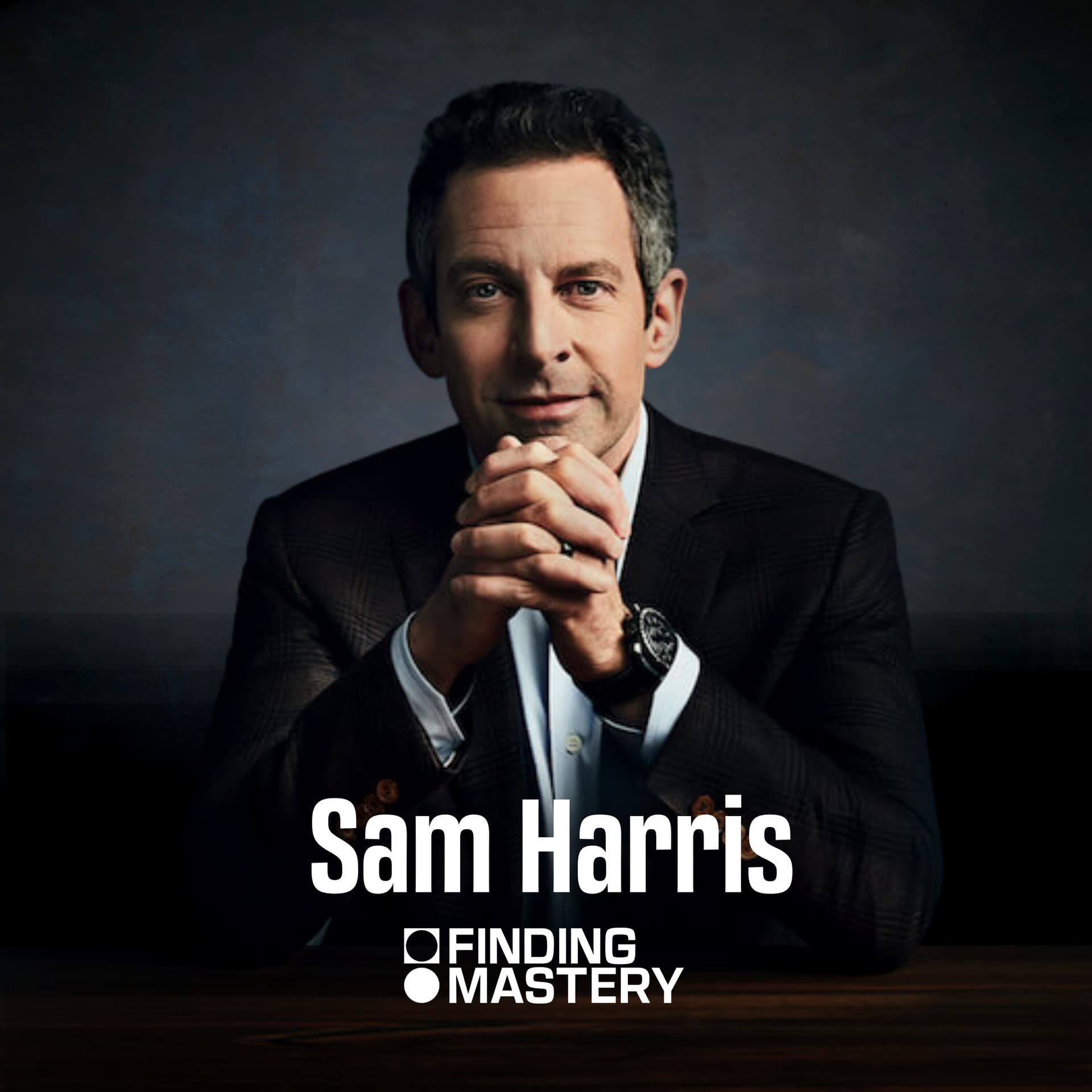

In short
How to define and pursue truth in a world of misinformation, tribalism, and dogmatism. Sam Harris argues for “reality bias” and a first principle of radical honesty (“don’t lie,” or more precisely “tell the truth that’s useful”), linking truthfulness to integrity, high-performance cultures, and better navigation of politics and AI-era media.
Guest backgrounds
Sam Harris is a neuroscientist and philosopher, best-selling author, and host/creator of the Making Sense podcast and the Waking Up app. He discusses consciousness as ground truth and frames meditation as an intellectually defensible way to interrogate mind from the first-person perspective. Host Michael Gervais is a high-performance psychologist who has worked with Pete Carroll (Seahawks) and Felix Baumgartner (Stratos).
Key claims
- Lying is “corrosive” and often enables self-deception and toxic relationships.
- Honesty is compatible with civility and compassion; it’s not “brutal honesty.”
- Truth-tracking fails mainly due to tribalism and dogmatism.
- AI and deepfakes may force “epistemic bankruptcy” with internet content, increasing reliance on trusted gatekeepers.
- Conscious experience cannot be doubted, even under radical skepticism.
Notable examples
- A Stanford seminar on lying (Ron Howard) that reframed “Is it ever okay to lie?”
- “Do I look fat?” as a case where the deeper truth is relational (love/attraction) or factual (dress fit).
- Pro sports: locker rooms can be more honest than coaching rooms; an NBA player hid by refusing to shoot in a championship, costing the team.
- Driverless tech discussion after a phone-distracted head-on collision.
Written by AI. May contain mistakes. Listen to the episode to check what was said.
Chapters
Tap a time to open that second in VOIntroduction to the Podcast
0:03 to 1:33
Dr. Gervais introduces the theme of truth and misinformation.
“Mastery because we know one great hire can change everything.”
The Importance of Understanding the Mind
2:58 to 4:54
Sam Harris shares insights on the significance of the mind in shaping experiences.
“Sam, I'm really excited to sit with you.”
The Dangers of Lying
4:54 to 6:16
Discussion on the corrosive nature of lying and the value of truth.
“So understanding that and understanding the degrees of freedom that are there to be explored within that.”
Exploring Subjectivity in Truth
6:16 to 8:04
Harris and Gervais delve into the nuances of subjective truths.
“Even though we lie to ourselves like 38 times a day on average or whatever.”
Ethics and Integrity in Communication
8:04 to 13:00
A discussion on the ethical implications of honesty in communication.
“There was this great professor, Ron Howard, who's in the engineering economic systems department, which had absolutely no, I was an English major.”
The Complexity of Truth and Authenticity
15:37 to 20:54
Exploration of the impact of honesty on personal identity and relationships.
“I love the way that you just framed that.”
Creating High-Performance Environments
20:55 to 24:15
Discussing the importance of honesty in high-performance teams and environments.
“Even in traditional stick and ball, high-performing environments, there is room to hide.”
The Role of Truth in Society
24:16 to 28:00
Analyzing the challenges of truth in the current political landscape and media.
“Well, again, so it's not just a posture or an artifice to be kind versus brutal.”
The Crisis of Trust in Media and Technology
28:00 to 31:21
Explore the evolving landscape of trust regarding media and the internet amid deep fakes and misinformation.
“I have some hope that AI might pull us back from the brink here.”
Exploring Human Authenticity and AI Impact
32:54 to 37:51
Discuss the implications of AI on human expertise and the authenticity of communication.
“So at the beginning of the year, I thought, okay, I don't, at Finding Mastery, we don't do resolutions, but we do set an intention, you know, like, and for, I don't know, the last four years, it was the same for me.”
Show all 40 chapters
Navigating Truth Amid Misinformation
37:51 to 42:04
Examine strategies for discerning truth in a world rife with misinformation and cognitive biases.
“Obviously, this is a real concern for many of us, but how are you thinking about getting to the truth in a world where there's so much misinformation?”
The Dangers of Tribalism and Dogmatism
42:04 to 44:20
Learn about how tribalism and dogmatism hinder our understanding of truth.
“I mean, I would put them into two categories.”
The Intersection of Religion and Dogmatism
44:20 to 45:26
Explore the relationship between organized religion and dogmatic beliefs.
“And so before we go to tribalism, can you talk to, I think you're going to bridge a gap between dogmatism and gurus.”
Understanding Consciousness
45:26 to 47:20
Delve into the nature of consciousness and its undeniable presence in our lives.
“that the universe is far stranger than we suppose or that we even can suppose.”
The Role of Science in Understanding Reality
47:20 to 51:49
Learn how science helps us interrogate reality and its relationship with consciousness.
“And there's two, go back to this hinge idea, there's consciousness or internal of your internal experience and of the external world.”
The Role of Science in Understanding Reality
51:52 to 53:16
Learn how science helps us interrogate reality and its relationship with consciousness.
“and I want to come back to something a little more personal.”
The Role of Science in Understanding Reality
54:21 to 54:31
Learn how science helps us interrogate reality and its relationship with consciousness.
“Again, that's sunlighten.com and use the code mastery for up to$2 ,100 off.”
Authority and Expertise in Modern Society
54:31 to 56:00
Examine the complexities of authority, expertise, and the importance of knowledge.
“to dogmatism and maybe gurus and religion.”
The Integrity of Science vs. Dogma
56:00 to 1:02:00
Explore the unique culture of error detection in science compared to the dogmatic nature of religion.
“I mean, there are very few places where we do this well.”
Personal Reflections on Religious Principles
1:02:00 to 1:04:00
Dr. Gervais shares personal insights on the shared principles across religions and their societal implications.
“Just to relate to what you're saying about the shared principles across religions.”
Critique of Religious Texts
1:04:00 to 1:10:00
A critical examination of the moral inconsistencies within religious texts and their implications for modern ethics.
“One professor, this is a different professor, he says to me, Mike, who's in front of the in a lecture hall.”
Moral Reflections on Religious Texts
1:10:00 to 1:13:16
Explore the ethical implications of slavery in religious texts and the failures of these texts to provide moral guidance.
“from a supernatural communication for us.”
Moral Reflections on Religious Texts
1:13:19 to 1:14:24
Explore the ethical implications of slavery in religious texts and the failures of these texts to provide moral guidance.
“Here's a stat that surprised me when I first came across it.”
Moral Reflections on Religious Texts
1:15:43 to 1:15:58
Explore the ethical implications of slavery in religious texts and the failures of these texts to provide moral guidance.
“That's Proton, P-R-O-T-O-N, VPN.com slash mastery for 70 % off your two-year plan.”
Understanding Gurus and Enlightenment
1:15:58 to 1:18:46
Delve into the concept of gurus in spirituality and the implications of enlightenment and authority.
“It is confusing because I grew up thinking about it from a formative age, well exposed to the fears of not getting this belief system right.”
Skepticism Towards Miracles and Cults
1:18:46 to 1:24:00
Examine the disparity in belief towards modern versus historical miracle claims and the characteristics of cults.
“There's an image in Tibetan Buddhism in the Dzogchen teachings talking about the way thoughts appear at different stages of enlightenment.”
Differentiating Cults from Religions
1:24:00 to 1:25:18
Explore how cults and religions differ based on adherence and history.
“but we're not going to get on an airplane.”
Case Studies: Mormonism and Scientology
1:25:18 to 1:27:59
Examine specific examples of Mormonism and Scientology as cults and their societal perceptions.
“A cult that a religion that is just a little too recent to not be more embarrassing than normal, I mean, I would put Mormonism in this category.”
The Nature of Mind and Truth
1:27:59 to 1:28:34
Discuss the exploration of truth and suffering in relation to human experience.
“I mean, I'm sure there's a cult starting, you know, that started two weeks ago in a neighborhood, you know, spitting distance from here.”
Experiencing Unity with the Universe
1:28:34 to 1:30:53
Delve into the profound experiences of oneness and their interpretations across cultures.
“Then it's just you sitting there again hoping to get back there somehow.”
Understanding Suffering and Pain
1:30:53 to 1:33:31
Clarify the difference between suffering and pain, and how to manage negative emotions.
“You tell me which one you want to pick up on.”
Transforming Personal Narratives
1:33:31 to 1:36:30
Learn how to interrupt negative thought patterns and reshape personal stories.
“And many of us live our lives as though they were one long emergency.”
The Mechanics of Emotions
1:36:30 to 1:38:03
Investigate the nature of emotions as behaviors and the importance of mindfulness.
“It was me being not the victim, but the one that was trying to solve the things, all the things that could go wrong.”
Understanding Emotions and Mindfulness
1:38:03 to 1:41:55
Explore how emotions function as covert behaviors and the role of mindfulness in recognizing thoughts and physical sensations.
“Well, I would say one way I would reframe it for people is that emotions are essentially covert behaviors.”
The Physiology of Anger and Anxiety
1:41:55 to 1:45:45
Discussion on the physiological aspects of anger and anxiety, highlighting the importance of recognizing and understanding these feelings.
“noticing this connection between their thoughts about why they have every right to be angry, why they should be angry, why that person was a total jerk, this is what they should have said, could have said, right?”
Cognitive Reframing and Performance Anxiety
1:45:45 to 1:51:40
Analyzing cognitive reframing techniques and how they can be applied to anxiety in public speaking and personal performance.
“I mean, so cognitive reframing would often acknowledge that excitement and anxiety are so close to one another, and really it's just the cognitive frame we put around them that makes them different.”
Perception of Physical Stress
1:51:40 to 1:52:00
Examining how the perception of physical stress varies in different contexts and its implications for mental well-being.
The Power of Framing in Physical Experiences
1:52:00 to 1:55:09
Explores how framing affects our perception of stress and suffering in workouts.
“recognize the power of framing and expectation that they're just experiencing on a day-to-day basis when you think about the experience of working out in a gym, right?”
Mindfulness and the Present Moment
1:55:10 to 1:58:35
Discusses the importance of mindfulness and recognizing the present moment.
“and thoughts themselves just become positive or negative thoughts, well-framed thoughts or poorly framed thoughts.”
Closing Thoughts and Gratitude
1:58:36 to 1:59:15
Reflects on the conversation's themes and expresses appreciation for the discussion.
“There's something I think I want that I'm going to be busy wanting it for the next minute.”
Transcript
Automatic transcript. May contain errors.0:00Dr. Michael Gervais:Finding Mastery is brought to you by LinkedIn. We use LinkedIn Hiring Pro here at Finding Mastery because we know one great hire can change everything. One bad hire, it can cost you a lot, way more than time. It can cost you momentum and culture and real dollars. And that's why how you hire matters just as much as who you hire. And it's why I've become a big believer in the power of LinkedIn Hiring Pro. Here's what I appreciate about it. When you're running lean, you don't have hours to sift through a pile of resumes hoping to find the right person somewhere in the stack. Hiring Pro is built exactly for that reality.
0:32Dr. Michael Gervais:You describe the role and it screens candidates for you, surfacing the people who are a best fit so that you can spend your time and conversations with those folks rather than in the weeds of the applications. And the results back it up. Those hiring with LinkedIn are 24 % less likely to need to reopen a role within 12 months compared to the leading competitor. So join 2.7 million small businesses already using LinkedIn to hire. Host your job for free at linkedin.com slash mastery. Terms and conditions apply. Again, that's linkedin.com slash mastery to post your job for free.
1:04Sam Harris:I've seen enough fake videos where the person's cocker spaniel saves them from a grizzly bear because it's just people have made 15 ,000 of them in the last hour. I'm not even interested in any of that anymore. I mean, as compelling as it can look, I'm going to wait for the New York Times to tell me that really happened.
1:19Dr. Michael Gervais:In a world full of misinformation, tribalism, and noise, how do you actually know what's true?
1:24Sam Harris:The larger the circumference of our scientific knowledge grows, the area of our ignorance, or at least implied ignorance, grows with it.
1:32Dr. Michael Gervais:Welcome back, or welcome to the Finding Mastery Podcast. I'm your host, Dr. Michael Gervais. A high-performance psychologist named Michael Gervais. Who Pete Carroll brought in to work with the Seahawks. Famous for his work with Felix Baumgartner when he jumped out of space in the Stratos Project.
1:48Sam Harris:Olympic athletes depend on something more than just training and talent. They have to stay mentally tough.
1:53Dr. Michael Gervais:Today's guest is Sam Harris, neuroscientist, philosopher, best-selling author, host of the Making Sense podcast, and creator of the Waking Up Abbott. This conversation is about defining truth, how we form it, how it shapes us, and how dangerous it becomes when we refuse to examine it.
2:11Sam Harris:What we need is a reality bias. We should want to be in touch with what is real insofar as that's possible. And we should be alert to those cultural practices and institutions that are reliably corrupting those efforts.
2:25Dr. Michael Gervais:We explore Sam's first principle, a radical commitment to honesty, what it means to live without lying.
2:32Sam Harris:Every room you walk into, whatever happens, whatever gets said, whatever topics come up, it's very powerful to know that you're not going to lie. Not at all.
2:40Dr. Michael Gervais:As you listen, I want to encourage you to notice where in your life you feel defensive. That friction is often where growth begins. With that, let's jump into this week's conversation with Sam Harris.
2:58Dr. Michael Gervais:Sam, I'm really excited to sit with you. Your body of work and your research on the mind is stunning. And so it's influential. It's clear. It's provocative. and so I'm really excited to have this conversation with you and also at the same time maybe slightly nervous because you think differently than I do and I'm I'm really curious about not the overlap but I'm more curious about the difference in the way that we see things and maybe there is more in common than I might think and so I'm really curious about kind of how this conversation goes but welcome to Finding Mastery and thank you for being here.
3:40Sam Harris:Oh it's a pleasure yeah thanks for the invitation.
3:42Dr. Michael Gervais:Yeah. So you spent much of your life studying the mind. And so let's just start with the obvious. Why?
3:48Sam Harris:Well, it's just, it really is the ground truth of everything we experience. I mean, obviously we have the world to deal with and the body in the world, but the mind represents the cash value of everything that you can notice, everything you can suffer, everything that can make you happy. When you see the contributions of your thinking and your expectations and the way you cognitively frame experience to the quality of your experience, you see that, I mean, it's almost never the case that the world is imposing the valence of experience on you. I mean, there are extreme cases, obviously, extreme pain, right?
4:31Sam Harris:You have a terrible injury, and there's not too many ways to reframe that so as to make it good, right? But even there, the difference between pain and suffering, there can be a lot of daylight between those two phenomena. So yeah, I mean, the mind is more or less all we have moment to moment, and it's the basis of everything that matters. So understanding that and understanding the degrees of freedom that are there to be explored within that. I mean, that seems like a pretty central life project.
5:02Dr. Michael Gervais:I don't think there was a word out of place in what you just said. And I recognize the intentionality between or from the words that you're choosing. And so I do want to, if I could rewind it.
5:12Sam Harris:I speak slowly, so I have an advantage. People listen to me often on 1.5 or 2x on my podcast. So yeah, I got more time to put the words in the right places.
5:23Dr. Michael Gervais:No, that's not the case. That's true. I think when I listen to like the show backwards, I'm like, damn, dude, spit it out. I do feel like I speak slowly, but I am looking for some accuracy in the words and the language I'm using. Okay. What are the most foundational ideas that you want our community to understand to live well in the modern world?
5:47Sam Harris:Not lying is on a very short list of firmware upgrades to a human mind and a human life that I've discovered. The Venn diagram, certainly the region of greatest interest, is in this intersection between what's true and useful. And especially when you're talking about communication, I'm an advocate of honesty and fundamentally of having an ethical commitment to not lying. I think lying is among the most corrosive things we do.
6:19Dr. Michael Gervais:Even though we lie to ourselves like 38 times a day on average or whatever. I don't know what the answer is. Well, we can talk about that. You're talking about lying to other people.
6:28Sam Harris:I think lying to other people is generally speaking a terrible thing to do. Even so-called white lies, I think we want to do very little, if any, of that. But it's not that you need to just helplessly utter every thought that comes through your head. I mean it's like you have Tourette's syndrome. No, you want to speak in terms of what is true and useful. So it's not just vocalizing everything.
6:53Dr. Michael Gervais:Are you saying true with a capital T or true with a subjective small t?
6:58Sam Harris:Well, true is insofar as you can get a handle on it. I mean, it's always true in every sense is just, I mean, sometimes it's probabilistic. I mean, you have a sense that you think it's more likely than not. So we're often calibrating our confidence in how we represent what we think is true. But I think, yeah, you're giving other people a view of the world as you see it, as faithfully as you can. But again, you might be—there's a role for civility here and kindness and compassion, and it doesn't quite have the shape that many people imagine, which is the—I mean, I think most people's default is that there's a lot of room for, and necessary room for just lying to be kind, right?
7:43Sam Harris:And I think when you drill down on all of those examples, in my experience, you almost never find one that survives any kind of test of integrity that I would want to stand behind. So I think white lies give a lot of scope for deception and self-deception and toxic relationships that fundamentally you don't want to have. I took a class freshman year at Stanford. There was this great professor, Ron Howard, who's in the engineering economic systems department, which had absolutely no, I was an English major. It had absolutely no relationship to what I was interested in, but he taught this seminar on lying.
8:20Sam Harris:I'm just like, basically it was just a, I think it was a graduate seminar, but it was just a single question in every session, which is, is it ever okay to lie? And then people would just kind of hurl examples at him. And most people came into that seminar more or less assuming that human beings have to lie. It's just something that we necessarily do. We do it some number of times a day, and that's perfectly normal and compatible with a healthy life and a good career and a good reputation. And obviously there are egregious examples of lying and you don't want to be that guy but you know lines unavoidable and you know if your wife asks you do it do I look fat in this dress well of course you're going to say no and what are you an idiot and and so like this is that default setting in almost every case in my experience it would just got recalibrated in that over the course of whatever eight weeks in this
9:14Dr. Michael Gervais:seminar so how do you how do you answer that question because let me set up the dilemma that I see it as, do I look fat in this dress? It's a subjective interpretation of what you think fat is. And really that question is not about, do I look fat? That question is, there's a deeper question underneath of it, which is - Well, it might be, do you love me? I mean, are you attracted to me? I mean, that's - Yeah, that's the deeper question and it's a ping, right? It's a little bit like a bellwether, like it's looking for a calling back, am i okay in your eyes um so i think that there's a trap so there's two there's two things that i want to inspect with you it's like it requires your subjective take on what fat is and if you are um if you are unbalanced in that let's say that if you think somebody that is i'll just create an image uh five foot six and 98 pounds is fat that that's actually a clinical disordered way of thinking about body weight, anorexia.
10:14Dr. Michael Gervais:And you say to your spouse, actually, yeah. So you told the truth, but you are clinically disordered in your take on what healthy looks like.
10:27Sam Harris:You can definitely be wrong and be telling the truth.
10:30Dr. Michael Gervais:Yeah, but you think it's useful and you think it's truthful. So this is where I think... And you can be wrong about that. And you can be wrong.
10:37Sam Harris:You can be an asshole. There's no question. I mean, so... How do you answer that? How do you know that your take? Well, I think one thing you discover when you're committed to not lying, whatever the situation, suddenly you have a mirror thrown up to your mind in life that you didn't have before. If you're the kind of person who has a sort of situational ethics where you've got one set of ethical books you keep for your friends and family and another you keep for strangers and people you meet in business, And so in a business context, you're willing to shade the truth and bullshit people and even lie outright because that's just the way your business is done.
11:15Sam Harris:But obviously, like a classic example would be, you know, imagine you're in the service industry. You're working in a store and someone comes to the front door and they're shopping in your store and you are recommending everything because that's how you do your job. After further conversation with this customer, you find out that you actually have a friend in common. Like this is like your friend's sister or suddenly you're in a different situation. And now you don't want to recommend it. And then you – so then if you're the kind of person where all of a sudden a different piece of software comes online, which, okay, now you've got – now you're actually going to speak honestly to this person because you realize that this is your friend's sister.
11:54Sam Harris:It's like, oh, actually, don't buy that one. And if you're that person where suddenly you get access to more integrity and more ethical commitment simply by discovering a fact about this person that you didn't know, you might take a moment to reflect, do you actually want to be this person? I mean, first of all, if you're that sort of person, you are always vulnerable to being embarrassed, right? I mean, think of what it says about you if you, in that situation, you recommended something that was, you know, obviously you can't stand behind. And then in your own defense, you say, well, I didn't realize you were so-and-so's sister.
12:40Sam Harris:That's the definition of not actually being ethical in this business relationship. So I think, you know, a little reflection could convince you that you actually don't want to keep two sets of books. You just want to be a unified person with respect to this variable of honesty.
13:00Dr. Michael Gervais:What we would shorthand, integrity. Yeah. That you are consistent with your thoughts, words, and actions across experiences. Yeah. Finding Mastery is brought to you by Rag & Bone. I've been a big fan of Rag & Bone for a number of years. I just love what they do. It's a go-to for me when I'm choosing clothes. I've been wearing their infused denim for a while now. They've done just a really nice job with this product. For me, I am really intentional about what I invest in. And clothing, it's no different. I want things that are well-made, that stand the test of time, that don't distract me, that support my focus on the things that matter most.
13:32Dr. Michael Gervais:And that's exactly why these deliver. And they look sharp, full stop. They've spent 20 years obsessed with getting this product right. And that kind of long-term commitment to craft, that's something we talk a lot about here at Finding Mastery. Quality compounds. The right inputs made consistently over time show up in everything. And you can feel that the moment you put these on. If you're ready to upgrade your denim with something that's genuinely built to last, it's time to upgrade your denim with rag and bone. For a limited time, our listeners get 20 % off their entire order with the code finding mastery at rag-bone.com.
14:04Dr. Michael Gervais:That's 20 % off at rag-bone.com with the promo code finding mastery. And when they ask you where you heard about them, please support our community and this show and let them know that we sent you. Finding Mastery is brought to you by our flagship mindset training course, Finding Your Best. Anytime you feel the pull to reset, to zoom out, to refocus and ask, am I moving toward the person I want to become? It helps to remember this. Lasting change comes from training. Not resolutions, not short-term sprints, but deliberate practice of the skills that shape how we show up. Work and relationships and in the moments of great intensity as well.
14:40Dr. Michael Gervais:That's what finding your best is all about. It's a science-backed framework for training your mind. And it's the same set of tools that we've taught to Olympic athletes, top executives, elite military teams, and artists at the peak of their craft. In this course, you'll learn the foundational psychological skills to be your very best. Full stop. And the best part is you can start anytime. Right now, we're running a limited time offer on finding your best. Simply head to findingmastery.com slash course and use the code RENEW100 to get$100 off your registration. If you've been waiting for the right moment, this is a good one now to lean into.
15:13Dr. Michael Gervais:Spring and summer, they are powerful seasons of momentum. It's a great natural time to step into growth, to refocus, to recommit to who you want to become. And this discount will not be around for long. So go to findingmastery.com slash course code renew100 for$100 off today because your future is not shaped by what you intend. It's shaped by what you train. I love the way that you just framed that. Those people I do not trust. Yeah. And those people in locker rooms get pushed out quickly to the fringe. And I don't want to be that person, to your point. And so this code switching or this dual self is something that some groups that feel marginalized and don't feel as though that they can bring themselves forward because of the biases or the vitriol that they will experience if they were to bring their more true self, their more quote-unquote authentic self forward, that they hold back.
Read the full transcript
16:10Dr. Michael Gervais:and then they code switch with their friends or whatever.
16:12Sam Harris:But maybe there's a reason. If your true self is the sort of self that you would be embarrassed to bring forward because it's gonna - That's actually your true self. Yeah, but the true self is modifiable with like, again, let's just say you're a jerk, right? Well, like if you have to be honest, if you took a vow of honesty so that you can't actually hide what a jerk you are, like if someone says, do you wanna go out on a date with me? And the answer is no. And why is the answer no? Well, you're too short. That's just the ground truth. Like, you're too short. I only like tall guys, right, or tall girls.
16:49This is a fact about you that might be of interest to you.
16:53Sam Harris:Like, how did you become the guy who's got a height cutoff, you know, with respect to this variable of who you're going to spend time with or who you're going to spend the rest of your life with? Now, maybe it's just true. And you have to get your mind around that. and then there's some way to work with that in the world. But for the most part, none of us are condemned, merely condemned to be the person we were yesterday. We have it by tendency. We're kind of doing a great impersonation of who we were yesterday or a moment ago. But there's actually a tremendous amount of freedom to grow with respect to all of the, you know, basically anything about yourself that you can notice.
17:31Sam Harris:And one of the things that forces you to notice everything, really, is just an unwillingness to lie, right? Like you just, okay, I'm not going to lie. My kid's going to ask me a question. I don't know what they're going to ask. But one thing I do know is that I will never lie to them, right? That is a very different context for anything that's going to happen in your relationship as a parent. And it's, again, you're an open system. It's like every room you walk into, whatever happens, whatever gets said, whatever topics come up, it's very powerful to know that you're not going to lie, right? Like, not at all.
18:06Sam Harris:Like, you're just not, like, that's just...
18:08Dr. Michael Gervais:So that's a first principle for you. Yeah, yeah. Do not lie.
18:11Sam Harris:It completely changed my life. I mean, I don't remember who I was before I had this epiphany, but it was forced upon me in this court. So I wrote a book, a very short book called Lying, which gives abundant credit to this professor who first drummed these thoughts into me.
18:28Dr. Michael Gervais:But it's... Is your first principle, do not lie? Or is your first principle, tell the truth that's useful? Well, again, there's a further filter on what some people would consider a kind of radical honesty, which is given that you can't say everything and can't know everything, then there's some scope to editing.
18:48Sam Harris:Like saying what's true and useful. I mean, you don't just have to give the unvarnished. Like everything that's happening in the privacy of your mind does not have to be externalized helplessly in the presence of other people who are there to hear it. Even if they ask. Even if they ask. It's not a question of dissembling at that point, but it's often a question of just getting down to what the truth really is. So, I mean, to come back to your wife in the dress, the classic example, I mean, the ground truth is really that you love this person, you're on the same team, you want to sort of meet that moment at all the levels that it really is emerging.
19:32Sam Harris:So if it really is what's being communicated is the subtext, which is, you know, do you still love me? Or are you still attracted to me? Well, then obviously you want to be able to communicate those truths too. But sometimes it's just at the level of the text, which is she's got a bunch of different dresses she could wear. She looks much better in some than in others. And she actually wants to know that. Like she wants your perspective on whether this dress is flattering. and if the truth is it's not flattering and that's your actual thought, well, you're on the same team, right? Like she's asking for your view of reality.
20:10Sam Harris:And I mean, you know, the one thing that happens in your life once you become the sort of person that will just be honest in those moments, then your social world rearranges itself around you. You find that people just don't actually come to you for advice unless they want the truth. And that's an amazingly clarifying thing to happen in all your relationships.
20:31Dr. Michael Gervais:I did not think you and I were going to be talking about creating a high-performance environment. I'll tell you why. People ask me all the time, like, what are the common threads or common themes of a high-performance environment? And while there are many, right, the ones that I am most attracted to that I feel have an outsourced impact on the results, meaning high performance, is cultures of honesty.
20:55Sam Harris:and so well i mean sports have to be the ultimate example of this because it's the one area where bullshit just is totally useless totally useless however there are people
21:08Dr. Michael Gervais:even in stick and ball sports which i obviously spent a lot of time celebrating with the seattle seahawks as of the recording two days ago being with that team for the last year again um asterisk I was with them for nine seasons and then back for this season, is that there's room to hide. Even in traditional stick and ball, high-performing environments, there is room to hide. But the ones that say, we are going to tell the truth and we are going to be great teammates to each other, which means that we're going to have to go through things, not around. How do you hide?
21:43Sam Harris:Can you give me an example? How to hide in pro sport?
21:47Dr. Michael Gervais:Point the finger, blame other people. Inside of sport, the most honest rooms tend to be locker rooms. The most dishonest tend to be coaching rooms. Okay. So why are the athletes so honest? Well, one, let's have fun with the imagery. They're walking around in towels or sometimes nothing at all. And in those environments, if you're slow, you're going to get pointed out that you're not going to the gym enough. You're not doing enough work. Maybe you need to lose some weight or gain some weight. And so there's just a directness and a boldness. And in those cases, literally there's nowhere to hide.
22:21Dr. Michael Gervais:But if you're not thoughtful and you're code switching, like we're talking about, you're two different people around two different rooms, or you're saying you're putting in strain, but you're actually not. You say you're about the mission, but you're out late drinking, that those environments at some point will get called out. So they are more honest than not, but you can still quote unquote hide. Case in point, Let me go from football to basketball for a minute. This was a gentleman that I spent time with. He won, I think, four rings in the NBA. Basketball player, there's only five players on the court.
22:57Dr. Michael Gervais:He said, Mike, in the third and fourth quarter in a championship game, he hid the entire time on the court. He came off the screens just a little bit slower. So he wasn't open. He was terrified to shoot the ball. He was purposely coming off just – and when he had the ball in his hands, he was reflexively looking to pass. So he looked like he was a good teammate. He was terrified to shoot. So he was not honest with his experience nor with his teammates. It cost them the championship.
23:25Sam Harris:But the thing that could not be ignored is he had whatever number of baskets he had and no more, right? So there was no illusions. That's right. The objective. The results. I mean, the results, you can't fudge the results.
23:39Dr. Michael Gervais:No, but you can fudge a lot of ways the quote-unquote intangibles. Right. Yeah. So this is one thing about sport I think is great, which is everybody's force ranked, stacked and force ranked publicly observable data. And so there is, in that case, nowhere to hide with the subjective you can. Let me take this and move it to one more piece. Maybe I'd put an exclamation point next to what I want to say. If you want a true high performing environment, if you want a great life, there needs to be a radical commitment to honesty. with self and others. Yeah, yeah. Yeah, and I am not saying brutal honesty.
24:18Dr. Michael Gervais:That's for jerks.
24:20Sam Harris:You're not saying what kind of honesty?
24:22Dr. Michael Gervais:Brutal honesty. Yeah, right. Yeah, thoughtful. I'll use your word useful in this.
24:26Sam Harris:Well, again, so it's not just a posture or an artifice to be kind versus brutal. It's, I mean, we're talking about situations, even potentially with all the strangers you meet, barring some moment where they disqualify themselves and become enemies or adversaries, it's true to say that your default is that you're on the same team with everybody. I love that piece. So it's like you actually want them to succeed. You're not in a situation where you're viewing your interaction as zero sum. And so, I mean, even just in a business situation, what is a good deal in business? A good deal is not where you get everything you want and the other person feels screwed.
25:13Sam Harris:A good deal, especially when you know that you have a reputation and you want to be able to play repeated games in an open-ended way with happy collaborators, a good deal is one in which they are also happy. The person you were just negotiating with is also happy with the result. So it's just there are very few truly zero-sum situations. And when it's truly zero-sum, then we're talking about something like self-defense. And then I would put lying as sort of the first stop on the continuum of violence where you're talking about, okay, I'm now in the presence of somebody who's not a rational actor or any kind of collaborator, and I'm trying to figure out how to get out of the situation, avoid them, nullify the threat they're posing, and maybe a lie is the first thing.
26:03Sam Harris:If I'm choosing between do I have to punch this person in the face or lie, well, then lying would be the first act of violence I would commit. So I would just put lying in the general case as somewhere on the continuum of violence between people that is usually avoidable but not always. And a self-defense mechanism.
26:22Dr. Michael Gervais:Yeah.
26:23Sam Harris:Then you're talking about self-defense or defense of other people.
26:26Dr. Michael Gervais:Very cool. Okay. So take this to the broader context. at the time of recording, I think our state of our country is in disarray. And the tension between my truth and your truth, my side of the understanding of how I see politics and your side could be radically violent in thought and or could be confusing to other people, meaning that I'm just confused how you think that way. Or I could have great contempt for the way that you're seeing things. So this idea of truth with a capital T is not really what we're working from. We're working from truth with a small t, my subjective truth of the way that I see the best way that our country should be run.
27:08Dr. Michael Gervais:How do you think about helping navigate the betrayal, like the Epstein files, and the betrayal of how leaders are acting, independent of how, if you're on the left or right of the political spectrum, how are you using this truth-telling principle as a way to maybe help the larger context of the country's health?
27:32Sam Harris:Well, I'm very worried about how we're entangled with our information technology. I mean, this is a story, obviously, of social media principally now, but really it's even just the Internet itself. It's just what the internet has done to our sense of what is real. And it has created a kind of shattering of culture, which is only intensifying, again, through social media and now with AI. I mean, it's not getting better. It's getting worse. I have some hope. Perhaps we could talk about it. I have some hope that AI might pull us back from the brink here. But – Wait a minute. Wait a minute. Optimist?
28:14Sam Harris:Wait. Hold on.
28:15Dr. Michael Gervais:We got a crack in the pessimistic approach here.
28:17Sam Harris:It's a pessimistic version of optimism. I don't think you could have both. Well, I mean, so the short answer there is that I think that the AI slopification of everything, I mean, the fact that we're now moving into a world where if you look at a piece of video, your first thought is, well, is this even real? I mean, whatever the video is, I mean, it could be, you know, Vladimir Putin declaring that he's just launched all his missiles and, you know, you're all going to die, right? It might look perfectly credible, and I think most people's sense at this moment would be to just not even react to it because there's just a basic assumption that you can't trust anything now on the Internet.
28:59Sam Harris:And so ironically, I think we're probably moving back toward a new moment where the gatekeepers are going to be the only source of ground truth for trust now. I mean, we're coming from a moment where the institutions have radically discredited themselves. No one trusts the New York Times or the Washington Post or anything. We just want to get it from the kind of the raw feed from X or some other social media platforms. Somebody's uncle can send us a YouTube clip and it's just shot on somebody's phone. They're standing near the protests and they saw the thing that happened and that's what's real.
29:36Sam Harris:Don't trust the gatekeepers. Trust the wisdom of the crowd. but now with the deep fakery and the slopification of everything I think we're getting to a point where we're not there yet but I could imagine six months from now we'll be at a point where we just declare epistemic bankruptcy with respect to the internet like we just decide okay I'm not going to react to anything my bias is going to be no this is not a real video of a grizzly bear attacking a woman in her backyard. I've seen enough fake videos where the person's cocker spaniel saves them from a grizzly bear because people have made 15 ,000 of them in the last hour.
30:21Sam Harris:I'm not even interested in any of that anymore. As compelling as it can look, it can look perfectly real. Suddenly everything is boring because it stands a chance of being fake. And even the most alarming communication, dozens of people killed on the White House lawn, okay, I'm going to wait for the New York Times to tell me that really happened. I cannot trust any other source until someone that has a reputation that can be damaged says, listen, we did the necessary journalistic work and forensic work to tell you that this video of Vladimir Putin declaring World War III on us is actually real, right?
31:03Sam Harris:And so now you can panic, right? So I think that may happen. And so that will be, I think, a sea change in our relationship to social media and everything else that has been ruling our lives for the last two decades.
31:21Dr. Michael Gervais:Body Mastery is brought to you by Fatty15. Did you know that Navy dolphins helped unlock a secret to healthy aging? It's a wild story. And it's the foundation for a product that I've come to really love, Fatty15. Fatty15 is built around C15, the first essential fatty acid discovered in over 90 years. And it was discovered by Dr. Stephanie Van Watson. She's the co-founder of Fatty15. While she was working with the U.S. Navy, and based on over 100 studies, we now know that C15 strengthens our cells and is foundational for healthy aging at the cellular level. Stephanie's been on the podcast, and it was one of my favorite conversations.
31:58Dr. Michael Gervais:She's amazing. And what her and her team are building is something I'm really excited about. Head to fatty15.com slash finding mastery and use the code finding mastery for an additional 15 % off your 90 day starter kit. Again, that's fatty, F-A-T-T-Y, one five dot com slash finding mastery. And the code is finding mastery. I want to take a second here to tell you about a morning routine that I've been using for years. For me, it's a great way to switch on my mind, to ready myself to take on the day. So before I check my phone, my emails, market updates, or text threads, I choose how to start my morning.
32:34Dr. Michael Gervais:That's always in my control. That's always in your control too. This is the same morning mindset routine that some of the world's top performers across sport, business, and the arts are using. The best part? It only takes about 90 seconds to do. So just head over to findingmastery.com slash morning to download the audio guide for free. Again, head to finding mastery.com slash morning to get your morning mindset routine.
33:02Dr. Michael Gervais:So at the beginning of the year, I thought, okay, I don't, at Finding Mastery, we don't do resolutions, but we do set an intention, you know, like, and for, I don't know, the last four years, it was the same for me. It was the year of play. I just knew I needed more play in my life. I'm intense. I'm serious. And I just wanted the yin yang kind of side of my, my approach in life. And so this year was different. This year was about humanness, the art of humanness. And that's when I'm waking up in the morning through my imagery and my meditation is like, what does that really mean to me now? But I do know that I'm not interested in being a quote unquote expert.
33:42Dr. Michael Gervais:I am interested in like honest expression. And the humanness piece is like the anti, like I said, cult proof earlier. I am cult proof. is like it's the counter rotation to the AI slot. To your point, like I really appreciate what you're saying because when I'll listen to a thoughtful commentary of even somebody that I do respect their thoughts on social, Instagram or whatever, and now I'm like, did they write that? Did AI write that? Is that from the heart?
34:14Sam Harris:So that's not even the slot. So you're talking about the other side of the AI product, which is the actual good stuff, the real expertise that can be generated in moments by anyone that is... I'm calling that slop too. Yeah, but what you've just described is the value of human hard-fought expertise on some level has gone way down when you're thinking of just the information, access to information that is in fact true. The knowledge that literally anyone within five seconds can get a concise answer to almost any question, and that answer is actually going to be good, right? That sort of devalues, I mean, on some level, what does it actually mean to be an expert if anyone, I mean, obviously there's the follow-up conversation that a real expert can have, and real experts know how to kind of edit and navigate information.
35:19Sam Harris:But the better AI gets, the more human expertise gets devalued. In the same way that it's like, on some level, everything is going to become like chess, right? Like, it's just simply the case that computers are better at chess than people are. And when you add people to the game, on some level, even the best grandmasters are just adding noise, right? So there was a case for the longest time where computers were not as good as—they were better than novice players, but they were not as good as grandmasters. Then Kasparov lost to Deep Blue, and there was this moment where we saw the writing on the wall where computers are going to be better than people.
36:01Sam Harris:But there was this brief period, or maybe it was a decade, where the human grandmaster pair, the computer person pair, the so-called cyborg, was better still than any computer alone because a grandmaster like Kasparov could just add the extra intuition that was valuable. But now that's no longer the case, and just the best players in the world just add noise to what is in fact the best chess that is possible to play, which is between computers. That's going to be true for, again, in success for all of human cognition, right? So you're going to be able to push a button and say, what's the best explanation for the causes of World War I and World War II?
36:44Sam Harris:I want it in exactly, you know, 400 words and, you know, bullet pointed into, you know, 17 different bullet points. No person can give you that in seconds. You know, even the best scholar of the period would take an hour and a half to come up with anything close to that kind of precision and probably longer. But AI can do that right now, and it can do it, depending on the topic, it can do a perfect, a virtually perfect, certainly better than human job of it, or a nearly best-in-class job of it, and it's only getting better. So what you've just described is a situation where even the things that we admire about ourselves and about other people that we've trained for and we've invested a lot in, that's getting offloaded into the technology.
37:35Sam Harris:And we're faced with a conundrum around how to revalue what it means to be human. What's talent good for? What is expertise good for?
37:50Dr. Michael Gervais:Yeah. So how are you thinking about... Obviously, this is a real concern for many of us, but how are you thinking about getting to the truth in a world where there's so much misinformation? Getting to the truth when we've got AI that is, in 400 words, potentially incredibly accurate or presenting as being accurate, but it's hallucinated 40 % of its response. So in a world where information is more available but less trustworthy, how are you helping?
38:23Sam Harris:I mean, I think the hallucination, I mean, we're either going to solve that to, you know, several decimal places beyond the human, or we're not going to be able to rely on the technology. So, I mean, we're, and I think we've solved it for.
38:38Dr. Michael Gervais:You think we're okay with it right now because of the idea that it's going to get better?
38:42Sam Harris:Yeah. And it's also, I mean, it's very, very good for many, many topics.
38:47Dr. Michael Gervais:Yeah. Right. Coding, aggregating information. but the emphatic nature when i ask it something in psychology i'm like oh my god that's like 85 right right but the 15 is actually quite egregious yeah you know and so it makes errors that that
39:02Sam Harris:human experts wouldn't make but again i think it's a very short period of time we have to wait before it's again it's going to be like chess where once it's superhuman for any one of these specific you know areas of cognition we care about there's no looking there's no looking back it's like once driverless i mean i think we're probably there with certainly some driverless cars we know that drivers cars are safe they're just like okay they're better than apes you know they're always gonna be better than apes and better than humans yeah i mean we're apes yeah
39:29Dr. Michael Gervais:yeah okay so it's um sam you know you know to interrupt your thought yeah so waymo is one of our clients huh yeah and i'm about it i am told i was so skeptical i experienced it myself i experienced it first i met with their leadership team we met with their some of their engineers and like, I'm about it. The data, the direction they're going, I am totally about it, even more so right now. And I'm subjectively biased because it was probably five weeks ago. 35-year-old driver, no median in between us. Tulane Highway going in both directions. He was 35, doing 70 miles an hour, was distracted by his phone, head-on collision into my car.
40:12Sam Harris:Oh, wow.
40:13Dr. Michael Gervais:Yeah. Wow. Heavy, heavy, heavy experience. and so um you weren't injured yeah there's an interesting thing so um no no there's three levels of fitness that showed up for me in that moment enough physical suppleness and mobileness and strength that when i hit the airbags my body stayed intact probably so that's that's like a call it a physical fitness there's a psychological emotional fitness that i see why car crashes can be absolutely um traumatic how fast it happens how violent it is how you need to go through that intersect those types of circumstances again but do it calmly you know and then there was a back lack of better words was like a resource fitness that i'm super grateful my car withstood it it's totaled right but it did its job unless I had some brinky dink car that would not have showed up.
41:08Dr. Michael Gervais:So super grateful for all that experience, which is also part of, as you know, a framing of a traumatic experience that's helpful. So anyways, long narrative to get to. I am about the driverless technology because the phones in hands of drivers, I experienced a casualty of it. So anyways, how do we get to truth? and how do we get to community that is in this broth of misinformation and let's just say misinformation?
41:44Sam Harris:Well, I think we have to recognize the variables that cause us to reliably not get to truth, right? And unfortunately, there are things we're anchored to that are, not only are they not recognized as dysfunctional, they're often trumpeted as being some of the most important features of human life. I mean, I would put them into two categories. The first is tribalism, and the second is dogmatism, right? And both reliably are not truth-tracking. What we need is a reality bias, right? We should want to be in touch with what is real insofar as that's possible. Now, there are many things that make it difficult, and there are many ways to be skeptical around whether the map is ever going to truly fit the territory.
42:28Sam Harris:but we want more and more accurate maps, cognitively and emotionally, scientifically, journalistically, and every other way. And we should be alert to those habits of attention and habits of thought and cultural practices and institutions that are reliably corrupting those efforts. And tribalism and dogmatism are some of the worst games in town. and unfortunately when you look at how they map on to things like religion and then when they map on to things like politics and just you know identity politics and you were talking about people bringing their truth and feeling like they can't you know they have the code switch that i can't bring their true self into into work or into the into the rest of their lives all of that is a story of how kind of tribal identity and and dogmatic thinking and the thing the things we believe are true despite the evidence and that we're not willing to revisit because these are our cherished beliefs that we find so consoling or so otherwise important that they're not even on the table to be discussed.
43:35Sam Harris:If anyone's going to raise them skeptically, we're going to be personally offended, right? Because all of this is so colossally dysfunctional and in the limit dangerous and divisive that this is the most corrupting software we have, that we have to figure out how to reconsider and rewrite. And much of my work, not so much in my meditation app, but on my podcast, is to criticize bad ideas. And again, so much of what ails us in the idea space is a matter of dogmatism and tribalism. I love how you answered that question. All right.
44:19Dr. Michael Gervais:Yeah. because as you started i was like oh that's interesting i've totally thought that you were going to go to yeah go to the inner world and get grounded on make contact with reality that way make contact with your thoughts make so that you can better make contact with reality outside of you and you did in an interesting way is that but as a systems thinker you said look you first we first got to address tribalism and dogmatism. And so before we go to tribalism, can you talk to, I think you're going to bridge a gap between dogmatism and gurus. Give us a way to understand your point of view on religion and maybe thread gurus and dogmatism if I'm thinking correctly about your thinking.
45:06Sam Harris:Yeah. So I have many critical things to say about organized religion, which I think religious people will naturally misinterpret or at least imagine that I'm implying things that I'm not. So, for instance, it's totally possible, in my view, that the universe is far stranger than we suppose or that we even can suppose. Science has not evaporated the last mystery of our appearance here in this cosmos. Did you say there's aliens in that statement? Well, I have just – I mean there are reasons to be doubtful that any aliens are flying around and performing amateur proctology on people in trailer parks and farmers.
45:54Sam Harris:There's reasons to be doubtful. Yeah, so I'm not convinced about the recent reports are indication. I did not know you were that funny. That's really good. But are we alone in the galaxy or in the cosmos? I have no idea, and either way it would be astonishing. It would be astonishing to recognize that the universe is teeming with complex life, and it would be astonishing to recognize that we're alone. I mean, both answers are astonishing. So, you know, I'm open to either. But I mean, there's clearly, we don't understand reality at its most basic level. We certainly don't understand how consciousness, the experience of what it's like to be us, relates to the physics of things at the most basic level.
46:39Dr. Michael Gervais:And that's your definition of consciousness. Yeah, consciousness is just experience.
46:43Sam Harris:I mean, the fact that there's something, something seems to be happening. And that's true whether all of this is a dream or whether this is a simulation on the hard drive of some alien supercomputer or whether we're actually in touch with the base layer of reality in our physics now and we're very close to understanding everything. We can be as confused as you might suspect or not, but something seems to be happening, and that seeming is the fact of consciousness. So on my account, consciousness is the one thing in this universe that actually can't be an illusion. I mean, the fact that something seems to be happening, again...
47:17Dr. Michael Gervais:Whether it's accurate or not.
47:19Sam Harris:Accurate or not. there's a qualitative feel to this moment from where you sit.
47:23Dr. Michael Gervais:And there's two, go back to this hinge idea, there's consciousness or internal of your internal experience and of the external world.
47:33Sam Harris:Yeah, I mean, both are appearing. What you're calling the world and what you're calling yourself in the world, all of that is appearing in this condition that I'm calling consciousness. And so you can call it experience, but experience is the ground truth of your being. and whatever is true, whatever else is true. And it's the one thing you can't actually doubt. Again, you can bracket it. You can bracket it with a radical skepticism about everything. You can say, maybe I'm asleep and dreaming right now, and I think I'm having this conversation. Maybe I'm going to wake up and recognize all of this isn't real.
48:08Sam Harris:That's fine, but still, in this moment, something seems to be happening, and that's the fact of consciousness.
48:13Dr. Michael Gervais:So this is the second first principle of yours.
48:16Sam Harris:Yeah. So consciousness is a ground truth that cannot be doubted, and it's in the context of being conscious that we're encountering other people and a world, or what seems to be other people and a world, and we're trying to understand what's happening here and how to control it. And science is the part of culture where we make our best efforts to do that, and we generate technology that allows us to reach further into areas of reality that we can't otherwise inspect, and we draw conclusions based on an experimental interrogation of reality as it appears, and all of that bears enormous fruit. It has enormous consequences.
49:01Sam Harris:I mean, the fact we have an internet, we live in cities, and we have cures for diseases that our ancestors didn't even have names for, I mean, all of this is progress, and yet it's still happening in a context where there is radical uncertainty and just a frontier of ignorance that keeps getting pushed back. I mean, the larger the circumference of our scientific knowledge grows, still the area of our ignorance, or at least implied ignorance, grows with it, right? So it's just there's more of reality that we obviously don't know. But all of that's happening in a context where consciousness is clearly the ground truth of everything.
49:46Sam Harris:And this is why meditation isn't this sort of a feat and disreputable kind of side hustle where the science done with white lab coats and expensive machines is the real interrogation of reality. What you can do in the darkness of your closed eyes while meditating is just something spooky that has no intellectual credibility. No, actually, once you see that consciousness is the ground truth of everything, whatever its relationship to the physics of things turns out to be, maybe it's just the product of a certain pattern of information processing in the physical brain, and maybe it'll be instantiated in machines, and that's all a separate conversation.
50:32Sam Harris:But however consciousness emerges, consciousness is the one inescapable fact of our appearance here. And to be able to interrogate it directly by learning how to pay attention to the moment-to-moment experience...
50:51Dr. Michael Gervais:This is essentially what meditation is.
50:52Sam Harris:This is a very important... It's not only an important skill in terms of just improving the quality of your life. it is a totally defensible intellectual exercise in terms of understanding the mind from the first-person side. It doesn't give you everything. I mean, it's important to recognize that to really understand the human mind and certainly its relationship to the human brain and to the world at large, you have to triangulate on yourself. I mean, you can't just be meditating because from the first-person side, you can't even tell that you have a brain, right? Like much less what it's doing or what its role is in producing what you can be aware of.
51:36Sam Harris:So it's not like it's the first person side is everything, but it is an indispensable part of our interrogation of reality and even from a scientific side.
51:47Dr. Michael Gervais:Brilliant. Finding Mastery is brought to you by LinkedIn. Earlier, I mentioned LinkedIn Hiring Pro, and I want to come back to something a little more personal. We talk a lot about the people who make extraordinary things possible. And I want to take a moment to acknowledge some of ours. Janelle, Taylor, Alex, Emma, and our newest teammate, Chelsea. Every single one of them came to us from LinkedIn. And every single one of them has raised the bar of how we operate here at Finding Mastery. Our relationship with LinkedIn, it also runs a lot deeper than just using their tools. We also work with their teams on the corporate side, helping them build the kind of high-performance culture where great people want to stay.
52:25Dr. Michael Gervais:They want to grow. I've been building businesses for over two decades now, and I'll tell you, the right team, that matters so much. It's the difference between grinding and flowing. So this partnership, I believe in from the inside out. When you hire through a platform like LinkedIn Hiring Pro that surfaces people who are genuinely aligned with what you're building, you get a different quality of candidate, not just in skills, but in fit and values, the kind of energy someone brings to a team. So if you're thinking about your next hire, I want to strongly encourage you to be intentional about where you look.
53:00Dr. Michael Gervais:The right person is out there and LinkedIn Hiring Pro helps you find them faster with a lot more confidence. Post your job for free at linkedin.com slash mastery. Terms and conditions apply. Again, that's linkedin.com slash mastery. Finding Mastery is brought to you by Sunlighten. I'm really excited about a new partner of ours. something that I've come back to again and again is when I invest in recovery with the same intention that I bring to my work, everything gets better. My energy, my focus, my ability to show up fully for the people that I'm with and the work that I care about. That's why I am so bought in on the Sunlighten M-Pulse Intelligent Sauna.
53:40Dr. Michael Gervais:I was first introduced to their team a few months ago and was so impressed by what they've created. This is one of the most advanced infrared saunas that they've built in over 25 years of pioneering this technology. That's right. They've been at this game for 25 years. I had one installed in my home a few months ago and it's made a real difference. I feel more refreshed, more grounded, more relaxed, and it's become a consistent part of how I recover, how I reset every day. I'm using it to support muscle recovery, for improved oxygen delivery, and for nervous system recovery. And what I love most, I don't have to leave my home.
54:14Dr. Michael Gervais:They're offering the Fonny Mastery community up to$2 ,100 off. Simply head to sunlighten.com and use the code mastery for this great discount. Again, that's sunlighten.com and use the code mastery for up to$2 ,100 off. And so now take that back to your kind of link to dogmatism and maybe gurus and religion. So when you're talking about the problem of authority,
54:42Sam Harris:I mean, so much—I mean, we're living in a moment now where there's a lot of skepticism around expertise and the nature of authority and just what's authority good for. Everyone has assimilated this idea that an argument from authority is just on its face illegitimate. You can't say this is true because Einstein said so, right? I mean, that's not an argument. That's all true. And yet it is also true that expertise is a thing. Talent is a thing. Not all opinions are equally valid or likely to be valid. It is the difference between someone who knows more than virtually anyone about this thing and someone who knows nothing about it is enormous.
55:27And it's not actually, I mean, despite what I just said about the availability of AI,
55:32Sam Harris:this disparity between knowledge and ignorance is not going away. And certainly where being in touch with the facts matters, this disparity really matters. And we really should care when people are lying or bullshitting or just faking it. And we really should want institutions that preserve knowledge and create systems of incentives where error correction is happening as efficiently as possible. I mean, there are very few places where we do this well. Science is one of those places. We don't do it perfectly. There is such a thing as scientific fraud and scientific self-deception and bad incentives and the politicization of science and all of that.
56:18Sam Harris:But the cure for all of that is more science and better science and real science. It's not some other modality coming in to purify science. I mean, we understand what scientific integrity is, and we understand its counterfeits. And crucially, within science, you have a kind of adversarial relationship set up among scientists where scientists can win points for defragging other scientific efforts and spotting scientific errors. And, you know, one thing that's totally unique in science is that your reputation can improve by spotting your own errors, right? Like you win points for proving yourself wrong in science.
57:09Dr. Michael Gervais:Because you're committed to the body of knowledge as opposed to your ego and identity.
57:15Sam Harris:Yeah, and again, that can be a hard one. and you can find individual scientists who are holding on to some doom theory long past the point where it's obvious to others. But still, it is a culture of error detection and error correction unlike any other we have. And the antithesis of that is religion, organized religion. I mean, religion is the only part of culture where dogma is actually a good word. I mean, dogma is a Catholic word, but dogma is not a pejorative word in Catholicism. It is just, these are the things you believe, because the Church says it's true, the Pope says it's true, this is not something you can inspect or reason about or pressure test, this is just true.
58:01Sam Harris:The dogma of the transubstantiation of the Eucharist at the Mass is true, and if you don't accept it, you're not a Catholic.
58:10Dr. Michael Gervais:And you should accept it because we told you so, and it's based on the practices that were coinciding with the book called the Bible.
58:20Sam Harris:And the fate of your eternal soul and the souls of your children rests on you accepting this. So the stakes are enormously high, and the culture is telling you certain things, inconveniently the most important things, have to be accepted on faith. And there's no rational argument. I mean, people will try to give you rational arguments, and they'll try to give you data that support this, but when rational argument breaks down and the data are unavailable, these are the things you have to believe, and the fate of your eternal soul depends on it. And unfortunately, Christianity is not the only game in town.
58:56Sam Harris:We've got Islam over here, and Judaism over here, and Hinduism over here, and a bunch of other religions that are vying in this competition. each, this is the quintessence of a zero-sum competition, where each claims to be perfectly right and all the others are irredeemably wrong. And again, the stakes are enormously high, right? This is not just for the fate of your life in this world or the fate of the world. We're talking about eternity here when you're talking about most religions. So on September 11th, we had people flying planes into our buildings based on what they believed about the divine origin of a specific book and the kind of cosmic moral war they were in with unbelievers, etc.
59:38Sam Harris:So I've spent a lot of my time seeing the downside of religious dogmatism and sectarianism, but none of this is to dispute that there is a there there, there's a baby in the bathwater we should want to save, which is more fundamental than these accidents of culture and geography that separate us, there's a possibility of discovering the depths of human well-being and spirituality and ethics and the relationship between those three things. Unconditional love, say, Christ-like love or Buddha-like wisdom. There is something to discover about all of that, but it's deeper than culture. It's certainly deeper than Christianity over here versus Buddhism over here.
1:00:29Sam Harris:in the same way that science is deeper. I mean, so it's true to say that the Christians essentially invented physics, right? Everything we take to be real physics... Dr. Michael Gervais emerged in the West and they were 99 times out of 100, it was a Christian like Isaac Newton doing the work. So you could say, well, the Christians gave us physics. Wait, wasn't Newton? It wasn't Newton. Was it Galileo? Who was strung up? He wasn't strung up, but the Inquisition. Yeah, he was under house arrest.
1:00:59Dr. Michael Gervais:Yeah, I mean, so you have this breakthrough.
1:01:01Sam Harris:No, there was clearly a tension between religious dogmatism and science there at the foundation of science. But you could say just contingently that Christian culture gave rise to what we now call physics, but physics is so obviously different and deeper than Christian culture and has no relationship to it. I mean, for physics to be real, the real physics works the same in Beijing as it does in Paris, as it does in Sydney. And for someone to talk about Christian physics or American physics, that's tantamount to just confessing that you don't know what physics is. And so it is with biology or computer science or any other area where we're getting at anything like ground truth with respect to facts.
1:01:50Sam Harris:And my argument is it's also true with spirituality and ethics and the deepest experiences human beings have.
1:01:58Dr. Michael Gervais:Really well put. And I'll go back to a story and then I have a follow-on question. Just to relate to what you're saying about the shared principles across religions. It was my first intro class to world religions, again, back to that freshman, sophomore year in college. And I had this moment. We'd studied all of them, all 11 warped religions at that point. And there is an imaginary line between when a cult becomes a religion that I will want to talk to you about. And so I had this moment. Professor says, you know, great semester. You know, let's just spend this last class just talking. Raised my hand.
1:02:38Dr. Michael Gervais:I stood up. I said, God, I love this. This is great. I said, you know, these three principles from Buddhism and these two principles from whatever. and Zoroastrianism, I'm a little confused by that one still. But Sikhism, oh, I mean, this ability to do no harm and just... And Christianity over here, I go, I think I want them all. I love, I want them all. And so the professor clapped back. He goes, just to be clear, Mr. Gervais, you think that you are possibly smarter than Buddha, Confucius, Jesus, all combined. And I was like, no, no, no, that's not what I'm saying. But there's a through line here.
1:03:16And I haven't lost that sense of wonder and awe about the through line of all of them.
1:03:24Dr. Michael Gervais:And I really appreciate the social practice, social meaning large groups in this moment, large group practice that religions offer people to be more intentional, to be more connected, to be more aware, to be more quote unquote Christ-like, meaning to have more kindness, empathy, more Buddha-like, loving kindness, whatever it might be. I love the intention, but I'm afraid that it's based on fear and control. I'm afraid it's based on manipulation. I'm afraid it's based on convenience of power. I was taught by Jesuits. This is my undergrad, taught by Jesuits. And Jesuits are like the academicians of Catholicism.
1:04:05Dr. Michael Gervais:One professor, this is a different professor, he says to me, Mike, who's in front of the in a lecture hall. I am what you would consider an off-access thinker. Cult proof is another way. I like to see it just a little bit differently than what the mainstream is doing. And so he picked on me and he goes, what's this thing about eating fish on Fridays during Lent? I said, oh, I think it's about this, this kind of moment of reverence, just to disrupt the pattern a little bit of daily living to be thoughtful about the sacrifices that came before. And he goes right how about the bishop that owned the wharf that owed money to the you know uh the the wharf like and he looked at me like you stupid little kid you know like you don't really know what's up here you've totally and i was like is that real and he looked at me again he goes i don't know but it's not written anywhere like think about how the world works and i was like damn So that set me down another path, which is like to really understand the context of things written.
1:05:13Dr. Michael Gervais:And I really like that idea. And so when I think you'll maybe remember the book, have you studied all world religions? Many. Many. So I'll pick on the Old Testament for just a minute. I can pick on a lot of them together. This might be fun to pick the eyes out of some of the language in it, but not to just go after the Old Testament. and some would call it the testament. But I don't know, how do you wrestle with, you're supposed to sell slaves off at six years?
1:05:44Sam Harris:I mean, this is just... There's no way around this, really, but most Christians and Jews and Muslims don't want to admit this because it is so destructive of their basic life project. The claim is that there are certain books that were not produced by human beings. They were revealed by the creator of the universe. And the reason to believe that on this account... Inspired by. Inspired by, or they're inerrant, or they're... Infallible. Yeah, they're infallible. There's kind of a spectrum of commitment there. I mean, some things have to be interpreted metaphorically or allegorically, or some people are completely literal with respect to everything.
1:06:30Sam Harris:This changes a little bit. I mean, what it means to be a fundamentalist in a Christian context changes a little bit when you're talking about Islam. Judaism changes the story a little bit because Judaism isn't so much about believing anything super committal about what happens after death, and it's even quite possible to run into Jews who are very committed to their Judaism, but they don't even believe in God, and so there's kind of... There's some marginalia there that you need. But leaving that aside, the basic claim is that God occasionally writes books, right? He doesn't shoot movies, he doesn't burn CDs, he doesn't write symphonies, but he did, you know, somewhere around, you know, 1 ,400 years ago, if you were Muhammad, or, you know, 2 ,000 years ago if you're Jesus, or 3 ,000 years ago if you're Abraham.
1:07:23Sam Harris:Sam, God was in the business of writing or dictating or otherwise inspiring books, and there's a problem with this. One is that it is on its face a kind of ridiculous notion, but it becomes especially so when you look at the contents of the books and compare them to everything else human beings have produced. So when you ask yourself just how good a book could be if it were actually authored by an omniscient being at any moment in human history. And you compare that, the book you have in your mind, to the Bible, any part of the Bible, even the best parts of the Bible. What you recognize is that there's no trace in the Bible of omniscience.
1:08:09Sam Harris:I mean, there's not a single sentence in the Bible that could not have been written by a person of the period in which that text first appeared. And the first thing you would do, if you were an omniscient author who wanted to inspire faith in some portion of humanity that this really was a book unlike any other book, the first thing you would do is you'd put something in there that could not have been written by a goat herd of the period, right? However literate or articulate. So what you find, the thing you don't find, the thing you should find and you don't find, I mean, you and I could write a book or a page of a book in five minutes that if we...
1:08:48they sent it back 2 ,000 years, would confound the best minds of the period,
1:08:54Sam Harris:but they would immediately recognize that this was a supernatural communication. I mean, in this case, it would be a communication from the future. But we would just give them some mathematics or some science that was so useful and made contact with what they knew, right, but was onward-leading in a way that they couldn't understand, but they knew was interesting, right? And if God exists and writes books, he could easily have given us a book that even now, having been in the presence of it for 2 ,000 years, we would still be struggling to decode the wealth of information and insight it had. I mean, just again, just imagine what the people—should we not screw everything up and we continue to make progress, the people from 200 years from our descendants in the future could tell us about what is real and about what is possible technologically or in any other way.
1:09:57Sam Harris:It would be basically indistinguishable from a supernatural communication for us. So there's nothing like that in the books. But what there is in the books are obvious moral errors that embarrass us even now, and you just pointed to one. On balance, these books recommend slavery. They give you a few niceties about how to keep slaves and don't beat your slaves and don't knock their eyes out, and if you do, here's the recompense and blah, blah, blah. But what they don't do is tell us in any kind of straightforward way the thing they really must tell us to be morally wise in the 21st century, which is slavery is an abomination.
1:10:39Sam Harris:You should not own people and treat them like farm equipment. You should not be raping people who you imagine are your property. All of this is awful, and this is something that every culture, in order to be ethical, should put behind it. So that's very clear to everyone now, barring a few people who are trying to live by the literal edicts of these texts. You know, slavery was just rebooted in Afghanistan. I just read in the last few weeks. And when the Islamic State got running in Syria and Iraq, they rebooted Islamic chattel slavery, and there were slave markets, and there were people dropping out of medical school in London to go join the caliphate and take Yazidi women as sex slaves, and they bragged about it on Twitter.
1:11:25Sam Harris:It was just a perfect jewel of awfulness that everyone could inspect. But this is what you couldn't say at that moment, is that these people were perverting the true teachings of their religion, because they weren't. I mean, slavery is right there in the source code of the religion, and that's a problem. And it's an embarrassment to every person who would argue that these books are perfect, because they're so obviously not perfect. That doesn't mean that there's nothing interesting in the communications of someone like Jesus or Muhammad or anyone else, any other patriarch or matriarch. It doesn't mean that there aren't deeper possibilities in human life that we should be desperately interested in exploring.
1:12:11Sam Harris:I think there are, and we should. But all we have is human conversation by which to organize our exploration here. And the choice for me is you can either have a 21st century conversation with all the tools available, including the best parts of Scripture. I mean, you can take Jesus in half his moods from the New Testament, and it's some of the wisest stuff ever said. You can take the Golden Rule. You can take Shakespeare. You can take Socrates. You can take Eastern wisdom. We should be living in the context of a conversation where the best ideas win. What organized religion forces us to do is to say, no, no, you need to be anchored to a conversation that happened in the 7th century, and you need to have that conversation verbatim if you're a Muslim or in the first century AD if you're a Christian or 700 to 1500 years before that if you're a Jew.
1:13:10Sam Harris:And I just, there's no reason to do that.
1:13:14Dr. Michael Gervais:Yeah. Body Master is brought to you by Momentus Fiber Plus. Here's a stat that surprised me when I first came across it. Nearly 95 % of us are not getting enough fiber. And the thing is, most people think that they are. That used to be me. I eat well, I'm intentional about whole foods, and I still wasn't hitting it consistently. And fiber matters. It's one of those quiet, unglamorous fundamentals that shapes how the rest of your system runs. Your gut, your energy, how well you absorb, everything else you're putting in. So when Jeff Beyers and the team at Momentus reached out about Fiber Plus, I paid attention.
1:13:48Dr. Michael Gervais:I've been using their products for years. And the reason I keep coming back to them, it's pretty simple. They don't chase trends. They go deep on the fundamentals and they build it to a high standard. And the same holds true for Fiber Plus. It's clean, no artificial flavors, no unnecessary additives. The cinnamon flavor uses real cinnamon bark powder, and it tastes great. And I don't usually say that about Fiber supplements. I mean, they built this thing right. Like everything they make, Fiber Plus is NSF certified for sport, which is why it's trusted by over 200 professional teams and athletes.
1:14:18Dr. Michael Gervais:That's the Momentus standard, and that's why it's been part of my routine. If you want to upgrade one of the most overlooked foundations of your health, Head to livemomentous.com slash findingmastery and use the code findingmastery for up to 35 % off your first order. Again, that's livemomentous.com slash findingmastery. The code is findingmastery for up to 35 % off. Finding Mastery is brought to you by ProtonVPN. For so many in our community, travel is part of the rhythm of doing meaningful work. Boarding flights, hopping between cities, working out of hotel lobbies and coffee shops, it's all part of what it takes for some of us to lead and build at a high level.
1:14:57Dr. Michael Gervais:And one thing that's easy to overlook in that rhythm is digital security. Because the moment you connect to public Wi-Fi in a hotel or airport or cafe, your activity is suddenly a lot more exposed than most people realize. Logins, emails, financial information, sensitive work, it's all in the open in a way that doesn't match the standards we hold for the rest of our lives. That's where ProtonVPN comes in. Proton VPN is a secure service designed for people who want to prioritize their digital privacy and security. It lets you access the internet the way it should work. Open, secure, and on your own terms.
1:15:31Dr. Michael Gervais:If you take your work seriously, take the conditions you work in seriously too. Right now, Proton VPN is offering you 70 % off a two-year plan when you go to protonvpn.com slash mastery. That's Proton, P-R-O-T-O-N, VPN.com slash mastery for 70 % off your two-year plan. Again, that's ProtonVPN.com slash mastery. I really appreciate that piece. It is confusing because I grew up thinking about it from a formative age, well exposed to the fears of not getting this belief system right. Yeah. And then at some point as a young mind, I was like, wait, hold on. And now as an adult, I'm like, hmm. Now, I love, I think the Trinity is really magical.
1:16:22Dr. Michael Gervais:I think that idea of spirit, the human, that's a, I mean, use my language, just a total badass. The Holy Spirit, meaning this animation of maybe loving kindness or whatever is mystical. And then the idea that there's something bigger, broader. I love that. I really, now all the things that you just mentioned caused me a great problem. Any organization that hides pedophiles should be disband, full stop. Right. And so because of a few of the denominations, Catholicism in particular, that has a longstanding practice of that, I cannot be down with. And so I know that that's polarizing for people in our community that, you know, have found great value in that faith practice.
1:17:12Dr. Michael Gervais:And I'm happy for that, you know, for you. I just have great trouble with it. So that's the position I'm in right now, especially in light of Epstein and everything else. I'm like really clear about it. That being said, before we go to cult, the imaginary line between cult and religion, can you go to gurus for a minute and just talk about your take on gurus? Because I know you've studied under many and Jesus was a guru at a point. And so was Buddha.
1:17:41Sam Harris:Yeah. Well, I mean, so the Hindu concept of a guru, I mean, the Sanskrit term guru just means teacher, right? So you can have a guru who's just teaching you how to play the sitar, or you can have a guru who's teaching you meditation and leading you to enlightenment, or at least that's the claim. It really just means teacher, but in the limit, it's a teacher who's imagined to be infallibly wise, at least, And so, again, here we're talking about what are the implications of acknowledging that expertise is a thing and that authority is a thing, and yet human imperfection is also obvious and also unavoidable.
1:18:23Sam Harris:So what does it mean for someone to be enlightened? Let's say there is a there there. Let's say it's possible to actually complete the project of recognizing the full promise of meditation. You can not merely recognize the illusion of the self, but fully transcend that illusion so that you're never taken in by it again.
1:18:45Dr. Michael Gervais:And be stable.
1:18:46Sam Harris:And be stable in that recognition. There's an image in Tibetan Buddhism in the Dzogchen teachings talking about the way thoughts appear at different stages of enlightenment. And at the ultimate stage, this is one of my favorite analogies, it said that thoughts are like thieves entering an empty house. there's nothing for them to steal. So just imagine what that's like. The thieves come storm into a house, but there's literally nothing to steal. There's just no implication of their thievery, right? Nothing's at stake, right? So just imagine having a mind where whatever thoughts arose, their mind is completely imperturbable, because it doesn't matter if it's a thought of shame or the end of the world or what.
1:19:27Sam Harris:It's like your mind is just an ocean of tranquility, because thoughts can't get a hold of anything, right? So let's just say that's an intelligible goal and it's achievable and there are people who can achieve it or have achieved it. All right, so then what's rational to believe about such a person? Well, some people, certainly in a Buddhist context, would imagine that by dint of that stability in just non-dual awareness, that person's going to have all kinds of magic powers, right? And they'll be able to read minds, and they'll be able to... Predict the future. Yeah, they'll be effectively omniscient, right?
1:20:08Sam Harris:And the Buddha, you know, the Buddha is imagined by his devotees to have been omniscient. And in Buddhism, they distinguish different degrees of enlightenment, and there can be Buddhahood, which entails something like omniscience, whereas there can be, you know, Arhanship, or various degrees of being a Bodhisattva, where you can be fully enlightened with respect to your personal freedom and the sense of self, but you don't have all the magic powers necessarily of a Buddha. Now, I'm open to the evidence of magic powers. Anyone who wants to prove that they've got the power of telepathy or anything else to any degree, I'm open to seeing that experiment run.
1:20:50Sam Harris:I would be willing to fund that experiment. Me too. We should do it together. And it would be the easiest experiment. So it is a glaring dog that didn't bark, the fact that no one has walked into a lab at Harvard or Stanford or MIT and demonstrated their comprehensive powers of psychic ability, because it would be among the easiest things to verify that could ever be tested.
1:21:14Dr. Michael Gervais:But there was one 2 ,000 years ago and 2 ,500 years ago and maybe others.
1:21:18Sam Harris:Yeah, and also what's interesting is that there are all kinds of gurus who claim these powers and whose devotees think they had these powers. Currently. Currently, or very recently, Satya Sai Baba was a very popular guru in India. He had tens of thousands of devotees, many of them were Western. You can see some of his miracles on YouTube. He's, you know, to the eye of anyone looking closely, he was clearly like a kind of a decent amateur but not very good stage magician who was manifesting amulets and trinkets, you know, by kind of grabbing them under some object. I mean, it's completely shoddy.
1:22:01Sam Harris:Anyway, you can see all that on YouTube. But to the true believers, he was reading minds and doing everything. What's interesting is that the people who think that Jesus-performed miracles are fundamentally uninterested in the testimony that's testifying to miracles happening just a short plane flight away from where they are right now by some other spiritual teacher whose miracles are far more credible than the miracles of Jesus, because what we're being asked to believe is, on the one hand, these miracles happening in the year 2015, say, in a modern context where you have lots of people who are to some degree scientifically trained and have a 21st century sense of evidentiary demands on any kind of claim, and yet these claims of miracles are still surviving those sort of basic tests of common sense among Western educated people.
1:23:01You get Germans and Brits and Americans
1:23:05Sam Harris:by the hundreds and even thousands will say, yeah, he did something there that was interesting. I can't say that wasn't a miracle, right? That testimony exists now, fundamentally uninteresting to virtually any believing Christian, but no, the same claims in a pre-scientific context among people who didn't have even the shadow of a scientific education. I mean, science just simply did not exist as a discipline.
1:23:33Dr. Michael Gervais:Two thousand years ago. Right?
1:23:34Sam Harris:and about which we don't even have contemporary testimony. We're talking about testimony that came at the earliest point 35 years after the death of Jesus. Just imagine now you and I start talking about the miracles of somebody who died 35 years ago. We didn't meet him, but we met someone who met someone who met someone who met him, and now we're sure these miracles happened, but we're not going to get on an airplane. like the miracles of Satya Sai Baba did not even merit an hour on cable television at a glance you can discount the testimony of thousands of people, it's all embarrassing there's no way it happened and yet somehow this shadow of a claim that this generation's hence is worth organizing all of our lives around until the end of the world that should at the very least be suspect to people.
1:24:35Sam Harris:And so it is, I mean, these head-to-head comparisons about the things we easily discount in the modern world and yet somehow become credible when you cast them back into deep history, this actually gets to how we differentiate cults from religions. I mean, a cult is... I mean, there's no hard and fast definition here, but the hallmarks of a cult versus a religion tend to be both in just numbers of adherence, like a smaller group of people, and also just the recency of its emergence. So a cult that is 500 years old, that's got a million people associated with it, or a billion people associated with it, well, that's a religion.
1:25:17Sam Harris:That's one of the great, quote, great world religions. A cult that a religion that is just a little too recent to not be more embarrassing than normal, I mean, I would put Mormonism in this category. Like Mormonism is basically, I mean, it's treated as a religion, generally speaking, in America, but most people who are not Mormon sort of view it as a cult because we just know too much about Joseph Smith. I mean, like his obviously human failings are just—we have the contemporaneous testimony. We know what he did on any given day historically, right? And we know he was making up new—just because he wanted to sleep with the wives of his followers, he was adding to the canon in real time to justify his misbehavior.
1:26:11Sam Harris:And so it's telling that you can—one of the greatest introductions to Mormonism is like the South Park episode on Mormonism. it's mortifying if you're a Mormon but it really does shine a light on the cultic embarrassment of that whole project as opposed to the grandfathered in religious respectability of it because we just don't know enough about it but more cultic still is something like Scientology where it's like literally you look at L. Ron Hubbard's driver's license and you can see video of him just obviously confabulating about what's going on in different constellations and star systems.
1:26:52Sam Harris:I mean, he could sit with his—maybe you've seen Going Clear, the Alex Gibney documentary based on Lawrence Wright's book on Scientology— absolutely scandalizing with respect to what his devotees believed in his— like what he could say that would pass the test of credibility among Western-educated, presumably psychologically normal people. I mean, he would sit there with his flock, and he would point up at the night sky, and he'd say, oh, you see that star there? Okay, that star, around that star, there's a galactic overlord named Jivu, and he's working with a student, and he would just freestyle, you know, and people believed it, right?
1:27:42Sam Harris:I mean, it's just completely incredible, And yet there you can see how a cult is born. And this is a cult that has a lot of subscribers and a lot of resources. And a thousand years from now, maybe it's going to be a religion. But right now it's a cult. And then, of course, there are less credible cults still. I mean, I'm sure there's a cult starting, you know, that started two weeks ago in a neighborhood, you know, spitting distance from here. and it's just somebody in his backyard making incredible claims about what he knows and how he knows it. But the difficulty here in sorting all this out is, again, there is a very deep well of truth here that we are interested in and are right to be interested in and should want to explore, which is just how possible is it to be free in this life?
1:28:41Sam Harris:I mean, just how much suffering can be overcome, and what is there to discover about the nature of the mind in each moment, and what disciplines of attention are useful in that discovery, and what is a rational belief system around these experiences? I mean, just what does it mean, I mean, if you're sitting in church or looking at the sunset or at the seashore or wherever you are, and you suddenly feel like a fundamental loss of your separate sense of subjectivity and a fusion with all that exists, I mean, it's just like there's no distance between you and the universe, and you're overcome by a feeling of love for all sentient beings and the tears stream down your face and all of a sudden, within seconds, you recognize this is the most important experience you've ever had.
1:29:42Sam Harris:What is... how... And then you lose it, right? Then it's just you sitting there again hoping to get back there somehow. What is rational to believe about that, right? Now, if you're a Christian, you'll think, okay, well, this was the descent of the Holy Spirit and this was the grace of God, and you'll have some things to pull off the shelf that are, again, dogmas. But the thing you need to notice, if you're being rational, is that Christians have that experience, and Muslims and Hindus and Jews and atheists like me have that experience. So it can't be a matter of the specific sectarian language that best captures all of that.
1:30:17Sam Harris:I mean, this is not a data point in favor of Christianity if you have this experience, because, again, a Hindu can have that exact experience and have his way of talking about it. And Hinduism looks nothing like Christianity, even though it subsumes Christianity by calling Jesus an avatar of Vishnu, which is just sort of a clever move that Hindus can always play. They can just always add one more person to their pantheon. But what I'm arguing is that clearly we want a deeper way of talking about all of this that is non-sectarian and not politically divisive, and that allows us to use the best ideas available.
1:30:53Dr. Michael Gervais:I like that a lot. You've got two hinge ideas. You tell me which one you want to pick up on. One is the difference between suffering and pain. And the other hinge idea is identifying with thoughts and observing thoughts. Which one would you like to pick up first? Because I think the second one is a little bit more illusory for many. And then the first one is like maybe more appetizing. Like what is the difference and how am I better to have less suffering, if you will?
1:31:21Sam Harris:Well, I think the second one explains the first. That's right. If you're suffering, if you're feeling regret or anxiety or despair or anger, whatever the mental state is that is getting flagged as negative,
1:31:43Dr. Michael Gervais:something you want to get rid of. Did you just hesitate before negative because you didn't want to do the binary bit? you know that there's good and bad that there's positive and negative no i mean i don't think so
1:31:57Sam Harris:no it's it's just and we can talk about whether the these classically negative emotions are are something we really truly want to get rid of right i mean i think that we can be skeptical about that but what what does seem clear to me is that you don't want to stay in them for very long right so if something makes you angry or impatient or afraid for me that's a salient signal that there's something in the environment or in your life or in your body or in a social situation that's worth paying attention to right now you might have misunderstood what's happening but in any case there's there's increased salience and when you look at what you know the the brain structures that begin to get involved in any experiential change of that kind like the amygdala it's much more a story of salience than it is of positive versus negative emotion it's just something that's just gotten your attention and perhaps should.
1:32:46Sam Harris:But then the question is, how long do you want to stay angry for or impatient for or sad for? How long is that negative state useful? And 99 times out of 100, the answer to that is not long at all, right? I mean, you want to solve whatever the problem is. You want to be in a different frame of mind. You want to be more open and equanimous and balanced in your interaction with another person or in just your efforts to put out a fire of whatever kind in your life, to be panicked is almost never ideal.
1:33:28Dr. Michael Gervais:Just sub-panic for like 16 hours a day. Yeah. That's not ideal, no.
1:33:32Sam Harris:And many of us live our lives as though they were one long emergency. And that is a story of thinking every moment of the day and not knowing that you're thinking. You're having a conversation with yourself. You're forming images about the past and the future. You're rehearsing conversations that you've had or that you might have. And our minds have this strange property where we never get bored of the story we've told ourselves a hundred times even that day. we'll tell it again to ourselves, even if it's a negative story. And if you just imagine what it would be like to have your thoughts broadcast on a speaker so that other people could hear them, other people would hear how you're just perseverating on the same thing, again, for the hundredth time in that day.
1:34:19Sam Harris:And it's the most boring monologue in the world. And yet, somehow we don't, in the privacy of our own minds, we don't even notice how strangely repetitive all this is.
1:34:28Dr. Michael Gervais:You know, I think there's two parts of that. One, I want to tell you a story that I think will lead to the second part is, so I was struggling. It was my freshman year in college and I was just going through a lot. I didn't realize it at the time, but looking back, I was really struggling through a bout of anxiety, but I didn't have words for it. I didn't know what that was. That's for those people, not for me. It was definitely something that, you know, I was struggling with, I found a professor in psychology to be very warm. And so we're going to class. I was just intrigued by how he thought.
1:35:01Dr. Michael Gervais:We're going to class. And I said, hey, Doc, you got a minute? He says, yeah. You going to class? I said, yeah. He goes, walk with me. And he noticed that there was a heaviness to me. And he said, what's on your mind? And I said, well, and I started telling him a story about what was bothering me. And I could recount almost word for word that I shared with him, not because I remember this moment. I remember that moment of it. I remember the next moment in great detail, but it's because I practiced that flipping story so many times. He recognized that I was in kind of mid stride of my story and it was well rehearsed.
1:35:41Dr. Michael Gervais:And he stopped and he interrupted the conversation, which I didn't realize was a good cognitive behavioral tactic. Okay. So he interrupted me midstream, not allowing me to rehearse it again, creating an interruption. And it was rude. He was very rude when he did it. I had no idea what he was doing. And he just stopped and he looked at me and said, look, I need you to figure something out. When someone knocks on your door, do you have to answer it? I was kind of fuddled and my eyes opened up like, uh, and he walked away. And I was like, man, these psychology people are weird. And so what he did in that moment is that he radically changed the loop that I was in.
1:36:20Dr. Michael Gervais:And the reason I think I was in the loop, this is the second part of the story, is because I loved the fast. I was fascinated with the drama of the story. It was me being not the victim, but the one that was trying to solve the things, all the things that could go wrong. Right. So I was both victim and hero in my own story. and so like wild in my own head but i i it was so lifelike when i tell a story i can see it only there's there is about five to seven percent of people that cannot see visual images i don't know if you're aware of that but yeah yeah there's obviously a range of abilities there i mean some
1:36:59Sam Harris:people have very faint images and some people can conjure crystal clear images so it's yeah and
1:37:04Dr. Michael Gervais:some people have zero capability to see like if you if i say um you know hold the image of an orange in your mind. And they're like, what are you talking about? Like they literally, it's not a skill. It's that they don't have the ability. And so anyways, it was so vivid in my mind that it was one of the, I don't know, I just love the stories. And so it was super vivid. So I do think that that's one of the loops that we need to solve. I digress a little bit to get to your point about suffering and pain. So I think your narrative here on suffering is that if you're in the throes of something that is oh let's call it prickly there's emotions that are scratchy if you will you actually have the ability to navigate through that with speed you actually also have the ability to mitigate whether you are going to kind of fall into that scratchy experience because the way you frame the experience is a capability and how quickly you move through the scratchy emotion is a capability.
1:38:05Sam Harris:Well, I would say one way I would reframe it for people is that emotions are essentially covert behaviors. I mean, there's something you're doing.
1:38:15Dr. Michael Gervais:You are seeing them as behaviors. Yeah, so it's like your - A physiological experience.
1:38:20Sam Harris:It's like to be angry requires that you keep doing something, right? It's almost like you're pinching yourself.
1:38:26Dr. Michael Gervais:To stay angry.
1:38:27Sam Harris:Yeah, and to worry. I mean, you're pinching yourself and now you're wondering why you're so uncomfortable. but you're still pinching yourself. But in the case of an emotion like anger, you don't even realize you have a hand, much less what it's doing, right? Like you're just, all of this is invisible to you. So on some level, mindfulness or meditation is a way of becoming aware of the mechanics of mental suffering. And the most basic level of the mechanics are you're tending to be thinking without knowing that you're thinking. And each new thought arises and seems to just become what you are. It feels like you.
1:39:05Sam Harris:It's like, so, you know, if people are listening to us now and they might think, well, what is he talking about thinking without knowing that I'm thinking? I know that I'm thinking. But that's a thought that is arising uninspected and it just feels like self. Like that voice in your mind feels like what you are subjectively. But mindfulness is a way of dropping back prior to that and noticing these bits of language and imagery that just arise on their own in this open space of awareness. And to break that connection, to break that spell of just mere identification with each next thought allows you to, in the ultimate case, allows you to just let a thought of whatever its contents.
1:39:51Sam Harris:It could just be the most awful thought, you know, just a thought that would otherwise humiliate you. But the moment you just notice it as an appearance in consciousness, it can arise and pass away and have no psychological implication. I mean, it could just be no more so than somebody else's thought. I mean, your speech doesn't modify my sense of myself in the way that my inner speech does. but it's totally possible to just hear your own inner speech as just more noise. And that becomes important when you're trying to free yourself from, again, a classically negative emotion like anger. The moment you notice the thoughts that are keeping you angry just kind of arise and pass away and become willing to just feel the raw physiology of anger.
1:40:45Sam Harris:I mean, how is it that you know that you're angry as opposed to excited or happy? Well, it's got this sort of physiological signature in your body. I mean, you feel a certain way, you feel a certain sense of energy in your face or your chest or somewhere. You're feeling something. Feel that. This is a side note to resolve some confusion here. Many people worry that meditation or mindfulness is a way of kind of suppressing emotion or just not feeling it or getting away from it.
1:41:10Dr. Michael Gervais:Like unbothered is the state of not caring. which is not the case.
1:41:17Sam Harris:Yeah, but to the contrary, in this case what you're letting yourself do is truly feel the anger completely. Just let yourself be incandescent with anger, but just notice the difference between the raw physiology of it and your thoughts about it, and just notice all of this arise and change and pass away. And if you're willing to do that, what you discover is that an emotion like anger has a very short half-life. I mean, it's just impossible to stay angry for more than, you know, some seconds. I mean, it's on the order of seconds or tens of seconds. It's not minutes, certainly not hours, and it's not days and weeks, you know, which can be somebody's experience when they're not noticing this connection between their thoughts about why they have every right to be angry, why they should be angry, why that person was a total jerk, this is what they should have said, could have said, right?
1:42:09Sam Harris:Break your connection to that automaticity of just thinking and rehearsing and perseverating on your life and the situation you think you're in, let all of that arise and pass away and just come back to the raw emotion. The raw emotion is falling away from you in every present second. I mean, you couldn't hold on to it if you wanted to. I mean, the only way to hold on to it, the only way to persist in anger is to suddenly be captured again by that thought about that dumb thing that she said, that I can't believe, how the fuck does she think? And you're that voice. You become that voice, but there's space around that voice.
1:42:45Sam Harris:There's this condition of awareness in which that voice and the physiology of anger are both appearing. And if you keep dropping back and just be the screen on which the movie is being played, there's real freedom in that. And in the most radical sense, the freedom can be enjoyed even before the physiology changes. Like you're not actually... Before the anger changes. Yeah, before anything has changed at the level of the contents of awareness. You're just... The moment you notice that there's this prior... That you are this prior condition. I mean, you are just the space in which these thoughts are appearing and these energy changes in the body are appearing.
1:43:30Sam Harris:That recognition can be a radical position of freedom even before the energy changes in your body. I mean, even before you could say your body is relaxed. I mean, you could make your body as tense as you want it to be. I mean, you could just make yourself as uncomfortable and as uptight as possible, right? Just find this feeling that you're calling I and just squeeze it like a fist, right? Just like make yourself—try to be as uptight as possible. But just notice that there's space around that. There's just this openness of awareness in which everything is appearing, including this feeling of being a clenched fist.
1:44:09Sam Harris:And that freedom is available even before you unclench anything, even before you can truly be said to be relaxed. And this applies, obviously, to every situation in life in which people want to feel a psychological freedom that seems contingent upon changing experience. Like let's say you have to speak in front of a crowd. Public speaking is a very common fear. It's a fear that I had growing up, and it wasn't until I became a writer and just actually had to speak in public that I got over it. But it's a very common fear, and people are very familiar with the sense of you're going to step out on stage in front of a crowd, and there's this kind of mismatch between who they are and who they want to be.
1:44:53Sam Harris:They want to be relaxed, but they're feeling nothing but anxiety. They want to feel natural, but they're basically broadcasting their sense of their being in the world to the crowd, and they're seeing themselves through the eyes of others, and that's enhancing their sense of self-consciousness. And there's this sense that the only way to feel free in that condition is to change all of that. Like, okay, your face has to feel different, your body has to feel different. You'll know you've arrived when the physiology is completely transformed. Actually, you can arrive much sooner than that. You can just recognize that there's space around all of that.
1:45:34Sam Harris:And when you recognize that space, all of a sudden the physiology of anxiety doesn't have the psychological implication you thought it had. In that moment, it becomes indistinguishable from excitement. I mean, so cognitive reframing would often acknowledge that excitement and anxiety are so close to one another, and really it's just the cognitive frame we put around them that makes them different. So there's kind of reframing techniques that are recommended there. But even more fundamental than that is that this energy in your body, it's like a pain in the knee or a feeling of indigestion or itchiness on the skin.
1:46:13Sam Harris:And none of those things are things that you map back onto yourself as a sense of who you are as a person. I mean, if you had to stand up in front of a crowd and speak and you had a pain in your knee, you wouldn't read from that negatively valenced sensation in the knee any lesson as to what sort of person you are. You wouldn't say, why am I sort of the person who feels a pain in his knee in front of all these people? Like, I don't want to be this guy, right? there's no connection between that unpleasant experience and your sense of the appropriateness of who you are in front of that crowd. And yet with anxiety, this kind of fluttering of energy in the chest and the face, it has a signature that we have used, we've learned to use to sort of deprecate ourself in some global way where it's like, why am I this kind of person?
1:47:07Sam Harris:I'm so far from who I want to be. in this moment because of this energy. And it's possible to totally break that spell. I mean, it has no lesson to teach you apart from the fact, again, kind of a salience cue, which is in this case, you actually care. You care about this speech going well, right? You actually want something from this experience. Well, okay, there are ways to get what you want, and one fundamental ways to just break the spell of your identification with this kind of inner doom scrolling algorithm you've acquired where you're talking to yourself about how inadequate you are. You know what I really appreciate is that you and I have very different paths in what
1:47:54Dr. Michael Gervais:we've studied and how we've studied. And you are speaking, using different words to describe it in the same exact way that I think about people getting free. and so I'm nodding my head to everything and and I just want to you know kind of maybe point back to another example of this in my own life and other people's lives that I think they can relate what first before I do the example is that the cognitive reframing from anxiety to excitement I think it's bs I get it I don't think it works I can't fool myself I know when I'm scared and I know when I'm excited. And if I say, oh, my body's just, I'm just mislabeling it.
1:48:33Dr. Michael Gervais:Like, no, I've actually labeled a lot of it in a way. I've been over labeling something that I'm afraid of. My body is switched on as a response to the way I've been thinking. So I like the idea that I can change the way I'm thinking about my experience. I radically appreciate that. And I think that that is a radical act to be able to work with the contents of your thought. Okay. And I think you can also train them back to that in a minute. But then you come, you came back around and you said, wait, you can actually say, oh, this is more descriptive. Oh, my body switched on. My body's activated.
1:49:12Oh,
1:49:13Dr. Michael Gervais:it's because something important is about to happen. Do I want this level of activation? Now I'm putting myself back in control. Do I want this level? No, I'm still eating breakfast and I'm not going to go do my public speaking for four hours. Why don't we back it down? So it's more matter of fact than it is in that case, than it is reframing it. But it is an alert system to me that I need to do some work on all of the thinking that led to my body switching on. If it really is nervousness, well, there's something that I'm over-identifying with in my performance is me, which is a performance-based identity.
1:49:49Dr. Michael Gervais:Our community here at body mastery will recognize how problematic a performance-based identity is so i love all of what you just said and i there's the the example i wanted to give when you're talking about space is that if we were to watch a world-class surfer and and you you are the world you are also a world-class surfer and i am a novice surfer we would watch the surfer paddle drop in and then do something at the bottom of the wave and then do this magnificent thing at the top of the wave big water splashes everywhere it's amazing it's a turn and the novice mind i go i have no idea how how he or she did that that's amazing and then you say well actually hold on there's all these little moments before the moment and watch his back hand watch his front hand watch how he's up on his three three toes on his back foot and releasing his big toe at the bottom of it and you would be describing all the spaces in between and in in sport it looks like bang bang things happen but when you talk to masters they're like no no there's all these frames in between that we're paying attention to that the novice isn't and i think people that are truly mastery of self there's all these slight little frames that precede thoughts that interstitch between thoughts that understand the intimate relationship between thoughts and the physiological experience call it the emotion here and that kind of bang bang experience is actually there's lots of space between it that you can insert and work with and almost be playful with but for the unconditioned or the untrained mind if you will or unexamined mind it feels very blurry very messy very like bang bang if you will like it happens so fast i'm just out of control yeah and so i just wanted to use that analogy for us sport-minded folks and see if you agree with what i just said i i think i
1:51:45Sam Harris:would like to say something about the power of reframing but i get that that as a technique it can feel powerless especially when you're having a big experience that it just seems like you can't get any purchase on it with just by changing your your inner monologue but i mean people can recognize the power of framing and expectation that they're just experiencing on a day-to-day basis when you think about the experience of working out in a gym, right? You know, you're just like, you go to the gym, let's say you're lifting heavy weights, and if you just check in with the physiology, the raw physiology of that experience, just what it feels like to be experiencing that kind of bodily stress, I think most people can recognize that if they were if they were feeling that stress in some other context that wasn't benign, that hadn't been sought out as being positive.
1:52:38Sam Harris:There you go. Or like if you wake up in the middle of the night at 3 a.m. and you felt the same sensations you felt when you're under a squat. Putting yourself under a squat. Yeah, you know. I mean, you'd call 911, right? Like this is a medical emergency. And it might be precisely the same physiological experience. Like the level of stress, the level of just the sheer unpleasantness, the raw unpleasantness of it. And so, I mean, one of the nice things about working out hard is that it can sort of inoculate you to a certain type of suffering. Like it can give you more resilience in harder moments in life because you know what it's like to actually put yourself through stress on a daily basis.
1:53:19Sam Harris:There is just the raw power of thought to just fundamentally change our sense of the desirability of an experience. I mean, I go into the gym wanting to feel that stress and loving it when I feel it. And in some other situation in life when it's not wanted, it could be analogous to being tortured. I mean, if someone imposed that stress on you and you didn't know what was going to happen next, in fact, what you thought was going to happen next was going to be worse, and you're terrified, what you do in the gym
1:53:52Dr. Michael Gervais:is indistinguishable from torture. I love this for two reasons, because I actually think you're talking about framing, not reframing in this case. But because if I frame the experience like, oh, I want my heart to pound, I want that sweaty, clammy feeling, I want to have a shakiness in my body, because I put my body under pounds of stress. And I wanna see how far I can actually go. Framing that is really, it's awesome. But if you are framing that same experience and going to the gym like, oh, man, I don't get it. This is stupid. I don't really see the results. You're going to create another experience.
1:54:28Dr. Michael Gervais:I think we are saying the same thing in the framing, reframing, and I would never argue that reframing is one of the most powerful tools in psychology.
1:54:35Sam Harris:Yeah, what I'm just arguing for is that, and urging people to notice, is that the role of our conceptual understanding of what's happening moment to moment is overwhelmingly powerful for good or for ill, right? And there is a degree of freedom to be discovered there, just at that level. But the level that I'm advocating whenever I'm talking about mindfulness or meditation is yet more fundamental than that. It's not a matter of changing your thoughts about your experience. It's just noticing the raw data of experience moment to moment prior to thought, and thoughts themselves just become positive or negative thoughts, well-framed thoughts or poorly framed thoughts.
1:55:21Sam Harris:They all become just more phenomenon to notice. Yeah.
1:55:24Dr. Michael Gervais:The hope that you have to be able to live a life more free, unbothered, more decreasing suffering, more love and kindness, more empathy. It feels like a warm hug. Like, that's exactly what I want more of for myself, for you, for loved ones, for the community, is just that. And there are practices. There are principles. And to not be dogmatic, I think is refreshing to hear. Look, I really appreciate your approach. When I said earlier at the top that there's some things that we differ on. It's the main thesis of atheism versus me being open to a deity. And I like how you put it, you're open to things being far stranger than you might imagine.
1:56:10Dr. Michael Gervais:So I've loved this conversation. You do incredible service to people who want to scrub logic and to get underneath and discern. And you're challenging people through your app and your reading or your book to be able to think deeply and to practice through meditation and other contemplative practices. So I just want to say thank you. This was really enjoyable. I just got like a take home question for us. If we knew what you know, how would we live just a little bit better life than we currently living now?
1:56:46Sam Harris:Well, on some level, I can ask that question of myself because when you're talking about the deepest wisdom that we all can touch through meditation, it is a matter of continually forgetting it and rediscovering it. On some level, you have to convince yourself of the thing you know 10 ,000 times for it to become the operating principle of your life. and you're continually, again, in the limit, maybe there's a way of stabilizing all of this and you're done. But until that moment arises, you're constantly rediscovering the most important thing. And there are different sides to this beautiful object and some of it can emphasize just the impermanence of life and the preciousness of it.
1:57:37Sam Harris:Like you're never going to get this moment again, you're never going to get this conversation again, you're never going to get this day again. And it's like, did you forget to hug your child when they went off to school? I mean, like, did you miss that moment? Because that's not coming back, right? So like, and there's a last time you're going to pick up your child, right? At a certain point, there's going to be a person there who you just don't pick up because they're too big. And you're not even going to remember the last time you pick them up, right? Like the things that end that you don't even know they end, right?
1:58:04Sam Harris:So impermanence, just impermanence on its own is such a deep reflection that just purifies his motives, and purifies priorities. But there are so many other facets to this thing. Non-duality or selflessness is another. But I would just say that even I'm on the receiving end of this answer because I'm continually getting lost in thought and being kind of submerged in the dreamscape of having some fictional priority for this. There's something I think I want that I'm going to be busy wanting it for the next minute. and my life and my attention are totally trimmed down by this kind of delusion. And then there's just this moment of recognition of the self-sufficiency of the present moment again and the gratitude to be able to have that recognition.
1:58:54Sam Harris:So there's just, it's a constant, you're constantly waking up if you're practicing.
1:58:59Dr. Michael Gervais:And that's - Hence the name of your book. Yeah. Hence the name of your app, which well done on both. Really well done. Thank you. And your podcast, Making Sense. Really well done. And thank you for a breath of fresh air. And I would say a non-pessimistic framing. Yeah, you got me there. Yes, that's great. All right, Sam, thank you so much for coming through. Great to meet you. Yeah, pleasure. Next time on Finding Mastery, we're joined by four-time Olympic gold medalist, nine-time world champion, and one of the fastest sprinters in history, Michael Johnson. Michael takes us inside the most intense moment in sport, the call room just before the race, and shares how he learned to channel nerves, control his environment, and prepare his mind to perform when the stakes are highest.
1:59:43Dr. Michael Gervais:He also reflects on how that same mindset helped him recover and rebuild after a more recent life-changing stroke. Join us Wednesday, April 1st at 9 a.m. Pacific only on Finding Mastery. All right. Thank you so much for diving into another episode of Finding Mastery with us. Our team loves creating this podcast and sharing these conversations with you. We really appreciate you being part of this community. And if you're enjoying the show, the easiest no cost way to support is to hit the subscribe or follow button wherever you're listening. Also, if you haven't already, please consider dropping us a review on Apple or Spotify.
2:00:21Dr. Michael Gervais:We are incredibly grateful for the support and feedback. If you're looking for even more insights, We have a newsletter we send out every Wednesday. Punch over to findingmastery.com slash newsletter to sign up. The show wouldn't be possible without our sponsors. And we take our recommendations seriously. And the team is very thoughtful about making sure we love and endorse every product you hear on the show. If you want to check out any of our sponsor offers you heard about in this episode, you can find those deals at findingmastery.com slash sponsors. And remember, no one does it alone. The door here at Finding Mastery is always open to those looking to explore the edges and the reaches of their potential so that they can help others do the same.
2:01:04Dr. Michael Gervais:So join our community, share your favorite episode with a friend, and let us know how we can continue to show up for you. Lastly, as a quick reminder, information in this podcast and from any material on the Finding Mastery website and social channels is for information purposes only. If you're looking for meaningful support, which we all need, one of the best things you can do is to talk to a licensed professional. So seek assistance from your health care providers. Again, a sincere thank you for listening. Until next episode, be well, think well, keep exploring.
From the publisher
There's a version of honesty most of us have never tried. Not brutal honesty. Not radical honesty. Something quieter and more demanding than either: a genuine commitment to saying what is true and useful, and nothing else.
That is where this conversation begins.
Sam Harris, neuroscientist, philosopher, bestselling author, host of the Making Sense podcast, and creator of the Waking Up app, joins Dr. Michael Gervais for a conversation that moves across truth, consciousness, AI, religion, and the inner mechanics of the mind. What starts as a discussion about lying becomes something much larger: an examination of the hidden forces that shape what we believe, who we trust, and how free we actually are.
Sam and Dr. Mike explore what it costs us to keep two sets of books — one for people we care about, one for everyone else. They dig into why high-performing environments depend on truth-telling, how tribalism and dogmatism reliably pull us away from reality, and what it might mean to find solid ground in an era of increasing chaos.
And then the conversation turns inward. To thoughts, awareness, and the gap between pain and suffering. To what meditation actually is and what it can do. To the possibility that the freedom most of us are chasing doesn't require changing our circumstances at all.
If you are trying to get more honest with yourself and the people around you, this conversation will give you a lot to work with.
In this conversation, you'll learn:
- Why a commitment to not lying is one of the most clarifying decisions a person can make
- How tribalism and dogmatism corrupt our access to truth and keep us divided
- What AI and deep fakes may actually do to our relationship with institutions and shared reality
- The difference between pain and suffering, and why that gap matters
- Why you are not your thoughts, and what opens up when you more fully understand that
We’re excited for you to listen.
__________________________________
Links & Resources
Subscribe to our Youtube Channel for more conversations at the intersection of high performance, leadership, and wellbeing: https://www.youtube.com/c/FindingMastery
Get exclusive discounts and support our amazing sponsors!
Go to: https://findingmastery.com/sponsors/
Subscribe to the Finding Mastery newsletter for weekly high performance insights: https://www.findingmastery.com/newsletter
Download Dr. Mike's Morning Mindset Routine: findingmastery.com/morningmindset
Follow on YouTube, Instagram, LinkedIn, and X
See Privacy Policy at https://art19.com/privacy and California Privacy Notice at https://art19.com/privacy#do-not-sell-my-info.