Ask ChatGPT


 Fintech Takes
2 Nov 2026 · 45m · 17 chapters
Nordics credit and collections differences; why banks treat collections as a low-value, cost-driven liability; how debt buyers/recovery specialists can be more customer-centric; where AI helps vs harms in debt management; and how Sweden’s data/regulatory setup enables lower defaults.
Anders Wallen, founder of Wallen Advisory and Consulting; former CIO of Hoist Finance; previously worked in credit/data (including FICO).
Lenders underuse data/tech because they’re conservative and risk-focused, missing business opportunities. Banks often outsource early (2–6 months) and sell/write off; debt buyers hold portfolios longer (10–20 years) and can wait for customers to re-stabilize (often 5–7 years). Debt buyers’ incentives lead to more innovative, “customers not adapters” approaches. AI should improve payment affordability and self-service, not replace humans with pushy AI callers.
Hoist’s machine-learning incentives (2013–2015) to predict collections within ~1% variance on ~€2B portfolios; Sweden’s tax/open-banking income verification; Swedish state debt collection via Kronofogdemyndigheten; UK-style clockwork outsourcing vs Denmark/Finland differences.
Written by AI. May contain mistakes.
Discussion on the value of tech in credit and how lenders often miss opportunities.
“I'm Alex Johnson, creator of the FinTech Takes newsletter, your host, and self-confessed FinTech nerd.”
Exploration of how a conservative mindset in lending affects technological opportunities.
“I mean, to add a point on that, I think that, you know, what I see lenders sort of approach those topics with is more of a, like, what do we need to do sort of perspective rather than like, what can we do, right?”
Insights into why collections tech stacks are often outdated and the perception of collections.
“And then I do want to talk specifically about collections and recovery.”
Analysis of the dichotomy between lender and customer views on credit life cycles and debt management.
“And so I think it's just cost and then to invest in technology to make it less a failure.”
Learn how banks can shift their perspective on customers in debt from viewing them as liabilities to valuable individuals with future potential.
“I mean, it's funny you brought up different markets too, because we've been doing a bit of a survey of different markets on this podcast in each episode.”
Explore innovative strategies in debt recovery that prioritize customer treatment and understanding over traditional harsh methods.
“And the treatment that, you know, banks, even before they sell the debt or engage third parties, will take in working with the customer where it's like, it's almost like they forget, like, this is your customer.”
Discover how technology and machine learning have revolutionized the approach to debt collection by creating personalized payment plans.
“So what I'm trying to say is that, as an example, that company focused a lot on how to treat customers in a way that, first of all, understand how much they wanted to pay, but also understand how much they can pay.”
Examine the potential and challenges of using AI in debt collection, focusing on enhancing customer experience and service efficiency.
“And if you check out the company, I think they're still the most profitable collection company in Europe.”
Learn how to leverage open banking and data to create customized payment plans that align with individual financial situations.
“But I'm curious, are there any specific things you see when you look at AI and kind of apply it to that mindset where you think there are opportunities?”
Learn how open banking data enhances understanding of consumer finances.
“And inevitably it's going to be used for both.”
Explore how Sweden's lending landscape differs due to regulatory frameworks.
“So you've spent a lot of time working in the Nordics.”
Discover the cultural differences in attitudes toward debt across regions.
“So Sweden, for instance, has extremely low default rates on loans, right?”
Understand the complexities of working across different regulatory environments.
“but those regulations are in some ways a reflection of the culture of credit and debt that is different country to country?”
Get insights on common misconceptions and overlooked innovations in credit technology.
“And then over time, as you learn the market, you might be able to insource more over time, but it's a strategy for entering the market and kind of solving for what you know you don't know.”
Examine how AI is poised to transform collections and lending practices.
“And this might be something that the banks or maybe the three-party collection companies are doing or thinking of.”
Learn about the potential advancements in collections through AI and technology.
“And I think collections in particular is an area that could really benefit from that because it often ends up being sort of the tail of the dog, right?”
The hosts reflect on their past work experiences and the podcast's collaboration.
“I can't believe that we never really worked together too much at FICO, but we were able to rectify this with the podcast today.”

Get the gist, explore an idea or ask about something said.
 Claude
On Fintech Takes, what are the key points of this episode?
Searching your listeningAutomatic transcript. May contain errors.
0:00Fintech Takes Host: This episode is brought to you by CNR Software. More than just debt collection, CNR sets the global standard for AI-native humanized credit management. They simplify the complex with technology built for modern financial services, delivering end-to-end credit risk lifecycle support powered by automated workflows, AI-native intelligence, and real-time data-driven decisioning. Learn more at crsoftware.com. Hello, and welcome back to our podcast series, Collections Conversations, sponsored by our friends at CNR Software. Our world tour continues, and this time to the Nordics, where our guide, Anders Wallen, founder of Wallen Advisory and Consulting, former CIO of Hoist Finance, and briefly, a colleague of mine at FICO, tells us what makes credit and collections in Sweden, Norway, Denmark, and Finland different than other markets.
0:58Fintech Takes Host: Anders and I also chat about why some of the most innovative and customer-centric ideas in debt management tend to come from debt buyers and recovery specialists rather than from lenders themselves, the relationship between culture and regulation in different countries, and where AI will make debt management better and where it'll make it worse. This was an awesome conversation that candidly could have gone on a lot longer. I think you're really going to enjoy it. So without further ado, here is the newest episode of Collections Conversations.
1:33Fintech Takes Host: This is FinTech Takes, the podcast keeping you in the loop on all the latest FinTech trends, news, and ideas. I'm Alex Johnson, creator of the FinTech Takes newsletter, your host, and self-confessed FinTech nerd.
1:47Anders Wallin: Let's go.
1:51Fintech Takes Host: Okay, Anders, thank you for coming on the podcast. Thank you for having me. It is my pleasure to have you here, sir. It's interesting because I think you and I have had, in some senses, similar careers in that we've spent a lot of time on the technology side of credit. You've worked for a traditional credit bureau, a debt purchaser, even FICO, where I think we briefly overlapped. though I don't think we got the chance to work too closely together. And so I was hoping to start with kind of a broad question from this perspective, which is, what does seeing credit from sort of the data and infrastructure and tech side teach you or has taught you that lenders or operators who maybe are newer to the business might miss?
2:40Anders Wallin: hmm uh yeah so i mean obviously lenders as as you are aware of um are very conservative crowd they don't like to invest in tech unless they have to and they're basically regulatory driven so uh what i've experienced i would say that i can see like a red thread through things are they they're missing business opportunities when they look at data and they're only uh looking for risk and and uh avoiding cost so uh since i come from a commercial background before starting working with uh credit information bureaus and banking and such that always you know stuck out to me how little they're using the data and how little tech they're investing in unless they just have to yeah so if that is the infrastructure and data you're talking about, I would say low utilization of data, a low usage of the infrastructure.
3:44Fintech Takes Host: Yeah. Yeah, that makes sense. I mean, to add a point on that, I think that, you know, what I see lenders sort of approach those topics with is more of a, like, what do we need to do sort of perspective rather than like, what can we do, right? A lot of other, I think, industries or even like groups within financial services look at technology as like an opportunity. Like, hey, we have this thing. What can we do with it? And I think to your point, like lenders are just so well trained by experience and by sort of the dictates of their job to look for risk, to look for the thing around the corner that's going to kill them.
4:26Fintech Takes Host: And so they tend to be very conservative in the way that they approach all of these topics. But I do think sometimes it causes them to miss opportunities with data or technology or infrastructure where it's like, hey, if you did this thing, you could meaningfully like transform the constraints of your business in a way that would like completely transform what you're doing. but it requires you to have more of a, almost like a positive sum mindset around data and technology rather than kind of like a zero sum mindset around technology and data, which I do think is still very, very common in lending generally.
5:05Fintech Takes Host: And then I do want to talk specifically about collections and recovery. Obviously that's the focus of this series. You've spent a lot of time working in collections and I will say that everything you just described is true in lending generally, but it's very true in collections, right? Because like in lending, at least when you're talking about like acquisition or origination or underwriting, there's a little bit more of like a pro growth mindset because that's what you're trying to do. You're trying to bring more customers in and like there is a desire to invest in technology and data and better experiences, conversion rates.
5:44Fintech Takes Host: But on collections and recovery, it kind of goes back to the other thing you were saying about like, it's just about operational efficiency. It's just about like, what's the minimum we can do here to do the job and not do anything beyond that? So I'm curious if you can kind of articulate why it is that collections tech stacks are often kind of the most outdated part of a lender's tech stack and like what drives that?
6:11Anders Wallin: No, I mean, I think we're in such agreement here. First of all, I think it's not their business to do collections. It's their business to actually lend money and collect the interest, right? And with as low risk as possible, trying to avoid the default rates. I mean, that's basically the banking business. You hand up money, you collect interest, use their money. If someone puts something in your deposits, you use that to make sure it grows more than you have to pay out. Simple business, right? and when that fails it goes to collections and the collections in in in a bank or in a lender per se i mean financial institution is such it's looked upon as a how do you say lower value operation thing something you have to do right yeah and to be very honest banks especially bigger banks are not very good at collections they're really bad at it and they only stay with the portfolio for a couple of months whatever that is four to six months and then they sell write it off sell it off uh head it out to you know a collections agency that works on on commission which is also something we should talk about compared to a debt purchaser but it's not their core business.
7:38Anders Wallin: They're just trying to get rid of it. They already lost their money. It's a liability in the book. And so I think it's just cost and then to invest in technology to make it less a failure. It's a hard sell internally at the bank, honestly.
7:58Fintech Takes Host: Yeah, no, that matches up with what I've seen as well. It is interesting that we're, I think, already in like violent agreement. I think we look at the world the same way on a bunch of this stuff. But I think maybe to add to your point, it's just, yeah, it's not seen as like, this isn't the business we're in, right? And collections is so often seen as like a thing we have to do, not a thing that we want to do, which is ironic actually, because one of the things I've always sort of thought about is the difference in the way that a lender looks at the customer credit life cycle versus the way a customer experiences the customer credit life cycle, right?
8:34Fintech Takes Host: So from a lender's perspective, They look at it as the most important thing and the thing we really want to differentiate ourselves on is acquisition and underwriting and getting new customers. And we're in the business of acquiring new customers, lending money. And what's funny is, I think from the customer's perspective, when they think about the relationship they have with the lender, it's almost the inverse in that the customer is like, look, I have lots of different companies that want to give me money. Everyone wants to lend me money. The problem I have is when I'm in the process of living my life and something happens and suddenly I can't make a payment, that's sort of where I as a customer am hoping that the lender really shows up for me and like differentiates themselves.
9:18Fintech Takes Host: Like that's the part of the journey where I could actually use more help. And I do think it's a really interesting contrast between the way lenders look at the life cycle versus the way that customers go through it and how they experience it. And it kind of ties back to what you were saying about the trade-off between keeping debt in-house and working in it in early-stage collections, late-stage collections, recovery, versus either hiring a third party to service the debt on your behalf or just selling the debt entirely. I know you've sort of sat across different parts of the debt life cycle. Where do you see, I guess it's a two-part question, where do you see banks sort of typically sort of letting go of it and selling the debt or giving it to a third party?
10:07Fintech Takes Host: And then where do you think banks should let go of the debt? Like, are they in the right spot right now in terms of where they use third parties or should they think about it differently?
10:17Anders Wallin: Oh, that's a large question. It is. Uh, because it's so different depending on the different banks, the different, um, geographies. Honestly, I see, I see something happening here in the U S I, I saw something happening in different countries in Europe when I was there. Uh, I've seen a lot of the movements in Canada recently. Um, and, and Canada is very, I'm not going to drift off here. I'm going to come back to your question. No, no, no. You're good. explaining, setting up the answer. So Canada is very, in many ways, like Scandinavia. You have four or five banks. They own the market. They sit on 95 % of all the assets.
11:01Anders Wallin: Okay? No one else can enter. It's really hard. So when someone moves in that geography, everyone moves, right? So if no one moves, no one moves. And if everyone moves, everyone moves. So what I've seen happening in certain geographers in Europe is that, look at UK, where they have a very, very well playing system when it comes to outsourcing. Yeah. So third party collections. Yeah. I mean, it's like, it's clockwork. Two months. Bang. Outsourcing. Playing with different outsourcing partners. Comparing. Champion challenge. Bam, bam, bam. Done. six months or 12 months sell to a purchaser sell on an auction market yeah people are bidding to buy the portfolio says yeah super lean there is no waste uh everyone does what they do best that's a very mature market uh i've seen that happening in the rest of europe uh depending on the regulatory requirements and what's what's not uh it's done in different ways um my my answer to what should you be doing you should do what you do do best if you're a bank you shouldn't try to be a collector you also have regulatory requirements say especially in europe where you have to sell you have to sell your portfolio or write it off after a certain amount of months trying to collect on it yeah and then you do your best on your fresh you hand it over when it's secondary to your outsourcing partners.
12:42Anders Wallin: They do their best. They're basically a copy of what you are. They're not really sophisticated either in comparison to the third stage when you sell it to a professional debt purchaser who's lean and mean and have a long-term perspective because they are buying your liability is now their asset and they can write it off for 10 years, 15 years, 20 years, not three months six months one year you know it's a totally different ball game when you start doing recovery on something that hasn't moved for a while and you set it up with micro payments and they have forever to pay and you can wait till they get back on track their customers i'm talking retail collections here when they get back on track which they do five to seven years from going into a default situation normally.
13:35Anders Wallin: They come back, become a payer. They're a good citizen again, and they buy a new house and a new car, what have you, and get credits. So that's kind of the life cycle I see in a good way. What I think banks sometimes are forgetting, what you touched on, is that they have a customer that is in need all of a sudden. Before that, they didn't care. they were you know everyone tried to lend money to them and now they're you know your customer and they can't pay so what you should do as a bank is think about the fact that this guy will actually come back in a few years and become a good customer again and don't look at them as a liability because you're you know the the deputies yeah that was a very long answer to your question No, no, you nailed it.
14:28Fintech Takes Host: I mean, it's funny you brought up different markets too, because we've been doing a bit of a survey of different markets on this podcast in each episode. So we've talked a little bit in previous episodes about Canada and about the UK and about South Africa, lots of different markets. And you're right, the regulatory treatment differs a lot and that drives a lot of the different behavior. But I also think the point you just made, and I think you stated it perfectly, like just because the debt is a liability on your balance sheet doesn't mean that the customer is a liability. And separating those two ideas, it's funny because I think banks will often switch into this very like mechanical and very like adversarial mindset as soon as someone misses a payment, right?
15:12Fintech Takes Host: It's like, it's good. It's good. It's good. We love you. We love you. We love you. And then as soon as you're like 30 days plus past due, it's like the switch flips. And I see it in And the treatment that, you know, banks, even before they sell the debt or engage third parties, will take in working with the customer where it's like, it's almost like they forget, like, this is your customer. You value them. You want them. You spend a lot of money to get them and to create a positive brand association with your brand and how they feel about you. And, like, keep all that stuff in mind as you're working on this.
15:46Fintech Takes Host: It's kind of ironic, actually, because, you know, you talked about late stage recovery and debt buyers. I actually find, and it sounds like what you described sounds very similar to this. I actually find that those debt buyers tend to have much more like of an incentive to try things differently than typical collections, right? Because as you say, like you're buying debt for pennies on the dollar. you have this very long time frame that you can use to try to get as much out of that asset as possible. And, you know, you also have to sort of introduce yourself to the customer as a new party that they don't know and that they weren't necessarily working with before.
16:26Fintech Takes Host: And so I actually find, ironically, that a lot of the most sort of innovative and oftentimes more like customer centric treatment strategies tend to start in like debt buying and recovery. And then they kind of slowly migrate their way back up the life cycle to earlier and earlier stages. And I guess I'm curious to get a little bit more from you on just if that matches up with what you've seen and like what some of the interesting, I don't know, treatment strategies or approaches are in those later stages. And are they more like customer centric or thinking about like other types of metrics when they're approaching it at that stage i mean yeah everything
17:13Anders Wallin: you just said first of all i would just like to state that uh you're 100 correct in my view um what i've seen and and i'll explain when we when we came in um to when i entered hoist and that was 2012 right and they just had almost went bankrupt a couple years before that so they have a new ceo he came basically a year or two before me and he got a new management team together he wasn't looking for he wasn't looking for a pure technology tech guy he was looking for someone like myself with a financial background but you know knows tech been doing that you know knows both and he was looking up we were all like mbas or you know business sure school people that came in and what he wanted to do is change the whole sentiment and um when we buy adept they are take away the word adapter that was not allowed anymore they were customers yeah so we we bought a debt from bank we contacted the customers and say hey you're now our new customer we're taking over this portfolio we understand you've had a problem paying we do understand you also had a bad experience uh with the previous owner of this debt so we're looking to see how we can find a way and then we put in so much effort and tech and what have you to analyze each and every client so we started this machine learning incentive early on 2013 and it was up and running full force 2015 when we did our ipo and went to the stock market and with that said what we did is that we had a very very good prediction of how much we would be collecting on each portfolio and that was based on all the data we had and we had a lot of data because we were really saving everything we could find and um yeah so we had a usually all the portfolios on average we had a one plus minus one percent diversity from what we were expecting on the value of the portfolio we're talking a two billion euro portfolio here so it's not a little money yeah material yeah so one percent can be a lot uh ten percent would be a bloody catastrophe and especially in collections where, you know, margins are slim.
20:06Anders Wallin: So what I'm trying to say is that, as an example, that company focused a lot on how to treat customers in a way that, first of all, understand how much they wanted to pay, but also understand how much they can pay. There's no reason setting up a payment plan with someone that wants to really get out of debt and they're paying more than they earn every month.
20:29Fintech Takes Host: Totally, yeah.
20:30Anders Wallin: There was a lot of know your customer on a, on, on not just a profile or a pattern, uh, but actually know your specific customer and set up individual plans. So with that, with so many customers all over Europe, 12 countries or whatever was running then, you need to have a lot of tech that does that. So individualize all the payment plans and, I'm not saying it was perfect, but it was a pretty good one. And if you check out the company, I think they're still the most profitable collection company in Europe.
21:07Fintech Takes Host: That's fascinating. Yeah, I mean, it's a perfect example of what I was describing where it's like, you know, when you're at the end of that life cycle, you have to play the game differently because it's like the typical, like, just call them and annoy them and yell at them until they pay you or like, you know, get them a payment plan, but like make it like the least flexible payment plan ever. Like the strategies just don't work. That's why the debt ended up being sold for pennies on the dollar. So I love everything you described about like, these are our customers. They, our default assumption is they want to pay, but they haven't been able to.
21:44Fintech Takes Host: And we want to try to help them pay. And I think it's like, it's something that gets lost a lot in this conversation where it's like, you know, yes, do you have people who strategically default or who commit fraud or whatever? Sure. Those ones are mixed into every portfolio. That's just the reality. But taking the default assumption that because someone missed a payment means they don't want to pay is just so contrary to our own lived experiences as individuals. People want to honor their obligations. And so I think taking that approach, like the fact that it worked so well, almost suggests to me that like what had been happening upstream, that's, that was the wrong strategy.
22:28Fintech Takes Host: Like if this thing worked so well at that stage, it's because it was so deeply in contrast to what had been tried at earlier stages. So I do find that really fascinating. And I want to ask on the tech side, you talked a little bit about machine learning and about having like, I assume more like digital technology so that you You could like personalize the communications to individual borrowers and really like tailor it to the individual. I'm curious how you think about AI in a modern context applied to a lot of this. Because again, this was a decade plus ago. We were using the most cutting edge technology we had at the time.
23:04Fintech Takes Host: To me, I feel like transformers, large language models, AI agents, like all of this allows for an even greater degree of personalization. understanding context, being able to have conversations with customers, but in a like very efficient digital context. But I'm curious, are there any specific things you see when you look at AI and kind of apply it to that mindset where you think there are opportunities? Oh yeah.
23:34Anders Wallin: Yeah. Um, I would say, I think it's, uh, it could be a revolution, but that, I mean, it's a it's a great tool you can do anything with it obviously and and it fits so well with this kind of business but my only worry here is that it's going to be the same as it's always been so when we go back to my experience when we started this uh you know learning blah blah machine learning and we found all these things we could do and we found out that one of the most annoying things for everyone customers we were dealing with was getting a bloody call from a call center with a pushy salesman that wants to make you, uh, start paying.
24:15Anders Wallin: It's not, it's not appreciated. Yeah. Yeah. The first immediate reaction will be, no, I'm going to try to get out of this. I'm feeling pushed. Yeah. Um, so, uh, when we set up the self-service platform, the first one, that was a revolution in terms of, of how much better it worked than, uh, calling people. Sure. Cold calling people is not the best way to communicate with anyone. You know that.
24:42Fintech Takes Host: If you're a banking customer, you don't want to...
24:44Anders Wallin: You're better off with your little web page or your phone and whatever tool it is.
24:50Fintech Takes Host: Well, it's like I want to be able to call when I want to, but I don't want calls coming to me. Right, right, right. That's a different thing.
24:56Anders Wallin: Don't call me, I'll call you as the general model for customers. Yeah, you call them and you want to get through the bloody push one, push three, push five. You should have an immediate connection with someone. Get where you want to get to immediately. Don't wait 20 minutes for someone to pick up something in a call center. So two different kind of experience. You're calling them because you want to get in contact with them. Or, you know, whatever. So the whole thing with AI is that, unfortunately, I hear a lot of noise from people I know in the collection business now. that, oh yeah, we're going to replace agents with AI agents, but we're still going to call them like crazy.
25:41Anders Wallin: And now I'm going to speak to a machine. I don't think that's a great, uh, you know, customer experience, to be honest. So to say something that I say, focus less on that and focus on using AI to identify how much it can pay, you know, make everything easy and ready, make them go into the webpage or the platform or push i don't know a link and get in contact with a real person that can help them out if you do that instead of trying to you know replace people agents with ai agents which would be you know that's easy to do one blah blah but can you imagine that customer experience when i have an ai agent cold calling you instead of a person.
26:32Anders Wallin: I don't think that's a great user experience, to be honest. So, um, I see a lot of, there's a massive amount of stuff you can do with AI right now. I'm just how you can combine all the data sources that you have your own, uh, you know, bespoke data centers with everything that is out there. And I mean, if we look at the open data directive and, and open banking data that you can get hold of there's no way you cannot create the perfect precise payment plan that can actually be uh sustainable forever tailored to that person and you can also see changes immediately uh when someone actually gets a job and they their salary coming into an account instead of waiting a year or waiting for someone to put in that information so with ai and the different data sources you can can get access to and also again, depending on jurisdiction regulations.
27:31Anders Wallin: Yeah. Wow. There's, there's so much you can do when I, um, my old collection, people that I used to work with are going to hate me for saying this, but you could take away the collection floor. That would be fantastic.
27:47Fintech Takes Host: Yeah, no, no, I, I very much agree. I mean, and I think you, you make a good point about like when any of these new technologies come along, there's like a good sort of customer aligned way to use them. And then there's a bad non-customer aligned way to use them. And inevitably it's going to be used for both. But I think you're right. Like the combination of AI with continuing access to better data. I mean, I'm a huge fan of open banking data being used kind of more broadly across the life cycle. Because the reality is like, if we have a better understanding, especially when it's consumer permission, when we have a better understanding of consumers' kind of current financial situation, it just allows us to tailor how we work with them and to align everyone's interests more effectively.
28:33Fintech Takes Host: And so I think that's incredibly important. I do, before I let you go, want to, you know, do what we do lately on this show and do a little bit of an international survey and take us into a new country. So you've spent a lot of time working in the Nordics. And so I wanted to specifically ask you about, you know, for my US centric audience, to tell us a little bit about kind of how credit data and how lending sort of works maybe a little differently in a market like Sweden. You know, one of the things I was surprised to learn was that lenders can verify income directly from tax authority data, which is sounds amazing to me, and something that would be a dream in the US, although there'd be plenty of credit bureaus and other data providers who would be sad if we enabled that.
29:26Fintech Takes Host: So every market is a little bit different, but can you describe sort of some of the infrastructure or regulatory reasons that make Sweden a little bit of a different market in that way?
29:36Anders Wallin: I mean, first of all, you have all the open data, open banking, regulatory stuff, which means that I, as a consumer person, private person, I can say, I want my data. I want to share my data with my bank. Okay. So then obviously they get access to my, to my, um, um, salary, but here's the thing. So this is salary that I've filed in my taxes. So it's going to be last year's, uh, got it. Okay. And here's where open data becomes a little more interesting if I may, where you have companies that currently are looking at all someone's accounts. If I, as a person say to the lender, I'm going to accept that, for instance, this company, let's say it's credits or Tink or someone have access to my bank accounts so they can verify my salary through there.
30:38Anders Wallin: and these people are these companies are selling that functionality so you can get access to that immediately last month salary okay obviously that creates a way way more precise uh credit score yep yeah which leads to way less default rates which leads to less collections problems and so on and so forth. So Sweden, for instance, has extremely low default rates on loans, right? And it's also a bunch of regulatory things around. If you happen to, you know, going to default, you have a, I don't know what that is in English. But anyways, there's a - Give us the Swedish word for it, please. Kronofugdemyndigheten.
31:35Anders Wallin: So they are basically collecting on behalf of the state. Okay. Yeah. Oh, okay. So basically if you have a, if someone owns your money, you can send in a request to this state agency and say, I want, I want my money back. And they're going to go to the debtor and say, you owe money to them. And that will, they'll try and, and they're kind of clunky but if that doesn't work and especially if the state goes to this agency they they they will get their money uh there's a priority here um but um then when it comes to someone that when they sell the debt to someone that is a collector that that is a you know it
32:19Fintech Takes Host: goes into the same kind of cycle as we all know i think that's the one that differs in sweden
32:24Anders Wallin: i think it's the same in norway it is not in finland so you can't say scandinavia it's not that easy market's a little different yeah denmark is totally different i would say denmark is more like compared to germany or something it's just yeah it's a weird market yeah um but uh definitely norway and sweden is very mature in terms of the information that you have at hand before you gave I gave a loan and I would say it's, it's, it's benefits everyone, honestly.
32:58Fintech Takes Host: Yeah, no, I mean, it sounds like it does. And it's, it kind of reminds me of another thing that's come up a lot in this podcast series where it's like, there are sort of market maturity factors, right? Like structure of the market, how many banks are there? How, what's the sort of state of regulation? There's also, I think like a cultural element to it as well that I find really fascinating because, yeah, I mean, like using the U.S. as a counterexample, we love debt. We take out loans all the time. We have loans for every single possible thing. And so the culture around debt is very, I guess, like loose in the U.S.
33:36Fintech Takes Host: for lack of a better term. Like it's totally fine to take out a lot of debt. It's encouraged. In fact, there's lots of mechanisms for dealing with debt that you owe or getting it restructured or getting it wiped away in bankruptcy. Like there's just a whole process around the acceptance of using debt. Whereas my understanding at least is that, you know, depending on the country in Europe, sometimes there's just not a very strong culture of credit and debt is something that you take under certain circumstances, but not others. There's more of a sort of cultural taboo for lack of a better word around like not paying debts.
34:09Fintech Takes Host: And so I think, I guess the question I have for you is especially given that you've operated across multiple countries and use Europe as an example, like what are the challenges of operating across multiple countries where not only do you have different regulations, but those regulations are in some ways a reflection of the culture of credit and debt that is different country to country? Wow. Yeah. It's a great question.
34:38Anders Wallin: It's a great question which i can spend uh more time on than answering than we have so yeah you're 100 correct um back to what you just said about us and i think if this is something i find at least if you look at the country's depths compared to their um gpa it kind of reflects how people look at that generally in the country. So I remember when Sweden at one point was over 60 % of the annual production in depth and people could just not accept it. Right, right. It was breaking the reins. Yeah, so like seven years of really tough fiscals from the government and down to like 30 % or something.
35:33Anders Wallin: I don't know. Yeah. So paying back the debts, very important if you come from a Protestant country. Okay. Not as much if you're from a Catholic country. That's a very funny statement, but this seems to be like in Europe, at least there's like a fine line that goes through Southern and Northern Europe, where it's more important to be out of depth than not. And when it comes to collections again regulatory uh i mean the legal systems are totally different yeah so i would say key to us when we started spread it throughout europe was to start working with a collection company in that country we bought a portfolio we handed over to a collection company that used to do you know collection on commission we handed out to maybe two three four different ones and then when we found that this one is really good uh a good partner to us we went in and bought them and that became our new office in that country that's the only way to try to do greenfield in countries where you don't know anything about the culture or right i haven't grown up in the regulatory environment it's really really tough and it's i think it's more different than anything you've seen here in the u.s if you go to like mexico or canada or something like right looking right it it's very different between the countries in europe i mean italy and and germany is like i don't know it's so far apart in terms of how they look at things and how they do their stuff and how their regulatory environments work so no doesn't totally doesn't cut it yeah yeah
37:09Fintech Takes Host: yeah no that that makes sense um and i guess uh the theory would be that like if you go into a new market, probably lean more on partners or people you can kind of work with to start. And then over time, as you learn the market, you might be able to insource more over time, but it's a strategy for entering the market and kind of solving for what you know you don't know.
37:33Anders Wallin: Yeah, that's exactly what we did. So I don't know. I can't remember how many companies we bought. I think we bought like 16 companies in three years or something throughout Europe. and we did due diligence on the numbers I can't remember. It was so many. But, you know, it was very successful and very profitable to do it that way.
37:59Fintech Takes Host: Yeah. And less risk, obviously. Totally. Yeah. Well, and again, coming back to in lending, that's ultimately what you need to manage is risk. All right. Before I let you go, Anders, you've been very generous with your time. I do want to get your hot take on something. And so we'll end with this question. What is the most overhyped idea in sort of the credit and collections tech world right now? And what's one that you think is sort of underrated or under discussed? That's a tough one. Well, I mean, I believe for a long time
38:34Anders Wallin: that the most overrated idea in credit in general is this belief in the secret sauce of the scoring. Uh, it's not so bloody secret and it's not so much a source. I mean, honestly, it's, it's, uh, um, the total fear of trying something new is just overwhelming. So that, that will say is in credit it's now, and it's been for a long time. Um, I understand I've seen how it's kind of being deregulated here in the US. Uh, that is something I applaud. I've seen it elsewhere. where it's benefits the customers, which is the most important one. It protects them better. Um, so I hope that will happen a little more.
39:22Anders Wallin: Um, when it comes to collections is this, I already touched on it as that. Oh, wow. We're going to use AI and replace people with AI agents are going to speak to. I mean, that's like, you have AI pieces to something totally different. Just replace a person with a robot, man.
39:44Fintech Takes Host: Yeah.
39:45Anders Wallin: So I would say that's kind of an overhyped idea, how that's going to be beneficial in any way or form. I don't see that. It might be lowering costs. And this might be something that the banks or maybe the three-party collection companies are doing or thinking of. If there are debt buyers, I don't think they will do that. They will see beyond that and do something proper. But it's still the overhyped. I hear it a lot. and i was like oh damn stop talking about it um the most underrated i don't think that everyone understand how much ai will democratize these services and how that actually will impact the players that will come popping up now when you have the possibility to do great scoring doing crunch data in a totally different way and form than anyone else i've been thinking of because those old companies are more mature companies they are probably doing what they're always been doing and then adding a little bit here and doing a little of this there because they're in such a position that they don't want to risk everything but you will have players coming from the side with new fresh ideas um maybe let's say we're looking at scoring for instance we always do the old data we crunch the statistics you know blah blah blah and you have these many credit cards what have you but if you um and you add some alternative data to to make it better but if you are a new company today you start from the other side i'm going to take all only alternative data because that's the freshest data that's happening now.
41:27Anders Wallin: I'm going to take all the data I have access to that's not propriety or part of my own database, and I'm going to crunch it that way, and I will add this part later. If you have people doing that from the side, I think that will have an impact on the business, and I think that is underrated. Yeah. That's just my take on it, but just comparing what happens in different countries And, you know, sometimes it's, you know, good to look over the horizon and see what's going on elsewhere.
42:00Fintech Takes Host: It absolutely is. And I think collections in particular is an area that could really benefit from that because it often ends up being sort of the tail of the dog, right? Where like everything else happens and then finally these things trickle down to collections. But I also think like that's a huge opportunity for collections, right? I sometimes think about the fact that like, it's almost like you can time travel without having to time travel where you just look at what's happening right now. And then you apply that lens to collections that is almost always 10 plus years behind everything else.
42:35Fintech Takes Host: And so I think there are huge opportunities around AI. I'm really bullish on the application of transformers as a new sort of modeling technology on data. I think there's a lot to be learned in collections and loan servicing there. So couldn't agree more. And Anders, thank you for coming on the podcast. It was a pleasure. I can't believe that we never really worked together too much at FICO, but we were able to rectify this with the podcast today. So thank you.
43:05Anders Wallin: We'll have to dive into that later and see why we didn't cross paths. Thank you so much for having me. It was a pleasure. Awesome. Thank you, sir.
43:20Fintech Takes Host: Thank you for listening to this episode of FinTech Takes. Stay up to date with emerging companies and the latest FinTech trends by subscribing wherever you get your podcasts. And if you love FinTech Takes, please tell a friend.
Welcome to Season 2 of Collections Conversations, a new miniseries from Fintech Takes, sponsored by our friends at C&R Software, which digs into how AI is reshaping debt collections.
In this season, we’re surveying everything that happens after origination by bouncing around different markets and talking to folks with different experiences.
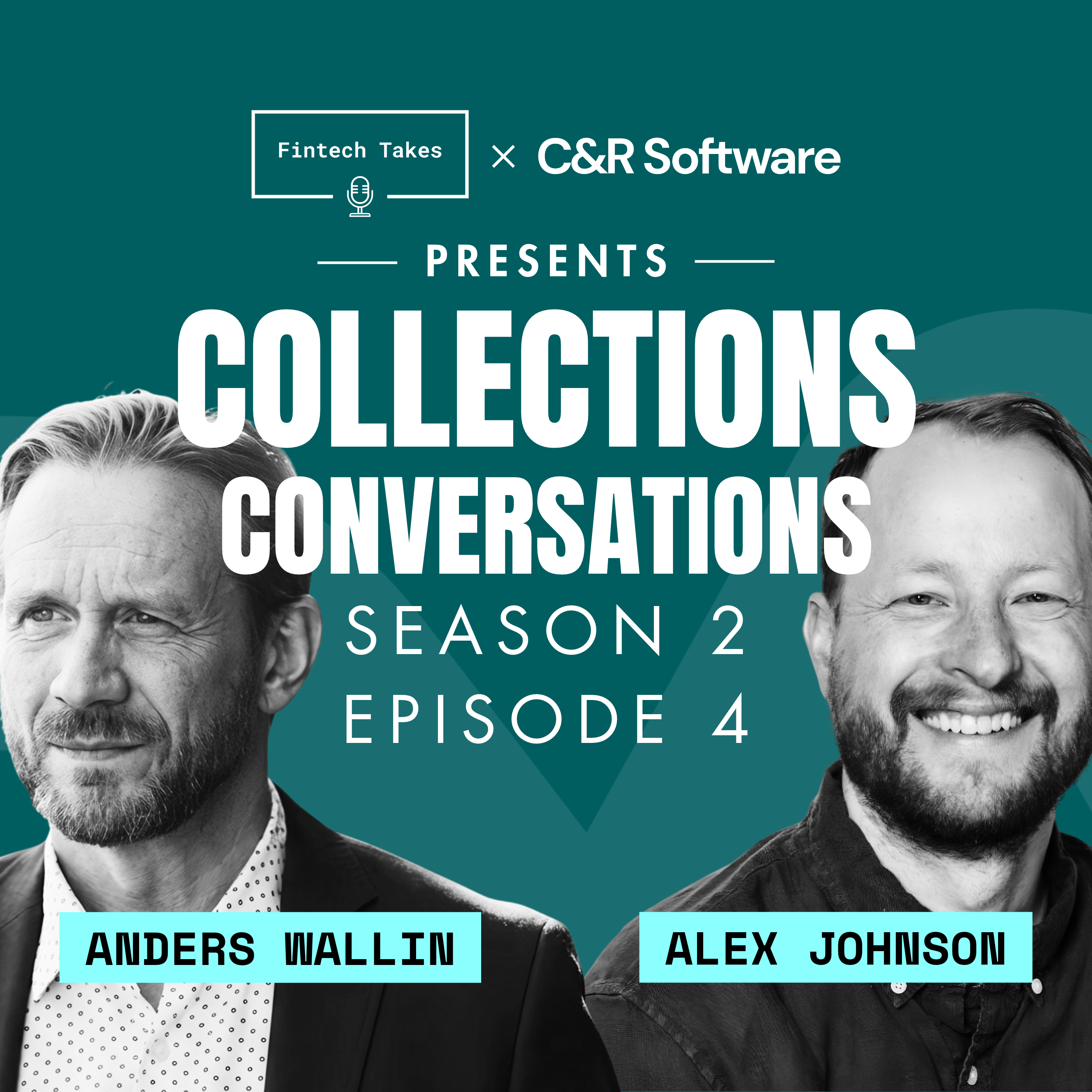
In Episode 4, I sit down with Anders Wallin, who has spent a lot of time on the technology side of credit (he’s worked as CIO for a traditional credit bureau and a debt purchaser, and even at FICO). We apply that view to collections and recovery, the most neglected stage of the credit lifecycle.
We start with the opportunities lenders miss when they see technology primarily as a way to avoid risk and cut costs. Banks invest plenty in acquiring customers, but the switch flips the moment a payment’s missed. Ironically, debt buyers often take the more customer-centric approach.
At Hoist, the debt purchaser Anders joined in 2012, the word “debtor” was banned, and machine learning helped them understand what borrowers wanted to pay. Anders says customers who default typically come back as payers 5-7 years later.
We get into:
Why big banks are “really bad” at collections, and what the UK’s outsourcing and debt sale market gets right
Why “your liability is now their asset” changes how a debt gets treated
How open banking data could enable sustainable, individualized repayment plans
How Swedish lenders verify last month’s paycheck, and why northern and southern Europe view debt so differently.
Tune in for a conversation about the customer on the other side of every delinquent account (and why they’re probably coming back).
---
This episode is brought to you by C&R Software.
More than just debt collection, C&R sets the global standard for AI-native, humanized credit management. They simplify the complex with end-to-end credit-risk lifecycle support, powered by automated workflows, AI-native intelligence, and real-time, data-driven decisioning. Learn more at https://hubs.ly/Q03Wl1DY0.
---
Sign up for Alex’s Fintech Takes newsletter for the latest insightful analysis on fintech trends, along with a heaping pile of pop culture references and copious footnotes. Every Monday, Wednesday, and Friday: https://workweek.com/brand/fintech-takes/
And for more exclusive insider content, don’t forget to check out my YouTube page.
---
Follow Alex:
YouTube: https://www.youtube.com/channel/UCJgfH47QEwbQmkQlz1V9rQA/videos
LinkedIn: https://www.linkedin.com/in/alexhjohnson
Twitter: https://www.twitter.com/AlexH_Johnson
---
Follow Anders:
https://www.linkedin.com/in/anderswallin/