Ask ChatGPT

 Fintech Takes
16 Nov 2026 · 42m · 11 chapters
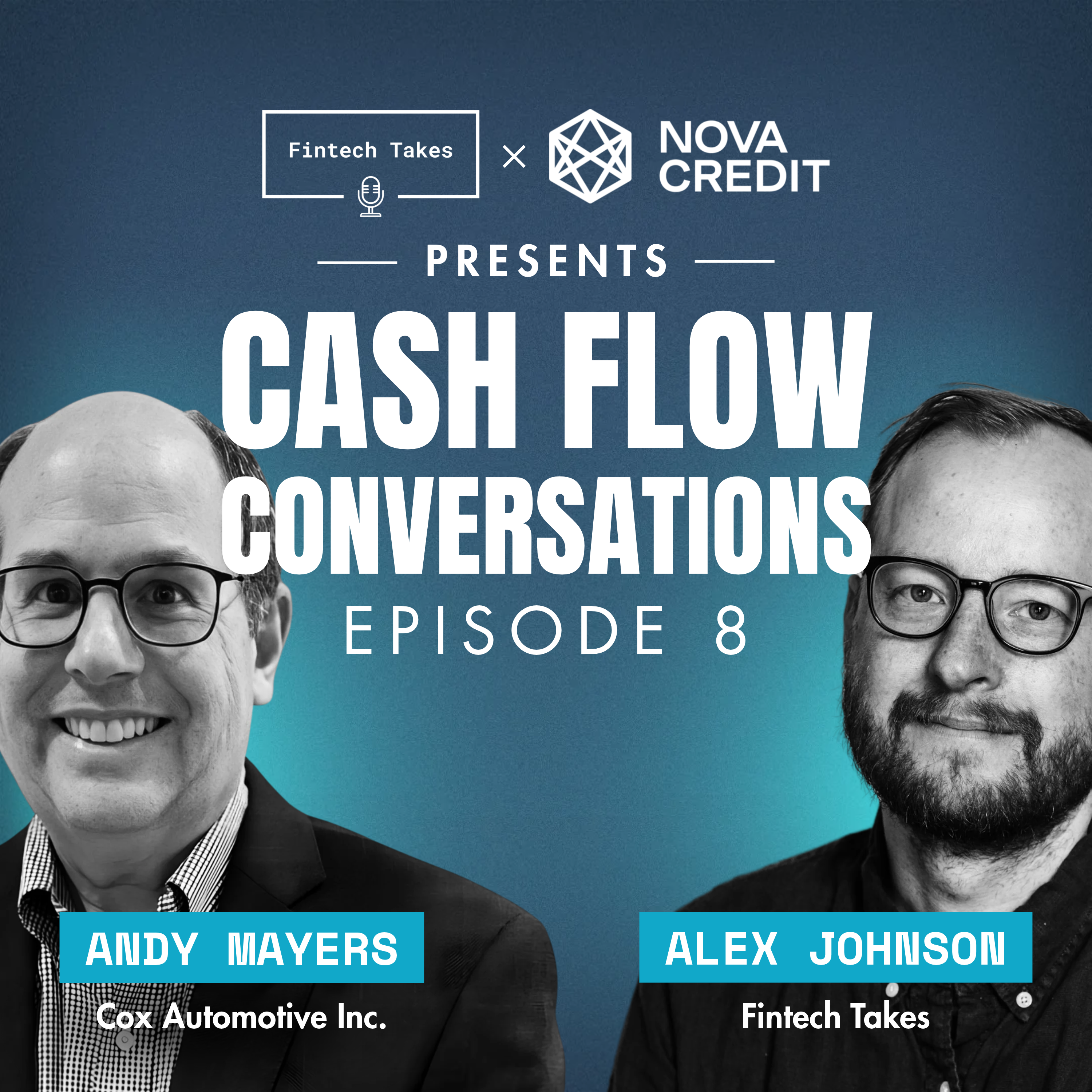
How consumer-permissioned cash flow data is being integrated into indirect auto lending via Cox Automotive’s DealerTrack, starting with income validation to reduce fraud and automate manual steps, with potential to evolve into cash-flow underwriting and earlier, online car-buying experiences.
Andy Mayers, lender solution strategist at Cox Automotive; 30+ years in indirect auto lending.
Pay-stub fraud is driving lenders to move away from paper documents toward consented, authenticated income/cash-flow data. DealerTrack is the right integration point because customers can consent while at the dealership, and dealers only need to know the process/stipulation is cleared (not the results). Lenders already auto-decision many apps quickly; the remaining manual bottlenecks are funding-package checks and income verification.
Mayers’ example of a Cox “friends and family” purchase requiring pay-stub redaction/upload; consented verification would be faster. Fraud example: fake pay stubs can be created quickly online, while proving bank-account-linked income is harder. Rollout: first lender expected late Q4/early Q1.
Written by AI. May contain mistakes.
Discussion on the integration of cash flow data in auto lending processes.
“I'm Alex Johnson, creator of the Fintech Takes newsletter, your host, and self-confessed fintech nerd.”
Exploration of the growing need for consumer consented validation in auto financing.
“First of all, in terms of the demand for income validation, you know, we've seen historically in our entire profile, we've seen historically about 16 to 18 % of all applications that get approved on our platform.”
Analysis of current stressors in the auto lending market and concerns over fraud.
“Why we put it in the dealer track is, in talking to our lenders, it's a logical place for a customer to actually be asked for the income.”
Vision for automating the auto lending process and improving efficiency.
“That's a very, I think, logical concern when you look at the state of auto lending right now.”
Description of the consumer experience during the financing process at dealerships.
“of that, where you actually have data and you let data do the work for you instead of having a person manually have to do the review.”
Discover how new processes make income verification faster and more secure for customers purchasing vehicles.
“experience going through this, what does it look like?”
Examine how accurate income data affects lending decisions and pricing.
“Is this also impacting like quality of the decision or pricing or those kinds of things.”
Explore how fraudsters might manipulate income verification and the implications for the auto lending space.
“and say, you know, I make this much money and somebody creates a fake pay stub, which by the way, you can do online for in 38 seconds and go to chat GBT or go to any website that says makemypaystub.com, whatever it is.”
Discuss the evolution of car buying experiences and the integration of cash flow data in financing.
“If you sort of project out a little longer term, and this is we're getting a little science fictiony.”
Examine how cash flow underwriting can enhance financing opportunities and improve customer experience.
“And one of the things, I know we're starting with the lenders, but eventually, you know, an opportunity for dealers is cash flow underwriting could actually help them structure a deal better.”
Gain insights into the expected rollout of cash flow solutions in the car lending market and its impact.
“I think being able to do that, and dealers do a great job of that today, right?”

Get the gist, explore an idea or ask about something said.
 Claude
On Fintech Takes, what are the key points of this episode?
Searching your listeningAutomatic transcript. May contain errors.
0:00This episode is brought to you by Nova Credit. Whether you're expanding credit access for newcomers or deepening risk visibility across gaps and beyond, Nova Credit lets you unlock credit bureau, cash flow, and alternative data through a single FCRA compliant platform built for today's credit decisioning. Learn more at novacredit.com. Hello, and welcome back to our latest episode of our ongoing quarterly series, Cashflow Conversations, sponsored by our friends at NovaCredit. In today's episode, I get to combine two of my all-time favorite topics, cashflow underwriting and indirect auto lending, into one conversation.
0:44NovaCredit recently announced a partnership with Cox Automotive to bring consumer permissioned cash flow data into the indirect auto lending process through an integration with DealerTrack, one of the big indirect auto financing portals in the US. This news caught my attention when it was first announced because indirect auto lending is simultaneously one of the most obvious lending products where cash flow data can add value and one of the trickiest lending experiences to integrate consumer permissioned cash flow data into. How do you get consumer permission in the dealership. Which steps in the auto lending process can cash flow data help improve the most?
1:23How do auto lenders think about the utility of cash flow data relative to traditional credit bureau data that they've always used? And how do you make it painless for dealerships to start using cash flow data to close more deals and move more metal? These are just some of the questions that I put to today's guest, Andy Mayers, lender solution strategist at Cox Automotive. Andy has worked in this space for more than 30 years, and as you will hear, he has forgotten more about indirect auto lending than any of us, certainly myself, will ever know. It was a real treat to get to pick his brain on this subject and to hear his thoughts on how consumer-permissioned cash flow data can help transform the car buying and financing experience.
2:05So, without further ado, here is the latest episode of Cashflow Conversations.
2:13This is Fintech Takes, the podcast keeping you in the loop on all the latest fintech trends, news, and ideas.
2:21Andy Mayers: I'm Alex Johnson, creator of the Fintech Takes newsletter, your host, and self-confessed fintech nerd. Let's go. Okay, Andy, thanks so much for coming on the podcast. Hey, thanks for having me today. I look forward to sharing some insights with you guys. Yeah, we are delighted to have you. It's kind of funny. This is one of those ones where it's an overlap of multiple topics that I care deeply about. Indirect auto lending and cash flow data and cash flow underwriting. So let's just jump right in. You know, the indirect auto lending process has for, gosh, decades run pretty exclusively on credit bureau data plus sort of pay stubs for income verification.
3:06I'm curious to get your perspective on why now in terms of starting to integrate customer permissioned cash flow data and specifically in the case of dealer track, why it made sense to sort of integrate it at a dealer track kind of infrastructure level as opposed to bolting it on kind of one lender at a time.
3:32Andy Mayers: So that's a lot of good things there. First of all, in terms of the demand for income validation, you know, we've seen historically in our entire profile, we've seen historically about 16 to 18 % of all applications that get approved on our platform. the lenders are asking for income validation, which for them is an opportunity for them to ensure the customer has the right income. That's validating what the dealer reports. Unfortunately, and I think why now is important for cashflow data, we'll probably talk about a lot. Fraud is really a problem now when it comes to pay stubs. So if you think about those 16 to 18 % of applications where a dealer has to get a pay stub, it's really easy to create a pay stub now.
4:19Andy Mayers: And I think lenders are aware that that document is no longer truly something they can count on for validity. So that's why I think consumer consented validation is a wave in the future of where people will go. And some of the lenders we spoke to have even said, I could see a day where I'll never take a paper-paste stub again. Why we put it in the dealer track is, in talking to our lenders, it's a logical place for a customer to actually be asked for the income. it makes no sense for a dealer to submit an application to a lender and then a lender who the dealer may or may not know they're doing business with because it's indirect lending, send a request to say, hey, fill out this and tell me your bank account information.
5:00Andy Mayers: It makes a lot more sense at the time at the customer sitting with the dealer. And it also is what a dealer needs to satisfy anyway. So enabling the dealer to have that process, I think is a much more effective way to do it. And I just think it's also So, you know, as we talk about data security and things like that, it's also better, right? Instead of a consumer faxing or emailing a pay stub with PII, you know, social security number data that's actually sitting there that could actually sit on the desktop, that's no longer available to be seen inside the dealership. So it's a lot more secure way to do validation of income anyway.
5:35But I think that's why it makes sense now.
5:38Andy Mayers: And I think fraud is driving a lot of the reasons to go to a consumer consented model. Yeah. Yeah. No, that makes sense. I mean, it's interesting because, and you would know this far better than I would, but the just state of auto lending generally is one where you are starting to see some stress in different parts of the market, right? And, you know, obviously, I think cars are incredibly important to consumers like they want to get approved. You know, there's like terms that are getting longer, like just the nature, cars are expensive, like just the nature of auto lending at this moment. I think it's very prudent on the part of lenders to worry about fraud or to worry about misrepresentation of data.
6:29That's a very, I think, logical concern when you look at the state of auto lending right now.
6:37Andy Mayers: Yeah, there's a lot in there. I think obviously affordability is a challenge and that, you know, making a customer that can't afford a car as much have to prove their income so that the dealer's, sorry, the lender's exposure is less. Because a lot of lenders, I mean, you mentioned bureau files in the beginning, but a lot of lenders have always looked at payment to income and debt to income as part of their analysis on when they're trying to do it. So with the affordability issues, I think there's a heightened sense of, can this person really afford this? And that's part of it. The fraud is just, as I mentioned, well, I'm sure we'll talk about it a million times, but everything we talked about lenders is about fraud now.
7:17Andy Mayers: It's a$10.4 billion industry in auto finance and first party fraud and fake pay stubs and things like that are just running rampant within our platforms and stuff like that. So I think that makes a ton of sense of why they're trying to get there in terms of like this type of data being more validated than just documents and things like that. So it's happening, yeah, unfortunately. Yeah, no, it is. It is an unfortunate reality, but it's one of those things that might ultimately prove to be a helpful catalyst for making some of these changes. Because I think, you know, and again, like DealerTrack plays such a unique role in the industry in terms of being kind of the infrastructure and the connective tissue between a large network of lenders, obviously a huge network of dealers.
8:08And, you know, a lot of that process has been, I think, you know, somewhat kind of static or the same for a long time. And in the release that, yeah, Nova Credit put out about this, one of the things that jumped out to me was that this being kind of one piece of a larger puzzle moving towards kind of fully automated origination and kind of continuing to add more data and more sort of, I would imagine, kind of convenience for borrowers and for dealers into this process. Can you kind of sketch out sort of the vision more broadly for what that looks like and how this particular thing fits into that vision?
8:48Andy Mayers: Sure, I think that's a great question. And probably besides fraud, the number one thing that our lenders ask for is helping them become more efficient in automating the processes. So if you look at the entire origination cycle for a lender. It starts with the receipt of an application. Most of our lenders are doing auto-decisioning. A large percentage of their apps are - You got to be fast and indirect auto, right? You got to be fast, but you got to be safe. But even on our platform, we have 1 ,500 lenders and we did some analysis. About 800 lenders are returning decisions in less than 45 seconds.
9:25Andy Mayers: so you know they're they're auto decisioning and on average the decision response time is about 20 seconds let's just say for the people that auto decision so you've already figured out a way to automate the decision process right you're looking at the criteria the application you look at the collateral you're doing some analysis you're doing the data and you have your funders their analysts are looking at the deals that require somebody to look at so a large percentage of deals don't require somebody to look at it. Alex has an 800 FICO score, he's got good income, he's buying this vehicle, he can afford it, good credit rating.
10:00Andy Mayers: Why does somebody look at it? So the decisioning part is pretty much an automated process now. And lenders intentionally take those deals that are exceptions and look at those deals a little more complex. And as you get downstream in the credit space, in the non-prime space, you have to look a little more criteria, but the non-prime lenders are also auto-decisioning as well. But the next step in the process and really where a lender actually generates revenue is when they fund a contract. And today with our ecosystem and auto finance, a large percentage of the lenders can do what we call digital contracting, which means they're able to electronically receive contract data.
10:40They're able to receive electronic documents, but despite the large percentage of digital
10:46Andy Mayers: contracting they're participating in, there's still a large lot of manual processes that are going on. And some of those manual processes include verifying income, verifying aftermarket documents, comparing all the documents in the funding package to see that they're aligned with what's actually being funded. So if you look at the broader financing journey, the efficiency play that lenders are looking for is, why do I need to do some of these manual things? Why can't technology do that for me? Why can't AI or, in our case, dealer track, why can't you look at a contract package and tell me if there's any problems before the dealer even sends it in so the dealer can fix it, which saves time for everybody?
11:30Andy Mayers: Income validation, as I mentioned, is one of those things that's a manual process in a lot of cases today. When traditionally prior to our opportunity with Nova Credit, a dealer would collect a pay stub. They'd manually send that pay stub into a lender, the lender would have to manually review that document. They might have to verify it. Income validation eliminates that, right? Because now what we can do is by having data, we can get the actual data. We know the data is valid. The data that can be compared and analyzed either by us or by a third party or by the lender themselves to know that that's validated.
12:07Andy Mayers: So like if you were to put in your application that you said you were making$10 ,000 a month, the income validation could compare those two attributes and say, yeah, that's accurate and know that that's correct. So I don't have to have somebody look at it again. So that's where it fits in this broader thing of how do I take things that are manually required by lenders to perform and use technology to automate those processes. Income validation is a great example of that, where you actually have data and you let data do the work for you instead of having a person manually have to do the review.
12:39Right, right, right. Well, walk me through the actual customer experience. Um, cause I think that, uh, you know, one of the nice things about auto lending is that, uh, most people listening to this probably have had the experience of walking into a dealership and buying a car and getting financing. It's, it's one of the great unifying experiences in all of our lives, right? We all can talk about our experiences buying a car. Um, and so I'm just thinking back to like my experiences in the dealership, let's just say that the dealer I went to used DealerTrack. I'm sure they did. And, you know, as you described, it's a funny process because from the consumer's perspective, there are steps that are really quick, as you're saying, right?
13:23Like we got you a decision, we got back multiple offers, what have you. There are steps that take a little bit longer if I want to change something and then the offer needs to be rehashed and sent back to the lenders or if there's aftermarket documents or income verification or other steps or stipulations that need to be cleared. But just when you think about the user experience, and this comes up all the time actually in the world of cash flow data and cash flow underwriting, the consumer permissioning step is often a new thing that's getting introduced into the process. And so I'm curious to have you walk us through, like, from the consumer's experience going through this, what does it look like?
14:06When are they asked to permission access to their data? Like, am I doing it on my phone? Is it on the, you know, laptop at the dealership? There's probably multiple ways to implement it, but what are you guys kind of thinking about? So the initial phase of how we're doing this, when a lending institution tells a dealer that
14:25Andy Mayers: they need to have the income verified. They will tell the dealer on a decision-by-decision basis. They'll say, hey, Alex, I need to verify income on Alex. The dealer will have within our platform the ability to initiate a text or email to the customer, inviting them to do the consumer consented authentication. So I get an approval back. I say it's for Alex. I have the ability to now send you a text or an email. And then Alex is going to be informed that, okay, I'm going to be doing this. I'm going to verify your income. You'll then get something. You'll go through the Nova Credit platform to go through the authentication consenting process that I think we're starting to see a lot more customers be more comfortable with than they used to be.
15:14Andy Mayers: I think that if you're signing up for Venmo, if you're doing all these types of things, you're typically enabling your capabilities. I know when I did my last tax return, I think I had to do some type of authentication. So I feel like we're becoming more, I don't desensitize the right word, but we're more accustomed to it. Right. So I think, and I think if, if positioned right by a dealer, I think it's a really good thing. And they say, look, Alex is a really easy way for me to verify your income. I'm going to send you a link, you're going to walk through it. You have to give credentials. You're not giving access to this data.
15:49Andy Mayers: Hey, it's no different than when you set up a Venmo account or whatever it might be, and it'll be a lot faster. I actually go back to my own personal experience on this, and I've told this story before, which is I recently purchased a vehicle and I did it through a friends and family program with one of the OEMs. And after I purchased a vehicle, the salesperson called me up and said, I need proof of employment because you're a Cox employee. I need to know that you're part of the Friends employee. Well, my personal experience was not great because what did I have to do? I had to find a pay stub, which if you're like me, I don't ever see pay stubs anymore, right?
16:27Andy Mayers: They're electronic. They go into, right? So I don't see a pay stub. I had to find a pay stub. I had to download a pay stub. I had to redact all the information on the pay stub. And then I had to upload the pay stub and then I had to send it to my dealer. If she had sent me a link that said, here, or just fill this out so I can verify who you are, I would have done that 100 times over. So I think from a consumer perspective, there's a good opportunity here to explain that it's more secured and it's faster than actually having the customer do something. The other thing is if a customer is sitting in a dealership, you don't need to go home to get a pay stub.
17:03Andy Mayers: You don't have to log into some system and find it and print it and download it. You actually can actually do it right then and there. So it's actually, I think, faster for a customer as well. to actually go through that process. So I think there's a lot of benefits there. And I think a lot of the surveys that Cox already does on consumer buyer experiences, what are the processes we can make faster for you? And I think this is a good example of here's one, we can make it a faster process for the consumer to go through than actually the traditional path. So I guess a good benefit for everybody.
17:35A good increase. Yeah. Can I ask just as a quick side note, you're a nerd on this kind of stuff. When the dealer calls you up and says, we need to verify your income. Like I've had this experience a few times with fintech or banking things where I'll get asked to do something and I'm like, I'm actually so glad you asked. Let's go through that process. And I'm like the biggest pain in the ass customer for it because I'm like trying to figure out exactly how the mechanics behind the scenes work. Was that you when they asked for your income verification?
18:04Andy Mayers: Not really. I was more really annoyed actually. I was like, what are you doing? And the worst part is I already had the car. Oh, sure. Yeah. You know, I'm like, I didn't really need to do this, but I'm like, I work for Dior Tracks. I didn't really think it was the best thing to just kind of blow off a Dior. Sure. Sure. No, I'm always interested. I'm definitely interested in Dior processes and what we can do to make Dior process more efficient. So I felt it was actually a great learning experience for me to actually go through that because it made me feel the process that I probably hadn't had to experience that a lot of customers do.
18:39Andy Mayers: So from that perspective, I think it was beneficial learning experience, but I'm always like you trying to understand exactly why they're doing it. Same thing when I was signing my contract remotely, I wanted to make sure I, like, I know about remote signing exactly how are you doing this. So, but yeah, it's always trying to learn, right? Totally. Yeah. Yeah. I mean, it's, it's nice because, um, you know, in addition to getting to work on this stuff, uh, in our sort of, uh, nine to five roles, you get to be a customer of all this stuff too. So it is, uh, it is always a good learning experience.
19:08Um, what does the, the dealership sort of see and how are they experiencing this? Because obviously you mentioned the privacy and the idea that like, we really should only be passing back just the data that's necessary to see, or not even exposing any data to the dealership necessarily. If it just needs to go to the lender, uh, whereas like a pay stub on a desk, like there's all kinds of information on there. And then I guess from the dealer's perspective, I mean, you guys always kind of sit in the middle of trying to make sure that every company or every group that's involved in the transaction gets what they need out of it.
19:45And oftentimes everyone's aligned, but sometimes there's a little bit of tension between it too, where it's like the dealer wants to keep things moving. The dealer wants the deal to go through. The lender is asking for this additional thing that has the potential to kind of slow things down or create a little friction. So how are dealers reacting to this? And then what is the level of information that the dealers see when they take this route instead?
20:08Andy Mayers: So initially the dealers will only see that somebody completed the invalidation process. They don't actually see the results. The results belong to the lender. And that's because it's credit data and things like that that belong to the lender. The benefit the dealer sees is they see that the process was done. So they get an update to know that Alex did complete the process, so they don't have to chase it down. Sure. They have the ability to chase down Alex. If Alex doesn't do it, they can always send a second request. But they also now see in a much faster way from a lender that the actual stipulation has been cleared because the expectation is that once a lender receives the data, they'll actually update the decision to tell the dealer that that stipulation is no longer required.
20:51Andy Mayers: So they can actually move faster. So they're going to get real-time information back from the lender to know that that stip was cleared. and lets them move to the next step in the process. So, you know, do they see the actual results at this time? No, they don't. But they see that the process has taken place. And ultimately, most importantly, they see that the stipulation has been cleared so they can move on to the funding process. This episode is brought to you by NovaCredit. Every lender wants better credit data. But most don't need more data. They need more connected data. NovaCredit's FCRA-compliant platform gives you unified access to credit signals across global credit bureaus, bank transaction data, payroll providers, and verified documents.
21:34If you're expanding into cash flow underwriting or reaching cross-border borrowers, NovaCredit makes the complex stuff of credit data usable. Learn more at novacredit.com. That makes a lot of sense. Is this also impacting like quality of the decision or pricing or those kinds of things. Cause I think the other thing that, uh, you know, you see with this is this sort of trade-off sometimes between basically like convenience and decision quality. Right. And what I mean by that is, um, you know, you might sort of take a guess like, Oh yeah, this estimation we have on income or this income pay stub that we don't even know what the data on it was, or like it might be out of date, or it might not be fully accurate.
22:23Like, we feel good enough from a risk perspective that will allow this, but we ideally would have liked like slightly more precise data or slightly fresher data. Or I guess in some cases, if you can make this easy enough and kind of woven into the process, lenders might be getting this in more cases, like there might be cases where, you know, there's like kind of that gray area of, is it really worth sort of putting a step on here and asking them to go through another step? Do we want to lose the deal? Or are we comfortable sort of underwriting without it? So I guess, how does this change the approach to underwriting?
22:58If you're a lender, and suddenly there's this sort of both more accurate way of getting the data that gets fresher data, but also is convenient in a way that might allow this to become less of a point of friction within the experience over time?
23:13Andy Mayers: So in the conversations with lenders, because obviously I'm not a lending, I don't accept the lender policy. I would answer the question a couple of different ways. First, verifying the actual income on the application, allowing them to know that their debt to income and pain to income ratios are correct, which is important in the pricing, adds a lot of value to the lenders right off the bat. Yeah. Right. So in that case, they're truly validating that their calculations for income were done correctly. Some of the lenders we've spoken to are now going to look at that data and have the opportunity now to say, well, wait a minute, maybe Alex underreported his income and there's more opportunity for me to lend more money.
23:52Andy Mayers: So they could actually go back and revisit the information and say, you know, based on what I've learned, Alex is actually eligible for a lower rate or something more because the debt to income and payment to income is actually lower than what I originally priced the deal on. As we evolve into cash flow underwriting, I think that's where you're going to see pricing change more automated. So, you know, a lender will now take those data elements and use it as part of the decision process and potentially say, OK, now I'm using my income calculations to figure this out. But I definitely think there's an opportunity for a lenders to reprice a loan based on what they learn about the income.
24:32Andy Mayers: I do think you hit an important part though adding a stipper income is not right now it's not always the best thing for a lender because if an application goes to two lending sources and one stips for income and one doesn't the dealer may choose the path to release resistance the expectation is that the path to release resistance may be eased by this process and that would actually make it better but ultimately I think better data always helps lenders make better decisions and those better decisions can help them make better pricing decisions as well. So I think those are the things that you get when you start to get consumer consented income data as part of your underwriting process or validation process.
25:16Andy Mayers: And I think we're early on in that phase. I think that's going to evolve in our industry, but I think that's why we're starting with the income navigation and then getting the cash flow. Cash flow requires a little bit more work for lenders to ingest because they now have to bring it into their pricing and scoring models. Whereas income validation is a little more like document validation and things like that. Right, right. Yeah, I mean, it's interesting because if I sort of apply an indirect auto lending sort of framework onto sort of just cash flow underwriting adoption generally, it's similar and it's different, right?
25:52Because in other lending product categories, the discussion is, it's similar, right? Like we don't know how to ingest cash flow data into our kind of core system or pricing or credit decisions or and or we don't want to introduce more friction than we need to at the top of the waterfall and the top of the experience. but later for things like, you know, second look decisioning where, hey, we were going to decline you anyway, but if you want to try to have one more chance to get approved and in auto, I think income steps are sort of the version of that, right? Where it's like, this is a thing we add on and not for everybody, but for some.
26:36And because it's already friction and because it's already a relatively like contained decision process, you can incorporate this there without really messing anything up earlier upstream. And that makes it a good place to start.
26:51Andy Mayers: Yeah, absolutely. You know, as you're talking about this, and I know, in work with Nova Credit, they do a lot of property management, like, sure, there's no asset there. The only asset is the person's ability to pay. So that's where income becomes that much more critical. Like, if I'm going to rent an apartment for$2 ,000 a month, do I have the right income to allow do that? In auto lending, you have the collateral. So you have the asset of the vehicle. So you have a little less risk. I say risk differently. I'm sure there's different risk. You still have the asset. The question is, can that customer still pay for that loan?
27:26Andy Mayers: But you still have the asset. And I think you're absolutely right. I think we see in auto lending, stipping for income right now is a, I want to do this deal, but I'm not sure yet. So I have to validate it. Although I could see in the future, Sure, I could see stiff for income and not stiff the income, but like really proof of income as a fraud detection tool. Right. Like somebody may say, you know what, it's worth it for me to ask for more proof of income because that is a great way to counter fraud. right? I mean, it's one thing to walk into a dealership with a fake driver's license and say, you know, I make this much money and somebody creates a fake pay stub, which by the way, you can do online for in 38 seconds and go to chat GBT or go to any website that says makemypaystub.com, whatever it is.
28:17Andy Mayers: It's a lot different when you actually have to prove that that's your actual income that you're reporting. Now, I'm not saying that fraudsters aren't good enough to have that level of detail, but primarily proof of income could be a great fraud detection tool. If you're actually going to someone's Chase Bank of America Wells account, that's really second level. If you're going that level, if you're trying to do fraud and having to set up accounts and stuff like that. So. Yeah. It's funny you say that because I think fraud, as we've talked about it, is one of those great sort of like levers in all of this, because, you know, reality is, especially in the age of AI, you can mock up pay stubs, you can create fake driver's licenses, you can, and this is already a big problem, but it's going to become, I think, even worse with AI.
29:04You know, you can seed fake identities into the credit bureaus and have a fake credit report and synthetic credit report. Or if you don't want to do that work yourself, you can buy it from someone else, right? Like fraud is a multi-level problem where there are suppliers and then buyers. And so I think a lot of that ecosystem is very fragile and AI will make it even more fragile. The one area that I think is just more resilient by nature is, as you're saying, it's pretty hard to create a fake bank account. I mean, it's essentially like you have to like launder money into an account solely for the purpose of making it look real.
29:40Like that's the one where the juice is probably not worth the squeeze for a fraudster. And so So I do think that the more we see both sort of stress put on the auto lending space, just in terms of like affordability and some of those issues as we talked about, and that's more like either first party fraud or like dealership fraud, where it's like either the customer or the customer and the dealer sort of collaborating to try to get approved where otherwise they wouldn't versus third party fraud, which is its own whole category where it's like a fake identity or stolen identity. But I think both of those will be drivers towards more what I would sort of consider to be like ground truth information that's harder to fake or harder to create synthetic versions of.
30:27And cash flow would seem like an obvious one there. If you sort of project out a little longer term, and this is we're getting a little science fictiony. So like adequate disclosures, this is not happening today. But just as we imagine things evolving, at Cox, you guys have lots of different platforms and lots of different ways for buyers to engage in the car buying journey, right? Online, you know, comparing different products before you go into a dealership, like all these different sort of experiences. I'm curious how you sort of think about the experience of car buying sort of evolving sort of in more significant ways over time.
31:06And in particular, I guess what I'm curious about is how might those changes in the experience, which could be online, could be in the dealership, could be a hybrid of the two, whatever, how those changes might open up the door to incorporating this cash flow data or this customer permission data in more places earlier in the experience? Like, have you spent any time thinking about that?
31:29Andy Mayers: We have. We spent a lot of time thinking about the shifts of the car buying experience. I imagine, yeah. And like you said, with AutoTrader, KBB, those types of properties, we're finding that's where people want to start the process. We also know where the satisfaction and dissatisfaction parts are in the car buying experience when we go through that. I think actually, to your point, cash flow underwriting is a great opportunity to do an online experience. Like customers don't know any better, and I don't mean it that way. But if you were just to create a path for someone that included, instead of asking for their income, just say, I need you to log in, give me your bank account information for logging to get your income, as opposed to tell me your job and your income.
32:13Andy Mayers: And you built that into your workflow and your application. And the customer just think that's part of the process. And I think the consumer experience is actually, in some cases, a great opportunity to add these tools that actually do more for fraud detection and things like that by having the customer do a selfie check or upload the driver's license themselves and compare the two. Does that eliminate fraud by itself? No, it doesn't, right? Because to your point, I could create a fake ID. Asking them to do income validation as part of the application process, asking more information, I think is the right place and very easy place to actually do this.
32:49Andy Mayers: Because like I said, the consumer doesn't know better. They don't do it 15 times a day. They do it once every couple of years, right? And I think it's a logical place to be asking those types of questions. and I think we've seen car buying and financing move online more. And asking a customer for more upfront is probably not a bad thing and I think that's a good place for that to take place. I very much agree. I think it's a huge opportunity. And it's interesting because the cash flow underwriting model, and I'm sure you and Nova Credit talk about this a lot, it's evolving as well, right? I mean, we're developing new ways for permissioning to happen upstream and for it to follow the customer downstream.
33:34And so, yeah, I mean, the idea of, like, if there's even a small chance that me permissioning something up front when I'm kind of shopping around and looking at sub makes my experience in the dealership faster, quicker, more efficient, like, sign me right up for that.
33:50Andy Mayers: And we have talked about it. And one of the things, I know we're starting with the lenders, but eventually, you know, an opportunity for dealers is cash flow underwriting could actually help them structure a deal better. Sure. Right? Because it could actually better inform the dealer that Alex has more capability to finance something than what's being reported. A lot of people under-report their income when they walk into dealership. And a lot of people that can't afford it, having cash flow data may actually help them by saying, by the way, do you have any other accounts we might be able to look at or things like that that would actually help me get you more?
34:24Andy Mayers: or like if I know you have through cashflow underwriting, if I know you have some more opportunity, maybe I could ask for another, some more down payment and say, look, here's a way to do that. Now, I think that's a more complicated conversation that we saw software because now a dealer is starting to have a conversation with a consumer about their banking information. So I think that's, we're not there yet, but we do definitely think there's an opportunity for cashflow underwriting to be pre-decision type processing, especially during the consumer journey. if you're getting that information to a customer, we're able to take that information and help them structure a deal.
34:58Andy Mayers: I think there's a lot of value there. Well, it's fascinating because as you described that, I was kind of thinking about my own personal experience as car buying and it is a really interesting workflow, right? Because like, hey, how much money do you make? Well, I'd prefer not to tell you that when you're trying to sort of push me towards a particular vehicle. So there's like a moment in which I might want to sort of sandbag or say I make less than I make or what have you. So like, depending on where you are in the journey, the data has different utility to all parties involved in it. And so I am really fascinated by where how that workflow evolves, because you're right, like, once you're later in the process, like, hey, this is the car, this is the price.
35:39Now let's figure out financing. Well, now I want you to have maximal flexibility to get me the financing that will work for me. And so there are a lot of different steps in the process where the role and value of this information kind of changes. I even think, and this is probably not something you guys are prioritizing in the short term, but I even think lenders are going to want permission of this data to follow the loan so that it can inform servicing and things that happen after origination when the loan is booked as well.
36:09Andy Mayers: Yeah, I think we've definitely become a payment sensitive car buying experience. I think everybody's worried about the payment. Sure. And the payment's all driven by, you know, obviously term or rate and amount, but down payment is a huge factor in that. And I think you're right. I think being able to do that, and dealers do a great job of that today, right? I mean, when they go to their desking process, hey,$2 ,000 down or get you this payment. Like, it's part of the journey today. But I agree. I think that the cash flow could help that process as I go there. As far as lenders using the data, I would defer to NOVA on that.
36:46Andy Mayers: That's their area of expertise in terms of what they do with the data and how lenders use it. But yeah, absolutely, that additional data can help people get a better deal, I think. Yeah, well, and it's just like ultimately, and I think this is what a lot of the cash flow conversations come down to, is what are the moments in consumers' lives where it makes sense to them and they are willing to permission access to their data, right? Because like, that's like, you know, it is a moment of friction, right? And like, there is always an inherent friction in doing that. And so I think the thing everyone's trying to figure out is where does that friction make sense for consumers?
37:27And where is it not really asking them to go that much more out of their way than what they're already doing? And I really do think the process of shopping for, going down to the dealership, test driving. Carbine has lots of those natural moments where it's just going to make sense for people to permission it as a step in the process. And I think you're right. Customers are definitely more accustomed to this today than they were even five years ago. And so it makes it much more of an approachable conversation. So to wrap up, give us kind of a short-term view into this rolling out into the market.
38:03Like, when am I perhaps going to experience this? What do you anticipate in terms of like rollout and adoption for dealers, for lenders? Like, where are we in the process and where will we be over the next couple of years?
38:17Andy Mayers: Well, hopefully you never get stiff for income. Just so you know. You know, Andy, you don't know the types of cars I'm trying to buy. I'm way outside my range. Hopefully I get there, but that's okay. Look, the nice thing about this, from a dealer perspective, there's really not a dealer adoption. Dealers don't have to subscribe to it or participate. Basically, when a lender like a Westlake, who's working with Nova Credit, when they stip a deal, will present to that dealer the fact that they have an opportunity to do the income validation. So there's no enrollment process. So from a dealer enrollment perspective, it's really as lenders roll out the capability on the deals they decision to SIP, the dealer will just see the opportunity to use the process, the Novacredit process.
39:03Andy Mayers: Pretty easy, and that's kind of nice. And it follows a pattern that we already use for our digital contracting and our signing strategy. So a lot of dealers are going to be very familiar with, hey, here's a checkbox, send it out, the customer gets information. Lender adoption, we're talking to a bunch of lenders. Lenders are all looking at this as an opportunity. As I mentioned, there's multiple levels of complexity to a lender. If you're just doing income validation, that's relatively easy because you're replacing the paper pay stub with an electronic pay stub. As they get in the cash flow underwriting, it becomes more complex because they don't have to figure out how they want to use it in their scoring systems, things like that.
39:42Andy Mayers: So that's why we started with income validation because essentially we're replacing the paper proof of income with an electronic proof of income with a better control. The lender can still receive a document per se, which is no different than what they've gotten to pay stuff. So we're trying to do it relatively easy for the lenders. Most of our lenders have capabilities to receive those today. There are receiving documents. So that's kind of the rollout phase for the lenders. As they evolve and eventually get more complicated or sophisticated with cash flow underwriting, they would use that. Now, the nice thing about the solution we put together with Nova Credit is that for us, it doesn't matter.
40:24Andy Mayers: A lender can tell us they want cash flow or income validation. It's the same experience for a consumer, same experience for a dealer. It's just the results that we get back from Nova Credit vary based on whatever the lender wants. So I think we're looking to be in market late Q4, early Q1 with the first lender. and we have other lenders that are lining up to be part of it. Fantastic. Well, I'm excited to see it roll out. Like I said at the beginning, anytime there are these areas of fintech and credit and lending that I'm personally passionate about, and these are two areas that combine, all the better.
41:03So thank you for coming on to talk me through it. This has been really, really helpful. I appreciate it. Thank you.
41:09Andy Mayers: I'm also interested in fintech and lending as well. Thanks. Well, you're among friends then. And we'll have you back on, but really appreciate the time. All right. Thank you very much.
41:21Thank you for listening to this episode of FinTech Takes. Stay up to date with emerging companies and the latest FinTech trends by subscribing wherever you get your podcasts. And if you love FinTech Takes, please tell a friend.
Hello, and welcome back to Cash Flow Conversations, a podcast series sponsored by our friends at Nova Credit.
Over seven episodes, we've explored the mainstream adoption of cash flow data in consumer lending, from the practical challenges of getting started to the possibilities that lie ahead.
So now, for our eighth and final episode, I sit down with Andy Mayers, Lender Solutions Strategist at Dealertrack, the Cox Automotive platform connecting dealers with ~1,500 lenders, to discuss a deployment nearing market: consumer-permissioned income verification in indirect auto lending.
On Dealertrack's platform, lenders request proof of income on 16–18% of approved applications. Traditionally, that's meant a pay stub, a document that can now be faked online in under a minute.
We get into why fraud is accelerating the move away from pay stubs, why the dealership is a more logical place to request bank data than an unfamiliar lender, and how a manual verification process becomes a text or email the borrower can complete on the spot.
We also look further down the road, to how cash flow data could inform loan pricing, help dealers structure financing, and enter the car-buying experience much earlier.
It starts with replacing the pay stub. It could end with changing how the car deal gets made.
---
This episode is brought to you by Nova Credit.
Nova Credit is a credit infrastructure and analytics company that enables businesses to grow responsibly by harnessing consumer credit data. Learn more at novacredit.com.
---
Sign up for Alex’s Fintech Takes newsletter for the latest insightful analysis on fintech trends, along with a heaping pile of pop culture references and copious footnotes. Every Monday and Thursday: https://workweek.com/brand/fintech-takes/
And for more exclusive insider content, don’t forget to check out my YouTube page.
Follow Alex:
YouTube: https://www.youtube.com/channel/UCJgfH47QEwbQmkQlz1V9rQA/videos
LinkedIn: https://www.linkedin.com/in/alexhjohnson
Twitter: https://www.twitter.com/AlexH_Johnson
---
Follow Andy:
https://www.linkedin.com/in/andy-mayers-a960714/
Learn more about Nova Credit here.