Ask ChatGPT
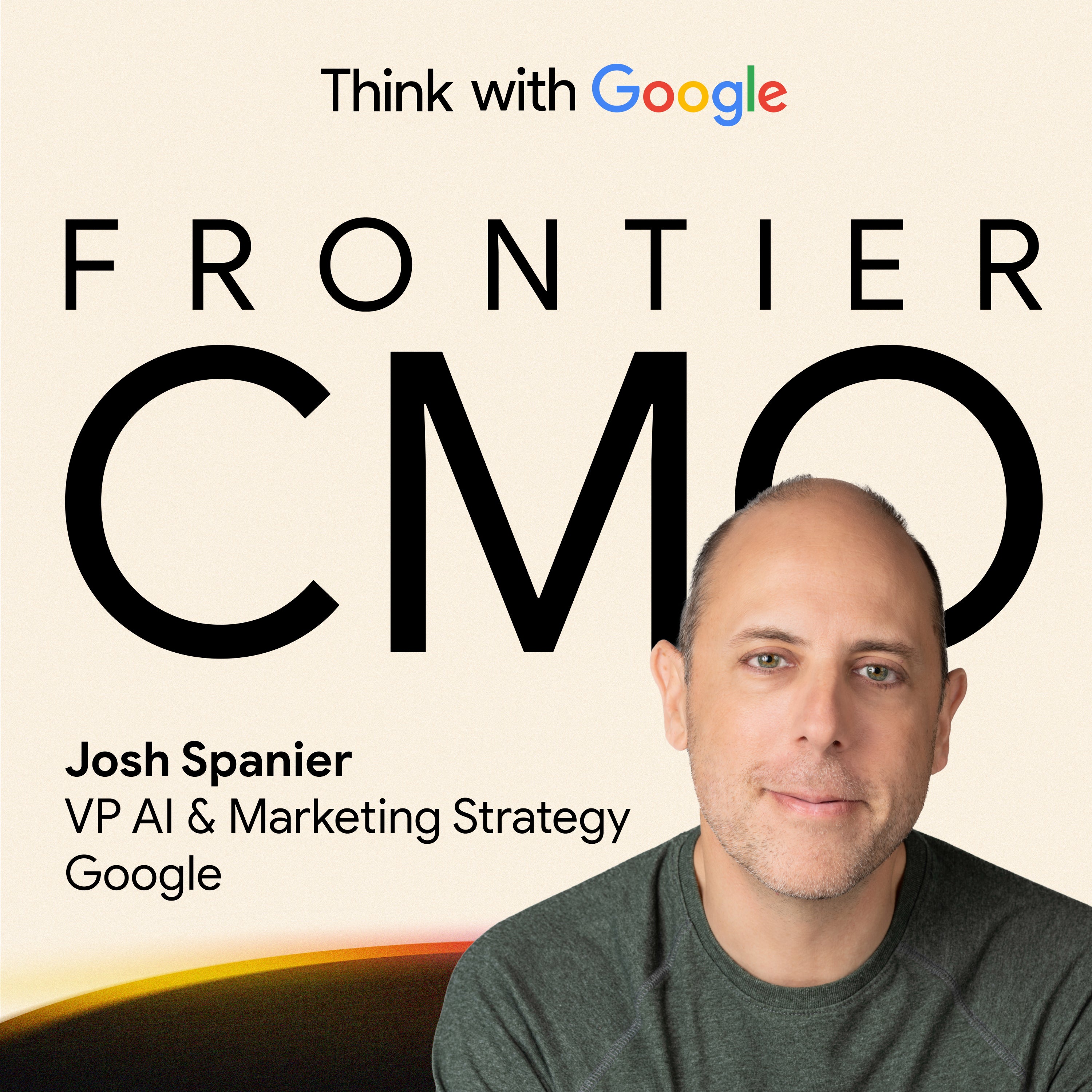
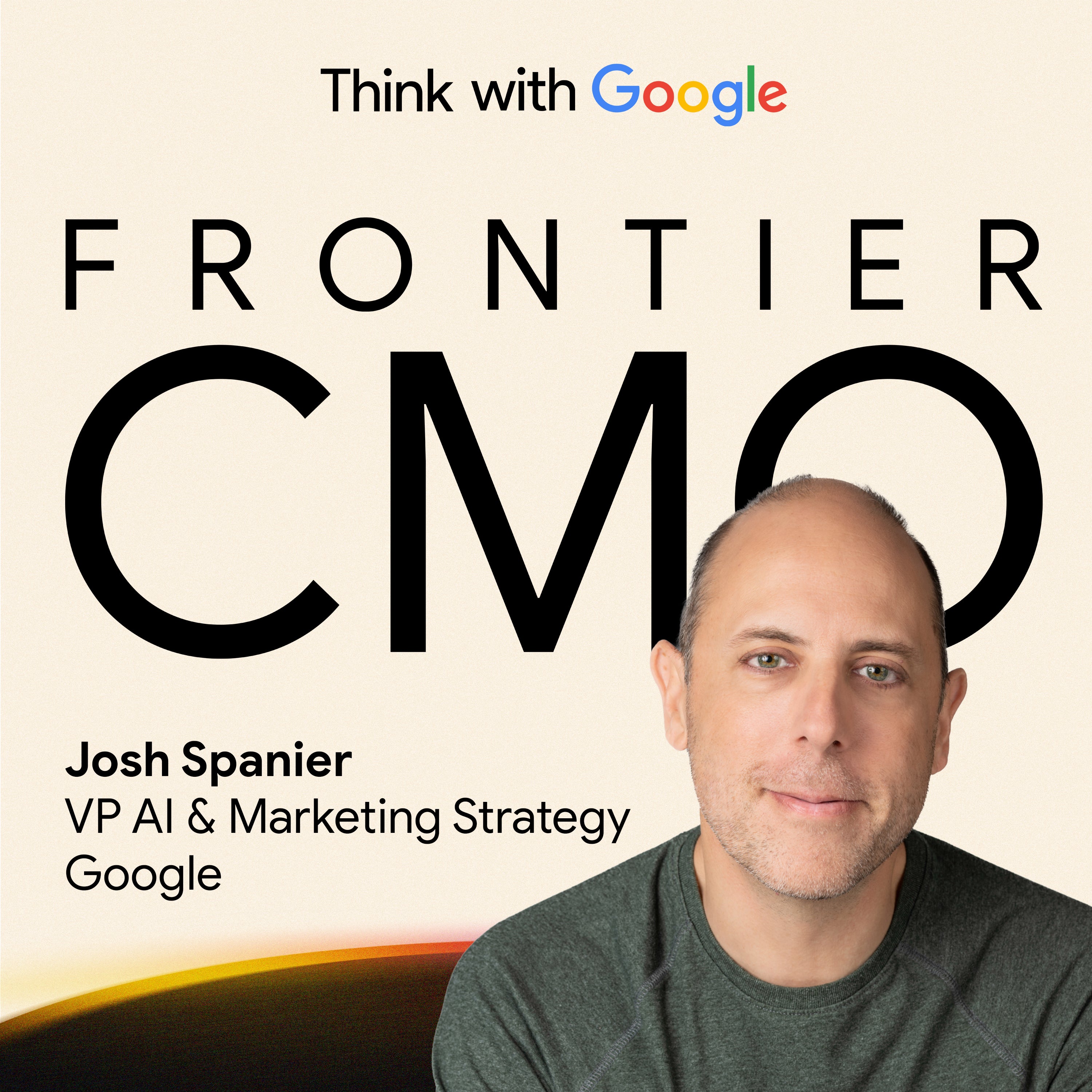
 Frontier CMO Podcast by Think with Google
2 Nov 2026 · 43m · 21 chapters
2026 year-in-review of Frontier CMO’s “frontier” lessons on using AI and culture to drive measurable growth, including CFO alignment, creator partnerships, strategy-first AI, fixing corrosive content/website issues, rebundling creative-production-media workflows, investing in talent alongside tech, and leaders learning hands-on.
Vanit Meera (Chime chief growth officer); O. Gandon (Estee Lauder chief digital and marketing officer overseeing 20+ beauty brands); Damon Berger (Gap marketing leader; cited for 11 straight quarters growth); Colin Rosenblum and Samir Chowdhury (hosts of The Colin and Samir Show, creator economy chroniclers); Benoit Vataire (Liquid Death chief media and digital commerce officer); Mark Ritson (mini-MBA founder); Ander Gasker (Notch co-founder/CEO); Josh Woodward (Google Labs/Gemini app lead); Robert Wong (Google Creative Lab leader); Emma Greed (Good American co-founder/CEO; Skims founding partner); Gary Vaynerchuk (VaynerX/VaynerMedia chairman/CEO); Carla Hassan (JPMorgan Chase global CMO); Rashid Tabakawala (strategist/author); Azmita Dubey (L’Oréal chief digital marketing officer); Kellan Smith-Kenny (AT&T chief marketing and growth officer).
CMOs must be capital allocators/systems architects who speak CFO math; “brand is performance” via cultural relevance; creators are strategic partners; AI amplifies strategy—no strategy means “mush”; audit the website/front door (impressions vs relevance; ~60% corrosive content); rebundle creative-production-media to avoid AI “traffic jams”; bank efficiency gains and reinvest 2x in talent per $1 tech; leaders must learn out loud via hands-on projects.
Chime’s CFO role-play; Estee Lauder transformation; Gap’s cat-eye denim (83M+ YouTube views); Google Pixel microdrama “Moving On”; Liquid Death “no briefs/creative writer’s room”; Notch’s finding that ~60% content is corrosive; L’Oréal upskilling 70,000+ people; JPMorgan’s AI editing model (30% efficiency, 2x output); AT&T’s emphasis on analytical horsepower; personal “Tech Thursday”/AI Fridays and demo slams.
Written by AI. May contain mistakes.
How CMOs can better communicate with CFOs and understand financial metrics.
“Nobody articulated better than Vanit Meera, the chief growth officer at Chime.”
The role of a modern CMO as a capital allocator and systems architect.
“When Vanit and I sat down, I asked him what it actually means to be a full-stack marketer today and why he believes the modern CMO only has two real jobs, capital allocator and systems architect.”
The importance of integrating performance marketing with brand storytelling.
“He connects it directly to how he allocates capital with his CFO.”
CMOs must navigate corporate relationships with diplomacy and understanding.
“And again, to do that, a lot of people will just say, hey, I'll take brand dollars and put it into sort of my direct response budget for the last month of the year and hit my budget and hit my numbers.”
How cultural relevance directly impacts marketing performance and revenue.
“But the CFO, we need to spend time to make sure that they also understand what we do.”
Marketers must adapt to the changing landscape by partnering authentically with creators.
“We sometimes, I think, don't talk enough about the importance of courage because it is not pure math marketing.”
Strategies for marketers to engage audiences through creator partnerships.
“you see ROAS outcomes, you see performance outcomes.”
Discussing how to demonstrate business returns from marketing efforts.
“How do you prove something to a marketer to yourself that this is actually going to have a business return or some sort of positive impact.”
Exploring the balance between brand voice and creator influence.
“By realizing brands don't build worlds anymore, they just join the communities that already exist.”
Analyzing the necessity of strategic training for marketers over AI training.
“I partnered with Ipsos to do a very interesting piece of research.”
Understanding the role of websites in marketing strategy and AI integration.
“That brings us to the question every creative director and CMO has asked me in quiet hallways all year long.”
Emphasizing the need for creativity and human touch in marketing campaigns.
“All of that has to kind of be, you know, AI first.”
Learn why integrating creative, media, and production is crucial for marketing success.
“Whenever a campaign flops, the media team gets blamed first, because that's where all the live data sits, even though creative is the number one determinant of success.”
Discover how AI can transform marketing efficiency and the importance of solid processes.
“with what it takes to rewire the workflow inside a massive global enterprise.”
Understand the significance of investing in talent alongside technology for growth.
“One of the things that we have spent a lot of time on as my marketing organization is process.”
Learn about the six keys to effective change management in organizations.
“Sometimes commentators talk about everyday AI productivity wins, writing copy faster, automating localization, summarizing research, as if efficiency is small ball.”
Explore how L'Oreal integrates creativity with technology in their marketing strategy.
“because they're all fixated on AI, AI, AI.”
Discover why leaders should be hands-on and learn alongside their teams in AI adoption.
“within marketing digital, you know, there's about 50 to 70 skills that we say, okay, good at brand building on idea generation, on CRM, on media, on advocacy and influence.”
Get actionable tips for marketers to improve their understanding of AI technologies.
“And every quarter, our leadership team runs demo slams where our marketers come in and showcase the solutions they've built with AI.”
Understand the need for constant adaptation and innovation in marketing practices.
“One of my clients did something fantastic.”
Explore how the marketing landscape is rapidly evolving and the importance of adaptation.
“Because here's the real secret from the frontier.”

Get the gist, explore an idea or ask about something said.
 Claude
On Frontier CMO Podcast by Think with Google, what are the key points of this episode?
Searching your listeningAutomatic transcript. May contain errors.
0:08Joshua Spanier: I can tell within 90 seconds of talking to a CMO whether they are actually working with AI or just talking about it. It's not about the budget they have. It's not about the size of their tech stack. You can hear it in how they talk about their Tuesday afternoon. Are they waiting for a team to bring them a slide deck about AI? Or did they spend 20 minutes last night prompting a model to stress test their Q4 media plan, all before walking into their CFO's office? Welcome to a special episode of Frontier CMO. I'm Josh Vanya. Over the past year, I've sat down with hundreds of the sharpest marketing leaders, creators, and thinkers in the world.
0:45Joshua Spanier: And every week in our Frontier CMO newsletter, I've shared the unvarnished field notes from those rooms. Alongside what my own team inside Google Marketing was testing, breaking, and learning in real time. Looking back across our conversations, I see a clear three-year arc. 2025 was the year of wow. Everyone marveling at the magic tricks the models could do. 2026 has been the year of experimentation. Thousands of pilots, hackathons, and test kitchens. 2027 is the year where we stand and deliver. The hall pass is expired. The board wants real, measurable growth. So whether you've listened to every episode this season, or you're just joining us for the very first time, we're opening up the vault and playing the very best extended conversations from the entire year.
1:33Joshua Spanier: Seven lessons, 45 minutes. Let's get into it.
1:46Joshua Spanier: lesson one starts in the boardroom stop defending marketing become the chief growth and diplomacy officer in almost every conversation i had this year we ended up talking about the relationship between the cmo and the cfo and here's what i realized cfos don't hate brand marketing they hate fuzzy math. They hate it when marketers walk into a quarterly business review speaking a foreign language of impressions, awareness scores, and can lions, while the rest of the executive table is talking about marginal return on capital, cash flow velocity, and customer acquisition costs. Nobody articulated better than Vanit Meera, the chief growth officer at Chime.
2:28Joshua Spanier: When Vanit and I sat down, I asked him what it actually means to be a full-stack marketer today and why he believes the modern CMO only has two real jobs, capital allocator and systems architect. How do you define what a full stack marketer is? How do you define it? How do you bring it into the culture? If you think about the job of a modern CMO in two ways, being a capital allocator to drive growth and being a systems architect, the full stack marketer can go from a systems conversation to a data science conversation, to a conversation about the cultural zeitgeist and geek out on the ad platforms and the latest sort of launches that Google's made around, you know, automation of the media stack, right?
3:11Double click into systems architecture. Sure. That's a relatively new phrase
3:15Joshua Spanier: and the audience may not quite understand what that is. The first thing is, if you think about it, it's no longer just about leading a human organization, right? Like I've got dozens of agents doing various tasks that humans used to do. So in many ways, you're not just architecting your organizational design with humans, you're now co-piloting a lot of your humans with machines, right? And the role of machines is no longer just a tool, right? Like a hammer is a tool. The carpenter is like an agent. A hammer is a tool. A carpenter is an agent. And notice what Vanit does with that systems architecture.
3:56Joshua Spanier: He connects it directly to how he allocates capital with his CFO. Later in that same conversation, Vanita and I got into the eternal civil war between East Coast brand builders and West Coast performance marketers, why he coined the term performance storytelling. And then we literally role-played how to handle a CFO who asked you to slash brand spend late in the quarter. You know, for so many years, there's been this sort of almost marketing civil war for like a Tupac, Biggie, West Coast, East Coast thing around sort of performance marketing and brand building. It's almost like West Coast is like, we do performance marketing, right?
4:36And East Coast is where brand builders. The honest truth is you can't performance market. And, you know, again, I'll come back to why I hate that term, but you can't performance market your way out of a brand narration and differentiation problem. And you can't use brand marketing to get out of a funnel kind of performance marketing funnel problem, What I've tended to do is I've coined this term called performance storytelling. And the reason I don't love the term performance marketing is because everything performs, right? Brand performs. It just does a different part of the performance, what I would say to a CFO.
5:11You get into these moments of sort of, you start talking about marginal return on your dollar, right? So let's say you're short the quarter a little bit and you have to make it up. There's only a few ways to do that, right? Either you get more dollars and sometimes the CFO will say, hey, if you spend a little bit more money this quarter, can we get this up? There's been many times where our CFOs come to me with this kind of a conversation. I said, no, thank you. I can't spend the money efficiently. That is an unbelievable answer to give to a CFO, right? You've got to be able to understand at all times when I put an extra dollar in, what will my customer acquisition cost be of that dollar?
5:47Number two would be, do you need to reallocate capital from some of the longer term areas into the shorter term areas? And again, to do that, a lot of people will just say, hey, I'll take brand dollars and put it into sort of my direct response budget for the last month of the year and hit my budget and hit my numbers. So in those situations, I'll say to the CFO, sure, I can do that. I'm going to reallocate. Just know that we may pay for that in this way in Q3 or Q4 based on the internal modeling tools that I've got. CMOs have to be able to sort of understand and connect their dollars to revenue, EBITDA, and EPS at all times.
6:25It's the only way I think you can have an effective conversation with a great CFO.
6:30Joshua Spanier: Think about how different that conversation is. When you tell your CFO, don't give me the next dollar because it breaks our marginal efficiency curve, you never have to beg for budget again. That same theme came up when I sat down with O. Gandon, who joined the Estee Lauder companies as chief digital and marketing officer to lead transformation across more than 20 iconic beauty brands, from La Mer and Clinique to Mac and Tom Ford. Ode told me she walked into her new CFO's office with a line straight out of Jerry Maguire. And then she and I had one of my favorite exchanges of the year on why the best CMOs also have to act like 19th century French diplomats.
7:08I've always said, if you want to be successful in marketing, you definitely need to make sure that you have a CFO who understand that marketing is actually a growth engine. And for me, you know, the best ally are the CFO. But the CFO, we need to spend time to make sure that they also understand what we do. I've always done this. I'm very Jerry Maguire, you know, show me the money at one point. If you don't have the money, there's nothing you can do. But so really making sure first that everybody understands it's not a cost, it's an investment. I know it can sound obvious, but it is not obvious, especially when companies have to make so much investment.
7:46Joshua Spanier: And I was just thinking about the role of the chief marketing officer and chief digital officer and some of these titles. And one of my favorite characters in history is the French diplomat, Talagran. He was sort of the chief diplomat for Napoleon Bonaparte. And then for 50 years, he basically led the French state through his diplomacy. And it just struck me, this notion of diplomacy, when to push, when to negotiate, when to concede, feels like a skill that CMOs need in abundance, this ability to be the chief diplomatic officer within the C-suite overall. Does this make any sense? Do you agree with this?
8:22I love your reference to Tellerrand because I think he's one of the most interesting characters in French history, at least. We also have a role of diplomacy. I think it requires focus on what exactly do we want to really deliver and therefore what is very important to push for and then what is not that important. And that's why you can sometimes as well compromise. It also, I think, requires an ability to listen. And usually very good marketers are the one who knows how to listen and hear what is being said, but also what is not being said. You know, sometimes the unsaid in a meeting is actually what is going to provide you the best information.
9:01Understand in this kind of multifunctions, multilayers organization, who is really going to make the decision. And then I think it's a question of courage. We sometimes, I think, don't talk enough about the importance of courage because it is not pure math marketing. There's more and more math because we have more and more data. But there's a lot of it, which is, you know, not math. And so when you feel like you have a clear path and a clear strategy, then you also need to get the courage to kind of take everybody with you and say, no, no, I will carry it and I will deliver it. And that's also what diplomacy is all about.
9:39I think the big diplomats were usually people who knew how to listen, how to build teams of people together who are influential, but then have the courage sometimes to make big decisions on behalf of the whole team.
9:55Joshua Spanier: And what happens when you get that commercial alignment and creative courage working in lockstep? You get what Damon Berger and the team at Gap have pulled off over the last two years. I sat down with Damon live on stage at Google's Rethink Retail event in September. Gap has delivered 11 consecutive quarters of positive growth. And their cat's-eye denim campaign racked up more than 83 million views on YouTube. We had a very animated exchange about the age-old debate between brand and performance. To us, relevance is culture and thinking about when you can really think about what people love about entertaining aspects of our brands and entertainment in general and what creators create.
10:37Those are the things that ultimately add up to culture and being talked about by people without having to us having paid for those types of mentions. that's really where culture happens. And I think culture happens faster and on social and on YouTube more than anywhere else today. So if we're relevant on those platforms, then we end up generating revenue from that relevance. I got to tell you, brand is performance. There's no question that we have seen as the brands have become more connected to culture, that's where you start seeing performance outcomes happen. But the fact is, as brand performs, you see ROAS outcomes, you see performance outcomes.
11:20Joshua Spanier: Relevance is revenue, brand is performance. Stop walking into the boardroom to defend a marketing budget. Walk in as a capital allocator and as a systems architect who speaks the language of growth. That brings us straight into lesson two. Once you realize that cultural relevance drives performance, you hit the next wall every CMO is wrestling with right now. How do you actually earn relevance when consumers have tuned out traditional corporate advertising? You recognize that the audience is boss now, and you give up some control to win with authenticity. When I was walking down the Quasette at Cannes this past summer, I wrote in our newsletter, Move over, mad men.
12:02Joshua Spanier: Everywhere you looked, creators weren't just invited to the party anymore. They were running the studio. Inside Google Marketing, we lead all the way into this. To promote Google Pixel, we partnered with Alex Cooper and Unwell Productions to create a multi-episode vertical microdrama called Moving On. Why? Because you can't interrupt culture anymore and expect people to care. You have to be the entertainment they choose to watch. Nobody understands that dynamic better than Colin Rosenblum and Samir Chowdhury, the hosts of The Colin and Samir Show and the sharpest chroniclers of the creator economy.
12:41One thing that we say to marketers quite a bit is you have to imagine, like for us as creators, when we evaluate working with a brand and how they show up in our world, it's very similar to us showing up to a party with our close friends and bringing a friend, right? And so if you bring someone to that party and everyone in the room is like, why did Samir bring this guy Steve? He's kind of strange and I don't get how he fits in here. Like, what does he bring to the party? If I do that over and over and have no context to my friends of why I brought Steve, then you're probably going to stop letting me have a plus one.
13:17And then eventually maybe you'll stop inviting me to the party.
13:20Joshua Spanier: So I've heard you guys talk about being strategic, like treat creators as strategic entrepreneurs. Yeah, for sure. I think sometimes we get treated as talent, but we're distributors, right? We have to think about how an audience is going to react to what we put out there. We're not just show up and get on camera. Like we're sitting in a room thinking through what's going to connect. So we're like, we're also the studio executive. Bring us in at that stage, at the early stage where you're like, this is what we're trying to do. What do you recommend? They should be audience members first so that you even know where to place your bets.
13:57And I think it's your job as a marketer now to understand and find those pockets.
14:02Joshua Spanier: How do you prove something to a marketer to yourself that this is actually going to have a business return or some sort of positive impact. I think for us, you know, one of the obvious metrics that's like data, empirical data is watch time. We can tell you if we're connecting both on watch time and comments. Are people watching for a long time? So like just about 50 % of our viewership comes from connected TV and on connected TVs, people are watching for 48 minutes. That shows us like, all right, people are, people are really watching this. 48 minutes on the living room TV. When Samir told me that, I shared with them how we sold our creator investment.
14:37Joshua Spanier: We call it the two-voice model. There is the voice of the brand, what Google says about our products, and there is the voice of the trusted third party, what a creator says when they actually put the product to the test in their own world. You need both voices. That's true whether you're a tech brand or a legacy CPG giant. Leandro Barreto, the global CMO of Unilever, told me this season that they've scaled that exact model to 300 ,000 creators. By realizing brands don't build worlds anymore, they just join the communities that already exist. And if you want to see what happens when you take that anti-bureaucracy mindset to the extreme inside your own creative process, listen to my exchange with Benoit Vataire, Chief Media and Digital Commerce Officer at Liquid Def, the canned water company that turned a commodity into a cult entertainment brand.
15:29Joshua Spanier: So it feels like you have the dream brief. Just do epic shit. Exactly. Do epic, epic stuff. We do not have briefs. We do not write briefs. How do you make these big swings happen? Mike Sario, the CEO and founder, is a creative genius. His thought is marketers are the least creative people on earth. So we should not have marketers doing creatives. You start with that. Then for us, we pick a line which was being funny. Comedy. Comedy is very difficult to do. But for him, the perfect setup was when you look at SNL skits. And the setup for us is exactly the same. We have a boardroom in LA in our HQ where we show up on every Thursday for four hours.
16:12No phones, just a room with him, with me, with the creative team. But the creative team is made of producers and made of comedians. There are no marketers. There are no agencies. There is nobody besides us. And that's how we create. And it creates by coming up with ideas. It's like a writer's room. We're just like throwing ideas. And that's how we create. We don't have brain guidelines. We don't have a brand book.
16:35Joshua Spanier: Okay, so you have no brand guidelines, no brand books. We don't have a brand book. We don't have brain guidelines. And our partners all the time are asking us, can we get your brain guidelines, your brand books? Like, no, we don't have one. Now let's talk about the trap that happens when marketers get their hands on generative AI without doing the hard homework first. In one of our most shared newsletters of the year, I wrote that AI is the ultimate amplifier. If you have a sharp diagnosis of your customer, clear segmentation, and distinctive brand positioning, AI lets you execute with breathtaking speed.
17:07Joshua Spanier: But if your strategy is mush, AI just helps you generate mush at the speed of light. And nobody called out the industry on this more fiercely or more hilariously than Professor Mark Ritson. founder of the mini-MBA. Listen to our back and forth on why Mark says marketers don't need AI training nearly as much as they need strategy training. I think the tragedy of modern marketing is more than 90 % of marketers never have a strategic day in their lives. They live in the tactical bushfires that surround them and they don't even know what they're missing. Learn strategy, learn to have the discipline to have a strategic plan, which really is only about targeting, positioning, and objectives.
17:50That's really what it means. Have those done before you even touch communications or product development or distribution. What is your strategy? The fundamentals matter. Strategy before tactics. I partnered with Ipsos to do a very interesting piece of research. We surveyed a representative sample of marketers in the US, UK, Canada, Australia. And Ipsos asked them a bunch of questions about how they felt about AI and other stuff. And I slipped in 10 questions that are basically sub-undergraduate knowledge questions about marketing with the single hypothesis, which is, I don't think many marketers know much about marketing.
18:34And so sure enough, what we discovered, and I'm telling you, these are the world's most obvious questions. What does positioning mean? What are the four Ps? Now, what does above the line mean? I know two of those. Well, that's good. We found that, yeah, 70 % of marketers can't pass a basic test of marketing. And what we've created successfully, I think, over the last 20 years, is the least trained profession in the professional world and an army of marketers who don't know anything about the thing that they do. It's a disciplinary shitshow of the highest order. You have to know what you're doing before you make these tools work.
19:13You know, the analogy I use is AI is an incredibly fast racehorse, the fastest racehorse we've ever seen. But if you get someone that hasn't ridden before or even been trained in riding to ride that horse, it's going to end very badly. So I don't think you need to be trained in AI. I think that's a nonsensical idea. I think you need to be trained in strategy and the big picture of marketing so you can operate AI and understand the right questions.
19:39Joshua Spanier: That same lack of strategic discipline shows up on the single most neglected piece of real estate in marketing today, your brand's own website. Think about it. Your website is now pulling double duty. It's where your highest intent customer goes to make a decision. And it's the primary source of truth teaching AI models what your brand actually stands for. Yet when people show up at that digital front door, what happens? Here's Ander Gasker, co-founder and CEO of Notch. Give us an example of something where you found something out that you thought was going to be high performing for the brand and was not.
20:14Joshua Spanier: And what underpinned that? Why it wasn't? And then what you changed it to? I would say across almost every one of our customers, what we constantly see is that marketers will confuse impressions with relevance. And I know that everyone talks about how impressions are a vanity metric, yet they are the number one metric that everyone still looks at. And so when you see that a, let's say a piece of content is getting a ton of traffic, you may think to yourself, this is good. Maybe you see that it's getting engagement. You may think to yourself, this is great. But what if people are actually consuming this content asset and not getting what they actually came there for?
20:49What if they're actually having a really shitty experience where they're getting to the end of that content asset and they're thinking, boy, this was completely useless. And that's what we call corrosive. It's really pervasive. About 60 % of the content we measure is corrosive. What I say to all the CMOs that we work with is, instead of answering that question from the CFO with a plan for everyone you're going to fire, take that dynamite and throw it into your MarTech stack. Your MarTech stack has not earned its place in the AI native world. It is so difficult to instrument. It takes 10 engineers and a donkey to change a button on a site.
21:25It's just a relic of the past.
21:27Joshua Spanier: 60 % of enterprise website content is actively lowering conversion rates. So before you use generative AI to pump out 10 ,000 more pages of content, audit your front door and get your strategy down to a single page. That brings us to the question every creative director and CMO has asked me in quiet hallways all year long. If everyone has access to the same models, where does the magic come from? At Cannes this past June, the legendary musician Wycliffe Jean looked out at a room of marketers and said a line that really stuck with me. There's one thing you have over your AI, a soul. To see how the best builders and creative leaders actually collaborate on this frontier, listen to my live conversation from Google Marketing Live with two guests who sit on opposite sides of the brain.
22:16Joshua Spanier: Josh Woodward, who leads Google Labs and the Gemini app, and and Robert Wong, who has led the Google Creative Lab for nearly two decades. I asked them how you get world-class creatives past the fear of AI, and why they built our creative filmmaking tool, Flow. Robert, how are you staying ahead of this AI wave? I think it's really important to lower the stakes for your team to kind of say like, hey, make them feel really safe because they, you know, there's a lot of fear like, ooh, am I behind in AI? Will AI take my job? So all this stuff is in the system. Just lower the fear, make them feel safe, but at the same time, challenge them not to play it safe.
22:56And that sounds like contradictory, the two things, make them feel safe and challenge them to not play it safe. But actually, it's the same thing, because when people feel safe, and creative people are some of the most insecure people on the planet, myself, they just take bigger swings. And you want people to be relaxed to take the big swings. And if you ever use AI, you realize, oh shit, it's really, really hard to get it to do amazing things, especially in the craft high bar. Not so much the scale and efficient part, that part is really, really good at. But it's very much an explore and refine process.
23:30It is not a slot machine, hit the button or pull the handle and sort of get what you want. I would say, talk about the soul of a product. It came a lot from Creative Lab and thinking about how do we build a tool that respects the creative, that respects the process, the craft.
23:50Joshua Spanier: I love that. Robert, I want to give you the last word. And I've worked with you a long time and you have always been maniacal about the fundamentals of marketing. You were just telling me again backstage, what really matters to make marketing? I said it should be the same as it always has been. Ask for great work. Don't ask for great AI work. That'd be like asking for great Photoshop work. Like the tools doesn't matter. Just ask for the work that will connect people in new and better ways. Don't ask for great AI work. Just ask for great work. And why does human taste matter so much before you can even open a creative tool?
24:28Joshua Spanier: Because an AI model can spot patterns and data, but only human gut instinct can feel what a customer needs before they even know how to ask for it. Nobody embodies that combination of operational rigor and gut instinct better than Emma Greed, co-founder and CEO of Good American and founding partner of Skims. one of our very top episodes of the entire season. I asked Emma why she launched a product the entire fashion industry told it was a mistake, what AI should never touch, and how she built her superpower of taste. Size 15 is a great example of something that really actually came out of me seeing, listening, and looking at comments, coupling that with returns data, and then, you know, being a rookie as I was at that time, not really understanding construction shirt and exactly how garments are made.
25:17Now, in the fashion industry, you would look at that and believe that it's a junior size. So immediately there was this pushback saying it won't be understood by the market. And I was like, but it will be understood by the body. And that's where you've got to take your gut instinct and say, you know what, I get it. On paper, it's going to be really hard. But if you give me a second to explain this, and of course, we have this kind of beautiful reality of our businesses now that you can take long form content to people. We're not dealing in 15 and 30 second ad spots anymore. So if I take the time to say, here's the problem, here's how I'd solved it.
25:49And I'd really like you to try this product. You know, I think it's a really good example of something everybody didn't know they needed, but it was an actual real need. The way that I am using AI both personally and in the business is, it's kind of interesting because I think that there's a bunch of things that are just non-negotiable. Like when it comes to the data and automating data and creating like intelligent dashboards, like there's no amount of people or expertise that can do that as well as AI is doing it right now. All of that has to kind of be, you know, AI first. And so it's a superpower, I think, for pattern recognition for all CMOs and for everyone across the business.
26:35This idea of the best CEOs and the best C-level people, it's not those who make the best decisions. It's those that make the most decisions. And you get better and better at making good decisions. And that's where I think I am. I just do a lot and I move and I don't procrastinate. And when I get stuff wrong, I'm like, great, thank you for that information. Let's keep moving. That's really how I operate.
27:04Joshua Spanier: Now, suppose you have your strategy on one page, and you have human tastes driving your creative. Why do so many campaigns still move like molasses and under the liver in the marketplace? Because of lesson five. For the last 20 years, our industry unbundled creative, production, and media into separate silos. Think about how traditional marketing still works in too many companies. Strategy writes a brief and throws it over the wall to creative. Creative takes months to make a hero film, hand it to production, and then two weeks before launch, someone emails the finished assets to the media agency and says, here you go, buy some media and make this work.
27:42Joshua Spanier: And if you put fast AI on top of that broken assembly line, you just create a high-speed traffic jam. When Gary Vaynerchuk, chairman of VaynerX and CEO of VaynerMedia joined me, I said something to him that I've observed for years inside Google. Media is always at the scene of the crime. Whenever a campaign flops, the media team gets blamed first, because that's where all the live data sits, even though creative is the number one determinant of success. Listen to what happened when Gary and I tore into why creative, production, and media have to be rebundled under one roof. And why Gary says he gets along better with Fortune 500 CFOs than he does with CMOs.
28:23Joshua Spanier: What is it for you that great marketers need to be doing, embracing? What's your philosophy on all this? I think all of marketing should be measured based on business results, both short and long-term. But the biggest issue for everyone, Joshua, is creative. I think the winners of the next generation are going to be the most creative and strategic people on earth. and the people that do great work in real-life production. Creative is the variable of success. I believe that production, along with creative and media, should be integrated under one roof from agencies. I now talk internally at Vayner that we're a production company that happens to do media, creative, and strategy.
29:03Joshua Spanier: Now, pair Gary's point on rebundling creative media with what it takes to rewire the workflow inside a massive global enterprise. I sat down with Carla Hassan, the global CMO of JPMorgan Chase. Carla leads thousands of marketers across one of the most regulated industries on earth. When I asked her where companies go wrong when rolling out AI across their marketing teams, she gave me a rule every leader should literally take to their monitor. Putting AI on a crappy process is just a crappy process now with AI. No, we talk a lot about AI changing everything and AI replacing jobs. And of course it absolutely will.
29:43But the example that I usually give, and I'll give it even in just how our media team thinks about even old school terminology now, search engine optimization. But, you know, writing the articles and like that, you know, all the stuff that is driving our alternative content. And again, historically you've had X number of people and those people are writing those articles. They are writers. Today, those people are editors. And we have seen an increase, an efficiency of 30 % so far. We've also seen our ability to double the content that we're producing because of the tools that we're using from the marketers.
30:24some marketers. One of the things that we have spent a lot of time on as my marketing organization is process. Because I do think that what ends up happening, particularly when something novel has come to the world and something new, I think that people immediately go, oh, let's take that thing and let's put it here on the current process that we have. And one of the things we are realizing in the marketing organization is that putting AI on a crappy process is a crappy process with AI.
30:55Joshua Spanier: When you can move as fast as you can, when AI does speed up the process, the notion of the separation of creative, of media, of design, of social, of comms actually becomes kind of a distraction and not helpful. And I'm just wondering whether you're seeing that trend towards some sort of re-bundling or bringing people together is happening for you. A hundred percent. I just actually had that conversation with someone today. This idea that, like, you know, you hand off something to someone else and then they come up with a media creative that you have created. I mean, we were already starting to say, you know, how do we think about integrated briefs when we're talking about all of the work that we're doing?
31:35Joshua Spanier: Did you catch what Carla just said? 30 % efficiency gain and two times the output. Lesson six, bank the efficiency dividend and invest$2 in talent for every$1 in tech. Sometimes commentators talk about everyday AI productivity wins, writing copy faster, automating localization, summarizing research, as if efficiency is small ball. Let me be super clear, getting AI to do routine work faster is awesome because that efficiency dividend is what buys your team the time and the budget to do more valuable growth work. It's not efficiency or growth, it's expansion. Legendary strategist and author Rashid Tabakawala laid out a mathematical rule for transformation that every CMO should bring straight to their CEO.
32:26Joshua Spanier: For every$1 you invest in technology, you must invest$2 in reskilling your people. Listen to how Rashad and I unpacked why most transformations fail. Give me one or two examples of stuff which was incredibly hard that you hadn't accounted for. Let's tell you about the mistakes I made. So one was we underestimated the willingness of people to change. That change sucks. We kept saying change is good, but when you change, it's really difficult. And the more seen you are, the harder it is. So I eventually basically decided this change sucks, but irrelevance is even worse. Say that again. Change sucks, but irrelevance is even worse.
33:10Tell you what the six keys to change are. I'm going to hold this up. You're going to run through this rapid fire, okay? So the first one is have a strategy, right? And a strategy is called future competitive advantage. Understand what your customers or your clients are going to want in the future. Understand who you're going to compete with in the future. You get an edge. That's one. Have a strategy. Number two was once you have it, you begin to realize that you don't have all the skills you need. So you start investing in either upgrading your skills or you buy companies, which is M &A. Third is you reorganize.
33:46But the big thing is everything is easy till people get in the way. Because four, five, six is you have to explain to the teams why this strategy and M &A and organization is good for them. And then the last thing was we needed to invest in training. So the idea basically is having a strategy, having M &A and having reorganization, all are very hard to do. We did those. But even harder is why is it good for the people? How are people incented correctly to do the right behavior? And where is the training for the new skills? And what I'm scared about is many companies are going to be repeating our mistake in this AI age because they're all fixated on AI, AI, AI.
34:32I actually believe that every advance in technology puts a premium on talent. That this is the time that for every dollar you invest in technology, you need to invest$2 in talent, not basically take out talent to buy technology.
34:45Joshua Spanier: And if you want to see what that$2 in talent for every$1 in tech looks like in practice across 37 global brands, Listen to my conversation with Azmita Dubey, Chief Digital Marketing Officer at L 'Oreal. What we say is we augment marketing. We want to flex the dual muscle. We want to do it with both creativity and technology. And also while we embrace technology, we want to keep everything that is creative in the DNA of our brands and brand marketeers. And therefore we call this math and magic. What have you done to help stay ahead, grow and learn through these unbelievable transformation times?
35:20We are people who we say that we are both poets and peasants, but we can be very visionary in terms of where the future is coming. But then we roll our sleeves and we are into the executional excellence. Innovation is in the DNA of our company. There has been a massive focus over the last few years and even now on skills. We have taken the whole organization and kind of broken it down into more than 500 different skills. within marketing digital, you know, there's about 50 to 70 skills that we say, okay, good at brand building on idea generation, on CRM, on media, on advocacy and influence. Just to give you an idea, when we talk about AI, and a lot of companies are doing that, but what is the internal L 'Oreal GPT, more than 70 ,000 people are upskilled on that.
36:13Joshua Spanier: That brings us to our seventh and final lesson. and it's personal to every single one of us sitting in a leadership chair. Your team does not need a CMO who pretends to have all the answers. They need a leader who learns out loud with their own hands on the keyboard. Inside Google Marketing, I block time on my own calendar for AI Fridays to test new tools myself. And every quarter, our leadership team runs demo slams where our marketers come in and showcase the solutions they've built with AI. I learn amazing new things every time, and it changes the way we work. Shelley Palmer talked about why the only way to build intuition is to build a personal weekend project yourself, and to gamify Tech Thursdays with your team.
36:58If absolutely all AI research and all AI advancements stopped today, as if we just put a stop to it, no more advancements in AI. We're five years away from realizing the efficiencies that can be achieved right now in big corporate. because this is not in any way a technology challenge. It is a leadership challenge. And what I mean by that is you are giving people, unless you're properly leading them, you find me a human being anywhere in the world who wants to do three years worth of work in one year and get paid for one year for three years worth of output.
37:31Joshua Spanier: They're not going to do it. I'm a CMO. I know nothing about AI. I need to get up to speed. What are three practical things as an individual, as a marketer, as a leader that I should be doing every day or every week to learn about and actually train myself about AI technologies and marketing. Personal projects are my favorite go-to. I don't care what it is. You pick a project. One of my clients did something fantastic. She had a kid in travel soccer and she decided she was snack parent and they wanted to do a rotation of like the people who bring like orange slices and the Dunkin' Munchkins and whatever you bring to after soccer.
38:11So what she did was she built an app that they could sign up. She got Stripe integrated to it. She built some performance marketing campaigns to get the parents to be reminded that they haven't got their snack thing going. She then built a dashboard with analytics and she was in marketing. And she said, what can I do? I said, what personal project is? And she was complaining that all the parents in the high school don't contribute properly and appropriately. So she decided to go for it. And this thing looks like a business. It literally looks like a business. It's got an unbelievable website. And the Stripe integration was hysterical because the parents, if they didn't want to come with snacks, could send money.
38:51My advice to everybody is choose something you really care about where you would know what the output looks like. And I would say to every marketer, I'd say to every executive, Tech Tuesdays or Tech Thursdays are a must. No one's doing this without getting paid. Nobody. You take an hour Thursday morning and you say, it's Tech Thursday, we're writing apps or we're writing agents. You're going to get paid to do it. And here's a Starbucks card or something. If you're the best one today voted by, you know, whoever you're voting with, you've got to gamify this. You have to pay people to do it and you have to lead from the front.
39:22Joshua Spanier: Here's Kellan Smith-Kenny, Chief Marketing and Growth Officer at AT &T. I spent the first four years of my career actually coding. Hands on keyboard, coding, functioning as a tech consultant, working on product. I can confidently say that coding is a nice to have, not a need to have. What I would say is much more important is making sure as marketers, we're cultivating leaders and contributors that have strong analytical horsepower, pattern recognition, a customer-centric orientation, and an ability to ask really good questions. And to close out our conversations for the year, listen to how two of the leaders I admire most, Lorraine Tuhill and Rashad Tabakawala, put this into practice in their own words.
40:08Joshua Spanier: It seems like today, you know, the pendulum sort of swings, but athletes today seem even more important than ever. In this AI world where we can all do a little bit of everything, having that five-tool skill set or whatever it is, it seems like a really important thing for us all to be cultivating. Well, I certainly think people who can pivot to different activities are coping quite well right now because they have to learn. It's a high-speed learning curve. That said, I will say that I think now more than ever, you also need specialists because we're looking at the specialists to define how best we use the tools for each of those activities.
40:39Let's just look at our research and insights specialists. They're helping define the research and insights agents that we're all going to use. Our creative specialists are helping to co-create the creative AI tools we're all going to use. Our media measurement specialists are the ones defining how we invest in AI tools for media measurement.
40:54Joshua Spanier: It is always slightly crazy. You tell them to a meeting and you have prototyped and read all the materials and said, I've got this idea, this idea, and this idea. Like you're doing the work of the marketing team in your preparation. And it's you using the tools in your day to day. Well, I think notebook.lm is amazing. So that's to me, I would have, my advice to anybody who's just starting this journey is to start by playing with notebook.lm. And I can put in, you know, I'll have a 70 page pre-read before some meeting and I'll put it in notebook.lm, summarize it in two pages. I'll then ask notebook.lm, what questions should I ask?
41:21What would you critique in this? Look at your calendar for the last two weeks and put all the stuff you've done into two different columns. Column number one is the time you were spending allocating, delegating, measuring, monitoring, and checking in. How much of your time would you do that? And then how much of your time did you build, sell, mentor, create, or make, or guide? Look at those two. If one of them, this left one, is more than 50%, reduce it. That's going to be done by machines. That's the real added value. And part of this whole idea is also learning. If you are spending an hour a day learning, you're falling behind.
41:59You're faking it.
42:00Joshua Spanier: One hour a day learning, or you're faking it. Because here's the real secret from the frontier. Everything is changing. Everywhere. All at once. And nobody has a magic manual. Anyone on a panel telling you their autonomous agentic swarm is already running multiple company-wide workflows is either lying or hallucinating harder than the first few chatbots. And that's actually great news because it means no one can fake it anymore. The CMOs winning this moment aren't chasing every shiny point solution. They're betting big on human imagination and reimagining workflows to find new levels of growth.
42:42Joshua Spanier: We're all figuring this out in real time, and there truly has never been a better time to be a marketer. So keep testing and stay close as we write the new playbook. I'm Josh Bania. Subscribe to Frontier CMO from Think with Google on YouTube or follow wherever you get your podcasts. And sign up for our weekly Frontier CMO newsletter so you never miss our latest field notes from the frontier. See you out there.
AI won’t fix your marketing. These seven lessons can.
In 2026 Year in Review: 7 Lessons from the Frontier, host Joshua Spanier brings together some of the biggest takeaways from a year of conversations with leading CMOs and industry thinkers at companies like Chime, Gap, Unilever, and L’Oréal to explore what it takes to grow in an AI-driven world.
How do you build a brand that stands out, make better creative, and help your team keep up with AI? These conversations dig into those questions and more.
Subscribe to Think with Google for more conversations on where marketing is headed and how to keep moving forward.
Sign up for the weekly Frontier CMO newsletter so you never miss the latest field notes from the frontier: Link
#ThinkWithGoogle #FrontierCMO #MarketingStrategy #AIMarketing