Ask ChatGPT
 Frontier CMO Podcast by Think with Google
19 Nov 2026 · 33m · 17 chapters
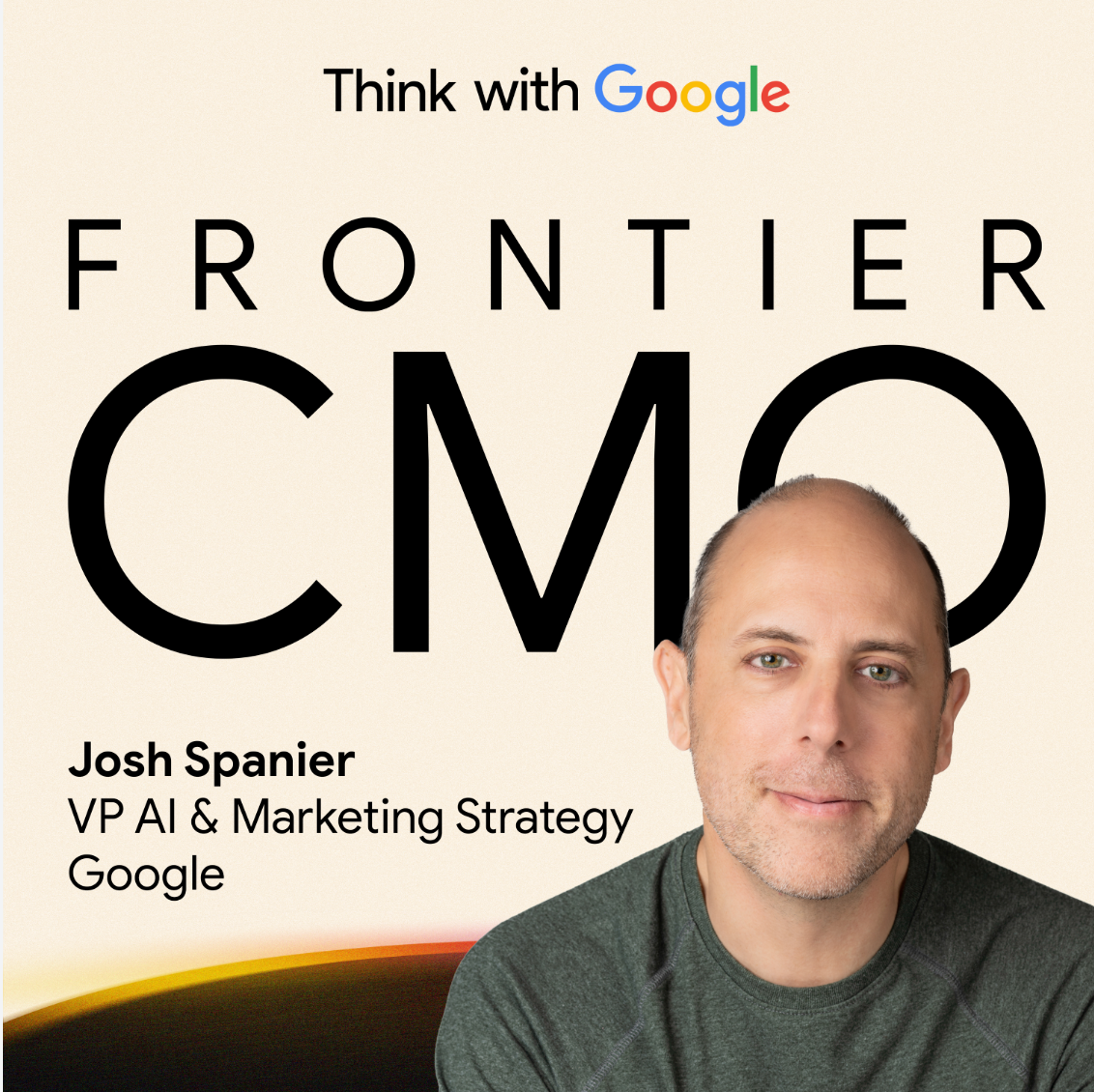
AI is forcing ad agencies and CMOs to reinvent how work is done; “zero nostalgia” means abandoning precious, craft-heavy processes and replacing billable-hour models with AI-native workflows, faster production, and new commercial structures.
Wesley ter Haar (Wesley Tahar), co-founder and Chief AI and Revenue Officer of Monks (formerly MediaMonks), started the agency in 2001; led major transitions from Flash to mobile/social/APIs and later video/short-form. He also runs AI agents for planning and operations.
AI should be used for ambition, not just efficiency; speed is a quality; pilots create politics (“pilot purgatory”); agencies should consolidate fragmented workflows into four steps (planning/insight, creation, deployment/orchestration, measurement); CMOs must lead AI adoption and restructure organizations.
SC Johnson uses AI agents for insights and turns morning insights into afternoon in-channel assets; Staples ran four “funny” AI-produced big spots that would be impossible under traditional budgets.
Written by AI. May contain mistakes.
Wesley discusses his background, founding Media Monks, and the evolution of the agency.
“There's a reason why I invited you on the pod, right?”
Wesley reflects on significant changes in the marketing landscape and the impact of AI.
“And I sometimes make the joke that that was as tough as it gets.”
Wesley introduces the idea of 'zero nostalgia' regarding past practices in marketing.
“Or is it fundamentally such a different technology class that you end up with a lot of the work that we might now see as typical agency work becoming easier to in-house or become a button in some piece of software?”
Discussion on the trade-off between quality and speed in modern creative outputs.
“It's quite joyful, but the process has to go away.”
Wesley shares success stories from SC Johnson and Staples regarding AI use.
“is also a little down to personal preference.”
Wesley emphasizes the importance of genuine AI adoption and commitment in marketing teams.
“One of the things that I've come to recognize, and I think you'll probably agree, is that the technology is not really a problem.”
Wesley discusses the challenges of pilot projects in AI transformation.
“So from an enterprise perspective, marketing pretty much gets to go first.”
Discussion on the complexities of organizational structure during AI transformation.
“You have to own a roadmap and a strategy and a structure.”
Discussing the challenges and realities of AI transformation for CMOs.
“And then people get incredibly protective of their little agent babies.”
Exploring the concept of AI-native workflows and their importance for efficiency.
“becomes a massive overhang on what that team can create.”
Understanding the need for brands to operate in real-time to capture attention.
“When it comes to being loved by people, I think we just have to be realistic that we have very fragmented attention.”
Examining how the roles of CMOs and agencies are evolving in the AI age.
“We want to be out in market continuously because that's how people interact and interface with brands.”
Discussing new approaches to agency compensation in the context of technology.
“And because of that, I think we allow our clients to be more ambitious because they can get more done.”
Identifying key strategic areas CMOs should focus on for 2027 and beyond.
“I have two final questions for you, Wes.”
Exploring the impact of AI on consumer decision-making and branding.
“Otherwise, you just massively slow yourself down.”
Evaluating perceptions of the agency model in the evolving marketing landscape.
“Okay, Wes, let's play a little signal or noise.”
Discussing the continued relevance of agencies in a tech-driven marketing world.
“Sometime in 2027, a major CMO will announce they're in-housing everything with their marketing team and agents, getting rid of all their agencies.”

Get the gist, explore an idea or ask about something said.
 Claude
On Frontier CMO Podcast by Think with Google, what are the key points of this episode?
Searching your listeningAutomatic transcript. May contain errors.
0:00Anything AI-related, I think the CMO should put their hand up. Yes, there's efficiency, but this is mostly about ambition. You can do more, you can try more, you can test more. You can start saying, what should we be doing versus what can we do? Which has been sort of the constrained mindset that we've had over the last decade.
0:20What's the future for ad agencies? In a world of AI efficiencies, why outsource your creative execution? If billable hours are dead, what takes their place? Three seasons, dozens of CMOs. In all of those conversations, agencies have of course come up, but seldom with any excitement. Every CMO I talk to is being asked to reinvent how their team works while quietly wondering what they're actually paying their agencies for. Using AI to bring execution in-house just makes sense. Or does it? To answer that question, I'm talking to co-founder and chief AI and revenue officer of Monks, Wesley Tahar. Wesley co-founded Media Monks 25 years ago to wage war on mediocre digital production.
1:01But now he's dropped media and become just monks. And he's blowing up his own agency model before someone else does it to him. So today, Wes and I are unpacking the gap between the AI hype cycle and AI for real. Enjoy my conversation with Wesley.
1:22Wes, welcome to Frontier CMO. I'm so excited to talk to you today. Yeah, this is going to be fun. Thank you for having me. There's a reason why I invited you on the pod, right? You are one of the sort of legends of today's industry. Does that surprise you? I don't think it's at that level, but it's very kind of you to say so. I'm going to update my LinkedIn with this quote. But I think that comes out of the time that we've done it. We're in year 26 now. And I think we've always been quite good at just being relevant. 2001, you start the agency. Why did you start Media Minus? We were very young.
1:53We were 21 and it was all born out of just an excitement of something new. You started seeing the internet, as we used to call it, become just a real sort of consumer level environment. Original version of MediaMonks was called MediaMonks Creative Art and we were just doing extremely artsy work, figuring out the language of the medium. To this day, I think it's really exciting to see how a lot of what we now see as modern user interfaces really come from that early time of the Flash pioneers really figuring out what's an interface in motion and how do certain sort of interactions and interfaces allow you to tell stories through the lens of design.
2:36If I think about the big shifts, we've probably had to make three or four really big shifts in the company to be relevant. I think the moment Flash went away was a really big moment. And I sometimes make the joke that that was as tough as it gets. So while AI is really big, it's never going to be as difficult for us as having to move away from Flash, which was really the... And that was about 2008 or so? Yeah, 2008, 2009. Flash was one. A couple of others. Mobile transition. Was that a big deal for you guys? Yeah, yes. I think it was interesting because it was the year of mobile for a few years.
3:09About a decade, right? A decade of year of mobile. So that was a great example of you could be right, but if you're early, you can still be very, very wrong. I think out of that, because mobile really begets us the age of social, and that changed a lot of how we got to think about how to reach consumers and sort of the age of APIs, which of course ended in not a great spot. But the age of APIs was really interesting because that got us this really high level of personalization and lots of creativity. I think honestly, the biggest change was the video and then later short-term video pretty much eating marketing.
3:46What do you do as an agency to be relevant in those spaces? So we've had these really big shifts, and I think we've always done quite well in figuring out how to come out on the other side. I think the fundamental question is, is AI one of those shifts, a big one, but one of those shifts? Or is it fundamentally such a different technology class that you end up with a lot of the work that we might now see as typical agency work becoming easier to in-house or become a button in some piece of software? What did you learn from these fundamental shifts in sort of business practice and ways of working and workflows?
4:20And then what feels new about AI that it's different from these past transitions? So my biggest learning is just zero nostalgia. just no preciousness because i think it's very easy for an agency but also for us as people to get very precious about the thing that we've built and then try and not change or push back against change or not embrace change that is a great quote zero nostalgia i love that but is there something specific in this ai moment that you feel like you have to give up on yeah i think like we built the company on a really high level of craft and you get quite enamored by the process of it, right?
4:59It's quite joyful, but the process has to go away. We have to be very open to sort of first principles, what is actually needed in this current landscape to get to the same level of work or maybe 90 % of that, but much faster because speed is its own quality and the ability to balance speed as a quality versus purely the level of quality in craft is tough. In one way, what I'm hearing you're saying is that you have to accept potentially a slightly lower quality of work today. We'll probably get back to where we were as the tools get better. But actually, the work we are producing today in aggregate is of lower quality today than it was three years ago, given the pressures of speed and such.
5:41Yeah, I think there is a lot of compression in the market anyway. Like there's always pressure on budgets. I think it's now probably worse than we've ever seen it. the last decade of conversations I've had with clients is we would like some more stuff, we have a little less money. I honestly personally think we're at the end of that paradigm. The talent base has been stretched so thin. There's so much pressure on hourly rates. I think the agency landscape has hollowed itself out to the point that I think it's lost relevancy. I see this as a massive opportunity to sort of regain some of that relevancy and make sure we put the right talent, not thinly stretched, right talent on every piece of business.
6:22But then you need to do more with fewer people. And that's where the technology is honestly quite amazing. I think the 90 % versus 100 % is also a little down to personal preference. So I think as creatives, as marketeers, as agencies, we like tinkering and we like tweaking, which is fine to do if you're making one ad. it sort of breaks down if you're making 100 or if you're making 1 ,000. So can you live with that scale and a little less tinkering and tweaking, which means it might not be 100 % your personal preference, but it's still doing the job it needs to do. When you talk about stepping away from some preciousness and some nostalgia, that's the friction point.
7:04It's super interesting because for so many decades, brands have been sort of command and control. You had your brand standards, your logo, your lockup, make the logo bigger, and everything had to be pixel perfect in every possible way. And today we talked about giving up control when it comes to YouTube creators and letting them speak authentically in their own voice. But to do so in the sort of the creative space on the one last piece that you control is a really interesting notion. But let's just make this practical though. You work with a whole number of customers. Who's getting it right in the partnership you have with them and the output, the speed at which you're doing and really embracing making work for today's marketplace?
7:40So I have two examples that I really like. So SC Johnson, family-owned business, sizable, raised their hand really early when it came to the concept of AI transformation. And the way they have adopted it in their own marketing teams using agents for insights and strategy. And then really us as a downstream partner from that to go from insight in the morning to an in-channel asset in the afternoon. Right. More and more you figure out that that requires a change of process and ways of working. So SC Johnson, I think, does that amazingly well. We recently did a campaign for Staples, other American brand.
8:23Back in the day, you would have a good sort of creative concept. And it wouldn't just be one ad. You'd have a few ads a year and would keep building into that. And often it'd be funny. We've sort of lost that a little because the budgets aren't really there. So most people have to collapse everything into a single ad. And that ad just becomes very middle of the road because it has to speak to everybody and has to say everything. So for Staples, we did four really funny, big spots, all AI production. Okay. Impossible to do within traditional budgets. But if you look at that, it reminds me of the ads I used to grow up with.
9:00It just allows you to brand build again. So I was really excited that they went all out on AI production. I've been playing around with Google's latest model, Argon, Gemini 4, and the reasoning capability is astonishing. One of the things that I've come to recognize, and I think you'll probably agree, is that the technology is not really a problem. It's the challenge of the people. So I reached out to you to be on the pod, and you said, great, and here you are. But I asked, give me your executive assistant. We can set up times. And you responded back with like six words, which were, it's just me and some AI agents.
9:32So you've got that request. What happens? What have you built to actually channel that? I have a planning agent, checks my email, checks my existing calendar. If there's any blocker comes to me and asks me what my preference is, and then rebooks anything that's there and has specific rules on how to try and rebook. I'm often still the person in the loop because it's connecting with clients, right? And I want to be super careful of how that goes. When it comes to personal stuff, it's more automated but then sometimes something goes wrong you're like sorry about that that was my that was my agent there's special rules for your wife versus customers well so first things first my wife absolutely hates ai so that's a nice balance okay although she does like some of the very personalized invitations it sends and lovely images it creates it'll put like a nice little image in the invite and a nice little piece of copy about how amazingly fun and romantic that outing will be.
10:31So it has been, it has been well briefed. I have an agent which basically scours where I live on the West coast, finds restaurants. I know that the parameters, and then we'll make reservations for us every Friday night. I love it. My wife has noticed. I haven't told her that there's an agent. So one of the things that I've noticed in my life at work is, you know, I've met probably 200 senior marketers, CIOs, CTOs this year for meetings about AI transformation. I can tell in 90 seconds if one of those people is talking the talk or actually walking the walk. You're clearly walking the walk. What's the state of the sort of CMO culture industry today as you see it?
11:10Like what's working, what's not working from your perspective as an agency lead? What worries me the most, I think, is when I have a feeling people aren't really all in. For better or worse, we get to go first. We're a low compliance industry, relatively low compliance. There's always budget pressure. We have an obligation to innovate. So from an enterprise perspective, marketing pretty much gets to go first. And I think that's a massive opportunity. I don't think there's a Fortune 500 company where AI adoption transformation isn't top three area of focus. And as a CMO, you can actually put numbers on the board.
11:50right if you lean in and you own that you're going to be i think more valuable as a cmo six months from now 12 months from now then the job is currently being perceived so i always feel a little worried and honestly a little uh disappointed when i i see cmo who sits on the fence and maybe has bought into some of the almost biases against ai or the typical it can't do this very specific thing that clearly only me as a human is able to do like when that type of talking point comes up i'm always like uh the other people are going to expect you to get things done and you're going to have to lean in so i've heard this phrase used pilot purgatory yeah how do you break the pilot purgatory how did you break it within mugs i think it's very comfortable to just do a bunch of pilots because you then you don't have to commit realistically as a marketing team it's not that difficult to pick two or three clear workflows that you have to go do at scale with AI and then actually go do that so I think it it takes commitment it takes decision making instead of doing many things a little bit you just have to pick two or three and do them really really well do you still do a bake-off you choose one or the other I mean like how long can a pilot be in AI I mean that's kind of a silly question I know but I think that's the risk of this sort of pilot landscape is you end up with five people that have done a version of the same thing and then everybody becomes weirdly precious about their thing it actually i think creates a massive amount of additional politics and complexity in the organization so while i like the concept of a thousand flowers blooming we sort of know what the garden needs to look like now and we just have to go tend to that instead of having everybody still plant their own seeds you can't run an organization with 10 ,000 vibe coded dashboards and workflows that go away when somebody's laptop gets closed down.
13:39You have to own a roadmap and a strategy and a structure. We had this thing inside of Google where in the marketing group where we have all these enterprising marketers building their own agents. And we ended up with about 600 agents and more that we didn't know about. And so we actually just had to kick off a program called No Secret Agents where we just asked people, have you built an agent? Is it actually scalable and usable? And then pick the ones which actually matter. And then people get incredibly protective of their little agent babies. It's like, my mom works better. It's funny. Humans are humans.
14:07It's a whole new wave of internal politics that you need to try and get ahead of. You're a CMO. You're at a top 500 Fortune 500 company or wherever in the world. And AI transformation is top of the agenda. What are the two or three questions or directions that they should be asking of you or just of themselves, I guess, do you see at this point? The reality is it probably takes bigger change than you hope it does. And I can put that on ourselves. When we started, we raised our hands quite early. We thought this was mostly going to be a sort of a tech and tool enabling piece. We were like, we have the right talent.
14:46We've transformed before. If we give people the direction and access, then the transformation will happen. But the transformation is tougher. It's more about your organizational structure. It's more about your internal process because you can see things that used to be two or three roles collapse into a single role, which means if you're innovating in silos, there's massive complexity and friction there. So I think as a CMO, if you're looking at it, you should be asking yourself, what does a modern version of my organization need to look like to fully adopt and adapt? You just said the CMO has to recognize that there's more disruption than they probably would like.
15:28and they have to ask the question of whether they're set up to produce the work and the speed and the way they want to do it. What does the, if not ideal, what does a prototype of the new agency, the new client-side structure look like to be optimized for AI that you've seen? We call it AI-native workflows. I think it's taking all of the steps and styles that we've created to handle the complexity of digital and bringing it back to four steps. There's a planning and insight piece There's a creation piece. There's a deployment and orchestration piece. And then there's a measurement piece. What we've done over the last 10 to 15 years, we've created all of these separate teams that have a really small slice of that.
16:12And the problem is that all of those small slices have their own process, their own software, their own agency. Crazy fragmentation. We've been there, yep. Insane fragmentation. It's impossible to innovate with that level of fragmentation. It means you need to collapse and consolidate a lot of what's happening in those spaces, which is uncomfortable. But it's the only way to innovate at the level that I suspect will be needed. I think the biggest aha moment, because we went through the same thing. If you would have asked me two years ago, I'm like, I want to get this team to be 30 % more productive.
16:47It's too small of an emission. We're seeing that the right talent that's integrated, they're not performing 30 % better. they're performing 10 to 20 times better. And the speed with which a small team can now operate means that every additional step that you create becomes a massive overhang on what that team can create. So in our own software teams, for instance, we're restructuring that teams can have a maximum size of three, but ideal is two, which is completely different to how we used to operate. So I think CMOs should do everything they can to be seen as the most knowledgeable person around AI within their organization and try and lead the roadmap.
17:28This is an opportunity for the CMO to lead. So anything AI related, I think the CMO should put their hand up. We try and position the technology. Yes, there's efficiency, but this is mostly about ambition. You can do more, you can try more, you can test more. You can start saying what should we be doing versus what can we do, which has been sort of the, I would almost say the constrained mindset that we've had over the last decade. I think there's a lot of infrastructure discussion that's about to happen still. We're coming to the end of the year. I'm thinking about my predictions for 2027 and beyond, and I'm trying to make them spicy and, you know, pointed.
18:02And one of the things I'm really struck by, and I think you're starting to reinforce for me, is this notion of the office of the CIO or the CTO and the CMO really coming together. And there obviously needs to be good partnership there. But eventually, I feel like it could actually just merge and become one thing. Does that sound outrageous? No, we were chatting to some folks from either Forrester or Gartner who are starting to put that into some talking points. Everybody thinks they can do marketing and the technology that we have looks a lot like marketing, even if it's bad marketing. So there's going to be a lot of pressure on, I think, the CMO and the marketing function from all sides, right?
18:38From internal technology teams, from startups. So that's why I'm always so focused on CMOs need to lead. I do think the best progress that we've seen is where the CMO and the CTO or CIO are very closely connected. One of the things I've been struggling with in my job as a marketer is to really think, what is marketing today? Watch NFL. I genuinely wonder whether if they made the ad breaks, instead of like six 30-second ads, they made them 18 10-seconds ads, whether I'd actually pay more attention. Like we're in a post-attention era or something. So when you're talking to a customer, when you're thinking about all the channels and tactics and opportunities, what is actually at the core of a marketing campaign today for you?
19:22We talk about it in two ways. Yes, it's important to work that's loved by people and more and more also work that's preferred by machines. When it comes to being loved by people, I think we just have to be realistic that we have very fragmented attention. We want our brands and our clients to be part of those short cycles of attention, which means we need to be able to go to market quickly. Right. But we still want to do that at a high level of quality. So the idea in the morning, ship it in the afternoon. Yeah, and the problem is historically, we were able to do things quickly, but not really good or very good, but slow.
19:58AI is the solution for that. We call it real-time brands. We want to be a real-time brand. We want to be out in market continuously because that's how people interact and interface with brands. Preferred by machines, there's two parts to that. One is the algorithms like variation, volume, and velocity. If you're pushing anything into PMAX or other algorithmic platforms, push 400 versions of an asset in there, not four. You're leaving a lot of money on the table. I think that's uncomfortable because a lot of agencies and marketeers don't really want that to be true, but it is. And you should lean into it.
20:37And then the last piece is if agents more and more become the proxy for the consumer, they live in the mid funnel as far as we can tell. They're not looking at your big Antimad. They're not clicking your banner. And mid funnel is largely ignored or has at least been under invested in. You used to have ecosystem thinking that all went away. Right. As reels pretty much ate marketing budgets. But agents are in that sort of CX space, which is a place to focus on. So inside of Google marketing, we've gone through the sort of the life cycle of some of what you're talking about. So if we were playing a drinking game with the word mid funnel, I would still be drunk right now.
21:16Can I ask a very practical question? How are you as an agency managing for token bloat, right? Another word of tokens is just money. How are you guys thinking about it? So the uncomfortable reality is I do not think tokens are software, or I don't think they can be budgeted as software because they're more variable than that, which means at least a decent amount of tokens become part of what I would normally see as a labor budget. But if we just put it in software, then we are stuck. because if I put my software budget in for 2027, we saw some of this this year and I run out of my tokens in April.
21:52My CFO is going to have a heart attack. So leveraging it in team-based budgets as a reflection or proxy of labor is where we're heading. I've mostly met with CMOs and Frontier CMO, as you would expect. In all those conversations, for the most part, none of those CMOs are saying to me, I can't wait for my agency and I to work this out together or I'm trusting my agency to solve this. But I liked what you said a minute ago when you said, with AI there's always possibility but you still need to work out what you should do not what you can do. So is that the secret source for great agencies? Is that what MediaMonks differentiation is?
22:25So our differentiation is no nostalgia. We've embraced it. And because of that, I think we allow our clients to be more ambitious because they can get more done. I think the reality that you then very quickly get to is we can change how we work. If the client doesn't change how they work, the impact is surprisingly limited. You maybe worryingly get more and more to the reality that a lot of what we're being paid for as agencies is helping the client go through their process versus the actual piece of work, which might be good for agencies or not, but that becomes starker when you start seeing AI be able to help you massively speed up a traditional process.
23:07We are experiencing this inside of Google Marketing. It's incredibly complicated. and the mantra has always been you get the agency you deserve, right? You get the agency work because they're catering to you. Talk about the billing, the costs. How do you charge in a commodity world? How should CMOs be thinking about paying their agency versus, because clearly billable hours is on the way out as it should be. Yeah, and it just should be. And I think that paradigm sort of broke down a few years ago anyway. It's honestly one of the more interesting challenges. We have been very forward to clients where we go, hey, we think if we change some of how we work, you can probably do this for less or you could get a lot more for what you're already paying.
23:52But it does require a slightly different commercial model. And it's been surprising how difficult it has been for clients to adopt different commercial models, even though how we're being bought isn't necessarily the smartest way to buy us. So my advice to clients would be have honest conversations with your agency on what they need from you to be able to change how they work i'm a cmo i want to work with you guys how should i structure the compensation approach to actually enable that like what are the three things just just put them on the table so i can understand so we call it subscription to innovation you still want your people right if you're a client people are still the the key to being happy with your agency yeah fewer people more senior tends to be where you go.
24:38The reality is most clients don't necessarily want to pay the rates for those senior people. We don't look at their rates. We look at a fixed group of really talented people, much higher level of accountability, less thinly spread. And then we set up the workflows, the agents, the infrastructure for those people and the technology to do the work. We package that into a single price point. And then we're trying to stay away from what I call punitive pricing. We don't really care if you make a thousand things or a hundred things or 10 ,000 things, except for some of the additional token costs that then have to be passed through.
25:11So the reality is you can get probably a higher, I find quality, maybe not the wrong world, but a higher seniority team that gets you more work for lower costs with a much lower incremental pricing per asset. But you have to buy it in a sort of a fixed fee structure. And it's interesting that that's not what modern procurement teams find nice to buy. There's a lot of focus on wash-ups of hours and that type of stuff, which that's not really how the machine works anymore. I have two final questions for you, Wes. We're going into 2027. What are the three bets that you're making, either personally or with monks, for 2027?
25:54Three bets. So we call it AGI over ego. We believe the technology is scaling laws hold. Technology keeps getting better. There's massive upside for us being able to deploy that technology in a fixed way of working in a fixed process. So AGI over ego means I don't want 10 teams having slightly different ways of doing a thing. We want one best practice. And within that best practice, people can do what they want to do, but you have to commit. Right. So lots more focus on the commitment to a way of working. Second piece, probably one of the more interesting parts of our business at the moment, we've built out relatively strong consultation system integration efforts related to AI.
26:38And we're doing sort of a new SaaS software and the service where our own software seems to be getting a lot of popularity with our clients. Helping our clients adopt that and then make sure that adoption is sticky and has meaningful output has been something that really kicked into gear four or five months ago. has put a lot of really interesting momentum in the business. So doubling down on that. And then the third piece, more ambitious internal org design. We've done a lot of good, but in my mind, still too incremental progress. So much sharper team structures. Super interesting. One of my predictions, slightly flippant, is 2029 is the new 2027.
27:22All the things we think we're going to deliver in 2027 that is actually not going to happen until 2029, but we should strive to get there. I like that sharper org design. Okay, let me just flip this around. Final question. What are the three things that a CMO should be betting big on for 2027? Embrace the technology to be more ambitious. It's a solution for a lot of the things that ailed the current CMO. So embrace it and be ambitious. Consolidation, less fragmentation in your ecosystem, which I think is both around internal team structures, but for good or bad, because sometimes we are on the right side of consolidations and sometimes we're on the wrong side of consolidation.
27:58But you have to get the fragmentation out of your landscape. Otherwise, you just massively slow yourself down. And it feels a little sci-fi, but thinking about the next wave of customers, which more and more is algorithms and agents and what that means for your brand and business, I find that people talk about geo, which is a very light version of that conversation, but meaningfully thinking about what does it mean if 10, 15, 20 % of my consumers hand off decision-making to their agent, what does that mean for my business and brand? It's something people should be more focused on. Those are three pretty good bets and places to focus.
28:34I'll add one more, going back to what you said earlier on. Every CMO needs to be leading in every part of this AI conversation, this AI transformation, even if it's not directly ready to mod marketing. Agree. And again, I think it's a way for the CMO role to gain importance. So embrace it and own the roadmap. And I think that's the most meaningful and impactful thing you can do is CMO. Awesome. Thank you, Wes. Thank you. Really good chat. Okay, Wes, let's play a little signal or noise. I'm going to ask you a question. You tell me whether it's a signal or just noise. Okay, first up, the agency billable hour is dead.
29:10The signal. There'll be parts of the ecosystem that will always still be a billable hour, but at scale, it's not a viable business. Signal or noise. every CMO wants to in-house everything right up until the point where they try in-housing everything. My honest take is the landscape is moving so quickly that this is not the moment to try and take all of that sort of intellectual and technical debt on. I think it's actually quite nice for CMO to be able to offload that to companies like ourselves where it's an existential threat because we're in it, in it. And I think in-housing that is probably a little too early.
29:45Okay, signal or noise. in an era of infinite AI content, great creative is the ultimate moat. Signal, but not, I want to be careful that we've already decided that AI can't do creative, right? That's where we as an industry have sort of built our hill to die on. I don't think AI is going to be a negative when it comes to good creative. I just think it takes a while because we have very specific expectations as an industry, but I think that will become a huge part of doing good creative. Good answer. Yeah. I like it. Signal and noise. Signal and noise. As it always is in these cases. Signal or noise.
30:28Sometime in 2027, a major CMO will announce they're in-housing everything with their marketing team and agents, getting rid of all their agencies. And sometime in 2028, that same CMO will have been fired and they'll have gone back to a more balanced approach. Signal or noise? It's probably signal. it's definitely going to happen in 2027. Again, I don't think it's directionally wrong. I just think if you're doing it now, you're taking on such an additional load that I think it's probably better to offload that to agencies at the moment. Fired in 2028? Depends. Depends. But definitely some signal.
31:05Yeah, there's some signal there. I just think that the technology isn't there and I work inside of Google, one of the most advanced companies in the world and we still incredibly value the agency ecosystem, the outside stimulus, the different thinking. It's so important you get that. And all the agents in the world don't give you that because the way you prompt them and the way you ask them. So there is still a role for agencies, whatever it's going to be. I hope so. But also, and I'm of course extremely biased from that perspective, but I think there's massive value in having expertise. There's massive value in having the ability to bring the outside in.
31:39But realistically, fewer people can get more done. So it's figuring out what a relevant agency looks like for a client versus the agency has no added value. Makes sense. Fun. Yeah. Wes, thank you so much for being on Frontier CMO. I appreciate it. Super fun chat. Thanks, Josh. All season, we've been talking about what it means to move toward the frontier. Wesley's built a home there. So before we wrap, here are your field notes from the frontier. First, for 2027, you have to move on from pilot purgatory. Trim down experiments, commit, and focus your energy on a handful of big swings instead. Second, succeeding with AI means no nostalgia.
32:22Restructuring is your friend. Think about how you can collapse workflows and team shape to inject AI from the jump. Third, talk to your CTO as much as your CFO. Billable hours may be easier to get through contracting, but subscription innovation and token maxing is the way of the future. And that's a wrap. Be sure to follow, rate, and review Frontier CMO on YouTube or wherever you get your podcasts. For more research, case studies, and tools to help you lead through the next platform shift, visit thinkwithgoogle.com. We'll be back with another leader operating at the frontier soon. Until then, keep moving, stay sharp, and stay out front.
If billable hours are dead, what takes their place?
In this episode of Frontier CMO, host Josh Spanier sits down with Wesley ter Haar, co-founder and Chief AI & Revenue Officer of Monks. Twenty-five years after co-founding MediaMonks to wage war on mediocre digital production, Wesley is blowing up his own agency model before someone else does it for him. Having steered the company through the death of Flash, the “decade of mobile,” and short-form video eating marketing, he explains why AI is a different kind of shift, and why surviving it takes zero nostalgia.
Wesley breaks down how his team goes from insight in the morning to in-channel asset in the afternoon, and why CMOs need to escape pilot purgatory. Plus: how to budget for tokens, why “subscription to innovation” should replace the billable hour, and the AI agent that books Wesley’s meetings and his date nights.
Tune in for a candid master class on what a relevant agency, and a relevant CMO, looks like in the AI era.