
In short
Global News Podcast Episode Summary
Episode Title
BBC Follows Journey of Gazan Child
Episode Overview This episode of the Global News Podcast discusses several significant global news stories, with a primary focus on the plight of a Palestinian child evacuated from Gaza for medical treatment. It also covers various political developments, notable deaths, and current events in other regions.
---
Key Stories Covered
- Siwar Ashour: The Gazan Child's Journey
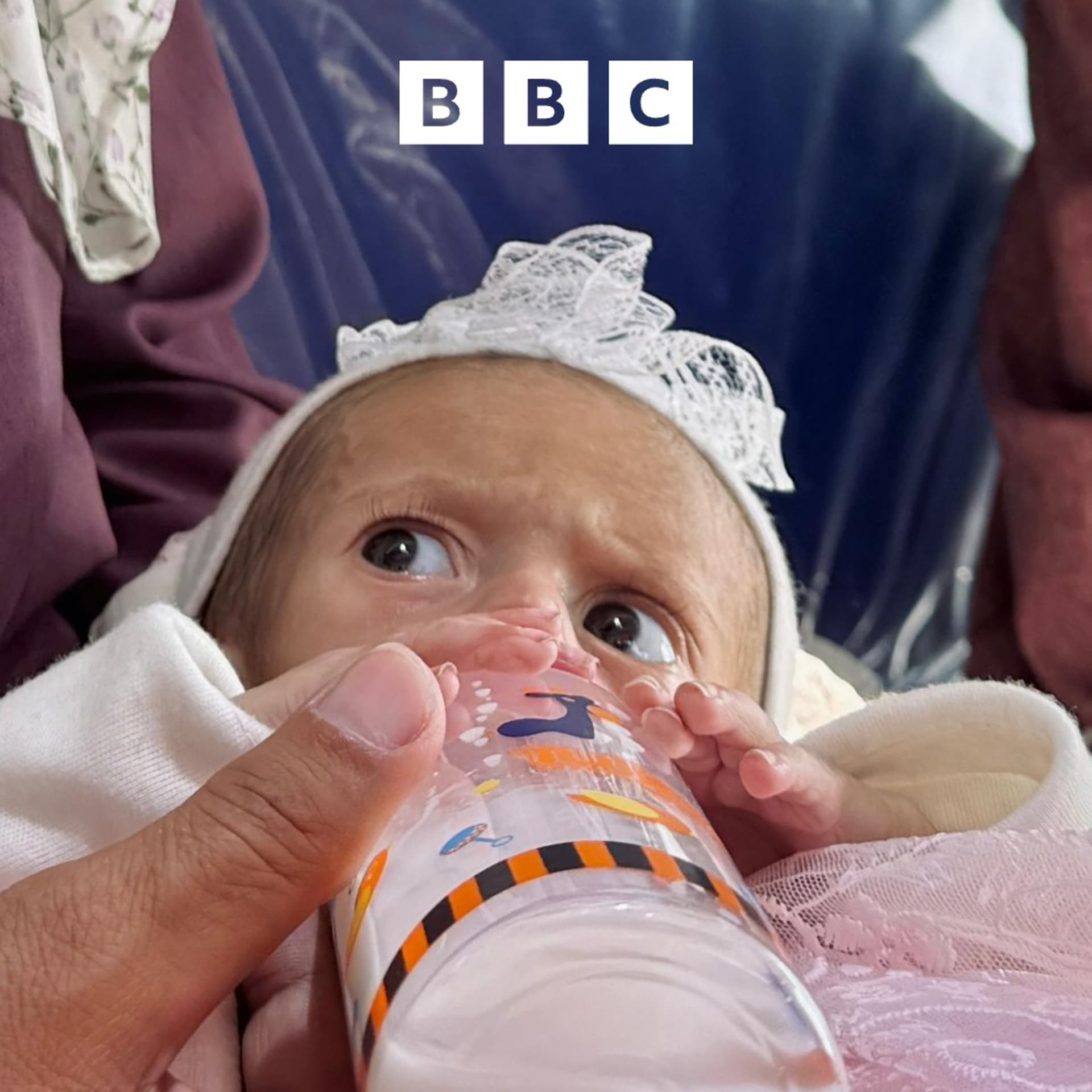
- Background: Siwar Ashour, a one-year-old girl from Gaza, suffered severe nutritional issues and was evacuated to Jordan for treatment.
- Current Status: After receiving medical care, Siwar has returned to Gaza but is back in the hospital due to worsening health issues.
- Family's Experience: Siwar's family faced challenges during her return, including the confiscation of essential medical supplies by Israeli authorities.
- Healthcare Crisis in Gaza: Hospitals are overwhelmed with child patients, and there is a severe shortage of medical supplies.
Key Quotes
- Dr. Khalil al-Dakran, Al-Aqsa Hospital: "The number of child patients arriving at Gaza Strip hospitals is three times the capacity."
- Donald Trump's Naval Announcement
- New Battleships: President Trump announced the construction of a new class of battleships named after himself, breaking tradition where ships are named after deceased presidents.
- Offshore Wind Projects Halted: Trump suspended all offshore wind power projects, citing national security risks related to radar interference.
- Nigeria's Response to Kidnapping
- Designating Kidnappers as Terrorists: The Nigerian government has reclassified kidnappers as terrorists in an effort to address rampant mass abductions.
- Recent Rescue: 130 school children and teachers were recently rescued after being held captive, offering some relief to their families.
- Vince Zampella's Legacy
- Death Announcement: Vince Zampella, co-creator of the Call of Duty franchise, passed away in a car crash at the age of 55.
- Impact on Gaming: Zampella was recognized for his significant contributions to the gaming industry and for creating one of the most popular game franchises.
- El Gordo Lottery Winners
- Celebrations in Spain: The annual Christmas lottery, El Gordo, brought joy to a Spanish town that recently faced adversity due to wildfires.
- Community Impact: The jackpot win was seen as a significant boost for the local economy and morale.
- Amazon and North Korean Job Applications
- Security Concerns: Amazon reported blocking numerous job applications from North Korean agents attempting to infiltrate their workforce for illicit purposes.
---
Key Takeaways
- Humanitarian Concerns: The episode highlighted the ongoing humanitarian crisis in Gaza, emphasizing the impact on children and healthcare systems.
- Political Developments: Trump's controversial decisions on naval projects and wind energy reflect ongoing tensions in U.S. energy policy.
- Reflection on Legacy: The remembrance of industry leaders like Vince Zampella illustrates the deep connections within the gaming community and its cultural significance.
- Community Resilience: The El Gordo lottery win showcases the power of community and hope amidst challenging economic conditions.
---
Closing Remarks Listeners are encouraged to stay tuned for future episodes of the Global News Podcast for ongoing updates and insights into current affairs. For comments and discussions, they can reach out at globalpodcast@bbc.co.uk or via social media platforms.
Produced by: Paul Moss Editor: Karen Martin Mixed by: Pat Sissons For more information: [BBC Global News Podcast](https://www.bbc.co.uk/news/world)
Written by AI. May contain mistakes. Listen to the episode to check what was said.
Transcript
Automatic transcript. May contain errors.0:00This BBC podcast is supported by ads outside the UK. If journalism is the first draft of history, what happens if that draft is flawed? In 1999, four Russian apartment buildings were bombed, hundreds killed. But even now, we still don't know for sure who did it. It's a mystery that sparked chilling theories. I'm Helena Merriman, and in a new BBC series, I'm talking to the reporters who first covered this story. What did they miss the first time? The History Bureau, Putin and the apartment bombs. Listen on bbc.com or wherever you get your podcasts. This is the Global News Podcast from the BBC World Service.
0:47I'm Paul Moss and in the early hours of Tuesday, December 23rd, we hear about a desperately ill one-year-old child who was evacuated from Gaza but is now back in the Palestinian territory. Donald Trump suspends all US offshore wind power projects, claiming they're a national security risk. Amazon says it's blocked North Koreans trying to sign up as tech company employees. Also in this podcast, the 19th century slave who escaped from the US and the letter she wrote to her mother back home. It's a really poignant story about how her daughter is OK. Her daughter made it and now she's free. Back in June, the BBC reported on a one-year-old girl from Gaza with severe nutritional problems.
1:34After that broadcast, Siwa Ashur was evacuated to Jordan for medical treatment. She's now back in the Palestinian territory, but she's also back in hospital. Our correspondent Fergal Keane has been following her story. She arrived in Jordan last June, frail and frightened looking. Siwara Shur has a medical condition that stops her absorbing enough nutrition and which doctors in Gaza said threatened her life. Five months later, this is her first birthday party in a man. Surrounded by her mother, father, grandmother and Jordanian health workers, medical treatment had improved her condition.
2:22but Siwar is now back in Gaza and back in hospital. Siwar returned from Jordan approximately 10 days ago. She changed for the worse. Around, I mean, the third day, she started having diarrhea and vomiting and her situation keeps getting worse. It's Jordan's official policy that patients must return when their treatment is finished. Siwar was among 45 children sent back this month. I spoke about her case with Jordan's Minister for Communications, Dr Mohamed Al-Mamani. Do you understand how people might find it hard to accept that a child in such a vulnerable state would be sent back to Gaza in the current conditions there?
3:06No patient is sent back before they finish their medical treatment. Upon the conclusion of the treatment, they are asked to go back for two reasons. The first reason is that this will allow us to bring more patients from Gaza. We cannot take all of them at once. We have to take them in batches. The second reason, honestly, we don't want to contribute in any shape or form to the displacement of Palestinians from their land.
3:40For Siwar's family, the journey back to Gaza was traumatic. They'd been given 12 cans of special milk formula essential to Siwar, only to have many of them confiscated by Israeli officials, as her mother Najwa explained. They kept saying, it is forbidden for you to take them. I had 12 cans with me. They took nine from me and left me three cans. But three cans don't suffice Sewar at all. I asked the Israeli authorities why this happened. This was their response. Due to security restrictions, the return of the families was approved subject to their arrival at the crossing with minimal luggage, including baby food and clothing.
4:24In cases where the luggage exceeded the approved scope, its entry was denied. After 90 % of the population was displaced during the war, infections and disease are hitting hard. Here's Dr Khalil al-Dakran from Al-Aqsa Hospital where Siwar is being treated. Since the ceasefire was announced, the number of child patients arriving at Gaza Strip hospitals is three times the capacity. The situation at Alak Samartas Hospital is no different from other hospitals in the Gaza Strip. It suffers from a severe shortage of medicines and medical supplies, and a major shortage regarding electric generators, which are the main artery to keep hospital going.
5:10Sibar's family now has some supplies of milk formula and money donations, including from Jordan. But they're working to evacuate her again from a place the UN calls a wasteland. Fergal Keen and the story of Siwa Ashur in Gaza. Since the ceasefire in Gaza was agreed in October, at least 400 Palestinians have been killed by Israeli fire, which does rather put the very meaning of the term truce in question. Meanwhile, Palestinians there continue to live in camps and shattered homes amidst flooding, low temperatures and food shortages. Abir is a teacher whose home in Gaza City was destroyed. During the conflict, she spoke regularly to the BBC.
5:51My colleague Krupa Padi asked her whether she feels that war in the territory has truly ended. It didn't stop, first of all. To the media, yes, it has stopped, but still danger exists on the areas that are called the buffer zones or near the so-called yellow zone. So we still hear bombardment on daily basis. What we are seeing is chronic collective PTSD due to the previous aggressions and to this war. So this is not a single traumatic event people are recovering from, but years of repeated trauma, bombardments and displacement, loss of loved ones, hunger, fear and uncertainty. We need to deal with all of that.
6:36We are all tired. We all need psychological attention. And I have seen children showing signs of severe anxiety. They have sleep disorders, aggression and withdrawal. Believe it or not, the rates of divorce have raised during this war and after it. And the mental health services are extremely limited. Considering the unimaginable challenges that you are facing right now from so many angles, how hopeful are you that this ceasefire will reach the next stage? Well, if you ask me or anyone else in Gaza, we will answer you the same response. We still have hope. Part of our belief in God is to have hope.
7:19So we have hope for the future. But we are disappointed from the current pace that this ceasefire is moving on or the stages of the deal is moving on. We hope that we could see the next stage where everything will go to normal, where the rebuilding starts, where opening the crossings will start, when everything really starts, like building schools again, building hospitals, etc. So we have hope for the future, but the signs on the ground are not very promising. Abir, a teacher from Gaza City, describing the situation on the ground and her hopes for the future. The US has a habit of naming Navy ships after its presidents.
8:06There's been a Franklin D. Roosevelt aircraft carrier and one called John F. Kennedy. There was even a Thomas Jefferson submarine. But what these all had in common is that the ships were given these names after those presidents had died. Donald Trump, though, has decided to break with this tradition. It's less than a week since the Kennedy Arts Centre he's chairman of announced that it would in future be called the Trump Kennedy Center. And now the president has decided to extend his brand to Matters Maritime with a decision to build the Trump class of battleships. There's never been anything like these ships.
8:42These have been under design consideration for a long time. And it started with me in my first term because I said, why aren't we doing battleships like we used to? The announcement came in a wide ranging news conference at his Mar-a-Lago residence in Florida. And there was another significant policy announcement from his administration that it was suspending all offshore wind farm projects. Now, the president has never been a fan of renewable energy, certainly not for its green credentials, as he's repeatedly suggested that climate change is a hoax. There were five large-scale windmill projects underway, all of them now on hold.
9:21I talked about this with our White House reporter, Bernd de Boosman, who's at Mar-a-Lago. According to the administration, these wind projects present national security concerns. Specifically, they said that the towers and the blades of the windmills themselves caused what is called radar clutter, in which certain items might not be caught on radar, or there might be false positives on radar, which they say could be a concern going forward. Secretary of the Interior, Doug Burdum, specifically gave the example of drone warfare between Ukraine and Russia as an example of why this is a concern to them, given the potential threat of drones from other states or from non-state actors as well.
10:06Is there any scientific evidence that wind farms interfere with radar? Well, if there is any scientific evidence, they certainly didn't presented, they based this finding purely on national security memorandum, which isn't available to the public about this. There was one public document that they cited, which did say that there could be false positives. And even if adjustments were made to radar systems, that again could cause false positives. And, you know, perhaps radar operators would see a target that isn't actually there or misinterpret that target. But they presented very little scientific detail in today's announcement.
10:47I guess we should mention Donald Trump's general antipathy towards renewable energy. Indeed. Actually, since the first day of his administration, getting rid of these wind projects is something he's wanted to do. He signed a memorandum on the first day in office halting permits and new leases until a federal review could be undertaken. And a few months later, five months later after that, 17 U.S. states led by New York sued the administration saying that that memorandum posed an existential threat to the US wind industry. Donald Trump also has had other concerns about wind that he says it's expensive and unreliable, and he generally doesn't like the aesthetic of it.
11:26Many listeners in the UK, for example, will remember he was quite opposed to Scottish wind farms being anywhere near his property in Scotland. It's been quite a busy day for Donald Trump. He gave this wide ranging speech in Mar-a-Lago, which you watched. What did he have to say? Well, the main purpose of the speech was to unveil something they've dubbed the Trump-class battleship. Now, this is a new heavily-armored, heavily-armed ship that will form part of what the administration is calling a golden fleet, kind of a revamped US Navy. They've said, with some evidence behind it, that the US is lagging far, far behind China in terms of shipbuilding capacity and output, which in any future conflict or any future tensions in the Pacific, for example, could pose a problem to the U.S.
12:17Navy. And that's something that President Trump has wanted to address for a very long time, stretching back to his first administration. But he also did speak about the ongoing tensions with Venezuela. He expressed that the strikes on boats alleged to be carrying drugs would continue and could expand to land targets, and not necessarily just in Venezuela. He had some quite harsh remarks about Colombia's government as well. He certainly didn't take any steps to de-escalate those tensions, and he certainly seems intent on Nicolas Maduro's government either bending or falling in the long term. Berne de Boosman.
12:55She was a slave in the United States, escaped to Britain in the 1830s and ended up living in a small fishing town just outside Newcastle in the north of England. Now historians have discovered a letter from Mary Ann Mackham. It was buried in the archives of a Virginia museum and her words have been written down by a local vicar. Jo Lonsdale has been looking at her remarkable story. Mary Ann Mackham endured years of brutality before escaping from a plantation in Virginia and stowing away on a ship. On arrival in Britain, she was taken in by a Quaker family and lived to the age of 92. Her story was largely forgotten until a local historian in North Shields stumbled across it in 2016.
13:36An exhibition followed, and last month a statue was unveiled to her. The resurgence of interest in her story led the Virginia Museum of History and Culture to check their archives, where they discovered a letter written in 1831 from Marianne. She'd asked a local vicar to pen it to try to send word to her still-enslaved mother of her survival. In the letter, Marianne admitted she knew she'd never see her mother again, but wanted to send assurances of her warmest love. Jo Lonsdale. Still to come in this podcast...
14:16Spain's El Gordo lottery winners are announced. A whole village celebrates.
14:26If journalism is the first draft of history, what happens if that draft is flawed? In 1999, four Russian apartment buildings were bombed, hundreds killed. But even now, we still don't know for sure who did it. It's a mystery that sparked chilling theories. I'm Helena Merriman, and in a new BBC series, I'm talking to the reporters who first covered this story. What did they miss the first time? The History Bureau, Putin and the apartment bombs. Listen on BBC.com or wherever you get your podcasts.
15:21to send its soldiers to fight for Russia in its war against Ukraine. Now, the head of security at the technology giant Amazon has revealed that the company's detected a growing number of North Korean job applicants. Stephen Schmidt offered assurances that Amazon had managed to block all but one of these applications. But he warned they weren't the only firm being targeted. Our Asia business correspondent Surinjana Tiwari has been following the story. This came through in a LinkedIn post from Amazon's chief security officer. And he said that the technology giant has blocked more than 1 ,800 job applications from suspected North Korean agents.
15:59He added in the post that North Koreans try to apply for remote working IT jobs using stolen or fake identities. And then they typically get hired, get paid and funnel those wages back to Pyongyang to fund the regime's weapons programs. Those were his words, rather. How exactly do these applicants disguise themselves? I mean, presumably they don't apply for a job at Amazon with an address in Pyongyang. Yeah, it seems that these kinds of operatives typically work with people managing what's called laptop farms, which refer to computers based in the US that are run remotely from outside of the country.
16:41Now, then they use a combination of artificial intelligence tools and verification by staff to screen job applications. and the strategies used by such fraudsters have become more sophisticated. That's according to Mr. Schmidt's LinkedIn post as well. How important is it for the North Korean economy to make foreign currency by these various illicit means? Yeah, well, North Korea is possibly the most reclusive country in the world. As you can imagine, it can't trade normally with other countries. It can't pay wages. It doesn't really have much of an economy to speak of for its citizens. And therefore, it has to make money through other means, often illicit.
17:26And actually, back in July, a woman from Arizona was sentenced to more than eight years in jail for running a similar laptop firm. And it was found that she was helping North Korean IT workers secure these kinds of remote jobs at more than 300 U.S. companies. And at the time, the DOJ, that's the Department of Justice in the US, said that the scheme generated more than$17 million in illicit gains for her and Pyongyang. So you can see the kinds of numbers and figures that can be generated from these types of schemes. Surinjana Tiwari, has Nigeria come up with a new way to tackle the scourge of kidnapping?
18:06Mass abductions have become so common there, they sometimes don't even make the news. Only last month, hundreds of children were taken from a Catholic school, though they have now been rescued. And what the government has done is to redesignate kidnappers as terrorists. It's not clear what practical difference that will make, but as our reporter Richard Kogoi told Anka Desai, they're putting them in the same category as a host of other hostile actors. It's a designation because previously acts such as kidnapping were widely regarded as just ordinary criminal acts. But now this now signals the intention by the government to address this problem, which, you know, has been described by analysts as one of the things that do pose existential threat to the country.
18:53So President Bolatino last week said that these measures were sort of like resetting, you know, the country's security architecture. And it now will be able to help them tackle banditry, kidnapping and terrorism. And do we know why this has been happening or who's behind it? Well, we've witnessed a surge of kidnapping incidents from 2014. This is when we had the Chibok girls who were abducted, close to about 250 of them. That really got global attention. But we've seen that over the years, this has been taken up by groups that are locally known as bandits. So these are armed men who normally target schools.
19:34They target churches. You know, those are soft targets. and they basically seize people particularly for ransom. But then, you know, payment of ransom in Nigeria is outlawed. And that's why the government say that those who have been released, especially in the past couple of days, has been as a result of military, police-led intelligence operations. OK, and as you mentioned, this does come on a day that 130 school children and teachers have been released. Has there been relief, I guess, in the country? Absolutely. I mean, this is a huge, huge relief. I mean, 130 children who had been held up, the last batch, according to the authorities there.
20:12The parents are really delighted. A lot of them who spoke to the BBC said they're really looking forward to be reunited with their children who've been away for close to about a month. I mean, so this ending a month-long ordeal for these children who have been held in captivity. So just seeing this is really quite positive progress and to see them now coming back and possibly being reunited with their families. It's a relief not just for their relatives but even for the entire country. I mean, this whole issue has really captured the imagination of the nation. Richard Kugoy. Even if you don't play video games, you'll probably at least have heard of Call of Duty.
20:49It was one of the most popular games created by Vince Zampella, who's died in a car crash at the age of 55. Keza MacDonald is video games editor for The Guardian newspaper here in the UK and interviewed Zampella multiple times. She told Krupa Pardy that his death had sent shockwaves through the gaming industry. He was a very outspoken game creator. He was a really strong, creative voice. And he was someone that a lot of players knew of and was aware of as well. So the person behind the game was quite well known as game developers go. I think I met Vance a couple of times, maybe three times. He was always someone you looked forward to interviewing at games industry events and someone you looked forward to speaking to because he spoke very energetically and with a great deal of excitement around video games and around what they mean to people and what they can do for people.
21:37He was well-liked and he really cared about the player experience. He cared about making games. He cared about how people felt when they played and that really came across whenever you spoke to him. For those who aren't familiar with the franchise, tell us more about Call of Duty and what's unique about it. So Call of Duty has been going since the early 2000s And it was one of the first shooting games that really felt like war stories. They felt more like war movies than the kind of more simplistic military shooters that had come before. It also really set the template for multiplayer games. These are games that really emphasize playing with your friends, playing in a squad.
22:15And there's a sense of camaraderie and kind of shared experience that really Call of Duty set a template for in the earlier days of online gaming. there's really no there's no online game and no shooter that does not have some of call of duty's dna in it really now it became a huge cultural phenomenon didn't it it wasn't just a game no i mean so more than 500 million call of duty games have been sold now um in total and every single year um it has been enormous enormous deal when a new college comes out it's something that people get together for and you know people reunite friends that have maybe been playing since high school or playing since university um and who are you know in their late 30s now They'll still get together when a new Call of Duty installment comes out and they'll still play as a squad.
22:57So it's something that people do feel very strongly about. I think Call of Duty will be his, it's one of the most famous games in the world. It will be the thing that he's best known for. But, you know, players of his other games, such as Titanfall, which is an incredibly brilliant first person shooter that came out later in his career. Basically, everything that he touched was quite a special game. And I think that lots of people, especially fans of shooters, will have a less well-known favorite game. of his mind is definitely Titanfall. I think that was Titanfall 2 particularly was a brilliant testament to his talent and to the talent of his studio.
23:28Keza MacDonald on the legacy left by Call of Duty creator Vince Sampella. If you were listening to this podcast yesterday, you'll remember us telling you about El Gordo, literally the fat one. That's the name given to Spain's annual Christmas lottery, one of the biggest in the world for total prize money. As we explained, it's a cherished tradition, more than 200 years old. But what we didn't know yesterday was that this year's lottery might just make the history books. The winning numbers were announced today, and one group of victorious ticket holders comes from a part of Spain which had previously suffered great loss.
24:05Carla Conte has that story.
24:13People across Spain spend the morning of December 22nd glued to their TV screen. watching the annual tradition of schoolchildren singing out the winning numbers in the country's famous Christmas lottery, El Gordo. This year, the top prize went to number 79 ,432, and a huge share of the winning tickets were sold in the northwestern province of León. The biggest winners were residents of the town of La Baneza, where locals shared out around 468 million euros, or 550 million dollars. Not surprisingly, celebrations spilled out onto the streets, with local football club players among those holding winning tickets.
25:02It's an especially poignant win for the people in Lyon. Many towns there are still recovering from a brutal year. This summer's wildfires were especially destructive, and the jackpot win has been described by locals as an injection of hope.
25:21The best thing is the joy in the village, in a village that is emptying and where young people are fighting for it. Nearby Villablino also took a major share, around 200 million euros, with many of the tickets sold through a local Alzheimer's association. For some winners, it still hasn't sunk in, including one man who says he's already planning to mark the moment permanently. Yes, yes, I'm going to tattoo it. I'm going to tattoo it big. Besides, I like tattoos. The number, the ticket. I'm going to tattoo the whole thing. In a draw where tickets are often shared between neighbours, friends and colleagues, this year's El Gordo win belongs to the whole community.
26:06Carla Conti. And that's all from us for now, but there'll be a new edition of the Global News Podcast later. If you want to comment on this podcast or the topics covered in it, you can send us an email. The address is globalpodcast at bbc.co.uk. You can also find us on X at BBC World Service. Use the hashtag hash global news pod. This edition was mixed by Pat Sissons. The producer was Buzafar Shakir. The editor is Karen Martin. I'm Paul Moss. Until next time, goodbye.
Read the full transcript
27:07first covered this story? What did they miss the first time? The History Bureau, Putin and the apartment bombs. Listen on bbc.com or wherever you get your podcasts.
From the publisher
A Palestinian baby who was evacuated for medical treatment has returned to Gaza and is back in hospital. The BBC has discussed Siwar Ashour's case with the Jordanian and Israeli governments. Also: President Trump announces new US navy battleships named after himself; Nigeria designates kidnappers as terrorists; Call of Duty creator Vince Zampella dies; Amazon warns of North Korean agents applying for remote IT jobs; and a Spanish town turns its luck around with huge "El Gordo" lottery win.
The Global News Podcast brings you the breaking news you need to hear, as it happens. Listen for the latest headlines and current affairs from around the world. Politics, economics, climate, business, technology, health – we cover it all with expert analysis and insight. Get the news that matters, delivered twice a day on weekdays and daily at weekends, plus special bonus episodes reacting to urgent breaking stories. Follow or subscribe now and never miss a moment. Get in touch: globalpodcast@bbc.co.uk