
In short
Global News Podcast Episode Summary
Episode Title
BBC on Frontline of Colombia's Drugs Crackdown
Episode Overview In this episode, correspondent Orla Guerin reports from Colombia, where an elite police force known as the Jungle Commandos is working to eradicate cocaine production in the Amazon and Andes. The episode covers the meeting between President Gustavo Petro of Colombia and President Trump of the United States, alongside significant news from around the world, including the death of Saif al-Islam Gaddafi, FIFA's potential re-admission of Russia to international football, Spain's plan to legalize undocumented migrants, and quirky stories from Florida.
---
Key Topics Covered
- Colombia's Drug Trade
- Jungle Commandos: An elite police unit focused on destroying cocaine production. Guerin accompanies them in the field.
- Mission Execution: They aim to destroy cocaine labs quickly (within 10-15 minutes) to minimize risk.
- Challenges: Cocaine labs can be rebuilt within a day after destruction, highlighting the difficulty of the war on drugs.
- Impact on Criminal Groups: While labs can be quickly rebuilt, the commandos aim to disrupt the profits of drug trafficking organizations.
- Local Perspectives: Interviews with farmers reveal the dire economic situation that drives them to grow coca despite the harmful consequences of the drug.
- U.S.-Colombia Relations
- Meeting Between Leaders: Petro meets Trump after a period of tension.
- Tone Shift: The meeting marks a thaw in relations, potentially paving the way for cooperation on drug trafficking and trade.
- Future Discussions: Both presidents hinted at agreements for further collaboration, including discussions on Venezuelan gas exports.
- International Stories
- Saif al-Islam Gaddafi: The son of Colonel Gaddafi is killed in an attack in Libya.
- Russia and FIFA: FIFA's president suggests the possibility of lifting the ban on Russia, prompting outrage from Ukraine.
- Spain's Immigration Strategy: The Spanish government plans to legalize half a million undocumented migrants to bolster the workforce, facing both support and criticism.
- Unique Local Stories
- Florida's Frozen Iguanas: Residents are collecting frozen iguanas that fall from trees during cold snaps, with one restaurant even incorporating iguana into its menu.
- John Bishop's Comedy Story: The UK comedian discusses how his stand-up routines about his divorce led to a reconciliation with his wife, which inspired a new film.
---
Key Takeaways
- Ongoing Drug Challenges: Colombia's fight against cocaine production continues to face significant hurdles due to the rapid rebuilding of drug labs.
- Changing Political Relationships: The meeting between Petro and Trump signifies a potential shift in U.S.-Colombia relations towards collaboration rather than confrontation.
- Cultural and Social Dynamics: The stories highlight the varied and complex issues of drug production, immigration, and local culture that resonate across different societies.
---
Conclusion The episode provides a multifaceted view of current global affairs, illustrating the intersection of local issues with international politics, and captures the complexities of drug trade dynamics, migration policies, and unique human interest stories.
For further insights and updates, listeners are encouraged to engage with the Global News Podcast and follow its coverage of breaking news from around the world.
Written by AI. May contain mistakes. Listen to the episode to check what was said.
Chapters
Tap a time to open that second in VOColombia's Drug Crackdown Overview
1:00 to 1:46
Explore the challenges and developments in Colombia's fight against drugs.
“Check out our new episodes wherever you get your podcasts.”
Inside Colombia's Jungle Commandos
1:46 to 4:25
Understand the operations of Colombia's special anti-narcotics police force.
“team should be readmitted to international tournaments.”
Impact of Coca Farming on Local Families
4:25 to 6:13
Hear from a farmer on the socio-economic impacts of coca production.
“They can rebuild countless labs, but they are losing the coca crop and the chemicals.”
US-Colombia Relations and Drug Policy
6:13 to 8:41
Discuss the evolving relationship between the US and Colombia regarding drug policy.
“and many here say growing coca plants is one of the few options they have.”
Gustavo Petro's Political Strategy
8:41 to 10:29
Analyze President Petro's approach to international relations and domestic challenges.
“For example, the US cutting aid to Colombia, imposing sanctions on Gustavo Petro.”
The Legacy of Saif al-Islam Gaddafi
10:29 to 14:05
Learn about Saif al-Islam Gaddafi's life, ambitions, and impact on Libya.
“I think, though, with Gustavo Petro, he certainly, at least publicly, has been wanting to show that he is prepared to, at least among his own base, stand up to Donald Trump.”
The Fragmentation of Libya Post-Gaddafi
14:05 to 14:56
Learn about the political fragmentation in Libya after Gaddafi's fall.
“It hasn't had religious problems in the sense that they're all Sunni Muslim.”
Russia's FIFA Ban and Its Implications
14:57 to 15:42
Explore the global reactions and implications of Russia's FIFA ban.
“What should be done about Russia's football team?”
Ukraine's Response to Russia's Sports Ban
15:43 to 16:18
Understand Ukraine's perspective on the lifting of Russia's sports bans.
“Among them were more than 100 footballers.”
US-Iran Tensions and Military Movements
18:36 to 19:29
Learn about the escalating tensions between the US and Iran amid military movements.
Show all 14 chapters
Spain's Immigration Policy Changes
19:33 to 23:56
Explore Spain's approach to legalizing undocumented migrants and its challenges.
“The Spanish government recently announced plans to legalise around half a million undocumented migrants, most of them from Africa or South Asia.”
Florida's Iguana Problem and Community Solutions
24:00 to 25:11
Discover how Florida is dealing with the iguana population crisis amidst climate changes.
“The green lizards have, it seems, been succumbing to the region's plunging temperatures and then falling out of trees.”
John Bishop's Unexpected Comedy Journey
26:35 to 28:00
Learn about John Bishop's comedic career and how it affected his personal life.
“He only got into stand-up by accident when he went into an open mic night and signed up to avoid paying the entry fee.”
Reflections on a Unique Love Story
28:00 to 30:28
Hear about the personal journey and memories shared during the film adaptation process.
“and seeing the head that I thought was in the fridge in the audience.”
Transcript
Automatic transcript. May contain errors.0:00This BBC podcast is supported by ads outside the UK.
0:30Find out more at polandyourplacetogrow.com. How do you update old systems without slowing your business down? It's not about modernization just to modernize. Or move AI from pilot to production. It's not the technology that's failing. It's the use case that you pick. Find out how global leaders are turning enterprise change into real competitive advantage. Do it in a resilient way with speed and effectiveness. Follow Resilient Edge, a business vitality podcast paid and presented by Deloitte. Check out our new episodes wherever you get your podcasts.
1:25White House after months of tension and social media insults. Our correspondent has a special report from the heart of Colombia's drug trade. And Saif al-Islam Gaddafi, the most prominent son of the late Libyan leader Colonel Gaddafi, has been killed in an attack on his home in western Libya. Also in this podcast, outrage in Ukraine after the president of FIFA suggests Russia's football team should be readmitted to international tournaments. And their numbers over the last decade have exponentially grown here. And this is the first real opportunity to actually call the numbers down. Why the people of southern Florida have been collecting frozen iguanas.
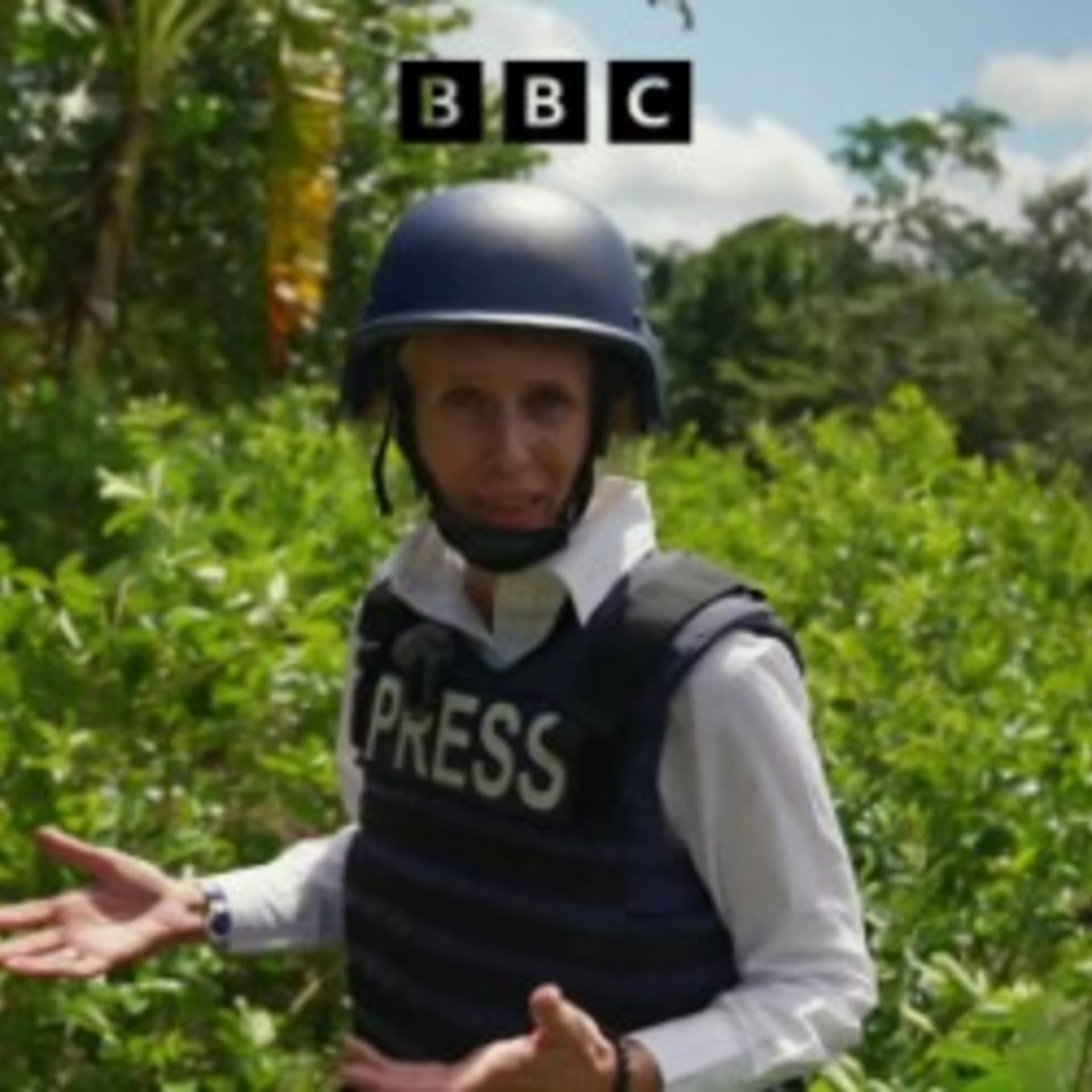
2:14For two people who'd previously exchanged insults, the US President Donald Trump seemed to get on very well with his Colombian counterpart during talks at the White House on Tuesday. That may in part be because of their plan to cooperate in tackling illegal drugs, both their production and distribution. Colombia remains the world's largest producer of cocaine, but President Gustavo Petro insists that his government has seized the largest amount of the drug in history. If so, that's in part down to the country's special anti-narcotics police force, known as the Jungle Commandos. Our correspondent, Orla Guerin, has been in the field to see how they operate.
2:58We've just landed in part of the cocaine heartland of Colombia. It can be risky. The aim is to be on the ground for the shortest time possible, no more than 10 or 15 minutes. And over here you can see fresh leaves that would have been turned into paste. You can see the drums that would be used, chemicals would be used. The mission for these commandos is to destroy this lab. Colombia's war on drugs has been going on for decades. The man leading the mission today is Major Christian Sedano. He's 37 years old and he's been fighting the drug trade in Colombia for 16 years. Today, if you destroy a drug lab, a factory, to produce cocaine, how quickly can they build another one?
3:52In one day. It's just a matter of changing location or moving by a few metres. We've seen it before. Sometimes when we return to areas where operations have taken place, we find structures have been rebuilt, just a few metres away. If they can rebuild so quickly and so easily, what are you achieving with these missions? We are affecting the profits of the criminal groups and their economic power. They can rebuild countless labs, but they are losing the coca crop and the chemicals. We're climbing higher and higher in the mountains. There are two competing guerrilla groups operating in this area.
4:41the FARC and the ELN. We're high in the Andes, about 1 ,400 metres up, and I'm on a farm with a local farmer who's taking me to see his best crop, which is coca plants. We're outside his home. It's a very basic breeze-block, three-room house. He's living here with his wife and five daughters. Javier, you say you are doing this to provide for your children, but in the end, what you are producing here will become cocaine and will go to Europe and other people's children will buy it and people could die. Do you ever think about the end result of what you are producing? The truth is, yes, we know.
5:34Sometimes you do think about it. But if you want to survive, you don't. There are no opportunities for us with this government. I have children. Of course I think about other children who could be harmed. There are coca plants all around me here. Some are about knee-high with distinctive bright green leaves. and this crop can be transported, trafficked, turned into cocaine, which is sold on the streets of the US or Europe, on the streets of London. This area is poor, remote, completely underdeveloped and many here say growing coca plants is one of the few options they have. The BBC's senior international correspondent, Ola Guerin, reporting, from Colombia.
6:30As I mentioned earlier, Tuesday's talks between the US and Colombian leaders were full of smiles and bonhomie. The two exchanged gifts as well as compliments. Hard to believe, really, that just a month ago, Mr. Trump referred to his Colombian counterpart as a sick man who likes making cocaine. While Mr. Petro may not have used quite such colourful language, he in turn had denounced Donald Trump, particularly for ordering attacks on Venezuelan shipping. But now it seems that was all water under the bridge. He and I weren't exactly the best of friends, but I wasn't insulted because I'd never met him.
7:05I didn't know him at all. And we got along very well, and we are. We're working on that. We're working on some other things too, including sanctions. We had a very good meeting. I thought he was terrific. He was very good. He got along great. Colombia's Gustavo Petro wasn't quite so effusive in his praise for his opposite number, but he too made clear that his frozen relationship relationship with Donald Trump was definitely thawing.
7:34I told him that between free people, one cannot act under blackmail. And I think the photos and the atmosphere of the meeting show a meeting between equals, who think differently. Yes, with different powers, obviously, but capable of finding common paths. That's it, nothing personal. While the two presidents might have been able to kiss and make up, it wasn't clear what they'd actually achieved in concrete terms. Though, as our South America correspondent Ionee Wells explained, we did get a sense of the areas in which the two countries might cooperate.
8:09Orla Guerin:Both leaders have suggested that they are now working together on what Donald Trump has described as some kind of agreement. A bit vague what that might be at this stage, but what Gustavo Petro has hinted at as well is further actions together to tackle drug trafficking. But also he said that they discussed the possibility of exporting Venezuelan gas via Colombia too. Now, both leaders have certainly, I think, suggested that this meeting has marked a really sharp shift in their relationship from one that was incredibly frosty. For example, the US cutting aid to Colombia, imposing sanctions on Gustavo Petro.
8:46Orla Guerin:Now the tone has really shifted. Donald Trump has said that they got on very well. Gustavo Petro, for his part, has shared images on social media of him and Donald Trump, including what appears to be a signed photo of the two of them by Trump saying, a great honour, I love Colombia, and also what appears to be a signed copy of Donald Trump's book, The Art of the Deal. Do we have any idea what prompted this rather remarkable reconciliation? Well, I think it's certainly some kind of talks have been on the cards for some time. When I met Gustavo Petro just last month after the US military action in Venezuela, he had had a phone call with Donald Trump.
9:25Orla Guerin:It is worth remembering that Colombia and the US are allies. They do work together when it comes to things like tackling drug trafficking. You know, there are there are CIA agents who are allowed to operate in Colombia. So I think behind the scenes, there have clearly been negotiations going on. Is there any sense that Gustavo Petro may have been just a little nervous? I mean, after the Venezuelan leader, Nicolau Maduro was captured by American forces. There was a suggestion he might intervene elsewhere. Is it possible the Colombian president felt he he had no choice but to to become friends again with Donald Trump?
9:59Orla Guerin:Yeah, I think it's certainly the case that, as you referenced that Donald Trump was very explicit. He said that military action in Colombia sounds good last month. And when I spoke to Gustavo Petro, he said it was something that they were taking very seriously. I think that will be something that was certainly playing on Gustavo Petro's mind. It's something we know is certainly playing on the minds of the new administration in Venezuela itself as well, that they feel they have to be compliant with what the U.S. wants or they could face the same fate as Nicolas Maduro. I think, though, with Gustavo Petro, he certainly, at least publicly, has been wanting to show that he is prepared to, at least among his own base, stand up to Donald Trump.
10:41Orla Guerin:He, as I say, when I spoke to him a couple of weeks ago, repeated his criticisms that he feels the US is acting like a kind of empire. And Latin America needs to, in his words, kind of rise up against it. Ione Wells. He was wanted by the International Criminal Court for Crimes Against Humanity. and Saif al-Islam Gaddafi was once sentenced to death by a court in Libya. But in the end, he was reportedly killed by four as yet unidentified gunmen who came to his home. The son of Colonel Muammar Gaddafi, Saif was once seen as effectively his second in command. And after his father's death, he tried to stand for election to be Libya's president.
11:21Indeed, speaking to the BBC in 2007, he sought to portray himself as an advocate for democracy. We have to have a more efficient and transparent democratic system in Libya. I said this many times. In fact, in reality, we have a different environment for human rights, freedom, everything. And I'm proud of that. We made a lot of changes and reforms better than any other Arabic country in the region, by the way. With his prominent role at so many different stages of Libya's recent history, it's perhaps not surprising that Saif Gaddafi made plenty of enemies. The BBC security Conti correspondent Frank Gardner told Julian McFarlane more about him.
12:01He was feared at home and quite well known abroad. He was quite a familiar figure on the lecture circuit. He got, for example, a PhD from LSE, the London School of Economics, in 2008, where I met him as he was delivering his thesis on how both Israel and the Palestinian Territory should be abolished and instead a new single country should be created, a republic called Israeliteen. The idea didn't take off. His luck ran out during the Arab uprising of 2011, where his father was killed and he was captured and he was in prison for six years.
12:37Orla Guerin:How has the country been since then? And what has Saif al-Islam been doing outside of his stint in prison? Libya has been a massive disappointment to a lot of people in the sense that it should be a really prosperous, successful country. It's got a relatively small population, under 2 million. It's rich in hydric carbons. It's on the shores of the Mediterranean. But it's been unlucky. And the NATO intervention, which wasn't boots on the ground other than a few special forces or target observers, it was an air intervention, which at the time was meant to prevent the massacre of rebels against Gaddafi's rule in Benghazi in the east.
13:17In fact, Saif al-Islam was implicated in ordering a column to move towards them. So that intervention has been followed by years of chaos. There was early optimism quite soon after the civil war officially ended in late 2011. Sarkozy, the French president, and David Cameron, the British prime minister, both went to Benghazi and had a sort of victory rally there. And it was all going to be sweetness and light. But sadly, for Libya, it's not ended up like that because for so long, from 1969, when Colonel Gaddafi seized power, until his demise in 2011, there was no opposition. It was a brutal autocracy.
13:56So there was no parliamentary life. There was no public life. It was all power concentrated in the hands of Gaddafi's family and their immediate cronies. So when that power was removed, the country kind of fell apart into tribal affiliations. It hasn't had religious problems in the sense that they're all Sunni Muslim. So there's no Sunni Shia split. But there are tribal divisions. and in fact Saif al-Islam Gaddafi was captured by the Zintan tribe. Came out of prison in 2017 and tried to resume political life. At one point even putting himself forward as a presidential candidate. So he had not given up his political aspirations and despite the fact that there was an arrest warrant out for him by the International Criminal Court accusing him of crimes against humanity and the fact that he was feared in his own country he was actually quite a good communicator and some even thought of him as a reformist.
14:50He even at one point said what Libya needs is democracy. Well, he was right on that. Frank Gardner. What should be done about Russia's football team? The country's been banned from FIFA and UEFA games since the full-scale invasion of Ukraine. But now there's been a furious reaction to a suggestion that it's time to bring Russia back into the international football fold. The president of the International Football Association, Gianni Infantino claimed that the ban had not achieved anything, FIFA, he said, would now consider lifting it. Our sports reporter John Bennett told us what Ukrainians had to say about this.
15:25Their sports minister, he's called Matvi Bidnyi, he said in a social media post Gianni Infantino's words sound irresponsible, not to say infantile. He added they detach football from the reality in which children are being killed. And he went on to say, let me remind you that since the start of Russia's full-scale aggression, more than 650 Ukrainian athletes and coaches have been killed by Russians. Among them were more than 100 footballers. Since Russia's ban, they've been unable to compete at the 2022 World Cup in Qatar, Euro 2024 as well, organised by UEFA. That was in Germany. And the country will not be part of the World Cup coming up in a few months as well.
16:06Last year, Ukraine also criticised the International Paralympic Committee's decision to lift a ban on athletes from Russia and its close ally Belarus. Despite the IPC lifting its ban, the Russian and Belarusian para-athletes will not be at next month's Winter Paralympics. John Bennett. Still to come in this podcast. At least it led to me being on the stage and seeing the head that I thought was in the fridge in the audience. And that at least opened a conversation. How a comedian stand-up routine about separating from his wife led to a reunion and a Hollywood movie.
17:07Poland offers the momentum, resources and reliability you need to take your business further. Poland, where businesses don't just grow, they're built to last. Find out more at polandyourplacetogrow.com. America is changing. And so is the world. But what's happening in America isn't just a cause of global upheaval. It's also a symptom of disruption that's happening everywhere. I'm Asma Khalid in Washington, D.C. I'm Tristan Redman in London. And this is The Global Story. Every weekday, we'll bring you a story from this intersection, where the world and America meet. Listen on bbc.com or wherever you get your podcasts.
17:51What if the 2027 SAP deadline wasn't a burden, but an opportunity? I'm Nishita Henry, special host of Resilient Edge, a business vitality podcast paid and presented by Deloitte. Discover how Deloitte, AWS, and SAP are helping enterprises move faster, operate smarter, and unlock AI value they didn't know was possible. Available now wherever you listen to podcasts.
18:35incident came at a particularly tense time, as our North America editor Sarah Smith explains. Donald Trump has sent what he's described as a large armada, including this aircraft carrier, to the Gulf region at a time when he is threatening to bomb Iran if its leaders will not agree to limit their nuclear program and to stop supporting proxy militias in the Arab world. Now, the US said they shot down this drone in self-defense and that no American equipment was damaged, no American personnel were injured and they're not threatening any kind of retaliation although they are warning Iran against these kind of aggressive tactics that could lead to an escalation.
19:12And there are talks planned for Friday between very senior American and Iranian officials and the White House says that those talks are going to go ahead and of course the reason that this aircraft carrier, fighter jets, other ships are all stationed in the Gulf region is to put pressure on Iran as those negotiations get going. Sarah Smith. The Spanish government recently announced plans to legalise around half a million undocumented migrants, most of them from Africa or South Asia. The move is designed to boost the country's workforce in economic sectors that have struggled to recruit. But opposition parties have criticised the plan and given Spain's complex bureaucracy, it is an open question how easy it will be to introduce the changes.
19:58Ashish Sharma has visited the headquarters of a charity in northwest Spain which provides legal aid, drop training and Spanish language classes to migrants. Are you attending the Spanish lessons in the class? Yes, I just started. My name is Zainab Stitu and I'm from Morocco. Studied there, got a bachelor's degree there in English studies. Zaidé Vstitu wanted to use her English and ended up working as a nanny in the Netherlands. As she has family in Spain, she had the option to come here too. And now she wants to stay and work. But as she doesn't have a work visa, it would be illegal for her to take on a job without the right documents.
20:35I've been here for three months now. Yeah, and it's going great. Spanish people are very warm with each other. You know, you can have a little chit chat with someone while doing your groceries. so yeah I feel like a home in here. What made you want to leave Morocco in the first place? The educational system here is high than what it is in Morocco because we study very hard in order for you to get a bachelor's degree or a master's degree. After my interview with Zainab, Lara Gonzalez from the NGO who sat next to me was so impressed by her English and the high qualifications that she immediately linked Zainab up with her NGO's career services.
21:15For lending a Spanish, and in September you will be able to attend a... But why is Spain so keen to hurry up the process and allow migrants to work legally? Firstly, Spain's economy has been outstripping its European Union partners. The areas of strong growth have been in tourism, hospitality and construction. Yet these are the sectors in which many Spanish people are not so keen to work in, due to lower wages and temporary contracts. In order to keep these engines of the economy roaring, Spain wants to utilize its migrant population. Another reason is that Spain has an aging population with one of the slowest birth rates in Europe.
21:53One day around 4 a.m he had the idea to eat fish and chips. He googled fish and chips in Barcelona there was none so we said okay we need to open one. We are born in Pakistan, British ex-colony so we have fish and chips in how to say childhood. From opening one restaurant 10 years ago Mani and his brother Majad Alam today run 22 restaurants in Barcelona and Madrid. They're mainly fish and chip shops, with the food having an extra taste based on Pakistani spices, they add. But they also run a Pakistani and an Indian restaurant. Being Spanish nationals, they have no problem setting up their restaurants.
22:31But Mani says it's a different story when it comes to hiring staff. They come with their CV, and you have the interview, everything goes good until the last part, and then they say, I have no papers. Obviously, we can't hire them because it's illegal. Sometimes we contract, no? We did, like, twice, no? Oferta de contrato, like, contract. To become legal first, to take it. Yeah, I have to become legal, and then you can hire them. It takes times too, no? It takes six months, So how people can survive six months in Madrid or Barcelona without any payment, not really possible. What would be your message then to someone like Pedro Sanchez?
23:15To make easier the process, they get papers and start working in short time. The Spanish government's legalisation announcement has been criticised by its opponents. The far-right Vox Party says this is the beginning of the loss of Spain's cultural identity. The Partido Popular warns of the wider impact for the European Union. The process for legalisation is set to begin in April, but given how burdensome Spain's bureaucracy has been so far for migrants and asylum seekers, many who are expected to benefit from this are understandably wary of just how quickly their status will be resolved. Ashish Sharma reporting from northwest Spain.
23:59They have a new hobby in southern Florida. collecting frozen iguanas. The green lizards have, it seems, been succumbing to the region's plunging temperatures and then falling out of trees. The animals are not actually dead, more in a state of suspended animation. So the local authorities have been asking people to pick up any they find and take them to collection points where they're euthanised or handed over to people allowed to keep them as pets. But not everyone is on board with this plan. one enterprising local has been using the lizards to make a pizza topping at his restaurant. Bacon first, venison, who is star of the show, iguana.
24:42First bite loaded with iguana. Unbelievable. The iguana meat, it really tastes like frog bite. It's a little bit sweet. I can't really describe it. At least 2 ,000 iguanas have been collected, and it should be said that few are mourning them. They're generally regarded as pests in Florida. As Blake Wilkins explains, he's the owner of Redline Iguana Removal. They don't have natural predators here. They're not native to Florida. So their numbers over the last decade have just exponentially grown here. I've been doing this a decade now and this is the first real opportunity that we've had to actually call the numbers down.
25:22So that being that there's no predators, they're able to reproduce extremely fast. They are excellent diggers. So, you know, we're in South Florida. There's a lot of seawalls. So they dig under that, cause issues with that. They get under roofs, cause damage to roofs. Everyone's beautiful flowers and landscaping. So it's a huge problem. So definitely a good opportunity to at least get a little bit ahead of their growth here. The biggest issue with this cold snap was that it was extremely windy. We had down branches, down trees, and it basically amplified the cold. So the ones that seemed to fare the best were the ones that were either in burrows or under roofs or kind of shielded from the wind.
26:05So interestingly, we found more of the smaller ones doing better than the larger ones, which is actually not what I've seen in the past. So I think the larger adults were more subjected to the brutal winds and cold weather. We found quite a bit of these little guys under ACs and stuff like that that are shielded from the wind and the cold. Iguana removal expert Blake Wilkins. John Bishop is one of the most successful comedians in the UK and has been for the past 25 years. He only got into stand-up by accident when he went into an open mic night and signed up to avoid paying the entry fee. He had just separated from his wife, Melanie, and their split became a regular topic in his routines.
26:54Strangely, though, it was through him performing his comedy routine that they ended up getting back together. And that story is the basis for a new film just out called Is This Thing On? It's directed by Bradley Cooper and stars Will Arnett and Laura Dern. Not exactly sure what happened. Came home from work one day. Someone said, is this thing over? Pretty sure it was her. Probably should have paid attention. That's what she meant about not paying attention. The BBC's Sarah Montagu spoke to the real life, John Bishop and Melanie. The two of them are still back together, though, as he explained, it was a close-run thing.
27:36We'd been apart for almost two years, so we were at that final stages of the divorce where you do the decree nicer and then the next bit is decree absolutes.
Read the full transcript
27:46Orla Guerin:But then, and we should say, your jokes, John, I mean, I read that actually they were things like you missed her so much you kept her severed head in the fridge. Yeah, but that's got to all be in context, to be honest. But the thing about it is that at least it led to me being on the stage and seeing the head that I thought was in the fridge in the audience. Melanie, so tell us, what made you go along that night? It was a works evening out. We're just not really seeing one another. It just was by absolute chance that I was in that club that night. We really had minimal contact. What did you think when you saw him on stage?
28:29Orla Guerin:Well, I didn't particularly like the head in the fridge joke. Still don't. The real sort of story between us was that we got talking and we were laughing and things seemed easy. But also we were at this point in our relationship, we had the three boys and we needed to be better. So that's when we embarked on our journey with Relate. And then one afternoon, the lady who was holding the sessions just basically said, I really just think you both need to go and have a cup of coffee now. And that's what we did. And now, I mean, I don't know how closely the film is based on your life, but what's it like for you both watching it?
29:10It's been weird. I mean, it's been brilliant because the film is good. but within the process of making it, you'd have to hand over this really precious story. You don't know how it's going to come back. At times, it was like watching a memory. There was moments in it that we both were squeezing each other's hand when we were watching it because it brought back all that time and all those memories. And also, to be honest, what happened when we had the premiere in London, Melanie said, look, I just want to have five minutes on my own with Bradley Cooper. which is not something any husband really wants to wear.
29:48But it's because she wanted to tell Bradley exactly what she thought of it.
29:54Orla Guerin:Which was, Melanie? I really sort of came on board when Laura Dern reached out to me before they went into the filming. And I met her and spent an afternoon with her. So I shared a lot of very personal memories. It involved a lot of trust. and what was clear when I saw the film, she'd given me basically a strong voice out there to be heard. Melanie Bishop and her husband, the comedian John Bishop. And that's all from us for now. If you want to get in touch, you can email us at globalpodcast at bbc.co.uk. And don't forget our sister podcast, The Global Story, which goes in-depth and beyond the headlines on one big story, available wherever you get your podcasts.
30:45This edition of the Global News Podcast was mixed by Abby Wiltshire. The producers were Stephanie Zacherson and Nikki Verrico. The editor is Karen Martin. I'm Paul Moss. Until next time, goodbye.
31:03This advertisement feature is paid and presented by Poland's Ministry of Foreign Affairs. Looking for the perfect place to grow your business? For over 30 years, Poland has been a launchpad for innovation at the heart of Europe, powered by world-class research and ambitious young talent. From bold startups to established powerhouses, Poland offers the momentum, resources and reliability you need to take your business further. Poland, where businesses don't just grow, they're built to last. Find out more at polandyourplacetogrow.com.
From the publisher
Our correspondent Orla Guerin travels alongside Colombia's Jungle Commandos - an elite police force - as they seek to eradicate cocaine production in the Colombian Amazon and Andes. The defence minister told the BBC that they destroy cocaine factories "every forty minutes". Meanwhile in Washington, following months of tension, Colombia's President Gustavo Petro met President Trump for the first time to discuss efforts to combat drug trafficking and increase trade.
Also: Saif al-Islam Gaddafi, son of the late Libyan leader Colonel Gaddafi, is shot dead. Could Russia be readmitted to international football tournaments by Fifa? As Spain plans to legalise half a million undocumented migrants, we hear from a charity helping them. Why the people of Florida have been collecting frozen iguanas and British comedian John Bishop's real life story which inspired a Hollywood film - Is This Thing On?
The Global News Podcast brings you the breaking news you need to hear, as it happens. Listen for the latest headlines and current affairs from around the world. Politics, economics, climate, business, technology, health – we cover it all with expert analysis and insight.
Get the news that matters, delivered twice a day on weekdays and daily at weekends, plus special bonus episodes reacting to urgent breaking stories. Follow or subscribe now and never miss a moment.
Get in touch: globalpodcast@bbc.co.uk