In short
Global News Podcast Episode Summary
Episode Title
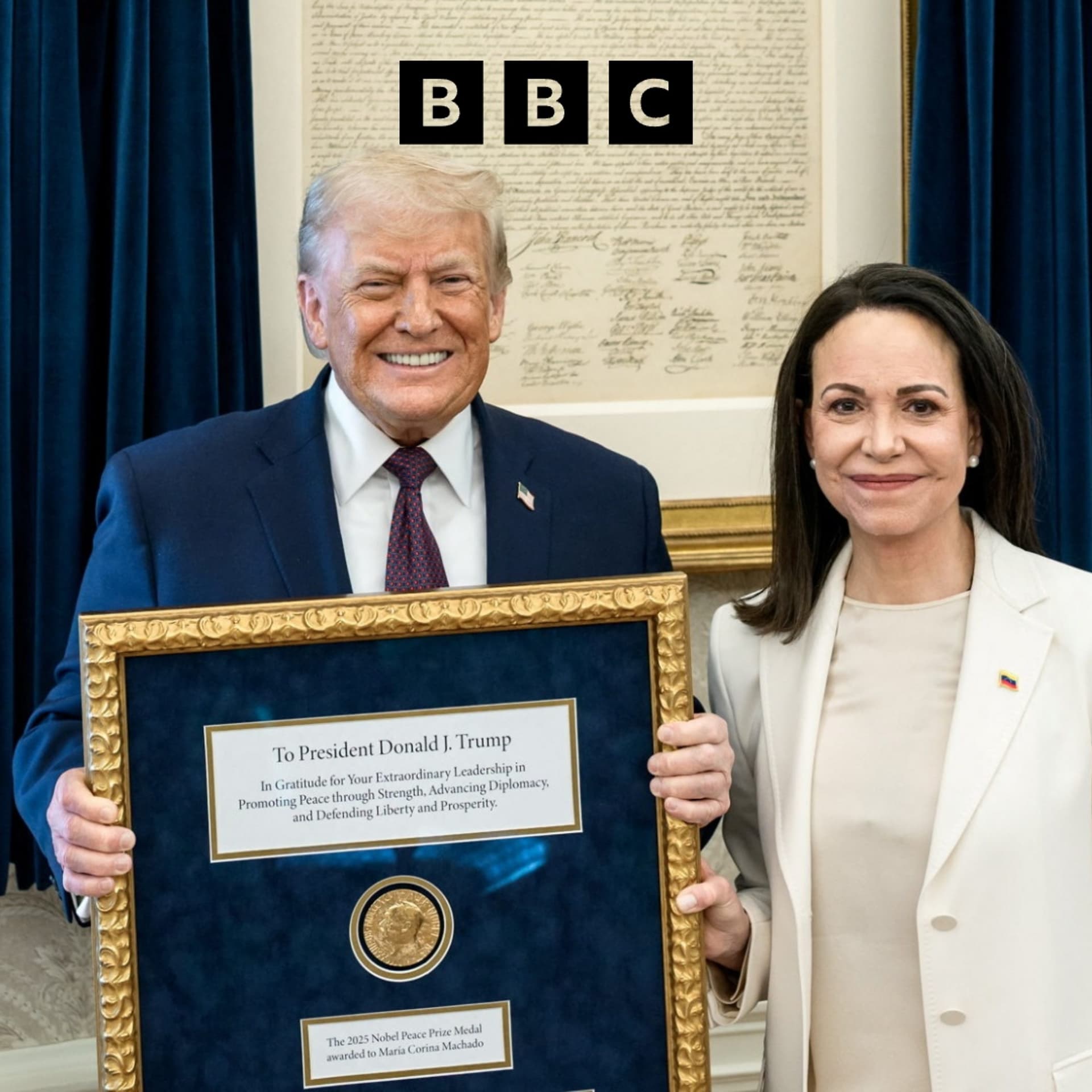
Machado Gives Trump Her Nobel Peace Prize Medal
Host
Will Chalk
Date
January 16, 2023
This episode of the Global News Podcast covers significant recent events, focusing primarily on the meeting between Venezuelan opposition leader María Corina Machado and President Donald Trump, as well as various global news highlights.
---
Key Stories
- Maria Corina Machado's Meeting with Trump
- Context: Venezuelan opposition leader María Corina Machado presented her Nobel Peace Prize medal to President Trump at a private meeting in the White House, symbolizing her appreciation for his support of Venezuelan freedom.
- Trump's Response: He expressed gratitude for the gesture on social media, calling it a "wonderful gesture of mutual respect."
- Political Implications:
- Despite this meeting, Trump has not officially endorsed Machado as a candidate to lead Venezuela, stating she lacks respect and support within the country.
- Machado's prominence rose after winning an opposition primary and receiving the Nobel Peace Prize for her commitment to democracy.
- Current Venezuelan acting leader Delcy Rodriguez is attempting to navigate the complexities of U.S. demands while maintaining support among Maduro's loyalists.
---
- Tensions in Minnesota
- Military Threats: Trump threatened to deploy military personnel in Minnesota amid rising tensions over federal immigration enforcement following violent incidents involving ICE agents.
- Local Reaction: Minnesota's Governor Tim Walz criticized the federal government's actions as a campaign of brutality against residents.
---
- Violence in Iran
- Protesters' Deaths: Families of protesters killed by authorities in Iran are reportedly being charged exorbitant fees for the return of their loved ones' bodies, with eyewitness accounts detailing shocking violence against demonstrators.
- Eyewitness Testimony: An Iranian witness described horrific scenes of violence during protests, including shootings and the suppression of public dissent by armed forces.
---
- New Antarctic Map
- Scientific Breakthrough: Scientists unveiled a detailed map of Antarctica's landscape beneath the ice, which is crucial for understanding the impact of climate change on sea levels.
- Research Implications: The findings will aid in more accurate models predicting future sea-level rise, informing policy decisions regarding coastal defenses.
---
- Canada's Diplomatic Relations with China
- Meeting Highlights: Canadian Prime Minister Mark Carney met with Chinese President Xi Jinping to discuss improving strained relations and boosting trade.
- Economic Strategies: Carney aims to enhance agricultural and energy ties while balancing national security concerns.
---
- Alcohol Consumption Trends
- Rise of Non-Alcoholic Options: An increasing number of individuals are choosing to reduce alcohol consumption year-round, influenced by health awareness and lifestyle changes.
- Market Growth: The non-alcoholic drinks market is expanding globally, particularly in emerging markets like India and Africa.
---
- Discovery of Naturally Mummified Cheetahs
- Archaeological Find: Researchers in Saudi Arabia discovered seven naturally mummified cheetahs, providing valuable DNA insights that could inform future conservation efforts for endangered cheetah subspecies.
---
Conclusion
This episode of the Global News Podcast highlights critical global issues, from political maneuverings in Venezuela to ongoing social unrest in Iran, scientific advancements in climate research, and evolving trends in consumer behavior related to alcohol. Each story underscores the intricate connections between local actions and broader global dynamics.
For more detailed coverage and updates, listeners are encouraged to subscribe to the podcast.
Written by AI. May contain mistakes. Listen to the episode to check what was said.
Chapters
Tap a time to open that second in VOUnderstanding Flawed Journalism
0:05 to 0:30
Explores the implications of flawed journalism on historical narratives.
“If journalism is the first draft of history, what happens if that draft is flawed?”
Machado's Peace Prize to Trump
0:42 to 1:49
Discussion on Maria Corina Machado's meeting with Trump and her actions.
“I'm Will Chalk and at 4.30 GMT on Friday the 16th of January, these are our main stories.”
Machado's Political Challenges
1:49 to 2:24
Analyzes Machado's political context and challenges in Venezuela.
“So it's been a big day for the two women vying to be central in the future of Venezuela.”
Machado's Symbolic Gesture
2:24 to 3:18
Details Machado presenting her Nobel Prize medal to Trump.
“But so far, Mr Trump has failed to officially endorse her, saying she wasn't respected enough to lead the country.”
Venezuela's Diplomatic Tightrope
3:18 to 3:47
Examines Delce Rodriguez's balancing act between Trump and Maduro.
“is something Donald Trump has made no secret that he wants badly.”
The Aftermath of Trump and Protests
3:47 to 7:40
Discusses protests in Minnesota and Trump's military threats.
“And while this was all going on in Washington, she was delivering her State of the Union address in Caracas.”
Eyewitness Accounts from Iran
7:40 to 12:45
Shares a first-hand account of protests and violence in Iran.
“So far, they've plotted a sort of strange path in the middle, but I'm not quite sure how long that can last before something starts to give.”
Eyewitness Accounts of Violence in Iran
14:03 to 17:01
Hear firsthand accounts of the horrific violence experienced in Iran during protests.
“shooting noises and when we went to the balcony we saw that there were some people i'm not i'm not sure the irgc police or other people they face their faces were totally covered they were shooting people.”
Scientific Breakthroughs Beneath Antarctica
17:02 to 19:07
Learn about new discoveries in Antarctica that could impact our understanding of climate change.
“In every street in that small town, one family was mourning a young, dead loved one.”
The Shift in Global Alcohol Consumption
19:21 to 24:31
Explore the trend towards non-alcoholic beverages and the reasons behind it.
“how long did it take to get a good beer that tasted nice?”
Show all 13 chapters
Uncovering Nature's Mysteries in Saudi Arabia
24:32 to 28:00
Discover a fascinating find of naturally mummified cheetahs in Saudi Arabia.
“The festive season has come and gone and you may well know someone who has proudly declared they're not drinking alcohol this month because they are doing what's known as dry January.”
Changing Attitudes Towards Drinking
28:00 to 28:34
Discusses evolving perceptions of alcohol consumption, particularly in Accra.
“Have you seen a change in kind of attitudes towards drinking?”
Discovery of Naturally Mummified Cheetahs
28:34 to 30:17
Details the significant discovery of mummified cheetahs in Saudi Arabia and its implications.
“Three words you don't hear together very often.”
Transcript
Automatic transcript. May contain errors.0:00This BBC podcast is supported by ads outside the UK. If journalism is the first draft of history, what happens if that draft is flawed? In 1999, four Russian apartment buildings were bombed, hundreds killed. But even now, we still don't know for sure who did it. It's a mystery that sparked chilling theories. I'm Helena Merriman, and in a new BBC series, I'm talking to the reporters who first covered this story. What did they miss the first time? The History Bureau. Putin and the apartment bombs. Listen on BBC.com or wherever you get your podcasts. This is the Global News Podcast from the BBC World Service.
0:47I'm Will Chalk and at 4.30 GMT on Friday the 16th of January, these are our main stories. The Venezuelan opposition leader Maria Corina Machado has given her Nobel Peace Prize to President Trump, but there's no sign she secured his backing to lead her country after talks at the White House. Mr Trump has threatened to send soldiers to put down protests in Democrat-run Minnesota over the presence of thousands of federal immigration officers. The Canadian Prime Minister Mark Carney is visiting China, hoping to improve strained relations. Also in this podcast, a first-hand account of the violence faced by demonstrators in Iran, far from the big cities.
1:30And scientists say a new map has unmasked the landscape beneath kilometres of Antarctic ice. So it's really important to know this everywhere so that those models of how sea level is going to change in the future can be more accurate.
1:49So it's been a big day for the two women vying to be central in the future of Venezuela. Opposition leader Maria Corina Machado has met Donald Trump at the White House. In October, she gained international prominence by being awarded the Nobel Peace Prize in recognition of her long fight for democracy in her country. Back in 2023, she won the opposition primary by a landslide, but was barred from running in the presidential election. Many thought that following the recent American military operation to seize President Nicolas Maduro, she would be the obvious candidate to replace him. But so far, Mr Trump has failed to officially endorse her, saying she wasn't respected enough to lead the country.
2:30The White House has said the meeting went very well. This is what Ms Machado said after the meeting, surrounded by supporters and press. I presented the President of the United States the medal of the Nobel Peace Prize, and I told him this, listen to this. 200 years ago, General Lafayette gave Simón Bolívar a medal with George Washington face on it. It was given by General Lafayette as a sign of the brotherhood between the United States, people of the United States and the people of Venezuela in their fight for freedom against tyranny. Well, the Nobel Peace Prize, and presumably the medal that goes with it, is something Donald Trump has made no secret that he wants badly.
3:25And he has expressed his gratitude in a social media post, saying the move was a wonderful gesture of mutual respect. Meanwhile, in Venezuela, the acting leader, Delce Rodriguez, has been walking a diplomatic tightrope. She's trying to meet Trump's demands without alienating Maduro loyalists who control Venezuela's security forces and feared paramilitaries. And while this was all going on in Washington, she was delivering her State of the Union address in Caracas. She told Parliament Venezuela was engaging with the US.
4:01There is a stain on relations between the United States and Venezuela, and we said that we would resolve it diplomatically, face to face, as Bolivar taught us, and not be afraid. Let us not be afraid of diplomacy. Our Central America correspondent, Will Grant, is in the Cuban capital, Havana, where tributes were being paid to 32 of the country's soldiers and security personnel who were killed in Venezuela during the US capture of Nicolas Maduro. I asked Will what Ms Machado had been hoping to achieve in her discussions with the US president. Maria Corina Machado was, if you like, the opposition politician behind the winner of the election last year, Edmundo González.
4:47So she is staking a very serious claim to playing a major role in any future government in Venezuela, arguably, of course, to head the government to be the president following elections. So, you know, it's not surprising that she has met with Donald Trump, even if he was initially quite dismissive of her possibilities of being president. You know, it's going to be interesting to see how that personal relationship begins to fare now that Nicolas Maduro has been removed from power, and whether or not this sort of peace offering, if you like, of the Nobel Peace Prize medal is sufficient to sort of smooth over any differences they might have.
5:31Yeah, you mentioned the medal there. I mean, it was probably a bizarre moment. Do you think that will really help win Donald Trump over? I mean, quite a lot has been made of it in terms of the US media and other parts of the media looking at the fact that it could have impinged on, you know, his perception of her that she went on to accept it when he felt it was, you know, it was rightfully his. I'm not so convinced that that really is behind the fact that the Trump administration is working with Delcey Rodriguez as an interim president in Venezuela. I think it seems like there were security and intelligence assessments of the opposition's plan for government, and it was deemed that they weren't ready or they weren't sufficient, and that Washington would essentially be having to prop up a proxy government for years, and that they didn't think that was as effective as working with the other parts of the Maduro administration once he was out of the picture.
6:34Nevertheless, it is, of course, extraordinary that she would hand over the medal to Donald Trump. And meanwhile, we've got Delce Rodriguez with this almost seemingly impossible task of continuing Maduro's socialist agenda, but also appeasing the US. and to make things harder. While she was speaking, she had Nicolas Maduro's family in Parliament today. So there's that on the one side. There is where I am in Cuba and that dynamic too. So, of course, the Cuban relationship with Venezuela has been key. So, you know, there will be people, of course, in Cuba who are extremely worried about what the future holds if Delce Rodríguez continues to make overtures to Donald Trump.
7:16But there are also people in Venezuela who, you know, who deem that this is supposed to be a socialist administration, a socialist government with close ties to Havana and anything sort of working in the other direction, whether or not that's sending new quantities of crude oil to the US instead of sending them to Havana. You're right. She has a very, very difficult task in trying to juggle those two extremely different visions. So far, they've plotted a sort of strange path in the middle, but I'm not quite sure how long that can last before something starts to give. Well, that was Will Grant in the Cuban capital, Havana.
7:57Let's go back to the US for this next story, though, because President Trump has threatened to send in the military to quell persistent protests in Minnesota. Demonstrators there are angry about the deployment of two to three thousand armed federal immigration officers to Minneapolis. Hundreds of residents took to the streets after an illegal immigrant from Venezuela was allegedly shot and injured during a traffic stop on Wednesday. And that would be the second shooting by an ICE agent there in a matter of days. Renee Good was shot dead by an immigration officer on January 7th. Minnesota Governor Tim Waltz has accused the Trump administration of launching a campaign of retribution.
8:36News reports simply don't do justice to the level of chaos and disruption and trauma. the federal government is raining down upon our communities. Two to three thousand armed agents of the federal government have been deployed to Minnesota. Armed, masked, undertrained ICE agents are going door to door, ordering people to point out where their neighbors of color live. They're pulling over people indiscriminately, including U.S. citizens, and demanding to see their papers. This long ago stopped being a matter of immigration enforcement. Instead, it's a campaign of organized brutality against the people of Minnesota by our own federal government.
9:17So if Donald Trump does send the military in, how exactly would it work? That is a question I put to our North America correspondent, David Willis. Normally, Will, members of the military are prohibited from being used in domestic civil or criminal law enforcement. The Insurrection Act of 1807 grants an exception to that. in the event that the commander-in-chief decides that members of the military are needed to quell a rebellion and that allows the occupant of the White House to either send in members of the armed forces or take command of soldiers in a state's National Guard. Now, a Supreme Court ruling has determined that the president alone can indeed decide if the conditions have been met that justify a move such as that.
10:09It's more than 30 years since the law was last invoked, in fact. That was at the behest of the governor of California during the Los Angeles riots back in 1992. And it was only implemented on the very rarest of occasions prior to that. President Trump, of course, we know, has already taken the unusual step of federalizing National Guard soldiers in order to assist in that immigration law enforcement crackdown. in Democrat-run cities such as Los Angeles, Portland and others, to the objection, of course, of state governors in those areas. We heard a bit there of some of the criticism Donald Trump's been receiving over this, but obviously, you know, if there's anyone who shrugs off criticism, well, it is Donald Trump.
10:57Do you think it's likely he'll pay attention to this? Well, that's right. And very unlikely, I would think, President Trump has made curbing illegal immigration, the centerpiece of his second term in office. He's vowed to deport millions of people who are in this country illegally, despite growing accusations of authoritarian overreach. And he continues to blame state officials for, as he sees it, failing in their duty to protect ICE agents who were simply trying to do their job and enforce the law. And Mr. Trump has threatened several times in recent months to implement the Insurrection Act in response to court decisions that have blocked his attempts to deploy the National Guard in some parts of the country and asked if the president was serious about invoking the Insurrection Act.
11:53The Homeland Security Secretary, Kristi Noem, said she didn't know, but she added that it was his constitutional right. David Willis in Washington. Families of protesters killed in Iran have told the BBC the authorities are demanding large sums of money for the return of bodies. Relatives say they're being asked to hand over thousands of dollars so they can bury their loved ones. In some cases, hospital staff have been warning people to collect bodies before they can be seized by the security forces. One human rights group says more than two and a half thousand people have been killed in the unrest.
12:30First-hand accounts of what's been happening in Iran are hard to come by, given the communication difficulties and the need for safety of those who want to speak freely. But the BBC has heard an eyewitness account of shocking brutality from an Iranian living in the UK who was back in her home country last week. She wasn't in a big city, but had clear sight of the events in the town in which she was staying from her family's balcony on the fourth floor. We're calling her Puna, which is not her real name, and we're not giving the name of the town. We've also revoiced her answers to protect her identity.
13:05She started by describing to my colleague Evan Davis the violent events she witnessed a week ago. On the 8th of January, it was about 8 or 9pm, something like that, people, especially young people, went to the streets to protest. They were very angry, you know. When we were talking to them, oh, please take care. They were saying that, oh, we don't have anything to lose. They said that the economy is so terrible, the situation is so terrible, the inflation is so terrible, that we don't have any hope for the future. So we go to the streets, we protest, and we don't care what will happen to us. Just before you go on, Pune, you were not involved in the protest.
13:47You were just sort of observing this we were observing this yes we're not the active protesters we were observing it from the balcony so we went to sleep and it was about 2 45 a.m that we woke up with a horrible horrible shooting noises and when we went to the balcony we saw that there were some people i'm not i'm not sure the irgc police or other people they face their faces were totally covered they were shooting people. It is just like computer games. You shoot, they fall, you shoot, they fall, you shoot, they fall. They shot some of them in their hands and their feet and they could again stand up and run away with the help of their friends.
14:35But we saw and we witnessed one very, very young man who was shot in the chest. There was terrible bleeding. I was shouting, saying, I want to call an ambulance. They were saying that all the ambulances are under the control of the police. If the ambulance comes, this person will never get to the hospital. What was the talk in the town the next day? Obviously something very, very traumatic has happened to a town. The next morning in the town, we were seeing many young people in the street and we were asking them what had happened that they couldn't talk it's so horrific because many of their friends had been killed you know you can't believe there's not that many people in this town and everyone we talked to said my friend fell down after they were shot in front of my eyes and then the second night the 9th of january they started shooting people directly at them just very early.
15:44It was 10 or maybe 11pm, maybe just an hour after the protests started in the streets. There were people on the back of a Toyota, you know, just like ISIS, something like this. And they're shouting, if you're brave enough, come out, come out and see what will happen to you. They were going in all the alleys, in all the streets, and they were shouting to people to come out. And it was something, you know, for example, imagine This 19-years-old boy, they followed him with a Toyota and they found him in a dead end and shot him. I think they had some orders that gave them more freedom to do whatever they wanted to do.
16:20You came out of Iran. How much contact have you had with your friends and relatives? What are they saying now about what's happening? Are the protests still ongoing? In the small towns from where we were in the north, after the second night and the third night, they're saying that the armed forces are so dominant in the town that my mum was saying that I am seeing more armed forces than ordinary people. I think that they have suppressed it in small towns because it is easy and they have killed a lot. And one thing I forgot to tell you, that on the morning of the 10th of January, that we were leaving our hometown to be able to get to the airport.
17:05In every street in that small town, one family was mourning a young, dead loved one. An eyewitness there to the events in Iran a week ago, speaking to Evan Davis. Now for more on Iran and many of the other big stories we cover, you can go to our YouTube, search for BBC News, click on the logo, then choose podcasts and Global News Podcast. There is a new story available every weekday. Right, a fact for you now. We know more about the surface of some planets in our solar system than we do about what lies between the vast ice of Antarctica. But researchers are making breakthroughs. They've developed a new map of the continent's underbelly, revealing thousands of previously undiscovered hills and ridges.
17:51They hope the research, published in the academic journal Science, will improve understanding of how the continent might respond to climate change. The study's lead author is Helen Ockenden. Having that high resolution of all those lumps and bumps can really affect how the ice is moving. So it's really important to know this everywhere so that those models of how sea level is going to change in the future can be more accurate. and that really helps policymakers and governments to make decisions about do we need to build a 10 metre or a 20 metre seawall, when do we need to do it. With more details, here is our climate reporter, Mark Poynting.
18:28Thanks to data collected by satellites, scientists have a good understanding of Antarctica's icy surface, but what lies beneath has remained more of a mystery. In fact, more is known about the surface of some planets in our solar system than much of what's under the continent's ice. Now researchers have used a new approach to create what they believe to be the most detailed map of the landscape yet. The ridges, mountains and channels shape how fast the glaciers above move and understanding the topography could help scientists work out how quickly the ice might retreat in a warming climate. The scientists say more research is needed to give greater confidence in their findings but they hope the new map will ultimately improve understanding of the potential impact on sea levels from Antarctica's melting ice.
19:14That was Mark pointing. Still to come in this podcast, how long did it take to get a good beer that tasted nice? We brewed a few different versions. One was terrible, one was OK, and one was brilliant. We're in the world of non-alcoholic drinks because the market globally is growing.
19:43If journalism is the first draft of history, what happens if that draft is flawed? In 1999, four Russian apartment buildings were bombed, hundreds killed. But even now, we still don't know for sure who did it. It's a mystery that sparked chilling theories. I'm Helena Merriman, and in a new BBC series, I'm talking to the reporters who first covered this story. What did they miss the first time? The History Bureau. Putin and the apartment bombs. Listen on BBC.com or wherever you get your podcasts.
20:22This is the Global News Podcast. The Canadian Prime Minister Mark Carney is in Beijing for a meeting with the Chinese President Xi Jinping. Mr Carney is facing a difficult balancing act after years of strained relations. so he would have welcomed the warm words of his host, President Xi, who has expressed optimism about improving ties between the two countries. Mr Carney is also under pressure to boost trade without angering the US or compromising concerns about national security and human rights. Our China correspondent Stephen McDonnell told me what the two sides were hoping to get from the visit.
20:58Relations have been so bad between Canada and China, any improvement is a gain for them, So they'd be expecting it to be better. I mean, it couldn't be any worse, considering our frosty relations had been between Ottawa and Beijing. But there are practical trade measures that they're talking about. So to give you an idea of some of the things that Mark Carney, who is, by the way, Canada's first Prime Minister to visit here since 2017, what he has been saying to Xi Jinping over the last hour at the Great Hall of the People. So both sides have described this meeting as a turning point for their two countries.
21:39Mark Carney said that, you know, they were forging ahead with this new partnership that both sides could make historic gains, particularly in agriculture, agri-food, energy and finance. And this is what I believe we can do in the immediate future. So very optimistic from him. But also, you know, they have these meetings. Often it's all symbolic. Our two great countries, yada, yada, yada, and everyone leaves feeling quite good about it. But this is a pretty substantial delegation, which has come here from Canada. And we're being told that apart from these kind of big picture meetings on the sidelines, they are negotiating, well, to attempt to work out a way that China could sell more electric vehicles into Canada.
22:26And that means reducing tariffs on those cars, which Canada, just like the US and Europe, had placed on China's EVs, accusing Beijing of artificially propping up these industries. Now, if that can be worked out, well, China's going to buy more raw materials. China's going to buy more agricultural products from Canada. Now, why would that be important to Canada? because everyone can see that its relationship with its previous number one ally, the US, just across the border, is kind of running off the rails at times with this unhinged government in the US putting tariffs on Canada despite their free trade agreement.
23:08And so Ottawa is looking around for other places to deal with. And even though you've got to send your goods all the way across the Pacific, a long way to China. This is a country with deep pockets. And even the smallest boost in trade with China can mean a lot of money going both ways, really. So that's what they want. How difficult is that going to be to achieve? Well, not so difficult to tell the truth, because really, the cause of the tensions, those things have gone away. People remember there were these two Canadian Michaels controversially thrown in prison here in response to Canada detaining Meng Wanzhou, a Huawei executive at the US's behest.
23:55Now all of that's been worked out, you know, so that considerable pressure and distrust that came from that period, now that the Michaels have been released, now that Meng Wanzhou is back in China, well, they can. It's like enough water has gone under the bridge. So I think they can work things out. And what Canada is trying to do is to say, let's get back to how this all started. We were one of the first countries to recognise the People's Republic of China back in the 70s. It's a kind of bond like that that we need to focus on. Stephen McDonnell speaking to me from Beijing. Right. We are well and truly into January.
24:34The festive season has come and gone and you may well know someone who has proudly declared they're not drinking alcohol this month because they are doing what's known as dry January. However, new data shows that more of us are choosing to cut our alcohol intake all year round. Imran Raman Jones has been exploring the growth in the non-alcoholic drinks industry. It starts off there in the mash tun. We're at a brewery just outside Scotland's capital, Edinburgh, and founder Sonia Mitchell is explaining how her beer is made. But there's something different about the product here. It's brewed with almost no alcohol.
25:14Sonia's company, Jump Ship, and many other brewers around the world have been gearing up for a big few weeks, as the dry January movement, that's going a month without alcohol, has grown in recent years. But increasingly, people are choosing to reduce their alcohol all year round. World Health Organization data suggests alcohol consumption has been falling since about 2013. And according to Global Drinks Industry Research Body, IWSR, worldwide alcohol sales have been flat since 2019. Martin Lodevikes is their president and managing director. The trend for non-alc grew initially in Europe, in the US, 10, 15 years ago.
25:55But I think over the last five years, what's really changed is that you're now seeing really strong non-alk growth coming out of India, out of China, South America, Africa. The growth in sales varies quite dramatically depending on the country. And globally, non-alk products are about 1 % of the total industry. So it's a small but growing market. Good news for someone like Sonia Mitchell at Jump Ship Brewery. I worked with a professional brewer on the first recipe. We brewed a few different versions. One was terrible, one was OK and one was brilliant, which kind of gave me the confidence to take it the next step to scale commercially.
26:35The non-alcoholic drinks market was pioneered by smaller craft producers. But in recent years, the huge drinks companies have also got involved. New Beef Eater 00, 0 % alcohol. Pernod Ricard launched alcohol-free beef eater gin, and Diageo says its Guinness 0.0 saw double-digit growth in sales last year. Martin Lodewijks again. Moderation is extending. So instead of doing what I want to do for 11 months and then behaving myself for one, I'm going to try and just moderate my consumption more consistently over the course of the entire year. Johnny Forsyth of Mintel, the global research agency, says his research shows campaigns such as Dry January are not the main reasons behind the rising growth in alcohol-free drink sales.
27:20It's really the kind of the consumers being much more conscious about their health and also governments realising that drinking alcohol puts a lot of pressure on their health systems and investing a lot of money in anti-drinks advertising. I quit drinking in 2018 and I quickly found out that in Accra there were a few places that you could go to to hang out to socialize without alcohol. John Asagonde is an entrepreneur and writer based in Accra in Ghana. I run Eden Bar, the first non-alcoholic bar in Ghana and in West Africa. We craft our cocktails to mimic the sophistication and you know the taste and feel of a traditional cocktail.
28:01Have you seen a change in kind of attitudes towards drinking? Most definitely. Of course I can take the credit to myself because Accra has a population of over 3 million people and I'm just doing my own bits in my small corner. Mintel's Johnny Forsyth thinks we have not seen the peak yet. A market like Germany, our figures show that it accounts for 8.5 % of all alcoholic beer sales. In many other markets, that'll be just around 1%. But what it does show is that this has got a significantly more runway to go. Johnny Forsyth, ending that report by Imran Rahman-Jones. Three words you don't hear together very often.
Read the full transcript
28:41Naturally mummified cheetahs. It's what researchers in Saudi Arabia have found deep inside a remote cave network preserved for centuries by cool, dry air. The find has allowed scientists to extract rare DNA from a population that disappeared from the region decades ago. Carla Conti has the details. In northern Saudi Arabia, a wildlife expedition has uncovered an eerie time capsule seven naturally mummified cheetahs hidden deep inside desert caves. The cool, dry and stable conditions inside the caves preserved the bodies for long periods, with some specimens dating to around 130 years old and others close to 2 ,000.
29:23Alongside the mummies, the team also documented skeletal remains from more than 50 other cheetahs, including specimens estimated at roughly 4 ,000 years old, suggesting the caves were used repeatedly over many generations as shelter from extreme heat. What makes the discovery particularly valuable, though, is the DNA. Scientists were able to sequence genomes from the preserved tissue, and the analysis indicates these Arabian specimens were closely related to the Asiatic and Northwest African cheetahs, two subspecies still alive today. Cheetahs became locally extant on the Arabian Peninsula in the 1970s, With so few Asiatic cheetahs left in the wild, largely confined to Iran, the researchers say the results could help guide any future reintroduction.
30:13Saudi Arabia has already started preparing for that possibility, breeding prey species like oryx and other antelope and creating conservation areas. But experts warn it would take long-term commitment, and it's still unclear how well cheetahs from another subspecies would cope in Saudi conditions. That report by Carla Conti.
31:01and Musafar Shakir. The editor is Karen Martin. I'm Will Chalk. Until next time, goodbye.
31:15If journalism is the first draft of history, what happens if that draft is flawed? In 1999, four Russian apartment buildings were bombed, hundreds killed. But even now, we still don't know for sure who did it. It's a mystery that sparked chilling theories. I'm Helena Merriman, and in a new BBC series, I'm talking to the reporters who first covered this story. What did they miss the first time? The History Bureau, Putin and the apartment bombs. Listen on bbc.com or wherever you get your podcasts.
From the publisher
Venezuela’s opposition leader Maria Corina Machado gave her Nobel Peace Prize medal to President Trump at a private White House meeting, calling it a recognition of his “unique commitment” to Venezuelan freedom. Mr Trump posted on social media that it was a gesture of mutual respect, and thanked her. The talks come weeks after US forces seized Nicolas Maduro in Caracas and charged him with drug trafficking. Also: President Trump threatens to deploy military personnel to Minnesota as tensions grow over the deployment of ICE officers in the city of Minneapolis. Families of protestors killed in Iran say they are being charged large sums of money to retrieve the bodies of their loved ones. Scientists unveil a detailed new map of the landscape beneath Antarctica’s ice. Canada’s prime minister Mark Carney meets China’s President Xi Jinping in Beijing as both countries seek to forge closer ties. We hear why more people are cutting out alcohol all year round, and how naturally mummified cheetahs found in a Saudi cave are yielding rare DNA from an extinct population.
The Global News Podcast brings you the breaking news you need to hear, as it happens. Listen for the latest headlines and current affairs from around the world. Politics, economics, climate, business, technology, health – we cover it all with expert analysis and insight. Get the news that matters, delivered twice a day on weekdays and daily at weekends, plus special bonus episodes reacting to urgent breaking stories. Follow or subscribe now and never miss a moment. Get in touch: globalpodcast@bbc.co.uk