In short
The Global News Podcast episode covers: Peter Magyar’s Tisza Party landslide victory in Hungary, unseating Viktor Orbán after 16 years; Iran’s defiant response to a planned US blockade of Strait of Hormuz; Peru reopening some polls after voting failures; Zambia’s fight against maternal sepsis via sanitation; a film discussion of Camus’s L’Étranger; and Rory McIlroy defending his Masters title.
Guests/backgrounds
Nick Thorpe (BBC correspondent in Budapest); Steve Rosenberg (editor in Moscow); Lise Doucette (chief correspondent in Islamabad); Kashaya Janadi (BBC Persian); Luis Fajardo (BBC Monitoring); Anita Nkonge (BBC); WaterAid’s Yanko Mataya (Zambia country director); François Ozon (film director); sports correspondent James Gregg.
Key claims/examples
Magyar’s win enables constitutional change with a two-thirds majority; Orban’s ties to Putin/Trump and Ukraine funding are central. Iran warns any vessel approaching Hormuz violates ceasefire; risk of escalation. Peru’s issues include late openings and missing materials in Lima. Zambia: 98.8% of clinics lack basic sanitation; WaterAid cites ~$1 per capita for major sepsis reductions. Ozon says “Arab” invisibilization reflects colonial context. McIlroy becomes only the fourth player to win back-to-back Masters, with a decisive back nine.
Written by AI. May contain mistakes. Listen to the episode to check what was said.
Chapters
Tap a time to open that second in VOHungary's Election Results
1:48 to 3:42
Discussion on Péter Magyar's election victory and implications for Hungary.
“I thought it was so difficult to win last year because of trying to win the Masters and the Grand Slam.”
Celebrations in Budapest
3:42 to 6:10
Report on the public reaction and celebrations following the election results.
“As the news broke that the Orban era was over, the Hungarian capital erupted in a sea of celebrations.”
Challenges Ahead for New Leadership
6:10 to 7:17
Explore the challenges Peter Magyar faces as Prime Minister post-election.
“Hungary definitely needs a new constitution.”
Impact on Hungary-Russia Relations
7:20 to 9:23
Analysis of how Hungary's election affects its relations with Russia and Putin.
“relations with the Russian president Vladimir Putin, a close ally of Viktor Orban.”
Iran's Defiance Against US Blockade
9:26 to 13:42
Iran's response to the US blockade announcement and the implications of rising tensions.
“Next to the Middle East, Iran has reacted defiantly to President Trump's announcement that the US military will blockade all maritime traffic to and from Iranian ports in the vital shipping route, the Strait of Hormuz.”
The Challenge of Sanitation in Zambia
14:02 to 14:21
Learn about the dire sanitation issues facing mothers and newborns in Zambia.
“The fight to improve basic sanitation and save mothers' lives in Zambia.”
Upcoming Topics in Tech
14:41 to 15:11
Explore the implications of algorithms on grocery prices and tech trends.
Peru's Election Challenges
15:11 to 20:47
Understand the logistical issues affecting voting in Peru's recent election.
“I asked BBC Monitoring's Luis Fajardo why so many Peruvians were unable to cast their ballots.”
Maternal Health Crisis in Sub-Saharan Africa
20:47 to 20:57
Examine the alarming rates of maternal sepsis and its causes in Zambia.
Albert Camus's Existential Exploration
20:57 to 22:55
Dive into the philosophical themes in Camus's work and its relevance today.
“The 20th century Nobel Prize winning French writer and philosopher Albert Camus was known for books described as existentialist.”
Show all 12 chapters
Film Adaptation of Camus's Work
22:55 to 23:40
Learn about the motivations behind the new film adaptation of 'L'Étranger'.
“We are living now in quite troubled, divisive times.”
Rory McIlroy's Masters Victory
23:40 to 28:03
Celebrate Rory McIlroy's back-to-back Masters win and its significance.
“Let's finish off from the beautiful greens of the Augusta National Golf Course, where Rory McIlroy won the prestigious Masters Tournament for a second consecutive year in Georgia in the United States.”
Transcript
Automatic transcript. May contain errors.0:00This BBC podcast is supported by ads outside the UK.
0:30time. Non-refundable fee. Product purchase required. Terms and service restrictions apply. Details at lowes.com slash terms. Subject to change. Spreadsheets, clunky software, a hundred different logins just to run your business. There's a better way. Odoo. One simple connected platform that handles sales, inventory, accounting, and more. So you can focus on growing, not juggling. Make the switch today at odoo.com. That's O-D-O-O dot com.
1:07This is the Global News Podcast from the BBC World Service. Hello, I'm Ankur Desai and in the early hours of Monday the 13th of April, these are our main stories. Peter Mejia wins a landslide election victory in Hungary, unseating Prime Minister Viktor Orban after 16 years in power. Iran reacts defiantly to President Trump's announcement that the US military will blockade all maritime traffic to and from Iranian ports in the Strait of Hormuz. And Peru says it will reopen some polls after tens of thousands of people were unable to vote in the country's presidential election. Also in this podcast.
1:48I thought it was so difficult to win last year because of trying to win the Masters and the Grand Slam. And then this year I realised it's just really difficult to win the Masters. Rory McIlroy makes golfing history at the Masters, becoming only the fourth player ever to win golf's biggest tournament twice in a row.
2:10The European Union's longest-serving leader has conceded power and there is now a new prime minister in charge of Hungary. Peter Modja has been greeted like a rock star in the Hungarian capital after the party of the opposition leader won a landslide election victory. It heralds sweeping change in Hungary after 16 years under Viktor Orban, with ramifications across Europe. The outgoing PM is a friend of Vladimir Putin and Donald Trump and had often been a thorn in the side of Brussels, repeatedly blocking funding for Ukraine, which he accused of trying to force his country into war with Russia.
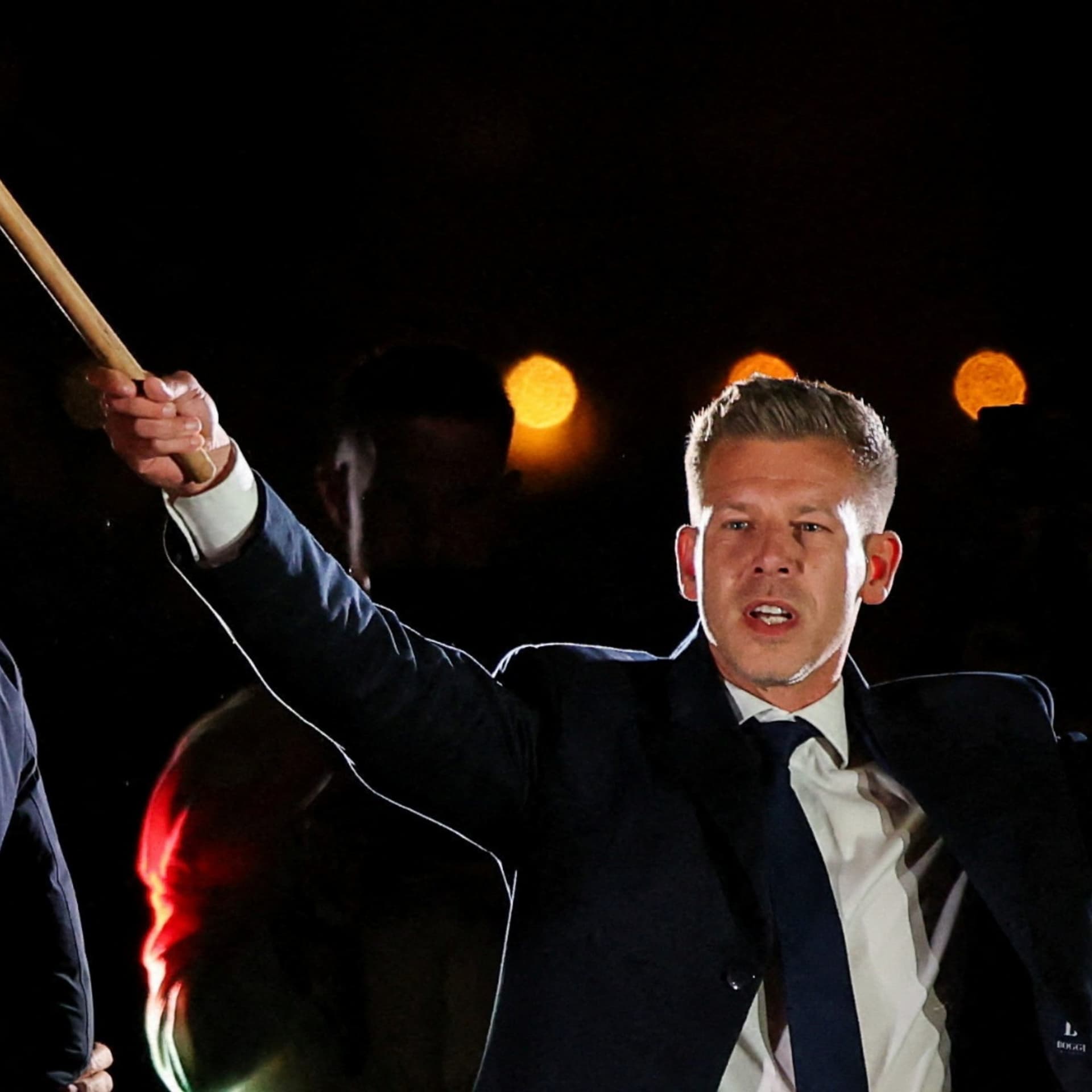
2:48But now Mr Madja, a former Orban ally who became his fiercest critic, has started a new era with his TISA party. He told a huge crowd in Budapest that the country had been liberated from the Orban regime. We did it. The TISA and Hungary have won this election. Not by a little, but by a lot. In fact, by an awful lot. Together we brought down the Orbán regime. Together we liberated Hungary. We took back our homeland. Thank you. Thank you all. The congratulations from other EU leaders have been effusive. Britain's Prime Minister Keir Starmer has called it a historic moment for European democracy.
3:32Our correspondent Nick Thorpe sent this report from Budapest.
3:42As the news broke that the Orban era was over, the Hungarian capital erupted in a sea of celebrations. People laughed and shouted and sang and danced in the streets. To the surprise of many here, Viktor Orban conceded swiftly, almost gracefully.
4:04The result of the election is painful for us, but unambiguous, he told his shocked supporters. The possibility and responsibility of governing was not granted to us. I have congratulated the winning party.
4:30Reaction in the huge crowd lining the shores of the Danube opposite the parliament was instantaneous. Young people who were toddlers 16 years ago could hardly believe that Viktor Orban and his Fidesz party could be defeated. I've been waiting against the Fidesz parliament forever. So I'm really happy that there is finally one person who is strong enough to actually challenge him for this world. And I hope it means we are getting closer to Europe. And I don't know, it means more democracy. Just more freedom for people. Hungary is European. Hungary is part of the West and not the East. And we believe that those are the countries we should make and establish and nourish our alliances with.
5:20Peter Magyar fielded phone calls from some prominent European leaders, among them President Macron of France, Kier Starmer from the UK and Ursula von der Leyen on behalf of the European Union. Then he came on stage.
5:40The Tissa Party and Hungary won this election, he told the cheering crowd. Not a small victory, a huge, enormous victory. Together we toppled the Orbán regime. Together we liberated Hungary. we took back our homeland. Before the election, I asked András Baka, former president of the Supreme Court, what a TISA victory would mean for Hungary and how difficult the task facing a government led by Peter Magyar would be. Hungary definitely needs a new constitution. It takes time to formulate, but it's not impossible, I think. But it requires a two-thirds majority, requires a serious judicial work and taking into account the law of the European Union, which is obligatory to Hungary too.
6:32So we have to change the system. And changing the system is exactly what the Hungarian people gave Peter Madja a mandate to do by electing him with a two-thirds majority on Sunday. I love the peace! I love the peace! I love the peace! After the celebrations, an immense task faces Peter Madja as Prime Minister. On Sunday night, he held out an olive branch to Fidesz voters, inviting them to work together to rebuild the country. All those who've stolen the national wealth, however, he warned, will have to face justice.
7:16Nick Thorpe with that report from Budapest. So how will the election result affect Hungary's relations with the Russian president Vladimir Putin, a close ally of Viktor Orban. Here's our editor Steve Rosenberg. This is clearly very bad news for Vladimir Putin. To explain why, let me use the kind of language that Donald Trump uses about cards, who's got the cards, who doesn't have the cards. For years, Viktor Orban was a super strong card in Vladimir Putin's hand, A sort of Trump card, if you like. This pro-Moscow, pro-Putin leader of an EU country, of a NATO member state, who opposed further sanctions against Russia, who opposed the idea of further assistance for Ukraine, who opposed the idea of Ukraine's accession to the European Union.
8:07This is why he was so useful for Russia. And I think the Kremlin saw him as a destabilising force inside the European Union. Having said that, I'm sure we'll see attempts by the Kremlin to try to reach out to the new administration in Budapest. Also, I think the Kremlin probably reckons it has a few other cards to play regarding Hungary. The country over the last few years has become heavily dependent on Russian energy. That isn't going to change overnight. Neither will the Russian authorities' attempts to destabilise the situation, I think, inside the European Union. Although, from what Russian commentators have been predicting in recent weeks, if the economic situation in Europe gets worse, if the energy situation in Europe gets worse, then destabilisation could be unavoidable.
8:58I've already read some comments on pro-Kremlin websites suggesting that Ukraine will get more assistance from the EU. Hungary, under Viktor Orban, had been opposing tens of billions of dollars of additional aid for Ukraine. So that might now go through. And as I say, these pro-Kremlin commentators were suggesting that the war will continue. Steve Rosenberg in Moscow. Next to the Middle East, Iran has reacted defiantly to President Trump's announcement that the US military will blockade all maritime traffic to and from Iranian ports in the vital shipping route, the Strait of Hormuz. Iran's parliamentary speaker, Mohamed Bagheer Khalibaf, has said Tehran will not submit to any threat.
9:46This comes after US and Iranian officials met in Pakistan for high-level talks at the weekend but were unable to reach any agreement. The US military says the blockade of the Strait of Hormuz will begin on Monday afternoon. Our chief international correspondent, Lise Doucette, filed this report from Islamabad. After these Islamabad talks, the big question is what next? And most urgently, what next for this 12-day ceasefire now entering its seventh day? And it still doesn't include Lebanon, even though the Iranians had insisted they wouldn't enter into talks until it did. And now that effectively there are two blockades of the Strait of Hormuz, the Iranian and the American, this increases the risk that one side or the other will open fire accidentally or deliberately, which could then spark a dangerous spiral.
10:39Is there any prospect of a return to talks? Well, both President Trump and Iranian officials are saying they would be ready to return to the negotiating table. And we still really don't have all the details about what happened in that marathon session behind closed doors. But what seems to have happened is that there was some progress. But what is really clear now is that both sides have very big red lines when it comes to Iran's nuclear program. And that neither side will be able or willing to move quickly, easily or at all. which means that for the moment it may be escalation rather than negotiation.
11:23Litu said with that report from Islamabad. Well, Iran has said that any attempt by a military vessel to approach the Strait of Hormuz would be considered a violation of the two-week ceasefire and dealt with severely. But what does that actually mean? That's a question for our correspondent Kashaya Janadi from BBC Persian. This means that, as Lise just mentioned, accidentally or deliberately, there's a high chance of military confrontation again before the ceasefire ends between Iran and the U.S. The U.S. is actually using this blockade as a pressure tactic, and Iran knows this. And Iran is also gesturing, warning the Americans that it will confront any U.S.
12:08military vessel trying to pass the Strait of Hormuz. Of course, the Americans have battered Iran's military presence at the Persian Gulf and the Strait of Hormuz, both in the sea and on the land. So it will become difficult for the Iranians to try to confront this. But let's not forget, Iran is talking about mines that it has lost in the Strait of Hormuz area. And this warning, of course, was for merchant vessels. But this kind of warning could also be serious for American naval vessels. So there is a high chance of confrontation before the ceasefire ends. Okay, just briefly then, what other moves could there be up Iran's sleeve?
12:54Does it have the leverage against the US to do anything else? And who holds the cards at the moment? Well, actually, you know, so far, Iran's biggest weapon against the Americans has been the Strait of Hormuz. And Iran is hoping that by adding up the confrontation at the Strait of Hormuz without entering a military confrontation, it will increase the pressure economically on the Americans. Mohamed Baqir-Ghalibov, Iran's parliament speaker, who was heading the Iranian delegation to Pakistan, just put on Twitter, on X, the social media, talking towards the American people, saying, enjoy the current pump figures.
13:35With the so-called blockade, soon you'll be nostalgic for$4 to$5 gas prices. And already gas prices have again exceeded$100 a barrel. Kajar Jenedi from BBC Persian. Still to come in this podcast. After I gave birth, I was still bleeding. I needed a bath but was forced to collect water which was dirty. I used it to bathe and drank it. It wasn't good for my body. The fight to improve basic sanitation and save mothers' lives in Zambia.
14:21Welcome to The Interface, the show that decodes the tech that's rewiring your week and your world. On this week's episode, we'll look at the way that algorithms could change how much you're paying for your groceries, how even astronauts have issues with Microsoft Outlook, and whether the next trend in tech is less tech. Listen on BBC.com or wherever you get your podcasts.
15:10in the campaign. I asked BBC Monitoring's Luis Fajardo why so many Peruvians were unable to cast their ballots. The Peruvian media are having a lot of reports on this, on how apparently many polling booths did not open on time on Sunday morning, apparently because of logistical issues. In many cases, election material did not arrive to many voting places, particularly in Lima, in the capital. And authorities are acknowledging that tens of thousands of people may have had problems with voting. That is why they initially said that voting was going to be extended for an hour on Sunday. There was an additional hour of voting on Sunday.
15:49And now they have said that some voting pools will also be open on Monday for this purpose. And are we getting any indication about the early exit polls and telling us about who's likely to win? There are plenty of candidates to choose from after all. There are 35 candidates to be precise. And exit polls are showing what people had predicted that no candidate was likely to obtain the majority that they needed to win the election outright. So it is going to be very, very likely a second vote, a runoff vote to be held in June. Peru's had nine presidents over the last 10 years. Why have there been so many changes in leadership?
16:26I mean, earlier we were talking in the programme about Hungary. Someone was ruling there for 16 years. So why has it been so different in a country like Peru, for example? There's many explanations that have been offered for this. Part of it has to do with the extreme skepticism that people have towards the system, the political system, and the continuous search for outsiders, people looking for complete outsiders from very, very different sectors of society that have promised change and have not really delivered in many cases. There's also weak political parties in which many cases presidents are elected but have very little representation in Congress.
17:05Therefore, the governance of the country becomes very difficult. This in the context of a lot of political instability in Peru. People were expecting a change this time. At this moment, there's still a lot of uncertainty over the result of the election and the impact this can have on political aspects in Peru. BBC Monitoring's Luis Fajardo. Mothers in sub-Saharan Africa are around 150 times more likely to die from maternal sepsis than those in Europe or North America. That's according to the charity WaterAid. Many of the causes for these deaths are linked to a lack of proper sanitation in healthcare facilities.
17:42Zambia has one of the highest number of births without basic sanitation in the world, which affects both mothers and newborns, as the BBC's Anita Nkonge has been finding out. Isabel is just 23 years old. She's sitting hunched over in a stool outside the house she shares with her grandmother, her face gaunt and grief-stricken. She's living through a mother's worst nightmare. Her first baby survived less than 48 hours. I just saw the condition of the child change it. He developed a high temperature. He stopped breastfeeding. We took him to health facility, but he later died. Isabel's newborn was showing signs of sepsis, a life-threatening reaction to an infection that causes the body to attack its own organs.
18:30The doctors told her that his death was caused by exposure from a local clinic that lacked basic sanitation. Here in Zambia, according to WaterAid, 98.8 % of local healthcare facilities lack basic sanitation facilities to be used on patients before and after childbirth. Here in Mazabuka, a local clinic I'm in, the showers and the toilets don't work. In fact, the shower is being used as storage. Clean, safe water is vital in pregnancy and childbirth, as Rachel Modenda, a midwife, explains. The mother has to wash hands. The mother has to bath after delivery. If that is not done properly, it means that infection will set in.
19:08According to government policy, we are supposed to observe mothers for 48 hours after delivery. Because we have inadequate running water, we observe them for six hours and we discharge them. In the town of Monze, an hour's drive away, mothers here said they would draw water from a dirty dam when they didn't have access to clean water, as 32-year-old Precious Jemima tells us. After I gave birth, I was still bleeding. I needed a bath but was forced to collect water which was dirty. I used it to bathe and drank it. It wasn't good for my body. In its recent report, WaterAid said Sub-Saharan Africa has the highest number of cases, with one in nine women experiencing maternal sepsis.
19:52According to the report, the solutions are clear, affordable and proven. Yanko Mataya, WaterAIDS country director in Zambia, explained more. Our recent report confirms that investing in water sanitation and hygiene is a cost-efficient way of tackling the issue of sepsis. And that in itself can translate into as much as 50 % reduction in illness and death that's related to maternal sepsis. We can see from our study that as little as$1 per capita can translate into the change that we want to see, and that$1 is three times much more cheaper than actually treating the sepsis. The BBC reached out to Zambia's Ministry of Health, but they have yet to respond.
20:34It did recently say on social media that it was launching a nationwide initiative to expand access to water, sanitation and hygiene in healthcare facilities, aiming to tackle associated infections. But those words will be little comfort to Isabel, who is struggling to come to terms with the loss of her baby. Anita Ngongé reporting from Zambia. The 20th century Nobel Prize winning French writer and philosopher Albert Camus was known for books described as existentialist. They explored what meaning there might be in human existence in a world without guiding religious or political principles. His 1942 novel, L 'Étranger, often translated as The Outsider or The Stranger, was no exception.
21:21The book centres on an emotionally detached man named Mersot, a French settler in Algeria, who kills a man who Camus simply calls the Arab. Mersot then goes on trial for the murder, with the book following this legal process and dissecting Mersot's thoughts throughout his detention. Julian Warwicker asked the film's director, Francois Orzon, why he felt the need to make a new film version of the book. I was quite shocked when I read the book to realise how the Arab community was invisibilised. And it was quite shocking for readers of today. So that's why I needed to understand the context of the writing of the book and to understand better the history between France and Algeria because it's still a kind of taboo in France today.
22:09I'm interested that you mention that aspect of it because in the original book, there is a character known simply as the Arab and you have given that character a name. It was a political choice because today the invisibilisation can be misunderstood by the audience of today. And of course, Camus was not racist, but he was at a period of colonialism. and I needed to show that two communities lived in parallel, the Arab on one side and the French on the other side. And it was a kind of apartheid. So if you don't know this context, you can't understand really the sense of the book and the focus of Camus.
22:54A word about the reception from the audience. We are living now in quite troubled, divisive times. What do you want people who see this film to take away from it? I don't have a goal, you know. I want you to live a kind of experience during the film and I don't have all the answers. I think the film is full of the questions which are in the book too. With all the wars in Russia, in Ukraine, in America, all these elements are so disturbing. And how do we react in front of that? It's interesting to plunge in the thoughts of Camus to try to understand better how to be a human today. French film director François Ozon.
23:40Let's finish off from the beautiful greens of the Augusta National Golf Course, where Rory McIlroy won the prestigious Masters Tournament for a second consecutive year in Georgia in the United States. He waited for many years to get his hands on the famous green jacket. And a year later, the Northern Irishman has gone back to back to become only the fourth player to successfully defend the Masters title. Here he is speaking at the Champions press conference. I thought it was so difficult to win last year because of trying to win the Masters and the Grand Slam and then this year I realised it's just really difficult to win the Masters.
24:18A sports correspondent, James Gregg, was right there on the 17th Green nearby watching all the drama and history unfold at Augusta. Incredible anchor. Coming into the week, there was all the talk about how free McIlroy might well be after winning it last year. And he's been incredibly candid about the fact that it was a huge weight off the shoulders and he could go out there and enjoy playing in the Masters for the very first time. He said for the first 16 Masters tournaments he played in, he was incredibly nervous walking towards the first tee. But this year, it was a different entity. And look, he started the week brilliantly, a round of 67, to share the lead after round one, a 65 to open up that six-shot lead, let's not forget, at the halfway stage.
25:01Obviously fell back yesterday, but really, really imperious performance on the back nine just to close things out. And he is the master for a reason. And it is so difficult to go back-to-back. He's only the fourth player to do that. And last year here, he joined the greats by completing the career Grand Slam. And this time he's made even more history, as you mentioned as well, joining Nick Faldo, the great Tiger Woods and the legendary Jack Nicklaus as well to successfully defend back to back. Awesome achievement. Yes, it is. And really nice moment. Just a few moments ago, as you talked to me, McElroy was walking out of the butler cabin, the wood panel room that they present the green jacket in before they then walk out the Masters champion to give a more kind of open speech to some of the patrons and some of the other Augusta members, etc., sort of in the sunshine.
25:52It's just three people. Nick Faldo then welcomed him out of the butler cabin and really genuinely, warmly congratulated him. And, of course, with that as well, going back to back and joining Sir Nick Faldo in doing that, he also joins Faldo on six major championships. So McIlroy definitely has moved his career into a different stratosphere. He revealed that his menu for being the defending Masters champion will be a bit of local Georgia cuisine mixed in by some of his Irish heritage, Northern Irish heritage. I wonder what he's going to do next year now. He's got to get his thinking cap on. He probably does, doesn't he?
26:28And we talked about that earlier on in the week saying, you know, he started the week with an incredible meal. If you've not seen the menu for that, definitely give it a Google. I'll give you a kick, Ron, then. Bacon-wrapped dates, grilled elk sliders, rock shrimp tempura, and peach and ricotta flatbread. That's just the starters. I mean, my mouth is watering. It's incredible. Look, he's going to have to think about that. And these are all the privileges that come with being a Masters champion. You know, he will be at that champion's dinner with all the greats and just this brilliant privilege that comes with it.
Read the full transcript
27:01And that was already secured for life anyway with what he achieved last year. But I think he just probably holds a little bit more weight in the room. Now he's a multiple Masters champion. Also back home in Northern Ireland as well, in Hollywood, where he grew up. And lovely pictures of the golf club there, where he began his career as a young boy. And all the support he still has there. And those celebrations will continue long into the night too. Oh, absolutely. Look, his father, Gerry, who is a real character. You know, I know him loosely just from watching McElroy down the years. He gave everything to McElroy.
27:35you know, along with his mother, Rosie. And, you know, he was a bartender, was Gerry McIlroy, at Hollywood Golf Club in Northern Ireland. I'm sure that all the members there have their own tales of Rory and he's just added another little slice of something, hasn't he, to that slice of golfing terrain up there in Northern Ireland. Fantastic. James Gregg in Augusta. And for more on the Masters, there's a special All About podcast on BBC Sounds or wherever you get your podcasts from. And that's all from us for now. If you want to get in touch, you can email us at globalpodcast at bbc.co.uk. You can also find us on X at BBC World Service.
28:12Use the hashtag Global News Pod. And don't forget our sister podcast, The Global Story, which goes in-depth and beyond the headlines on One Big Story. This edition of the Global News Podcast was mixed by Darcy O 'Brie and produced by Helena Burke. The editor is Karen Martin and I'm Ankur Desai. Until next time, goodbye.
28:39Welcome to The Interface, the show that decodes the tech that's rewiring your week and your world. On this week's episode, we'll look at the way that algorithms could change how much you're paying for your groceries, how even astronauts have issues with Microsoft Outlook, and whether the next trend in tech is less tech. Listen on BBC.com or wherever you get your podcasts. For more info il fuPodcast.com
From the publisher
Péter Magyar, leader of the Tisza party, has promised closer ties with the European Union - and an anti-corruption drive - after winning the Hungarian election. The 45-year-old defeated Viktor Orbán, of the Fidesz party, who had ruled the country for 16 years. Also, Iran has said it won't submit to threats from the US after President Trump said the American military would start blockading the Strait of Hormuz from Monday afternoon. Peru's election authority says it will be reopening some polls after tens of thousands of people were unable to vote in Sunday's Presidential election. We hear how a lack of basic sanitation in Zambia is putting mothers at high risk of maternal sepsis. French film director, Francois Ozon, talks about adapting the work of philosopher Albert Camus. And, in golf, Rory McIlroy has become only the fourth man ever to win successive Masters titles.
The Global News Podcast brings you the breaking news you need to hear, as it happens. Listen for the latest headlines and current affairs from around the world. Politics, economics, climate, business, technology, health – we cover it all with expert analysis and insight. Get the news that matters, delivered twice a day on weekdays and daily at weekends, plus special bonus episodes reacting to urgent breaking stories. Follow or subscribe now and never miss a moment. Get in touch: globalpodcast@bbc.co.uk