
In short
Global News Podcast - Episode Summary: The Happy Pod: A Song Fit for a King
Episode Overview In this episode of the Global News Podcast, titled *The Happy Pod: A Song Fit for a King*, host Bernadette Keogh introduces us to Jack Pepper, a young composer who has created a piece for King Charles III. The episode also discusses advances in Alzheimer’s research and an innovative tourism initiative in Mexico aimed at helping stray dogs.
Key Highlights
- Jack Pepper and His Song for King Charles III
- Composer's Background: Jack Pepper, 26, is recognized as one of Britain's youngest commissioned composers, having begun his orchestral writing in his early teens.
- The Composition: The song, titled *Harmony*, is inspired by King Charles's environmental philosophy and is based on his book of the same name.
- Themes: The piece emphasizes the relationship between humanity and the natural world, calling for action to address environmental challenges.
- Creative Process:
- Pepper detailed the pressure of writing for royalty, mentioning the extensive approval process.
- He composed the song in a short, highly inspired session, focusing on an uplifting chorus that conveys empowerment.
- The performance for King Charles included a string quartet and a youth choir, creating an intimate setting that impressed both the audience and the King.
- Advancements in Alzheimer's Research
- Current Landscape: An estimated 50 million people globally suffer from Alzheimer's, with numbers expected to rise.
- Research Developments: Dr. Shona Scales from Alzheimer’s Research UK discusses:
- 180 trials underway, with 75% focusing on disease-targeting treatments.
- Potential for repurposing existing medications for Alzheimer's treatment.
- Future Outlook: There is cautious optimism for developing drugs that might slow down or even reverse Alzheimer’s, with early diagnosis being critical for effective treatment.
- Tourism Initiative for Stray Dogs in Mexico
- Project Overview: Caitlin Garcia-Ahern discusses her charity, Caravana Canina, which organizes guided walks to help socialize stray dogs for adoption.
- Impact: The initiative has successfully rehomed over 150 dogs and spayed/neutered 450 to help control the stray population.
- Community Engagement: Tourists participate in hikes, providing both funding and socialization for the dogs, while enjoying a unique experience that connects them with local culture and philanthropy.
Additional Stories
- Indian Astronaut Launch: Celebrations in India as Group Captain Shubanshu Shukla becomes the first Indian astronaut to visit the International Space Station, symbolizing national pride and unity.
- Women Driving Taxis in Nigeria: A report on women breaking gender norms by becoming taxi drivers in Kano, highlighting the economic empowerment and cultural shift this represents.
- Family Connection Through Books: A touching story of a man discovering books in a charity shop that belonged to his wife’s family, rekindling memories and connecting their past.
Conclusion The episode blends inspiring musical artistry, promising medical advancements, and innovative social initiatives, showcasing the diverse themes addressed by the Global News Podcast. Each segment contributes to a narrative of hope and action in various sectors of society.
---
For feedback or to share your own stories, contact: [globalpodcast@bbc.co.uk](mailto:globalpodcast@bbc.co.uk).
Written by AI. May contain mistakes. Listen to the episode to check what was said.
Transcript
Automatic transcript. May contain errors.0:00This BBC podcast is supported by ads outside the UK. If journalism is the first draft of history, what happens if that draft is flawed? In 1999, four Russian apartment buildings were bombed, hundreds killed. But even now, we still don't know for sure who did it. It's a mystery that sparked chilling theories. I'm Helena Merriman, and in a new BBC series, I'm talking to the reporters who first covered this story. What did they miss the first time? The History Bureau Putin and the Apartment Bombs Listen on bbc.com or wherever you get your podcasts
0:43Hello there, it's Jack Pepper here and I'm going to be telling you about the song I wrote for King Charles III in this edition of The Happy Pod from the BBC World Service
1:02I'm Bernadette Keogh and in this edition
1:09I knew I wanted a chorus that was uplifting and a kind of a rallying cry that says that yes we do have power to the actions that we can all take inspiring action to help the planet with a song written and performed especially for King Charles. Newfound optimism for controlling Alzheimer's disease with dozens of potential treatments being trialled. Thinking about the patients of today and the patients of tomorrow just really gives me hope and propels me on. Why astronauts from India, Poland and Hungary have an unusual crewmate and they get to meet all kinds of people, all kinds of energy, learn to be calm and confident.
1:51We're able to expose them to different situations where they can be really well-rounded dogs. Using tourism to help stray dogs in Mexico.
2:04We begin with a young musician given the daunting task of writing and performing a song that was fit for a king and could inspire people to take action to help the planet. Jack Pepper, who's 26, is one of Britain's youngest commissioned composers. He's been writing for orchestras since his early teens. And it was a significant honour when he was approached by the charity, the King's Foundation, and asked to compose a piece inspired by the King's environmental philosophy. The result is Harmony, named after a book of the same name, written by the then Prince Charles in 2010. It's about the need for a good relationship between people and the natural world.
2:46The piece was first performed for the charity earlier this month, but Jack came into our studios to record a version for us and to chat to our reporter, Harry Bly, about the experience of writing for royalty. The daunting nature of a royal piece can be that you think, oh my goodness, a lot of people have to like this, and you do have to get it approved by lots of different layers. So I tried not to let that get to my head. I did the research for a few weeks, read the book, and then parked it and did other things. And a couple of weeks later, this melody out of nowhere with some of the words came.
3:21I sat at the piano and the whole song, music and lyric was probably written in an hour. And this sort of inspiration that came to you, it's a very catchy earworm. Yeah, so the... Thank you, that's very kind. The opening melody... We are beautiful when we want to be. I knew I wanted a chorus that was uplifting and a kind of a rallying cry that says that, yes we do have power, we do have agency, there is beauty in the world but I also wanted it to start acknowledging the challenges that the world faces and that's why very early on when I was writing I knew I wanted the song to start with are you tired of fighting fires but then there's something that we can do and that's exactly what the King's Foundation stands for, it's the actions that we can all take to promote a better and more sustainable world and of course the joy of this song is it's one massive crescendo basically.
4:12It starts very small, just voice and piano and by the end everybody's singing. We have this big build so the choir just one voice, this is just one voice, just one person singing second, just one voice this is just one voice and the females come in, just one voice this is just one voice and then I have this lovely big bass note to really set up the big chorus but I tease you there's a silence and then we are beautiful when we want to be and it really gets big there so the choir are beautiful
4:54and the joy of that is that you can make the music match the words so we said we are beautiful we are powerful at the beginning and we didn't really sound particularly powerful it was very small it was fragile and that was the point i was making about the world you know there's there's fragility there but there's also power and beauty and when we all come together as we do at the end of the song everybody's singing and playing together then finally that lyric we are powerful sounds powerful too
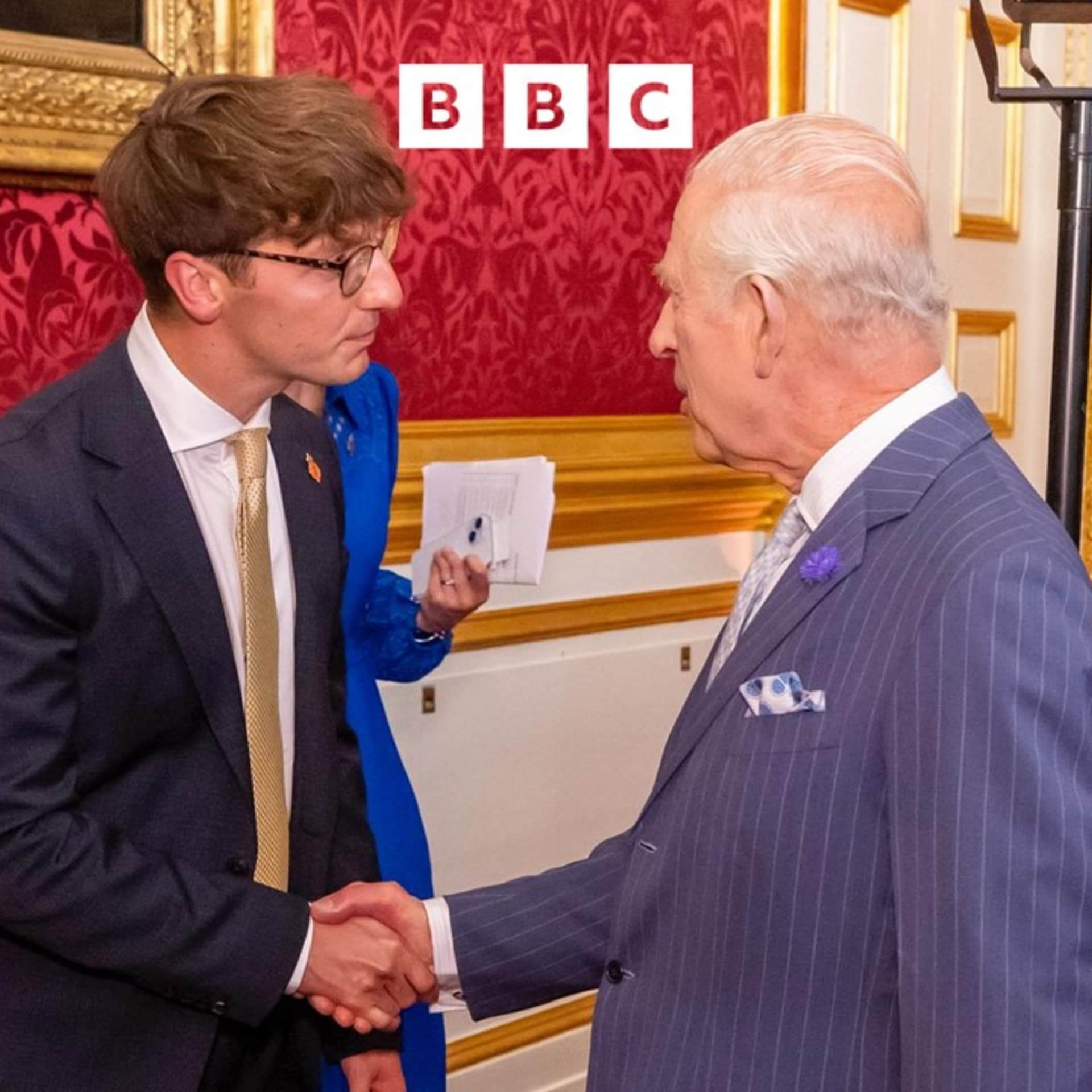
5:29you performed this to his majesty the king how did it go it was an extraordinary premiere So we had a string quartet, a youth choir and then me singing at the piano. And His Majesty was literally stood at the end of the keyboard. That kind of intimacy is pretty extraordinary. I could literally sense him leaning forward at certain lines. I could hear him responding to the cello in the string quartet. And for this performance it wasn't just the King who was a special guest because your parents were invited as well. They were. It was my dad's birthday. and even more special that after His Majesty spoke with me and with some of the performers, he then turned around and went to my parents and they had a good five minutes talking with the king and so it was really lovely that rather than just sort of coming back and telling them about my day this time, they could be there and they literally stood behind Meryl Streep and the king and heard this piece performed live, a piece that they'd heard me noodling away at home quite a lot but for them to hear it come together in that way in that room was pretty epic.
6:33Around the world there will be so many young people that compose their own music in their bedrooms, at school, at home. What's your advice to those young people who wish to compose for a bigger audience, perhaps for royalty? Where do you find your muse? I think you have to share. Ultimately you need an audience, you need a stage and that can be just down the road from you. It can be 10 people in a room, sounds obvious, but you have to let it out and get it out. The more you do it, the more you'll realise you can lift heavier, you can play to this big space and you will grow in confidence. Music was not made just for us, it was made as an act of communication, as something social, so you must share.
7:23What is it about music that makes you happy? Self-expression, definitely. It helped me express things that I couldn't find the words alone for. Meeting new people. Ultimately, music is an expression of curiosity. So it's that treasure trove of discovery that is constant. However old you are, whatever country you're in, whatever your background, there's always more music just around the corner. And I love that. It's an adventure. We are capable Even after all we've done There still can be harmony Jack Pepper speaking to Harry Bly. We were thrilled to invite Jack here to BBC Broadcasting House where he recorded a piano version of Harmony, which you can hear at the end of this podcast.
8:16Around the world, it's estimated more than 50 million people are living with Alzheimer's disease and related dementias, and the numbers are expected to continue rising sharply. But scientists say there's reason for optimism, with dozens of potential treatments currently being developed that could have a huge impact. Alzheimer's is characterised by memory loss, cognitive decline and behavioural changes caused by an abnormal protein building up in the brain, and it gradually progresses over time. Peter Goffin spoke to Dr Shona Scales, the Director of Research for Alzheimer's Research UK. There's now 180 trials underway globally.
9:00About three quarters of these treatments are actually what we call disease targeting and can change the course of the disease. And about a third of these drugs are already being used in other conditions and they're being looked at to be repurposed into Alzheimer's disease treatment, meaning that we could potentially speed up the drug development pipeline for these drugs. The most famous one at the moment, or the one that's really gathered a lot of attention within the media, is that of semaglutide, which is a type 2 diabetes and weight loss drug. And that's currently being trialled for mild cognitive impairment or mild dementia from Alzheimer's disease.
9:39We have a number of clinical trials that will be reading out this year. And all we can do is just wait excitedly to see what those results are. And are there treatments that are in development now that are, would you say, drastically different than what's on offer now? Yes. So there's two treatments at the moment that can modify the course of the disease. These are lacanumab and ananumab. They're difficult to administer and their effects are modest. So we have drugs that are coming where they're thinking about actually how to increase the effects of the drugs by using new technologies to bypass the blood brain barrier.
10:21So that barrier that stops nasties getting into your brain and protects it, but also obviously makes it very difficult to drugs to enter. Different treatments would be needed from the earliest stages of Alzheimer's disease to the later, more advanced stages. And so different biological sort of underpinnings are being looked at within these treatment pathways in order to really broaden out the number of treatments and the number of shots on target that we're aiming to get. There was a previous story on the Happy Pod that we covered about a new blood test for Alzheimer's. I'm just wondering how likely that sort of diagnostic tool could be to help improve things for Alzheimer's patients.
11:03Some of the biological changes that happens within Alzheimer's disease actually can happen decades before you get the onset of clinical symptoms. And we know that treating at the earliest possible moment means that these drugs can have a bigger effect. So being able to have a early and accurate diagnosis is vital. Can we look forward now to a time when Alzheimer's is completely controllable or even curable? Is that imaginable at this time? Here at Alzheimer's Research UK, we have real hope for the future. We have hope that we will have drugs that can slow the disease down, that can stop the disease and then one day hopefully maybe reverse the disease.
11:56We know that the drugs that we're seeing today are those first generation of treatments and the second and even third generation of treatments are already in our sights. We can see them coming. On a personal level, how does it feel to be working on research that could improve the lives of millions of people one day? Working in this area is genuinely one of the most incredible things I have and will ever do. I remember the days where we were doing slow, painful research, trying to understand the underpinning parts of the disease. And it's taken decades of research. And now it really feels exciting to be on the cusp of something.
12:45you can see that these treatments that have come through are the chink in the armour and suddenly feeling that pace of change just start to really take off means that suddenly working in this area right now is just scientifically an exciting place to be but also thinking about patients of today and the patients of tomorrow just really gives me hope and propels me on. Dr Shona Scales from Alzheimer's Research UK. There were celebrations in India this week as the country's first astronaut to visit the International Space Station took off from Cape Canaveral in Florida. Across the country, people gathered round screens to watch live coverage of Group Captain Shubanshu Shukla lift off, especially in his hometown of Lucknow, where his parents joined hundreds of students for the event.
13:4310, 9, 8, 7, 6, 5, 4, 4, 3, 2, 1.
14:00For three nations, a new chapter in space takes flight. Godspeed, X4.
14:14Axiom 4 crew members, Swarovsh Usnansky-Wizhnesky from Poland and Tibor Kapu from Hungary, also took their countries back to space after more than four decades. And before the launch, the astronauts revealed their fifth crew member, a soft, cuddly swan called Joy. The mission's leader, former NASA astronaut Peggy Whitson, said the five-inch-tall toy was more than just a cute companion. I believe that space has a unique way of bringing people together, and I'm proud to be a part of a mission that reflects that spirit. I'm honored to lead AX4, and I can't wait to share this journey with all of you.
14:54And now I'm proud to unveil our zero-G indicator for AX4, Joy. It's a plush swan symbolizing grace and elegance. More than just a companion, Joy will signal our arrival in microgravity shortly after launch. Joy represents the shared aspirations of three nations united in their return to human spaceflight. The swan is rich in cultural symbolism, stands for wisdom in India, resilience in Poland, and grace in Hungary. Through joy, we'll celebrate our diversity and our unity in the shared journey of space exploration. And Group Captain Shukla said he was proud to represent the spirit of his country.
15:39In Indian culture, the swan is the vehicle of goddess Saraswati, symbolizing wisdom, learning, and purity. It is said to have the rare ability to separate milk from water, a symbolism that is a powerful reminder of discernment in an age of distraction. To carry this symbol is to carry the essence of our mission, pursuit of knowledge, clarity of purpose, and grace under pressure. Now, with the training behind me and not just ahead, I feel deeply inspired, prepared and confident. The excitement of venturing into space, of experiencing a new way of living, seeing and being is beyond words. Group Captain Shukla.
16:26Coming up in this podcast. We thought no more of it and what a strange coincidence. So I was sitting there a few days later and thought, oh, well, I still haven't gone through that stack of books. And lo and behold, I found a second book and a third book with my past name in it. The mind-blowing coincidence that stunned one book collector.
16:55If journalism is the first draft of history, what happens if that draft is flawed? In 1999, four Russian apartment buildings were bombed, hundreds killed. But even now, we still don't know for sure who did it. It's a mystery that sparked chilling theories. I'm Helena Merriman, and in a new BBC series, I'm talking to the reporters who first covered this story. What did they miss the first time? The History Bureau, Putin and the apartment bombs. Listen on BBC.com or wherever you get your podcasts.
17:33To Mexico now, where one woman has found a way to use tourism to help her city deal with a large number of stray dogs. Her charity, Caravana Caninu in Huaca, runs guided walks that help socialise strays so they can find new homes, while also raising money to pay for their care. So far, more than 150 dogs have been rehomed, while a further 450 have been spayed or neutered to help control the population. Maddy Drury joined five tourists and five excited dogs for a trip to the forests of the Sierra Norte region. Welcome everyone to Oaxaca. I'm Caitlin and I am originally from Atlanta, Georgia, but I've been living in Oaxaca now for six years.
18:23That's Caitlin Garcia-Ahern, who co-founded the Rescue Centre five years ago and is leading the hike. So we started Caravanacanina really just doing a spay and neuter campaign with vets in my garage, with some of the street dogs that were in the neighbourhood. And then in that area I would find dogs that had tumours or dogs that had machete wounds. Caitlin started taking the dogs into her home and slowly built a team of animal lovers who were willing to treat and train the dogs so they'd be suitable for adoption. Of course, all of this costs money, which is where tourists come in. We already take the dogs hiking anyways for fun for the dogs.
19:05It's great for them, it's great for us to be in the forest. And then combining that with tourism creates this opportunity for us to fundraise for the project. We are in the forest on the walk, and the dogs are running in and out of us, through our legs, going a bit crazy for the first 15 minutes. No, no, no. No, no, no. No, no, no. They don't think much of the mountain bikes that are coming through here. In fact, I think some of them are a bit scared, but that's all part of the experience for them, all part of socialising them with human beings. I get chatting to Leila Kadri. She is a fosterer with the organisation and introduces us to one of the dogs.
19:49So Zora has been with me the longest. So it took about six months to get her healthy and also to a point where she could comfortably socialize. She's very emotionally in tune. She's very elegant, but she's also quite goofy. She's wonderful and she's kind of like the big sister and keeps all the other puppies in line, which is nice. Why are those hikes so important? They get to meet all kinds of people, all kinds of energy, learn to be calm and confident, And, you know, as well as hiking with us, waiting in the car, things like that. But it also, I think, shows a side that people might not often see.
20:27When we think of rescue dogs, we might have a bad connotation of a dog that's been in a shelter, in a metal cage, and might have behavioral problems, might be traumatized. When we're able to have these dogs in smaller groups and with more focused care like this, such as in our homes, we're able to expose them to different situations where they can be really well-rounded dogs. It's clear the tourists are getting as much out of the hike as the dogs. I get chatting to one of them, Maria del Carmen Reyes, who lives in the US but grew up in Mexico. It's amazing that these dogs were all street dogs per se, or rescues, because they are more well-behaved than some of our domesticated pets at home.
21:07They're intuitive, they listen, they can be off leash and they come right back to you. They're curious. And it's wonderful to see that they get to be a part of nature. I also chat to Emily from Canada, who is on the tour with her mum. You know, we're such big dog fans. And, you know, especially being here as tourists, I ideally want in some way my presence here to be in some way for good. The hike has been wonderful. All the dogs, learning about the dogs has been really quite inspiring. And, yeah, just also always good to get in some dog time and hopefully make a positive impact is, like, such a win.
21:46After a fun but tiring walk under the warmth of the sun, we drive back to the office in Oaxaca. I have another chat with founder Caitlin. You have helped hundreds of dogs, but there are millions on the streets. Is this just a drop in the ocean? You know, there are certainly moments when it feels like there's so much more work to do. What's the point? And then I think you have these case-by-case relationships with animals and with the humans caring for them. And that makes it all worth it. Like anything in the world, there are ripple effects. It just creates a culture of care. Caitlin Garcia-Ahern, ending that report from Maddy Drury.
22:30And you can hear more on People Fixing the World wherever you get your BBC podcasts. In the city of Kano in northern Nigeria, the streets are full of bright yellow three-wheeled taxis known as kekes. Traditionally, they've been driven by men, but now a small group of pioneering women have been getting behind the wheel. Mansu Abubakar from BBC Africa went to meet the woman who led the way. My name is Amina Ibrahim, the first woman to ride keke for the whole of Kano. Wamina Ibrahim is a cleaner in a popular hospital in Kano. And for her, this is a secondary job. We know the situation in Nigeria and how the economy has been very, very rough the last couple of years.
23:19Before I start with the ride keke, I'd already learned how to ride bicycle and motorcycle. Actually, her brother was the one who owns a keke. She always tell him that she wants to learn and be able to help her family make some money. and she was able to learn from him.
23:39The first day where I ride, now one day where I asked my husband, and he said the first time she was able to take his keke, go out, the looks she got from people was unbelievable. She said everywhere she went to, people were in love staring, looking at her because it was the first time they were seeing a woman riding keke. But what kept her going was the fact that the first few days she made a lot of money and she just kept going. and it was money that was very helpful for her family. I think in a day, aborigely, they make at least 10 ,000 nera. 10 ,000 nera is about$8 to$10, yeah. So for Nigeria, for the KK riders, it's money that go a long way for their families.
24:17You don't say get some people, wait on why some people are dead behind regarding women and work, but generally, people, they appreciate me. At the moment, there are thousands of women in Kano that are KK drivers. The group is a non-governmental organization which was inspired by Amina and the fact that women were complaining of getting harassed by men in cars. So they wanted female drivers and KK where only women will be carried. So you can see them around with the pink uniform and all of that. It's interesting to see in the car. So the pink uniform is to identify the female drivers so that the women who are particularly concerned about getting into KK with men will go into that one that they are sure that it's only women that are carried.
25:03I know they think of retirement or anything. This is not something where I won't do for the rest of my life. So when we met, I mean, when I met her, she was happy with the care-driving and she took us around Kano and then finally took us to her home where her children were waiting to welcome her with hugs. And we spoke to some of them and they said they are proud of their mum and how inspiring she is to a lot of other women. Mansur Abubakar. Now to a story about a rather strange coincidence. When Steve Mills bought a set of books from a local charity shop, little did he know they were connected to his family, five decades ago and hundreds of kilometres away.
25:45Holly Gibbs has the story. Steve Mills has been collecting books by the children's author Enid Blyton since he retired a few years ago. Some people think, a grown man, why are you buying Enid Blyton? But the books, they mean something. He bought his latest finds in a charity shop in Essex where he lives with his wife Karen, took them home and sat them on his bookshelf amongst his collection. It was only months later that Steve opened one of the books and was in for a big surprise. I started to rearrange some books on the shelf and thought, oh, let's just have a look through these. And I turned the page, the cover, and inside was my brother-in-law's name.
Read the full transcript
26:27And I just sort of stood there in shock looking at it. And I recognised the address, because that address had come up in Family Conversations and showed it to my wife and she was completely amazed. And she then turned the next page, which I hadn't done, and there was her name that she'd written. You know, we were both sitting there thinking, wow, what are the chances? Luckily, her parents are still with us and they're in their mid-80s now. So we contacted them and they were absolutely thrilled to hear this because obviously it's part of their family history. There are sketches in the book by Steve's wife Karen, old addresses and details of family members.
27:07Steve's mother-in-law gave them away to a public fate more than 50 years ago and 275 kilometres away from where he found them. But it doesn't stop there. We thought no more of it than what a strange coincidence. So I was sitting there a few days later and thought, oh, well, I still haven't gone through that stack of books. and lo and behold I found a second book and a third book with my wife's name in it and we just couldn't believe it and it's just destiny these books wanted to be found. Steve says in the back of one of the books Karen has written I have 12 Eden Blyton books and his next challenge is to find the remaining nine.
27:49He says the experience of finding the books has been mind-blowing and has brought him and his wife even closer together. Holly Gibbs. And that's all from the Happy Pod for now, but we thought we'd end where we began, with Harmony. Harmony.
28:10Harmony.
28:15A bed without a blanket, a house without a roof. I need you to complete me In circles there is truth We are made for feeling And we are made for feeling If you have a story to share, the address as ever is globalpodcast at bbc.co.uk And you can now watch some of our interviews on YouTube. Just search for The Happy Pod. This edition was mixed by Callum MacLean and the producers were Holly Gibbs and Rachel Bulkeley. The editor is Karen Martin. I'm Bernadette Keogh. Until next time, goodbye.
29:29If journalism is the first draft of history, what happens if that draft is flawed? In 1999, four Russian apartment buildings were bombed, hundreds killed. But even now, we still don't know for sure who did it. It's a mystery that sparked chilling theories. I'm Helena Merriman, and in a new BBC series, I'm talking to the reporters who first covered this story. What did they miss the first time? The History Bureau, Putin and the apartment bombs. Listen on bbc.com or wherever you get your podcasts.
From the publisher
We meet Jack Pepper, the composer who's written a song for King Charles. The piece celebrates the harmony between people and the natural world. Also: hope for Alzheimer's patients; and how tourism could help stray dogs.