
In short
The Happy Pod episode centers on turning loss and disability into connection and hope, plus human-interest stories: a grief-driven anti-loneliness pub campaign (“Empty Chairs”), brainwave-controlled dance for ALS, a 95-year-old masters swimmer’s record chase, Brazil’s new official tartan, a paddleboard survivor reunited with lifeboat rescuers, and a therapy dog helping chemotherapy patients.
Guests
Dean Perryman (creator of Empty Chairs in the UK after friend Rob’s suicide; chats with strangers in pubs wearing an orange hoodie). Belen Luna-Sans (Bolivian running Empty Chairs in Belgium; migrant building community in Brussels). Also featured: Brianna Olson (American dancer with ALS using a brain-controlled avatar), Naoki Tanaka (Dentsu Lab tech lead), Jane Asher (95-year-old Zambian-born masters swimmer), Fernanda Dal Piaz (Brazilian consulate judge in Edinburgh), Mandy Galloway (paddleboarder rescued at sea), lifeboat crew Scott Brown and Louis McNaught, Dr. Lena Pugliano (CancerFit oncologist), Sam O’Keefe (Guide Dogs NSW), and Marcus (Black Labrador therapy dog).
Key claims
Empty Chairs reduces loneliness and can prompt people to seek professional help; brainwave tech can restore “voice” and movement for ALS; masters swimming and community support sustain long-term performance; Brazil’s tartan deepens Scotland ties; proper life-saving gear matters; Marcus’s calm presence supports emotional healing during cancer recovery.
Notable examples
Dean’s “day one” on Rob’s would-be 30th birthday; global events in Norway/Australia/US; Brianna’s Amsterdam stage performance; Jane Asher’s record pursuit in Budapest; Brazil tartan “Spirit of Brazil” designed by six-year-old Indy Mingus; Mandy’s near-drowning and later reunion; Marcus calming a patient who then cried from relief.
Written by AI. May contain mistakes. Listen to the episode to check what was said.
Chapters
Tap a time to open that second in VOFilling the Empty Chair
1:18 to 2:34
Discussion on Dean's mission to fill the empty chairs left by his best friend.
“the man on a mission to fill empty chairs.”
The Empty Chairs Campaign
2:34 to 4:26
Dean explains the concept and impact of his Empty Chairs campaign.
“We start with a man who is turning his grief into a campaign to help others feel less alone.”
Stories of Connection
4:26 to 6:50
Dean shares memorable interactions and the positive impacts of his campaign.
“I wear a really garish orange hoodie every time I go out and thankfully not many people wear this so it's kind of it's kind of worked as a signpost and signal for people.”
Going Global with Empty Chairs
6:50 to 8:11
Discussion about the global reach of the Empty Chairs initiative.
“of how he turned his grief into something that made everyone feel so much better about the way they do community.”
Support and Resources
8:11 to 10:11
Dean offers advice for those hesitant to join the Empty Chairs events and provides support resources.
“I think it's more of a shock to me because I have no idea what I'm doing.”
Technological Advancements in Dance
10:11 to 13:14
Exploring how technology is helping dancers with ALS express themselves.
“can be found at Befrienders Worldwide, www.befrienders.org.”
Record-Breaking Swimmer Jane Asher
13:14 to 14:05
Profile of Jane Asher, a 95-year-old swimmer breaking world records.
“Pace yourself and enjoy spending time with friends.”
Jane's Swimming Journey and Accomplishments
14:05 to 15:57
Explore Jane's lifelong dedication to swimming and her upcoming competition.
“and has a British Empire medal, all for her dedication to swimming.”
AI Concerns and Global Story Podcast
17:29 to 18:00
Discuss the potential dangers of AI based on claims from Anthropic.
“Is this the moment we all have to start being terrified that AI will take over the world?”
Brazil's First Official Tartan
18:01 to 20:16
Learn about the creation of Brazil's first tartan and its significance.
“Tartan is something that people in Scotland will instantly recognise.”
Show all 15 chapters
A Life-Saving Reunion: Mandy's Story
20:16 to 22:26
Hear Mandy's harrowing experience of being rescued at sea and her reunion with the lifeboat crew.
“She has a connection to Charles Miller, who is credited to have introduced football to Brazil.”
Mandy's Near-Death Experience
22:26 to 23:42
Mandy recounts her terrifying moments while lost at sea and her thoughts during the ordeal.
“It feels so special to have me at the crew that saved me I am obviously I can't remember what any of them looked like but their voices are very familiar now that I've met them Lifeboat crew member Scott Brown.”
Marcus the Therapy Dog
23:42 to 25:46
Discover how Marcus transitioned from a guide dog to a therapy dog, helping cancer patients.
“Mandy was lucky, but admits she wasn't properly dressed for the conditions.”
The Impact of Therapy Dogs on Healing
25:46 to 28:00
Explore the profound effects therapy dogs like Marcus have on patients during recovery.
“She's an oncologist who founded the Cancer Care and Rehabilitation Centre CancerFit.”
Rehabilitation After Cancer Diagnosis
28:00 to 28:40
Learn about the importance of community and gentle moments in healing post-cancer.
“Or that was the first time I've relaxed since my diagnosis.”
Transcript
Automatic transcript. May contain errors.0:00This BBC podcast is supported by ads outside the UK.
0:30Moto Casino, America's Social Casino.
1:00While supplies last, selection varies by location. See Lowe's.com for details. Soil offer excludes Alaska and Hawaii.
1:08This is the Happy Pod from the BBC World Service.
1:17I'm Holly Gibbs and in this edition, the man on a mission to fill empty chairs. The thing that I couldn't wrap my head around was this idea of the empty chair, where, like, he would have always sat. So I was like, what can I do to kind of have an impact on that? And I was like, well, I'm not good at many things, but I'm OK at chatting and I'm good at drinking beer. So let's go to the pub and let's just see if there's anyone there that wants to chat. We meet Dean, who created the campaign in memory of his best friend. Also on this podcast, the cutting edge technology helping one dancer be on stage again.
1:50It was magical and exhilarating. is a new way of expression to be able to move in a new way. The 95-year-old swimmer still breaking records. Plus why Brazil now has its own version of a classic Scottish tartan. And this stillness, this calmness, it's so incredibly powerful. That's where the magic starts. That's where the cancer recovery starts, the healing physically and emotionally. Meet Marcus, the Labrador too lazy to be a guide dog, now helping people in his own special way.
2:34We start with a man who is turning his grief into a campaign to help others feel less alone. Dean Perryman started Empty Chairs after his friend Rob took his own life. The concept is simple. Dean will go to a pub and sit with empty chairs around him, and people can join him if they would like some company. This is me on day one of empty chairs, on what would have been Rob's 30th birthday. Four seen incredible people across the country wore orange and hosted their own empty chairs. They showed up in their local pubs to create space for people in their community who might have needed it. Across the UK, we filled over 100 empty chairs.
3:10Day 19 of trying to fill empty chairs in pubs to fight loneliness. I've been showing up to pubs alone for just over a month now, leaving empty chairs at a table and seeing who pulls one up. Dean started Empty Chairs here in the UK, but the campaign has now gone global, with people hosting their own events in places such as Norway, Australia and the United States. I spoke to Dean and Belen Luna-Sans, who set up Empty Chairs in Belgium, and just a warning, our conversation includes details some people might find distressing. In November of last year, I lost my best friend Rob to suicide, and almost immediately after that I just I really struggled with the guilt and the grief that came alongside that.
3:51Rob was my best friend and I had no idea how sad he was so I was just overwhelmed by all of that and I felt compelled to do something. I didn't know what it was I was like I have to do something. The thing that I couldn't wrap my head around was this idea of the empty chair where like he would have always sat so I was like what can I do to kind of have an impact on that and I was like well I'm not good at many things but I'm okay at chatting and I'm good at drinking beer so let's go to the pub and let's just see if there's anyone there that wants to chat and I started doing that every day in December and yeah it's kind of spiralled into what empty chairs is now.
4:26I wear a really garish orange hoodie every time I go out and thankfully not many people wear this so it's kind of it's kind of worked as a signpost and signal for people. Have you had a memorable interaction with somebody that has come and sat next to you in the empty chair? I think my favourite story so far is I didn't really have a plan when I started doing this. And I think if I'd spent time to kind of figure out what it was I was trying to do, I never would have done it. But as I started doing it, I was like, it would be amazing to build something that Rob might have actually engaged with in a positive way.
4:58And after about, it might have been the third weekend to doing it, I had a man in his 40s come and he came for the first time and he saw it purely as like a way to meet people and like a comfortable environment just to have a beer and a chat and that was kind of it and then he came back a second and a third time and each of those times he kind of opened up a little bit more about the actual reason as to why he wanted to come and I saw him at the back end of last year and he was like oh now I've opened up at empty chairs I'm in a position now where I can seek professional help and I thought that was really really inspiring because for me it was just like that's what I would have hoped Rob would have done he isn't someone who would have ever engaged with anything professional in that light because it's just not what he would have it's just not him but he would have gone to the pub and chatted to a stranger and hopefully developed the confidence to talk about how he was doing so that for me was amazing gosh how do you feel knowing that you've had such a positive impact on somebody's mental health i i really struggle to kind of talk about how this has impacted me i still find myself kind of like i don't i don't know get just forgetting but he's not here um so i really have almost like been naive almost to the fact of like what empty chairs has become and how many people it has helped and for me empty chairs has been incredible because i've been able to process that in a way that i never would have done before before rob passed i was not a talker i was not someone that would be on the front lines banging the drum for men talking about mental health i don't know what i would have done without empty chairs because one it kind of forced me to talk and it also kind of just exposed me to other people around i mean how helpful people are if you give them an opportunity strangers tend to be quite incredible so that's been really lovely for me to experience well now it's gone global we've got Belen here with us she's Bolivian but runs empty chairs in Belgium Belen what made you want to do that I watched the whole story in TikTok and it was really heartwarming because for me it was a way of how he turned his grief into something that made everyone feel so much better about the way they do community.
7:06And at the time, I was quite a lot struggling to find that community, especially in Brussels, where we have so many events and so many people coming and going. And seeing that really spoke to me. I am very community-oriented, and that's something that is quite hard to build when you are a migrant. And has it gone well in Brussels? Well, I think it has gone well. I just go to a bar and because it is international, there is not this symbolic part of the orange hoodie. I still wear my orange sweater, which I'm not very much of a fan of. It has done wonders. I was very surprised that people actually sat down and talked to me on the first night.
7:52Dean, how does it feel knowing that people all around the world, because it's not just Berlin in Belgium, but it's also I've seen Canada, the United States. Like, how does that feel knowing that your campaign that you set up for your friend Rob has gone completely global? It's just surreal. Like, it's honestly insane. I think it's more of a shock to me because I have no idea what I'm doing. The first video I ever put online was day one of me going to the pub and I had no expectation that anything would happen. I set myself the goal in December to just, I'm going to do this every day and if I can meet two people in the month of December and maybe give them a space that Rob didn't have, then I'd feel as though I did something positive.
8:35So to see that it's taken off in this way, it's just it hasn't sunk in and I don't think it will, but I've been so inspired by everyone that's gone out and done it. And Dean, what's the feedback been from social media? A number of consequences I didn't really think about is so many people are taking solace just from watching the videos, which is something I never really understood. Like just seeing people out there in the world doing this thing is just giving comfort to so many. It's amazing to see that so many people are finding something from it. What would you say to somebody listening who feels too scared to come and sit next to you in the pub at an empty chairs event?
9:13I mean, I would say that's totally understandable. I think the one thing that I want everyone to kind of understand is that like this isn't an easy thing to do. It takes courage to put on the orange hoodie and it takes courage to go and sit with a stranger. Just from my own experience, the one thing I would really want to stress is that I've hosted countless times now. And there have been days where I've just not wanted to do it. But every single time I've left an empty chair, I've felt so much better for going. And it's the same situation for me every time. I never know who's going to come. I never know what topics are going to come up I never know if I'm going to have the right thing to say but not once have I left regretting having done it if you do something simple for others it's honestly the greatest thing you could ever do and I'm confident that if you put yourself out there you'll have a good time Dean Perryman and Belen Luna Sands if you are suffering distress or despair and need support you can speak to a health professional or an organisation that offers support details of help available in many countries can be found at Befrienders Worldwide, www.befrienders.org.
10:18Next, to a remarkable story of human determination and cutting-edge technology. Two and a half years ago, an American dancer, Brianna Olson, found out she had ALS. It's a form of motor neuron disease which progressively weakens muscles and has no known cure. But now, Brianna has been able to see herself dancing on stage again, controlling an avatar with her brainwaves in real time. Naoki Tanaka from the Japanese technology firm Dentsu Lab led the project. Talking with ALS people, I learned from the final stage of ALS, totally locked in state. In this stage, the person can no longer communicate.
11:02So I felt that this is a profound issue. There are many brainwave technology in the research all over the world, but most of them are very expensive and they require surgery. So I think this is not accessible for everyone. So this is exactly why we started this project. The performance at a theatre in Amsterdam saw Brianna on stage in her wheelchair, while her avatar followed the dance moves she imagined. She spoke to my colleague Mark Lobel about how it felt. It was magical and exhilarating to watch her move. I really feel that this technology is unique and definitely has a place for those with disabilities.
11:56Would you say this was a case of technology giving you your voice back? Absolutely. It's a new way of expression to be able to move in a new way and a different way. What has this experience taught you about ALS? That the mind is very, very powerful. You really achieved something incredibly special. What's your message to other people with ALS? I really hope that they feel a little bit of hope and joy. I hope that they feel their own inner strength. And even the days that they feel like they're doing nothing, I hope that they feel that they're doing amazing things, even just making it through one more day with ALS.
13:14That's the dancer Brianna Olson. Pace yourself and enjoy spending time with friends. That's the golden advice from a 95-year-old swimming champion. Jane Asher has broken five age group world records for swimming. She can add that to her collection of 100 Masters world records. Originally born in Zambia, her swimming career has taken her across the world to the US, Australia and Europe, earning her a place in the International Swimming Hall of Fame. And she's showing no signs of slowing down, as our reporter Gemma Riley has been finding out. She's been nicknamed Super Grand, but many would say she's got more strokes to her than that.
14:00She's won more than 20 gold medals, is in the International Swimming Hall of Fame and has a British Empire medal, all for her dedication to swimming. It just makes you feel well, makes you healthy. And after you've had a swim, you get out, you just feel, oh, I can go anywhere. My mother was English and her mother taught her to swim in the sea. It's sort of part of the family history. Despite recently celebrating her 95th birthday, she's still working towards her next competition and another potential world record in Budapest. And her skills are very much still going strong. I'm watching what the others are doing because I never go too fast.
14:46that pacing is the most important, especially in these long swims. People watch and they can't tell me. That's so helpful because it's friends that makes the whole thing work. Originally born in Zambia, Jane's swimming journey has followed her all over the world. Indianapolis, New Zealand, Christchurch, Perth in Australia, and Italy twice, Paris, Spain of course. She broke her first master's record which is for swimmers over 25 in 1986 which grew to 100 records by the time she was 80 years old and she's got many more targets to go but she says it's all down to the people she's been supported by along the way what do your children think how proud is your family well i didn't realize that they were proud i'm pleased i feel grateful it's just i'm so lucky I've had the right parents.
15:45I've had the opportunities. I've got the friends who help. Now that's absolutely crucial. It's friends that make the whole thing. That's what life's about, isn't it? Gem O 'Reilly reporting.
16:04Coming up on The Happy Pod. I was really semi-unconscious at that point and I just heard a voice saying, we are so glad to see you. And I was like, oh, I think I'm more glad to see you. A woman who almost died at sea returns to thank the lifeboat crew who saved her.
16:27Hi, Uncle Lazer here. America's built on fast cars, fast food, and even faster women. Moto Casino's built in America. You know what they're fast at? Fast cash, prize, redemption. You see, only Moto is US-owned and operated. Moto. It's American-made. That's who we are, and that's who we care about. Play for free at Moto.US. Moto Casino is a social casino. Avoid were prohibited. No purchase necessary. Visit Moto.US for more details. Must be 21+. Moto Casino. American Social Casino. Saving money on all of your outdoor projects at Menard's. Create stunning patios and walkways with our huge in-stock selection of durable concrete blocks.
17:07Ready to take home today. Plus, get free estimates fast with our easy-to-use design program in-store or on Menards.com. Save big money on our 16-inch brick base, cobblestone or legstone patio blocks. On sale now. Plus, check out our flyer on Menards.com for more great deals happening this week. Save big money at Menards. Is this the moment we all have to start being terrified that AI will take over the world? I'm Tristan Redmond, one of the hosts of the Global Story podcast from the BBC. Anthropic, a leading AI company, says it's created an AI model that's too dangerous to be released to the public.
17:46Are we all doomed or is this marketing hype? To hear more, listen to the Global Story on bbc.com or wherever you get your podcasts.
18:01You're listening to The Happy Pod. Tartan is something that people in Scotland will instantly recognise. It's a traditional cloth with a pattern of interlocking stripes. But now Brazil, a country more than 9 ,000 kilometres away, has just got its first official tartan. Spirit of Brazil was designed by six-year-old Indy Mingus as part of a competition to mark the two countries meeting in this year's Football World Cup and celebrates the Scotsman who introduced the game to Brazil in the late 19th century. Fernanda Dal Piaz from the Brazilian consulate in Edinburgh was on the judging panel and spoke to my colleague Leila Nathu.
18:42So it has the Brazil colours. It's predominantly green with dark blue, blue, yellow and it has a very thin red line representing the school that participated in the competition. I mean, it's very vibrant and it is recognizably Brazilian in some ways. Why did you think that Brazil needed its own tartan? So we are only three years old, the consulate here in Edinburgh. I think it was important to us to deepen our connection to Scotland. And when we arrived, every place we went, people asked, do you have a tartan? And we didn't. We looked into the Scottish National Register of Tartans. we couldn't find a tartan representing Brazil.
19:26So we thought it was important to have one. And now we can use it in official functions. The Brazilians can use it. It's a tartan for everybody, really. And you were one of the judges in this competition. How did you assess all the entries? So we had the students from primary seven doing previous selections. So they brought to us five designs. And we thought that Indy's design was the most Brazilian one of them. She chose beautiful colours. So that's how we decided to go with hers. And coincidentally, she has a lovely connection herself, doesn't she, to Brazil? Yes. So that's such a coincidence because we didn't know that beforehand, obviously.
20:11But her family, her grandmother, did the research on the family lineage and they found out that She has a connection to Charles Miller, who is credited to have introduced football to Brazil. That's an incredible, incredible connection. And so lovely for her that she has had the opportunity now to design this material. How is it going to be used? So the first event we have is the Charton Day Parade here in Edinburgh. I think it's on the 10th of May, but it's going to be used in any official event. We have made ties, we have made kilts and trues. and also I think it's going to be worn by Brazilians in the World Cup, you know, that Brazil and Scotland are playing together.
20:53I was going to ask if the football team were going to get a sample of it. We hope to send them some. I don't know if they're going to be able to wear it, but definitely, yes. Well, it's all very collaborative now though, isn't it? But when it comes to the game, it's going to be the competition between Brazil and Scotland will resume. Yes, and we are so happy that we're playing against Scotland because Brazil has played against Scotland so many times in World Cups. And yes, we're going to be compacted, but I think it's going to be a great party anyway. Fernanda Dal Piaz and staying in Scotland, a mother of four who nearly died after being swept out to sea, has been reunited with the lifeboat crew who saved her.
21:33Mandy Galloway was paddleboarding on the West Coast on a sunny summer's day three years ago when she got into difficulty. Graham Oxton takes up the story. A desperate search for a paddleboarder swept out to sea. We spotted the paddleboard. Well, it was instant relief, but also we're still worried because we didn't know if Mandy was attached to the paddleboard. Hypothermic and clinging to her paddleboard after being swept out to sea, Mandy Galloway was minutes from dying. My grip was going. I could now hold on, and I was like, OK then. well, if you're going to let me die we're just going to die then I am Andy, it's really good to see you again Now, almost three years later Mandy's been reunited for the first time with the crew from Anstruther who saved her life I'm so glad to see everybody It's really good to see you again It feels so special to have me at the crew that saved me I am obviously I can't remember what any of them looked like but their voices are very familiar now that I've met them Lifeboat crew member Scott Brown.
22:40It was lovely, really nice to meet Mandy again. But it's something that doesn't happen often. A lot of rescues, we maybe never see the person again. Mandy was paddle boarding when the wind picked up and blew her miles out to sea. I was panicking when I was under the water. I was panicking then. It kind of went to a surreal calm. I was talking to my auntie and uncle who are no longer here. And I think that kept my brain going. As the minutes passed, Mandy started to lose hope. I was really semi-unconscious at that point. And I just heard a voice saying, we are so glad to see you. And I was like, oh, I think I'm more glad to see you.
23:27And that was when I knew they were there. She was very pale, very cold, shivering. Lifeboat crew member, Louis McNaught. Barely clinging onto the board. It was quite difficult to get into the boat because she couldn't use her legs at all. Mandy was lucky, but admits she wasn't properly dressed for the conditions. I had a swimming costume on and a t-shirt and a pair of crocs. So that's not appropriate, just in case. I mean, these things do happen, and even checking an app, it can still happen. But if you've got proper life-saving gear on, you've got more of a chance. Mandy made a full recovery, but after her ordeal, has never returned to the water.
24:09Obviously, it's never left me. That was quite a horrific, traumatic experience because I was only a couple of minutes for dying. So the emotions are still quite raw, even though it was a wee while ago. Mandy Galloway ending that report by Graham Ogston. We end in Australia with a dog that's found his true purpose. Six-year-old Marcus was deemed too lazy to be a guide dog and was more interested in affection, companionship and treats. But the Black Labrador has found his calling as a therapy dog, helping people going through chemotherapy. Sam O 'Keefe from the charity Guide Dogs NSW says he didn't have the necessary drive to work hard.
24:57Instead of finding satisfaction in reaching targets, he preferred to look towards his handler and like to check in. and he was very affectionate. He loved nothing more than sitting close by you and just received all the affection you could give him. Marcus has a calm and friendly personality. He's happy when he's greeting people but he quickly settles into a relaxed state where he can offer a comforting presence when needed. He's reliable and intuitive and he just seems to know when people need his support. Marcus is from a long line of dogs selectively bred to become a guide or therapy dog. He was carefully selected for his role to ensure that he suited the client and their needs, but to also ensure that the role suited him and that he would be happy going to work each day.
25:39Marcus's innate ability to seek out people in distress and allow them to take comfort in his presence makes him much more than just a cute dog. The charity matched Marcus with Dr. Lena Pugliano. She's an oncologist who founded the Cancer Care and Rehabilitation Centre CancerFit. She says Marcus's personality makes him a perfect therapy dog. He can definitely be a little bit on the sleepy side, but actually he's always present. He's always in the moment. It's actually quite difficult to put into words because what he does is really not dramatic. He's very subtle. He's very quiet in how he approaches things.
26:23And so what you see is often someone is coming in, they're kind of holding everything just together, the shoulders are tight, the voice is very controlled and he obviously gets a sense of that and just kind of you know casually walks over to them, sits beside them or sits under the desk. There's no fuss and all of a sudden you just notice that the room changes. It softens, it slows, you can hear in their breathing that there's this real sort of proper exhale. And Dr Lena has seen firsthand the impact Marcus has had on patients. There's lots of stories that come to mind but there's one patient who I remember quite well.
27:08She hadn't really cried through all of her cancer treatment because often people are just in doing mode. They're just trying to get through all the different appointments and then Marcus just kind of came and sat next to her and she rested a hand on his head and she just burst into tears. And it wasn't because she was upset or scared. It was relief. And it was really sort of an acknowledgement of everything that she'd been through with this cancer, this stillness, this calmness. It's so incredibly powerful. And, you know, that's where the magic starts. That's where the cancer recovery starts, the healing physically and emotionally.
27:52When patients talk, they talk about things very simplistically. I'll hear things like, I felt like myself again, just for a moment. Or that was the first time I've relaxed since my diagnosis. One of my faves is, I came for the exercise, but I stayed for Marcus and the community. And it shows you how much people are carrying emotionally, physically, psychologically a long time after treatment ends. That's the part that the world around them often doesn't see or fully understand and it's often the part that cancer treatment doesn't quite reach. And so these really small gentle moments that Marcus creates allow people to start to rehabilitate after a diagnosis.
Read the full transcript
28:40Dr. Lina Pugliano.
28:47And that's all from the Happy Pod for now. If you have a story to share or want to comment on anything in this episode, we'd love to hear from you. As ever, the address is globalpodcast.bbc.co.uk. This edition was produced by Rachel Bolkley. The editor is Karen Martin. I'm Holly Gibbs. Until next time, goodbye.
29:15Is this the moment we all have to start being terrified that AI will take over the world? I'm Tristan Redmond, one of the hosts of the Global Story podcast from the BBC. Anthropic, a leading AI company, says it's created an AI model that's too dangerous to be released to the public. Are we all doomed or is this marketing hype? To hear more, listen to the Global Story on bbc.com or wherever you get your podcasts. Thank you.
From the publisher
We meet the man helping to tackle loneliness by offering strangers somewhere to sit and chat. Dean Perryman started the Empty Chairs project, honouring the memory of his best friend. After he posted the concept online, it has been replicated around the world.
Also: How technology has allowed a dancer with a muscle-wasting disease to see herself performing on stage again. A headset allowed Breanna Olson to control a digital avatar with her brainwaves in real time. Plus, we meet the 95-year-old swimmer still breaking records and showing no signs of slowing down. Brazil gets its own tartan. And we introduce you to Marcus, the black labrador too friendly to be a guide dog, but who's found his calling supporting cancer patients receiving chemotherapy.
Our weekly collection of inspiring, uplifting and happy news from around the world.
Presenter: Holly Gibbs. Music composed by Iona Hampson
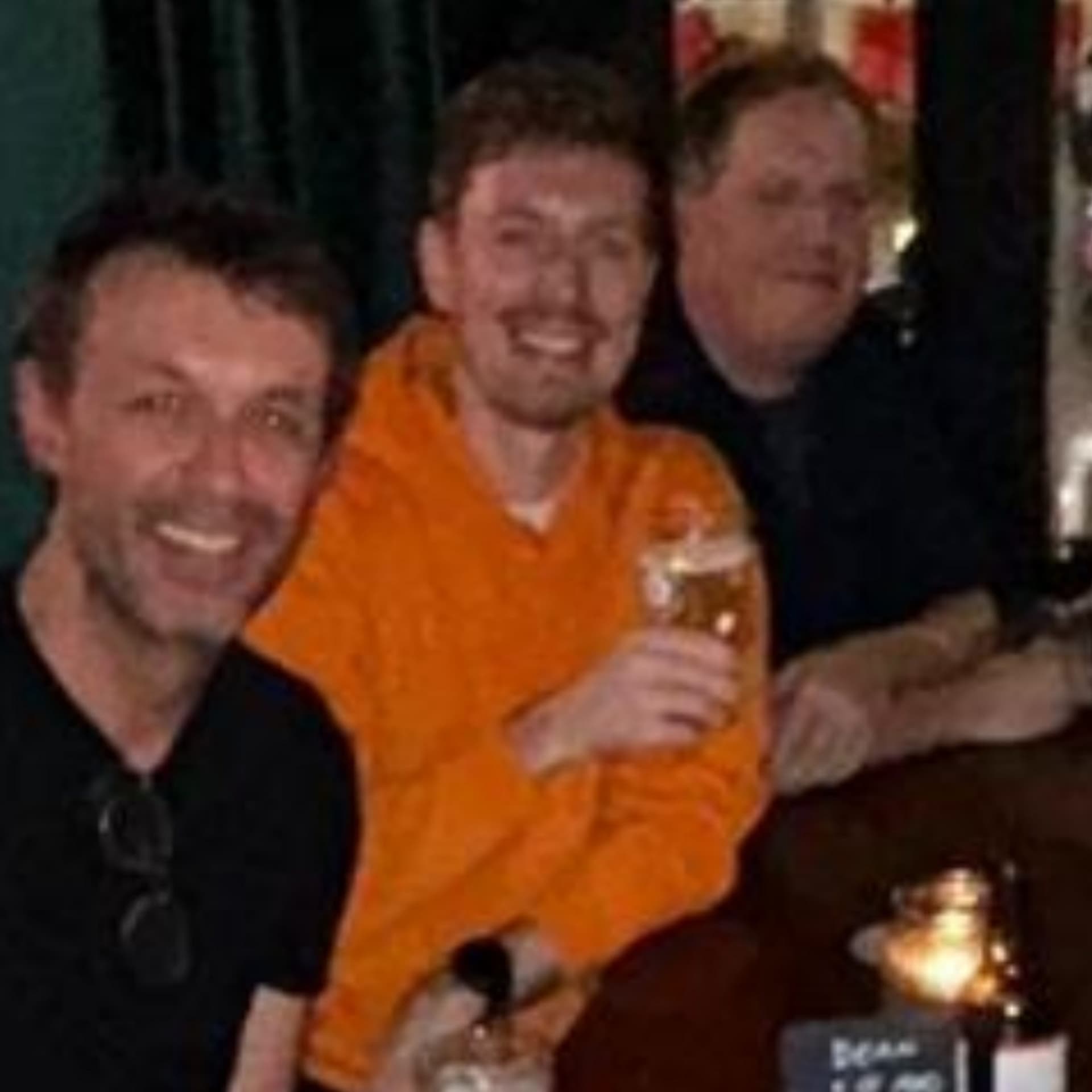
Photo: Dean Perryman hosting an Empty Chairs event in his distinctive orange hoodie. Credit: @EmptyChairsUK