
In short
The Happy Pod (BBC World Service) is a mix of uplifting human-interest stories and creative social experiments. Topic: a teacher’s Alzheimer’s-themed fashion designs reach the Met; a Swiss “bus to nowhere” promotes face-to-face connection; a Canadian tow truck driver rescues a moose; a UK mother meets the recipient of her late daughter’s donated hand; a Polish influencer raises £50m via a nine-day livestream; Chilean communities restore threatened wetlands; and “Singing with Nightingales” pairs musicians with wild birds.
Guests/backgrounds
Nadia Pinckney, Scottish art and fashion teacher inspired by family Alzheimer’s; Rebecca Wood reports on Swiss Line Zero; Clint Gottinger rescues moose “Rebel”; Jackie Kerwin meets Georgie Peterson’s hand recipient; Branka Lesedisar reports on Pyotr Hanka (“Latvogang”); Jane Chambers reports on Chile’s wetland restoration (Luisa Valenzuela, Loreto Arriagada); Anna Foster interviews Sam Lee on nightingale concerts.
Key claims/examples
Met curator contacted Nadia; her designs use brain-scan “tangles” and red/grey/white symbolism and will enter the Met’s permanent archive. Line Zero has no fixed route/timetable; passengers sing and connect; driver collects “experiences” not tickets. Clint says moose was in ice all day; neighbors helped; Rebel became famous online. Jackie holds Georgie’s hand again; Georgie donated after PVNH diagnosis. Pyotr listened to a viral charity track on loop for nine days; 1.4m viewers; money to Cancer Fighters Foundation. Chile wetlands act as “giant sponges”; project removes dumps and reconnects floodplains. Sam Lee’s concerts let nightingales “adapt” to musicians; Charlotte Church is cited.
Written by AI. May contain mistakes. Listen to the episode to check what was said.
Chapters
Tap a time to open that second in VONadia Pinckney's Designs at the Met
1:24 to 2:27
Nadia Pinckney discusses her journey and design inspiration for the Met.
“thinking, wow, all the people that have already walked past this through the Met Gala.”
Creating Meaningful Fashion
2:27 to 6:02
Nadia explains how her experiences shaped her fashion designs.
“Nadia Pinckney, an art and fashion teacher from Scotland, created a line of clothes which represented Alzheimer's disease.”
Impact of Art on Conversations
6:02 to 8:17
Nadia shares the emotional impact her work had during the exhibition.
“So for it to end up in the Met, and it's after the exhibition closes in January 2027, they've asked to keep it and put it as part of a permanent archive.”
The Bus to Nowhere in Switzerland
8:17 to 11:01
Exploration of a unique bus initiative in Switzerland that fosters social connections.
“To Switzerland next and a bus that's taking people nowhere.”
A Truck Driver's Unusual Rescue
11:01 to 13:52
Clint Gottinger recounts his heroic moose rescue from an icy trap.
“To Canada now and a truck driver's unusual rescue mission.”
A Touching Story of Donation
17:31 to 20:10
A story about a mother meeting the recipient of her daughter's hand transplant.
“A mother here in the UK has been able to hold her daughter's hand again a year after she passed away from a rare brain condition.”
Influencer Raises Millions for Charity
20:12 to 22:01
An influencer's non-stop livestream raises significant funds for childhood cancer.
“It all started with a charity single by the Polish rapper Bedoes.”
Wetlands Restoration Efforts in Chile
22:03 to 26:42
Local communities work to protect and restore wetlands in Chile.
“Many are protected by an international agreement that recognises their vital role in cleaning water, supporting wildlife and preventing flooding.”
Singing with Nightingales Project
26:45 to 28:00
Musicians improvise music with nightingales in a unique conservation project.
“on People Fixing the World, wherever you get your BBC podcasts.”
Musical Conversations with Nightingales
28:00 to 30:13
Explore the unique interactions between musicians and nightingales in a magical setting.
“And there we begin to make a musical conversation, a little bit like that recording there made over 100 years ago.”
Transcript
Automatic transcript. May contain errors.0:00Nadia Pinkney:This BBC podcast is supported by ads outside the UK.
0:31America's Social Casino. Download the Moto Casino app today. Pool days call for cookouts and lots of laundry. This Memorial Day at Lowe's. Save$80 on a Charbroil Performance Series 4-Burner Gas Grill. Now just$199. Plus, get up to 45 % off select major appliances to keep dishes, clothes, and food fresh. Having fun in the sun is easy with us in your corner. Our best line-up is here at Lowe's. Ballot through 527. While supplies last, selection varies by location. See associate or lowes.com for details. This is the Happy Pod from the BBC World Service.
1:17I'm Holly Gibbs and in this edition, the teacher whose university designs ended up on display at the Met. It was almost like an outer body experience, just being in amongst all these amazing artists and designers, thinking, wow, all the people that have already walked past this through the Met Gala. It was just amazing. Also on this podcast, why people in Switzerland are catching a bus to nowhere. They sing, they laugh, they speak. It is a try to bring more humanity back into the daily life. A woman who's able to hold her late daughter's hand again. It's absolutely one billion percent, Georgie's hand.
1:57Yeah, no doubt whatsoever. It's amazing, yeah. To know there's a little piece of her still there. The nine-day live stream that's raised millions of dollars for a cancer charity. And... That sign over there, my granddaughter painted it. It says, I love the wetlands. I want my granddaughter to be able to say, my grandmother stood up for this. She fought to leave us a better world. The fight to save Chile's wetlands for the next generation.
2:26We start with a story about how one teacher's designs ended up on display at one of America's most prestigious museums. Nadia Pinckney, an art and fashion teacher from Scotland, created a line of clothes which represented Alzheimer's disease. She made the collection as part of her degree 10 years ago, and the items were then stored in a cupboard in her classroom. That was until last year when Nadia got a message from a curator at the Metropolitan Museum of Art in New York asking for her designs. The clothes are now part of a new exhibition on costume art. I caught up with Nadia fresh from her trip to New York and started by asking her what inspired her collection all those years ago.
3:08I had grown up with my grandmother on my dad's side and my great-grandmother on my mother's side, both had Alzheimer's. And probably between the ages of like eight and 19 year old, I was visiting care homes multiple times a week and seeing all these people with Alzheimer's and dementia. And so it was really that that kind of drove the theme to start off with. And then I was just really lucky that Alzheimer's Scotland let me in and speak to their researchers. And I got access to different patients' brain scans. they had discussions to me and put into quite simple terms so I could understand what happened so basically when the disease enters the brain it starts to tangle and not all the neurons which is why then people can't access their memories because there's basically a blockage and so because of that I then used the tanglement and the knots within the range quite heavily and then the other thing was about I feel like a lot of people refer to dementia and Alzheimer's that the person's like slowly fading away.
4:15So I wanted to make sure that it was almost like one colour and it was slowly getting muted. So there was a tone of black, grey and white in there. And when I was speaking to Dr Tom Russ with the brain scans, he was telling me that the colour red symbolised the area of the brain that was still very much active. So even in the most severe cases of Alzheimer's, there's always still a little part of the brain that's red. The colour red tied in lovely because my great-grandmother's favourite colour was red so it was quite nice that the symbolism behind it connected in with the science but also in a personal level as well.
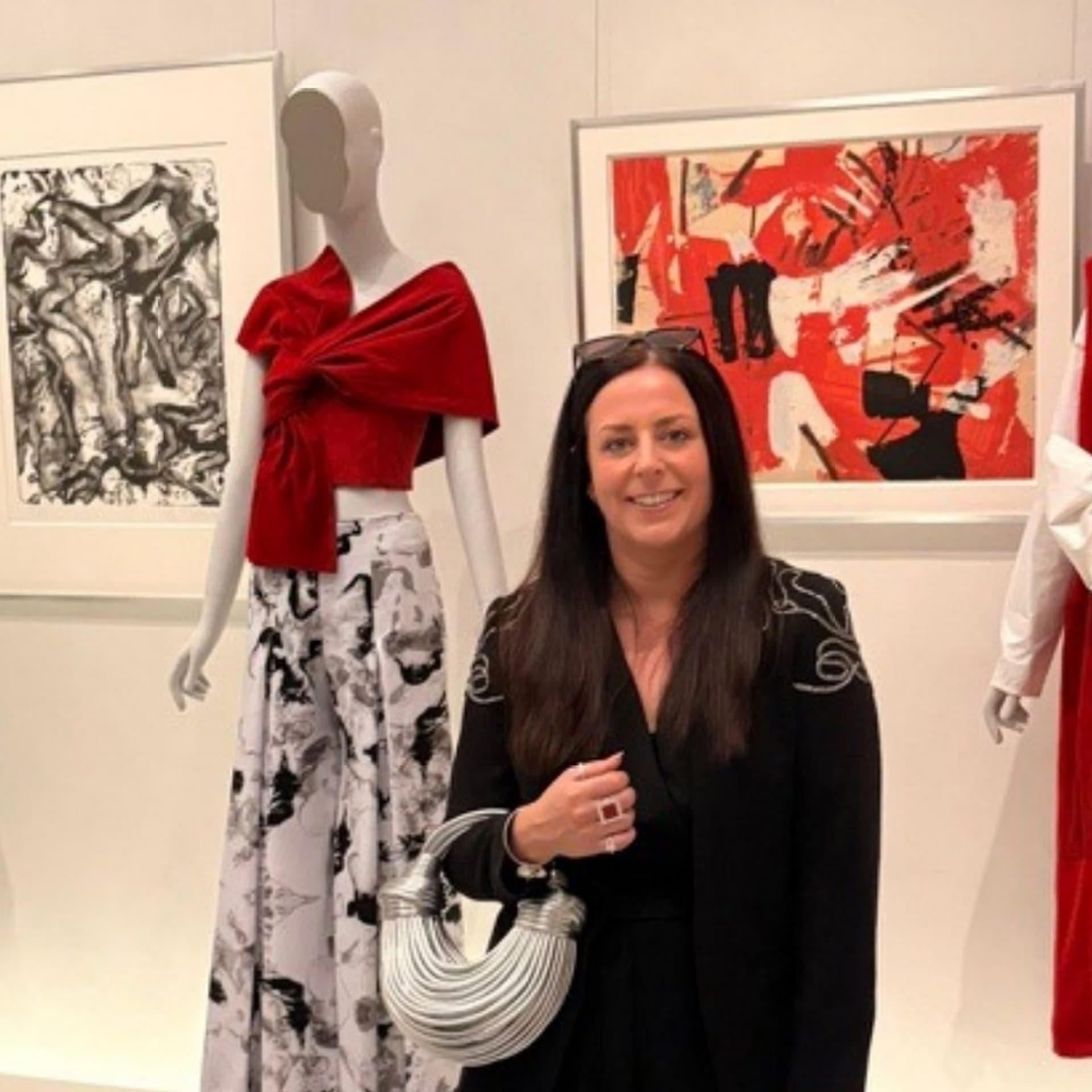
4:53So then one day you get a message from a curator at the Metropolitan Museum of Art. What happens next? Yeah well that message came through on a Friday evening and I thought well this has to be a scam and then I realised oh this is actually a serious thing and I thought I don't know if I've got all these pieces I went into the school and was able to gather the pieces that I had however they really wanted the brain scan tangled coat which I actually just hadn't kept because it was quite a large piece and they said okay we'll take what you've got but could we also ask you to remake the coat when you see the exhibition you can see the link of the brain scans and the artwork from de Kooning that we've paired it with so I can now clearly see why they wanted that specific piece to be part of something that's trying to celebrate everybody and say everyone has a say in fashion and you know everyone can choose exactly what they want to wear and let's celebrate everybody I think that was a really lovely thing to be part of people have asked me like what's you know it's dreams are made of, isn't it?
6:01Did you ever dream that this would happen? I was like, no. I never expected it to go anywhere. So for it to end up in the Met, and it's after the exhibition closes in January 2027, they've asked to keep it and put it as part of a permanent archive. And can you describe what it was like seeing your pieces there on display? I've been told that my work was in the exhibition, but I hadn't been told how much or how little would be in the exhibition and we kind of walked into the first gallery and you could see the work and it had the blurbs I mentioned both my grandmother and my great-grandmother I think it was almost like an outer body experience just being in amongst all these amazing artists and designers and thinking wow all the people that have already walked past this through the Met Gala it was just amazing and I think what was more overwhelming to be honest was when other people were looking at the work and reading the blurb and the conversations that those people were having was just amazing to watch because you know somebody would be like oh you know like my mum had Alzheimer's or my dad had that and it resonated with them and it opened up this conversation you know it's easier not to talk about it and actually if the whole thing has meant that one person feels more seen or heard or valued.
7:25That's the main goal. It's to raise awareness. What's your message for people who might be designing fashion items about thinking really outside the box like you did and taking inspiration from something that is quite sad, but as you say, making it something that raises awareness? I think, I say this a lot to the kids in my classroom as well, like don't let anyone ever tell you no if you're quite clear and you're quite passionate and you have a vision for something then you have to run with it and especially in a creative process like it's never straightforward you're not going to please everybody and you have to be confident in your own abilities first and as long as you're trying your best like I would just say you know definitely go for it do what you want to do I mean worst case if it goes wrong and you stop that project and start a new one.
8:18Nadia Pinkney. To Switzerland next and a bus that's taking people nowhere. Yes, you did hear that right. It's a social experiment which is encouraging its passengers to slow down and connect with people face to face. Rebecca Wood has the details. Where are we going? Up to the mountains. With no fixed route, no timetable and no destination, the Line Zero bus in Baden, Switzerland, offers passengers a different kind of commute. The service encourages people to hop on and enjoy the social connection, and is the brainchild of conceptual artists and twin brothers Patrick and Frank Ricklin. People don't take it to go from A to B, they take it to experience the journey itself.
9:05They sing, they laugh, they speak. one person had a birthday, suddenly the whole bus was singing. It is a try to bring more humanity back into the daily life. It's a counter idea to what we see as a kind of a zombification of society. As Frank says, it can give passengers a break from their normal daily routine, a time to put their mobile phones down and connect with others in real life.
9:37Nadia Pinkney:everyone's happy and everyone's talking to each other it's a lot noisier because of it but it's fun i'd definitely recommend it it's just so unplanned and spontaneous we sang on the bus we talked to everyone we turned on our phone flashlights in the tunnel it was just amazing we even had an ice cream party it was really cool you can ride on the bus for free and instead of Taking tickets, the driver, like Thomas Bosshard, collects experiences. It's crazy, but it's a good idea because you go out of the usual work every day and you can do something a little bit crazy too. It's a cool idea, I think.
10:18But having a real bus driver like Thomas and looking like a normal public bus means the service does sometimes pick up an accidental passenger or two. Here's Frank again. We had a lot of people that were in the line zero without knowing it. Funny was that one of these persons was a second time in the line zero, three, four hours later. And then we asked, oh, again, you are in the wrong line. And then she said, no, now I decided for the line. It's a decision. I wanted to be here. The Ricklin brothers hope that if this creative concept catches on, the bus could make stops in other places too. Rebecca Wood reporting.
11:03To Canada now and a truck driver's unusual rescue mission.
11:07Nadia Pinkney:I just backed up to my house and I phoned the wife and I said, bring out some blankets, I got a moose. That's Clint Gottinger. He'd been on his way to help some humans in his tow truck when he spotted a moose that had fallen through some ice. He's been speaking to CBC News. About a kilometre from my house, there's a junction. And I see an across, and there that poor guy was in the ice, froze in the ice there. I drove up beside him and looked, oh, I can't leave him. So, yep, everyone will have to wait. This is a priority. And I'm thinking, yeah, I'm pretty sure I can just slide the deck down to him.
11:40Nadia Pinkney:And I know I've got a soft sling I can throw around him. I'm sure we can pop about. And it worked out great. Pretty leery to walk up to him at first, but he was so tired and exhausted. He's been in there for a long time. And I took that nice sling and I threw it around and I wanted to get under his arms and stuff, but couldn't quite. So I just went around his neck area. And so I started winching and pulling and he was helping a bit. About that time, my neighbors showed up. We got the sling around his butt and popped him right out. Talked to another neighbor. They saw him there at 8.45 in the morning and I got him out at 5.30 at night.
12:15Nadia Pinkney:So he was, yeah, he was in there all day. And once I pulled up there, this moose sitting on the deck, she'd come running out with blankets. And we set a nice big blanket down on the ground. And I set him down nice on there. And then, yeah, he let us put a blanket over top of him. I think once I pulled him out onto the deck, he was pretty happy to get out of there. But I'd go out there once in a while. I'd scratch his cheek. He let me scratch his cheek in his ear. And he liked that. So then about later in the evening there, 8, 9 o 'clock, I went and checked on him. And he was still laying there.
12:46Nadia Pinkney:I'd give him some oats, but he wasn't eating. Then before we went to bed at 11 o 'clock in the dark, I went out there, and here he was standing. So I thought, well, let's see if I can walk up and scratch his cheek again, eh? But he kind of grunted and put his leg up. Oh, you're still wild. So we left him. And then the next morning, he was still laying there, but across the road more. So he was kind of moving around a little bit. But that was all day Sunday. He hung around. Once in a while, I'd look, he'd be standing. Next time, he'd be sitting. And I'd go out there when he was sitting and he would let me scratch him.
13:17Nadia Pinkney:And my wife's mad at me. Stop walking up to that guy. You're going to get hurt. And then the next morning he was gone. Remember, like I said, I was on these two tow calls, you know, a long ways away. So as I'm playing with Rebel, the moose here, people are phoning. Where are you? Where are you? Whereabouts are you? So I had to explain to them, well, something came up. Once I told them I'm digging a moose out of the ice, they were very understanding and oh no that's fine so my customers were very understanding with that. And the calf named Rebel is now arguably the most famous moose in Canada. The rescue has been a hit on social media and people have been commenting saying that there is still kindness in the world.
14:05Coming up on the Happy Pod. An exquisite meditation occurs as the Nightingale starts to sing with us and incorporate our human music into their avian song. The improvised concert celebrating Nightingales.
14:26From lashes for days with the Viral Liquid Lash Extensions Mascara to lift and colour from the brilliant eye brightener. Thrive Cosmetics is the go-to for amplifying everyday looks. Plus, every product is 100 % vegan, cruelty-free, and made with clean skin-loving ingredients that work with your skin. Amplify your everyday. Go to thrivecosmetics.com slash shine26 for an exclusive offer of 20 % off your first order. That's Thrive Cosmetics. C-A-U-S-E-M-E-T-I-C-S dot com slash shine26.
14:57Nadia Pinkney:Your social media feed says eat more protein, track your sleep, boost your VO2 max. Wake up and cold plunge. Cleanse yourself of parasites. You're intrigued, but confused. So where can you turn? Welcome to Health vs. Hype, the show where we take the loudest wellness trends on the internet and ask the questions only science can answer. What's real, what's exaggerated, and what is completely wrong. I'm Trace Dominguez. Each episode, we show the science behind viral health claims, from high-protein diets to cold plunges, detoxing to sleep tech obsession. And we talk to the people in the middle of it all.
15:35Nadia Pinkney:Influencers, the curious, but more importantly, doctors and researchers. Not to cancel the trend, not to hype it more, but to understand it. Listen to Health vs. Hype with the American Medical Association on the iHeartRadio app, Apple Podcasts, or wherever you get your podcasts. Slow the scroll. Start asking better questions. The U.S. Virgin Islands invites you to discover the stunning beauty of St. Thomas, St. Croix, and St. John. The U.S. Virgin Islands is truly a magical place, one of a kind, and unlike any other destination. With incredible food, warm hospitality, vibrant culture, and breathtaking beaches, it's everything you could want in a vacation.
16:17And the best part? No passport is required when traveling from the U.S. No hassle, just easy travel. Whether it's the world-famous Trump Bay in St. John that was voted the best beach in the world, the picturesque Megan's Bay Beach, or the stunning Point Udall, America's easternmost point, USVI will take you to a place that no other Caribbean destination can match. For most, the U.S. Virgin Islands is just a quick nonstop flight or a simple connection away. Start planning your getaway to America's Caribbean at visitusvi.com. That's visitusvi.com. USVI, naturally in rhythm you ain't heard about Moto Casino Moto has real Vegas slots any game you can find on the floor in Vegas you can play it on Moto I like my slots hot, Moto's free to play like food stamps, in line at the grocery store at a funeral, in traffic, keep your eyes on the road hop on Moto Casino Moto Casino got jackpots that are bigger than my belly Moto, America's hottest free to play social casino download the Moto Casino app today Moto Casino is a social casino board we're prohibited, no purchase necessary visit Moto.us for more details
17:31You're listening to The Happy Pod. A mother here in the UK has been able to hold her daughter's hand again a year after she passed away from a rare brain condition. 33-year-old Georgie donated her hand and her mother Jackie has been to meet the recipient. As Kate Bradbrook reports. Morning, how are you? Two women brought together by a series of life-changing events. Eight years ago, Kim Smith lost all four limbs to sepsis. Last year, she received a rare hand transplant from her donor, Georgie Peterson. After sending an anonymous letter via the transplant team to Georgie's mum, Jackie, the pair decided to meet.
18:16It's absolutely one billion percent Georgie's hand. Yeah, no doubts whatsoever. Freckles, little mark here. It's amazing. Yeah. Yeah. To know there's a little piece of her still there. I didn't expect to actually end up meeting the family. I just thought I've got to send a letter and say thank you. I just thank you doesn't seem enough for this because it's just such an incredible gift that's given me so much independence. Georgie was 33 and was living with a rare brain condition called PVNH, which caused epileptic seizures and cluster headaches. Human sunshine, that's how I would describe her.
18:56When she was 17 and she was diagnosed, she came to me and said, I've signed the organ donor register and if anything happens, this is my wishes. and that she didn't want to be kept alive if it wasn't fully her. I've been able to finally hold my youngest granddaughter's hand and I can actually feel it now. I don't have feeling like other people do, but I've got sensations so I can feel touch and things like that, which is absolutely incredible. NHS Blood and Transplants say limb donation is rare and not covered by the organ donor register. If organ donors are a match and are close by, limb donation can be discussed with loved ones.
19:40When I was asked about limbs, I kind of paused for a minute, I thought, what is the difference? If I'm given heart, liver, lungs, kidneys, what difference does it make? And it will change somebody's life, so yeah. How do you feel when you're holding her hand? Like I'm holding Georgie's hand. Feels amazing. Do you get comfort from that? Yeah, yeah, absolutely. Jackie Kerwin ending that report by Kate Bradbrook Here on the Happy Pod we love hearing from our listeners and we've had someone get in touch about our next story so thank you to Inga in Poland an influencer there has raised millions of dollars for a cancer charity by hosting a nine-day non-stop live stream Branka Lesedisar has the story
20:33Broadcasting from a flat in Warsaw saw 23-year-old Pyotr Hanka, better known as Latvogang, managed to raise£50 million for a children's cancer charity. It all started with a charity single by the Polish rapper Bedoes. Pyotr had promised to listen to a second of the track for every like of the video he'd shared. So when the song went viral, he ended up listening to it on a continuous loop for the whole nine days. The live stream was supported by musicians, celebrities and sports stars, including Cold place Chris Martin and Grand Slam champion tennis player Iger Sviatek. Sviatek sent in a video message encouraging others to donate too.
21:13I would like to support this by donating 100 ,000 Zloty and two tickets to my Wimbledon match, so I highly encourage you to donate. Hanker's online marathon began on April 17th and finished on Sunday, April 26th. At one point, it was being watched by 1.4 million people. Supporters gathered outside the flat as it came to an end, celebrating the huge achievement.
21:40The money raised, which was more than three times the previous record for a livestream fundraiser, went to the Cancer Fighters Foundation, a Polish organisation that supports children with cancer. The charity has pledged to publicly account for all the money received, so everyone who's been a part of the campaign can see their commitment translate into real help. Branka Lesedisar reporting. Chile is home to thousands of wetlands. Many are protected by an international agreement that recognises their vital role in cleaning water, supporting wildlife and preventing flooding. But they're under threat, often used as land for new homes or illegal rubbish dumps.
22:20Now, though, many local communities are working to restore them. Jane Chambers went along to the central city of Concepcion to find out more. The city's built on low, flat land near rivers and the sea, so water builds up easily when it rains. I met local resident Luisa Valenzuela, who lives right next door to the Rokuant-Andalien wetland, one of the most important and threatened wetlands in Concepcion.
22:50Living here is difficult, especially in winter. With illegal dumping and construction, the water now rises enough to get into our homes, and sometimes the sewage system overflows. It's really affecting people's quality of life, especially older residents. The illegal dumping and building means the wetlands are filling up with rubbish, buildings and concrete. The water can't soak into the ground. Instead, it runs off quickly, which makes flooding worse. A few years ago, Louisa saw something which made her decide to take action.
23:25I saw trucks dumping rubble near my house and a pair of ducks diving at the truck and trying to defend their home probably because they had a nest and young ones there that's when I realised I couldn't just watch I had to become a voice for the species that live here I'm in Louisa's local wetland and she's jumping up and down showing me how springy the ground is She wants me to understand that wetlands are giant sponges. Beneath the surface, water flows through hidden channels, helping them soak up rain so it doesn't rush into streets and homes. The wetlands then release the water slowly, reducing the risk of flooding.
24:07And jumping with her is someone who has a plan to use wetlands as a solution.
24:16Nature-based solutions involve developing infrastructure that imitates nature in order to restore the riverbank and reconnect it with the floodplain. That's Loreta Arriagada, the local coordinator for Audubon, an international non-profit environmental organisation. She's working with them, BirdLife International, and the Development Bank of Latin America and the Caribbean on a project called the America's Flyways Initiative. This project is about restoring wetlands so they can actually work again. Right now, a lot of them are fragmented. They've been cut up by development, so they're not functioning as one system.
24:55And if you restore them, they can start working together to manage water. Loreto thinks government money could be better spent on this issue.
25:07At the moment, most money goes into dealing with floods after they happen. This project is about prevention, fixing the wetlands so flooding doesn't happen in the first place. Once the funding's there, the project involves removing landfill sites and small illegal dumps. They'll create terraces with drainage so water can soak into the ground and flow naturally. It will also reconnect the wetlands water system and restore the riverbanks so water can move between the river and the wetland, spread out and soak into the soil. This helps reduce flooding during heavy rain and protects nearby homes.
25:45Luisa wants Loreto's project to go ahead so that more of her beloved wetland is restored to its former glory and she wants to show me some of the things she loves about it including a space in the heart of the wetland We're just entering the magic forest and there's a sign, a brightly coloured sign with a dragonfly Tell me about it, cuéntame
Read the full transcript
26:11That sign over there, my granddaughter painted it when she was five. It says, I love the wetlands because she's learnt so much here. She can recognise the plants and understand nature. If we don't take care of these places, the situation is going to get worse. There's already water scarcity and these wetlands are where the fresh water is. So their future is at risk if we don't protect this. I want my granddaughter to be able to say, my grandmother stood up for this. She fought to leave us a better world. That report was by Jane Chambers, and you can hear more about efforts to preserve Chile's wetlands on People Fixing the World, wherever you get your BBC podcasts.
26:52We end with a harmony of arts and nature.
27:00That's the sound of a nightingale, a bird known for its beautiful song. So much so that in 1924, a cello player persuaded the BBC to broadcast live from her garden, where a nightingale had begun singing as she practised.
27:29That recording has inspired people to gather at dusk for improvised performances with wild nightingales in southern England. The project, called Singing with Nightingales, was founded by musician and conservationist Sam Lee. He told the BBC's Anna Foster how they do it. Very sensitively, because this is their mating song after 11pm, myself, a guest musician, and a small audience will very sensitively go and sit right at the feet under the blackthorn bush of a wild bird And there we begin to make a musical conversation, a little bit like that recording there made over 100 years ago. And an exquisite sort of meditation occurs as the Nightingale starts to sing with us and incorporate our human music into their avian song.
28:20Yeah, describe to me how they respond to it, because they clearly get something from it. Otherwise, they could quite happily fly away if they wanted to. I still disbelieve myself sometimes when I say it, but just a few hours after last night's concert and there we sat under the stars. And as the musicians sang and played, we just experienced this way that the bird starts to adapt his voice and come into tune with us and rhythm and really starts to listen deeply to what we're playing and find that harmony, that unison. and their voice amplifies, it grows, and he starts to really come into some sort of rhythm and play with us.
29:04It does beggar belief, I must admit. What we are celebrating is the joy and the survival of the population here, and their voices are of such expressiveness. But the sadness is, is that we are listening to a relatively significant, if small percentage of the nation's nightingales that are left. We're just hearing a small fraction of what it used to sound like. And what we played was the sound of a nightingale and a cello. But actually, you've got a real range of different artists, different music who are doing this. And it works every time. It really does. And the nightingale responds differently to every musician.
29:44They are so very good at reading. So when Charlotte Church sang last weekend under the full moon on May Day, she channeled and the nightingale really found a soulmate. And every player and every instrument has a different sort of interaction. And that's part of the magic. No two nights are alike. And every evening, the journey we go on is completely unique. And every audience falls into a complete spell. I think this is what's so important. It's spellmaking stuff. Sam Lee.
30:20And that's all from the Happy Pod for now. We'd love to hear from you. As ever, the address is globalpodcast.bbc.co.uk. This edition was produced by Rachel Bolkley. The editor is Karen Martin. I'm Holly Gibbs. Until next time, goodbye.
30:43I'm Kyra. I'm Carter Sherman. Welcome to Stateside with Kai and Carter. We're a new show from The Guardian. We're talking to big thinkers and the best journalists, just trying to understand the world through smart conversation and honest reporting. We don't have billionaires telling us what to say. Stateside with Kai and Carter will come out three times a week, Monday, Wednesday, and Friday, starting May 13th. Subscribe on YouTube or wherever you get your podcasts.
From the publisher
We meet a teacher whose college fashion designs have gone on display at the famous Metropolitan Museum of Art in New York. Nadia Pinkney says she was shocked when the curator said they wanted to display her collection, which was inspired by a family history of Alzheimer's disease. She describes seeing the exhibition as an out-of-body experience and hopes it will encourage more people to talk about difficult topics like dementia.
Also: the passengers catching a bus to nowhere in Switzerland. The project is designed to encourage people to slow down and talk to new people face to face.
The mother who's found comfort from being able to hold her late daughter's hand again, after it was donated for a rare transplant.
The Polish influencer who's raised millions of dollars for a cancer charity by hosting a livestream for nine days, non-stop.
The grandmother fighting to preserve Chile's wetlands for the next generation.
Plus the Canadian truck driver who rescued a moose called Rebel; and why musicians in southern England are holding improvised concerts with nightingales.
Our weekly collection of inspiring, uplifting and happy news from around the world.
(Photo: Nadia Pinkney with her designs on show at the Met in New York. Credit: Nadia Pinkney)
Presenter: Holly Gibbs. Music composed by Iona Hampson