
In short
Global News Podcast Summary
Episode Title
The Happy Pod: Sending my mother's ashes around the world
Episode Overview In this touching episode of "The Happy Pod," presenter Nick Miles explores themes of grief, conservation, and innovation through personal stories and uplifting news. The episode features Cara Melia, who has embarked on a unique journey to honor her late mother's wish to travel, alongside significant conservation success stories involving tigers in Thailand and starfish in California.
---
Key Themes and Discussions
- Grief and Healing Through Creativity
- Guest: Cara Melia shares her story of honoring her mother, Wendy Chadwick, who passed away from an undiagnosed heart condition.
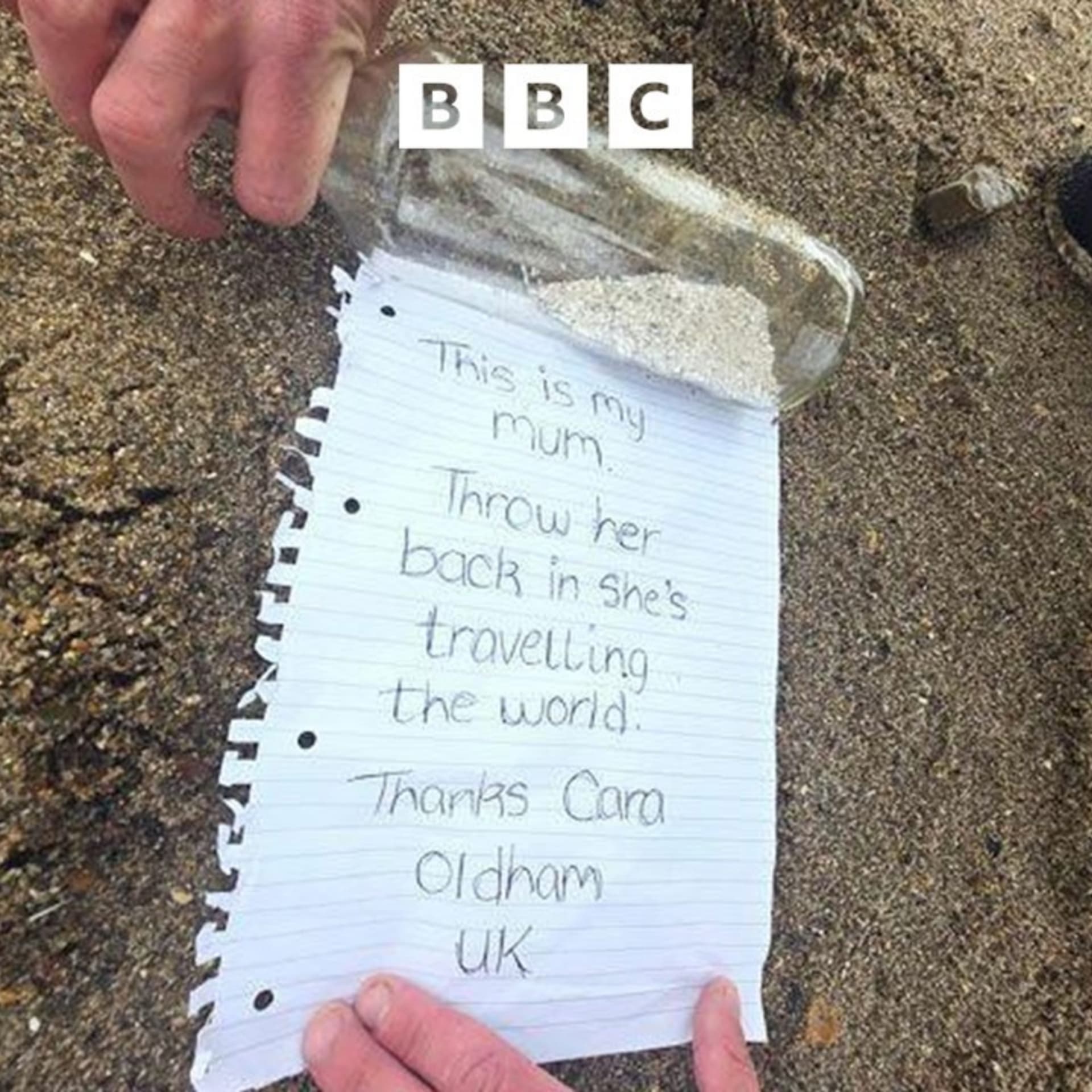
- Concept: Cara decided to send her mother's ashes out to sea in a bottle, with a note encouraging finders to "throw her back in," allowing her spirit to travel the world.
- Response: The story went viral, resonating with many and inspiring them to consider similar acts to cope with their grief.
- Impact: Cara's initiative has drawn attention to the power of creativity in healing, showcasing the ways people can celebrate the lives of loved ones.
- Tiger Conservation Success in Thailand
- Overview: Reports indicate a substantial increase in the Indo-Chinese tiger population in Thailand, from 40 to around 200 over 15 years.
- Initiatives: This success is attributed to collaboration between the Thai government and the WWF, which included breeding deer to increase the food supply for the tigers.
- Insights from Expert: Tara Piri, an ecology lecturer, explains the factors contributing to the decline in tiger populations and emphasizes the importance of habitat restoration.
- Restoration of Kelp Forests in California
- Challenge: The kelp forests off California have been devastated due to a surge in purple sea urchins, exacerbated by the decline of sunflower starfish caused by disease.
- Breakthrough: Scientists are now successfully breeding sunflower starfish to help restore balance in the ecosystem.
- Future Plans: The goal is to reintroduce these starfish to combat the urchin population and rejuvenate the kelp forests, which are crucial for marine biodiversity.
- Innovative Solutions for Water Access in Pakistan
- Challenge: Millions in rural Pakistan lack access to clean water, burdening women and girls who trek long distances for water collection.
- Invention: Nehda Sheikh introduces the H2O wheel, a device that transforms water collection from a physical strain to a more manageable task.
- Impact: The H2O wheel has not only improved physical health but also empowered women economically and socially, allowing children to return to school.
- Further Developments: Alongside the wheel, solar-powered water facilities have been installed, significantly enhancing water quality.
- Creating Happy Spaces in Hospitals for Children
- Program Overview: Seattle Children's Hospital employs immersive video games to help young patients cope with the stress of hospitalization.
- Innovative Approach: A Minecraft version of the hospital has been developed to familiarize children with the environment and alleviate fears.
- Personal Experiences: Patients and parents share how this program has made a significant difference during long hospital stays.
- Cultural Shifts in Parenting in South Africa
- Highlight: A new celebration called a "nappy braai," akin to a baby shower, is gaining popularity among men in South Africa.
- Community Building: Azola Muzukandabo discusses how this event fosters support and a sense of community for fathers-to-be.
- Personal Reflection: Azola emphasizes the importance of being present in a child's life and how this event represents a new narrative of fatherhood.
---
Conclusion This episode of "The Happy Pod" effectively intertwines themes of grief, environmental conservation, and innovative societal changes. By sharing stories of personal loss and triumph, the episode inspires listeners to find joy and meaning in life's challenges while highlighting significant progress in conservation efforts and community empowerment.
Contact Information
To share your story or feedback, email
globalpodcast@bbc.co.uk.
---
Note This summary captures the essence of the episode while highlighting key discussions, insights, and impactful stories, providing listeners with a comprehensive understanding of the topics covered.
Written by AI. May contain mistakes. Listen to the episode to check what was said.
Transcript
Automatic transcript. May contain errors.0:00This BBC podcast is supported by ads outside the UK. If journalism is the first draft of history, what happens if that draft is flawed? In 1999, four Russian apartment buildings were bombed, hundreds killed. But even now, we still don't know for sure who did it. It's a mystery that sparked chilling theories. I'm Helena Merriman, and in a new BBC series, I'm talking to the reporters who first covered this story. What did they miss the first time? The History Bureau, Putin and the Apartment Bombs. Listen on bbc.com or wherever you get your podcasts. This is The Happy Pod from the BBC World Service.
0:49I'm Nick Miles and in this edition, an unusual version of A Message in a Bottle. Even when things are really tough then, you know that you're going to find something to be happy about in it. When you get to the other side of it, you are going to be smiling at some point. Why one woman decided to send her mum's ashes on a journey around the world. How breeding deer helped a remarkable recovery for endangered tigers in Thailand. And... My favourite part about the hospital model is that they can go to their room and jump on the bed, right? Gain a little more agency back. How computer games can help make hospitals more fun for children.
1:32We start with a story about trying to find happiness whilst grieving for a loved one. Cara Melia's mother, Wendy Chadwick, passed away at the age of 51 from an undiagnosed heart condition. Determined to keep her dream of travelling the world alive, Cara put some of Wendy's ashes in a bottle and launched it out to sea with a note that says, this is my mum, throw her back in, she's travelling the world. The bottle entered the water in the English seaside town of Skegness, and when someone posted on social media that they'd found it on a nearby beach, the story went viral. Cara spoke to the Happy Pod's Holly Gibbs and started by telling her what Wendy was like.
2:17She was amazing. She was just like the heart of the family. She was quirky, she was different, she never wanted to fit in. She never got the chance to really travel since she was a kid because obviously she had five kids of her own to look after, a mum, a brother. So she never got the chance, but like she was talking at the start of the year and the end of last year that she wanted to start travelling again anywhere that had a really nice beach and really good sun. So that's originally where the idea has come from. And what has the response been like? It's gone viral on social media. So it's been really positive from what I've seen mostly.
2:58Everyone's absolutely loved the idea. They want to do it themselves. From what I've read, it's made people cry. It's just I weren't expecting any of it and I weren't expecting it to be viral either. How does it feel to you when you have someone say to you that their story has made them cry? I'm like, well, I weren't expecting that, but I'm happy that it has touched people the way it has and I'm happy it has travelled as far as it has. Would you inspire other people who are struggling with grief and the loss of a loved one to do something similar to this to keep their legacy going? Yeah. I think it helps a lot, just like with the whole grief part, just to know that, like, I did get to fulfil what she wanted to do.
3:46Obviously, it weren't in the way that we wanted, but... Where do you hope the bottle will wash up next? Possibly, like, Barbados. or even Spain, just somewhere that's really nice and sunny for us, anywhere over the beach. What should people do if they find your mum in a bottle washed up on a beach? Well, I've had so many different comments about it, of people putting some paper in it or writing on the back of the note, but if they do find her, throw her back in. If you want to share it on Facebook or anything, tag the place that you've found her, and then hopefully it gets back to me so I can see.
4:25Talk to me about the day that you put the message in the bottle in the sea for the first time. I felt really sad, actually, but it's something that I wanted to do. It was just like saying bye to her in my own little way. So it was a good experience, it was, especially for, like, my grief. It's made me happy to know that, you know, she's out there, She may not be in body form, but she is still out there. She is travelling. I don't have a clue where she is now, but she is travelling somewhere. I think it made me feel a bit better knowing that she weren't just sat in a box. What legacy do you hope she will leave by travelling around the world in a bottle?
5:10I hope it'll inspire people, just anyone who's lost someone, that there is a way to kind of make it like a happy thing that hopefully inspires other people to do something of the sort just to manage their own emotions throughout it. What do you think your mum would say in response to all of this media attention and also to travelling the world in a bottle? Oh, she'd be... One, she'd be calling me crazy because why? Why not? and two she'd be absolutely laughing because she wasn't one to ever like want the attention or anything so for it to all just come so suddenly but she also knows that this is like the type of person I am I will make a good thing out of a bad situation hopefully she'd be laughing and seeing a good side to it like I would have drowned in the grief if I couldn't find something to try and make it happy.
6:16Because even when things are really tough then, you know that you're going to find something to be happy about in it, even though it's obviously a horrible situation. But you know when you get to the other side of it, you are going to be smiling at some point. Cara Melia, and if you found an unusual way to celebrate the life of a loved one that you think could help others, we would love to hear from you. Just send us an email or a voice note to globalpodcast at bbc.co.uk. Now to some good news for one of the world's endangered big cats. Figures released this week show there are now five times more Indo-Chinese tigers in Thailand than there were 15 years ago, from about 40 to around 200.
7:04It follows a joint project between the government and the conservation group WWF, which included breeding deer for them to hunt. Indo-Chinese tigers, which are smaller than many other species, with darker fur and narrower stripes, are only found in Thailand and Myanmar now. Tara Piri is a lecturer in ecology and conservation at the University of Surrey here in the UK. Tigers have been in trouble for a very long time, unfortunately, because, you know, that they are this majestic creature. They've got this beautiful coat. And unfortunately, there's a lot of mythical properties surrounding it as well.
7:46And unfortunately, it's really come under poaching a lot. But also the loss of habitat has really impacted the tiger because they do need a large space. They need a lot of prey. They're kind of getting hit from both sides. And so they have plummeted in numbers. So now we're looking at about four and a half thousand tigers worldwide. They are in a fragment of what they used to roam across. Now, this population of tigers, the Indo-Chinese tiger in Thailand in particular, seems to have been boosted by the reintroduction of deer in that particular area to boost the numbers of prey. Absolutely. So it's not just the boosting of prey.
8:31There's been a lot of logging in the area and again, a lot of poaching. And it's not just of the tigers, it's of the food source as well. So by regenerating, those areas have been logged and actually adding in grasslands, which is really what the deer need. And then being able to improve the deer populations. There's enough food source there for the tigers to survive. So we're seeing this amazing increase in numbers. That's absolutely brilliant. And it just shows, you know, having a really good strategy for regenerating the forest really does reap the rewards. And hopefully we can keep going with that.
9:08I mean, that is a huge effort, a massive increase in the population of this particular tiger there. Is it something that's being replicated for other tiger species? Yes, I believe so. You know, again, looking at the numbers, it's really encouraging to see. But, you know, it needs to happen on a big scale and it can't happen without money. So that's why I think, you know, having WWF behind the governments and providing funds from the general public. I mean, this is this is the big thing. You know, people across the globe have actually been able to get involved in this. So just by donating money, it provides the funds that are sorely needed to help locals get involved.
9:47and locals need to be involved because at the end of the day, if they're not involved, they don't know to conserve these animals, they will still go on and poach and log and that sort of thing. So getting them involved, making sure that they have what they need to help protect these species is absolutely vital. So it can be rolled out and it has been seen in other species. And I think we need a few wins. We need to hear about these wins. So this is why it's so important. Tara Pirri. And staying with good news for endangered animals, scientists have made a breakthrough that could help restore part of the Pacific Ocean and tackle climate change.
10:25The kelp forests off the coast of California provide food and shelter for a vast array of marine life, as well as absorbing carbon dioxide, the main gas that causes global warming. Well, in recent years, they've been devastated by a surge in purple sea urchins. But now researchers have found a way to breed a critically endangered starfish that can restore balance to this vital ecosystem. Harry Bly reports.
10:54It's easy to see where the name Sunflower Star comes from. These animals have 24 arms, like petals, and measure up to a metre wide from tip to tip. While some are a soft yellow or orange in colour, like the flower, they can also be purple or brown. These creatures once thrived along the Pacific coast of North America, but in the past decade, the population has decreased by 90%. Jessica Withley is a senior biologist at the California Academy of Sciences. The sunflower starfish is actually incredibly important. They were recently listed as critically endangered along the California coast by the ICUN list.
11:36That means that there's barely any that you would find in the California coast where you used to find them all over the place. Sunflower starfish are also voracious predators feasting on crabs, sea cucumbers, urchins and even other sea stars. That might not sound like good news but it's actually part of what makes them crucial to the local ecosystem. California has beautiful cow forests that is habitat to thousands of different animals and that habitat is being destroyed right now by overpopulation of purple urchins. Those purple urchins normally would get eaten by pycnopodia or sunflower starfish, but because of their decline after the sea star wasting disease multiple years ago, the purple urchins population has mass produced and is decimating our kelp forest, which is destroying habitat for many different species and affecting animals all up and down the California coast.
12:28But now Jessica and her team have learned how to breed them and are building up captive populations. We have a ton of larvae. So we are growing these up from flea floating larvae to tiny settled starfish to much larger juvenile starfish. The laboratory is aiming to cooperate with other aquariums across California to raise and eventually release hundreds of sunflower stars back into the wild. Already three other aquariums in the state are now caring for these creatures. The goal here is to get good and kind of break the code about how to mass produce and breed and care for these animals in our care so that then we can reintroduce them back into the wild to see surges of their numbers along the west coast.
13:15It's hoped that by reviving the population of sunflower sea stars, the tide could turn on reinvigorating California's kelp forests and biodiversity. This year, four of the starfish were spotted off the northern California coast, which scientists say is a hopeful sign of natural return. Harry Bly.
13:40Coming up in this podcast. I see these women, they have free time and they are improving their lives economically, socially, they feel empowered. How an invention that makes it easier to carry water is transforming lives in Pakistan.
14:04If journalism is the first draft of history, what happens if that draft is flawed? In 1999, four Russian apartment buildings were bombed, hundreds killed. But even now, we still don't know for sure who did it. It's a mystery that sparked chilling theories. I'm Helena Merriman, and in a new BBC series, I'm talking to the reporters who first covered this story. What did they miss the first time? The History Bureau, Putin and the apartment bombs. Listen on bbc.com or wherever you get your podcasts. Now, being in a hospital can be frightening and lonely at any age, and especially so for children. But in the United States, immersive video games are helping young patients come to terms with illness and long stays.
14:55The project at Seattle Children's Hospital is entirely funded by donors, including the charity Child's Play and some computer games companies. Scott Miles went to meet some of those involved. My name is Maximilian Williams, and I am one of the therapeutic gaming specialists here at Seattle Children's Hospital. The idea is simple. Use what children already love to help them cope with being in hospital. Max explains one way this works. It's very hard to feel achievement in the hospital because a lot of these treatments, you know, you're doing better. Everybody's telling you you're doing better, but you're feeling worse and feeling more side effects.
15:35And so feeling that journey is very difficult. But, you know, if you were able to get from level four to level seven and then tomorrow you get from level seven to level 10, it's just that little tiny engine of, you know, achievement and helps you hold on to hope in medical settings. 14-year-old Aiden, who has spent most of his life in hospital, knows this firsthand. Aiden is using a ventilator while I speak to him. Well, I like having video games here because all of my procedures, surgeries, they get really stressful for me. So it just really helps me out. For Aiden's mom, Elsa, the gaming program has been a lifeline.
16:16I think it's absolutely amazing. It has definitely helped Aiden through some really hard times. It's a great distraction, personally, even for myself. And there's one ambitious part of this gaming program, which was started by one of the hospital's senior surgeons in his spare time. Dr. Henry O spent hundreds of hours building a complete virtual replica of the entire hospital inside the video game Minecraft. I wanted to make something that would make the hospital more familiar to kids and make it less scary. So I figured, okay, you know, if they can actually go to where they are in the hospital and see it, or before they come to the hospital, ideally say, okay, I'm having surgery.
16:59Where is that going to be? What is that going to look like? For those unfamiliar, Minecraft is a video game where players build structures and worlds using virtual blocks, a bit like digital Lego. Multiple players can connect and interact together. Dr. O and I are joined by Max as the surgeon gives me a tour of the virtual hospital. Dr. O built everything from the patient's rooms to the operating theaters to help children explore the virtual hospital. Dr. O has added a few playful touches he hopes will turn the Minecraft world into something familiar and fun to navigate. I like put like little animals and then have a scavenger hunt that is like, oh, find Kelly, the cow who is in this, so that kids can navigate the hospital and learn the hospital.
17:44If this is the first impression that most, maybe many, patients have, then they have a positive association when they get here. I hope so. Yeah, that's what I hope. And importantly, other patients can appear in the virtual world alongside each other. So children who can't leave their rooms can still meet other kids and even become friends. There you go. That's a patient in their room right now having fun in the server. My favorite part about the hospital model is that they can go to their room and jump on the bed, right? Gain a little more agency back. Which they're not allowed to do otherwise.
18:17They're not allowed to do, but you are allowed to do that in the Minecraft servers. Those kids who are able to move around the hospital get together once a month on game night. Max takes me downstairs. All around the airy space are carts and tables with video games, board games, and art supplies. It's a great way for patients and staff alike to connect. It's a great opportunity for peer-to-peer connections, so patients that are on disparate units tend not to have the opportunity to meet. And we've created lasting friendships and also knocked down barriers with new staff groups. You know, a staff member who may be just passing by and they see two of their patients and they're like, oh, you know, I love Mario Kart.
18:54And they're like, what? You love Mario Kart? And so now then those daily visits are so much easier, right? That was Max Williams ending the report by Scott Miles. And you can hear more ideas on making hospital life easier for children on People Fixing the World, wherever you get your BBC podcasts. In Pakistan, 22 million people lack access to clean water. And in rural areas, women and girls often have to trek for hours to collect and carry what their families need every day. But one young woman has invented a device which makes the process quicker, easier and safer called the H2O wheel. And Nehda Sheikh's organisation, Tayuba, has also installed equipment that dramatically improves the water quality.
19:42Nehda's been speaking to our reporter Jacob Evans and began by telling him more about the challenges people face in rural areas. They carry these multiple clay pots on their heads, like 50 kgs of weight every day. And when they reach these water sources, they don't even know if the water is safe to drain. And sometimes the sources are wells, which are 400 feet deep. And it's like a tug of war. We call it a tug of war of four to five women just to get water out. That takes about 10 minutes just to get a pint of water. men do not contribute to the water collection responsibility it's only on the shoulders literally physically and mentally on the women because it's considered to be a woman only chore so talk me through what you've made and how it works we developed this simple tech enabled solution called the h2o wheel that's how we started with uh that aimed to reduce the physical burden of these women who collected water on a daily basis it's a water roller that carries water equivalent to eight clay pots aimed to solve the transportation problem.
20:50But what it did was it transformed their lives holistically. You know, as they say, Jacob, water is life. And it saved them so much time that not only did it improve their physical health, like, you know, all the back issues, chronic joint issues that they were facing, it also contributed positively to their mental health. Income prospects increased by 100 percent. Children who accompanied their mothers on these arduous journeys could now go back to schools. So this was a ripple effect just created through the provision of safe water. And guess what? It's very rare. Men started to contribute to the water collection duties because the H2O wheel, as opposed to a clay pot, was not considered a woman-only thing.
21:33And you've also improved the quality of the water. Through those rollers, they were still collecting water from unsafe water sources. So then we decided to solve the water source problem as well. And we installed solar-powered water facilities that are generating safe drinking waters in these off-grid communities in these rural areas. And now we've also launched this new revolutionary device called an H2O air device that produces safe drinking water produced from the humidity that's found in the air. so in less than three years we've provided over half a billion liters of safe water what's the impact been of this if you've seen women and girls what do they think about it how's it been for them i see these women they have free time and they are improving their lives economically socially they feel empowered they just needed a push and they are truly very happy and we've scaled this up across pakistan we went in very slow we wanted to test it we wanted to learn so i think in less in three years, we have reached almost 1 million people because of the ripple impact.
22:41You've received global recognition for this work now. How does that make you feel? Again, it's incredible. It's reassuring. It does alleviate those feelings of isolation, frustration, and sometimes anger that you feel because you do feel the burden. You know that the solutions exist. And so these kinds of recognitions are definitely important to get more people to mobilize, you know, root for you, support you. And because of the support, so many doors have been opened which would have been closed to me. Ned a shake. Now time for a celebration you might not have heard of that's becoming increasingly popular amongst men in South Africa.
23:17It's called a nappy braai and is seen as the male equivalent of a baby shower usually involving a big braai, the South African version of a barbecue and gifts of nappies to prepare the father-to-be for his new chapter as a parent. Azola Muzukandabo founded Black Dads Unplugged, a network of men supporting each other through fatherhood. He told my colleague Namolanta Combo about his own nappy braai and why this celebration represents a new kind of parenting. I walked into what I thought was a chilled Saturday braai. It was just a bunch of guys, There's not a lot of us, under 10. When I arrived, everyone burst out laughing and handed me a massive adult-sized nappy.
24:04Before I could protest, the adult-sized diaper was strapped onto me like it was some sort of sacred right. My friends brought quite a number of nappies. But for me, the gift of their time, the gift of their care, to know that they're thinking that my daughter is coming, is the greatest gift, like to be in solidarity as brothers. How did you feel about the advice you received at your Napi Braai? The thing is with men, the advice usually comes with humor and sometimes you need to read between the lines. But they were like, the first step is just being there, you know, which I think for me is very important because my first recollection, collection, first memory of my father was seven years old, you know, so for me, the advice was just be there, you know, you'll figure it out as you go.
25:00And you talked about your own dad. How has becoming a parent after you had your first child, your son, how did that make you feel about your childhood? I want to parent differently. I'm 35 right now. My father has never asked me how I am you know and I love my father I feel like I was brought up in a house filled with love primarily my mom being the conduit of that love all I ever wanted was to be seen by my father and so I want to affirm my children you know I want them to know that They are unconditionally loved. A part date for people who don't know was essentially institutionalizing racial segregation and discrimination.
25:55You know, there's an element of taking out manhood and masculinity from the Black man, which I think informed how the dads also showed up in their families. I came up with a project called Black Dads Unplugged, which is here to inspire a new narrative. It's a space where Black fathers from all walks of life come together to share, to reflect and support one another. I think we are living in a time where only the negative is being spoken about. and I know a lot of young fathers who are showing up so beautifully, so honestly and willing to learn and willing to grow and that's the story that I want to tell.
26:42You can hear more from Azola and many other interviews about parenthood, relationships and families on Dear Daughter, wherever you get your BBC podcasts. One last thing before we go. We've had a voice note from one of our listeners. At the end of every episode of The Happy Board and our global news podcast, which goes out twice a day on weekdays, you'll hear this. The editor is Karen Martin. The editor is Karen Martin. Our editor's Karen Martin. The editor is Karen Martin. The editor is Karen Martin. The editor is Karen Martin. And Ed got in touch with some concerns. This is Ed Porter from Auckland in New Zealand.
27:21In listening to the closing credits for each episode, I have become concerned that Karen Martin does not appear to have had a day off for several years. So I am now making a welfare inquiry as to her well-being. If you are not being forcibly held against your will, I would appreciate any sign you can provide to confirm all is well. Well, Ed, we put your message to Karen herself and this was her response. Ed, I really appreciate you getting in touch and the concern that you shared. I'll be sending it on to the higher ups and requesting more time off. But seriously, though, I'm lucky enough to lead a team of amazing journalists who all work really hard behind the scenes and not all of them get a name check.
28:08So luckily for me, yes, I am the editor of the overall podcast and that is a massive privilege. But do I have the odd day off? Yes, I do. Thanks, Ed. Be more Ed, everyone.
28:25And that is all from the Happy Pod for now. If you have a story you think would bring happiness or inspiration to other listeners, we would love to hear from you. As ever, the address is globalpodcast at bbc.co.uk. And you can now watch some of our interviews on YouTube. Just search for The Happy Pot. This edition was mixed by Sydney Dundon and the producers were Holly Gibbs and Rachel Bulkeley. The editor, as we heard, is Karen Martin. I'm Nick Miles and until next time, goodbye.
Read the full transcript
29:03If journalism is the first draft of history, what happens if that draft is flawed? In 1999, four Russian apartment buildings were bombed, hundreds killed. But even now, we still don't know for sure who did it. It's a mystery that sparked chilling theories. I'm Helena Merriman, and in a new BBC series, I'm talking to the reporters who first covered this story. What did they miss the first time? The History Bureau, Putin and the apartment bombs. Listen on bbc.com or wherever you get your podcasts. you
From the publisher
The woman fulfilling her mother's dreams of travel by launching her ashes out to sea in a bottle. It's brought her happiness amid her grief. Also: Thailand's tigers bounce back; and making hospitals happier for children.
Presenter: Nick Miles. Music composed by Iona Hampson