
In short
The Happy Pod episode “The art of ageing gracefully” explores how arts and culture can support health and wellbeing, and pairs that with stories of resilience and giving back. Topic: research on “epigenetic clocks” suggests regular arts engagement (performing arts, crafts, music, dance, and cultural events) is linked to younger biological age, with effects comparable to moderate physical activity; diversity of arts participation matters, not just frequency. Guests/backgrounds: Professor Daisy Fancourt (psychological/social health factors; epigenetic clocks and DNA methylation); Karen Eslier (Head of Learning, National Gallery); Lawrence Childs (Head of Digital Services; sonification for accessibility); Leonie Harm (golfer, survived a 1% chance crash, won German Masters); Laban Mwangi (Kenyan ranger for mountain bongo conservation, Tusk award recipient); Ellis Sandals (knitter of 100+ newborn blankets); William Kamkwamba (Malawian windmill inventor); Branka Lesser-Dissar (reports on Denmark’s letter-writing revival). Key claims/examples: virtual National Gallery tours and “Long Grass with Butterflies” themes support mental health; virtual tours can aid people with disabilities via sound; Leonie’s recovery included returning to golf after hospital/coma; mountain bongo patrols include removing snares and facing armed poachers; blankets help newborns and families (“From baby Aya”); Kamkwamba built a windmill from scrap after famine; Denmark’s postal service pause inspired handwritten letters turned into a “Last Post” exhibition.
Written by AI. May contain mistakes. Listen to the episode to check what was said.
Chapters
Tap a time to open that second in VOThe Importance of Art in Our Lives
1:35 to 2:49
Art plays a crucial role in expressing ourselves and our connection to the world.
“I'm Holly Gibbs and in this edition, viewing world-renowned art at the UK's National Gallery, no matter where you are in the world.”
Art's Impact on Physical Health
2:49 to 4:46
Research shows engagement in arts can affect biological aging and health.
“New research suggests that regular artistic activities, such as viewing museums and theatres, can slow down your body's biological clock in the same way as moderate exercise.”
Exploring Virtual Museum Tours
4:46 to 7:21
Discover how virtual tours can enhance accessibility to art.
“So what do we do if we can't get to galleries or museums?”
The Value of In-Person Art Experiences
7:21 to 8:20
Discussing the irreplaceable qualities of experiencing art in person.
“I have come here in person so I can experience all this in person.”
Leonie Harm's Journey of Resilience
8:20 to 11:57
Leonie shares her incredible recovery journey after a life-threatening accident.
“Lawrence Charles ending that report from Ira Khan.”
Conservation Efforts for the Mountain Bongo
11:57 to 14:00
Learn about the efforts to save the endangered mountain bongo.
“To Kenya now and one man's quest to save a critically endangered species known as the ghost of the forest.”
Conservation Efforts and Community Impact
14:00 to 15:47
Learn about the excitement of spotting rare wildlife and the recognition of conservation efforts.
“Because obviously they are so hard to actually get a glimpse of.”
Community Kindness: Knitting for Newborns
16:45 to 21:00
Discover the touching story of a woman knitting blankets for newborns to thank nurses.
“Here in the UK, a woman has knitted more than 100 blankets for newborn babies at her local hospital.”
William Kamkwamba's Inspiring Journey
21:00 to 24:55
Hear the remarkable story of a boy who built a windmill to save his village.
“In Malawi, almost 99 % of the population in the Lulo areas are farmers, depending on growing their own food.”
Reviving the Lost Art of Letter Writing
24:55 to 28:04
Explore an artist's initiative to encourage letter writing as a meaningful practice.
“We end with a woman who invited the whole of Denmark to revisit the lost art of letter writing by sending her one.”
Show all 11 chapters
Gratitude and Reflection
28:04 to 28:33
Listeners are encouraged to reflect on gratitude and share their experiences.
“We don't always make time to send things, so I think if the exhibition reminds people how nice that is and prompts them to put something in the post, then that would be great.”
Transcript
Automatic transcript. May contain errors.0:00This BBC podcast is supported by ads outside the UK.
0:30The new tropical butterfly refresher from Starbucks. Guava and passion fruit flavors with mango pineapple flavored pearls. Yeah, that feels like summer before you even taste it. Funny how one small stop becomes the best part of the day. Start your summer rhythm with Starbucks. Try the new tropical butterfly refresher from Starbucks.
1:21We'll be right back. Denton.
1:26This is the Happy Pod from the BBC World Service.
1:35I'm Holly Gibbs and in this edition, viewing world-renowned art at the UK's National Gallery, no matter where you are in the world. Art for me is absolutely crucial. If we lose that connection to things that people have made to try to express themselves or their place in the world, I think we'll be lost. Also on this podcast, the golfer given a 1 % chance of survival wins her first professional title. I was only in the hospital for like, I don't know, two and a half weeks or something. And I was like, yeah, you know what, I feel great. Seven weeks later, I was like, yeah, let me try golf again.
2:09A man who risked his life to save a critically endangered animal he's never seen. Mountain bongo, they are beautiful. They are strips. They are also special. Also, it is also found only in Kenya. Whether it is difficult or it is easy, we need to protect them. And giving back. Every time I come home from work and there's a bag full of her blankets, it makes my day. When I bring them on, the staff love seeing them, the women love them. The patient thanking the hospital that saved her sight by knitting blankets for newborn babies.
2:45It's often been said that arts and culture can benefit our mood, but you might be surprised to learn they can actually make a real difference to our physical health too. New research suggests that regular artistic activities, such as viewing museums and theatres, can slow down your body's biological clock in the same way as moderate exercise. In a moment, we'll be taking you to the UK's National Gallery. But first, let's hear from Professor Daisy Fancourt, who specialises in the psychological and social factors that influence human health. We've been looking at a particular way of measuring biological aging called epigenetic clocks.
3:22So essentially, we're all born with our set of DNA, but our lifestyles can decide which parts of our DNA get read out. So a bit like a recipe book, the recipes are there when it's printed, but we only choose to make some of them. And we've been looking at a process called DNA methylation, which is when a molecule called methyl attaches to our DNA, making it hard to read out, a bit like sticky pages in that recipe book. and as we get older there are particular patterns of DNA methylation that tend to occur so we can look at these patterns to see if someone is older or younger than the number of birthdays they've had and we found that people who engage more in the arts have got this younger epigenetic age and it's actually the same effect size for arts engagement that we see for physical activity.
4:03We looked at performing arts so making things, crafts, music, dance as well as people going to cultural events, whether that's museums or libraries or carnivals, gigs, festivals. We used a very broad inclusive index that captured a lot of modern and digital participation as well, but we found it's not just about frequency of engagement. Diversity of engagement also appears really important. We're all used to the kind of advice we have for diet and physical activity, like get your five a day of vegetables and fruit or get your 10 ,000 steps, and I think it can be helpful if we start to frame arts engagement in a similar way behaviourally.
4:39So trying to find a rule for ourselves that tries to prioritise even small amounts of engagement, but on that regular basis, ideally on a day-to-day basis. Daisy Fancourt there. So what do we do if we can't get to galleries or museums? Well, the National Gallery here in London is welcoming you to view its art from the comfort of your home, wherever you are in the world. Its free virtual tours mean that anybody can log on and see the world famous collection. Ira Kahn has been along to the gallery to find out more.
5:15This may feel like you are being transported to a field or garden on a spring morning, but it's actually what artists imagine Van Gogh's painting, Long Grass with Butterflies, sounds like.
5:29The virtual tours mean more people from around the world can feel the benefits of art. I spoke to Karen Eslier, Head of Learning at the National Gallery, about the link between art and mental health. You know, you can look at those paintings in the gallery, there's 2 ,400. You could find themes around love, life, betrayal, family, community, war, religion, belief. I mean, the list goes on. Personally, I find it incredibly helpful in my life to have a connection and a long view. If difficult things are going on in the world, there's a painting there that you can go and visit. and other people have been through that same thing.
6:07But I think really importantly as well, learning is about making mistakes, being resilient. Those artists in the gallery, you could come in and think, oh my goodness, they're so wonderful at what they do, this is out of reach. But some of those artists might have taken 30, 40, 50 years to get to that point and to be a good artist, you have to probably make terrible mistakes and go through a lot of life experiences. So again, for me personally, and I know a lot of our learners, it's about humanity essentially, isn't it? So art for me is absolutely crucial. If we lose that connection to things that people have made to try to express themselves or their place in the world, I think we'll be lost.
6:49We then went to see Van Gogh's Long Grass with Butterflies and Karen told me more about how the painting made her connect with her inner emotions. The colours in it are quite astounding and you can see the actual marks that he's made. So I love it because it connects me to him as a person. As well as looking, I can almost hear it and I can smell it and I can feel what the weather's like. There's bits of grey that look a bit gravelly. I think there'll be a crunch to this. So you can kind of transport yourself, not just with your vision but with all your senses. So what do visitors think of these virtual tours?
7:23I have come here in person so I can experience all this in person. and when I go back home, I have access to all this in digital form. I would be very happy to explore because I have limited time of my trip. I think you'd be able to consume art more regularly through that. However, I do think there is something about seeing the texture of the painting in real life and seeing how the light hits it in different directions and different angles. Lawrence Childs, head of digital services at the gallery, agrees. But he says the virtual tours also make art more accessible to people with disabilities.
7:55I think the sensory nature of what we can do with online technologies, we've done a lot of work to, as we call it, sonify the paintings. And so even if you aren't able to see, just even be able to experience the painting through the sounds that we've been able to do for that, the tours that we're able to create now, they don't replace being in front of the painting. And technology is great, but it's not quite the same as standing in front of that physical object. So we're trying to do different things. So they are different spaces. Lawrence Charles ending that report from Ira Khan. Next to a golfer who's just won her first professional title 13 years after being given less than a 1 % chance of survival.
8:36Leonie Harm was out running in 2013 when she was hit by a drunk driver. She had severe brain injuries, a collapsed lung and was put in a coma. After an incredible recovery, she turned pro in 2020 and this week won the German Masters. Leonie has been speaking to the BBC's Lucy Hockings. It was overwhelming, like, emotionally. Everyone is just flooding my phone with how happy they are for me and that this eventually had a fairytale ending. And yeah, just processing it all still. I hope you're very proud of yourself. I am. I am indeed. Take us back then. You were hit by a car when you were running.
9:19You were injured quite seriously, a 1 % chance of survival. Take us through, we have to call it a journey, this incredible journey of recovery and resilience. well i got extremely lucky because i was that morning um uh well now friend of mine uh she was a paramedic at the in the german army and i basically like fell in front of her feet as she was walking to the bus station so i would assume every other person um would have completely panicked if like someone just got struck by a car lands in front of their feet bleeding out of both ears but she knew exactly how to handle the situation and managed to bridge that time until the actual paramedics got there and took me to a hospital with incredible urgent care so um yeah and this aftermath could not have been handled any better which is why I was only in the hospital for like I don't know two and a half weeks or something and I was like hey you know what I feel great and like seven weeks later I was like yeah let me try golf again and obviously that that season was still a bit rocky and all sorts of things but ultimately it really didn't affect me physically as much as people would have expected because in the very moment it looked pretty bad uh i just recently learned how deeply it mentally actually affected me because i just kind of never processed it to the extent that it may be deserved because my brain just forgot it happened like i just deleted it from my memory which obviously a top-tier trauma response I just didn't know that at the time because mental health just wasn't that big of a thing back then and yeah but we're we've dropped that emotional baggage now and we're on to better and bigger things I guess.
11:06And Leonie what is it that you love about golf or what is it that the game gives you because you've also studied I understand biochemical and biophysical sciences but have chosen to pursue this life as a professional athlete? I mean, being a professional golfer is just incredible. And it's such a privilege that this is one of the few sports where women actually can make a living of that and can pursue this as a full time career, which is incredible. And women's golf is just getting bigger and bigger by the season. So I just love being a part of that. But golf itself, I just love the never ending set of challenges you get.
11:42Like every course is different. Every day is different. The weather is different. The pin positions are different so there's never going to be ever a moment where like oh I'm bored like that's just not happening like you just keep keep grinding keep trying to get better and I just love that. Leonie Harm speaking to Lucy Hawkins. To Kenya now and one man's quest to save a critically endangered species known as the ghost of the forest. The elusive mountain bongo is a vibrant red and white striped antelope with striking spiralled horns. They're rarely seen and it's thought there's only about 40 of them left in the wild.
12:20But one ranger risked his own life to try and save them from extinction. And his work has even been recognised by royalty here in the UK. Laban Mwangi is the ranger. He works with Oscar Dyer on the Mountain Bongo project. They've been speaking to the Happy Pod's Stephanie Prentice. Mountain bongo, they are beautiful. They are strips, they are also special. Also, it is also found only in Kenya. You can't find mountain bongo elsewhere. So to protect them, Laban, you're out in the forest doing regular patrols, setting up cameras, dismantling any traps that you might find. But there's also moments that you come up against groups of armed poachers that are trying to harm them.
13:03I have risked my life in protecting bongos in the wild because poachers do enter in the forest and set some snares and also they go with dogs and spears. So there was a time that we came across with some armed poachers. So they attacked us. I didn't feel good, but I persevered. Yeah, I persevered it and I also continued with the work. So even if it was tough, but because I have passion of protecting Bongo, I couldn't quit. It's humbled me quite a lot seeing the amount of effort that the guys put into protecting this animal. Sometimes an animal that even our rangers never see with the naked eye.
13:47The amount of work and effort that goes into putting up a camera trap miles into the forest and that reward of seeing such a beautiful animal on that camera trap, it just sort of makes it all worth it, all the grind that goes into it. Because obviously they are so hard to actually get a glimpse of. What is it like when you do see one on one of your cameras? Yeah, it's a hard feeling to describe, but I'll give you an example. In January this year, we saw a bongo on the camera trap in a forest called the Maasai Mao for the first time in around five years. And there was such excitement when we saw that.
14:24everyone was smiling for all of that day and the day afterwards. And all of this work has been recognised with a major award, one of the Tusk Conservation Awards, and it was given to you by the UK's Prince of Wales, Prince William. I got a chance to speak with him and he was asking me about how we work in the forest, how we protect Bogoran, I explained. And I appreciated the award because it helped us to be recognised worldwide. It means a lot because the grant that they are helping us with is helping us to get some more equipment and also bringing some new rangers in the project. And speaking of new rangers, Laban, you've been called an inspiration for future generations of rangers and you are doing a lot of work in local schools.
15:14Yes, I have been in school educating them and showing them how we do patrols, how we carry out our days in the forest. They also ask how it takes to be a ranger. Every time I've visited a school along with the rangers and Laban, it's incredible how interested the kids are in what they're doing and how many of them actually want to be rangers when they grow up. Bongo have the right to live, so the lesson that I've learned is that whether it is difficult or it is easy, we need to work hard, we need to protect them. Laban Mwangi and Oscar Dyer speaking to Stephanie Prentice.
15:56Coming up on The Happy Part. Dear Jillian, mission not completed. Enclosed is the letter I tried to send to you. End November 2022. Dear Jillian, it's been many years since I've written a letter by hand. Why a woman wanted everybody in Denmark to send her a letter.
16:41We'll be right back. for more details.
17:21You're listening to The Happy Part. Here in the UK, a woman has knitted more than 100 blankets for newborn babies at her local hospital. Ellis Sandals did it to say thank you to the staff there who saved her sight. Jessica Bailey has been to meet her. This one is near enough finished. I'm just doing the edging, which you can see is a narrow bit of white but I can't do fiddly knitting anymore because of my sight. I was already registered blind back in 87. Got a very narrow field of vision. My daughter would tell you, as a child in our house, she used to say, you never heard the radio playing in the background, which is true.
18:01She said all you could hear was click, click, click, click. Eliza's love of crocheting now plays a part in an initiative set up by midwife Sophie Woman. The cupboard we start is a maternity care cupboard, and we started that a couple of years ago. After a sad case when someone came into the hospital needing help, but we had no toiletries to help her, so me and my colleague Kate decided to start a collection of toiletries just to sort of help people that came in, but it kind of snowballed from there. I asked in my community if anyone could help, and my lovely neighbour, Jez, who's a chef at a care home, said, I know someone, and that's how we found Liz, who spends most of her time now crocheting these beautiful blankets for us.
18:39every time I come home from work and there's a bag full of her blankets it makes my day when I bring them on the staff love seeing them the women love them siblings want them you know and it's great to be able to give that back and we try and give out as many as we can to anyone who needs or wants one and I've had a lot of feedback one or two messages from mothers one actually from a baby it was just a little envelope and it says from baby Aya thank you with my blanket keep on making more hi i'm tammy miller so i will came into labor it was a really early labor they were born at 24 weeks and five days and we didn't know that i was going into labor so we didn't have anything planned we didn't have anything packed and they were in intensive care for quite a bit and after a while my partner had left to go back to work so it was just me and the ward and the midwives were really really really kind that they'd actually introduced us to these blankets.
19:31We did want to bring stuff, but obviously we couldn't because everything needs to be cleaned, because they're in terms of care and in case of infection. So when we were introduced to these blankets, it was really, really nice because it was something that was homemade, something from home that we could give to them when they got a little bit bigger and that made us feel a little bit homely. So my name is Nemo Tashio Mimo. Next to you is your little boy and one of these fabulous blankets on top of him. How old is he? Five days old. When did you get the blanket when did you get told that you could have one of those yeah well I got it about three days ago it was a really good present yeah of course I've had all other blanket but they are not knitted blanket this is absolutely one of my favorite because you know it's really warm and cozy I'm very sure my baby's going to love it this is something that is made with so much love I can't knit I'd always wish like I can but I could not so for someone to sit down puts all all of these beautiful colours together, with so much love and care in their hearts and giving out for Fay, I mean, this is a very nice thing to do.
20:37Actually, it was the chef that said it to me, Jez. He said, I've got a vision in about 18 years' time, or 20 years' time, a boy and a girl getting together and they're going to move in and one says, oh, I've got a blanket like that. Ellis Sandals ending that report from Jessica Bailey William Kamkwamba was born and raised in Malawi he was forced to drop out of school due to famine but he didn't let that stop him from learning William taught himself how to make a windmill from scrap metal it generated enough electricity and water for his village it's a story that has since gained worldwide recognition and has been adapted for the screen and now the stage William has been speaking to my colleague, Julian Warica.
21:26In Malawi, almost 99 % of the population in the Lulo areas are farmers, depending on growing their own food. Even my family was also badly affected by the situation. At that time, I was supposed to start high school, but because of the situation, my parents couldn't afford to send me to school. I was forced to drive out of school. I started thinking, what can I do in order for me to continue with my studies? I decided to go to the library to read books. I found a book which had the pictures of the windmill on the cover. And I said, if I can build this windmill to pump water, I can start irrigation, growing crops two to three times a year.
22:06That would be the solution to the problem that we're facing. So you built it to help the family home. Yes. Out of what? What materials did you use? So the book didn't say what type of materials you need to use. I ended up going to the junkyard, picking up pieces of metal that I could find, putting them together to build this windmill. What did people in the village think? They have never seen a windmill before, and we don't even have the name for windmill in my language. So people were like, what on earth is he doing, collecting junk, putting it together, saying that he is going to build something that we have never seen?
22:46There must be something wrong with him. Maybe he's going crazy. But it did work. And how much difference did it make in your family home for power and for water? It had a great impact in my family once the wind made work because we were using the power for the lighting, for listening to radio. And later on, when we started pumping water for vegetable garden that we were eating, some of it we were selling at the market. It's now become a worldwide story. You've been interviewed at a TED Talk. Your story is now part of this new musical in London. Could you ever have imagined that that was going to happen when you were a 13-year-old?
23:32No. At that time, when I was building the windmill, I was just thinking that it's going to solve the problem that we were facing at that time. But I didn't imagine that the work I was doing, it would take me further. What did you think of the musical when you first saw it? I was amazed. To me, watching it, I have this mixed feelings. It's because I'm only living the past. Some of that past, that was very exciting. Some of that was very difficult. But I'm happy with the work that the actors and the lighters and the producers have done. I wanted to ask you as well about the project that has arisen as a result of what you did, the Moving Windmills project.
24:13This is the organisation that you're helping to take forward. What are you looking to do via that organisation? One thing that a lot of people ask me when I'm going around the world and talking to people, they ask me, what do you wish you had when you were building the windmill? I said, I wish if I had a space with tools and mentors to guide me through my work. If I had that, it could have made my life much easier. That's why we want to build this with the Moving Windmills project to build the Innovation Centre, a space where we can bring in young people from all over Malawi or connect them with other people from other parts of the world.
24:55William Kamkwamba. We end with a woman who invited the whole of Denmark to revisit the lost art of letter writing by sending her one. It all began when the country's postal service announced it was stopping letter deliveries at the end of last year. Branka Lesser-Dissar has been finding out more. Dear Gillian. Dear Gillian. When Gillian Taylor, an artist from England, heard about the decision by Denmark's state-run postal system, she had an idea. I asked people in Denmark to write me a letter, to send me their last letter probably ever. Mission not completed. Enclosed is the letter I tried to send to you on the 20th of December.
25:36Sorry. I hope other friends make it in time. It's been many years since I've written a letter by hand. Here is the only advantage I can find in sending letters instead of emails. You can put small things in the envelope. Somebody wrote me some wonderful memories of receiving letters. When she was a child, her aunt would send letters from Norway and her mum would read the letters out to the family. People in Denmark are still able to send letters using a private delivery company, but they have to go to a shop or pay extra to have them collected. It's the end of a more than 400-year-old tradition.
26:23Post-Nord explained that there had been a 90 % decline in sending letters since the start of the century, so there wasn't enough demand. But Gillian knew that many people would see this as the end of an era. I wanted to mark this momentous time because I think the end of a National Postal Service delivering letters is a big thing. Gillian made copies of all the letters she received and then transformed them into paper daisies, the national flower of Denmark. And then I used stamps, Danish stamps. I received a whole bag of old stamps and I cut the centres of the daisies out from those. Now, these paper daisies are part of an exhibition named The Last Post in the southwest of England.
Read the full transcript
27:08Although the installation marks an ending of sorts, Gillian wanted it to leave visitors feeling hopeful. The daisies also were sort of a symbol of hope, so I felt that I was kind of offering or hoping for some kind of optimistic note. Gillian also asked people to record themselves reading their letters.
27:37The composer Laura Reed used those recordings to make music that features alongside the installation.
27:52Gillian believes that the end of the service in Denmark made people think about letters, and what we lose when we can't send or receive them. She hopes her exhibition can encourage people to pick up a pen and write. We don't always make time to send things, so I think if the exhibition reminds people how nice that is and prompts them to put something in the post, then that would be great. Kind regards, Karen, and many greetings from Jörn. Die beste Hilfsner, Heidi. Have a wonderful 2026, Espen. Branka Lesedi Saar reporting.
28:33And that's all from the Happy Pod for now. We'd love to hear from you. Tell us, what was the one good thing that you were grateful for this week? As ever, the address is globalpodcast at bbc.co.uk. This edition was produced by Rachel Bolkley. The editor is Karen Martin. I'm Holly Gibbs. Until next time, goodbye.
28:59I'm Kai Wright. I'm Carter Sherman. Welcome to Stateside with Kai and Carter. We're a new show from The Guardian. We're talking to big thinkers and the best journalists just trying to understand the world through smart conversation and honest reporting. We don't have billionaires telling us what to say. Stateside with Kai and Carter will come out three times a week, Monday, Wednesday, and Friday starting May 13th. Subscribe on YouTube or wherever you get your podcasts.
From the publisher
We find out why art could be the secret to living longer and how you can view the National Gallery's world-renowned collections from the comfort of your home, wherever you are, with its virtual tours.
Plus, the German golfer Leonie Harm wins her first professional title, 13 years after she was given a 1% chance of survival. She was hit by a drunk driver and ended up in a coma. Also, we meet the man who risked his life to save critically endangered Mountain Bongos and, the woman in the UK who is knitting blankets for newborn babes to say thank you to hospital staff for saving her sight.
Our weekly collection of inspiring, uplifting and happy news from around the world.
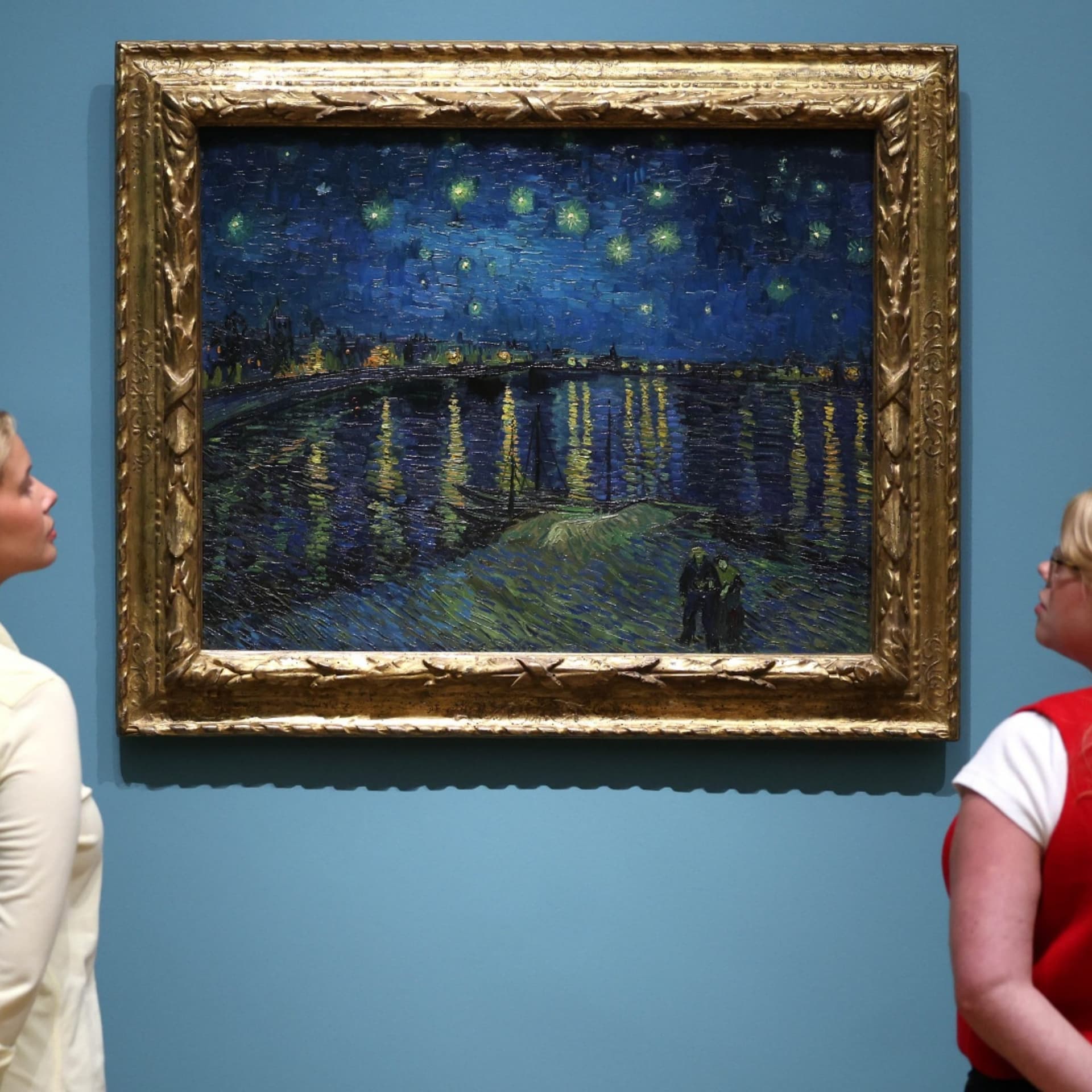
(Photo: Van Gogh's Starry Night on display at the National Gallery in London. Credit: NEIL HALL/EPA-EFE/REX/Shutterstock)
Presenter: Holly Gibbs. Music composed by Iona Hampson