
In short
The Happy Pod (BBC World Service) covers fetal surgery, drowning prevention, turning criticism into marketing, inclusive sport, sustainable tourism, and Zambia’s “Afronauts” space program.
Guests/backgrounds
Helena Burke (host). Maisie Savage and Josh French (London parents of Theo, who had fetal surgery for gastroschisis). Dr Michael Belfour (Texas Children’s Hospital fetal surgeon). Karen Martin (reporter on German Swim Foundation). Rebecca and Frieda von Malikrot (German child/swimmer via her mum). Annalisa Conway (New Bedford Whaling Museum chief engagement officer). Adam Solon (UK blind boxing athlete). Rika Holm-Peterson (Copenhagen tourist board). Kasper Eich Romer (GoBoat co-founder). Eber Makuka Coloso (Zambia’s 1960s Afronauts founder, via story). Circus Zambia cast (e.g., Musa Zulu, Ephraim Pieri).
Key claims
Fetal surgery can prevent weeks/months of intensive care; Germany’s swim lessons start at kindergarten to cut drowning risk; the “Worst Aquarium Ever” Google review drove 2,000+ t-shirt sales; blind boxing can reach Paralympics; Copenhagen rewards tourists for volunteering/biking and boosted bike rentals 59%; Zambia’s Afronauts trained “astronauts” (including cats) for interstellar ambitions.
Notable examples
Theo’s 20-week gastroschisis surgery in Texas; Lake Starnberg swim lessons and fin/crocodile play; “Worst Aquarium Ever” sperm whale merch; Adam’s elbow-tucked punching technique; Cope & Pay bike/public-transport volunteering and GoBoat canal clean-ups; Afronauts’ steel-drum weightlessness training and astronaut cats.
Written by AI. May contain mistakes. Listen to the episode to check what was said.
Chapters
Tap a time to open that second in VOGroundbreaking Fetal Surgery for Theo
1:42 to 4:30
The story of baby Theo saved by fetal surgery during pregnancy.
“The surgical breakthrough that's changing the lives of newborn babies.”
Maisie and Josh's Journey
4:30 to 7:22
Maisie and Josh discuss their emotional journey and decision-making.
“Without it, he probably would have needed months in intensive care and multiple surgeries after he was born.”
Learning to Swim: A Life-Saving Skill
7:22 to 11:43
Exploring the importance of swimming skills for children in Germany.
“For many children, learning to swim is just another part of growing up.”
Creative Marketing After a Bad Review
11:43 to 14:00
A museum turns a negative review into a successful merchandise campaign.
“Now to the story of a museum in the United States that's turned a terrible review into booming sales.”
Humor in Museum Reviews
14:00 to 14:50
Discussion about a humorous museum review and its aftermath.
“which simply said, three stars, parking very difficult.”
Adam Solon's Journey in Blind Boxing
15:10 to 19:01
Interview with Adam Solon about his experience and journey into blind boxing.
“You've probably heard of wheelchair basketball, para-athletics and maybe even boccia.”
Sustainable Tourism Initiatives in Copenhagen
19:01 to 22:46
Exploration of innovative tourism initiatives in Copenhagen to promote sustainability.
“Over the last few decades, cheap flights and package holidays have fuelled a boom in mass tourism.”
Zambia's Ambitious Space Program
22:46 to 26:57
A look at Zambia's space ambitions in the 1960s and its cultural impact.
“Then we sort of started a global movement.”
Transcript
Automatic transcript. May contain errors.0:00This BBC podcast is supported by ads outside the UK. If you are currently overpaying on software to run your business, remember this number. 10 ,000. That's the number of new businesses that join Odoo per month. Join Odoo today at odoo.com. That's O-D-O-O dot com. Chicago talks. A lot. Hold on, let me step over here. People are talking too much. We debate about food, deep dish, tavern style, who's got the best beef. We yell across rooms, across blocks, across generations. Yes, nice earrings, Grammy. And now we're doing it on our phones, too. Video calls from the L train, group chats that never shut up.
0:42Neighbors texting you the score before your TV catches up. Come on! Get a load of this guy. Catch up on a dog. Yeah, we've got thoughts. Too loud? In Chicago, you're gonna hear it. Because nothing here gets built without conversation. Nothing moves without connection. So if you think you know AT &T, it might be time to rethink that because their network has improved, like, a lot. So Chicago can keep speaking its mind with AT &T Wireless and AT &T Fiber. Chicago won't stop talking. Our improved network backs it up. AT &T, connecting changes everything. AT &T Fiber, limited availability in select areas.
1:23Hello. Willkommen zum Happy Podcast. Hello. Welcome to the happy part.
1:37I'm Helena Burke and in this edition from the BBC World Service. Fetal surgery is coming into its own now, so this kind of operation will become more common. It is such an amazing joy to me. The surgical breakthrough that's changing the lives of newborn babies. How a German charity is tackling drownings. I would say, will you try it? She would tell the child that it's very important. Don't you want to try it? It's so important that you know how to swim. Also in this podcast. If you can hear me and you can hear the passion in my voice in speaking about boxing, I know you can believe that. Look, if he can do it, I can do it too.
2:20The story of a blind man who's become a champion of the boxing ring. And cats rolling down hills in barrels and bringing religion to Martians. This guy had a dream. He believed he had a plan, he had all these things set up. There was an academy, he recruited people, there was training and everything. So for us, we just focused on the positivity. The true story of an unusual space programme comes to the stage.
2:48We start with a truly remarkable surgical breakthrough. He's a little miracle, isn't he? Where do you smile? That's five-month-old Theo and his mum, Maisie Savage, who underwent pioneering surgery while he was still in the womb. 20 weeks into the pregnancy, Maisie and her partner Josh French were told parts of Theo's bowels and intestines were growing outside his body, a potentially life-threatening condition. But, as you may have heard on the Global News podcast, the couple from London were offered the chance to travel to Texas, where surgeons have been developing a way to fix the problem before birth.
3:28Dr Michael Belfour, who performed the operation, believes the technique could be used to treat many other medical issues. I do think that fetal surgery is coming into its own now, so this kind of operation will become more common. We're certainly waiting for the final results of this trial, but the initial results are really encouraging. Clearly, you will need specialized fetal centers, but the technique that we pioneered at Texas Children's Hospital is now being used all over the world for spinal bifida surgery. And I think once we prove that this is a new surgery that can be done in the same way, it will spread rapidly.
4:12It is such an amazing joy to me. I get videos from people and photographs almost every day thanking our team. It's such a privilege. I'm nearing retirement now and to see that this field is developing the way it is, is such a godsend. Theo is only the third baby in the world to have this operation. Without it, he probably would have needed months in intensive care and multiple surgeries after he was born. His parents, Maisie and Josh, spoke to my colleague Lewis Vaughan-Jones. He's amazing. He's doing so well. Yeah, with love and parenthood, having a healthy, normal, noisy baby at times. But no, he's fantastic.
4:53I'm so pleased that you are both smiling, despite obviously sleep deprivation and all the normal things that go along with parenthood there. But just take me back, if you could, to when you first found out that something was wrong, Maisie. And what the kind of feelings you went through at that point. Yeah, when we found out, I was 20 weeks pregnant and we were just going for our normal anomaly scan. The feelings that we had were just worry, anxiety, like we were just overwhelmed. We'd never even heard of gastro-scesis before. So it was all so new and just really scary. We didn't know what it meant for Theo or what it meant for us as a family.
5:35And it was just the unknown and the waiting. And then, Josh, the decision to go ahead with this new way of treating this. Was it both of you thinking, right, we're just going to go for it, an easy decision or not? Bear in mind it was such a big decision, it was relatively straightforward because every decision that we wanted to make would just be what is best for Theo. And so Maisie and I quickly said, if we need to drop everything and move to Texas, if it gives him the best chance, then that's what we need to do. It was a big decision to make, but, I mean, I feel like I just went into full mum mode and you just want to do whatever you can for your baby to have the best start in life.
6:14Recovery-wise, I was in the hospital for a week and then took it slow, but I was healed enough to be able to give birth to Theo naturally, which was amazing. And just finally both, just talk us through what kind of message you're hoping people take away here. I suppose sharing the amazing processes that the medical profession and industry and the impact that it can have on families who experience an extremely tough time or extremely tough news that, you know, there are people out there, there are institutions out there who are developing these brand new medical procedures which can really make such an instrumental positive start to someone's life but also the impact on a family.
6:54It's scary to be a new mum anyway but to have a condition where you don't really know what that means for your baby is so scary but I think if you're given a chance, even if it's the smallest chance, that you could do something that will help the start of your baby's life be better than take it, because that's what we did and I couldn't be more grateful to the surgeons and to all the doctors and anyone who came in contact with us during that scary time and helped us. Maisie Savage and Josh French. For many children, learning to swim is just another part of growing up. But recent drowning deaths during the heatwave across Europe have highlighted the number of youngsters who have never learned to swim or don't feel confident in the water.
7:37A charity in Germany is hoping to change all that, as The Happy Pod's Karen Martin found out. I'm standing on the shores of Lake Starnberg, 25 kilometres south-west of Munich, and it's clear these boys and girls like nothing more than messing about in the water. For them, learning to swim has been as important as learning to read and write. And 10-year-old Frieda von Malikrot, speaking through her mum Rebecca, says it's fun too. Because they can move freely within the water and they like the water all over their skin. She has a fin like a mermaid and she has a crocodile and they like to play. But latest figures show that over half of primary school children in Germany lack adequate swimming skills, putting themselves in danger around the water.
8:38The German Swim Foundation aims to change all that by funding lessons starting at kindergarten level, including adapted programmes for children with physical or learning disabilities. The charity's efforts are supported by local hotel La Villa on the shores of Lake Starnberg. It hosts an annual swim from one side of the lake to the other. And in a moment of madness, I signed up. We're on a boat crossing the 2.4 kilometres to the start of the race and I'm with Katya Lindorova from La Villa. I asked Katya why this was a cause close to her heart. We have a lot of drowning. That's not just in Germany, but all over the world.
9:21A lot of adults underestimate the danger of the waters. As beautiful water is and as much fun swimming is, at the beginning it's very dangerous. And we have a lot of children who are scared of the waters. The parents are shy. There might be cultural differences. They might be scared themselves of the water. So we're trying to get kids excited about water, get them close to the water. and you cannot start early enough and teach the child that water is important to conquer. And we're surrounded by swimmers. So why are they taking part? This is just the best thing to do for your soul, for your body.
10:01And I always wanted to cross this lake Starnberg here. I've never felt a bigger connection to our earth than in those moments where I dive into water. It's fun, it's relieving, it's healthy and mostly it's important to enjoy your life Yes, we are crazy, but the world is a crazy place It's such a great way to move and to feel confident in the water and I think one changes if one is in the water You're floating, literally, and that helps also with your mental health, I think Well, I made it across in one piece but I'm too embarrassed to tell you my time. The winner was former German Olympian swimmer Christian Truger.
10:51But coming in a close second was 13-year-old Gustav Bruce. He's been swimming as long as he can remember. So how would he encourage other kids to learn? You should know how to swim when you want to go with your friends to the sea or where I live, it's a big river, and there are many people dying. take somebody with you for safety and just have fun and maybe don't go too deep in the water. And the last word goes to 10-year-old Frida, who hopes to encourage other children to take the plunge. I would say, do you want to try it? Do you want to go to the swimming course? It's very important. She would tell the child that it's very important.
11:38Don't you want to try it? It's so important that you know how to swim. That report by Karen Martin. Now to the story of a museum in the United States that's turned a terrible review into booming sales. The New Bedford Whaling Museum in Massachusetts has been educating people about whales and the whaling industry for more than a century. But a few years ago, it received a one-star rating on Google, along with the complaint that it was the worst aquarium ever. I spoke to the museum's chief engagement officer, Annalisa Conway, about what happened next. So this review came in in 2020 and it always gave everybody on the staff a laugh because truly we are obviously not an aquarium.
12:25We don't have any living whales. In fact, we have five whale skeletons on view. The review became a running joke at the museum. before it sparked an idea. It has been a bit of staff lore throughout the last six years and it's always provided a chuckle to the staff. If this new staff would come on, they would hear about the one-star review and the joke was always that it should be put on a t-shirt or in some way should be shared on some kind of merchandise. A few weeks ago, they did just that, printing branded t-shirts and hoodies with a sperm whale on the front and Worst Aquarium Ever written on the back.
13:05The merchandise has become a huge hit, with the museum having sold more than 2 ,000 T-shirts already. Rory Sutherland, who's an advertising executive, says turning negativity on its head can be a very effective marketing tactic. There are cases of pubs which leave negative reviews on a kind of sandwich board outside, simply because, you know, if it's completely ridiculous or if the person's obviously got the wrong end of the stick, You can benefit enormously from negative reviews from ridiculous people. He believes it's important to read the comments made by people who give low ratings to find out what they're actually taking issue with.
13:44Decontextualised scores are actually quite dangerous. Anybody's allowed to complain about a business, but businesses aren't really allowed to complain about their customers, and 5 % of customers are mad. My favourite and maddest review of all time, which I discovered myself by accident, was a three-star review of an extremely eminent Los Angeles oncologist which simply said, three stars, parking very difficult. The idea that someone who might be helping cure you of cancer gets marked down for the poor parking facilities seems ridiculous. The museum has since installed a fish tank, but insists it's not because of the review.
14:21Annalisa has also managed to track down the man behind the critique, who says he was joking about thinking the museum was a substandard aquarium. In terms of bringing some lightness and some humour to the world, it was a great joke. The staff enjoyed it and now we get to share our family joke with the rest of the world. Annalisa Conway from the New Bedford Whaling Museum.
14:49Coming up in this podcast... We cannot save the world here in Copenhagen, But imagine if we next year see 40 cities having implemented this. Then we sort of started a global movement. How the Danish capital got tourists to do good deeds.
15:09You're listening to The Happy Pod. You've probably heard of wheelchair basketball, para-athletics and maybe even boccia. But what about blind boxing? A young athlete here in the UK is helping put the sport on the map. Adam Solon relies on sound, touch and spatial awareness to locate his opponent and any incoming punches. He's now campaigning to get blind boxing included in the Paralympics. I spoke to Adam about his journey into the sport. Growing up as a young British Pakistani boy, I grew around watching people like Prince Nassim or Ame Khan, was really famous at the time on telly his fights would come on and my whole family would sit down and would kind of be like biting our nails or praying that Amey Khan would win the fight that was like my earliest memories of boxing.
15:59Adam tell me what it was like losing your sight. My vision was deteriorating as a teenager and it's like going through grief imagine you're going through puberty and I was figuring out wow I find this girl pretty or I found this and then at the same time your vision's getting darker and it's getting darker and you're like wait what's going on here I remember actually even going to the hospital with my mum and the doctor saying oh look I'm your son now he's uh severely sight impaired he's registered blind he's and I remember my mum crying and I didn't understand it and so how did you then get into blind boxing in my school there was a gym that was across my gym and and I saw this guy Carl my coach and a couple years later he met me and he said wow adam you're grown i'm a boxing coach what do you think about boxing and i didn't think anything of it i just went oh yeah boxing that sounds cool but and also how can i do this like i am blind you know that right like how am i gonna land the punch and he's like come just give it a go i go into this boxing session with no expectation and i'm thinking right he's holding up pads where are those pads and he's like just punch it keep your elbow tucked in and punch it and so he had to like direct me so I tell this now to everyone I talk to about well how can you throw a punch and I always say listen if you keep your elbow tucked into your body and you've got your arm covering your face you've got your arm shaped like a v if you throw a punch it'll naturally land straight so okay kept practicing it and then all of a sudden he was like wow Adam you're fast can I record this he posted it online and people like Like, wow, is he actually blind?
17:37He's so quick. You're now really good at the sport. I've seen the videos. How does that change how you feel about yourself? It boosted my confidence, boxing did it. It created this impact where I was like, I'm so comfortable with myself. And being blind, being a Pakistani brown man, at first I was considered vulnerable. But now when you see me, people change the way they speak to me now. And they don't even think like that. So it's shifted so many mindsets. It's creative, this impact, which I really love. And I pushed boxing so much because it was like, oh, not everyone can do it. But I disagree.
18:11I think anyone can do it. And I've got friends now. I've built a community of friends with all kinds of abilities. Yet we all have a passion for boxing. And the dream now is to get blind boxing added to the Paralympics. It can be done. It's so possible. And I'm just trying to showcase that. Why is this sport in the Olympics, but not in the Paralympics? I also compete in judo. and judo is a Paralympic sport. So why can't boxing be? I think there's so many more visually impaired people out there that think they can't do it. So my capacity right now is to demonstrate to visually impaired people that, look, let me train you.
18:47Let me show you that it can be done. Because if there's more of us, then eventually they can't deny us. But if you can hear me and you can hear the passion in my voice in speaking about boxing, I know you can believe that. Look, if he can do it, I can do it too. Adam Solon. Over the last few decades, cheap flights and package holidays have fuelled a boom in mass tourism. In fact, the World Bank estimates around 1 in 10 jobs around the globe are now supported by travel and tourism. But it's also led to increased pollution and waste, and some areas are becoming overwhelmed with visitors, upsetting local residents.
19:23So how can tourism have a more positive impact? Adrian Murray got on her bike to find out about one idea in the Danish capital Copenhagen. More tourists are choosing this green way of getting around. But as a local resident, I can tell you many of them struggle with the busy cycle lanes. And it can cause us commuters a lot of frustration. To help, the city is holding cycling safety workshops and offering a free bike rental session for visitors who take part. Don't forget to look over your door. Oh, OK, got it. So otherwise you're blindly going into a corner, right? There might be somebody coming.
20:04Yeah, OK, thank you. The sessions are part of a city-wide scheme called Cope & Pay, which essentially rewards tourists for good behaviour. Visitors can earn perks, like a free drink or a museum tour, by doing some volunteering or travelling around by bike or public transport. Rika Holm-Peterson from the local tourist board says the scheme has encouraged tourists to move around sustainably. We've been running Copenhagen for two years now and we've seen bike rental increase of 59%, which is huge. And for sure we need to make sure that people are safe. So it really become a great experience both for the visitors and the locals.
20:43I got chatting to a few of my fellow cyclists to see what they thought, starting with Bo, who was visiting from New Jersey. I stumbled across it online. It didn't occur to me that we could do this in Copenhagen, but now that I'm doing it, I'm definitely going to rent a bike and see the city that way. You cover a lot more ground, and it's great. I'm Shefali Suchteva. I belong to India. We wanted to experience the bike culture here, and it was a very pleasant experience, I would say. But do you think it's a good approach, that Copenhagen, the colourful, rewarding tourists for doing positive things?
21:18Absolutely. It is a great thing. I mean, you know, rather than restricting places for tourists, which, you know, some of the cities do. The Copenhagen scheme started in 2024 with 24 local partners. It's now expanded to more than 100 partners, and they range from cafes and restaurants to museums and even a ski slope. Another partner that's been involved since the beginning is GoBoat, a Danish company that rents out battery-powered boats on Copenhagen's canals.
21:52I met up with GoBoat co-founder Kasper Eich Romer to try out their activity. The good deed in Copenhagen is to come out, help us clean up the waters, and the reward is to get a boat ride in return. Rika from Copenhagen's tourist board says all the activities are shaped to help tourists think a bit more about their impact. I mean, the reason why we did it was creating awareness about the choices we make when we travel or when we are at a destination. We've had 30 ,000 participants doing Copenhagen during the past two years. And of course, we hope a lot more participants or people will join. Rika says that since Copenhagen was launched two years ago, 100 other tourist destinations have been in touch to find out how it works.
22:39Last month, Germany's capital ran a pilot called BerlinPay. We cannot save the world here in Copenhagen, but imagine if we next year see 40 cities having implemented this. Then we sort of started a global movement. Rika Holm-Pedersen, ending that report by Adrian Murray, for People Fixing the World, which you can find wherever you get your BBC podcasts. We end this edition with a rather surprising tale of one country's efforts to win the space race of the 1960s. When you think about the contest to land the first man on the moon, you probably think of the US and the USSR. But Zambia also had interstellar ambitions, which have now inspired a new touring theatre production.
23:23Stephanie Prentice went to the Wilderness Festival in the English countryside to find out more. That's one small step for man, one giant leap for mankind. Back in 1969, Neil Armstrong became the first man to walk on the moon, winning the space race for the United States after years of jostling with the Soviet Union to get there first. But the world's superpowers at the time weren't the only ones trying. Over in Zambia, a scientist and teacher called Eber Makuka Coloso was busy setting up a science academy. In 1964, he started recruiting what he called Afronauts, a group of teenagers and two cats who he trained on a large abandoned farm.
24:17Is this the site for your rocket launching programme? That the BBC went to visit. And what do you think the reaction of America and Russia will be to Zambia's joining in the space race? We underestimate our resources plus the intelligence, but I'm sure we are catching them. Training involved exercises like rolling astronauts down a hill in steel drums to simulate weightlessness. And the stated goals of the programme were to establish a Christian ministry to primitive Martians and the hope of Zambia becoming the controllers of interstellar space. The story is only really well known in Zambia, but now one group is changing that.
24:59Meet the Akronos. Musa Zulu is part of a performance group called Circus Zambia. Just being on stage, it's like going back in the 1960s. It is very important to tell these kind of stories because when people know about our story as Zambia, it means that our history is going to be preserved.
25:27The mission is brought to life as a circus spectacle with aerial acrobatics, dancing and songs and astronaut cats. Cast member Ephraim Pieri told us how it felt finding a new audience. For us, it was an amazing experience to see people sitting with us. So it was emotional, happy, flying, explosive moments that we just saw everywhere. It was super, super overwhelming and powerful. And it's an indigenous Zambian African story. Kirsty Taylor is one of the programmers for the stage at Wilderness Festival. Whether you're speaking to the people in the audience who may not often see their stories on stage and showing them that as a festival we think it's important to uplift all voices, or you're speaking to an audience and saying, look, there are stories that are different to yours, I think that help creates a greater sense of understanding.
26:28the zambian space program's dream of a human feline presence on the moon may not have worked out in the end but as the cast told us that's not the point of telling the story when people talk about this story most of them focus on their failure because if you look at things way back it was almost impossible for a zambian country or for a zambian team of people to go to the moon But this guy had a dream. He believed he had a plan, he had all these things set up. There was an academy, he recruited people, there was training and everything. So for us, we just focused on the positivity and sharing this story in the aspect of encouraging young people, big people and everyone around the world to say, if you have a dream, you can achieve it and you can do it.
27:12So just believe it and work hard.
Read the full transcript
27:19Musa Zulu from Circus Zambia ending that report by Stephanie Prentice
27:30And that's all from the Happy Pod for now If you have a story you think we should cover we'd love to hear from you As ever, the address is globalpodcast at bbc.co.uk This edition was mixed by Rachel Boakley The editor is Karen Martin And I'm Helena Burke Until next time, goodbye
From the publisher
We hear about the pioneering operation that fixed a baby's life-threatening condition while he was still in the womb. Theo and his mum Maisie underwent the surgery in Texas when she was 26 weeks pregnant. It was only the third operation of its kind in the world but doctors hope the technique could go on to help many more families.
Also: we join those jumping into a lake in Germany to help tackle the high number of children who can't swim. The ongoing heatwave in Europe has highlighted the importance of water safety skills for young people.
We meet a young blind man who's found self-confidence and friendship by taking up boxing. Adam Solan's now fighting for the sport to be added to the Paralympics.
Plus - the museum that's turned a bad review into a marketing campaign; the city showing how tourism can have a positive impact on the local environment; and the play celebrating the little-known story of Zambia's part in the space race.
Our weekly collection of inspiring, uplifting and happy news from around the world.
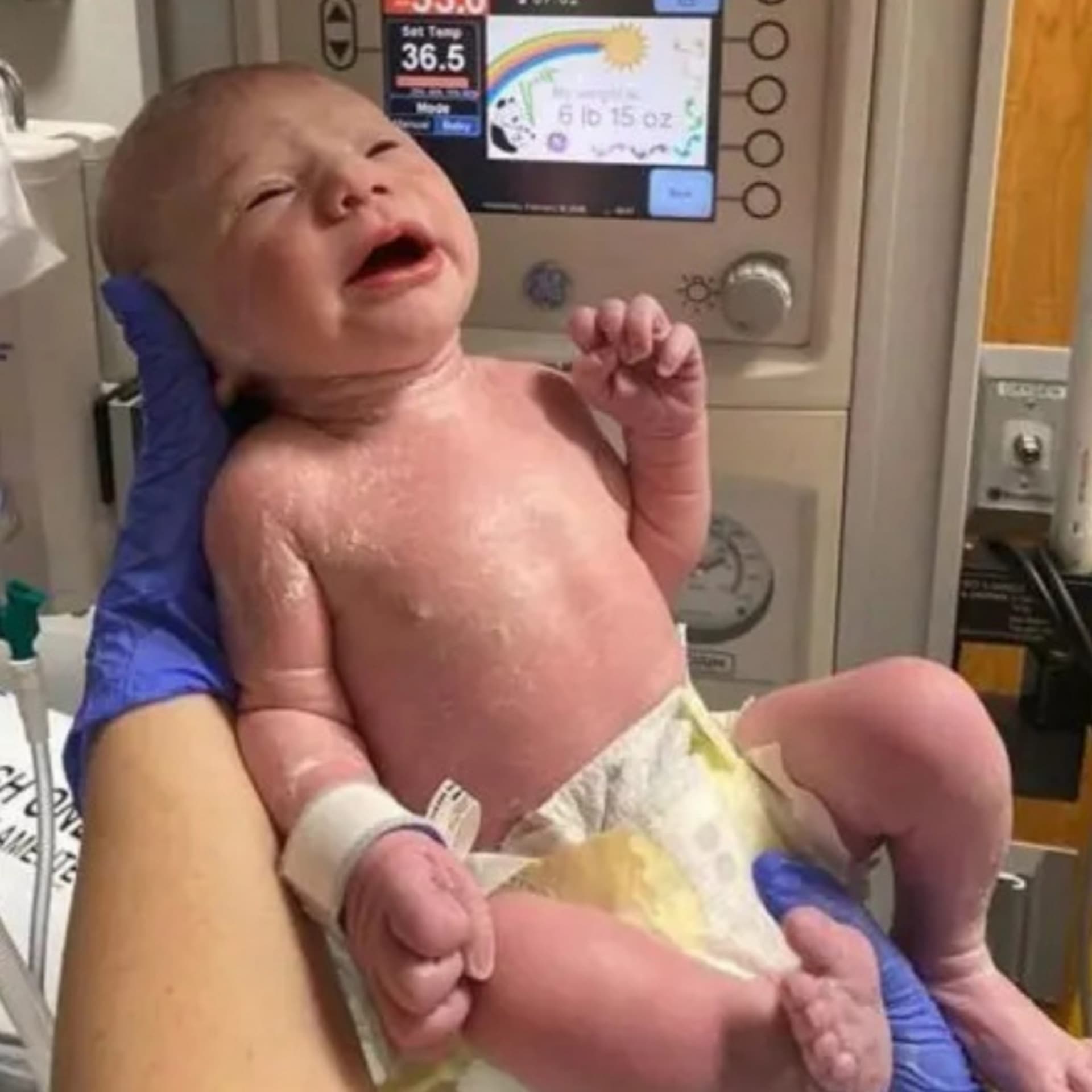
(Photo: Baby Theo shortly after his birth. Credit: Maisie Savage)
Presenter: Helena Burke. Music composed by Iona Hampson