
In short
The Happy Pod episode is a multi-story edition about connection and healing. It opens with Mina Geltink and Mina Taisen, two best friends who discover via a DNA test that they are biological sisters. Both were born in early 1980s India, adopted from Mumbai orphanages, and raised near each other in the Netherlands; they met as teens, wrote letters for years, then lost contact until 2026. Key claim: their DNA results confirmed 100% sisterhood.
Notable examples
their first reunion after 30 years, meeting each other’s husbands and children, and plans to revisit the orphanage. Next: Paraguay’s Recycled Orchestra of Cateura, where instruments are made from landfill scrap; founder Fabio Chavez started music lessons in 2006 and later built the orchestra.
Notable examples
international acclaim, a musical premiering in Atlanta, and Carnegie Hall plans. Then: Brad Ryan and grandmother Joy Ryan healing after a 10-year estrangement by visiting all 63 US national parks, then traveling to Kenya and beyond. Finally: Nantes’ Bureau de Coeur office-shelter scheme for people experiencing homelessness; and weekly Brighton table tennis sessions for Parkinson’s patients.
Written by AI. May contain mistakes. Listen to the episode to check what was said.
Chapters
Tap a time to open that second in VODNA Discovery of Sisters
1:23 to 2:30
Explore the story of two best friends who discover they are sisters.
“It's like all those 30 years we've been apart.”
The Recycled Orchestra of Cateura
2:30 to 6:15
Learn about an orchestra that creates instruments from landfill waste.
“They were then adopted by different families and raised near each other in the Netherlands.”
Brad and Grandma Joy's Adventure
6:15 to 10:43
Follow Brad and his grandmother on their journey to mend their relationship.
“It sounds just like any other violin, but it looks distinctly different.”
Healing Through Nature
10:43 to 14:00
Discover how nature helped heal a fractured family relationship.
“A man and his grandmother have been on a mission to visit every national park in the United States before going on safari trips around the world.”
Travel Memories and Life Lessons
14:00 to 15:50
Reflecting on memorable travels and the importance of seizing opportunities.
“And two months after we reached the National Park of American Samoa, which was our 63rd and final U.S.”
Introduction to Table Tennis Benefits
15:50 to 17:26
Exploring how table tennis can aid those with Parkinson's disease.
“I firmly believe that this is a sport because of The quick decision-making you have to make with your brain massively has benefits in terms of slowing down the illness.”
Supporting the Homeless with Office Space
18:28 to 21:43
Innovative charity efforts to provide overnight accommodation for the homeless.
“On the opposite side of the wall to the bed is a modest cabinet where Frederick keeps his small number of possessions.”
Probiotics and Coral Health
21:43 to 25:11
Investigating the role of probiotics in enhancing coral resilience.
“They produce a lot of compounds that are stressful for everybody, including the coral host.”
Table Tennis for Parkinson's Improvement
25:11 to 28:01
Discussing the positive impact of table tennis on Parkinson's patients.
“We end here in the UK, where people living with Parkinson's disease have been benefiting from weekly table tennis sessions.”
The Benefits of Table Tennis for Social Interaction
28:01 to 28:26
Explore how table tennis fosters social connections and inclusivity.
“and it's also been really beneficial for social interaction as well.”
Show all 11 chapters
Additional Listening Recommendations
28:40 to 29:16
Discover more content related to the podcast's themes and discussions.
“For the full interview, listen to The Global Story on bbc.com or wherever you listen.”
Transcript
Automatic transcript. May contain errors.0:00This BBC podcast is supported by ads outside the UK. Decisions made in Washington can affect your portfolio every day, but what policy changes should investors be watching? Washington Wise is an original podcast from Charles Schwab that unpacks the stories making news in Washington right now and how they may affect your finances and portfolio. Listen at schwab.com slash Washington Wise. That's schwab.com slash Washington Wise.
0:55platform. No messy integrations. No bouncing between tabs. And best of all, no spreadsheets. Stop managing software and start managing your business with one unified system. Try for free today at odoo.com. That's O-D-O-O dot com. This is The Happy Pod from the BBC World Service.
1:22I'm Holly Gibbs and in this edition meet Mina and Mina. It's like all those 30 years we've been apart. We've never been apart. It's like we're picking up after that and it feels really strange but very good. It feels like home. The girls who became best friends only to discover they are actually biological sisters. Also on this podcast... This project is not just about teaching music. We're bringing to the world's attention this place, these kids. The orchestra, who play instruments made from rubbish. Plus the grandmother and grandson duo healing their relationship through travel. And... When you think about it, it's pretty logical.
2:11I mean, when we're out of the office, it's just empty space and a lot of space and that can be comfy. The offices in France, which welcome people experiencing homelessness to stay.
2:29We start with a remarkable DNA discovery, which revealed that two best friends were actually biological sisters. Mina and Mina were both born in India. They were then adopted by different families and raised near each other in the Netherlands. It was only when they met by chance that they realised their similarities, as Amelia Clark reports.
2:55Mina Geltink and Mina Taisen were both born in the early 1980s. They were adopted from two different orphanages in Mumbai within months of their birth. They first met in their early teens at an event hosted by an adoption agency their parents had used and were struck by their uncanny similarities in their appearance and mannerisms. They promised to stay in touch and spent years writing letters to each other, often addressing each other as cis despite not knowing the truth about their relation. Minal and Mina lost contact after Minal moved to France and Mina had a baby until earlier this year when Minal decided to take a DNA test.
3:34I was home alone and then I got the pop-up on my phone and it said, your results from DNA in my houses are ready. So I opened it and then there was written Mina's sister. And I didn't realise it was Mina that I know. Minal messaged Mina on social media asking if she remembered her. Mina had tried to do a DNA test in 2017 but was told she had no matches. But the test Minal did confirmed the girls were 100 % sisters, which means they share the same biological mother and father. Last month, the girls met for the first time since finding out they were related. Minal says it's what she's dreamed of.
4:22I've always been surrounded by many people who love me and who took care of me. But something inside of me, I've always felt very lonely. and I always hoped to find some biological family somewhere and I always said yes, I would love to see if there's my biological mother but even more brothers or sisters. And now this happens, so inside it was like now I don't feel alone anymore. For Mina, it's as if no time has passed. It's like all those 30 years we've been apart. We've never been apart. It's like we're picking up after that. And it feels really strange, but very good. It feels like home. Yeah.
5:14It's like we don't live together. We have very different lives. But when I see you, it's like I'm home. I feel finally complete. And that's the puzzle phase in my heart. And yeah, I know that it's a lot, but it feels really good. Since finding out, Mina and Minal have spoken almost every day. They've met each other's husbands and children and the families they were adopted into. One day, they hope to go back to the orphanage where the story began. But for now, the sisters say the fact they're siblings is something that is still sinking in. That was Emilia Clarke reporting. To Paraguay next, and an orchestra which plays rubbish, quite literally.
6:04All of their instruments are made of scrap found at landfill. Branca Lessa de Sarr has been finding out more.
6:15That's Wiwi Lopez, playing his violin. It sounds just like any other violin, but it looks distinctly different. Rather than the usual mahogany wood, Wiwi's instrument is a hafazard combination of colours and textures. And that's because it's made from rubbish. Wiwi is talking to me from his studio in Paraguay. Here, he turns scraps of metal, wood, paper and plastic into music. He works with Fabio Chavez, the founder and conductor of the Recycled Orchestra of Cateura. Cateura lies on the outskirts of Paraguay's capital, Asunción. It's a vast, sprawling landfill. Every day, about three million pounds of solid waste get dumped here.
7:03Thousands of families live in and around Cateura. They survive by sorting the rubbish for things they can sell. Kids regularly get pulled out of school to help. Theirs is a childhood marked by the sound of garbage trucks and plastic bags, or was, until Fabio Chavez came along.
7:25Fabio started working in Cateura in 2006 as an environmental technician, helping locals to classify what they found in the waste. When he first arrived, he was shocked by what he saw. I met families whose most basic necessities weren't being met. The children in this place didn't have the options for study or ways to use their free time positively. Fabio wanted to help and knew there was only one way he could. What I knew at that time and had experience in was music. to offer the possibility of music lessons, as I was already a music teacher back home. He began to offer lessons to the children of Cateure, using donated instruments.
8:14But the classes proved so popular, they soon ran out. Instead of turning people away, Favio had an idea, to make instruments out of the rubbish, from the dump. It was a long process, and it continues to be, as we're still refining it. Despite the difficulties, they eventually did manage. And thus was born the recycled orchestra of Cateure.
8:42The orchestra has now been playing for over 20 years and gained international acclaim. They have travelled and performed in countries across the world.
8:54More recently, a musical was made about their story. It premiered this summer in Atlanta. The production was a success, and next year they'll be performing at Carnegie Hall.
9:09But when Wiwi first joined the orchestra, he could never have imagined the success it would come to have. At the time, they didn't have their own rehearsal space or shows lined up. It really was a passion project, something from the heart. Wiwi had received free music lessons from Fabio when he was at school. For him, who had always loved music but lacked the means to pursue it, the lessons were transformational. So when he found out about the project, he immediately knew he wanted to help.
9:43I really admired it because it reminded me of me. And I felt a lot of empathy and connection to these kids who gave everything they had to make their dreams come true. Now, as well as teaching music lessons and playing, Wiwi makes and repairs all the instruments used by the orchestra. But for both Faviu and Wiwi, the project is about more than just music, or recycling.
10:10This project is not just about teaching music. We're bringing to the world's attention this place, these kids. When a child stands out for a skill, in this case music, they cease to be anonymous. They cease to be someone that doesn't matter. and they become someone important.
10:40That was Branca Lessa-Dissar reporting. A man and his grandmother have been on a mission to visit every national park in the United States before going on safari trips around the world. For them, it wasn't about the sights, but healing their relationship. Brad and Joy Ryan had not spoken in 10 years, but now they have rekindled, and Brad has even written a book about their adventures. Brad and Grandma Joy have been speaking to my colleague, Kasa Aloum. Well, it started when I was 85. He called up, wanted to know if I wanted to go camping, and I said yes. So away we went, and we got there in the rain.
11:20It was quite a trip, I can tell you that. I held umbrella over him while he put the tent together. And then the air mattress, I kept falling off of it. So I said, the heck with it. I just slept on the ground. Brad, you know how to treat a woman, don't you? You know, Grandma Joy is cut from a different cloth. I will admit, like when we were driving down and I was looking at her hands, I thought, wow, I forgot that she's an old woman because her mind and her spirit are so young. We had so much fun that weekend and she blew my expectations out of the water. And that's why, you know, she not only we went down there because she had never seen a mountain.
11:59And at age 85, she not only saw her first mountain, she climbed her first mountain as well. That's really why I wanted to keep the magic alive. I didn't intend in the beginning to go to all 63 U.S. national parks. We had no intention of setting a world record. You know, she became the oldest person in the world to begin and complete a circuit to all 63 U.S. national parks. But it really just began as a way to repair our relationship. relationship we hadn't spoken in 10 years at the beginning of this journey and now we're best friends. And Joy, for yourself, spending this time with Brad, how has that been for you as well as visiting all these places?
12:31We had a lot of things to discuss about. We talked about the things we saw outside and I think we got along pretty good. When you haven't spoken to each other in 10 years, you know, there's a lot of, there's a lot of ground that you have to make up. Why was that, by the way? It was a fractious divorce. Her eldest son was my father. When I was hiking the Appalachian Trail, when I was in my late 20s, and it was nearly a decade into our estrangement, I was sleeping next to the stream and thinking about those early childhood memories when she would take me into the local state park. And I just felt like I had to try.
13:08When I finished the Appalachian Trail after six months in the wilderness, I felt like I had to try to reconnect. And I thought she might slam the door in my face, to be honest, because her feelings were really hurt. It's like any other type of reparation, right? You don't rebuild a relationship overnight after 10 years of not speaking to somebody. You have to start somewhere. And for us, going back to nature was the most natural place to begin that healing process. And that nature took you all around the world. Joy, tell me about some of the places that you've traveled to then all around the world.
13:37What's been your favorite place, both of you? Well, we started in Kenya, and that was our first international trip. So after she completed the 63 U.S. National Parks, her Instagram followers asked me what the next chapter was going to be. And 63 was a big number. And so we thought, what's an epic journey that would be a smaller number? And so we came up with the seven continents. And when I was 20 years old, I had never been overseas and she took me to the airport and I went to Kenya. And two months after we reached the National Park of American Samoa, which was our 63rd and final U.S. national park, she and I ended up going to Kenya.
14:17And I remember thinking when we were in the Lamar Valley at Yellowstone National Park, when we were stuck in this bison traffic jam for four hours, that she would never get to see the great migration of wildebeest and zebra in Africa. But at least she had that memory. And, you know, my assumption was wrong. And she ended up getting to see the great migration along the Mara River. And so for me, that was just a living, breathing example that we can manifest these seemingly impossible dreams if two hearts are willing to go along for the ride. What about you? What was your favorite country that you visited?
14:53The favorite place that you visited overseas? Oh, I think when we went over and helped the rhinos, we went over there and there were several people with us. And it was an amazing experience. It was quite a big operation. There was airplanes and helicopters and truckloads of young men that helped. There'll be lots of people listening to you with a smile on their face. What would you say to anyone who hasn't traveled that much in their life? If you get a chance to go, go. Somebody asks you to go to some place, don't say no, say yes. Because the next day you'll say, daggone it, I wish I'd have said yes.
15:38and not know. You know, the older we get, the faster time flies. So I'm getting close to the end. So I'm not saying no to nothing. I do everything I can. That was Brad Ryan and Grandma Joy.
15:57Coming up on The Happy Pod. I firmly believe that this is a sport because of The quick decision-making you have to make with your brain massively has benefits in terms of slowing down the illness. The Table Tennis Club helping people with Parkinson's disease.
16:24John Deere is putting in work and putting up highlights. Oh man, look at those passes. tillage, planting, harvesting. Three years in and these pre-owned machines are still at the top of their game. We're talking reliability, performance and long-term potential. And get this, these veteran machines can pick up the latest precision tech with ease. You know it and fans ready to add John Deere certified pre-owned equipment and more options to their lineup can shop at machinefinder.com. Booyah! Can politicians improve our economic fortunes? Dave Ramsey says no. I'm Tristan Redmond from The Global Story, and I've been speaking to the massively popular US money guru who says if there's a financial crisis, it's on us.
17:08When you borrow on credit cards and take out a$1 ,200 car payment on a freaking Range Rover, you've destroyed your life, not the president. For the full interview, listen to The Global Story on BBC.com or wherever you listen.
17:26You're listening to The Happy Part. In Western France, one charity is helping those experiencing homelessness. They are partnering with businesses to open up unused office space so it can be used as overnight accommodation. Alex Collins has been to Nantes to find out more. I'm meeting Frederick at the place where he lives. It's not your standard accommodation. It's in the office of a software company called Iprisia. He takes me through the modern open plan office, past workers at their desks, to the room he sleeps in at night.
18:00here's my stuff my detergent to do my washing and the bottle of water i don't have many things it's a modest space with plain white walls and at the far end is a large desk with two computers which in the day are used by workers the biggest object in the room is a rectangular box which looks at first like an office cabinet but to my surprise it contains a fold-out bed okay can you just show me the bed? The bed is being pulled down. It's on the side of a wall and it just flips down. It's a very clever use of space. On the opposite side of the wall to the bed is a modest cabinet where Frederick keeps his small number of possessions.
18:38On top of that is some ingredients for cooking. So you've also got some food there. You've got a lemon, some nuts. Yes, I also have some pistachios and some baby onions. Do you want to show us where you cook? We head to a kitchen area which staff members use in the day to eat their lunch. It's the space that Frederick uses to make dinner in the evening.
19:03So I have everything I need, a coffee machine, plates, a sink, a fridge. You've got your own shelf on the fridge with a little post-it note with your name, that's very handy so everyone knows not to touch your food. Occasionally Frederick has a coffee with some of the staff. The ambition of the charity is to help those staying in offices into permanent work and secure housing, Bureau de Coeur believes having a stable place to sleep makes this easier. Every month, a meeting takes place with the resident and relevant support agencies to ensure everything is staying on track.
19:42I've just got on the number three tram to meet Pierre-Yves Loeck. He's actually the founder of Bureau de Coeur. I'm inside the office of advertising agency Nobilito. It's a business Pierre-Yves runs alongside Bureau de Coeur, so it's no surprise to find that he's also hosting a person who is homeless there. He's here one from one once ago. I am literally in this big office, but in the corner here it does feel like suddenly if I turn this way and look straight forward. It looks like someone's bedroom. A black curtain gives a degree of privacy, but there's also a sofa, which is long enough for someone to sleep on.
20:23I can even see the sheets on the bed there. To ensure a respectful experience for the guest, offices are inspected by Bureau de Coeur volunteers in advance. Guests must have access to a toilet and shower and cooking facilities. So far, the scheme has helped over 100 people, but Pierre-Yves acknowledges that it's addressing only a small fraction of the homeless problem in Nantes. However, he says the solution goes beyond helping vulnerable people off the streets. We commissioned a study that confirmed that companies who took part in our scheme had happier employees compared to the standard French office.
21:00In the end, I find companies do this because they think it's the moral thing to do. But what does staff in his own office think about the scheme? Wandering around, I met Claire and asked her what she thought about the office providing space for a person who is homeless. When you think about it, it's pretty logical. I mean, when we're out of the office, it's just empty space and a lot of space and that can be comfy. So if that can help someone in a difficult situation, I say go for it. That was Alex Collins reporting. And for more on this story, just search for People Fixing the World wherever you get your BBC podcasts.
21:42probiotics have long been all the range in health advice but now scientists have also discovered they could be good for corals erica santoro is a microbiologist turned ecologist she's been testing a probiotic treatment on reefs in the red sea she's been speaking to my colleague roland peas every single organism on planet host bacteria and other microorganisms this is not different in the ocean as well so the corals also host a big amount of bacteria and microalgae so it is a big mix and super for other microorganisms that live together with these coral hosts so we call these a holobiont because they actually work together and evolve together as well the thing that happens when there is any stress like the temperatures are raising in the ocean there's a trigger which like cause a lot of stress in the microalgae.
22:40They produce a lot of compounds that are stressful for everybody, including the coral host. And a couple of process can happen there that these algae can be expelled by the host, that they can escape, the cell can just like break apart and like this mutualistic relationship, they just break up. But somewhere along the way, you thought that there was some way that using probiotics, in other words, adding extra bacteria to unhealthy coral would help them? Yes. So the idea here is we look at the coral and try to understand the beneficial relationships that exist between the coral and the microorganisms.
Read the full transcript
23:23And we isolate and manipulate those beneficial ones. I'm wondering how you do this, because it's a bit different from taking a teaspoon of yogurt. So what's the process? Currently, we are doing these in the ocean. So we are upscaling from the lab setups and bringing to the field. We culture those beneficial cells. We increase them in number and put them in syringes and apply on top of the coral. So this is going to create a kind of cloud of beneficial bacteria on top of those colonies. And we apply these often. So we guarantee that those corals are going to actually uptake those bacteria that we are offering to them.
24:03What difference did you see between the treated and the not treated coral? So we observed, first of all, some proxies that are related to coral health. One of them and observing like how good they are doing this photosynthesis. And these were decreasing along the time when we don't treat them. But when we apply the probiotics with time, they were actually recovering. They were actually having a better photosynthesis in those colonies that were treated with probiotics. So we saw a good result. Corals in the world cover a greater area than just the United Kingdom. This would be, if it became practical, a huge effort.
24:41What are the steps before you even get that far? We have been observing this positive effect and beneficial effect in different coral species for different reasons to protect against bleaching, mortality, even like against diseases. So we are really getting excited about like the results and we see that it really works. Now, I think our question is not if it has an effect or not, but how to apply this in a big scale. Erica Santoro speaking to Roland Pease. We end here in the UK, where people living with Parkinson's disease have been benefiting from weekly table tennis sessions. The BBC's Mark Norman has been to the Brighton Table Tennis Club to find out more.
25:28People living with Parkinson's disease have described the benefits of playing table tennis as a no-brainer, saying it improves their movement, mood and confidence. Playing on the tables today, a few volunteers, but also a range of people living with Parkinson's. In a moment, we'll hear from Richard Witts, an emeritus professor of music and sound, diagnosed with Parkinson's five years ago. But first, here's David Preece, a former restaurant worker, diagnosed 15 years ago. So if I play for the session this morning, for most of the afternoon, I'll feel my movement will improve, my mood will improve.
26:10The main problem with Parkinson's is balance. You lose your sense of balance. And so this helps to address this problem. Also playing the tables today, Tracy Steele. He's a former maths teacher and was diagnosed five years ago. And finally, we will hear from Carol Gill. She's been living with Parkinson's for 11 years and is a former student administrator. I've got lots of people you can talk to, which is really useful because you need people who have actually been there themselves. You have to react so quickly and score and move and think about your tactics at the same time. So for people with Parkinson's, that's a really exceptional thing.
27:00The Brighton Table Tennis Club hosts weekly sessions for people with Parkinson's, dementia and other neurological conditions. The club's head of community outreach and the voice you may have heard shouting in the background, Nick Creel. I firmly believe that this is a sport because of the quick decision making you have to make with your brain massively has benefits in terms of slowing down the illness. Parkinson's is a progressive disorder affecting the brain, nervous system and muscle control There are around 150 ,000 people in the UK living with the condition Last year, Table Tennis England and Parkinson's UK announced a partnership to create more opportunities like this for people to play the sport Philip Lindley is from Parkinson's UK Table tennis has shown to have many benefits for things like balance and coordination it can also be really good for memory and it's also been really beneficial for social interaction as well.
28:06And Table Tennis England have recognised how powerful their sport can be in supporting people and said it wants everyone to feel there's a place for them at the table tennis table. That report was from Mark Norman.
28:25and that's all from the happy pod for now we'd love to hear from you as ever the address is globalpodcast at bbc.co.uk the editor of this edition is karen martin i'm holly gibbs until next time goodbye
29:10the president. For the full interview, listen to The Global Story on bbc.com or wherever you listen.
From the publisher
Meena and Minal were born in India, but adopted by different families and raised near each other in the Netherlands. When they first met in their early teens at an event hosted by the adoption agency their parents had used, they were struck by the uncanny similarities in their appearance and mannerisms. This year, Minal took a DNA test, which revealed the Meena she already knew was her biological sister.
Also, we hear from the Cateura Orchestra of Recycled Instruments -- a group in Paraguay which play music on instruments made from landfill waste. Plus, Brad Ryan and Grandma Joy's adventures to visit every national park in the United States, before going on Safari trips around the world. For them, it wasn't about the sights, but healing their relationship, after they had not spoken in ten years. Why probiotics could help corals, and the table tennis club helping people with Parkinson's disease.
Our weekly collection of inspiring, uplifting and happy news from around the world.
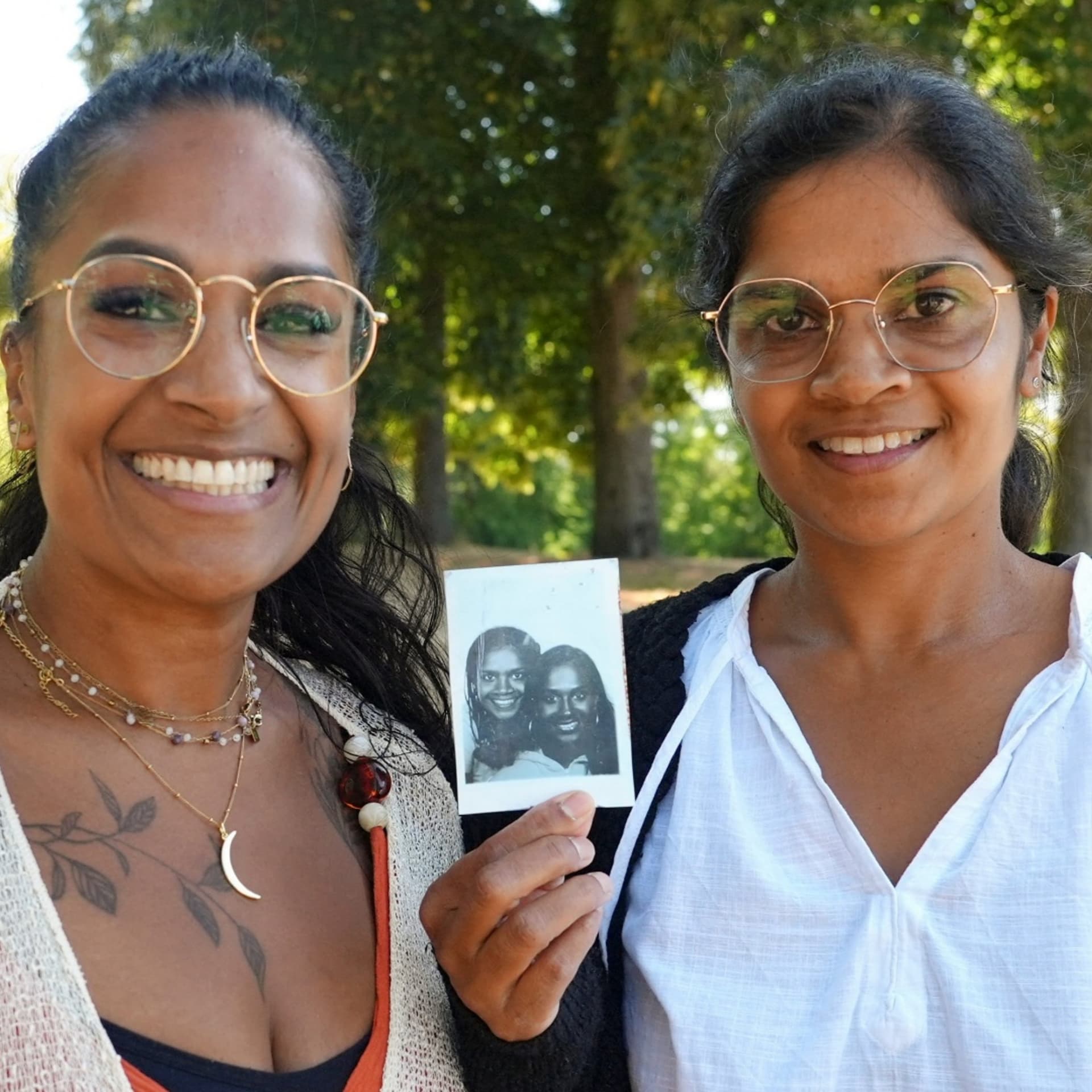
Image: Meena Geltink and Minal Tijssen holding a picture of their younger selves. Credit: Reuters
Presenter: Holly Gibbs. Music composed by Iona Hampson