In short
The episode of BBC World Service’s The Happy Pod focuses on “can’t” becoming “can”: an off-key choir in northern England where about 80 members sing weekly without pitch pressure; a conservation project building rope canopy bridges in the Amazon to stop roadkill; tactile 3D ultrasound models for parents with sight loss in the UK; a UN-backed push to use a map that reflects Africa’s true size; and a Mexico City video-game physiotherapy program for stroke recovery. Guests/backgrounds: Diane Chapman (founder of the Off Key Choir), Sheila Burnham and Joy Garvin (members), Dr Fernanda Abra (Reconnecta conservationist), Ray Walker (UK pilot participant), Moki Makura (Africa No Filter executive director), Dana Hathaway (US children’s literacy/digital product manager; Gruffalo read-alouds), Jaya Bhattacharji Rose (publisher), Rogelio Navarro (reporter), Rogelio Navarro/Joas Ramirez/Montserrat Canu (Cañonazo lab). Key claims/examples: choir has a waiting list; Reconnecta recorded 17,000 crossings and zero primate road deaths near Alta Floresta; tactile scans restore “independence”; Africa map vote was 164-country unanimous; Cañonazo uses a knee brace to aim a cannon game and can improve walking confidence.
Written by AI. May contain mistakes. Listen to the episode to check what was said.
Chapters
Tap a time to open that second in VOThe Off-Key Choir's Unique Appeal
0:57 to 1:28
Explore the off-key choir where singing is all about joy, not perfection.
“But honestly, it's even worse when you buy business software.”
The Off-Key Choir's Unique Appeal
1:46 to 3:21
Explore the off-key choir where singing is all about joy, not perfection.
“It's just so much fun and we laugh and nobody cares.”
Personal Stories from Choir Members
3:21 to 6:15
Hear personal anecdotes from choir members about their experiences and the joy of singing.
“The off-key choir has become so popular it has a waiting list to join.”
The Power of Singing Together
6:15 to 8:16
Understand how singing as a group fosters joy and connection among members.
“You come here and you know when they say sing and dance if no one's watching you.”
Animal Conservation in the Amazon
8:16 to 12:51
Learn about a project using bridges to help animals safely cross roads in the Amazon.
“The Amazon rainforest is home to more primate species than anywhere else on Earth.”
The Gruffalo's Enduring Popularity
12:51 to 14:00
Discover why the Gruffalo continues to enchant children worldwide years after its release.
“So 2027 is going to be a busy year here for the Reconnecta project.”
Exploring the Success of The Gruffalo
14:00 to 18:05
Learn about the impact of The Gruffalo on children's literacy and reading habits.
“Luke Jones brought together the American author Dana Hathaway and Jaya Bhattachaji Rose, a book publisher in the Indian capital Delhi who has worked with Julia Donaldson.”
Innovative Approaches for Expectant Parents
19:26 to 20:32
Learn about tactile 3D models for expectant parents with sight loss.
“We debate about food, deep dish, tavern style, who's got the best beef.”
Ray Walker's Touching Experience
20:32 to 24:17
Hear Ray Walker's firsthand experience with a 3D model of her baby.
“For many expectant parents, seeing that first ultrasound scan of their baby is a huge moment.”
UN Votes for a True Map of Africa
24:17 to 26:30
Discover the significance of the UN's vote for a new map of Africa.
“Campaigners across Africa are celebrating a significant step forward in the way the world sees the continent, quite literally.”
Show all 14 chapters
Video Game Therapy for Brain Injury
26:30 to 28:00
Explore a new video game designed to aid rehabilitation for brain injury.
“they've come up with a solution to make physiotherapy more enjoyable for people recovering from a brain injury.”
Innovative Rehabilitation Through Gaming
28:00 to 31:20
Learn how gaming technology is being used to enhance physical rehabilitation.
“This is the man who runs it, Joas Ramirez, a computer scientist.”
Celebrating Ethiopian New Year
31:20 to 31:30
Discover the unique features of the Ethiopian New Year and its significance.
“That report by Rogelio Navarro in Mexico City.”
Cultural Significance of Flowers in Ethiopian New Year
31:30 to 32:48
Explore the cultural practices and beauty surrounding the Ethiopian New Year.
“but Ethiopia follows its own calendar, which is rooted in ancient religious traditions, and it runs around seven to eight years behind the Gregorian calendar.”
Transcript
Automatic transcript. May contain errors.0:00This BBC podcast is supported by ads outside the UK.
0:30most to investors, including policy initiatives for retirement savings, taxes and trade, inflation concerns, the Federal Reserve, and how regulatory developments can affect companies, sectors, and even the entire market. Mike and his guests offer their perspective on how policy changes could affect what you do with your portfolio. Download the latest episode and follow at schwab.com slash Washington Wise or wherever you listen. Imagine buying a toy for your kid, but it doesn't come with batteries. That sucks. But honestly, it's even worse when you buy business software. You end up with fragmented, disconnected systems that cost a fortune and don't talk to each other.
1:12Odoo completely changes that. Odoo comes fully complete, with all your business apps perfectly integrated and working together seamlessly. It's everything your business needs in one place, saving you time, headaches and serious money. Stop paying for missing pieces. Go to odoo.com. That's O-D-O-O dot com to learn more. This is The Happy Pod from the BBC World Service.
1:43I'm Chantal Hartle and in this edition... It's just so much fun and we laugh and nobody cares. Yeah, we can't sing, but nobody cares. You come here and you know when they say sing and dance if no one's watching you. That's what we do here. The choir with the off-key selling point. We can't sing, but we love to do it anyway. A project to help animals safely navigate the vast Amazon rainforest pays off. We have recorded 17 ,000 crossings. So all the six monkey species are using the canopy bridges. How 3D ultrasound models are allowing expectant parents with sight loss to experience a precious moment.
2:23You can feel the outline of our head and our little tiny ear and our nose and our mouth. To be able to get that information firsthand is really powerful and it gives you that sense of independence back. And the unconventional video game therapy helping stroke survivors to regain mobility. The patient has to hold the leg out straight and the player controls a cannon. It simulates being in a bay with pirate ships coming in. The cannon fires continuously and the player aims it by moving the leg.
2:59If you can't sing, come and join my choir. That was the unusual advert Diane Chapman posted in a local newspaper in the north of England eight years ago. Diane didn't expect many people to turn up, but now around 80 enthusiastic members come together each week to sing at the top of their lungs without the pressure to sound pitch perfect. The off-key choir has become so popular it has a waiting list to join. One member, Sheila, gets so much enjoyment from it that she even moved house to be closer to where the choir meets. Our reporter Jane McCubbin has been to one of their rehearsals. Hello, everybody!
3:42Come on in! Nice to meet you! Debbie, you can sit down. Let me introduce the off-key choir. Hello! Hello! You're welcome! We won't sing. Has anybody ever told you that you can't sing? Di has the answer and a motto. Just because you can't doesn't mean you shouldn't. Di is Diane Chapman who set up the off-key choir eight years ago. This is Jane. Hi everybody! Here, no one believes they can sing so no one ever sings alone. Until today. And I know some of you feel a bit nervous about this, Sheila, but could we just do a few little solos just to show people the power of when you come together? I love going to the choir.
4:36I do look forward to going to the choir of a Wednesday, even though I can't sing. This is Sheila Burnham. Can we get you to do a solo? Oh, God, no. Oh, go on. Oh, go on, Sheila. Oh, I sound awful. Well, do you know, isn't that the point? I know. Because when you are all together, you don't sound awful. Yeah. Would you do it? I don't... Alone, they might wobble. When the night has come. And the land is dark. Alone, they're exposed. Is the only light we see. No, I won't be afraid. But they're not chasing perfect pitch here. They're chasing joy. And when they come together, shoulder to shoulder, once every week, that is when the magic happens.
5:38Stand by me, stand by me.
5:50Ladies, I'm just the proudest choir mum ever! It's amazing! Debbie, you love it. I do. Adore it. I do. It's made a big difference to my life. Lost a few of my cat lives this year. The choir's really been there for me and got me through, you know, some tough times, and it's just so much fun. And we laugh, and nobody cares. Yeah, we can't sing, but nobody cares. You come here and you know when they say sing and dance if no one's watching you. That's what we do here. Sheila's amazing. She's got loads of confidence since she's been with us. But what do we believe anyway? Just because you can't. Doesn't mean you should live.
6:34You put an advert in the paper of not knowing what would happen. And this has happened. And it said, if you can't sing, come and join my choir. I put 15 chairs out on the first night. And 52 people turned up. This is Joy Garvin. You'd just lost your husband when you saw that ad there. I had, yes. I closed my eyes, drew back the... Had 10 to see for certain... And I made friends and I've never looked back. I just love it. I love every minute of it. Far, far away... For what we did... So why should you let not being able to do something stand in your way? A flash of drums, a flash of drums Whatever it is, I can't bake and I can't dance and I can't sing, but do it anyway.
7:30The colors faded into darkness, I was left alone Because it's just so joyous. and you never know what adventures and what opportunities might come along if you do. Make your own kind of music If anybody out there has been told they can't sing, what do you say to them? Absolute rubbish. Definite rubbish. Just sing your heart out. It just makes every day worth living. Go out and sing and enjoy. In a world obsessed with polish and perfection, This choir reminds us the only thing that matters is coming together and giving it a go.
8:16Jane McCubbin meeting the Off Key Choir. The Amazon rainforest is home to more primate species than anywhere else on Earth. But traffic on the roads cutting through the vast forest is one of the major threats to the many animals that live there. One Brazilian conservationist has made it her mission to change that, building rope bridges to help monkeys and other animals cross safely. And it's proving to be very effective. The Happy Pod's Helena Burke spoke to the woman behind this pioneering project. In 2021, Dr Fernanda Abra carried out a road mortality assessment for wildlife living in a section of the Amazon in northern Brazil.
8:56The results shocked her. I recorded dozens and hundreds of primate road kill, especially the golden-handed tamarind, but I also recorded frightened spider monkeys and the squirrel monkeys and many other arboreal species such as sloth, porcupines and etc. So I also had a very bad experience where I found a primate that was hit by a car and it was a very traumatic experience. Dr. Abra knew something had to be done to stop this and so the Reconnecta project was born. Alongside a team of engineers, architects and biologists, she designed a special bridge for animals to get from one section of the rainforest to another and avoid walking on the road.
9:46Our canopy bridge is very solid, resistant. We tested all the materials for the Amazon weather because we have a lot of rain, high temperatures. So basically we install our bridges on two concrete posts. The core of the bridges is based on steel cables, ropes. The bridges cater for a wide range of species, from porcupines using the walkway below to monkeys swinging across the ropes overhead. Dozens of these bridges have been installed across the Amazon over the past six years, but the project around the town of Alta Floresta has arguably been the most successful. In October 2024, we installed the first seven bridges and it was a very nice experience because we saw the whole city embracing the project, so many different sectors of the cities together with universities, private owners, the whole city hall involved in reducing the impact of road mortality for the species they have there.
10:58And then we, of course, at the moment we install the canopy bridges, we started to monitor all the seven for full time using camera traps full time. And in 19 months of monitoring, we have recorded 17 ,000 of crossings. So all the six monkey species are using the canopy bridges. Since those bridges were installed in 2024, not a single primate has been killed on the roads around Alta Floresta. After 19 months of monitoring, we have recorded zero road mortality. So I think this is an amazing milestone. I think this project is something that really touches me because it's not only research, this is applied ecology.
11:50This is pure conservation, right? So we are saving animals' lives and not only animals' lives. We are promoting better traffic for everybody. Dr. Abra's project has been so successful that it's now going global, with the first canopy bridges outside Brazil about to be built. So Suriname is going to be the first country where we're going to really expand, installing new bridges, but we are also collaborating with other initiatives from other countries. So, for example, we already shared the design we use for our canopy bridges with people from Costa Rica, Colombia, Peru, and also from Nepal. So I think we have a lot of potential to scale up our solution, not only inside Brazil, but also to many other countries in Latin America and who knows other tropical countries worldwide.
12:51So 2027 is going to be a busy year here for the Reconnecta project. Dr Fernanda Abra ending that report by Helena Burke. Now, 27 years ago, young and maybe not so young readers around the world were first introduced to the brown furry creature with purple prickles known as the Gruffalo. He has terrible tusks and terrible claws and terrible teeth in his terrible jaws. Well, if you have raised a child since the millennium, you'll most probably know exactly how the rest of that description goes. The original picture book written by the author, Julia Donaldson, has sold millions of copies worldwide and it's been translated into more than 100 languages.
13:49Well, now a long-awaited third book has just been released with a new character, Gruffalo Granny. But in a world increasingly dominated by screens, what is it that makes the Gruffalo so popular even all these years later? Luke Jones brought together the American author Dana Hathaway and Jaya Bhattachaji Rose, a book publisher in the Indian capital Delhi who has worked with Julia Donaldson. She was full of boundless energy and she was always so full of joy and rhythm and colour. I mean, you can understand why Gruffalo has had the kind of success that it has, because at the core of it is the happiness and the joy that she reverberates through her words.
14:35Dana, how would you explain why her work has been such a sort of global hit and is something that so many children seem to take up and read? I discovered the Gruffalo, actually, during my teaching years. And of course, when you're in that industry, the highlight of the day was read-alouds. You know, kids would sit down and listen when it was time for us to read a book. So no one should underestimate the power of read-alouds 100%. And that day, the Gruffalo was on the shelf. And this one boy, Josiah, he kept insisting we read that book. And the rest was history. And I think I've probably read that book hundreds of times.
15:15It was the most requested book, and kids even asked if they could take our coffee home. It was so easy for me to do the voices because of the writing patterns. And then it made it easy for the kids to memorize the beats of the story. So everyone loved that clever mouse. That's one thing that they wanted to be. They wanted to be like that mouse who could pretty much trick all these other predators into thinking, well, I'm the most dangerous thing around here. And yet the unfortunate thing is we do know that kids increasingly are reading less. Dana, are you worried about that phenomenon? And how important are some of these big kind of key books, be it The Gruffalo or Harry Potter or Philip Pullman, to kind of get kids interested in reading?
16:01Oh, yeah, definitely worried about that. I currently work as a digital product manager at Reading is Fundamental, which is the leading children's literacy nonprofit here in the United States. And our goal has always been to fight the literacy crisis. And the way that we do that is to get books in the hands of children. For the past 60 years, we've been doing that. And I think legacy books like The Gruffalo do make a good impact in terms of children's literacy. you know as a young child the way that adults read with them is something that builds these literacy practices that they continue to take as they grow up.
16:43Jia is that a phenomenon that worries you? Well yes and no in the sense that from the time that I've been in publishing and witnessed quite a transformation from traditional publishing houses which didn't have dedicated children's literature departments. Now they do. We now see entire generations of children coming up remembering book fairs. We have author outreach programs. We have workshops. The new education policy of 2022 of the government, in fact, states very clearly that we should have storytelling in classrooms. We have at the lowest administrative level in certain states, like in South India, Karnataka, Pratham Books partnered with the smallest administrative unit called the Grand Panchayat and set up 6 ,000 libraries, of which the 100 books which are in the seed library, 10 % are for Braille, are dedicated to Braille books.
17:392008, we had the first children's book festival come up, literature festival, called Bookaroo. It is incredibly popular. Dana Hathaway and Jaya Bhattacharji rose on the popularity of the Gruffalo.
17:59still to come on the happy pod campaigners celebrate a un vote to adopt a new map reflecting africa's true size it really made africa and africans stand a little bit taller a little bit prouder we've asked the world to take a fresh look at africa that's actually the most important Thank you.
18:47ready to add John Deere certified pre-owned equipment and more options to their lineup can shop at machinefinder.com. Booyah! John Deere is putting in work and putting up highlights. Oh man, look at those passes. Tillage, planting, harvesting. Three years in and these pre-owned machines are still at the top of their game. We're talking reliability, performance, and long-term potential. And get this, these veteran machines can pick up the latest precision tech with ease. You know it, and fans ready to add John Deere-certified pre-owned equipment and more options to their lineup can shop at machinefinder.com.
19:24Booyah! Chicago talks a lot. Hold on, let me step over here. People are talking too much. We debate about food, deep dish, tavern style, who's got the best beef. We yell across rooms, across blocks, across generations. Yes, nice earrings, Grammy. And now we're doing it on our phones, too. Video calls from the L train, group chats that never shut up. Neighbors texting you the score before your TV catches up. Come on! Get a load of this guy. Catch up on a dog. Yeah, we've got thoughts. Too loud? In Chicago, you're gonna hear it. Because nothing here gets built without conversation. Nothing moves without connection.
20:03So if you think you know AT &T, it might be time to rethink that. Because their network has improved, like, a lot. So Chicago can keep speaking its mind with AT &T Wireless and AT &T Fibre. Chicago won't stop talking. Our improved network backs it up. AT &T, connecting changes everything. AT &T Fibre, limited availability in select areas.
20:29Welcome back to The Happy Pod. For many expectant parents, seeing that first ultrasound scan of their baby is a huge moment. but those with sight loss will have a very different experience. Clinics in Brazil and France have previously transformed 20-week scans into tactile 3D models allowing parents who can't see to feel their baby's features. The charity Guide Dogs recently launched a similar pilot scheme in the UK. Here's the moment mum-to-be Ray Walker got to touch her baby girl's shape for the first time. Oh, that's our head. Wait, is that an ear? That's an ear. Wait, that's an arm? Mm-hmm.
21:12It's like she's got it up like she's waving. Oh, she's cute. Well, Ray has been telling Peter White what she could feel on the 3D mould and why it meant so much to her. It literally is like a little baby and you can feel the outline of her head and her little tiny ear and her nose and her mouth and her little hands and she's all curled up and she just seems really happy. And it was really lovely to feel it because when you go for an ultrasound, I'll have it audio described via the sonographer or my partner. But in a sense, it's secondhand information. So it's always going to be a little bit biased because it's what they perceive.
21:55But to have that model in your hand and to be able to get that information firsthand hand is really powerful and it gives you that sense of sense of independence back how much does it actually feel like a baby i mean in the sense of you know arms legs the shape of it the way it's curled all that sort of thing how much can you do that from what is effectively something on an an embossed surface? It literally does feel like an actual baby. So mine, she was curled up, kind of like in the fetus position, and you can feel her head and you can feel the outline of her ear and if you run down the side of her face, you can feel the little indent where her eyes would be and then the little indent where her nose and mouth are.
22:45So it literally is like a 3D model. So it's not like an ultrasound where it's like all abstract ink blocks on a screen. It's actually a lot clearer than you would think. Has this made what is after all an exciting event anyway? Has it made it more exciting for you? Yeah, it was lovely to get to see and feel again. I had no idea what to expect. I was almost a little bit scared because I didn't know what my initial reaction was going to be like and how medical it was going to be. but it's not. It's lovely. And to know that I've got something like that as a wee keepsake that I can keep forever and ever is really sweet.
23:26We've mentioned you're having a girl, but I think your partner came up with a creative way of you being able to find out what the gender of your baby was, not just to be told, but finding out for yourself. It was my partner that said, let's make it really simple. And he came up with an ingenious idea of getting a nice little box and there's these things called wiki sticks and it's like pipe cleaners but they're sticky so you can stick them onto pieces of paper and things. And we literally said to the scenographer, can you put an X in the bottom if it's a boy or a circle if it's a girl? So she handed me the box and I got to feel inside to see what it was before anyone else did and it was such a lovely surprise.
24:13Mum-to-be, Ray Walker, speaking to Peter White for the BBC's In Touch series. Campaigners across Africa are celebrating a significant step forward in the way the world sees the continent, quite literally. The UN General Assembly has overwhelmingly voted in favour of phasing out the traditional world map with one that more accurately reflects the size of Africa. And we're not talking about a minor discrepancy here. On common maps, Africa appears similar in size to Greenland, despite the continent being 14 times larger. Moki Makura from the advocacy organisation Africa No Filter told us how she felt about this long-awaited recognition for change.
24:56Excitement, I would say, is a huge part of how I felt because it was nearly two years of work to get to that point. It was almost unanimous. 164 countries voted in our favour and you cannot not be anything but pleased. It really made Africa and Africans stand a little bit taller, a little bit prouder. First of all, 54 African countries came together because we first of all signed an AU resolution and then we took it to the UN. And it shows that when we get together as a continent behind a single issue, and we all agree, things happen because the world takes you seriously. And I think the second symbolic part to this is that this map we've been looking at for over 400 years, it's been wrong.
25:40We changed that. We got the world to agree to use a new map for us, a new projection. And to me, that means that we asked the world to take a fresh look at Africa. That's actually the most important thing, because we've been looking at Africa in the wrong way for such a long time. What else? What else have we taken for granted? What else do we not know about the continent? And this resolution, this global moment we've had, is asking the world to look at us differently. And those are the symbolic parts of it. But the practical aspect to me is one very clear and very simple. The map that we were using for 400 years was wrong, factually wrong.
26:15The one we're asking you to use now is right because we want to make sure our children, the education system, our schools are teaching our children the right thing. Moki Makura, the executive director of Africa No Filter. To Mexico now, where researchers think they've come up with a solution to make physiotherapy more enjoyable for people recovering from a brain injury. They've developed a video game that allows patients to do exercises similar to those in conventional therapy, but in a more engaging, accessible and consistent way. Rogelio Navarro in Mexico City has been finding out how it works.
27:00That sound is a cannon sinking a pirate ship It is also the sound of a leg learning to walk again Silvia Salinas is 45 and she lives in Mexico City She's in rehabilitation after a life-altering health incident A little over two years ago I had a cerebrovascular event, what we usually call a stroke. I had the stroke and I lost all movement on the left side of my body from my face down to my leg. I woke up from surgery realizing I've lost sensation and movement in my arm and my hand and in my leg so I couldn't walk. What Silvia was given in rehabilitation was not a standard prescription. It was a video game.
27:48It is called Cañonazo, roughly cannon shot, and it was built at the Laboratory of Interactive Applications for Neurorehabilitation at the National Autonomous University of Mexico. This is the man who runs it, Joas Ramirez, a computer scientist. Once the calibration is done, the patient has to hold the leg out straight, and the player controls a cannon. It simulates being in a bay with pirate ships coming in. The cannon fires continuously and the player aims it by moving the leg. The idea is to destroy all the pirate ships. The controller is not a joystick or a gamepad. It is a 3D-printed knee brace that measures, in real time, the angle at which the knee bends.
28:37Before play begins, the system calibrates how far each patient can move the leg and scales the game to that. This is how Sylvia describes it. The mission is to hit a ship and knock it down. There's a steel ball, a cannonball, and with my foot, using a device they fit on my knee, I make the movement of kicking it but sitting down. I line my foot up visually with the ball I can see on the screen. I kick it, and the ball is launched at the ship and knocks it over. If I do it well, the ship never reaches its target. Conventional physiotherapy is repetitive and people give up on it. The window in which the brain recovers best is the first few months after the damage.
Read the full transcript
29:24And that is precisely the time many Mexican patients spend waiting. In Mexico, the university's own laboratory has said publicly that treatment can be delayed by as much as five months because there aren't enough therapists or rehabilitation units, and the ones that exist are overloaded. Since 2021, the project's objective has been to fill that availability gap. Montserrat Canu is the project's neuroscientist. Another of the laboratory's objectives is to take the video games into telerehabilitation so that patients can have them at home and start their therapy from home, without needing to travel to a rehabilitation centre or to have specialised equipment.
30:06As long as they have a computer, a laptop and the software, they can begin the rehabilitation at home. Cañonazo is one of around 15 games this laboratory has built. The laboratory has two peer-reviewed papers. Cañonazo, the leg game, has no published results yet. What Silvia can describe is her own body. My walking improved to the point where I now step over obstacles. I can walk with far more confidence now. If I'm out on the street, I have to be able to step around an open drain or dodge a dog if one runs across me. Sylvia is still recovering from her stroke, but she does rehabilitation every day, and this is what she wants people to know.
30:52Even if the change is tiny, the brain is recovering. It isn't like a wound. When you cut yourself, the wound heals and I can see it because a scab forms. With this, the brain doesn't tell us how we're doing or how far along we are or how much is left or at what speed. But if I can't move my hand and one day I notice that my finger's done this, then I'm on my way. So, patience.
31:20That report by Rogelio Navarro in Mexico City. Before I sign off, I would like to wish any Ethiopians listening a Happy New Year. Now, that might sound a bit odd considering it's September, but Ethiopia follows its own calendar, which is rooted in ancient religious traditions, and it runs around seven to eight years behind the Gregorian calendar. Well, as of the 11th of September, Ethiopians have entered the year 2019, and it is a time of great celebration, as Daniel Saif Michael, a theology professor in Addis Ababa, explains. Our new year is kind of a unity of the nature, the culture and the religion and also some of the major events in the solar and lunar calendar, where we think that it's the beginning of a new revolving of the year.
32:10It is the end of the rainy season and then we have flowers everywhere in the mountains. These yellow flowers, which we call Ade Ababa, which is a very beautiful flower, which happens only in September. girls' voice sing a song of flowers, you know, welcoming the time of flower. And actually in some places in the north, in the northern part of our country, they have also a culture of, you know, singing together all the members of the family in the village, in the neighbourhood to welcome the New Year.
32:45And that's all from the Happy Pod for this week. If you'd like to get in touch, our email is globalpodcast at bbc.co.uk. This edition was mixed by Lee Wilson and the editor is Karen Martin. I'm Chantal Hartle. Until next time, goodbye.
33:09Did America's war on terror work? I'm Asma Khalid, host of the Global Story podcast from the BBC. In the words of a former U.S. official, on September 11th, 2001, the terrorists hijacked not just airplanes, but also the direction of U.S. foreign policy. 25 years on, what were the unintended consequences of the war on terror? For the full story, listen to The Global Story on BBC.com or wherever you get your podcasts.
From the publisher
The Off-Key Choir in Southport on Merseyside has a simple motto: just because you can't sing doesn't mean you shouldn't. Around 80 members come together every week to sing their hearts out, without the pressure to hit all the right notes. Since it was formed in 2018, the choir has also acted as a support group. It has become so popular there is now a waiting list to join.
Also: the successful canopy bridge project giving animals a safe way to cross roads in the vast Amazon rainforest. How a pirate ship themed video game is helping stroke survivors in Mexico to regain mobility. A pilot scheme from Guide Dogs is turning ultrasound scans into 3D printed models for expectant parents with sight loss to feel their unborn baby's features. Campaigners across Africa are celebrating after a UN vote to adopt a new world map reflecting the true size of the continent. Plus, as a new Gruffalo book is released, we hear why the original story resonates with so many children.
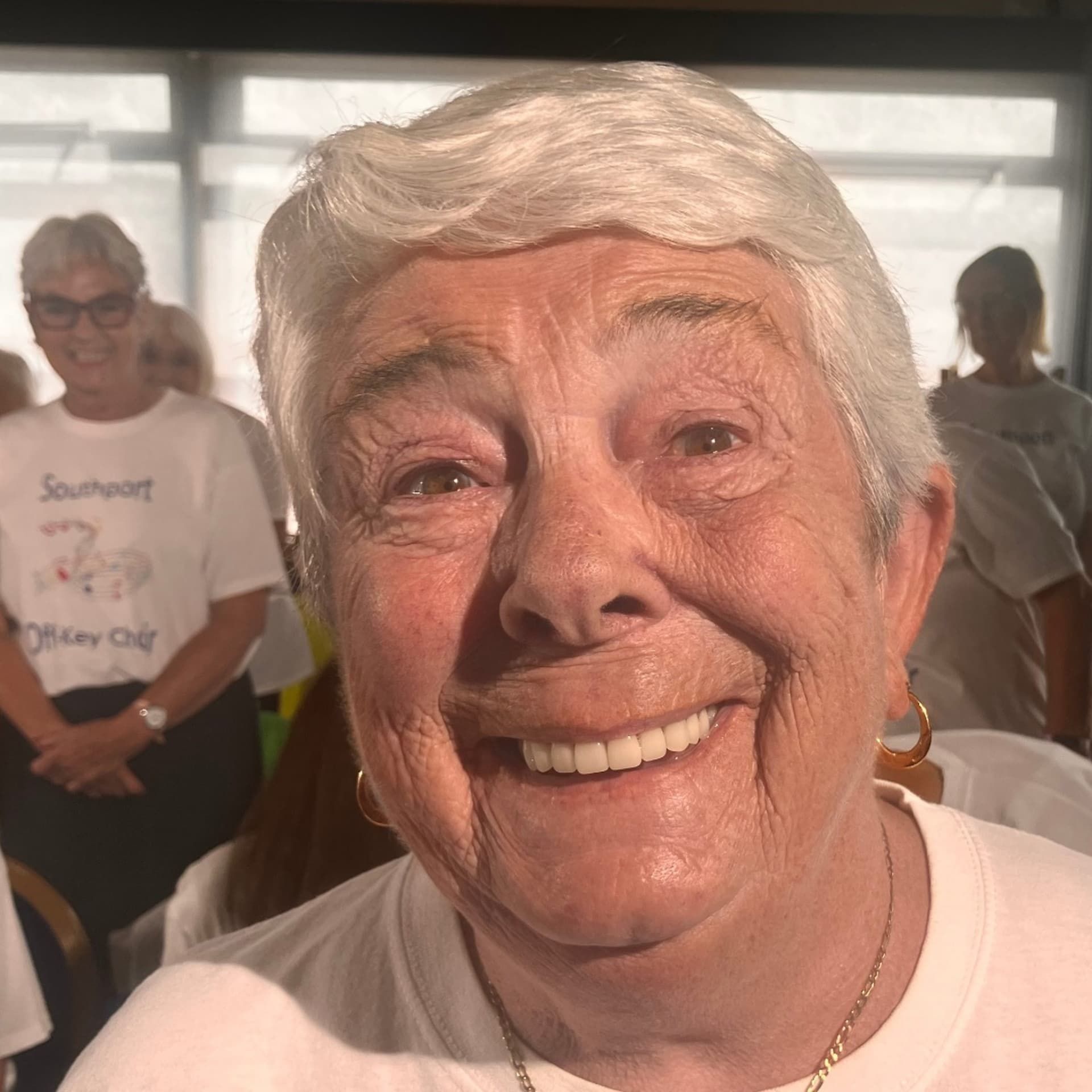
(Image: Sheila Byrne, member of the Off-Key Choir. Credit: BBC)
Presenter: Chantal Hartle. Music: Iona Hampson