
In short
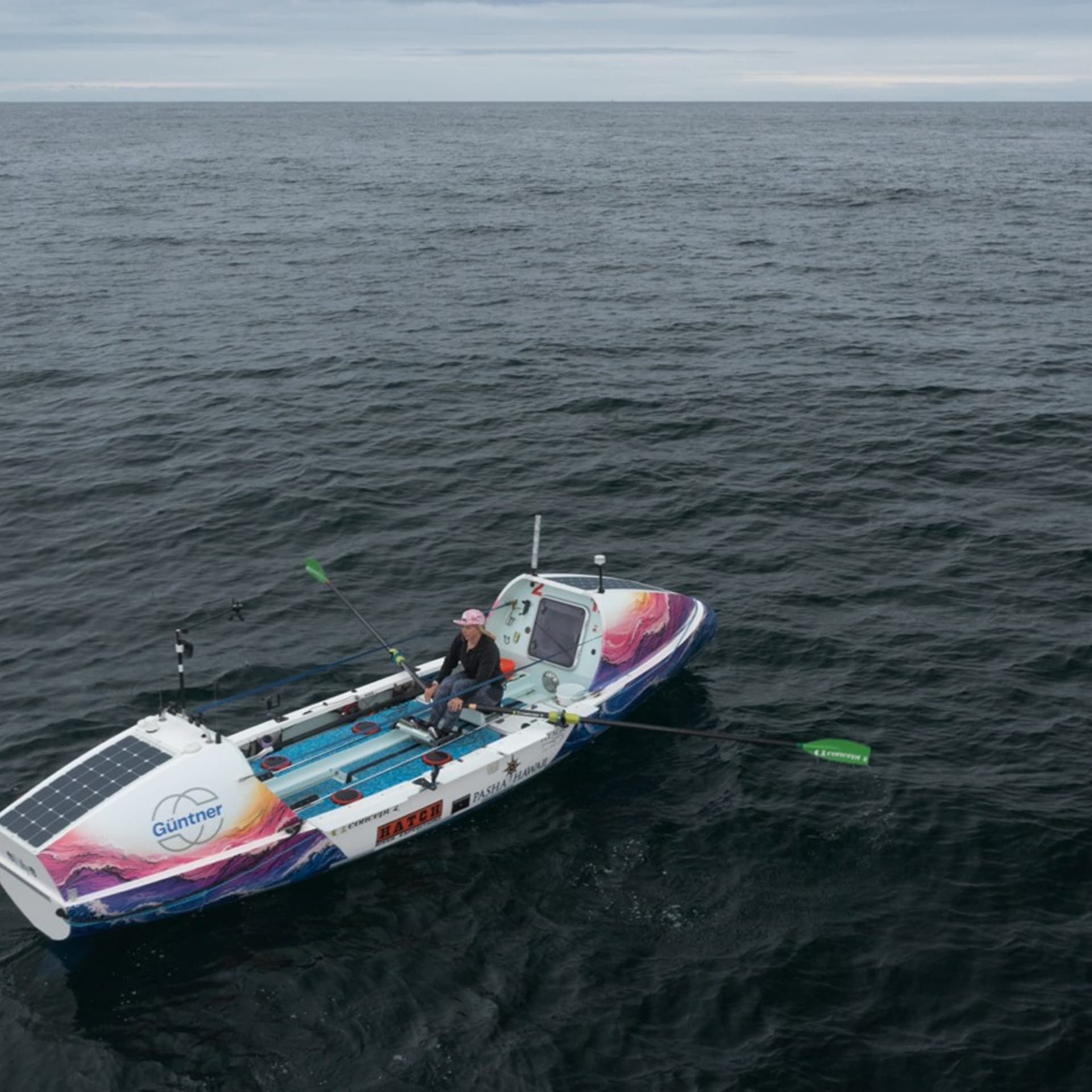
The Happy Pod (BBC World Service) explores how people find joy and purpose through extreme challenges and everyday reinvention. Main story: Kelsey Fendler, 32, becomes the fastest solo rower from California to Hawaii (about 43 days), also the youngest and first American woman to do it, breaking men’s and women’s speed records (Ocean Rowing Society International). She credits “sheer joy,” focusing on the next step, and humility before the ocean; flying fish repeatedly hit her face. She posted daily updates that drew nearly 300 million TikTok views. Other segments: Welsh “Wrestling Nanas” (Rose, Lynn, Susie, Christine) befriend Slam Masters wrestler Dereese Gordon after a flight seat mix-up; they train and may be approached for a film. Sauna raves: DJ/sound therapist Mishi describes 40°C sauna dancing, stress relief, and social connection. Argentina blanket-coat workshops: Leonor Barreros and Lourdes Chico Ruiz teach upcycling for comfort and emotional memory. Twin-to-twin transfusion syndrome: Professor Christophe Lees and patient Bryony Garrett discuss high-intensity focused ultrasound to stop shared-placenta blood flow. Singapore seniors parkour: Movement Singapore founder Shibun and student Barry Clark say classes build safer movement, agility, and community.
Written by AI. May contain mistakes. Listen to the episode to check what was said.
Chapters
Tap a time to open that second in VOKelsey Fendler's Joyous Journey
1:16 to 2:48
Discover Kelsey Fendler's record-breaking solo row across the Pacific Ocean.
“This is The Happy Pod from the BBC World Service.”
The Experience of Ocean Rowing
2:48 to 6:05
Kelsey shares her challenges and the joys of rowing alone at sea.
“where she became the fastest person to row solo from California to Hawaii, as well as the youngest and the first American woman to do it alone.”
Finding Power in Vulnerability
6:05 to 7:12
Kelsey discusses the importance of embracing vulnerability and joy.
“You're not going to be able to fight the current, but you can also put your hopes and dreams into the current, and hopefully it's going to let you go that way.”
The Unlikely Friendship and Wrestling Adventure
7:12 to 11:22
Explore the story of a friendship that blossomed during a flight mix-up.
“Now the producer behind the British comedy film The Full Monty has said he thinks their story could make a brilliant movie.”
Sauna Raves: A New Trend
11:22 to 14:00
Learn about the growing popularity of sauna raves and their unique appeal.
“Nick Barton has approached us with the prospect of it might be a film.”
Health Benefits of Sauna Dancing
14:00 to 16:13
Explore the potential health benefits of sauna dancing, including stress relief and social connections.
“they're like oh I wish it was a bit hotter I was like what no alcohol obviously no alcohol I would say no caffeine.”
Upcycling Blankets into Coats
16:20 to 19:58
Discover a group of women in Argentina transforming old blankets into new coats, emphasizing sustainability and emotional connections.
“Around the world, it's estimated we throw away more than 2 billion tonnes of waste every year.”
Innovative Treatment for Twin-to-Twin Transfusion Syndrome
19:58 to 22:44
Learn about a groundbreaking treatment using high-intensity ultrasound for a serious pregnancy condition affecting twins.
“That report was by Jane Chambers and you can hear more about these recycling schemes on People Fixing the World wherever you get your BBC podcasts.”
Seniors Embracing Parkour
22:44 to 27:36
See how seniors in Singapore are using parkour as a means to stay fit and agile, breaking stereotypes about aging.
“How many women have you successfully treated?”
Transcript
Automatic transcript. May contain errors.0:00This BBC podcast is supported by ads outside the UK.
0:30No bouncing between tabs. And best of all, no spreadsheets. Stop managing software and start managing your business with one unified system. Try for free today at odoo.com. That's O-D-O-O dot com. Choiceology, an original podcast from Charles Schwab, is a show about the psychology and economics behind our decisions. Join host Katie Milkman, an award-winning behavioral scientist and author of the best-selling book, How to Change, as she shares true stories from Nobel laureates, authors, athletes and everyday people about why we make the choices we do and how to make better ones to help avoid costly mistakes.
1:08Listen to choiceology at schwab.com slash podcast or wherever you listen.
1:16This is The Happy Pod from the BBC World Service.
1:25I'm Holly Gibbs and in this edition If any part of this made at least one person feel a little bit more powerful in their own skin I couldn't ask for anything else and I'm happy Think about trying to find your own big, hard, scary thing The rower who used joy to break records in the Pacific Ocean The unlikely friendship that could become a Hollywood film It's like a dream and we never want to wake up from it. I've been able to meet some amazing people. We've had lots of fun and now we've been able to go professional wrestling. You couldn't write it really, could you? Also, a potential way to save the lives of identical twins.
2:04Plus, the women making coats out of old blankets. I like to say that we took bedclothes into the street. it's the way we find to use textiles that we already have and an increasingly popular way to work up a sweat the heat is going to make your heart rate go up anyway but people are dancing and enjoying it it's just like taking a dance floor from a club and just dumping it in a sauna it's quite surreal for some people the idea of spending a month alone at sea would be gruelling But for 32-year-old Kelsey Fendler, it was, in her words, sheer joy. She's just completed a remarkable and record-breaking journey across the Pacific Ocean, where she became the fastest person to row solo from California to Hawaii, as well as the youngest and the first American woman to do it alone.
3:02Kelsey's 4 ,000-kilometre adventure wasn't without its challenges, and she hopes it will inspire more women to take risks and try something new. The Happy Pod's Riley Farrell has been finding out how she kept motivated. When you imagine rowing from California to Hawaii, you probably picture blue waves. Maybe the Pacific stretching to the horizon, or the sun beating above you. But what you probably don't picture is getting smacked in the face by a flying fish. Oh, we got another one. Here, I'm sorry. Every night was just like kind of like an onslaught battle of these flying fish hitting me and like jumping on the boat and like trying to like get them off the boat.
3:48So hard to grab without squishing. I'm so sorry. I remember like as I was taking a voice note, one hit me in the face and I was like, OK. Kelsey did it in roughly 43 days. She broke both the women's and men's speed records, according to Ocean Rowing Society International. The reason I was able to go so fast is because I never woke up any of those days and didn't want to be there. I think ocean rowing is kind of like the epitome of like all the things I love packaged into one thing. Endurance, sports, the water, rowing, all of that just like in one piece. I mean, I was tired, of course, but like I deeply wanted this.
4:29The speed was just an extension of my joy. Kelsey was alone on the water, but she wasn't entirely isolated. Every day she posted updates online. Day one of becoming the first American woman to row solo from California to Hawaii. Good morning. Day 38. Woohoo! We're surfing! Yeah, I've been rowing against a headwind and some pretty strong southerly current. I'm under 100 miles from Oahu. You can see land over there. That's Oahu right there. Over the course of her journey, those videos racked up nearly 300 million views on TikTok alone. I had no idea that anyone else was going to care besides like my family and like the 10 people that I know that love ocean rowing.
5:20So I feel completely humbled and grateful that so many people could find themselves in my own story. because I do not see myself as this kind of like elite athlete figure or like this unreachable, unattainable concept. People are capable and people can do really hard things, especially if they really want to be there and find the joy within it. Tell me about your relationship with the water. They're so big! It's the massive amount of respect I have for water, but also the deep desire to be as close as possible to it pretty consistently. If you're going to spend time there, you have to acknowledge that you are not in control of the situation.
5:57The water is always going to be a lot more powerful than you, but it is such an incredible experience to be able to have a little bit of that humility and also let go of that control that we like to pretend that we have. You're not going to be able to fight the current, but you can also put your hopes and dreams into the current, and hopefully it's going to let you go that way. If any part of this made at least one person feel a little bit more powerful in their own skin, I couldn't ask for anything else and I'm happy. It's so easy to get overwhelmed by all the tasks that like you have to do to pull off the goal.
6:34And it's such a simple thing. But if you just focus on like the next step and the next step, by the time you look up, you're already almost to the goal. And I think finding the reason you want to do something, holding on to that reason throughout the really boring, messy centre of these big projects is how you get to your end goal. Think about trying to find your own big, hard, scary thing. You might not think that you are strong enough to finish it right now, but you're definitely strong enough to start it and you'll find everything else along the way. Kelsey Fendler ending that report by Riley Farrell.
7:12next to a story about a hollywood film a wrestler and four welsh grandmothers you might remember this story we told you a few months ago rose and her friends lynn susie and christine were flying to las vegas to scatter her husband's ashes a seating mix-up ended with them befriending a professional wrestler called Dereese Gordon. Now the producer behind the British comedy film The Full Monty has said he thinks their story could make a brilliant movie. Dereese and the Nanas have been speaking to the BBC's Megan Davis and James Williams. It's been absolutely amazing. It's like a dream and we never want to wake up from it.
7:59Just when you think you've seen it all, you have welcomed the Slam Masters heavyweight champion, Man like the race and the Welsh Nanas into the banking hall here in Cardiff. Wow. We went to the wrestling performance and they trained us, which was absolutely hilarious. We had headlocks and finger punching. I'll teach you first thing simple is a headlock. Get your arm across his chin. You want to be mean with it. You don't want to be nice. You have to be ruthless.
8:36and then they did a grand opening.
8:41Dereese came out and he was singing and rapping and everybody was clapping and cheering and we were running around and high-fiving everybody. It was amazing. Oh, my gosh. And where do you start when it comes to learning how to get involved with wrestling? Oh, well, Lynn, the seat on the plane was there. Oh, yeah, well, that was the start of it all, really, because he had one of our seats. So there was a bit of a hoo-ha, you're in my seat. But we ended up getting friendly with him and chatting. At the end of the flight, he asked us if we'd like to go and see him wrestling. So we go, yeah, yeah, he didn't think we were going to turn up.
9:19And when we did, it was just brilliant, absolutely hilarious. And it's just gone on from then. We've just had so much fun, honestly. It's been as amazing for me as the women say it's been for them because I've been able to meet some amazing people. We've had lots of fun. We've been on a tour bus of Cardiff. We've been bingo. And now we've been able to go professional wrestling. He is your nan's favourite wrestler. And he is accompanied to the ring by Susie. by Lynn by Chrissie and by Rose they are the Welsh Wrestling Nest what did you think of their wrestling skills? I thought it was amazing I think the natural performers the Welsh Wrestling Nanos and Naturals.
10:25And I think everybody at Slam Masters Wrestling had a great time watching everyone get involved and have some fun and beat up bad wrestlers. Susie put JJ in a big headlock and he couldn't get out of the headlock. Susie's looking very quiet and mischievous there. Yeah, Susie isn't as innocent as she looks. Did you enjoy the weekend, Susie? Oh, it was just absolutely amazing because when we first came out with DeReece, He was showing us all the moves. But did he know that when he was bringing us out officially for us to go in the ring as his tag team, we had all the gear. We had the sweatbands, the glasses, the headgear, the stripes on our face.
11:08We wish we could have got the lycra, but we never had enough time to... Next time. So wrestling, as a starter, main course, Hollywood? Who knows? Who knows? We have been approached. We have been approached. We can say, can't we? Yeah, we can. Go on. Nick Barton has approached us with the prospect of it might be a film. Rose, can I ask you quickly, what do you think Pete would have made? He would think it's wonderful. He had such a fantastic sense of humour. So, yeah, he's up there saying, go, go, go for it. It was quite sad going. Of course. I needed the support of my friends to go. And then you couldn't write it, really, could you?
11:49I mean, it's just gone and expanded and expanded. And also, I think the people have been so kind to us wherever we've been and the support and love we've had. I got quite emotional on Sunday because people were outside with banners. Oh, Welsh nanners, Welsh nanners. I mean, you know, they went through all our effort. Banners, banners, banners, banners. Rose, Lynn, Susie, Christine and Dereese. Time to take a sauna with a difference.
12:22That's the sound of a sauna rave, which are growing in popularity in cities like London, New York and Berlin. As the name suggests, people dance to electronic music in a hot, darkened space. But what's the appeal? My colleague Paul Henley spoke to Mishi, a DJ and sound therapist who was involved in arranging an event for around 90 people in London. So usually a sauna would be probably around 80 degrees Celsius, but we take it down to 40. but as you can imagine when the bodies start piling up in there it can get pretty heated again. So it's quite close proximity stuff, is that the appeal? Yes, yeah I think like having that, it's just a real life connection really.
13:06There is like a call-off area that has the cool down pools and showers etc and so you can go and call off and then come back in. The music's really loud as well so you might want to break from that, kind of like a rotation. And it's a real rave, is it? People dance big time. Yes, yes. I was actually really surprised the first time I did it. So I'm using club standard equipment in there. I play the music slower than I normally would, simply because the heat is going to make your heart rate go up anyway. But people are dancing and enjoying it. Like it's just like taking a dance floor from a club and just dumping it in a sauna.
13:43It's quite surreal. But it's a controlled space where they're used to applying heat and a lot of the people that come are part of these sauna clubs so they do this every week some of my followers would come and they're like that was really hard work for me yes too and then you had people that go to these sauna events and they're like oh I wish it was a bit hotter I was like what no alcohol obviously no alcohol I would say no caffeine. I mean that I gave out some simple instructions like stay hydrated, coconut water, electrolytes. You just see people whenever bottles of water. What are the health benefits or is that not your field?
14:26I don't have any medical background. However, I do know just from even dancing, you know, it's a stress relief, it's a mood boost. I know that a sauna can help regulate your circulation, give you great sleep. There could be a mental reset. You're in that environment. You're away from screens. It's a real human connection. Are people coming on their own? Is it a dating thing? Well, you know, I did think about this after. I did think about this after. People are definitely coming by themselves. It's a 90 minute session. So it's not too intense. It's not like if you go to a club by yourself, you might be there for four or five hours.
15:04and people are definitely meeting because it's quite a niche environment, isn't it? If you both like dancing in a sauna, you're probably going to have other stuff in common. And then there's also a spillout area after where you're rehydrating and people just kind of getting to know each other. So I do feel like, you know, the run clubs are known for dating now and maybe this could be the next thing. DJ and sound therapist, Mishi.
15:34Coming up on The Happy Part. The general impression of parkour is young boys recklessly jumping from rooftops to rooftops. And so when they see seniors doing it, they will go like, yeah, you must be crazy. Why seniors in Singapore are taking up parkour.
16:03and build positive money habits. It's an account co-owned by you and your teen, so you can monitor and engage with the account while your teen learns how to invest and manage money. Learn more at schwab.com.
16:19You're listening to The Happy Pod. Around the world, it's estimated we throw away more than 2 billion tonnes of waste every year. But for many, the rising cost of living is providing an added incentive to repair and reuse things instead. In Argentina, a group of women have been helping people do just that, teaching them how to turn old or sentimental blankets into new coats. Jane Chambers went along to find out more. Leonor Barreros is sitting at a long wooden table full of scissors, threads and piles of brightly coloured old blankets. Perched on high stools around the table, there's a group of five women carefully taking on board her instructions.
17:02She's busy folding and snipping a piece of paper to show them how to make the pattern. I like to say that we took bedclothes into the street. Why is it important to make these coats out of blankets and not with some new material? Because the old blankets have better materials. It's the way we find to use textiles that we already have. Lourdes Chico Ruiz, who's running the workshop with Leonor, tells me there's an emotional reason to transform the blankets, as well as a practical one. For me, it's important that these blankets get a new life, bringing back memories. It might be cozy recollections from their childhood, and we can take those memories out onto the street and face the world as an adult.
17:58It's like an emotional shield. So you're wearing the most beautiful muster-coloured coat. Where's it from? It comes from my ex-girlfriend's granny. It's quite stiff and heavy, and when I wear it, it feels like I'm warm in bed. It gives me that comfort that grannies can give us when we are little. I'm here with one of the participants in the workshop. Can you tell me your name? Ana Maria. And I see that you were very excited when you arrived and you were talking about your blanket.
18:33It's from when I was little. I went to my mother's house to find it. I would wrap myself up in a blanket and read. Or when I was little, they would read to me. And for me, coming here today is a way to continue those memories. We've got some beautiful coats at the back that are already made that everyone's trying on and eyeing up. Some really lovely colours and very soft. This is their inspiration for what they can make their blankets into later. Leonor makes it clear that anyone can do this because the coats are stitched together by hand and the pattern's available on the Lindor Instagram.
19:19While the women kneel on the floor, carefully cutting around the coat pattern on their blankets, Lourdes tells me that the blankets are also a way of getting people to think more about what they're wearing and where it comes from. She thinks that some people in Argentina are moving away from mass-produced, low-cost clothes that are often thrown away. I think more and more people are anti-fast fashion, And I'm pleased to say clubs that teach people how to upcycle and reuse their old clothes are becoming popular. There's value in being able to repair, to transform things. That report was by Jane Chambers and you can hear more about these recycling schemes on People Fixing the World wherever you get your BBC podcasts.
20:08Here in the UK, there's been a potential breakthrough for a medical condition called twin-to-twin transfusion syndrome. It's when blood passes from one foetus to another during pregnancies with identical twins and can lead to miscarriage. But now doctors are developing a way to treat it using high-intensity ultrasound. Bryony Garrett had the procedure to save the lives of her twins. Being diagnosed, I was only at 12 weeks and they were already at stage 3, so it was very dire. and I was very blessed that the consultant I saw in Bristol was aware of Dr Lees and the trial and put me forward and thank God that he did.
20:46You know, the risks were low. The worst risk was that nothing was going to work and I was already in that place. So for me, there was nothing to lose. My colleague Tim Franks spoke to Professor Christophe Lees, head of foetal medicine at Imperial College Healthcare Trust in London. About a third of all twins are identical and about 10 % of those will develop this condition, which arises because they share a placenta. if the blood vessels direct blood from one twin to another, then one twin can gradually lose its circulating blood volume and the other twin ends up suffused with blood, with too much blood and fluid, and then that can cause real difficulties for one or both of the twins and it can lead to miscarriage or injury-tribe death, very unfortunately.
21:32Right. So tell me about what you have devised, this use of sound waves, ultrasound. so very very high power and i'm talking about thousands of times the power of standard ultrasound directed very very specifically to a tiny point and we've used it from outside the mother's abdomen so we don't need to do anything invasive at all and that allows you to focus extremely carefully and precisely on one little area one or two millimeters in diameter so a blood vessel and we can actually stop the blood flow by using high-intensity focused ultrasound. We could image, we could do scans at the same time so we could see exactly where we were placing the high-intensity focused ultrasound beam.
22:18And really the challenge is to be able to do this safely and do it effectively. So could we see the vessels in the placenta? Well, 10, 15 years ago you couldn't. But advances in ultrasound imaging have allowed us to visualize tiny vessels with very low velocity flow. in the placenta. And of course, the next stage is being able to do this safely. We have to be extremely careful. Unfortunately, none of the women in our series got skin burns. And that's the key thing. There is minimal or no heating. It sounds ingenious and efficient. How many women have you successfully treated? So we described in the paper that's just been published, we described our first experience of 10 women.
22:59So we're not at a stage yet where we have said this is a clinically available treatment that cures twin twin. We're at a stage where we can say we can in principle do this treatment. Professor Christophe Lees. If you're looking for a way to stay fit as you get older, parkour might not immediately spring to mind. But in Singapore, a group of over 50s have taken up the urban action sport as an unusual form of exercise. Gabriel O 'Regan has this report. Awesome. Wow.
23:36A parkour class in the suburbs of Singapore. Barefooted on the drain. Look at that. OK, let's go. One, two, three, row. But it's not your usual teenagers vaulting across rooftops. Instead, it's a group of seniors around the ages of 50 to 70 jumping over barriers, hurling themselves over playground equipment, balancing on walls, and all of them navigating Singapore's urban landscape with a confidence and agility so often perceived as the preserve of younger generations. I'm Sri Boon. I am the founder of Movement Singapore, and I teach seniors parkour to prevent dangerous falls. 2026 was the year that Singapore officially became what the UN calls a super-aged society, where more than one in five people are over 65.
24:25By 2030, it will be one in four. Shibun's solution was to adapt the principles of parkour, the art of moving efficiently through an environment for older bodies. But if you ask him to describe what his classes actually entail, his answer's a lot simpler. Urban monkey. You're learning how to be a monkey in an urban environment. It started in 2017. One coach, one 64-year-old student and plenty of people questioning his approach. The general impression of parkour is young boys recklessly jumping from rooftops to rooftops. And so when they see seniors doing it, they will go like, you must be crazy because seniors are already on the risk of getting injured easily.
25:10Nine years later, though, the sceptics seem to have gone quiet. Most of his students are Singaporean women in their 60s and 70s, but not all of them. My name is Barry Clark. I was born in the UK. And upon retirement, looking out for something to get more active in, I found parkour. And I've had two years now of courses and lessons from Shibun. And it's been a great experience. Kept me healthy, both in terms of my body, but also, I think, in terms of my happiness. And my mental activities also improved as well, I believe. So what does a senior parkour class look like? If you're expecting pensioners vaulting over skyscrapers, you'll be disappointed.
Read the full transcript
25:50The foundation of the class is rooted in something much closer to the ground. If it's the start of class, you wouldn't be standing in front of a bench. You would be face to face with the floor. So I would basically ask you to put your hands on the floor and just crawl forward. We might do some routines together, some balancing routines, some one leg squats, different heights according to ability, maybe the newcomers, for them it'll be slightly more gentle but still challenging and that's again the key point. There's also an element of figuring out yourself because that allows you to awaken that instinct of movement that is innate within all of us.
26:28Far too many of us at any age just don't move enough. Parkour gives a great opportunity just to keep moving. Shibun students report being faster and more agile and recovering more quickly. Nobody pretends it's risk-free either. So I'll be extremely realistic. Your mum is going to fall. She's just going to make a mistake. She's going to fall. There's no doubt. What matters is you hone your judgments. You try to make good decisions that protect your body while you get stronger. That's the only way to become more alert, not to ignore the danger, but to come face to face with it. For Barry, the benefits go beyond just core strength and agility.
27:07it's about the camaraderie of a shared challenge and proving that ageing doesn't have to mean slowing down. Growing old together is better than growing old alone. The key thing is that it's good for me, it's good for the community, it's probably good for the nation, and it's something that I think could easily be replicated in other societies. So I hope it is. Hardcore for geriatrics, hardcore for elderly, active ageing, label it as you wish, just get out there and do it.
27:36Barry Clark ending that report from Gabrielle O 'Regan.
27:45And that's all from the Happy Pod for now. We'd love to hear from you. As ever, the address is globalpodcast.bbc.co.uk. This edition was mixed and produced by Rachel Bolkley. The editor is Karen Martin. I'm Holly Gibbs. until next time goodbye
From the publisher
Kelsey Pfendler has completed a record-breaking journey across the Pacific Ocean, where she became the fastest person to row solo from California to Hawaii -- as well as the youngest and the first American woman to do it alone. She hopes it will inspire more women to take risks.
Plus, the four Welsh grandmothers who met a professional wrestler by chance could have their story told on the big screen. Rose and her friends Lynne, Suzie and Christine met DeReiss on a flight to Las Vegas, where they were going to scatter her husband's ashes. Why people in some major cities are raving in sauna's. The potential breakthrough in the medical condition called 'twin to twin transfusion syndrome' and the seniors in Singapore taking up Parkour.
Our weekly collection of inspiring, uplifting and happy news from around the world.
(Image: Kelsey Pfendler on her rowing boat. Credit: Carlos Andina)
Presenter: Holly Gibbs. Music composed by Iona Hampson