
In short
Donald Trump criticises Israel for continuing strikes on Hezbollah targets in Lebanon despite a US-Iran ceasefire deal; the episode also covers a UK-Russia maritime incident, J.D. Vance’s new faith-focused memoir, AI career advice, Iranian fuel smuggling into Pakistan, and Serena/Venus returning to Wimbledon doubles.
Guests/backgrounds
No single “guest” panel; includes interviews/voices from BBC reporters and sources. J.D. Vance is interviewed via BBC’s James Kumarasamy (The Atlantic’s Vivian Salama also referenced). AI segment features Babith (25 years at Microsoft) and his daughter Thea, interviewed by Rahul Tandon. Fuel-smuggling segment features courier “Mazar” (real name withheld) and Pakistani officials/expert Paddy Gin.
Key claims/examples
Trump says Israel is killing too many civilians (“knock down an apartment house”); G7 allies worry Iran could rearm and Hormuz stay open. UK MoD investigating Russian warship warning shots near a yacht; Kelvys report horn blasts and small-arms warning fire. Vance’s book Communion frames his Catholic conversion and presidential ambitions. AI: AI will displace entry-level roles in 3–5 years; safer careers include healthcare and skilled trades. Smuggling: couriers earn about $11/day moving hundreds of litres of fuel; Pakistan oil firms say official sales hit a 27-year low. Tennis: Serena and Venus receive Wimbledon doubles wild cards; they previously won Wimbledon doubles six times.
Written by AI. May contain mistakes. Listen to the episode to check what was said.
Chapters
Tap a time to open that second in VOTrump's Criticism of Israel
0:00 to 1:10
President Trump criticizes Israel's strikes against Hezbollah in Lebanon.
“This BBC podcast is supported by ads outside the UK.”
Trump's Criticism of Israel
1:24 to 2:20
President Trump criticizes Israel's strikes against Hezbollah in Lebanon.
“President Trump has criticised Israel for continuing strikes against Hezbollah targets in Lebanon, despite the deal with Iran that's meant to halt the fighting.”
G7 Summit Tensions
2:20 to 4:56
Report on the G7 summit and Trump’s criticism of Netanyahu's actions.
“saying their aim was to upend the Iranian regime and with it any chance of Iran developing nuclear weapons.”
Frustrations in US-Israel Relations
4:56 to 7:58
Discussion of the tensions in US-Israel relations and Trump's pressures.
“I asked our North America correspondent, David Willis, what those statements from Donald Trump tell us about his relationship with Benjamin Netanyahu.”
Russian Warship Incident
7:58 to 11:51
Retired British couple recounts a warning shot from a Russian warship.
“That's not what most people who go sailing off the south coast of England have in mind for their trip.”
J.D. Vance's New Book
11:51 to 14:00
Discussion on J.D. Vance's new book and his aspirations in politics.
“This is a very busy stretch of water, and while it's not a formal shipping lane, it is close to what is by far the busiest traffic separation scheme in the world.”
Political Shifts and the New MAGA Politician
14:00 to 16:59
Discussion on J.D. Vance's political career and his relationship with Trump.
“party gets more and more conservative, that element of it is really significant.”
AI and Career Choices for the Next Generation
17:50 to 22:00
Exploration of the impact of AI on job prospects and career guidance.
“Summer adventures are better with Minky Couture.”
Smuggling Oil: A Dangerous Economy
22:00 to 25:50
Insight into the illegal oil smuggling operations in Pakistan.
“Rahul Tandon speaking to Thea and her father, Babith.”
The Return of the Williams Sisters at Wimbledon
25:50 to 28:00
Coverage of Serena and Venus Williams' comeback at Wimbledon.
“There may be one or two points where smugglers can take advantage.”
Transcript
Automatic transcript. May contain errors.0:00This BBC podcast is supported by ads outside the UK.
0:30with clear research-backed insights. No jargon, no misinformation. Make your next financial move with confidence. Follow NerdWallet's Smart Money Podcast on your favorite podcast app. Every wireless service comes with a cost, right? Wrong. The TextNow app lets you do your thing for free. Get real talk, real text, and 5G data from must-have apps with no monthly bill. Need more data? Add it right from the app. Done? Go back to free. No long-term contracts. No pressure. No surprises, just wireless that works around you. TextNow, we've got your back. Download TextNow in your app store today. Wireless plans require the purchase of a SIM card.
1:10Visit textnow.com for terms and conditions. This is the Global News Podcast from the BBC World Service. I'm Will Chalk, and in the early hours of Wednesday the 17th of June, these are our main stories. President Trump has criticised Israel for continuing strikes against Hezbollah targets in Lebanon, despite the deal with Iran that's meant to halt the fighting. Britain's Ministry of Defence is investigating after a UK-registered yacht said a Russian warship fired warning shots near it in the channel on Tuesday morning. Also in this podcast, the US Vice President J.D. Vance has a new book out and in tennis.
1:51Serena Williams gets involved, volleys away and raises her arms aloft. She goes to hug her sister Venus. The Williams sisters are returning to Wimbledon at the ages of 44 and 46.
2:07So we're just two days away from the official signing of the US-Iran ceasefire deal, but Israel continues to refuse to abide by Donald Trump's demands to stop launching attacks in Lebanon. Mr Trump and the Israeli Prime Minister Benjamin Netanyahu were on the same page when they launched the war at the end of February, saying their aim was to upend the Iranian regime and with it any chance of Iran developing nuclear weapons. But Mr Netanyahu also has his own agenda, especially when it comes to Lebanon and the Iran-backed militant group Hezbollah. And then at the G7 summit in France, a stern public criticism of Mr Netanyahu from Donald Trump, saying his actions in Lebanon could jeopardise the deal.
2:48James Waterhouse filed this report from the summit. As the leaders of some of the world's richest countries once again gathered for their customary group photo shoot, the serene surroundings of the French Alps and the smiles did not reflect some of the deep divisions among the attendees. There had been ambitions of discussing topics such as global inequality, online safety and cancer treatment. But what has instead dominated is once again Donald Trump and America's foreign policy. There was a summit on the US-Israeli war with Iran, and Washington's allies wanted assurances that its claimed peace agreement was robust enough to prevent Tehran from rearming and to keep the vital Strait of Hormuz open.
3:32During the talks, President Trump gave his most pointed public criticism yet of his close ally Israel and of its operations against the Iranian-backed Hezbollah in southern Lebanon. I'll tell you what, Israel's fighting Hezbollah too long and too many people are being killed. And you don't have to knock down an apartment house every time you're looking for somebody, because there are a lot of people in those apartment houses. And they're not all Hezbollah, that I can tell you. And I suggested to Israel to let Syria take care of Hezbollah. Because to be honest with you, I think they do a better job of doing it.
4:03There was also a meeting about the war in Ukraine, lower down on the US president's priorities. He was urged to better support Kiev and get tougher on Moscow. President Zelensky managed to secure some time with Mr Trump today, but knows his American counterpart is losing interest in helping end the invasion of his country. I think that President Trump can do it, or only, maybe only him. I don't know, really. We will see what Europeans will do. Of course, Europe wants negotiations with coordination with the United States, but we don't know all the tracks. For the host Emmanuel Macron, this will be his last G7 as France's president, and he wants his legacy to be one of uniting Europe and the West.
4:46The undeniable truth, however, is that these formats have become centred on charming Donald Trump with varying levels of success. James Waterhouse there. I asked our North America correspondent, David Willis, what those statements from Donald Trump tell us about his relationship with Benjamin Netanyahu. It's extraordinarily strong language from Donald Trump. Well, these are his most outspoken comments of the kind to date, and they reveal the extent of his frustration, I think, with Benjamin Netanyahu and his concern that an agreement with Iran could easily be derailed by what's happening in Lebanon.
5:25there is thought to be real anger, certainly real frustration in the White House about the way that Benjamin Netanyahu has handled the conflict in Lebanon against Hezbollah. The president had previously condemned an Israeli strike on Beirut last weekend as vicious. And today he went further than that, accusing Israel of using disproportionate force, as he put it, saying that you don't have to knock down an apartment building every time you are looking for someone. Now, Israel strongly objects to this deal with Iran, of course, not least because, according to the Iranians, one of the conditions is that Israel abandoned the conflict in Lebanon and withdraw from there.
6:11And now Benjamin Netanyahu is thought to regard that deal as a form of, I suppose, capitulation, if you like, and has said that his forces will remain there as long as is necessary in order to hit Hezbollah in self-defense. But Donald Trump is desperate to end this war with Iran. He doesn't want any chance of an agreement to be scuppered by Israel's conflict with Hezbollah. Yeah, and you've got Benjamin Netanyahu under pressure in his own country, but also Donald Trump under pressure in his own country, his popularity ratings plummeting. Just how much pressure is he under? Enormous pressure here at home, certainly.
6:50Iran's blockade of that vital energy supply, waterway, the Strait of Hormuz provoked a global energy crisis. It's seen petrol prices soaring as a result. And even with the promise that we now have that the Strait of Hormuz may soon be reopening, Experts believe that it could be weeks or even months before shipping volume returns to pre-war levels, along, of course, with the price of fuel and fertilizer. Polls have consistently shown that the majority of people here oppose the war with Iran. And those polls have also shown that Americans are more concerned about so-called cost of living issues, chiefly, of course, inflation than they are with the conflict in the Middle East.
7:34Hence, any easing of those pressures cannot really come soon enough as far as Donald Trump is concerned, particularly given the fact that the midterm elections here are now less than five months away. It's interesting that polls published earlier this month will show that 70 % of those interviewed disapproved of President Trump's handling of the US economy. David Willis in Los Angeles there. That's not what most people who go sailing off the south coast of England have in mind for their trip. A Russian warship firing warning shots at them to try and make them change course. But it's what happened to retired British couple Alan and Jane Kelvey earlier.
8:16They told the BBC the Russian warship had come within 500 metres of their yacht as they drifted in heavy fog just outside UK territorial waters. They gave out five blasts on their horn, which means, have you seen us? We immediately turned two degrees to port so that they could see we'd made a deliberate change of course, which meant we had seen them. And then a minute or so later, they gave another five blasts on their horn, immediately followed by four to five small arms fire that wasn't aimed at us. It was a warning fire that went up in the air, we believe. Now, the timing of all this is crucial because it comes just two days after Royal Marine Commandos intercepted a tanker belonging to Russia's so-called Shadow Fleet carrying sanctioned oil.
9:08And on Tuesday, concerns over British defences and the threat from Russia were voiced in Parliament. Our maritime specialist, David Waddell, first explained to me the regulations in place to keep vessels clear of each other. These rules, formally they are the International Regulations for Preventing Collisions at Sea. That's what they're called. They really govern the behaviour of all vessels, large and small, who might pose a collision threat to each other. They cover all sorts of circumstances and they are such that there is usually a give-way vessel and a stand-on vessel, which should normally hold its course.
9:41And it is normally the case that a ship under power, a frigate for example, should give way to a yacht under sail. In fog, we might expect lighter winds in which the yacht would have been more vulnerable than usual. That would give a powered vessel an even greater imperative to keep clear. Now, the Russian defence ministries argue that the yacht was on a dangerous approach towards the warship in open waters in which the commander of a frigate with a cruising speed in excess of 30 knots might argue she was under threat from a sailing yacht, likely to have been making way under 5 knots. On the face of it, that's an extraordinary argument.
10:17Right, so the onus usually on the frigate then, but there are circumstances in which the yacht might have to keep clear of the warship. In a harbour situation perhaps, or somewhere near shallow waters, it's normal that yachts would keep clear of ships. This incident occurred in deep open waters. British officials believe the Admiral Grigorović was attempting to signal it was drifting rather than being powered by its engines, therefore making it less manoeuvrable. That would change the calculus, requiring the yacht to keep clear. Aboard the yacht, Jane Kelvey told the BBC in the clip we've just heard that they made an initial course correction of two degrees.
10:55Normally a larger course correction might be expected to indicate clear intentions. Those five blasts of the horn she mentioned, strictly that means what are your intentions? Russia says their ship tried to contact the yacht by radio and also fired flares by way of warning. That account's disputed by the Kelvys. Right, and as to why this ship was in these waters in the first place, I mean, just to remind people, this is just off the coast of Britain. Well, last week, a NATO source told BBC Verify that the Admiral Grigorych had been ordered by Moscow to escort Shadow Fleet vessels through the Channel.
11:31You mentioned one a short time ago. She's understood to have been operating in the area for some time, that's the frigate, and had been repeatedly resupplied by a repair vessel. This may explain why, if true, the engines were off, if she wasn't on passage as such. Now, I've sailed in these waters between the Isle of Wight and Cherbourg on the coast of Normandy. This is a very busy stretch of water, and while it's not a formal shipping lane, it is close to what is by far the busiest traffic separation scheme in the world. The English Channel shipping lanes carry 500 ships a day, normally more, several times busier than the Strait of Hormuz in normal times.
12:07That's our maritime expert, David Waddell. A best-selling book about a complex childhood, followed by another one two years out from a US presidential election. That proved to be the literary path to the White House for Barack Obama. So will history repeat itself for J.D. Vance? Tuesday saw the publication of Communion, Finding My Way Back to Faith, the US vice president's follow-up to 2016's Hillbilly Elegy, his political career-launching memoir of growing up in poverty in rural Ohio. And J.D. Vance has been doing the press rounds, including on the ABC talk show The View, where he called his notorious description about Democrats being childless cat ladies as one of the dumbest things he's ever said.
12:55He also spoke to The Atlantic and staff writer Vivian Salama. She spoke to the BBC's James Kumarasamy. He really sets out to talk about how he came to discover his faith. He's a Catholic convert, and he converted in 2019. His first book, Hillbilly Elegy, was published in 2016. So this was aimed at kind of filling that gap because a lot of the first book talks about his religious skepticism, if you will. and since then he's sort of been on this quest to find spirituality, to find maybe a spiritual home and he talks about having done so through a lot of trial and error in his life, his sort of non-religious Protestant upbringing and eventually kind of discovering or rediscovering the Catholic Church later in life.
13:45To what extent is this an attempt to finish his journey to the very top of American politics. You know, it is a rite of passage for any presidential candidate, if you will, to write a memoir. And of course, he's already done that. But this one sort of picks up on the spiritual element of it, which for a Republican, especially and especially as the party gets more and more conservative, that element of it is really significant. They make up a big voting block for Republicans. And so I told him, you know, I'm a skeptic and I'm going to ask you, Are you trying to win over the religious conservatives here?
14:18And so I asked him about that shift, and he sort of brushed aside the political element of it. Your assessment, though, I mean, the timing of this, the fact he's on all the talk shows, he's talking to you. I mean, is this not clearly part of a longer term pitch for the presidency? Oh, there's no question about it. He is believed to be the heir apparent to President Trump, and he represents a very different brand of sort of the MAGA politician to President Trump, whose views we would tell you are pretty malleable in terms of ideologies that he promotes. J.D. Vance is much more of a believer. He's much more sort of traditional textbook MAGA official.
15:00And yet he's still having trouble breaking through in terms of getting the voters to know who he is and distinguishing himself from President Trump. And this book, in a way, tries to do that in terms of even the religious component to it. He talks about, you know, religion in such a way that President Trump never does. I mean, President Trump has really stepped away and calls himself a non-practicing Christian. I mean, he had another conversion, didn't he? He was a never-Trumper. He was very overtly a critic of Donald Trump, used some very strong language about him back in the day. And obviously, he's now his right-hand man in the White House.
15:37So is he now trying to gently distance himself by stressing this side of his personality, which is very different to the one that Donald Trump emphasizes of his. I mean, just to emphasize your point, he once called Donald Trump Hitler, and now he is one of the staunchest defenders of President Trump and the administration's policies. And he talks about that in the book, although he does not, he very conveniently leaves out the Hitler reference. But he does talk about his skepticism about President Trump once upon a time. And he says, you know, I'm never going to be able to convince some of my political opponents of this journey that I had, and they're going to be skeptical of me, and that's fine.
16:21But the bottom line is, is that I started to really look at his policies after his first term, and I saw them as being effective. Vivian Salama of The Atlantic, speaking to the BBC's James Kumarasamy. Still to come in this podcast, we meet the motorbike riders being paid a pittance to smuggle oil out of Iran. I'm helpless. That's why I'm here. Just look at the heat. We sleep during the journey. We travel day and night. Now I will go and sell this petrol.
16:59This episode sponsored by KiwiCo. Need a better answer to, I'm bored? KiwiCo replaces free time with hands-on fun. With KiwiCo, kids get projects delivered right to the door, so they can build, test, tinker, create, and actually see how things work. One day, it's science. Another day, art. Next thing you know, I'm bored, turns into, look what I made. Each KiwiCo crate comes ready to go, with all the materials and instructions included. No planning, no supply run, no, wait, do we have glue? Just open the box and let curiosity take over. Whether your kid loves science, art, engineering, or making something from scratch, KiwiCo makes learning feel like play.
17:45Visit KiwiCo.com to learn more. KiwiCo. Seriously fun, hands-on learning. Summer adventures are better with Minky Couture. From road trips to ball games, beach nights to backyard movies, Minky has you covered. Don't miss the everywhere blanket. Water-resistant, ultra-soft, and made for life on the go. Wherever summer takes you, bring comfort along. MinkyCouture.com, the original best blanket ever.
18:43in the US is worried about. So she asked her dad, Babith, who spent 25 years at Microsoft leading AI and customer experience initiatives, what profession she should move into. He developed a guide for her and other young people. Rahul Tandon has been speaking to them both. You will hear from Thea first. I wasn't necessarily kind of scared of AI. I just didn't know which direction to kind of go with it, you know, because like, I think that was kind of my thought process. Babith, can I come to you here? You're a dad like me with a young daughter who's about to enter the world of employment at some point in the next few years.
19:21Were you worried about the impact of AI on her? I mean, I'm worried about the impact it's going to have on my daughter's career prospects. Yeah, worry was really in the form of timing for me, Rahul. And let me explain that. You know, really, if you look at previous automation waves, they sort of displaced workers over decades. But with AI, it's actually displacing entry-level professional roles in three to five years. I mean, we can already see the impact of that in the industry. We can see the progression of the technology going at blitzkrieg speed. So TIA's generation, when I looked at it, they won't have the runway that you and me have or the generations before us.
20:03and that really terrified me because there isn't a lot of opportunity to learn the craft and then course correct over time. So here you are, your daughter comes to you and then you come up with this guide of, I suppose if we take it at face value, you know, the best careers. Let's start with the question every parent, every child wants an answer to. What are the AI proof professions? Are there any? What AI is really taking out today is that 20 to 30 percent of the bottom rung where the tasks were mostly reputed. Those kind of things are already automated. They have already eroded from the bottom rungs.
20:40But there will be some careers, won't there, which are less at risk from AI. Medicine, doctors, nurses, are those safer from the research you've done? Yes, absolutely. So So the fundamental here is to really look at careers from the aspects that AI cannot replicate in terms of emotional intelligence. You know, it's not just being in the room, but the ability to understand the sentiments across the person who's sitting with you. Of course, careers that demand physical dexterity, you know, careers that include a lot of skilled labor, for example, electricians, plumbers. And the careers that score highest in my research all anchor on at least one of these human capabilities.
21:21Yeah, and they were healthcare, weren't they? Skilled traders. Education was high there as well. Thea, I know before dad's research, before you asked him the question and he went off and did all of this, finance was something you were looking at after the research. Are you still looking at that or are you going to become a plumber? No, I'm not looking at finance anymore. I'm thinking of international relations. I think for sure this generation would have to think harder, but I think they also have to think smarter. It's not really necessarily about working harder than our parents. I think it's more about choosing differently and making more deliberate decisions than my parents previously did when picking career pathways.
22:03Rahul Tandon speaking to Thea and her father, Babith. Iran's export economy has long been propped up by one thing, oil. And the war with the US has shattered that. But illegal Iranian oil is still leaving the country. The BBC World Service has gained rare access to the motorbike couriers who smuggle millions of litres of Iranian fuel across the mountains into Pakistan. It's then sold on the black market. The riders who risked their lives for tiny profits say the Iran war has led to a new smuggling boom in Pakistan's poorest region. Farhat Javed reports.
22:43On the edge of Pakistan's border with Iran, thousands of motorbikes are gathered together, kicking up dust in blistering heat. The riders' faces are protected with scarves and goggles. They are smugglers, and here for one thing, Iranian fuel. On large containers strapped to their bikes, they move it from Iran's border into Balochistan. Pakistan's poorest province. It's the front line of what some estimate to be a billion-dollar illegal fuel-smuggling operation. In footage obtained exclusively by the BBC from inside Iran, we see this fuel being loaded onto trucks, ready to be delivered into the hands of drivers like Mazar, not his real name, in Pakistan.
23:38Once a farmer, he had to turn to smuggling after drought hit. I'm helpless. That's why I'm here. Just look at the heat. We sleep during the journey, we travel day and night and then sleep in the morning. Now I will go and sell this petrol. It's hard work with small returns. For a profit of just$11 a day, Mazar travels more than 12 hours through unforgiving terrain under constant threat of violence due to the region's decades-long armed insurgency. His worn-out motorbike is loaded with hundreds of litres of flammable fuel, adding more risk to an already dangerous journey. In hot weather, these soften and catch fire.
24:24I have to die one day anyway. I don't worry about that. I could die now. Who knows? That is a last decision. Smuggling here isn't new. It's a well-established black market. But since the war in Iran, it seems more fuel has been crossing the border. Earlier this month, Pakistan's oil companies warned the government that smuggling had pushed official fuel sales to their lowest level in 27 years. A decline, they say, is costing the government more than$50 million a month. Paddy Gin, the senior expert for the Global Initiative Against Transnational Organized Crime. The Iran war has led to a hike of prices on the petrol forecourts in Pakistan, and criminal actors are increasing their amount of smuggled fuel to profit from this.
25:18It's ramped up, and it's an absolutely essential survival network, or survival means, both for the Iranian regime, but also for the communities on both sides of the borders. Local authorities here deny smuggling is on the rise, but admit it's an industry which is hard to control. Shahid Rindh is an aide to the chief minister of Balochistan. Look, you have to give us the benefit of the doubt, as this is a porous border. We not only fenced our border with Afghanistan, but also started fencing the border with Iran. There may be one or two points where smugglers can take advantage. Smuggling is a lifeline for millions who rely on it as a means of survival.
26:02It's lucrative for some, but not those at the lowest end of the network. Couriers like Mazar. Few other job opportunities in Balochistan mean they will continue to take the huge risks for very little return. The Iranian government did not respond to our request for comment. Fahad Javed. Finally, the return of a truly legendary tennis duo to a truly legendary tennis tournament. The 23-time Grand Slam singles champion Serena Williams and her sister Venus will be back at this year's Wimbledon after being given a wild card for the women's doubles. Katie Gornall reports. Serena Williams gets involved, volleys away and raises her arms aloft.
26:46She goes to hug her sister Venus. They are Wimbledon doubles champions. They are one of the most successful partnerships in tennis history. Venus and Serena Williams have won the women's doubles at Wimbledon six times together, most recently in 2016. Now the 45 and 44-year-old sisters are set to team up again on the grass courts where they built their legend. It's a reunion many tennis fans thought they might never see. Four years ago, Serena played what many expected was the final match of her career at the US Open. But last week, the 23-time Grand Slam singles champion made her much-anticipated comeback in the women's doubles at Queen's.
Read the full transcript
27:32And Serena Williams is back with a bang. Now that comeback is set to reach another level. Here's former British No. 1 Annabelle Croft. Venus and Serena are already icons of the sport and they have brought so much to the world of tennis. And I think, you know, for young kids to be able to see them back out there together, it just feels like it's a really special moment in time. Everybody is so intrigued, but so, so excited. Neither sister has a wild card to compete in the singles at Wimbledon, though intriguingly, there is still one spot left. Katie Gornall. And that's all from us for now. If you want to get in touch, you can email us at globalpodcast at bbc.co.uk.
28:15You can also find us on X at BBC World Service. Use the hashtag Global News Pod. We have a sister podcast, The Global Story, which goes in-depth and beyond the headlines on One Big Story. This edition of The Global News Podcast was mixed by Rezenwin Dorel and the producer was Muzaffar Shakir. The editor is Karen Martin and I'm Will Chalk. Until next time, goodbye. Thank you.
From the publisher
President Trump has criticised Israel for continuing to strike Hezbollah targets ahead of the formal signing of a US-Iran deal in Switzerland on Friday. He said Israel didn't need to knock down an apartment block every time it was looking for someone from Hezbollah. Lebanese state media reported at least four deaths. Also: Britain's Ministry of Defence is investigating after a retired British couple said a Russian warship had fired warning shots near their yacht in the Channel on Tuesday; the US vice president JD Vance has a new memoir out - this time about religion; how illegal Iranian oil is smuggled across the mountains into Pakistan; and the Williams sisters return to Wimbledon at the ages of 44 and 46.
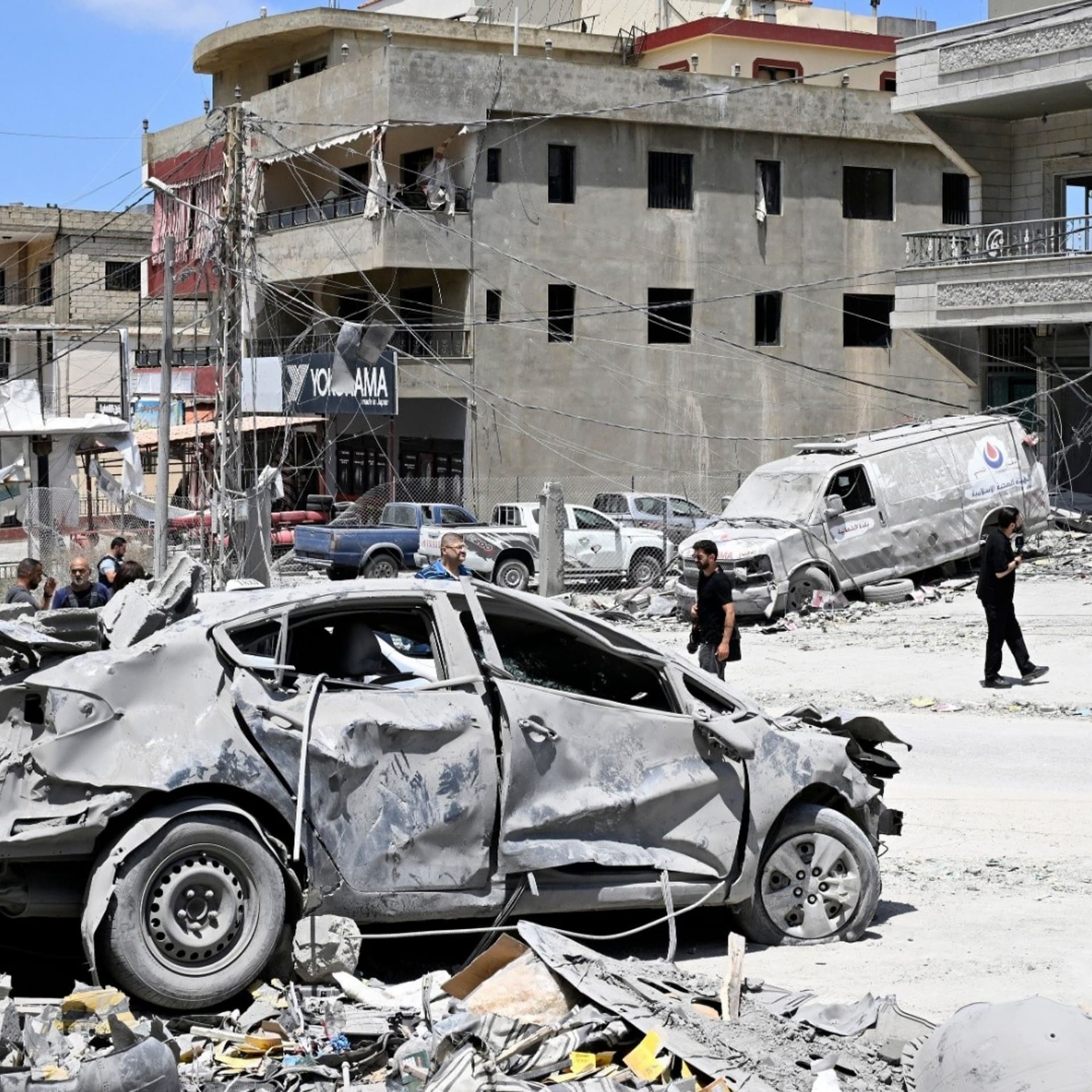
The Global News Podcast brings you the breaking news you need to hear, as it happens. Listen for the latest headlines and current affairs from around the world. Politics, economics, climate, business, technology, health – we cover it all with expert analysis and insight. Get the news that matters, delivered twice a day on weekdays and daily at weekends, plus special bonus episodes reacting to urgent breaking stories. Follow or subscribe now and never miss a moment. Get in touch: globalpodcast@bbc.co.uk Photo: A car and ambulance belonging to Hezbollah's health unit damaged during an Israeli strike on the village of Al Shaabiyeh in southern Lebanon Credit: EPA/Shutterstock