
In short
Global News Podcast Episode Summary
Episode Title
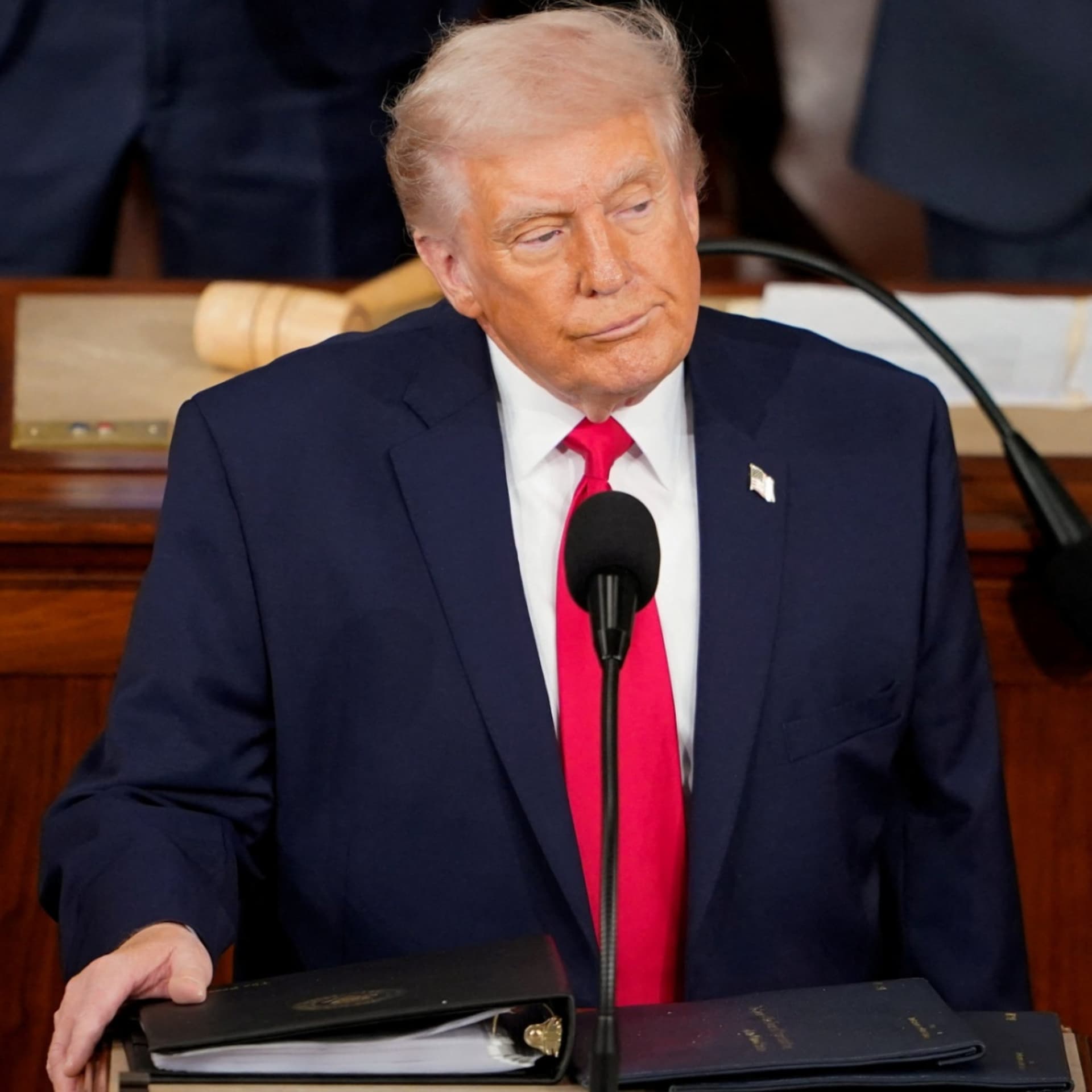
Trump Delivers Longest-ever State of the Union
Episode Description In this episode, President Trump delivers a lengthy "America First" State of the Union address, the longest in U.S. history, while facing declining approval ratings ahead of mid-term elections. The podcast also covers various global stories, including the UK's new electronic travel authorization for visitors, the investigation of tiger deaths in Thailand, and the return of colonial artifacts. Moreover, the episode highlights technological issues regarding robot vacuums and features the artistic achievements of 91-year-old Rose Wylie.
---
Main Stories and Highlights
- Trump’s State of the Union Address
- Overview: President Trump characterized his tenure as a transformative period for America, declaring it a "Golden Age."
- Key Points:
- Critiques of the Democratic Party were frequent; he faced heckling from some Democratic members during his address.
- Major themes included:
- Economic Recovery: Asserted improvements in the economy, with claims of falling inflation and rising incomes.
- Military Strength: Highlighted a strong military presence and peace through strength.
- Foreign Policy: Claimed efforts to end multiple conflicts, including operations against Iran and drug cartels.
- Contentious Issues:
- Attacks on sanctuary cities and immigration policies.
- Comments on gender affirming care elicited reactions from Democratic attendees, illustrating a polarized atmosphere.
- Analysis of Trump’s Address
- Correspondent Insights:
- Simi Jolaoso noted Trump's focus on rallying his Republican base rather than appealing to independents or moderates.
- Criticized his avoidance of broader economic discussions and the potential impact of tariffs on everyday Americans.
- Global News Stories
- UK Electronic Travel Authorization:
- Starting February 25, visitors to the UK must apply for an electronic travel authorization (ETA).
- The ETA aims to increase security and streamline entry but has faced criticism for adding complexity for tourists.
- Tiger Deaths in Thailand:
- Over 70 tigers died in a Chiang Mai park due to a virus outbreak, raising concerns about the conditions in such tourist attractions.
- Artifact Controversy:
- A golden ram’s head looted from Ghana remains inaccessible to the public, prompting calls for its return and public display.
- Technology and Cybersecurity
- Robot Vacuum Hacking Incident:
- An engineer’s attempt to connect his robot vacuum to a game controller inadvertently exposed countless devices and data, highlighting severe cybersecurity vulnerabilities.
- Cultural Spotlight: Rose Wylie
- Artistic Achievement:
- At age 91, Rose Wylie is the first female British painter to have a solo exhibition at the Royal Academy.
- Her work is characterized by boldness and draws inspiration from diverse cultural references.
---
Key Takeaways
- Political Landscape: Trump's State of the Union reflects ongoing partisan divides and strategic positioning ahead of the mid-term elections.
- Global Issues: Current events illustrate international challenges in conservation, security, and post-colonial accountability.
- Cultural Recognition: Rose Wylie’s success at an advanced age represents a significant milestone in the arts, challenging gender norms within the art community.
---
Closing Remarks This episode encapsulates significant political discourse led by President Trump amid critical global developments. The synthesis of domestic and international news provides listeners with a comprehensive understanding of current affairs affecting lives worldwide.
For further inquiries or feedback, listeners can reach out at globalpodcast@bbc.co.uk.
Written by AI. May contain mistakes. Listen to the episode to check what was said.
Chapters
Tap a time to open that second in VOTrump's State of the Union Highlights
1:08 to 2:35
Overview of Trump's State of the Union address and its significance.
“And in the early hours of Wednesday, the 25th of February, these are our main stories.”
Trump's Domestic Achievements
2:35 to 4:23
Discussion on Trump's claims regarding domestic achievements and policies.
“Donald Trump has delivered the annual State of the Union address.”
Foreign Policy and Military Operations
4:23 to 5:07
Analysis of Trump's foreign policy claims and military operations.
“Cambodia and Thailand, Pakistan and India would have been a nuclear war.”
Contentious Issues in the Address
5:07 to 7:21
Examination of polarizing issues raised during the address, including immigration.
“where 25 ,000 soldiers are dying each and every month.”
Analysis and Reactions from Correspondents
7:21 to 11:29
Insights and analysis from correspondents on Trump's address and its implications.
“That is why I'm also asking you to end deadly sanctuary cities that protect the criminals and enact serious penalties for public officials who block the removal of criminal aliens.”
Ukraine Conflict and International Response
11:29 to 14:01
Discussion on the ongoing conflict in Ukraine and international implications.
“of the Union address that he was working hard to end the war in Ukraine, which has just marked its fourth anniversary.”
Global Security Posture and the Ukraine Conflict
14:01 to 15:06
Explore the current geopolitical landscape and the ramifications of the Ukraine conflict on global security.
“It's also about the impact on the rest of Europe and the wider world.”
Tiger Park Controversy in Thailand
15:09 to 16:34
Investigate the outbreak of disease among tigers in captivity and the ethical concerns surrounding tiger parks.
“At least 72 captive animals died this month after being infected with a virus at a specialist tiger park in the northern city of Chiang Mai.”
Cybersecurity Breach via Vacuum Hack
16:39 to 16:55
Examine a man's failed attempt to hack his robot vacuum and the broader implications for cybersecurity.
“He basically just requested his data from DJI's servers and suddenly it showed him everybody's data and everybody's robots in their homes all over the world.”
American Trends in Religion and Values
17:11 to 17:58
Discover the rising interest in Russian Orthodoxy among Americans seeking traditional values.
“Many new converts say the churches they were raised in are too woke and they're looking for a faith which promotes traditional values.”
Show all 14 chapters
UK ETA and Travel Challenges
19:11 to 23:55
Learn about the new electronic travel authorization for visitors to the UK and its impact on travelers.
“From today, almost all visitors to the UK will need to apply for an ETA.”
Rose Wiley: Trailblazer in British Art
23:56 to 28:00
Meet Rose Wiley and explore her groundbreaking achievements as the first female British painter at the Royal Academy.
“From the point of view of the 21st century, it is in shockingly bad taste.”
Art World Inequality and Personal Journey
28:00 to 29:39
Explore the challenges women face in the art world and the story of Rose Wiley's career.
“I mean, historically, just extraordinary.”
Reflections on Success and Artistic Process
29:40 to 31:29
Discuss Rose Wiley's artistic inspirations and her views on age and success.
“I had a little green metal paint box with proper paints.”
Transcript
Automatic transcript. May contain errors.0:00Global News Team:This BBC podcast is supported by ads outside the UK. Available now on the documentary from the BBC World Service. In the US, increasing numbers of Americans are embracing Russian orthodoxy. Many new converts say the churches they were raised in are too woke and they're looking for a faith which promotes traditional values. I'm Lucy Ash. Join me to find out more. Listen now by searching for the documentary wherever you get your BBC podcasts.
0:56Global News Team:intersection where the world and America meet. Listen on BBC.com or wherever you get your podcasts.
1:07This is the Global News Podcast from the BBC World Service. Hello, I'm Ankur Desai. And in the early hours of Wednesday, the 25th of February, these are our main stories. President Trump has delivered a stridently America first State of the Union address to Congress. He lavishly praised his own administration's record while attacking that of the Democrats, some of whom walked out and heckled the president during some heated exchanges. At just under two hours, the speech was the longest in history. We'll hear some of the highlights from the speech and get analysis from our correspondent in Washington.
1:48Also in this podcast, if you're traveling to the UK, keep listening. As from today, you'll need to apply for a new electronic travel authorisation. If you apply for a visa, if you're a country that needs to apply for a visa, you've already had pre-authorisation. Up until now, we've not had that. Elsewhere, authorities in Thailand are investigating the deaths of dozens of tigers at a popular tourist attraction. And... This is an extraordinary golden ram's head, some 20 centimetres across, and it weighs, I think, 1.2 kilos. You'll hear the story of a golden ram's head from Ghana and other stolen artifacts from colonial times, which the public are being denied access to.
2:35Donald Trump has delivered the annual State of the Union address. He spoke for nearly two hours, making it the longest such speech in history. The president began by saying his administration had heralded what he called the Golden Age of America. When I last spoke in this chamber 12 months ago, I had just inherited a nation in crisis with a stagnant economy, inflation at record levels, a wide open border, horrendous recruitment for military and police, rampant crime at home and wars and chaos all over the world. But tonight, after just one year, I can say with dignity and pride that we have achieved a transformation like no one has ever seen before and a turnaround for the ages.
3:24It is indeed a turnaround for the ages.
3:31And we will never go back to where we were just a very short time ago. We're not going back. USA! USA! USA! USA! USA! USA! USA! Thank you. Today, our border is secure. Our spirit is restored. Inflation is plummeting. Incomes are rising fast. The roaring economy is roaring like never before. And our enemies are scared. Our military and police are stacked and America is respected again, perhaps like never before. President Trump also touted America's military strength, but said it would seldom have to use this great power as he chose what he called peace through strength. Our country has never been stronger.
4:25My first 10 months, I ended eight wars. Cambodia and Thailand, Pakistan and India would have been a nuclear war. 35 million people said the Prime Minister of Pakistan would have died if it were not for my involvement. Kosovo and Serbia, Israel and Iran, Egypt and Ethiopia, Armenia and Azerbaijan, the Congo and Rwanda, and of course the war in Gaza which proceeds at a very low level. It's just about there.
5:02And we're working very hard to end the Ninth War, the killing and slaughter between Russia and Ukraine, where 25 ,000 soldiers are dying each and every month. Think of that. 25 ,000 soldiers are dying a month. A war which would have never happened if I were President. Would have never happened. As President, I will make peace wherever I can, but I will never hesitate to confront threats to America wherever we must. That's why in a breakthrough operation last June, the United States military obliterated Iran's nuclear weapons program with an attack on Iranian soil known as Operation Midnight Hammer.
5:47The U.S. military has also been active closer to home, fighting what it alleges are drug traffickers in the Caribbean and Pacific region. President Trump claimed that as another the win. For years, large swaths of territory in our region, including large parts of Mexico, have been controlled by murderous drug cartels. That's why I designated these cartels as foreign terrorist organizations, and I declared illicit fentanyl as a weapon of mass destruction. And with our new military campaign, we have stopped record amounts of drugs coming into our country and virtually stopped it, completely coming in by water or sea.
6:33You probably noticed that. We very seriously damaged their fishing industry also. Nobody wants to go fishing anymore. We've also taken down one of the most sinister cartel kingpins of all. You saw that yesterday. Dozens of Democrats boycotted the State of the Union address. Some of those who were there heckled the president. If you agree with this statement, then stand up and show your support. The first duty of the American government is to protect American citizens, not illegal aliens.
7:14Isn't that a shame? You should be ashamed of yourself not standing up. You should be ashamed of yourself. That is why I'm also asking you to end deadly sanctuary cities that protect the criminals and enact serious penalties for public officials who block the removal of criminal aliens. In many cases, drug lords, murderers all over our country, they're blocking the removal of these people out of our country. And you should be ashamed of yourself. And there were also clashes over another polarizing issue, that of transgender rights. Look, nobody stands up. These people are crazy, I'm telling you.
7:58They're crazy. Amazing. Boy, oh boy. We're lucky we have a country. With people like this, Democrats are destroying our country, but we've stopped it just in the nick of time, didn't we? Well, our correspondent in Washington, Simi Jola, also was watching the address and she gave me her analysis. It was interesting that President Trump focused on issues that will rally his Republican base. He didn't seem to really touch on issues that might attract a broader base, especially independents, because polls show he's lost significant support within that key group. He defended his own record as we expected him to when he spoke about the economy, a reduction in crime rates.
8:49He spoke about foreign policy. He touted his claim of having stopped eight wars. He reflected on the strength of the American military. But then he repeatedly attacked Democrats on issues related to gender affirming care, corruption, the Save America Act that he's trying to push. And then he also used the opportunity to call on Congress to pass certain laws, like one he called the Delilah Law. He also mentioned trying to ban children from accessing gender related medical care. He spoke about tough legislation with regards to immigration and halting the release of violent repeat offenders. We could see from the reaction of the Republicans and Democrats, even Democrats shouting back at him when he was talking about corruption within the country.
9:42You could hear Ilhan Omar shout that he calling him a liar. We saw one Democrat walk out as well. But the Republicans were applauding pretty much everything President Trump said. So when it comes to the impression he's going to make to the people who try and vote in the midterm elections away from his MAGA core base, would he have said enough to try to convince them that he's still the man and the Republicans should still hold the House going forward? I don't think so. I think he could have said a bit more about the economy and his plan going forward. He did mention tax cuts. But he also kept pushing the narrative of tariffs being better for Americans.
10:28But what a lot of Americans have been seeing are higher costs. Economists have said that it's Americans that are feeling the cost of the tariffs. And it's not actually improving the economy. But President Trump keeps saying that tariffs are needed to boost American manufacturing and production. He also spoke about immigration. We of course know what's happened in Minnesota with the killing of two US citizens and President Trump at the time said he would take a softer approach but he hasn't really said that this time around. He's pushed for a tougher approach on immigration and he's praised what's happened so far with regards to enforcement officials in and around the country.
11:14So whether he's done enough to bring the independents, the people who might have been supporting him at the start of last year and now isn't so sure, it's not very clear. Simi Jalaoso reporting. As we heard, President Trump said in his State of the Union address that he was working hard to end the war in Ukraine, which has just marked its fourth anniversary. In advance of the speech, the BBC's James Kumrasani asked Mikhailo Podolyak, one of the Ukrainian president's closest advisors, what he'd like to hear Donald Trump say.
11:50Global News Team:That Ukraine undoubtedly is the partner of the United States and Europe, and that Russia now is completely different from Russia before 2022, and Russia today is not a global leader. Have you ever heard Donald Trump talk about Russia in those terms? You asked what I would like to hear. Trump has his own interest and everybody is hearing his words, but nobody is taking into account what he is doing. He is pushing Russia from the international markets. What of the current peace negotiations? The point of the talks is to see what decides in the talks what countries want. We know that Ukraine wants peace.
12:43Global News Team:Russia still wants war. The United States, they want to gain some dividends from this process. They want to get some preferences for themselves. Can I just ask you about the view of the Ukrainian public? The opinion polls suggest that more and more want a negotiated end to the war as soon as possible. How long do you have? How long do you think you can continue this war without losing the public support?
13:15Global News Team:Russia is not offering anything. It's just offering more war, more violence, and there is only one option to go to the end.
13:29Meanwhile, the UN General Assembly has passed a resolution in support of Ukrainian sovereignty. The resolution has called for a full ceasefire and lasting peace. The US was among 51 countries to abstain, with the conflict now into its fifth year. Our international editor Jeremy Bowen has this assessment.
13:48Global News Team:The full-scale invasion four years ago was the first clear sign that the world had changed. What's happened since then is not just about the impact of four years of killing and destruction on Ukraine and Russia. It's also about the impact on the rest of Europe and the wider world. Old assumptions about security, about the safety of the future, have been overturned. Leaders are finding ways to spend more money on the military. That's because the world is more dangerous now than at any time since the height of the Cold War. Russia's war effort depends on allies in China, North Korea and Iran. Ukraine relies on NATO countries.
14:29Global News Team:Perhaps President Zelensky had a point when he told me at the weekend that it amounted to a world war. Other principles are at stake. President Trump has abandoned the idea held since 1945 that big countries should not take land from smaller ones by force. He is pushing Ukraine to accept President Putin's demand to give up territory that Russia has tried and failed to capture in return for a ceasefire. The war between Russia and Ukraine is still flashing danger signals across Europe. Will the war end this year? Not the way things look now. Jeremy Bowen reporting. Next, the authorities in Thailand are investigating the deaths of dozens of tigers at a popular tourist attraction.
15:15At least 72 captive animals died this month after being infected with a virus at a specialist tiger park in the northern city of Chiang Mai. Thailand has several such parks where tourists pay to take photos and have contact with the big cats. But conservationists have long criticised the zoos as unsuitable, as Jonathan Head reports from Bangkok.
15:38Global News Team:Tiger parks are a familiar site in Thailand, popular in particular with Chinese tourists, but criticised by conservation and animal welfare groups for the conditions in which hundreds of animals are kept together in small spaces. This leaves them vulnerable to outbreaks of disease. More than 70 have died over the past week in one zoo after contracting canine distemper, possibly from the chicken carcasses which make up the bulk of their diet. Officials from the Department of Agriculture say the outbreak is now under control, but it is bound to prompt more calls to shut the tiger parks down completely.
16:14Global News Team:Most of them hold Bengal tigers, which breed well in captivity, but Thailand also has a small, though endangered, wild population of Indochinese tigers in its forests. Conservationists fear the large number of tigers held in zoos can help to conceal the illegal trade in tiger parts, which is still rife in much of Asia. Jonathan Head reporting. Still to come on this podcast, what went wrong when one man in the US tried to hack his robot vacuum? He basically just requested his data from DJI's servers and suddenly it showed him everybody's data and everybody's robots in their homes all over the world.
16:55This is absolutely terrible for cyber security.
17:06Available now on the documentary from the BBC World Service. In the US, increasing numbers of Americans are embracing Russian orthodoxy. Many new converts say the churches they were raised in are too woke and they're looking for a faith which promotes traditional values. I'm Lucy Ash. Join me to find out more. Listen now by searching for the documentary wherever you get your BBC podcasts.
17:36Global News Team:America is changing. And so is the world. But what's happening in America isn't just a cause of global upheaval. It's also a symptom of disruption that's happening everywhere. I'm Asma Khalid in Washington, D.C. I'm Tristan Redman in London and this is The Global Story. Every weekday we'll bring you a story from this intersection where the world and America meet. Listen on bbc.com or wherever you get your podcasts.
18:20The president of Poland, Carol Nowrowski.
18:25Global News Team:The US president, Donald Trump. To cultural icons. Two-time Oscar-winning actor, Sir Anthony Hopkins. The interview from the BBC World Service. Listen now wherever you get your BBC podcasts. Deepfake porn didn't come out of nowhere. It was allowed to spread, while governments dragged their feet and tech companies shrugged. I'm staring at myself in this video that I know I haven't made. This is what it looks like to feel violated. This season on Understood. If you follow the trail, who does it lead to? These images, they were like hunting me. And the biggest platform was Mr. Deepfakes. Understood.
19:03Global News Team:Deepfake Porn Empire. Available now on CBC Listen or wherever you get your podcasts. From today, almost all visitors to the UK will need to apply for an ETA. That's an electronic travel authorisation before they can enter this country. It costs about US$21 and follows similar schemes already in place in the US and Australia. The European Union will also bring in its own compulsory visa later in the year. And the UK government says it prevents those who are a threat from getting into the country. But as Rick Kelsey reports, some travel groups say it's an unnecessary burden on tourists. I'm coming through airport passport security, a biometric scan and I'm through.
19:50Global News Team:From now on, people from outside the UK coming through these gates will need to have a UK ETA, an electronic travel authorisation. You'll need to apply three days before to guarantee you'll get it on time. We hear week on week about people who have been unable to board flights, have wasted huge amounts of money, and they just haven't understood fully the paperwork that they need to cross the border. Claire Irwin is travel editor for the Sunday Times in the UK. If you are relying on your consumer rights to get you a refund for a flight you're not able to take because you haven't got the right paperwork, you're sadly mistaken.
20:34Global News Team:You are the only one who's going to miss out. It is complicated. The European Union's new entry and exit scheme will come in from October. There are thousands of messages on travel forums you can read about people missing flights because, frankly, they didn't know about these new visas. There's also the problem of fraud and businesses making large profits off the new arrangements. Almost all the visas ask that people book directly from the government or official site of the country that you're visiting. But this has not stopped companies charging sometimes hundreds of dollars for doing it for them, even masking as official partners, which is what happened to Jasmine Gallant from New Brunswick in Canada.
21:18Global News Team:We had paid our flight. This link appeared and said all travellers to the UK need a travelling visa. So I applied for it. They never mentioned any fees. I just assumed that it was going to be the same fees as before. But I ended up paying£100, which the first time I had applied cost me£20. Esther Fraud is frequent enough that US Customs and Borders Protection regularly warns travellers about these type of scams. Julia Lobusayad is from the Advantage Travel Partnership, a global group of independent travel businesses. This is all about anyone that doesn't need a visa to travel to a country. How do we know who's in the country?
22:03How do we control security from that point of view? If you apply for a visa, if you're a country that needs to apply for a visa, you've already had pre-authorisation. But up until now, we've not had that.
22:13Global News Team:Most of these new travel authorisations cost between$15 and$30 and they last for up to three years. But don't forget to do it before you head to the airport. Rick Kelsey with that report. As the West begins to return some stolen artefacts to the countries they were taken from in colonial times, the British Royal Artillery has come under fire for denying all public access to looted Ashante treasure. A golden ram's head pillaged from what is now Ghana remains hidden in an officer's mess. The British Army says access to military locations is controlled for security, operational and safety reasons.
22:52But Barnaby Phillips, one of the expert authors denied access, told us the artefact should at least be loaned to museums. This is an extraordinary golden ram's head, some 20 centimetres across, and it weighs I think 1.2 kilos. It's perhaps the single most striking object which the British looted from the palace of the Ashanti King in Kumasi, today in the centre of Ghana, on a military expedition in 1874. And it was taken by a group of officers. They were caught by their superiors, red-handed, as it were, and they were able to buy it directly. They paid£135 in 1874. That's about£16 ,000, over$20 ,000 today.
23:41And they were able to take it back to the Royal Artillery officer's mess. The Royal Artillery decided it needed to be better protected. They put it in a glass dome and then they put a stand underneath it. And that stand is comprised of the figures of three West African boys, so described, naked except for loincloths. From the point of view of the 21st century, it is in shockingly bad taste. And I should say, I'm not alone in my frustrations, Tim. I know even museum curators who struggle to see these objects. They are very, very closely kept by the Royal Artillery, and only they and their invited guests can go into the mess and see them.
24:26In fact, I spoke to one curator, director of a national museum here in Britain, and I should say he's a fairly temperamentally conservative man. He did manage to go and see these objects. He said, when you see these things and you realise no one else can see them and they will never leave this place, it's like a punch in the stomach. Barnaby Phillips. To the US now and the story of an AI computer engineer who wanted to be able to remotely control his new robot vacuum cleaner. And so he used his skills to link it to a PlayStation game controller. But by doing that, he accidentally gained access to thousands of the vacuum devices.
Read the full transcript
25:06He could not only just control them, but could see their live camera feeds in thousands of people's homes. The technology journalist, Mary-Anne Russon, told us more about what happened. Technology journalists, we've been warning for probably the last 12 years at least, that the internet of things is not secure. Particularly if you're a cybersecurity journalist, we've long warned that it isn't secure. There's lots of different things floating around all the time. So what I always sort of say, really, is that you use these things at your own risk, really. It's kind of a bit of a wake up call. I mean, this guy has technically done them a favour because he's found this all out for free and told them so they can now block it.
25:45And the fact is, it went in through, he was using his user ID token, and he basically just requested his data from DJI servers, and suddenly it showed him everybody's data and everybody's robots in their homes all over the world. This is absolutely terrible for cybersecurity, but this has obviously been the problem with many such internet-enabled services and products around the world. they're not unique in this they were originally a very small quadcopter drone company that makes you know ones with little cameras for for hobbyists to use right um you know and the reality is that you know drones have not become commonplace as we expected them to do there's rules all over the world for where you can use them and basically they're not really in the business of cyber security but essentially all businesses in the world a cyber security person was saying last week his post went viral on X and he was saying you need to remember even if you're a bakery even if you're a fashion retailer you are at the heart of it you're an IT company and you need to protect your services your products and your customers as if you're an IT company.
26:53Tech journalist Mary Ann Russon. At 91 years old Rose Wiley is making art history by becoming the first female British painter to have a solo exhibition in the main galleries of London's famous Royal Academy. Her paintings are big, bold and bright, and she takes her inspiration from cinema, history and sports, including the likes of footballers Wayne Rooney, Thierry Henry and Brazilian icon Ronaldinho. She also famously depicted the award-winning actress Nicole Kidman in a one-strapped dress from a photo she saw of her at a film premiere. The BBC's culture editor Katie Razzle went to meet her.
27:34I love this kind of thing. I love things going up on walls. She's the rebel painter of the British art world and now Rose Wiley's watching her paintings being lifted into position in the Royal Academy. Over there's a painting. That's me. That's the first me with painting with grey hair. Self-portrait? Yes. Somewhat incredibly, Wiley is the first female British painter to have a solo exhibition in the Royal Academy's main galleries in its more than 250-year history. It's obscene. I mean, historically, just extraordinary. Do you think the art world is still male-centric? The interesting thing is that when it comes to the price of the work, men's paintings are still much higher than women's.
28:17There's something very wrong with that. It's not like sport, where men are more powerful, and therefore maybe they play a more powerful game. I mean, And in painting, it's like writing. There's no gender difference in terms of how we tackle anything. The image, the size, the amount of paint, it's not gender specific. So the fact that the man will get more should be fixed. Rose Wiley's own paintings are now highly valued, but her career only really took off when she was in her 70s. In the studio in Kent, where she's worked for more than 40 years, paint-spattered newspapers cover the floor. She starts with drawings and uses photographs and other visual images as references and inspiration for her work.
29:05I don't want to do an illustration. I am not a copyist. I work, I transform. I use a lot of paint. You do. We can see lots of it on the floor around you. It doesn't all go on the work. Yes, because I take it off. You see, the thing is, when it's not working, you take it off. So it's constantly coming off. So a lot of paint is on the floor. She's now aged 91 with a rescue cat she thinks is 16. You are the most lovely pussycat. You're very happy. Wylie didn't paint for many years while she raised her family, but she'd started as a child growing up in the Blitz. I had a little green metal paint box with proper paints.
29:45I used to spend my pocket money on refill. What do you think that little girl would think now of her adult self and all the success? It would blow the little child's mind. I mean, it's not something you think about, particularly the art students of the 50s. We were not grounded in being successful. I hate to be ageist, but people definitely think this is the work of a young artist. They do say that. You are right. Not in a negative way, though, in a positive way. No, it's positive. No, it's positive. I'm perfectly happy when they say it. Who wants to paint like an old person? It's fresher. Back in the Royal Academy, her big, bold, irreverent canvases chronicle her life and inspirations, including doodlebugs from The Blitz, actresses like Nicole Kidman and scenes from Quentin Tarantino films.
30:37I think it was the end of part one of Kill Bill. There was this marvellous shot of a woman lying horizontal with her arm up, spurting blood. It reminded me of Renaissance Fontaine's. I mean, it's not realistic, but then Tarantino's violence is not realistic. Is it true you like painting at night? Well, I often go into the night. It's not a plan. What sort of time do you paint to, then? 20 to 4 is probably my notice, but it's not normal. Often it's more like 1.30. And do you get tired? No, you don't notice. But then I get up to early, so I'm not losing sleep. So you're basically living the life of a teenager?
31:17Well-proved. Wiley's now got her biggest show yet, 90 paintings in all. An artist very much in her prime, who says she hopes her best is yet to come. Katie Razzle speaking to artist Rose Wiley. And that's all from us for now. If you want to get in touch, you can email us at globalpodcast at bbc.co.uk. And don't forget our sister podcast. It's called The Global Story, which goes in-depth and beyond the headlines on One Big Story. And that's available wherever you get your podcasts from. This edition of The Global News Podcast was mixed by Masood, Ibrahim Kael, and the producers were Paul Day and Nikki Varrico.
31:59The editor is Karen Martin, and I'm Anka Desai. Until next time, goodbye.
32:33to find out more. Listen now by searching for The Documentary wherever you get your BBC podcasts.
From the publisher
President Trump touts his record in office in a fiery "America First" State of the Union address -- the longest in US history. The speech comes as polls suggest Americans are souring on his second-term agenda ahead of crucial mid-term elections. We have the highlights and analysis from Washington. Also: the UK introduces ETA for travellers entering the country; Thai authorities investigate tiger deaths; debate rages over a golden ram's head looted from Ghana; how an AI computer engineer accidentally hacked robot vacuums; and we meet Rose Wylie who's making art history at 91.
The Global News Podcast brings you the breaking news you need to hear, as it happens. Listen for the latest headlines and current affairs from around the world. Politics, economics, climate, business, technology, health – we cover it all with expert analysis and insight.
Get the news that matters, delivered twice a day on weekdays and daily at weekends, plus special bonus episodes reacting to urgent breaking stories. Follow or subscribe now and never miss a moment.
Get in touch: globalpodcast@bbc.co.uk
US President Donald Trump looks on as he delivers the State of the Union address in the House Chamber of the US Capitol in Washington, D.C. February 24, 2026. PHOTO CREDIT: REUTERS/NATHAN HOWARD