
In short
UK announces sanctions/import ban on goods and services from Israeli settlements in the occupied West Bank, framed as part of a “comprehensive reset” and tied to the claim that the occupation is unlawful under international law; episode also covers Saudi-Iran-linked conflict escalation in Yemen, AI’s impact on healthcare, Sudan’s humanitarian healthcare collapse from funding cuts, Canada-US tariff retaliation, French Renoir museum art theft, and an Oasis reunion documentary.
Guests/backgrounds
No named guests; interviews are with BBC correspondents/reporters: Paul Adams (diplomatic correspondent), Yoland Nell (Middle East correspondent), Sebastian Usher (global affairs reporter), Faisal Islam (economics editor), Barbara Plett-Usher (Africa correspondent), Theo Leggett (international business correspondent), Hugh Schofield (Paris correspondent), Anna Foster (interviewer), Stephen Knight (documentary writer/producer).
Key claims/examples
Miliband says settlement expansion and occupation are unlawful; bans settlement products and services and mentions advertising; Jordan Valley date-farmers cite water diversion and settler control; Saudi says Houthi strikes hit Aramco/King Khalid; Arm’s René Haas predicts AI will shorten drug testing and help cure cancer; MSF warns 37% of Sudan healthcare facilities are out of service with clinic closures; Canada tariffs target US goods like milk/perfume/video games; Renoir paintings stolen from his former home; Oasis documentary focuses on reconciliation behind the scenes.
Written by AI. May contain mistakes. Listen to the episode to check what was said.
Chapters
Tap a time to open that second in VOUK Sanctions Overview
1:21 to 3:19
Discussion on UK's new sanctions against Israeli settlements in the West Bank.
“The UK government announces sanctions over Israeli settlements in the occupied West Bank.”
Analysis of Ed Miliband's Speech
3:19 to 6:32
Insight into Ed Miliband's address regarding the occupation and its implications.
“A number of other European countries, including Poland, Portugal and Sweden, are planning to limit trade with the settlements, according to a statement from their foreign ministries.”
Impact of Settlement Ban
6:32 to 10:10
Exploration of what a UK ban on settlement goods means for Palestinians and Israelis.
“Settlements in the occupied West Bank have expanded rapidly under the current Israeli government, which its far-right finance minister, Basil El Smotrich, has said will bury the idea of a Palestinian state.”
Saudi-Iran Conflict Escalation
10:10 to 13:32
Report on the recent escalation between Saudi Arabia and the Houthi group.
“Fighting has escalated between Saudi Arabia and the Iran-backed Houthi group.”
Saudi-Iran Conflict Escalation
14:30 to 14:58
Report on the recent escalation between Saudi Arabia and the Houthi group.
“Now through September 29th, save on all your favorite personal care essentials and earn four times a point.”
AI's Impact on Healthcare
15:07 to 17:42
Exploring how AI is expected to revolutionize drug development and healthcare.
“The boss of one of the world's leading computer chip makers is predicting artificial intelligence is poised to cause a revolution in healthcare.”
Humanitarian Crisis in Sudan
17:43 to 20:03
Discussion on the ongoing humanitarian crisis and healthcare collapse in Sudan.
“Tens of thousands of people have died and millions have fled their homes.”
Trade Tensions Between US and Canada
20:04 to 24:16
Analysis of the escalating trade tensions and tariffs imposed between the US and Canada.
“MSF is calling them at the breaking point.”
Art Theft in France
24:17 to 26:41
Details on the recent high-profile art theft from a French museum.
“a number of paintings worth millions of dollars have been stolen from the former home of the Impressionist painter Pierre-Auguste Renoir.”
Oasis Documentary Insights
26:42 to 28:01
An exploration of the behind-the-scenes story of Oasis' return to the stage.
“To the English rock band Oasis now, who, after 16 years of not performing, took to the stage again last year, and we're about to see how it all unfolded behind the scenes in a new documentary.”
Show all 11 chapters
Exploring the Oasis Documentary
28:01 to 28:59
Learn about the unexpected resurgence of interest in Oasis and the making of a documentary exploring it.
Transcript
Automatic transcript. May contain errors.0:00This BBC podcast is supported by ads outside the UK.
0:30and more options to their lineup can shop at machinefinder.com. I love a brighter smile. What I don't love is that little wince when I take a sip of something cold or even breathe in cold air. You know that feeling? It takes your breath away. That's ouch, eek. That's why I like Sensodyne Clinical White. Its triple action formula whitens, polishes, and helps protect against sensitivity. Plus, it protects against new stains for up to six months. So I can keep enjoying my iced coffee and everything else I love. without the sensitivity. Whiter teeth without the wince. Try Sensodyne Clinical White today.
1:07This is the Global News Podcast from the BBC World Service. I'm Alex Ritson and at 14 Hours GMT on Tuesday the 8th of September, these are our main stories. The UK government announces sanctions over Israeli settlements in the occupied West Bank. Canadian tariffs on a range of US goods come into effect, and thieves steal Renoir paintings worth millions of dollars from a French museum. Also in this podcast... More importantly, you'll find a cure for cancer that today, you and I, other humans, not in our lifetimes. I believe in our lifetime, AI will help cure cancer. Boss of a leading computer chip maker predicts AI will create a revolution in healthcare.
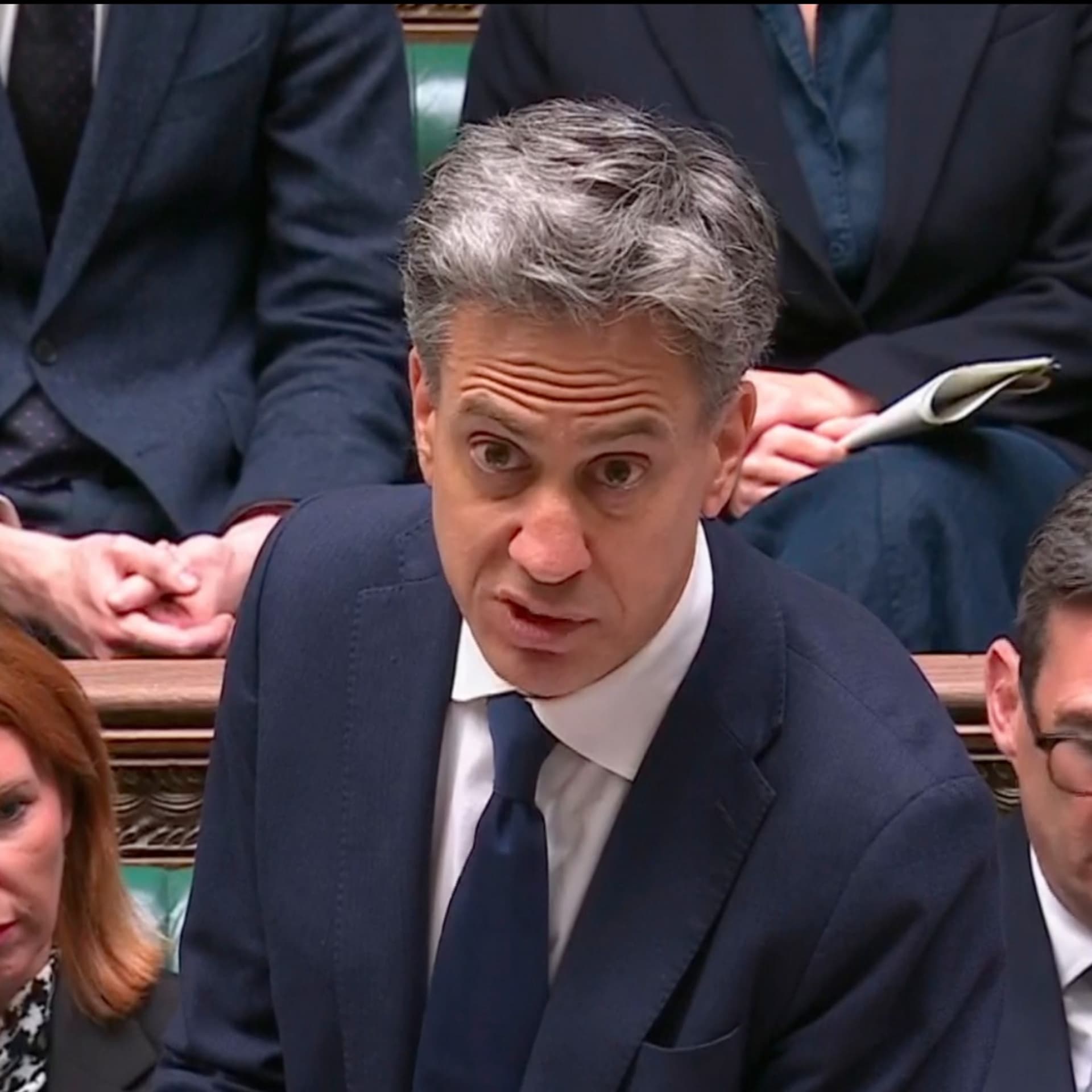
2:00The British government has announced a ban on goods from Israeli settlements in the occupied West Bank as part of what it calls a comprehensive reset of policy. Settlements are illegal under international law. Speaking in Parliament, the Foreign Secretary, Ed Miliband, said his commitment to the two-state solution had led him to a deep sense of shame about what has been happening in Palestine. He also said plans to build thousands of new homes in Jewish settlements in the West Bank were unacceptable. Today I announce that the official view of the British government is that the occupation is unlawful.
2:37Because of Israel's entrenchment of its control, its intention to extend permanent sovereignty and its expansionist agenda via illegal settlements. Madam Deputy Speaker, our position is not just an overdue statement of reality. the government believes the unlawfulness of the occupation should be reflected in the economic relationships we choose to have with the occupied territories. I do not believe the British people want us supporting the occupation by accepting products from settlements in our shops and supermarkets. So I can announce today that we will introduce an import ban on goods from illegal settlements in the occupied territories.
3:15The British Foreign Secretary, Ed Miliband. Mr Miliband also said Canada and France are joining the UK in banning these goods and services from Israeli settlements in the occupied West Bank. A number of other European countries, including Poland, Portugal and Sweden, are planning to limit trade with the settlements, according to a statement from their foreign ministries. Our diplomatic correspondent Paul Adams was listening to the UK Foreign Secretary's speech. He gave us his assessment of what Mr Miliband had to say. I think this is very significant and clearly the tone of and content of Ed Miliband's speech made it clear that he feels that too.
3:57This was a speech clearly highly personal, perhaps a speech that only a Jewish foreign secretary could make. And he spoke of his commitment to Israel, of his fond memories of visiting Israel. He was keen to draw a distinction between criticism of Israel and the relationship of this government and the Jewish population of the UK. But at the same time, he made it clear that the government is going to depart very significantly from the policies of previous governments when it comes to the measures that you just mentioned. not just a ban on the products from settlements, something that many MPs have called for for a long time, but also on services to settlements, on the advertising of settlements in the UK.
4:45And he used language that, frankly, would have been unthinkable only perhaps a couple of years ago. He talked about his agreement with an Israeli former brigadier general who said that ethnic cleansing was going on in the West Bank. So this was, I think, both in tone and content, an absolutely fundamental departure with the policies of previous governments. Paul, what did he say about some of the criticisms that he heard from the shadow Foreign Secretary, Tom Tugendhat, which have been raised by others, including the Board of Deputies here in the UK, that this action will fuel anti-Semitism in the UK?
5:26He anticipated much of that at the beginning of his address in talking about anti-Semitism in the United Kingdom and about his own relationship with the Jewish people. He is Jewish and with the state of Israel. He said he described himself as a proud British Jew. And he said that there was absolutely, in his words, no contradiction between the support for Israel and the support for a state of Palestine. When it comes to some of the other things that Tom Tugendhat was highlighting, the threats to important exports of medical supplies to the United Kingdom from Israel, to the issue of security cooperation, and of course also the fact that Israel is about to go into elections and these measures announced by Britain and other governments could bolster the hard right in Israel.
6:16I think clearly Mr Miliband responded in a way that suggested that he had thought through these issues very carefully and had decided that notwithstanding these dangers, some of which he dismissed, the important and the right moral thing to do. Paul Adams. Settlements in the occupied West Bank have expanded rapidly under the current Israeli government, which its far-right finance minister, Basil El Smotrich, has said will bury the idea of a Palestinian state. At the same time, settler violence against Palestinians has surged to what the UN says is an all-time high. Our Middle East correspondent Yoland Nell reports from the Jordan Valley on what a settlement goods ban could mean.
7:02On a sweltering day, Israeli settlers splash in a pool at a Jordan Valley archaeological site. It was filled this summer by diverting the water supply for a nearby Palestinian village in the occupied West Bank.
7:20At the start of the year, the last of some 600 Palestinian Bedouins packed up their belongings and fled from nearby Ras Ain Al-Odja. They'd endured years of attacks by violent settlers. The UK calls what's happening across the West Bank appalling settler terrorism. The Foreign Secretary Ed Miliband says new Israeli plans to expand settlements illegal under international law, mark the crossing of a red line. He plans to reset policy. This government will not acquiesce in the destruction of the two-state solution. We will act and I will set out a comprehensive set of measures in the coming weeks.
8:00I'm in the Jordan Valley to find out if one expected measure, a British ban on settlement produce, could make a difference. The main road here is dotted with date palms. Their juicy fruits are the main export crop from this region for Israeli settlers and Palestinians.
8:22About half the palms have no fruits, complains Abdul Halim Abu Omar in Al-Urja village. It's because we lack water. Palestinians say Israel denies them a fair share of resources. This year, the farmer has few dates that are fit to show local exporter Mouman Sinokrot, who sells to the UK. Moeman believes ending trade with settlements could curb settlement growth. Settlers are very active in the Jordan Valley and increasingly active, and they are not obeying any laws or rules or anything, even from the Israel army itself. They are going to the fields of the growers, they are stealing from them, and they are controlling more and more land.
9:03Palestinians want this wide swathe of fertile land along the West Bank's border with Jordan as part of their own hoped-for state.
9:15But Israeli date farmer Avigdor Abel is confident that Israel will never give it up. He's lived in a settlement here for more than 50 years and dismisses the impact of any UK ban on his goods.
9:30As soon as we have a situation of pressure and boycotts, we always break out and look for other markets. So I believe that if we get to a situation when there's no place to sell my fruits in Europe, we'll find other markets. Already, Israel's Foreign Secretary Gideon Saar is threatening retaliation for any UK ban. I want to say just one thing. If Britain acts against the State of Israel, the State of Israel will act against Britain. Several other European countries have already banned trade with settlements, saying it's a legal obligation. But Britain's expected action is now putting a heavy strain on relations with Israel.
10:09Yoland Nell. Fighting has escalated between Saudi Arabia and the Iran-backed Houthi group. Attacks on Saudi energy facilities and infrastructure have left more than 70 people wounded. The Houthi's military spokesperson, Yahya Sari, gave this statement after the attack.
10:32The Yemeni armed forces carried out a broad and extensive military operation targeting the Aramco company and the King Khalid airbase with tens of ballistic missiles and drones. Thanks to God, the strikes were accurate and direct, causing significant damage to those facilities. The Yemeni armed forces hold the criminal Saudi enemy responsible for the escalation. Saudi Arabia has been supporting Yemen's internationally recognised government against the Houthis. Saudi authorities and official media said the strikes caused fires and temporary shutdowns. So how significant is this attack? I asked our global affairs reporter Sebastian Usher.
11:14It's significant within the terms of what goes on between the Saudis and the Houthis and the whole Yemen conflict. I mean, it's very difficult to gauge quite where that's going. I'll have to see how the Saudis respond to this. They've said that they will respond firmly. One assumes that will be the case. But this has happened just as there's been very heavy fighting in Yemen over the past few days. Now, it's all really the contagion, essentially, from the Iran war. I mean, the Houthis are semi-independent. They're not just the poor of the Iranians. But the way they have tried to close off this second major waterway, the Babamandeb Straight, which is off the coast of Yemen to Saudi vessels which are using it as an alternative to the Strait of Hormuz has been significant.
11:59It has led to both the showdown with the Saudis again, which I think we will see obviously that develop, but also it's destabilised the situation in Yemen. And oil prices already on the up as a result? Absolutely, because I mean, this is very much as far as the Houthis are concerned, the key element of it with the Saudis is to close down that oil export route. Now, Now, the Saudis do have other ways of getting oil out, if that were to be the case. But nervousness, of course, in the oil markets will increase every time you see something like this. And part of the thing that has led to this latest escalation inside Yemen was an assault that the Houthis launched last Thursday towards coastal areas, which if they took control of that, of course, it would give them greater control of the battle of man Australia.
12:46And essentially, they could possibly close the whole thing down. So there's that element. But within the fighting in Yemen, what we're hearing at the moment, of course, there isn't that much independent reporting, but the pro-government forces backed by Saudi Arabia are staging quite a strong response to the Houthis, that they have taken towns, that there is momentum behind them at the moment. The big question is whether that will continue, whether that will change the equation in Yemen. And one other thing, there was a defence pact that the Saudis signed called the Mecca Alliance with Turkey and Pakistan.
13:19Now, essentially, Turkey and Pakistan should be coming to the Saudis' aid if they're in this kind of situation. That would change things, of course, enormously. At the moment, that does seem unlikely. Sebastian Usher. Still to come in this podcast. I just don't see myself on stage with Liam. I don't really want to be going back with the tension. Will it fall apart again? Looking back in anger, unseen footage about what life was really like during the Oasis reunion.
14:01John Deere is putting in work and putting up highlights. Oh man, look at those passes. Tillage, planting, harvesting. Three years in and these pre-owned machines are still at the top of their game. We're talking reliability, performance, and long-term potential. And get this, these veteran machines can pick up the latest precision tech with ease. You know it, and fans ready to add John Deere certified pre-owned equipment and more options to their lineup can shop at machinefinder.com. Booyah! Hey, it's Ryan Seacrest for Jewel Osco. Now through September 29th, save on all your favorite personal care essentials and earn four times a point.
14:38Shop in-store or online for items from your favorite brands like Native, Pantene, Crest, Always, Gillette, Oral-B, and Tampax and earn four times the points. Points can be redeemed for discounts on future purchases on groceries and gas. Get these deals before they're gone. Offer ends September 29th. Restrictions apply. Offers may vary. Visit JuleOsco.com for more details.
15:05You're listening to the Global News Podcast. The boss of one of the world's leading computer chip makers is predicting artificial intelligence is poised to cause a revolution in healthcare. René Haas of Arm Holdings has been speaking to our economics editor, Faisal Islam. Drugs can take 20 years to be developed. 95 % of those R &D efforts fail. AI is going to not only shorten the amount of time that those drugs can be invented, it's going to shorten the amount of time that you test them. You'll start to replace some human trials with AI. But more importantly, you'll find a cure for cancer that today, you and I, other humans, not in our lifetimes.
15:45I believe in our lifetime, AI will help cure cancer. So this is your company that built on science, but it will transform science as well. Absolutely. I want to start pretty big, right? What does the world look like in 10 years time because of AI? I do think in 10 years we will see physical AI robotics in a very large way, whether it's around manufacturing, cleaning services, security, infrastructure, building bridges, doing repairs. People talk about robots and they're not quite the sci-fi future of actual robots. Absolutely, 100%. Robots prior to AI were built for a certain purpose. You see them in factories today.
16:27They install a tire in a factory or inside a distribution area. They're the forklifts that move up and down. With artificial intelligence, these robots can see, learn, and essentially be reprogrammed for new tasks. So in the service industry, the robot that was programmed to make a bed can now make a bed but can also learn how to arrange the towels in a room or clean the dust bins or whatever you want to go off and do we need to get the costs down we need to be able to get them to be uh lighter faster but that's just an engineering cost issue that's we're going to get our hands around and what about in your in your home life how would you advise people use it with their children and some concerns as well as some opportunities there yeah you know the for people to say, gosh, you know, AI is going to replace humans and it's going to replace jobs and knowledge work.
17:21AI is going to be there, period. We know that. And that's for all things we're talking about. So I would tell anyone who's talking to their kids or in my case, grandkids, learn it, embrace it and become comfortable with it. Because ultimately, AI is a utility that's going to allow us to be more productive and effective. So don't be afraid of it. René Haas of tech giant Arm Holdings. The United Nations has called the war in Sudan the world's largest humanitarian crisis. Tens of thousands of people have died and millions have fled their homes. The civil war has been ongoing for more than three years as the Sudanese armed forces and the paramilitary rapid support forces fight for control.
18:01And now people are facing a severe healthcare crisis. The medical charity, Médecins Sans Frontières, warns that international funding cuts are contributing to the collapse of the fragile health system. Cuts have closed medical clinics, hospitals are losing their capacity to function, and medicine supplies are running low. Our Africa correspondent, Barbara Plett-Usher, told me more. Last year, the US shut down its main aid agency. So what we're seeing right now is the continuing impact of that, because the existing grants that USAID had given to organizations operating in Sudan ran out in June.
18:39Those organizations have not been able to find alternative funding, so they've had to pull out. And where it comes to health, that means local clinics have either shut down or severely downsized, and that has put more pressure on hospitals. MSF, the medical charity, gave specific examples. For example, they said in a refugee camp in the eastern state of Gadaref, the maternity and surgical wards have been closed. In another refugee camp in the same state, they said that the aid organizations are down to 10 from a high of 35 five years ago. In central Darfur, 45 health centers have lost support.
19:13Many of them have closed. One of them in particular, a large one, has stayed open, but with vastly reduced services, no vaccinations, only able to see 40 patients a day down from 200. And so this is compounding an already quite severe health crisis in Sudan. This presumably in humanitarian terms means it could yet get a lot worse. Yes, definitely. And that is the warning. Now, I mean, we are talking about specific funding withdrawals and program closures at a local level. There is still money coming in. The Americans are still the largest donor to Sudan. Some European governments are prioritizing their Sudan funding, even though they are cutting their international assistance overall.
19:51all, but already 37 % of Sudan's healthcare facilities are estimated to be out of service. And now, with these local clinics being shut, that's putting extra pressure on hospitals that are still open. MSF is calling them at the breaking point. The truth is that this conflict is not a priority for the international community. You're right. I mean, there is some attention on the conflict. You've had more UN reports lately talking about the war, highlighting the international and especially transnational networks that are supplying weapons to the warring parties, especially the paramilitary rapid support forces.
20:29The U.S. is joining calls to extend the arms embargo. There is one already on Darfur, has been for many years, but there are calls to extend it to the rest of the country. There's going to be a vote on that in the Security Council on Thursday. There have been sanctions put on both warring parties, but the bottom line is there just hasn't been the political will to really put pressure on the main players, the national ones and especially the international ones, or to hold them to account. And in the meantime, we are in an environment of international aid decreasing. So I don't really expect that we'll see a reversal in that.
21:01Barbara Plett-Usher. Following the collapse of trade negotiations between the US and Canada last month, Canadian retaliatory tariffs on various American goods have come into effect. Ottawa says it's matching Washington's latest tariffs dollar for dollar. And the dispute may be widening. President Trump has now threatened to stop Canadian aircraft maker Bombardier selling planes in the US unless it manufactures them there. I asked our international business correspondent Theo Leggett what products could be affected by the new Canadian tariffs. A whole gamut of products, really. I mean, we're looking at American milk, perfume, video games, machine goods.
21:43washing machines, fridges, jackets, T-shirts, all sorts of things. But the way that the Canadians have done their retaliation is it's, in a sense, it's deliberately unprovocative. It's retaliation, but it's proportional retaliation. So as they say, they're going dollar for dollar, rate for rate, with the tariffs on$20 billion worth of Canadian exports that the White House imposed tariffs on a couple of weeks ago. So at the moment, you have this standoff, which is the latest salvo in an ongoing trade war that's been going on for about 18 months. There were negotiations, as you say, through the summer which were designed to put an end to all of that.
22:23Those negotiations were coming close to an end. It was thought that a deal would be reached and at the last moment they broke down. And what we have now is retaliation and an escalation of rhetoric that seems to show no sign of ending. Yeah, Donald Trump making these threats against the Canadian aircraft maker Bombardier will cannot be matching those dollar for dollar. Well, you have to ask whether the Americans will actually impose tariffs or any other sort of sanctions on Bombardier. Bombardier is not the company it once was that used to build regional jets and even at one point was trying to take on the likes of Boeing and Airbus with its C-series aircraft.
23:00It's smaller than that now. It predominantly makes regional and business jets, and also some military hardware. Now, it doesn't make the planes in America, but it does make a lot of components there, and a lot of US jobs do actually rely on Bombardier. So whether it would be in the US interest to sanction Bombardier is very much open to question. Despite the rhetoric, though, most trade between the two countries, which are enormous trading partners, is still tariff-free. Yeah, I mean, Canada does 70 % of its trade with the United States. that trade is worth about 411 billion US dollars. The tariffs are on less than 5 % of that.
23:39Likewise, going the other way, US exports to Canada, the tariffs will affect about 6%. So yes, in overall terms, it's pretty small beer. And if you look at the average tariff rates that Canada pays, they're about level with what the UK is being charged by the US, that kind of level. But it's where the effect of these tariffs will fall, who's likely to be affected. And it is, In the case of US tariffs on Canada, it's Canadian manufacturers. And in the case of Canadian tariffs on the US, it targets people in Midwestern states that may turn out to be crucial in November's midterm elections. Theo Leggett.
24:16In the latest high-profile art theft to hit French museums, a number of paintings worth millions of dollars have been stolen from the former home of the Impressionist painter Pierre-Auguste Renoir. It follows a heist at the Louvre Museum last year, when historic jewellery, dubbed as the French Crown Jewels, were stolen and most of the items remain missing. Our Paris correspondent, Hugh Schofield, is on the case of this latest theft. This is a museum near Nice, Cagnes-sur-Mer, the last home of Renoir. He died in 1919. It's been a museum since the 60s, contains a number of his paintings. And very early in the morning, between 5 and 6 o 'clock in the morning, Two men broke in.
Read the full transcript
24:59They apparently were well-equipped in gloves and in combat fatigues. They knew what they were doing, says the mayor. They broke into the museum. Immediately, the alarm went off. They had to make a very quick getaway. They took four paintings, but abandoned in their haste to them in the grounds of the museum, and two are still missing. And they are original Renoir paintings, so they're worth an awful lot of money, but will not be sellable on the open market because they're very famous pictures. Yeah. What is it about museum security in France? Well, I think you've got to distinguish perhaps between the Louvre, where it's possibly the most famous museum in the world, where everyone expects there to be an extremely high standard of security, which was clearly lacking for the heist a year ago, and this very, very rich and extensive network of smaller museums around the country.
25:52I would class the Renouard Museum as the kind of middle-ranking museum, but I mean, below that, there are hundreds, thousands of small museums in France, which are very, very exposed and which are now being targeted more and more by unscrupulous thieves. Here, quite clearly, the place was targeted, but they will argue that their system of security actually functioned. And I think they're fairly confident that they will catch these people because they really only had five minutes in there before the police were on their tail. As you say, hard to sell, but perhaps they were stolen to order. Well, I think that must be the case.
26:28I mean, you can't sell these things. They're famous pictures. So it must be a kind of prestigious thing ordered by some high-up gangster who wants to be able to boast to his cronies because there's not much else he's going to be able to do with them. Hugh Schofield. To the English rock band Oasis now, who, after 16 years of not performing, took to the stage again last year, and we're about to see how it all unfolded behind the scenes in a new documentary. The way it finished, unacceptable. It didn't sit right with me, man. I just don't see myself on stage with Liam. I don't really want to be going back with the tension.
27:08Will it fall apart again? Stephen Knight is the writer and producer of the film Oasis Don't Look Back in Anger. Anna Foster asked him how it all worked out. It's the first documentary I've ever made, so I'm not in charge of it. I'm not in control. I don't know where it's heading. But as an act of faith, I sort of said to everybody involved, we have to assume this is going to work. we have to assume they're going to come together that this is going to be about reconciliation because that was never a guarantee never a guarantee but that's what we we set out to tell that story fortunately that's what happened but when I met Noel and Liam at the very beginning of this they had such a burning desire for this to work that I sort of had no doubt that they were going to see it through but I had no idea how emotional and profound this journey was going to be because it's not just about these two brothers it's about a lot more than that yeah one of the reasons i'm really excited to see it is because when they first announced the tour i thought oh i'm not sure do i want to go back to my teenage years and i think i think they almost in the same way they didn't realize what it would become in the end that journey that is absolutely true when i first met noel um and i'm sort of looking for because i've been invited to do this and i was sort of quite shocked to be asked to do it but liam and all wanted me to do it so i said yes and then when i met noel he said that they were not expecting the tidal wave of interest in buying tickets and so what they realized was this isn't just the people who loved it originally there's a whole new generation there is for whatever reason have found this music and found the words and found the feeling that oasis give and so my question then for the documentary was let's find out why that has happened.
28:56And that's what this film is about. Documentary maker Stephen Knight. And that's all from us for now. If you want to get in touch, you can email us at globalpodcast at bbc.co.uk. You can also now watch our episodes in full. Just search for the Global News Podcast on YouTube. This edition was mixed by Chris Lovelock, and the producer was Richard Hamilton. The editor is Karen Martin. I'm Alex Ritson. Until next time, goodbye.
29:52and music subscription.
From the publisher
Twelve countries ban goods from Israeli settlements in the occupied West Bank; Britain's Foreign Secretary, Ed Miliband, says plans to build thousands of new homes there are unacceptable. Also: Canada's imposes retaliatory tariffs on various American goods; fighting escalates between Saudi Arabia and the Iran-backed Houthi group; the medical charity, Medecins sans Frontieres, warns that international funding cuts have closed healthcare facilities across Sudan; the boss of one of the world's leading computer chip makers, ARM Holdings, predicts artificial intelligence will cure cancer; masterpieces by the Impressionist painter, Pierre-Auguste Renoir, are stolen in France; and we speak to the writer of a new documentary on the English rock band, Oasis.
The Global News Podcast brings you the breaking news you need to hear, as it happens. Listen for the latest headlines and current affairs from around the world. Politics, economics, climate, business, technology, health – we cover it all with expert analysis and insight. Get the news that matters, delivered twice a day on weekdays and daily at weekends, plus special bonus episodes reacting to urgent breaking stories. Follow or subscribe now and never miss a moment. Get in touch: globalpodcast@bbc.co.uk
Photo: Foreign Secretary Ed Miliband making a statement on Israel-Palestine in the House of Commons. Credit: House of Commons/UK Parliament/PA Wire



