
In short
Global News Podcast - Episode Summary
Episode Title
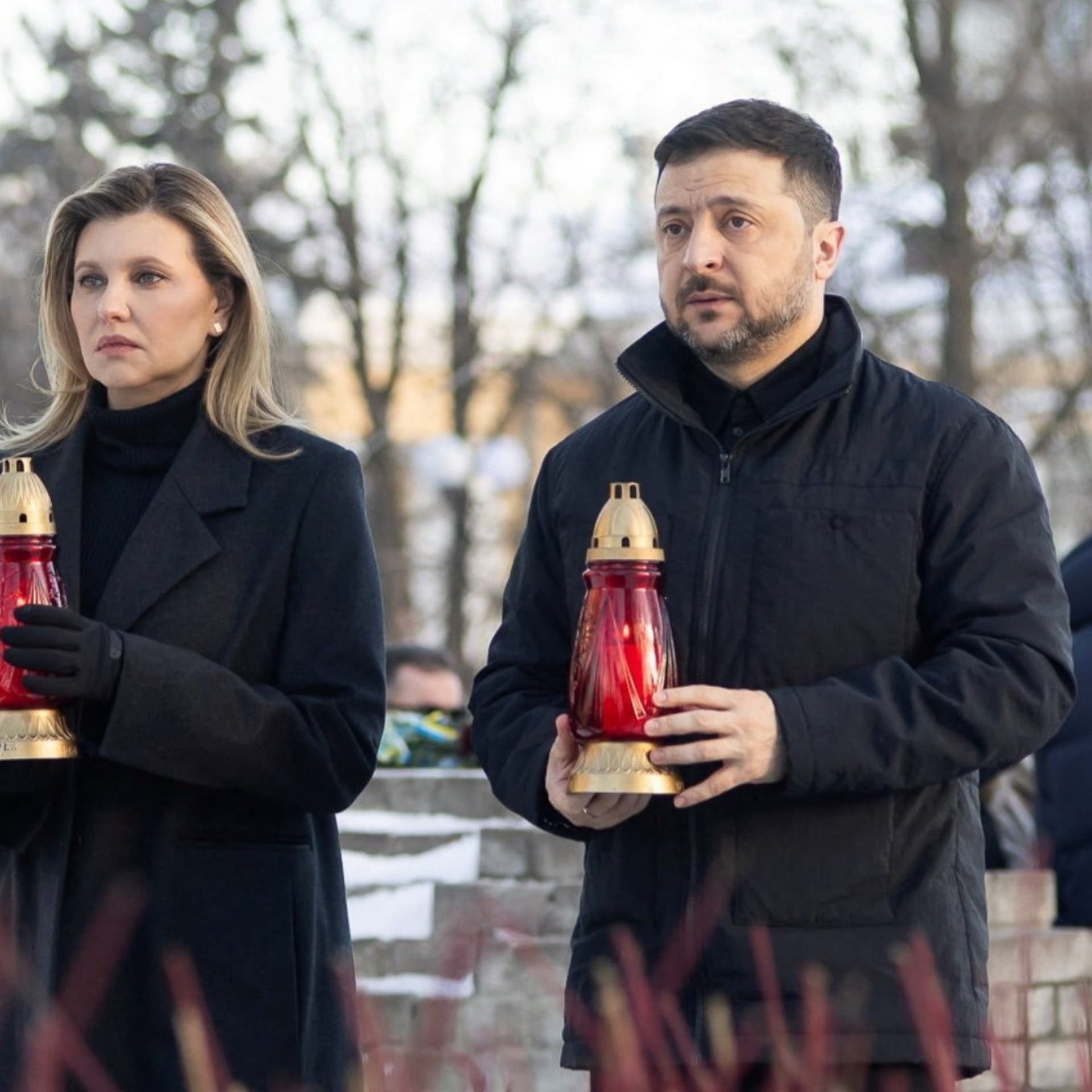
Ukraine Defiant on the 4th Anniversary of Russia's Invasion
A. Overview
- Date: February 24, 2024
- Host: Jonat Jalil
- Main Focus: Fourth anniversary of Russia's invasion of Ukraine, featuring President Zelensky's address, Western support for Ukraine, and various global news highlights.
B. Key Highlights
- Ukraine's Response to Invasion Anniversary
- Address by President Zelensky:
- Praised the resilience and courage of the Ukrainian people.
- Emphasized that Ukraine will never yield to Russian aggression, reflecting on the four years of conflict.
- Noted that the initial expectation of a quick Russian victory was proven wrong.
- Ceremonies Across Ukraine:
- Commemorative events held in Kyiv and other cities to honor the resistance against the invasion.
- A correspondent highlighted the heavy human cost of the war, with many killed or displaced.
- Western Leaders' Support
- Statements from British Prime Minister Keir Starmer:
- Acknowledged Ukraine's incredible resilience and pledged ongoing support.
- Highlighted Russia's significant casualties and slow territorial gains.
- European Leaders in Kyiv:
- Several leaders visited to reaffirm their commitment to military and humanitarian aid.
- Focus on providing air defense systems to counter Russian missile strikes.
- Military Dynamics
- Current Situation of the War:
- Russian forces have faced substantial losses, with over half a million casualties reported.
- Ongoing discussions regarding the pace of military aid from the US and its implications on negotiations with Russia.
- Concerns Over US Military Engagement:
- Reports indicated worries within the US military about potential conflicts with Iran amid escalating tensions.
C. Other Global News
- Medical Breakthrough in the UK
- First Baby Born from Womb Transplant from a Deceased Donor:
- A mother, Grace Bell, shares her transformative journey after years of infertility, highlighting the implications of such medical advancements.
- China-Japan Trade Tensions
- Export Restrictions Imposed by China:
- China restricts dual-use exports to major Japanese firms, citing Japan's military expansions.
- Restoration of Giotto's Bell Tower
- Historic Landmark Restoration in Florence:
- Detailed plans for the restoration of Giotto's Bell Tower, the first full restoration in over 600 years, emphasizing the importance of cultural preservation.
D. Conclusion
- The episode encapsulates the ongoing geopolitical tensions surrounding Ukraine and reflects broader international relations, particularly with the US and China. The discussions around military aid, humanitarian issues, and cultural heritage restoration underscore the complexities of current events.
E. Contact Information
- Email: globalpodcast@bbc.co.uk
- Further Listening: Mention of sister podcast "The Global Story" for more in-depth coverage.
---
Key Takeaways
- Ukraine's resistance continues to symbolize resilience against aggression.
- Western leaders remain committed to supporting Ukraine amidst military and humanitarian challenges.
- Global dynamics reflect both military and cultural narratives shaping current events and international relations.
Written by AI. May contain mistakes. Listen to the episode to check what was said.
Chapters
Tap a time to open that second in VOUkraine Marks Invasion Anniversary
0:44 to 1:45
Ukrainians commemorate the fourth anniversary of Russia's invasion.
“As Ukrainians mark the fourth anniversary of Russia's full-scale invasion, President Zelensky delivers a defiant address.”
Zelensky's Defiant Address
1:45 to 2:58
Zelensky delivers a powerful message of resilience against Russian aggression.
“bloodiest conflict since the Second World War, in ceremonies in Kyiv and across the country.”
The Human Cost of War
2:58 to 4:49
Discussion of the human impact and losses experienced in Ukraine over four years.
“Today marks exactly four years since Putin took Kiev in three days.”
Ukraine's Resilience Against Odds
4:49 to 5:32
Exploration of how Ukraine has defied expectations during the conflict.
“And, Paul, we heard President Zelensky say that this is the fourth anniversary of the Russian president taking Kiev in three days.”
Military Support and Challenges
5:32 to 6:38
Discussion on military support for Ukraine and challenges in receiving aid.
“always believing that they were not getting quite enough support from their Western allies.”
US Pressure on Ukraine
6:38 to 9:44
Examination of the US influence on Ukraine's negotiations and military support.
“But this obviously all lends urgency to the peace talks, which are continuing.”
Russian Military Struggles
9:44 to 11:11
Insights into Russian military challenges and losses during the conflict.
“Kyiv is now trying to be very diplomatic.”
Inside Russia's War: Dima's Story
11:11 to 14:02
An interview with a former Russian soldier sharing his experiences in the war.
“over the past three months, Russia has lost more troops than it's been able to recruit.”
The Miracle of Womb Transplants
14:02 to 15:22
Explore the groundbreaking story of a womb transplant that led to a healthy birth.
“His mother, Grace Bell, says that after years of believing that she would never have a baby, Hugo was simply a miracle.”
Understanding Womb Transplant Procedures
15:22 to 16:39
Learn about the complexities and surgical methods involved in womb transplants.
“Womb transplants normally come from close relatives who've already had their own families or from deceased donors.”
Show all 16 chapters
Pregnancy Risks in Donated Wombs
16:39 to 17:35
Discover the risks and management of pregnancies in women with donated wombs.
“so it's just about connecting the vessels so the organ gets the blood supply from the recipient and then my colleague Professor Smith does the gynecological bit that joined in the vagina.”
Military Concerns Over Iran
18:44 to 23:07
Delve into the US military's apprehensions regarding potential conflict with Iran.
“whose might would bring Iran to the negotiating table.”
US Trade Tariffs and Global Impact
23:07 to 25:58
Examine the implications of new tariffs imposed by the Trump administration.
“His tariffs were ruled illegal by the US Supreme Court last week.”
Security Concerns Ahead of the World Cup
25:58 to 28:00
Assess the security issues in Mexico as it prepares to host the FIFA World Cup.
“Guadalajara is also due to be a host city for the FIFA World Cup in four months' time.”
The Impact of Cartel Violence on Mexico's Reputation
28:00 to 29:55
Explore how recent cartel violence impacts Mexico's global image ahead of the World Cup.
“And I think that you see why with something like the incident that we're seeing now.”
Restoration of Giotto's Bell Tower in Florence
29:55 to 31:48
Learn about the full restoration effort of a historic Florence landmark after centuries.
“The tower will stay open to visitors while work is carried out.”
Transcript
Automatic transcript. May contain errors.0:00This BBC podcast is supported by ads outside the UK.
0:30to make those markets work for you. Follow Merrin Talks Money on Apple Podcasts, Spotify, or wherever you listen. This is the Global News Podcast from the BBC World Service. I'm Jonat Jalil and at 16 hours GMT on Tuesday the 24th of February, these are our main stories. As Ukrainians mark the fourth anniversary of Russia's full-scale invasion, President Zelensky delivers a defiant address. Western leaders visit Kyiv to show their support. Reports say senior figures in the US military are deeply concerned that President Trump may start another long-drawn-out conflict in the Middle East. And China imposes restrictions on dual-use exports to 20 major Japanese companies.
1:22Also in this podcast, the first baby born in Britain to a mother who received a womb transplant from a dead donor. I received that phone call and we ultimately then had to go to Oxford and have the transplant. Following that, then of course embryo transfer and I'm still a little boy.
1:44Ukrainians are marking the fourth anniversary of what has become Europe's bloodiest conflict since the Second World War, in ceremonies in Kyiv and across the country.
2:02Fierce Ukrainian resistance and hundreds of billions of dollars in Western military aid have prevented Russia from achieving what it thought would be an easy victory. This is how the start of the invasion was reported on the BBC. Russia has launched a large-scale military assault on the country. Ukrainian politicians are describing it as an invasion. Explosions have been heard across Ukraine in cities including the capital, Kiev. In the last hour... Ukraine can fight, and we will fight. Our parliament had an extraordinary meeting. We provided a martial law in Ukraine, and we will fight for our land.
2:43That is our country, and we will definitely win. In an address to mark the anniversary, the Ukrainian president, Vladimir Zelensky, vowed that his country would never yield to Russian aggression.
2:58Today marks exactly four years since Putin took Kiev in three days. And that really says a lot about our resistance, about how Ukraine has been fighting all this time. Behind these words are millions of our people. Behind these words are great courage, very hard work, endurance, and the long road that Ukraine has been travelling since 24th of February. In those four years, hundreds of thousands have been killed and millions of Ukrainians have been forced to flee their homes. A correspondent, Paul Adams, is in a place of great significance for Ukrainians. This is Butcher. Listeners may recall in the immediate weeks after the full-scale invasion that this is where Russian troops came.
3:47They landed at an airbase nearby four years ago today. They occupied this town for a few weeks before they were repulsed by the Ukrainian military. And in the immediate aftermath of that, the world was horrified to see images of civilians who were shot and their bodies left in the street, and then the uncovering of a mass grave just a few weeks later. No one quite knows how many people were killed here, but it was probably many hundreds. I'm at a cemetery just on the edge of Butcher where people have come this morning to commemorate the soldiers who died, both in those few weeks, but also in the four long years since.
4:30And as I walk up and down the row of headstones here, each one with a face of a soldier, I can see, you know, dates from 2022 onwards. And there are many, many places like this. You are constantly struck by the sheer human cost of what has happened here over the last four years. And, Paul, we heard President Zelensky say that this is the fourth anniversary of the Russian president taking Kiev in three days. Those words are a reminder of how Ukraine, despite all its suffering, has defied the odds. Yes, it has. I mean, who would have thought it? There was an assessment that the country would fall, that Kiev would fall within a matter of days, the government of President Zelensky would be removed, and it would all be over.
5:17Of course, President Zelensky famously decided to stay. He said what he needed was ammunition, not a ride out of town. and the country rallied around him and around their own sense of identity. And they have continued to fight ever since. They have found it difficult, always believing that they were not getting quite enough support from their Western allies. But the fight continues. Russia's progress in the east is glacial. Of course, Ukrainians right across the country continue to experience the drones and missiles that Russia fires and has fired throughout the winter in an attempt to turn the lights off and plunge people into the darkness and the cold.
5:57We're emerging from that winter now. And once again, Ukrainians feel that they have weathered the storm. But under President Trump, that ammunition is getting harder for Ukraine to obtain. How long can this war go on for realistically, given the US pressure on President Zelensky to agree to a deal with Russia? Well, yes, there is definitely American pressure. And it seems to be driven in part by a sense that the White House wants this to be dealt with before the run up to the midterm elections later this year. But despite that, the flow of weapons remains what it has been all along. The Ukrainians will tell you it's not enough and it doesn't arrive quickly enough, but it enables the Ukrainians to stay in the fight.
6:38But this obviously all lends urgency to the peace talks, which are continuing. But as one Ukrainian negotiator put it to me just a couple of days ago, what's missing is a political decision and a phone call from the Kremlin, from Vladimir Putin, saying enough is enough. Paul Adams in Butcher. Well, in a show of support, senior European leaders and officials have come to Kiev where they praise the Ukrainians' resistance. In a video call, the British Prime Minister, Kyrstama, promised to stand by the people of Ukraine for as long as it takes. Whatever Putin tells himself and his people, Russia is not winning.
7:16And we must shift the narrative into that place with greater force and determination. And just to underscore that point, in the last year, Russia has suffered half a million casualties to gain and occupy less than 1 % extra of Ukrainian territory. That is not a country that four years into a conflict is winning. With more on the visits and pledges of support by Ukraine's Western allies, here's our correspondent in Kyiv, Abdujalil Abdurastulov. A number of European leaders have arrived. And at the meeting of the Coalition of Willing, there were a number of speeches reiterating support for Ukraine and reiterating specific pledges that they made in the past.
8:06Kirshan mentioned about the importance of air defense systems for Ukraine, because Ukrainian cities have been hammered by Russian airstrikes recently, and mostly they were targeting energy facilities and power plants and substations, and therefore there's a massive energy crisis now in Ukraine because of these attacks. Earlier, President Zelensky just complained that their Patriot systems simply had no missiles to intercept those Russian ballistic weapons. And therefore, Ukraine says that they need more interceptors in order to stop those attacks. And until President Trump came to power, it was the US that was the biggest backer in Ukraine's war against Russia.
8:50So it's striking, but perhaps not surprising that no senior official from the Trump administration is there in Kiev today. Yes, it has been already raised by journalists asking the President's press office whether anybody from the U.S. will be attending and what it means to the fact that they are not in Kiev. They haven't given any specific response to this question. However, Kiev maintains the position that U.S. is crucial to achieve a peace deal. And the U.S. is involved directly in the peace talks. And therefore, Kiev says that without the U.S. support, without the pressure that the U.S. can apply, it will be incredibly hard to achieve a peace deal.
9:38But there have also been complaints in Ukraine that the U.S. is supplying more pressure on Kiev than it is on Moscow. Kyiv is now trying to be very diplomatic. They don't directly criticize President Trump or his administration because they already had a very negative experience back in the US when there was a span between President Zelensky and President Trump. And therefore, they learned the lesson that in order to win over, they cannot antagonize President Trump by criticizing his actions. And therefore, by choosing carefully the words, by saying praises to President Trump for all these actions, Ukraine hopes that President Trump can be convinced to provide greater support for Ukraine.
10:25Abdujaleel Abdurasulov in Kiev. Well, on this fourth anniversary, the Kremlin spokesman, Dmitry Peskov, admitted that the war in Ukraine had changed Russia and that President Putin had not reached all his goals in what he's still calling a special military operation. Yes, it is true. All the goals of the special military operation have not yet been achieved. Many goals have already been reached, but the main one to ensure security for people who lived and continue to live in eastern and southern Ukraine and who were in fatal danger has not been achieved. So yes, not all the goals have been reached yet, which is why the special military operation continues.
11:10Western officials say that over the past three months, Russia has lost more troops than it's been able to recruit. And over the past four years, it's estimated that well over a million Russian troops have been killed or wounded. Staggering losses, even for a country as big as Russia. Few people there have dared to speak out publicly against the conflict after the initial protests were crushed. But over the past year, four Russian soldiers have worked in secret with the BBC for a documentary called The Zero Line Inside Russia's War. Here's an interview with one of them, a former Russian army medical officer called Dima.
11:48Anna Foster asked him how he ended up serving in the Russian army. They tell me if I don't go to the army, I will go to the jail. It's very simple in Russia. It's very simple. When you joined the fighting, what about the other soldiers? Did they feel the same way as you? Sometimes yes, sometimes no. But too many people, too many people like me, nobody really understands we are fighting for what, with who, for who, just for Putin, you know, not for motherland. You didn't want to be involved in what's known as a meat storm. It's a word that some people might not have heard before. What did it mean to you?
12:31It's assault. Without artillery, without support from commanders, it's one-way assault. But 5 % of people can stay on enemy territory and it begins again and again and again. This is how rationally we take territory. And you didn't want to do that? And you wouldn't tell your men to do that either? I have medals for medicine. I have medicine experience. And I will be an officer. That's why I can say to them, I don't do this. I can do something different. But it's about me. Because just a regular soldier can't. Because if he's declined the order, he will die in the next few minutes. he will be shot, he will be dead.
13:28The commander will just kill him. You saw, in some cases, when people said no, they were shot or they had their cash cards taken away from them. And you thought that was just happening where you were, but it was happening more widely to other soldiers in the Russian army. How does that make you feel about the country that you were fighting for? What I feel about my country now, I think Russia is not Russia anymore. Dima, a former Russian army medical officer. For the first time here in the UK, a baby has been born to a mother who received a womb transplant from a dead donor. The boy is called Hugo.
14:11His mother, Grace Bell, says that after years of believing that she would never have a baby, Hugo was simply a miracle. It's been a long journey, if I'm honest. Now, 16 years ago, I was told that I could never carry my own baby. And that was final. There was nothing in the world that could have solved that. I was diagnosed with something called MRKH syndrome, which meant my uterus was in two halves. So all this time, it was always surrogacy or adoption. Me and Steve actually decided to go down, initially down the route of them surrogacy. We created our own embryos. And then I got the phone call from Queen Transplant UK.
14:52And that was just such an unbelievable moment for me to get that phone call. I got put on the waiting list because, of course, I have a deceased donor. We were waiting for a donor, a match with myself. And then one June day, I received that phone call. And we ultimately then had to go to Oxford and have the transplant. and following that then of course embryo transfer and that's a little boy. Womb transplants normally come from close relatives who've already had their own families or from deceased donors. More than 100 have been performed around the world with more than 70 healthy babies born as a result.
15:35Isabel Kiaroga is a consultant surgeon and she carried out Grace Bell's womb transplant. Anna Foster asked her why when heart and kidney transplants are so common, there are still relatively few womb transplants. So with uterus transplant is not a life-saving operation, but it is a life-creating operation. It was in 2014 when the first transplant was done, uterus transplant was done successfully in Sweden. So it does take a very, very long time for everything to fall into place, for the research to be done safely and to translate it onto the human setting. And how complex is it as a procedure?
16:19Oh, unfortunately, I remember some years ago talking to the Swedish surgeons and they said, oh, you know, it's like a kidney transplant, like a living donor kidney transplant. Well, there's nothing like it. The vessels are extremely small, very, very small, and it's very delicate and sensitive operation. so it's just about connecting the vessels so the organ gets the blood supply from the recipient and then my colleague Professor Smith does the gynecological bit that joined in the vagina. Yeah and obviously the pregnancy when it happens has to be monitored very carefully. What are some of the complications of a pregnancy in a donated womb?
17:04Well yes this is a high-risk pregnancy Of course, they are immunosuppressed. We manage the immune system and they could develop any infections. This is the same for any other transplant. But of course, we don't, especially with this transplant, we don't want to let the baby be born naturally. So they have to be born by cesarean section. So the pregnancy has to be very, very closely managed. Surgeon Isabel Kiaroga. Still to come in this podcast, Florence prepares to restore one of its most famous landmarks, Giotto's Bell Tower. A specially designed scaffolding system will be installed and lowered section by section as work progresses, so restored areas can be revealed while the tower remains open to visitors.
18:07I've spent the last three decades trying to better understand money across the boardroom, the newsroom and the trading floor. That's longer than most podcast hosts have been alive. But even though I've got questions, join me, Merrin's upset web every week for my show, Merrin Talks Money from Bloomberg Podcasts, where I have in-depth conversations with fund managers, strategists and experts about how markets really work. And join me for a separate episode where I answer listener questions and how to make those markets work for you. Follow Merrin Talks Money on Apple Podcasts, Spotify, or wherever you listen.
18:43President Trump called it an armada whose might would bring Iran to the negotiating table. The US military buildup in recent weeks in the Middle East is the largest since the one that preceded the war in Iraq more than 20 years ago. But given the disastrous outcome of that war and Iran's refusal to make any real concessions to the Trump administration, senior figures in the US military are reported to be deeply concerned that Mr. Trump might start another long-drawn-out conflict in the Middle East. Our North America correspondent Anthony Zerka explained to Nick Robinson what's been going on. General Dan Cain, it was reported in the Washington Post recently, had expressed behind closed doors concerns about the dangers that would be presented towards American forces if they engage in a long-duration military operation directed towards Iran.
19:41He was particularly concerned, according to this report, about American munitions running low, the munitions, the kinds of munitions, Patriot missiles, THAAD missiles, that are used to defend against Iranian ballistic missiles. And therefore, it could become, if this takes time, if this is drawn out, it could lower the Americans' defenses against the kind of missiles that Iran might launch in retaliation. Now, Donald Trump himself has come out and said this is false reporting, that Dan Cain is in favor, or at least not opposed to a war with Iran, that he's providing his counsel, but that both Dan Cain and the president don't want this to become a military operation, but they're prepared to do it if Iranians don't negotiate on their ballistic missile program and their nuclear program.
20:33That council appears to be focused on the sheer scale of Iran and the power of its military to inflict damage, not just on U.S. forces in the region, but on allies in the region too. And that was one of his concerns that he expressed according to this report, that allies would not cooperate with the United States. that Arab nations in particular would not allow the bases in the region to be used by American forces to launch strikes, that they wouldn't have overflight rights to go over the territory of these Arab nations, making it more difficult to strike into Iran. And you have to remember, Iran is three times the size of Iraq.
21:12It's a much bigger nation. The targets that this is an extended campaign are spread out across the country. They're more difficult to find. The ballistic missile program would be difficult to totally demolish in a short-term operation similar to the one that the United States had during the Iran-Israel war last year, where it was a one-and-done strike on a nuclear facility. This, it appears, by all indications, would be a much larger, wide-ranging operation. And what does that mean for opinion within the MAGA movement, which we know divides between a kind of J.D. Vance view of not getting over entangled and someone like H.R.
21:56McMaster, who we heard on the program the other day, saying there was a price to doing nothing in Iran. It was better that the president acted. It's interesting. Last year, before the operation that I mentioned striking the nuclear facilities, there was pretty significant opposition or at least opposition voiced by the MAGA movement, by key members of Donald Trump's coalition, opposition to any kind of military operation targeting Iran. to the point where there were stories and reports about divisions within the White House and within the movement writ large. This time around, there doesn't seem to be the same level of opposition.
22:38And it may be because after those strikes last year, it was a one and done, a one off sort of operation. And the concerns that they had at the time of the United States getting bogged down into another protracted military campaign in the Middle East were allayed. Now, whether this is going to be the same sort of thing, it remains to be seen, but at least the voices within the MAGA movement don't seem to have those kind of concerns. Anthony Zirka. But the standoff with Iran is not Mr. Trump's only worry. His tariffs were ruled illegal by the US Supreme Court last week. To try to get around this, the Trump administration has brought in a new flat rate tariff of 10 % on global imports.
23:23Mr Trump has threatened to raise the new import tax even further, to 15%, but has not yet done so amid concerns that US allies would be hit the hardest. Theo Leggett reports. Uncertainty, confusion, even chaos. These are the terms being widely used to describe the impact of the latest trade decisions from the White House. Today, the United States introduced a new 10 % tariff or tax on imports from around the world. That was lower than the 15 % rate promised by President Trump on Saturday, in response to a Supreme Court ruling that declared a significant part of his existing trade agenda illegal.
24:02Analysts said businesses would be relieved that the new rate wasn't higher, but warned that the situation could change at any time.
24:21every weekday. China has imposed restrictions on dual-use exports to major Japanese industrial companies, accusing them of helping to build up Japan's military capabilities. Components which have a civilian application but can also be used in military equipment will either be blocked from sale or require specific clearance for export. It's the latest escalation in a row that was triggered last year when the Japanese Prime Minister angered China by saying that Tokyo could use its military to defend Taiwan against attack. More from Stephen McDonnell in Beijing. Japanese industrial giants, including Mitsubishi Heavy Industries, Subaru and the country's space agency, have had restrictions imposed on what products they can import from China.
25:06Beijing has accused Japan of remilitarising and now the country's commerce ministry has released a list of 20 Japanese entities which are blocked from buying so-called dual-use technologies from China. Details of the specific products have not been released. A further 20 Japanese entities have been put on a watch list and exporting dual-use items to them requires clearance. The Chinese government said the measures would not hurt normal trade with Japan. Stephen McDonnell. Mexico, under pressure from the Trump administration to act against drug gangs, took decisive action over the weekend, arresting the leader of the powerful Jalisco New Generation cartel.
25:48In the shootout, the drug lord known as El Mencho was wounded and later died. In response, his gang unleashed a wave of violence across the country, especially in the city of Guadalajara in Jalisco State. Guadalajara is also due to be a host city for the FIFA World Cup in four months' time. Anne Soy asked the sports journalist John Arnold, who covers football in Mexico and the US, how big a concern security is in Mexico. I think it's a huge concern. For decades now, Mexico has been waging war on organized crime, the cartels. But I think that day to day people feel that, but maybe it doesn't come into things like football that often.
26:32We've had some incidents where you have had these moments. There have been matches, not frequently, but there was an incident of a match where the shooting took place outside and the match was cancelled because players ran off the field and people left the stadium in fear. So it does happen, but it kind of rarely touches the kind of football world. But yeah, I mean, insecurity in Mexico, it is a problem. It is real and people are dealing with it every day. And the current outbreak is rather severe. Do you think this was a consideration, the security in Mexico? Was it a consideration before it was considered as a host nation?
27:08Yeah, I definitely think that FIFA, when they were going through the host nation process, thought about kind of the security situation in Mexico. You know, I would say that all three of the host nations kind of bring their own quirks and concerns. Canada, maybe less so, but obviously the recent immigration enforcement push in the United States and the violence that ISIS caused has been a concern for many people, especially for an event that's supposed to welcome the world. And in Mexico, I think that security was always kind of the big question mark. Infrastructure was up there too. When I've been traveling in the Mexican host cities, a lot of people talked to me about the traffic that's going to be caused, a lack of public transportation systems, not completely, but lack of public transportation to the stadium or from the airport to the main part of the city, for example.
Read the full transcript
27:53But I definitely think that FIFA probably, if you gave officials truth serum, their biggest concern about Mexico hosting a Men's World Cup for the third time, a record, their biggest issue was the security and the concern. And I think that you see why with something like the incident that we're seeing now. Although there's a very clear kind of cause and effect, right? the Mexican government kills El Mencho, captures and kills the leader of this very powerful organized crime group, the cartel New Generation Jalisco. And the effect is that cartel responds with a show of force. So I think the Mexican government also knew that and kind of considering the timing of all this around the World Cup, as silly and as frivolous as it might sound, I think it is a consideration.
28:37How so? Because, you know, these images over the last 48 hours have been broadcast across the world, it just sends a strong message. And it's not a very positive message across the world ahead of the World Cup. No, not at all. And there are actually pretty credible reports from Mexican reporters who cover organized crime in the cartels in 2025 that Mexican officials actually had requested with their U.S. partners that maybe El Mencho be left alone until after the 2026 World Cup to avoid a scene like this. These scenes really recall something that happened in 2019 in Culiacán, which is in Sinaloa, where the Sinaloa cartel operates.
29:16The Culiacanazo, it's called kind of the battle for Culiacán, that city when the Mexican authorities tried to capture El Chapo, the famous cartel leader's son. But the response was quite similar to what we're seeing now. And Mexican officials seem to want to avoid those scenes precisely for the reason you're mentioning. The reputation, the people's image of Mexico becomes cars on fire in the street and pharmacies and supermarkets being burned to the ground. We don't really know how long this will last. The reports today are that it is a kind of tense calm, but you can't wait for a football match for this to be, you know, carried out, especially one that's still months and months away.
29:55Sports journalist John Arnold. We end the podcast in Italy, where the city of Florence is preparing to restore one of its most famous landmarks, Giotto's bell tower, which sits beside the city's cathedral, in what will be the first full restoration of the monument in more than six centuries. The tower will stay open to visitors while work is carried out. Carla Conti reports. In the heart of Florence's historic centre, beside the majestic cathedral of Santa Maria del Fiore, stands Giotto's Bell Tower, a gothic landmark faced in white, green and red marble, with delicate sculpted panels and a panoramic terrace above the city's terracotta rooftops.
30:42It is one of Florence's most recognizable monuments. The construction of the tower in 1334 was the task of Giotto, the Florentine painter and architect, often credited as a pioneer of Italian Renaissance art. He died just a few years later, with only the base completed. His successors, including Andrea Pisano and Francesco Talenti, finished the tower in 1359. Now, for the first time in its history, the Bell Tower is undergoing a full restoration. The project is expected to cost around 7 million euros, or over 8 million dollars, and will tackle cracks, fractures and deteriorating marble across the exterior surface.
31:25From March, a specially designed scaffolding system will be installed and lowered section by section as work progresses, so restored areas can be revealed while the tower remains open to visitors. The restoration is part of a wider plan to preserve the city's historical sites and build new housing in an effort to address the impact of over-tourism. Carla Conte. And that's all from us for now. If you want to get in touch, you can always email us at globalpodcast at bbc.co.uk. And don't forget our sister podcast, The Global Story, which goes in-depth and beyond the headlines on One Big Story, is also available wherever you get your podcasts.
32:09This edition of the Global News Podcast was mixed by Chris Ablakwa. The producers were Arian Kochi and Oliver Berlau. The editor is Karen Martin. I'm Jeanette Jalil. Until next time, goodbye.
32:48your work and your politics, your everyday life. And all the bizarre ways people are using the internet. Listen on BBC.com or wherever you get your podcasts.
From the publisher
President Zelensky has praised the endurance and courage of the Ukrainian people as the war with Russia enters its fifth year. With events being held across Ukraine to mark the day, Western leaders have been reaffirming their support for Kyiv. The British prime minister, Keir Starmer, hailed what he called Ukraine's incredible resilience. Also: For the first time in the UK a baby has been born to a mother who received a womb transplant from a dead donor. President Trump has dismissed media reports that the United States' most senior general had spoken of risks in potentially going to war with Iran. China has imposed restrictions on dual-use exports to major Japanese industrial companies, accusing them of helping to build up Japan's military capabilities. And one of Italy's most famous landmarks, Giotto Bell's Tower in Florence, is to be fully restored for the first time in centuries.
The Global News Podcast brings you the breaking news you need to hear, as it happens. Listen for the latest headlines and current affairs from around the world. Politics, economics, climate, business, technology, health – we cover it all with expert analysis and insight. Get the news that matters, delivered twice a day on weekdays and daily at weekends, plus special bonus episodes reacting to urgent breaking stories. Follow or subscribe now and never miss a moment. Get in touch: globalpodcast@bbc.co.uk



