
In short
Global News Podcast - Episode Summary
Episode Title
US and Israel Hit Iranian Oil Depot Date: March 8, 2023 Host: Alex Ritson
Episode Overview In this episode of the Global News Podcast, the focus is on the escalating conflict involving Iran, following recent airstrikes by the US and Israel on Iranian oil facilities. The episode covers multiple facets of the conflict, including Iran's responses, international criticisms, and significant political developments in other regions, such as Nepal and advancements in NASA's asteroid deflection experiment.
Key Topics Discussed
- US and Israeli Airstrikes on Iran
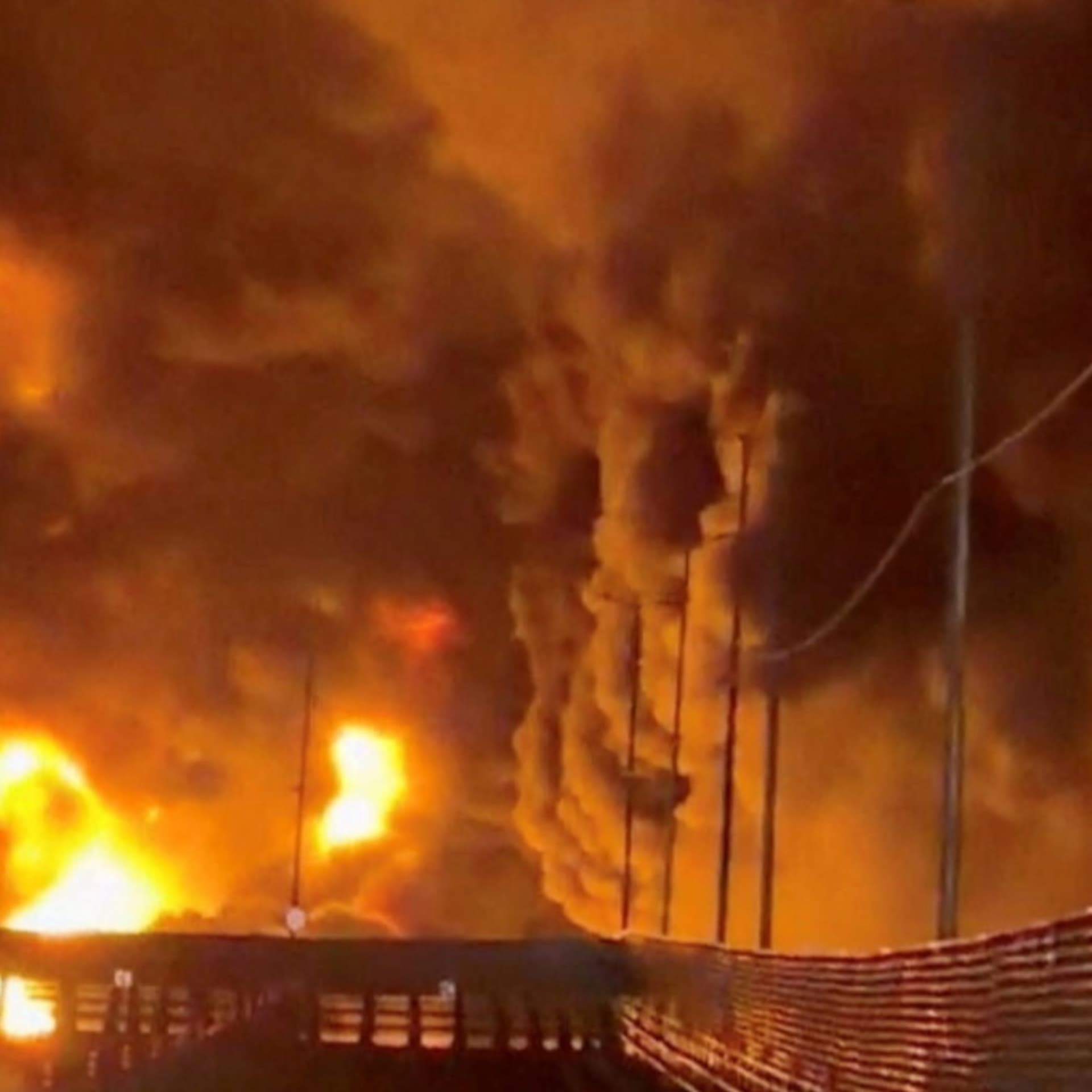
- Target: The US and Israel conducted airstrikes on Iranian oil depots, marking a significant escalation in their military campaign against Iran.
- Iran's Response: Iran retaliated by launching drones and missiles at neighboring countries, including:
- United Arab Emirates
- Saudi Arabia
- Bahrain
- Qatar
- Statements from Leaders:
- Iranian President Masoud Pazeshkian claimed that Iran would only target neighbors if attacked first, despite ongoing strikes against them.
- Political Developments in Lebanon
- Israeli Strikes on Hezbollah: The episode provides a report on the extensive Israeli bombardment of Hezbollah strongholds, resulting in severe destruction and significant casualties in Lebanon, including:
- Over 300 reported deaths.
- Approximately half a million people displaced due to the conflict.
- Local Perspectives: A report from the Beqar Valley highlights the devastation and the local population's sentiments towards Israeli attacks.
- Criticism from Donald Trump
- UK's Military Support: Donald Trump criticized UK Prime Minister Keir Starmer for his lack of military support for the US in the conflict, suggesting the UK is joining the fight too late.
- Military Dynamics: Trump’s remarks indicate a strain in the US-UK relationship regarding military involvement and support in the ongoing conflict.
- Reports from the Gulf Region
- Ongoing Iranian Strikes: The episode outlines Iran's continuous launch of missiles and drone strikes across the Gulf, causing destruction and exacerbating regional tensions.
- Specific incidents of attacks on Dubai and other Gulf locations are highlighted.
- Political Shift in Nepal
- Emerging Leadership: The episode discusses the rise of 35-year-old former rapper Balendra Saha, who is poised to become Nepal’s new Prime Minister following a significant electoral victory.
- Youth Influence: Saha's political career, stemming from his critique of corruption through rap, highlights a generational shift in Nepali politics.
- NASA's Asteroid Deflection Experiment
- DART Mission Success: NASA's Double Asteroid Redirection Test (DART) successfully demonstrated that it is possible to alter an asteroid's orbit, showcasing a potential new method for planetary defense against threats.
- The impact of the spacecraft on the moonlet Dimorphos showed a reduction in its orbiting time, suggesting that asteroid deflection is feasible.
Conclusion The episode encapsulates critical geopolitical dynamics surrounding the US-Israel-Iran conflict, highlights local impacts on Lebanon and regional stability, and offers a glimpse into shifting political landscapes in Nepal. In addition, it showcases advancements in space exploration with implications for global safety.
Follow-up Note: For ongoing updates and insights, listeners are encouraged to subscribe to the Global News Podcast for daily news coverage and expert analysis on current affairs.
Written by AI. May contain mistakes. Listen to the episode to check what was said.
Chapters
Tap a time to open that second in VOMilitary Campaign Against Iran
1:17 to 2:25
Discussion on the military actions taken by the US and Israel against Iran.
“And President Trump criticises the British government, accusing Prime Minister Keir Starmer of joining wars after we've already won.”
Impact of Airstrikes on Iran
2:25 to 3:38
Analysis of the airstrikes on Iranian oil depots and their ramifications.
“After a week of pounding the Islamic Republic's military machine and security apparatus, the United States and Israel are now bombing one of Iran's biggest sources of revenue, oil.”
US Public Reaction to Military Casualties
3:38 to 4:36
Examining how American audiences are responding to military casualties.
“Wearing a white USA baseball cap, he saluted the flag-draped cases that contained the bodies.”
Trump's Perspective on the War
4:36 to 5:41
Insight into President Trump's views on the military campaign against Iran.
“And I think if this war drags on over time and those casualties begin to mount, then you begin to see a lot more public conversation about this.”
Iran's Defiance Amid War
5:41 to 7:18
Discussion on Iran's response and resilience despite US strikes.
“We spoke to him on Air Force One on the flight from Dover to Miami, where he's spending the weekend.”
View of the War from Iranian Civilians
7:18 to 9:07
Insights into varying perspectives among Iranian citizens regarding the conflict.
“So have the air attacks undermined the Iranian authorities?”
Lebanon's Involvement in the Conflict
9:07 to 12:40
Exploring Lebanon's role in the ongoing Middle East conflict and its consequences.
“and civilians killed, infrastructure damaged.”
Trump's Criticism of UK Military Support
12:40 to 14:02
Analyzing President Trump's remarks regarding the UK’s role in the military campaign.
“as we're trying to put together exactly what happened, is that a few hundred metres to my left, at the same time, there was an Israeli military incursion by helicopter.”
Trump's Criticism of UK Involvement
14:02 to 15:28
Learn about President Trump's sharp remarks regarding the UK's military involvement in the Middle East.
“He has suggested that the UK has come too late to the fight.”
Iran's Ongoing Strikes in the Middle East
15:31 to 16:46
Explore Iran's continued military actions and the implications for neighboring countries.
“despite President Masoud Padeshgian earlier apologising for attacks on neighbouring Arab countries and promising to only target them if they attack first.”
Show all 16 chapters
Impact of Iranian Attacks on Dubai
16:47 to 17:50
Understand the effects of Iranian drone and missile attacks on Dubai's infrastructure and safety.
“It's coming to the airport, to the airport again.”
Nepal's Political Shift with New Leadership
20:11 to 21:18
Learn about the significant political changes in Nepal with a new, young prime minister.
“your everyday life and all the bizarre ways people are using the internet.”
Balendra Saha's Rise in Nepali Politics
21:20 to 23:04
Explore the journey of Balendra Saha from rapper to prime minister in Nepal.
“mayor of Kathmandu, and now likely Prime Minister, here's Fanindra Dahal from the BBC Napoli service.”
The Importance of Seagrass Ecosystems
23:05 to 26:46
Understand the ecological significance of seagrass meadows and their threats.
“Seagrass meadows are among the world's most valuable underwater habitats.”
NASA's Asteroid Deflection Experiment
26:47 to 28:04
Learn about NASA's successful mission to demonstrate asteroid deflection techniques.
“And for more on that story, just search for People Fixing the World wherever you get your BBC podcasts.”
DART Mission's Impact on Asteroids
28:04 to 29:10
Learn how the DART mission successfully altered the motion of asteroids.
“Didymos has a smaller moonlet called Dimorphos orbiting around it, similar to the Earth-Moon system where the Moon is orbiting the Earth.”
Transcript
Automatic transcript. May contain errors.0:00This BBC podcast is supported by ads outside the UK.
0:30Schwab. Visit schwab.com to learn more.
1:00Visit mentallyhealthynation.org to learn more. This is the Global News Podcast from the BBC World Service. I'm Alex Ritson, and in the early hours of Sunday, the 8th of March, these are our main stories. The military campaign against Iran broadens as America and Israel's latest strikes target oil depots. Iran has continued to hit its neighbours, including the United Arab Emirates, Saudi Arabia, Bahrain and Qatar, despite Iranian President Masoud Pazeshkian claiming they would no longer target them unless they were attacked first. And President Trump criticises the British government, accusing Prime Minister Keir Starmer of joining wars after we've already won.
1:49Also in this podcast, a special report on Lebanon's role in the war with Israel and the US. I'm standing in front of one of the biggest bomb craters I have ever seen. It has destroyed everything. There are cars blown up onto the roofs of nearby houses. And Iran remains defiant. The strikes carried out by the Islamic Republic will continue. We will not let them go. This disgraceful act they have created on the international stage carries a heavy cost.
2:25We begin in Iran. After a week of pounding the Islamic Republic's military machine and security apparatus, the United States and Israel are now bombing one of Iran's biggest sources of revenue, oil.
2:45Huge fireballs which reached into the night sky were seen across Tehran when an oil depot was hit by airstrikes. It's the first reported attack on Iran's oil infrastructure since the start of the war. Israel said the depot was being used by the military. Earlier, Israel's Prime Minister, Benjamin Netanyahu, said that Iran would be attacked with all of our force and vowed to wipe out the country's leaders in order to safeguard the Jewish state. We will, in any case, do whatever is necessary to protect our communities and our citizens. As for the next step in Iran, we have a well-organized plan, with many surprises, to destabilize the regime and enable change.
3:29In the US, President Trump was at Dover Air Force Base in the state of Delaware for the return of six American service members who were killed in a drone strike. Wearing a white USA baseball cap, he saluted the flag-draped cases that contained the bodies. I asked our Washington correspondent Bernd de Boosman, how Americans will react to this somber ceremony. It's still very early days in the conflict. And this is certainly a possibility that Trump had mentioned from the outset that the US would very likely take casualties. And in the grand scheme of things, as far as military operations go, those casualties have still been light.
4:07But today, and watching the transfer cases, as they're called them, of the fallen being transported to Dover and being paraded in front of the president and Secretary of Defense Pete Hexeth and General Dan Cain, the chairman of the Joint Chiefs. I think it really brings home to Americans that this is not necessarily just some faraway conflict, but this is something that has very real consequences for Americans. There are, after all, now six families across the country whose loved ones won't be coming home this year. And I think if this war drags on over time and those casualties begin to mount, then you begin to see a lot more public conversation about this.
4:46This is a scene that would have been very familiar to Americans of my generation, for example, who grew up in the era of the wars in Iraq and Afghanistan. But this is something that we haven't seen as much recently, although there have been several other incidents since those wars were over. But particularly among Trump's MAGA base, there is a significant chunk of that base that It is very weary of long, messy foreign entanglements or regime change exercises in the Middle East, having seen what happened in Iraq and then in Afghanistan over 20 years of war. And the more casualties, the more politically difficult it is for the administration to make the case for war to those who really don't want to see this turn into a long running stream of U.S.
5:33casualties, as we saw in the 2000 and 2010s. And yet President Trump seems to think the campaign is going well. He certainly does. We spoke to him on Air Force One on the flight from Dover to Miami, where he's spending the weekend. And he seems to think that from a military standpoint, this is going extremely well, that Iran is being decimated, that their capacity to manufacture and then launch drones and missiles has been very, very much diminished. And he certainly thinks that this is going extremely well. What he didn't answer was what he thinks necessarily comes after. He did say that the U.S.
6:11would, in his mind, have to choose another Iranian leader that is perhaps more cooperative than the Islamic regime in the hopes that the U.S. doesn't have to return militarily to the region again in five years or 10 years. But he's certainly, at least in the short term, very optimistic about how this is going and the impact that these strikes from the U.S. and Israel are having on Iran's military capacity. Bernd Deboosman. President Trump thinks the bombing campaign is going well, but the Iranian government remains defiant. Ali Larijani is the head of Iran's Supreme National Security Council, as well as a close confidant of Ayatollah Ali Khamenei, who was killed last week.
6:56The strikes carried out by the Islamic Republic will continue. We will not let them go. They should not think that we will allow the Americans to quickly bring this matter to an end and say we struck them. Now let's wrap it up. This can only be wrapped up when they understand that they no longer have the right to attack Iran and when they compensate the Iranian nation for the damages. This disgraceful act they have created on the international stage carries a heavy cost. They assassinated the leader of Iran. The price for it will not be small. So have the air attacks undermined the Iranian authorities?
7:35Kashayan Janadi is from the BBC Persian service in Washington. It's very difficult to say because actually air defences are not working that much. The Americans and the Israelis have hit most of the air defenses. And Tehran is like an open sky for American and Israeli planes. Tonight, Tehran's oil refineries and oil depots, fuel depots, were heavily bombarded in several parts of the city. And the pictures we see on social media is like huge, big fires all around the city. So that shows that actually there's no air defense and they could easily come and attack wherever they want. But Iran is a big country, a country of 90 million, and it has relatively strong armed forces.
8:19So, so far they've managed to avoid collapse. President Trump is expecting Iran a total surrender, but they're keeping on fighting and they're defiant. What's your sense of how the war is being viewed by the Iranian people? Well, it depends who you ask. Let's not forget the government brutally crushed protests all around the country. Thousands of people were killed. And many people were upset and they want the regime to go. So they were supportive of military action against this regime. And when Ayatollah Ali Khamenei was killed last Saturday on the first day of the war, many people were joyful and cheered.
8:54And of course, not the entire nation is supportive of the war. The government's supporter, the government's loyalists, they're against this war. They see this as a war of aggression. At the same time, there are other parts of the Iranian society who don't like to see their country being attacked and civilians killed, infrastructure damaged. And as this war continues, people are saying that these are civilian infrastructure that are being destroyed. And of course, as this carries on, the number of people who oppose the war will increase as well. Kashayan Janadi from BBC Persian. Israel has warned Lebanon that it will pay a very heavy price if it does not rein in attacks by Hezbollah.
9:35Lebanon was drawn into the broader Middle East war on Monday when Hezbollah, based in Lebanon, but backed by Iran, fired at Israel, which responded with overwhelming force. The Lebanese government says around half a million people have registered as displaced and more than 300 have been killed since the Israeli attacks began. Our correspondent Wirra Davis reports from the Beqar Valley in western Lebanon, which saw a major incursion by Israeli forces on Friday night. This is the town, quite a large town of Nabi Sheet up in the Beka Valley and I'm standing in front of one of the biggest bomb craters I have ever seen There's a huge hole in the ground damaging obviously dozens of houses around it The hole is about 10 metres deep I'd say It has destroyed everything There are cars blown up onto the roofs of nearby houses Now this is clearly an Israeli bomb strike.
10:41People are trying to clear up the rubble from this huge bomb crater, and I've been speaking to the head of the local municipality to find out exactly what happened. At midnight, we felt a strange movement on one side of the village. It turned out to be an Israeli commander's unit deployed for some mission. The resistance then surrounded them, and heavy clashes ensued. The enemy air force increased their airstrikes to allow the extraction of their unit, which caused tremendous damage, like this one here. This is crazy. You look how much? 10 metres. Well, there's still a lot of confusion about exactly what happened here.
11:21I've been speaking to Ali Shoukou. He's an architect, he's a mayor, and he also teaches in the local university. I think at one o 'clock they sent an alert to the Israeli army to evacuate all people who live here, child, parent, older, elder, to evacuate in less than half an hour. Where to go? We have here some people who have a special need. Where to go? How to leave them? How? I don't know. After half hour, they began. After half hour. Although many younger families perhaps did heed Israeli warnings to leave, the elderly and those who couldn't have stayed here, including one very angry woman we've been speaking to who lives around the corner from this huge bombsite.
12:18Israel is attacking us unjustly. What do they want from us? They want to fool us? No one fools us. We are Hezbollah and we will prevail. A few people were killed at this site. We're not sure how many. But this area has been the subject of loads, many, many Israeli bomb strikes in recent days. What is particularly interesting about this one, as we're trying to put together exactly what happened, is that a few hundred metres to my left, at the same time, there was an Israeli military incursion by helicopter. Those Israeli fighters apparently engaged in a gunfight with Hezbollah fighters. There were casualties.
12:58We don't know exactly how many from the gunfight. Details are still scarce, but this has been one of the biggest incidents so far of this particular episode of the war in Lebanon. Weira Davis in Lebanon's Bekaa Valley. Donald Trump has again sharply criticised the British government over its apparent lack of military support for the US-Israeli war in Iran. At the start of the conflict, the UK Prime Minister Keir Starmer denied the US permission to use its military bases. Donald Trump responded by questioning the so-called special relationship between Washington and London. And now, in the last few hours, Donald Trump has further criticised the British PM, accusing him of joining wars after we've already won, following the news that one of Britain's two aircraft carriers has been placed on advanced readiness to sail to the Middle East.
13:51The BBC's Simi Jola Osho in Washington has more. President Donald Trump has mocked the UK's response to the ongoing conflict with Iran. He has suggested that the UK has come too late to the fight. In a post on Truth Social, President Trump said the UK was once a great ally, maybe the greatest of them all, but that the UK is now finally giving serious thought to sending two aircraft carriers to the Middle East. He then makes an apparent jab at Sir Keir Starmer, the prime minister, saying, that's OK, prime minister. We don't need them any longer, but we will remember. He goes on to say, we don't need people that join wars after we've already won.
14:39Now, this isn't the first time that President Trump has criticized the British government during this military campaign against Iran. He has previously said that the prime minister was not very helpful. He said that Sir Keir Starmer is no Winston Churchill and then went on to praise other allies such as France. Now, the UK initially refused to allow the US to use its bases, such as Diego Garcia on the Chagos Islands, for offensive strikes against Iran, citing international law concerns. But Sakhir Starmer reversed that decision and has now allowed the US to use bases such as RAF Fairford, but for defensive actions against Iranian missiles and drones.
15:27Simi Jolla Osho in Washington. Iran has continued to launch strikes across the Middle East, despite President Masoud Padeshgian earlier apologising for attacks on neighbouring Arab countries and promising to only target them if they attack first. The United Arab Emirates, Saudi Arabia, Bahrain and Qatar have all reported incoming threats from Iran. UAE officials say their air defence systems have intercepted ballistic missiles while fighter jets are targeting drones. Nick Beak has more from Doha. A glistening Dubai skyscraper smouldering. The tower in the Marina area, the latest neighbourhood to be hit by Iran from the air.
16:09This the fallout of an interception during a missile and drone attack. One UK expat telling the BBC his experience. We've heard booms and interceptions through the week, but this has been definitely the most prominent one, the window shook. And we're just trying to work out what's going on. Authorities confirmed a Pakistani national driving his car had been killed by falling debris. Tonight's attack has shattered any hope people here may have had that Iran was prepared to stop firing at its neighbours in the Gulf. In fact, the UAE said it intercepted five missiles and more than 100 drones. And the day had started with an Iranian attack on the main airport here in Dubai that could have been catastrophic.
16:53It's coming to the airport, to the airport again. Yeah, straight to the airport.
17:02The drone crashed down right next to a terminal building. Planes on the tarmac nearby. This at the world's busiest airport for international passenger traffic. Without even acknowledging the strike, Dubai authorities announced they were halting flights to protect the safety of passengers, they said. But services quickly resumed. More people able to escape a crisis that has engulfed the Middle East. The reality here in Dubai tonight, a far cry from the polished picture so often uploaded to social media. Iran continues to lash out at Gulf states with links to the US. The reach of the embattled neighbour across the water felt more than ever.
17:46Nick Beak with that report. Still to come in this podcast, a report from one of the world's most important underwater habitats. This water is at zero degrees Celsius. The eelgrass, what kind of depth does that normally grow in? Anywhere from like a couple inches to six feet maybe. And NASA's experiment to deflect any asteroid that might be on a collision course with Earth.
18:26I'm Steve Rosenberg, the BBC's Russia editor. In Our Man in Moscow, I'll show you what it's like being a news correspondent in Russia as the Russian authorities wage war on Ukraine and try to silence dissent. The sound of war has reverberated around Ukraine for three years. Dramatic geopolitical upheaval alongside threats of intimidation and imprisonment. Our Man in Moscow. Watch with a subscription to bbc.com and the BBC app. Visit bbc.com slash docs to learn more. Ever wonder why we make the choices we do? And how to make smarter ones? Introducing Choiceology, an original podcast from Charles Schwab.
19:06Join Wharton Professor Katie Milkman, an award-winning behavioural scientist and author of the best-selling book How to Change, as she shares true stories from Nobel laureates, authors, athletes, and everyday people about why we do the things we do and how to make better choices to help avoid costly mistakes. Each episode covers the latest research in behavioral science and dives into themes like the power of self-control, shaping your mindset for success, navigating new beginnings, and why starting over can feel so hard. Listen to choiceology at schwab.com slash podcast or wherever you listen.
20:11your everyday life and all the bizarre ways people are using the internet. Listen on bbc.com or wherever you get your podcasts.
20:25This is the Global News Podcast. The US and Israeli war with Iran has dominated the news agenda over the last week, but of course, major events have been taking place elsewhere in the world, including in Nepal. Six months after it was rocked by Gen Z protests, the country is set to get a new prime minister, a 35-year-old former rapper.
20:56Balendra Sara is on course to win a landslide in the general election, which pitted the establishment against a new generation of politicians. He easily defeated the four-time Prime Minister K.P. Sharma Oli in his own constituency. Mr. Oli had already been forced out of office in last year's protests, which left at least 77 people dead. For more on the rise of Bolendra Sarra from Rapa to the first independent mayor of Kathmandu, and now likely Prime Minister, here's Fanindra Dahal from the BBC Napoli service. Many are describing this as the watershed moment in the Nepali politics. It was a kind of political gamble for the former mayor of Kathmandu, Balendra Saha.
21:45It was around 2012-13, he was a rap singer. He had just started a career on that. His songs were the critique of the political elites. They talk about the problems that majority of Nepalese, They complained about mainly corruption, the pain suffered by Nepalese who work in Gulf and Middle East countries, and send remittance so that the Nepali economy survives and the Nepali households leave. He used to say that he wanted to see all Nepalese smile and live happily. It was just a few years ago that he contested as a memorial candidate of Kathmandu. Nobody anticipated or expected that he would win because he was an independent candidate and many perceived that there were mainstream parties who had a strong political base.
22:39But he won the election and while in office, he did some exemplary works on traffic management, heritage conservation. He also forced private schools to provide scholarship quotas and private hospitals to provide health facilities to poor and needy. Fanindra Dharal in the Nepali capital, Kathmandu. Seagrass meadows are among the world's most valuable underwater habitats. As well as providing food and shelter to thousands of species, the plants play a vital role in tackling climate change by absorbing carbon dioxide. But seagrass is also under threat from global warming, with most species unable to tolerate temperatures of more than 25 degrees Celsius, although scientists have now discovered that some plants are evolving to survive at higher temperatures.
23:33Ben Wyatt reports from the east coast of the United States. Given the recent snowstorms, it's an icy path that leads to the Paul Saban's Coastal Ecology Centre in the Asseteague National Park of Maryland. The team here are preparing to take me across the lagoon of the Sinopuxan Bay so we can get up close to the seagrass meadows they've been working so hard to restore. I sit down with leader of the Seagrass Project, Professor Stephen J. Tomasetti, of the University of Maryland Eastern Shore, to learn more about its focus. We're, as a team, working on eelgrass. It's the foundational seagrass species of the U.S.
24:11East Coast, essentially. Here in Maryland, we're near to the southern edge of its range. They're not the flashy coral reefs, but they serve a lot of the same function. This is Katie Tanner, a PhD student working on the project under Stephen's guidance. These vegetated ecosystems provide the physical structure for a lot of biodiversity. We have seahorses, I've seen sharks out in the eelgrass meadows, shellfish, but also a lot of culturally important fish species. It's a very useful plant to have around, only it's fast disappearing. Stephen's team turned to genetic science for help. My name is Stephanie Kamel, professor in the Department of Biology and Marine Biology at the University of North Carolina, Wilmington, and I'm the genomics lead on this project.
24:55So, in some meadows challenged by higher temperatures, a small number of plants have been mutating or changing genomically. When we're talking about genomic change, at the very basic level, we're asking, have there been changes to that DNA sequence? Does that change enable me to be taller, live longer, be more heat resistant? So when I go out and sample seagrasses, I sequence the genome, and I will find change has occurred in a gene that regulates heat shock. By comparing the DNA of the variants with that of normal eelgrass, the team using Stephanie's data can now focus their attention on harvesting just the seeds that contain heat resistant genes before replanting them in dying meadows.
25:39It was this technique that Katie used to seed her new eelgrass meadows last year. Around March, when all the pollination has occurred and seeds are developing, we then go out and we pluck these reproductive shoots and then hold on to them until they're ready to germinate. Then it's just a matter of moving them to where they need to be. It's really just moving seeds around at the right time. And to find out how those meadows were coming along, it was time to put on some waders. This water is at zero degrees Celsius. The eelgrass, what kind of depth does that normally grow in? Anywhere from like a couple inches to six feet maybe.
26:18The water today is too murky to see the sprouting grass, but Katie hopes the meadow will not only have regrown, but will then also flourish in the hot temperatures of the summer. If it does, the team are that bit closer to securing the future of eelgrass meadows in Maryland. We need to take a much more active role in managing our ecosystems. We're really not sitting back. We're like, OK, we're going to try these things because the absence of that is just let seagrass loss continue. I mean, we can't let that happen. Professor Stephanie Kamel ending that report from Ben Wyatt in Maryland. And for more on that story, just search for People Fixing the World wherever you get your BBC podcasts.
26:58four years ago nasa set out to determine whether it could deflect an asteroid if it was hurtling towards the earth to do this they smashed a spacecraft into dimorphos the moon of an asteroid called didymos good news is that fresh analysis of that mission known as dart has now shown that it is possible to change an asteroid's orbit rakil makadia a planetary defense researcher at the University of Illinois at Urbana-Champaign told us more about this unique experiment. The name of the mission was the Double Asteroid Redirection Test, or DART for short. It was a spacecraft that NASA launched in November of 2021.
Read the full transcript
27:42And the basic idea there is that if we can take something really fast and smash it into an asteroid that might be headed towards the Earth early enough that we would be able to push it clear off the Earth to avoid any asteroid impacts. So the target of the mission was the binary asteroid system Didymos, and the primary asteroid Didymos has a smaller moonlet called Dimorphos orbiting around it, similar to the Earth-Moon system where the Moon is orbiting the Earth. Before the DART impact, the smaller asteroid used to take 12 hours to complete one full revolution around the primary, and after the DART impact, it now takes around 11 and a half hours, so 30 minute or so reduction in the time it takes the secondary to move around the primary.
28:29We know that we can actually go ahead and hit an asteroid when we're moving at very fast speeds, and the morphos is around 160 meters in diameter, so it was a test to make sure that we can go ahead and hit an asteroid and making sure that we're not doing it for the first time if we ever find an asteroid that's headed towards the Earth. What this new study found is that not only did the DART impact shift the motion of the secondary asteroid around the primary asteroid, but it also changed both of the asteroids around the sun. And that's exactly what we need to do if we find an asteroid that's headed to the Earth.
29:04We need to change its motion around the sun to make sure that we've pushed it clear away from the Earth. That was the big result from this new study. Planetary Defence Researcher at the University of Illinois at Urbana Champagne, Raheel Makadia.
29:41on one big story. This edition of the Global News Podcast was mixed by Joe McCartney and the producers were Mickey Bristow and Ira Khan. The editor is Karen Martin. I'm Alex Ritson. Until next time, goodbye.
From the publisher
The US and Israel target Iranian oil facilities for the first time since start of war - but Tehran remains defiant. It continues to retaliate, launching drones and missiles on neighbouring countries. Also, Lebanon continues to count the cost after Israel carries out huge strikes on what it says are Iranian-backed Hezbollah strongholds. More US criticism of Britain, as Donald Trump accuses the UK Prime Minister, Kier Starmer, of joining a war that the US has already won. In other news, we look at the 35-year-old former rapper who looks set to become the new prime minister of Nepal. And, some good news - NASA's experiment to deflect asteroids that might be on a collision course with earth was a success.
The Global News Podcast brings you the breaking news you need to hear, as it happens. Listen for the latest headlines and current affairs from around the world. Politics, economics, climate, business, technology, health – we cover it all with expert analysis and insight.Get the news that matters, delivered twice a day on weekdays and daily at weekends, plus special bonus episodes reacting to urgent breaking stories. Follow or subscribe now and never miss a moment. Get in touch: globalpodcast@bbc.co.uk



