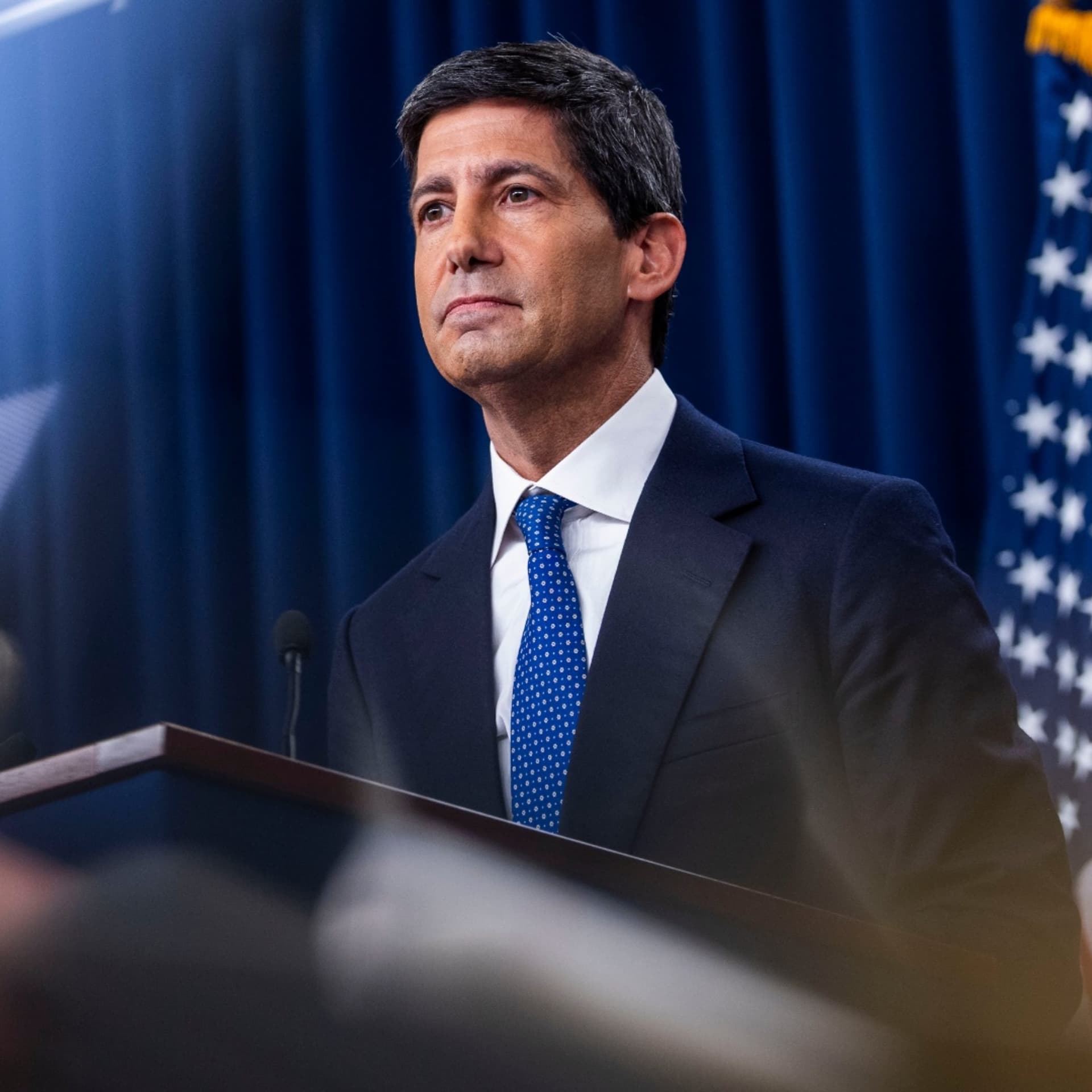

In short
The episode is a BBC Global News roundup plus science and culture segments. Main topics: the US Federal Reserve raises interest rates for the first time in three years (a 0.25 percentage-point hike) to curb inflation, despite President Trump’s demands for cuts. Samira Hussain reports that inflation has risen to 3.4% (from around 2.5%), hitting consumers; mortgage rates are cited near 7% versus 3–4% months earlier. Guest/experts: Kevin Warsh (Fed-related commentary) and Samira Hussain (New York business correspondent). Other stories: Nepal flash-flood recovery, with missing revised to 6,000+; neuroscientists at Stanford create mice with mostly human cortex tissue to model brain disorders; Asian Games athletes complain about short beds and flooded rooms; profiles include Nigerian actor Olu Jacobs and a rapid sepsis blood test (Harriet Watt/UK Sepsis Trust).
Notable examples
mortgage-rate jump; Nepal’s Betravati Bazaar swept away; “Frankenstein” mice with human brain organoids; Asian Games cruise-ship housing ~4,000 athletes; Luke Hartog rescuing Ollie Milroy from a burning car.
Written by AI. May contain mistakes. Listen to the episode to check what was said.
Chapters
Tap a time to open that second in VOUS Interest Rates Rise Amidst Trump’s Criticism
1:23 to 2:55
Exploration of the US Federal Reserve's decision to raise interest rates and Trump's response.
“The US Federal Reserve puts up interest rates for the first time in three years, despite loud calls from President Trump to lower them.”
Impact of Rising Interest Rates on American Consumers
2:55 to 6:01
Analysis of how increased interest rates affect consumers and the economy.
“But Kevin Walsh says inflation is too high.”
Devastating Flash Floods in Nepal
6:01 to 7:00
Reports on the aftermath and toll of the devastating flash floods in Nepal and surrounding areas.
“Everyone else is facing a rise because everyone else is also facing inflation, because everyone else is also facing similar inflationary pressures because of the high cost of energy.”
Laboratory Mice with Human Brain Cells
7:00 to 12:23
Discussion about the creation of lab mice with human brain cells for research purposes.
“It's been three weeks since devastating flash floods hit Nepal and Tibet and China when a torrent of muddy water tore through villages and homes, killing at least 1 ,400 people.”
Complaints from Athletes at the Asian Games
12:23 to 14:00
Coverage of accommodation issues faced by athletes at the Asian Games in Japan.
“Now, neuroscientists in the United States have created laboratory mice with functioning human cells in their brains.”
Concerns Over Athlete Accommodation at Asian Games
14:00 to 18:26
Learn about the complaints from athletes regarding their accommodation for the Asian Games.
“in a way that has not been possible before.”
Tribute to Olu Jacobs
19:15 to 22:59
A look back at the life and contributions of Nigerian actor Olu Jacobs.
“One of Nigeria's best-known actors has died.”
Advancements in Sepsis Testing
22:59 to 26:29
Learn about a new blood test that could revolutionize sepsis diagnosis.
“It's the body's overreaction to an infection leading to shock and organ failure.”
London's Best Pizzas: A Culinary Delight
26:29 to 28:01
Find out why a pizzeria in London was named the best in the world.
“Maybe chefs from Naples, Rome or New York spring to mind.”
Michele Pascarella's Award-Winning Pizzeria
28:01 to 29:20
Learn about the achievements and philosophy behind Napoli on the Road's success.
“I have to say, I can see where the hype is coming from.”
Show all 11 chapters
Heroic Rescue in Racing
29:20 to 31:24
Discover the remarkable story of Luke Hartog saving Oli Milroy during a race.
“Finally earlier this month you may have seen dramatic footage of a racing driver being pulled from his burning car by one of his rivals at a race in China.”
Transcript
Automatic transcript. May contain errors.0:00This BBC podcast is supported by ads outside the UK.
0:30Listen to Choiceology at schwab.com slash podcast or wherever you listen.
1:00No bouncing between tabs. And best of all, no spreadsheets. Stop managing software and start managing your business with one unified system. Try for free today at odoo.com. That's O-D-O-O dot com. This is the Global News Podcast from the BBC World Service. I'm Alex Ritson and in the early hours of Thursday the 17th of September, these are our main stories. The US Federal Reserve puts up interest rates for the first time in three years, despite loud calls from President Trump to lower them. Nepal has revised upwards to more than 6 ,000, the number of people still missing after last month's devastating flash floods.
1:47And athletes criticise conditions at the Asian Games in Japan. Some competitors can't even fit into the beds. also in this podcast we build a new model that allows us to actually capture aspects of human brain function in a way that has not been possible before frankenstein rodents we hear about the part mouse part human brain and the world's best pizza is apparently not found in italy
2:22Rising prices, soaring fuel rates and the cost of living are hitting consumers and financial markets globally. So much so that for the first time in three years, the US Central Bank, the Federal Reserve, is raising interest rates for the biggest economy in the world by a quarter of a percentage point in the hope it will bring down inflation. But the US president, whose demanded cuts, responded with a loud social media post, writing in all caps, lower the interest rates for the United States of America and fast. This is not the script Donald Trump expected from the man he appointed as the new Fed chair.
3:00But Kevin Walsh says inflation is too high. While uncertainty remains elevated, owing in part to geopolitical developments, domestic spending has been resilient. Productivity growth, strong, and capital investment is robust. Job gains have kept pace with the workforce, and the unemployment rate has changed little. But inflation remains elevated. Today's policy action will support a timelier return to the committee's 2 % goal. Our business correspondent in New York is Samira Hussain. She gave us her assessment. Kevin Warsh says that the U.S. economy is doing really well despite the geopolitical developments, as he put it.
3:43And presumably he's referring to the war with Iran, which has been a big driving factor for inflation in America right now. Inflation here has been running above the target rate of 2 percent for about five years, but it was hovering around two and a half percent. But now we're seeing this jump since February to 3.4%. And this is having a huge impact on all Americans. They are having to pay so much more for the same things that they did just a year ago. And that's really putting a lot of pressure on the American consumer. And now they're going to have to pay more for their interest rates. It's going to hurt, isn't it?
4:26It's going to hurt for those people that are looking to borrow money. It's going to put pressure on those people that are looking to buy a home or get a car loan. But what Kevin Worsh was trying to say in the press conference is that this is about the American consumer and very much the consumer that is living paycheck to paycheck, where the cost of living has been so high. And it is making it very difficult for people to make ends meet. Even when you look at the labor market, which Kevin Worsh had also said is doing really well in the United States, you see that wages aren't going up in line with inflation.
5:04And that's also making it even harder for the American consumer. This is like the bottom interest rate, though. This is the interest rate upon which everything else is set. 3.75 to 4 percent, plus whatever your lender adds on the top. People aren't used to interest rates at this level, are they? We certainly haven't seen interest rates this high in a very long time. And then if you look at the bond market, the 10-year Treasury yield, which is also a big indicator and perhaps more of an indicator in terms of what your mortgage rate is going to be. Here in the United States, we're looking at mortgage rates that are in the 7 % realm.
5:44And just six, eight months ago, you could still get a mortgage for about, you know, 3 % to 4%. So it's been really dramatic increases and it's going to start putting a lot of pressure on different parts of the American economy. And this is an international issue, isn't it? Everyone else is facing a rise too. Everyone else is facing a rise because everyone else is also facing inflation, because everyone else is also facing similar inflationary pressures because of the high cost of energy. We didn't think Donald Trump was going to like this, and he doesn't, does he? He's already responded. He has responded and saying that, look, interest rates should be at 1 % or lower.
6:27The interesting thing to me about this is that the criticism was related to interest rates only, and he didn't resort to personal attacks against Kevin Warsh. And if you'll remember, his predecessor, the Fed chair, former Fed chair Jerome Powell, faced a litany of criticisms, both personally and his performance as Fed chair from the president of the United States. Perhaps Kevin Warsh is a little bit saved given that he was appointed by President Trump himself. Our US business correspondent, Samira Hussain. It's been three weeks since devastating flash floods hit Nepal and Tibet and China when a torrent of muddy water tore through villages and homes, killing at least 1 ,400 people.
7:15Many more are missing. In fact, the Nepalese authorities have just revised that figure upwards. They're now saying that more than 6 ,000 are unaccounted for. That's left many families stuck in limbo, fearing the worst, but still hoping for a miracle. AJ Gupta in Delhi, in India, received the final text message from his daughter, Arushi, on the morning of the flood. It said she was just 15 minutes away from the Nepal-Tibet border. We cry sometimes when we try to compose ourselves, me and my wife.
7:49Michael Bristow:Her husband is convinced, I am convinced, wife is convinced. every one of our family member is convinced that she will be rescued miracles do happen Nepal government and China government it folded and I have faith in China and Nepal government they will definitely rescue her she will be found our global affairs reporter Anbarasan Etirajan told me more about the recovery efforts. It's a mammoth task for the rescuers because it impacted a vast area as the flash floods came roaring down the valley, sweeping away villages and towns. That's one of the reasons why even the Nepalese government is still not clear about how many people are missing.
8:42Michael Bristow:In fact, they have revised the number of dead to more than 1 ,400, but the number of missing has gone up from 5 ,100 to more than 6 ,100, such a jump of 1 ,000 people. But the Disaster Management Authority were saying that they were talking to various district officials after analyzing various data. Now they have revised this figure. This is only on the Nepali side. On the Tibetan side, again, dozens of people were killed, more than 500 were missing. So Nepal is still trying to kind of manage this problem. And first of all, they won't understand what was the impact and damage. And every day they're learning something new.
9:24Michael Bristow:So many families still waiting for answers about their loved ones. Because these entire villages were wiped out. And I was just reading one of the Nepali media reports in a village in Timuray. There were 250 houses when the incident happened, customs houses, police stations. and some army detachments, only 6 ,000 were standing there. So two officials were giving contradicting information, like one was saying there were 3 ,000 people at the time, including tourists, but another official was saying probably the number could be half. So there is a lot of confusion even among Nepalese officials. And a group of families from southern India, they were in fact holding a protest outside a police office in India, in Tamil Nadu state because many of the relatives went as pilgrims across Tibet and they were coming back from Tibet into Nepal.
10:19Michael Bristow:And they have no information about the relatives. They just simply disappeared. And also on social media, I keep seeing families from Australia, some from the US, from Sri Lanka, but there is no information because even if you unfortunately die in an accident, you need to know the legal paperwork you need to be doing. you need to try to get their bodies to do this cremation or ceremonies. So the families have no clue about what happened. All they knew, some people waiting at the border crossing between Tibet and Nepal, texting them, we have arrived at the immigration centre. But after that, there's no news what happened to them.
10:56Michael Bristow:The suspicion is many of the bodies could be buried under this feet of, several feet of clay and mud. It's going to be a huge task to recover those bodies as well. And if and when the bodies are recovered and laid to rest, there's still the enormous challenge and cost of reconstruction? Several villages just disappeared. They're all above four or five feet of mud. One bazaar is called Betravati Bazaar. It's a very picturesque small town. And that town was about 100 meters above the riverbed, but it was completely swept away. So if you want a reconstruction, if you want to have reconstruction, it's going to be a huge task.
11:34Michael Bristow:And that's why Nepal's government estimates that it could cost up to$5 billion. But where is the money going to come from? That's a big question. And also hydropower plants. Nepal heavily relies on hydropower. In fact, 10 years ago, they were short of electricity, but now they were exporting power to India and Bangladesh. But that has come as a huge jolt. 12 projects were wiped out completely. They were constructing. So that's about 10 % of their capacity. So where is the money going to come from to rebuild this hydropower? And that's why Nepal is now trying to put out this argument that this is climate injustice.
12:09Michael Bristow:We are not responsible for climate change. Our greenhouse gas emissions are very low compared to our developed countries like the US, Western Europe, India and China. And the world should give us compensation rather than aid. Anbarasan Etirajan. Now, neuroscientists in the United States have created laboratory mice with functioning human cells in their brains. The rodents are genetically engineered and surgically altered so most of their cortex is of human origin. The team from Stanford University say it could help researchers develop treatments for psychiatric diseases. More details from our science correspondent, Victoria Gill.
12:50While mice with partly human brains might sound a Kafka-esque experiment, the scientists say that these are not mice that think like humans, rather they're animals that are altered so that some of their brain tissue is human. The researchers engineered mice to develop almost none of their own cerebral cortex. That's the outer layer that's sometimes referred to as grey matter. It handles higher level thinking, memory and senses. They then used skin cells taken from humans, reprogrammed them and grew them into pieces of brain-like tissue called organoids, collections of connected living brain cells.
13:23When these organoids were implanted into the mice, they formed connections with the rest of the brain and the spinal cord, functioning like brain tissue. Having working human brain cells inside a living animal, the scientists say, gives them a new way to understand the biological causes and develop treatments for brain disorders, including dementia, epilepsy and cerebral palsy. Understanding disorders of the brain is really, really difficult. That's lead researcher Professor Sergio Pasca from Stanford University in the US. These disorders are having devastating consequences. We need better models, models that include human cells.
13:59So here we build a new model that allows us to actually capture aspects of human brain function in a way that has not been possible before. The study raises questions about what it means to change the brain of an animal and exactly how these laboratory mice will experience the world. So there'll be ongoing discussions weighing the scientific value of these mice against these ethical challenges. Victoria Gill. Thousands of athletes from more than 40 countries and regions are getting ready for the Asian Games which are being held in Japan. But just a couple of days before the event is due to begin, there have been numerous complaints about the athletes' accommodation.
14:38The games in the city of Nagoya officially open on Saturday, but football and basketball are already underway. For more on what the complaints centre on, I spoke to our correspondent Kurumi Mori, who's in Tokyo. These athletes are complaining about several things regarding accommodation. One being that they're just not big enough, quite literally. Some of the basketball athletes are saying that the beds are too short and they're not able to lie down fully on these beds. So you can imagine how uncomfortable that must be for athletes set to compete. There have also been complaints about the condition of the rooms, including a video showing a leaking pipe and a soaked floor, a flooded floor, because we had some heavy rains here in Japan that really added to this disruption and the complaints.
15:27Several hundred people from the Games were briefly evacuated from their accommodation last week when we had the heavy rains flooding through Nagoya. And I'm told cruise ships have been sent to Nagoya to accommodate the athletes. Yeah, and you know, that's probably the most unusual part of this accommodation story. Organizers decided not to really build a traditional athletes village like they did, for example, in the Tokyo Olympics. So they've had to get creative to be able to house all of the athletes that are here. I mean, this is a massive event. The Asian Games have more athlete involvement than even the Summer Olympics in Paris.
16:06So it is a huge number of people coming here. They had an Italian cruise ship arriving in Nagoya to house around 4 ,000 athletes and officials. Other people are staying in hotels, Airbnbs, and also temporary huts as well. But the cruise ship, they're saying it's the first time that Japan has used this kind of facility for a sporting event, for a major international sporting event. And they're saying it's a sustainable alternative to build a temporary living space for the athletes. Have the organizers responded to the criticism? They are saying that basically that, you know, we hear you and we're working on it.
16:45The managers are saying that they've taken steps to improve the conditions for the athletes that are here. They've also set up a 24-hour call center where athletes and officials can come and report some problems and try to mitigate some of these issues. But part of the challenge I want to point out is that these games were expected initially to have around 15 ,000 athletes and officials participating. But that number rose to about 17 ,000 pretty late in the game. And so they hadn't planned for this many people. They say that everyone is now, though, guaranteed accommodation and saying that this whole plan was trying to be built around sustainability.
17:27Karumi Mori in Tokyo. Still to come in this podcast. He dealt with the fire and getting out of the car and everything. He did every step right and it's, you know, quite rightly created this really strong bond between us. The racing driver rescued from a burning car by his rival gets to thank his saviour.
18:19Transcription by CastingWords everything you need, all in one place, so you can invest your way. Visit schwab.com to learn more. John Deere is putting in work and putting up highlights. Oh man, look at those passes. Tillage, planting, harvesting. Three years in and these pre-owned machines are still at the top of their game. We're talking reliability, performance, and long-term potential. And get this, these veteran machines can pick up the latest precision tech with ease. You know it and fans ready to add John Deere certified pre-owned equipment and more options to their lineup can shop at machinefinder.com.
18:58With the new Schwab teen investor account, teens can gain hands-on investing experience and build positive money habits. It's an account co-owned by you and your teen, so you can monitor and engage with the account while your teen learns how to invest and manage money. Learn more at schwab.com.
19:18This is the Global News Podcast. One of Nigeria's best-known actors has died. In a career spanning more than five decades, Olu Jacobs was hailed as a pioneer of Nollywood, Nigeria's homegrown film industry. Richard Hamilton looks back on his life. Olu Jacobs was born in southwestern Nigeria but spent his formative years in the northern city of Kano. There, he was inspired to take up acting after seeing a performance by the Nigerian actor Hubert Ogunde at the city's colonial hotel. He travelled to London and studied at the Royal Academy of Dramatic Arts, or RADA. He featured in several British TV shows and stage plays in the 1970s before moving into international films.
20:10Brown. Keith Brown, yes. What business do you have in Zengaro?
20:18Michael Bristow:I work for a nature magazine. Here he is playing an immigration officer in the 1980 action movie The Dogs of War in a tense dialogue with Christopher Walken, who plays a mercenary. Do you have a drinking problem, Mr Brown? I thought there might be a problem with the war. There is? Jacob subsequently returned to his homeland and was instrumental in starting Nigeria's homegrown movie industry, or Nollywood, in the early 1990s. In total, he starred in more than 120 Nollywood films, in which he was revered for his commanding screen presence and depth of character portrayal. Together with his wife, Joke Silva, he founded the Lufodo Group, which was committed to the development of the performing arts in Nigeria.
21:11Interviewed on Nigerian television a few years ago, he talked about the need to nurture talent inside the country. I'm really very, very excited because the avenue for our children to begin to express themselves positively and confidently is very, very important. You know, there was a time when, not too long ago, when everything that we did was measured against what the Europeans did. What they did was the best and ours was the worst. But our children, even being born in foreign land, don't think so anymore. more. They know that we are capable. We may have our faults. More and more are coming home.
21:58They are coming home and they are staying home and they are productive. You know, and I'm very, very happy. I'm proud of that. Olu Jacobs won a string of prestigious trophies, including the Africa Movie Academy Award for Best Actor and the Industry Merit Award for Outstanding Achievements. In 2011, he was given the Member of the Order of the Federal Republic by the then-president Goodluck Jonathan. But rumours that Jacobs had died emerged in 2021, until he turned up at that year's Africa International Film Festival, where he was honoured with the Lifetime Achievement Award. The former vice-president, Atiku Abubaka, described Jacobs as a cultural icon.
22:47His wife called him the Lion of Lufodo. Richard Hamilton on the life of the Nigerian actor Olu Jacobs, who has died at the age of 84. Sepsis is a life-threatening condition which kills about one in five affected people. It's the body's overreaction to an infection leading to shock and organ failure. For doctors, it's a race against time to find out the cause of the infection to treat it, but currently it can take up to a week to find out which bug or pathogen is behind the patient's rapid decline. But researchers in Scotland and Germany are developing a new blood test that could dramatically reduce that time, delivering results within hours.
23:30Dr Ron Daniels, founder and chief medical officer of the UK Sepsis Trust, explains why this could be a game changer. Yeah. Sepsis is one of the most time critical conditions that we face in healthcare. In the most severe cases, it's not even that every hour counts in treating, it's every minute counts. But we know that across the spectrum of sepsis, because it can range from very rapidly progressive to more slowly progressive, getting the right treatment in within the first hour, or at worst within the first three hours, can often make the difference between life and death. Professor Maiwan Kursadeh-Kirwas is with Harriet Watt University's Global Research Institute in Health and Care Technologies.
24:18She told Laura McIver about the new rapid test they're working on. My team at Harriet Watt has developed a way to detect these sepsis-causing microbes in a matter of hours rather than days. So instead of waiting for samples to be cultured, that means growing the pathogens, the microbes, we catch the DNA that is shed by these microbes in our bloodstream. And it just uses the same blood sample as a normal test would. But we can entirely skip the blood culture, which takes days, by analyzing directly these bits of DNA. We worked on a pilot, so we received samples from patients in Germany and we had some really good results, including a clinical case where we had a young woman in her 30s with a urinary patch infection and the blood culture had completely failed.
25:20So after seven or nine days, they were still not able to say what was the problem. But we were able to detect using our tests traces of the DNA left by the microbes causing the infection. And we're able to match these findings with their other type of cultures. So now we have just received more funding from the state of Rheinland-Pfalz in Germany. and that will enable us to acquire more samples in order to further validate the tests and hopefully bring it closer to patients. So what kind of difference do you think this could end up making, Maiwan? I think our test could make a big difference to patients.
26:05So instead of waiting days, the clinical care team would have the results on the same day or maybe next day. And that means that they could administer the right treatments. So potentially saving lives in some cases, maybe getting you quicker out of hospital. And also by administering the right targeted treatments, they could reduce antibiotic resistance. Professor Maiwan Khosode-Kawas of Harriet Watt University. Now, who makes the best pizzas? Maybe chefs from Naples, Rome or New York spring to mind. Well, according to a jury for the 50 Top Pizza World 2026 contest, the best slice of pizza comes from London.
26:51You can sample them at one of Napoli on the Road's three branches. As the name suggests, they serve classic Neapolitan pizza with its charred doughy crust. The BBC's Adriana Urbano, who is herself Italian, went along to have a taste. So here they are, two Napoli-style pizzas. with their thick borders and a nice thin base that I have been assured will not flop. The first one I will be trying is a classic margarita, but I've also ordered a ricordo d 'infanzia. It's a pizza whose name means childhood memory. It's got ragout, parmigiano fondue and a lot of extra parmigiano shaving on top. The margarita first.
Read the full transcript
27:35Now, I have lived 21 years of my life in Italy, and this is a very good, tasty pizza. The buffalo mozzarella is very stringy. It's got a lovely texture in the dough and there's a nice, thick border. And now, Riccardo d 'Infanzia, the award-winning pizza. It's got a lovely, thick ragu base, just like the kind of ragu Italians would eat up and down the country as part of many Sunday meals. I have to say, I can see where the hype is coming from. Napoli on the road is the passion project of Michele Pascarella, who learned his trade as a boy in Campania, the region of Italy, home to Naples, before moving to London.
28:17He gave the BBC his reaction to winning the award. Still can't believe it's just happened. I'm very, very happy and, of course, I'm very, very proud also about the team. We got, like, 90 people that work with us, so we are very proud of what we achieved, actually, yes. I was like singing the song, it's finally coming home. We won best pizzeria in Europe for three years in a row. Best pizzeria in Europe, but outside Italy. But this time we won best pizzeria in the world, including Italy. So it was very, very, very beautiful. We are like always trying to evolve our product. We focus on really high quality ingredients.
28:58We change our menu every three months. And, you know, lots of restaurants and pizzeria. just think about pizza is a fast food but pizza is like a serious thing and we will love and I think we did very good to explain to our customers that we are doing something different on the pizza. Michele Pascarella of Napoli on the road. Finally earlier this month you may have seen dramatic footage of a racing driver being pulled from his burning car by one of his rivals at a race in China. Luke Hartog's act of heroism, stopping his car to rescue a barely conscious Oli Milroy, stuck in the wreckage, saved Milroy's life.
29:38He suffered multiple fractures and a punctured lung in the impact and is recovering in hospital. The pair have been speaking together for the first time since the crash in an interview with the BBC. First, we heard from Luke Hartog. We haven't had the chance to see each other like this face to face yet. Truthfully, that's the only thing I really care about. I was prepared for things becoming a bit worse, sort of such as a traumatic experience, but it really wasn't. And I think Oli and I both believe in this, but how racing kind of teaches you to do acts like this is a kind of natural thing. Therefore, it's just very healing in some way to speak with Ollie.
30:25It's honestly the strangest feeling when you watch the onboard video from Luke's car. As soon as my car started going up in flames, he aimed for me. As I had been pre-programmed, rehearsed, it was the weirdest thing, you know. And even the way that he dealt with the fire and getting me out of the car and everything, he did every step right and it's you know quite rightly created this really strong bond between us i didn't have any memory of the accident at all so the first time that anyone talked me through it was actually luke himself in hospital and i remember the the two of us were just in floods of tears when we um just when you were telling me what happened and what you did and you know how different the result could have been for me.
31:11Holly Milroy thanking rival Luke Hartog for saving his life by pulling him from his burning Ferrari during a race in Shanghai. And that's all from us for now. If you want to get in touch, you can email us at globalpodcast at bbc.co.uk. You can also find us on X at BBC World Service. Use the hashtag Global News Pod. And don't forget our sibling podcast, The Global Story, which goes in-depth and beyond the headlines on One Big Story. This edition of The Global News Podcast was mixed by Holly Smith. The producer was Stephanie Zacherson. The editor is Karen Martin. I'm Alex Ritson. Until next time, goodbye.
32:06Thank you.
From the publisher
The US central bank has raised interest rates for the first time in more than three years, to try to curb inflation. The Federal Reserve lifted its benchmark rate by a quarter of a percentage point and suggested it could do so again before the end of the year. In a social media post, President Trump demanded "lower interest rates... and fast."
Also: Nepal has sharply revised upwards the number of people missing after last month's flash flood to 6,150. Hundreds more are missing across the border in Tibet. What American scientists are trying to achieve by putting human brain cells in mice. The racing driver, Ollie Millroy, who says he “owes his life” to a rival who pulled him from his burning car during a race in Shanghai. And we look back at the life of one of Nigeria's best-known actors, Olu Jacobs, who has died at the age of 84.
The Global News Podcast brings you the breaking news you need to hear, as it happens. Listen for the latest headlines and current affairs from around the world. Politics, economics, climate, business, technology, health – we cover it all with expert analysis and insight. Get the news that matters, delivered twice a day on weekdays and daily at weekends, plus special bonus episodes reacting to urgent breaking stories. Follow or subscribe now and never miss a moment. Get in touch: globalpodcast@bbc.co.uk Photo: Federal Reserve Chairman Warsh speaks after interest rate hike, Washington, USA - 16 Sep 2026 Credit: EPA/Shutterstock



