In short
Global News Podcast Episode Notes
Episode Title
US Threatens Tariffs Over Greenland
Date
January 18
Overview This episode covers significant global news, including President Trump's threat to impose tariffs on European countries opposing his plan to annex Greenland, the admission of violence in Iran's protests, the re-election of Uganda's president, and updates on NASA's Artemis II mission.
---
Key Stories
- Trump's Tariffs and Greenland
- Background: President Trump has expressed a longstanding interest in acquiring Greenland, a semi-autonomous Danish territory.
- Recent Developments:
- Trump threatened tariffs starting at 10%, increasing to 25%, against eight European countries (Denmark, Sweden, France, Germany, UK) that oppose his Greenland acquisition plans.
- European leaders condemned Trump's actions as "blackmail," with French President Macron calling it unacceptable.
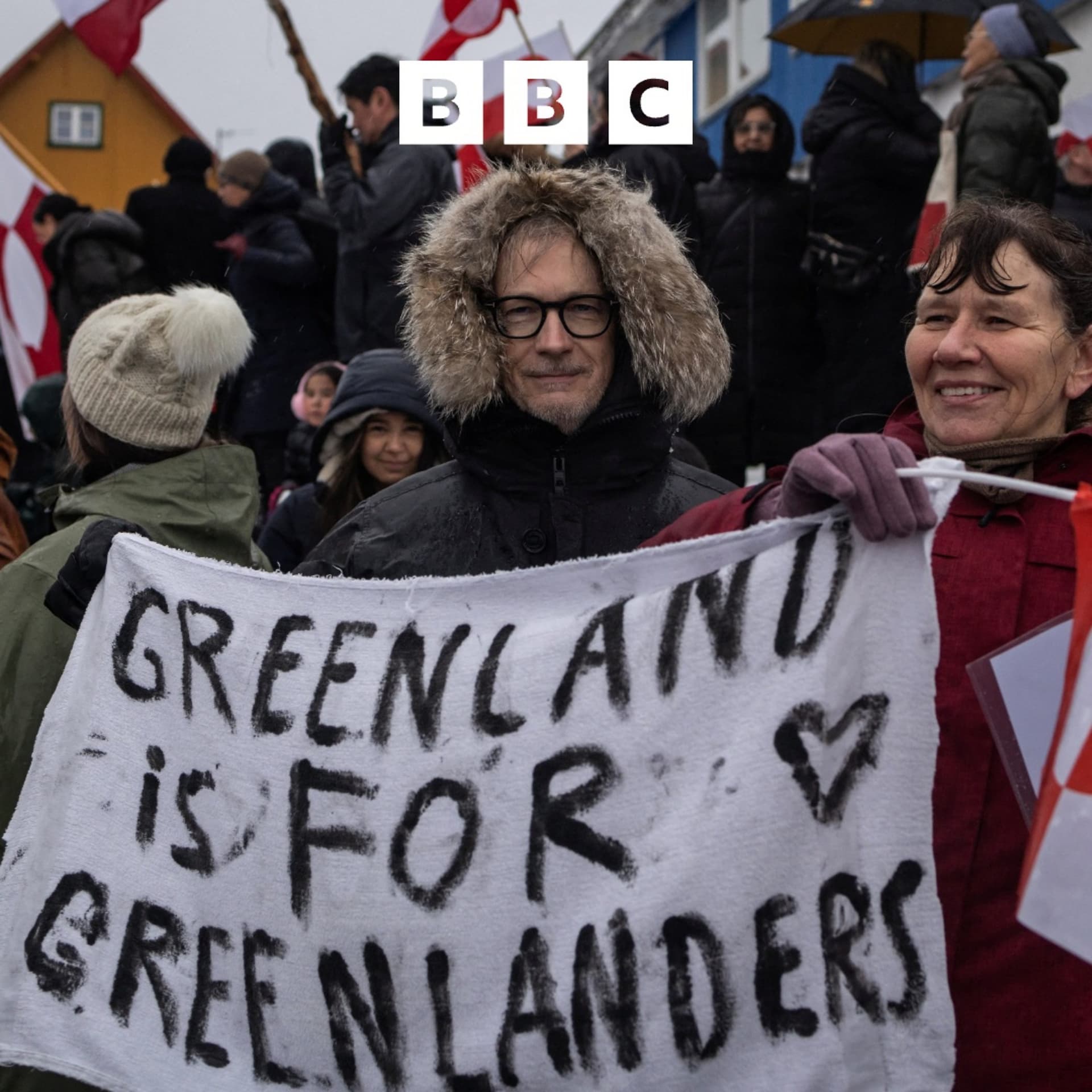
- Protests erupted in Greenland against the threats to annex their territory, emphasizing their desire for autonomy.
Key Quotes
- “We want to be our own country. We don’t want anyone to take our country.” – Greenland protestor
Analysis
- Trump’s administration views Greenland as crucial for U.S. national security and resource access, particularly in the Arctic.
- The tariffs could be a negotiating tactic, with a two-week window for discussions before potential implementation.
---
- Iran's Admission of Violence
- Context: Following anti-government protests driven by economic issues, Iran's Supreme Leader acknowledged the deaths of "a few thousand" people during the unrest.
- Accusations: Khamenei blamed the U.S. for inciting violence and indicated that the regime considers Trump responsible for the protests.
Significant Points
- Reports suggest over 3,000 fatalities amid government crackdowns.
- Khamenei's acknowledgment is seen as a significant shift in the regime’s narrative.
---
- Uganda's Presidential Elections
- Result: Yoweri Museveni declared the winner for a seventh term, garnering about 72% of the vote amid allegations of election fraud and repression.
- Opposition Response: Bobby Wine, the main challenger, claims widespread voter manipulation and is currently in hiding following threats from authorities.
Observations
- Concerns about the integrity of the electoral process have been raised by observers.
- Museveni's rule has lasted over 40 years, raising questions about succession and political change in Uganda.
---
- NASA's Artemis II Mission
- Highlights: The Artemis II Moon rocket has reached the launch pad in Florida, marking a milestone for NASA's return to lunar exploration.
- Mission Details:
- The mission will take astronauts around the moon without landing, aiming to test systems for future missions.
- The journey is a response to global competition, particularly with China, in space exploration.
Commentary
- NASA emphasizes the mission's importance for inspiring future generations in science and exploration.
---
- Medical Research on Paracetamol
- Findings: A new international study finds no evidence linking paracetamol use during pregnancy to autism, contradicting earlier claims by Trump.
- Expert Insight: Dr. Asma Khalil reassures that paracetamol remains the first-line treatment for pain and fever during pregnancy.
---
- Scottish Football Team's Attire Controversy
- Issue: The Scottish football team will wear suits instead of traditional kilts during the World Cup, sparking debate over cultural representation.
- Response: Some fans and cultural figures express disappointment, arguing that wearing kilts is a significant aspect of Scottish identity.
---
- European Film Awards Highlights
- Winner: "Sentimental Value" won multiple awards, including European Film of the Year, showcasing the growing prominence of European cinema.
- Impact: The film's success is anticipated to influence Oscar nominations, reflecting a potential shift in audience preferences.
---
Conclusion The episode encapsulates various critical global events, illustrating the complex interplay of politics, culture, and social issues across nations. It emphasizes the importance of staying informed about international affairs and their implications on global relations.
---
Contact Information
- Email: globalpodcast@bbc.co.uk
- Social Media: Follow on X (formerly known as Twitter) @BBCWorldService using #GlobalNewsPod.
Production Team
- Editor: Karen Martin
- Producers: Pierre Vickery, Daniel Mann
- Mixer: Rebecca Miller
---
Stay tuned for the next edition for more breaking news and insightful analysis.
Written by AI. May contain mistakes. Listen to the episode to check what was said.
Chapters
Tap a time to open that second in VOTrump's Tariffs on Greenland
0:42 to 2:28
Discussion on Trump's tariff threats over Greenland and international reactions.
“I'm Alex Ritson and in the early hours of Sunday the 18th of January, these are our main stories.”
Greenland's Response
2:28 to 4:28
Protests in Greenland against Trump's annexation threats and their message.
“We don't want anyone to take our country.”
The Stakes of Greenland
4:28 to 6:36
Analysis of the strategic importance of Greenland for the US and its resources.
“And European Union leaders have warned the tariffs risk a dangerous downward spiral in transatlantic relations.”
Iran's Acknowledgement of Protest Deaths
6:36 to 7:39
Iran's Supreme Leader acknowledges deaths during protests and blames the US.
“But it is, of course, also an island that is rich in rare earth minerals such as iron, uranium and so on.”
Bobby Wine and Uganda's Elections
7:39 to 11:31
Coverage of Uganda's elections and Bobby Wine's allegations of repression.
“We do consider the US president a criminal because of casualties and damages, because of accusations against the Iranian nation, said Ayatollah Ali Kamehna 'i.”
The Future of Uganda under Museveni
11:31 to 14:07
Discussion on Museveni's presidency and the future political landscape in Uganda.
“There was multiple voting at different polling stations.”
Ueri Museveni's Popularity and Stability
14:07 to 15:10
Explore the mixed opinions surrounding Ueri Museveni's leadership in Uganda.
“Yeah, African observers said they saw no evidence of ballot stuffing, but they criticised reports of intimidation, arrest and abductions.”
Federal Judge Rules on ICE Restrictions
15:10 to 18:33
A report on a federal ruling affecting ICE tactics amidst protests in Minneapolis.
“Richard Kagoy, a US federal judge in Minnesota, has ruled that the 3 ,000 Immigration and Customs Enforcement agents sent to Minneapolis should face restrictions on what tactics they can use.”
Scientific Study on Paracetamol Safety
18:33 to 19:33
A new study claims paracetamol is safe for pregnant women, countering popular myths.
“There is no evidence that paracetamol increases the risk of autism, ADHD or intellectual disability.”
NASA's Artemis II Mission to the Moon
19:33 to 21:52
Details on NASA's Artemis II mission and its significance in lunar exploration.
“The NASA rocket, which will take astronauts to the moon for the first time in more than 50 years, has arrived at the launch pad in Florida.”
Show all 15 chapters
Paracetamol Study and Public Health Messaging
21:52 to 24:24
Discussion on the implications of new research regarding paracetamol use during pregnancy.
“Researchers have insisted that taking paracetamol while pregnant is safe.”
European Film Awards and International Cinema
24:24 to 27:18
The impact of European Film Awards on the Oscars race and its significance for filmmakers.
“the US Health Department criticised the study.”
Debate Over Traditional Kilt in Scottish Football
27:18 to 28:05
Discussion on the significance of the kilt for Scottish football players and fans.
“The kilt is synonymous with Scotland, a knee-length garment which resembles a pleated skirt.”
The Significance of the Kilt in Scottish Identity
28:05 to 29:16
Explore the cultural importance of the kilt for Scotland's national team and its fans.
“received in the wars, when it was the active uniform of the Highland regiments, it's emulated courage, it increased morale, it brought belongingness of the team.”
Craftsmanship Behind Bespoke Kilts
29:17 to 30:36
Learn about the intricate craftsmanship involved in making bespoke kilts.
“And does it still play that very important role in Scottish identity?”
Transcript
Automatic transcript. May contain errors.0:00This BBC podcast is supported by ads outside the UK. If journalism is the first draft of history, what happens if that draft is flawed? In 1999, four Russian apartment buildings were bombed, hundreds killed. But even now, we still don't know for sure who did it. It's a mystery that sparked chilling theories. I'm Helena Merriman, and in a new BBC series, I'm talking to the reporters who first covered this story. What did they miss the first time? The History Bureau. Putin and the apartment bombs. Listen on BBC.com or wherever you get your podcasts. This is the Global News Podcast from the BBC World Service.
0:48I'm Alex Ritson and in the early hours of Sunday the 18th of January, these are our main stories. Demonstrations in Greenland as Donald Trump threatens export tariffs on eight European countries which oppose his plan to take control of the semi-autonomous Danish territory. Uganda's electoral authorities declare Yuri Masevani president for a seventh term, despite opposition accusations of widespread voter fraud. Iran's Supreme Leader Ayatollah Ali Khamenei admits, as he puts it, a few thousand people died in the recent anti-government protests. Also in this podcast... Get off the fence! We will identify you and come arrest you.
1:33Get off the fence. We will come arrest you. A US federal judge in Minnesota has ruled that 3 ,000 ICE agents sent to Minneapolis should face restrictions on what tactics they can use.
1:51Ever since his first presidency, Donald Trump was keen to get hold of Greenland. But since the audacious US raid on Venezuela, the President has been increasingly strident about his desire to buy the semi-autonomous Danish territory. On Saturday, he threatened eight European allies with tariffs if they continue to oppose his plan, starting at 10 % before rising to 25%. The nations in the firing line include Denmark, Sweden, France, Germany and the UK. Just hours before the announcement, people in Greenland took to the streets to protest against Mr. Trump's threats to annex the Arctic territory.
2:33We don't want anyone to take our country. We want to be our own country. We don't want them here. Tell a message to the world and to Donald Trump that he should keep his hands off Greenland. I strongly believe that Europe and Denmark is a great and very important alliance for Greenland. And yes, I do believe in the world's big alliances to step up and be a part of what's happening at the moment. The message is that Greenland is not for sale. We want to have our own country. Greenland will always be Greenland. We don't want to have war. Stephen Miller, Mr Trump's deputy chief of staff, told the Fox News Channel in the US why the president was so focused on Greenland.
3:27Greenland is essential for America's national security. The new domain of international competition is going to be polar competition. That is where more and more resources are being spent by our nation's adversaries and rivals, is the ability to control movement, navigation, lanes of travel in the polar and Arctic regions. Greenland is 25 % larger than Alaska. Greenland is the size of one-fourth of the continental United States. With respect to Denmark, Denmark is a tiny country with a tiny economy and a tiny military. They cannot defend Greenland. They cannot control the territory of Greenland.
4:13The French President Emmanuel Macron called Mr Trump's threat of tariffs unacceptable, saying Europe would respond in a united and coordinated manner. Britain's Prime Minister Keir Starmer said applying tariffs on allies for defending NATO's collective security is completely wrong. And European Union leaders have warned the tariffs risk a dangerous downward spiral in transatlantic relations. I asked our North America correspondent David Willis if President Trump's threats and fresh economic tariffs would help him to take control of Greenland. They may well certainly serve, I think, to fire a shot across the bowels of many European leaders, Alex.
4:55And President Trump has now drawn the EU into the political brinkmanship surrounding Greenland's future. He's up the ante as well, as far as rhetoric is concerned, claiming on social media that the security of both this country, the United States and the world rests with Greenland becoming part of the United States. And as you said, he's threatening tariffs of up to 25 % on imports from eight European nations until such time as an agreement is reached for the United States to purchase Greenland. Now, all eight of the countries mentioned have backed Denmark, warning that the use of US soldiers to seize control of Greenland could spell the end of the NATO alliance.
5:46Yeah, because words are one thing, but will Donald Trump actually follow through and impose tariffs on these countries? And what would they need to do to avoid that? I think raising the price of imports once again would not be popular both here and in Europe. And he has allowed himself a two-week window, hasn't he, for negotiation over the future of Greenland, saying that those first 10 % tariffs won't be introduced until the end of this month. That's some wriggle room which the president tends to set himself in these sort of circumstances. And those on both sides of the pond, I think, will be hoping that some sort of compromise can be reached.
6:27Do we know what the real reason is for Donald Trump's desire to add Greenland to the United States? Well, he insists, doesn't he, that it's all about vital national security interests. But it is, of course, also an island that is rich in rare earth minerals such as iron, uranium and so on. Those are the sort of minerals that China currently has the monopoly over and which the United States needs to acquire for the development of high-tech products such as cell phones, car batteries and so on. David Willis. Iran's Supreme Leader Ayatollah Ali Khamenei has for the first time acknowledged that, in his words, a few thousand people were murdered in the Islamic Republic during the recent anti-government protests, which were sparked by a cost-of-living crisis.
7:26In a televised address, he also said they were killed with the utmost inhumanity, pure savagery. But the Supreme Leader blamed what he called agents, adding that President Trump was responsible for the deaths and that he was personally involved in the unrest.
7:48We do consider the US president a criminal because of casualties and damages, because of accusations against the Iranian nation, said Ayatollah Ali Kamehna 'i. Mr Trump recently urged Iranian demonstrators to keep protesting and threatened military intervention if security forces kill them. According to the US-based Iranian human rights activist news agency, the number of dead is just over 3 ,000. Despite a near total internet blackout, the BBC has received voice messages from a woman who has been speaking to her sister in Tehran and from two others inside Iran. They are read by our producers.
8:29Unfortunately, the severe crackdown has caused the protests to be completely silenced. My sister said that when people, including herself and her friends, talk among themselves, they jokingly say they're waiting for Trump to attack. Now it is Trump's duty to support the people. People's hopes are pinned on Trump's words. I consider part of the blood that has been shed to be Trump's responsibility. In the Ma 'aliabad area of Shiraz, security forces are still patrolling on motorbikes, but overall, things have gone back to normal. The Supreme Leader, despite his age, remains defiant. He said that the Iranian nation must break the back of the seditionists just as it broke the back of the sedition.
9:12So how significant is this speech from the Ayatollah? Here's Sivash Adalan from BBC Persian. Up to now, the Iranian authorities had not mentioned any statistics, not even hundreds, let alone thousands. We only had heard about a few dozen security forces, members of the IRGC or the paramilitary besiege, and a handful of ordinary citizens to have died in the hands of what the regime called rioters and vigilantes. One Iranian official had said two-thirds of the overall death toll is from that category of people. Whether this was a slip of the tongue by the Iranian Supreme Leader, he's mentally still very sharp at 86, so he probably knows what he is saying.
9:58It's very significant that he says thousands of people were killed, but he doesn't mean the protesters. He is saying that the people affiliated with the government were killed. And Donald Trump keeps changing his word at any second. And when he thanked the Iranian authorities for not executing 800 people, something that wasn't true to begin with, there wasn't even a plan to execute 800 people. And then he comes out and says that he stopped the execution of those people and And thanks to the Iranian supreme leader, who many Iranians now see as the person who ordered these killings, which some people think is up to 20 ,000 people who were dead.
10:34Many Iranians now feel angry and they feel betrayed because in the height of the protest, it was really many people relying on the promise of Donald Trump to intervene militarily, went out in the street thinking that somehow the U.S. has thought this out, that there is an actionable plan to stop these security forces from massacring the people. And that turned out to be completely false. And now they hear that the President of the United States is thanking the Supreme Leader. So you can imagine in the midst of this internet blackout, the sense of frustration, grief, and now abandonment and betrayal, how pervasive it could be now among Iranians.
11:18Siavash Ardalan The 81-year-old president of Uganda, Yowari Museveni, has been in power for 40 years and to no one's great surprise, he's just been declared the winner again for a seventh term Official results gave him nearly 72 % of the vote against 25 % for his main challenger, Bobby Wine Election observers say the campaign was marred by widespread repression including an internet shutdown which has now been lifted Benjamin Katana is a senior opposition party official. There was multiple voting at different polling stations. There was ballot staffing. There was impersonation where people come and vote in the name of others at different polling stations.
12:02All these undermine the integrity of the process. On Saturday, there was much confusion over the whereabouts of Bobby Wine with reports, denied by the police, that he'd been arrested. He says he's in hiding. Oliver Conway heard more from Richard Kagoy, who's been following developments from neighbouring Kenya. Based on the trends that we've seen in the past, it was widely expected. He's going to secure the seventh term. There's been a lot of speculation in terms of succession. That was really quite a major talking point in the run-up to this election. But now that extends his rule of the East African country for more than 40 years, having come to power in 1986 in January 30th.
12:41and now he becomes amongst one of the longest serving African leaders, actually the third one. So chances for Bobby Wine really causing a major upset to a slim, you know, in terms of the crackdown on opposition supporters and this is something actually that had been raised by human rights organisations and even the UN Human Rights Office. And indeed a crackdown following the election according to Bobby Wine. Do we know what happened to him? Bobby Wan has come out in a video addressing his supporters saying he managed to escape. He describes an incident that took place at his residence as a security operation.
13:19He says that police agents who are in plain clothes who couldn't be easily identified storm his residence and he managed actually to find his way out of the residence. So right now he is in an undisclosed location hiding saying that he fears for his life. What he says is that his family members are currently under house arrest, but the police have responded to these allegations and saying that they are false. And it's basically his family members and him spreading rumours because the police spokesperson say that he's currently in his residence and he's free to move. So there have been very conflicting reports.
13:58I think this has really been difficult to verify because of an internet shutdown that has been there just from the eve of the elections. Yeah, African observers said they saw no evidence of ballot stuffing, but they criticised reports of intimidation, arrest and abductions. I mean, how popular is Ueri Museveni genuinely? Do you think he would still have won without those efforts? Well, it's divided opinion. You know, the people in Uganda who still see him as a figure of stability, they see him as a father, somebody who was able to get the country from a major crisis, a country that has really experienced instability since independence intermittently, you know, with a dictatorship under Idi Amin and bringing the country back from the brink, improving even the quality of life.
14:45His age, being 81 years old, that's also a subject of debate. But of course you have a youthful generation, people who grew up knowing no other person as president, young people who really want to see change. You know, they want to express themselves. They're looking for opportunities. So it was a mixed bag. And I think that's quite really reflected on the situation in the ground. In Kampala, no major celebrations really took place following the announcement. Richard Kagoy, a US federal judge in Minnesota, has ruled that the 3 ,000 Immigration and Customs Enforcement agents sent to Minneapolis should face restrictions on what tactics they can use.
15:24The judgment relates to a lawsuit filed against the Department of Homeland Security three weeks before Rene Good was shot dead by ICE agent Jonathan Ross. The new order prohibits immigration agents from detaining people who are peacefully protesting and bars them from using tear gas or pepper spray. Tom Bateman sent this report from Minneapolis.
15:49I'm in the middle of a street outside a federal government building, which has become the ICE headquarters here in Minneapolis. this and there's a gateway entrance a huge wire fence with concrete blocks along it and three or four police cars are lined up with their headlights beaming out towards a group of protesters a lot of them holding banners somewhere in gas masks and helmets and a lot of anti-ice slogans they're getting as close as they can to the barriers. Get off the fence. We will identify you and come arrest you. Get off the fence. We will come arrest you. So what we have at the moment is a standoff.
16:38Just tell me your name. Logan. Anna. And why are you here? We're here to protest what's going on. We don't like ice in our cities. Trump is taking it way too far, especially with the threat of the Insurrectionist Act. This is my third day out here, and I'm getting angry. I want to see it stop. It's scary right now. I literally have my passport with me right now, just in fear of being racially profiled by ICE, and that's an awful feeling and something I've never felt before in Minnesota. I love this state, and I plan to be here for a long time, and I just hate seeing what's going on in our state right now.
17:18Get out of the entryway. You are not allowed to obstruct the entryway. you will be identified you will be arrested
17:31well the police have warned the protesters not to block the entrance here we're now seeing the vehicles moving closer to the protesters some of the group here saying get closer because they can't arrest us all and now we're seeing the police coming out
17:58The police are now lined up here just after some cars came through, the protesters surrounded them. We've got the police coming out now, we've got the masks on because we've been told there's been a bit of tear gas and pepper spray already. The protesters not moving. What we are doing is legal. It is not legal. We saw really an hours-long standoff between those two sides. So there's a continuing sense of tension, suspicion and concern in this city ahead of what is likely to be another weekend of protests. Tom Bateman reporting.
18:37Still to come in this podcast. There is no evidence that paracetamol increases the risk of autism, ADHD or intellectual disability. A major international scientific study disputes one of President Trump's pet theories.
19:01If journalism is the first draft of history, what happens if that draft is flawed? In 1999, four Russian apartment buildings were bombed, hundreds killed. But even now, we still don't know for sure who did it. It's a mystery that sparked chilling theories. I'm Helena Merriman, and in a new BBC series, I'm talking to the reporters who first covered this story. What did they miss the first time? The History Bureau, Putin and the apartment bombs. Listen on BBC.com or wherever you get your podcasts.
19:40The NASA rocket, which will take astronauts to the moon for the first time in more than 50 years, has arrived at the launch pad in Florida. Artemis II was moved from its assembly point about five kilometres away. NASA chief Jared Isaacman said that it was an historic moment. We are doing this to fulfil a promise to the American people that we will return to the moon, A promise to all of the pioneers, the engineers, the scientists, the astronauts, the researchers from the 1960s, which laid the foundation that we are standing upon right now. We'll do it to inspire my kids, your kids, kids all around the world to want to grow up and contribute to this unbelievable endeavour that we're on right now.
20:24The rocket will take four astronauts around the moon and back to Earth. Our science editor, Rebecca Murrell, told us more about Artemis II. Well, it's a very exciting mission. It's going to be a 10-day mission to the moon and back home again. For the first two days, the astronauts are going to be orbiting around the Earth and they're going to be checking out their spacecraft because basically humans haven't flown in the Orion spacecraft before, so they need to check all systems are OK. And then mission control will hopefully give them the go-ahead to go to the moon. It takes about four days for them to get to the moon.
20:57They'll be flying around the far side of the moon and hopefully seeing bits of the moon that haven't been seen with human eyes before. The far side of the moon is the side we can't see from here on Earth. And then they'll be making their way back home. So they're not landing on the moon this time. That's for Artemis 3, but they are flying around it. And the rocket is going to be reaching incredible speeds eventually. Today, we saw it moving really, really, really slowly. So the rocket is nearly 100 metres tall. It weighs about 5 ,000 tonnes. It's carried on the back of this sort of monster machine called a crawler transporter.
21:32So the entire journey takes up to 12 hours. And the Apollo missions were all about a race with the Soviet Union. This time around, it's with China, who've been pushing ahead to get to the moon. They want to get astronauts there by 2030. So it will be really interesting to see how the two continue and who gets there first, really. Rebecca Murrell. Researchers have insisted that taking paracetamol while pregnant is safe. A major new international study found no evidence that taking the painkiller raises the risk of autism. The findings contradict controversial claims from President Trump that women should tough it out rather than take it.
22:10He said that paracetamol was associated with a very increased risk of the condition. One of the scientists behind the latest research is Dr. Asma Khalil. This review included 43 studies, and these studies come from worldwide. But when you focus on the high-quality research and the studies that carefully adjusted for maternal health or other confounders, you find that there is no evidence that paracetamol increases the risk of autism, ADHD, or intellectual disability. And this lack of association was consistent across the most robust study design, the studies that have low risk of bias or the studies that followed up the children for more than five years.
23:00So what would you say to the Trump administration considering its advice to women not to take Tylenol or paracetamol during pregnancy because of concerns it says they could lead to autism? I think we need to be careful when we give the messages to the public. Our findings from this study send a strong, reassuring message to the millions of pregnant women there that it's safe to take paracetamol in pregnancy. It remains to be the first-line treatment if you have fever or pain during pregnancy and is consistent with the recommendations by the national or international medical organisations. It can be a difficult time for mothers trying to figure out what is safe or unsafe for their unborn baby.
23:53Considering the misinformation that's out there online, what would be your advice to mothers today? I think following the announcement back in September 2025, pregnant women were afraid of taking paracetamol. And there are implications of not treating fever or pain during pregnancy. That increases the risk of miscarriage, premature births, birth defects. Asma Khalil, Professor of Obstetrics at St George's Hospital in London, speaking to Catherine Biaruhanga, the US Health Department criticised the study. It said that other experts had expressed concern about using the drug while pregnant. Sentimental Value was the big winner at the European Film Awards, which are regarded as Europe's Oscars.
24:39Not only did it win European Film of the Year, but it was also successful in the categories of director, screenwriter, actress and actor. The last going to Stellan Skarsgård, who also won a Golden Globe a week ago for his performance in the film. For more on sentimental value, here's Tom Brook from a noisy red carpet scrum at the European Film Awards in Berlin. It's a Norwegian film. It's a family drama. It deals with this strange father-daughter relationship. And a lot of people have really actually taken to this film. It's now become the most successful Norwegian film of all time. And I'm sure when the Oscar nominations are announced on Thursday of the week that's coming up, it will get several nominations.
25:27One of the best performances in the film comes from 74-year-old Swedish actor Stellan Skarsgård, who could make history conceivably by becoming the first Swede to win an acting Oscar in his category. And I spoke to him on the red carpet not so long ago, asking him why this role was important for him. It's about relationships within the family. And it's a remarkably quiet film, in a way. It's subtle. and it's about really dark subjects, but incredibly light. It's like a souffle in a way. But I think it's funny, it's entertaining. So it's really a strange mixture without compromising, without being tacky.
26:12Interestingly, I think this event can have an impact on the Oscars race, which is of course centred in Los Angeles. The Oscars ceremony will take place on March 15th. Because what happens is the Oscars are determined by the 10 ,000 voting members of the Academy. And in the last four or five years, they've expanded their membership to include a lot of international members, many of whom here live in Europe. Those European members will be paying attention to this European Oscars event tonight. And I think the thing is that European cinema has a window of opportunity right now. Most people who are in the film business would agree that Hollywood no longer really makes many films that engage grown-up audiences.
Read the full transcript
26:58They do well with family films, films like a Minecraft movie, and this provides an opportunity for European filmmakers to get attention for their films. And I think they're being quite strategic with this event, and it could bring fortunes to the European film industry. Tom Brook in Berlin. The kilt is synonymous with Scotland, a knee-length garment which resembles a pleated skirt. Traditionally, it's made of wool with a tartan design. Given that Scottish football fans are known as the Tartan Army and some of them wear kilts when they go overseas, it was assumed by many that the men's team would do the same at this summer's World Cup.
27:42But the players will instead wear traditional suits off the pitch and at formal events. Some fans welcomed the change, but not Marion Foster, a master kilt tailor. I was stunned actually. You know, when these athletes, these sportsmen are wearing the kilt, it is so beautiful to look at and it is so powerful the kilt is. When you think of how it was received in the wars, when it was the active uniform of the Highland regiments, it's emulated courage, it increased morale, it brought belongingness of the team. You know, thinking of the impact with the fans. When I heard this news, I felt, gosh, going over to the USA where there is a huge diaspora of Scots out there and they are hugely passionate about the kilt and their heritage.
28:32And when they see the Scottish team coming out in smart suits, there'll be massive disappointment. And they didn't wear a kilt at the Euros more recently. They did wear kilts in 1998, the last time they were in the World Cup. Why do you think it matters for a national Scotland team to wear the kilt on the world stage? Shouldn't they be allowed to modernise or do things differently? Well, is it modernising? I don't think it is. I think modernising is actually working with the huge popularity of the kilt. It is hugely popular. So to be stripping the team of that cultural representation of their homeland and the country they are representing, I don't think that's modernisation.
29:16What makes the kilt so special for Scotland? And does it still play that very important role in Scottish identity? Yes, it does. Really, at the beginning of the last century, the 1900s, the kilt was more worn in civilian life for more formal occasions. But it was in the 1970s that it really took off being driven by the rental market. And so although it was still coming in for weddings, it has become hugely popular to be wearing the kilt and the tartan at the rugby games, at going up hills, becoming a practical, a very practical garment in which it has always been. Give us an idea of the craftsmanship that goes into making a traditional bespoke kilt.
30:00So bespoke tailoring is a craft within itself with technical knowledge. It serves the higher end of the market. So some of the high street kilts can take two days to make. As a bespoke tailor, with my fittings, it takes me a good nine, at least nine days, sometimes 10 days to create. It's all hand stitched. The bespoke tailored kilt will last generations and be passed down because it can be altered to fit the changing body and altered also for the next generation. There's enough cloth in it. So bespoke tailoring is the highest end. My motive is really to try and bring bespoke tailoring above what is the norm and not let the norm just be manufacturing and off the peg sort of thing.
30:47Marion Foster speaking to Caroline Wyatt. And that's all from us for now. But there'll be a new edition of the Global News Podcast later. If you want to comment on this podcast or the topics covered in it, you can send us an email. The address is globalpodcast at bbc.co.uk. You can also find us on X at BBC World Service. Use the hashtag Global News Pod. This edition was mixed by Rebecca Miller and the producers were Pierre Vickery and Daniel Mann. The editor is Karen Martin. I'm Alex Ritson. Until next time, goodbye.
31:35If journalism is the first draft of history, what happens if that draft is flawed? In 1999, four Russian apartment buildings were bombed, hundreds killed. But even now, we still don't know for sure who did it. It's a mystery that sparked chilling theories. I'm Helena Merriman, and in a new BBC series, I'm talking to the reporters who first covered this story. What did they miss the first time? The History Bureau, Putin and the apartment bombs. Listen on bbc.com or wherever you get your podcasts.
From the publisher
President Trump warns he'll impose fresh trade tariffs on countries that oppose his plan to annex Greenland. European leaders have condemned the move, describing it as blackmail. Also: Iran's supreme leader acknowledges that "a few thousand people" were murdered during recent anti-government protests; a US federal judge calls for ICE agents in Minneapolis to face restrictions; Yoweri Museveni becomes Uganda's president for the seventh time in a row; NASA's Artemis II Moon rocket arrives at the launch pad; scientists debunk claims linking paracetamol to autism; the Scottish football team's change of clothes sparks a row over identity; and 'Sentimental Value' wins big at the European Film Awards.
The Global News Podcast brings you the breaking news you need to hear, as it happens. Listen for the latest headlines and current affairs from around the world. Politics, economics, climate, business, technology, health – we cover it all with expert analysis and insight. Get the news that matters, delivered twice a day on weekdays and daily at weekends, plus special bonus episodes reacting to urgent breaking stories. Follow or subscribe now and never miss a moment. Get in touch: globalpodcast@bbc.co.uk