In short
The episode is a BBC Global News roundup focused on Venezuela’s earthquake response, plus other world headlines. Topic: Twin earthquakes in Venezuela have killed over 1,400 people, with tens of thousands missing; rescuers warn the “first 72 hours” window is closing as survivability drops.
Guests
No podcast guests are interviewed in this segment; instead it features BBC correspondents and an expert.
Guest backgrounds
Jay McNeill is a UN-linked international search-and-rescue specialist (technical equipment, seismic detectors, thermal imaging, drones).
Key claims
Venezuela’s government was unprepared; frustration is growing in La Guayra and Miranda (Chacao). UN has 39 international search-and-rescue teams.
Notable examples
bodies recovered in Chacao; families searching hospital lists; a doctor says supplies are available; McNeill describes vibraphone-like seismic detectors and thermal imaging to find trapped people.
Written by AI. May contain mistakes. Listen to the episode to check what was said.
Chapters
Tap a time to open that second in VOVenezuela's Earthquake Tragedy
0:37 to 1:04
Overview of the devastating earthquakes in Venezuela and their aftermath.
“Do you have a friend who treats airfare like a puzzle and somehow always ends up with a first-class upgrade?”
Venezuela's Earthquake Tragedy
1:11 to 2:23
Overview of the devastating earthquakes in Venezuela and their aftermath.
“More than 1 ,400 people are now confirmed dead following twin earthquakes in Venezuela as public frustration at the government's response grows.”
Survivor Accounts and Government Response
2:23 to 4:29
Firsthand accounts of rescue efforts and frustrations with government aid.
“As Venezuela enters the fourth day since the two earthquakes that have devastated the country, a crucial window of opportunity to find survivors is closing.”
International Rescue Operations
4:29 to 8:01
Insight into how international teams are coordinating rescue efforts.
“We saw one of those being recovered about an hour ago.”
Middle East Tensions and US-Iran Relations
8:01 to 12:10
Discussion on the recent US strikes in Iran and the ongoing tensions.
“And we also use a huge amount of tools for actually then getting inside that damaged structure as deep as we need to go to then get out whoever we find trapped there.”
Heatwave Impact in Europe
12:10 to 14:00
Effects of the unprecedented heatwave in Europe and melting glaciers.
“They're claiming rights that they never had.”
The Impact of Climate Change on Glaciers
14:00 to 16:02
Learn about the concerning trends in glacier melt and its broader implications.
“to fill up one Olympic swimming pool every six seconds.”
Celebrating 80 Years of Vespa
16:02 to 19:59
Explore the cultural significance and history of the Vespa scooter over the decades.
“Vespa, the little Italian scooter that's played an outsized role in Western pop culture, is celebrating its 80th anniversary.”
Recent Violence in Karachi
21:09 to 24:33
Understand the circumstances surrounding a recent attack in Karachi and its implications.
“On NerdWallet's Smart Money Podcast, you'll hear from trusted journalists who explain the why behind major financial decisions.”
Changes in Hungary's LGBT Rights Landscape
24:33 to 26:37
Examine the shifting attitudes and policies towards LGBT rights in Hungary post-Orbán.
“Viktor Orban's policy on LGBT rights was widely considered to be the European Union's most restrictive.”
Show all 14 chapters
The Role of Midges in Cacao Pollination
26:37 to 28:00
Learn how tiny midges are crucial for cacao production and the implications for chocolate.
“but in recent years production has fallen because of poor harvests of cacao or cocoa beans.”
The Importance of Pollinators in Cacao Production
28:00 to 29:24
Learn about the critical role of tiny midges in cacao pollination and the impact of climate on microclimates.
“They're about one millimeter in size because the cacao flower itself is also quite small.”
Richard Kind Reflects on Mel Brooks
29:24 to 32:31
Hear Richard Kind share his personal anecdotes and insights about Mel Brooks and his influence on comedy.
“Pollination ecologist Eliza van der Sander.”
Celebrating Mel Brooks' Centenary
32:31 to 33:24
Discover how Mel Brooks will celebrate his 100th birthday and Richard Kind's thoughts on it.
“I hear it's going to be very intimate and very small and just with family and I don't think he wants to share his birthday with the world.”
Transcript
Automatic transcript. May contain errors.0:00This BBC podcast is supported by ads outside the UK.
0:29Snapdragon. That's how. Today's episode is sponsored by Smart Travel, a podcast from NerdWallet. Do you have a friend who treats airfare like a puzzle and somehow always ends up with a first-class upgrade? Smart Travel is like that friend, minus the group texts. NerdWallet's travel journalists break down the pros and cons of travel decisions, like when lounge access is worth paying for and which hotel loyalty programs actually pay off. Make your travel dollars work harder. Follow Smart Travel on your favourite podcast app. This is the Global News Podcast from the BBC World Service.
1:10I'm Pete Ross and in the early hours of Sunday 28th June, these are our main stories. More than 1 ,400 people are now confirmed dead following twin earthquakes in Venezuela as public frustration at the government's response grows. The US military says it struck military sites in Iran in response to a drone attack on an oil tanker near the Strait of Hormuz. Tehran has retaliated with strikes on Kuwait and Bahrain. And tens of thousands take part in a pride march in Budapest, the first since the end of Viktor Orban's government.
1:46Also in this podcast, as a record-breaking heatwave continues to grip Europe, Ice in the Swiss Alps is melting at an unprecedented rate. We're losing as much water from the Swiss glaciers to fill up one Olympic swimming pool every six seconds. And thousands of scooters travel through the streets of Rome in a parade to celebrate 80 years since the invention of one of Italy's best-known exports, the Vespa.
2:23As Venezuela enters the fourth day since the two earthquakes that have devastated the country, a crucial window of opportunity to find survivors is closing. Humanitarian aid agencies say the first 72 hours after a disaster of this kind are key to rescuing people alive. More than 1 ,400 people are now known to have died, but the true figure is thought to be higher. Tens of thousands are still missing, and first responders warn that with every hour that passes, survivability reduces. We are here in Chacao, Miranda State, working non-stop since last night, and have recovered the body of a woman with her dog in her arms.
3:03The dog came out alive, but the woman unfortunately died. They say there are people who are still alive, but it seems there's not enough machinery and equipment to clear all this rubble. I ask please to send people who are capable of helping us and that they don't stop searching, because we still hope our loved ones come out alive. The coastal state of La Guayra was one of the area's hardest hit, and there's been growing frustration at the pace of the government response there. Families and volunteers have spent days pulling survivors and bodies from the rubble as they wait for specialist equipment to arrive.
3:39The Venezuelan authorities were not prepared for a disaster of this scale, as we heard from our senior international correspondent, Earl Oguaran, in the capital, Caracas. This country has been running on empty for years. Under the control of President Nicolas Maduro, the economy was basically run into the ground through mismanagement, through corruption. People have suffered years of hyperinflation. One young Venezuelan here has just said to me, a monthly salary would not buy you one packet of medication. So if this was a test for the Venezuelan state, it's a test. It could only fail. Where we are standing now, there is a big operation going on still, but this is to try to recover bodies, not to find the living.
4:25Hope of that is gone at this particular place. Now, about seven bodies have been taken out so far today. We saw one of those being recovered about an hour ago. It was a very moving moment. The body was found, it was lifted gently from the rubble, it was covered very carefully and placed on a stretcher and carried away by rescue workers with as much dignity as they could provide in a situation like this. Orla Guerin. Also in Caracas is our reporter Vanessa Silva. Earlier she visited a hospital in the capital. We saw people in the hospital looking for their loved ones as missing people, grabbing hope that they can be found alive.
5:08In the hospitals, you can see pictures of people missing. You can see a list of names of the people injured that were taken to these places. I spoke with a man that was looking for a 14-year-old boy, and they say they create a team in the family going to different points to try to figure out if they found him. But when he was there, they received a call telling them that there is a huge possibility that they found the body, but the conditions of the body that they couldn't recognize at the moment. So they say, well, maybe it's him, but maybe we still have a chance to find him alive. Another men were looking for a cousin of his wife.
5:53He says that he came from Miami the same day on the airquake, and they were driving to a hotel in La Guayra State and these earthquakes happened and they were trapped there. But in this case, his relative was missing. And how are hospitals coping? Well, in this hospital that I visit, I spoke with a doctor there. He says that in this case, they have supplies and they were not collapsed. I can see also people coming with supplies, making donations to the hospital. Well, we wanted to go inside the hospital and try to speak with people injured, maybe with small fractures, someone that gave our testimony.
6:37But still, the authorities in Venezuela are not allowing journalists to go inside hospitals, or at least in my case, it was not possible for me. The conditions of hospitals here are not the best ones after years of crisis, of course. Do you think Venezuelans think that the response from the authorities and the government has been adequate up to this point? Honestly, what I think is like nobody's prepared for a double earthquake like the one that we have, and especially the areas that were hit. So it requires a lot of logistic process to deal with a situation like this one. And with the hours, they just realise how complicated this is going to be.
7:21Vanessa Silva. The UN says it now has 39 international search and rescue teams in Venezuela and more specialists are on the way. Among them is Jay McNeill. He's been telling Caroline Wyatt about the equipment he and his team will be using on the ground. We bring a huge amount of technical search and rescue equipment, so tools that will help us to find people who may be trapped quite deep within a pile of rubble and then will help us extricate them. We use seismic detectors like a vibraphone, which are incredible pieces of equipment. When you're trained to use them, you know how to use them well.
7:54You can hear the most minuscule of movement, sometimes many metres down. We use thermal imaging cameras. We sometimes use drones to cover a large area. And we also use a huge amount of tools for actually then getting inside that damaged structure as deep as we need to go to then get out whoever we find trapped there. How dangerous a job is it for rescuers like you? What are the risks you need to be careful of? It's a really difficult thing to think about for us, I guess. You know, we all go into this work because we care about people. And, you know, I always think that if this was my family or someone I loved, I would want someone to be going to find them and going to get them.
8:30That kind of motivates us through the risk, I think. So we train incredibly well. We're trained in the sort of spaces that we go into. We're trained to manage the risks in as much as you can. You know, if there's an aftershock on your inside a collapsed structure, it's inherently unstable. So there's always danger. We work incredibly closely as a team. We train month after month, year after year, so that we know each other and how to look after each other really well. But there's security risks often that we face in countries. There's risks from animals and diseases and climate. So it's no small undertaking, but ultimately I just keep thinking I would want someone to be going.
9:05And what are the chances of finding survivors after those first 72 hours? It's not uncommon, not by a long shot. So, you know, it really does happen. Quite a while back in Haiti, I think there was a rescue that was about two weeks after the initial quake. So it really depends on the conditions, you know, in the country. It depends on things like temperature. It depends on where people are trapped in a structure and how much space they have to move in. Some people might have access to water through rain filtering in. That can keep people going or they might be trapped somewhere where they've got access to food.
9:36So I personally would want to make sure across all the teams that deploy, we had covered everything that was collapsed to make sure there was no one trapped. And what about coordination between the international teams going in? I mean, do you get assigned by the local government where you're going to go and operate? Yeah, largely it's coordinated by the UN in combination with the local government. Initially, the whole area that's been damaged will be mapped into sectors. and then different teams as they come in will be given a sector to go and clear, manage all the structures and make sure there's no one there.
10:07Jay McNeill. Now to the Middle East. The US says its forces have struck multiple targets in Iran at President Trump's direction. In a post on Truth Social, Donald Trump warned that Iran would no longer exist if Washington decided to further escalate its action. The strikes were in response to a drone attack on an oil tanker near the Strait of Hormuz. In response, Iran's Revolutionary Guards have launched missile and drone strikes against Kuwait and Bahrain. It's the latest challenge to a fragile interim peace agreement that Iran and the US reached earlier this month. Mark Kincaid is a retired US Marine colonel, now senior advisor with the Centre for Strategic and International Studies.
10:49He gave us his assessment of the situation. We're in this tit-for-tat dynamic where the Iranians struck a ship. The United States responded, bombing at Iranian positions. The Iranians responded by striking another ship and possibly Bahrain. We've struck them again. The Iranians always respond, you're going to see another strike. Not clear how we get out of this dynamic because the two sides disagree about the strait. There are two problems with this ceasefire, particularly regarding the strait, but also with nuclear weapons. That is, the United States saw this as a means to negotiations, but the United States also announced its view of what had been agreed to.
11:35And Iran has said consistently with regard to the strait, that is not what they agreed to. The United States said that there would be free flow of traffic. Iran said, no, it has authority over the strait. And any ships going through the strait would need its authorization. We're seeing that played out now with missiles rather than at the bargaining table. The United States might escalate in the strait. They might use naval forces to open it up. That would be a major combat operation. I think the United States could do it, but there would be casualties. It would involve all the forces in the region.
12:10But we're in an unstable position. Iran is not reasserting its rights. They're claiming rights that they never had. Mark and Kane. Europe continues to swelter under a prolonged and unprecedented heat wave. Germany has broken its all-time temperature record when 41.5 Celsius was recorded in the east of the country on Saturday. In France, hospitals have warned of a surge in emergency calls. Darren Bett from the BBC Weather Centre has this report. The record-breaking heat in Western Europe is coming to an end this weekend, but large parts of the continent are still enduring some searing temperatures.
12:47In France, after records were broken earlier in the week, there's been disruption to transport and power plants, while many schools have closed and public events cancelled. Some areas ban the sale of alcohol. It's a similar picture in Italy, where the Health Ministry has issued a red alert in 18 cities, including Rome and Venice. June temperature records have been broken in Switzerland and Luxembourg, the Netherlands and Belgium, where temperatures were up to around 40 Celsius. Authorities in Germany have been urging people to conserve water this weekend. The rail operator Deutsche Bahn is reducing its services because the intense heat has caused rail tracks to swell.
13:24There's also a growing risk of wildfires. The area of high pressure or heat dome that has brought the extreme temperatures is moving east, allowing temperatures in the UK and Western Europe to fall, with more comfortable days and nights ahead. Darren Bett there. Switzerland has seen the temperature record for June broken for three days in a row, and the heatwave has been causing the country's glaciers to melt unusually quickly, as James Kumarasamy heard from Dr Matthias Huss, head of glacier monitoring in Switzerland. According to our data, we're losing as much water from the Swiss glaciers, to fill up one Olympic swimming pool every six seconds.
14:04And this now lasts for two weeks. So as long as this heat wave is ongoing and day and night every six seconds. That is a very vivid image. And you have a day in the year, don't you? A tipping point day, if you like. This Glacial Lost Day is going to occur next Monday, most likely. It's the day when all snow reserves accumulated over the winter have been used up and we're entering the phase where we are losing old ice. So every day from next Monday onwards is really contributing to the unsustainable loss of ice. And this is, of course, worrying because it's very early. It's even before the main part of the summer.
14:45So all the rest of the summer will contribute to unsustainable loss. How does this compare to recent years? There is a very clear trend to this day occurring earlier and earlier. We had one record in the year 22, which was shattering all previous records so far. Then this day was still three days earlier than this year. However, in all other years, it's normally occurring in late July, in August. It should actually not occur at all if the glacier would be healthy. But we've seen this day occurring always earlier and earlier. Is there any way to get the glacier healthy again? Well, it's snowfall on the one hand, but even more importantly is the temperatures during the summer.
15:29And the combination of dry winters and hot summers, this is the worst for the glaciers. So the biggest rivers in Europe are sourcing in the Alps, so the Rhine, the Rome, the Danube. And all of those are sourced by glacial meltwater and snow meltwater. This has impacts on the transport of goods over the rivers, for the cooling of nuclear power plants, for irrigation. So this water that is coming from the mountains is needed for many aspects. Swiss glaciologist Dr Matthias Haas. Vespa, the little Italian scooter that's played an outsized role in Western pop culture, is celebrating its 80th anniversary.
16:09In Rome, thousands of Vespa enthusiasts from all over the world took to the streets of Italy's capital to mark the milestone, as Alice Adderley reports. In 1946, after the Second World War had left Italy's roads in ruins, the aviation company Piaggio spotted an opportunity. It began making the small, relatively cheap, agile scooters. Upon seeing the prototype, the company's owner, Enrico Piaggio, said it looks like a wasp. The name Vespa, Italian for wasp, captures the vehicle's shape, a wider bulky rear connected to the front by a narrow step through waist and the quick zippy agility of the insect.
16:53The design quickly caught on and by the 1950s they were given the kind of cultural cachet that money can't buy, with Audrey Hepburn riding one in the film Roman Holiday.
17:11The film ensured the Vespers' worldwide popularity. In the 1960s in Britain, it became part of a stylish working-class subculture with enthusiasts known as mods decorating their machines with multiple mirrors and lights and driving them in packs to the seaside. This was immortalised in the 1979 film Quadrophenia.
17:38And I will see You'll all see I'm the one
17:52You've killed me, screw her! Robin Quartermain was part of a late 70s revival of this movement and is honorary president of the Vespa Club of Great Britain. He's in Rome taking part in the four-day party for the Vespa and explains some of the places he's visited on his scooter over the last 40 years. My first European adventure was more or less four years ago in Barcelona. I've been doing it ever since, you know, visiting countries like Croatia, Italy, Saint-Tropez, all those sort of places. And this event has grown over the years, whereas the rest of the world is now joining in. They come from the Far East, you know, Malaya, Indonesia, as well as South America.
18:37modern Vespas are much more refined than their 1940s ancestors, but the basic design remains the same, taking the concept of getting from A to B and giving it charm.
18:59Alice Adderley.
19:05Still to come in this podcast... I said, excuse me, Mr Brooks, I hear that you are making the producers into a musical. And I go, listen, that movie had a tremendous effect on me. It made me sort of who I am. An appreciation of Mel Brooks as the comedy legend turns 100.
19:35the processor that gives you long battery life. Work on the go. Jump between back-to-back calls. Stay locked in from brewing morning coffee to burning the midnight oil. Get maximum performance, even when unplugged. Finally, the freedom to move across the room or across the world is here. Snapdragon. That's how. Today's episode is sponsored by Smart Travel, a podcast from NerdWallet. Do you have a friend who treats airfare like a puzzle and somehow always ends up with a first-class upgrade? Smart travel is like that friend, minus the group texts. NerdWallet's travel journalists break down the pros and cons of travel decisions, like when lounge access is worth paying for and which hotel loyalty programs actually pay off.
20:23Make your travel dollars work harder. Follow Smart Travel on your favourite podcast app. Imagine buying a toy for your kid, but it doesn't come with batteries. That sucks. But honestly, it's even worse when you buy business software. You end up with fragmented, disconnected systems that cost a fortune and don't talk to each other. Odoo completely changes that. Odoo comes fully complete, with all your business apps perfectly integrated and working together seamlessly. It's everything your business needs in one place, saving you time, headaches, and serious money. Stop paying for missing pieces.
21:00Go to odoo.com. That's O-D-O-O dot com. To learn more, today's episode is sponsored by NerdWallet's Smart Money Podcast. Personal finance can feel like a pop quiz you didn't study for. This podcast is your study guide. On NerdWallet's Smart Money Podcast, you'll hear from trusted journalists who explain the why behind major financial decisions. You'll get research-backed insights and clear pros and cons, whether you're planning a big purchase or just want to grow your wealth. Make your next financial move with confidence. Follow NerdWallet's Smart Money podcast on your favourite podcast app.
22:03We were sitting at home having tea when we heard a loud explosion. The blast was so powerful our wooden staircase almost shifted from its place. I immediately went to look for my son, who's usually outside playing with other children. When I reached the gate, I saw that the situation was very serious. There was intense gunfire coming from the rangers' headquarters and I was frightened by the sound of the shooting. After finding my son, I quickly brought him back home. Later, watching from a safe distance, we heard two or three more explosions from inside the area. Our global affairs reporter Amparasan Etirajan is following developments.
22:42What we understand is the attack by suspected Islamist militants began with an explosive laden vehicle being rammed into the front gate of the provincial headquarters of the paramilitary force called the Pakistani Rangers. And that triggered a gunfight between security forces and the militants. And then soon after that, officials rushed in more reinforcements to surround this area. Eyewitness accounts said there was a loud explosion that was followed by heavy exchange of fire in Karachi City. It was late in the evening. It went on for a couple of hours. But a major attack like this has come up as a wake-up call for the Pakistani authorities.
23:24You describe it as a wake-up call, but how unusual is this kind of attack? Even though we have been seeing several attacks in northwest Pakistan in Khyber Paktoonkwa province, allegedly by the TTP, the Tehrik-e-Taliban militants, and also the Baloch ethnic rebels in Balochistan province. Hundreds of soldiers have been killed in the past few years. Attacks on big cities have come down in recent years because of various military operations. The last time the incident happened in Karachi was in October 2024. And in that attack, two Chinese nationals were killed. But again, Karachi is a mega metropolis with millions of people.
24:03So this has come as a surprise for the authorities because the city has been relatively calm apart from the regional local level violence. So the fact that the government will be investigating how the suspected militants have managed to get through, because it's also one of the well-defended protected cities to come into near the regional headquarters of the paramilitary unit. So it may be of concern to the authorities because it is now moving into the city. Ambarasan Etiraja. Viktor Orban's policy on LGBT rights was widely considered to be the European Union's most restrictive. Last year, Hungary's then Prime Minister banned Budapest's Pride march, but thousands of people still came out.
Read the full transcript
24:47This year, following Orban's fall from power, Pride supporters in the capital braved high temperatures to march through the capital with a sense of change. People are much more optimistic right now. So, like, probably it's because of the political change, but everyone is just so much more uplifted at the moment. So, Orbán is out of power. So, actually, what we can feel personally is that the government is more or less behind us. So, we feel much more support than the last 16 years. Although the new Prime Minister, Peter Maudjo, authorised this year's march, the Orbán government's pride laws remain on the statute book.
25:28Dr Aaron Demeter from Amnesty International Hungary joined Saturday's march. I think probably for most this is the first time in 16 years where people are feeling that they are here for something and not against Orban and his unlawful and arbitrary decisions and policy. So I think a lot of people see this year's Budapest Pride as something which is more about the celebration rather than the protest. This year, the police decided to acknowledge the protest, which means that there is not going to be any fine or no procedures against the organizers or the participants. But I have to say that, unfortunately, the law is still very much in place, so the legal context hasn't changed.
26:17That's something that the new government will have to rectify as soon as possible. I think they have different priorities at this moment, but I'm relatively hopeful that they will do it soon. At least they said that the pride can go on and no one has to fear any kind of hypertension. Dr Aaron Demeter. The world's chocolate industry earns annual revenues of more than$140 billion, but in recent years production has fallen because of poor harvests of cacao or cocoa beans. But that could change because of new scientific research which has discovered how the plants are pollinated. Apparently midges, those tiny biting flies similar to mosquitoes, are absolutely essential to the process.
27:02Julian Walker heard more from the study's lead author, Eliza van der Sand, a PhD student at Virgé University in Brussels. Cacao tree is a tropical tree that grows in warm and humid regions around the equator, between the tropics. Originally it comes from rainforests from Central and South America, but today actually most of the cocoa is grown in Western Central Africa. And we make chocolate from the seeds from this large fruit that are called cocoa pots. And those seeds in turn we call the beans, cocoa beans. And why do these midges matter so much? If you look at cacao trees, these bioimages are the agents that do this movement of pollen from one flower to the other flower.
27:45So you don't have any other pollinator. The flower won't get fertilised, so you won't get the seeds, you won't get the fruit, and ultimately you don't get chocolate. That's why they're crucial to the production of cocoa. And in discovering that, what was the process? Because I gather it's quite difficult to see inside the plant where the actual pollination process is happening. Indeed. These midges are incredibly small. They're about one millimeter in size because the cacao flower itself is also quite small. It's a little flower that's about as large as your fingernail. So obviously the insect that goes in there needs to be small enough.
28:22So what we do is actually we walk around early in the morning when these insects are active in the cacao farms. And we just observe which insects are found on the flowers. And we don't just check which insects were present on the flower. We also wrote down what they were exactly doing. Were they just visiting the reproductive parts of the flowers where pollination is actually happening? Or were they just resting on the petals or walking across it? Then we collected them of the flower and immediately put them under a microscope to examine their bodies for the attachment of pollen. Cacao production is an incredibly complex system.
28:54So climate change could affect those different parts. The humidity, the rainfall that's naturally present in the system. But one thing we're particularly interested in right now is the microclimate within the cacao farms. So shade trees, for example, can create locally cooler and more humid little microclimates, which may benefit both the cacao tree and the pollinators. And likely this microclimate will be more important for the pollinators than the regional larger climate that will in turn help you keep your production stable. Pollination ecologist Eliza van der Sander. And last, here's a question.
29:30What would you consider to be the funniest movie of all time? The American Film Institute has come up with a fresh answer to that, the 1974 comedy classic Blazing Saddles. The organisation made that pronouncement at a key moment, just ahead of the 100th birthday of the man who directed and co-wrote the satirical Western screenplay, Mel Brooks. He's also known for films such as The Producers and Young Frankenstein. Richard Kind, the actor and comedian from Curb Your Enthusiasm and Inside Out, also starred in numerous stage productions of Mel Brooks' work, most recently a London production of The Producers.
30:07He's been speaking to Amal Rajan about his long friendship with the comedy legend. First time I ever met him was at Cipriani's restaurant in New York, and he was leaving and I ran outside and I said, excuse me, Mr Brooks. And he said, yeah. And I go, listen, I hear that you are making the producers into a musical. And he goes, yeah. And I go, listen, that movie had a tremendous effect on me. It made me sort of who I am. So don't screw it up. And I didn't use the word screw. And he laughed and he said, don't worry, it's going to be great. He certainly had an effect on me and all my life. He's a really smart, smart man.
30:51But everybody knows him sort of as a clownish funny man. But he's so brilliant. In the end, being funny is just being funny, isn't it? I mean, his comedy is just very funny. You watch it and it's very hard not to laugh. There's a lot of people... I don't agree with you. I think a lot of people don't get them. Especially today. My kids, I've tried showing them Blazing Saddles. They won't have them.
31:19Surprise, jerk, do it. The French mistake. Voila! All right, cut! That's so interesting because that would suggest that he's a man that was perhaps better understood in a different historic moment. Do you think there's something about that? I think that's true. I think that's very true because he grew up in a certain time and we were allowed to do things and say things that we're not allowed to do and say now. It's very interesting what you say about the element of danger in his comedy. Of course, the element of danger in not just his life, but in the life of his ancestors. Does Jewish comedy exist?
31:53And is it useful for understanding the extraordinary success of Mel Brooks's extraordinary career? I guess it does. You got to remember, you know, I heard something about Jerry Lewis the other day. He was he like probably Mel Brooks is the son of immigrants and language was. well, I guess if they've been through a lot, then the diving board gets a little higher and they're not as scared. And therefore they can go to the edge. And I think that's what he did. He went to the edge a lot. Also, now I will tell you this, there is a rhythm and it's something I have, a rhythm, a New York rhythm or what could be called the Catskill or even Jewish rhythm.
32:37And I think he has that there's a musicality to a Jewish New York delivery step one we find the worst play in the world a surefire flop step two I raise a million bucks a lot of little old ladies in the world step three you go back to work on the books phony lists of backers one for the government one for us you can do it Bloom you're a wizard step four we open on Broadway and before you can stay step five we close on Broadway final thought Richard have you been in touch with Mel Brooks very recently have you a sense of how he'll be celebrating his centenary. How is he going to spend his birthday?
33:09I hear it's going to be very intimate and very small and just with family and I don't think he wants to share his birthday with the world. Actor and friend of Mel Brooks, Richard Kind.
33:24And that's all from us for now. If you want to get in touch, you can email us at globalpodcast at bbc.co.uk and don't forget our sister podcast, The Global Story, which goes in-depth and beyond the headlines on one big story. This edition of the Global News Podcast was mixed by Zabi Hula-Karush and the producers were Stephanie Zacherson and Nicky Verrico. The editor is Karen Martin. I'm Pete Ross. Until next time, goodbye.
33:57Take the leash off your laptop with the processor that gives you long battery life. Work on the go. Jump between back-to-back calls. Stay locked in from brewing morning coffee to burning the midnight oil. Get maximum performance, even when unplugged. Finally, the freedom to move across the room or across the world is here. Snapdragon. That's how.
From the publisher
The Venezuelan government says 1,430 people are now known to have died following Wednesday's twin earthquakes, and many thousands are still missing. More international search and rescue teams have arrived in the country to help with efforts to find survivors. A 72-hour window of opportunity that rescuers believe is the best chance of finding people alive is ending.
Also: the United States has launched a wave of strikes on Iran, following a drone attack on a Panama-flagged oil tanker in the Strait of Hormuz. Iran has responded by attacking US bases in Kuwait and Bahrain. Heavy explosions and gunfire have rocked the Pakistani city of Karachi after militants rammed an explosive-laden vehicle into the headquarters of a paramilitary unit. Ice in the Swiss Alps is melting at an unprecedented rate, as a record-breaking heatwave continues to grip Europe. Thousands take part in Hungary's LGBT Pride parade in Budapest, the first since Viktor Orbán was ousted as prime minister. Proud Vespa owners celebrate the Italian scooter's 80th birthday by riding around Rome. And how do tiny biting flies called midges help the world's billion dollar chocolate industry?
The Global News Podcast brings you the breaking news you need to hear, as it happens. Listen for the latest headlines and current affairs from around the world. Politics, economics, climate, business, technology, health – we cover it all with expert analysis and insight. Get the news that matters, delivered twice a day on weekdays and daily at weekends, plus special bonus episodes reacting to urgent breaking stories. Follow or subscribe now and never miss a moment. Get in touch: globalpodcast@bbc.co.uk
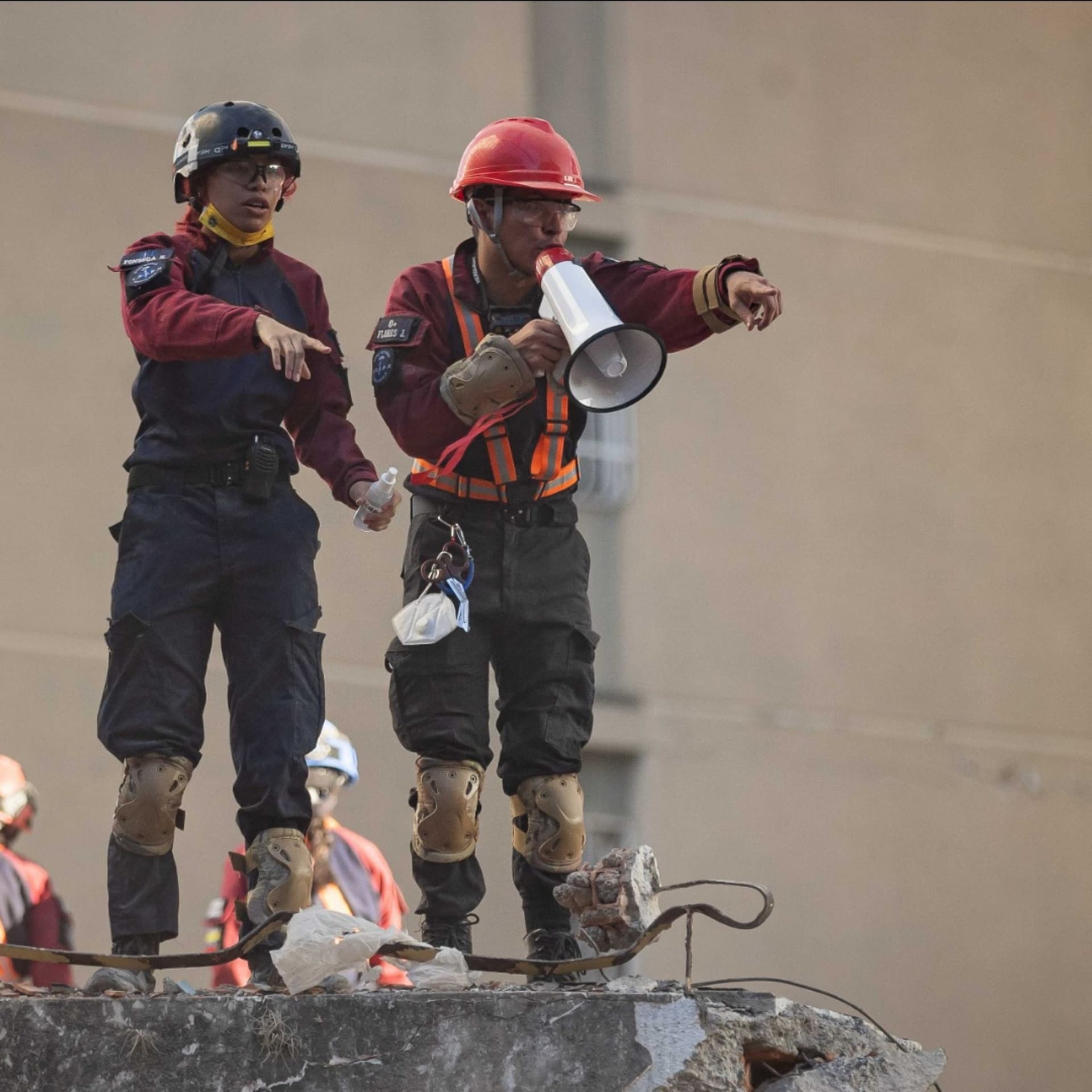
Photo: Rescue workers conduct a search-and-rescue operation in a building damaged by the earthquakes in Caracas, Venezuela, 27 June 2026.
Credit: RONALD PENA R/EPA/Shutterstock