Ask ChatGPT
 Harvard Business Review
12 Nov 2026 · 33m · 7 chapters
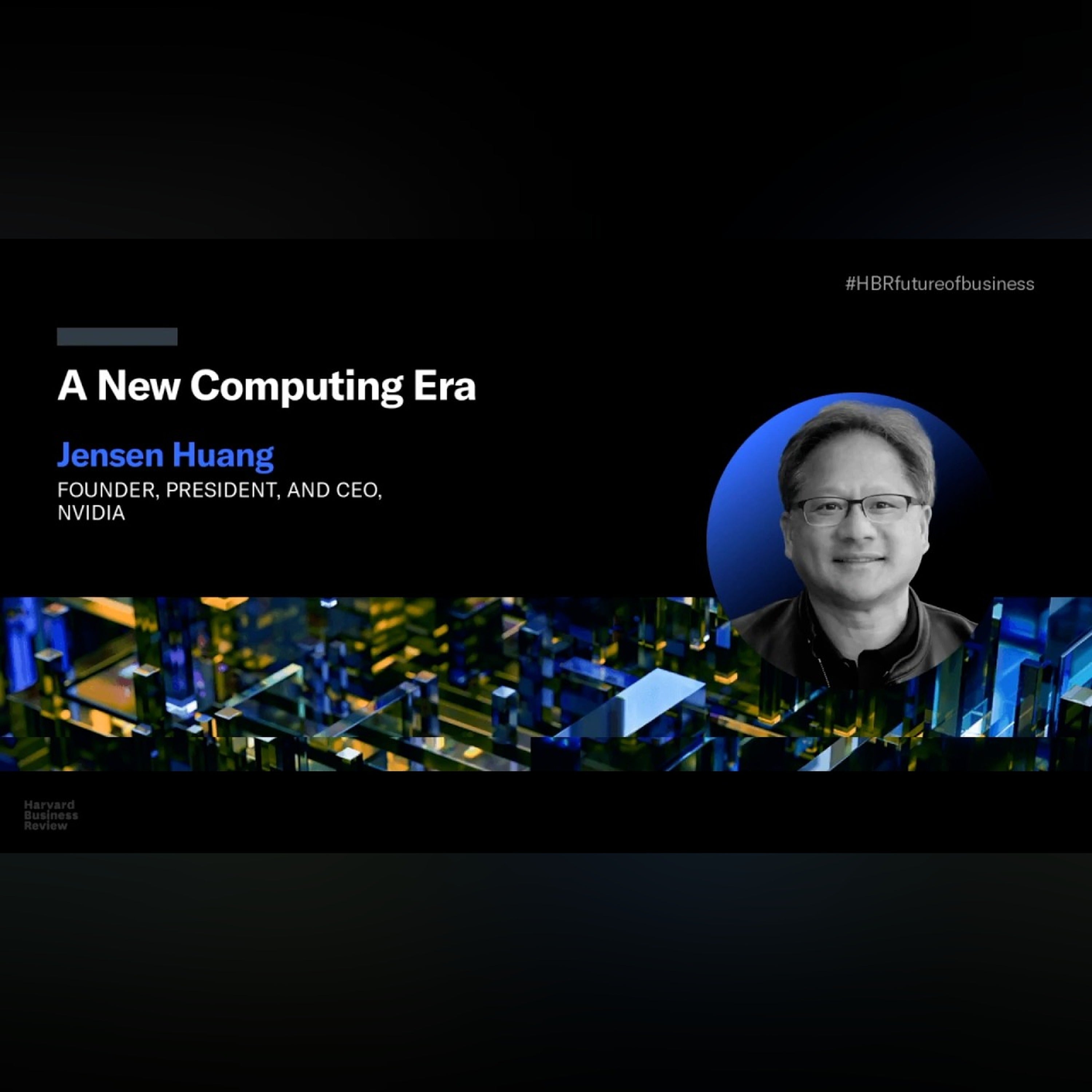
NVIDIA CEO Jensen Huang discusses how generative AI works, real-world uses of NVIDIA tech, and how to run a fast-moving tech company. He also covers human-in-the-loop safety, “guarded optimism” culture, flat management, export restrictions affecting China, and NVIDIA’s relationship to quantum computing.
Jensen Huang is NVIDIA’s founder and CEO. An electrical engineer by training, he co-founded NVIDIA in 2005 at a Denny’s. NVIDIA earns about $26B annually and employs ~26,000 people.
GenAI learns data representations and meaning across modalities (text, images, 3D, proteins/chemicals). AI is used to design/optimize chips and debug failures. Vectorized company data plus large language models enables “talking to your data” via semantic search and retrieval augmentation. Human oversight remains essential for safety and validation. NVIDIA stays resilient via diversity/redundancy and a flat structure to keep information flowing.
AI chip design for optimal transistor placement; generative AI locating likely bug sources and responsible code lines; customer-service databases vectorized for semantic trend queries; self-driving redundancy (cameras/radar/LiDAR; redundant steering/braking) and air-traffic-control-style monitoring; quantum computing expected to arrive as an accelerator alongside classical accelerated computing.
Written by AI. May contain mistakes.
Jensen Huang discusses the revolutionary potential of generative AI and its applications.
“We really appreciate you making the time.”
Learn how NVIDIA is leveraging AI for chip design and customer service improvements.
“Do you have examples, maybe using NVIDIA technology of applications that you're amazed by, that you're seeing out there already?”
Learn how Nvidia copes with sales restrictions and competition in China.
“Coping with the loss of, you know, I think it's billions of dollars in sales to China, partly as a result of U.S.”
Explore the necessity of human supervision in AI and autonomous systems.
“I don't know where Steven is, but the question is, do you think that AI will always need human supervision?”
Discover how Nvidia maintains a sense of urgency and innovation within the company.
“And so there are a lot of different methods that we ensure safety in.”
Understand how a flat organizational structure enhances efficiency at Nvidia.
“sensibility, I think, is really good and healthy for companies to have.”
Learn about the collaboration in the quantum computing ecosystem and the role of classical systems.
“And so we work with just about everybody out there.”

Get the gist, explore an idea or ask about something said.
 Claude
On Harvard Business Review, what are the key points of this episode?
Searching your listeningAutomatic transcript. May contain errors.
0:01Whoever said good things come to those who wait, never shop Black Friday early at Lowe's. Right now, get up to 50 % off select major appliances. Plus, get free delivery, free haul-away, and free basic installation and parts when you spend$896 or more on select major appliances. Shop Black Friday early in-store and online now at Lowe's. Valid through 12-2 while supplies last. Selection varies by location. See associate at lowes.com for details. Jensen Huang is the founder and CEO of NVIDIA, a world leader in AI-driven computing, makes both software and hardware for a host of industries. Its technology is quite literally propelling us into the future.
0:43As an electrical engineer by training, Jensen launched the company with two co-founders in 2005 at a Denny's restaurant. It now earns 26 billion in annual revenue and employs 26 ,000 people around the world. Jensen, thank you for joining us. And what I know is an early morning for you, Probably a busy day for you. We really appreciate you making the time. I'm happy to be here. Good. Okay, now before we start, let me just tell everyone in the audience, we want to ask your questions too. Put them in the Ask the Speaker chat. We'll get to as many as we can. So let's take it away. So, you know, Jensen, as I just said, your NVIDIA is producing technology that is quite literally driving the future.
1:21And I'm talking about the chips and processors that are driving innovation in AI and generative AI. I'd love your view as a sort of hardware guy. What's your thought on AI, on Gen AI? Do you think it will revolutionize how we work and play, or is it simply too soon to tell? Well, at the core of generative AI is the ability for software to understand the meaning of data. It can understand the meaning of words, of course, letters and words and sentences and paragraphs and find relationships and patterns. And from a lot of examples, it figures out the learns the representation of the data and even understand its meaning.
2:09And so it understands the structure and understand how it's constructed and the meaning of the information. This applies to English. It applies to pixels, 3D objects, proteins, chemicals. We've now used this deep learning method to learn the representation of a whole lot of different types of data, almost any data with structure. And so there are a lot of things in the physical world and in the world that we live in that has structure. once we once we can understand the the meaning of the data and we can associate one modality to another modality for example we can associate the pixels of a cat in an image with the word cat once you could do this for one modality to another modality then you can translate things and so you You could translate from English to Chinese, Chinese to French.
3:18You can also, of course, translate from English to pixels, which is generative AI, or from pixels to language, which is captioning. Or you could go from text to text, summarization, so on and so forth. And so this basic model, the model that has learned representation of data, is incredibly powerful. And so now what the AI industry, what the computer industry is doing, is mixing all of these type of mutations and generative methods and translation methods into all kinds of interesting applications. And so I think at the core of this excitement is the fundamental ability to learn representation, learn meaning, and to go from one modality to another.
4:17And that's just incredibly powerful.
4:23I'm guessing that our viewers, by and large, are familiar with Gen.AI. Maybe you're playing around with it probably relatively. Good news for anyone who's bad at waiting. Black Friday deals at Lowe's are already on. Get up to three free select DeWalt, Craftsman, or Cobalt power tools with the purchase of a select battery kit. Three for free? You better believe it. Plus, select ladders are up to 50 % off. So go ahead, get in there early. Shop Black Friday deals in-store or online now at Lowe's. Valid through 1118. While supplies last. Free tools vary based on battery kit purchase and location. The few are using it or applying it other than through experimentation.
5:06Do you have examples, maybe using NVIDIA technology of applications that you're amazed by, that you're seeing out there already? Well, we're using AI to design our chips to find optimal placements to help us connect transistors into circuits and help us optimize designs at a scale that isn't really possible before. We're starting to use AI to help us determine from a failure where the bug likely started from, which line of code was responsible for the bug. And so we're using generative AI to help us from everything from designing the chip, optimizing the chip, to understanding where the failures are.
6:11one of the one of the most powerful things that's happening of course is that uh germative ai predicts the next as you know predicts the next word or pretty next letter next word next sentence next paragraph uh predicts the next pixel it predicts the next um frame of a video so it makes a prediction of the next thing uh these predictions could could uh hallucinate And one of the really effective ways is to, one of them, of course, is providing a lot of context, a lot of prompts that people do to set the background, set the context, precondition the model before you prompt it, before you ask it a question or before you ask it to do something.
6:57One of the things that's really useful is retrieval augmentation. And what that means is a database that, whether it's structured or unstructured, tabular or, you know, otherwise, that has been vectorized. Vectorizing or embedding a database requires you to learn the relationship between all the data among each other, just like you're learning the representation of the data that I was talking about before. and by learning the representation and learning the vectorizing the database, you could understand its meaning. And so what's really exciting now is that you could vectorize a database, you can connect it to a large language model and that large language model essentially allows you to talk to your data.
7:55And every company has a ton of data in their company. most of that data is now dormant. It's hard to use. Sometimes you have to do a lot of queries on it. Maybe it's a relational database that you're doing a query on. But now you could have a database that actually understands meaning. And so you could do a semantic search into the database. It brings back out the information that you meant to query. and you take that embedding and you augment that with the prompt that you're prompting the model with. And so now the context, the background information, the augmented information with this prompt is much richer.
8:46And so the thing that is really quite generalized now is the ease of being able to interact with applications because of large language models that understand your meaning. And then secondary. Good news for anyone who's bad at waiting. Black Friday deals at Lowe's are already on. Get up to three free select DeWalt, Craftsman, or Cobalt power tools with the purchase of a select battery kit. Three for free? You better believe it. Plus, select ladders are up to 50 % off. So go ahead, get in there early. Shop Black Friday deals in-store or online now at Lowe's. Valid through 1118, while supplies last.
9:27Free tools vary based on battery kit purchase and location. All of these databases that you can now vectorize, which could then be used to augment the prompts and queries. And so the applications across your company is really quite amazing. One of the fun things, of course, if you're a company with a large customer service department and customer service agents are inputting their interactions with customers, whether it's problems or complaints or whatever it is, help that you're routing the customer through, all of that is somehow captured in a very large database. But wouldn't it be amazing if now that database was vectorized and you can just talk to the database?
10:16You know, what are the things that people are most upset about? What are some trends that we're starting to see? You know, if we want to improve the customer service of our company, what are some of the top two or three things that you can do? You could talk to your database like you're talking to a person. And that's really powerful. So I want to shift here a little bit and talk about some of the challenges of running a tech company in 2023. And, you know, for starters, you know, how do you keep up with constantly shifting demand for new products, for new services? And how do you build a management team that can imagine the future and keep pace with so much change?
11:00Well, you got to learn. you're you're um yeah first of all you're surrounded we're surrounded by by uh people who are who are um expert in the art in in the found the fundamental and the foundational parts of computer science and you know uh they could be you know compiler experts or they could be chip design experts or they could be processor design experts or internet connect interconnect experts or so on and so forth. And so you've got experts all over your company and they're the best in the field of what they do. Meanwhile, you want your company to be as alert as possible. And so the ability for information to be moving freely in your organization without being trapped in silos is something that's really important as the company gets larger and larger, especially when the industry is moving so fast.
11:56you want to be alert of very weak signals that could be coming from somewhere. And so it could be a research paper that's coming out of left field. It could be related to digital biology. It could be related to something in robotics. And somehow that robotics information, it could be generalized in such a way that it could be useful for how we train a chatbot. You know, maybe reinforcement learning was something that was really invented for articulating and animating stick figures and articulating fingers and things like that and playing a game. But it turns out that reinforcement learning human feedback could be quite useful in fine-tuning a large language model.
12:34And so you want to be able to see developments in adjacent fields or even unrelated fields and be able to somehow distill it back down to first principles and then extrapolate it to useful applications in other domains. And so that fundamental ability of starting from really good foundation expertise in the company, the ability to stay alert of weak signals, and then being able to go back to first principles. You know, when you make some observation, go back to first principles on why is that important? You know, what is the reason? What are the governing dynamics associated with that phenomenon?
13:21And then be able to generalize them. And then you have the political issues that affect your business. I'd love to hear you talk about how NVIDIA is. You know, you don't have to wait to shop Black Friday at Lowe's, right? Save up to$150 now and select power tools, equipment, and accessories. Got gifts to get? We've got plenty under$50. Plus, MyLow's Rewards members get same-day delivery for free. Shop Black Friday deals before the rush at Lowe's. Valid through 1118,$25 minimum, and loyalty membership acquired. Order eligible items by 2 p.m. Subject to weight and size restrictions and availability.
13:57Terms at lowes.com slash shipping terms. Coping with the loss of, you know, I think it's billions of dollars in sales to China, partly as a result of U.S. restrictions on sales of sophisticated chips to China? Well, the restriction is a capability restriction. It's not an absolute restriction. The limitations are related to the performance levels of our GPUs. And this is like restrictions of CPUs and computers that has gone back a very, very long time. The restrictions limit the level of capability or the amount of computation that a processor can do. And so the first thing that we have to do is comply with the regulation and understand what the limits are and to the best of our ability, offer products in the marketplace to serve customers that can still be competitive while complying with the restrictions.
15:03And so the challenge there is that the local markets, especially in China, has a lot of competitors. And so we have to compete in the marketplace while, of course, complying with the regulations that are inspired by national security. And so it's not easy and it's a great challenge. And the competitors are moving quickly. And so it's like anything else. You've got to stay alert and do the best you can. So it sounds like you're saying you're not giving up on that market. You're finding ways within what's allowable, finding ways to, if I have you right, create new products or new approaches to that market.
15:51Is that fair? Well, only if the new products continues to be attractive to customers. The first thing that we have to do is understand what the regulation limits. And the second thing we do is go propose products to the marketplace that customers might still find attractive, but there's no guarantees. I mean, competitors are coming up with all kinds of ways to attract the customer. And so we'll float the best possible products that we can that are fully compliant with regulations and take it from there and see if customers are still attracted to the products that we offer. Got it. Okay, I want to go to an audience question now.
16:35This is from Steven. I don't know where Steven is, but the question is, do you think that AI will always need human supervision? human in the loop is pretty important as you know in robotics you could have you could have different levels of autonomy and most of the levels of autonomy until you you have a great deal of nines of of safety and safety in all kinds of different ways so for example in the case of a self-driving car, if you want the self-driving car to be able to take your family while they're sleeping in the backseat fully autonomously, you want to be fairly assured that the sensor system, the computing system, the vehicle control, all of it has diversity and redundancy.
17:31And so, for example, you might insist on making sure that you have cameras as well as radars, as well as LIDARs. You might even have redundant steering control and redundant braking dynamics and so on and so forth. And these things give you assurance that irrespective of the conditions that the –
18:21store and online now at Lowe's. Valid through 12-2 while supplies last. Selection varies by location. See associate at lowes.com for details. Critical components that affects the functionality has diversity and redundancy. Diversity and redundancy is an important part of intelligence, autonomous intelligence in a lot of ways. Even in companies, we have diversity and redundancy. Notice we talk a lot about diversity in companies because it allows the company to be more resilient. We have redundant ways of doing the same thing. We're trying to analyze the same problem from different perspectives.
19:01Maybe the sales organization is augmented by the marketing organization, which is augmented by so on and so forth, and different types of ways to ensure the vibrancy and the resilience of the company. in most autonomous systems whether it's a as a robotic car or it's a a large organization wants to be designed in such a way that you have diversity and redundancy and then above that you want you want a human in the loop sometimes the sometimes the uh you you get to a level where where um you don't believe you need human in the loop inside the car maybe maybe you have human out human in a loop outside the car and you're monitoring the effectiveness.
19:45This is no different than air traffic control, for example. You have two pilots. You also have redundant autopilot systems, but you also have air traffic control and pilots keep an eye out for each other. There's a lot of different ways that autonomous systems are designed for maximum safety and reliability. This is going to happen the same line of thinking will have to be done for generative AI. We have to invent the technologies for safety. We have to apply engineering methods that allows us to design systems that are safe, validation systems that ensure safety. And then lastly, Lastly, for quite a long time, we will likely, not likely, we will surely have human in the loop.
20:42For example, while you're learning the next batch of data, before you release it out into the world, you have humans validate it and test it and red team it instead of just have it be continuously learning and continuously updating all by itself. And so there are a lot of different methods that we ensure safety in. Human in the loop is one of the best ways. Yep. I'm interested in hearing more about NVIDIA's culture. One of your vice presidents was quoted as saying, working at NVIDIA feels existential every day. We feel like the company is going to go bankrupt tomorrow. So I'm wondering, is that deliberate?
21:24Do you try to instill a sense of paranoia to try to spur innovation? uh you know you don't have to instill it uh if you if you don't think you're in peril um it's probably because you have your head in the sand there are no no companies that are that are assured survival and and um we have the benefit of having built the company from the ground up And having not exaggerated circumstances of nearly going out of business, actual experiences of nearly going out of business a handful of times, we don't have to pretend that the company's always in peril. The company's always in peril and we feel it.
22:14And, and I don't, I don't, I don't need, and the company doesn't need assurance that we will, we will do well in order to do our, our best work, you know? And so I, I think the company living somewhere between. whoever said good things come to those who wait never shopped black friday early at lowe's right now get up to 50 off select major appliances plus get free delivery free hallway and free basic installation and parts when you spend 896 or more on select major appliances shop black friday early in store and online now at lowe's valid through 12-2 while supplies last selection between aspiration and desperation, that living somewhere within that, within that, you know, within that spectrum, um, is, is a lot better than, than either, either, um, always optimistic or always pessimistic.
23:16And so I, I think a, a, um, a guarded, guarded level of optimism, um, and, uh, uh, and realistic understanding that, that the company could be in peril at any time and we have to stay focused and alert and do our best work and constantly earn the right to be in business. Those feelings and that sensibility, I think, is really good and healthy for companies to have. From what I've read, your management style is somewhat unusual that you maintain a very flat organizational structure, that you have very few one-on-one meetings. Talk about your theory of management. Well, an architecture is designed for the company to do its work, to operate as efficiently as possible.
24:09And one of the things that is really important for a company in technology that's moving as quickly as it is, we invented this technology called accelerated computing. and whereas Moore's Law in the past, it's no longer nearly this fast. But Moore's Law in the older days would increase performance by a factor of 10 every five years and a factor of 100 every 10 years. But in the case of accelerated computing, we're moving somewhere between 1 ,000 to 100 ,000 times every 10 years. And so when you're moving that fast, you want to make sure that information is flowing through the company as quickly as possible.
24:57You want the company to be as aligned as possible. And also, our company builds really complicated things. You know, people think our GPUs are like the adding cards that we design for gamers. And they are. We build those with great pride and great joy. But the GPUs that we build for AI weighs 70 pounds. They have 35 ,000 parts. Out of those 35 ,000 parts, eight of them come from TSMC. They consume 10 ,000 amps. Obviously, they're so heavy, you use robots to manufacture them. And the computers are so advanced that it takes a supercomputer to test another supercomputer. And so these GPUs that we're building are insanely complex.
25:51And it requires a lot of software to run it. And for a company like us that designs the fundamental chips, creates the systems, create the software, and creates all the networking and all the silicon photonics and connect it into a large data center. and help companies stand it up and operate it. Our company information has to really move quickly through the company and really, really have no barriers and no boundaries. And so we architected a company that allows us to be able to work across this really complicated stack of computing technology on the one hand, build incredibly complicated things on the other hand, and be very comfortable moving at light speed.
26:39And if you want a company like that, then the last thing you want is for it to be information to pass along hierarchically. And if you look at most organizations, there are only two or three people at the top. And if that starts that way, then the number of layers of management, layers of managers, before you get to somebody who is actually dealing with ground truth, could be seven, eight, nine, you know, ten layers. And I didn't want that to happen. And so the best way to do that is to put the most, at the highest level, to be as flat as possible up there. And so we probably reproduced, you know, three or four layers of management out of our company just by doing so.
27:24Yeah. So we have time for one more quick question. I wanted to bring in one more audience question. This is from Leon. And the question is, you know, what can you say about quantum computing? To what extent are you investing in it? And what can you say about that? Well, in order to build the world's next fast computer, you need the world's fastest computer to help you design it, simulate it, create new algorithms for it. And the world's fastest computer is NVIDIA's accelerated computing systems. And so we don't build quantum computers, but we work with just about everybody in the quantum computing ecosystem, from people who are doing the basic quantum computing design to algorithm developers, to architects who are working on classical quantum computers, architectures.
28:21And so we work with just about everybody out there. The quantum computer won't come along in a real industrial way for probably another decade data, maybe two. And when it gets here, it'll likely be an accelerator that's connected to the NVIDIA accelerated computing systems. And some of the computation will be done on quantum computers. A lot of the computation will be done on classical computers doing pre-processing, post-processing, and so on and so forth. And so I'm looking forward to when quantum computers are going to be useful and effective. And when it comes, classical computers, and particularly accelerated computing, and AI will be a very big part of it.
29:10All right, so we're out of time, but Jensen Huang, thank you very much for being here with us today on HBR Live. I'm delighted to be here. Thanks a lot. Okay.
In this conversation from HBR’s Future of Business event in November, 2023, Adi Ignatius speaks with Nvidia’s CEO and cofounder Jensen Huang about what it takes to lead the AI computing giant and why the future goes far beyond individuals using ChatGPT. They discuss how Huang keeps his company agile in the face of accelerating change, building the right management team, navigating regulation, and what it means to operate from a place of constant transformation and uncertainty.Uploaded 10-11-26“If you don’t think you’re in peril, it’s probably because you have your head in the sand," Huang says. "There are no companies that are assured survival.”You can listen to this conversation on the HBR IdeaCast https://hbr.org/podcast/2023/11/nvidias-ceo-what-it-takes-to-run-an-a-i-led-company-nowAnd don’t miss our next live virtual conference: On November 12, 2026, HBR is convening our annual Innovation Summit for leaders driving innovation in an era of rapid technological change:https://events.bizzabo.com/908398?promo=YT&tr=trueBrowse more of HBR’s coverage of AI and Machine learninghttps://hbr.org/topic/subject/ai-and-machine-learning?sort=newestBooks, tools, and more: store.hbr.orgFollow us:https://hbr.org/https://www.linkedin.com/company/harvard-business-review/https://www.facebook.com/HBR/https://twitter.com/HarvardBizhttps://www.instagram.com/harvard_business_reviewSign up for Newsletters: https://hbr.org/email-newsletters#HarvardBusinessReview #YourCareer #Career #Job #Work #Business #Harvard #HarvardBusinessSchool Copyright © 2026 Harvard Business School Publishing. All rights reserved.
Learn more about your ad choices. Visit megaphone.fm/adchoices