 Honest Ecommerce
23 Nov 2026 · 25m

 Add vo to ChatGPT or Claude to ask about everything you hear
vo listened to this episode to put together the overview and transcript, so there may be the odd mistake.
Loui’s origin and growth story—how founder Anastasia Chapman created “pre-poop drops” (odor-trapping toilet drops used before using the toilet), validated demand via friends/family and pop-ups, scaled from garage production to manufacturing, and survived a forced rebrand after a trademark cease-and-desist.
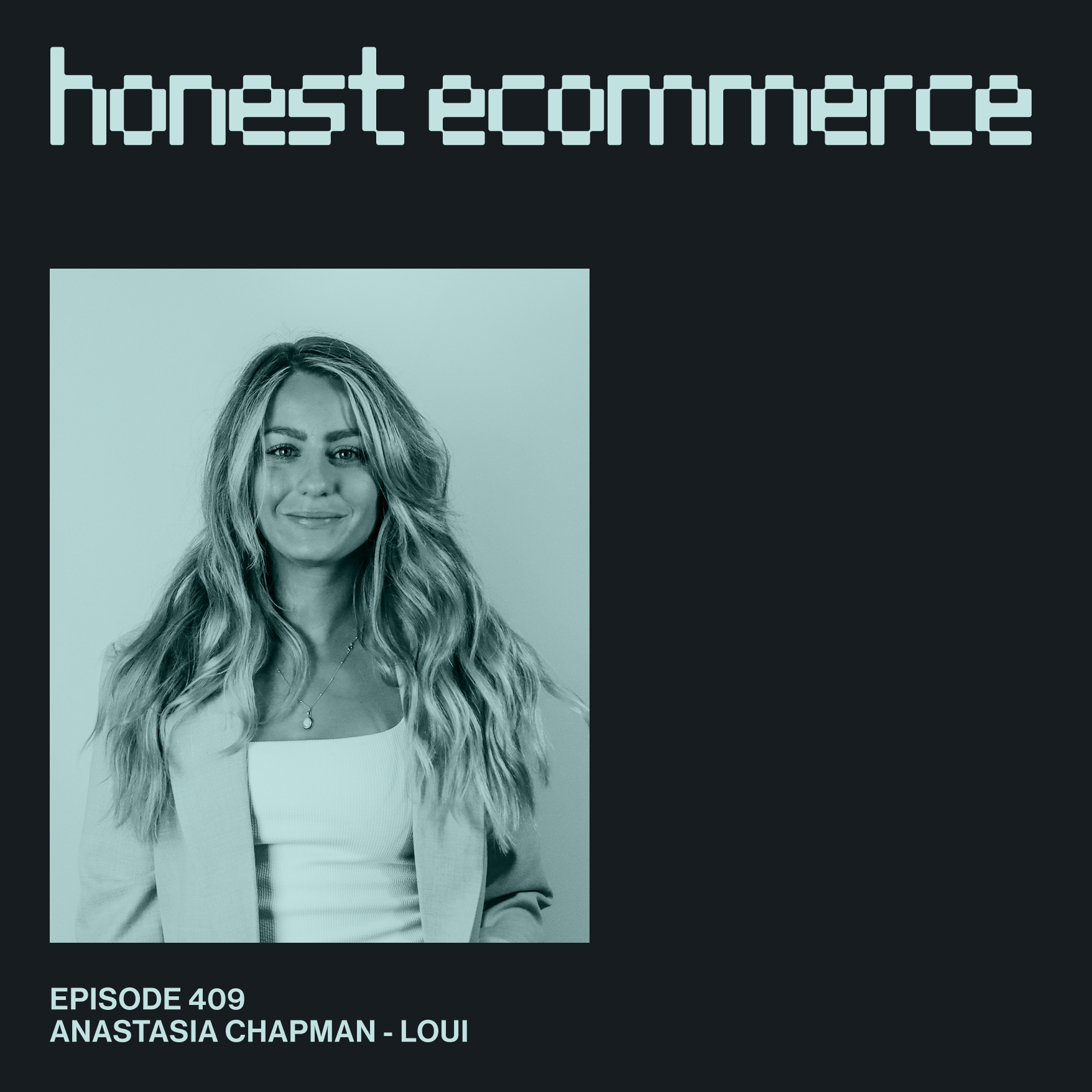
Anastasia Chapman is founder of Loui, a personal modern care brand. She previously worked for a travel startup as a digital nomad, then moved from Mexico to Cape Town while developing prototypes.
You can improve an existing product by changing its use and formulation; early validation from friends/family is flawed but can work if you also test via events; growth came from organic momentum plus small Meta ad budgets; the rebrand (from “Lou/Lou Drops” to “Loui”) caused Q4 marketing shutdown and confused customers, but the company regained “hockey stick” momentum after ~5 months.
100+ prototype batches; “poop scorecard” vials tested by bathroom users; starting with 800 Alibaba bottles and Sticker Mule labels; shipping 10,000 orders from her mom’s garage; selling in ~300 boutique stores; launching toilet stools and planning flushable wipes, new scents, and travel sizes.
0:00You can just take a product that exists, find a different use for it, improve upon it in a, you know, truly interesting way that does help solve the problem for, you know, potential consumers out there. And that's enough. That's like all you really need to do. And the market will speak for itself. Yeah. I mean, 100%. I also think nowadays as an entrepreneur, I'm always looking for products that are solving problems. But at the time, I really wasn't looking at it like that. I just had some gut issues, lived with a lot of people and just thought this product sucks. Why isn't it better? Honesty Commerce is a weekly podcast where we interview direct-to-consumer brand founders and leaders to find out what it takes to start, grow and scale an online business today.
0:42Honest Ecommerce is proudly produced by Electric Eye, a Shopify Plus partner helping Ecommerce brands sell more with strategic design and development. Visit electriceye.io for more information. Hey, everybody. Welcome back to another episode of Honest Ecommerce. Today, I'm welcome to the show Anastasia Chapman. She is the founder of Louie, a personal modern care brand. Welcome to the show, Anastasia. Thanks so much for having me, Chase. I'm excited to chat from halfway around the world, the power of technology. So for those that don't know, what is the flagship product that you and the team are bringing to market over there at Louie?
1:18Yeah, it's a very fun one. Our hero product is our pre-poop drops. So most people don't know what those are. But they are drops that you put into the toilet before you go number two. And it's formulated to trap and eliminate bathroom odors so that you can poop in peace or shit in confidence is what we like to say. Absolutely. And we love cursing and dirty words over here on the podcast. Actually, yeah. So don't worry about holding your tongue by any means. So I mean, this is a hilarious product, but it is not a hilarious business. It's a real business and it works. Yes. Take me back in time to where did the idea for this come from?
1:54Yeah. It's a funny story. But like, well, I always say that like all good ideas happen on the toilet. And that's actually where this idea did happen on the toilet. But in my previous life. I worked for a travel startup. So I was very lucky that I was a digital nomad, kind of pre COVID and did a lot of traveling while I was working. And part of that was sharing a lot of Airbnbs and hotels and apartments and spaces with colleagues and friends and significant others. And you know, like most people, when you share a small space, you are sharing the bathroom. And there's some awkwardness sometimes of when you are going number two, like we all do, because we're all human.
2:28So I actually had a competitor product. I was traveling, I was living in Mexico at the time. I was living with 4 girlfriends and a new boyfriend. And we shared 2 bathrooms. And I had this old product that I was using that was a spray that you put in before you go. And I just remember hating it. One day, I just remember being like, this product doesn't make any sense. It smells so artificial. The packaging was so gimmicky that I was actually hiding it away. I was embarrassed for my friends to see it and my boyfriend at the time. So it was always under the sink. And I also didn't love the spray application.
2:56You had to stick your whole hand into the toilet bowl to make the spray actually work, which like who wants to do that. So when I came out of the bathroom, I made a joke to my girlfriends about like, this should be a drop, it should smell like a spa, like it should be more like fresh smelling and fresh scented and something you'd want to leave out. And that was a joke in our friend group for a bit. It wormhole in my brain for about six months. And about, yeah, six months to a year later, I started developing it really as just a side thing. I in no means meant for this to be a business. I just wanted to solve this problem of poop odors, I guess.
3:31Hey, everybody. Just a quick reminder. Please like this video and subscribe. If you haven't, we're releasing interviews like this every week. So don't miss out. Now back to the interview. One thing I like to highlight here is good ideas. And like you said, you were using a pseudo-competitor's product. And you were just like, This could be better in these 2 differentiated ways. And I just like to highlight that type of thought process for entrepreneurs out there. It's like, you don't need the next Facebook or insane product. You can just take a product that exists, find a different use for it, improve upon it in a truly interesting way that does help solve the problem for potential consumers out there.
4:16And that's enough. That's all you really need to do. and the market will speak for itself. Yeah. I mean, 100%. I also think nowadays as an entrepreneur, I'm always looking for products that are solving problems. But at the time, I really wasn't looking at it like that. I just had some gut issues, lived with a lot of people and just thought this product sucks. Why isn't it better? And then ordered a bunch of essential oils and chemicals to an Airbnb and just started mixing like a mad scientist until I created something. You were the first chemist per se. So how long were you being a mad scientist until you got your first prototype?
4:50Let's call it that. I think it was about only a month because I was kind of mixing quite a bit. I made about 100 batches. So what I would do is I would start mixing. My goal was to actually formulate something that would stay on top of the water. So there was a time where I've now moved from Mexico to Cape Town. So I was living in an Airbnb in Cape Town, again, with friends and a boyfriend. And I would mix a whole bunch of different products. And then I would actually put it into a water, like a wine glass filled with water to see if it would stay on the surface of the water. so it would trap the odors.
5:19So that was kind of step one. Once I got, yeah, I think it was like 100 batches, I felt confident that it was going to trap the odors. We started actually testing those batches. And then what happened was there was a poop scorecard in the bathroom. And every time somebody had to take a poop, they had to score. They had to take one of the vials. There was like five vials that were numbered and they had to choose one, use it and then write little notes. And no one wanted to do this, of course, like who would want to do that, but they did do it for me. And that's actually how we came up with the winning product.
5:50And we still use the scorecard to this day when I come up with new scents. It's still something. But the only way to do it is to poop. And it's like, you can't really do that in the lab. So we just do it in the bathroom and people leave a note. It's usually just family and friends until we land on one. That is amazing. Also, it's just that's how product research is done. Yeah. To everyone out there. My poor partner. Do you know what's going on with Klaviyo? When is the last time you explored what it can do. Klaviyo has been shipping tons of new AI, data, and automation features designed to help Ecommerce teams move faster, personalize better, and automate more of the work that used to take entire teams.
6:30Most brands are only using a fraction of what is already inside their Klaviyo account. Klaviyo is not just email and SMS anymore. It is your customer data platform, your lifecycle marketing engine, your analytics layer, and now your AI-assisted execution layer They're all in one place. That means your customer data updates in real time. Your segments stay current automatically. Your flows and campaigns all run off the same source of truth. And now AI can help predict churn risk, forecast spend, recommend next best products, generate campaign content, and optimize send timing across channels. The big unlock is speed and efficiency.
7:11There are fewer tools to manage, less dependency on engineering, less time moving data between systems, and a lower total cost of ownership across your marketing stack. And brands are seeing real results from leaning further into Klaviyo. Dollar Shave Club has reported over 30 % reduction in total CRM stack costs after consolidating onto Klaviyo. Brands like ThirdLove have seen a 15x ROI from SMS after consolidating channels. And companies like Corksicle have grown flow revenue over 90 % after bringing email and SMS together inside Klaviyo. Across our customer base, almost every single brand we work with today is using Klaviyo.
7:53That is just where serious Ecommerce customer data and lifecycle infrastructures are living these days. If you're already on Klaviyo, but you feel like you're not getting everything you can out of it, or you're just running multiple tools and want to simplify without losing power, I think this is worth your time. You should head on over to klaviyo.com slash honest to learn more. That's K-L-A-V-I-Y-O.com slash honest to learn more about what Klaviyo can do for you today. Now, did you do any more validation as like more in the sense of like, is this a marketable? Is this a product that the consumers want?
8:32I want this product. That's a good question. I don't even know how I would do it today if I were to do it over. Because all I did is send it to friends and family. And I think that's actually horrible advice for people that are listening because your friends and family are going to tell you that they love it. This is the best idea you've ever had, Anastasia. Yeah. They're like, you need poop drops. I think what worked in my benefit is I had a full-time job and wasn't trying to make this into the business. So I did have the luxury of making this in small batches and giving it to people. Eventually, I was giving it to colleagues.
9:00I was running a lot of pretty large-scale events at my job. So I would bring them to certain events. I would put them in bathrooms. And I was collecting feedback that way. I also started to do a couple pop-up markets. So I would do some Christmas markets and start collecting feedback that way, which isn't necessarily like how it works, but how it smells, which one people gravitated towards, what problems we were solving, who is most interested in it, who is our target market. But it started small. Really, I started with 800 bottles that I ordered off Alibaba. I got stickers on Sticker Mule. I labeled them.
9:32And then it just grew and grew and grew. And to the point like last year, we just moved into our manufacturing exactly a year ago to this month, but we had poured 50 ,000 of our first bottles from my mom's garage. So it got to the point where it was small and it started to grow pretty organically. And then it was all hands on deck, cousins, their girlfriends, my mom, my sister, we were all pumping bottles late at night into the into the evenings. That's amazing. Now, how did that... We'll call it hockey stick growth, for lack of a better term. But how did that growth happen? It seems like there was maybe missing something between...
10:11I'm doing a lot of in-person activations to... This is flying off the shelves and now I need to manufacture. Draw me the whole owl. Yes. Yeah, I definitely jumped there. It got to the point where it was a steady... A very small... A few grand up to, let's say, $5 ,000 a month,$8 ,000 a month on the side while I was working full time. I was also traveling full time too. So I wasn't really in the garage being able to work on it. What happened is I started to feel the momentum organically. I also started to run a few meta ads. And I'm talking like$20 budgets a day. I remember spending$20 a day. I was like, that's crazy.
10:48It's$20,$40. Anyway, so I started with some meta ads. It started to really pick up. And I was like, okay, I think there's something here. The company I was working for was going under. And I was at a crossroads where I wanted to quit my job. They wanted me to move to San Francisco. I said, I kind of have this side project that something's happening here. I can feel it. I have the savings. I'm going to give myself a year to go all in and work on it. And if it's not successful in a year, I'll just get another job. And I obviously never got another job. So and then within that year of going full in, I think a lot of it was like time, attention.
11:19And then in terms of growing online, it was kind of two pronged. It was organic. And then meta, like spending money on ads. And retail. We do have a retail... Also reaching out to stores too. So we're in like 300 boutique stores across the country. It's a small amount of our business, but starting to also build some of the retail momentum as well. Absolutely. We will circle back to the retail stuff here in a second. What is the next big idea that could change your business? A pricing change? A new bundling strategy? Adding subscriptions? Tweaking your shipping offer? Most brands make these decisions based on gut feel.
11:51They roll out the change, hope for the best, and have no real idea if it helped or hurt their business. IntelliGym's fixes that. It is an AI-powered testing platform that brings CRO-level clarity to the decisions that actually move the needle. Not just button colors and headlines, but the big stuff. Pricing, offers, shipping, new apps, even major site changes. Brands like Ridge, Jones Road, and True Classics are using IntelliGems to test their most important decisions and see exactly how each one of those impacts profit before they commit. Momofuku used it to test promotional offers ahead of Black Friday and found the version that increased profit by about 28%.
12:33Mott & Bo ran structured pricing tests that drove roughly 30 % more incremental profit. We use it at Electric Eye with almost every client we work with. And now IntelliGems has a free AI-powered audit that gives you 3 specific ideas that you can test on your store today. No commitment, no credit card, just 3 opportunities worth exploring. Head to IntelliGems.io slash audit and get your free audit in just a few minutes. That's IntelliGems.io slash audit. IntelliGems.io slash audit. You obviously said spending$20 a day was scary. how long until that wasn't scary and then like what was the next number that was you know what were some milestones you thought like week one stopped being scary because people started buying it pretty immediately uh we have a really when did it start feeling like an atm at a certain point yeah in a way it was really rewarding because i was like oh wow there's all these strangers that like want to buy my product and it's funny because before this podcast i had complimented you on your voice he said you hate listening to your voice but at the time i i remember making my first video ad with me in it as a founder talking and being like, there's no way I'm going to put that on the internet.
13:43But then I put it on the internet. It started to make us a lot of money. And not even just money. People started to find out about the brand, which I think was really cool. So it was slow increments. I mean, I'm not one of those e-com bros that have done this before. This is my first time in e-commerce. So it wasn't like one day I spent$40 and the next day I spent $10 ,000. It was a slow creep. And I think we've been really good at being a sustainable brand too with our growth. We've been profitable since day one. I'll admit to what I said before this. Yeah, I'm not a huge fan of the sound of my own voice.
14:13But I think it goes back to that. No one actually is comfortable in front of the camera or in front of the mic or anything like that. There's a little bit of imposter syndrome there. But I do it because I know the truth is people want to buy from people. Yes. This is obviously a marketing channel for our agency at the end of the day. There isn't... We're not pulling the wool over anyone's eyes. It's getting my name out there. It's getting our brand out there. But the first year of doing this podcast, I had to force myself to do it. Now it's just I've done it so many times that you can show up and do it.
14:48But yeah, it's just people want to buy from people. And as the founder, you're unfortunately the only people. So get out there and use your face and tell your story. Yeah. And while it's a unique product and it's not maybe for everyone, it is niche, I will say, I compliment myself in that in growing sustainably and growing in my mom's garage and growing Bootstrap. I think that actually benefited me for my founder story. All of my best performing content and ads is all of me making it, mixing it, telling the story of why I created it because it's genuine. I did genuinely create this for myself and my friends and family and then actually grow it in a garage until it got to the point where we physically couldn't.
15:26And we shipped 10 ,000 orders out of that garage too until we moved to a 3PL. So if anyone is listening and starting a brand, I think actually filming everything. I've never been founder-facing in terms of one of those founder-facing organic brands. But I did film a lot of behind-the-scenes content. And I banked it. And it's really benefited me now, especially that we are in larger facilities. I don't have that garage space. But I'm still able to tell that story of who Louie is. Absolutely. Yeah. It's the boring things people actually find interesting. You'd be surprised. And it's... I think just people like watching things get built.
16:01Yeah. I mean, me too. Be it the business, be it the product. So it's like... You probably have more interesting things going on in your development of your product, in the packaging of your product, in building the kit or whatnot than you really think. And it's like all that stuff can be content. Yeah. Especially if you explain what's happening over top of it. And if you don't hire for it too, I do still edit all my own content and I upload it all. And I'm replying to every single customer, which is crazy. I need to change that because it's exhausting. But you learn a lot about your product and how to market it, but also what people want.
16:36So we had just launched our toilet stools. People call them squatty potties. That's actually a brand. So they're called toilet stools. But anyways, we just launched them. They're in acrylic colors. They're beautiful. They're very cool. But we started in a small batch. We only launched a couple weeks ago. And I'm already seeing the feedback in all of the comments of our videos of what people want to see. So I'm doing that still this day where it's like, I only ordered 700 of them. And now our next order is going to be double that and then probably double that and double that. But I'm able to make those iterations because I'm really close to our customer and what they're saying because I'm the one doing the content instead of hiring someone to do it for me.
17:10Absolutely. And as you said, it is a double-edged sword. Some of it can be delegated. But at the same time, it's like there's nothing stronger than talking to your customer and interacting with your customer and knowing what they're up to. You have prepped all year and all that hard work is paying off. Your store is converting, the ads are working, and this is shaping up to be your best holiday season. But your 3PL can't keep up. Orders are backing up. Customers are asking where their stuff is. The reviews are starting to turn. All that hard work, all that momentum, undone by a fulfillment partner that can't scale with you.
17:46This is a nightmare scenario and it happens to brands every holiday season. Enter eFulfillment Service. eFulfillment Service is the 3PL that scales with you. They are family-owned, they've been in business for over 25 years, and they're built specifically for growing direct-to-consumer brands. There are no setup fees, no minimums, and no long-term contracts. You only pay for what you use. If you're scared your 3PL can't keep up this holiday season, now is the time to reach out to eFulfillment Service. Go to efulfillmentservice.com slash honest and get up to 8 weeks of account fees completely waived.
18:21That's E-F-U-L-F-I-L-L-M-E-N-T-S-E-R-V-I-C-E.com slash H-O-N-E-S-T efulfillmentservice.com slash honest. Looking back now on what you have built, is there a mistake or a misstep from the early days that turned out okay? Besides some manufacturing errors, our biggest misstep was we had a legal trademark infringement last year. So we did have our hockey stick growth was all of last year, which was incredible. A lot of that was built behind this meta machine that we all know and love. But I actually... I was originally called Lou or Lou Drops. And there was another brand with a similar name that I had never heard of.
19:07And they hit us with a couple of cease and desist. We had to go. We went through this legal battle with them, which was expensive and time-consuming and very stressful as a new business owner. Ultimately, we decided to... We had to rebrand our name. I love the name Louis. It's so much better. I think what kicked us in the teeth, though, is we had our biggest Q4 month. And as of January 1st of this year, we had to turn all of our marketing off and completely switch it over to say Louis. So every single thing, packaging, I had just placed a 40 ,000 bottle order. and then that same week or the week the production was done, we found out we had to rebrand.
19:44And I was like, I have all of this product that I've just spent tens of thousands of dollars on. So it was a mix of product, marketing, everything had to switch over and I'm just a one-person team. So it was a pretty tough first start of this year doing that rebrand. And I would have done it a little bit differently if I had to do it again. I don't know if that was the positive story you're looking for, but it's a part of our story for sure. Well, no, it's still... I think most brands are thinking about rebrands for at least a year. And it's a whole big rolled out thing. You're like, well, January 1st, we're going to be a different thing.
20:18Yeah. So my question would be, how has things settled out as far as the growth, the trajectory, the sales? Yeah. I mean, I think we're back on the hockey stick momentum again. I would say it took about 5 months, way longer, I really underestimated what it was going to do the business in terms of product cash flow and having to order new products in terms of the marketing machine. So not just how we... Also how we talked to our customer. I think a lot of customers were like, is this a ripoff of the old brand? Who is this? This looks like you. We were getting a lot of confused customers. And I didn't really have someone to help me walk through that rebrand.
20:57So I don't think our unveil was great because it had just happened after Q4. And I was exhausted. on January 1st, it was like, okay, January 1st, now we're Louis. So I think one lesson is I was too reliant on Meta, I think, for our acquisition. So when we had to turn everything off and turn it on again, we just couldn't get our new ads to stick. And it was pretty tough to get that momentum going. And at the same time, the bills had never been higher. So revenue was sinking, bills were higher. It was struggle streets for a bit of this year. That said, we are registered under Louis. We have some great new products.
21:32I feel like we've never had more momentum. And I'm feeling really proud that we were able to survive that period and come out on top. Absolutely. Things are obviously looking up. We've got 2027 in front of us. What are some of the goals that you have for the next 12 to 18 months? More product innovation. I feel like we've had the same SKUs and Hero products for the first year. And they've proven really well, we have a high returning customer rate and people love them. And I just want to continue building on that now that we have our momentum back. So I want to be the brand that owns the bathroom space.
22:13Because if you think about it, the bathroom is something that we use every single day, every single person. And so many of the products have been overlooked. It's like, there's so many products in skincare and healthcare and facial makeup, up. But then there's nothing in terms of poop and bathroom and how we go to the bathroom every day. So I'm looking at innovation. We're going to be coming out with our flushable wipes, unscented flushable wipes and a travel size. You can take them with you anywhere. New scents with our pre-poop drops, potentially smaller travel size, larger sprays, and then also our stools, which are killing it right now.
22:50So I think people are trading in their old 15-year-old squatty potties and are really excited for something that's like, Like it does the trick. It's functional, but it's also like fashionable. It like looks very cool in the bathroom. So that's only a few weeks old, but we're going to be sold out really quickly. So I could really see us growing in that category as well. Now, is there anything I didn't ask you about that you think would resonate with our audience? Okay. The hardest part about building a brand, if you've never done it before, is showing up and doing the same thing over and over and over and over again.
23:19And finding that same momentum every day. I think as founders, it's so easy to have like shiny object syndrome. of like you want to build something. And even I just touch on it. I want to touch on innovation and owning the bathroom space. But it's so easy as a founder to want to do a million different things. It's really hard to do the same thing over and over again, especially when things aren't working. Like this year, the beginning of this year was really tough on me mentally with this business. So then to show up every day and have customers mad at you, have things not work, have you owe money.
23:53It's fucking tough. And I think sometimes the best founders can just withstand that, withstand the pain and outlast it and consistently problem solve. So I'd say that's the hardest thing. And also one of the best qualities in a founder is just being resourceful and being ready to problem solve every single day until it's over. Yeah. Showing up and doing the work is basically how you have a successful business. It can be a slog. I think there's this... Sorry, I cut you off. But I think I see all these founders online and they're showing their houses and their cars or their jet-setting lifestyle.
24:28And then on the other side, it's like they make it look so fun. I'm just like... It's fun. I love what I do. I love the brand. But it can be... It's a slog when you're looking at your P &L and your accounting and your customer service and your inventory. And that's a huge... It's like 90 % of what the job is. Yeah. I have a lot of opinions about people showing off wealth online because they got it on the internet. And that's where the name of this podcast comes from, Honesty Commerce. Because I don't think a lot of those people are being very honest. I don't either, Chase. I agree with that. Awesome.
25:00Anastasia, I can't thank you enough for coming on the show and sharing all those insights. If I'm a listener out there and I'm like, these products sound cool, where should I go? What should I do? You can find us at TryLouis, tryLouis.com and also on Instagram and TikTok, TryLouis. Thank you so much. Thanks for having me. Outro Music
Anastasia Chapman is the founder of Loui, a modern personal care brand that discreetly and effectively eliminates bathroom odor.
What started as a formula mixed by hand in her mom’s garage has grown into tens of thousands of bottles sold, all without a single full-time employee.
Loui is on a mission to bring peace of mind, comfort, and a little confidence to every bathroom trip.
In This Conversation We Discuss:
Resources:
If you’re enjoying the show, we’d love it if you left Honest Ecommerce a review on Apple Podcasts. It makes a huge impact on the success of the podcast, and we love reading every one of your reviews!
Scan the code with your iPhone camera
Listen in the app.