 In Depth With Graham Bensinger
2 Nov 2026 · 2h 30m

 Add vo to ChatGPT or Claude to ask about everything you hear
vo listened to this episode to put together the overview and transcript, so there may be the odd mistake.
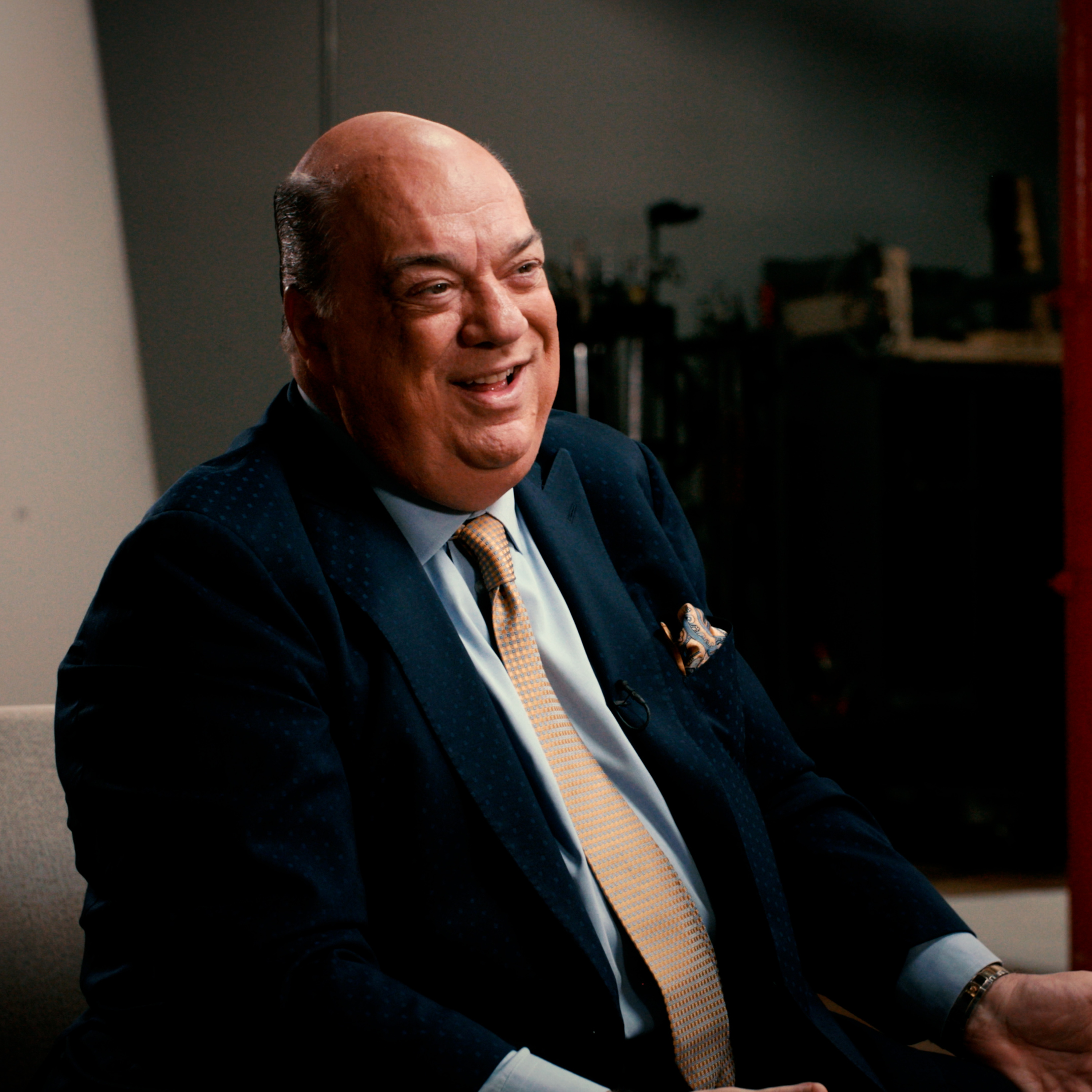
Paul Heyman discusses how he approaches creativity and business, his path from WWE to entrepreneurship, and how his family history shaped his worldview. He also describes building Looking for Larry Studios/Agency, and shares personal stories about his Holocaust-survivor mother and his father’s courtroom style and parenting lessons.
This episode is a solo interview with Paul Heyman. The other speaker is the host (Graham is mentioned). No other guest is described.
Longtime WWE creative figure and executive known for shaping “unforgettable moments.” He says his WWE run ended in 2006, and he later built marketing/branding work with business partner Mitchell Stewart. He is the son of a Holocaust survivor (mother in Auschwitz and Bergen-Belsen) and describes his father as a Bronx trial attorney and lifeguard.
0:00See? Oh wow, do you need glasses? Sir, how are you? Thanks for doing this. Oh no, thank you for having me. What do you enjoy about the creative process? I always tell people that I work with closely, intellectually speaking, you're going to be more intimate with me than you are with your spouse. What turns you on? What really, really, really turns you on? Your entrepreneurial ambition started young. Yes, so I started a newsletter about professional wrestling. And then I bullshitted my way into Madison Square Garden when I was 15 years old. You said in 2008, Vince McMahon is a most complex individual.
0:47I don't think Vince ever considered himself a good man. Really? I don't think he cared about him. The ECW. What was your single lowest point during that period? The day I just had to finally accept, we're going into bankruptcy. I've heard you talk about before the connectivity to your mom and you living without fear. When you understand that my mother's sister was seven years old when she went to the gas chambers, that my mother's mother went with her to the gas chambers, what do I have to fear in life? You said you're uncomfortable being your true self in public. Yeah. What's the concern that somebody could see?
1:32It's not a concern. I'm just a terribly up person like everybody else. I just embrace my up ass.
1:41Where are we right now? Well, this is where we grow our marijuana. and no no this is the Looking for Larry Studios in New York City we partnered up with a major studio here in New York because you know the cultural curve was obvious to us and we wanted to at least have the capabilities of getting into AI as it came to the forefront with still having a lot of respect for talent since I understand I've walked in no shoes for 40 years as well. But just the desire to have a content hub and a hub for content creators in New York and the realization of how few places are affordable in New York for content creators and just some sort of an environment that encourages innovation and creativity and people launching their creative products, we realized, wow, we really need a full-fledged studio and more than just the ability to run and gun and hit the streets with a bunch of cameras and keep an office that's just more of a storage unit for our production equipment and editing, that we needed to really become a studio.
3:14So we're here in Midtown Manhattan at what is now the Looking for Larry Studios. And what made you realize you wanted to get involved in this in the first place? Well, my business partner Mitchell Stewart and I have been building the Looking for Larry Agency for years and more of a creative advertising branding firm. But look at the cultural curve and look at where the money is and look at where society has gone. What's the biggest platform on the face of the planet today? YouTube. It's not TikTok. It's not Instagram. It's not X, formerly Twitter. It's not Threads. It's YouTube. YouTube is the largest platform on the face of the planet.
3:57Why? Because it has so many creators that get to self-distribute. And the only partner that you have is YouTube if you turn your advertising over to them. So when you take a look at that and how many of the creators are coming out of the gate with new innovations and understanding the algorithm and trying to cheat code the algorithm and find how to SEO the algorithm. When you just take a look at what drives content now, the ability to offer content creators a hub that's not just a content hub but a creator hub as well, to me that's the next step. That's the next part of the evolution. It's not just the fact of trying to ride the curve.
4:50It's trying to stay ahead of the curve so that when the curve hits, you're already the one that everyone's going to. But, I mean, you have long had your hands full with WWE. So what, like, the motivation on your end in the first place to create Looking for Larry was what? Well, the idea for Looking for Larry came about because I could tell in 2006 my run in WWE was coming to an end, which it did for five and a half years. And you thought on many occasions before you were kind of going to be done, right? I always presume. You know, Vince McMahon used to have a wonderful philosophy about the way to approach looking at either creativity or business.
5:37And he always thought, come into the room as if it's your first day on the job. Because the greatest inhibitor of creativity is experience, because you learn what not to do. That second part was always my philosophy, trying to incorporate and understand his, because he was the chairman of the board. But I always felt, make it like it's the last day on the job. If you walk in like it's the last day on the job, you fear nothing. You're not afraid to offer an honest opinion. First day on the job, you're going to be tepid. You're going to be intimidated. You're going to say, ooh, I don't want to rock the boat yet.
6:12I don't want to step on this person's toes. If you walk in the door saying, I don't give a f*** if I step on that person's toes. I don't care. I don't care if they like my opinion. It's my last day on the job. I get to be honest on my way out the door. So if you're honest in your evaluation of business or creativity, then you'll presume that every day is your last day, and you live it like it's your last day. And I've always approached things that way. This is my last day, and if it is my last day, here's how I'm going out. But in 2006, it was my last day. I was on my way out the door, and I knew I needed something to jump into, because I already had two children at home, and they were very small at the time.
6:53And I said, boy, I better figure out a way to make a living here. And I needed some sort of an expression of my creativity. and Mitchell and I had already been working on a number of movie scripts that we were overly obsessed with and not wanting to sell yet that we still wanted to refine. You're a massive film and TV fan. Yeah, I'm a buff. I'm a cinemaphile. I obsess over movies big time. But so you and Mitchell were... So we said, you know, I had a lot of publicity because still at that time, ad age was still huge. And they used to have, you know, the ad age 100, the most influential brand strategists or marketers.
7:40That was it, the marketers, marketers and brand strategists in the world. And I made the top 100. And the publicity coming off of that led people to believe that I actually knew what I was doing in marketing, which I can assure you I really don't, but people thought I did. So we said, let's open up a marketing company and offer our services to people because he was brilliant at it as well. He had taken Z100 in New York, as the saying went in the documentary on what he did with it, from worst to first. And that is the station in New York. Oh, at the time, absolutely. Absolutely. So we decided, hey, let's offer our services out there to people and see if these two knuckleheads can actually make a living offering some advertising, marketing, and branding advice to people and implement some campaigns.
8:34So we did. So at least I had something to fall back into coming out of WWE in December 2006. And the rest is kind of history. So I wanted to, you know, you talk about living without fear and like every day is your last on the job. And I wanted to start kind of by talking about family. And I've heard you talk about before the connectivity to your mom and you living without fear. Explain that, if you don't mind.
9:14Well, I'm the son of a Holocaust survivor. My mother was in Auschwitz and Bergen-Belsen. She was part of the march from Auschwitz to Bergen-Belsen that, however, I don't want to say a number because someone will look it up, and if I'm off by a number, I'm being terribly disrespectful to those who perished. But however many people left Auschwitz on that march, far fewer actually made it all the way to Bergen-Belsen. And she was in that march. In the end of 1944 to the beginning of 1945. And when you look at it from the perspective of the fact that 13 of my mother's cousins died of starvation in the Widge ghetto.
9:59That both of her grandmothers died. that she had four aunts, three of whom died, one of whom went missing, looking for two of her children that may have been in a roundup. When you understand that my mother's sister was seven years old when she went to the gas chambers, that my mother's mother went with her to the gas chambers.
10:29What do I have to fear in life? What am I going to face in my life that compares to that? My mother, you know when people wear glasses, they see everything through the lens of those glasses. My mother saw everything in life through the lens of the separation. When she got off the train from Widge to Auschwitz in August 1944, and she was separated from her mother and her sister. The sister was seven years old. She's not fit for slave labor. That's it. She's being put to death. They would kill the mother with the child, because once you kill the child, the mother's of no use for slave labor because their soul is gone.
11:12And my mother was pulled to the right by an SS guard to go to the barracks to go to slave labor because she was fit for slave labor. and everything in my mother's life, every moment, every micro moment of my mother's life was seen through the lens of that separation. And what made that evident to you when you were growing up?
11:38Well, first of all, how many times she referenced it? Like, what would she say? She would tell me the story of the separation. She would tell me where the sun was. What the old Jews behind the fence were yelling at my mother's mother. And if you notice, I will never dare to call that woman my grandmother. Because for me to sit here and say to you, well, my grandmother perished in the Holocaust, I didn't know her. And that makes it my personal story, and it's not my personal story. That moment belongs to my mother. That pain, that suffering, that indignity, that exposure to inhumanity belongs to my mother.
12:25And I wouldn't dare step on it by personalizing it to myself. It's personal to me because I heard it and I learned about it and I was educated about it by my mother. I saw it in her eyes. and she wanted to make sure that I would understand that story because my role in life to her was to pass this story down to the next generation. Whatever I did in my life, my holy obligation, my purpose for being on this planet was to educate the next generation so that they educated the next generation. Because no matter how much to the horror of a Holocaust survivor, in time the story gets dulled down. We are now, as we sit here, we're 81 years past the liberation of the death camps.
13:29and there's no way that society can understand the intensity of the story as was explained to me when I was a small kid in the 1970s because then it was only 30 years ago and it's still so fresh. It was still an open wound. There's no survivors left. My mother was one of the youngest because she was one of the youngest that was fit for slave labor. She went to Auschwitz in August 1944 at 16 or 17 years old. My mother would have turned 99 this year. So how many survivors are left? How many will be left in five years? Who's here to tell the story? Who's here to say, I was there. I witnessed it. I suffered for it, by it.
14:24through it and I survived it. In 10 years, they'll all be gone. There won't be any left. So now it's incumbent upon those who looked directly into the eyes of those who could tell the story to pass it down with as much of the passion in telling the story to my children to where I have to tell my children at some times, make sure you tell your children about this because I grew up with the understanding that's my purpose in life. What was it about her smile at your bar mitzvah that still you remember so much? It wasn't tempered. you know the and was that the only time the only the only no it was the only time until until my children and then it was a completely different side of my mother that i had never seen how cool is that oh i i was happy for her happy for it and happy happy for my father to see her so happy as well, because any other moment in her life was tempered.
15:45I will tell you this. If I had been through anything remotely close to what those survivors had been through, I would have been one of the people up on a rooftop just picking other people off going, okay, them too, and them too. I would end up a serial killer, as would most other people. You hear stories of people who have survived traumatic incidents in life. Death of someone close, a rape, a fire that killed somebody, a crime that was committed against them, and people that come back with PTSD from an incident in a war would own an entire war. This woman's soul was raped on a micro-moment to micro-moment basis over the course of years.
16:42There was never an escape. There was never a moment of relief. There was never a moment of everything's going to be okay. Nothing was going to be okay. Everything was wrong. It was hell on, literal hell on earth. And so every moment that she experienced joy, again, it's through the lens of the separation, was, well, how happy can I truly be when this happened to my younger sister, when this happened to my mother, when this happened to every member of my family. So, you know, there's an old joke about Jewish guilt, but she would feel guilty that she could find pure joy in any moment because how could that not be disrespectful to those whose lives were taken away from them?
17:34That was her mother and her sister and all of her cousins and her aunts and her grandmothers. And so all joy was tempered. You know, it's a terribly twisted psychology when you think about it, but it's truly understanding if you look at it from an empathetic basis and how beautiful the love that she had for members of her family that she would allow it to never be forgotten. But at my bar mitzvah. pure joy pure joy I look at the pictures of my mother at my bar mitzvah and I never except with my children I never saw her that happy I never saw her let herself accept herself being so absolutely positively 100 % uninhibitedly happy and the reason being that she was so happy oh it was revenge And f*** you, we made it.
18:41All Jewish holidays are the same. They tried to kill us and we would not die. And to her, it was, look, we made it. You know, the bar mitzvah is the anointing of the child to become a man. My son became a man. We made it another generation. We weren't supposed to be here. This was supposed to be taken away from us, and you didn't get the job done. This family survived. I heard one person who had survived a different atrocity in life. He was a POW in Vietnam, and he was a frequent guest at the China Club here in New York City back in the days that I was hanging out at the China Club. And I was fascinated by him because, again, this is someone that went through a horrible experience in life and comes out from the other side and was one of the happiest human beings.
19:47His happiness was never tempered. He was happy all the time, no matter what was going on in his life. And I asked him about that one day, and he said, every single solitary breath that I take carries with it a measure of revenge. And at that moment, I understood how my mother felt at my bar mitzvah. This has sounded like a joke before when I've heard you say it or read you quoted saying it, but you've said it enough that it makes me wonder. You have said before that you were her greatest disappointment in life. Oh, absolutely. Genuinely? Oh, yeah. Like, explain that, if you don't mind. My mother felt I wasted all my talents.
20:36My mother had very high hopes for me. My mother... Supreme Court justice? Oh, beyond that. President of the United States, Supreme Court justice. I think I said it on the A &E biography. I don't think my mother would have ever been proud of me or at least not disappointed in me unless I became the replacement for God. That understanding of her disappointment affected you how? I accepted it for what it was. I understood her perspective. I appreciated her ambition. I appreciated her belief that I could carry out what she envisioned for me. What would she say? To me? You're wasting your life. You're depriving the world of what it needs right now.
21:25stop f***ing around this is what you want to do this, really, this what's the goal, what's the benefit to humanity how are you changing the world not that many people have the ability to change the world, you do it this is what you choose to do hey fine, you want to waste your time in your life great, go ahead she was understanding what she had been through and the fact that she believed that the world needed change and constant change and someone to monitor the change and someone to be the guardian for that, for humanity, to make sure that something like that never happens again anywhere to anyone.
22:10And first of all, her belief that I was capable of being that person, to be the guardian for humanity, was a terribly bad misjudgment by my mother. Oh, come on. Wait, okay. Come on. I'm the least qualified person to ever run for office. Okay, we're all the least qualified people when we're kids, but we can, I mean, you obviously had a ton of talent and had a ton of success and you would have in whatever you did. Thank you, but... But in question, because your dad, on the other hand, you were his biggest joy. Yes, until my children. What is it when it comes to talking about him that will occasionally bring a tear to your eye?
23:00I miss him. I miss my father every day of my life. I'm incomplete without him here. What would it say about my father if he wasn't worthy of at least one cry a day that he's not here. That he's not as great of a... My father was the greatest man I've ever met in my life. If you talk about someone that should have been the guardian for humanity, if you talk about someone that should have been president, should have been a Supreme Court justice, should be someone who was a beacon of light for the world to follow, that was my father. My father was the coolest man I've ever met in my life to this day.
23:44Okay, and what made him that? Everything. He was just a man. Joe Kool? Yeah, yeah. My father was Joe Kool.
23:53You know the Peanuts cartoons by Charles M. Schultz? You know when Snoopy becomes Joe Kool? That was my dad. Bobby Orr was my favorite hockey player, even though he played for Boston and I'm from New York. Bobby Orr was my favorite hockey player. I loved watching Bobby Orr. I admired his talent. He was not my hero. I admired him, but he wasn't my hero. Muhammad Ali was my favorite boxer, but he was not my hero. Tom Seaver, Pete Rose were my favorite ballplayers for different reasons. Tom Seaver because he was the New York hero. Pete Rose because I love the way he, Willie Mays too. But they were my heroes.
24:24I can go down the list of all these different celebrities. James Cagney was my favorite actor. This person, Robert Merrill and then Placido Domingo were my favorite opera stars. I've had multiple different musicians that I have admired, admired, greatly admired, respected their work. None of them were my heroes. My father was my hero. Anything I could do that is up to that level of greatness, of dignity, of just being a man, that was my father. Tough as tough could be. He could handle himself on the streets with anybody. Nobody never had a temper, never had a need to show it, never had a need to display it, never had a need to show it off.
25:16Smarter than anybody I ever met. Street smart. I mean, street smart like a gangster. But but ethical beyond description, funny as hell. the way he performed in front of a jury I just marveled at his charm and his ability to make everyone relate to him and what do you remember from those days shadowing him in the courtroom? well it's what my kids will tell you is the story of diamonds my father had a case what a therapy session this is by the way holy s*** we haven't even talked about anything I tell you so, Graham, you know. But my parents used to let me skip school and watch my father on trial.
26:08He was a trial attorney. He was a personal injury attorney in the Bronx. And never took a job with a major law firm. He was a sole practitioner. Always liked to be his own boss. Didn't want to answer. It's another thing about him. my love. Didn't want to answer to anybody. Want to be his own boss. Want to be his own man. Just, here's what I do. Comfortable with the living I make. Don't want to answer to partners. Don't want to answer to a boss. Want to answer to myself. So he was just a poor kid from Rochambeau Avenue in the Bronx. You know, his parents were Hungarian immigrants. His father ran the movie projectors for Lowe's movie theaters all over the Bronx, was part of a union.
26:53So he worked during the Depression, but didn't make a great living, but enough to feed the family. And they moved up and down Rochambeau Avenue, depending on which movie theater he was assigned to. So there was some stability in life, but he was still, he was a kid of the Depression. Soon as he turned 18 in May 1944, he was drafted into the U.S. Navy for World War II. He was served in the third fleet off the coast of Okinawa, came back in 1946, and went to law school through the GI Bill. Became a lawyer in 1949, 1950, because he had skipped a couple of years in school because he was so far ahead of everybody else because he was just so hyper-intelligent.
27:36My favorite case of my father had to do with a woman in the Bronx. She was a magnificent beauty. Her husband was a manual laborer, worked with his hands. They had four children together. And as the husband was in his late 40s or early 50s, the man died. So she's left as a single parent of four children in the Bronx, and she's a school teacher in the Bronx. There was a supermarket in the Bronx at this time that had multiple floors and an elevator. And she would go shopping apparently once a week, buy groceries for the week. She's carrying her groceries. She elbows the button that summons the elevator.
28:30Elevator doors open. She steps in. There's no cab inside. Falls down the shaft. cuts her face like Omar on the wire by the cable. When she hits the ground, smashes everything from her toes up to her hips. She's in a wheelchair for the rest of her life. This is a major lawsuit. And multiple defendants, the supermarket, the elevator company, the inspector of the elevator company, the borough of the Bronx, because they're supposed to inspect all these elevators. nine, ten, I think the number was around eight or nine. Don't know. I don't want to embellish the story, nor do I want to diminish from it.
29:13Let's settle on nine. Nine defendants. The judge assigns one of their lead general counsels to be the point person attorney for all of the defendants, because otherwise you're going to have nine defendants. Someone has to lead the charge. My father handles the case by himself. This is nine defendants with depositions and discovery and everything else. Takes five years to get this to trial. The opposing general counsel is this hot shot, young, Bronx born, so he understands the courtroom and the jury attorney. And he's really good. He put on a hell of a case. But as I'm watching the entire trial, I realize my father's still whipping their ass.
30:06Until the summation to the jury. And the opposing counsel gets up and he goes to the jury box and he says, ladies and gentlemen, the jury, this is a terrible thing that's happened. No one's denying that. She's a wonderful woman, a pillar of the community. No one's denying that. But the case here is about liability.
30:35We're not liable. I'm sorry to say this to you and to her, but we're not liable. This wonderful woman is lucky that she's alive. She's lucky that she still can move her arms and hug her children. She's lucky because the school that she teaches in is handicap accessible and she can still teach, which is what she loves to do. but we're not liable for this. The Bronx Courthouse is at Lou Gehrig Plaza, right? It's in between Yankee Stadium and the Grand Concourse. And he brought up the point, when you teach, it's a jury full of your peers, so it's a jury filled with people that live in the Bronx. When you teach your children to cross the Grand Concourse, do you look at northbound traffic?
31:23Do you look south? Do you look at southbound traffic and look north? Or when you teach your children to cross the Grand Concourse, do you teach them to look both ways in case somebody's coming the wrong way? That elevator door opened. A blind person has a walking stick and makes sure that they're not walking into a hole. So even a blind person would know not to walk into that elevator. She could have taken her foot and just tapped to see if something was there, but she didn't. She recklessly walked into that elevator shaft, and that's why she fell down. It's a terrible thing that happened to her.
32:03But she's not a victim. She's lucky. And the unfortunate part about it is that we in this community all know it. He sits back down, and he goes, we rest our case. And my father sat there for a second, and he's looking, and I could see even from behind his wheels are spinning. You still remember this vividly. Oh, verbatim, word for word.
32:33This will sound funny, but I even remember what the courtroom smelled like. And he takes his notes and he turns them over and I'm sitting in the front row and he looks behind and I just go, we're f***ed. Because that was so great what he did. And my father walked up to the jury and he performed. He did a promo better than anything I've ever done on any live show, any Monday Night Raw, any Friday Night Smackdown, any ECW show, any WCW show before that. I've never cut a promo this good in my life. And certainly not just one off the top of my head. He walked up to the jury and he said, ladies and gentlemen, the jury, my name is Richard S.
33:15Hayman. I am the advocate for that woman sitting right there. the one that you have been described as being lucky. Does she look lucky to you? Because she doesn't look lucky to me. You know what luck is to me? We here in the Bronx, we all understand how to get to LaGuardia Airport. You drive down what's the rest of the Grand Concourse. You cross over what was then called the Triborough Bridge. You get to LaGuardia Airport. You go to LaGuardia Airport, you're going on a trip. Plane takes off. Where does it go? It goes out west. What are you going to pass over? the BQE, the Brooklyn-Queens Expressway.
33:50You're going to pass over Staten Island. You know what Staten Island is famous for? The barge. You know what a barge is? A barge is where they take all the garbage, all the sewage from the city of New York, and they compress it, and they put it on a boat. And that boat is called a barge. You know what's on that barge? You know what kind of sewage is on that barge? Excrement. Human excrement. Poop. Jury kind of chuckles. Oh, he's warming them up. Okay, this is interesting. Where's he going with this? Where's he going? He's talking about Staten Island and poop. And they pile this in drums, and they pile this in mile-high, mile-high piles of excrement.
34:34And the plane is going over the barge. And you know what happens? The door rips open. And you as the passenger, you're sucked out of the door. And you fall from 40 ,000 feet, 40 ,000 feet, five miles up in the air, You fall down. And you know what you fall into? Human excrement on the barge. 5 ,000 feet high. A mile high. And you fall into this poop, this excrement. And it breaks your fall. You're not going to die. And as you sink to the bottom and it slows down your fall, as you get to the bottom, oh my God, you're impaled by something. What went up inside of me? Oh my God, I'm alive, I'm alive.
35:13But, oh, my God, that stench, what the hell's up inside of me? And you reach behind you and you pull out what's inside you, what has impaled you, and you know what you have in your hands? Diamonds.
35:28Ladies and gentlemen of the jury, that's lucky. Does she look lucky to you? Walks back, everyone in the courthouse is going, what the f*** is he out of his mind? Sits back down, he goes, Your Honor? Ladies and gentlemen, the jury, we rest our case. Sits back down, and I'm sitting there going, oh, they're going to hold him in contempt of court for this. My God, what the hell is he doing? He was so charming in his delivery. He was so magnificent off the cuff. He so changed the narrative of that trial that they gave her triple what he was asking for. and it didn't they didn't deliberate long they came back with a verdict they asked the judge if they're allowed to give more than what the what the lawsuit was for and i just sat there and well that's my hero that's um it was on that day that i decided i'll never be a lawyer because i knew i would never be as good as my father what what about that story still touches you when you recall it today?
36:42His ability to improvise, his ability to own the narrative, just how charming he was. Just how everyone in that courtroom was sitting there and saying, that guy's really cool. And of course I'm sitting there going, yeah, that's my dad, you know? Just him. Just his control of the moment. Just the fact that nothing took him out of his game. His ability to pivot. His ability to deal with the circumstances. His ability not to panic. He never... He always... He was very concerned in life when I was a kid that I would ever panic over anything. Why? Because he was a lifeguard, one of the many jobs that he held as a teenager, and he saw a lifeguard drown, swimming out to save someone.
37:43And the person who was drowning panicked so bad, he pulled the lifeguard down and they both drowned. And to him, that was the moment, the common thread that I have with my father is it takes a moment to learn a lesson. And that's the reference that I've always referred to in life because, see that? Okay, I remember this, and that taught me that, and I never forget it. And that made him realize panic is the worst thing that you can do. And then there's a million examples that he, you know, there's a fire in a house, one person's going to make a decision, and you've got to go with it. You know, we're going left.
38:22Okay, we're going left. Oh, my God, which way do we go? Make a decision, and that's it. Make your decision. Understand that it has to be the right decision. Bear that accountability, that responsibility, that obligation to be right. Wear it well and let's go. And this is the way that we're going in case there's a fire. Panic will kill everyone around you. So he was insistent that I embrace the notion of never panicking under any situation, that the more dire the circumstance, the colder your assessment becomes. In what ways do you see your father in you in terms of what you're like as a parent?
39:04I don't panic. I never panic. I go big picture. My daughter, during COVID, my daughter took her car and she ran out to get something to eat. She has to cross a highway to get to the food place. light turns green she starts to cross some kid is coming down the Sawmill River Parkway in Westchester County where we live he's on his phone he runs the red light at 55 miles an hour he smashes her into the side of the car spins her car around like this she calls me she just left the house 10 minutes earlier she says dad had been in a bad car accident
39:58everybody's first inclination is to say what happened my first question was are you okay yes are you absolutely okay yes are you sure you're okay yes where are you here's where i am on my way i grabbed my son jacob i said jacob she's been in an accident she's fine let's go jacob gets into the car we're in the car a minute we're five minutes away from where she is five however many minutes she calls again hey dad i just want you to know i did nothing wrong wasn't my fault i don't care i don't care are you okay yes all that matters to me everything else we can solve now anybody else that i know you know would say uh did you have a drink did you take a puff of anything did you do this and do that and though i cared about those things and she didn't, by the way.
40:52She was totally in the right and she didn't have anything to drink or to smoke or anything else like that. But those were questions to ask later. The only thing on my mind, I didn't even care what the car was. And by the way, the car was totaled, which I didn't know until I got there. And when I got there and I pulled up and the cops knew, oh, that's the father, they ran to me and said, calm down, be calm, be calm. And I was like, hey, I don't even know what happened here. I just know that my daughter's been in a wreck. Okay, be calm. Be calm. Sir. Like, okay, could someone smart me up to what's going on?
41:28And finally, a sergeant came up to me and said, hey, the kid, he was on the phone, and he smashed your daughter. The car's totaled. I saw the car, and it looked like, oh, my God, she got out of there alive, let alone, thank God, nothing happened to her. Right. because when she got a car, that was my only insistence, five-star crash protection. But, yeah, the only thing on my mind was, you okay? You fine? You okay? You're good? You're not hurt? Move your head around? No, no, good. I couldn't care less about anything else. And that comes from my father. It's not what happened, why did this happen, why didn't you look to see if someone was fine?
42:11It's not that. Are you okay? You're okay? All right, so we're going to live, and we're going to be healthy tomorrow to discuss this. So anything that she could have done wrong, which she didn't, we could have discussed the next day. Instead of, am I at a hospital grieving over some tragic thing that happened to my child, let alone am I sitting there the next 48 hours picking out a casket? That comes from my father. Single parent? Single parent. The reality of knowing, you know, it's you, your two kids, no partner, influence decisions you would make. How? In every conceivable way because I'm the only one making a decision.
42:56So if I'm wrong, I tell my children this every day. There's no one in life that's going to f*** you up as bad as your parents. and you hit your 20s and you get tired of hearing this from your parents. Yeah, I know, everything I say, you think I'm wrong, but as you get older, you're going to say, especially when you have children, you're going to realize, oh yeah, that's what they were talking about. You're going to realize how right I am and they lay that guilt trip on you. But the older I get, the more things that I reference, the more things that I react to, the more things that I become proactive about, I realize, oh man, this starts at childhood.
43:45Everything starts at childhood. And everything is a reflection. Well, I mean, most people of great accomplishment, at least that I know, are a manifestation of overcompensatory behavior of something that happened to them in their childhood. I also will say that from my observations... Also, by the way, you deserve a ton of credit for doing it on your own, too, and two obviously amazing kids. It could not have been easy, right? It's not supposed to be. Especially with a big career that has you running all over the place. Like, what were the challenges connected with that early on? When my daughter was born, my father said to me, well, now you're going to learn to love something more than yourself.
44:43And he was right. That's the job. That's the gig. That's the accountability. That's the responsibility when you become a parent. Otherwise, please don't become. I didn't become a parent. I didn't even want to become a parent until 9-11. What was it about that? I realized my parents were getting significantly older. I wanted my parents to know my children. I wanted my children to know my parents. I wanted my children to be influenced by my parents because I realized there was no way I could measure up to being a parent to what they were to me. And I still to this day believe that wholeheartedly.
45:20There's no way I've ever filled their shoes as a parent. No way I can. Oh, come on. No, no, no. Listen, I embrace my flaws in life, and I embrace my shortcomings because I have to accept myself for them. I hit the lottery when it comes to parents. No, you were living in the same house you grew up in. Yeah. And the period of time where, you know, you're living with your parents, too, and, you know, your kids. That had to be the coolest thing ever. Well, no. When my parents were alive and I had kids, we lived two blocks down. Ah, got it. Okay. Well, two blocks down, there's a notion that I've always lived in that house.
46:05And it's not exactly true. I moved out when I was 19 years old. I always had a place. But to me, it was always just a place. Whether I rented it, whether I owned it, I've had places in New York City since I was 19 that I've rented. I've had some that I've owned. But it was never home. Home was where I grew up. Home was the house that we just re... We took four years to rebuild it, but that's home. It's home to my kids now, too. Any place else that I've been, it's just a place. It's just where I was. And that was important to you. Why? I don't know. It just was. It was just... That was home.
46:50That's our little corner of the universe. that's our fortress of solitude, that's our place of solace. I don't know. It's just home. It's, you know, it's just, my parents made it a home. And so I always considered it a home. I've lived in some really cool places. I've had some really I've lucked into some of the some ridiculously cool real estate in New York City even and other places as well but it was never home to me it was always just this is my joint this is my place this is where I crash this is where I am this is my hideaway this is whatever it was but that was home you know Your entrepreneurial ambition started young.
47:47You were voted one of the most likely to succeed in class. Tell about this mail order business you started at 11. I was a fan of the movie, and still to this day, I think it's my favorite movie, Angels with Dirty Faces with James Cagney, 1939. And back in the day, again, this was several years ago, movies were promoted with what was called a one-sheet, a 27-inch by 41-inch poster. There was a 22 by 28, and then there were a series of lobby cards, usually eight. Lobby cards were 11 by 14 scenes from the movie that with the logo of the movie and the studio with the star's name. and, you know, James Cagney starring in Angels with Dirty Faces or Humphrey Bogart in Casablanca, Marlon Brando in The Godfather or, you know, whatever the movie would be.
48:51And we were someplace in New York City. My parents would go down to the Lower East Side every Sunday. That was our ritual in my house. We dropped my mother off on Delancey Street. My mother would go shopping because even in the wintertime in Delancey Street, This is where all the street vendors were. And my mother got to haggle with the street vendors. And my mother loved to haggle. Oh, my God. She enjoyed that. How much is that? How much are those shoes? How much is that purse? How much is that frying pan? Whatever it is. Oh, for you,$20. Oh,$20. No, I'll give you$11. Oh,$11. You make me go broke.
49:34Give it to you for$17. Oh, no,$12.25. Oh, she enjoyed that. So my mother would go shopping on Delancey Street. My father would take me, well, we would go see a movie or a show or a play. There used to be a guy who was put on shows for kids called Bill Baird, B-A-I-R-D. If anybody looks it up, you'll be going down a rabbit hole. He used to put on a marionette show every Sunday. We would go see that. Then we'd go to Katz's Delicatessen, which was a New York institution on Houston Street. And then we'd eventually pick up my mother. We'd go to Chinatown. And then we'd go home. So in one of the stores that we had gone to, I saw a lobby card for Angels of Duty.
50:23Oh, beat up, half torn, with duct tape on the back and everything else. So it wasn't that expensive. And I was like, oh, my God, can we get that? So my father bought it for me. a lobby card. And I started to, um, find out more about this before the internet, you know, so research was not easy, but I found out about lobby cards. I got educated to the, um, to, to movie memorabilia and, uh, found out about the series of lobby cards and the 27 by 41 and, and, and, and a one sheet and this and that. And I, and I wanted to get more from angels with dirty faces. And I collected all the lobby cards but one.
51:07And then there was a convention, a movie collector's convention, a movie memorabilia convention in New York City. And I went to that. And one of the dealers at the table had the missing lobby card. But it was way too expensive. And I said to him, I said, man, I need that to complete the set. And he said, do you have the other seven? Yes, I do. And he said, well, I'll buy them from you. And we negotiated a price. And I was like, I'm not that sentimentally attached to the lobby cards. Okay. So with that, I found out that there was a place in the village, Jerry Olinger's Movie Material Store, 120 West 3rd Street.
51:59And so I took the money and I went down there and they had all the posters. of all these movies, but not only the retro, but the new movies as well. And this was, oh my God, this is secret access. None of us knew how to get these posters and everything. And I bought a bunch of them. I bought a couple to school. And kids were like, wow, where'd you get this? Eh, I got my ways. And I sold them. Had a profit. And I went down and I bought more. and I sold them and I had a profit and I went down there and I bought more. I said, man, this is easy and it's a subject that I like and I have an affinity for and I can take the profits and buy things that I want.
52:52And I started a mail order business. I took out an ad in what was then Movie Collector's Digest and the other one was back then Film Collector's World. I took out a little ad. Send me a self-addressed stamped envelope and your want list. I'll tell you how much they cost. So as part of our Sunday ritual, we'd stop off at Jerry Olinger's movie material store, and I'd walk in and say, how much is this poster or this much? Okay, mark it up by 30%, 25%, whatever the percentage was. And this, this, this, and this. And I'd respond to the person. They'd say, yes, I want to buy it. They send it to me. I go down there.
53:25I pick it up. I ship it out to them. I'm making a profit. So I had a movie memorabilia mail order business. I opened up a P.O. box at the post office right by the house. And I had a movie memorabilia mail order business going when I was 11 years old. But that was so I could afford getting the posters that I wanted. What were you doing by the time you were 16? Oh, but when I was 13, I took my bar mitzvah money and I built a photo lab. I bought a photo lab. And a printing press too, right? Yes, yes. So I started a newsletter about professional wrestling and through the luck of a few marketing things, started to get a regular clientele to the newsletter.
54:09And then I bullsh**ed my way into Madison Square Garden when I was 15 years old. Okay, and explain how you did that. so back then it was it was vince mcmahon senior vincent james mcmahon the father of the person that people today identify as vince mcmahon who was the chairman of the board for 40 years of wwe and he he was the pope of madison square garden he was the end-all be-all he was the promoter of the northeast which was then called the worldwide wrestling federation and uh i i just i'm no good sitting in a crowd. I don't like it. It's just not for me. Don't know why. Don't know the psychology behind it.
54:50Don't, don't know what overcompensatory behavior that I'm exhibiting when I do it. Don't know the childhood trauma that, or the PTSD that forces me not to be able to sit in a crowd. I don't like sitting in a crowd. I don't want to be there. I don't want to be one of many. I want to be on the inside. I want to get it. That's, that's where I want to be. I never watched a movie and, and said, I want to be the actor. I watch a movie and I say, I want to write that. I want to direct that. I want to produce that. I want to be part of the creation of it or the implementation of it. So one day from school, I ran home for lunch and I called what was then called the Capital Wrestling Corporation, which was the parent company of what is now called WWE, then called Worldwide Wrestling Federation.
55:39And what happened was, backtracking, during one of our trips to the Lower East Side, one of the things that my father always encouraged me to do was to become a voracious student of not only information but of opinions. No matter how much you disagreed with him. Didn't matter. Didn't matter. Understand the perspective. If you're going to enter into a conversation with somebody, how are they thinking? What's their perspective? What's their vantage point? Because if you understand that, number one, you may learn something. You may learn how right they are. But number two, if they're wrong, at least you understand from what perspective they're coming because they believe that they're right.
56:30Again, the philosophy of Richard S. Heyman, the sage wise man of the Bronx. the smartest guy in the room is the one that realizes that at any given moment he's not the smartest guy in the room. Because if he approaches it with that humility and realizes that at any given moment someone else is the smartest guy in the room and he's the one that realizes it that makes him the smartest guy in the room. It's always the contradiction in the equation that makes the equation correct. So when we would go to the Lower East Side I would pick up all the, again, we're talking the late 1970s, the radical newspapers that were available on the Lower East Side.
57:13People now reflect back, they go, oh, you mean the Village Voice. The Village Voice was not the radical newspaper on the Lower East Side. It was one of, and the most famous and the most successful. And whether it was free or for a dollar, whatever it was, that's the one that everyone fondly remembers. But, man, there were some really radical, radical, radical newspapers back then. You know, Cornel West made a big part of his reputation writing for a number of these avant-garde, eccentric, radical papers, whether it was female empowerment, black power, the liberation of Puerto Rico from having to answer to anybody, you know, become a sovereign state of its own, No matter what it was, very radical papers.
58:02One of these radical newspapers had, I'm sure that, I don't know how many people actually read this paper. Fifty? I don't know. One of these papers had a sports column, which did not belong. The sports column wasn't even that radical. There was no agenda to its appearance here, except the person that wrote it was probably the child of the publisher, and the publisher is giving his kid a first break. Okay, you want to learn how to be a writer? I'll publish it for you. This person writes, here's where George Steinbrenner goes after a Yankee game. Here's where Leon Hess goes after a Jets game. Vince McMahon, who is the owner of WWWF, takes his inner circle to Ben Benson Steakhouse in New York City, which, by the way, was true, because Ben Benson Steakhouse was right next door or part of the Warwick Hotel, which is where Vince Sr.
59:05used to get his hair cut before the garden shows every fourth Monday before Madison Square Garden. So I found out that Vince McMahon Sr. would close down Ben Benson's steakhouse after a Madison Square Garden show, arrived there between 1130 and midnight with his inner circle. And I said, hmm, I wonder how many people know that. And I never heard about that anywhere. I never read about it anywhere. I never heard any folklore about it. And I said, well, let me see if I can use this to my advantage. So I called up the Capital Wrestling Corporation. It took forever to finally get to someone that could patch me through.
59:46And I don't know where Vince was. I called the Cape Cod Coliseum, owned by Vincent Kennedy McMahon. That was the phone number for the Capital Wrestling Corporation. Vince Sr. was either in coastal Delaware, which is where he kept a house, or he was in Florida because he lived in South Florida as well. He certainly wasn't in Cape Cod. And I got to an assistant that finally said, I'm sorry, why are you calling for Vince McMahon? And I said, well, he promised me a press pass from Madison Square Garden. And he did? Where did this happen? Ben Benson's Steakhouse. Oh, hold on, please. How would I know that?
1:00:29Because nobody tipped him off that he's in this avant-garde, read-by-nobody newspaper that has some radical agenda about, I don't know, the liberation of Quebec. okay I mean no one is tipping him off to this the fact that he's that he's in this column because nobody reads it I got some I have this real great piece of inside information so after a number of different people that I went through all of a sudden I'm patched through hello yes who is this this Paul Heyman from the Wrestling Times and what may I do for you sir oh well I ran into it Ben Benson Steakhouse and I told you that I you know I have this publication I'm a photographer, and you said I should call you to get instructions on my press pass from Madison Square Garden.
1:01:13I did? Yes, sir. Yes, sir, you did. And I hear him pause for a second, and he's probably thinking. He goes, sir, I have to apologize to you. When I go to Benson's, there's a time where I might indulge in a bottle or two of wine, And I don't really recall meeting you, sir, but go to the Holland Hotel on 42nd Street and 8th Avenue. Go to the second floor. There will be an office there, Gorilla Monsoon, and Arnold Skolan. These are two old-time lieutenants of Vince McMahon Sr. We'll be there. And, sir, how do you spell your name, please? H-E-Y-M-A-N. All right. And your first name again, sir? Paul.
1:01:53Paul Heyman. Yes, sir. P-A-L-H-E-Y-M-A-N. All right, Mr. Heyman, there will be a press pass for you from Madison Square Garden. This is our next date, of which I was very well aware. And I look forward to meeting you, sir, or at least re-meeting you, sir, this time to where hopefully I shall remember you. Yes, sir. Thank you very much, sir. I hung up the phone. I ran back to school, so I wasn't late for class, which I was. The Monday in question, I found my way down to the Holland Hotel on 42nd Street and 8th Avenue, and this was long before the Disneyfication of 42nd Street, and especially that area.
1:02:31That was a rough area. Went up the stairs at the Holland Hotel on 42nd Street and 8th Avenue. There is Gorilla Monsoon, who is a 400-pound amateur wrestler from Ithaca and a legendary, legendary tough guy. and at one time the heir to the throne for the WWE empire. And Arnold Scoland, another legendary tough guy, who was Bruno San Martino's manager back in the day, with an open Halliburton with tickets and comps and this and papers and an open bottle of whatever they were drinking, which was some real harsh, hard liquor at the time. And they're playing either cribbage. I don't remember which one, either cribbage or pinochle.
1:03:21Those were what those two old timers would play. And I walked in, and Skoland recognized me because I used to go to the county center in White Plains, New York, when he ran shows. And as long as he let me take pictures at ringside, I'd help set up chairs or set up the merchandise stand. So Skoland goes, you're the kid. I have a press pass. And Monsoon goes, not for tonight, right? He goes, no, not for tonight. From Vince. Which Vince? Vince, you know? Vince Sr.? How do you spell your last name? H-E-Y-M-A-N. Kid has a press pass. He goes, see you at the garden, enjoy the show. Yes, sir. And I went in and I hid because I didn't want them to realize I was only 15 years old.
1:04:10Because if they did, they would have thrown me out. And rightfully so, by the way. And it came time, the show had started at 8.30. And I wanted to make a beeline to get out and go out to the ring and do my job. And as I'm coming down the hallway in Madison Square Garden from this cubbyhole that I was hiding in, Vince Sr. is standing there with Andre the Giant. And I used to shoot what was called 400 ASA film. It's a very fast film. You can use natural light. You don't need a flash. And I just held my camera down here, which, by the way, is now known, not because of me, but is now known as the Andre shot.
1:04:55Because if you shoot someone from down here up, they look so much bigger. So I'm down here, and I just turn off the flash, and I just do this. As I'm walking down the hallway. And I used all 36 shots on that roll of film, praying for one good one. Just one. And went out to the ring, shot all night long, went back home, go downstairs to the photo lab, developing the film. I developed the film. I got three. I got three killer shots. Vince McMahon's golden hair, the gray hair shining in the lights from Madison Square Garden, where he really looks like the Pope of MSG. And Andre, just looking so massive, like a Sasquatch.
1:05:44And just three different, perfectly framed pictures. I didn't have to even edit them. I'm like, oh, my God, these are great. I take a couple copies of each picture, make it into an 8x10, really nice, high, glossy picture, put it in a manila envelope along with a photo release for each, get my press pass, go to the garden, hiding out in the hallway in a little cubby hall. I see Vince Sr. with his roll of quarters. He used to carry around a roll of quarters, like an old-school Irish gangster, you know, past the quarters, the roll of quarters in between both hands. and I see him and everybody, you know, going up to kiss the ring and hello, sir.
1:06:22I see him by himself for one moment and I make a beeline for him. And I'm going to go, oh, Mr. McMahon, these are for you, sir. And as soon as I hand him the manila envelope, two cops grab me right underneath the arm and just whisk me away. And they take me all the way back to the famous elevator and they are throwing me out of Madison Square Garden. And this young person who had just become the ring announcer that was working for the company named Howard Finkel goes, gentlemen, gentlemen, if I may have a moment, please. Gentlemen, he's OK. He's OK. Young man, come with me. And took me over to Vince Sr.
1:07:04And Vince Sr. says, I'm Vince McMahon. And I go, Paul Heyman. He goes, he thought I was in college, by the way. He goes, young man, did you take these pictures? Yes, sir, I did. I took them last month. Very good pictures. Well, thank you very much. But what's with the photo release? I said, well, you've given me access to your world. I can't take these pictures if you don't give me access. I want to give back. So if you want to use them for posters, publicity, your programs, for whatever, they're yours. Because I wouldn't be able to take them if you didn't give me access. thank you for the access and old school Vegas style he had a $50 bill folded up in his hand he goes please allow me to contribute to your are you going to school young man education is very important young man yes sir yes sir I believe in education I didn't say high school he thought I was in college may I contribute to your transportation funding coming down to the garden nice to meet you young man And he pushed the 50 into my hand, put it in my pocket, didn't know what it was till the end of the night.
1:08:14And he said, he says, every garden show, please come to me for a moment. Bring me a picture or two. Bring me a photo release. Let's make this a ritual. Yes, sir. Thank you very much. Got away from him. Knew to get away. Not going to overstay my welcome. And every garden show for as long as he was still alive, which was a couple of years. I'd bring him a couple pictures from the show before with a photo release in a manila envelope put a$50 bill in my hand ask me a very quick question what match are you looking forward to tonight what do you think the audience is looking forward to seeing besides the main event anything catch your eye recently my answer would be in a sound bite I'd give it to him quick 15-20 seconds thank him very much and scurry away number one because who's this kid to talk to Vince Sr.?
1:09:09I'm just going to piss off everybody else in the garden and make enemies, which I was going to make anyway from being so young and having access. And number two, never wanted to overstay my welcome and didn't want to give him the wrong answer and piss him off and he strips me on my privileges. So because I had ingratiated myself with, you know, who was then known as the old man, people said, well, I guess he belongs. he wouldn't be back there talking to Vince Senior if he didn't belong kid must be somebody don't know who he is but he must be somebody so the other guys in the locker room Roman Reigns' father and uncle Arthur and Sika said the kid must be somebody he must be okay if the old man likes him and the three wise men of the east Lou Albano, Freddie Blassie, Ernie Roth the Grand Wizard they would talk to me and I started making friends with everyone in the locker room so that I would be accepted and just kind of fit in with the furniture.
1:10:14Tell about the deal you made with your teacher, Mr. Solomon. Well, it wasn't Solomon, but I wanted to do it. Solomon was who I was going to try it out on, and I just, I knew I'd never get over on him. I got real tired of school. By what age? Oh, God. Fourth or fifth grade? Because, well, because, see, in my household, oh, my. And your parents were intellects. Oh, boy. And they would quiz you on stuff. You know, again, you're talking a different generation. You're talking, you know, the evening news was with Walter Cronkite And the op-ed was by Eric Severide. And here was Eric Severide's opinion on the rest of the world.
1:11:09And information was currency inside my house. My parents were ridiculously smart people. I mean, my mother was deprived of an education as a child and then went to City College in the 1960s, early 1970s, even after having a child, who was a handful, I might add. I was a handful. And my mother read an op-ed in the New York Times by a woman named Ada Bozeman, who was a professor at Sarah Lawrence College and had something to do with the UN, and I don't really remember what it was. But she wrote an op-ed on something, and my mother vehemently disagreed with her. Which, again, anybody who talks about my mother, everything with my mother was vehement.
1:12:06But whew! And my mother wrote Ada Bozeman a letter and scolded her. Reduced Ada Bozeman's op-ed down to shreds. And Ada Bozeman wrote my mother back a letter saying, I'm fascinated by your perspective. I would love to have lunch with you somewhere. And my mother went to have lunch with Ada Bozeman. And Ada Bozeman, after lunch, said to my mother, you know, what's your background? My mother said, oh, I'm just going to City College. I was deprived of an education as a child. And Ada Bozeman said, well, if you ever would like to come to Sarah Lawrence for education, you're welcome to. I will write you a letter of recommendation to the Board of Admissions, or however the admissions process was.
1:12:55And my mother found out that they were not going to accept the credits, and my mother was ecstatic about this because she would now not only just have to get to go to one class, she could start her education over and get four years at Sarah Lawrence, one of the greatest blessings of her life. And my mother went to Sarah Lawrence College in her 40s with a husband that was building his own business, a sole practitioner, and a handful of a hyperactive ADHD son just running around the house rampantly, breaking everything in sight, and finished top of her class in her 40s. Mopped the floor with everybody else.
1:13:424.0 grade point average. Was not going to screw around. And, you know, again, one day came home. I don't remember if it was a 94 or a 96. Let's say 94. She got a 94 and a test on an essay that she wrote and was so pissed off about where's the other six points. It wasn't good enough for her. Education was to be taken seriously. And so here you are, fourth and fifth grade, ready to be done with school and then cutting deals with teachers. Well, you know, when you're five years old and you're a big fan of, again, you know, Charles M. Schultz, you know, Peanuts cartoons. And when the discussion at the dinner table is not going to be about Snoopy and Charlie Brown and Lucy pulling the football from Charlie Brown.
1:14:29But it's about, you know, OK, well, let's talk about the Byzantine Empire. You know, let's talk about the Spanish Inquisition. But, you know, let's Eric Severi tonight talk about the fallout from Vietnam. You know, well, this was a war that also happened back in this many hundreds of years ago. My father's favorite story about me being just a horrible student was I had a midterm sometime in high school about history. It was a history book. My father said, you're going to have to read this book. You're going to have to read this book. Let's read the book. And I said, OK, here's the book. And my father opens the book.
1:15:04Because when you open it, it had never been opened before. and my father just looked at me and he went we got to work at Alphia tonight and we had to go through the book but I just knew these subjects so wait, so what was the deal you cut with one of your teachers? could I not show up to by this time I was driving I didn't want to go to school I just wanted to drive around I just wanted some time to myself or whatever else I was getting involved in some stupidity and I said, make you a deal. I'll take every test. I'll take every quiz. I don't get an A, I'll come to every class. I get A's in it, leave me alone, will you?
1:15:44Don't make me come. Don't make me show up. And what was the response? Well, I did it with more than one teacher. I pretty much didn't even show up till noon most of the days. At first they were all skeptical of it and I kind of pushed and pushed and pushed and prodded and pushed and pushed and pushed. funny. Okay, we'll call you bluff. All right. And for most of the classes, I got away with it. You know, the history classes, I certainly did. The English classes, I certainly did. So I got to skip a lot of school because I already knew the subject matter. I learned it at home. I got it already. I was homeschooled.
1:16:27I was taught by my parents. The discussion in my house was never what the Yankees, if the Yankees were going to get to the series. It wasn't about how many games, you know, the Yankees and the Red Sox are playing tomorrow. Oh, it's the Subway Series. Or can the Knicks get the championship? We didn't talk about that in my house. It wasn't a subject matter. You know, is anybody going to hit 400 besides, since Ted Williams hit it? These weren't the discussions. We didn't talk about sports. We didn't talk about things that didn't have consequence on a national or global basis. We talked about the world.
1:17:04We talked about politics. We talked about ethics. We talked about humanity. We talked about decisions by the Supreme Court. And we talked about the history that led to this moment in time. That was the household that I grew up in. Consequences. consequences that lead to where we are today and how today will lead into tomorrow. Because this is who I was raised by. I was raised by a child of the Depression and a survivor of the Holocaust. So things had meaning, had substance in my house. I want to jump way ahead. You used photography as a role to subsequently create a lot of other opportunity for yourself.
1:17:48I want to talk about the ECW. How did that come about in the first place? I got fired from WCW and I didn't want to ever get fired again. So I was leaving. I got fired from WCW. When you were doing what? I was the CEO of the Dangerous Alliance, which was the group of villains that was opposing the big heroes in WCW. you. And they brought in an executive to reshape the company named Bill Watts, and he wanted to cut everybody's contracts. And I wasn't going to take the pay cut. And I rebelled against it, and I ended up on the outs. And I was really pissed off, and I was 28 years old. And I said, oh, I'm done with the wrestling business.
1:18:31I'm out. And did you really think that at the time? Oh, absolutely. And by this point, you had been in wrestling for quite a long time. I'd been a performer since I was 21, and I had been on the inside as a photographer since I was 15. And I got picked up by the William Morris Agency here in New York. There were a couple gigs that I had lined up, and one of them was I was going to go on the radio in New York and go head-to-head with Howard Stern. this was in a day I was known as Paul E. Dangerously and I was absolutely uninhibited with no filter in anything that I said and a lot of the things that I said would just get you absolutely cancelled today but back then it was free for all and Howard Stern was the guy in New York, he had become the guy by being far more outrageous than even Don Inus and the other stations in New York could not compete with Howard.
1:19:38Philly couldn't compete with Howard Stern. Boston couldn't compete with Howard. He syndicated that show and he was mopping the floor with all of these other DJs. And they were looking for someone that was super controversial and willing to be. And that was me. So I was days away from signing the contract negotiated by William Morris to go on New York radio in the mornings, head to head with Howard Stern. And what happened? There was the old school promoter from the NWA who sold the NWA to Ted Turner. His name was Jim Crockett Jr. And Crockett was going to start back up. And he wanted a lead writer, which was at the time called The Booker, because you booked out the storylines.
1:20:37And I had some experience already as a booker, as a lead writer in this industry. And Crockett said, okay, I'm going to start up, and you're going to be my booker. I'll give you a piece of the action. And I said, I'm not interested. I'm going to go do this. And he said, so all the bitching that you've done about the other bookers, how far behind the times they are, how the business has been lost and has lost the plot, it's too embedded in its own thinking. That's just you bitching like everybody else? You mean you don't really want to change it? You don't really want to show everybody how progressive, how forward-thinking you are?
1:21:18He called my bluff. and I always complained about the guys that would bitch but never stepped up to the plate. The pencil is what you call the guy that writes the show, the booker. And I always used to, people would bitch in the locker room and I'd say, grab the pencil. Ah, I don't want the headaches and the politics. Well, then don't bitch. Don't judge that guy for the job that he's doing if you're not willing to step up and do it yourself. So here's the person that was the number two promoter for a long time. offering me the gig, and I'm saying, I got this other thing going on now. Okay, so in other words, you just want to be a bitch like everybody else.
1:21:58And I said, okay, you know what? I'll take you up on it. And we started planning out the promotion. So I told, oh, man, it was William Morris pissed off. I backed out of the deal before we signed the contract. And in the meantime, a booking mentor of mine named Eddie Gilbert had moved to Philadelphia and had taken over the book for a start-up promotion called Eastern Championship Wrestling, ECW. They ran once every six weeks, taping television in a bingo hall, literally on the wrong side of the train tracks in South Philadelphia, you at a bingo hall called viking hall which was half a bingo hall or two-thirds of bingo hall and the other third was a storage unit for the mummers parade you know the mummers parade is in philly it's like mardi gras it happens january 1st and so all the big floats and the big heads and everything else were stored here in this place.
1:23:10This is the hood in South Philly. Okay? And they're running this place once every six weeks. They're taping television that would air on Sports Channel Philadelphia, Tuesday nights, 6 p.m. You talk about a time slot that's unique for professional wrestling. This is unheard of. This is distribution the likes of which anyone else would kill for, and they have this time slot. And Eddie had hit a point in his life. He'd just gone through his second divorce. He had terrible pain from a broken neck that he suffered in a car wreck from years earlier, and he was in very bad shape based on pain pills. And he was hitting rock bottom.
1:24:07And it was showing in his work. And he asked me to come in to help teach the younger guys how to do interviews, promos. And would I appear on camera for him? And I figured I was on my way out the door in the industry anyway. Ah, sure. Love to work with young talent. Love to teach people how to do promos. And appear on camera. I get to play with Eddie on TV a little bit. Okay, why not? And as I got into Philly, which I found to be the practice run before I did this move with Jim Crockett, Eddie's condition was getting worse and worse. His addictions were taking, it was like the exorcist. The devil was taking over his soul.
1:24:53and his relationship with the owner of the company fell apart the week of a show. And the owner asked me to step in and take over the book. And he couldn't afford me. I was doing it for free. And I said, oh, man, that's a big responsibility. And as I had been discussing things with Jim Crockett, I realized Crockett was behind the times. He wasn't going to take this to where it needed to go, especially in 1993, the whole culture was changing. Music was changing. MTV was changing. Youth culture was changing. Hip-hop was breaking down the door but couldn't break through yet to the mainstream. And I was the target demographic.
1:25:49I was still only 28 years old, turning 28. And I was in touch with it. My friends were mostly of that age bracket, 18 to 34, 18 to 30, 18 to 25. And I had my finger on the pulse and I said, you know what, let me have a backup plan for Jim Crockett. So I took the job in exchange for half the company. And I just came in and just said, we're going to do this differently than anyone has ever done this before. We're going to pay attention to where the culture is, which neither WCW nor WWE had a finger on the pulse. They were behind the times. Their characters were behind the times. Their storylines were behind the times.
1:26:38What was making those companies tick and turning a profit, if they were to turn a profit, was not getting into the zeitgeist that was out there at that moment. And I went for it. I took it to a completely different presentation than anybody had ever seen before and built to the moment where we got rid of the regional, narrow-casting terminology of Eastern Championship Wrestling, and we made it extreme Championship Wrestling, which was the concept that I had walking in the door, and became a forward-thinking, progressive movement. We became the disruptor in the entire industry. And you kind of put your money where your mouth was.
1:27:29How much money did you end up investing in the ECW? Oh, everything my family had. Or at least most of everything that my family had. Which, from what I understand, your life savings,$4 million from your parents, you were - Yeah, I don't know how much I spent on it because I didn't pay myself. I didn't pay myself. And anything that I had would just go into the expenses of surviving and running the company. And we ended up owning the entire company. I ended up owning the entire company April 1995. What ended up happening? I mean, it - I mean, we survived until January 2. Here's the thing. First of all, we didn't have the right.
1:28:12When I took over the creative end of the company, the person that owned the company had a$500 ,000 line of credit. He was$470 ,000 into that$500 ,000 line of credit. So when I took it over, we were on death's door. If we had lasted to the end of the year, I took over the creative end of September 1993. There was no way to last until January 1. I put on a major show. We ended up putting on the November to Remember. If we didn't sell out the November to Remember and clear out all the merchandise and sell a bunch of videotapes, we weren't going to make it to the next show, which was Christmastime, Holiday Hell.
1:28:51We made it to Holiday Hell. If we didn't sell out the arena on Holiday Hell, if we didn't sell all the Holiday Hell t-shirts, if we didn't sell all the videotapes for the November to Remember, we weren't going to make it to January or to February. So we were show to show surviving. But as we started to grow, we were paying down, we started to actually pay down the debt. So from September 1993 to April 1995, I finally, I take over the entire company, become the owner. And my goal was not to stay in Philadelphia. I wasn't going to run a regional because this was going on during what had then by then become the most hyper competitive environment in the history of our industry, the Monday Night Wars.
1:29:41So the multi-billion dollar TBS corporation headed by Ted Turner is now bankrolling to an absurd degree with an open ATM card, WCW, and Vince McMahon, who's a legendary fighter corporately, a legendary ruthless businessman, and who will never be outworked. He will obsessively come after you until he wins and later on goes public and becomes a billion dollar corporation himself. So there are now two billion dollar corporations going head to head on national cable networks. And here I am at a bingo hall in Philadelphia with a local sports channel clearance. what chance did I possibly have to survive a day, let alone seven and a half years of doing this?
1:30:46By the time ECW was driven out of business, it was the same time WCW, the Turner-owned company, was driven out of business by Vince McMahon and the enormous popularity of what became WWE during the Attitude Era. I had survived as long as WCW did in this hyper-competitive environment. I had no big money. First of all, our product was taboo. We were the bad boys on the marketplace. We couldn't get on pay-per-view for two years. Oh, my God, more than that. We couldn't get on pay-per-view until April 1997 because the cable companies thought we were real. This is when UFC couldn't get clearance. And they thought we were real.
1:31:29And no, we're scripted just like everybody else. were just more realistic. Oh, yeah, but we saw this story. It's a storyline, but our storylines were more rooted in reality, more rooted in street culture. You know, their storylines were larger than life and fluffy, and our storylines were gritty and hard-hitting. What do you think you learned going through it? Everything. Same lesson I learned at Studio 54 in that... Which we're going to visit with you later today, the old site. Nothing lasts forever. You go to Studio 54 and you're part of Studio 54 and you see the enormity of the world's most famous and most successful nightclub.
1:32:13And people say, like, you know, one day this won't be here. Like, oh, come on, this will be here forever. How can it not be? I can't imagine a world without it. But, yeah, in April 1986 when the insurance companies shut it down, you learn it can go away. ECW could go away the same way WCW could go away. I learned that nothing lasts forever. I learned that it can go away. What was your single lowest point during that period? Well, I mean, you see. And by the way, did I read Vince lent you like half a million bucks? Oh, absolutely. And what was that like? Smart Business by Vince McMahon. The loan from Vince McMahon of$500 ,000 came in July 2000.
1:32:59We had signed a national cable deal with TNN, which was the national, the Nashville network that was transferring over to become the national network. It ultimately became Spike TV. What we did not know in signing a contract with TNN was that it had been taken over by Viacom. It just wasn't public knowledge yet. What we also didn't know was that WWE, who had just gone public and just created a secondary show to Raw called SmackDown and sold that license to UPN, which was run by Dean Valentine, that WWE had cut a deal with Viacom that when their license, when WWE's license with USA Network, then owned by Barry Diller, who you just interviewed.
1:33:44My compliments, by the way. Who talked a lot about Studio 54. Oh, I'm sure you did with him. And when the license with USA Network was going to expire, WWE, for what was then an unheard of amount of money for the license, was going to jump Monday Night Raw over to TNN. And we didn't know it. So we were the guinea pig on Friday nights instead of Monday to see how wrestling would play on TNN. They were coming aboard in September 2000, 2001. So they were coming aboard in September 2000, and we were starting on Friday nights in September 1999. So he wanted to give you money to allow you to be the getting pig?
1:34:37No, no, no, no, no, no. We didn't know any of this, so we signed with TNN. And, you know, the big deal for me was promotion. Promote us and we'll build up the show and we'll make the show worth so much money that the license will be worth so much more. You know, we had synergistic opportunities that were being offered to us. And all this advertising across all of TNN across the entire week. You know, where all of our TV shows, where the advertisement for ECW would air on TNN during the ECW television show. So by week number three, I'm sitting there saying, wait a minute, why is my commercial inventory not airing on bull riding and country music shows and CMT and this and this and this and this?
1:35:23And why is all the advertising for ECW airing during ECW? And I called the president of the network and I said, can you please explain this to me? And his answer was, well, it hits the target demographic. And I realized something is really, really, really wrong here. We had been repped in getting on TNN by who was then the number one television agent in Hollywood, Mark Itkin of William Morris, which then became William Morris Endeavor. He had a bone to pick with WWE because he was the agent for WWE that sold the license of SmackDown to Dean Valentine at UPN. And then WWE dumped its relationship with William Morris and everybody started suing each other.
1:36:14Which is funny that ultimately Endeavor by Ari Emanuel takes over William Morris. Vince goes back to William Morris Endeavor. and Ari Emanuel ends up leading the group TKO that buys out Vince McMahon and WWE. Just the incredible nature of show business. Lowest point, though, in how you got through it? The day I realized I was going to die. The day I just had to finally accept, all right, we're going into bankruptcy. It's over. But even that, even the lowest day was a great day because, okay, so the - Oh, come on. You couldn't have been thinking that at the time. Sure, I did. I realize, okay, so - And you're filing for personal bankruptcy.
1:37:02Oh, absolutely. Okay, so I'm starting from zero. I'm alive. I'm healthy. I got my wits about me. I'm capable. I, oh, you know, the only expression, 10 fingers, 10 toes, you know? Okay, but this nest egg that you built up for yourself, all this hard work that earned you this money, it's all gone. But I'm alive. I'm breathing. And are you telling yourself that at the time? Sure. Okay. Sure. My kid's favorite story about how to handle adversity is the day Vince McMahon fired me from being executive director of Monday Night Raw, which is a job, by the way, that I really, truly, absolutely, positively loved.
1:37:41and I'm guiding raw through the middle of COVID. And that wasn't an easy job, but I loved doing it. Loved it. Loved it. Got no sleep during that time. And I'm trying to keep up with Vince, who doesn't sleep. And I'm notorious for not being able to sleep, but that man, I couldn't give up with him. And I was trying to, and I loved every moment of it. And he fired me from it, because our visions got to be different. for where we were going to take Raw during COVID. He wanted to bank on reliable stars to appease the network. I thought I had a great relationship with USA Network and the management that was in charge at the time, who actually put out a statement that they were disappointed that I was removed as executive director, which, by the way, Vince McMahon did not appreciate them doing that, but I had a great relationship with them.
1:38:41and Chris McCumber was the president of USA Network at the time. And I had sold them on, let's build to the youth. Let's build a whole new crop of stars so that when we come out of COVID and we go touring again, we have all new stars here on this show instead of just the same bankable guys from pre-COVID. And Vince and I just had different philosophies and that was it. I was going to be out. The news hit that I was removed from the job in the 35-minute ride from the towers back to Westchester County because WWE put out a release that I had been removed. And my kids were just terrified that I was just going to be, you know, some crumpled up heap of, you know, just of misery.
1:39:28and I came home cranking ACDC with my windows open, laughing my ass off, coming in going, well, I don't have to look good tomorrow. Let's eat some Chinese food and pizza. And they couldn't understand why I was in such a good mood. Okay, because here it is. The lowest point is being fired. I'm now an hour removed from being fired. I'm an hour into my comeback already. I'm already planning what my next move is. I'm already taking a look at what the world is. I'm looking at the world of opportunity that I now have now that I'm not locked into this other job that I love doing, but I'm not doing that anymore.
1:40:00So I'm already an hour past being fired. Okay, let's talk about Vince some, because you brought him up, and then I want to get into process and your creativity, et cetera. But how about the best and worst part of working with Vince McMahon? Well, the worst part is just he expects you to keep up with his work ethic, and that's impossible. There's just no way. There's just no way. I mean, I'm notoriously obsessive over how hard I work, but there's no way to keep up with him. He's, to his credit, he built a company in 30, 40 years that should take anybody else, I mean, outside of the tech business, which is a completely different avenue.
1:40:52you, and the times for an entertainment business, for how quickly he built it, no one else could have done that. And he put his entire life into it. He put 24-7, 365. He didn't take holidays. He did what everybody in his business will talk about. He missed weddings. He missed funerals. He missed ball games. He missed a lot. He sacrificed. And his work ethic is unparalleled. I've never met anyone that works as hard as Vince McMahon. And it is both inspiring and it is paralyzing because trying to keep up with him is absolutely impossible. It is being a slave to the cause to which he benefits more than anyone.
1:41:44And you just sit there and say, How can I keep up with these expectations? Because his expectations change. The further you grow and the more ability you show, the more than he's, oh, I can get more out of this person. And it's the exploitation of your gifts and your knowledge and your ability and your talent that drives him and makes him as successful as he had become. and it's at the same time, he's riding that vehicle until the wheels fall off. You're the vehicle and it's your wheels that are falling off. What's the best part about it? Everything I just said. You said in 2008 about him, Vince McMahon is a most complex individual.
1:42:31It would take Freud himself to accurately describe in probably 900 pages to explain how his mind works. There's a lot of self-justification that goes on. I stand by that. How so? It's a fascinating study. It's overcompensatory behavior again. It's what drives every person of great accomplishment. He grew up thinking that his name was Vince Lupton until he was 12 years old. His mother, he was the illegitimate child of Vincent James McMahon, of Vince Senior. The mother left, retreated to the Carolinas, had a string of father figures or stepfathers for Vince within a short period of time, several of whom were abusive, according to Vince, and I have every reason to believe those stories.
1:43:31Found out who his father was at 12 years old. Went to go meet him at some point in his teenage years. Vince Sr. did not want Vince in the business. He had a fight to get into the business.
1:43:48Goes through what I'm sure you've had many different guests though. These were my childhood afflictions. His was dyslexia. I had to overcome that. I had to overcome his own personality. I had overcome a complicated mother, had a fight for his father's love, and didn't like the universe that he was in. So he created his own universe in which no one could ever hurt him. And his ruthless pursuit of success was at the very same time very psychological and overcompensatory behavior from being a child, and that it was a ruthless pursuit of becoming Teflon, of becoming invincible and invulnerable, and in a situation where no one could ever hurt him again.
1:44:39And at the very same time, if you look at it, his success was seductive seductive to people. People wanted to be around the entertainment product that he was producing. So why would you ever leave him? So at the same time that the ruthlessness scared anyone to ever try to hurt him, what he had and who he was and how he presented it was so seductive, why would you ever leave him? Why would you ever abandon him? I mean, we can go on in in this psychological study about it for so long, but take a look at what he did, and if you try to narrow it down to the simplistic way that I'm trying to explain it, it's still such a fascinating character study as to what makes that man tick.
1:45:37How do you view him today?
1:45:41As a supremely complicated human being of great accomplishment that... A good man? No, I don't think Vince would consider him. I don't think Vince ever considered himself a good man. Really? I don't think he cared about it. I don't think that was part of his self-judgment. I don't think he felt he was placed on his planet to be a good man. Do I think he's a man of great accomplishment? Yes. Do I regret the battles? And I had some battles with Vince. What was the worst one? So 2006, when he when he relaunched ECW, told me he was putting me in charge of it. And 30 seconds later, started stripping me of any authority that I had in controlling or contouring or tailoring or creating the product.
1:46:32And I ended up just being someone that had to sit there and protect anything that was left of the vision that I had for it. and I just desperately wanted to write another one of the shows and hand ECW off to somebody else because me being... See, that's another fascinating psychological study. Wait, what does that argument look like when you guys get in the room together? It's a lot of f*** you, f*** yous. And he liked confrontation. So if I said, you know, hey, f*** you on this, he wouldn't go, oh, how can you talk to me that way? I'm the chairman of the board. I'm going to fire you. Oh, really?
1:47:11F*** me? Oh, you know, it's like, OK, here we go. I mean, it was just it was these childish battles over a creative project that I had great passion for. And again, if you dumb it down to try to explain it to somebody that doesn't understand, it goes like this. Vince had no one left to compete with. He was the only game in town. Any other game was a minor league. It wasn't even a B team. It wasn't even a C team. It was Pee Wee League compared to WWE. He had no one to challenge him, no one to inspire him, no one to motivate him to fight. So he resurrects ECW, which was going down in history and still goes down in history today as Paul Heyman's vision.
1:48:03He puts Paul Heyman in charge. Paul Heyman is now re-presenting ECW. ECW and Vince McMahon can change the ECW creative and the ECW product on Paul Heyman. It's this Machiavellian. And you really feel like that's what it was. I can look at it in the most objective way today. And I can tell you in my heart of hearts or in a cold blooded business assessment, No matter what perspective I take in looking at it, that's exactly what happened. He got off changing ECW on me. And it became just such a personal battle that was, one, terrible for the product, terrible for the company, even worse for the audience.
1:48:58That was the most miserable six months. You think you guys ever reconnect? Oh, of course we did. Five and a half years later. No, I mean today. Well, I don't know. I mean, you know, our business is very, very funny. You have to, if you want to be at the top in this industry, you have to be obsessed with it. You have to be. You have to give of your life to it. And there are so many people in this industry that once they're not, you can be on a different show. Somebody can be on Raw, and the other person's on SmackDown, you don't even talk. Because your life becomes Raw, their life becomes SmackDown.
1:49:36and then you don't see each other for a year or so and as soon as you run into each other and you sit oh we're on the same show together and you sit down in catering together or on an airplane together you reconnect in five seconds and it's as if no time had passed I saw Vince for the first time when I went back to WWE in May of 2012 I had not seen Vince in five and a half years within an hour it felt like we had never missed any time together at all So right now, we're on different paths in life. So do I think we reconnect? I don't know. Yeah. I don't think about it. And I can very much guarantee you, neither does he.
1:50:19And he's obviously now gone, accusations, settlements, et cetera. There's new leadership. In what ways have things changed with Stephanie and Paul at the helm? Well, Paul runs the creative. And it's a much different environment with Paul running the creative than Vince because they are distinctly different personalities. And Nick Kahn runs the company reporting to Mark Shapiro who reports to Ari Emanuel. That's the corporate structure. It was off a little bit, yeah. And it's just a completely different environment. It's a completely different methodology of work. It's a different approach to the creative.
1:51:07Vince was a dictator. And it was his money. It was his money. And therefore, it's his show. And you're going to be the executive director, or you're going to be the lead writer, or you're going to be my top idea man. Graham, I see this is not half empty. It's not half full. that is a percentage which I have in my mind and you can't talk me out of it well Vince what's in your mind I don't know why don't you tell me what's in your mind and talk me out of what's in mine so you better be good at pitching well you know Vince I see that not as a glass I see that as a metaphor for uh for the universe and Elon Musk colonizing Mars and getting this particular podcast on as the first podcast on the platforms that we bring tomorrow oh that's very interesting Keep talking me into it.
1:52:01How do I make money doing it? And it's the constant chase for Vince to buy into your ideas over his own. That's the dynamic of pitching Vince McMahon. He's right. He has the right to be wrong. It's his show. Give me your best shot. Because if you can sell Vince, you can sell the talent. You can sell the lieutenants. And you can sell the audience. So if you're that good of a salesman, he's going to buy it because, and then it's his idea because he gets the credit because he's the owner. That's not the way it works today. Paul Levesque is not a dictator. He's a collaborator. See, Vince loves a blank piece of paper.
1:52:45Paul Levesque doesn't like the blank piece of paper. He accepts the fact that the paper has writing on it already. He's the best editor I've ever worked with in my entire life. Ever. because he's an open collaborator that walks in the room with no expectations of his own vision. His vision is to listen to very smart people that have different ideas than he does. And he likes to then listen to that idea and say, wow, that really works. And you know what? If we take his idea and we take her idea and we then sprinkle in what he has in mind, to what you said, look at all the smart people I have now taken from and built something bigger than I could do on my own or we could do together because we're going to be smart enough with your idea to listen to him and her and him and him and that person.
1:53:48And you know, somebody said something to me the other day that relates to this. And if we incorporate that, wow, look at all the, the collective of this concept. And then you sit there and you say, okay, what about this? Let's add that too. So he's a collaborator, the likes of which I've never had the pleasure of working with. It's just a completely different experience. I know you don't like this word, but you've been called one of the greatest managers and creative minds in the history of wrestling. And we were just talking about the creative process. What do you enjoy about the creative process?
1:54:36Everything. Which is... It's stimulating. It's motivating. It's inspiring.
1:54:49It's being five years old and going into your backyard and somebody is Superman and somebody is Lex Luthor. It's somebody's Batman, someone's the Joker. Someone's Luke Skywalker, someone's Darth Vader.
1:55:08I mean, and again, you know, it all goes back to overcompensatory behavior and it all goes back to stuff that f***s you up when you're a child. I get to see things through the lens of the person that I'm creating a character for, a persona that I'm embellishing, a scene that I'm writing. I get to think as you. I get to see things through your eyes. And for the record, it's all based on my flaws and turning my flaws into strengths. I'm ADHD to this day. I was an ADHD child. I was placed on Ritalin as a kid, which I took myself off because I just didn't like being on meds. And I just figured I'm going to have to deal with this sometime in my life.
1:56:06Your parents weren't having it when they were called into school. Yeah, my father didn't like the word disorder. You know, back when I was a kid, you know, attention deficit disorder became the big thing, let alone attention deficit hyperactivity disorder. And, you know, oh, you know, he's going to need special ed. Why is he going to need special ed? He's doing fine in school. Oh, well, he's been diagnosed as age. What does that stand for? Well, you know, disorder, you know, disorder. Hmm. Really? So you view it as a disorder that he can't concentrate on one thing at a time. You know what that tells me?
1:56:43The kid can multitask. And he looked at me and he goes, get back to class. And I left the principal's office and, you know, the school's counselor and a psychiatrist and a psychologist and everything else. And I went back to class. That was it. My father never looked at it like a disorder. And I'm sure he had it, too. My father looked at it like it was a gift. I could multitask. And I do that to this day. I will be writing my notes on the script for Raw or SmackDown or WrestleMania or SummerSlam or whatever the upcoming premium live event is. And then flip over to a movie script that I'm writing on.
1:57:23And then flip over to music that I'm listening to. Or flip over to something that I'm watching that I'm catching up on a streaming series or something. I do multiple things at the same time. I hyper-focus on the moment that I'm doing it, and then I move in between multiples so I never get bored just doing one thing. If I were to be diagnosed by anybody capable today, they would tell me I have autism. They would tell me I have all these different things that is not politically correct to say or is insensitive for me to say. I would be diagnosed on 90 different things. They would put me on 100 different medications, and they would tell me, slow down and stop.
1:58:07Why? I like it. I can do all that. I can write a movie script while I'm watching this, while I'm listening to music, while I'm petting the dog, while I'm talking to my children. It drives my children crazy, because they think I'm not focusing on stuff that they say, and they'll say, Dad, are you listening to me? And then I'll repeat the last 10 sentences that they said. They're like, well, you don't have to tell it. You don't have to repeat it, throw it back in my face. Um, that's just me. I've accepted myself for who I am. Um, I get to not only create characters and create circumstances around those characters.
1:58:41I get to live through the skin of those characters as I write for them. Or if we're going, or if I get to direct you in a scene, I get to explain to you how I see your character, your persona reacting to the circumstances or the situations around you. So I've heard, you know, if it's an 8 p.m. show, you know, you're in the back of the arena at noon and you're like a kind of a revolving door of talent coming to see you. What's discussed in those situations? Anything and everything. Like, give some examples. Oh, someone can come down and sit with me and they say, this is what has been written for me today.
1:59:30I see my character looking at it from a different perspective. And we will talk about their character and what the character's perspective may be. Or they may say, this is what's been written for me. Where do I put the emphasis on these words? Do I say these words? If I do, how do I say them? Or I want to change this script. Or I don't like the story that I'm in. I'd like to change it. Or I love the story that I'm in. How do I make it better? Or how do I play it to the expectations of those who wrote it? It can be from any different perspective. But we talk about the persona that they present to the public, the circumstances that that person is in, what's the layer that we're going to expose?
2:00:12How does that character react to these circumstances? And we talk about it as if the character is a real person. and we talk through the scene, or we create a scene, or we talk about long-term storylines, and sometimes they come and sit with me, and it has nothing to do with what they're doing. Sometimes they just want to talk to the wise man and just say, hey, today my dog was barking at the neighbor. My dog drives me up a wall. Hey, let's talk about dogs for a while, because ultimately something gets revealed in that about them. that I then find out, that I understand triggers. I can't direct you if you don't open.
2:00:57I always tell people that I work with closely, you're going to have to be, not sexually speaking, but spiritually speaking, soulfully speaking, intellectually speaking, you're going to be more intimate with me than you are with your spouse. I have to know your fears. I have to know the things that motivate you. I have to know your triggers so that if I want you to cry, I can get you to cry like that. If I want you to laugh, I can get you to laugh. If I want you to be scared, I know things that will trigger that response from you. Okay, so give me, like, without naming names, like, give me a specific example of something you would say to make somebody cry or laugh.
2:01:39I'll give you my own. I'll give you my own. I had to do a scene where my character, who's a smartass and a hardass and laughs at tragedies, the more pain that's inflicted, the more, the more, you know, I'm going to laugh at it. And there came a time where the character had a breakdown, a real breakdown, had a cry on air. and the person I was with was an interviewer, Renee Young, who was superb and she knew me very well and we had a lot of fun on the air together. You know, because she was a great straight person to the shtick that I was doing, whether I was doing something that was funny or something that was over-the-top evil, whatever it was, you know, or just to give me the, like, I'd say something, like, terrible on the air and I'm like, oh, that miserable.
2:02:34So back to you at ringside. Oh, my God, what a horrible person. You know, show contempt and disdain for me. So we worked, again, intimately, you know, in a professional basis. And I had a cry on the air. So I brought with me that day the suit that I wore to my father's funeral. I had not worn it since my father's funeral. I couldn't. It was too heavy for me. And I brought it with me. And I kept it in a bag. and I dressed in a completely different suit the entire day. And as we were blocking the interview, which was just like this, this type of a set, this type of setup, chair in chair, we were this close to each other, I had someone sit in for me at all times.
2:03:23I didn't want to sit in the chair even. I didn't want to be comfortable in the chair. I didn't want to know what that chair felt like. I didn't want to look into it. And I didn't shave for the week. and dye my hair. I wanted to look sick. I wanted to look despondent. I wanted to look like I hadn't slept for a week. I wanted to look like I was on, I was strung out. And on top of that, I needed the emotion. Because I can look it, but it doesn't mean I can portray it. It just means I look it. So if it's a picture, I'm fine. But if it's a performance, I'm not there yet. So I waited and I told them, This is one take.
2:04:05And I want to know three minutes before you're ready to roll. And we're going to roll. It's not live, but it's going to be live to tape. And we're going to roll. And when we roll, we're rolling. That's it. It's happening one time. And the only thing I said to Renee was, hey, when I sit in the chair, don't look up. Just look down like this. Look over to the camera over there. Or I'll do it this way. Hi, ladies and gentlemen. My name is Renee Young. And we're here with Paul Heyman and Mr. Heyman. And when you say Mr. Heyman, look to me. And we'll take it from there. And ask your question no matter what you see.
2:04:44And I went into a side room and I put on that suit and I was crushed. I, it crumbled me because all I could feel was my father's funeral. And it just tore me apart. It ripped me. It reduced me to just being, to pushing through every word that I had to say. And my eyes teared up, and they were already red from not sleeping and from eating the food that upset my stomach. And I was holding back, just openly weeping with, you know, when your eyes are tearing and your nose is running and your mouth gets so watery that you're trying to say something without spitting all over yourself. And I told the guy that was producing the segment, I just said, do not let her see me.
2:05:42Do not let her see my eyes. Because she's going to know. You're going to feel it coming off of me. And I sat down in the chair and I go, three, two, one. Hello, ladies and gentlemen, it's Renee Young and I'm here with her. And she gasped because she'd never seen me like that. Because as soon as she said my name, I did this. And when I looked up, she knew. Like, I don't know what he's going through at this moment, but this man is in awful pain. And you could feel it. It resonated off of me. It permeated the room. I knew that was my trigger. I knew that suit would take that out of me. I knew that suit would place me at my father's funeral.
2:06:30I knew I would, no matter what I was talking about, I was truly conveying the emotion of the day. I had to bury my hero. I had to bury my best friend. I had to bury my idol. I had to bury the greatest man I ever met in my entire life. I had to bury a part of me and my father. and I knew to get to make that scene happen that's what I needed I need to know that about you I need to know what that trigger is for you what can I say to you when you're walking in that room and go remember when your dog died when you were five remember when you lost your skateboard key remember this terrible thing that happened to you remember remember this moment in your life Remember when you first understood this?
2:07:12Why was it important to you to get yourself to that place? That was, that was, that's what the scene called for. And I'm not that good of an actor that I can do it without the trigger. I'm, I'm, I'm, I'm method, all the way method. That's, that's my cheat code because I'm not that good. I'm not, I never took an acting class. I never, I never learned the craft. So I have to cheat to do it. So when I teach people, I don't know. I'm not Lee Strasberg. I'm not Stella Adler. I'm not a great acting coach. I can't tell. You're an apple. He's an orange. Interact as an apple and an orange. I don't know how to do that.
2:07:51Here's what I know. Tell me something about yourself that you haven't told anybody else on the face of the planet. Where's your pain? Where's your happiness? What turns you on? what really, really, really turns you on? What scares the s*** out of you? Tell me these things. Tell me these stories so I can whisper to you something right before you go through that curtain that's going to make you walk out to that ring and go, Ha, ha, ha, ha, ha, ha! Ladies and gentlemen, tell me something that's going to make you sit there and quiver. Tell me something that's going to reduce you. Tell me something to make your balls crawl up into your stomach and make your knees come together.
2:08:37That your body language... See, you can say the lines. But... Will your aura be the same? When somebody's really scared, they don't go, I'm scared today, I'm terrified, bulls***. They do this. They block it. They go in the fetal position. The body doesn't lie. This is an instrument. This is a prop. This is a canvas for you. So how do you paint that canvas? People can look at professional wrestling as much as they want to go, it's professional wrestling. To me, it is the most beautiful performance art that I have found in conveying stories because Paul Giamatti or Tom Hardy or Cillian Murphy or Matt Damon or Christian Bale or Jeffrey Wright, you take the greatest actors of this generation and you put them on Broadway, you know, in a 1 ,400, 1 ,500-seat theater and doing a performance with 1 ,400, 1 ,500 people and something that they have rehearsed time and time and time and time again with the same script over and over and over and over.
2:10:02We do scripted but improv'd. Because if you're out there and the audience reacts to you differently than you expect, we're not bound to the script of a play that is written by a brilliant screenwriter or playwright. We are bound to interact with an entire audience. That is 10, 15, 20, 50, 100 ,000 people all at once. and we're playing these scenes in front of these people live. And sometimes that audience wants you to screw up because they want to take over the moment. And you have to lure them into the scene. Our performance art is so beautiful. If you give it the credit for what it deserves, if you just say, that's professional wrestling, a couple guys in their underwear fighting for a scripted grievance.
2:10:57Okay, I can see that point, too. I choose to look at it for how I see it, which is this indescribable opportunity to perform art in front of a live audience that if you hook them, again, going back to being ADHD, that dopamine effect. Man, there's nothing like it. I don't, you know, lead guitarist, you know, gets the spotlight put on him and gets to play in front of a stadium filled with people just mesmerized by his greatness. The drummer, you know, gets the solo. The singer does it without the band backing him up. That's your moment. Speaking of performing for an audience, correct me if I'm wrong.
2:11:48It doesn't matter if you're going out in the middle of the night. You're typically still wearing a suit and tie. Yeah, it's what people expect of me. I've also been photographed like this in flip-flops and shorts running down to the local convenience store and, you know, in a torn-up T-shirt. And some truck will go by in the aisle, so I'm going, hey, Paul Eamon, how you doing? Hey, can we take a selfie? And I'm not going to say no. I'm not going to be rude. So I end up in a selfie and ends up on the Internet. And there I am, you know, with a pair of shorts with one testicle hanging out and flip-flops, you know.
2:12:20Does it actually bother you, though? Yeah. Why? Because I'm out of character. there? That's who they pay to see. If you ask a fan of Paul Heyman, their image of me is, I swim in this. People think I shower in this. And I'm not going to deprive them of that image because this is what they come to expect of the wise men. And plus, it makes it so much easier when I need to show a different layer. So if I don't shave for just a couple of days, if the tie is out of place, I didn't wear a pocket square today. So if the pocket square doesn't match the tie and the tie is loose and the shirt is wrinkled and the suit's not that nice, oh man, there's something wrong.
2:13:13And I don't even have to tell you that there's something. We did a thing once on TV where I was, you know, I was the wise man to the tribal chief, Roman Reigns. And my whole world revolved around what, Roman Reigns was the sun and we're all the planets that revolve around the sun, Roman Reigns. My world was to be the wise man to the tribal chief on the island of relevancy. And when Roman Reigns took a hiatus, took time off, I stopped dying my hair. And I started washing out any product that I had in my hair to make my hair darker. And I started to go grayer and grayer and grayer on television every week that Roman Reigns wasn't there.
2:13:57So the last week that he was there, I had the darkest tan I could possibly have. My hair was Johnny Cash black. My suits were the most expensive suits with the most expensive tie, with the most expensive pocket square. My shoes were shined military level. And every week that he wasn't there, I wore a suit that was less expensive, ties that were less expensive, shoes that were less shined, and my hair was turning gray. I didn't even have to not shave. I didn't have to look unkempt. Every week you go, holy shit, he looks like six months older. He's greater today than he was one week ago. And I would even start to put in gray highlights to speed up the process that the longer he was gone, the grayer I got.
2:14:49So that people would sit there going, my God, what is going on with him? He's missing his tribal chief. Now, the week that he came back, Johnny Cash, black hair, most expensive suit, shoes were shined the most. I didn't have to fall apart that he was gone. I just had to twist the image a little bit, take away from the presentation. So if you always see me in a suit, you always see me presented this way, if I want to twist the narrative, I don't need to do much. You said you're uncomfortable being your true self in public. Yeah. What does that mean?
2:15:40It's vulnerable. It's flaws and all. It's just me, and I'm very private. What's the concern that somebody could see? It's not a concern. I'm just a terribly fucked up person like everybody else. I just embrace my fucked up-ness. And... You ever unpack that in therapy? No. Why would I... Come on. Being as fucked up as I am has made me who I am. It's made me successful. I embrace my flaws. Everything about me is because of my mother's drive, my father's humorous approach to diplomacy, and how by being in such conflict, they mesh together well. because opposites attract. And it's a chase for the dopamine effect that I get from being so ADHD.
2:16:42Everything is about the chase for dopamine. Why do I like what I do? Because there's a dopamine effect to it. Why do I love directing? It's the dopamine effect to it. It's what we were saying 20 minutes ago. Everything is that chase for the adrenaline rush that I get by creating something new, by being involved in something different, by pursuing something that inspires me or motivates me. That's it. It's right there. What makes me in love with what I do? There's a dopamine effect to it. I heard that you never truly feel fulfilled or accomplished. Your thoughts on that? True. Okay, explain why.
2:17:25Well, then what's there left to do? Alexander the Great sat down on a rock and cried because there was no other worlds left to conquer.
2:17:35If I die fulfilled, it's because I died because I was fulfilled. I don't want to be fulfilled. I'm 61. I just turned 61. I'm just getting started in the things that I want to pursue. There are so many more things in life that I want to do. And so many things in life that I want, once I do them, I want to do things past them. and I I want to direct at least one more than one not a movie, a film I want to do something of substance I have had so many offers to direct just last night I got a phone call one was a pretty decent budget but it's a movie it's a revenge yarn and it's real typical I want to do it I want to do a film.
2:18:26I want to do something of substance. I want to do something I can be proud of. I want to do something where people go, wow, I wasn't expecting that. Whoa, what a ride. What a thrill. Oh, you know what? F*** Heyman did it. I want my name. I don't want my name to be Paul Heyman. I want my name to be F*** Heyman. That's what I want to be. I want to create a streaming series that's different than what's out there today.
2:18:53I want to go into studio like Rick Rubin and produce a quality music album. And I don't care what genre it is. I want to do something that I look back on and say, yeah. And once I accomplish that, there's going to be something else that I'm going to go after with everything that I have that I can be passionate about. If it makes money, great. That's certainly part of it. But it's not the end-all be-all. And I'm not this crazy, stupid artist that I want to do it for the art and I don't care if I lose money doing it. Yes, I do. I want both. I would like fabulous wealth along with wonderful creativity and expression of creativity.
2:19:42I'd like them both to come together. And if that's the case, great. But I want to be happy. Happiness is not an emotion. Happiness is a choice. Happiness is a decision in life. And I can prove it to you. you have a bad day your kids have a bad day get on your laptop or your phone and pull up these kids that lose their legs to cancer and are in wheelchairs bumping into each other like bumper cars falling out of their chairs and playing basketball and giggling their asses off not one of those kids that at least that i see are sitting there going oh man i lost my legs to cancer and i'm young and it affects the rest of my life and and look i can't even play a game of basketball without being in a wheelchair that's not what they're doing they're not letting their circumstances ruin their day they're going you you know what take my legs i'm still gonna play basketball and I'm still going to enjoy it whether God or the devil wants me to or not.
2:21:01I'm going to like this moment. I'm going to live for this moment. I'm going to make the most of what I can. I'm going to use whatever I have to be happy. Happiness is a decision. Happiness is a choice. They're going to enjoy that basketball game and not look at it for what's been deprived, for what's been taken away from them, they're going to say what little they have, they have the ability to giggle. They have the ability to enjoy this moment. Now, if those kids can do that, with all that they have faced, with all that's been taken away from them,
2:21:41I'm going to find something that makes me happy. So we can end with this, if that's okay. You know, you talked about how there's so much you want to do before you die. A year or two ago, you got quite sick. You were going in for surgery. What was it that was important to you to impart on your kids then? Happiness and peace of mind. That's it. And, you know, just... And I was told, never sacrifice dignity. When I come to my mother. Always strive for peace of mind. The peace of mind was my father, and the dignity was my mother.
2:22:30My mother was terribly affected by the fact that she was standing on the bread lines in the witch ghetto. And my mother's mother was holding her hand, and my mother was holding her sister's hand. And my mother's sister was, at the time, five or six years old. And my mother's sister needed to go to the bathroom. and if they took her to the bathroom, she was going to lose her place in line for bread, for the only bread they were going to get. This was the bread lines. This was their only food. And every member of the family was starving to death. And her older sister couldn't hold her urine. And her older sister peed on herself.
2:23:03And my mother, when you talk about the witch ghetto, it's not the death. It's the indignity. They stripped us of our dignity. They took away our ability to live with any dignity. So to my mother, compromise anything you want. Compromise your morals. Compromise your ethics. Compromise yourself. Don't ever, ever let anybody compromise your dignity. You die for your dignity. You die on that sword. You die for that cause. You don't let anybody take your dignity away from you. You look in the mirror, no matter what you're going through, no matter what you have to do to survive, and if you have your dignity, you breathe your next breath with pride.
2:23:50That's it. My father, my father was a happy man his entire life. My father loved his life, loved every moment of his life. So I get that. And by the way, the surgery that I had to go through was not life-threatening. I had kidney stones. My kidney stones passed through, and they were so razor sharp, they cut my urinary tract the whole way out. And when they did, it developed scar tissue, and so it was just a miserable experience every time I had to go to the bathroom. And one of the cuts through my urinary tract that the kidney stones had caused got infected, and the infection started to spread.
2:24:35And now I'm infected all throughout this region of my body. And, of course, my only question is, hey, I'm done by Sunday because I've got to be on the jet to go to RAW on Monday. And they're looking at me like, do you understand how bad of a situation that you're in here? You have an infection that antibiotics are not working on, not Cipro, not Levaquin, you know, not anything that we're giving you. We're going to have to upgrade to antibiotics that you can't get outside of the hospital that are one step shy of chemotherapy. And and you're worrying about going to work on Monday. Yeah, that's what I do.
2:25:17And what happened was I I would check myself against doctor's orders. I would check myself out of the hospital as late on Monday as I could. I would charter my own jet to go to Monday Night Raw. I would show up in time to work on Raw with a catheter a catheter and a pick line the pick line was funny because I kept on forgetting about the pick line and one time someone that I was in a scene with the scene went wrong and he threw the guy out of the ring and he's a dear friend of mine too by the way he came back into the ring and I didn't see him coming so he leg dived me and he takes me down to the canvas and my guys just start beating the crap out of him and I have a catheter in and I'm thinking like, oh man, I hope it doesn't rip out this catheter.
2:26:09Oh man, and you know and you have a urine bag on you which wasn't full because I emptied before I went out to the ring and full of blood anyway and I'm going, oh, I hope it doesn't rip out that catheter and my doctor is blowing up my phone because as soon as I got back through the curtain he was saying, does anybody know that you're sick? No, nobody knows I'm sick. I didn't tell anybody and I would just fly back home on the WWE jet to White Plains or Teterboro and then I checked myself back into the hospital on Monday night I take all my phone calls during the week and then the next Monday I charter a jet and I fly to Raw and I fly back on the WWE jet just went on for like three or four weeks until I finally had surgery and my doctor's saying you have a PICC line in you do you understand how dangerous it is and he's screaming at me do you understand how dangerous it is and I'm like oh man they try to have a PICC line in I forgot all about the PICC line.
2:26:59I was more concerned about the catheter, because there's a... PICC line, you forget about. The catheter, there's no way to forget about it. But I told my children before I went in for surgery, and again, it wasn't a life-threatening surgery, but you never know. Hey, you know, happiness and peace of mind. That's it. If you take nothing from me in life, nothing. If your children asked you, what was he like? Well, here's what he taught me. Happiness and peace of mind. If you have that, if you have happiness and peace of mind, everything else is relative. Everything else is just life. Everything else is just circumstances.
2:27:41Everything else is just the day. You've got peace of mind. And you have some happiness. Again, happiness is a decision. It's a choice. If you have that, what's going to throw you, of course, Life is way too short to be anything less than happy in. And life is too long to be anything less than happy in. It's the same thing. I don't know if I have more than one trip. I don't know if I have previous lives. I don't know if I have future lives. But I've been thinking about it, and I don't recall any of my previous lives, so I've got to think this is my one shot. I'm going to spend it happy. I'm not going to be one of these people that spend it miserable I'm not going to be one of these people that walk around I'm not going to do that I'm going to enjoy this trip any way I have to any way I can I'm just going to enjoy it because this is it it's my one shot how do you want to spend your life well I presume you want to be happy I presume you'd like to have some peace of mind you know you know what I'm alright with it So, you know, do I need therapy?
2:28:57Sure I do. Do I have childhood trauma? I'm sure I do. Was I raised up by very diverse personalities? Yeah. Were they affected by the Holocaust? Were they affected by the Depression? Of course they were. Do I exhibit every single symptom of overcompensatory behavior? Sure I do. Am I ADHD? Of course I am. Am I addicted to the dopamine effect? Of course I am. And you want to know what? I'm fucking fine with it. Because it makes me me. It makes me an... What do they tell you when you're a child? It's okay to be different. It's okay to be you. You're special. Right. I'm special. I'm different. I'm fucked up.
2:29:41You're fucked up in your way. He's fucked up in his way. She's fucked up in her way. All respect to everybody in the room. And I embrace it. And my children are going to be fucked up for nothing else but because they're my children. And that's f***ed up as it is. And I hope they embrace it in the same way. What was your father like? He was f***ed up like me, and I loved him for it. Thanks for doing this, Paul. Thanks for having me. Thanks for listening to this week's podcast. Don't forget to leave a rating and review. And for more in-depth interviews, visit GrahamBenzinger.com.
WWE Hall of Famer Paul Heyman sits down with Graham Bensinger for an in-depth conversation about his remarkable career in professional wrestling, from lying his way into Madison Square Garden as a teenager to building ECW, working alongside Vince McMahon, and becoming one of WWE's most influential creative minds. Heyman reveals the financial struggles behind ECW, why Vince McMahon fired him, and the secrets behind his creative process. He also opens up about his childhood as the son of a Holocaust survivor, his mother's disappointment in his career, his relationship with his father, and the challenges of raising two children as a single parent.
Scan the code with your iPhone camera
Listen in the app.