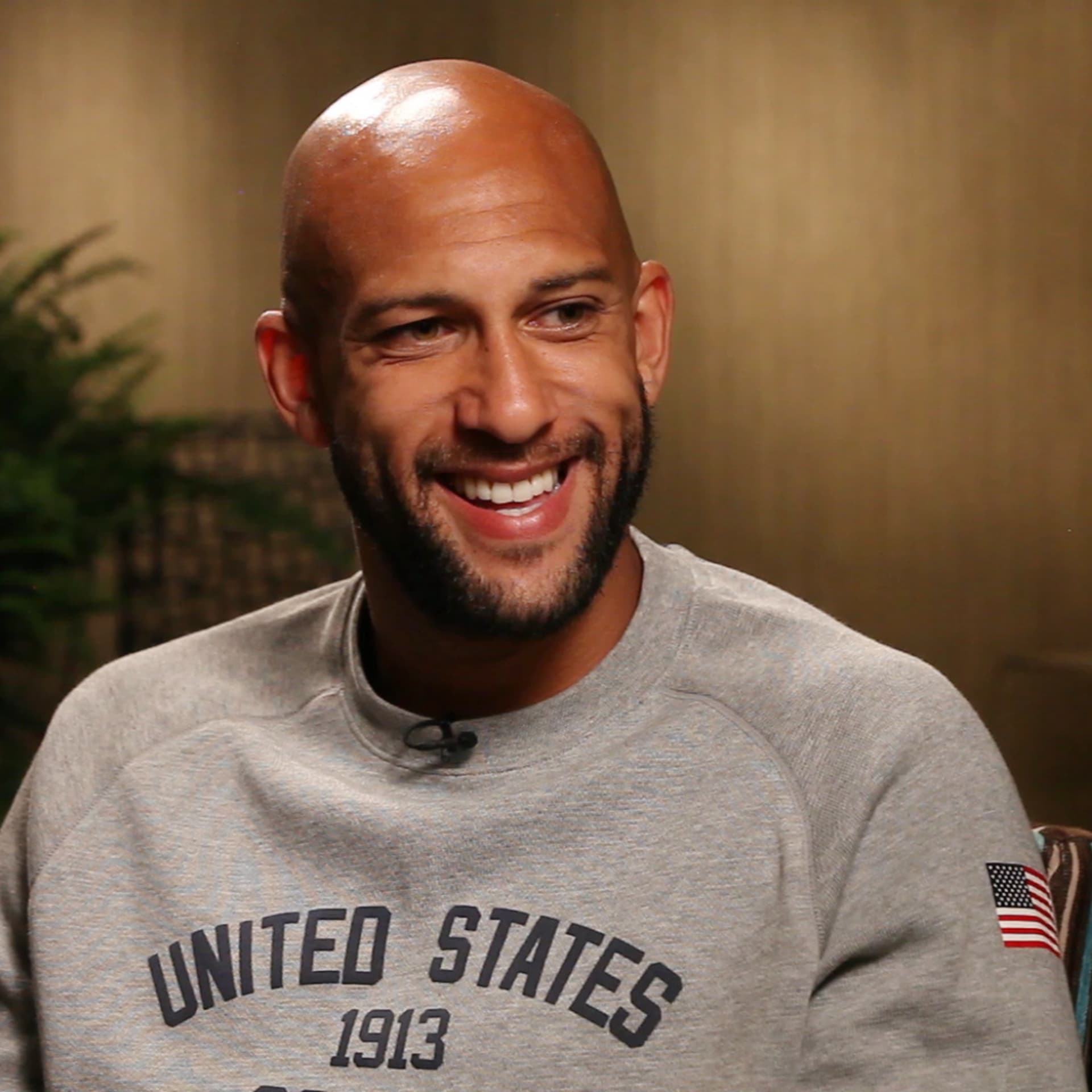

In short
Tim Howard discusses his life and career as the U.S. men’s national team’s most capped goalkeeper, connecting his Tourette’s syndrome, upbringing, and experiences at Manchester United and the World Cup to broader views on soccer in America and elite performance.
Guests
Tim Howard is the main guest. The host is Bill Simmons (mentioned as “Bill from the Bill Simmons podcast”). Other named figures include Howard’s mother Esther (interviewed previously), his longtime friend/former coach Tim Mulqueen (goalkeeping camp co-director), and coaches Tim Mulqueen and David Moyes; no additional co-guests are clearly present in the transcript.
Key claims
Tourette’s symptoms peak in the 24 hours before matches; he avoids medication because he “likes who I am.” He says goalkeeping is a mentally challenging position that often peaks in the 30s. He calls the World Cup the highest possible achievement for international players. He argues U.S. soccer popularity is held back by competition for attention and youth costs.
Notable examples
immigrating family history from Budapest (POW camp stories); saving $10 Mexico per diem; Manchester United signing call in 2003 and rapid contract in mid-2003; British tabloid headlines; Manchester United “business” lesson after early success; Everton confidence under David Moyes; hiding Tourette’s until becoming a starter at MetroStars/Red Bulls.
Written by AI. May contain mistakes. Listen to the episode to check what was said.
Chapters
Tap a time to open that second in VOIntroduction to Tim Howard
0:32 to 0:54
Tim Howard, U.S. soccer icon, discusses his experiences and contributions.
“As the official beer sponsor of the FIFA World Cup 26, Michelob Ultra is giving away$1 million worth of FIFA World Cup 26 tickets and prizes.”
Introduction to Tim Howard
0:57 to 1:30
Tim Howard, U.S. soccer icon, discusses his experiences and contributions.
“for free entry, entry deadlines, prizes, and details.”
Tim Howard's Family Background
1:30 to 2:36
Howard reflects on his family's immigration history and upbringing.
“It was something I wanted to suppress and I wanted to hide.”
Financial Challenges Growing Up
2:36 to 4:32
Howard shares insights about the financial struggles his family faced.
“You know, we'd probably stay at his house, my grandparents' house, once a week.”
The Impact of Humble Beginnings
4:32 to 7:03
Howard discusses how growing up with limited resources shaped his character.
“And we saw how hard my mom worked because she wouldn't get home.”
Early Love for Soccer
7:03 to 8:45
Howard explains his journey into soccer as an outlet for his energy.
“And again, as much as we struggled, quote, unquote, you know, that struggle was really on my mom.”
Sacrifices for Soccer Dreams
8:45 to 10:30
Howard reflects on the personal sacrifices made in pursuit of soccer.
“So it was something I could do all year round.”
Sacrifices for Soccer Dreams
10:56 to 11:22
Howard reflects on the personal sacrifices made in pursuit of soccer.
“Because Quaker's coming in hot with morning nutrition.”
Sacrifices for Soccer Dreams
11:26 to 11:53
Howard reflects on the personal sacrifices made in pursuit of soccer.
“Build your own multi-view, choose up to three streams and follow player spotlights.”
Soccer's Popularity in the U.S.
11:53 to 14:01
Howard discusses the challenges of soccer's popularity in America compared to other countries.
“I love him, and he's the co-director of my goalkeeper camp.”
Show all 32 chapters
Encouraging Youth to Choose Soccer
14:01 to 16:45
Learn how to inspire young athletes to take up soccer.
“They're just in the NFL and maybe not that many in baseball, but basketball and hockey.”
The Call from Manchester United
16:45 to 18:59
Discover Tim Howard's unforgettable call from Manchester United.
“I was in national team training camp in January, the annual January training camp.”
Adjusting to Fame in England
18:59 to 21:08
Understand the shift in popularity when moving to England.
“How did it change in terms of anonymity?”
Mental Focus as a Goalkeeper
21:08 to 22:37
Explore how goalkeepers maintain focus during games.
“and everything else is kind of a peripheral blur.”
Peak Performance for Goalkeepers
22:37 to 24:52
Learn why goalkeepers peak later in their careers.
“And then in the game, something that I think, what I perceived to be something, you know, made me clue into another way.”
The Role of Emotion in Goalkeeping
24:52 to 26:18
Examine how emotion and presence affect a goalkeeper's leadership.
“The point is that prior to that, as you're learning, there's this small little uneasy feeling that something may happen that you're unsure about that you're not capable of handling.”
The Intensity of Game Day
26:18 to 28:00
Understand the pressures and challenges during a match.
“and sometimes the crowd gets on your back, and if everyone's body language is really calm, even if someone made a mistake, it's really calm.”
Understanding Tourette's and Personal Identity
28:00 to 30:00
Tim Howard shares his relationship with Tourette's and how it shapes his identity.
“And you have to, it's like a puzzle you have to figure out.”
Understanding Tourette's and Personal Identity
30:05 to 30:58
Tim Howard shares his relationship with Tourette's and how it shapes his identity.
“And we're live from the living room As Doug eyes up the matchday spread He's reaching for the Buffalo wing Perfect Hang on, what's this?”
Childhood Experiences with Tourette's
31:06 to 36:50
Tim recalls specific childhood behaviors related to his Tourette's symptoms.
“She said you'd come in from outside having to go to the bathroom.”
Lessons from Manchester United
36:50 to 41:13
Tim discusses the challenges and lessons learned during his time at Manchester United.
“It was such a whirlwind, so something was going on, that I never picked up the paper when I was in Manchester for my signing and saw the headlines, and people showed it to me.”
Future Aspirations in Soccer
41:13 to 42:00
Tim expresses his desire to remain involved in soccer and his interest in television.
“I played for David Moyes for seven years, hundreds of games.”
Transitioning to Television
42:00 to 43:10
Tim Howard discusses his recent experiences in television and how it excites him.
“It's given me so much, probably more than I could ever give back to it.”
Landon Donovan's Roster Exclusion
43:10 to 45:20
Howard shares his thoughts on Landon Donovan being left off the national team roster.
“You know, before I go on camera, I get very nervous, which is a very similar feeling for an athlete that you get before a game.”
Coach Klinsmann's Challenges
45:20 to 47:50
Howard analyzes the challenges faced by Coach Klinsmann with the national team.
“I mean, you also, though, have a very unique perspective and insight on how to handle something like that as well.”
Comparing Coaching Styles
47:50 to 49:59
A comparison of coaching styles between Klinsmann and previous coach Bob Bradley.
“Well, I think in general his style of coaching is to change a lot of things.”
The Significance of the World Cup
49:59 to 52:37
Howard reflects on the importance and challenges of the World Cup.
“doing lots of different things to gain that edge.”
Memorable World Cup Moments
52:37 to 54:01
Tim shares his favorite World Cup memory and its significance to him.
“Get through the group and then see who we face and stand toe-to-toe and see what happens.”
Faith and Personal Beliefs
54:01 to 54:50
Howard discusses the role of faith in his life and its impact on him.
“And that goal is regarded as the most famous goal now in U.S.”
Concussion Awareness in Soccer
54:50 to 56:00
Howard talks about the differences in concussion protocols between Europe and the U.S.
“Why do you think concussions are viewed so much differently in Europe than they are here in the States now with all the precautions that are being put in place?”
Exploring the Art of Tattoos
56:00 to 58:01
Tim Howard discusses his passion for tattoos and the creative process behind them.
“What's, your mom said something interesting when I was talking to her about this.”
Exploring the Art of Tattoos
58:22 to 59:10
Tim Howard discusses his passion for tattoos and the creative process behind them.
“It can help you with practically anything on the web, like restoring a vintage motorcycle from a 50-page restoration block, or finally break down that long article you've had open for weeks.”
Transcript
Automatic transcript. May contain errors.0:00We are live from Fetty's house. Guests are gathering around the TV, even with a big storm outside. Are we worried about the fee? Nope, they have Xfinity Wi-Fi. Get reliable fiber-powered gig Wi-Fi with Peacock included to stream the beautiful game this summer. Xfinity, imagine that. Restrictions apply. New gig internet customers only. Actual speeds vary. Offer for Peacock Premium with ads currently at$10.99 a month value and limited to Xfinity internet members with newer upgraded gig speed or faster service. Activation required to access content. Peacock must be activated within first 90 days.
0:24Management of existing subscriptions may be required to avoid multiple subscriptions and duplicate charges. Third-party built subscriptions continue until canceled. Hey, it's Bill from the Bill Simmons podcast. FIFA World Cup 26 fans, listen up. As the official beer sponsor of the FIFA World Cup 26, Michelob Ultra is giving away$1 million worth of FIFA World Cup 26 tickets and prizes. Enter now at MichelobUltra.com slash superior access slash FIFA World Cup 26. Michelob Ultra FIFA World Cup 26, superior access, no purchase necessary. Open U.S. Residence 21 Plus begins on December 1st, 2025, ends on July 31st, 2026, multiple entry periods.
0:54Visit www.micelobUltra.com slash superior access slash FIFA World Cup 26 for free entry, entry deadlines, prizes, and details. This week on the In-Depth Podcast, Tim Howard, the most capped goalkeeper in U.S. men's national team history, has stayed close to the game of soccer since retiring in 2019. Howard's the minority owner for the USL team in Memphis, along with the international ambassador for his former club team, Everton. When we caught up in 2014, Howard talked about the importance of the World Cup. For me, for any international player, that's the top. You can't get higher than that. And opened up about dealing with Tourette's syndrome that's plagued him since childhood.
1:32It was something I wanted to suppress and I wanted to hide. And, you know, maybe I wasn't brave enough at the time. Howard says symptoms would reach their peak right before games. My tics and twitches will become heightened more often. I can feel the tenseness in my muscles. But that he wouldn't change a thing. You said before, if I woke up tomorrow without Tourette's, I wouldn't know what to do with myself. Why not? Up first, we discuss Howard's frugal upbringing and the sacrifices his mom made to keep him humble. I wanted to start off with this because I thought this was interesting when I was talking to your mother, Esther, yesterday.
2:11She talked about how back, you know, before you were even born, your mother and your grandparents immigrated to the U.S. in 1956. They left Budapest. And she was telling me just kind of the danger involved with that. So what was, like, what do you know about, you know, that time? Well, growing up, you know, my grandfather was amazing. He was probably the greatest man I've ever known. And he used to tell my brother and I, like, bedtime stories. You know, we'd probably stay at his house, my grandparents' house, once a week. We'd always tell him stories, and he'd tell stories about being in POW camp and being in the military and all the different things.
2:48And he'd oftentimes tell us family stories about how they escaped and what it was like and when they decided to go. And yeah, it was quite, I'm obviously a kid, so it was like a story. You know, it was entertaining. But as you got older, you went, wow, that was real. That was my mom and my grandmom and granddad and uncle. So kind of special. When your family came to the U.S. for the first time, how much did they actually have? Not a lot. You know, they were immigrants and they were trying to make a better life. and even though they realized that they would have next to nothing, they also realized the opportunity that America presented.
3:26So, and they worked hard for it. You know, by the time my grandparents passed away, they had lived a very full life and a rich life. And so, you know, basically the American dream as we know it. Your parents got divorced when you were three years old. Your mother had to work several jobs just to make ends meet. How tight were things financially when you were growing up? Well, very, you know. I think we knew it at the time. You did? Yeah, as much as you can know as a kid. But my mom did an amazing job of allowing us to have a good childhood. When my brother and I look back, I think we had a tremendous childhood.
4:11You know, we had the typical American upbringing as we knew it. You know, we never had holes in our sneakers. And, you know, we had enough food on the table, barely. But, you know, there was times when we'd get up and, you know, the pilots on the stove would be on because that was the heat. And the kitchen would be warm and the rest of the house would be cold. We were trying to save money, you know. And we were latchkey kids. And we saw how hard my mom worked because she wouldn't get home. You know, we'd go off to school. She'd get home at 5, 6, 7 o 'clock. and there are certain periods throughout our childhood that she'd take up two jobs, but, you know, she's a very strong one.
4:48What were some of the things that stuck out back then that made you realize you guys might not have had as much money as some of, you know, your classmates?
5:00Probably lots of minute macaroni and cheese and beans and franks for dinner a lot of times. And, you know, I think we grew up in a pretty cool town in North Brunswick because you have, you know, socioeconomically, you had the haves and the have-nots. And when it came to sports, it was always funny because my brother and I played sports, a lot of sports. And there were kids on the team whose parents drive nice cars and lived in nice houses. And when you went for sleepovers, it wasn't a one-bedroom apartment like we lived in, which my mom made into three bedrooms somehow. You know, and there was big houses.
5:35And so you kind of knew that there was a difference. But like I said, we had a great, great upbringing. How did she make the one bedroom into three bedrooms? So that was back when like one bedroom apartments had basements. And we had a basement. My grandfather came over and put like plywood and sheetrock up. And that was the basement was a bedroom. And then when I got too old to share a bedroom with my brother, we took the dining room and we made it into a bedroom. So that was the three. Do you recall the Mexico national team story where you were given$10 per diem? Yeah, that was, gosh. When I was a kid, I think my first trip was when we got per diem.
6:18I'm sure she told it better. I vaguely remember it. She said that kids were going to Mexico with the national team, and everybody was given$10 per diem, which obviously isn't a lot for a trip like that. So all the parents, you know, gave their kids extra money to spend while they were there. And you obviously weren't able to get the extra money. And not only did you not spend the$10 per diem while you were down there, but you saved it to come back and be able to, I guess, buy clothes for yourself. Yeah, I mean, you know, back then money was obviously, we didn't have a lot of pocket money. So when my brother and I got it, we didn't, we held on to it.
7:00you know, tightly, and we spent it wisely. How do you think the financial issues growing up helped in shaping you? I think it humbles you. I think humility is important. And again, as much as we struggled, quote, unquote, you know, that struggle was really on my mom. She didn't allow it to spill over to us. So, you know, I think I, for me anyway, I appreciate what I have, you know, And I think that's a special gift because not a lot of people can say that. Why soccer? I don't know. I wish it was basketball. You were a heck of a basketball player as well. You beat the former Bulls player Jason Williams in a game.
7:44Yeah, he was amazing. Jersey produces a lot of talent. And I came up in a time when everybody came to Washington, New Jersey, tournament of champions. And, yeah, I love basketball. That's my first love. Still is. But soccer was something that was just, I was allowed to get all my energy out and run around and, you know, chase. I was fast. I was, I was, I was basically my son now. I watch him on the soccer field with my daughter and they run past kids and, you know, they don't really know much about soccer, but they have the athletic ability. So that was just a release. You know, my parents put me in, in soccer because I was hyperactive and I needed an outlet.
8:20And that was, that was a start of sports for me at, I think, age six. Were you noticeably better in soccer than the other sports? Yeah, I enjoyed it a lot. I played baseball, basketball, and soccer, and it just kind of stuck. I think the cool thing about soccer in New Jersey or on the East Coast, it's a fall and a spring sport. It kind of goes into summer as well. So I almost played all year round with indoor mixed in. Back then we used to play in gyms. There was no AstroTurf. So it was something I could do all year round. I think that's where the passion, as much as I love basketball, it was like three months.
8:53And soccer was pretty much all year round for me. So I know your mom says you didn't do all that well academically when you were growing up. So you caused her many sleepless nights because of that. And then I guess, you know, the Tourette's as well. But, you know, she was talking about how she just, you know, was concerned for future career prospects. But soccer seemed like, you know, a good opportunity should, you know, your talent allow it. But what sacrifices do you think you had to make growing up in pursuit of your dreams?
9:32You know, I think anybody who plays on a national team, youth national team's coming up, and it's an odd sport in the way the season's run. And for me, you just missed a lot of things as a kid, you know? High school dances, time with friends, different things like that, which seems a small sacrifice now where I'm sitting. But at the time, when you're a kid, those are important things. You know, and so it ended up for me every now and again would boil over and I'd say, you know, the heck with this soccer thing. I want to be with my friends. And I think that's when my mom would, her eyes would open really big.
10:06I'm like, no, you know, you need to be able to play soccer and make something of yourself. So I'm glad she, you know, she kept pushing me and kept me on the right path. You ever come close to quitting? Not that I can remember. I'm sure there were times where I didn't want to keep going. And, you know, again, probably out of the fact that my friends were in college having fun and I was away on these crazy, silly trips at the time. I thought, what crazy, silly trips to all these different countries and, you know, what the heck am I doing? But I'm sure she'll tell you I was on the verge of it. But, you know, looking back, I can't ever remember being too, too bad.
10:43The regional and state youth championships. Explain why you guys would actually play for penalty kicks. Do you hear that? Sounds like breakfast is ready. Because Quaker's coming in hot with morning nutrition. 100 % whole grain oats and a good source of fiber to fuel the rhythm of your morning and kickstart your day. And that sounds absolutely delicious. Fuel to start whatever's next. Quaker, official sponsor of FIFA World Cup 26. I-O, let's go! This episode is brought to you by Fox one. Watch all 104 matches of the FIFA world cup live in 4k for just$19.99 a month with three days free. Build your own multi-view, choose up to three streams and follow player spotlights.
11:38Stay on top of every moment with live stats, highlights and instant replays. The FIFA world cup streaming live on Fox one offers a subject to change. See Fox.com for complete terms and conditions. Well, I had his coach, Tim Mulquinn, who's a dear friend. I love him, and he's the co-director of my goalkeeper camp. And he used to coach us. He was wild and crazy back then. So he's toned it down a bit. I was good at penalty kicks. Like I said, I was athletic and explosive at that age, and I had a good penalty save record. So I think Coach Mulquinn at the time was what we called him. He used to just play for penalties and pack it in and see out overtime and we'd win in penalties.
12:24How would you describe the difference in popularity of soccer, U.S. relative to internationally? You know, I think the trouble with American soccer is it's not soccer itself. It's such a big country. You know, you're talking about a sport that's relatively in its infancy. I know we've played it a while and the league is 20 years old now, which is crazy to think, or something like that. But these other sports have been around for forever. And, you know, when you look at soccer, it's competing from a popularity standpoint at, like, number four, number five, maybe trying to compete with hockey, you know?
13:03Whereas, you know, in England, it's the number one. It's the only sport. It's a country the size of Texas, maybe smaller. And it's the only sport. It's, you know, everyone, men, women, kids, grandparents, everyone knows about football, something about it. Okay, they have cricket and they have rugby, but not even close. Those are a distant second and third. So it's the national sport. It's the blood and the lifeline of English people, of Italians, of the French, of the Germans, of the Spanish. It's everything. The cities and towns and villages in the country stops. And it's hard from a popularity standpoint to compete when soccer is not our number one sport, when we have such a big country, the allegiances aren't as tight as some of the other sports.
13:51Because we may lack the talent in soccer players right now, but it's not as if we lack the quality athletes. They're just in the NFL and maybe not that many in baseball, but basketball and hockey. So how do you get some of the other best athletes as they're growing up? How do you encourage them to pick soccer? Yeah, it's a big question. I think soccer at a youth level is very, very popular. It's one of the most popular youth sports. You know, I think America, you know, as individual teams, as a league, as a country, as a federation, you know, we need to get into the inner cities more. You know, we need to get into the black communities, the Latino communities.
14:47You know, we need to have, I think when you grow up as a kid, you want to be who you see. You know, I saw Michael Jordan on television. He was on all the commercials. I saw him on TV. You know, now we're starting to see soccer players on TV because it's cool. It's in fashion. But when I was growing up, we didn't have that. And I think that's how you get into kids' faces. You see Clint Dempsey scoring a bicycle kick on TV, and all of a sudden the kid says, that's who I want to be. I want to go to those games. And that's how someone becomes your idol, not blindly. You have to see. It has to be in your face.
15:25How much do you think it has to do with the lack of money in the sport in the U.S. compared to the other big leagues? I mean, I think it's a poor excuse only because if you look at what basketball is and sandlot football and all the sports we know, you just get a ball and you play with your friends. You know, when I'm in England, I'm in Manchester or Liverpool, you know, kids come home from school, they get their little clip-on ties, they put them on the floor and make goals and they play. And they play in their school clothes until the streetlights come on. That's not a cliche. That's what happens.
15:57That happens even now. In America, we think of the sport as having to have soccer moms and jugs of sports drinks and all the uniforms paid for. It's too much. There's almost too much money involved in the youth side of the game, if that makes sense. Because when you look at soccer, it costs a fortune for a kid to go to the tournament, pay the dues, you know. Right. LeBron James didn't have that. He just got a ball and played with his friends, and that's how he became great. So you're in your early 20s. you're playing for the New York Metro Stars, now the New York Red Bulls, and you end up getting a call from the Manchester United goalkeeping coach telling you the club is interested in your services.
16:36Is it true when you get that call? I mean, basically, you say, if not another thing happens, I could live on this the rest of my life. For sure. I remember it. I remember it clear as day. I was in national team training camp in January, the annual January training camp. It It must have been 2003. I might get my years wrong, but I think it was 2003. In the January camp, we were in Bradenton, Florida, and I got a call. I had never seen the number before, and I picked it up. It was him. And it was almost Mission Impossible style. Like, there wasn't much of a conversation. He didn't need a call back.
17:09He was just saying, look, we're following you. There's nothing you can do. Just keep playing. Try to play well. And, you know, we're excited at the prospect of continuing to follow you and hopefully making something happen. That was it. What do you do when you hang up from a call like that? Tell a lot of people. Tell my friends and family and just put a smile on my face and boosted my ego. It actually spurred me on because that was the beginning of a new season, so I was excited. And to give this some context, Manchester United is probably the single most storied and popular team in all of sport.
17:48Yeah. So how long was it before you actually ended up getting signed? Well, that was in January. And then we had, there might have been another point of contact at some time. I don't remember. But in May, we played Mexico. And we played Mexico in Houston. And that same goalkeeper coach had called myself and my agent and said that he was going to fly over for the game, to watch the game and to meet with me briefly. We played, well, I think the game game was 0-0 and then that was it basically they got the ball rolling I saw what they needed to see and then it happened so very quickly after that I mean by June or July I was signed I was on a plane signed the contract coming back over packing up my stuff and not that I had much stuff at that time and then I met up with the team for preseason.
18:37So in terms of your popularity then I mean and I guess the state of the MLS at that point anyways, you basically, you could walk down the street, go completely unrecognized. When you get off the plane in Europe, how quickly did you realize things have changed? I kind of knew that my world was going to change, you know, how much and exactly how, I wasn't sure, but I was, I think I was, I was preparing myself for like, okay, things are going to change in a big way. How did it change in terms of anonymity? Yeah, you know, I think that basically everyone, without even having played a game, everyone knew who I was.
19:14You know, in Manchester, at the restaurants, at the stadium for press day and all the rest of it, people just, people know who football players are, soccer players are in England. And so, again, without having even kicked the ball, you know, there's so many more people knew my name than even they did in New Jersey. I know your very first game in the MLS, Giants Stadium versus Colorado, was particularly significant for you. But then also your mom, she told me she almost fainted the first time she saw you on the field. Your longtime friend and former coach, Tim McQueen, talked about how nervous he was just leading up to that game.
19:51But I wonder how that compares to your first game with Manchester United. Yeah, very similar feelings. You know, kind of trying to keep my head above water in the Colorado game, not having played before, just trying to keep it simple and make a few saves and stay out of the headlines. And my first game for Manchester United was no different. Same butterflies, same nervousness, you know, questions of whether I could compete at that level. Again, another step up. Keeping it simple, trying to make saves, you know, it didn't change. But my mom, she'll get nervous on this weekend. So, you know, I've played 600 games and nothing's changed, which is kind of funny.
20:38How hostile will fans get behind the goal? In England, very. Lately in what ways? They're just passionate about their team and they say lots of things. It's usually negative things I probably can't say on camera, but it's not just at me. I mean, as long as you're an opposing player on an opposing team, you're going to get heck, really. How much are you able to block it at? Yeah, now it's, for me, it's no problem now. I've played that many games where, you know, you get hyper-focused on the task at hand, and everything else is kind of a peripheral blur. But you have said it's nearly impossible to stay focused for an entire 90-minute game.
21:17So what will you think about at times? Oh, anything and everything. You know, I've found a really good way over the years to kind of adapt to staying focused for long periods of time. And I think about anything, really. You know, anything that pops into my head, it doesn't last very long. It's a fleeting thought. You've got to pick up the dry cleaning. Yeah, anything. You know, what am I doing next week? Or something funny that a guy said before the game or all sorts of crazy stuff. You ever catch yourself daydreaming? Again, if I do, it's a very fleeting passing thought because I have the ability now after so long to be able to stay focused.
22:01When an opposing player is approaching, you know, getting ready to take a shot on goal, what are you looking for? Nothing. It's all instinct at that point. You see it so many times. That's why goalkeepers get better as they get older. You see it so many times, you know, thousands of times, tens of thousands of times. You see a shooter, you see his body language. you're just you're just reading the moment I'm not really looking I I can tell you what I'm looking for now but in that moment I'm not actually thinking you know I'm just trying to read his body shape if there's an approaching defender where the defenders come from that's going to help me get my angles better little things like that but it's all instinctual how do you decide which way to dive during a penalty kick oh I don't know I think sometimes you have a feeling about a guy or maybe you've seen him, you know, you watch highlights during the season, like any other sport, and you see, oh, maybe he's gone right or maybe he's gone left.
23:00But I've had that in my head. And then in the game, something that I think, what I perceived to be something, you know, made me clue into another way. And I changed direction. Sometimes I get it right. Sometimes I get it wrong. It's a crapshoot, really. How much video will you watch and how does that actually help? I think that's kind of been overplayed. I mean, there was a goalkeeper a couple of years ago who watched video and then with all the technology and all the different tablets, you could watch it, you know, live right before the game. I don't know. I don't know how many people study it because I think if, I think if that was foolproof, goalkeepers would start saving a lot more and really our percentages are still down.
23:38So yeah, not a ton. Okay. Got it. And you may mention this, may mention this a little earlier, You're goalkeepers peaking a little later on in their career. Most professional athletes, it seems, mid-20s, they're at the height of their performance ability, yet with goalkeepers it is 30s, even mid-30s. Why do you think that is? I just think we don't have a lot of as demanding of a position as it is physically. We don't have a lot of miles on our legs. We don't do all the running. and it's a very mentally challenging position. I think you mature and you get older and, as I talked about, you gain experience on actual match day shooters and the way they like to dribble around you or shoot.
24:27You learn all these things and you pick them up. And you said you feel you're at your peak now. Why? Just don't seem to be phased anymore. You know, I'm at a place now where, you know, there's nothing that I haven't seen now. You know, when I cross the line and the whistle blows, I'm prepared for everything. It doesn't mean that I'm perfect or that I don't get scored on. That's not the point. The point is that prior to that, as you're learning, there's this small little uneasy feeling that something may happen that you're unsure about that you're not capable of handling. Now that I've gotten older, I pretty much know that I'm not going to face anything on that day that I'm not prepared for.
25:09You said on the field you're an actor. Mm-hmm. And that's really just used to motivate people. Explain what you mean by that. Well, I think any time you see a picture of me or any highlight, I'm yelling at somebody, you know? Well, it's funny because I watch these TV interviews you do and you're like very like monotone and calm. And then out on the field, I'm getting a little emotion from you now, which is good. But out on the field, you're like, I mean. You have to be, you know, from the goalkeeping position, the goalkeeper's a leader. The goalkeeper sees everything. You know, we have the best perspective on the field because there's nothing behind us.
25:41There's no one running on the left or right of us. Everything's in front of us. And so you need to be a voice. You need to be kind of the coach and the leader. And you have to be the one pulling the reins, almost like a puppeteer. And, you know, when you tell, I say it's an act because you have to, your presence has got to mimic the flow of the game. And sometimes, you know, when I scream and shout, it's only to, it's only for effect. You know, if I think a guy is lethargic and not pulling his weight, I need to say something that's going to get an immediate reaction. You know, and I think as players on the field, you have fans and they have opinions and they see certain things.
Read the full transcript
26:19and sometimes the crowd gets on your back, and if everyone's body language is really calm, even if someone made a mistake, it's really calm. It just kind of gives a very easy feeling, where if the crowd starts to get on top of you and you're shouting at each other, it makes for a very uneasy emotional time. But you weren't able to get on as your defenders as much 10 years ago as you are now, right? No. I mean, because you just didn't have the... Clout. Right. Yeah, I mean, you earned that. You earn that by playing games, by playing well. You earn that by giving respect. As much as you want to sometimes yell and scream and point guys in the right direction, you have to give them respect.
27:01And to be honest, 75 % of the things I'm saying out there is positive feedback. Just don't. Well, right. So how much do you get on your defenders when they mess up? Depends on how much they need getting on, you know. Everybody's different. Some defenders will slip up and they'll hold their hand up and say, gosh, my fault. And other times, a guy's head's in the clouds and doesn't know he messed up. Listen, I messed up too, so I'm happy for guys to get on me. You've commented before, and I was shocked when I read this, I don't enjoy the game. I've never actually had fun within the course of those 90 minutes.
27:36Yeah, definitely. Why not? It's too intense. It's too emotional. I think I enjoy the buildup to it sometimes. Definitely enjoy the feeling afterwards of putting in a hard day's work, and hopefully if you got the right result, that means there's a bunch of things that went really well. I enjoy that. There's too much pressure on the game. It's work. It's a highly intensive chess match, physical as well. And you have to, it's like a puzzle you have to figure out. Until you figure it out, it's not much fun. It's too intense because even if you make a play, the athlete in all of us, the pessimist in all of us knows there's still time on the clock.
28:17There's still time for the other team to do something great. And until that's finished, there's not enough time to enjoy it. Why do you play if you don't enjoy it? Well, I do. I enjoy the buildup to it. And I enjoy the afters. Don't enjoy that 90 minutes. Got it. Okay. You said before, if I woke up tomorrow without Tourette's, I wouldn't know what to do with myself. Why not? I don't know. It's who I am. I like who I am. I've had success in my professional life. I've got the greatest friends that anybody can have. I've got two amazing children. I've got a great family. So I don't know. Life is good, and this is the only life I know.
29:02So I don't know. I like who I am, and it's part of my personality. Going back to when you were a child, your mother, Esther, told me it seemed like the symptoms, to her at least, developed over the course of like a day. What do you recall from the first time you really felt like something was wrong? Which happens a lot. You hear that from so many parents. All of a sudden, boom. It probably didn't happen overnight because the kid probably recognized it and tried to hide it. But eventually, it starts to get into motion. It's like, wow, when did that happen? I don't know. I can't put an exact moment, but I remember some sort of head movement or eye movement or twitch and it happened.
29:48I did it a lot and it was weird and it was odd. You know, I remember a lot of OCD, a lot of counting, a lot of touching, a lot of things like that, you know. Again, which just felt probably not normal. They became normal pretty quickly, but it didn't feel normal at the time. And we're live from the living room As Doug eyes up the matchday spread He's reaching for the Buffalo wing Perfect Hang on, what's this? Oh, he's going for a can of Pepsi too Incredible What a finish Sensational combination Look at the delight on his face There's no doubt about it It just tastes better Matchdays deserve Pepsi Food deserves Pepsi Grab a pack of Pepsi Zero Sugar For today's match It's poetry in motion.
30:35Study and play. Come together on a Windows 11 PC. And for a limited time, college students get the best of both worlds. Get the Unreal College Deal. Everything you need to study and play with select Windows 11 PCs. Eligible students get a year of Microsoft 365 Premium and a year of Xbox Game Pass Ultimate with a custom color Xbox wireless controller. Learn more at windows.com slash student offer. While supplies last, ends June 30th. Terms at aka.ms slash college PC. Well, it's interesting you bring that up because your mom gave me a few examples of that. She said you'd come in from outside having to go to the bathroom.
31:14The bathroom was on the far end of the apartment. Before you'd go to the bathroom, there'd be certain things every time in the room that you had to touch. Or before you would talk to your mom, you had to tap her three times on the shoulder. That was a funny one, yeah. And she also said you just could not for the life of you bear to throw anything away. Mm-hmm. In all of those instances, like, what are you thinking about that, you know, would make you act that way? I don't know. I don't think I was thinking. It was just natural. That's what my mind was wanting to do, you know. So, obviously, there were some pretty funny moments in there, you know.
31:53Was it funny at the time, though? I mean, did you realize something? Yeah, I realized. But my mom was great, you know, stuff like that. she just didn't she did her research on it she she found out stuff but she just let me be me you know and which was which was great so it wasn't like anyone called me on it you know it was just just some weird stuff that i was doing what do you recall for finding out for the first time that you did have tourette's nothing no nothing nothing that was like brimstone and fire it was just you know i think somebody some doctor some professional put a name to what i was doing but it wasn't like, for my mom, it was a huge aha moment, you know, like, okay, finally, we kind of figured out what this is, but for me, I was just a kid, you know, I was a kid who was about to be a teenager, and, you know, I was into girls and sports and my friends, and the fact that what was going on had a name didn't really faze me, it wasn't something I spent a lot of time thinking about.
32:50How did it affect your sleep? I think it still affects my sleep, I'm not a very good sleeper, you know. How will it affect it? I just don't really sleep through the night much. Most athletes don't, but yeah, I don't know. Just a very interrupted sleep. How often will you wake up, or how much sleep do you think you get in the average night? I get some good sleep. I make sure of it now. I don't know. Maybe every few hours I'll wake up and roll over, but probably when I was first diagnosed with her or the onset of TS, probably a lot more. Yeah. Not a great sleeper. Yeah. After you were diagnosed, you go to a clinical psychologist in Connecticut or in Princeton.
33:34Princeton. Yes. What did, how did that help? You know, she, I think her name was Dr. Hollander, actually. She gave me forms of, you know, very low level forms of meditation and just kind of trying to calm me down before sleep. So in those brief moments before I climbed into bed, just doing some, like I said, low-level meditation to try and bring some calmness over me before I got into my sleep cycle. And to what extent does that help? I think it helps. I think meditation helps. I'm not sure I do it enough. It does help, but... You still do it? I wish I did it more. I have a good friend who's into meditation, and I always tell him, you've got to teach me, but he's like, you don't really want to learn.
34:20I said, yeah, not really. When are symptoms generally the worst? Usually right before a game, you know, so that's 24 hours before a match. They're very, very intense. And what will happen?
34:37Just get super tense, you know. like my tics and twitches will become heightened more often. I can feel the tenseness in my muscles, and it's normal to me now. Why not take medication for it? I know that's something you've avoided forever. You know what? Ages and ages ago when I was probably a young teenager or just before, we spoke to, my mom and I spoke to a doctor, I think, in New York, And, you know, unfortunately, quite a lot of medical professionals don't have it right yet. It's just a concoction of drugs for other ailments. And they kind of, you know, take that for a few months, see how it works.
35:24Lower dosage, lessen the dosage, change the medicine. And at the time, the doctor had said, well, you know, it'll kind of make you drowsy. It'll make you zombie-like. And I just said, even then, I said, I like who I am. I've got great friends. You know, they don't make fun of me. And I don't need to change anything. You know, that was, again, I was a young teenager. But I didn't want to, or maybe I was in my mid-teens. I didn't want to not be who I was. But it is interesting you mentioned that. Because for a while, you did apparently try to hide it from, like, friends, family. Later on, the teammates impressed.
35:59Why did you feel compelled to do that? I think I wasn't very good at hiding it, you know. I think a lot of kids do. Some kids can grow two ways with TS, and I've seen it, and I don't think there's a right way. Even now when I speak to kids and they tell me their stories, some kids are just super brave and bold, and they want to, you know, look, this is what I, they've got a good family unit, and they want to tell their class, and this is who they are, and I think that's wonderful. if you feel that like I did you know it was something I wanted to suppress and I wanted to hide and you know I maybe I wasn't brave enough at the time.
36:36How did you try and hide it? I don't know I tried to be as still as I possibly could for as long as I possibly could but again I don't think it worked very well. What made you decide to open up and tell people? Again I think there was a time when I was at the Metro Stars where I was a backup goalkeeper and I became a starting goalkeeper and I don't know I think there was a I made a conscious decision that look I'm gonna be a starting goalkeeper and I'm gonna be on television more and be in the press more and people are gonna see it and so I just at that point I just thought there's no reason to to hide this anymore you know it's not gonna be of any use people are gonna see it anyway you know so and that gave me a good platform to to use to use that how well do you recall the British newspaper headlines when you first signed with Manchester United?
37:27You know what? People have... Talk about ignorant. Yeah, very ignorant. People have showed it to me. It was such a whirlwind, so something was going on, that I never picked up the paper when I was in Manchester for my signing and saw the headlines, and people showed it to me. Rightfully so, my family got upset about it, which I would too. I've got children. If that was my son or daughter or brother or whomever, I'd be pissed too, but for me it was nothing. and it was ignorant journalists writing nonsense to try and sell papers, and they still do it today. Nothing's changed. Right, and more of it, for that matter.
38:01So after your first season with Manchester United, you win Goalkeeper of the Year awards. Your second season, though, mistakes become more frequent. How amazed were you by how quickly opinion of you changed? Yeah, I think that was a surprise, but it was also part of my learning curve. But it was good. It was good for me. You know, I think the first year of Manchester United, things went flawlessly, and it was brilliant, and it was good to have. You know, but I also think life's about checks and balances, and, you know, to have a season where things didn't go my way, you know, it taught me some harsh lessons, but some invaluable lessons.
38:44What were the lessons? Well, just that I needed to improve, and I always knew I needed to improve. But again, there's a professional learning curve, and you get better, and you sink or swim. And so I needed to step up to the plate, challenge myself, get better, and learn. And I think I did that. Well, and it's interesting. Your longtime friend and former coach Tim McQueen was telling me how one of the biggest lessons you learned from that experience was that it's a business. What made that sink in? Well, I think there was a lot of people who I didn't know. in and around Manchester United that would, because I knew nothing else, I went in and had immediate success.
39:25So they sang my praises and, you know, lots of pats on the back and lots of good mornings. And then when things weren't going, so those same people who I thought were great, you know, they'd walk past me in the hallway and not say good morning, you know. So I learned very quickly that it was a business and it was a good lesson. It's interesting because you've had so much success now with learning about kind of the the trying moments that shaped you. And you end up switching teams to another team in England, Everton, in 2006. Your manager at the time was quoted as saying, since we signed Tim, he's worked to prove what happened to him at Manchester United was only a learning experience as opposed to what might have led to the downfall of his career.
40:06So I wonder, how is your confidence impacted by what happened with Manchester United? And how do you recover from that? Oh, I think, you know, I've been around, you know, I've had some amazing people in my life, my mother and Tim Mulqueen, who, you know, head down, walk straight ahead and work hard. And I think, I think hard work is, you know, a hard day's work is everything. And that's the, that's, that's the only way you get better in any walk of life is working hard and, you know, not worrying about poor me and all the rest of it, just getting better. I knew I had the talent. It was just about trying to get better each and every day, which I did.
40:42You know, I hardly ever miss a day's training. And I also had a manager in David Moyes who believed in me, you know, which, you know, to have someone who believes... You said he gave you all the confidence in the world. All the confidence in the world, yeah. I love him dearly. I think he's, you know, for me, where I was at my career, again, it was a crossroad, but whether it was big or small, I needed to move on, I needed to plan, I needed to get better. And he gave me the keys, you know. He just said, look, I want you to be my goalkeeper. I want you to play. And for a club the size of Everton, which is a big club, that was huge for me.
41:16And he always backed me. I played for David Moyes for seven years, hundreds of games. And he always backed me, always. And I love him dearly. I think he's a brilliant manager. And he was just so instrumental in my career because he gave me that belief that I needed. What interests you about working in an MLS front office? I want to stay in the game. I think as players, when you leave the game, there's different options. Coaching, doing television. And maybe that doesn't interest you anymore. I know a couple years back at least. Listen, working for a club, working in U.S. soccer, there's a bunch of things that excite me.
41:59Just being around the game. I want to be around the game. I love it. It's given me so much, probably more than I could ever give back to it. But I would like to do that. I think I have a skill set and knowledge and experience that could help certain clubs or a club. But I've been dabbling in television recently, and I've got the bug for that now. So I'm going to try and learn that trade and get better at it. How much do you like that? I love it. You do? Yeah. And in fact, I've shied away from doing stuff like that because I just didn't really think it was for me. And I got a pretty brilliant opportunity with NBC.
42:31Sure. I did it one time. I thought it was going to be a one-off. and then it ended up being eight games, and I've fallen in love with it. I've fallen in love with it because at the time when I started, I knew I wasn't going to be perfect, so there was going to be some constructive criticism. Sure. And I wasn't sure if I would take that on board or if I'd say, listen, the heck with this. I'm too busy. You know, I don't want to. And I've loved it. I've loved it. You know, I've gotten the bug where, you know, I get from Pierre Moussa, the producer, I get some serious constructive criticism. I take it on board and I get hungry for the next game to try and make it better.
43:09What do you like about actually doing it? Yeah, that's a good question. You know, I think I like the nerves. You know, before I go on camera, I get very nervous, which is a very similar feeling for an athlete that you get before a game. You know, and there's not many things in life that excite me in that way that give me nerves, that make me really need to step up to the plate and challenge myself. So I think when you find something like that, you have to hold on to it. Landon Donovan surprisingly left off the U.S. national team's roster. In your opinion, what do you think happened? Juergen didn't select them.
43:51He thought there was 23 other players suited for the job. You know, I think, unfortunately, what gets lost in the shuffle is that six other guys didn't make it either. You know, and those are dear friends of ours, and maybe they don't want to get spoken about, but they've not got talked about. And there's some guys who had real quality who helped us qualify for the World Cup. And it's part of the business. It's harsh. I know it's harsh, and I've seen it firsthand. But guys get cut. Guys move on. It's part of what this is. I mean, but he has been one of the faces of U.S. soccer, and rightfully so.
44:24How much do you think was because him and coach just did not see I die? I mean, you'd have to ask. You're in Klinsman. that I don't know. And I'm sure... Well, but you have to have a little... Yeah, I've never seen that. Landon's been a consummate professional. Right. Always has been. Right. You know, if they had arguments or beef behind closed doors, that's obviously their personal thing. We as a team never witnessed anything. So, you know, I think there's a lot of speculation. How surprised were the players to learn that Landon Donovan was going to be left off the team? I don't know. I don't think there was...
44:59I mean, there was some surprise. You know what? I think there was a surprise that quite a few of the guys were left off. You know, to be honest, there was probably four guys that guys were shocked that didn't make the team. But, you know, I think it'd be the other way. If those four were on the team and four guys who were here got left off, there'd be a surprise. That's what happens when you have to cut 30 guys down to 23. But this is Landon Donovan. I mean, you also, though, have a very unique perspective and insight on how to handle something like that as well. Because you were with Manchester United when the captain was let go.
45:31a decision that's far greater than what happened with the U.S. national team and Landon Donovan. So what do you take from that to use in talking to the national team teammates about what happened? Yeah, Roy Keane is the greatest captain in football, you know? And things don't always work out. So again, I was on a Manchester United team who was experienced and who could handle it, and they weren't rocked by it. And I think this team is the same. I think a lot more is made of it in the media than actually happened. You know, we went back out there a couple hours later and started training and preparing.
46:09You know, there was no discussion that needed to be had amongst the players. Like, hey, this is what just went on. We knew it was going to be a tough day. We knew that day was coming, that seven of our brothers, our friends, were going to get cut. Yeah, Landon was one of them, unfortunately for him. But it wasn't, I think a lot more was made of it than really actually happened. There was, you know, in reading about you, obviously you get a stack of profile stories. And there was a March 2013 sporting news story that was just kind of a scathing profile about the team state at the time. and it said a significant number of Klinsmanns, that being the current coach of the U.S.
46:52national team, Klinsmanns players believe they're not being put in a position to play well and win, and that team tactics, rhythm, and chemistry have suffered under his watch. The article, obviously, more than a year ago. But looking back, how fair do you think it was at that time? I've given up trying to figure out the media. It was a witch hunt. We had just lost a game. We tried to tell everybody, you know, when we lost down, it was in Honduras, I think, that there was still another nine games to go. We proved our worth, and, you know, I think it was just bad journalism. But, again, I wasn't there.
47:31I had a broken back, and I didn't go to those games. But I was obviously in touch with Clint and Brad Guzan and Michael Bradley. And, you know, I think it just pulled the team closer together. It was just— Really? It was one silly—well, yeah, we won. We beat Costa Rica and went down to Mexico and got a draw. So we put all that to bed and moved on. What do you think are the biggest challenges Coach Klinsman has faced?
47:56Well, I think in general his style of coaching is to change a lot of things. It's to get his ideas across and wake the players up. He talks about that all the time, putting players in environments where they have to change and adapt and survive. Maybe some of those environments are uncomfortable, but he's happy to do that because he believes in the long run that creates success. So I think, but he's ready for that challenge because he knows going in, when he shakes things up, you're going to have people who you butt heads with and guys who don't agree with it, but eventually fall into line. So there's a challenge.
48:28I think, you know, his biggest challenge was the fact that we've brought in so many Mexican-Americans, German-Americans and trying to bleed that group together to become one because our unity and our chemistry has always been our foundation, our staple. And so we've done a good job because this is a really good team, really young team, happy, hungry. Guys work for each other. But that's a challenge to do that. What are the biggest differences between Coach Klinsman and the former U.S. National Team coach, Bob Bradley? Two guys who I love to play for. I mean, they just have, you know, the tactics aren't terribly, terribly different.
49:04They're just two different individuals with different personalities. So it's hard to kind of compare them, really. So who do you like playing for more? No, I'm just kidding. Yeah. The blood tests, full-time nutritionist, yoga. What would you say is most unique about Coach Klinsman's commitment to fitness? All of it. I mean, if you look at him, he takes his shirt off and does run on a beach. He's fit for a guy his age. You guys are running around too today with heart rate monitors. Was that common previously? That's kind of a common practice in soccer nowadays. But yeah, I mean, I think he believes in getting an edge.
49:42I think he can only coach the way he played, the way he thought he was a winner. If you're a winner, you have ideas on how to win. He believes that you don't just step on the field and kick a ball, that you gain an advantage over the course of time doing all the right things, doing lots of different things to gain that edge. The World Cup, obviously the largest athletic event on the globe. more than a billion people watch the World Cup on television live. What does the World Cup mean to you? For me, for any international player, if that's the top, you can't get higher than that. Obviously, in club soccer, you can do some amazing things, but I think anybody will tell you, if you do it on the world stage at the World Cup level, it's the top.
50:28It's the best players. It's the best teams in the world. If you're talking about a measuring stick, that's it, and you'll be remembered forever. Good or bad, you'll be remembered forever. So the U.S. faces Ghana, Portugal, Germany in the draw, all powerhouses. To somebody who doesn't know a lot about the World Cup teams and how the tournament works, how would you explain the challenge that presents? It's a big one. You know, it's a big one. I think any time you play in a World Cup, you're going to be challenged. You know, I don't think you get to a World Cup and expect a cakewalk. So, you know, the fact that we got a tough group, it's no surprise.
51:11I mean, I think any group that the U.S. was in was going to be really tough. So, but again, you look at a team like Germany, probably a team who has a good chance of getting to a final. You know, Portugal has the world's best player. Cristiano Ronaldo, right. So, you know, that explains the group all by itself. I mean, it could have been a little easier draw. Pundits have called Team USA's draw the group of debt. Team USA has to finish in the top two to advance. Why do you believe the U.S. is fielding its strongest team ever? You know, I've said it before. I think we're young. You know, we're younger than we were, or so it seems, in 2010.
51:56And with youth, you get that naivety, that aggression, that hunger for success. Look, I think experience is brilliant. I have experience. But I also think experience comes with baggage. You know, the what ifs, the days we lost, you know, all the things that kind of creep into the back of your head sometimes. And it's good to be young and to be hungry and to be naive, you know, because you don't know anybody. You go out there and you play and the heck with Cristiano Ronaldo or whoever else plays for Germany, you know. Some of these kids think they're better than that, which is great. That's what you want.
52:28Your expectations for the U.S. national team in the World Cup are what? Get to the group. We've got three games that we know about. We don't know anybody else. We don't know any other opponent. Get through the group and then see who we face and stand toe-to-toe and see what happens. That's the best we can do right now. We don't know anything else. What do you see needing to happen for the U.S. to legitimately be in contention to win the World Cup? I think any time you look at the clubs that we play on around the world, the best club teams have the best players and they have a lot of them. So we've got some really top players who can hold their own.
53:06The sooner that we can get to 11 top players, 15 top players, that's when we'll really do some damage and be within a shout of lifting a cup. This will be your third World Cup. Your favorite World Cup memory to date? Oh, yeah, it would definitely be beating Algeria last World Cup. Everyone knows that, you know. Landon scored, and both teams needed it, so it became less of a soccer match and more of a tennis game, you know, just back and forth and back and forth. And it was wide open because both teams needed to advance and to score. and Landon scored that late goal. And we remember seeing scenes on the highlights back home and the bars, people spilling their beers.
53:54And it was crazy. We had never seen that before in the U.S. And so it was a pretty cool moment that we were a part of that and we got to advance out of the group. We actually finished first in the group, so it was cool. When you throw the torpedo to Landon. I didn't want to say that. And that goal is regarded as the most famous goal now in U.S. soccer history. A few random items in the remaining moments I have with you. What role would you say faith has played in your life? Yeah, a lot. You know, I'm a firm believer in Christ, and I certainly don't hide that. I think every person, whether you're atheist or not, you have a personal relationship with somebody or something, and mine's with Christ, and I try and live that every day.
54:37I'm not perfect, but hence the reason I need Christ. In one of your Europe Premier League games, an opposing player gets knocked out in the game, and same game ends up coming back to play. Why do you think concussions are viewed so much differently in Europe than they are here in the States now with all the precautions that are being put in place? We're behind in Europe. That was funny and ha-ha. It was a crazy time. Some of the debates that I had with even doctors and medical professionals after that game were mind-blowing. Like what? Well, just basically the question was because he's a goalkeeper, the guy who got knocked out.
55:24The question was asked to me, because I argued the guy should come off. Clearly, when you come out of a concussed state, you're clearly aggressive, and he wanted back on the field and all the rest of the signs. and the medical staff let him back on. So the question was asked to me, what would I want to happen? And I just thought it was a stupid question. I said, you're the doctor. I shouldn't have a say in the matter. If I showed signs of being concussed and being knocked out, I don't think my opinion should count for anything. But again, still having those discussions, which is mind-blowing. Right, because there are studies that have clearly shown the long-term side effects.
56:00What do you think should change? well you know it's i think more research needs to be done you know anytime you get a a massive rule change or or change to try and change a way of thinking you need you need some bold people in charge to try and to get to try and pass those laws through so what's the deal with you and tattoos my hobby doesn't look like you have any on right now other than yeah it's I'm all over. It's my hobby. I love it. It's an amazing art form. What's, your mom said something interesting when I was talking to her about this. She said, I'm a firm believer that beauty is in the eye of the beholder.
56:41That's brilliant. I'm sure she's, yeah, I get to see that. Every now and again, I'll get excited about one and she'll say, oh, that's nice. How did you, what led you to start getting them? No, I don't know. Like I said, I just, I was drawn to the art form. I love tattoos, even tattoos that I wouldn't necessarily get on my body and I see them on someone else. I think tattooers are just amazing, amazing artists in every single way, from start to finish. The whole process is a beautiful thing. I love it. Is it true you've gone to a tattoo artist before and just told them to come up with something?
57:10Yeah, I mean, there's... I'm trying to think how many times I've done that. How many times have you done that? Yeah, a couple. I mean, it depends. There's so many great artists. And when you get an amazing artist, I don't really want to be giving her or him my great artistic ideas because they're not that great. You know, and you see some of the hand sketch drawings of some of these artists are incredible. So, you know, if you're a tattoo collector and you love tattoos, you want original pieces. So depending on how good the artist is, I give them a little bit of leeway, but most of the time it works out really, really well.
57:44So how many do you have? I mean, my whole front's done, almost full sleeves on both arms, and I'm getting a back piece done, which is going to take a long time because it hurts. Oh, you do a whole back piece? Yeah, a whole back piece. Really a pleasure, Tim. Awesome. Thanks for making the time. Thank you. Thanks for listening to my chat with Tim Howard. For more content from the interview, go to youtube.com slash Graham Bensinger. And as always, before you go, please leave us a rating and review. Thanks again for listening.
58:18This episode is brought to you by Google Chrome. You think you know a browser, but Gemini and Chrome, that's new. It can help you with practically anything on the web, like restoring a vintage motorcycle from a 50-page restoration block, or finally break down that long article you've had open for weeks. Gemini and Chrome is here for it. Ready to make anything online make sense? There's no place like Chrome. Check responses set up required compatibility and availability varies 18+. Uncovered windows can make your home feel up to 20 degrees hotter. Stay cool and save up to 45 % off custom window treatments during the 4th of July VIP access sale at blinds.com.
58:54From outdoor shades to room darkening blinds, finding the perfect fit is easy. Get free samples, expert design help, and professional measure and install services. Or DIY it with confidence and support every step of the way. Shop up to 45 % off site-wide right now during the 4th of July VIP access sale at blinds.com.
From the publisher
U.S. Soccer icon Tim Howard reflects on the journey that took him from a one-bedroom apartment in New Jersey to Manchester United, Everton and the World Cup. He opens up about living with Tourette’s, handling brutal criticism in England, and the mental pressure of playing goalkeeper at the highest level.


