
In short
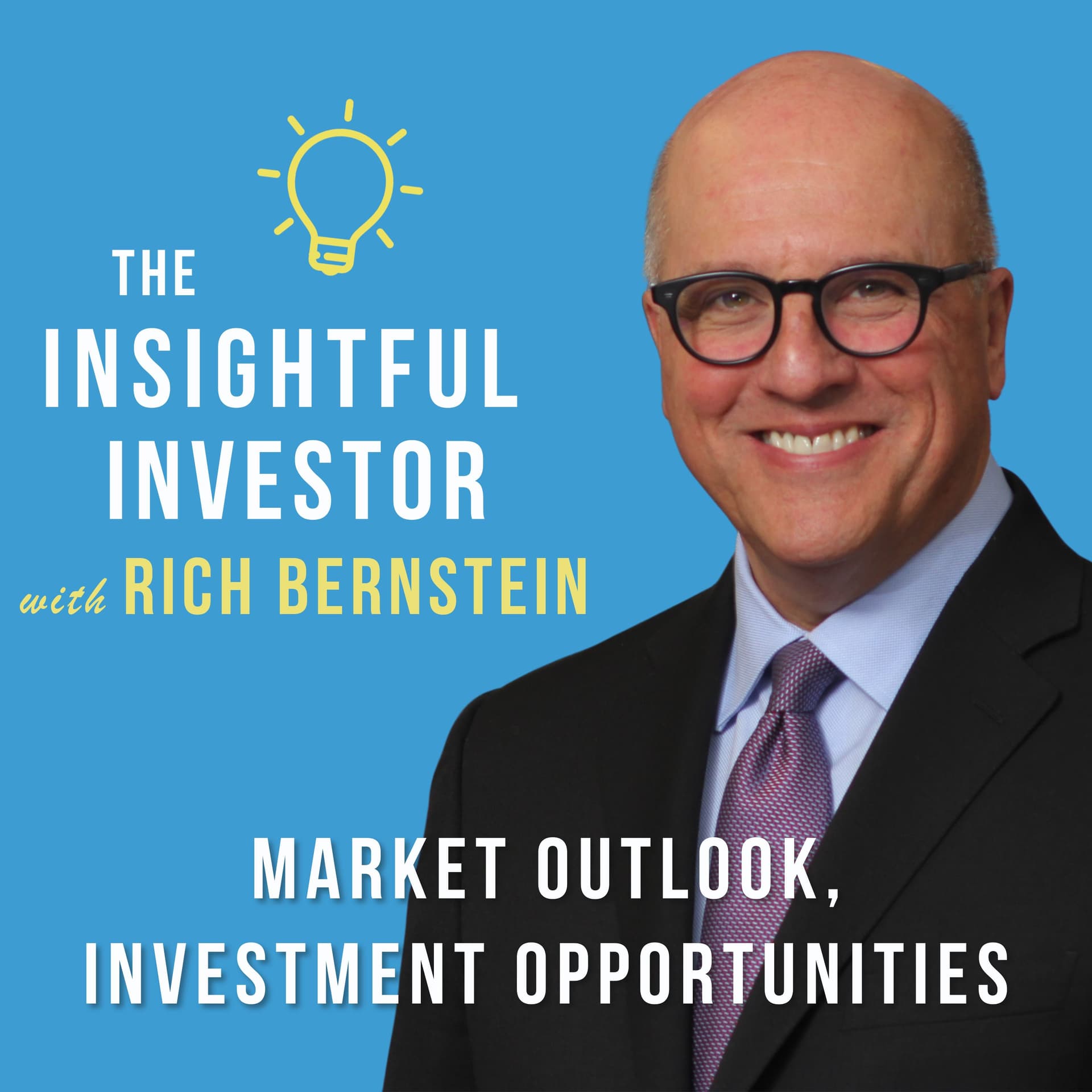
Insightful Investor Podcast - Episode #10: Rich Bernstein - Market Outlook, Investment Opportunities
Overview
- Host: Alex Shahidi, Co-CIO of Evoke Advisors
- Guest: Rich Bernstein, Founder, CEO, and CIO of Richard Bernstein Advisors (RBA)
- Theme: Market insights and investment opportunities based on macroeconomic and quantitative analysis.
- Episode Length: Not Specified
Key Discussions
Introduction to Rich Bernstein
- Rich Bernstein's background includes:
- Founder and CEO of RBA, managing $15 billion.
- Former Chief Investment Strategist at Merrill Lynch for 21 years.
- Transitioned from a potential career as a labor economist to finance.
Career Transition
- Discussed the moment he decided to leave Merrill Lynch, citing burnout.
- Emphasized the importance of adaptability in career paths.
Economic Outlook
- Current Consensus: Many believe the economy is slowing and a recession is imminent.
- Rich's Perspective: The economy is actually getting healthier; corporate profits are improving.
- Leading indicators suggest economic strength contrary to popular belief.
Market Environment
- Historical Context:
- Discussion on past decades: Inflationary 70s, disinflationary 80s and 90s, lost decade of the 2000s, and zero rates of the 2010s.
- Future Predictions:
- Expectation of a contraction in globalization, leading to potential inflation and changes in interest rates.
- Emphasis on the shift from speculative assets to productive assets.
The "Seesaw" Analogy
- Rich uses the seesaw analogy to describe the current market:
- Magnificent Seven (big tech stocks) riding high versus the broader market (smaller companies, emerging markets) lagging behind.
- Suggests that while the popular stocks are performing, there’s a vast opportunity in historically undervalued sectors.
Investment Strategies
- Diversification:
- Stressing the importance of broad diversification in portfolios.
- Current market concentration calls for maximum diversification rather than the popular trend of focusing on a few high-performing stocks.
- Cash vs. Other Assets:
- Cash is currently an attractive option due to high yields, but should not be a long-term strategy (i.e., "date cash, don’t marry it").
- Emerging Markets and Private Debt:
- Perspective on emerging markets as potential investment opportunities due to current valuations.
- Caution against overexposure to private credit due to liquidity and risk considerations.
The Impact of AI on Investing
- Believes that while AI will change the economy significantly, the investment opportunities surrounding it may not yield the same returns as the tech bubble of the 2000s.
Long-term Investment Wisdom
- Rich’s Investment Principle:
- "Buy low and sell high" remains the golden rule of investing despite how difficult it is to execute due to human emotions and market trends.
- Emphasizes the need for a financial plan that acts as a guiding force during emotional extremes in investing.
Key Takeaways
- Economic Discrepancies: There is a disconnect between perception and reality regarding economic health.
- Adaptability is Crucial: Investors and firms must be willing to adapt strategies as market conditions change.
- Diversification is Essential: A diversified portfolio is critical in the current environment characterized by concentrated market leadership.
- Caution with Cash: While cash may be appealing now, long-term investments should involve growth assets to build wealth sustainably.
- Recognizing Behavioral Biases: Investors must be aware of their biases and emotions impacting their decision-making processes.
Conclusion Rich Bernstein provides a thought-provoking outlook on the current market dynamics, advocating for adaptability and diversification. His insights challenge the prevailing narratives about recession and emphasize the opportunities that lie within the broader market, away from the highly concentrated tech stocks. The episode concludes with a reminder of the timeless investment rule of buying low and selling high, encouraging listeners to maintain a disciplined investment approach.
For more insights, visit [Insightful Investor](https://insightfulinvestor.org/) and listen to the episode.
Written by AI. May contain mistakes. Listen to the episode to check what was said.
Transcript
Automatic transcript. May contain errors.0:06Welcome to the Insightful Investor Podcast, a weekly series that seeks to share industry investment and market insights. We define insights as concepts that are counterintuitive, widely misunderstood, or underappreciated. In other words, unique ideas that you probably won't hear elsewhere. I'm Alex Shahidi, the host of the podcast and co-CIO of Evoke Advisors, one of the nation's leading investment advisory firms. Learn more about our show at insightfulinvestor.org.
0:43I'm pleased to have Rich Bernstein with me today. Rich is the founder, CIO, and CEO of Richard Bernstein Advisors, or RBA, which is a$15 billion investment manager that combines macroeconomic and quantitative analysis to construct portfolios. Prior to launching RBA in 2009, Rich was the chief investment strategist at Merrill Lynch for 21 years. Thanks for joining me today, Rich. Yeah, Alex, great to be with you. Thanks for the invitation. Of course. You know, I spent the first 10 years of my career at Merrill Lynch following your advice and your insights, and I really enjoyed it. So I'm excited to have this conversation today.
1:26Yeah, great. So one thing that really stands out is that you're clearly passionate about the economy and markets. Why don't we just kick it off with what sparked that interest Yeah, so it's a very long story, but to shorten it quite a bit, when I graduated college, I actually wanted to be a labor economist. And in the late 70s, I graduated college in 1980. In the late 70s and early 80s, labor unions were very powerful. And every single major corporation had a labor relations department. And it was actually a growth industry back then. And I thought, well, this is cool. And so I wanted to be a labor economist.
2:12And upon graduating, I got a job as a research assistant in labor economics group, a very prestigious economic consulting firm. And we did a lot of affirmative action type plans for major corporations and things like that. But it was it was fun stuff. It was a lot of demographics, a lot of statistics, a lot of probability, things like that. Okay. The day after, I'm not exaggerating one bit here, the day after Reagan beat Carter, right? So Tuesday is election day. Wednesday morning, 50 % of our business went away. All our clients started saying, we were consultants. We billed by the hour. All of our clients said, stop billing.
2:53We want to see what's going to happen under the new administration. Look, I wasn't the smartest guy in the room by far, but it was pretty clear to me that this was no longer a growth industry. And so the project I was working on was too far along, but a lot of my friends got fired very soon thereafter. And one of them called me up one day. He was working for a subsidiary of Chase Bank that had the largest set of economic and financial databases in the world. And he said, you have to come over here. You're a great programmer. You're going to love this stuff. And I said, I don't want to, what do I want to work on Wall Street for?
3:27You know, like, I mean, I don't want to do that. And he said, you know, the starting salary is basically twice what you're making. And so I said, well, I'll go for the interview, right? I was like 22, 23 years old. I said, I'll go for the interview. Sure, why not? Went for the interview, got the job. My biggest client turned out to be the Merrill Lynch Investment Strategy Group. And that's how I got my introduction to Wall Street. I began to realize that I liked it. Then later on, I began to realize I was actually pretty good at this stuff. And there you go. That's how I got into all of this. I'm curious, is there something about it that really attracted you that kind of aligned with the way you think and the way your mind works?
4:06Yeah, it was a great combination of analysis. You know, I was a big kind of math geek type person. It was a lot of math, a lot of statistics. It was a lot of, believe it or not, philosophy and relativism and things like that, which I'd also almost majored in in college. It was a lot of sociology. It was a lot of different things all coming together, economics, everything. And it was a field that I could kind of put all my varied interests together, which I was kind of lucky to find, right? Most people don't get a chance to do that. I was extraordinarily lucky in finding a little niche for myself that incorporated everything I like to study.
4:45You spent 21 years at Merrill Lynch as the chief investment strategist. Why was it time for you to leave in 2009 to start your own firm? Yeah, so thank you for saying that. I wasn't actually the chief strategist for 21 years. I worked my way up. I was a little squid when I started, but I don't think people realize that as you become a more successful analyst on Wall Street, the demands on your time get greater and greater and greater. And to be perfectly frank, I burned out. I mean, that's really the result of that. I realized this one night I was in, I think I was in Taiwan. It was either Taiwan or Hong Kong.
5:22I can't remember, Taipei or Hong Kong. And a lot of my colleagues, I was traveling with a group of people, they were all going out. And I said, I don't want to go. I'm just going to. And I ended up staying in the hotel room watching TV. And as I'm watching TV, I began to realize I'm in one of the greatest cities of the world. And I chose to sit in and watch TV. There's something wrong with my life, right? That I was just so burned out. I'd been to Hong Kong, you know, probably 15, 20 times in the past. It was no different than Cincinnati. And so I decided there's something wrong with my life. And that was when I began to realize that I had to do something different.
5:59And it took a while. And, you know, Merrill was great. And I had turned 50. And I figured, well, you know, that's pretty good. And it was time to do something else. And Merrill was great. I have to tell you, Merrill was great. They tried to keep me. They were very, very nice. They would have rolled over backwards. And I just said, no, you know, I'm burnt. I'm done. I got to do something different. And so we started RBA. And what was the vision when you started? And how has that evolved since then? I'd like to tell you we had some grand vision. I'm not sure we really did. I'm kind of a go-with-the-flow kind of person.
6:35I was the person who, when I was graduating college and went on an interview, and interviewers would say, where do you want to be in five years? I would actually say, I don't know. It took me a while to figure out that was the wrong answer, and people didn't like that because it showed you had no path that you wanted to be on. But I was being honest and eventually ended up making things up for people and got the jobs. But my whole life has kind of been like that, to go with the flow. And what I like to do is not enter with a preconceived notion, have a general concept of what I want to do at any point in time in my career, and then see how that changes.
7:09Because what I found is that day one, when you walk into a new job, or in this case, a new venture, you really don't know enough to make the decisions about where you want to go. We all think we do, but realistically, we don't. And so we sort of had a certain vision as to what we were going to do. We knew we wanted to be a macroeconomic type investment firm, right? My background was not in picking individual stocks. So we knew that. Beyond that, I think if you had said to us, you know, here we are now 15 years later, roughly, did you envision the firm this way? The answer would be no, no. We really thought that we would be in very traditional mutual funds and that sort of thing.
7:52And of course, as I'm sure everybody knows, the mutual fund industry has been suffering. It's been difficult. And we've completely changed the tone of our firm to where we're predominantly separately managed accounts and ETF-based. Not many people were using ETFs 15 years ago or 20 years ago. And so these are things that kind of morphed through time. And the firm continues to morph. I don't think we have anything cast in concrete. And one of the lessons that I've learned in these interviews is the importance of being adaptable, because the environment is constantly evolving. The industry is changing.
8:25There are new things that come up that you couldn't have envisioned would happen. And if you're dogmatic about your approach, you may completely miss the mark. A hundred percent, Alex. I think, you know, people forget the financial sector is kind of the heart and soul of capitalism. And so things change very rapidly within the financial sector. And so what was once, you know, very unique and different, quickly becomes commodity and then becomes obsolete. And, you know, the people that I've met in my career that have been unsatisfied with their jobs or disappointed have been ones that put on blinders and said, this is what I'm going to do and never going to change.
9:07And a lot of them don't work on Wall Street anymore. Yeah, you can do that in an industry that doesn't change as quickly as ours. Yeah, exactly. Let's talk about your outlook. you're obviously highly regarded for your perspectives. Let's start out with the zoomed out perspective, the very, very big picture. Are there any key themes, risks, or trends that you like to start with? Sure. So Alex, I think right now the most interesting thing that's going on is the general consensus that the economy is slowing, that there's some probability of recession. We could argue what that is, that people are talking about that, and that the Federal Reserve is going to have to lower interest rates, if not immediately, quite soon.
9:52Our view is, and the unfortunate reality appears to be, the economy is actually getting healthier, not weaker. And corporate profits are getting healthier, not weaker. And so I think there's a disconnect between perception and reality in terms of economic forecasts. Our industry hoping, and I use that word on purpose, hoping the Fed will be lowering interest rates. And the reality, the economy is actually much healthier than people think. And there's many reasons why this is happening. But we tend to follow the leading indicators. Keyword is leading because they do lead the economy. And the leading indicators have bottomed.
10:34We could argue what version of leading indicators is showing how much strength and that sort of thing, but they're not going down. They're either going sideways or they're going up. And that, I think, is very counter to the general perception the economy is in bad shape. And economists have been very stubborn in revising their forecasts upward. There's something called the Citi Surprise Index, obviously put out by Citi, that looks at positive and negative surprises relative to economic forecasts. And we have been going through, we meaning all of us, the markets have been going through the longest set of weekly positive surprises in the surprise index history outside of immediately after the pandemic.
11:24So you would think in that kind of an environment where you're constantly being surprised, economists would revise their forecast upward. Nope, they're not doing it. They're being very, very stubborn in that respect. And I think that presents tremendous opportunities, which I'm sure we'll talk about in a little bit. But I think that's the biggest issue out there right now is the difference between perception and reality about the overall economy's health. And we just talked about the importance of being adaptable. And it does seem like when you look at the historical metrics over the last 20, 30 years, you have an inverted yield curve.
11:58Therefore, a recession is almost guaranteed. And you're kind of sticking to that until you've proven wrong for a long enough period where eventually you change your mind. Seems to be a slow process. One of the things that's very interesting is the pandemic distorted a lot of traditional economic relationships. I'm not suggesting they're not going to work. I think they're going to work. But the lag times, the magnitude of the effects have all been altered by this huge downturn in the economy and immediate upturn in the economy has really distorted a lot of traditional relationships. And I think to your point about not being adaptable, I think many economic models that people use for forecasting can't deal with that kind of situation.
12:40The volatility that we're seeing in economic variables right now is probably the highest in my career. That's right. Why don't we stay zoomed out for a second? I think it's always helpful to look at the market environment over longer periods, let's say decades. And when you look at the last 50 plus years, you've had pretty distinct decades in terms of asset class returns. You had the inflationary 70s, the disinflationary 80s and 90s, the lost decade of the 2000s. Many people have forgotten about that. The zero rates environment of the 2010s. What are your thoughts about what this decade potentially looks like?
13:19Is it going to resemble something like the past or do you think it's completely different? No, I think this is, I don't want to say a new era because that's always dangerous to say. I think the world is changing. And I think the world is changing in front of our eyes, but people aren't adapting their portfolios to that change. And the change that I'm referring to is I think the next 10 to 20 years are going to be about globalization contracting. contracting. You know, we see it's right in front of our noses, right? If you think about what's going on in Eastern Europe, you think about what's going on in the Middle East, you think about what's going on with our relationships with China.
13:56If you look at Latin America, the turmoils in Latin America that are going on, Africa has some change. It's pretty clear that globalization is contracting, and that's not unusual. Globalization historically has been like an accordion. It has expanded and contracted, expanded, contracted. We had a monster period of 20 years to probably almost 30 years of expansion of globalization. And now it's starting to shrink. And I think we're at the very beginning of that accordion starting to contract here. The reason I think that's so important is because I would argue, and I think my colleagues here at RBA would argue, that the prime reason, not the sole reason, but the prime reason that we had secular disinflation and therefore secularly falling interest rates for the last 30 plus years was because of globalization.
14:41What globalization did was by constantly opening markets, we constantly increased competition. And when you increase competition, you get downward pressure on prices, not upward pressure on prices. So we saw it secular disinflation because of that. The unfortunate reality to go along with that, though, is that the United States now runs a massive trade deficit, which people have been whining about for a long time. And it really didn't matter as long as globalization was expanding because look, we were getting higher and higher quality goods for cheaper and cheaper and cheaper prices. Like who cares about a trade deficit, but what difference does it make?
15:17And, uh, but now as globalization starts contracting, the reality is the United States economy is dependent on the rest of the world for virtually everything, right? Like I, I point out to people, why do we understand the national security implications of being dependent on the rest of the world for semiconductors, but we don't understand it for anything else. And I think that's going to be the big story over the next, you know, 5, 10, 15, 20 years is going to be the United States necessity to become more economically independent, right? Whether it's energy, whether it's infrastructure, all these different things are all related.
15:56You know, we've allowed infrastructure to lapse because we had, we weren't producing anything. It didn't make any difference. We've allowed all these things to happen. Well, that's going to start reversing. And so I think what's going to happen in the big investment themes that we're looking at are moving from what I like to call cute wiener dogs in the metaverse to real productive assets. You can call it reshoring. You can call it nearshoring. You can call it infrastructure. You can call it the rebuilding of the American capital stock. It's all the exact same theme. And we think that's a huge, huge story going forward.
16:30In my experience, I feel like the market is very slow to respond and discount major inflection points. You know, it's very good at looking at the recent past and extrapolating that into the distant future. But it has a very hard time when you have a sea change of recognizing that has occurred until it's lasted a while. It seems like that may be the case again here. What you just said is incredibly important because if you think about what's going on right now and the enthusiasm that individual investors have for the stock market right now, why didn't they have that in 2009, 10, 11, 12 when the bull market was starting?
17:10Here we are in, you know, towards the latter stage. We could argue how long this is going to go on, but the latter stages of U.S. stock dominance and now everybody's enthusiastic. I think that's a great example. I mean, there's data that shows this. You know, my former employer, your former employer, Merrill Lynch, keeps data on their entire private client systems. This isn't one individual. It's like millions of portfolios. And one of the most interesting things that they published recently was their client's equity allocation and the beta of that equity allocation. So at the beginning of the bull market, their equity allocation was like 39%.
17:51and their beta, meaning the sensitivity to the market, was 0.75. Today, it's 61 % with a whopping beta of 1.2. So that's the overall system. That means some people are taking an immense amount of risk, right? But to your point, you should have had 61 % and a beta 1.2 in 2009, 10, 11, 12, 13, not today. Right. But that's and I think your point's very, very important, not only in terms of how things shift, but we are definitely starting to look at other themes that people are talking about. Yeah. I mean, when you when you study history and you look at the dollar way to return of various funds, meaning, you know, the return in dollars that the investors actually earn based on their cash flows.
18:42They usually pile in after a bull market and they jump out after a bear market. And it seems like you're seeing that again right now. Yeah. Well, it's funny. In one of the books I wrote, I have an anecdote where I say that somebody asked me for my best advice. What's the best investment advice you could offer? And I said, buy low and sell high. And whenever I say other people have got that, you know, like, come on, what's your real investment advice? I'm saying, go try to do that. Go try to buy low and sell high. See how hard it is and see how your emotions carry you away from buying low and selling high.
19:19But I still think that's the best investment advice one could ever offer. Yeah. I mean, we make decisions as humans based on fear, fear of loss and fear of missing out. Absolutely. And the decisions become more compelling at the extremes, right? When you look backwards and you see, oh my God, I could have just been in the magnificent seven, which we'll talk about in a second. And I would have done so well. And then you don't give in. And then you look back and say, oh, I should have done it. And then after a while, you just give in. And the masses do that. And that is reflected in high equity allocation, high US equity allocation, high beta, you know, more or maybe more technology exposure.
19:58and that ultimately reverses and it tends to be very painful. Is your sense that we're potentially on the verge of another lost decade for U.S. stocks, sort of like what happened in the late 90s with the internet euphoria? I actually think we are. Now, this is a little bit down in the weeds and I apologize for that. But because the Magnificent Seven, the stocks you referred to, those seven big companies that are dominating the equity market are such a big chunk of the equity market and of the global equity market now, we've suggested that people view the equity market as a seesaw, right? So on one side of the seesaw, we have seven companies.
20:37That's the side that's riding high. On the other side of the seesaw, we have almost everything else in the global equity market that's been left behind to varying degrees. And our argument is that this other side of the seesaw is historically broad, literally like everything else in the global equity market, historically cheap, and a once in a generation opportunity. And the reason I say once in a generation was the last time you had this was during the tech bubble. The tech bubble was now 24 years ago, roughly a generation. So what happened then was similar today. It wasn't about AI. It was about the internet.
21:14And you had stocks that went up and left everything else behind, leadership in the market. In other words, how many stocks are outperforming or that sort of thing. Leadership was very narrow. It was a very narrow group of companies that were dominating. Everything else got left behind. OK, what happened in the next 10 years? Well, the market is the fulcrum of the seesaw. So what happened was the market, equities as an asset class, if you will, gave you marginal negative returns for the next decade, right? Did nothing. The sexy side of the seesaw underperformed dramatically. If you had bought NASDAQ at the peak of the bubble, you would not have broken even for 14 years.
21:59That's breaking even. Let's say you were smart. You bought NASDAQ a year before the bubble. It took you 11 years to break even. Let's say you were smarter yet and you bought real companies. You weren't buying Pets.com and things like that. Real companies took between, I think it was eight and 20 years to break even. If you look at the top six, the six largest tech companies, real cash flow, real balance sheets, all the real companies, it took them like between eight and 20 years to break even. So this side of the seesaw did really, really badly. Fulcrum of the seesaw doesn't move. That's the lost decade.
22:37The other side of the seesaw does fantastically well. Emerging markets, energy, small caps, all these other things on the other side of the seesaw did fantastically over the next decade. So here we are today. We have a small universe of companies dominating the index. Again, think of the fulcrum of the seesaw. This group up here is eventually going to disappoint for whatever reason. And some of them already are, right? Somebody told me the other day that the Magnificent Seven are now the Fantastic Four. I'm not sure I get that. You know, it's a little selective. okay, these guys, we don't want them anymore.
23:13So you're starting to see that happen. At the same time, you're seeing the other side of the seesaw pick up, right? You're seeing non-US, you're seeing small caps, you're seeing the market broaden a little bit. That's exactly the point. And so we think that the story is not about the market. It may not be about equities as an asset class and equity allocation. It may be about what side of the seesaw you're on. We are firmly on this other side of the seesaw down here about any theme you could name on this side of the seesaw, we're overweight. And the Magnificent Seven, we are tremendously underweight.
23:52You know, our argument is there can't be opportunities in stocks that people are talking about at cocktail parties. That just doesn't work. It's become too popular. It's too much capital chasing too few ideas. And I think the most interesting thing, that there is a real speculative element going on here. If you look at financial conditions, financial conditions are actually easing, believe it or not, with the Fed tightening. Fed tightened 525 basis points. Financial conditions are actually easing, and you're seeing speculative assets take off. And we've published charts that show cryptocurrency returns as financial conditions ease, along with MAG7-type stocks.
24:33And they go hand in hand. So what you're seeing right now in some of the MAG7 stocks that are now all of a sudden the darlings of the world and Bitcoin going up, it's the same effect. People don't really see that, but it is the same effect that you're seeing. So we think this side is not only more conservative, we think it actually presents tremendous opportunity once in generation. And it goes back to your original advice for the investors, the golden rule, buy low, sell high. And typically, people don't talk about the low price stocks at the cocktail parties. They talk about the ones that are done really well.
25:09Exactly. And I think people should realize that there's been academic studies that show the number one factor that influences people's stock selection is an upward sloping price chart. Not valuation, not business prospects, not competition, not any of these things people talk about. It's the upward sloping price chart. Yeah. And, you know, it is understandable because you can't see the future price. You can only see the past price. And in most of the world outside of our industry, past performance is indicative of future results. Even though we get the warning here, people, I guess, ignore that warning.
25:44So you look backwards and you see an upward sloping line and it's easy to extrapolate that into the future. So it's understandable why these patterns and mistakes recur. Oh, absolutely. I mean, it's just human nature. But the way, you know, I used to teach in the grad school at NYU. And one of the things I used to do with the MBA classes was the first night I would walk in and I would say, look, you're basically going to forget everything in this class. You're going to remember you took a class with a bald guy with glasses at one point. There's one thing I want you to remember. You're not going to remember anything else.
Read the full transcript
26:18This is what you have to remember. And that is the return on investment is always highest when capital is scarce. Translated, you want to be the one banker in a town with a thousand borrowers. Think about that for a second. If you're the one banker in a town with a thousand borrowers, you're going to make a mint, right? Because you're going to control the interest rate on every single loan. Turn it around. A thousand banks and one borrower, the borrower makes out like a bandit because the banks he'll compete away the profit margin on the loan. And so whenever you're investing, you want to think, am I in a situation?
26:54Am I the one banker in a town with a thousand borrowers? When I was in Maryland, I used to get in trouble for saying I would liken it to loan sharking. And people would get very, because loan sharks are the ultimate investment. You know, they find people need money really, really badly. And then they charge them an exorbitant rate, right? No, I'm not suggesting our industry is loan sharks. Don't misunderstand the point. But it's an economic analogy that I think is very appropriate here. in the, you know, you want to be the one banker in a town with a thousand borrowers and people forget that. Earlier, you mentioned artificial intelligence and it's obviously it has potential impact economically, inflationary wise and so on.
27:35Would you talk about your perspectives about that and how investors should think about AI? From the notion, will AI change the economy? of course it's going to. I don't know why that's even open for discussion. All major technologies have major impact on the economy. My favorite one, which we don't consider technology anymore, is the light bulb, where the light bulb turned the economy into a 24-hour economy, a massive productivity increase. You can't have a graveyard shift in the dark. You need light for that. So that was true. But I think what we have to do as investors is separate out the economic story from the investment story.
28:18We don't really care about the economic story. We care about the investment story. So again, let's go back to the technology bubble and what happened. So the technology bubble was all about the internet. And the story was the internet was going to change the economy. And it did. It changed the economy in ways that we could never have envisioned. Look at what we're doing right now, as an example. However, despite that wonderful economic story, the investment story was terrible. As I said before, if you'd invested in NASDAQ at the peak of the bubble, it took you 14 years just to break even. Terrible investment story, wonderful economic story, right?
28:56So now let's talk about AI. So is AI going to change the economy? As I said, of course it will. Why would anybody argue it's not going to? Of course it will. But that's the economic story. What about the investment story? And I think the investment story, given the hype and given the narrowness of the market and everything else, I think we are going to find that the investment story is not as good as people think. My guess is that if we come back here in five years or 10 years or 15 years, the companies that we are talking about with respect to AI are not the companies we're talking about today.
29:29Then, you know, if you go back to the tech bubble, I don't think there's a couple of companies still that people would talk about, but the majority of the big names, like people think of them as either has-beens or boring companies or, yeah, okay, they're around, you know, that type of thing. A couple of them people would say they're still leaders, but most of them you wouldn't. So I think that's going to happen today as well. Yeah, and that's certainly consistent with history. Even, you know, before the internet, you had the nifty-fifty, you have all these companies that are all of a sudden the darlings and they become overpriced relative to what is likely to transpire.
30:07And you can take any great company and make it a bad investment by just raising the price too high. Right, exactly. One concept that you've described in the past is that investors should only date cash. Cash has been king for a while. I think cash has outperformed in the stock market last two years. Do you think now is a good time to date cash? It's interesting. The number one question I get asked, Alex, is cash attractive? And the unfortunate reality is, yes, it is. And that's how monetary policy works, right? When the Fed raises rates, they do so to explicitly make cash attractive relative to other investments in the economy as they try to suck capital away from everything else in the economy.
30:56That's how they slow down the economy is by doing that. And so when people say it's cash attractive and the Fed has raised rates 525 basis points, you should say, yeah, it's attractive. However, the analogy that I've used, you know, you date cash, you never marry it. What happens inevitably is that investors fall in love with cash. They say, wow, I can get 5 % or 6 % out of cash. Why should I invest in anything? Well, we all know that over longer periods of time, cash is a miserable investment. Why? Because you're not taking part in the economy. And so the whole point of investing is to invest in profitable ventures and get returns on your assets and things like that.
31:40Well, cash, you're not taking any risk, of course, but you're not getting anything either. So as you stretch out the time horizon, what you find is that cash becomes a more inferior, more and more and more and more and more inferior investment. I say date cash, never marry it. So I think, yeah, today it's probably worth going out on a couple of dates and that sort of thing. But again, one has to remember that cash is a short-term investment, always has been, is incredibly poor long-term investment. Now, what's comparable, well, there's all kinds of things that people should be looking at. Again, think of my earlier seesaw analogy.
32:19I would argue this side of the seesaw all the way down there. If your time horizon is a year, two years, three years, this other side of the seesaw is a lot more attractive than cash. I mean, people forget that cash is the risk-free asset. If you want to take no risk, you get whatever the yield cash delivers. And for a long time, it was near zero or at zero. and all of a sudden it looks attractive relative to that history. But all these assets, price versus cash, they have to offer an expected return above cash. And when cash goes from zero to five and a quarter that quickly, assets reprice to give you a forward-looking return that's competitive with cash.
32:56And so I think looking backwards, you can misunderstand that and say, oh, cash was king, therefore, and the yield is high relative to history, it looks attractive, but that could be missing a lot of the analysis. You talked about the once-in-a-generation trade opportunity. You've written about that in the past. Would you share with us some of your historical observations and talk about potentially the next trade of a generation? It's kind of cute to divide these things up by decades, right? And of course, the markets don't start on December 31st and end on December 31st. But let's for a second assume that that's the case, that we're talking decade by decade because it's easier to talk that way.
33:44And you alluded to this before about how each decade has had different kind of characteristics to it. And I think that's true today, too. But the one that I find very interesting is the relationship within the equity market decade by decade between emerging markets and venture capital. You've really never had a decade where they both did well. Venture capital did well. Emerging markets didn't. Emerging markets did well. Venture capital didn't. And my guess, I'm not sure I know why, but my guess is that what happens is you get too much capital flowing to one asset class or the other. We overcapitalize the asset class.
34:22And the investment opportunities then become less attractive, right? Similar to a lot of things we've been talking about. So one of the things that's very interesting is that we went through the lost decade of equities, the 00s. Emerging markets significantly outperformed venture capital. Then we get to the 10s, right? Venture capital significantly outperforms emerging markets. Might say for the next 10 years that we should be looking at emerging markets relative to venture capital. And I don't think that's going out on a limb. It doesn't mean the venture capital investments are all going to start coughing up blood or anything.
34:54That's way too dramatic. But which of the two asset classes is likely to perform better? I think it really could be something like emerging markets as you're looking at the next five, 10 years, as opposed to venture capital, which is clearly being overcapitalized now. When you think about the amount of existing investments, amount of capital being raised, the AI craze, everything else that's going on, it's hard to argue, using my line from before, that you're the one banker in a town with 1 ,000 borrowers. Yeah, you're also coming off of a 20, 30, almost 40-year period where you either had falling interest rates or zero or near zero interest rates.
35:33And it's very possible that we're now in a secular change where interest rates aren't going to be falling or near zero, and it's a different environment. And that can change the math very quickly. I think that's right. You know, our head of fixed income, Mike Cantopoulos here, pointed out that from 1980 to 2020, the 10-year yield fell 75 % of the time. And, you know, we do it by month by month. It was like 75 % of the months the 10-year yield fell. Since 2020, the yield has gone up 75 % of the time. Now, Now, one could argue, wait, that's like 40 years versus four years. Yeah, I get that. I understand that.
36:14But what if it's not 75-25? What if it goes to 50-50? That would argue that the contours of valuation, the contours about the fixed income in the equity markets are going to start changing. If you think about the potential causes of that shift for that period that you just described from the early 80s until recently, inflation wasn't a concern. So anytime there was a hint of economic weakness, you could have an expectation and the Fed would respond to this by cutting rates. Now inflation is a concern. And so my guess is, is the Fed is going to be slower to cut and may keep rates higher for longer because now they have to worry about inflation as a potential tradeoff.
36:58Is your view similar? Yeah, I would go one step further and say, I think there's a possibility, not necessarily a high probability, but a possibility that the Fed may be forced to even raise rates more, depending on what happens with inflation and the strength of the economy. You know, as we were talking before, the economy is actually stronger than people think right now. One has to remember that inflation is a lagging indicator. So what we're starting to see in some of the inflation figures is they seem to be bottoming now. They're not going down anymore. That makes sense. If the economy is actually stronger than people think.
37:33You wait and wait and wait for your lagging indicators. Inflation being a lagging indicator, sure enough, there it goes. It's starting up again. That doesn't mean we're going to have 9 % and 10 % inflation, right? That we're in a very hair on fire environment where everything has to be so dramatic. But all that has to be is more inflation than people expect, more inflation than the Fed expects. That's all it takes. And that's essentially what happened in the 70s. It just kept going up and up and up. Expectations are rising, but inflation stayed ahead. A lot of people miss that. In that environment, you had nominal rates go up significantly, but real rates actually fell.
38:07Yeah. So that's a very, you know, that environment could obviously repeat. It's likely going to be different. But those are periods where both stocks and bonds can do poorly at the same time. Yep. Exactly. Absolutely. And I think that was, you know, it's the reason why people don't like inflation is that financial assets tend to do less well, real assets tend to do better. Yeah, let's talk about diversification for a second. Diversification hasn't really paid off the last couple of years. You've had a stretch where assets moved in tandem based on expectations of the Fed's next move. And then also you've had the S &P 500, the index that everybody loves, that's had this tremendous run last almost 15 years.
38:52And the more of that you own, the better you did. And the less of it you own, in other words, more diversification hasn't really panned out. How do you think about all this? We've actually suggested that today, not today, but I mean, this current period right now is a call for maximum diversification, right? We have the narrowest equity market probably in my career. I don't think we've ever seen anything where we could talk about seven stocks. And I would venture a guess, and I say this tongue in cheek, I would venture a guess that there is no sound theory of building wealth that says you should invest in only seven companies as a sound way.
39:32We all know the diversified portfolio built through time is a great way to build wealth. And so when we have this extreme concentration, we would argue it's a call for maximum diversification. Again, think of my seesaw analogy, right? This side of the seesaw has like a bazillion different ways you could invest. But then you come to the reality. And when I was at Merrill, I used to talk about this all the time. Investors are habitually under-diversified, right? We all know diversified portfolios are what you want to have. Why are people habitually under-diversified? Why are they so destroyed by bear markets?
40:07Why the psychology of all this? And the answer is because people don't really want to be diversified because diversification means holding assets that you don't particularly like, right? In other words, everybody has a view of the world. You diversify in case your view of the world is wrong. Well, if your view of the world is wrong and you're not holding those assets, you think those assets are going to be terrible. Why would I invest in those assets? Because it doesn't fit your view of the world. And so you have nothing in the portfolio at that point. You'll have nothing in the portfolio that protects you against you being wrong.
40:44And the end result is people are habitually under-diversified. And I think we're at one of those periods, again, where people become, if I can use the word, a little bit investment myopic, where they're only looking at this very short, very nearsighted view of the financial markets and missing the range of opportunities that are out there. So I actually think most portfolios, I think the data shows are really not very well diversified. There's some data that shows that individual investors are punting diversified portfolios to go trade individual stocks again. This is not good stuff. And we all know that this is not the way to build wealth through time, but it's like a siren song, right?
41:29We can't resist, and then we crash on the rocks, for those of you who enjoy Greek mythology. In my experience, the way you build wealth over time is you don't lose it. and slow and steady wins the race, but it's a hard thing to actually do in practice. And I think part of it is it's easy to have a view of what you believe the future is going to hold. And then you position for that as you described. But I think the part that's really missing is that most investors and many professionals included are overconfident in their ability to predict the future. They just don't realize that they're going to be wrong a lot.
42:05Oh, absolutely. I think we all fall into that category. Yeah. And then if you think about today's environment, for a long time, inflation wasn't really a concern. Now it's an issue. And you have volatility, not just in growth, but also in inflation. You have volatility in what the Fed's going to do. The Fed doesn't know what they're going to do. You have geopolitical risks. There's just a lot of potential risks brewing. And it feels, if you just look at that and forget the past, that it's a time to be more diversified than less diversified. One of the trends that I've observed is a big move into private credit.
42:42There's a lot of interest in that space because the yields are so high. You've spent some time talking about the importance of having a liquid fixed income portfolio this year. Would you talk about that? Sure. So I think, look, there's private credit is, it's very interesting how it came about, right? You'll notice that the major banks are all saying how sound they are right now. And the bank analysts are talking about how sound they are. And you might like regulation or not like regulation, but the reality is that the big banks are so sound right now because of all the regulation after 2008, they were prohibited from doing all these kinds of risky things.
43:17And so the major banks are very sound. However, what happened by forcing them to be so sound was that they lost market share. And they lost market share to entities that were not regulated, commonly called private debt. It is a very interesting opportunity given those dynamics. Sort of an unintended consequence of the post-2008 bank regulation was that somebody was going to take risk. Where was it going to go when it went to private debt? Now, there's nothing wrong with private debt. And I don't want anybody to think that the comments I'm about to make here are negative anyway. No, they're not.
43:53There's going to be good private debt and bad private debt, as there are good stocks and bad stocks. It should not be a shock to anybody. But the movement, people have generally used fixed income as kind of a safer, more liquid investment relative to other investments. And the move to private debt is taking you towards riskier. That's the reason why they exist, because the banks can't invest there. So by definition, the loans are riskier and they're less liquid. So what we've said is fine. That's fine. There's nothing wrong with that. But let's try to balance that out with more liquid fixed income alternatives.
44:33So what we've said is, okay, you've got this illiquid version. Let's go with uber liquid, but not lose the fixed income exposure. You can go to cash like we were talking about before, but then you're going to lose all the benefits of the fixed income market overall. Why would you want to do that? So what we've said is go illiquid, that's fine, but then go uber liquid. How do you do that? Enter stage left, fixed income ETFs. Fixed income ETFs are a major innovation in the fixed income markets. And one has to remember that one of the main purposes of the financial markets is to facilitate transactions, right?
45:11So many people on this call may have traded commodity futures like pork bellies or something like that. I'm going to guarantee nobody on this call has ever hauled around a pork belly. Commodity futures are more liquid than the underlying asset. Equities are more liquid than the assets they represent on the balance sheet. Imagine if every time you wanted to trade a stock, we'd have to bring lawyers into the room and sign contracts about the transaction that's going on and stipulate all the terms and conditions and everything else. equities are more liquid than the underlying assets on the balance sheet, and it facilitates the transaction, right?
45:47Fixed income ETFs are doing exactly that. They are bringing liquidity to a notoriously illiquid marketplace. People don't often understand the fixed income markets are still what's called dealer markets. They are not exchange markets. And dealer markets, because you put two dealers together to make a transaction, are notoriously illiquid. Fast transactions, big transactions are more difficult to make than they would be in, say, the equity market or the commodity futures market or something like that. Fixed income ETFs are bringing that liquidity to the fixed income markets. And so we've been managing our fixed income portfolios using fixed income ETFs, I don't know, 14 years, whatever it is now.
46:27And we've been doing that on purpose because we saw this innovation coming and we thought it was going to change the way fixed income money management was going to occur. Well, let's take that technological change, if you will, with what we were talking about before and the potential change that maybe we're moving from secular disinflation to some version of secular inflation, right? Let's not talk about the 1970s. That's very extreme, but not disinflation anymore. That's going to call for more active management in fixed income. You're not going to be able to buy and hold for 30 years like we did.
47:01But how do you become an active manager in an illiquid market? It's very difficult. That's the advantage of fixed income ETFs. We've been talking about diversification and the importance of diversification. One of the more diversifying markets is China. It's the second biggest economy in the world. Potentially, it could outpace the US at some point in the near future. And it is highly diversifying because it's a different economy. They have their own monetary system and more and more, it's more domestically driven. But there's heightened geopolitical risks. How does all of those considerations net out for you?
47:43Let me give you two preambles here before we go on and talk about China. Number one, everybody at RBA understands the politics. We get that. We understand it, but that's not really our job to opine on politics. Our job is to look for investment opportunities as best we can. When we have stated mandates from our investors, of course, we pay attention to the stated mandates. That could be anything from, if you remember, the sin stocks and things like that. There's all kinds of... People have always had political or religious views about what should or shouldn't be in a portfolio. When we are presented with that, of course, we adhere to those things.
48:21But If we don't, but we're not given a mandate like that, it's not our job to impose a mandate on the portfolio. Second thing I want to point out is, using the term that we were using before when we were talking about cash, I think China is a date but not a marriage. And the reason why is I think their long-term issues are reasonably well-known, but the demographics there are terrible. This is going to hinder economic growth and hinder productivity through time. And the more you want to stretch this out, the more it becomes. So in the comments I'm about to make, I'm not suggesting that China is some great long-term investment and that kind of thing.
48:58No, no, no. I think that's not worth it. We're talking about kind of a cyclical play here that maybe lasts a year. If we're lucky, we get two years out of it. So the reality is that, number one, China is dirt cheap. There are many issues surrounding China. We know them. Everybody knows them, right? You could list all the concerns one has about China. China sells about one third of the valuation of NASDAQ. I don't even know what it is versus the MAG-7. It's probably like a quarter of the MAG-7's valuation. Now, remember, NASDAQ and MAG-7 are everybody's favorite. And China is over here. So again, the seesaw analogy, I think, is very important.
49:40I would argue those concerns that everybody has are already discounted into the stock prices when you get that kind of valuation disparity. Who doesn't know about Taiwan? Who doesn't know about these? Everybody knows it's discounted to the valuations. Number two, the fundamentals in China are much better than general perception. Retail sales in China, industrial production in China, corporate profits in China are all stronger. And I say profit. Retail sales, industrial production, corporate profits, and GDP growth. That would be the other one. I'm sorry, there were four. GDP growth would be the other one.
50:15They're all stronger than in the US. And it's like, nobody knows this. Everybody thinks China's economy is imploding. It's not. It's actually stronger than the US economy right now. So there's a gap here, again, between perception and reality. And I think, as we discussed a little bit, performance will change that. I think we're starting to see a bottoming in the Chinese stock market. Jury's out, of course. But I think if we find that the Chinese stock market is somewhat counter-cyclical, and it does start appreciating here, I think we'll find that enthusiasm for China and we'll build to some extent.
50:50Not the way it used to be, right? There are political issues, there's all kinds of things going on. I get that. But as a cyclical opportunity for a year, a year and a half or something, I think it's very, very attractive. And how do you think about incorporating alternative investments in a well-diversified portfolio? We obviously don't. We're not an alternative manager. We don't have that. But I am asked the question quite often. I don't like the term alternative investments. because there's so many different branches of alternative. I mean, you've got venture capital, you've got private equity, private debt, you've got real estate, you've got commodities, you've got all these different things running around here.
51:28And to group them all is like saying, I want to invest, right? It doesn't make any sense. So I think there are areas of alternative investments that are always attractive. And I think there are areas that are probably unattractive. And so I don't think there's anything necessarily good or bad about them the same way, you know, just say, I like stocks, right? What does that mean? There's good sectors, good themes, and bad sectors and bad themes. I view alternative investments the exact same way. So I think they have a role in a portfolio, of course. Why not? I don't, you know, privates and investing on a private scale, why not?
52:06Why wouldn't you do that? But I don't think I just don't like the whole concept of alternatives. That just doesn't make any sense to me. Yeah, I suppose it's very opportunity dependent. And also, when I look at them, I think about how diversifying are they to the existing exposures that you have. So if they basically go up and down with the stock market, that's not with worse terms, that's not necessarily a great addition to a portfolio. But if it's reliably different, that can be diversifying. And if it has a decent expected return, that could be additive to a portfolio. Exactly. And it should be, you know, I've always thought that the places to invest privately are places the public market, you can't invest in the public market, right?
52:49If there's no way to invest in the public market, then you know that the privates are probably going to have pretty good returns. If it's just kind of dovetailing with what's going on in the public market, probably a little bit hyped. Well, Rich, why don't we end with one insight that you feel is unique that many have not thought of before? I think besides my buy low, sell high, which I think is so hard to do. The one thing that when I talk to individual investors that I, and I wrote a whole book about this, you know, 20 years ago or something. And it really is about, we know there are basic building blocks to building wealth and we know they work.
53:32Why don't people do them? And the example that I use in the book was a weather forecast. We all look at the five-day weather forecast, although you guys are in California, the five-day weather forecast may not change. But in the Northeast, where I am, the five-day weather forecast is kind of important. And people always look at that fifth day. And now they tease people with seven and 10-day forecasts. And we know the probability of the seven or the eight or nine or 10th day forecast is getting less and less accurate as we go out. We know that, but yet they keep that seven to 10 day forecast right at the end of the news because they know people are waiting for it.
54:12Am I going to be able to go on a picnic over the weekend? You know, that kind of thing. And I say in investing, it's the same thing. I can give you a weather forecast that'll be right 100 % of the time, but you'll laugh because it's so obvious, right? And my weather forecast is going to be cold in Minneapolis in January. I mean, of course it is, right? There's no insight of my telling you that. Well, when we come to investing, it's the exact same thing. A well-diversified portfolio held for the long term is a great way to build wealth. Why don't people do it? And the answer is there's always something out there telling them it's newer, it's better, it's quicker, you're going to make more there's always some sexy thing out there that lures people in you know like moths to the flame and and the difficult aspect of investing is not finding opportunities it's sticking to your discipline right and and that's i i tell when i speak to individual individual investor audiences i would say that is the role of the financial plan that when you get too greedy or you get too fearful there should be something on the financial plan says, you know, break glass, pull out financial plan, because it's at those extreme points that that's the role of the financial plan day to day.
55:27Like who cares? Right. Extremely fearful, extremely greedy. That's when you need the financial plan to tell you that you're going off the rails and you're going away from this very easy, well-diversified portfolio held for the long-term builds wealth. Yeah. I guess the problem is we're human and we were subject to emotions and that's probably not going to change. So, so I guess the best you can do is to be aware of that, of those blind spots, particularly at the extremes, both on the upside and the downside. And all you have to do is zoom out, see the big picture. Don't make the wrong decision at the wrong time because that will basically take you off track.
56:07And it's really as simple as that. And it's just much easier said than done. Of course. Rich, this was great. I appreciate you taking the time, sharing your insights. I enjoyed the conversation. I hope you did as well. Yeah, Alex, thanks so much for the invitation. Thanks for listening. We hope you enjoyed this episode. Please visit our website at insightfulinvestor.org to access past shows and learn more about our podcast. If you have questions, feel free to email us at info at insightfulinvestor.org. And if you enjoyed the discussion, please subscribe to this podcast to ensure you don't miss future episodes.
56:45And don't forget to forward today's conversation to others you think would enjoy listening. This podcast is provided for informational purposes only and should not be relied upon as legal, business, investment, or tax advice. All opinions expressed by podcast participants are solely their own opinions and do not necessarily reflect the opinions of Evoke advisors, their affiliates, or companies featured. Due to industry regulations, participants on this podcast are instructed not to make specific trade recommendations, nor reference past or potential profits. And listeners are reminded that securities trading, commodity trading, and alternative investments are complex and carry a risk of substantial losses.
57:24As such, they are not suitable for all investors.
From the publisher
Rich Bernstein is the Founder, CEO and CIO of Richard Bernstein Advisors (RBA), a $15B manager that combines macroeconomic and quantitative analysis to construct portfolios. Prior to launching RBA in 2009, Rich spent 21 years at Merrill Lynch and served as the Chief Investment Strategist. Rich shares insights about his market outlook and investment opportunities.


